
Showing 7 items matching "atomic warfare"
-
 Bendigo Military Museum
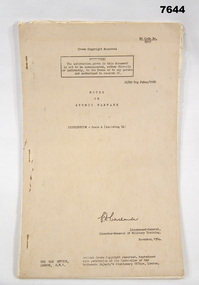
Book - NOTES ON ATOMIC WARFARE, London War Office, 1954
... NOTES ON ATOMIC WARFARE...Atomic Warfare...Book NOTES ON ATOMIC WARFARE London War Office ...This explains Atomic blasts, protection from damage done, radiation levels and protection. Item in the collection re BCOF Association, refer Cat no 7625.This is a foolscap sized book. The covers are khaki card board. Printing is in black ink. Top RH Corner has WO code No. 8912. Bottom shows the War Office London. It was bound by 3 metal staples, which have rusted or taken out. atomic warfare, book -
 Bendigo Military Museum
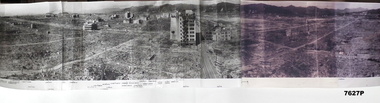
Photograph - PANORAMIC PHOTO OF BOMBED HIROSHIMA, C. 1945/46
... ...ATOMIC WARFARE...Item is part of the BCOF Association Collection, refer Cat No 7625. WW2 ATOMIC WARFARE HIROSHIMA This is a wide black and white panorama of a severely bomb damaged city. ...Compared to photos in AWM collection, this photo appears to have been taken August 1945 to Feb 1946. Item is part of the BCOF Association Collection, refer Cat No 7625.This is a wide black and white panorama of a severely bomb damaged city. It is composed of five separate photos joined together. At the bottom are Japanese characters/writing. They have a dot beside each sentence. There are no English subtitles.ww2, atomic warfare, hiroshima -
 4th/19th Prince of Wales's Light Horse Regiment Unit History Room
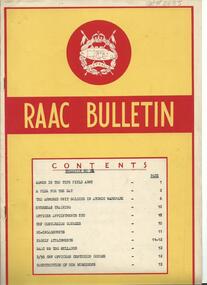
Document - Bulletin, Royal Australian Armoured Corps Bulletin No 32, July 1956
... A 7 page document on various subjects including 'Armour in the Type Field Army', 'A plea for the Bat', 'The armoured unit soldier in atomic warfare', overseas training, officer appointments, CMF conversion courses, re-engagements, etc ...raac bulletin RAAC A 7 page document on various subjects including 'Armour in the Type Field Army', 'A plea for the Bat', 'The armoured unit soldier in atomic warfare', overseas training, officer appointments, CMF conversion courses, re-engagements, etc Royal Australian Armoured Corps Bulletin No 32 Document Bulletin ...A 7 page document on various subjects including 'Armour in the Type Field Army', 'A plea for the Bat', 'The armoured unit soldier in atomic warfare', overseas training, officer appointments, CMF conversion courses, re-engagements, etc raac bulletin, raac -
 Eltham District Historical Society Inc
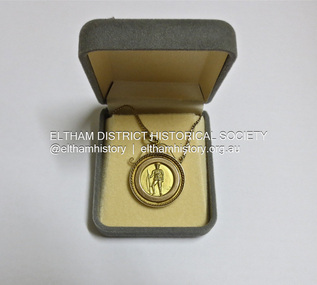
Photograph - Medal, Jim Connor, Welcome Home Medal awarded to Spr. W. H. Orford by Shire of Eltham Welcome Home Committee, 22 April 2014
... warfare. The explosions, including those at the heavily contested Hill 60, created craters 60 feet deep, killed roughly 10,000 German troops, and were heard as far away as London. Tunnellers from Australian and British units worked for over a year (since 1916) in treacherous conditions—including quicksand and mud—to dig tunnels beneath German strongpoints. At 3:10 a.m. on June 7, nearly 1,000,000 pounds of explosives (ammonal) were detonated, creating one of the largest pre-atomic...warfare. The explosions, including those at the heavily contested Hill 60, created craters 60 feet deep, killed roughly 10,000 German troops, and were heard as far away as London. Tunnellers from Australian and British units worked for over a year (since 1916) in treacherous conditions—including quicksand and mud—to dig tunnels beneath German strongpoints. At 3:10 a.m. on June 7, nearly 1,000,000 pounds of explosives (ammonal) were detonated, creating one of the largest pre-atomic ...Awarded to Spr. W. H. Orford by Shire of Eltham Welcome Home Committee Welcome Home Medal The Welcome Home Medal was issued to acknowledge service during World War 1. As groups of servicemen returned and were discharged a local welcome home function was held in their honour. The welcome home committee decided that to commemorate the occasion a medal should be presented to the returned servicemen and also to the nearest relations of those who had fallen during the conflict. The medal shown was presented to Sapper William Henry Orford, of the 2nd Australian Tunnelling Company, an uncle of Doug Orford, one of our members. Sapper Orford participated in an operation where on June 7, 1917, British and Australian tunnellers detonated 19 massive mines beneath German lines at Messines Ridge, Belgium, marking a pivotal moment in WWI underground warfare. The explosions, including those at the heavily contested Hill 60, created craters 60 feet deep, killed roughly 10,000 German troops, and were heard as far away as London. Tunnellers from Australian and British units worked for over a year (since 1916) in treacherous conditions—including quicksand and mud—to dig tunnels beneath German strongpoints. At 3:10 a.m. on June 7, nearly 1,000,000 pounds of explosives (ammonal) were detonated, creating one of the largest pre-atomic explosions in history The explosions shattered German morale and destroyed defences, allowing Allied forces to take the ridge. Specifically, Australian miners placed, at great risk, two massive mines under the German-held Hill 60 and the nearby "Caterpillar" crater. Inscribed on the front of the medal is: SPR W.H. ORFORD FROM ELTHAM WE HONOUR YOU GREAT WAR 1914 – 1919 On the back of the medal is the image of a soldier standing at ease with a rifle. Smaller than originally stated the Eltham Districts medal is midway between a 10 and 20 cent piece in size. The medal is a fine piece of craftsmanship and is understood to have cost £4 to make. On 22nd April 2014 Society members were pleased to attend an announcement by Mr Damien Drum, Victorian Minister for Veterans Affairs and Sport, of funding for installation of signage for the Eltham and Hurstbridge Avenues of Honour. Doug Orford was there and created much interest with his Welcome Home Medal, including from Minister Drum. See also EDHS Newsletter No. 216 May 2014spr. w.h. orford, welcome home committee, welcome home medal, world war 1, avenue of honour, jim connor collection, mr damien drum, victorian minister for veterans affairs and sport, william henry orford -
 Eltham District Historical Society Inc
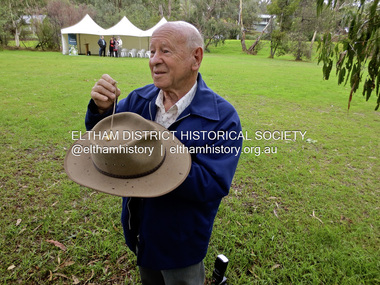
Photograph - Medal, Jim Connor, Doug Orford with the Welcome Home Medal awarded to Spr. W. H. Orford by Shire of Eltham Welcome Home Committee, 22 April 2014
... warfare. The explosions, including those at the heavily contested Hill 60, created craters 60 feet deep, killed roughly 10,000 German troops, and were heard as far away as London. Tunnellers from Australian and British units worked for over a year (since 1916) in treacherous conditions—including quicksand and mud—to dig tunnels beneath German strongpoints. At 3:10 a.m. on June 7, nearly 1,000,000 pounds of explosives (ammonal) were detonated, creating one of the largest pre-atomic...warfare. The explosions, including those at the heavily contested Hill 60, created craters 60 feet deep, killed roughly 10,000 German troops, and were heard as far away as London. Tunnellers from Australian and British units worked for over a year (since 1916) in treacherous conditions—including quicksand and mud—to dig tunnels beneath German strongpoints. At 3:10 a.m. on June 7, nearly 1,000,000 pounds of explosives (ammonal) were detonated, creating one of the largest pre-atomic ...Awarded to Spr. W. H. Orford by Shire of Eltham Welcome Home Committee Welcome Home Medal The Welcome Home Medal was issued to acknowledge service during World War 1. As groups of servicemen returned and were discharged a local welcome home function was held in their honour. The welcome home committee decided that to commemorate the occasion a medal should be presented to the returned servicemen and also to the nearest relations of those who had fallen during the conflict. The medal shown was presented to Sapper William Henry Orford, of the 2nd Australian Tunnelling Company, an uncle of Doug Orford, one of our members. Sapper Orford participated in an operation where on June 7, 1917, British and Australian tunnellers detonated 19 massive mines beneath German lines at Messines Ridge, Belgium, marking a pivotal moment in WWI underground warfare. The explosions, including those at the heavily contested Hill 60, created craters 60 feet deep, killed roughly 10,000 German troops, and were heard as far away as London. Tunnellers from Australian and British units worked for over a year (since 1916) in treacherous conditions—including quicksand and mud—to dig tunnels beneath German strongpoints. At 3:10 a.m. on June 7, nearly 1,000,000 pounds of explosives (ammonal) were detonated, creating one of the largest pre-atomic explosions in history The explosions shattered German morale and destroyed defences, allowing Allied forces to take the ridge. Specifically, Australian miners placed, at great risk, two massive mines under the German-held Hill 60 and the nearby "Caterpillar" crater. Inscribed on the front of the medal is: SPR W.H. ORFORD FROM ELTHAM WE HONOUR YOU GREAT WAR 1914 – 1919 On the back of the medal is the image of a soldier standing at ease with a rifle. Smaller than originally stated the Eltham Districts medal is midway between a 10 and 20 cent piece in size. The medal is a fine piece of craftsmanship and is understood to have cost £4 to make. On 22nd April 2014 Society members were pleased to attend an announcement by Mr Damien Drum, Victorian Minister for Veterans Affairs and Sport, of funding for installation of signage for the Eltham and Hurstbridge Avenues of Honour. Doug Orford was there and created much interest with his Welcome Home Medal, including from Minister Drum. See also EDHS Newsletter No. 216 May 2014spr. w.h. orford, welcome home committee, welcome home medal, world war 1, avenue of honour, jim connor collection, mr damien drum, victorian minister for veterans affairs and sport, william henry orford -
 Eltham District Historical Society Inc
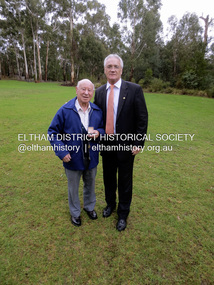
Photograph - Medal, Jim Connor, Doug Orford with Minister Damian Drum, Minister for Veterans' Affairs at Wingrove Park, Eltham, 22 April 2014
... warfare. The explosions, including those at the heavily contested Hill 60, created craters 60 feet deep, killed roughly 10,000 German troops, and were heard as far away as London. Tunnellers from Australian and British units worked for over a year (since 1916) in treacherous conditions—including quicksand and mud—to dig tunnels beneath German strongpoints. At 3:10 a.m. on June 7, nearly 1,000,000 pounds of explosives (ammonal) were detonated, creating one of the largest pre-atomic...warfare. The explosions, including those at the heavily contested Hill 60, created craters 60 feet deep, killed roughly 10,000 German troops, and were heard as far away as London. Tunnellers from Australian and British units worked for over a year (since 1916) in treacherous conditions—including quicksand and mud—to dig tunnels beneath German strongpoints. At 3:10 a.m. on June 7, nearly 1,000,000 pounds of explosives (ammonal) were detonated, creating one of the largest pre-atomic ...Awarded to Spr. W. H. Orford by Shire of Eltham Welcome Home Committee Welcome Home Medal The Welcome Home Medal was issued to acknowledge service during World War 1. As groups of servicemen returned and were discharged a local welcome home function was held in their honour. The welcome home committee decided that to commemorate the occasion a medal should be presented to the returned servicemen and also to the nearest relations of those who had fallen during the conflict. The medal shown was presented to Sapper William Henry Orford, of the 2nd Australian Tunnelling Company, an uncle of Doug Orford, one of our members. Sapper Orford participated in an operation where on June 7, 1917, British and Australian tunnellers detonated 19 massive mines beneath German lines at Messines Ridge, Belgium, marking a pivotal moment in WWI underground warfare. The explosions, including those at the heavily contested Hill 60, created craters 60 feet deep, killed roughly 10,000 German troops, and were heard as far away as London. Tunnellers from Australian and British units worked for over a year (since 1916) in treacherous conditions—including quicksand and mud—to dig tunnels beneath German strongpoints. At 3:10 a.m. on June 7, nearly 1,000,000 pounds of explosives (ammonal) were detonated, creating one of the largest pre-atomic explosions in history The explosions shattered German morale and destroyed defences, allowing Allied forces to take the ridge. Specifically, Australian miners placed, at great risk, two massive mines under the German-held Hill 60 and the nearby "Caterpillar" crater. Inscribed on the front of the medal is: SPR W.H. ORFORD FROM ELTHAM WE HONOUR YOU GREAT WAR 1914 – 1919 On the back of the medal is the image of a soldier standing at ease with a rifle. Smaller than originally stated the Eltham Districts medal is midway between a 10 and 20 cent piece in size. The medal is a fine piece of craftsmanship and is understood to have cost £4 to make. On 22nd April 2014 Society members were pleased to attend an announcement by Mr Damien Drum, Victorian Minister for Veterans Affairs and Sport, of funding for installation of signage for the Eltham and Hurstbridge Avenues of Honour. Doug Orford was there and created much interest with his Welcome Home Medal, including from Minister Drum. See also EDHS Newsletter No. 216 May 2014spr. w.h. orford, welcome home committee, welcome home medal, world war 1, avenue of honour, jim connor collection, mr damien drum, victorian minister for veterans affairs and sport, william henry orford -
 Bendigo Military Museum
Booklet - BOOKLET ABOUT HIROSHIMA 1946, Japan Hiroshima 1946
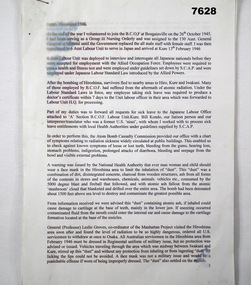
... Two Atomic Bombs dropped on Japan hastened the end of WW2. Item is part of the BCOF Association Collection, refer Cat No 7625 WW2 Nuclear Warfare Booklet This is a locally made information booklet. ...Two Atomic Bombs dropped on Japan hastened the end of WW2. Item is part of the BCOF Association Collection, refer Cat No 7625This is a locally made information booklet. It is printed in black ink. It contains photo's, text and lots of data about Nuclear war and radiation effects, Uranium and Plutonium Bombs.ww2, nuclear warfare, booklet
