
Showing 92 items matching "attitudes to war"
-
 National Vietnam Veterans Museum (NVVM)
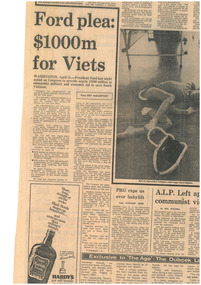
Newspaper - Articles about attitudes to end of war and Operation Babylift, The Age, 12 April, 1975
... Articles about attitudes to end of war and Operation Babylift...The Age President Ford ALP Vietnam Babylift Operation Babylift Post-war vietnam Military aid fall of saigon communist take-over Two newspaper article from The Age, Saturday April 12, 1975 The Age, 12 April, 1975 Newspaper Articles about attitudes to end of war and Operation Babylift ...Two newspaper articles from The Age in 1975 that contributes to an understanding of those involved in the war in Vietnam (1962 -1972) other than Australian servicemen.Two newspaper article from The Age, Saturday April 12, 1975the age, president ford, alp, vietnam, babylift, operation babylift, post-war vietnam, military aid, fall of saigon, communist take-over -
 Returned Nurses RSL Sub-branch
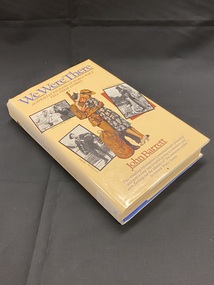
Book - Hardcover book, John Barrett, We were there: Australian soldiers of World War II, 1987
... ...attitudes to war...WW2 WWII Second World War World War 1939-1945 attitudes to war veterans Australian Armed Forces AIF 'We were there' provides an account of the "wide ranging lives and attitudes of some ordinary Australians who went to war". ...'We were there' provides an account of the "wide ranging lives and attitudes of some ordinary Australians who went to war". It includes brief references to discrimination, education, employment, prisoners of war, attitudes to religion, trackers, Aboriginal army service, promotions, valour and distinctions earned. - TroveCream coloured dust-jacket, title in blue along the spine. Cover shows an image of a soldier and a woman embracing, surrounded by three black and white photographs. Title is printed at the top and author at the bottom. There is a white spine label at the base of the spine.non-fiction'We were there' provides an account of the "wide ranging lives and attitudes of some ordinary Australians who went to war". It includes brief references to discrimination, education, employment, prisoners of war, attitudes to religion, trackers, Aboriginal army service, promotions, valour and distinctions earned. - Troveww2, wwii, second world war, world war 1939-1945, attitudes to war, veterans, australian armed forces, aif -
 Returned Nurses RSL Sub-branch
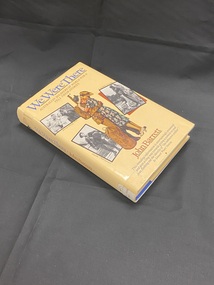
Book - Hardcover book, John Barrett, We were there: Australian soldiers of World War II, 1987
... ...attitudes to war...WW2 WWII Second World War World War 1939-1945 attitudes to war veterans Australian Armed Forces AIF 'We were there' provides an account of the "wide ranging lives and attitudes of some ordinary Australians who went to war". ...'We were there' provides an account of the "wide ranging lives and attitudes of some ordinary Australians who went to war". It includes brief references to discrimination, education, employment, prisoners of war, attitudes to religion, trackers, Aboriginal army service, promotions, valour and distinctions earned. - TroveCream coloured dust-jacket, title in blue along the spine. Cover shows an image of a soldier and a woman embracing, surrounded by three black and white photographs. Title is printed at the top and author at the bottom. There is a white spine label at the base of the spine.non-fiction'We were there' provides an account of the "wide ranging lives and attitudes of some ordinary Australians who went to war". It includes brief references to discrimination, education, employment, prisoners of war, attitudes to religion, trackers, Aboriginal army service, promotions, valour and distinctions earned. - Troveww2, wwii, second world war, world war 1939-1945, attitudes to war, veterans, australian armed forces, aif -
 National Vietnam Veterans Museum (NVVM)
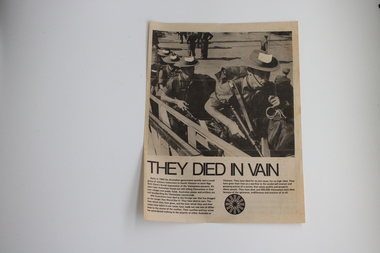
Article, They died in vain
... This article contributes to an understanding of the array of attitudes towards the war in Vietnam and Australia's participation in it....This article contributes to an understanding of the array of attitudes towards the war in Vietnam and Australia's participation in it. ...This article contributes to an understanding of the array of attitudes towards the war in Vietnam and Australia's participation in it.A magazine page with an image (in sepia) of soldiers in full uniform walking up a gang way boarding a ship. They Died In Vainvietnam, protesters, moratorium, anti-war, malicki -
 Federation University Historical Collection
Magazine, J.A. Hoskin & Son, SMB Students magazine 1934, 1934
... M. Bickett, An Attitude to War, Some Impressions by a New Comer to New Guinea, Fumes from the Lab, Arts & Crafts Gossip, Sport, Commercial Notes, The Junior Tecs...M. Bickett, An Attitude to War, Some Impressions by a New Comer to New Guinea, Fumes from the Lab, Arts & Crafts Gossip, Sport, Commercial Notes, The Junior Tecs SMB student's magazine james allan lorna bailey e. brimacombe betty brown enid causon jean coates joan Collins g. ...List of Full Course Students' 1934, Editorial, Obituary - Mr Sutherland's Wife and Mr W.H. Steane, Personal Column, Personal Column, The "Head" - An Appreciation, The Late Dean - W. F. Tucker, A Tribute - J. M. Bickett, An Attitude to War, Some Impressions by a New Comer to New Guinea, Fumes from the Lab, Arts & Crafts Gossip, Sport, Commercial Notes, The Junior TecsYellow soft covered magazine of 70 pages, including advertisements. Artworks * Example of color printing - By students of the printing class SMB * The President - By LC * Editor - By G. Leviston * Skipper Heck - By Nornie Gude * Goldie - By Nornie Gude * Interior of Art School Main Entrance - By Lorna Bailey * V.G - By Nornie Gude * Miss K. - By Nornie Gude * Caught in a slack moment - By Evelyn Shaw * You can't kid me - By Evelyn Shaw * B.B. - By Nornie Gude * Ferret. L - By LC * "Solemn Lorna" smileth - By Evelyn Shaw * View of Junior Technical School from Grant Street - By J.Hopwood * Complete fiddle with a paint brush - By Evelyn Shaw * Mr J with his finished product - By Evelyn Shaw * Our Cartoonist - By Nornie Gude * A modern Pygmalion - By Evelyn Shaw * Del - By Reg Warnock * I think your wife dropped this - By Gilda Gude * Mrs Mac - By LC * "Eavesdropping again !" Said Adam as his wife fell out of the tree. - By Dorothy Woolcock * Harvey - By LC * Here is the spot for a village - By Colin S. Hunt * Here is the village for a spot - By Colin S. Hunt * Miss McTaggart - By Reg Warnock * Molly - By J.Hopwood * John A Very Bootiful - By J. Hopwood * Neet - By Nornie Gude * Grace - By Nornie Gude * Jean - By Lorna Bailey * Jean. G - By Lorna Bailey * Nancy Mac - By Lorna Bailey * Clara - By Jesse Skelton, Lorna Bailey and J. Hewitt * Waxy - By J. Hopwood * Nancy. D - By Nornie Gude * Edna - By Nornie Gude * Bena - By Lorna Bailey * Bowes - By J. Hopwood * Headlights - By Reg Warnock * Voge - By Reg Warnock * Mum - By J. Hopwood * The big hold-up - By J.Hopwood Signed on front by Hester Darbysmb, student's magazine, james allan, lorna bailey, e. brimacombe, betty brown, enid causon, jean coates, joan collins, g. cornish, g. crawley, ethel crossthwaite, coralie cubbin, marcellene dixon, ailsa freeman, gilda gude, nornie gude, j. hewitt, j. hopwood, joan james, n. jelbart, valma jensen, marjorie john, g. leviston, a. loughton, ruth mellor, ron morrison, g.c. netherway, allan nye, norma oxbrow, a. paganetti, george palmer, maud paterson, hazel robinson, mona rogerson, betty saunders, evelyn shaw, jessie skelton, pat salter, olive scott, g.c. whitworth, dorothy woolcock, j. wright, sylvia wyres, kath windsor, reg warnock, mr f.g. procter, dr j.r. pound -
Federation University Historical Collection
Magazine - Booklet, Ballarat School of Mines Students' Magazine, 1935, 1935
... M. Bickett, An Attitude to War, Some Impressions by a New Comer to New Guinea, Fumes from the Lab, Arts & Crafts Gossip, Sport, Commercial Notes, The Junior Tecs...M. Bickett, An Attitude to War, Some Impressions by a New Comer to New Guinea, Fumes from the Lab, Arts & Crafts Gossip, Sport, Commercial Notes, The Junior Tecs ballarat school of mines magazine f. t. wimble & co. ltd., sydney j. woolcock a. nye d. shore d. taylor j. elliott b. saunders w. williams a. moodie v. hunt j. shelton r. warnock dr. j. r. pound g. procter g. merlin j. b. robinson james pound peter wilson mr alexander mr creelman mr crouch h. steane j. sutherland a. bell. a. max wilson g. f. eric rumpff r. mcconnell t. byrne c. r. king p. marshman a. f. heseltine w. f. tucker j. m. bickett a. m. wilson f. whitworth w. tierney r. leigh g. berriman a. sneddon a. collins h. maddern d. flynn n. bayly m. rickey w. calaghan d. wright e. wallace b. lamb s. wise r. quick i. leviston b. chaplin j. coates n. dunstan d. mcarthy d. henderson j. mathes g. leviston e. mcdonald k. blackie j. mouton n. jelbart r. brown k. mathes a. pickering j. mcghie r. white w. dawson j. forrest m. hamill w. martin m. jeffs k. waller d. nolan l. baxter r. knight l. moy m. hunt j. henry a. goldby j. menhennet mr king w. nice k. pattie f. capuano l. g. r. crouch gilda gude valma jensen e. shaw lorna bailey marjorie john dorothy woolcock Yellow soft covered magazine of 70 pages, including advertisements. ...List of Full Course Students' 1935, Editorial, Obituary - J. B. Robinson, Personal Column, Personal Column, Editor's Notes, Old Boys: Personal, The "Head" - An Appreciation, The Late Dean - W. F. Tucker, A Tribute - J. M. Bickett, An Attitude to War, Some Impressions by a New Comer to New Guinea, Fumes from the Lab, Arts & Crafts Gossip, Sport, Commercial Notes, The Junior TecsYellow soft covered magazine of 70 pages, including advertisements. Artworks * Blocks and Inks supplied by F.T. Wimble and Co. Ltd Sydney - Printed by students of printing class School of Mines Ballarat * Mr G - By Valma Jenson * Miss G - By E.Shaw * Joker of the pack by Gilda Gude * Oh Mother - By Valma Jensen * Man Praying - By A.P. * Swell - By Valma Jensen * In his element - By E.Shaw * Our jazz band - By Valma Jensen * Spaghetti - By E.Shaw * The Peter Pan statue in Kensington Gardens - By Gilda Gude * Hunted - By Valma Jensen * Bridget & Vic - By Valma Jensen * Lady pointing a statue - By Gilda Gude * Hi first solo flight - By Dorothy Woolcock * Dear Me - a millionth of a milligram out ! - By E.Shaw * Marley & Paul - By Valma Jensen * Green Plan Print - By Hunt * Yes, but it doesn't read, it doesn't read - By E.Shaw * The Big Noise - By Valma Jensen * Bashful Barney - By Valma Jensen * Willowy Verna - By E.Shaw * Margaret - By Valma Jensen * Don - By Valma Jensen * Cyril - By Gilda Gude * Jack - By Gilda Gude * Nancy - By Valma Jensen * Off to English - By Valma Jensen * "A mag article today please or six tomorrow" By E. Shaw * "Oh you boys are awful" - By E. Shaw * Maureen - By Valma Jensen * Geggy - By Valma Jensen * Aw crikey - By Valma Jensen * The wheelbarrow crate reaches Africa - By J.W * Lady Dean - By Valma Jensen * Margery - By Valma Jensen * Bubba - By Lorna Bailey * Chook - By Marjorie John * Bunny - By Valma Jensen * Sixa - By Valma Jensen * Fish Print - By Hunt * Betty - By Lorna Bailey * Bessie - By Lorna Bailey * Janette - By Lorna Bailey * Butcher - By Valma Jensen * Minnow - By F.J.Hballarat school of mines, magazine, f. t. wimble & co. ltd., sydney, j. woolcock, a. nye, d. shore, d. taylor, j. elliott, b. saunders, w. williams, a. moodie, v. hunt, j. shelton, r. warnock, dr. j. r. pound, g. procter, g. merlin, j. b. robinson, james pound, peter wilson, mr alexander, mr creelman, mr crouch, h. steane, j. sutherland, a. bell., a. max wilson, g. f. eric rumpff, r. mcconnell, t. byrne, c. r. king, p. marshman, a. f. heseltine, w. f. tucker, j. m. bickett, a. m. wilson, f. whitworth, w. tierney, r. leigh, g. berriman, a. sneddon, a. collins, h. maddern, d. flynn, n. bayly, m. rickey, w. calaghan, d. wright, e. wallace, b. lamb, s. wise, r. quick, i. leviston, b. chaplin, j. coates, n. dunstan, d. mcarthy, d. henderson, j. mathes, g. leviston, e. mcdonald, k. blackie, j. mouton, n. jelbart, r. brown, k. mathes, a. pickering, j. mcghie, r. white, w. dawson, j. forrest, m. hamill, w. martin, m. jeffs, k. waller, d. nolan, l. baxter, r. knight, l. moy, m. hunt, j. henry, a. goldby, j. menhennet, mr king, w. nice, k. pattie, f. capuano, l. g. r. crouch, gilda gude, valma jensen, e. shaw, lorna bailey, marjorie john, dorothy woolcock -
 National Vietnam Veterans Museum (NVVM)
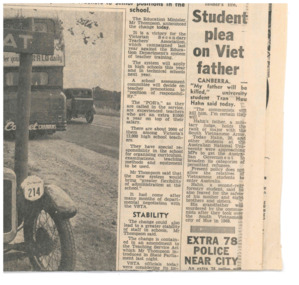
Article - Newspaper article, Student plea on Viet father - The Herald, 24/4/75, page 3
... Newspaper article in which a Vietnamese uni student asks the Australian Government to broaden its categories of refugees to save his father's life after Australian Forces have withdrawn from Vietnam. Shows post-war attitudes....Newspaper article in which a Vietnamese uni student asks the Australian Government to broaden its categories of refugees to save his father's life after Australian Forces have withdrawn from Vietnam. Shows post-war attitudes. Newspaper articles Vietnam Conflict Vietnam Refugees refugee plea news article post-war Vietnam Small one coloumn article / Mr Tran Huu Hanh / Son of military judge with South Vietnamese Army. ...Newspaper article in which a Vietnamese uni student asks the Australian Government to broaden its categories of refugees to save his father's life after Australian Forces have withdrawn from Vietnam. Shows post-war attitudes.Newspaper article from The Herald, 24/4/75.Article heading 'Student plea on Viet Father' and story of Mr Tran Huu Hanh.Small one coloumn article / Mr Tran Huu Hanh / Son of military judge with South Vietnamese Army.newspaper articles, vietnam conflict, vietnam refugees, refugee, plea, news, article, post-war vietnam -
 National Vietnam Veterans Museum (NVVM)
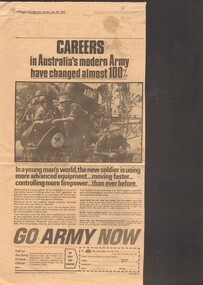
Newspaper - Recruitment advertisement
... This item contributes to an understanding of the experience of Australian society and attitudes to the war in Vietnam. This item was donated by Colin Laurence Grey OAM. ...This item contributes to an understanding of the experience of Australian society and attitudes to the war in Vietnam. This item was donated by Colin Laurence Grey OAM. ...This item contributes to an understanding of the experience of Australian society and attitudes to the war in Vietnam. This item was donated by Colin Laurence Grey OAM. Colin was the driving force behind many of the displays at the National Vietnam Veterans Museum. He will be remembered for his expertise, and boundless enthusiasm for all things Australian. Colin organised teams of like-minded souls to bring home and restore many important historical aircraft. His success has been recognised and rewarded with an Order of Australian Medal 2000, and he is named in the Worldwide Who’s Who 2014-2015. Colin’s skills as an engineer, tool maker, boiler maker and organiser enabled him to restore steam trains, trucks, tanks, infantry weapons, various aircraft including a MIG-15 jet fighter and his largest project the Consolidated B-24 Liberator bomber. He even replicated two dinosaur skeletons for Museum Victoria. In 1989 Colin joined the fledgling B-24 Liberator Memorial Fund as Project Manager/Restoration Co-Ordinator with the task to build a volunteer organisation that could find the AUD$10m required, source parts and materials for the largest aircraft restoration in Australia. The B-24 program had 10 volunteers, 60 sponsors and an international support network that provided parts, tooling, aviation equipment and political support. Colin’s combined engineering, academic and logistical skills provided the basis for advancing the skills of a very disparate group of volunteers form all walks of life. Colin established links with Centrelink, Corrections Victoria, RMT Uni and the ADF to develop the skills base of many less fortunate individuals of all ages and backgrounds. Colin’s work in this area gained him an AOM (2000). He featured in an ABC Australian Stories program and was awarded a life membership of the organisation. Colin was a founding member and President of the Oceania Aviation Museum Inc. which was instrumental in the historic listing of the joint WW2 USAAC/RAAF facility at Werribee and the Preserve Point Cook Aerodrome Group. Colin developed best practice engineering and fund-raising programs for a volunteer group, the Phillip Island Aquatic Centre. Colin’s constant learning, curiosity, passion and contribution to all things Australian have been an inspiration and a great example to all of us. He will be sorely missed and fondly remembered. Yellowed newspaper Army recruitment article from The Sun 20/01/1969. Photo of 3 young men in Australian Army uniform a Sioux helicopter with a kangaroo emblem. Beneahan article are the words 'Go Army Now" and a coupon to be detached, filled and posted.The Sun newspaper Jan 20 1969. Careers/in Australia's modern army/changed almost 100%. Picture of Australian helicopter with pilot inside and two soldiers beside the helicopter. Flying kangaroo on the side of the helicopter.careers, army, recruitment, vietnam, newspaper article, medal of the order of australia -
 Returned Nurses RSL Sub-branch
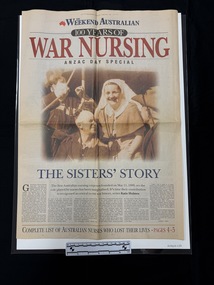
Newspaper - Newspaper lift out, The Weekend Australian et al, 100 years of War Nursing : ANZAC Day Special, 19990424
... 'A long day's journey' - p7 - Brief interview article with Del Waterman an RAAF Nurse who served in Malaysia during the Vietnam war. 'Attitudes changes in the face of suffering' by Siobhan McHugh - p7 - Brief interview article with Anne Hall on her time as an army nurse during the Vietnam war. ...'A long day's journey' - p7 - Brief interview article with Del Waterman an RAAF Nurse who served in Malaysia during the Vietnam war. 'Attitudes changes in the face of suffering' by Siobhan McHugh - p7 - Brief interview article with Anne Hall on her time as an army nurse during the Vietnam war. ...The Weekend Australian lift out from ANZAC Day 1999. Contains article titles as follows: 'The Sisters' story' by Katie Holmes - p1 - Beginning of an article talking about the circumstances of nurses in warfare, duties, conditions, etc. Continued on p8 'Private battles' by Jan Bassett - p2 - Article gives a brief overview of how armed forces nursing services were formed, why and how they developed, including major players such as Nellie Gould and Grace Wilson. '100 years of service, dedication' - p2 - Timeline of armed forces nursing services. 'Wild dogs and 13 patients' by Jan Bassett - p2 - Edited extract from recollections of Julia Anderson who served as a nurse in the Boer War. 'A pioneer called Nellie' by Jan Bassett - p2 - Brief biographical article on Nellie Gould. 'Into the mess' by Jan Bassett - p3 - Article on the conditions faced by WWI nurses serving overseas including memories of various nurses. 'Tragedy made more personal' by Jan Bassett - p3 - Brief biographical article on Grace Wilson. 'The old ship is heaven after the peninsula' - p3 - Edited excerpt from WWI diary of Ella Jane Tucker. 'In Memoriam' - p4-5 - Names of nurses who have died as a result of war service from Boer war to Vietnam war. 'Hell of Banka' by Catherine Kenny - p6 - Article providing basic details on the sinking of the Vyner Brooke, massacre on Banka Island, survival of Vivian Bullwinkel and later surrender to Japanese. 'A will to remember' by Catherine Kenny - p6 - Article providing overview of stories shared by surviving Japanese POW nurses including Betty Jeffrey, Wilma Young (neé Oram), Jessie Hookway (neé Simons), Pat Darling (neé Gunther), Vivian Bullwinkel, Lorna Johnson (neé Whyte), and Mavis Cation (neé Cullen). Article also discussed artistic representations of the stories on stage and screen. 'Making do to survive' by Jessie Simons - p6 - Reprinted excerpt from book by same author 'Japanese Hands Australian Nurses as POWs'. 'Grim miracles' by Siobhan McHugh - p7 - Article on experiences of nurses in the Vietnam war including Colleen Mealy, Anne Hall, Trish Ferguson, Jan McCarthy, Del Waterman, Terrie Roach and Anne Healy. 'Anyone's blood was welcome' by Siobhan McHugh - p7 - Brief article of the working conditions of civilian nurses in Vietnam during the war, including recollections of Jenny James, Fran Sardelich and Kay Collett (radiographer not nurse). 'A long day's journey' - p7 - Brief interview article with Del Waterman an RAAF Nurse who served in Malaysia during the Vietnam war. 'Attitudes changes in the face of suffering' by Siobhan McHugh - p7 - Brief interview article with Anne Hall on her time as an army nurse during the Vietnam war. 'Neglected heroes' by Ken Inglis - p8 - An article on war memorial recognition or lack of for nurses throughout history of memorials in Australia, how some were recognised and others not and how attitudes have changed over time. '100 years of service, skill and sacrifice' by Katie Holmes - p8 - Continuation of article on p1. 'Sisters in arms' - p8 - Box insert of numbers of military nurses who served in major conflicts from Boer - Gulf wars.A large newspaper lift out with text in red, blue and black. Front cover has large headings and a large sepia toned photo featuring a woman in nurses uniform with men in dressing gowns around her. The lift out is made up of two pieces of paper folded to make 8 pages of articles.nursing in warfare, anzac day, memorial -
 Returned Nurses RSL Sub-branch
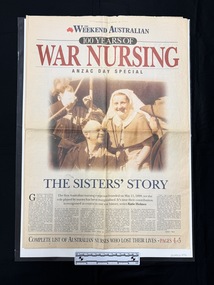
Newspaper - Newspaper lift out, The Weekend Australian et al, 100 years of War Nursing : ANZAC Day Special, 19990424
... 'A long day's journey' - p7 - Brief interview article with Del Waterman an RAAF Nurse who served in Malaysia during the Vietnam war. 'Attitudes changes in the face of suffering' by Siobhan McHugh - p7 - Brief interview article with Anne Hall on her time as an army nurse during the Vietnam war. ...'A long day's journey' - p7 - Brief interview article with Del Waterman an RAAF Nurse who served in Malaysia during the Vietnam war. 'Attitudes changes in the face of suffering' by Siobhan McHugh - p7 - Brief interview article with Anne Hall on her time as an army nurse during the Vietnam war. ...The Weekend Australian lift out from ANZAC Day 1999. Contains article titles as follows: 'The Sisters' story' by Katie Holmes - p1 - Beginning of an article talking about the circumstances of nurses in warfare, duties, conditions, etc. Continued on p8 'Private battles' by Jan Bassett - p2 - Article gives a brief overview of how armed forces nursing services were formed, why and how they developed, including major players such as Nellie Gould and Grace Wilson. '100 years of service, dedication' - p2 - Timeline of armed forces nursing services. 'Wild dogs and 13 patients' by Jan Bassett - p2 - Edited extract from recollections of Julia Anderson who served as a nurse in the Boer War. 'A pioneer called Nellie' by Jan Bassett - p2 - Brief biographical article on Nellie Gould. 'Into the mess' by Jan Bassett - p3 - Article on the conditions faced by WWI nurses serving overseas including memories of various nurses. 'Tragedy made more personal' by Jan Bassett - p3 - Brief biographical article on Grace Wilson. 'The old ship is heaven after the peninsula' - p3 - Edited excerpt from WWI diary of Ella Jane Tucker. 'In Memoriam' - p4-5 - Names of nurses who have died as a result of war service from Boer war to Vietnam war. 'Hell of Banka' by Catherine Kenny - p6 - Article providing basic details on the sinking of the Vyner Brooke, massacre on Banka Island, survival of Vivian Bullwinkel and later surrender to Japanese. 'A will to remember' by Catherine Kenny - p6 - Article providing overview of stories shared by surviving Japanese POW nurses including Betty Jeffrey, Wilma Young (neé Oram), Jessie Hookway (neé Simons), Pat Darling (neé Gunther), Vivian Bullwinkel, Lorna Johnson (neé Whyte), and Mavis Cation (neé Cullen). Article also discussed artistic representations of the stories on stage and screen. 'Making do to survive' by Jessie Simons - p6 - Reprinted excerpt from book by same author 'Japanese Hands Australian Nurses as POWs'. 'Grim miracles' by Siobhan McHugh - p7 - Article on experiences of nurses in the Vietnam war including Colleen Mealy, Anne Hall, Trish Ferguson, Jan McCarthy, Del Waterman, Terrie Roach and Anne Healy. 'Anyone's blood was welcome' by Siobhan McHugh - p7 - Brief article of the working conditions of civilian nurses in Vietnam during the war, including recollections of Jenny James, Fran Sardelich and Kay Collett (radiographer not nurse). 'A long day's journey' - p7 - Brief interview article with Del Waterman an RAAF Nurse who served in Malaysia during the Vietnam war. 'Attitudes changes in the face of suffering' by Siobhan McHugh - p7 - Brief interview article with Anne Hall on her time as an army nurse during the Vietnam war. 'Neglected heroes' by Ken Inglis - p8 - An article on war memorial recognition or lack of for nurses throughout history of memorials in Australia, how some were recognised and others not and how attitudes have changed over time. '100 years of service, skill and sacrifice' by Katie Holmes - p8 - Continuation of article on p1. 'Sisters in arms' - p8 - Box insert of numbers of military nurses who served in major conflicts from Boer - Gulf wars.A large newspaper lift out with text in red, blue and black. Front cover has large headings and a large sepia toned photo featuring a woman in nurses uniform with men in dressing gowns around her. The lift out is made up of two pieces of paper folded to make 8 pages of articles.nursing in warfare, anzac day, memorial -
 Flagstaff Hill Maritime Museum and Village
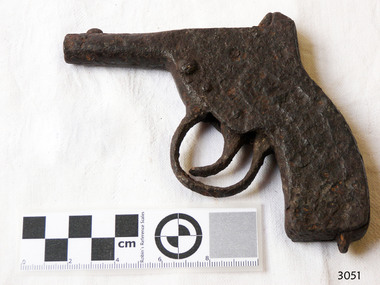
Toy Gun, 1911
... The item demonstrates significantly how our societies social attitudes have changed since world war two from general societal acceptance of such toys to one of distaste. flagstaff hill warrnambool shipwrecked-coast flagstaff-hill flagstaff-hill-maritime-museum maritime-museum shipwreck-coast flagstaff-hill-maritime-village toys cap gun national fireworks distrubuting company toy guns toy pistol "National" Toy gun; cap gun. ...This cap gun was found by a local Warrnambool resident in about 1971. Cap guns first appeared following the end of the American Civil War in the mid-1860s, when firearms companies experimented with toy guns to stay in business. Cap guns became especially popular when the heroes of cinema and television rode through the West ridding the territories of villains. Many cap guns were named after or endorsed by leading matinee idols like Roy Rogers, Gene Autry, Hopalong Cassidy, The Lone Ranger, Tonto, Dale Evans, Marshal Matt Dillon, or any of countless others. Cap guns became popular after the second world war and children all over the world emulated their heroes and collected and played with these toy guns. Eventually all of the famous cap gun manufacturers either sold out to other toy companies or started manufacturing other types of toys. Before it was deemed dangerous or politically incorrect for young children to point pistols at each other and fire at will, cap guns were a staple of toy chests. The item demonstrates how society has changed its attitudes and now regard these types of toys as morally unacceptable as they tend to promote violent attitudes towards others. The item demonstrates significantly how our societies social attitudes have changed since world war two from general societal acceptance of such toys to one of distaste.Toy gun; cap gun. Cast iron toy pistol with metal trigger. Name "National" in raised embossing in the casting on the handle on both sides of the gun. Made in 1911."National" flagstaff hill, warrnambool, shipwrecked-coast, flagstaff-hill, flagstaff-hill-maritime-museum, maritime-museum, shipwreck-coast, flagstaff-hill-maritime-village, toys, cap gun, national fireworks distrubuting company, toy guns, toy pistol -
 Flagstaff Hill Maritime Museum and Village
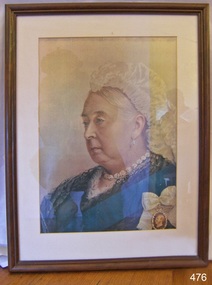
Print - Portrait of Queen Victoria, Hoy Art Picture Framing, Original probably painted in 1887 or 1897 to commemorate 50 or 60 years on the throne
... attitude towards these attacks greatly strengthened her popularity. With time, the private urgings of her family and the flattering attention of Benjamin Disraeli, Prime Minister in 1868 and from 1874 to 1880, the Queen gradually resumed her public duties. In foreign policy, the Queen's influence during the middle years of her reign was generally used to support peace and reconciliation. In 1864, Victoria pressed her ministers not to intervene in the Prussia-Denmark war...attitude towards these attacks greatly strengthened her popularity. With time, the private urgings of her family and the flattering attention of Benjamin Disraeli, Prime Minister in 1868 and from 1874 to 1880, the Queen gradually resumed her public duties. In foreign policy, the Queen's influence during the middle years of her reign was generally used to support peace and reconciliation. In 1864, Victoria pressed her ministers not to intervene in the Prussia-Denmark war ...Queen Victoria was born at Kensington Palace, London, on 24 May 1819. She was the only daughter of Edward, Duke of Kent, the fourth son of George III. Her father died shortly after her birth and she became heir to the throne because the three uncles who were ahead of her in the succession - George IV, Frederick Duke of York, and William IV - had no legitimate children who survived. Warmhearted and lively, Victoria had a gift for drawing and painting; educated by a governess at home, she was a natural diarist and kept a regular journal throughout her life. On William IV's death in 1837, she became Queen at the age of 18. Queen Victoria is associated with Britain's great age of industrial expansion, economic progress and, especially, empire. At her death, it was said, Britain had a worldwide empire on which the sun never set. In the early part of her reign, she was influenced by two men: her first Prime Minister, Lord Melbourne, and then her husband, Prince Albert, whom she married in 1840. Both men taught her much about how to be a ruler in a 'constitutional monarchy, in which the monarch had very few powers but could use much influence. Albert took an active interest in the arts, science, trade and industry; the project for which he is best remembered was the Great Exhibition of 1851, the profits from which helped to establish the South Kensington museums complex in London. Her marriage to Prince Albert produced nine children between 1840 and 1857. Most of her children married into other Royal families in Europe. Edward VII (born 1841), married Alexandra, daughter of Christian IX of Denmark. Alfred, Duke of Edinburgh and of Saxe-Coburg and Gotha (born 1844) married Marie of Russia. Arthur, Duke of Connaught (born 1850) married Louise Margaret of Prussia. Leopold, Duke of Albany (born 1853) married Helen of Waldeck-Pyrmont. Victoria, Princess Royal (born 1840) married Friedrich III, German Emperor. Alice (born 1843) married Ludwig IV, Grand Duke of Hesse and by Rhine. Helena (born 1846) married Christian of Schleswig-Holstein. Louise (born 1848) married John Campbell, 9th Duke of Argyll. Beatrice (born 1857) married Henry of Battenberg. Victoria bought Osborne House (later presented to the nation by Edward VII) on the Isle of Wight as a family home in 1845, and Albert bought Balmoral in 1852. Victoria was deeply attached to her husband and she sank into depression after he died, aged 42, in 1861. She had lost a devoted husband and her principal trusted adviser in affairs of state. For the rest of her reign she wore black. Until the late 1860s she rarely appeared in public; although she never neglected her official Correspondence, and continued to give audiences to her ministers and official visitors, she was reluctant to resume a full public life. She was persuaded to open Parliament in person in 1866 and 1867, but she was widely criticised for living in seclusion and quite a strong republican movement developed. Seven attempts were made on Victoria's life, between 1840 and 1882 - her courageous attitude towards these attacks greatly strengthened her popularity. With time, the private urgings of her family and the flattering attention of Benjamin Disraeli, Prime Minister in 1868 and from 1874 to 1880, the Queen gradually resumed her public duties. In foreign policy, the Queen's influence during the middle years of her reign was generally used to support peace and reconciliation. In 1864, Victoria pressed her ministers not to intervene in the Prussia-Denmark war, and her letter to the German Emperor (whose son had married her daughter) in 1875 helped to avert a second Franco-German war. On the Eastern Question in the 1870s - the issue of Britain's policy towards the declining Turkish Empire in Europe - Victoria (unlike Gladstone) believed that Britain, while pressing for necessary reforms, ought to uphold Turkish hegemony as a bulwark of stability against Russia, and maintain bi-partisanship at a time when Britain could be involved in war. Victoria's popularity grew with the increasing imperial sentiment from the 1870s onwards. After the Indian Mutiny of 1857, the government of India was transferred from the East India Company to the Crown, with the position of Governor-General upgraded to Viceroy, and in 1877 Victoria became Empress of India under the Royal Titles Act passed by Disraeli's government. During Victoria's long reign, direct political power moved away from the sovereign. A series of Acts broadened the social and economic base of the electorate. These acts included the Second Reform Act of 1867; the introduction of the secret ballot in 1872, which made it impossible to pressurise voters by bribery or intimidation; and the Representation of the Peoples Act of 1884 - all householders and lodgers in accommodation worth at least £10 a year, and occupiers of land worth £10 a year, were entitled to vote. Despite this decline in the Sovereign's power, Victoria showed that a monarch who had a high level of prestige and who was prepared to master the details of political life could exert an important influence. This was demonstrated by her mediation between the Commons and the Lords, during the acrimonious passing of the Irish Church Disestablishment Act of 1869 and the 1884 Reform Act. It was during Victoria's reign that the modern idea of the constitutional monarch, whose role was to remain above political parties, began to evolve. But Victoria herself was not always non-partisan and she took the opportunity to give her opinions, sometimes very forcefully, in private. After the Second Reform Act of 1867, and the growth of the two-party (Liberal and Conservative) system, the Queen's room for manoeuvre decreased. Her freedom to choose which individual should occupy the premiership was increasingly restricted. In 1880, she tried, unsuccessfully, to stop William Gladstone - whom she disliked as much as she admired Disraeli and whose policies she distrusted - from becoming Prime Minister. She much preferred the Marquess of Hartington, another statesman from the Liberal party which had just won the general election. She did not get her way. She was a very strong supporter of the Empire, which brought her closer both to Disraeli and to the Marquess of Salisbury, her last Prime Minister. Although conservative in some respects - like many at the time she opposed giving women the vote - on social issues, she tended to favour measures to improve the lot of the poor, such as the Royal Commission on housing. She also supported many charities involved in education, hospitals and other areas. Victoria and her family travelled and were seen on an unprecedented scale, thanks to transport improvements and other technical changes such as the spread of newspapers and the invention of photography. Victoria was the first reigning monarch to use trains - she made her first train journey in 1842. In her later years, she became the symbol of the British Empire. Both the Golden (1887) and the Diamond (1897) Jubilees, held to celebrate the 50th and 60th anniversaries of the Queen's accession, were marked with great displays and public ceremonies. On both occasions, Colonial Conferences attended by the Prime Ministers of the self-governing colonies were held. Despite her advanced age, Victoria continued her duties to the end - including an official visit to Dublin in 1900. The Boer War in South Africa overshadowed the end of her reign. As in the Crimean War nearly half a century earlier, Victoria reviewed her troops and visited hospitals; she remained undaunted by British reverses during the campaign: 'We are not interested in the possibilities of defeat; they do not exist.' Victoria died at Osborne House on the Isle of Wight, on 22 January 1901 after a reign which lasted almost 64 years, then the longest in British history. Her son, Edward VII succeeded her. She was buried at Windsor beside Prince Albert, in the Frogmore Royal Mausoleum, which she had built for their final resting place. Above the Mausoleum door are inscribed Victoria's words: "Farewell best beloved, here, at last, I shall rest with thee, with thee in Christ I shall rise again." Source: https://www.royal.uk/queen-victoria This picture captures Queen Victoria in her later years. It may well have been painted to commemorate her Golden Anniversary in 1887, or her Diamond Anniversary in 1897.Picture, print, reproduction of a drawing or photograph of Queen Victoria. She is wearing a dark-coloured dress, white headdress and a diamond necklace and earrings. On her left shoulder is the Royal Order of Victoria and Albert, awarded to female members of the British Royal Family and female courtiers. There are four grades or classes of this Royal Order as well as the Sovereign's Badge, which is exclusive to her. Also across her left shoulder, is a blue riband representing the Order of the Garter. The picture is in a medium-coloured timber frame with a white string across the width at the rear. The label says it was framed by Hoy Art, Warrnambool. The signature of the Queen is on the picture but is not obvious since the picture has been re-framed."HOY ART / PICTURE FRAMING / 48 Kepler St, Warrnambool 3280 / Phone (055) 62 8022" Signature (hidden by new framing) "Victoria H.R.S."flagstaff hill, warrnambool, shipwrecked-coast, flagstaff-hill, flagstaff-hill-maritime-museum, maritime-museum, shipwreck-coast, flagstaff-hill-maritime-village, picture of queen victoria, queen victoria, the royal order of victoria and albert, the order of the garter, hoy art -
The Beechworth Burke Museum
Audio - Oral History, Jennifer Williams, Gwen and Jack Scott, 24th February 2000
... War, and apprenticed with her sister as a hairdresser. Jack and Gwen provide some insight into maternal health issues in brief discussions of hospital birthing trends and awareness of contraception and family planning. Both Jack and Gwen recalled attending the open-air cinema at ‘The Rock’ in their childhoods. Gwen remembers that the ‘elites’ would sit on chairs at the front, and Gwen’s family sat on a rug at the back, while Jack would jump the fence and get in for nothing. Jack and Gwen discuss attitudes...War, and apprenticed with her sister as a hairdresser. Jack and Gwen provide some insight into maternal health issues in brief discussions of hospital birthing trends and awareness of contraception and family planning. Both Jack and Gwen recalled attending the open-air cinema at ‘The Rock’ in their childhoods. Gwen remembers that the ‘elites’ would sit on chairs at the front, and Gwen’s family sat on a rug at the back, while Jack would jump the fence and get in for nothing. Jack and Gwen discuss attitudes ...Jack Scott was born in Beechworth on the 24th January 1919 into a third generation Beechworth family who had migrated from Scotland, Cornwall and Ireland during the 1860s. Also present during the oral history recording is Jack’s wife, Gwen Scott. In 1878 Jack’s grandfather established the carrier business - R. Scott Carriers. Jack’s grandfather secured a contract with the Zwar Brothers' Beechworth Tannery to transport all goods between the tannery and train station via horse and cart. Jack’s father and uncle carried on the family business, before Jack and his brother eventually joined after the Second World War. The company expanded from a single horse and cart short route to multiple trucks operating interstate routes. Prior to joining the family carrier business, Jack on leaving school started work at the tannery and served in the air force during the Second World War. When asked about the working conditions at the tannery, Jack recalls while they did have union representatives, it was not particularly effectual. The union representatives were often placated by sharing multiple whiskies with the Zwar brothers when in their offices to discuss workers’ issues. Gwen’s father also worked for the tannery for a period of time, and she enjoyed the annual picnics the tannery provided for employee families. Both Jack and Gwen’s connections to the tannery reinforces the tannery’s role as a major employer and presence in the Beechworth community. Prior to marrying Jack, Gwen worked in a range of roles including at the Ovens and Murray Hospital for the Aged, managing the family home when her parents both worked during the Second World War, and apprenticed with her sister as a hairdresser. Jack and Gwen provide some insight into maternal health issues in brief discussions of hospital birthing trends and awareness of contraception and family planning. Both Jack and Gwen recalled attending the open-air cinema at ‘The Rock’ in their childhoods. Gwen remembers that the ‘elites’ would sit on chairs at the front, and Gwen’s family sat on a rug at the back, while Jack would jump the fence and get in for nothing. Jack and Gwen discuss attitudes towards both Chinese Australians and Italian migrants in Beechworth. They did not notice any racism and from their perspective felt they were accepted in the town. Jack did note that Italian employees lost their jobs at the tannery during the Second World War, but believed they all stayed within the area and found stonemason and concrete work in the interim. Jack socialised with members of the Italian community and joyfully recalled attending their homes for music nights with lots of drinking and instruments being played. This oral history recording was part of a project conducted by Jennifer Williams in the year 2000 to capture the everyday life and struggles in Beechworth during the twentieth century. This project involved recording seventy oral histories on cassette tapes of local Beechworth residents which were then published in a book titled: Listen to what they say: voices of twentieth century Beechworth. These cassette tapes were digitised in July 2021 with funds made available by the Friends of the Burke. Gwen and Jack Scott’s account of their lives in Beechworth is historically and socially significant to the cultural heritage of the region. Gwen and Jack in reflecting on their everyday experiences of operating a family business, availability of work, leisure opportunities, interaction with migrants, and access to maternal health care provide essential economic, social, and healthcare insights. Gwen and Jack Scott’s oral history recording is part of a larger collection of oral histories recorded by Jennifer Williams in 2000, collectively they provide invaluable insights into Beechworth during the 20th century, much of the information in these oral histories would be lost if not documented and missed in the interpretation of tangible objects. This is a digital copy of a recording that was originally captured on a cassette tape. The cassette tape is black with a horizontal white strip and is currently stored in a clear flat plastic rectangular container. It holds up 40 minutes of recordings on each side.Mrs Gwen and Mr Jack Scott jack scott, gwen scott, r. scott carriers, scott brothers, zwar brother's beechworth tannery, zwar tannery, beechworth tannery, ovens and murray hospital for the aged, benevolent asylum, open-air cinema, the rock cinema, italians beechworth, hospital births 1920s, wang tech, wangaratta tech, nell scott, jennifer williams, oral history, listen to what they say: voices of twentieth century beechworth, tannery union -
 Flagstaff Hill Maritime Museum and Village
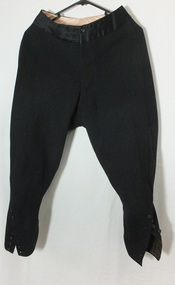
Clothing - Riding Habit, Jodhpurs, 1920s
... This riding habit is particularly significant on a number of levels, it shows the beginnings of change in society's attitudes through women's fashion after the First World War. A change that was to bring a start to a more liberating societal attitude towards women after the successful establishment of the Representation of People Act 1918 that gave women the right to vote. ...The Manifolds were a significant pioneering pastoral family in Western Victoria. The donated riding jodhpurs originally belonged to Mrs Edward Manifold, formally Beatrice Mary Synnot Anderson. Beatrice was Edward Manifold’s cousin once removed whom he married in 1900. Edward, the son of John Manifold, was born on 15 November 1868 and educated at Geelong and Melbourne Grammar schools and at Trinity Hall, Cambridge (B.A., 1891). He chose the Danedite portion of land at Purrumbete, and on the death of his bachelor brother Thomas Peter (1863-1895), after a hunting accident, he took over his allocation, Wiridgil. He also owned Boortkoi, near Hexham and on these properties, he ran merino sheep, a Lincoln stud which dated back to 1870, and Shorthorn cattle. 3000 acres were also leased to dairy farmers. Edward was a member of Hampden Shire Council in 1909-31 and three times president at Camperdown. The town was largely bordered by Manifold land and partly dependent upon the local pastoral dynasties, which benefited the local area from the families’ various business interests. Though an offer to build public baths to commemorate the Queen Victoria Jubilee in 1897 was not proceeded with, the town acquired a hospital, a reserve on Mount Leura, a clock tower and a cricket pavilion, as well as notable donations from the Manifolds to St Paul's Church and the grammar school. Edward was a keen polo player and racing man. He was also a successful owner of steeplechasers and a committeeman of the Victoria Racing Club for many years. He was also a member of many Western District racing clubs. On the 16 July 1900, Edward had married his sixteen-year-old cousin Beatrice Mary Synnot Anderson by whom he had three sons Thomas Peter, Andrew and Robert Edward Manifold. Edwards's estate at his death was valued for probate at nearly £500,000. Edward died following an operation on 14 February 1931 at a private hospital in Yarra Vale Melbourne. Beatrice passed away in 1954, aged 79 in Ballarat where she was born in 1874. Contextual historic Family background: The Manifold brothers Thomas (1809-1875), John (1811-1877) and Peter (1817-1885) were the fourth, fifth and sixth sons of William Manifold and Mary, nee Barnes, of Courthouse Farm, Bromborough, Cheshire, England. The family had decided to emigrate to Van Diemen's Land. Thomas was sent ahead, arriving in Hobart Town on 23rd January 1828 with £1500 and a letter of recommendation from the Colonial Office. Thomas acquired 1280 acres on the west bank of the Tamar River. John and Peter, with their parents and three sisters, arrived on 8th July 1831. Land grants by then had finished but William brought ninety acres next to his son Thomas’ land and on the combined properties the family built Kelso House. The Manifolds’ properties were comparatively poor and when news of the Port Phillip District, in Victoria reached Thomas, he lost no time in coming to see for himself in February 1836. He was impressed with what he saw and hurried back to Tasmania to buy lambs and ewes. With one of his brothers, on July 9th he landed his stores at Point Henry and proceeded to occupy both sides of the Moorabool River. Thomas, at the end of the year, returned to Tasmania and left Peter and John to run the new property. Thomas, however, returned to Victoria for several visits and on one of these visits he, along with his brothers, examined the country near Ballarat. In December 1838 they managed to penetrate the Stony Rises, and Peter and John reached Lake Purrumbete and the Mount Leura country. During this time, on 4th July 1838, Thomas married Jane Elizabeth, eldest daughter of Captain Walter Synnot, formerly of Ballinate, County Armagh, Ireland, and then of Van Diemen's Land. Thomas joined his brothers, and they occupied the Purrumbete run in January 1839. On the journey to Purrumbete they could not take their stock and drays through the Stony Rises, so went north of Lake Corangamite, to the neck of land between it and Lake Gnarpurt. By April the move from Moorabool area was complete. As yet they had no hut and were working day and night, but their delight in their new run was unbounded. John wrote to his mother: “We are at last got to the land we wished for it is a beautiful place, and cannot be surpassed by any I have ever seen”. The three brothers occupied Purrumbete together, breeding both sheep and cattle until Thomas went to Grassmere run on the Merri River near Warrnambool in 1844. John and Peter soon gave up breeding sheep but retained the well-known '3M' brand for the cattle. These were Shorthorns, derived from four bulls originally imported by the Boldon brothers and later improved by further importations, and were renowned for size and quality. By the time of the gold rush in 1851, John and Peter were breeding over 1000 head a year, as well as fattening stores. The diggings at this time had disorganised Grassmere by drawing away Thomas's men, and his wife decided to take her two sons and two daughters to Europe for their education. Thomas gave up the property next year, went to England to join his family, and eventually brought the family back to live in Melbourne. At Purrumbete things were different. The brothers, John and Peter, preferred black stockmen to white, so the discovery of gold upset them very little while providing the very market they required. John was on his second visit to England when the rush started, and Peter went in his turn soon after John returned. On 2 September 1856 John married Marion Thomson, at Cormiston, Van Diemen's Land. They had four daughters and five sons, from three of whom, William Thomson, James Chester and Edward, the later generations of the family descend. Through the years the brothers had to contend with the scab, fluke and footrot, depression, rabbits, bush fires and pleuro-pneumonia. In 1861 they appointed as manager Henry Manifold Matson, their nephew, who had already been with them for five years. Thomas died in Melbourne on 7 November 1875, John at Purrumbete on 3 January 1877 and Peter at Purrumbete on 31 July 1885. Devout members of the Church of England, John and Peter, during their lives, gave generously towards building St Paul's Church, Camperdown, and guaranteed part of the vicar's stipend. Peter was a member of the Hampden and Heytesbury Roads Board from 1859 and carried on into the Hampden Shire Council when it was formed in 1864. However, it was not for public works that they were known, but for their personal example. In a new land where speculators and adventurers were all too common, the Manifold brothers were among those who intended it to be their home and their children's home. Industrious, unpretentious and hospitable, they were respected in their community as men of the highest integrity. This riding habit is a characteristic example of the type and style of riding clothes that well-dressed ladies wore in the 1920s. It highlights the changes that were beginning in society for women. Prior to 1918 ladies still had to ride side-saddle with skirts over Jodhpurs. Society of the time regarded women riding astride as unseemly and just not done. This riding habit is particularly significant on a number of levels, it shows the beginnings of change in society's attitudes through women's fashion after the First World War. A change that was to bring a start to a more liberating societal attitude towards women after the successful establishment of the Representation of People Act 1918 that gave women the right to vote. This garments provenance is linked to one of Victoria's important pioneering families the Manifolds, one of the first families that came from Van Diemen's land to settle the Western District of Victoria in 1844. Originally the garment belonged to the wife of the great-grandson of pioneer William Manifold, Edward Manifold who married Beatrice May Synnot Anderson, Edwards Cousin in 1900. The garment was made by the Mayfair tailors J. Busvine & Co. in the early to mid-1920s (estimate) who at the turn of the century were tailors to the Courts of Europe. Their clothing is highly collectible today and examples can be found in a number of significant museum collections around the world, notably the Metropolitan Museum of Art in New York and the FIDM in Los Angeles. Jodhpurs, part of a three-piece, side saddle riding habit tailored for Mrs Edward Manifold, with four buttons to the front material black woolen twill the legs are cuffed below the knee with 8 buttons holes which are reinforced to the inside with fabric. Cream Satin waistband and removable chamois lining to the seat makers label Busvines Co. tailored for Mrs Edward Manifold.Embroidered in blue on a Satin Cream label to Jodhpurs "Busvine Ltd / 4, Brook St, London. W. No." Hand written in black ink script "523/ Mrs Edward Manifold"flagstaff hill, warrnambool, shipwrecked coast, flagstaff hill maritime museum, maritime museum, side saddle riding habit, side saddle riding outfit, breeches, mrs edward manifold, beatrice manifold, shipwreck coast, flagstaff hill maritime village, great ocean road -
 Flagstaff Hill Maritime Museum and Village
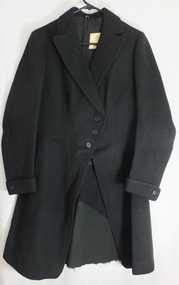
Clothing - Riding Habit, jacket, Early 20th Century
... This riding habit is particularly significant on a number of levels, it shows the beginnings of change in society's attitudes through women's fashion after the First World War. A change that was to bring a start to a more liberating societal attitude towards women after the successful establishment of the Representation of People Act 1918 that gave women the right to vote. ...The Manifolds were a significant pioneering pastoral family in Western Victoria. The donated riding jacket originally belonged to Mrs Edward Manifold, formally Beatrice Mary Synnot Anderson. Beatrice was Edward Manifold’s cousin once removed whom he married in 1900. Edward, the son of John Manifold, was born on 15 November 1868 and educated at Geelong and Melbourne Grammar schools and at Trinity Hall, Cambridge (B.A., 1891). He chose the Danedite portion of land at Purrumbete, and on the death of his bachelor brother Thomas Peter (1863-1895), after a hunting accident, he took over his allocation, Wiridgil. He also owned Boortkoi, near Hexham and on these properties, he ran merino sheep, a Lincoln stud which dated back to 1870, and Shorthorn cattle. 3000 acres were also leased to dairy farmers. Edward was a member of Hampden Shire Council in 1909-31 and three times president at Camperdown. The town was largely bordered by Manifold land and partly dependent upon the local pastoral dynasties, which benefited the local area from the families’ various business interests. Though an offer to build public baths to commemorate the Queen Victoria Jubilee in 1897 was not proceeded with, the town acquired a hospital, a reserve on Mount Leura, a clock tower and a cricket pavilion, as well as notable donations from the Manifolds to St Paul's Church and the grammar school. Edward was a keen polo player and racing man. He was also a successful owner of steeplechasers and a committeeman of the Victoria Racing Club for many years. He was also a member of many Western District racing clubs. On the 16 July 1900, Edward had married his sixteen-year-old cousin Beatrice Mary Synnot Anderson by whom he had three sons Thomas Peter, Andrew and Robert Edward Manifold. Edwards's estate at his death was valued for probate at nearly £500,000. Edward died following an operation on 14 February 1931 at a private hospital in Yarra Vale Melbourne. Beatrice passed away in 1954, aged 79 in Ballarat where she was born in 1874. Contextual historic Family background: The Manifold brothers Thomas (1809-1875), John (1811-1877) and Peter (1817-1885) were the fourth, fifth and sixth sons of William Manifold and Mary, nee Barnes, of Courthouse Farm, Bromborough, Cheshire, England. The family had decided to emigrate to Van Diemen's Land. Thomas was sent ahead, arriving in Hobart Town on 23rd January 1828 with £1500 and a letter of recommendation from the Colonial Office. Thomas acquired 1280 acres on the west bank of the Tamar River. John and Peter, with their parents and three sisters, arrived on 8th July 1831. Land grants by then had finished but William brought ninety acres next to his son Thomas’ land and on the combined properties the family built Kelso House. The Manifolds’ properties were comparatively poor and when news of the Port Phillip District, in Victoria reached Thomas, he lost no time in coming to see for himself in February 1836. He was impressed with what he saw and hurried back to Tasmania to buy lambs and ewes. With one of his brothers, on July 9th he landed his stores at Point Henry and proceeded to occupy both sides of the Moorabool River. Thomas, at the end of the year, returned to Tasmania and left Peter and John to run the new property. Thomas, however, returned to Victoria for several visits and on one of these visits he, along with his brothers, examined the country near Ballarat. In December 1838 they managed to penetrate the Stony Rises, and Peter and John reached Lake Purrumbete and the Mount Leura country. During this time, on 4th July 1838, Thomas married Jane Elizabeth, eldest daughter of Captain Walter Synnot, formerly of Ballinate, County Armagh, Ireland, and then of Van Diemen's Land. Thomas joined his brothers, and they occupied the Purrumbete run in January 1839. On the journey to Purrumbete they could not take their stock and drays through the Stony Rises, so went north of Lake Corangamite, to the neck of land between it and Lake Gnarpurt. By April the move from Moorabool area was complete. As yet they had no hut and were working day and night, but their delight in their new run was unbounded. John wrote to his mother: “We are at last got to the land we wished for it is a beautiful place, and cannot be surpassed by any I have ever seen”. The three brothers occupied Purrumbete together, breeding both sheep and cattle until Thomas went to Grassmere run on the Merri River near Warrnambool in 1844. John and Peter soon gave up breeding sheep but retained the well-known '3M' brand for the cattle. These were Shorthorns, derived from four bulls originally imported by the Boldon brothers and later improved by further importations, and were renowned for size and quality. By the time of the gold rush in 1851, John and Peter were breeding over 1000 head a year, as well as fattening stores. The diggings at this time had disorganised Grassmere by drawing away Thomas's men, and his wife decided to take her two sons and two daughters to Europe for their education. Thomas gave up the property next year, went to England to join his family, and eventually brought the family back to live in Melbourne. At Purrumbete things were different. The brothers, John and Peter, preferred black stockmen to white, so the discovery of gold upset them very little while providing the very market they required. John was on his second visit to England when the rush started, and Peter went in his turn soon after John returned. On 2 September 1856 John married Marion Thomson, at Cormiston, Van Diemen's Land. They had four daughters and five sons, from three of whom, William Thomson, James Chester and Edward, the later generations of the family descend. Through the years the brothers had to contend with the scab, fluke and footrot, depression, rabbits, bush fires and pleuro-pneumonia. In 1861 they appointed as manager Henry Manifold Matson, their nephew, who had already been with them for five years. Thomas died in Melbourne on 7 November 1875, John at Purrumbete on 3 January 1877 and Peter at Purrumbete on 31 July 1885. Devout members of the Church of England, John and Peter, during their lives, gave generously towards building St Paul's Church, Camperdown, and guaranteed part of the vicar's stipend. Peter was a member of the Hampden and Heytesbury Roads Board from 1859 and carried on into the Hampden Shire Council when it was formed in 1864. However, it was not for public works that they were known, but for their personal example. In a new land where speculators and adventurers were all too common, the Manifold brothers were among those who intended it to be their home and their children's home. Industrious, unpretentious and hospitable, they were respected in their community as men of the highest integrity. This riding habit is a characteristic example of the type and style of riding clothes that well-dressed ladies wore in the 1920s. It highlights the changes that were beginning in society for women. Prior to 1918 ladies still had to ride side-saddle with skirts over Jodhpurs. Society of the time regarded women riding astride as unseemly and just not done. This riding habit is particularly significant on a number of levels, it shows the beginnings of change in society's attitudes through women's fashion after the First World War. A change that was to bring a start to a more liberating societal attitude towards women after the successful establishment of the Representation of People Act 1918 that gave women the right to vote. This garments provenance is linked to one of Victoria's important pioneering families the Manifolds, one of the first families that came from Van Diemen's land to settle the Western District of Victoria in 1844. Originally the garment belonged to the wife of the great-grandson of pioneer William Manifold, Edward Manifold who married Beatrice May Synnot Anderson, Edwards Cousin in 1900. The garment was made by the Mayfair tailors J. Busvine & Co. in the early to mid-1920s (estimate) who at the turn of the century were tailors to the Courts of Europe. Their clothing is highly collectible today and examples can be found in a number of significant museum collections around the world, notably the Metropolitan Museum of Art in New York and the FIDM in Los Angeles. A riding jacket, part of a three-piece, side saddle riding habit tailored for Mrs Edward Manifold. Knee length English woolen jacket black in colour, seamed and fitted to the female client's figure, fastening from the waist with three bone buttons to rather high lapels. The sleeves are long with closely fitted cuffs and one button and lined with cream satin. The jacket is fitted to the waist and flared to below the hips with a 35 cm vent to the back. Lower back to the jacket is reinforced with removable fabric and the jacket is lined with black twill cotton, there is a cream satin label, with makers' emblem Busvine. Circa 1920s Label to Jacket Embroidered in gold with a Royal logo on a Cream Satin label “By Special /Appointment” “To Her Majesty/The Queen”, “Busvine / Ltd / London 4 Brook St. W. / No” “hand written in purple ink 315 / Mrs Edward Manifold”flagstaff hill, warrnambool, shipwrecked coast, flagstaff hill maritime museum, maritime museum, side saddle riding habit, mrs edward manifold, edward manifold, busvines, shipwreck coast, flagstaff hill maritime village, great ocean road -
 Flagstaff Hill Maritime Museum and Village
Clothing - Riding Habit, Skirt, 1920s
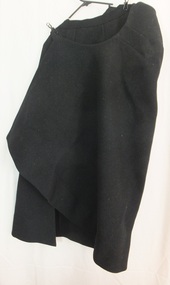
... This riding habit is particularly significant on a number of levels, it shows the beginnings of change in society's attitudes through women's fashion after the First World War. A change that was to bring a start to a more liberating societal attitude towards women after the successful establishment of the Representation of People Act 1918 that gave women the right to vote. ...The Manifolds were a significant pioneering pastoral family in Western Victoria. The donated riding skirt originally belonged to Mrs Edward Manifold, formally Beatrice Mary Synnot Anderson. Beatrice was Edward Manifold’s cousin once removed whom he married in 1900. Edward, the son of John Manifold, was born on 15 November 1868 and educated at Geelong and Melbourne Grammar schools and at Trinity Hall, Cambridge (B.A., 1891). He chose the Danedite portion of land at Purrumbete, and on the death of his bachelor brother Thomas Peter (1863-1895), after a hunting accident, he took over his allocation, Wiridgil. He also owned Boortkoi, near Hexham and on these properties, he ran merino sheep, a Lincoln stud which dated back to 1870, and Shorthorn cattle. 3000 acres were also leased to dairy farmers. Edward was a member of Hampden Shire Council in 1909-31 and three times president at Camperdown. The town was largely bordered by Manifold land and partly dependent upon the local pastoral dynasties, which benefited the local area from the families’ various business interests. Though an offer to build public baths to commemorate the Queen Victoria Jubilee in 1897 was not proceeded with, the town acquired a hospital, a reserve on Mount Leura, a clock tower and a cricket pavilion, as well as notable donations from the Manifolds to St Paul's Church and the grammar school. Edward was a keen polo player and racing man. He was also a successful owner of steeplechasers and a committeeman of the Victoria Racing Club for many years. He was also a member of many Western District racing clubs. On the 16 July 1900, Edward had married his sixteen-year-old cousin Beatrice Mary Synnot Anderson by whom he had three sons Thomas Peter, Andrew and Robert Edward Manifold. Edwards's estate at his death was valued for probate at nearly £500,000. Edward died following an operation on 14 February 1931 at a private hospital in Yarra Vale Melbourne. Beatrice passed away in 1954, aged 79 in Ballarat where she was born in 1874. Contextual historic Family background: The Manifold brothers Thomas (1809-1875), John (1811-1877) and Peter (1817-1885) were the fourth, fifth and sixth sons of William Manifold and Mary, nee Barnes, of Courthouse Farm, Bromborough, Cheshire, England. The family had decided to emigrate to Van Diemen's Land. Thomas was sent ahead, arriving in Hobart Town on 23rd January 1828 with £1500 and a letter of recommendation from the Colonial Office. Thomas acquired 1280 acres on the west bank of the Tamar River. John and Peter, with their parents and three sisters, arrived on 8th July 1831. Land grants by then had finished but William brought ninety acres next to his son Thomas’ land and on the combined properties the family built Kelso House. The Manifolds’ properties were comparatively poor and when news of the Port Phillip District, in Victoria reached Thomas, he lost no time in coming to see for himself in February 1836. He was impressed with what he saw and hurried back to Tasmania to buy lambs and ewes. With one of his brothers, on July 9th he landed his stores at Point Henry and proceeded to occupy both sides of the Moorabool River. Thomas, at the end of the year, returned to Tasmania and left Peter and John to run the new property. Thomas, however, returned to Victoria for several visits and on one of these visits he, along with his brothers, examined the country near Ballarat. In December 1838 they managed to penetrate the Stony Rises, and Peter and John reached Lake Purrumbete and the Mount Leura country. During this time, on 4th July 1838, Thomas married Jane Elizabeth, eldest daughter of Captain Walter Synnot, formerly of Ballinate, County Armagh, Ireland, and then of Van Diemen's Land. Thomas joined his brothers, and they occupied the Purrumbete run in January 1839. On the journey to Purrumbete they could not take their stock and drays through the Stony Rises, so went north of Lake Corangamite, to the neck of land between it and Lake Gnarpurt. By April the move from Moorabool area was complete. As yet they had no hut and were working day and night, but their delight in their new run was unbounded. John wrote to his mother: “We are at last got to the land we wished for it is a beautiful place, and cannot be surpassed by any I have ever seen”. The three brothers occupied Purrumbete together, breeding both sheep and cattle until Thomas went to Grassmere run on the Merri River near Warrnambool in 1844. John and Peter soon gave up breeding sheep but retained the well-known '3M' brand for the cattle. These were Shorthorns, derived from four bulls originally imported by the Boldon brothers and later improved by further importations, and were renowned for size and quality. By the time of the gold rush in 1851, John and Peter were breeding over 1000 head a year, as well as fattening stores. The diggings at this time had disorganised Grassmere by drawing away Thomas's men, and his wife decided to take her two sons and two daughters to Europe for their education. Thomas gave up the property next year, went to England to join his family, and eventually brought the family back to live in Melbourne. At Purrumbete things were different. The brothers, John and Peter, preferred black stockmen to white, so the discovery of gold upset them very little while providing the very market they required. John was on his second visit to England when the rush started, and Peter went in his turn soon after John returned. On 2 September 1856 John married Marion Thomson, at Cormiston, Van Diemen's Land. They had four daughters and five sons, from three of whom, William Thomson, James Chester and Edward, the later generations of the family descend. Through the years the brothers had to contend with the scab, fluke and footrot, depression, rabbits, bush fires and pleuro-pneumonia. In 1861 they appointed as manager Henry Manifold Matson, their nephew, who had already been with them for five years. Thomas died in Melbourne on 7 November 1875, John at Purrumbete on 3 January 1877 and Peter at Purrumbete on 31 July 1885. Devout members of the Church of England, John and Peter, during their lives, gave generously towards building St Paul's Church, Camperdown, and guaranteed part of the vicar's stipend. Peter was a member of the Hampden and Heytesbury Roads Board from 1859 and carried on into the Hampden Shire Council when it was formed in 1864. However, it was not for public works that they were known, but for their personal example. In a new land where speculators and adventurers were all too common, the Manifold brothers were among those who intended it to be their home and their children's home. Industrious, unpretentious and hospitable, they were respected in their community as men of the highest integrity. This riding habit is a characteristic example of the type and style of riding clothes that well-dressed ladies wore in the 1920s. It highlights the changes that were beginning in society for women. Prior to 1918 ladies still had to ride side-saddle with skirts over Jodhpurs. Society of the time regarded women riding astride as unseemly and just not done. This riding habit is particularly significant on a number of levels, it shows the beginnings of change in society's attitudes through women's fashion after the First World War. A change that was to bring a start to a more liberating societal attitude towards women after the successful establishment of the Representation of People Act 1918 that gave women the right to vote. This garments provenance is linked to one of Victoria's important pioneering families the Manifolds, one of the first families that came from Van Diemen's land to settle the Western District of Victoria in 1844. Originally the garment belonged to the wife of the great-grandson of pioneer William Manifold, Edward Manifold who married Beatrice May Synnot Anderson, Edwards Cousin in 1900. The garment was made by the Mayfair tailors J. Busvine & Co. in the early to mid-1920s (estimate) who at the turn of the century were tailors to the Courts of Europe. Their clothing is highly collectible today and examples can be found in a number of significant museum collections around the world, notably the Metropolitan Museum of Art in New York and the FIDM in Los Angeles. Safety skirt/apron, part of a three-piece, side saddle riding habit tailored for Mrs Edward Manifold. This side saddle skirt is made from black woolen material fixing at the waist with two metal hooks and three buttons to the front opening. One internal concealed pocket lining to the top part of the apron made of cotton the seat is shaped for side saddle riding and the skirt wraps around the body the longer side draped over the leg that is in the stirrup. flagstaff hill, warrnambool, shipwrecked coast, flagstaff hill maritime museum, maritime museum, side saddle riding habit, side saddle safety skirt, side saddle apron, mrs edward manifold, beatrice manifold, female riding habit 1920s, shipwreck coast, flagstaff hill maritime village, great ocean road -
 Australian Commando Association - Victoria
Work on paper - Sketch, Corporal Francis John Papworth, Some Independent Attitudes - Katherine 1942, June-July 1942
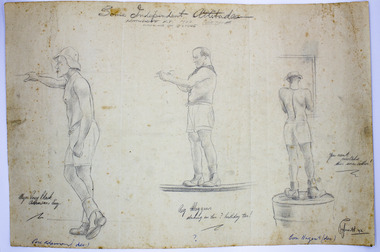
... Strong provenance as part of the family collection. soldiers wwii world war 2 second world war artists wartime francis john papworth Signature right hand corner: Papworth 42. Written in pencil at top of page: Some Independent Attitudes/Katherine N.T. 1942, June/July Working in the Q Store. ...Drawing done on location by Francis John 'Curly' Papworth whilst serving in Katherine, Northern Territory during World War Two. This work of soldiers is significant as a work produced by a serving soldier on location during WWII and is a unique example of an artistic work showing the men and their surroundings at the time. Strong provenance as part of the family collection. Pencil sketch on white paper of three bare chested male figures, two left profile and one rear view. All attired in shorts and boots. Information relating to the figures and location are written on the work. Signature right hand corner: Papworth 42. Written in pencil at top of page: Some Independent Attitudes/Katherine N.T. 1942, June/July Working in the Q Store. Beneath each figure written in pencil and ink left to right: Figure 1: Maj Percy Black Adamsom Esq. (in blue ink below: Perc Adamson Dec) Figure 2: Reg Moggins, working on his Birthday too! (in blue ink below: ?) Figure 3: You can't mistake this one either! (in blue ink below: Con Nugent, Dec)soldiers, wwii, world war 2, second world war, artists, wartime, francis john papworth -
 Ringwood and District Historical Society
Letter, RSL War Service Fund Ringwood 1944
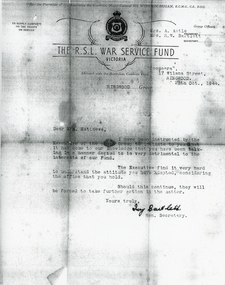
... Matthews complaining of her attitude to the fund. Also a photo copy. RSL War Service Fund Ringwood 1944 Letter ...Single typed buff coloured page. A letter from the Honorary Secretary of the fund, Ivy Bartlett to Mrs. Matthews complaining of her attitude to the fund. Also a photo copy. -
 Running Rabbits Military Museum operated by the Upwey Belgrave RSL Sub Branch
Diary, 1914
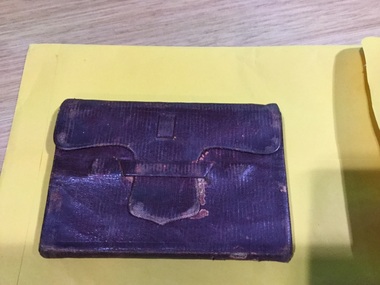
... Gallipoli diary written by Donald Johnson who was killed at the battle of the Nek on the 7th of August 1915 Important insight into early 20th century attitudes world war 1, aif, gallipoli, nek, 7 august 1915, donald mathieson mcgregor johnson, 8th light horse regiment To Dear Don wishing you every success with love and best wishes for a happy xmas from Ruby Small red covered diary with leather cover and clasp Diary ...Gallipoli diary written by Donald Johnson who was killed at the battle of the Nek on the 7th of August 1915Important insight into early 20th century attitudesSmall red covered diary with leather cover and claspTo Dear Don wishing you every success with love and best wishes for a happy xmas from Rubyworld war 1, aif, gallipoli, nek, 7 august 1915, donald mathieson mcgregor johnson, 8th light horse regiment -
 Kiewa Valley Historical Society
Letters - Briggs Bros
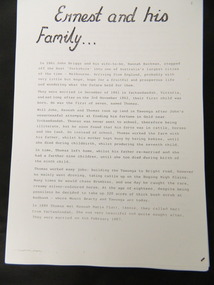
... Their letters from the war give an insight into its effects and the attitude of the time....Their letters from the war give an insight into its effects and the attitude of the time. ...The Briggs family lived in Tawonga. Thomas assisted building the Tawonga to Bright road and drove cattle to the Bogong High Plains before marrying in 1887 and raising 7 children, 2 of whom, Ernest and Albert enlisted in WW1 in 1916. Their letters from the war give an insight into its effects and the attitude of the time.The Briggs Bros. lived in the Kiewa Valley at Tawonga. Their letters give an insight into the war and an understanding of the times. Their parents lived and worked locally further enriching an understanding of the history of the Valley.30 pages of photocopies A4 size, of the Family Tree of the Briggs Family of Tawonga, including letters from two brothers from the trenches in WWI..briggs bros.. ww1. letters. tawonga. briggs family. droving. bright road. bogong high plains. -
 Kiewa Valley Historical Society
Book - Non Fiction History, Honour Roll - South Africa 1899 - 1902 Albury-Wodonga and District Residents Who Served In The Boer War, reprinted 03/2008
... This union remained strong up until the middle of World War II when England could not help Australia to defend itself against possible invasion by Japan. The alliance between Australia and the United States of America replaced the British/Australian pact. Secondly the attitude ...Historical information of soldiers from the Albury-Wodonga district who fought in the Boer War in South Africa 1899 - 1902. In 1996 the then curator for the 8/13 VMR Museum, the Hon Colonel John Neale, commissioned the author to research a group of returned servicemen and women from the Boer War and had lived within 100 km radius of the Albury/Wodonga townships.The Boer War was the second war in South Africa and was the result of heavy taxes and non voting rights of the local white Boer population. Colonial forces including the Australian Light Horse contingent where called upon by England to overthrow the rebellion. This War was the first engagement of Australian troops fighting on foreign soil.This Honour Roll details the pay rates, the battle highlights, weapons used and maps covering the first Australian contingent of soldiers who fought in the Transvaal (Boer War).. Listed are the names of those soldiers who lived within 100klms of Albury and Wodonga.The soldiers are listed by Location, Rank, Initial,Name and Unit. The significance of both the War and those who served in it is two fold. Firstly it demonstrates that the tie between the Colonial outreaches of England's Empire to "the Motherland" were extremely strong at this point in time. This union remained strong up until the middle of World War II when England could not help Australia to defend itself against possible invasion by Japan. The alliance between Australia and the United States of America replaced the British/Australian pact. Secondly the attitude of, and the high degree of horsemanship of those from the Albury and Wodonga area. The degree of adaptability, by these servicemen, to suit the environment in which they fought provided the first real insight into the Australian psyche "of those living and surviving on the harsh Australian outback"This book has a bright red soft cover and is bound with bright yellow tape. There is a drawing of two Australian soldiers on the front, one on horsebackAuthor's complimentary inscription "To Mount Beauty Museum with compliments" signed Ian R Docking history, boer war, ex-servicemen and women, albury and wodonga -
Kiewa Valley Historical Society
Polisher Floor, Hoover Appliances, Meadowbank
... The Kiewa Valley residents (mainly from the intermingling of rural and post World War II refugees working at the construction of the Victorian Hydro electricity installations, resulted in this rural area becoming integrated to new ways of living (both socially and economically). Once the attitude ...This appliance was a time saving method of cleaning floors. It appeared at a time (after World War II) when the domestic pressures faced by mothers and domestic staff was on the increase. The necessary "working parents" was through necessity becoming part of the "typical" family environment. It was the start of the ever increasing demand, from an economical reason, for both parents to work outside their property. Historically the period of the 1950s was one of extreme changes. It was an era where established role models were under pressure from an ever increasing demand for new and advancing consumerism. Communication levels via radio, newspapers and television was expanding at an ever increasing rate. Relatively isolated rural areas were opening up (post war) to foreign ideologies of consumerism. The basic restraints of "this will be alright mate, she'll do" was under a slow but effective take over. "I can get this done faster by this new whiz bang gadget that I saw on the TV last night!" was the new way to live by.This item is very significant in that it demonstrates the new consumerism at its infant stage of the social changes occurring due to greater communication levels between the rural Australian communities and other advancing communities world wide. The Kiewa Valley residents (mainly from the intermingling of rural and post World War II refugees working at the construction of the Victorian Hydro electricity installations, resulted in this rural area becoming integrated to new ways of living (both socially and economically). Once the attitude of "we have always done it this way mate!" was challenged and overcome, the acceptance of new time saving "gadgets" which started to pour in from foreign markets, the relative isolation of the Kiewa Valley (being mainly psychological entrenched), was over.This hoover electric floor scrubber and polisher has a main base containing two brushes (can be replaced with polishing pads). The two brushes/pads are fastened or removed from the base unit by pulling/pushing the heads from the small hexagonal shaft on the bottom of the machine motor. A pressure sensitive wire is inlaid at the brush/pad end to hold the brush/pad unit onto the shaft. The discs body and main body covering the electric motor are made from sturdy plastic. The rest of the appliance materials i.e. upright handle and the u framed attaching arm are made from lightweight powder coated steel. A small (350mm) red coloured foot switch protrudes from the back of the motor to release the the upright handle from the storage position to the action position.There are two fork shaped brackets on the rear of the handle, for securing the 6.5 metre long electrical cord and plug. There is no on/off switch on the appliance. A small stainless steel "u" framed clip (for hanging the appliance in the vertical position) for cupboard storage. Within the circle of the cleaning brush is stamped "1 above S.A.B.351" and on the opposite side P/No: 5023792". On the main plastic head of the brush discs are "TO CLEAN" and under this "USE ONLY WARM(underlined) WATER AND SOAP" on the opposite side, and within a circle is the Hoover Trademark. On the front of the blue coloured plastic dome covering the electric motor is (on a raised domed shaped plaque (on a red background) Hoover in slanted print from left to right(in a diagonal level)domestic appliances, floor cleaning, electric floor scrubbers and polishers -
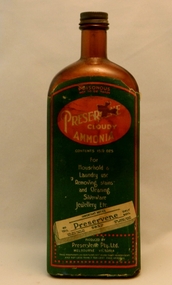 Kiewa Valley Historical Society
Bottle - Stain Remover, circa mid to late 1900's
... This attitude by the manufacturer fits into the mores held by the populous not only in cities but especially in the rural sector. This was an era where the success of a product was measured by the degree of versatility that came with it. The war ...The Trade Mark "Preservene" was registered on 23 June 1914 and traded in that name until 1930 when Cussons Australia Pty Ltd incorporated the name and its products including the Preservene Cloudy Ammonia. The Preservene Company produced a book (19 pages) "The Presevene Method Of Housework" in 1911. This publication was not only a self promotion but also a useful tool for the rural household and commercial enterprises.This bottle is very significant as it details the type of household cleaning methods and products used in the early 1900's up until the mid 1900's, when greater product diversities became available for rural areas. This product was a general cleaning agent that could be used for a variety of household items. It was the one product that "fits all cleaning". This attitude by the manufacturer fits into the mores held by the populous not only in cities but especially in the rural sector. This was an era where the success of a product was measured by the degree of versatility that came with it. The war years, the great depression had a lingering affect upon those who lived through them not to "waste" money on a multitude of products if one product had multiple uses. This was more so in rural areas where semi remote locations (as the case of the Kiewa Valley in the early 1900's) did not have the market place choices of city dwellers.This oblong shaped brown stained bottle has a red,green and faded white label covering 90% of the bottle. The bottle has a screw on lid. The bottle has embossed at the top back "POISON NOT TO BE TAKEN"on front label starting from top down "POISONOUS" IN SMALLER LETTERS "NOT TO BE TAKEN", below in an eclipse red backed sphere "PRESERVENE CLOUDY AMMONIA" below this in smaller print "CONTENTS 15 1/2 ozs", "For Household & Laundry use " below this "Removing stains and clearing Silverware Jewellery Etc". On a slant with green lettering on off white background, "IMPORTANT NOTICE (underlined) NO TOIL PRESERVENE ONLY BOIL(underlined) SOAP". Below within a red dotted boundary "PRODUCED BY Preservene Pty. Ltd. Melbourne Victoria". Below this and in smaller print "This preparation contains not more than 10 percent and not less than 7 percent free ammonia" Both sides of the label detail manufacturers instructions for different applications.laundry cleaners, stain removers, preservene label -
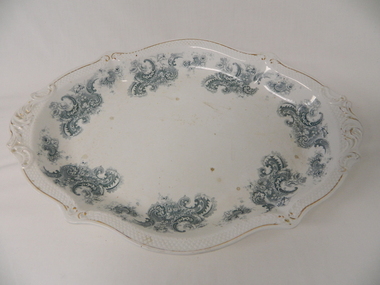 Kiewa Valley Historical Society
Dish Platter Meat, Circa 1914 to 1925
... The quality of good English merchandise and the "British best" attitude of the Australian psyche of this period, especially in rural regions, was strongly entrenched into the population. However after World War ...This serving meat plate/platter dates to the 1914 to 1930's period in time. This was a period when fine bone china and crockery was imported from England or Europe (mainly Germany). It was highly regarded not only as good crockery but also a linkage to "mother" England and showed a that the family was "well to do". This plate has important relevance to the socio- economical "atmosphere" of rural life (Kiewa Valley) in the early 20th Century. The quality of good English merchandise and the "British best" attitude of the Australian psyche of this period, especially in rural regions, was strongly entrenched into the population. However after World War II this psyche changed drastically as European refugees from war torn Europe "invaded" the mainly "British" based cultural mores. This was the beginning of cultural diversity and rolled out onto multi-culturalism of the latter 20th Century. This large bone china oval shaped serving plate has a green floral pattern around the the base extending up the sides, similar to the "Brussels" pattern. The top edge is delineated with a swirling pattern emphasised with gold leaf. On the rim and detailing 15mm before the edge are oyster or scollop like bubbles in three rows.manufacturers stamp (dating manufacture 1914-1925) and numbered "36" domestic kitchen crockery, english crockery, serving plates and platters -
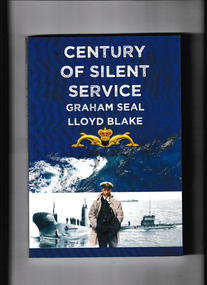 Monbulk RSL Sub Branch
Book, Boolarong Press, Century of silent service, 2013
... Royal Australian navy - Submarine forces Submarine warfare Australia's Submariners are a group with an extremely strong sense of identity that goes well beyond occupational comradeship or the esprit de corps of military life in peace or war. Since 1914, the unique skills, attitudes, values and demands of the work they do and the environment in which they do it have forged unparalleled camaraderie. ...Australia's Submariners are a group with an extremely strong sense of identity that goes well beyond occupational comradeship or the esprit de corps of military life in peace or war. Since 1914, the unique skills, attitudes, values and demands of the work they do and the environment in which they do it have forged unparalleled camaraderie. A camaraderie that extends beyond nationality, embracing submariners past and present of every other nation. No one but submariners understand the experience of diving deep beneath the waves in technology filled tubes of steel, each submariner totally dependent on the other for a safe return to the surface. The ethos of Australia's submariners is based upon these factors and remains strong even when they leave the sea and take up other occupations. Australia's future submarines will certainly present challenges in terms of sophistication, technology and capability however the characteristics of our submariners evolved over previous generations will remain much the same; trained and equipped to meet the challenges; just as they have been met and surmounted so many times, in silence, over a century of service.Bib, ill, maps, p.243.non-fictionAustralia's Submariners are a group with an extremely strong sense of identity that goes well beyond occupational comradeship or the esprit de corps of military life in peace or war. Since 1914, the unique skills, attitudes, values and demands of the work they do and the environment in which they do it have forged unparalleled camaraderie. A camaraderie that extends beyond nationality, embracing submariners past and present of every other nation. No one but submariners understand the experience of diving deep beneath the waves in technology filled tubes of steel, each submariner totally dependent on the other for a safe return to the surface. The ethos of Australia's submariners is based upon these factors and remains strong even when they leave the sea and take up other occupations. Australia's future submarines will certainly present challenges in terms of sophistication, technology and capability however the characteristics of our submariners evolved over previous generations will remain much the same; trained and equipped to meet the challenges; just as they have been met and surmounted so many times, in silence, over a century of service.royal australian navy - submarine forces, submarine warfare -
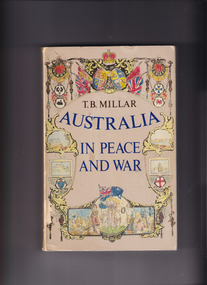 Monbulk RSL Sub Branch
Book, Australian National University Press, Australia in peace and war, 1978
... attitudes historically derived from Europe. It pleads for recognition that Australia can adapt the best of its European traditions in coming to terms with and helping to shape its Asia-Pacific environment. Index, bib, p.578. Australia in peace and war ...AUSTRALIA IN PEACE AND WAR is the first work to trace the development of Australia’s external relations from their colonial origins to the present. It shows how successive Australian governments have seen the world, what their attitudes have been, their actions and (much more often) their reactions. This important and controversial book details the successes and failures of Australian foreign policy over two centuries. It shows how geographical aspects of the world's largest island, anchored off the south-east corner of Asia, have increasingly impinged on perceptions and attitudes historically derived from Europe. It pleads for recognition that Australia can adapt the best of its European traditions in coming to terms with and helping to shape its Asia-Pacific environment.Index, bib, p.578.non-fictionAUSTRALIA IN PEACE AND WAR is the first work to trace the development of Australia’s external relations from their colonial origins to the present. It shows how successive Australian governments have seen the world, what their attitudes have been, their actions and (much more often) their reactions. This important and controversial book details the successes and failures of Australian foreign policy over two centuries. It shows how geographical aspects of the world's largest island, anchored off the south-east corner of Asia, have increasingly impinged on perceptions and attitudes historically derived from Europe. It pleads for recognition that Australia can adapt the best of its European traditions in coming to terms with and helping to shape its Asia-Pacific environment. australia - foreign relations, australia - history - military -
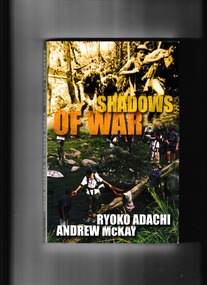 Monbulk RSL Sub Branch
Book, Ryoko Adachi et al, Shadows of war, 2005
... world war 1939-1945 - prisoners of war - japan world war 1939-1945 - veterans - attitudes Australian veterans of the Second World War who fought against the Japanese share their feelings about the war in the sixtieth anniversary of its close. p.247. ...Australian veterans of the Second World War who fought against the Japanese share their feelings about the war in the sixtieth anniversary of its close.p.247.non-fictionAustralian veterans of the Second World War who fought against the Japanese share their feelings about the war in the sixtieth anniversary of its close.world war 1939-1945 - prisoners of war - japan, world war 1939-1945 - veterans - attitudes -
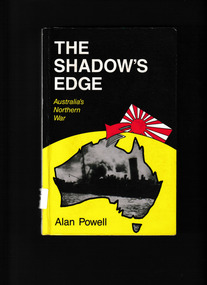 Monbulk RSL Sub Branch
Book, Alan Powell, The shadow's edge : Australia's northern war, 1988
... Stanner and the North Australia Observer Unit ; Protectors of women ; results of war experiences ; white attitudes towards Aboriginal people. ...Account of the Second World War as viewed and experienced in northern Australia ; includes references to Aboriginal people as coast watchers and rescuers, in army service, as trackers, in the Special Reconaissance Unit ; W.E.H. Stanner and the North Australia Observer Unit ; Protectors of women ; results of war experiences ; white attitudes towards Aboriginal people.Index, bibliography, notes, ill, maps, p.346.non-fictionAccount of the Second World War as viewed and experienced in northern Australia ; includes references to Aboriginal people as coast watchers and rescuers, in army service, as trackers, in the Special Reconaissance Unit ; W.E.H. Stanner and the North Australia Observer Unit ; Protectors of women ; results of war experiences ; white attitudes towards Aboriginal people. world war 1939-1945 - campaigns - australia, darwin - bombing -
 Monbulk RSL Sub Branch
Book, Melbourne University Publishing, The broken years, 2010
... He highlights and examines the new attitudes to war and to the homeland that developed and foreshadows the important effects in Australia of the changed outlook brought home by the survivors. ...Before the First World War most Australians shared the emotions and traditions of the British Empire. Proud of their British heritage, anxious to raise the Imperial status of Australia, they were eager to fight and, if need be, to die in defence of their race and country. But the horror and tragedy of the conflict brought fundamental changes in outlook. Many of the pre-war enthusiasms persisted, but the days of unquestioning allegiance to Empire were beginning to come to an end, to be replaced by the bittersweet tradition of Anzac. Dr Gammage shows how and why these changes took place. Using the diaries and letters of one thousand front-line soldiers of the First Australian Imperial Force, most of them now part of a unique collection housed in the Australian War Memorial in Canberra, he reconstructs the motives and expectations with which these men volunteered and the experiences they encountered. He highlights and examines the new attitudes to war and to the homeland that developed and foreshadows the important effects in Australia of the changed outlook brought home by the survivors. Those who have returned from war will recognise immediately the raw realities faced by the 'diggers', the growing disillusionment, and the hopes for the future. Those with fathers, husbands, or brothers who served, and all those concerned with what happens to men at war, cannot fail to be moved by the simple dignity of the men{u2019}s accounts, or by the understated courage with which they wrote to their families of the miseries they endured. This book, written with sensitivity and scholarly care, must be read if we are to understand war and its impact on the ethos of a nation.Index, bib, ill, notes, p.288.non-fictionBefore the First World War most Australians shared the emotions and traditions of the British Empire. Proud of their British heritage, anxious to raise the Imperial status of Australia, they were eager to fight and, if need be, to die in defence of their race and country. But the horror and tragedy of the conflict brought fundamental changes in outlook. Many of the pre-war enthusiasms persisted, but the days of unquestioning allegiance to Empire were beginning to come to an end, to be replaced by the bittersweet tradition of Anzac. Dr Gammage shows how and why these changes took place. Using the diaries and letters of one thousand front-line soldiers of the First Australian Imperial Force, most of them now part of a unique collection housed in the Australian War Memorial in Canberra, he reconstructs the motives and expectations with which these men volunteered and the experiences they encountered. He highlights and examines the new attitudes to war and to the homeland that developed and foreshadows the important effects in Australia of the changed outlook brought home by the survivors. Those who have returned from war will recognise immediately the raw realities faced by the 'diggers', the growing disillusionment, and the hopes for the future. Those with fathers, husbands, or brothers who served, and all those concerned with what happens to men at war, cannot fail to be moved by the simple dignity of the men{u2019}s accounts, or by the understated courage with which they wrote to their families of the miseries they endured. This book, written with sensitivity and scholarly care, must be read if we are to understand war and its impact on the ethos of a nation. world war 1914-1918 - personal correspondence, world war 1914-1918 - social conditions -
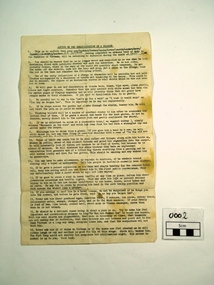 Yarrawonga RSL Sub Branch
Document, Untitled et al, Advice on the rehabilitation of a soldier, 01/09/1970
... war era. It was created as light relief for families of veterans due to return home from overseas This document shows the larrican attitude of Australian soldiers ready to return home from hazadous overseas service. vietnam document An A4 document from the Vietnam era giving a humourous angle on how to rehabilitate a Vietnam veteran guided at the family of the veteran. ...This item is from the Vietnam war era. It was created as light relief for families of veterans due to return home from overseasThis document shows the larrican attitude of Australian soldiers ready to return home from hazadous overseas service.An A4 document from the Vietnam era giving a humourous angle on how to rehabilitate a Vietnam veteran guided at the family of the veteran. It has paragraphs numbered 1 to 16vietnam, document
