
Showing 3 items matching "augusta borrack (ziebell)"
-
 Friends of Westgarthtown
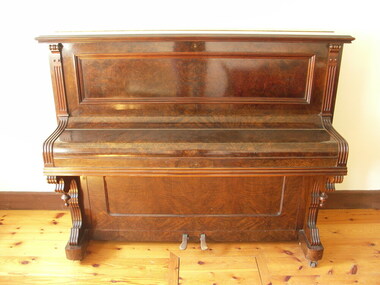
Instrument - Piano, Thurmer, Circa 1910-1915
... ...augusta borrack (ziebell)...Owned by Augusta Borrack (Nee Ziebell), circa; 1910-1915. Made with German parts, with a frame likely assembled in Melbourne by Wertheim. ...Owned by Augusta Borrack (Nee Ziebell), circa; 1910-1915. Made with German parts, with a frame likely assembled in Melbourne by Wertheim. musical instruments keyboard thurmer piano augusta borrack (ziebell) leo borrack allan & co. ...Owned by Augusta Borrack (Nee Ziebell), circa; 1910-1915. Made with German parts, with a frame likely assembled in Melbourne by Wertheim. Iron-framed Thurmer upright piano with dark wooden panels. Two marks where candlesticks or other objects may have been attached can be seen on the front panel. Decorative carving on sides. 2 pedals.Thurmer; Sole Agents Allan & co. Pty Ltd Melbourne, on front. Paper sticker inside top lid - 'Ferd. Thurmer'.musical instruments, keyboard, thurmer, piano, augusta borrack (ziebell), leo borrack, allan & co. -
 Friends of Westgarthtown
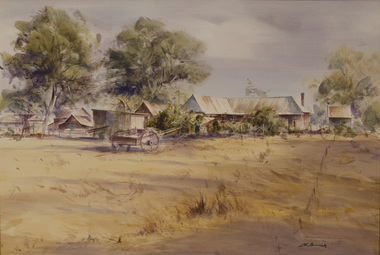
Painting, John Borrack, Last Days Ziebells "The Pines" Thomastown, c. 1970s
... Provenance: Augusta Borrack (nee Ziebell) Collection, John Borrack Collection...Provenance: Augusta Borrack (nee Ziebell) Collection, John Borrack Collection These two paintings by acclaimed Victorian artist John Borrack, a direct descendant of the Ziebell family through his mother Augusta, hold substantial artistic, historical, and familial significance for Ziebell’s Farmhouse Museum and the broader Westgarthtown narrative. ...Painted from the home (or front) paddock which ran south to the creek. The paddock was used for the cultivation of lucerne and maize crops in the lower regions while closer to the house where Ainwick Crescent is now situated, it was a burgeoning market garden for the cultivation of all varieties of vegetables. The large pines beyond, sheltered the farmyard on the west of Gardenia Road. That complex can be partly glimpsed on the left of the painting. This is a directly painted watercolour relying on the use of white paper and transparencies to impart a feeling of morning light. The figure is the artist's mother for whom the picture was painted. Provenance: Augusta Borrack (nee Ziebell) Collection, John Borrack CollectionThese two paintings by acclaimed Victorian artist John Borrack, a direct descendant of the Ziebell family through his mother Augusta, hold substantial artistic, historical, and familial significance for Ziebell’s Farmhouse Museum and the broader Westgarthtown narrative. Borrack, recognised as one of Australia’s leading landscape painters, is known for his sensitive, precise and atmospheric depictions of place. His professional standing and artistic skill considerably elevate the cultural value of these works. The paintings depict Ziebell’s Farmhouse and the associated outbuildings on the opposite side of Gardenia Road, capturing the rural character of the property prior to subdivision and suburban encroachment. They function as accurate visual records of the farm’s earlier setting and the self-sufficient lifestyle. Their documentary value is amplified by Borrack’s own reflections: he explained that he made the original sketches in the 1950s and later, in the 1970s, “decided to make a positive record of what the farm looked like”, developing these paintings from those earlier drawings. One work shows the farmhouse and milking shed as seen from the cemetery: the other captures the view from the front garden toward the former vegetable garden. Their provenance deepens their significance. As works created by a Ziebell descendant who consciously sought to record his family heritage, the paintings embody intergenerational memory, personal connection, and the enduring legacy of the Ziebell family within Victoria’s cultural landscape. They enrich the museum’s interpretive capacity, offering rare artistic insight into the historic farmstead and contributing meaningfully to the preservation and understanding of Westgarthtown’s heritage. Watercolour painting, depicting Ziebell's Farmhouse from the south (Thomastown and Mernda). Painting is mounted in a gold frame with cream board.Artist signature: John Borrack; Last Days at Ziebells "The Pines" Thomastown, 'Pro mea matre hanc picturan feci (In Memoria)'illustrations, watercolours, john borrack, ziebell, watercolour, painting -
 Friends of Westgarthtown
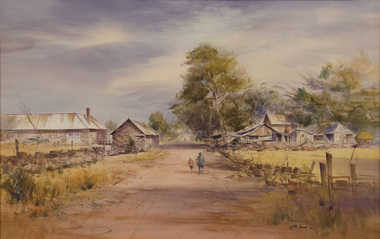
Painting, John Borrack, Ziebells, German Lane, South View, c. 1970s
... Ziebell Farm was known as “The Pines†and sadly none of the many that proliferated there remain. Today they would be equivalent to those at the cemetery, having been planted at the same time. Provenance: John Borrack Collection These two paintings by acclaimed Victorian artist John Borrack, a direct descendant of the Ziebell family through his mother Augusta, hold substantial artistic, historical, and familial significance for Ziebell’s Farmhouse Museum and the broader Westgarthtown narrative. ...Painted from Gardenia Road. The extensive farm complex on the right. (Western side of Gardenia Road). was demolished in 1972 for housing development. Buildings shown are cowshed, hay barn, engine shed and stables. Painted in the late afternoon, the lengthening shadows and lowering sky, could presage the ominous fate awaiting the farm with development. The Ziebell Farm was known as “The Pines†and sadly none of the many that proliferated there remain. Today they would be equivalent to those at the cemetery, having been planted at the same time. Provenance: John Borrack CollectionThese two paintings by acclaimed Victorian artist John Borrack, a direct descendant of the Ziebell family through his mother Augusta, hold substantial artistic, historical, and familial significance for Ziebell’s Farmhouse Museum and the broader Westgarthtown narrative. Borrack, recognised as one of Australia’s leading landscape painters, is known for his sensitive, precise and atmospheric depictions of place. His professional standing and artistic skill considerably elevate the cultural value of these works. The paintings depict Ziebell’s Farmhouse and the associated outbuildings on the opposite side of Gardenia Road, capturing the rural character of the property prior to subdivision and suburban encroachment. They function as accurate visual records of the farm’s earlier setting and the self-sufficient lifestyle. Their documentary value is amplified by Borrack’s own reflections: he explained that he made the original sketches in the 1950s and later, in the 1970s, “decided to make a positive record of what the farm looked like”, developing these paintings from those earlier drawings. One work shows the farmhouse and milking shed as seen from the cemetery: the other captures the view from the front garden toward the former vegetable garden. Their provenance deepens their significance. As works created by a Ziebell descendant who consciously sought to record his family heritage, the paintings embody intergenerational memory, personal connection, and the enduring legacy of the Ziebell family within Victoria’s cultural landscape. They enrich the museum’s interpretive capacity, offering rare artistic insight into the historic farmstead and contributing meaningfully to the preservation and understanding of Westgarthtown’s heritage. Watercolour depicting Ziebell Farmhouse from the north, Thomastown and Mernda. In gold frame with cream border.Artist signature: John Borrack; 70's Ziebells German Lane South Viewillustrations, watercolours, john borrack, ziebell, watercolour, painting
