
Showing 13 items matching "australia's first electric road"
-
 Ballarat Tramway Museum
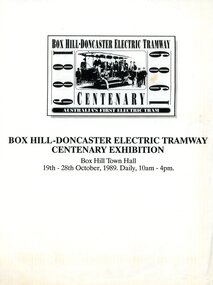
Memorabilia - Memorabilia - Collection of items, Box Hill-Doncaster Electric Tramway Centenary Exhibition; 1889 - 1989
... ...australia's first electric road...(The Tramway Museum Society of Victoria Inc.) .b) Small yellow booklet - "Australia's First Electric Tram: The story of the Doncaster and Box Hill Electric Road" by J.K.Moir. ...First Electric Road" by Melbourne architect and historian, Robert Green. This will be a limited edition and due for release in late November 1989. Order form on reverse of the flyer to be sent to John Mason Press. box hill-doncaster electric tramway memorabilia centenary exhibition 1889-1989 public street transport why have tickets? tramway museum society of victoria melbourne w3 tramcar henry james hilton n m maddocks merrick hilton australia's ...Ron Bridger was an avid collector of items related to transport, predominately Trams. These items include newspaper cuttings, pamphlets, reports, timetables, fares prices plus special items relating to events. Items from Melbourne and regional Victoria, interstate - Adelaide and Sydney, plus overseas, make up this collection. Item is a white paper bag specifically for the Centenary of the Box Hill - Doncaster Electric Tramway. Dates and times for this celebration are printed on the bag. Inside are numerous items related to this occasion. .a) Information sheets No 1: Public Street Transport in Melbourne. by N.W. Maddocks No.2: The role of the Melbourne and Metropolitan Tramways Board in the history of street transport. by N.W. Maddocks No.3: Why have tickets? (The Tramway Museum Society of Victoria Inc) No.4: The historic trams of Victoria. (The Tramway Museum Society of Victoria Inc.) No.5: Driver's cab - Melbourne W3 Tramcar. (The Tramway Museum Society of Victoria Inc.) No.6: Henry James Hilton - Member Institute of Engineers 1891. From notes by Merrick Hilton (grandson) 1987. No.7: Where is this tram going?. (The Tramway Museum Society of Victoria Inc.) .b) Small yellow booklet - "Australia's First Electric Tram: The story of the Doncaster and Box Hill Electric Road" by J.K.Moir. Printed Melbourne 1940. .c) Postcard - black and white; Shows the Opening of the Box Hill-Doncaster Electric Tramway - 14 October 1889. The reverse side gives a brief history. It operated from October 1889 until January 1898. .d) Small white paper bag with title stamped on it. Inside two small yellow tickets for Centenary Tramway Exhibition. A sticker for the Centenary also included. .e) Pamphlet giving a brief outline of the Box Hill-Doncaster Electric Tramway. Contains an article that appeared in "The Reporter" dated 17 October 1989 stating the importance of this enterprise - "Footprints in the sands of time......." .f) Yellow flyer advertising a book "The First Electric Road" by Melbourne architect and historian, Robert Green. This will be a limited edition and due for release in late November 1989. Order form on reverse of the flyer to be sent to John Mason Press. White bag labelled - Box Hill - Doncaster Electric Tramway - Centenary. Numerous items relating to exhibition collected and placed in paper bag. Date: 19th - 28th October, 1989. Daily, 10am - 4pmbox hill-doncaster electric tramway, memorabilia, centenary exhibition, 1889-1989, public street transport, why have tickets?, tramway museum society of victoria, melbourne w3 tramcar, henry james hilton, n m maddocks, merrick hilton, australia's first electric road, j k moir, the first electric road, robert green, historian, postcard-black and white, opening of tramway, 14 october 1898, centenary sticker, ron bridger collection, as box 48a -
 Eltham District Historical Society Inc
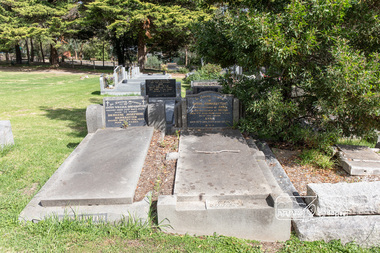
Photograph, Peter Pidgeon, Brinkkotter family graves, Eltham Cemetery, Victoria, 5 April 2021
... Road between Research Primary School and the Maroondah Aqueduct) in 1906, which steadily grew to become one of the largest in Victoria, supplying customers all over Australia. By 1935 it was a thriving business, with buildings housing 6,000 birds and incubators capable of hatching 8,000 eggs. He died suddenly from a heart attack in 1938 and is buried with his wife Anna in Eltham Cemetery. The business was carried on by his son Anton William Brinkkotter. When electricity came to Research in 1940, the Brinkkotter Poultry Farm was the very first customer, enabling further expansion and modernisation. Two electric...Road between Research Primary School and the Maroondah Aqueduct) in 1906, which steadily grew to become one of the largest in Victoria, supplying customers all over Australia. By 1935 it was a thriving business, with buildings housing 6,000 birds and incubators capable of hatching 8,000 eggs. He died suddenly from a heart attack in 1938 and is buried with his wife Anna in Eltham Cemetery. The business was carried on by his son Anton William Brinkkotter. When electricity came to Research in 1940, the Brinkkotter Poultry Farm was the very first customer, enabling further expansion and modernisation. Two electric ...German-born Anton Brinkkotter, a skilled metal-worker by trade, migrated to Australia in 1880. His initial job was to supervise the installation of ornamental ceilings in the Melbourne Exhibition Building. He moved to Research in about 1900, working first as a plumber and tank-maker. But he is best known for having established a poultry farm (on Main Road between Research Primary School and the Maroondah Aqueduct) in 1906, which steadily grew to become one of the largest in Victoria, supplying customers all over Australia. By 1935 it was a thriving business, with buildings housing 6,000 birds and incubators capable of hatching 8,000 eggs. He died suddenly from a heart attack in 1938 and is buried with his wife Anna in Eltham Cemetery. The business was carried on by his son Anton William Brinkkotter. When electricity came to Research in 1940, the Brinkkotter Poultry Farm was the very first customer, enabling further expansion and modernisation. Two electric incubators were installed with a capacity of 10,000 eggs each. Anton William Brinkkotter became active in public affairs, a trustee of the Eltham Public Hall in Henry Street and was an Eltham Shire Councillor between 1941 and 1961 serving three years as Shire President. The Brinkkotter house in Dudley Street was used to house the Eltham Library prior to a dedicated Library being completed with the southern wing of the Shire offices in 1971. He died in 1970 and is buried with his wife Bridgene in Eltham Cemetery, alongside his parents. In Loving Memory Of Anton William Brinkkotter Passed away 29th Sept. 1970 Aged 72 years Bridgene Josephine Brinkkotter Passed away 5th Feb. 1995 Aged 90 years R.I.P. and In Loving memory Of Anton Brinkkotter Loved husband of Anna & loving father of Anton Died 7th June 1938 aged 71 yrs. Also the above Anna Died 12th Jan. 1954 aged 80 yrs. R.I.P.Born Digitaleltham cemetery, gravestones, anna brinkkotter, anton brinkkotter, anton william brinkkotter, bridgene josephine brinkkotter -
 Box Hill Historical Society
Book, Moir, J.K, Australia's First Electric Tram
... Tram services Station Street Box Hill Elgar Road Doncaster Box Hill and Doncaster Tramway Company Doncaster Transport The story of the Doncaster and Box Hill Electric Road 28p. Australia's First Electric Tram Book Moir, J.K. ...The story of the Doncaster and Box Hill Electric Road28p.The story of the Doncaster and Box Hill Electric Roadtram services, station street, box hill, elgar road, doncaster, box hill and doncaster tramway company, doncaster, transport -
 Ballarat Tramway Museum
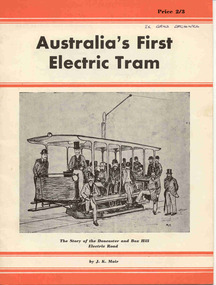
Book, J. K. Moir (author), "Australia's First Electric Tram", 1950 to 1977'
... Twenty page book including card covers titled "Australia's First Electric Tram" written by John Kinmont Moir and published by Traction Publications, Historical Series No. 151 in 1961. The story of the Doncaster and Box Hill Electric Road...Includes a number of photographs. 2458.2 - ditto - Red card cover (see images i2 and i3) - Second edition - 1950. 2458.3 - ditto - cover same as 4th Edition, - Third Edition 1957 - see image .4 2458.4 - Thirty two page book, centre stapled, including light green card covers titled "Australia's First Electric Tram" written by John Kinmont Moir and the story of the Doncaster and Box Hill Electric Road (tramway). ...Twenty page book including card covers titled "Australia's First Electric Tram" written by John Kinmont Moir and published by Traction Publications, Historical Series No. 151 in 1961. The story of the Doncaster and Box Hill Electric Road (tramway). Note on page 6, advises that this book was the 4th edition. Price at the time 2/3d. Has a sketch on the front cover of the opening ceremony at Box Hill, poster advertising the tramway, a map, foreword written by J.K. Moir about Mr. H. J. Hilton who operated the tramway, the birth of the tramway, the company that was formed to operate it, , a sample ticket, opening, operation, timetable, reminiscences of H. J. Hilton. Includes notes on the subsequent work of Mr. Hilton, the AETA, Traction publications and a short biography on the back cover of the author, J. K. Moir. Includes a number of photographs. 2458.2 - ditto - Red card cover (see images i2 and i3) - Second edition - 1950. 2458.3 - ditto - cover same as 4th Edition, - Third Edition 1957 - see image .4 2458.4 - Thirty two page book, centre stapled, including light green card covers titled "Australia's First Electric Tram" written by John Kinmont Moir and the story of the Doncaster and Box Hill Electric Road (tramway). Republished by Rotary Club of Box Hill, May 1977, see back cover for publication details. Has a photo on the front cover of the opening ceremony at Box Hill, poster advertising the tramway, a copy of a share certificate, foreword written by J.K. Moir about Mr. H. J. Hilton who operated the tramway, the birth of the tramway, the company that was formed to operate it, a sample ticket, opening, operation, timetable, reminiscences of H. J. Hilton. See images 5 and 6.On the front cover in black ink "Ex ARHS Archives" 2458.2 and 3 and .4 - has "I. J. Stanley" written in ink on page 3.trams, tramways, box hill, doncaster, tramways -
 Whitehorse Historical Society Inc.
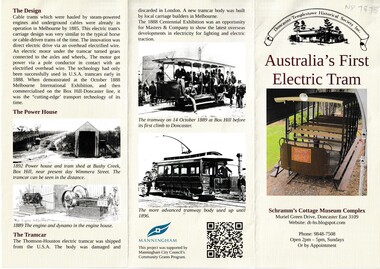
Pamphlet - Historical Resource, Manningham City Council, Australia's First Electric Tram, 2022
... An electric tram ran between Box Hill and Doncaster along Tram Road from1889-1896. A replica of the tram is housed at Schramm's Cottage along with a length of the original track. Australia's first ...A4 folded twice coloured pamphlet picturing Australia's first electric tram which ran from Box Hill to Doncaster in the late 1880's.A4 folded twice coloured pamphlet picturing Australia's first electric tram which ran from Box Hill to Doncaster in the late 1880's.non-fictionA4 folded twice coloured pamphlet picturing Australia's first electric tram which ran from Box Hill to Doncaster in the late 1880's.tram, tram services, schramm's cottage -
Whitehorse Historical Society Inc.
Pamphlet, Box Hill and Doncaster Electric Tramway Co, 1/10/1989 12:00:00 AM
... Tram Services Station Street Box Hill Elgar Road Doncaster Box Hill and Doncaster Electric Tramway Co Doncaster Road Doncaster History of the first electric tram in Australia which ran between Box Hill Post Office and Doncaster Between October 1889 and January 1896. ...History of the first electric tram in Australia which ran between Box Hill Post Office and Doncaster Between October 1889 and January 1896.History of the first electric tram in Australia which ran between Box Hill Post Office and Doncaster Between October 1889 and January 1896.History of the first electric tram in Australia which ran between Box Hill Post Office and Doncaster Between October 1889 and January 1896.tram services, station street, box hill, elgar road, doncaster, box hill and doncaster electric tramway co, doncaster road, doncaster -
 Wodonga & District Historical Society Inc
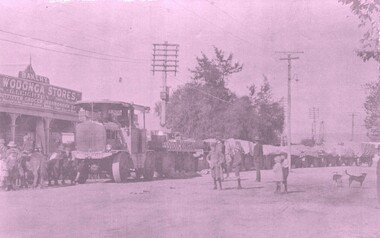
Photograph - Falkiner Electric Road Train in front of George Leighton's Wodonga Store and Bakery Wodonga 1914
... Australian road transport. Falkiner Electric train Early road transport High Street Wodonga George Leighton Black and white images of the Falkiner Road Train in Wodonga and on its first journey from Melbourne to Wagga, NSW It is taken in front of the Wodonga Stores and Bakery operated by George Leighton in Sydney Street, Wodonga. ...This image of the Ralph Falkiner’s Mueller Petrol-Electric Road Train was taken in Wodonga in February 1914. Imported from Germany by Mr Ralph S Falkiner in late 1913, the train’s inventor, Major W A Mueller with two assistants, came to Melbourne to assemble then commission the train. The train cost Mr Falkiner about £13,000 plus £4,591 import duties. The Falkiner family were sheep breeders in the Western Riverina and he hoped to use the road train primarily to convey wool to the railways for despatch to Sydney. The train was 216 feet long, weighed 43.5 tons with a top speed loaded of 6-8m/h and petrol consumption up to two gallons per mile. Its first Australian journey was to haul 50 tons of cargo to Edmondson & Co at Wagga Wagga, 277 miles away. The journey from Melbourne was plagued with problems including broken cylinders and crank shaft and overheating as it was not designed for Australian climatic conditions. Three months after leaving Melbourne it arrived in Wodonga. A series of problems between Springhurst and Wodonga, including broken cylinders and valves caused an eight day delay. Some of the cargo was off-loaded in Albury, then after repairs the train continued on to Wagga where it arrived in May 1914. After unloading there, the road train was taken to Mr Falkiner's Groongal Station, near Hay and subsequently made several long trips into drought-stricken areas or the Western Riverina. Eventually the dream collapsed when the engines gave out after the train bogged in the sticky black soil of the Hay plain with 251 bales of wool on board. The train was finally railed back to Melbourne and stored but destroyed when the warehouse burnt down. In this photo, the road train is drawn up outside the Wodonga Stores and Bakery owned and operated by George Leighton. Mr Leighton began his business opposite the Terminus Hotel in Sydney Street, Wodonga in 1885. His business included a general store, stocking groceries, ironmongery, drapery, crockeryware, boots and shoes as well as a bakery. He was very actively involved in the community and served on the Wodonga Council for 18 years including three terms as Wodonga Shire President in 1901 – 02, 1910-11 and 1913-14. He was also Chairman of the Wodonga Waterworks Trust for several terms. Mr. Leighton also took a prominent part in the movement to establish a Public Library in Wodonga. His other involvements including being a Founder of the Wodonga Lodge of Freemasons, Honorary Treasurer of the Wodonga Bulldogs Football Club and Secretary of the Wodonga Racing Club. Mr Leighton passed away in Wodonga in 1916.This image is significant because it records a rare event in Wodonga and an experiment in Australian road transport.Black and white images of the Falkiner Road Train in Wodonga and on its first journey from Melbourne to Wagga, NSW It is taken in front of the Wodonga Stores and Bakery operated by George Leighton in Sydney Street, Wodonga.falkiner electric train, early road transport, high street wodonga, george leighton -
 Melbourne Tram Museum
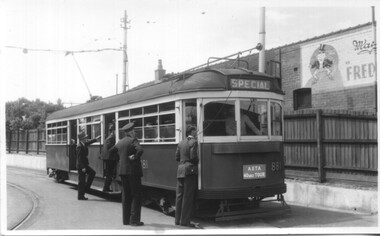
Photograph - Set of 5 Black & White - First AETA tour, 15-2-1947
... first Australian Electric Traction Association (AETA) tram tour of Melbourne on 15/2/1947. See page 8 of the March 1947 issue of "Tram Tracks" for details of the tour and the MMTB Crew. 1 - SW6 881 about to leave Glen Huntly Depot 2 - Crossing Balaclava Junction 3 - Crossing the Kooyong railway level crossing in Glenferrie Road - has the railway signal box and gates in view. 4 - Turning into Riversdale Road from Glenferrie Road with the Stotts Business College building in the background. 5 - Just to the east of Yarra River Bridge in Swan Street with the Burnley Gardens on the right....first Australian Electric Traction Association (AETA) tram tour of Melbourne on 15/2/1947. See page 8 of the March 1947 issue of "Tram Tracks" for details of the tour and the MMTB Crew. 1 - SW6 881 about to leave Glen Huntly Depot 2 - Crossing Balaclava Junction 3 - Crossing the Kooyong railway level crossing in Glenferrie Road - has the railway signal box and gates in view. 4 - Turning into Riversdale Road from Glenferrie Road with the Stotts Business College building in the background. 5 - Just to the east of Yarra River Bridge in Swan Street with the Burnley Gardens on the right. ...Set of five photographs of the first Australian Electric Traction Association (AETA) tram tour of Melbourne on 15/2/1947. See page 8 of the March 1947 issue of "Tram Tracks" for details of the tour and the MMTB Crew. 1 - SW6 881 about to leave Glen Huntly Depot 2 - Crossing Balaclava Junction 3 - Crossing the Kooyong railway level crossing in Glenferrie Road - has the railway signal box and gates in view. 4 - Turning into Riversdale Road from Glenferrie Road with the Stotts Business College building in the background. 5 - Just to the east of Yarra River Bridge in Swan Street with the Burnley Gardens on the right.Yields information about the first AETA tram tour in 1947Set of 5 Black and white photograph on paper. Two copies of each held.Each one of the set has a photographers file stamp on the rear, but no details filled in.trams, tramways, aeta, tram tours, tram 881, sw6 class, glen huntly, kooyong level crossing, glenferrie road, riversdale road, burnley, hawthorn, balaclava junction, glen huntly depot, hawthorn road, swan st -
 Melbourne Tram Museum
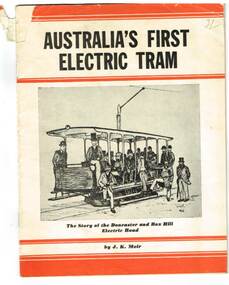
Book, J. K. Moir, "Australia's First Electric Tram", 1957
... Twenty page book including paper covers titled "Australia's First Electric Tram" written by John Kinmont Moir and published by Traction Publications, Historical Series No. 1 in 1957. The story of the Doncaster and Box Hill Electric Road...Twenty page book including paper covers titled "Australia's First Electric Tram" written by John Kinmont Moir and published by Traction Publications, Historical Series No. 1 in 1957. The story of the Doncaster and Box Hill Electric Road ...Twenty page book including paper covers titled "Australia's First Electric Tram" written by John Kinmont Moir and published by Traction Publications, Historical Series No. 1 in 1957. The story of the Doncaster and Box Hill Electric Road (tramway). Publishers Note on page 6, advises that this book was the 3rd edition and gives the background history. Has a sketch on the front cover of the opening ceremony at Box Hill, poster advertising the tramway, a map, foreword written by J.K. Moir about Mr. H. J. Hilton who operated the tramway, the birth of the tramway, the company that was formed to operate it, , a sample ticket, opening, operation, timetable, reminiscences of H. J. Hilton. Includes notes on the subsequent work of Mr. Hilton, and on the back cover a details of the AETA , office bearers, publications and contact details. Includes a number of photographs. .1 - Copy of the 4th edition, dated 1961, added 19/11/14 - see image i4. Front inside cover has a different arrangement. See image htd420i5.pdf See Reg Item 2058 for the second edition - 1950 and 3850 for the 1940 edition.420 - In pencil on the front cover 2/- 420.1 - has label of "From the library of Esmey Herscovitch" on lower left hand corner of page 3, and "Herscovitch" in ink on the top of the same page.trams, tramways, box hill, doncaster, tramways -
 Melbourne Tram Museum
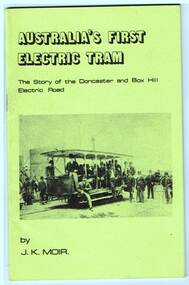
Book, J. K. Moir, "Australia's First Electric Tram", 1957
... Thirty two page book, centre stapled, including light green card covers titled "Australia's First Electric Tram" written by John Kinmont Moir and the story of the Doncaster and Box Hill Electric Road (tramway). ...Trams tramways Box Hill Doncaster Tramways Thirty two page book, centre stapled, including light green card covers titled "Australia's First Electric Tram" written by John Kinmont Moir and the story of the Doncaster and Box Hill Electric Road (tramway). ...Thirty two page book, centre stapled, including light green card covers titled "Australia's First Electric Tram" written by John Kinmont Moir and the story of the Doncaster and Box Hill Electric Road (tramway). Republished by Rotary Club of Box Hill, May 1977, see back cover for publication details. Has a photo on the front cover of the opening ceremony at Box Hill, poster advertising the tramway, a copy of a share certificate, foreword written by J.K. Moir about Mr. H. J. Hilton who operated the tramway, the birth of the tramway, the company that was formed to operate it, a sample ticket, opening, operation, timetable, reminiscences of H. J. Hilton. Includes a number of photographs. See also Reg Item 420 for an AETA version of this publication. 2nd copy added 24/12/2014.trams, tramways, box hill, doncaster, tramways -
 Melbourne Tram Museum
Book, J. K. Moir, "Australia's first electric tram", 1950
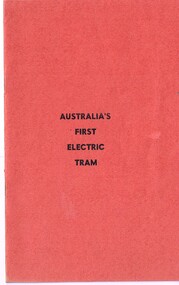
... Twenty page book including paper covers titled "Australia's First Electric Tram" written by John Kinmont Moir and published by Traction Publications, second edition, 1950. The story of the Doncaster and Box Hill Electric Road (tramway). ...Trams tramways Box Hill Doncaster Tramways Twenty page book including paper covers titled "Australia's First Electric Tram" written by John Kinmont Moir and published by Traction Publications, second edition, 1950. The story of the Doncaster and Box Hill Electric Road (tramway). ...Twenty page book including paper covers titled "Australia's First Electric Tram" written by John Kinmont Moir and published by Traction Publications, second edition, 1950. The story of the Doncaster and Box Hill Electric Road (tramway). Publishers Note on page 3 that the first edition of the book was published by Mr. Moir at his own expense - this edition is a reproduction of the first and uses some of the printing blocks. Red covers, poster advertising the tramway, a map, foreword written by J.K. Moir about Mr. H. J. Hilton who operated the tramway, the birth of the tramway, the company that was formed to operate it, , a sample ticket, opening, operation, timetable, reminiscences of H. J. Hilton. Includes notes on the subsequent work of Mr. Hilton, and on the back cover a details of the AETA , office bearers, publications and contact details. Includes a number of photographs. See Reg Item 2058 for the second edition - 1950 Items 2058 to 2069 within box 72.3 in a brown folder marked "Box Hill to Doncaster Electric Tramway" in black ink.trams, tramways, box hill, doncaster, tramways -
 Melbourne Tram Museum
Pamphlet, City of Whitehorse, "The Box Hill - Doncaster Electric Tramway", 1998
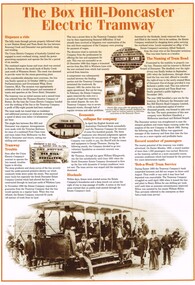
... Australia's first electric tram service - Box Hill to Doncaster in 1889. A3 Pamphlet folded into 6, with photos and copy of timetable. Includes extensive notes on the tramway history, economics, passengers, services and notes on Henry Hilton. Includes notes o Tram Road...Australia's first electric tram service - Box Hill to Doncaster in 1889. A3 Pamphlet folded into 6, with photos and copy of timetable. Includes extensive notes on the tramway history, economics, passengers, services and notes on Henry Hilton. Includes notes o Tram Road ...Two colour pamphlet describing the history of the Australia's first electric tram service - Box Hill to Doncaster in 1889. A3 Pamphlet folded into 6, with photos and copy of timetable. Includes extensive notes on the tramway history, economics, passengers, services and notes on Henry Hilton. Includes notes o Tram Road and Hilton's Lane. Document has been laminated. Notes that the document was published in 1998 by the City of Whitehorse. Printed on off-white paper, with a reddish brown colour partly through the sheet. See Reg Item 2146 for a full set of these pamphlets - earlier versions. See Reg Item 869 for an DL version.trams, tramways, box hill, centenary, exhibitions, tramways, doncaster, city of box hill -
 Melbourne Tram Museum
Album - Ron Scholten Slide Collection, Ron Scholten
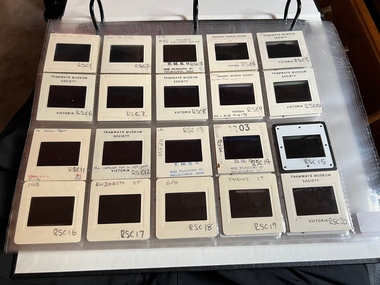
... RSC64 Australia’s First Electric Tram at Box Hill with tramway men including H J Hilton who is in the centre RSC65 W2 484 en-route to St Kilda Junction and another wait for passengers after a race meeting at Caulfield Racecourse RSC66 X1 463 on the Footscray system en-route to Russell Street RSC67 Geelong 35 on Chilwell Route, Formerly HTT 13, M&MTB 119, then Bendigo 1 and Ballarat 37 RSC68 P&MTT No 4 on Opening Day of the system in Glenferrie Road RSC69 Bendigo No 6 in McCrae Street near the Depot en-route to North Bendigo RSC70 P&MTT No 4 in Glenferrie Road on opening day of the system RSC71 Scrubber No 3 stripped and awaiting scrapping at Preston Workshops RSC72 Scrubber No 4 at South Melbourne Depot RSC73 Q 191 & 139 at Preston Workshops awaiting scrapping RSC74 Rail Grinder No 3 at Preston Workshops as purchased from Sydney RSC75 Y 469 waits to shunt at Wattle Park Terminus as Y1 613 departs on driver training duties RSC76 VR 53 on the outside roads at Essendon Depot RSC77 W5 796 with three doors and square windows running out of Brunswick Depot in Cameron Street, with a supplementary destination board showing “City via Swanston St” RSC78 W2 258 on the wheel grinder road at Brunswick Depot RSC79 X2 676 on a TMSV tour, W5 817 & 836 & VR 53 on the open roads at Essendon Depot RSC80 PCC 1041 on test, passes W7 1035 in High Street Preston RSC81 D1 class production number 7 as delivered on test in Matthews Avenue RSC82 W2 383 on route 5 turning from the reserved track in Dandenong Road into St Kilda Road at St Kilda Junction RSC83 Z3 204 as advertising tram for Vodaphone Grand Prix running into Malvern Depot new shed RSC84 Z1 No 4 on test in St Georges Road RSC85 PCC 1041 on Route 96 in Bourke Street near Exhibition Street RSC86 Z1 No 3 without numbers on test turning from Miller Street in St Georges Road RSC87 Track components stored in Coldblo Road at Malvern Depot with Z class cars adjacent RSC88 D1 3501 in M/Tram Livery on Route 55 in Peel Street at Franklin Street RSC89 C 3001 in Yarra Trams Livery Porto No 018 & D1 3502 in M/Tram Livery on display in Harbourside Esplanade RSC90 D1 class tram production number 7, in as delivered condition on test in Matthews Avenue RSC91 D1 3503 inside Malvern Depot RSC92 SW6 955 and W6 974 in St Kilda Road at City Road at dusk. ...RSC64 Australia’s First Electric Tram at Box Hill with tramway men including H J Hilton who is in the centre RSC65 W2 484 en-route to St Kilda Junction and another wait for passengers after a race meeting at Caulfield Racecourse RSC66 X1 463 on the Footscray system en-route to Russell Street RSC67 Geelong 35 on Chilwell Route, Formerly HTT 13, M&MTB 119, then Bendigo 1 and Ballarat 37 RSC68 P&MTT No 4 on Opening Day of the system in Glenferrie Road RSC69 Bendigo No 6 in McCrae Street near the Depot en-route to North Bendigo RSC70 P&MTT No 4 in Glenferrie Road on opening day of the system RSC71 Scrubber No 3 stripped and awaiting scrapping at Preston Workshops RSC72 Scrubber No 4 at South Melbourne Depot RSC73 Q 191 & 139 at Preston Workshops awaiting scrapping RSC74 Rail Grinder No 3 at Preston Workshops as purchased from Sydney RSC75 Y 469 waits to shunt at Wattle Park Terminus as Y1 613 departs on driver training duties RSC76 VR 53 on the outside roads at Essendon Depot RSC77 W5 796 with three doors and square windows running out of Brunswick Depot in Cameron Street, with a supplementary destination board showing “City via Swanston St” RSC78 W2 258 on the wheel grinder road at Brunswick Depot RSC79 X2 676 on a TMSV tour, W5 817 & 836 & VR 53 on the open roads at Essendon Depot RSC80 PCC 1041 on test, passes W7 1035 in High Street Preston RSC81 D1 class production number 7 as delivered on test in Matthews Avenue RSC82 W2 383 on route 5 turning from the reserved track in Dandenong Road into St Kilda Road at St Kilda Junction RSC83 Z3 204 as advertising tram for Vodaphone Grand Prix running into Malvern Depot new shed RSC84 Z1 No 4 on test in St Georges Road RSC85 PCC 1041 on Route 96 in Bourke Street near Exhibition Street RSC86 Z1 No 3 without numbers on test turning from Miller Street in St Georges Road RSC87 Track components stored in Coldblo Road at Malvern Depot with Z class cars adjacent RSC88 D1 3501 in M/Tram Livery on Route 55 in Peel Street at Franklin Street RSC89 C 3001 in Yarra Trams Livery Porto No 018 & D1 3502 in M/Tram Livery on display in Harbourside Esplanade RSC90 D1 class tram production number 7, in as delivered condition on test in Matthews Avenue RSC91 D1 3503 inside Malvern Depot RSC92 SW6 955 and W6 974 in St Kilda Road at City Road at dusk. ...Photo - see pdf file for further information. Number Brief Description RSC1 PCC 1041 at the gates of Preston Workshops on a test run without its trolley retriever RSC2 PCC 1041 in Glenhuntly Road on Route 67 en-route to Carnegie crossing the Railway Gates at Glenhuntly Station RSC3 W2 482 stored at Malvern Depot with Olympic Park on the Destination RSC4 Cable Car Set 64 in Swanston Street outside Princess Bridge Station in bound with open top Double Deck Bus, Trak Motors ? Departing from Flinders St Station RSC5 W3 669 in St George Road at Sumner Street en-route to Preston Workshops for scrapping RSC6 Cable Car in Lygon Street en-route to Carlton RSC7 PCC 1041 turning from St Georges Road into Miller Street to enter the Preston Workshops RSC8 Flinders Street Station with cable cars RSC9 PCC 1041 in strife on its maiden day in service. Trams on route 88 delayed in Queens Parade Clifton Hill RSC10 Flinders Street at William Street with Cable Cars RSC11 L 104 on the fan of the new shed at Malvern Depot on a TMSV tour RSC12 Cable Set 1 after it’s restoration at Preston Workshops on the fan near the front gate RSC13 X1 466 at a suburban terminus of the Footscray System RSC14 X2 680 at Point Ormond Terminus RSC15 An ex Launceston Tram at the outside terminus of the Penny Royal Complex Tramway in Launceston RSC16 Q 148 at Preston Workshops awaiting disposal RSC17 Elizabeth Street with Cable Cars RSC18 Elizabeth and Bourke Streets corner outside the GPO with cable cars RSC19 Collins Street with Cable Cars RSC20 A photo taken from the observation deck of the ICI building showing a view of Parliament House with a W class tram in Nicholson Street RSC21 Auburn Horse car with a posed photo of all the tramway men employed RSC22 Cheltenham Double Deck Horsecar with a full load of passengers RSC23 City of Northcote cable trailer No 3 at a terminus RSC24 City of Northcote Cable cars passing in High Street Northcote RSC25 St Kilda Road at Princes Bridge with Cable Cars RSC26 Flinders Street with Cable Cars RSC27 Cable Cars RSC28 Bourke Street looking towards Elizabeth Street from Queen Street RSC29 Cable cars in Bourke Street at Elizabeth Street looking east RSC30 Cable cars in Elizabeth Street at the terminus at Flinders Street RSC31 Cable cars in Bourke Street at Swanston Street looking west RSC32 Cable cars in Swanston Street at Flinders Street looking north RSC33 Cable cars in Collins Street near Russell Street RSC34 Cable cars in Elizabeth Street at Bourke Street RSC35 Cable cars in Collins Street at Elizabeth Street RSC36 Cable Cars in Swanston Street at Flinders Street RSC37 Cable cars in Collins Street RSC38 Cable Cars RSC39 Cable cars in St Kilda Road near Princes Bridge RSC40 Cable cars in Collins Street east of Swanston Street RSC41 Cable cars in Spring Street outside Parliament House RSC42 K class No 92 in M&MTB Chocolate and cream livery but with a P&MTT Destination box on Route 14 RSC43 Thornbury Depot viewed from Miller Street and St Georges Road. Two W2 class cars are laying over between the peaks RSC44 Z3 No 201 in Met Livery passes D1 No 3510 in new M/Tram livery. A staff member in uniform stands in the doorway. Dandenong Road RSC45 D1 No 3530 advertising Heinekin Super Golf on Route 55 in Royal Park RSC46 D1 No 3504 in M/Tram livery on the reserved track in Matthews Avenue near Essendon Airport showing Route 81 Travancore. I suspect it is a private enthusiasts charter due to the Malvern W class run number in the rear windscreen RSC47 D1 No 3504 on Route 64 in Dandenong Road in M/Tram Livery RSC48 D1 No 3504 in M/Tram Livery at Airport West Terminus RSC49 D1 No 3504 in M Tram Livery in Union Road outside the Showgrounds RSC50 D1 No 3504 at West Maribyrnong Terminus in M/Tram Livery RSC51 D1 No 3503 in M/Tram Livery in Malvern Depot RSC52 SW6 No 960 and VR No 53 in Harbour Esplanade for the NMEL&T Co Centenary RSC53 Hawthorn Tramways Trust No 32 in Harbour Esplanade for the NMEL&T Co Centenary RSC54 VR 53 & B 2042 in Harbour Esplanade for the NMEL&T Co Centenary RSC55 VR 53 & C 3016 in Harbour Esplanade for the NMEL&T Co Centenary RSC56 NMEL&T Co No 13 (Formerly No 214) in Harbour Esplanade for the NMEL&T Co Centenary RSC57 NMEL&T Co 13 (formerly No 214) at Preston Workshops for the NMEL&T Co Centenary RSC58 Hawthorn Tramways Trust Lettering on HTT No 32 in Harbour Esplanade for the NMEL&T Co Centenary RSC59 Hawthorn Tramways Trust No 32 in Harbour Esplanade for the NMEL&T Co Centenary RSC60 Hawthorn Tramways Trust No 32 in Harbour Esplanade for the NMEL&T Co Centenary RSC61 Hawthorn Tramways Trust No 32 in Harbour Esplanade for the NMEL&T Co Centenary RSC62 NMEL&T Co No 13 (formerly No 214) at Preston Workshops for the NMEL&T Co Centenary RSC63 W2 516 and another on route 59 wait to shunt at Essendon Aerodrome Terminus as W2 571 on route 49 departs. This was the last day of operation. RSC64 Australia’s First Electric Tram at Box Hill with tramway men including H J Hilton who is in the centre RSC65 W2 484 en-route to St Kilda Junction and another wait for passengers after a race meeting at Caulfield Racecourse RSC66 X1 463 on the Footscray system en-route to Russell Street RSC67 Geelong 35 on Chilwell Route, Formerly HTT 13, M&MTB 119, then Bendigo 1 and Ballarat 37 RSC68 P&MTT No 4 on Opening Day of the system in Glenferrie Road RSC69 Bendigo No 6 in McCrae Street near the Depot en-route to North Bendigo RSC70 P&MTT No 4 in Glenferrie Road on opening day of the system RSC71 Scrubber No 3 stripped and awaiting scrapping at Preston Workshops RSC72 Scrubber No 4 at South Melbourne Depot RSC73 Q 191 & 139 at Preston Workshops awaiting scrapping RSC74 Rail Grinder No 3 at Preston Workshops as purchased from Sydney RSC75 Y 469 waits to shunt at Wattle Park Terminus as Y1 613 departs on driver training duties RSC76 VR 53 on the outside roads at Essendon Depot RSC77 W5 796 with three doors and square windows running out of Brunswick Depot in Cameron Street, with a supplementary destination board showing “City via Swanston St” RSC78 W2 258 on the wheel grinder road at Brunswick Depot RSC79 X2 676 on a TMSV tour, W5 817 & 836 & VR 53 on the open roads at Essendon Depot RSC80 PCC 1041 on test, passes W7 1035 in High Street Preston RSC81 D1 class production number 7 as delivered on test in Matthews Avenue RSC82 W2 383 on route 5 turning from the reserved track in Dandenong Road into St Kilda Road at St Kilda Junction RSC83 Z3 204 as advertising tram for Vodaphone Grand Prix running into Malvern Depot new shed RSC84 Z1 No 4 on test in St Georges Road RSC85 PCC 1041 on Route 96 in Bourke Street near Exhibition Street RSC86 Z1 No 3 without numbers on test turning from Miller Street in St Georges Road RSC87 Track components stored in Coldblo Road at Malvern Depot with Z class cars adjacent RSC88 D1 3501 in M/Tram Livery on Route 55 in Peel Street at Franklin Street RSC89 C 3001 in Yarra Trams Livery Porto No 018 & D1 3502 in M/Tram Livery on display in Harbourside Esplanade RSC90 D1 class tram production number 7, in as delivered condition on test in Matthews Avenue RSC91 D1 3503 inside Malvern Depot RSC92 SW6 955 and W6 974 in St Kilda Road at City Road at dusk. RSC93 Freight Car No 19 at Preston Workshops in green Livery RSC94 Rail Grinder No 3 in green Livery at South Melbourne Per Way Yard RSC95 A SW6 class car on route 50 shunting at Elizabeth Street Terminus at night, taken from Flinders Street Station RSC96 W2 588 & 435 in St Kilda Road at Batman Avenue RSC97 Y1 613 in service at Wattle Park Terminus RSC98 W2 588 in Wellington Parade en-route to the City with a Grand Final Load of passengers followed closely by No 384 RSC99 W2 558 on MCG Footy Special entering the Simpson Street siding RSC100 W3 657 & an L Class in the new shed at Malvern Depot RSC101 Y1 613 in St Kilda Road on an enthusiast's tour in St Kilda Road south of St Kilda Junction RSC102 Y1 613 on an enthusiast's tour in Clarendon Street with the two extra tracks on the Railways viaduct under construction RSC103 W6 976 on the fan of the new shed at Malvern Depot RSC104 W7 1024 as an advertising car for Bank of NSW at the route 1 terminus at South Melbourne Beach RSC105 PCC 980 on route 96 in Nicholson Street near North Fitzroy Depot RSC106 SW6 890 with dash canopy lighting in Market Street on the opening day of William Street Services RSC107 W2 444 with big numbers heads a line of footy specials in Simpson Street Siding RSC108 Cable Cars in Elizabeth Street RSC109 NMEL&T co No 2 with a trailer outside the power station in Mount Alexander Road RSC110 Alf Twentyman’s cable car set in his Northcote backyard RSC111 Cable Cars in Queens Parade Clifton Hill RSC112 Cable cars in Collins Street outside the Town Hall RSC113 PCC 1041 at Carnegie terminus RSC114 Cable cars in Elizabeth Street RSC115 Cable cars in Collins St near Swanston St RSC116 HTT 19 turns from Riversdale Road into Camberwell Road at Camberwell Junction RSC117 W1 419 official builders photo of first car of the class RSC118 Cable car with a full load of passengers RSC119 W1 422 illuminated for the visit of T.R.H. The Duke and Duchess of York RSC120 PCC 1041 in strife on it’s maiden day in service. Trams on route 88 delayed in Queens Parade Clifton Hill RSC121 Bendigo Birney car in Finn Street near North Bendigo terminus RSC122 SW6 in St Kilda Road at Domain Road at night RSC123 All 3 of Alf Twentyman’s cable cars in his Northcote backyard RSC124 Cable trailer 256 being unloaded into the shed at Bylands RSC125 Cable grip car 1 being removed from the Melbourne Museum RSC126 Alf Twentyman's cable cars in his Northcote Backyard RSC127 Alf Twentyman's cable cars in his Northcote Backyard RSC128 Alf Twentyman's cable cars in his Northcote Backyard RSC129 Alf Twentyman's cable cars in his Northcote Backyard RSC130 W class car in Swanston Street at Collins Street RSC131 Y1 469, L & W3 on the run out of Glenhuntly Depot on a tour RSC132 W7 1024 as an advertising tram for Bank of NSW at Clifton Hill RSC133 W2 496 on a footy special in Simpson Street Siding RSC134 W2 as originally converted to a test car at Preston Workshops RSC135 W3 667 in Brunswick Depot with Ellen Butland at the controls RSC136 W3 669 on its final run at Victoria Parade and Brunswick Street RSC137 W2 571 in Wellington Parade at Clarendon Street with a Footy Final load of Passengers RSC138 Y1 613 shunts at Spencer Street Terminus as X 217 waits on Australia Day Pageant RSC139 PCC 1041 on Route 96 in Bourke Street outside the Southern Cross Hotel RSC140 SW6 890 with accident damage on the outside roads at Preston Workshops, c1978 RSC141 W2 535 on Route 4 at the old St Kilda Junction, c1967 RSC142 PCC 1041 on Route 88 turns from Bourke Street into Spring Street, 1973 RSC143 L 102 on a tour at Albert Park Beach Terminus, Feb 1972 RSC144 W5 class Nos 833, 834 & 835 in Malvern Depot, c1976 RSC145 W2 No 281 in Wellington Parade on a football very crowded special c1974 RSC146 X1 No 464 Ballarat Road 1960 RSC147 T No 181 bound for the Explosives Factory - at Footscray Station - July 1960 RSC148 T No 181 at Williamstown Road, 1960 RSC149 Cable car set in Alf Twentyman’s back yard, c1970 RSC150 X No 217 at Malvern Depot, c1970 RSC151 X1 No 465 and T No181 Footscray Football ground in Barkly Street. c1960 RSC152 Scrubber No 5 at South Melbourne Depot, c1960 RSC153 X1 No 465 Footscray to Russell Street, c1960 RSC154 X1 No 467 Leeds Street Footscray, 1960 RSC155 PMTT No 4 Glenferrie Road, 1910 RSC156 S No 164 at Malvern Depot c1970 RSC157 T No 178 Footscray c1960 RSC158 Cleaner No. 7 at South Melbourne Depot c1960 RSC159 Two Y classes at Princes Bridge and Batman Avenue mid 1950s RSC160 Swanston Street – Nu color vue slide – M142 Demonstrates the work of Ron Scholten in photography, collection and/or production of duplicate slidesAssembled album in a black presentation folder of 160 colour slides, 8 slide sleeves, collected or produced by Ron Scholten. Many are TMSV or Windsor Publications slides. All photographs have been scanned and placed on the Museum's G drive. A list of all photographs with details has been compiled. melbourne, tramways, trams, cable trams, horse tram, route 67, route 88, route 55, route 64, route 59, route 49, route 50, point ormond, royal park, swanston st, footscray, essendon depot, matthews ave, brunswick depot, glenhuntly depot, malvern depot, st.georges road, preston workshops, pcc class, vr class, w2 class, w3 class, l class, s class, x class, x1 class, k class, z3 class, d1 class, sw6 class, w6 class, w7 class, t class, b1 class, c class, q class, y class, y1 class, w5 class, z1 class, tram 465, tram 181, tram 217, tram 467, tram 164, tram 102, tram 669, tram 667, tram 976, tram 890, tram 558, tram 657, tram 571, tram 484, tram 535, flinders st, tram 980, tram 1041, tram 482, tram 64, tram 104, tram 1, tram 466, tram 680, tram 676, tram 955, tram 92, tram 201, tram 3510, tram 3530, tram 3504, tram 3503, tram 53, tram 588, tram 383, tram 960, tram 32, tram 2042, tram 3016, tram 516, tram 43, tram 463, tram 191, tram 139, tram 469, tram 613, tram 796, tram 258, tram 384
