
Showing 531 items matching "australia -- history -- 20th century."
-
 National Vietnam Veterans Museum (NVVM)
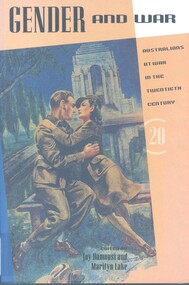
Book, Damousi, Joy ed.,Lake, Marilyn ed, Gender and War: Australians at war in the Twentieth Century
... Sex role - Australia - History - 20th century...Sex role - Australia - History - 20th century Women and war - Australia - History - 20th century Men - Australia - Sexual behavior - History - 20th century War has been a key part of the Australian experience and central to many national mythologies. ...War has been a key part of the Australian experience and central to many national mythologies. Yet more that most activities, war polarises femininity and masculinity, While there has been no shortage of military history, little has been written about Australia's military involvements from the perspective of gender. This exciting collection of essays explores for the first time the interrelationship of gender and war in Australia.War has been a key part of the Australian experience and central to many national mythologies. Yet more that most activities, war polarises femininity and masculinity, While there has been no shortage of military history, little has been written about Australia's military involvements from the perspective of gender. This exciting collection of essays explores for the first time the interrelationship of gender and war in Australia.sex role - australia - history - 20th century, women and war - australia - history - 20th century, men - australia - sexual behavior - history - 20th century -
 Mrs Aeneas Gunn Memorial Library
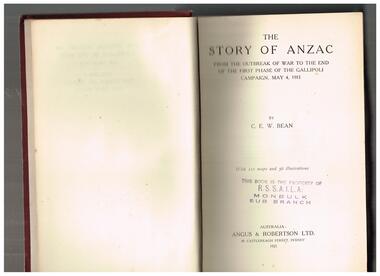
Book, C. E. W. Bean, The Official history of Australia in the War of 1914-1918: The story of ANZAC, from the outbreak of war to the end of the first phase of the Gallipoli campaign, May 4, 1915, 1921-1942
... Australia - History...Australia - History - 20th century...World War 1914-1918 - Australia - History Australia - History - 20th century Volume one of the official history of Australia in the war of 1914-1918 Index, Ill, maps, p.607. ...Volume one of the official history of Australia in the war of 1914-1918Index, Ill, maps, p.607.non-fictionVolume one of the official history of Australia in the war of 1914-1918world war 1914-1918 - australia - history, australia - history - 20th century -
 Mrs Aeneas Gunn Memorial Library
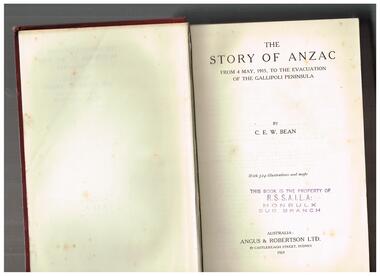
Book, C. E. W. Bean, The Official history of Australia in the War of 1914-1918: The story of ANZAC, from from 4 May, 1915, to the evacuation of the Gallipoli Peninsula, 1921-1942
... Australia - History...Australia - History - 20th century...World War 1914-1918 - Australia - History Australia - History - 20th century Volume two of the official history of Australia in the war of 1914-1918 Index, Ill, maps, p.910. ...Volume two of the official history of Australia in the war of 1914-1918Index, Ill, maps, p.910.non-fictionVolume two of the official history of Australia in the war of 1914-1918world war 1914-1918 - australia - history, australia - history - 20th century -
 Mrs Aeneas Gunn Memorial Library
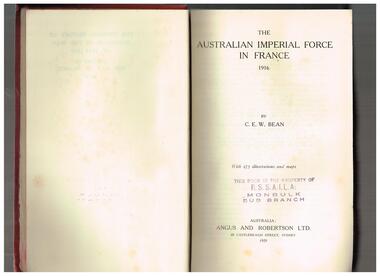
Book, C. E. W. Bean, The Official history of Australia in the War of 1914-1918: The Australian Imperial Force in France 1916, 1921-1942
... Australia - History...Australia - History - 20th century...World War 1914-1918 - Australia - History Australia - History - 20th century Volume two of the official history of Australia in the war of 1914-1918 Index, Ill, maps, p.967. ...Volume two of the official history of Australia in the war of 1914-1918Index, Ill, maps, p.967.non-fictionVolume two of the official history of Australia in the war of 1914-1918world war 1914-1918 - australia - history, australia - history - 20th century -
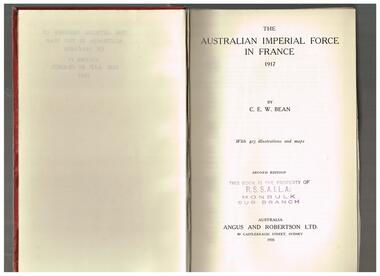 Mrs Aeneas Gunn Memorial Library
Book, C. E. W. Bean, The Official history of Australia in the War of 1914-1918: The Australian Imperial Force in France 1917, 1921-1942
... Australia - History...Australia - History - 20th century...World War 1914-1918 - Australia - History Australia - History - 20th century Volume one of the official history of Australia in the war of 1914-1918 Index, Ill, maps, p.967. ...Volume one of the official history of Australia in the war of 1914-1918Index, Ill, maps, p.967.non-fictionVolume one of the official history of Australia in the war of 1914-1918world war 1914-1918 - australia - history, australia - history - 20th century -
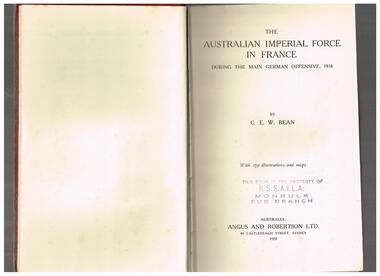 Mrs Aeneas Gunn Memorial Library
Book, C. E. W. Bean, The Official history of Australia in the War of 1914-1918: The Australian Imperial Force in France 1918, 1921-1942
... Australia - History...Australia - History - 20th century...World War 1914-1918 - Australia - History Australia - History - 20th century Volume one of the official history of Australia in the war of 1914-1918 Index, Ill, maps, p.764. ...Volume one of the official history of Australia in the war of 1914-1918Index, Ill, maps, p.764.non-fictionVolume one of the official history of Australia in the war of 1914-1918world war 1914-1918 - australia - history, australia - history - 20th century -
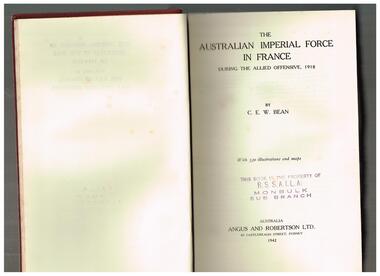 Mrs Aeneas Gunn Memorial Library
Book, C. E. W. Bean, The Official history of Australia in the War of 1914-1918: The Australian Imperial Force in France 1919, 1921-1942
... Australia - History...Australia - History - 20th century...World War 1914-1918 - Australia - History Australia - History - 20th century Volume one of the official history of Australia in the war of 1914-1918 Index, Ill, maps, p.764. ...Volume one of the official history of Australia in the war of 1914-1918Index, Ill, maps, p.764.non-fictionVolume one of the official history of Australia in the war of 1914-1918world war 1914-1918 - australia - history, australia - history - 20th century -
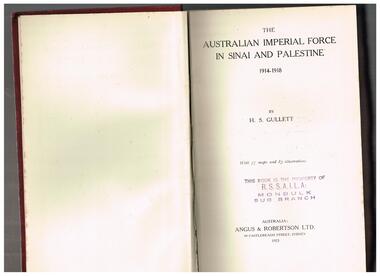 Mrs Aeneas Gunn Memorial Library
Book, Angus & Robertson Ltd, The Official history of Australia in the War of 1914-1918: The Australian Imperial Force in Sinai and Palestine, 1921-1942
... Australia - History...Australia - History - 20th century...World War 1914-1918 - Australia - History Australia - History - 20th century Volume one of the official history of Australia in the war of 1914-1918 Index, Ill, maps, p.792. ...Volume one of the official history of Australia in the war of 1914-1918Index, Ill, maps, p.792.non-fictionVolume one of the official history of Australia in the war of 1914-1918world war 1914-1918 - australia - history, australia - history - 20th century -
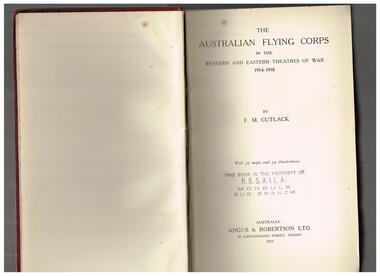 Mrs Aeneas Gunn Memorial Library
Book, Angus & Robertson Ltd, The Official history of Australia in the War of 1914-1918: The Australian Imperial Force in Sinai and Palestine, 1921-1942
... Australia - History...Australia - History - 20th century...World War 1914-1918 - Australia - History Australia - History - 20th century Volume one of the official history of Australia in the war of 1914-1918 Index, Ill, maps, p.452. ...Volume one of the official history of Australia in the war of 1914-1918Index, Ill, maps, p.452.non-fictionVolume one of the official history of Australia in the war of 1914-1918world war 1914-1918 - australia - history, australia - history - 20th century -
 Mrs Aeneas Gunn Memorial Library
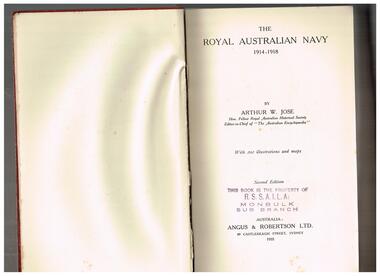
Book, Angus & Robertson Ltd, The Official history of Australia in the War of 1914-1918: The Royal Australian Navy 1914-1918, 1921-1942
... Australia - History...Australia - History - 20th century...World War 1914-1918 - Australia - History Australia - History - 20th century Volume one of the official history of Australia in the war of 1914-1918 Index, Ill, maps, p.612. ...Volume one of the official history of Australia in the war of 1914-1918Index, Ill, maps, p.612.non-fictionVolume one of the official history of Australia in the war of 1914-1918world war 1914-1918 - australia - history, australia - history - 20th century -
 Mrs Aeneas Gunn Memorial Library
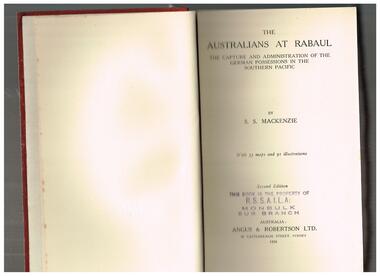
Book, Angus & Robertson Ltd, The Official history of Australia in the War of 1914-1918: The Australians at Rabaul, 1921-1942
... Australia - History...Australia - History - 20th century...World War 1914-1918 - Australia - History Australia - History - 20th century Volume one of the official history of Australia in the war of 1914-1918 Index, Ill, maps, p.386. ...Volume one of the official history of Australia in the war of 1914-1918Index, Ill, maps, p.386.non-fictionVolume one of the official history of Australia in the war of 1914-1918world war 1914-1918 - australia - history, australia - history - 20th century -
 Mrs Aeneas Gunn Memorial Library
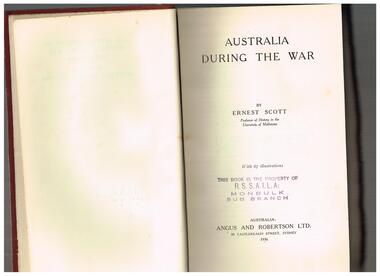
Book, Angus & Robertson Ltd, The Official history of Australia in the War of 1914-1918: Australia during the war, 1921-1942
... Australia - History...Australia - History - 20th century...World War 1914-1918 - Australia - History Australia - History - 20th century Volume one of the official history of Australia in the war of 1914-1918 Index, Ill, maps, p.888. ...Volume one of the official history of Australia in the war of 1914-1918Index, Ill, maps, p.888.non-fictionVolume one of the official history of Australia in the war of 1914-1918world war 1914-1918 - australia - history, australia - history - 20th century -
 Mrs Aeneas Gunn Memorial Library
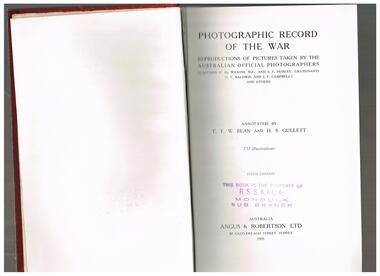
Book, Angus & Robertson Ltd, The Official history of Australia in the War of 1914-1918: Photographic record of the war, 1921-1942
... Australia - History...Australia - History - 20th century...World War 1914-1918 - Australia - History Australia - History - 20th century Volume one of the official history of Australia in the war of 1914-1918 Index, Ill, maps, p?. ...Volume one of the official history of Australia in the war of 1914-1918Index, Ill, maps, p?.non-fictionVolume one of the official history of Australia in the war of 1914-1918world war 1914-1918 - australia - history, australia - history - 20th century -
 Monbulk RSL Sub Branch
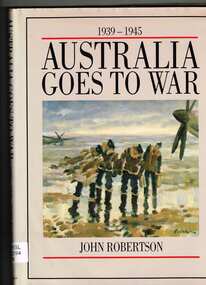
Book, Doubleday, 1939-1945: Australia goes to war, 1984
... ...Australia - History - 20th century...World War 1939-1945 - Australian involvement Australia - History - 20th century Between the wars - Mediterranean campaign - Japanese threat - Malaya - New Guinea - Australia's role in the war - Australian armed services casualties. ...Between the wars - Mediterranean campaign - Japanese threat - Malaya - New Guinea - Australia's role in the war - Australian armed services casualties.Index, ill, maps, p.218non-fictionBetween the wars - Mediterranean campaign - Japanese threat - Malaya - New Guinea - Australia's role in the war - Australian armed services casualties.world war 1939-1945 - australian involvement, australia - history - 20th century -
 National Vietnam Veterans Museum (NVVM)
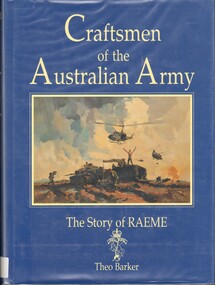
Book, Barker, Theo, Craftsmen of the Australian Army: the story of RAEME, 1992
... Australia. Army. Corps of royal Australian Electrical and Mechanical Engineers - History...Military engineering - Australia - History - 20th century...Corps of royal Australian Electrical and Mechanical Engineers - History Military engineering - Australia - History - 20th century The Corps of Royal Australian Electrical and Mechanical Engineers (RAEME) has the major responsibility for the maintenance, recovery and repair of the Army's electrical and mechanical equipment. ...The Corps of Royal Australian Electrical and Mechanical Engineers (RAEME) has the major responsibility for the maintenance, recovery and repair of the Army's electrical and mechanical equipment.The Corps of Royal Australian Electrical and Mechanical Engineers (RAEME) has the major responsibility for the maintenance, recovery and repair of the Army's electrical and mechanical equipment.australia. army. corps of royal australian electrical and mechanical engineers - history, military engineering - australia - history - 20th century -
 National Vietnam Veterans Museum (NVVM)
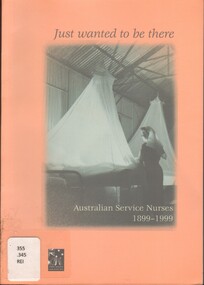
Book, Reid, Richard, Just wanted to be there: Australian Service Nurses 1899-1999
... Nurses and nursing - Australia - History - 20th century...Nurses and nursing - Australia - History - 20th century Military nursing - Australia - History For soldiers, the battlefield is a harsh and savage place. for the wounded and dying, it is an environment of extreme fear, however much their sense of themselves as soldiers demands they must not show it. ...For soldiers, the battlefield is a harsh and savage place. for the wounded and dying, it is an environment of extreme fear, however much their sense of themselves as soldiers demands they must not show it.For soldiers, the battlefield is a harsh and savage place. for the wounded and dying, it is an environment of extreme fear, however much their sense of themselves as soldiers demands they must not show it.nurses and nursing - australia - history - 20th century, military nursing - australia - history -
 Koorie Heritage Trust
Book, Bandler, Faith, Turning the tide : a personal history of the Federal Council for the Advancement of Aborigines and Torres Strait Islanders, 1989
... History. | Aboriginal Australians -- Social conditions. | Race discrimination -- Australia. | Australia -- History -- 20th century...History. | Aboriginal Australians -- Social conditions. | Race discrimination -- Australia. | Australia -- History -- 20th century. | Australia -- Race relations. ...Turning the Tide is about political struggle in the past three decades of Aboriginal affairs in Australia. Faith Bandler's background has given her the right to speak out loudly and clearly against racial discrimination. In 1956 she co-founded the Aboriginal - Australian Fellowship and later became a key figure in the founding of the Federal Council for the Advancement of Aborigines and Torres Strait Islandersxvii, 173 p. : ill., ports. ; 20 cm.Turning the Tide is about political struggle in the past three decades of Aboriginal affairs in Australia. Faith Bandler's background has given her the right to speak out loudly and clearly against racial discrimination. In 1956 she co-founded the Aboriginal - Australian Fellowship and later became a key figure in the founding of the Federal Council for the Advancement of Aborigines and Torres Strait Islandersbandler, faith. | federal council for the advancement of aborigines and torres strait islanders -- history. | federal council for the advancement of aborigines and torres strait islanders -- history. | aboriginal australians -- social conditions. | race discrimination -- australia. | australia -- history -- 20th century. | australia -- race relations. -
![A Smile for My Parents / [by] Heather Henderson](/media/collectors/550653872162f11fb04854aa/items/5ece6a72f36c2704c4f2bf03/item-media/5ece6ad5f36c2704c4f2bf8d/item-fit-380x285.jpg?cb=6) Kew Historical Society Inc
Kew Historical Society IncBook, Allen & Unwin, A Smile for My Parents, 2017
... australia -- history -- 20th century -- biography....australia -- history -- 20th century -- biography. prime ministers -- australia -- biography. ...Biography of Dame Pattie and Sir Robert MenziesCrows Nest, NSW : Allen & Unwin, 2017 ©2013 xii, 227 pages, 16 unnumbered pages of plates : illustrations, portraits, plates ; 20 cm non-fictionBiography of Dame Pattie and Sir Robert Menziesaustralia -- history -- 20th century -- biography., prime ministers -- australia -- biography. -
 Kew Historical Society Inc
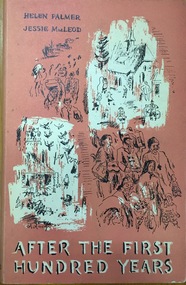
Book, Longmans et al, After the First Hundred Years, 1961
... ...australia -- history -- 20th century....The volume formed part of the professional library of the historian Dorothy Rogers. children's history australia -- history -- 20th century. Owner signature: Dorothy Rogers London : Longmans, Green, 1961 203 p. : ill. ; 22 cm. ...London : Longmans, Green, 1961 203 p. : ill. ; 22 cm. non-fictionchildren's history, australia -- history -- 20th century. -
 Mrs Aeneas Gunn Memorial Library
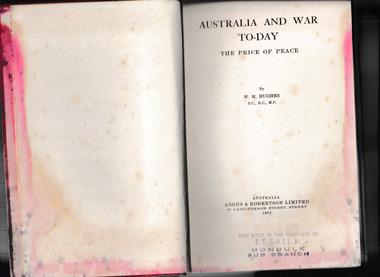
Book, William Hughes, Australia in the war today: The price of peace, 1935
... ...Australia - History - 20th century...Australian - Foreign relations Australia - History - 20th century Views of former Prime Minister William Hughes on the world situation in the 1930s p.162. ...Views of former Prime Minister William Hughes on the world situation in the 1930sp.162.non-fictionViews of former Prime Minister William Hughes on the world situation in the 1930saustralian - foreign relations, australia - history - 20th century -
 National Vietnam Veterans Museum (NVVM)
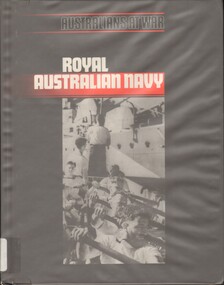
Book, Evans, Alun, Royal Australian Navy: Australians At War
... Australia. Royal Australian Navy - History...Australia - History... Naval - 20th century...Royal Australian Navy - History Australia - History Naval - 20th century the history of the Royal Australian Navy throughout various wars. ...the history of the Royal Australian Navy throughout various wars.the history of the Royal Australian Navy throughout various wars.australia. royal australian navy - history, australia - history, naval - 20th century -
 National Vietnam Veterans Museum (NVVM)
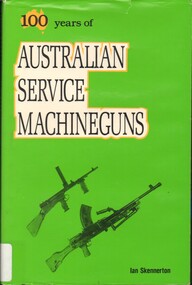
Book, Skennerton, Ian, 100 years of Australian Service Machineguns
... Australia. Army - Firearms - History - 20th century...Australia. Army - Firearms - History - 20th century Machine Guns Australia's history of issues and manufacture is unique, with such renowned foreign guns as the U.S. 100 years of Australian Service Machineguns Book Book Skennerton, Ian ...Australia's history of issues and manufacture is unique, with such renowned foreign guns as the U.S.Australia's history of issues and manufacture is unique, with such renowned foreign guns as the U.S.australia. army - firearms - history - 20th century, machine guns -
Kew Historical Society Inc
Book, Roger Leong, Dressed to Kill: 100 Years of Fashion, 2010
... Australia -- Exhibitions...Costume -- History -- 20th century -- Exhibitions...history and/or to support the Society's collections of pictures, maps, fashion and artefacts. Reference books have entered the collection through donation, presentation, collection and purchase. National Gallery of Australia -- Exhibitions Costume -- History -- 20th century ...80 p. : ill. (some col.), ports. ; 30 cm. non-fictionnational gallery of australia -- exhibitions, costume -- history -- 20th century -- exhibitions, costume -- history -- 19th century -- exhibitions, fashion design -- history -- 20th century -- exhibitions, fashion design -- history -- 19th century -- exhibitions, fashion -- history -- 20th century -- exhibitions, fashion -- history -- 19th century -- exhibitions, fashion and art -- exhibitions. -
Federation University Historical Collection
Book, Ballarat School of Mines Tertiary Orientation Programs, 1980, 1980
... The courses offered were TOP Biology, Chemistry, Computer Science, Workshop Practice and Drawing, Home Economics, Applied MAthematics, General Mathematics (Computing Option), Pure Mathematics, Physical Education, Physics, Craft, Ceramics and Sculpture, Garment Construction, Graphic Communication, Graphic Design (including Design Studies and Printmaking), History of Art, Painting and Drawing, Drawing, Photography, Accounting, Advanced Typewriting, Economics, Legal Studies, Secretarial Studies, 19th Century Australian History, 20th Century Australian History, Australian Media, Behavioural Studies, Drama, English Expression, Field Studies, Film Studies, Introduction to Psychology, Literature, Music, Political Studies and Sociology. ...The courses offered were TOP Biology, Chemistry, Computer Science, Workshop Practice and Drawing, Home Economics, Applied MAthematics, General Mathematics (Computing Option), Pure Mathematics, Physical Education, Physics, Craft, Ceramics and Sculpture, Garment Construction, Graphic Communication, Graphic Design (including Design Studies and Printmaking), History of Art, Painting and Drawing, Drawing, Photography, Accounting, Advanced Typewriting, Economics, Legal Studies, Secretarial Studies, 19th Century Australian History, 20th Century Australian History, Australian Media, Behavioural Studies, Drama, English Expression, Field Studies, Film Studies, Introduction to Psychology, Literature, Music, Political Studies and Sociology. ...148 page yellow covered book outlining the Tertiary Orientation Programs offered by the Ballarat School of Mines in 1980. The courses offered were TOP Biology, Chemistry, Computer Science, Workshop Practice and Drawing, Home Economics, Applied MAthematics, General Mathematics (Computing Option), Pure Mathematics, Physical Education, Physics, Craft, Ceramics and Sculpture, Garment Construction, Graphic Communication, Graphic Design (including Design Studies and Printmaking), History of Art, Painting and Drawing, Drawing, Photography, Accounting, Advanced Typewriting, Economics, Legal Studies, Secretarial Studies, 19th Century Australian History, 20th Century Australian History, Australian Media, Behavioural Studies, Drama, English Expression, Field Studies, Film Studies, Introduction to Psychology, Literature, Music, Political Studies and Sociology. Programs were offered in Applied Science, Nursing, Physical Education, Home Economics, Engineering, Computer Science, Accounting, Secretarial, Humanities and Social Sciences, Art & Design and Fashion and Design.ballarat school of mines, tertiary orientation program, top, courses -
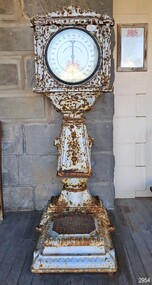 Flagstaff Hill Maritime Museum and Village
Instrument - Scale, Weighing Machine, G. Salter & Co, 1884-1909
... Australia from the early-to-mid 20th century. It is a rare example of an early vending machine used in public places from the late 19th through to the mid-20th century. These machines were the early step in the evolution of coin-in-the-slot machines, which are still used today. The scales give a glimpse into our history ...This ornate, Victorian-era automatic weighing machine was made in England around 1884-1909, by George Salter and Co. of West Bromwich, UK, makers of scales since 1760. It is protected by Queen Victoria’s Royal Letters Patent, signed in 1900. The scale stood outside the Warrnambool Post Office in Timor Street from around 1909 to 1966, as shown on postcards and photographs held at the State Library of Victoria. The scale is identified by the Serial Number '665', and was installed by the distributors, the Australasian Automatic Weighing Machine Co. Ltd.. The scale’s weight measurements were in Imperial stones and pounds up to 20 stone (127 kg). The scale’s face included charts of average weights, for men, women, boys and girls, by various heights, in feet and inches. The coin slot and its face were converted to metric measurements by the Eastern Scale Company Pty. Ltd; that firm was registered on October 2, 1974. The Australasian Automatic Weighing Machine Co. Ltd was a large supplier of weighing scales in Australia and held the Royal Letters patent for their machines, distributing them in prominent locations. In 1902, the firm was listed under the Import Entries Passed at His Majesty’s Customs, importing into Sydney, NSW, eight cases of scales. In 1911, the company asked permission from the Port Pirie Corporation to install a machine in Alexander Street. In 1913, the company applied to the City of Sydney to install machines around the city, including at the tram depot. One application mentions “… three machines in three places for three pounds per year”. In 1923, the firm tendered for the right to place Automatic Weighing Machines on railway and tram premises throughout New South Wales, subsequently for five-year terms, in return for a fixed payment per machine and a portion of the revenue to the NSW Government. In 1928, the Sydney Harbour Trust gave the firm the right to place the weighing machines on various ferry jetties. The firm was still operating in 1941, advertising for two boys aged 14-16 for the workshop and messages, at the Rialto building, 497 Collins St., Melbourne. On December 21, 1946, the Commonwealth government invited offers to tender for the right to place automatic weighing machines on postal premises throughout the six states; the successful company then made arrangements with the federal Postmaster General's Department to place machines outside post offices across the country. A few years later, on September 11, 1950, the firm's Adelaide branch ceased trading. From 11th July 1950, the Australian and Eastern Engineering Company Pty. Ltd took over at the same premises, at 179 Pirie Street, Adelaide. The Perth branch ceased business in WA on July 6th, 1950. Percival Everitt invented and patented the automatic, coin-operated personal scale design. Everitt was a Norfolk-born engineer and regarded as the father of the coin-operated industry. As a young man in 1877, he invented a hay and corn pitcher, a turnip thinner in 1878 and an Automatic Travelling Anchor in 1880. But his fame came in 1883 with the first postcard-vending machine, over a hundred of which he distributed around London. In 1884, he patented one of his many inventions, the coin-operated scales for use in public places; for many people, it was their first exposure to coin-operated machines. His success prompted the formation of the Weighing Machine Company in 1885. Further inventions followed: a blow tester in 1887, the machine for testing a person's grip in 1888, and in 1889, the dispensing machine for hiring out opera glasses, and a device for shutting down the coin entry slot if the machine was empty. In 1890, he invented a fortune-telling machine. Everitt sadly did not make his fortune; he died suddenly in February 1893, in his late forties, with £71 to his name. George Salter & Co., West Bromwich, England, produced automatic weighing scale machines from Everitt’s patented design, and advertised them as suitable for hotels, pleasure gardens, theatres, exhibition halls, clubs, baths and places of public resort. The company was established in 1760 by brothers Richard and William Salter, and manufactured springs and pocket steelyards (spring balances). After several generations, the company was taken over in 1855 by a nephew, George, and renamed George Salter & Co. In 1884, Salter registered the trademark of a Staffordshire knot pierced by an arrow. The company's expanded range of products included the first coin-operated public weighing machines in the 1880s and, in 1895, the first English-made typewriter. In 1915, Salter became a limited company, Geo. Salter & Co. Ltd. When the last George Salter died in 1917, the company passed into the hands of other relatives, but continued to grow before being bought out by Staveley Industries in 1973. Despite several subsequent mergers, the Salter name continues to be seen on household products such as digital scales. This patented, coin-operated weight machine is significant for its association with Percival Everitt, the inventor of the world’s first slot machine, with the renowned maker of scales, G. Salter & Co., which began operating in 1760, and also with the Australasian Automatic Weighing Scale Co., which imported and widely distributed the scales throughout Australia from the early-to-mid 20th century. It is a rare example of an early vending machine used in public places from the late 19th through to the mid-20th century. These machines were the early step in the evolution of coin-in-the-slot machines, which are still used today. The scales give a glimpse into our history; they became quickly popular with the public, which, until then, had little access to weight scales apart from those at medical services. They also provided inexpensive entertainment for families, especially while waiting for trains or visiting the post office. The machines were also attractive and lucrative to the distributors; once installed, they required very little maintenance, and their low cost to customers kept the money coming in. This automatic weighing machine is also significant for its decades of service to the local and regional community of Warrnambool, for personal and commercial purposes. A public coin-operated weighing scale, also called a penny scale. It is a large, silver-painted cast metal stand with a square top on a pedestal that flares outwards to join a rectangular platform base with posts on the side and corners that may have had fitted wheels. The round, white face on top has red and black measurements and inscriptions. A slim indicator with a point at one end and an arc at the other is attached to the face’s centre. The coin slot is above the face, on the left, and the scale’s identification number is engraved on an oval plate on the right. Moulded motifs decorate the pedestal’s front and are repeated on its sides; they depict a tall, narrow urn with a bowl on top and fancy scrolls on either side. There is a decorative panel across the front top of the stand. The top of the pedestal has a small keyhole. The size of the coin slot fitted a penny coin, and the weight measurements on the face were in Imperial stones and pounds. Quite some time after 1966, when Australia introduced new decimal weights, measurements and currency, the scale was updated; the coin slot size was changed, and a new face with metric measurements was installed. The scale now accepts a $1 coin (one dollar) and the scale measures weight in kilograms and grams, from 0 to 125 kg.. The rear of the scale has a small, rectangular metal plate with printed text. The scale was made by G Salter & Co. of West Bromwich, UK, distributed by the Australasian Automatic Weighing Platform Co., and updated to metric measurements by Eastern Scale Co. Pty Ltd. It was previously installed at the Warrnambool Post Office. Engraved on an oval plate on the right: "665" Top centre of the face, in red: "$1 coin" Top of face: "EASTERN SCALE CO. PTY LTD" Base of face, in red: "[Royal Coat of Arms of Britain]" with words, below in red: "BY ROYAL LETTERS PATENT" Around the face, in black: "[numbers 0 to 125, in increments 5, and makes between the numbers for each 500g]" "kg" Below the face, moulded letters within a shield: "AUSTRALASIAN AUTOMATIC WEIGHING MACHINES CO. LTD." At the back of the weighing platform: "G SALTER & CO. / WEST BROMWICH", remnants of logo “[Staffordshire knot pierced by an arrow]” Plate on rear: THIS SCALE REMAINS THE PROPERTY OF EASTERN SCALE CO. PTY. LTD., 8 GEORGE COURT, GREENSBOROUGH, VIC, 3088. PHONE (03 ) _ 34 _ _ 33” (434 9333 ?_flagstaff hill, warrnambool, maritime village, maritime museum, flagstaff hill maritime museum and village, shipwreck coast, great ocean road, scale, weighing scale, salter, australasian, 1 dollar, $1 coin, 1p, 1 penny coin, penny scale, coin in slot scale, eastern scale co. pty. ltd., british royal coat of arms, royal letters patent, letters patent, health, ending machine, coin-operated machine, percival everett, weighing machine co., george salter & co., g salter & co, west bromwich, vending machine, weights & balances, measurements, slot machine, coin operated machine, penny-in-the-slot, coin fed, coin op scale, weights & measures, australasian automatic weighing machine co. ltd., warrnambool post office, machine 665, no. 665, blalnce technology, scales and weights, weights and measures, penny weight scales, vintage, weighing machine, coin in the slot, coin operated, public scale, public weighing machine, penny-weighing machines, penny weighing machines, penny scales, coin operated weighing machine, scale weighing machine -
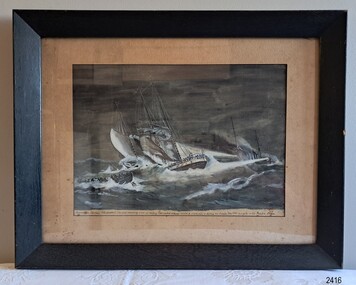 Flagstaff Hill Maritime Museum and Village
Print - Lithograph, sea rescue, R.N. Duffield, Australian cruiser “MELBOURNE” (Tons 5600) rescuing crew of sinking four-masted schooner “HELEN B. STERLING” of Halifax NS Canada, Tons 1343 in a gale in the Pacific Ocean, 19-11-1924
... Australian cruiser “Melbourne”. The image demonstrates the perilous conditions experienced by seafarers. It includes an example of the line and breeches buoy method used to save lives at sea from the 1860s and into the 20th century. It reflects a time in our history ...This framed lithograph print in watercolour and gouache was produced on November 19th, 1924, by 20th-century marine artist, Mr R.N. Duffield. It depicts the event of a sea rescue that took place two years earlier. The framer was A.L. Frith of Footscray, Melbourne, who actively advertised from 1933 to 1935. The now disbanded Shiplovers' Society of Victoria (1930-2018) donated the print, and it seems likely that this print was framed for that organisation. This graphic image shows the conditions in which the rescue from the wrecked Helen B. Sterling happened. Captain George Harris was master of the American-owned, four-masted windjammer. His wife Edith and their ten-year-old son Leslie were on board, along with a crew of fifteen seamen. The ship set off from Newcastle, NSW, on January 5th, 1922, loaded with a cargo of coal to deliver to the Society Islands and on to San Francisco. Young Leslie later wrote a lively school composition for his teacher about his experiences on board the Helen B Sterling. He tells of a fire that broke out the day after they departed and burned a hole in a beam. Then another troublesome time on the 9th, when a strong gale blew a sail off the ship. Finally, he tells of the highlight of his voyage when, on the 18th January, the ship was right in the path of a strong cyclone, which broke the mainmast. Huge waves crashed over both sides of the deck, meeting in the middle, and the ship began to sink. The rescue from the wreck was an exciting time for the young boy, and even more so when one of his cats survived after being carefully wrapped in a pillowcase and thrown down from the ship for the boy. Reporters later wrote about Leslie’s comments, “... what had grieved him most was the thought that he might never see his two little sisters again”. Captain Harris said in a published statement, “… the gale was the worst he had met in his 12 years’ experience at sea. All went well for the first week. We then encountered a strong blow from the south-east. We tried the gasoline pump, but the engine broke down, and we had to do the pumping by hand. We at once shortened sail, but the sea increased in fury to such an extent that men were washed from the pumps. I was below at 5:30 on Sunday morning [January 22nd, 1922] when the main mast went over the side, … I at once sent out SOS signals, and got word that HMAS Melbourne was coming to our assistance. I had made a mistake with regard to our position, but did not know it until 11:30 o’clock, when I sent out the correct location. This was picked up by the Melbourne and I received the following reply: “We will reach you about 2 am. Keep a good heart. The Melbourne will do all she can.” Our ship was practically awash when we were taken off.” (Ref: the ‘Helen B. Sterling Disaster’, Maitland Weekly Mercury, NSW, 4-2-1922.) Officers from the Royal Australian Navy, Captain Henry J Feakes (later Rear-Admiral) and Commander Wilfrid Ward Hunt, were on board the light cruiser, HMAS Melbourne (1913-1928), when it left Sydney for New Zealand. After the SOS was received, the ship sped at full steam towards the sinking Helen B. Sterling. They found the vessel at about midnight and shone bright search lights on the distressed ship to illuminate the desperate scene. The Melbourne was unable to move close to the schooner, so sixteen seamen, including Commander Hunt, volunteered to man the Melbourne’s lifesaving 12-oared cutter. They rowed the sea boat with great urgency towards the victims of the sinking ship, keen to save lives no matter what the conditions. When the cutter was close to the Sterling, a line was secured between the Sterling and the cutter. The weary, waterlogged and anxious men on board could be rescued, one at a time, in the breeches buoy equipment, which looked like canvas shorts with a lifesaving ring in the waistband. The victims were hauled along the line and pulled aboard by many willing hands. All eighteen crew and passengers were saved, including Captain Harris and his family. The seamen of the Melbourne received a heroes’ welcome when they arrived in New Zealand. The grateful survivors were taken to Auckland, where they received the care and comfort they needed. Melbourne’s Lord Mayor, Cr. Swanston, on behalf of the citizens of Melbourne, formally recognised the heroic rescue efforts of the seamen of the HMAS Melbourne on March 2nd, 1922, at a special presentation. Two large flags, a White Ensign and an Australian “Jack" Flag, were presented to the Captain of HMAS Melbourne, and souvenirs were awarded to the sea boat’s crew and its Commander, Wilfred Ward Hunt. Commander Hunt was also presented with an original watercolour depicting the heroic rescue from the wreck of the Helen B. Sterling, painted just after the event by renowned marine artist Arthur V Gregory (1867-1957), and he received a silver cigarette case bearing the City’s coat of arms and the inscription, "To Commander Ward Hunt from the Citizens of Melbourne as a memento of the rescue of the crew of Helen B. Stirling by H.M.A.S. Melbourne, on 23.1.22". Both the painting and the cigarette case are now treasured items inherited by his grandson; a reminder of “… a very fine naval gentleman who believed in leading by example." R.N. DUFFIELD: - The Lithograph print in our collection by 20th-century English artist R.N. Duffield is dated Nov. 19, 1924. It is very similar to, and possibly created from, the original A V Gregory watercolour presented to Commander Hunt and dated 1922. Mr R.N. Duffield has art works in the Yarmouth Museums, Norfolk Museums Collection; “Orient Liner Otranto …,” and "Convoy of six ships at sea", both painted in watercolour and gouache during the 1940s. Some of his other works, also painted in watercolour and gouache, have been advertised for sale on Internet sites. Some details differ between the original A.V. Gregory and this Lithograph Print: - -the words on the bow on the original watercolour are “Helen B. Sterling, Blain”, which is in Washington, USA, where the Sterling Shipping Company was registered from around 1919; the words on the print are “Helen B. Sterling, Halifax, N S”, for Nova Scotia, Canada, which is the hometown of Sterling Shipping Company founder’s wife, Helen B Sterling. -The watercolour is coloured and has fine details; the print is monochrome - The A V Gregory signed the watercolour in 1922, on the lower left; the print is signed with the Lithographer’s name on the lower right; “R N Duffield, Nov. 19. 1924” ARTHUR VICTOR GREGORY (1867-1957): - A.V. Gregory is a renowned marine artist who worked in watercolour and gouache. He painted actively between 1899 and 1932, creating over 3o0 works. South Melbourne, Victoria, was where he lived and worked. This Lithograph print is significant in that it depicts the rescuing of the passengers and crew of the schooner “Helen B Stirling”. At the time this was a significant event that made most Australian and New Zealand papers because of the involvement of the Australian cruiser “Melbourne”. The image demonstrates the perilous conditions experienced by seafarers. It includes an example of the line and breeches buoy method used to save lives at sea from the 1860s and into the 20th century. It reflects a time in our history when sail and steam ships cruised the world’s seas together, the former trading with a cargo of coal from Newcastle, the latter defending our country in World War I. The print is part of Flagstaff Hill Maritime Museum’s Collection of maritime artworks that depict famous events, vessels and locations, showing the evolution of sea craft, and aiding the interpretation of our maritime history. The Lithograph print is behind glass in a black painted timber frame and mounted under a cream matte. The vivid image depicts a sea rescue in progress. The night scene is illuminated by a light beaming from a steamship, the Cruiser HMAS Melbourne. It reveals figures on the deck of a sinking sailing ship, the schooner Helen B. Sterling, as foaming waves roll across it. The stricken ship has a broken main mast, and a sail has been detached. A small figure is floating in the choppy sea, secured in a breeches buoy that is attached to a rescue line between a lifesaving cutter and the sailing ship. The crewmen in the cutter are ready to haul the shipwrecked victim aboard, while the figures on the foundering ‘Sterling’ watch them. The print’s paper-covered wooden backboard is attached to the frame with small tacks. A metal hanging wire is secured to two dissimilar eyelet screws. Inscriptions include text on the bow of the sinking vessel, a handwritten title below the picture, and a handwritten name in the print’s lower right corner. On the reverse are two oval, black ink stamps and a round cream label with printed text. The hand-painted print was reproduced from a lithograph, signed in the lower right, by R.N. Duffield of England, on November 19th, 1924. A Frith of Footscray, Melbourne framed it. Painted on the ship’s bow: “HELEN B. STERLING / HALIFAX N S” [Nova Scotia, Canada] Handwritten below the print: “AUSTRALIAN CRUISER “MEMBOURNE” (Tons 5600) rescuing crew of sinking four-masted schooner “HELEN B. STERLING” of Halifax NS Canada, Tons 1343 in a gale in the Pacific Ocean.” Handwritten on lower right: “R.N. DUFFIELD / Nov. 19. 1924” (underlined) On paper label: “Phone: / Footscray 398 [some of the text has torn off] / “A. FRITH / PICTURE FRAMER / Manufacturer / 17 Paisley Street / Footscray.“ On both oval stamps: “SHIPLOVERS SOCIETY OF VICTORIA / LIBRARY” flagstaff hill, flagstaff hill maritime museum and village, warrnambool, maritime museum, maritime village, great ocean road, shipwreck coast, lithograph, lithograph print, reproduction print, helen b. sterling, the sterling, american owned schooner, halifax, halifax n s, halifax nova scotia, nova scotia, halifax n s canada, schooner, windjammer, sailing ship, four-masted ship, captain george harris, george harris, edith harris, leslie harris, sterling shipping line, hmas melbourne, hmas melbourne (1), cruiser hmas melbourne, the melbourne, australian cruiser, captain henry j feakes, commander wilfred ward hunt, sinking ship, shipwreck, sea rescue, gale, cyclone, 1922 rescue, shipwreck rescue, breeches buoy, line rescue, rescue line, lifesaving, cutter, cutter melbourne, sea boat, lifesaving crew, 12-oar cutter, shipwreck victim, r.n. duffield, marine artist, nov. 19. 1924, 20th century artist, a frith, footscray picture framer, shiplovers’ society of victoria, shiplovers’ society library, watercolour, a v gregory, arthur victor gregory, melbourne artist, newcastle coal, newcastle nsw, society islands, san fracisco, aukland new zealand, school composition, ship’s cat, sos signal, lord mayor cr. swanston, heroes, cigarette case -
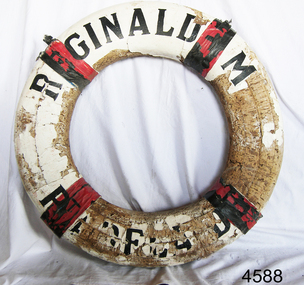 Flagstaff Hill Maritime Museum and Village
Equipment - Lifebuoy, John Murch, 1922
... history. Sadly, in late 2016, the decision was made to 'decommission' the vessel due to the continuing high cost of maintenance and the risk to public safety. Many of the components of the vessel are held as part of Flagstaff Hill's collection. The lifebuoy is an example of equipment carried on vessels in the late 19th and early 20th century to help preserve life. There were many lives lost in Australia’s ...Lifebuoy is from the ketch Reginald M, built in Port Adelaide by John Murch in 1922. Lifebuoys were part of the emergency lifesaving equipment carried on vessels in the late 19th and early 20th century. The ring was made of strips of cork wood joined together to make the ring shape then covered in canvas and sealed usually with white paint. Four evenly spaced canvas reinforcing bands would be added for strength and for a place to thread a rope or line. A lifebuoy, or life-preserver, is used as a buoyancy device often thrown to an endangered or distressed person in the water to keep them afloat while they receive help. It is usually connected by a rope to a person in a safe area such a nearby vessel or on shore. Lifebuoys is a made from a buoyant materials such as cork or foam and ae usually covered with canvas for protection and to make it easy to grip. The first use of life saving devices in recent centuries was by the Nordic people, who used light weight wood or cork blocks to keep afloat. Cork lifebuoys were used from the late 19th to early 20th century. Kapok fibre was then used as a filling for buoys but wasn’t entirely successful. Light weight balsa wood was used as a filler after WW1. In 1928 Peter Markus invented and patented the first inflatable life-preserver. By WW2 foam was combined with Kapok. Laws were passed over time that has required aeroplanes and water going-vessels to carry life-preservers on board. The Reginald M 1922- The two-masted coastal trading ketch Reginald M was built by John (Jack) Murch in Port Adelaide, South Australia, in 1922 and it was launched there in Largs Bay in the same year. It is thought that the keel was hewn from two telegraph poles - its owner was a regular visitor to salvage yards. Its cargo at times included Guano, Barley, Wool, Horses, Cattle, Timber, Explosives, Potatoes, Shell Grit and Gypsum. At one time the vessel was used as a customs boat, renamed 'HMC No. 3, Pt Adelaide'. In 1969 she was used by a mining and railway company as a barge to carry explosives. In 1972 the vessel was renamed 'T.S. Macquarie' and planned to be used for sea cadet training.; this did not eventuate. It was sold again and went to Melbourne to be used for pleasure sailing, and again sold for use as a ferry. Late in 1975 Flagstaff Hill purchased the vessel to be used as an exhibit at the Maritime Village where many visitors enjoyed being able to board and explore a real ship with a long history. Sadly, in late 2016, the decision was made to 'decommission' the vessel due to the continuing high cost of maintenance and the risk to public safety. Many of the components of the vessel are held as part of Flagstaff Hill's collection.The lifebuoy is an example of equipment carried on vessels in the late 19th and early 20th century to help preserve life. There were many lives lost in Australia’s colonial period, particularly along the coast of South West Victoria. The lifebuoy is significant for its connection with the Australian built, 1922 coastal trader, Reginald M. Lifebuoy, round , cork, filled, white canvas cover with four red tabs. Text is printed in black on quarters 1 and 3. This lifebuoy once belonged to the vessel 'Reginald M' , Pt Adelaide. "REGINALD M / Pt ADELAIDE".flagstaff hill, warrnambool, shipwrecked-coast, flagstaff-hill, flagstaff-hill-maritime-museum, maritime-museum, shipwreck-coast, flagstaff-hill-maritime-village, lifebuoy, lifesaving, ship equipment, reginald m, life rings, safety ring, life-saving buoy, ring buoy, life preserver, personal floating device, floatation device, safety equipment, coastal trader, john murch, reg webb -
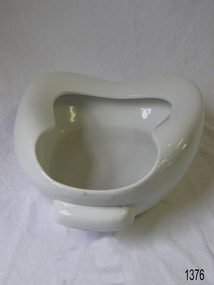 Flagstaff Hill Maritime Museum and Village
Ceramic - Bed Pan, R. Fowler, 1927-1935
... Australian company during the first half of the 20th century and quite rare today. The item is significant as it gives a snapshot of the early development of manufacturing companies in Australia. This informs our social history ...The company R. Fowler Limited was established in Ultimo, Sydney, in 1837 when Enoch Fowler (1807-1879) came to Australia from Ireland and is known today as the oldest pottery still in operation in Australia. They were mostly known for producing bottles, jars, and pipes. The pottery was originally located at Abercrombie Place on Parramatta Street, Chippendale, NSW before they relocated to Glebe in 1847. Later the pottery manufactured building materials such as tiles, pipes, and chimney pots. As the business grew, they moved to Parramatta in the 1850s. Enoch's son Robert (1839-1906) had joined the company, and took over its management in 1873, changing the name to “R Fowler Sydney” in 1880. Robert, introduced the black under glaze trademark with the archer as shown on the subject item. He went on to opened further sites at Marrickville and Bankstown, with the company becoming R. Fowler Limited in 1919. The factory at Thomastown, Melbourne was opened in 1927. Fowler also owned a Pottery somewhere near Lithgow, where they produced clay pipes that look like salt-glazed Earthenware pipes. There have been numerous developments to the company over subsequent decades, and the company was still operating in 2002 but is now owned by Caroma Industries Ltd, manufacturing only sanitary fixtures. An item made by an Australian company during the first half of the 20th century and quite rare today. The item is significant as it gives a snapshot of the early development of manufacturing companies in Australia. This informs our social history in Australia marking Australia's evolution into an independent country and no longer a colony of England. Bed pan ceramic white glaze handle at one end.Marked R Fowler Ltd and trademark a person sitting with a bow and arrow "00"flagstaff hill, warrnambool, shipwrecked-coast, flagstaff-hill, flagstaff-hill-maritime-museum, maritime-museum, shipwreck-coast, flagstaff-hill-maritime-village -
 Flagstaff Hill Maritime Museum and Village
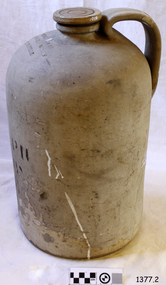
Functional object - Chemical Storage Jug, Wilhelm & Marie Wischer, 1895-1920
... century and had undertaken the journey to Australia over three months. During this voyage, several passengers had died and a number of babies had been born. The travellers had endured storms, injuries, broken equipment, and numerous other privations. The couple had lived in the suburb of Hawthorn and their family history is documented in a book by John Wischer. The link is in references this document from "Kainos Books" and makes for fascinating reading as it reveals an account of life in Melbourne during the late 19th and early 20th...century and had undertaken the journey to Australia over three months. During this voyage, several passengers had died and a number of babies had been born. The travellers had endured storms, injuries, broken equipment, and numerous other privations. The couple had lived in the suburb of Hawthorn and their family history is documented in a book by John Wischer. The link is in references this document from "Kainos Books" and makes for fascinating reading as it reveals an account of life in Melbourne during the late 19th and early 20th ...Wilhelm and Marie Wischer were the founding couple of the successful Wischer phosphate and chemical works at Yarraville, Melbourne. They had emigrated from Magdeburg in Germany in the late 19th century and had undertaken the journey to Australia over three months. During this voyage, several passengers had died and a number of babies had been born. The travellers had endured storms, injuries, broken equipment, and numerous other privations. The couple had lived in the suburb of Hawthorn and their family history is documented in a book by John Wischer. The link is in references this document from "Kainos Books" and makes for fascinating reading as it reveals an account of life in Melbourne during the late 19th and early 20th century. The book also gives an account of the Wischer phosphate mining activities on Ocean Island in 1904, Wischer & Co. eventually merged with Mt. Lyell Chemical works.An item giving a snapshot of early industrial life in Melbourne during the late 19th century with also an interesting story of early migration to Australia. The item also makes us aware of the privations early migrants had in trying to establish a life in a new country and how the Wischer family overcame these challenges to establish a very successful business.Jug, clay large with handle glazed screw on stopper. Sulphur Acid Wischer Chemical Company Yarraville printed on side, also a number 5 on the screw lidflagstaff hill, warrnambool, shipwrecked-coast, flagstaff-hill, flagstaff-hill-maritime-museum, maritime-museum, shipwreck-coast, flagstaff-hill-maritime-village -
 Flagstaff Hill Maritime Museum and Village
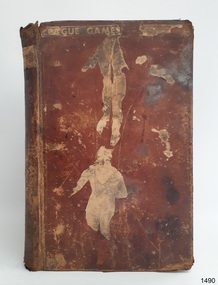
Book - Ledger Book, Warrnambool Harbour Board, Ships' Report Inward, ca. 1877 plus scrapbook entries to ca. 1953
... It is also a reference to early Australian and Victorian football media. flagstaff hill warrnambool shipwrecked-coast flagstaff-hill flagstaff-hill-maritime-museum maritime-museum shipwreck-coast flagstaff-hill-maritime-village book Warrnambool Harbour Board ships' report inward Port of Warrnambool Warrnambool Harbour Harbour Master AFL VFL Australian Football League Victorian Football League Early 20th Century newspaper cuttings maritime record maritime history 1877-1917 1953 Embossed title "SHIPS' / REPORT / INWARDS" Pasted title "LEAGUE / GAMES" Label inside back cover: "R 759" Ledger of the Warrnambool Harbour Board, containing the handwritten Ships Report Inwards for the Port of Warrnambool. ...The Ship's Report Inward contains entries from 1877 to 1917. It is a record of vessels that visited the Port of Warrnambool during that time and was filled in by the Harbour Master on behalf of the Warrnambool Harbour Board. The book has also been used as football scrapbook for both the Australian and Victorian Leagues, with articles and photographs from the early 20th century events and photos of players in 1953. A child has also used the book for drawing and writing.It appears that this historic ledger was once regarded as insignificant and used for other purposes such as a scrapbook and spare paper for drawing. However, the ledger is now considered to be of important locall significant for its accurate reports of all vessels inward bound to the Port of Warrnambool, giving a summary of activities during the forty year period from 1877 to 1917. It is also a reference to early Australian and Victorian football media.Ledger of the Warrnambool Harbour Board, containing the handwritten Ships Report Inwards for the Port of Warrnambool. First entry 1877. Last entry 1917. The book has also been used for a football scrapbook and contains newspaper cuttings of early 20th century AFL (Australian Football League) and VFL (Victorian Football League) events and photographs. There are several lose clippings between the pages throughout the book. The cover's spine has a gold embossed title and a pasted title, and the pasted front cover has figures relate to the scrapbook. There are also child's writing and drawings in pencil on some pages. A white label inside the back cover has a blue pen inscription. Embossed title "SHIPS' / REPORT / INWARDS" Pasted title "LEAGUE / GAMES" Label inside back cover: "R 759"flagstaff hill, warrnambool, shipwrecked-coast, flagstaff-hill, flagstaff-hill-maritime-museum, maritime-museum, shipwreck-coast, flagstaff-hill-maritime-village, book, warrnambool harbour board, ships' report inward, port of warrnambool, warrnambool harbour, harbour master, afl, vfl, australian football league, victorian football league, early 20th century, newspaper cuttings, maritime record, maritime history, 1877-1917, 1953
