
Showing 7 items matching "australia law for nurses"
-
 Alfred Hospital Nurses League - Nursing History Collection
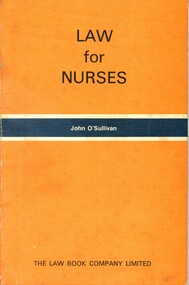
Book - Textbook, John O'Sullivan 1927, Law for nurses, 1976
... Australia Law for nurses...First texbook on this subject that applied specifically to Australian law Insight into how laws and legislation applies to nurses Australia Law for nurses medical law and legislation - Australia Nursing -law and legislation-Australia Legislation-nursing-Australia Nursing-study and teaching An overview of Australian medical laws and legislation specifically for the nursing profession, applicable at the time of publication (1976) Previous catalogue number [black ink] inside front cover at top left, 'E. ...An overview of Australian medical laws and legislation specifically for the nursing profession, applicable at the time of publication (1976)Book with orange cover with black band edged in white in centre. On front cover the title [black print] is above this band, author [white print] on band, publisher [black print] at base.Similar details on spinenon-fictionAn overview of Australian medical laws and legislation specifically for the nursing profession, applicable at the time of publication (1976)australia law for nurses, medical law and legislation - australia, nursing -law and legislation-australia, legislation-nursing-australia, nursing-study and teaching -
 Flagstaff Hill Maritime Museum and Village
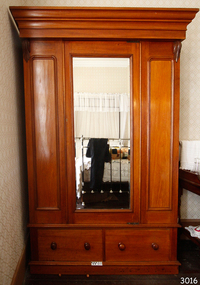
Furniture - Wardrobe, Late 19th to early 20th Century
... Australia's most highly decorated nurses of World War 2 and for 16 years matron of the Warrnambool and District Base Hospital. There is a street in Warrnambool named after the Swinton family. The Giles Collection: There are many 19th century items of furniture, linen, and crockery donated to Flagstaff Hill Maritime Village by Vera and Aurelin Giles. The items are associated with the Giles Family and are known as the "Giles Collection". These items mostly came from the simple home of Vera's parents-in-law...Australia's most highly decorated nurses of World War 2 and for 16 years matron of the Warrnambool and District Base Hospital. There is a street in Warrnambool named after the Swinton family. The Giles Collection: There are many 19th century items of furniture, linen, and crockery donated to Flagstaff Hill Maritime Village by Vera and Aurelin Giles. The items are associated with the Giles Family and are known as the "Giles Collection". These items mostly came from the simple home of Vera's parents-in-law ...The original owner of the beautiful wardrobe was William Swinton Jr. (1860-1929) and was later given to a friend of the Giles family. It is part of the Giles Collection. William Swinton Jnr. was a Warrnambool Councilor 1903-20 and Mayor 1917-19, during which time Warrnambool declared a City (1918). William's father, William Swinton Snr. (c.1831-1901) arrived in Warrnambool in 1854 from Edinburgh, Scotland. He established the Swinton store in Timor Street in 1865 where it is still located. William Snr's grand-daughter, Doris Swinton (1904-1986) was one of Australia's most highly decorated nurses of World War 2 and for 16 years matron of the Warrnambool and District Base Hospital. There is a street in Warrnambool named after the Swinton family. The Giles Collection: There are many 19th century items of furniture, linen, and crockery donated to Flagstaff Hill Maritime Village by Vera and Aurelin Giles. The items are associated with the Giles Family and are known as the "Giles Collection". These items mostly came from the simple home of Vera's parents-in-law, Henry Giles and his wife Mary Jane (nee Freckleton), whose photos are in the parlour. They married in 1880. Henry Giles was born at Tower Hill in 1858. He was a labourer on the construction of the Breakwater before leaving in 1895 to build bridges in N.S.W. for about seven years. Mary Jane was born in 1860 at Cooramook. She attended Mailor's Flat State School where she was also a student teacher before, as a family legend has it, she became a governess at "Injemiara" where her grandfather, Francis Freckleton, once owned land. Henry and Mary’s family of six, some of whom were born at Mailor’s Flat and later children at Wangoom, lived with their parents at Wangoom and Purnim west, where Henry died in 1933 and Mary Jane in 1940. The wardrobe is also significant for its association with early Warrnambool history, being owned by William Swinton Jnr. who was a Warrnambool Councilor and Warrnambools first Mayor (1917-19) the son of an early colonial family, arriving in Warrnambool in 1854. The Giles family collection also has social significance at a local level, because it illustrates the level of material support the Warrnambool community gave to Flagstaff Hill when the Maritime Museum was established.Wardrobe, colonial, made of cedar wood. The doors of the wardrobe have a mirrored door between them and there are two large drawers below the doors, each drawer has two round wooden handles. The wardrobe was once owned by a William Swinton Jnr. It is now part of the Giles Collection.Noneflagstaff hill, warrnambool, shipwrecked-coast, maritime-museum, shipwreck-coast, flagstaff-hill-maritime-village, wardrobe, bedroom furniture, domestic furniture, william swinton jnr., warrnambool's first mayor, warrnambool mayor, giles collection, henry giles, tower hill, cooramook, warrnambool breakwater, mailor’s flat, wangoom, 19th century furniture, doris swinton, swinton street warrnambool -
 The Beechworth Burke Museum
Audio - Oral History, Jennifer Williams, Mrs Sheila Parkinson, 3 January 2000
... nurse at Mayday Hills hospital prior to the second World War. At that time, unmarried women were accommodated and received nursing training on-site. Shiela was obliged to cease professional training and employment when she married in 1941, which disrupted completion of her final nursing examinations. Following post-war changes to the law that allowed married women to work, Sheila returned to Mayday Hills. Sheila's husband, Don, returned to Beechworth after four years abroad as a serviceman in the Australian...nurse at Mayday Hills hospital prior to the second World War. At that time, unmarried women were accommodated and received nursing training on-site. Shiela was obliged to cease professional training and employment when she married in 1941, which disrupted completion of her final nursing examinations. Following post-war changes to the law that allowed married women to work, Sheila returned to Mayday Hills. Sheila's husband, Don, returned to Beechworth after four years abroad as a serviceman in the Australian ...Mrs Sheila Parkinson was born in Wagga in 1916 and came to Beechworth as a young woman around 1938. Sheila trained as a psychiatric nurse at Mayday Hills hospital prior to the second World War. At that time, unmarried women were accommodated and received nursing training on-site. Shiela was obliged to cease professional training and employment when she married in 1941, which disrupted completion of her final nursing examinations. Following post-war changes to the law that allowed married women to work, Sheila returned to Mayday Hills. Sheila's husband, Don, returned to Beechworth after four years abroad as a serviceman in the Australian Air Force. Beechworth's institutions were a major source of local employment throughout the twentieth century. As well as providing limited employment opportunities to young women like Shiela, post-war European migrants from Bonegilla Migrant camp found at Mayday Hills, encouraging European migrant settlement in the district. Mayday Hills was renamed several times since its establishment in 1867. At the peak of operations, it comprised sixty-seven buildings housing over twelve hundred patients patients and five hundred staff. The hospital officially closed in 1998. Today, the decommissioned two-storey Italianate style main building stands on eleven hectares of botanical gardens under National Trust protection. The site remains a popular cultural heritage destination for visitors. This oral history recording was part of a project conducted by Jennifer Williams in the year 2000 to capture the everyday life and struggles in Beechworth during the twentieth century. This project involved recording seventy oral histories on cassette tapes of local Beechworth residents which were then published in a book titled: Listen to what they say: voices of twentieth century Beechworth. The cassette tapes were digitised in July 2021 with funds made available by the Friends of the Burke.Employed as a psychiatric nurse at one of Beechworth's large welfare institutions, Mayday Hills, Mrs Sheila Parkinson recalls the conditions faced by staff and patients at the hospital, which cared for chronically ill people from the Ovens region and patients from the Yarra Bend Asylum, Melbourne, which closed in 1925. When Sheila first began her nurse training, Mayday Hills suffered from a lack of resources and rudimentary facilities and patients frequently suffered from the cold due to poor heating and inadequate clothing and bedding. However, as the twentieth century progressed, Sheila recalls how conditions and treatments improved as a result of increased government funding of services and advances in psychiatry and pharmaceutical medicine. Mrs Sheila Parkinson's oral history recording is historically and socially significant for its witness to life in Beechworth in the pre- and post-WWII period. Sheila's story enriches our understanding of processes of modernisation with regard to psychiatric and welfare services, while the course of Sheila's professional training and employment brings attention to systemic and socio-economic barriers faced by women, as well as the valuable contribution women and migrants make in the delivery of care and ancillary services. This oral history account is socially and historically significant as it is a part of a broader collection of interviews conducted by Jennifer Williams which were published in the book 'Listen to what they say: voices of twentieth-century Beechworth.' While the township of Beechworth is known for its history as a gold rush town, these accounts provide a unique insight into the day-to-day life of the town's residents during the twentieth century, many of which would have been lost if they had not been preserved.This is a digital copy of a recording that was originally captured on a cassette tape. The cassette tape is black with a horizontal white strip and is currently stored in a clear flat plastic rectangular container. It holds up 40 minutes of recordings on each side.Mrs Sheila Parkinson /twentieth century beechworth, mayday hills, psychiatric care, benevolent asylums, nursing, wwii, psychiatric treatment, country women, psychiatric hostpital, beechworth's institutions, local employment, government institutions, listen to what they say, oral history, burke museum, sheila parkinson, beechworth lunatic asylum, beechworth mental hospital, beechworth hospital for the insane, the kerferd clinic, bonegilla migrant camp, working women, white australia policy -
 Alfred Hospital Nurses League - Nursing History Collection
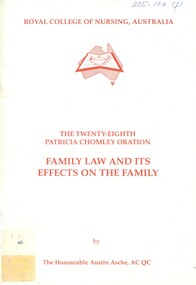
Journal - Oration, College of Nursing, Australia, The twenty-eigth Patricia Chomley oration: Family law and its effects on the family, 1994
... Patricia Chomley graduted from the Alfred Hospital in 1934 Of significance to the AHNL as Paticia Chomley oration, was an important annual event for the Royl College of Nursing College of Nursing Australia nursing Patricia Chomley Oration Family law - Australia Children-legal status This oration 'Family law and its effects on the family', by a family law judge, also includes the role of the nurse, where family law can impact the care of their patients. ...This oration 'Family law and its effects on the family', by a family law judge, also includes the role of the nurse, where family law can impact the care of their patients. The booklet also include a list of past speakers and titles of orationsStapled booklet, white cover with red print. Above the title and author's name are the words 'Royal College of Nursing Australia' and the logo of the college.non-fictionThis oration 'Family law and its effects on the family', by a family law judge, also includes the role of the nurse, where family law can impact the care of their patients. The booklet also include a list of past speakers and titles of orationscollege of nursing australia, nursing, patricia chomley oration, family law - australia, children-legal status -
 Australian Nursing & Midwifery Federation
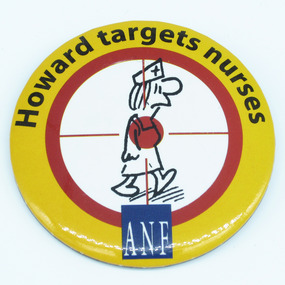
Australian Nursing Federation WorkChoices protest badge, 2006
... Australian Nursing Federation (ANF) members and staff as part of a 2006 campaign protesting the controversial 'WorkChoices' federal industrial relations laws that were introduced by the Liberal John Howard government in 2005-2007. These laws saw the weakening of unfair dismissal laws, giving employers significantly more powers to strip existing rights and wages away. The laws were repealed following the election of an opposition Labor government in 2007 under Kevin Rudd. The 'Howard Target Nurses...Australian Nursing Federation (ANF) members and staff as part of a 2006 campaign protesting the controversial 'WorkChoices' federal industrial relations laws that were introduced by the Liberal John Howard government in 2005-2007. These laws saw the weakening of unfair dismissal laws, giving employers significantly more powers to strip existing rights and wages away. The laws were repealed following the election of an opposition Labor government in 2007 under Kevin Rudd. The 'Howard Target Nurses ...Button distributed to and worn by Australian Nursing Federation (ANF) members and staff as part of a 2006 campaign protesting the controversial 'WorkChoices' federal industrial relations laws that were introduced by the Liberal John Howard government in 2005-2007. These laws saw the weakening of unfair dismissal laws, giving employers significantly more powers to strip existing rights and wages away. The laws were repealed following the election of an opposition Labor government in 2007 under Kevin Rudd. The 'Howard Target Nurses' campaign was featured in ANF Victorian Branch newsletters around late 2006. During this period, a number of enterprising bargaining agreements were set to soon expire, leaving nurses vulnerable to have rights stripped away under the new IR legislation. A large campaign began, with rallies across the state of Victoria. The August 2006 Branch newsletter featured images of the Tandberg 'Howard targets nurses' design on placards, shirts and badges worn by nurses at these rallies. The illustration by The Age cartoonist Ron Tandberg made reference to John Howard's involvement in wars in the Middle East throughout the early 2000s, and linked this to the 'war' on unions and worker rights.Circular yellow, red and white badge. Silver metal, plastic-coated, with safety pin fastener adhered to back. Badge printed with a blue and white ANF [Australian Nursing Federation] logo, the black text '[then-Prime Minister John] Howard targets nurses' and a Ron Tandberg cartoon of a nurse with a 'sniper target' overlay.nursing, nurses, protest, campaign, activism, activists, unions, unionism, buttons, badges, pins, campaigning, john howard, ron tandberg, labour history, australian nursing federation, workchoices, workplace relations, industrial relations -
 Australian Nursing & Midwifery Federation
28-minute video documentary on nurse to patient ratios in Victoria, Battle : the road to ratios [legislation], 2016
... Australian Nursing and Midwifery Branch (Vic Branch) members achieved staffing ratios in the Victorian public health system in 2000 and campaigned throughout 2001, 2004, 2007 and 2011-12 to keep them in workplace agreements. After strong campaigning, ratios were legislated for the public sector in Victoria with the passing of the Safe Patient Care (Nurse to Patient and Midwife to Patient) Bill in 2015. The short digital documentary, 'Battle: The Road to Ratios [Legislation]', tells the story of this campaigning, from the nurse shortage crisis in 2000 to ratio laws...Australian Nursing and Midwifery Branch (Vic Branch) members achieved staffing ratios in the Victorian public health system in 2000 and campaigned throughout 2001, 2004, 2007 and 2011-12 to keep them in workplace agreements. After strong campaigning, ratios were legislated for the public sector in Victoria with the passing of the Safe Patient Care (Nurse to Patient and Midwife to Patient) Bill in 2015. The short digital documentary, 'Battle: The Road to Ratios [Legislation]', tells the story of this campaigning, from the nurse shortage crisis in 2000 to ratio laws ...Australian Nursing and Midwifery Branch (Vic Branch) members achieved staffing ratios in the Victorian public health system in 2000 and campaigned throughout 2001, 2004, 2007 and 2011-12 to keep them in workplace agreements. After strong campaigning, ratios were legislated for the public sector in Victoria with the passing of the Safe Patient Care (Nurse to Patient and Midwife to Patient) Bill in 2015. The short digital documentary, 'Battle: The Road to Ratios [Legislation]', tells the story of this campaigning, from the nurse shortage crisis in 2000 to ratio laws in 2015. The documentary, produced by Black Sheep Films, was first shown at the 2016 Annual Delegates Conference to more than 700 ANMF Job Reps and Health and Safety Reps. The documentary features interviews with current and former ANMF leadership and Job Reps, academics, and journalists.28 minute video file (.mp4 multimedia format). In colour, with sound. Original produced digitally.nursing, ratios, workforce, nursing workforce, staffing, nurses, unionism, documentaries, campaigning, labour history, safe patient care (nurse to patient and midwife to patient ratios) act 2015, victoria, australia -
 Royal District Nursing Service (now known as Bolton Clarke)
Photograph - Photograph, black and white, 1905
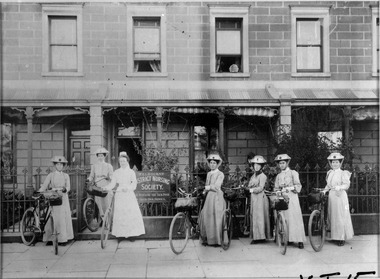
... laws which outlined the work conditions for the Nurses. Section 111.1 states ‘Each nurse shall be ready to go to her district at 9 am. She will be expected to visit urgent cases on Sundays, and will be required to work eight hours on each week day, to wear the special uniform, and live in the Home of the Society’. In February 1885, only 50 years after Melbourne was founded, it was recognized that nursing care was needed for the sick poor in inner Melbourne. The Melbourne District Nursing Society (MDNS), the first Society of its kind in Australia ...This photograph is a record of Head Nurse, Sister Lee-Archer, and her staff of six Trained nurses, 'Nurses', of the Melbourne District Nursing Society (MDNS) outside their new Nurse’s Home and Headquarters rented at 5 Royal Terrace, Nicholson Street, Fitzroy. The bicycles seen were the first mode of transport purchased by MDNS and allowed these Nurses to extend the nursing visits they made into more Melbourne suburbs.The Melbourne District Nursing Society (MDNS) moved into larger premises at No. 5 Royal Terrace, Nicholson Street, Fitzroy in May 1904. Head trained Nurse, Lee-Archer and her staff of six Trained nurses pose outside the new ‘Nurse’s Home’ at 5 Royal Terrace, Nicholson Street, Fitzroy. The Nurses worked in the districts of North and West Melbourne, the City Proper, Carlton, Richmond, South Melbourne, Fitzroy and Collingwood making 17,954 visits during the year. The Society had a set of bye-laws which outlined the work conditions for the Nurses. Section 111.1 states ‘Each nurse shall be ready to go to her district at 9 am. She will be expected to visit urgent cases on Sundays, and will be required to work eight hours on each week day, to wear the special uniform, and live in the Home of the Society’. In February 1885, only 50 years after Melbourne was founded, it was recognized that nursing care was needed for the sick poor in inner Melbourne. The Melbourne District Nursing Society (MDNS), the first Society of its kind in Australia, was founded with one Trained nurse, known as 'Nurse' in those days, and a second employed six months later. They liaised with Doctors and worked in the now CBD, ie from Spencer Street to Spring Street and from Victoria Parade to Flinders Street. From its inception the Society was at the forefront of health care. They provided high quality nursing care; educated their patients in the curing and prevention of disease; teaching the importance of cleanliness, fresh air and good nutrition, both by verbal instruction and demonstration, even supplying soup and milk when needed. At that time they walked the streets and lane ways amid the slums of inner Melbourne carrying their nursing bag containing lotion, ointments, powders, liniment, bandages, dressings, a case of spirits, and the Nurse's own clean apron, soap and small towel for her use. They loaned equipment, such as earthenware hot water bottles, splints, urinals, bed pans, bed cradles, feeding mugs, and air-cushions as well as providing clean bed linen and nightdresses as necessary. Trained Midwives began home births in late 1893 taking midwifery bundles and providing clothes for the babe and mother as needed. This was arduous work, particularly in the heat of summer. As the work increased a third Nurse was employed but due to this arduous work many Nurses only remained with the Society for several months. Permission to use bicycles was given to the Nurses in 1898 and the Society decided to purchase their own in 1903. A business man offered ‘new free wheel’ bicycles at £13 each which included maintenance for one year. Bells and wooden frames were added, at a cost of £5 per frame, so the Nurses could carry extra equipment. Nurses’ bags were strapped to the handlebars. Soup was made for those in need 2-3 times a week and if patients could not arrange to have it collected the soup was delivered by the Nurses on their bicycles. The use of bicycles caused a change in uniform, with white pith helmets, and veils covering them and tied under their chin, now being used. They provided high quality nursing care to a range of people, often in destitute situations, some lying on rags on the floor as they had no bed, others with just a bed and maybe a thin blanket, a chair and nothing else. Their ages ranged from babes, children, adults to the elderly. The Nurses gave medications as ordered by a Doctor, dressed wounds e.g. to the injured, and surgical cases, and to those with leg ulcers; attended to patients with ‘surgical ailments’ such as ‘hip disease’; gave care to those with acute illnesses such as bronchitis, pleurisy, pneumonia, measles, and scarlet fever, as well as those with chronic illnesses such as consumption (tuberculosis), heart disease, arthritis, cancer, debility, neuritis and paralysis. In 1913 a Nurse had her Board and residence, uniforms, bicycle and laundry expenses provided and was paid £50 a year for her first six months. At the end of a year her salary was increased by £5, and later she earns £60 a year. Over the years the nurses complained that their veils became wet in the rain and asked for a change of uniform but this did not occur until 1921. Bicycles continued to be used in inner areas until 1945. Black and white photograph of six Trained nurses and their Matron, who has her hair swept up, and is wearing a long white uniform with belt, and white cap; part of her veil is seen hanging down her back, outside their Nurses Home The trained. nurses are holding their two wheeled bicycles, and are wearing long grey frocks, white collars and belts and straw hats with a Maltese cross in the centre of headband, this is held in place with scarves over the hat and tied under their chins. Their nursing bags are strapped to the handlebars of the bicycles. A black sign with the white capital letters 'Melbourne District Nursing Society. ....nursing the sick poor in their own homes' is on the metal spiked fence. The building is made of brick and five long sash windows are seen in the upper section. A metal roofed veranda, held up with four posts and two brick columns, divides the upper and lower section. A door and three long windows are seen which are partly obscured by several bushes behind the fence.melbourne district nursing society, 5 royal terrace, nicholson st carlton, nurses home, bicycles, mdns transport, royal district nursing service, rdns, mdns trained nurses, sister florence lee-archer
