
Showing 135 items matching "australian aboriginal names"
-
 Tatura Irrigation & Wartime Camps Museum
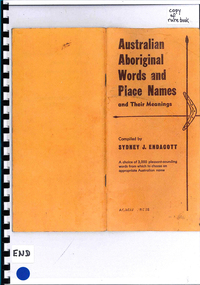
Small booklet, Frank Endacott (copyright), Australian Aboriginal Words and Place Names and their meanings , compiled by J.Endacott, 1924
... Australian Aboriginal Words and Place Names and their meanings , compiled by J.Endacott....australian aboriginal names...A choice of 3,000 pleasant sounding words from which to choose an appropriate Australian name. australian aboriginal names A choice of 3,000 pleasant-sounding words from which to choose an appropriate Australian name. ...A choice of 3,000 pleasant sounding words from which to choose an appropriate Australian name.Peach coloured cardboard cover, with dark red printing. 2 x Spears and boomerang on cover. Small paperback booklet.A choice of 3,000 pleasant-sounding words from which to choose an appropriate Australian name.australian aboriginal names -
Victorian Aboriginal Corporation for Languages
Book, Australian Aboriginal Place-names and their meanings, 1953
... Australian Aboriginal Place-names and their meanings...A short book of Aboriginal place name definitions from around Australia - the state of each name is indicated....Australian Aboriginal Place-names and their meanings Book James R Tyrrell ...A short book of Aboriginal place name definitions from around Australia - the state of each name is indicated. -
Victorian Aboriginal Corporation for Languages
Book, Australian Aboriginal place-names and their meanings, 1953
... Australian Aboriginal place-names and their meanings...A short book of Aboriginal place name definitions from around Australia - the state of each name is indicated....Australian Aboriginal place-names and their meanings Book James R Tyrrell ...A short book of Aboriginal place name definitions from around Australia - the state of each name is indicated.word listsglossaries, vocabularies -
 Victorian Aboriginal Corporation for Languages
Book, Sydney J Endacott, Australian Aboriginal words and place names and their meanings, 1985
... Australian Aboriginal words and place names and their meanings...(Appear to be different printings) Australian Aboriginal words and place names and their meanings Book Sydney J Endacott ...Word list with definitions. (Appear to be different printings)B&w photographs, word lists -
Victorian Aboriginal Corporation for Languages
Book, Sydney J Endacott, Australian Aboriginal words and place names and their meanings, 1985
... Australian Aboriginal words and place names and their meanings...glossaries vocabularies word lists Cover has subtitle: A choice of 3,000 pleasant-sounding words from which to choose an appropriate Australian name. Australian Aboriginal words and place names and their meanings Book Sydney J Endacott ...Cover has subtitle: A choice of 3,000 pleasant-sounding words from which to choose an appropriate Australian name.word listsglossaries, vocabularies -
Box Hill Historical Society
Book, Endacott, Sydney J, Australian Aboriginal Words and place names and their meanings, 1985
... Australian Aboriginal Words and place names and their meanings...Australian Aboriginal language language A compilation of Australian Aboriginal Words and places names and their meanings. ...A compilation of Australian Aboriginal Words and places names and their meanings. The book contains about 3000 words and meanings of various things and matters, including a great many Australian aboriginal place-names and their meanings. The book also contains three photographs of aborigines.64 pages non-fictionA compilation of Australian Aboriginal Words and places names and their meanings. The book contains about 3000 words and meanings of various things and matters, including a great many Australian aboriginal place-names and their meanings. The book also contains three photographs of aborigines.australian aboriginal language, language -
Lakes Entrance Historical Society
Book, Endacott Sydney J, Australian Aboriginal Words and Place Names and their meanings, 1980
... Australian Aboriginal Words and Place Names and their meanings....A choice of 3000 pleasant sounding Australian Aboriginal words and meanings from which to choose an appropriate Australian name....Aboriginals A choice of 3000 pleasant sounding Australian Aboriginal words and meanings from which to choose an appropriate Australian name. ...A choice of 3000 pleasant sounding Australian Aboriginal words and meanings from which to choose an appropriate Australian name.aboriginals -
 Victorian Aboriginal Corporation for Languages
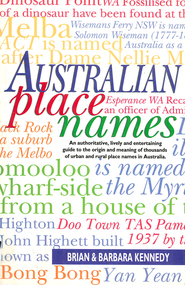
Book, Brian Kennedy et al, Australian place names, 1996
... Alphabetical listing of some place names across Australia, Includes Aboriginal and European names with a good description of the place and origin of the name....place names gazetteers Alphabetical listing of some place names across Australia, Includes Aboriginal and European names with a good description of the place and origin of the name. ...Alphabetical listing of some place names across Australia, Includes Aboriginal and European names with a good description of the place and origin of the name.place names, gazetteers -
 Victorian Aboriginal Corporation for Languages
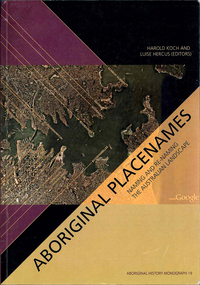
Book, Harold Koch, Aboriginal placenames : naming and re-naming the Australian landscape, 2009
... Central Australia: 'Aboriginal names of places in southern South Australia': placenames in the Norman B.Tindale collection of papers /? ...Central Australia: 'Aboriginal names of places in southern South Australia': placenames in the Norman B.Tindale collection of papers /? ..."Aboriginal approaches to the naming of places across Australia differ radically from the official introduced Anglo-Australian system. However, many of these earlier names have been incorporated into contemporary nomenclature, with considerable reinterpretations of their function and form. Recently, state jurisdictions have encouraged the adoption of a greater number of Indigenous names, sometimes alongside the accepted Anglo-Australian terms, around Sydney Harbour, for example. In some cases, the use of an introduced name, such as Gove, has been contested by local Indigenous people." "The 19 studies brought together in this book present an overview of current issues involving Indigenous placenames across the whole of Australia, drawing on the disciplines of geography, linguistics, history, and anthropology. They include meticulous studies of historical records, and perspectives stemming from contemporary Indigenous communities. The book includes a wealth of documentary information on some 400 specific placenames, including those of Sydney Harbour, the Blue Mountains, Canberra, western Victoria, the Lake Eyre district, the Victoria River District, and southwestern Cape York Peninsula." -- Publisher description. Contents: Introduction: Old and new aspects of Indigenous place-naming /? Harold Koch and Luise Hercus NSW &? ACT: 1. Aboriginal placenames around Port Jackson and Botany Bay, New South Wales, Australia: sources and uncertainties /? Val Attenbrow 2. Reinstating Aboriginal placenames around Port Jackson and Botany Bay /? Jakelin Troy and Michael Walsh 3. The recognition of Aboriginal placenames in New South Wales /? Greg Windsor 4. New insights into Gundungurra place naming /? Jim Smith 5. The methodology of reconstructing Indigenous placenames: Australian Capital Territory and south-eastern New South Wales /? Harold Koch Victoria: 6. Toponymic books and the representation of Indigenous identities /? Laura Kostanski 7. Reviving old Indigenous names for new purposes /? Laura Kostanski and Ian D. Clark 8. Reconstruction of Aboriginal microtoponymy in western and central Victoria: case studies from Tower Hill, the Hopkins River, and Lake Boga /? Ian Clark South Australia &? Central Australia: 'Aboriginal names of places in southern South Australia': placenames in the Norman B.Tindale collection of papers /? Paul Monaghan 10. Why Mulligan is not just another Irish name: Lake Callabonna, South Australia /? J.C. McEntee 11. Murkarra, a landscape nearly forgotten: the Arabana country of the noxious insects, north and northwest of Lake Eyre /? Luise Hercus 12. Some area names in the far north-east of South Australia /? Luise Hercus 13. Placenames of central Australia: European records and recent experience /? Richard Kimber Northern Australia: 14. Naming Bardi places /? Claire Bowern 15. Dog-people: the meaning of a north Kimberley story /? Mark Clendon 16. 'Where the spear sticks up': the variety of locatives in placenames in the Victoria River District, Northern Territory /? Patrick McConvell 17. 'This place already has a name' /? Melanie Wilkinson, Dr R. Marika and Nancy M. Williams 18. Manankurra: what's in a name? placenames and emotional geographies /? John J. Bradley and Amanda Kearney 19. Kurtjar placenames /? Paul Black.Maps, b&w photographs, tables, word listsaustralian placenames, sociolinguistics, linguistics, anthropology, sydney harbour placenames, blue mountains placenames, canberra placenames, western victoria placenames, lake eyre placenames, victoria river district placenames, cape york peninsula placenames -
 Federation University Historical Collection
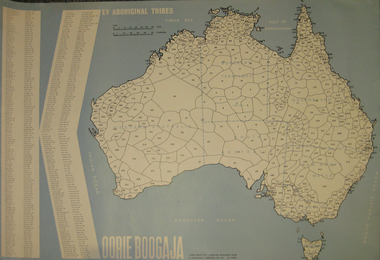
Poster, Key Aboriginal Tribes, 1971, 1971
... aborigine aboriginal aboriginal tribes aborigines advancement league koorie Wadawurrung Dja Dja Wurrung Large blue poster with the shape of Australia depicted in white. Tribal lands have been placed onto the plan with numbers relating to names listed on the left of the poster. ...Large blue poster with the shape of Australia depicted in white. Tribal lands have been placed onto the plan with numbers relating to names listed on the left of the poster.aborigine, aboriginal, aboriginal tribes, aborigines advancement league, koorie, wadawurrung, dja dja wurrung -
Federation University Historical Collection
Document, Articles on the Bunyip, 1983 - 1989
... Aboriginal people of South-Eastern Australia. However, the bunyip appears to have formed part of traditional Aboriginal beliefs and stories throughout Australia, although its name varied according to tribal nomenclature. ...Aboriginal people of South-Eastern Australia. However, the bunyip appears to have formed part of traditional Aboriginal beliefs and stories throughout Australia, although its name varied according to tribal nomenclature. ...The bunyip is a large mythical creature from Aboriginal mythology, said to lurk in swamps, billabongs, creeks, riverbeds, and waterholes. The origin of the word bunyip has been traced to the Wemba-Wemba or Wergaia language of Aboriginal people of South-Eastern Australia. However, the bunyip appears to have formed part of traditional Aboriginal beliefs and stories throughout Australia, although its name varied according to tribal nomenclature. Various written accounts of bunyips were made by Europeans in the early and mid-19th century, as settlement spread across the country. (http://en.wikipedia.org/wiki/Bunyip) This material was collected and used for resarch purposes by David Waldron A number of articles on the Bunyip * The Nessie Mystery Solver by Roy Fraser (October 1983) * Developers meet match (Wagyl) (The Age, 06 Jan 1989) * Narrandera's bunyips burst into tourism's limelight by Melanie Sincock (wagga Advertiser, 18 November 1986) * Hunting the bunyip by M.A. Troyahn (Australiasian Post, 06 October 1883) * Beware the bunyip, you Moomba skiers by Edel Wignell (The Age, 05 March 1982) * The yarn that grew the bunyip legend (Australasian Post, 30 December 1971) australian animal folklore collections, bunyip, bunyipswagyl, shane picket, narrandera, swan river, david waldron -
 Flagstaff Hill Maritime Museum and Village
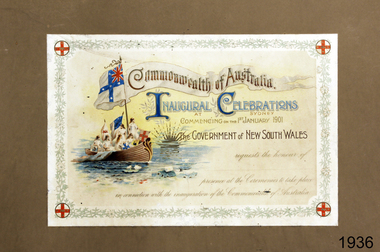
Document - Invitation, Government of New South Wales, Commonwealth of Australia Inaugural Celebrations, Bef. 01-01-1901
... Australia's Federation. There is no recipient's name on the invitation. The illustrations on the invitation represent the Federation of Australian States, with their historic symbols carried on the sailing ship, representing the colonisation of Australia. The 'rising sun' possibly represents the rising of the young Australia. The Sough Australian symbol appears to be the historic seal of South Australia, depicting Britania meeting an Australian Aboriginal...Australia's Federation. There is no recipient's name on the invitation. The illustrations on the invitation represent the Federation of Australian States, with their historic symbols carried on the sailing ship, representing the colonisation of Australia. The 'rising sun' possibly represents the rising of the young Australia. The Sough Australian symbol appears to be the historic seal of South Australia, depicting Britania meeting an Australian Aboriginal ...This is an Invitation to attend the Inaugural Celebrations of the Commonwealth of Australia, to celebrate the Federation of Australia's united Colonies. It was created on behalf of the Government of New South Wales. January 1st, 1901, is the official date of Australia's Federation. There is no recipient's name on the invitation. The illustrations on the invitation represent the Federation of Australian States, with their historic symbols carried on the sailing ship, representing the colonisation of Australia. The 'rising sun' possibly represents the rising of the young Australia. The Sough Australian symbol appears to be the historic seal of South Australia, depicting Britania meeting an Australian Aboriginal seated on the beach. The symbol was replaced in 1904. The Victorian symbol of a crown above the Southern Cross appears on the flag at the back of the ship, with a crown and the Southern Cross beside each other. The invitation was originally framed by G.U. Petterd, a picture framer and plush worker in Warrnambool, Victoria.The invitation holds great significance, representing a point in Australia's history when the British Colony became an independent nation, with the states uniting under a Federal government. The symbols on the invitation represent those used by each state at the time, many of which have evolved and changed since that time. The decorative and careful creation of the certificate represents the importance placed on the celebrations.Invitation; rectangular page printed in colour with text and illustrations, and attached to cardboard. The document has a floral border with a symbol in each corner. The illustration includes a wooden sailing ship with six figures with long fair hair wearing white robes, and holding six flags or symbols. The mast holds a swallow-tailed banner showing a flag and text. The invitation is from the Government of New South Wales, for the recipient to attend the inaugural celebrations in Sydney on 1st January 1901, for the official date of the Federation of Australia. There is a purple oval stamp on the revers with inscriptions. The picture was originally framed by G.U. Petterd, WarrnamboolSTAMP: "G.U. PETTERD, WARRNAMBOOL / PICTURE FRAMER & PLUSH / WORKER" TEST: - "Commonwealth of Australia. / INAUGURAL CELEBRATIONS / AT SYDNEY / COMMENCING on the 1st JANUARY 1901" "The GOVERNMENT of NEW SOUTH WALES / requests the honour of / (blank line) / presence at the Celebrations to take place / in connection with the inauguration of the Commonwealth of Australia" Symbols: - [white flag, blue cross, Union Jack] (Australian Federation Flag) [blue Maltese cross with crown in centre] (Queensland symbol) [red St George cross with a lion in the centre] (New South Wales symbol) [white with a symbol on one side (crown?) with a blue flag with Southern Cross on the other] (Victoria's symbols of Crown above Southern Cross) [red lion on white] (Tasmanian symbol) [black swan on yellow] (Western Australia badge) [two figures, one standing and one seated] (South Australian seal) and image of (rising sun on the horizon)flagstaff hill, flagstaff hill maritime museum and village, warrnambool, maritime museum, maritime village, great ocean road, shipwreck coast, invitation, commonwealth of australia, inaugural celebrations, sydney, 1st january 1901, 01-01-1901, federation of australia, australian states, government of new south wales, symbols, flags, australian colony, certificate, g.u. petturd, picture framer and plush worker, picture framer, plush worker, 1901 -
 The Beechworth Burke Museum
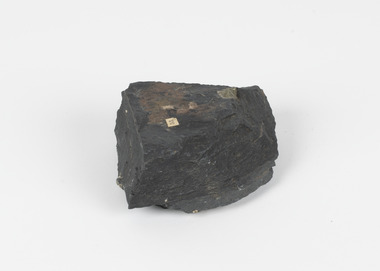
Geological specimen - Slate with Iron pyrites
... Australian state of Victoria. In the 1850s the location of Moonambel was part of the ‘Mountain Creek’ pastoral run, but in 1860 reports began to appear of a gold-rush at McKinnon’s ‘Mountain Creek’ station. By 1861, a township had developed on the diggings site, and on 21 October 1861 the “municipal district of Moonambel, on Mountain Creek” was proclaimed. The name 'Moonambel' is believed to be an aboriginal...Australian state of Victoria. In the 1850s the location of Moonambel was part of the ‘Mountain Creek’ pastoral run, but in 1860 reports began to appear of a gold-rush at McKinnon’s ‘Mountain Creek’ station. By 1861, a township had developed on the diggings site, and on 21 October 1861 the “municipal district of Moonambel, on Mountain Creek” was proclaimed. The name 'Moonambel' is believed to be an aboriginal ...This specimen was recovered from Moonambel, Donkey Hill, Victoria. Established in the early 1860's, Moonambel is a small town in the Pyrenees region of the Australian state of Victoria. In the 1850s the location of Moonambel was part of the ‘Mountain Creek’ pastoral run, but in 1860 reports began to appear of a gold-rush at McKinnon’s ‘Mountain Creek’ station. By 1861, a township had developed on the diggings site, and on 21 October 1861 the “municipal district of Moonambel, on Mountain Creek” was proclaimed. The name 'Moonambel' is believed to be an aboriginal word meaning 'hollow in the hills'. Slate is a stone with a fine grain that is noted for its persistent strength and ability to naturally split into slabs. It forms under low temperatures and is most often created from clay. Pyrite is a crystallising compound that occurs naturally in grey and blue-black slate that is colloquially referred to as slate-rust as it resembles regular rust. This specimen is part of a larger collection of geological and mineral specimens collected from around Australia (and some parts of the world) and donated to the Burke Museum between 1868-1880. A large percentage of these specimens were collected in Victoria as part of the Geological Survey of Victoria that begun in 1852 (in response to the Gold Rush) to study and map the geology of Victoria. Collecting geological specimens was an important part of mapping and understanding the scientific makeup of the earth. Many of these specimens were sent to research and collecting organisations across Australia, including the Burke Museum, to educate and encourage further study.Pyrite is iron sulphide (also known as “fool's gold”) which is commonly found in slates.Existing label: 53 /moonambel, slate, pyrite, burke museum, beechworth, indigo shire, beechworth museum, geological, geological specimen, mineralogy, victoria -
 Lara RSL Sub Branch
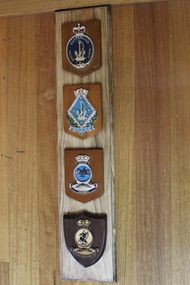
Plaques for Australian Navy 4 off, Australian Navy plaques - 1. Royal Australian Navy, 2. W.R.A.N.S.,3.HMAS Vampire, 4.HMAS Perth
... aboriginal waddy followed by a banner "Audamus" meaning "we dare, we venture, we risk" 4.HMAS Perth, A circular plaque a crown on the top a sailing ship in a crown format. Over a name of Perth in gold on a black back ground. The middle is a circle painted gold with a black Griffen in the center. The bottom of the plaque is emblazoned with a boomerang, stone axe and aboriginal waddy followed by a banner "Fight and Flourish". motto. Pine-board backing with 4 plaques mounted 1. Royal Australian ...Registered plaques representing R.A.N. , W.R.A.N.S. , H.M.A.S. Vampire, and H.M.A.S. Perth.Rare collection of Royal Australian Navy plaquesPine-board backing with 4 plaques mounted 1. Royal Australian Navy, 2. W.R.A.N.S.,3.HMAS Vampire, 4.HMAS Perth, The plaques are mounted on a wooden shields. 1. Royal Australian Navy plaque consists of an oval shape topped by a regal crown and bottom an anchor and chain, The center of the plaque is Black in color embossed in a ring of "Royal Australian Navy" the center of the plaque is a symbol of an anchor and chain. 2. W.R.A.N.S. Triangle shape with a Crown made-up from a sailing ship and the bottom a bow of blue ribbon. The lower half of the triangle is a wreath of leaves. the center of the triangle is painted light blue and has small stars one in each corner. In the center there is a ships anchor and chain. The bottom of the plaque is the initials "W.R.N.S." 3.HMAS Vampire A circular plaque a crown on the top a sailing ship in a crown format. Over a name of Vampire in gold on a black back ground the middle is a circle painted blue with a black Bat in the center. The bottom of the plaque is emblazoned with a boomerang, stone axe and aboriginal waddy followed by a banner "Audamus" meaning "we dare, we venture, we risk" 4.HMAS Perth, A circular plaque a crown on the top a sailing ship in a crown format. Over a name of Perth in gold on a black back ground. The middle is a circle painted gold with a black Griffen in the center. The bottom of the plaque is emblazoned with a boomerang, stone axe and aboriginal waddy followed by a banner "Fight and Flourish". motto.plaques, r.a.n., w.r.a.n., h.m.a.s. vampire -
 Federation University Historical Collection
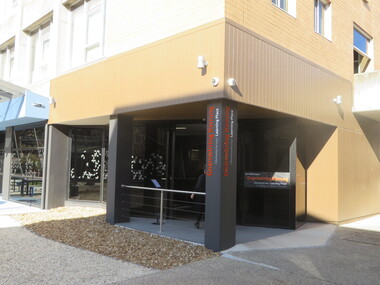
Photograph, Clare Gervasoni, Gnarrwirring Karung (Learning Place), Federation University Mt Helen Campus, 2018, 22/06/2018
... Federation University Australia’s Student Commons Area at the Mt Helen Campus was the first FedUni building to be officially given an Aboriginal name, Gnarrwirring Karung. ...Federation University Australia’s Student Commons Area at the Mt Helen Campus was the first FedUni building to be officially given an Aboriginal name, Gnarrwirring Karung. ...Federation University Australia’s Student Commons Area at the Mt Helen Campus was the first FedUni building to be officially given an Aboriginal name, Gnarrwirring Karung. Meaning Learning Place in the local Wadawurrung language, the re-named centre (pronounced Narrowing Ker Ung) will provide recognition of the area’s cultural heritage and increase the vibrancy, diversity and rich culture throughout the campus. The re-naming ceremony was held at the Gnarrwirring Karung Student Commons Area, S Building, Mt Helen Campus. “The choice of name follows an extensive process of seeking suggestions from the student body, the University’s Aboriginal Education Centre and local Aboriginal custodians,” Geoff Lord, Chairman of the University’s Reconciliation Action Plan (RAP) Committee, said. “The official naming meets many elements recognised within the FedUni RAP such as enhancing community, embedding culture, providing opportunity and, most importantly, respect. “The ceremony is a fine example of putting Aboriginal culture at the centre of our daily lives.” Jasmine Graham, Manager of the Aboriginal Education Centre, said the re-naming was a milestone for the local Aboriginal community. “The University is committed to greater recognition of Aboriginal heritage and culture throughout all of its campuses,” Ms Graham said. “Gnarrwirring Karung will be an impressive landmark throughout the Mt Helen Campus and a welcoming learning place.” A number of photographs taken at the naming of a Federation University space in the Mt Helen Campus 'S' Building. The space has been named Gnarrwirring Karung, Waddawurrung for Learning Place. waddawurrung, gnarrwirring karung, aboriginal, mt helen campus, reconciliation action plan, s building, waddawurrung language, place names -
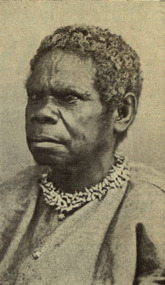 Federation University Historical Collection
Photograph - Image, Truganini
... Australia' by Charles Barrett and A.S. Kenyon (Sun Books) aborigine aboriginal truganini tasmania Bruni Island Shell Necklace Title - Truganini (When She Died Her Race Became Extinct). Aboriginal woman named ...Digitised directly from 'Blackfellows of Australia' by Charles Barrett and A.S. Kenyon (Sun Books)Aboriginal woman named Truganini wearing a shell necklace. She was a native of Bruni Island, Tasmania. Title - Truganini (When She Died Her Race Became Extinct).aborigine, aboriginal, truganini, tasmania, bruni island, shell necklace -
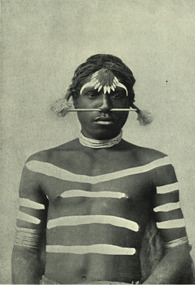 Federation University Historical Collection
Image - black and white, Barwon River Man (New South Wales)
... The Aboriginal people generally used the wetlands for hunting, fishing, and gathering uses, and for cultural association.(Wikipedia) The name "barwon" is derived from the Australian Aboriginal words of barwum or bawon, meaning great, wide, awful river of muddy water; and also baawan, a Ngiyambaa name for both the Barwon and Darling rivers. ...The Aboriginal people generally used the wetlands for hunting, fishing, and gathering uses, and for cultural association.(Wikipedia) The name "barwon" is derived from the Australian Aboriginal words of barwum or bawon, meaning great, wide, awful river of muddy water; and also baawan, a Ngiyambaa name for both the Barwon and Darling rivers. ...Digitised directly from 'The Native Races of the British Empire: Victoria' The Barwon River in New South Wales is formed through the confluence of the Macintyre River and Weir River (part of the Border Rivers system), north of Mungindi, in the Southern Downs region of Queensland. The Barwon River generally flows south and west, joined by 36 tributaries, including major inflows from the Boomi, Moonie, Gwydir, Mehi, Namoi, Macquarie, Bokhara and Bogan rivers. During major flooding, overflow from the Narran Lakes and the Narran River also flows into the Barwon. The confluence of the Barwon and Culgoa rivers, between Brewarrina and Bourke, marks the start of the Darling River.Black and white Image of an Aboriginal man from Barwon River, New South Wales. Aboriginal people from six language groups originally occupied the area of the Barwon River wetlands. These were the Ngemba, the Baranbinja, the Murrawari, the Ualayai, the Weilwan, and the Kamilaroi peoples. The Aboriginal people generally used the wetlands for hunting, fishing, and gathering uses, and for cultural association.(Wikipedia) The name "barwon" is derived from the Australian Aboriginal words of barwum or bawon, meaning great, wide, awful river of muddy water; and also baawan, a Ngiyambaa name for both the Barwon and Darling rivers. The history, culture and livelihoods of the local Aboriginal people are closely intertwined with the Barwon River and its associated tributaries and downstream flows. (Wikipedia)aborigine, aboriginal, barwon river -
 Federation University Historical Collection
Letterhead, University of Ballarat Aboriginal Education Centre Letterhead, 2012, c2012
... The name Federation University Australia was chosen to convey the scope and capacity of an expanded regional university with a federated network of campuses. university of ballarat university of ballarat aboriginal education centre letterhead aboriginal education centre A number of sheets of Aboriginal Education Centre letterhead. ...Federation University Australia was established on 1 January 2014. Formerly known as the University of Ballarat, its enabling legislation was the University of Ballarat Amendment (Federation University Australia) Act 2013. Although formally created as a University in 1994, the University of Ballarat has a lineage back to 1870 with the establishment of the School of Mines Ballarat, making it the third institution of higher learning to be established in Australia and the first to be established in regional Australia. On 1 January 1994, Ballarat University College became the University of Ballarat and in 1998 the University merged with three TAFE Institutes to become a dual sector institution with multiple campuses. On 1 January 2014, the University of Ballarat amalgamated with the Monash University Gippsland Campus to form Federation University Australia. The Gippsland Campus also had a long lineage dating back to 1928 with the establishment of the Yallourn Technical School which became a predecessor institution to the Gippsland College of Advanced Education formed in 1968. In 1990, it was renamed the Monash University College and in 1993 became the Gippsland Campus of Monash University. In 2016, Federation University Australia announced plans to take possession, over a two-year period, of Monash’s Berwick Campus in the south-east corridor of Melbourne. Federation University Australia, or FedUni, is headquartered in Ballarat and offers programs in Higher Education and Vocational Education and Training to regional Victoria and beyond. The University’s commitment to educational and social equity, teaching excellence, research distinction, environmental sustainability and regional capacity building has enabled it to develop in a way that draws on its proud heritage to inform its future. Its regional character sets a framework for the University’s priorities but does not constrain it from serving wider community interests, nationally and internationally. The name Federation University Australia was chosen to convey the scope and capacity of an expanded regional university with a federated network of campuses.A number of sheets of Aboriginal Education Centre letterhead. university of ballarat, university of ballarat aboriginal education centre, letterhead, aboriginal education centre -
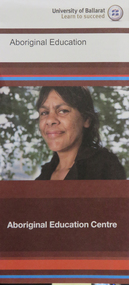 Federation University Historical Collection
Pamphlet - Brochure, University of Ballarat Aboriginal Education Centre Brochure, c2012, c2012
... The name Federation University Australia was chosen to convey the scope and capacity of an expanded regional university with a federated network of campuses. university of ballarat university of ballarat aboriginal education centre logo statement of reconciliation shirley morgan Aboriginal Education Centre A 4 bi-folded brochure outlining the role of the University of Ballarat Aboriginal Education Centre, entrance policy, and Reconciliation Statement. ...Federation University Australia was established on 1 January 2014. Formerly known as the University of Ballarat, its enabling legislation was the University of Ballarat Amendment (Federation University Australia) Act 2013. Although formally created as a University in 1994, the University of Ballarat has a lineage back to 1870 with the establishment of the School of Mines Ballarat, making it the third institution of higher learning to be established in Australia and the first to be established in regional Australia. On 1 January 1994, Ballarat University College became the University of Ballarat and in 1998 the University merged with three TAFE Institutes to become a dual sector institution with multiple campuses. On 1 January 2014, the University of Ballarat amalgamated with the Monash University Gippsland Campus to form Federation University Australia. The Gippsland Campus also had a long lineage dating back to 1928 with the establishment of the Yallourn Technical School which became a predecessor institution to the Gippsland College of Advanced Education formed in 1968. In 1990, it was renamed the Monash University College and in 1993 became the Gippsland Campus of Monash University. In 2016, Federation University Australia announced plans to take possession, over a two-year period, of Monash’s Berwick Campus in the south-east corridor of Melbourne. Federation University Australia, or FedUni, is headquartered in Ballarat and offers programs in Higher Education and Vocational Education and Training to regional Victoria and beyond. The University’s commitment to educational and social equity, teaching excellence, research distinction, environmental sustainability and regional capacity building has enabled it to develop in a way that draws on its proud heritage to inform its future. Its regional character sets a framework for the University’s priorities but does not constrain it from serving wider community interests, nationally and internationally. The name Federation University Australia was chosen to convey the scope and capacity of an expanded regional university with a federated network of campuses.A 4 bi-folded brochure outlining the role of the University of Ballarat Aboriginal Education Centre, entrance policy, and Reconciliation Statement. university of ballarat, university of ballarat aboriginal education centre, logo, statement of reconciliation, shirley morgan, aboriginal education centre -
 Federation University Historical Collection
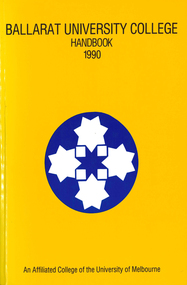
Book, Ballarat University College Handbook, 1993, 1992
... Australia. courses ballarat university college handbook jeff stewart Jeff Stewart name on first page. Blue covered book an image of the dam near the Mt Helen swimming pool. Information includes council membership, staff, admission policies and procedures, fees, Aboriginal and Torres Strait Islander Students, Scholarships, accomodation, International Students, courses, units, academic regulations, E.J. ...Ballarat University College was formed in 1990, and is a predecessor organisation of Federation University Australia. Blue covered book an image of the dam near the Mt Helen swimming pool. Information includes council membership, staff, admission policies and procedures, fees, Aboriginal and Torres Strait Islander Students, Scholarships, accomodation, International Students, courses, units, academic regulations, E.J. Barker Library Regulations, Appeals, Student discipline, Academic Board Policy, Student Union, Enrolment.Jeff Stewart name on first page.courses, ballarat university college handbook, jeff stewart -
 Greensborough Historical Society
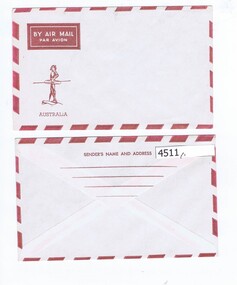
Envelope, Air Mail envelope (Australia), 1950s
... Australian air mail envelopes with Aboriginal motif based on 1930s photograph of "One pound Jimmy" envelope air mail "By AirMail, Par avion" with aboriginal motif. "Sender's name ...Australian air mail envelopes with Aboriginal motif based on 1930s photograph of "One pound Jimmy"Air Mail envelopes, printed in red-brown on off-white. "By AirMail, Par avion" with aboriginal motif. "Sender's name and address" on gummed flap on back.envelope, air mail -
 The Beechworth Burke Museum
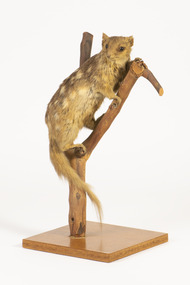
Animal specimen - Eastern quoll, Trustees of the Australian Museum, 1860-1880
... Australia and New Guinea. Tjilpa is the name given to the quoll amongst the Northern Arrernte language group of Australian Aboriginal people. ...Australia and New Guinea. Tjilpa is the name given to the quoll amongst the Northern Arrernte language group of Australian Aboriginal people. ...Quolls are small carnivorous marsupials native to Australia and New Guinea. Tjilpa is the name given to the quoll amongst the Northern Arrernte language group of Australian Aboriginal people. Quolls are primarily nocturnal and spend most of the day in a den. Of the six species of quoll, four are found in Australia and two in New Guinea. The six species vary in weight and size, from 300g to 7kg. They live in coastal heathlands, sub-alpine woodlands, temperate woodlands and forests, riparian forests and wet sclerophyll forests. This specimen is part of a collection of almost 200 animal specimens that were originally acquired as skins from either the Trustees of the Australian Museum or from the amateur anthropologist Reynell Eveleigh Johns between 1860-1880 and mounted by members of the Burke Museum Committee around the same time. When all taxidermy mounts were completed, they were quickly put-on display in the formal space of the Museum’s original exhibition hall where they continue to be on display. This display of taxidermy mounts initially served to instruct visitors to the Burke Museum of the natural world around them, today it serves as an insight into the collecting habits of the 19th century. This specimen is part of a significant and rare taxidermy mount collection in the Burke Museum. This collection is scientifically and culturally important for reminding us of how science continues to shape our understanding of the modern world. They demonstrate a capacity to hold evidence of how Australia’s fauna history existed in the past and are potentially important for future environmental research. This collection continues to be on display in the Museum and has become a key part to interpreting the collecting habits of the 19th century.Small quoll with a small round head, long body, and long, thin tail perched on a branch attached to a wooden mount. The quoll has four skinny legs which have long, dark claws. The quoll's hair is a fawn colour with cream spots. There are two black eyes made of glass, two short pointed ears and black whiskers.On wooden mount: BMM5897 /taxidermy, quoll, animal, australia, burke museum, beechworth, reynell eveleigh johns, taxidermy mount, marsupial -
 Orbost & District Historical Society
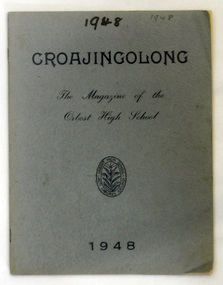
magazine, Snowy River Mail as "Mail" Print, Croajingolong 1948, 1948
... The name Croajingolong derives from the Australian Aboriginal Krauatungalung words galung, meaning "belonging to" and kraua, meaning "east". ...The name Croajingolong derives from the Australian Aboriginal Krauatungalung words galung, meaning "belonging to" and kraua, meaning "east". ...This is the first issue of the Orbost High School annual magazine. The name Croajingolong derives from the Australian Aboriginal Krauatungalung words galung, meaning "belonging to" and kraua, meaning "east". This book belonged to Mary Gilbert, a teacher at the school.This is the first edition of the Orbost secondary school magazine and is a useful reference tool. A 32 pp grey covered magazine titled Croajingolong 1948. It is the annual magazine of the Orbost High School. It has an Orbost High School badge in black print on the front cover. This is the first issue of the magazine.croajingolong orbost-high-school -
 Orbost & District Historical Society
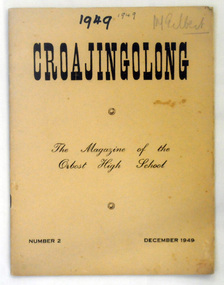
magazine, Croajingolong 1949, 1949
... The name Croajingolong derives from the Australian Aboriginal Krauatungalung words galung, meaning "belonging to" and kraua, meaning "east". ...The name Croajingolong derives from the Australian Aboriginal Krauatungalung words galung, meaning "belonging to" and kraua, meaning "east". ...The name Croajingolong derives from the Australian Aboriginal Krauatungalung words galung, meaning "belonging to" and kraua, meaning "east". This is the second edition of the annual magazine of Orbost High School. The magazine belonged to Mary Gilbert, a former teacher at the school.This magazine is the second issue of the Magazine producd by Orbost High School and is a useful reference tool.A 28 pp buff coloured magazine titled Croajingolong 1949. This is the second issue of the annual magazine of Orbost High School.on front cover - M Gilbert handwritten in blue penorbost-high-school magazine -
 Orbost & District Historical Society
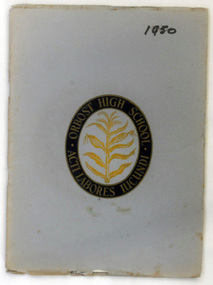
magazine, Croajingolong 1950, 1950
... The name Croajingolong derives from the Australian Aboriginal Krauatungalung words galung, meaning "belonging to" and kraua, meaning "east". ...The name Croajingolong derives from the Australian Aboriginal Krauatungalung words galung, meaning "belonging to" and kraua, meaning "east". ...This is the third issue of the Orbost High School annual magazine. The name Croajingolong derives from the Australian Aboriginal Krauatungalung words galung, meaning "belonging to" and kraua, meaning "east". This book belonged to Mary Gilbert, a former teacher at Orbost High School.This third issue of Croajingolong, the annual magazine of Orbost High Schoo,l is a useful reference tool.A 40 pp grey covered magazine. On the front cover is the school crest in black and gold. The book is titled Croajingolong 1950 - this is not on the cover.orbost-high-school croajingolong -
 Orbost & District Historical Society
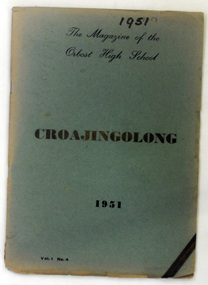
magazine, Croajingolong 1951, 1951
... The name Croajingolong derives from the Australian Aboriginal Krauatungalung words galung, meaning "belonging to" and kraua, meaning "east". ...The name Croajingolong derives from the Australian Aboriginal Krauatungalung words galung, meaning "belonging to" and kraua, meaning "east". ...This is the 4th issue of the annual Orbost High School magazine. The name Croajingolong derives from the Australian Aboriginal Krauatungalung words galung, meaning "belonging to" and kraua, meaning "east". This magazine was owned by Mary Gilbert, a former teacher at the school.This magazine is the fourth issue of the annual Orbost High School magazine and is a useful reference tool. A 36 pp green covered magazine titled Croajingolong 1951. This is the 4th issue of the annual Orbost High School magazine.croajingolong orbost-high-school -
 Orbost & District Historical Society
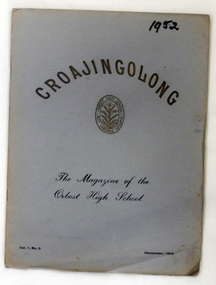
magazine, Croajingolong 1952, 1952
... The name Croajingolong derives from the Australian Aboriginal Krauatungalung words galung, meaning "belonging to" and kraua, meaning "east". ...The name Croajingolong derives from the Australian Aboriginal Krauatungalung words galung, meaning "belonging to" and kraua, meaning "east". ...This is the fifth issue of the Orbost High School annual magazine. The name Croajingolong derives from the Australian Aboriginal Krauatungalung words galung, meaning "belonging to" and kraua, meaning "east". This magazine belonged to Mary Gilbert, a former teacher at the school.This fifth issue of the annual Orbost High School magazine is a useful reference tool.A grey covered magazine of 32 pp. On the front cover is the text Orbost High school Croajingolong 1952 Dec. 1952 Vol.1 No.5croajingolong orbost-high-school -
 Orbost & District Historical Society
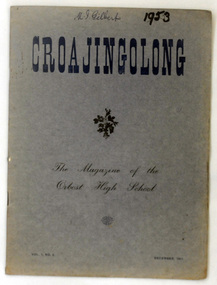
magazine, Croajingolong 1953, 1953
... The name Croajingolong derives from the Australian Aboriginal Krauatungalung words galung, meaning "belonging to" and kraua, meaning "east". ...The name Croajingolong derives from the Australian Aboriginal Krauatungalung words galung, meaning "belonging to" and kraua, meaning "east". ...This is the sixth issue of the Orbost High School annual magazine. The name Croajingolong derives from the Australian Aboriginal Krauatungalung words galung, meaning "belonging to" and kraua, meaning "east". This magazine belonged to Mary Gilbert, a former teacher at the school.This sixth issue of the Orbost High School's annual magazine is a useful reference tool.A grey covered magazine of 28 pp. The front cover has dark blue text The Magazine of the Orbost High School Croajingolong 1953 Vol.1 No. 6on front cover - M Gilbert handwritten in blue inkcroajingolong orbost-high-school -
 Orbost & District Historical Society
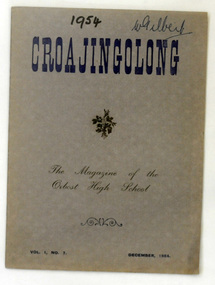
magazine, Croajingolong 1954, 1954
... The name Croajingolong derives from the Australian Aboriginal Krauatungalung words galung, meaning "belonging to" and kraua, meaning "east". this magazine was owned by Mary Gilbert, a former teacher at the school....The name Croajingolong derives from the Australian Aboriginal Krauatungalung words galung, meaning "belonging to" and kraua, meaning "east". this magazine was owned by Mary Gilbert, a former teacher at the school. ...This is the seventh issue of the Orbost High School annual magazine. The name Croajingolong derives from the Australian Aboriginal Krauatungalung words galung, meaning "belonging to" and kraua, meaning "east". this magazine was owned by Mary Gilbert, a former teacher at the school.This seventh issue of the annual magazine of Orbost High School is a useful reference tool.A 22 pp grey covered magazine titled Croajingolong 1954 Vol. 1 No. 7 Dec. 1954On front cover - M. Gilbert handwritten in blue pencroajingolong orbost-high-school -
 Orbost & District Historical Society
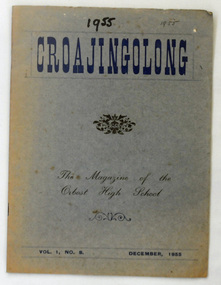
magazine, Croajingolong 1955, 1955
... The name Croajingolong derives from the Australian Aboriginal Krauatungalung words galung, meaning "belonging to" and kraua, meaning "east". ...The name Croajingolong derives from the Australian Aboriginal Krauatungalung words galung, meaning "belonging to" and kraua, meaning "east". ...This is the eighth issue of the Orbost High School annual magazine. The name Croajingolong derives from the Australian Aboriginal Krauatungalung words galung, meaning "belonging to" and kraua, meaning "east". This magazine belonged to Mary Gilbert, a former teacher at the school.This eighth issue of the annual Orbost High School magazine is a useful reference tool.A 24 pp magazine with a grey cover titled Croajingolong 1955. Vol.1 No. 8croajingolong orbost-high-school
