
Showing 234 items matching "australian army - engineers"
-
 Chiltern Athenaeum Trust
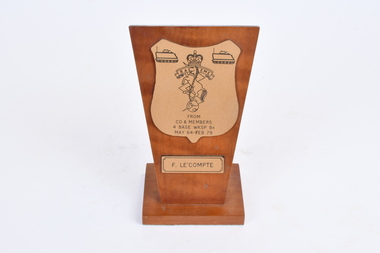
Farewell Trophy RAEME (Royal Australian Electrical and Mechanical Engineers) Australian Army : F. LE' Compte, 1979
... Farewell Trophy RAEME (Royal Australian Electrical and Mechanical Engineers) Australian Army : F. LE' Compte...RAEME being "The Royal Australian Army Electrical and Mechanical Engineering Corps. Farewell Trophy RAEME (Royal Australian Electrical and Mechanical Engineers) Australian Army : F. ...To signify a service members contribution to their Corps (RAEME) of the Royal Australian Army and upon their leaving at 15 years of service. The name plate indicates member F. LE' Compte. Royal Australian Army - RAEME Corps, member F. LE' Compte, 4 Base Workshop Battalion. Wooden trophy with synthetic plate signifying a farewell remembrance from fellow service personnel within the Number 4 Base Workshop Battalion. RAEME being "The Royal Australian Army Electrical and Mechanical Engineering Corps. From CO and Members 4 Base Workshop Battalion May 64 - 79. F. LE' Compte. The synthetic name plate also has the RAEME Corps emblem which is : : 'Upon a lighting flash a horse forcene gorged with a coronet of four fleur-de-lis, a chain reflexed over its back and standing on a globe. ... The horse forcene and chain are symbolic of power under control and the lightning flash, of electrical engineering.raeme corps, royal austrlaian army 64-79, f. le'compte -
 Monbulk RSL Sub Branch
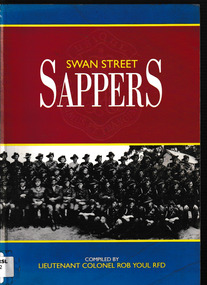
Book, Headquarters Logistic Support Force Engineers committee, The Swan Street Sappers 1860-1996 : a history of the Engineer Training Depot, Swan Street, Melbourne and of Sappers in Victoria, 1995
... Australian army - History...Australian army - Engineers...Australian army - History Australian army - Engineers This book marks the closing of the Engineer Training Depot at Swan Street, Melbourne in late 1991 by registering its great contribution to military and community life and by telling the story of Sappers in Victoria. ...This book marks the closing of the Engineer Training Depot at Swan Street, Melbourne in late 1991 by registering its great contribution to military and community life and by telling the story of Sappers in Victoria.Index, bib, ill, p.203.non-fictionThis book marks the closing of the Engineer Training Depot at Swan Street, Melbourne in late 1991 by registering its great contribution to military and community life and by telling the story of Sappers in Victoria.australian army - history, australian army - engineers -
 Monbulk RSL Sub Branch
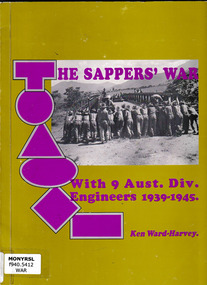
Book, Sakoga in conjunction with 9th Division RAE Association, The sappers' war with Ninth Australian Division Engineers 1939-1945, 1992
... Australian army - Engineers...Australian army - Engineers World war 1939-1945 - Regimental histories - Australia Traces the activities of the 9th Australian Division Engineers during World War Two Ill, maps, p.224. ...Traces the activities of the 9th Australian Division Engineers during World War TwoIll, maps, p.224.non-fictionTraces the activities of the 9th Australian Division Engineers during World War Twoaustralian army - engineers, world war 1939-1945 - regimental histories - australia -
 National Vietnam Veterans Museum (NVVM)
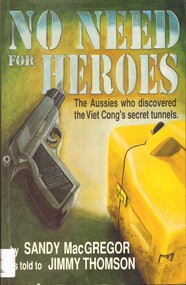
Book, MacGregor, Sandy, No Need for Heroes: the Aussies who discovered the Viet Cong's secret tunnels. (Copy 2), 1993
... Australia. Australian Army. Royal Engineers...Australia. Australian Army. Royal Engineers Australia. Australian Army. ...This is the thrilling, hilarious and inspiring true story of a ragtag band of Aussie Army Engineers who redefined the word heroes...and reinvented larrikin too.This is the thrilling, hilarious and inspiring true story of a ragtag band of Aussie Army Engineers who redefined the word heroes...and reinvented larrikin too.australia. australian army. royal engineers, australia. australian army. royal engineers. field troop, 3., tunnels - vietnam - cu chi (quan), tunnel rats -
 Running Rabbits Military Museum operated by the Upwey Belgrave RSL Sub Branch
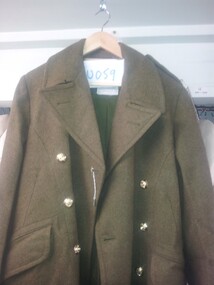
Greatcoat
... Army, Royal Australian Engineers, with buttons...Uniform 1966 Army Army, Royal Australian Engineers, with buttons Greatcoat ...Army, Royal Australian Engineers, with buttonsuniform, 1966, army -
 Running Rabbits Military Museum operated by the Upwey Belgrave RSL Sub Branch
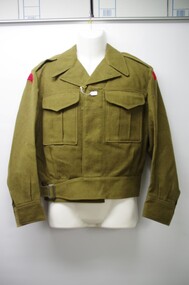
Jacket - Battledress
... Army, Royal Australian Engineers, battle dress, stored with trousers (U060)...Uniform 1965 Army Army, Royal Australian Engineers, battle dress, stored with trousers (U060) Jacket - Battledress ...Army, Royal Australian Engineers, battle dress, stored with trousers (U060)uniform, 1965, army -
 Ringwood and District Historical Society
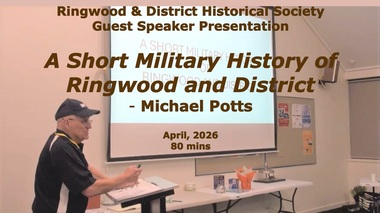
Mixed media - Video, RDHS Guest Speaker Presentation - Ringwood Army Engineers - "A Short Military History of Ringwood and District" - Michael Potts
... The 22nd Engineer Regiment is an Australian Army engineer unit based in Dublin Road, East Ringwood. ...The 22nd Engineer Regiment is an Australian Army engineer unit based in Dublin Road, East Ringwood. ...Digitised Powerpoint presentation video (3.48GB) Duration: 80 minutes. Recorded April, 2026 (Video is available for viewing at Ringwood & District Historical Society Archives by appointment)The 22nd Engineer Regiment is an Australian Army engineer unit based in Dublin Road, East Ringwood. It was raised in 1950 and has been part of Ringwood's community for many years. The regiment gained Freedom of the City. RDHS Member Mike Potts has had a long aassociation with Ringwood Army Engineers and is extremely knowledgeable of its history and militaria covered in his presentation at our April General Meeting. -
 Federation University Historical Collection
Document, Albert E. Stohr, Curriculum Vitae of A.E.Stohr, 1970, 19/01/1970
... Engineers (Australia) for 46 years, member of the Association of Professional Engineers of Australia for 22 years, and chairman of the Ballarat Group of the Association . Member of the Rotary Club of Ballarat for 24 years, and many other organisational. stohr bert stohr a.e. stohr white swan reservoir engineering alumni engineer ballarat school of mines. Five foolscap pages relating to the education and career of Albert Edward Stohr. Work places include: Broken Hill Proprietary Co. Ltd; Victorian Railways Construction Branch; Melbourne & Metropolitan Board of Works; Sewerage and Main Drainage Branch; Water Supply Branch; United States Army ...Albert E. Stohr was a member of the Council of the Ballarat School of Mines for 24 years, a member of the Council of the Ballarat grammar School for 24 years, represented all Provincial Sewerage Authorities in Victoria on the Plumbers and gasfitters registration Board of Victoria for 25 years, member of the Institution of Engineers (Australia) for 46 years, member of the Association of Professional Engineers of Australia for 22 years, and chairman of the Ballarat Group of the Association . Member of the Rotary Club of Ballarat for 24 years, and many other organisational.Five foolscap pages relating to the education and career of Albert Edward Stohr. Work places include: Broken Hill Proprietary Co. Ltd; Victorian Railways Construction Branch; Melbourne & Metropolitan Board of Works; Sewerage and Main Drainage Branch; Water Supply Branch; United States Army Services of Supply; Department of the Australian Army; Ballarat Water Commissioners; Ballarat Sewerage Authority. His projects include the White Swan Reservoir, Gong Gong Reservoir Spillway Channel; Installation of Venturi Meters at Brown Hill; Sewerage treatment Works; Nightsoil Dumping and Pan Washing Depot. stohr, bert stohr, a.e. stohr, white swan reservoir, engineering alumni, engineer, ballarat school of mines. -
 Federation University Historical Collection
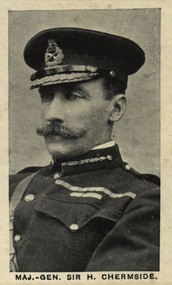
Photograph (black & White), Major-General Sir Herbert Charles Chermside - South Africa
... Australia. He announced his retirement in 1904 and returned to Britain. He retired from the Army in 1907. Chermside was awarded the Companion of the Order of the Bath in 1886, Companion of the Order of St Michael and St George in 1880, upgraded to Knight Commander of the Order of St Michael and St George in 1897 and Knight Grand Cross of the Order of St Michael and St George in 1899. herbert chermside royal military academy commissioned royal engineers arctic egypt british army intelligence staff curragh camp ireland south africa second boer war governor of queensland companion of the order of the bath companion of the order of st michael and st george knight commander of the order of st michael and st george knight grand cross of the order of st michael and st george Individual image from photographed poster of tobacco and cigarette cards. ...After attending Eton College, Herbert Chermside attended the Royal Military Academy where he graduated at the top of his year and was commissioned in the Royal Engineers in 1870. After several postings and expeditions, including the Arctic in 1873, he was promoted to captain in 1882 and appointed to the British Army's intelligence staff in Egypt and given command of the Egyptian Army's 1st Battalion. He spent four years in Egypt. Promotions and consular appointments followed and eventually he returned to Britain. He was appointed in command of the Curragh Camp in Ireland, 1900. However, he was sent to South Africa to command the 14th brigade and the 3rd division during the Second Boer War. Late 1901 he returned to his position in Ireland and in 1902 he was appointed the first Post-Federation Governor of Queensland, Australia. He announced his retirement in 1904 and returned to Britain. He retired from the Army in 1907. Chermside was awarded the Companion of the Order of the Bath in 1886, Companion of the Order of St Michael and St George in 1880, upgraded to Knight Commander of the Order of St Michael and St George in 1897 and Knight Grand Cross of the Order of St Michael and St George in 1899. Individual image from photographed poster of tobacco and cigarette cards.herbert chermside, royal military academy, commissioned, royal engineers, arctic, egypt, british army intelligence staff, curragh camp, ireland, south africa, second boer war, governor of queensland, companion of the order of the bath, companion of the order of st michael and st george, knight commander of the order of st michael and st george, knight grand cross of the order of st michael and st george -
 Lara RSL Sub Branch
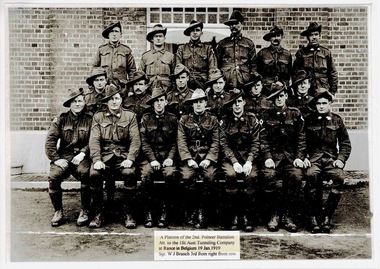
Photograph, A Platoon of the 2nd, Pioneer Battalion Att. to the 1St.Aust. Tunneling Company at Rance in Belgium 19 Jan 1919
... Australian infantry and light engineer unit raised for service during the First World War as part of the all volunteer Australian Imperial Force. Formed in Egypt in March 1916, the battalion subsequently served on the Western Front in France and Belgium, after being transferred to the European battlefields shortly after its establishment. army, rance belgium,australian army, lara r.s.l. ! ...The 2nd Pioneer Battalion was an Australian infantry and light engineer unit raised for service during the First World War as part of the all volunteer Australian Imperial Force. Formed in Egypt in March 1916, the battalion subsequently served on the Western Front in France and Belgium, after being transferred to the European battlefields shortly after its establishment. Rectangular shaped black and white Photograph.A Platoon of the 2nd, Pioneer Battalion Att. to the 1St.Aust. Tunnelling Company at Rance in Belgium 19 Jan 1919 Sgt. W J Branch 3rd from right front row. army, rance belgium,australian army, lara r.s.l., !st.australian tunnelling company, 2nd pioneer battalion. -
 Lara RSL Sub Branch
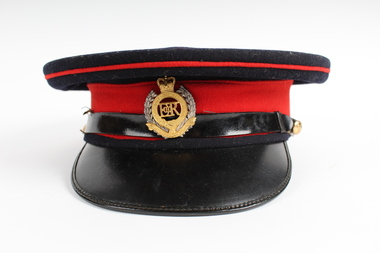
Uniform, Australian Engineers Force Officers cap
... Army officer's peaked cap worn on formal occasions, dark blue with red band around hat. The peak top side is finished in high gloss black leather and the hat has a similar high gloss black hat band. Worn by an officer in the Royal Australian Engineers...This hat is referred to as a 'blues' hat. hat engineer army australian army rae royal australian engineer officer On badge: Royal Australian Engineers. ...Army officer's peaked cap worn on formal occasions, dark blue with red band around hat. The peak top side is finished in high gloss black leather and the hat has a similar high gloss black hat band. Worn by an officer in the Royal Australian Engineers (RAE). This hat is referred to as a 'blues' hat.Navy blue cap with red and black trimming. The hat itself is a flat cap made out of navy blue felt. around this is a red felted band, itself encircled with a black patent band and peak. The black band is held on by two smaller badges, which are brass in colour and have an image of the Australian map (above which is the crown) and around the edges says Australian Military Forces. At the front of the cap is a badge which says: Royal Australian Engineers. On badge: Royal Australian Engineers. Moni Soit Qui Mal Y Pense Inside cap: L. Silberston and Sons Ltd London hat, engineer, army, australian army, rae, royal australian engineer, officer -
 Lara RSL Sub Branch
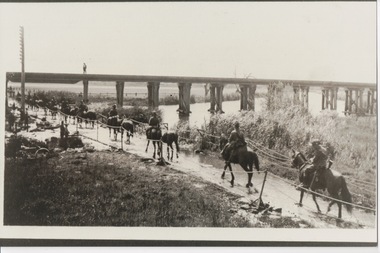
Photograph, Set 4 photographs. and others for Torquay Light Horse camp, 1940
... Engineers, Signals, Field Ambulance and other branches of the Army necessary to enable a Division to function. It wasn’t just the sheer numbers of men coming to this little town that made the event significant, it was also the fact that the men of the Light Horse were dramatic, almost glamorous figures and it is easy to see their exploits as some splendid adventure. Horses have played a special role in the story of Australia...Engineers, Signals, Field Ambulance and other branches of the Army necessary to enable a Division to function. It wasn’t just the sheer numbers of men coming to this little town that made the event significant, it was also the fact that the men of the Light Horse were dramatic, almost glamorous figures and it is easy to see their exploits as some splendid adventure. Horses have played a special role in the story of Australia ...These images capture for all time Light Horsemen travelling through Geelong on their way to camp at Torquay for the last Group meeting in Australia . information following - details obtained from .........https://torquayhistory.com/light-horse-brigade/ On Australia Day, 1997, Sir John Young unveiled this plaque on Point Danger, Torquay. Torquay history, Light Horse Training Camp, WW2 Plaque at Pt. Danger Note----- (See images to view plaque) The plaque identifies a significant event in Torquay’s history and the sentiments of ‘change’ for the Light Horse Brigade – from horses to machines. In 1940 the four Light Horse Regiments (4th, 8th, 13th and 20th), some 5000 Light Horse and 2000 horses camped and trained at Torquay. Three other regiments, formerly mounted on horses, were also at Torquay ‘mounted’ on privately owned trucks and cars. Division troops included Artillery, Engineers, Signals, Field Ambulance and other branches of the Army necessary to enable a Division to function. It wasn’t just the sheer numbers of men coming to this little town that made the event significant, it was also the fact that the men of the Light Horse were dramatic, almost glamorous figures and it is easy to see their exploits as some splendid adventure. Horses have played a special role in the story of Australia. They were the only means of transport across this huge country, so it was necessary for everyone to have the ability to ride a horse. When war broke out in 1899 between Britain and the Boers of South Africa (“Boer” was Dutch for “farmer”) Australia sent troops to fight. At first Britain was wary of using untried, unprofessional colonial cavalrymen but soon saw that the slouch-hatted Australian “bushmen” were a match for the fast-moving and unconventional mounted commandos of the Boers. The Australians proved themselves to be expert rough-riding horsemen and good shots. Bush life had hardened them to go for long periods with little food and water. They also showed remarkable ability to find their way in a strange country and use its features for cover, in both attack and defence. By 1914, when Australia joined the war against Germany, there were 23 Light Horse regiments of militia volunteers. Many men from these units joined the Light Horse regiments of the Australian Imperial Force (AIF). Men were given remounts (if not using their own horses) – army horses bought by Commonwealth purchasing officers from graziers and breeders. These were called “walers” because they were a New South Wales stockhorse type – strong, great-hearted animals with the strains of the thoroughbred and semi-draught to give them speed, strength and stamina. On 1st November, 1914, Australia’s First Infantry Division and the first four Light Horse regiments sailed for England in a fleet of transport ships. The first of the Light Horse arrived at Gallipoli in May without their horses. Back with their horses after Gallipoli, they were formidable combatants across the Sinai and Palestine. Some British commanders observed that the light horseman moved with a “lazy, slouching gait, like that of a sleepy tiger” but described how the promise of battle “changes that careless gait, into a live athletic swing that takes him over the ground much quicker than other troops”. They had Light Horse, Torquay, training campdeveloped a reputation as formidable infantrymen. The Turks called them “the White Ghurkas” – a reference to their deadly skill with the bayonet. The Arabs called them “The Kings of the Feathers”. The plume had originally been a battle honour of the Queensland Mounted Infantry for their work in the shearer’s strike of 1891. During WW1 it was adopted by almost all the Light Horse Regiments. It was the proud badge of the light horseman. The most famous of their battles was the attack on Beersheba- the charge of the 4th Light Horse Brigade. Mounted infantrymen and their superb walers had carried out one of the most successful cavalry charges in history – against what seemed impossible odds. They surprised the Turks by charging cavalry-style, when they would normally have ridden close to an objective then dismounted to fight. The fall of Beersheba swung the battle tide against the Turks in Palestine; and changed the history of the Middle East. While 19 men from the Surf Coast Shire served with the 4th Light Horse over the course of WW1, only four were involved in the charge of Beersheba- John GAYLARD, Philip QUINN.(Winchelsea); Wallace FINDLAY (Anglesea); Harry TRIGG (Bambra). After the war, Light Horse units played a key role in the Australian Government’s compulsory military training programme. The Citizen Military Forces (C.M.F.) thrived on the glamour of the wartime Light Horse tradition, ignoring the possibility that motor vehicles would soon replace the horses. When training was no longer compulsory, the C.M.F. regiments declined and horses became more of a luxury during the 1930s depression years of poverty and unemployment. Some regiments were motorised. Then, in 1939, Australia joined Britain in another world war. Training was increased for the militia at both home bases and regional training camps. The camp at Torquay in 1940, commanded by Major General Rankin, was at Divisional strength. By the end of the camp some felt that the Division was ready for active service. Gradually, over the next four years, the Australian Light Horse units were mounted on wheels and tracks and the horses were retired. Six men enlisted at the Torquay camp and another 57 men and women enlisted at Torquay for service in WW2. Those who served in the Militia provided valuable Officers and NCOs and men for the armed services during the war. Each infantry division of the 2nd AIF had a Light Horse regiment attached to it. But the day of the Australian mounted soldier hadn’t quite passed. During World War II, Australia’s 6th Cavalry Regiment formed a mounted unit they called “The Kelly Gang” which did valuable scouting work. In New Guinea, a mounted Light Horse Troop did patrol duty and helped carry supplies. Some fully equipped walers were flown into Borneo for reconnaissance in rugged mountain country. But by the end of the war, in 1945, the horse had disappeared from the Australian Army. References: Australian Light Horse Association www.lighthorse.org.au National Australia Archives Australian War Memorial Surf Coast Shire WW1 memorials www.togethertheyserved.com The Light horse- a Cavalry under Canvas Light Horse, Training Camp, Torquay, WW2 Late in 1939 it was decided to set up a Lighthorse training camp in Torquay to train both men and horses for the battles of the Second World War. Horses, men and equipment came on special trains from all over Victoria and NSW, and as you would expect horseman came from areas such as Omeo and Sale, the Wimmera and the Western District. They arrived at the Geelong racecourse for watering in the Barwon River and then were ridden across the ford at the breakwater and began their 11 mile trek to Torquay. Light Horse, Training Camp, Torquay, WW2 Tent city By the end of January 1940 the camp at Torquay accommodated some 5000 men and 2500 horses of the Second Cavalry Division. The rows of horses, tents and huts near Blackgate Road were quite a sight. While the cavalrymen engaged in exercises on the land and on the beaches, many of the troops took over the Torquay School for special training of men and officers. Mr Bob Pettit local farmer and Councillor for the Barrabool Shire, wrote about the Light horse in the Surf Coast Community News in 1985 saying “They used to travel about the district riding four abreast in one long convoy. To my annoyance they went through my property and shut all the gates behind them. I had certain gates open to let stock in to the water holes and it would take me three -quarters of an hour to follow the horsemen up and put all the gates right again” he continued “the men from the Light Horse were here when the fire went through in March 1940. He recalled an incident when early one morning, as some one blew the bugle, a soldier putting a white sheet on the line frightened the horses. They panicked and ran off in all directions. Six went over the cliff near Bird Rock, five were never found, and the rest were gathered up after nearly a fortnight in the bush around Addiscott and Anglesea" Light Horse, Training Camp, Torquay, WW2, Geelong Parade Geelong parade The training camp culminated in a parade through the streets of Geelong on March 12th 1940. The salute was given at the Town Hall and the troops continued on a route to the You Yang’s for a training exercise. Note-----(see media section for photograph) The Camp was abandoned in mid 1940 as it was deemed unsuitable for training during winter and the cost of a permanent camp could not be justified if it could not be used all year. Historic.......Rare,,,Interpretive.Sepia photographs.set of four ....post card size ....Horses &LighthorsemenNo 1, Lighthorsemen Regiment Geelong 1940......No 2 Light Horse at Breakwater Geelong 1938 to 1940....No 3 Light Horse at Breakwater Geelong 1938 to 1940.....No 4 Light Horse crossing Breakwater camped at Geelong Showgrounds. These markings are on reverse of photographs.light horsemengeelong 1940., world war 2 -
 Lara RSL Sub Branch
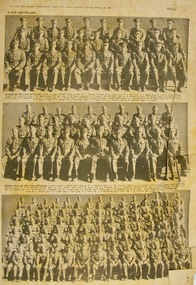
Newspaper, 17th Australian Infantry Brigade, February 22nd 1940
... The Argus 17th Australian Infantry Brigade, Second AIF, Souvenir Supplement, Thursday, February 22, 1940 Page 1 2/5th Battalion - Picture 1 Officers of the 2/5th Battalion; Picture 2 Senior NCO's of the 2/5th Battalion; Picture 3 A Company 2/5th Battalion Page 2 B Company 2/5th Battalion; C Company 2/5th Battalion; D Company 2/5th Battalion Page 3 Headquarters 2/2nd Field Regiment 6th Divisional Artillery; 3rd Battery 2/2nd Field Regiment 6th Divisional Artillery Page 4 Officers, NCO's and men of 2/2nd Field Company, 6th Divisional Engineers; Officers NCO's and men 2/2nd Field Ambulance and 2/2nd Australian General Hospital 6th Divisional Australian Army Medical Corps...The photographs are of national significance as they may reflect the only known photographs of individuals from WW2. aif army 17th brigade second aif 2/5th battalion australian army australian infantry brigade 2/2nd field aumbulance 2/2nd australian general hospital 6th divisional australian army medical corps 6th divisional engineers The Argus 17th Australian Infantry Brigade, Second AIF, Souvenir Supplement, Thursday, February 22, 1940 Page 1 2/5th Battalion - Picture 1 Officers of the 2/5th Battalion; Picture 2 Senior NCO's of the 2/5th Battalion; Picture 3 A Company 2/5th Battalion Page 2 B Company 2/5th Battalion; C Company 2/5th Battalion; D Company 2/5th Battalion Page 3 Headquarters 2/2nd Field Regiment 6th Divisional Artillery; 3rd Battery 2/2nd Field Regiment 6th Divisional Artillery Page 4 Officers, NCO's and men of 2/2nd Field Company, 6th Divisional Engineers; Officers NCO's and men 2/2nd Field Ambulance and 2/2nd Australian General Hospital 6th Divisional Australian Army Medical Corps 4 page newspaper pictures of 17th Brigade, Second AIF 17th Australian Infantry Brigade Newspaper ...The 17th Australian Infantry Brigade was an infantry brigade in the Australian Army. First formed in 1917 during World War I, it did not see any action. Reformed during World War II, before being disbanded in 1946. Today, its name is perpetuated by the 17th Combat Service Support Brigade, which was raised as a logistics formation in May 2006. The 17th Brigade was reformed on 13 October 1939, again as part of the 6th Division, recruited from Victoria. The 17th Brigade fought in the Western Desert Campaign in Libya, the Battle of Greece, the Battle of Wau, the Salamaua-Lae campaign in Papua, and in the Aitape-Wewak campaign in New Guinea. The photographs are of national significance as they may reflect the only known photographs of individuals from WW2.4 page newspaper pictures of 17th Brigade, Second AIFThe Argus 17th Australian Infantry Brigade, Second AIF, Souvenir Supplement, Thursday, February 22, 1940 Page 1 2/5th Battalion - Picture 1 Officers of the 2/5th Battalion; Picture 2 Senior NCO's of the 2/5th Battalion; Picture 3 A Company 2/5th Battalion Page 2 B Company 2/5th Battalion; C Company 2/5th Battalion; D Company 2/5th Battalion Page 3 Headquarters 2/2nd Field Regiment 6th Divisional Artillery; 3rd Battery 2/2nd Field Regiment 6th Divisional Artillery Page 4 Officers, NCO's and men of 2/2nd Field Company, 6th Divisional Engineers; Officers NCO's and men 2/2nd Field Ambulance and 2/2nd Australian General Hospital 6th Divisional Australian Army Medical Corpsaif, army, 17th brigade, second aif, 2/5th battalion, australian army, australian infantry brigade, 2/2nd field aumbulance, 2/2nd australian general hospital, 6th divisional australian army medical corps, 6th divisional engineers -
 Lara RSL Sub Branch
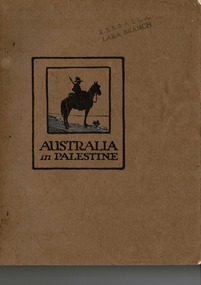
Book, Australia in Palestine, 1919
... His fearlessness, initiative and endurance, and his adaptability to almost any task, are due to the adventurous life he leads in his own country where he has been accustomed to long hours in the saddle, day and night, and to facing danger of all sorts from his earliest youth. battle of beersheba battle of richon ze zion battle of bir er abd camel corps lighthorse slush light sir h.g. chauvel mounted division at kantara medical services signal engineers katia oasis new zealand mounted troops sir edmund h allenby walers story 5th lighthorse romani WW1 World War 1 Australian Army To the memory of fallen comrades. ...A soldier's book produced almost entirely by soldiers in the field under active service conditions to send to their friends in Australia and abroad. Australian Lighthorse men is a type peculiar his own and has no counterpart in h is NZ brother. His fearlessness, initiative and endurance, and his adaptability to almost any task, are due to the adventurous life he leads in his own country where he has been accustomed to long hours in the saddle, day and night, and to facing danger of all sorts from his earliest youth.Brown front and back hardcover with dark brown text 'Australia in Palestine' with a light horseman framed in centre of front cover. The spine is green with text Australia in Palestine, Angus and Robertson bottom of spine. Evidence of water on front cover. Silverfish have eaten top right hand corner of first two pages. Farm scene in four boxes with AR in the lower corner of each square. Inside front and back covers are illustrations of a camel train and came corps in the desert with the rising sun in the background with a mountain. There is a grave and white cross in their foreground right lower corner Illustrations, photographs, poems, short stories, Centre foldout of the Battle for Richon Le Zion and Battle of Beersheba and after the Battle of Bir El Abed To the memory of fallen comrades. Pen mark inside W. Mathews Larabattle of beersheba, battle of richon ze zion, battle of bir er abd, camel corps, lighthorse, slush light, sir h.g. chauvel, mounted division at kantara, medical services, signal engineers, katia oasis, new zealand mounted troops, sir edmund h allenby, walers story, 5th lighthorse, romani, ww1, world war 1, australian army -
 Lara RSL Sub Branch
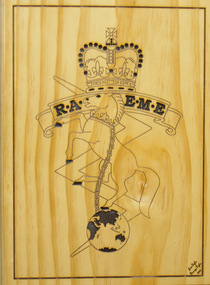
Plaque - RAEME Plaque
... Ref: www.raeme.org.au The Royal Australian Electrical and Mechanical Engineers (RAEME) is a technical corps tasked with the maintenance of the Army's modern hardware and equipment. ...Ref: www.raeme.org.au The Royal Australian Electrical and Mechanical Engineers (RAEME) is a technical corps tasked with the maintenance of the Army's modern hardware and equipment. ...RAEME Corps was first established in 1942 when the Ordnance Corps and the Service Corps were combined. The royal ascent was granted in 1948. Ref: www.raeme.org.au The Royal Australian Electrical and Mechanical Engineers (RAEME) is a technical corps tasked with the maintenance of the Army's modern hardware and equipment. RAEME personnel are represented in most Army units, with the representation varying in size from one or two tradespersons, to small groups of 20 to 30 tradespersons, to large maintenance units with over 150 personnel and a totally integrated military and civilian workforce. The Royal Australian Electrical and Mechanical Engineers corps motto is ‘Arte et Marte’, which is Latin for ‘With Skill and Fighting’. Ref: www.army.gov.auVarnished Wooden BoardRAEME Badge Jan Zyla George Zyla 2020 -
 City of Moorabbin Historical Society (Operating the Box Cottage Museum)
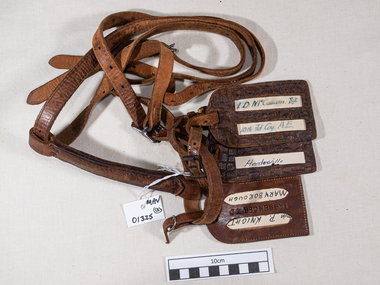
Leather, luggage straps and labels c1916, 20thC
... The labels enabled easy identification when collecting luggage from transport carriages, coaches, buses and trains. 10th Field Company, Australian Engineers WW1 1914-18. The 10th Brigade was an infantry brigade of the Australian Army. ...The labels enabled easy identification when collecting luggage from transport carriages, coaches, buses and trains. 10th Field Company, Australian Engineers WW1 1914-18. The 10th Brigade was an infantry brigade of the Australian Army. ...Leather straps were commonly used to secure cases and other forms of luggage when traveling. The labels enabled easy identification when collecting luggage from transport carriages, coaches, buses and trains. 10th Field Company, Australian Engineers WW1 1914-18. The 10th Brigade was an infantry brigade of the Australian Army. Originally formed in 1912 as a Militia formation, the brigade was re-raised in 1916 as part of the expansion of the Australian Imperial Force following the end of the Gallipoli campaign. It subsequently saw service on the Western Front in France and Belgium during the First World War. After the war it was disbanded but was re-raised in 1921 as a part-time formation based in the state of Victoria. During the Second World War the brigade was used in a garrison role in Australia before being disbanded in 1942.These leather straps and labels were attached to the luggage of an Australian soldier during early 20th C who may have been a resident or relative of a resident in City of MoorabbinLeather luggage straps with metal buckles and 3 luggage address labels attached.Label 1 - L.D.McCallum Sgt / 10th Fd Coy AE Label 2 - Healesville Label 3 - Maryborough leather, straps, belts, luggage labels, tools, saddles, wallets, personal effects, horses, drays, world war 1 1914 -18, world war 2 1939-45, army, 1st aif, military, 10th field company australian engineers, western front, france, belgium, -
 Montmorency–Eltham RSL Sub Branch
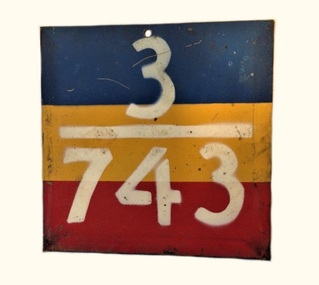
Functional object - Vehicle Identification Plate, metal, Post WWII
... Identification plate is for the Royal Australian Mechanical and Electrical engineers (RAME), 3rd Military District, vehicle number 743. Vehicle identification plate used by the Australian Army. vehicle identification plate rame 3rd military district Horizontal blue, yellow and red horizontal stripes. ...Identification plate is for the Royal Australian Mechanical and Electrical engineers (RAME), 3rd Military District, vehicle number 743.Vehicle identification plate used by the Australian Army.Small square shaped steel metal plate. Khaki coloured paint on rear face. Blue, yellow and red horizontal painted stripes on the front face. White coloured numbers with a narrow horizontal white line painted on front face. Small hole drilled through the plate on the top.Horizontal blue, yellow and red horizontal stripes. Number 3 on top of a narrow horizontal white line with the numbers 743 underneath.vehicle, identification, plate, rame, 3rd military district -
 Australian Commando Association - Victoria
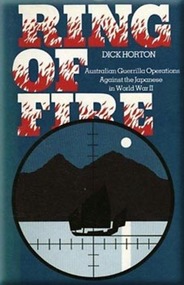
Book, Ring of Fire: Australian Guerrrilla Operations Against Japan in World War II
... He describes the magnificent series of operations of the Independent Companies against the crack 5th and 48th Divisions of the Japanese Army on Timor and the achievements of HMAS KRAIT a converted Japanese fishing boat. He goes on to describe the revolt of the population in Borneo which was engineered by a handful of men. mostly Australians from Z Special Unit, and which materially assisted the Allied Forces when they invaded and re-took it. ...Dick Horton, as a Lieutenant RNVR. was a member of the Special Forces with which this book is concerned and was awarded the DSC and the American Silver Star for his services. He writes from first-hand knowledge and pays fitting tribute to his brothers-in-arms. He describes the magnificent series of operations of the Independent Companies against the crack 5th and 48th Divisions of the Japanese Army on Timor and the achievements of HMAS KRAIT a converted Japanese fishing boat. He goes on to describe the revolt of the population in Borneo which was engineered by a handful of men. mostly Australians from Z Special Unit, and which materially assisted the Allied Forces when they invaded and re-took it. Apart from its unquestionable value to students of military history, "Ring of Fire" is an exciting account of a variety of imaginativenon-fiction Dick Horton, as a Lieutenant RNVR. was a member of the Special Forces with which this book is concerned and was awarded the DSC and the American Silver Star for his services. He writes from first-hand knowledge and pays fitting tribute to his brothers-in-arms. He describes the magnificent series of operations of the Independent Companies against the crack 5th and 48th Divisions of the Japanese Army on Timor and the achievements of HMAS KRAIT a converted Japanese fishing boat. He goes on to describe the revolt of the population in Borneo which was engineered by a handful of men. mostly Australians from Z Special Unit, and which materially assisted the Allied Forces when they invaded and re-took it. Apart from its unquestionable value to students of military history, "Ring of Fire" is an exciting account of a variety of imaginative -
 Flagstaff Hill Maritime Museum and Village
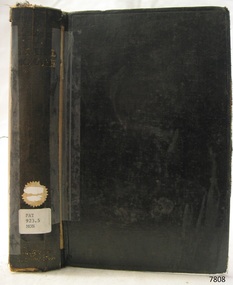
Book, War Letters of General Monash
... Australian soldier of Jewish birth, was born in Melbourne, graduating at Melbourne University..Began practising as a civil engineer in 1884, and became President of the Victorian Engineering Institute .. In 1887 entered the Australian Army...Australian soldier of Jewish birth, was born in Melbourne, graduating at Melbourne University..Began practising as a civil engineer in 1884, and became President of the Victorian Engineering Institute .. In 1887 entered the Australian Army ...This item is from the ‘Pattison Collection’, a collection of books and records that was originally owned by the Warrnambool Mechanics’ Institute, which was founded in Warrnambool in 1853. By 1886 the Warrnambool Mechanics’ Institute (WMI) had grown to have a Library, Museum and Fine Arts Gallery, with a collection of “… choice productions of art, and valuable specimens in almost every branch and many wonderful national curiosities are now to be seen there, including historic relics of the town and district.” It later included a School of Design. Although it was very well patronised, the lack of financial support led the WMI in 1911 to ask the City Council to take it over. In 1935 Ralph Pattison was appointed as City Librarian to establish and organise the Warrnambool Library as it was then called. When the WMI building was pulled down in 1963 a new civic building was erected on the site and the new Warrnambool Library, on behalf of the City Council, took over all the holdings of the WMI. At this time some of the items were separated and identified as the ‘Pattison Collection’, named after Ralph Pattison. Eventually the components of the WMI were distributed from the Warrnambool Library to various places, including the Art Gallery, Historical Society and Flagstaff Hill. Later some were even distributed to other regional branches of Corangamite Regional Library and passed to and fro. It is difficult now to trace just where all of the items have ended up. The books at Flagstaff Hill Maritime Village generally display stamps and markings from Pattison as well as a variety of other institutions including the Mechanics’ Institute itself. RALPH ERIC PATTISON Ralph Eric Pattison was born in Rockhampton, Queensland, in 1891. He married Maude Swan from Warrnambool in 1920 and they set up home in Warrnambool. In 1935 Pattison accepted a position as City Librarian for the Warrnambool City Council. His huge challenge was to make a functional library within two rooms of the Mechanics’ Institute. He tirelessly cleaned, cleared and sorted a disarrayed collection of old books, jars of preserved specimens and other items reserved for exhibition in the city’s museum. He developed and updated the library with a wide variety of books for all tastes, including reference books for students; a difficult task to fulfil during the years following the Depression. He converted all of the lower area of the building into a library, reference room and reading room for members and the public. The books were sorted and stored using a cataloguing and card index system that he had developed himself. He also prepared the upper floor of the building and established the Art Gallery and later the Museum, a place to exhibit the many old relics that had been stored for years for this purpose. One of the treasures he found was a beautiful ancient clock, which he repaired, restored and enjoyed using in his office during the years of his service there. Ralph Pattison was described as “a meticulous gentleman whose punctuality, floorless courtesy and distinctive neat dress were hallmarks of his character, and ‘his’ clock controlled his daily routine, and his opening and closing of the library’s large heavy doors to the minute.” Pattison took leave during 1942 to 1945 to serve in the Royal Australian Navy, Volunteer Reserve as Lieutenant. A few years later he converted one of the Museum’s rooms into a Children’s Library, stocking it with suitable books for the younger generation. This was an instant success. In the 1950’s he had the honour of being appointed to the Victorian Library Board and received more inspiration from the monthly conferences in Melbourne. He was sadly retired in 1959 after over 23 years of service, due to the fact that he had gone over the working age of council officers. However he continued to take a very keen interest in the continual development of the Library until his death in 1969. The Pattison Collection, along with other items at Flagstaff Hill Maritime Village, was originally part of the Warrnambool Mechanics' Institute’s collection. The Warrnambool Mechanics’ Institute Collection is primarily significant in its totality, rather than for the individual objects it contains. Its contents are highly representative of the development of Mechanics' Institute libraries across Australia, particularly Victoria. A diversity of publications and themes has been amassed, and these provide clues to our understanding of the nature of and changes in the reading habits of Victorians from the 1850s to the middle of the 20th century. The collection also highlights the Warrnambool community’s commitment to the Mechanics’ Institute, reading, literacy and learning in the regions, and proves that access to knowledge was not impeded by distance. These items help to provide a more complete picture of our community’s ideals and aspirations. The Warrnambool Mechanics Institute book collection has historical and social significance for its strong association with the Mechanics Institute movement and the important role it played in the intellectual, cultural and social development of people throughout the latter part of the nineteenth century and the early twentieth century. The collection of books is a rare example of an early lending library and its significance is enhanced by the survival of an original collection of many volumes. The Warrnambool Mechanics' Institute’s publication collection is of both local and state significance. War Letters of General Monash Edited by F M Cutlack Publisher: Angus & Robertson Date: 1934Label on spine cover with typed text PAT 923.5 MON Pastedown front endpaper has sticker from Warrnambool Mechanics Institute and Free Library Front loose endpaper has a sticker from Corangamite Regional Library Service On a type written page inside book is written General Monash: 1865 - 1931 …. Australian soldier of Jewish birth, was born in Melbourne, graduating at Melbourne University..Began practising as a civil engineer in 1884, and became President of the Victorian Engineering Institute .. In 1887 entered the Australian Army, in which he rapidly rose to the rank of Col. At outbreak of World War 1 , he became Chief Censor, and then was sent in command of 4th Brigade to Gallopoli... Later commonded 3rd Australian Division in France, and in June 1918 took command of the Australian Corps. After armistice, Director general of Demob. for Australia.. Knighted in 1918 and published Australian Victories in France two years later.warrnambool, shipwrecked-coast, flagstaff-hill, flagstaff-hill-maritime-museum, maritime-museum, shipwreck-coast, flagstaff-hill-maritime-village, shipwrecked-artefact, book, pattison collection, warrnambool library, warrnambool mechanics’ institute, ralph eric pattison, corangamite regional library service, warrnambool city librarian, mechanics’ institute library, victorian library board, warrnambool books and records, warrnambool children’s library, great ocean road, f m cutlack, war letters of general monash, general monash, victorian engineering institute, 4th brigade, gallopoli, 3rd australian division, australian corps -
 Heidelberg Repatriation Hospital
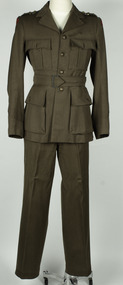
Uniform - Vietnam War Uniform, Circa 1960
... Army Uniform from the Vietnam War era. Representative of the era. Massed produced by the Australian Government. uniform army vietnam Label reads: Buckleys & Nunn Ptd Ltd / Melbourne. Handwritten: Chappell Uniform comprises Jacket (.1) Pants (.2) and Tie (.3) . Khaki wool. Button up trousers. Jacket has Royal Australian Engineers ...Army Uniform from the Vietnam War era.Representative of the era. Massed produced by the Australian Government.Uniform comprises Jacket (.1) Pants (.2) and Tie (.3) . Khaki wool. Button up trousers. Jacket has Royal Australian Engineers badge on shoulder, gold buttons on epaulettes.Label reads: Buckleys & Nunn Ptd Ltd / Melbourne. Handwritten: Chappelluniform, army, vietnam -
 Ringwood and District Historical Society
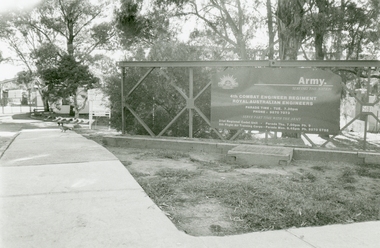
Photographs, Army Depot, Dublin Road, East Ringwood in 1999
... 4th Combat Engineer Regiment, Royal Australian Engineers Army Depot, Dublin Road, East Ringwood in 1999 Photographs ...4th Combat Engineer Regiment, Royal Australian Engineers -
 Ringwood and District Historical Society
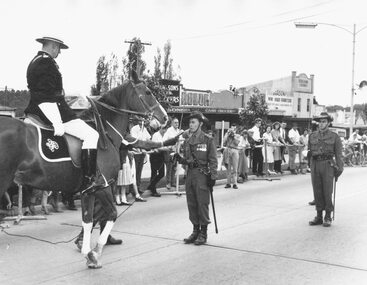
Photograph, Pump, Brian, Presentation of "Freedom of the City" to 3rd Division Australian Engineers by Mayor, Ben Hubbard, March 27, 1965
... Army Public Relations.' Catalogue card reads, 'Freedom of the City. Taken when Ben Hubbard was mayor.' Typed on back of another copy: Police Inspector A. Angus challenging the R.A.E. on their right to enter Rignwood. O.C. replies. this took place outside the entrane to the Railways Station. Date Stamp 27 Mar 1965. Black and White Photograph. See also ABC silent movie of the event in VC record 11129. Ringwood Mail Newspaper article about the ceremony and parade is in VC 11129 Lt. Col. E.R. Baldwin Being challenged. Presentation of "Freedom of the City" to 3rd Division Australian Engineers ...Black and White Photograph. See also ABC silent movie of the event in VC record 11129. Ringwood Mail Newspaper article about the ceremony and parade is in VC 11129 Lt. Col. E.R. Baldwin Being challenged. Written on back of one copy of photograph, 'Photo ... Southern Command, Army Public Relations.' Catalogue card reads, 'Freedom of the City. Taken when Ben Hubbard was mayor.' Typed on back of another copy: Police Inspector A. Angus challenging the R.A.E. on their right to enter Rignwood. O.C. replies. this took place outside the entrane to the Railways Station. Date Stamp 27 Mar 1965. -
 Eltham District Historical Society Inc
Document (Item) - Article, The Eltham Roll of Honour: Second World War, 9 Aug 2020
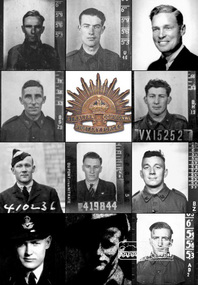
... Lt., 410262 (KIA 5 Apr 1945, Varrelbusch, Germany) FIELD, Kevin Francis, Pte., VX144763 (KIA 28 Jun 1945, Bougainville, PNG) BUTHERWAY, Jack Herbert, Pte, VX37645 (DOD 8 Jul 1945, Borneo) eltham war memorial roll of honour second world war eltham eltham roll of honour shire of eltham 2/4 field workshop 22 independent brigade group ordnance workshop a.i.f. australian army ordnance corps australian corps of electrical and mechanical engineers changi falkiner street florence mary butherway jack herbert butherway prisoner of war (pow) ranau number 1 jungle camp sandakan death march singapore thomas james butherway vx37645 2/2 field company 6th division abington annie castledine arthur frederick castledine george ernest castledine greece jean simonson lower plenty old eltham road royal australian engineers vx10044 sapper g. e. castledine 2/23 bn derril gahan house main road rats of tobruk studley manston gahan tobruk vx48379 3 squadron r.a.a.f. aboukir alamein memorial beulah alice (simpson) rutter bir el gubbi broken hill aero club david rutter egypt hubert rutter libya yarra braes 2/21 bn 23rd australian infrantry brigade 8th division alfred charles clerke ambon island battle of ambon bidgeland park estate inga caroline (nicholls) clerke inga mary nicholls laha airfield nora ann clerke rose matilda clerke vx23112 william charles clerke 2/14 bn 2/16 bn 21st brigade 7th division cuthbert douglas dunlop gona gona war cemetery henry street janet dunlop kokoda track new guinea palestine papua new guinea port moresby (bomana) war cemetery reuben cuthbert dunlop syria vx15252 10 operational training unit 410236 ada (key) ingram berkshire bomber command england group no. 91 john ingram lester neil ingram longworth n.1374 r.a.a.f. r.a.f. r.a.f. abington research (vic.) whitley v bomber 419844 514 bomber squadron emmerich germany gordon stanley mclean ji-g2 kleve lancaster lm735 lucy mclean mount pleasant road r.a.f. waterbeach reichswald forest war cemetery stanley mclean 2/10 ordnance workshops albert feldbauer eltham cricket association eltham girls club frank street henry feldbauer jessie margarette feldbauer june feldbauer ken ingram margaret (feldbauer) ingram montmorency imperials research cricket club research state school sandakan number 1 camp sandakan number 2 camp theodore albert feldbauer valerie (feldbauer) waller violet amelda (teagle) feldbauer vx51733 247 ‘china-british’ squadron caithness cloppenburg donlad hemphill rutter essen gloucester hanover war cemetery hanover-limmer british military cemetery holten-lochem oldenburg r.a.f. castletown r.a.f. station lealing stoppenburg typhoon ib jp443 typhoon ib sw526 15th australian infantry brigade 1940 cup 3rd division 57th/60th bn best and fairest bougainville island buin road mary field mayona road mivo river mobiai river montmorency vx144763 william field Word/PDF document file The Eltham Roll of Honour: Second World War Document Article ...Information regarding the circumstances of the eleven men of the Shire of Eltham who died serving their country in the Second World War and for whom the Eltham War Memorial was dedicated. Their names are listed on the Eltham Roll of Honour in order of rank. The image portrayed shows the eleven men (left to right, top to bottom) by date of fatality: CASTLEDINE, George Ernest, Spr., VX10044 (KIA 18 Apr 1941, Greece) GAHAN, Studley Manston, Capt., VX48379 (KIA 17 May 1941, Tobruk, Libya) RUTTER, David, Flying Off., 833 (400833) (KIA 9 Dec 1941, Bir El Gubbi, Libya) CLERKE, Alfred Charles, Cpl., VX23112 (KIA 2 Feb 1942, Laha, Ambon Island) DUNLOP, Cuthbert Douglas, Sgt., VX15252 (KIA 22 Nov 1942, Gona, New Guinea) INGRAM, Lester Neil, Flt. Sgt., 410236 (DOD 22 Apr 1943, Longworth, England) McLEAN, Stanley, Flt. Sgt., 419844 (KIA 7 Oct 1944, Emmerich, Germany) FELDBAUER, Theodore, Sgt., VX51733 (DOD 27 Mar 1945, Borneo) RUTTER, Donald Hemphill, Flt. Lt., 410262 (KIA 5 Apr 1945, Varrelbusch, Germany) FIELD, Kevin Francis, Pte., VX144763 (KIA 28 Jun 1945, Bougainville, PNG) BUTHERWAY, Jack Herbert, Pte, VX37645 (DOD 8 Jul 1945, Borneo)eltham war memorial, roll of honour, second world war, eltham, eltham roll of honour, shire of eltham, 2/4 field workshop, 22 independent brigade group ordnance workshop, a.i.f., australian army ordnance corps, australian corps of electrical and mechanical engineers, changi, falkiner street, florence mary butherway, jack herbert butherway, prisoner of war (pow), ranau number 1 jungle camp, sandakan death march, singapore, thomas james butherway, vx37645, 2/2 field company, 6th division, abington, annie castledine, arthur frederick castledine, george ernest castledine, greece, jean simonson, lower plenty, old eltham road, royal australian engineers, vx10044 sapper g. e. castledine, 2/23 bn, derril, gahan house, main road, rats of tobruk, studley manston gahan, tobruk, vx48379, 3 squadron r.a.a.f., aboukir, alamein memorial, beulah alice (simpson) rutter, bir el gubbi, broken hill aero club, david rutter, egypt, hubert rutter, libya, yarra braes, 2/21 bn, 23rd australian infrantry brigade, 8th division, alfred charles clerke, ambon island, battle of ambon, bidgeland park estate, inga caroline (nicholls) clerke, inga mary nicholls, laha airfield, nora ann clerke, rose matilda clerke, vx23112, william charles clerke, 2/14 bn, 2/16 bn, 21st brigade, 7th division, cuthbert douglas dunlop, gona, gona war cemetery, henry street, janet dunlop, kokoda track, new guinea, palestine, papua new guinea, port moresby (bomana) war cemetery, reuben cuthbert dunlop, syria, vx15252, 10 operational training unit, 410236, ada (key) ingram, berkshire, bomber command, england, group no. 91, john ingram, lester neil ingram, longworth, n.1374, r.a.a.f., r.a.f., r.a.f. abington, research (vic.), whitley v bomber, 419844, 514 bomber squadron, emmerich, germany, gordon stanley mclean, ji-g2, kleve, lancaster lm735, lucy mclean, mount pleasant road, r.a.f. waterbeach, reichswald forest war cemetery, stanley mclean, 2/10 ordnance workshops, albert feldbauer, eltham cricket association, eltham girls club, frank street, henry feldbauer, jessie margarette feldbauer, june feldbauer, ken ingram, margaret (feldbauer) ingram, montmorency imperials, research cricket club, research state school, sandakan number 1 camp, sandakan number 2 camp, theodore albert feldbauer, valerie (feldbauer) waller, violet amelda (teagle) feldbauer, vx51733, 247 ‘china-british’ squadron, caithness, cloppenburg, donlad hemphill rutter, essen, gloucester, hanover war cemetery, hanover-limmer british military cemetery, holten-lochem, oldenburg, r.a.f. castletown, r.a.f. station lealing, stoppenburg, typhoon ib jp443, typhoon ib sw526, 15th australian infantry brigade, 1940 cup, 3rd division, 57th/60th bn, best and fairest, bougainville island, buin road, mary field, mayona road, mivo river, mobiai river, montmorency, vx144763, william field -
 Bendigo Military Museum
Uniform - COLOUR PATCHES
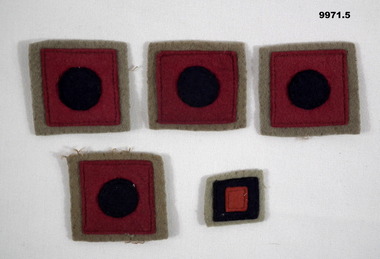
... AEME stands for Australian Electrical and Mechanical Engineers. Their role was to support and advise troops in the field. AAOL - Australian Army...AEME stands for Australian Electrical and Mechanical Engineers. Their role was to support and advise troops in the field. AAOL - Australian Army ...AEME stands for Australian Electrical and Mechanical Engineers. Their role was to support and advise troops in the field. AAOL - Australian Army Ordnance Corps.1. to 4. Felt colour patches, square, brown front and grey back. Smaller red square on front, then smaller black circle in centre. For AEME Field Units. 5. Small felt colour patch for AAOC now Field Unit. Light brown front and back with a small blue square on front then small red square in centre for AAOC non Field Unit.aeme, colour patches, selby collection -
 Bendigo Military Museum
Instrument - Multiplex Unit Projector, Williamson Manufacturing Co, Circa 1950
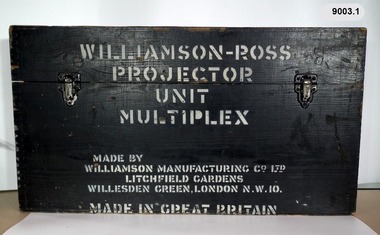
... Army Survey Regiment’ ISBN: 0-646-42120-4. This instrument is only one of the projectors of a set and is unfortunately missing its platen, coloured filters and coloured glasses. A cardboard set of glasses is included as an example. Another Multiplex instrument is in the collection as Item 9039.4 Royal Australian Survey Corps RASvy Fortuna Army Survey Regiment Army Svy Regt WILLIAMSON MANUFACTURING CO, PHOTOGRAPHIC ENGINEERS, SERIAL NUMBER 3437, TYPE MPC, LITCHFIELD GARDENS, LONDON AND READING. ...Multiplex mechanical stereoplotting equipment was used at the Army Survey Regiment, Fortuna Bendigo. c1950s. Multiplex equipment was imported from the UK in 1951 and introduced in the following year, to accelerate map production output covering CMF training areas at 1:25,000 map scale. Multiplex plotting was a productive advancement replacing the ‘Arundel’ method of graphical plotting planimetric detail that was expensive and slow, especially in timbered mountainous terrain. Air photos were made into small diapositives and mounted on racks in the exact position relative to when the aerial photos were taken. The technicians operated the Multiplex in a darkened room, with one photo projected with a green filter and the other through a red filter to form a 3D view of the overlapping photos. The 3D model projected onto a platen, which was a small platform that was raised up and down. The technician viewed the 3D image with special glasses fitted with red and green lenses. In the centre of the platen was a small pinhole that served as a floating mark, with a vertical pencil located exactly below the pinhole. This tracing table was moved to follow the topographic feature or contour line and draw it on the paper underneath. The technician raising or lowering the platform’s floating mark to match the height of the 3D terrain. It also replaced the slotted template method of mechanical adjustment of strips of aerial photography, however was restricted to each strip rather than between strips in the block. Although the Multiplex was phased out of production in 1968, it was used in the training of photogrammetry and aero-triangulation at the School of Military Survey located at Bonegilla, Victoria until the early 1990s. The history of the Multiplex is covered in more detail with additional historic photographs, in pages 50 to 51 of Valerie Lovejoy’s book 'Mapmakers of Fortuna – A history of the Army Survey Regiment’ ISBN: 0-646-42120-4. This instrument is only one of the projectors of a set and is unfortunately missing its platen, coloured filters and coloured glasses. A cardboard set of glasses is included as an example. Another Multiplex instrument is in the collection as Item 9039.4A black wooden box containing a Multiplex Unit Projector (incomplete). The Multiplex has a Lamp Head, Barrel Housing, Body of the Projector and a Platen which is missing. .1 Protective wooden box .2 Multiplex Instrument .3 Multiplex Instrument Parts Diagram .4 A bank of Multiplex projectors in operation WILLIAMSON MANUFACTURING CO, PHOTOGRAPHIC ENGINEERS, SERIAL NUMBER 3437, TYPE MPC, LITCHFIELD GARDENS, LONDON AND READING.royal australian survey corps, rasvy, fortuna, army survey regiment, army svy regt -
 Bendigo Military Museum
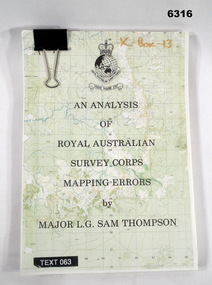
Administrative record - An analysis of Royal Australian Survey Corps mapping errors by Major LG Sam Thompson, Major LG Sam Thompson US Army Corps of Engineers at Army Survey Regiment, circa 1978
... Australian Survey Corps RASvy Fortuna Army Survey Regiment Army Svy Regt ASR Marked on front cover "X - Box - 13", "TEXT 063" A4 loose leaf booklet held together with a "bulldog" paper clip. Cover part of an a RASvy 1:50,000 map. 1x Cover, 7x Introductory pages, 103x report pages. An analysis of Royal Australian Survey Corps mapping errors by Major LG Sam Thompson Administrative record An analysis of Royal Australian Survey Corps mapping errors by Major LG Sam Thompson Major LG Sam Thompson US Army Corps of Engineers at Army Survey Regiment ...The purpose of the report is to analyze and study the map making procedures at the Army Survey Regiment to quantify the accuracy of the mapping to see if they meet acceptable accuracy standards. This was achieved through the study of possible errors.A4 loose leaf booklet held together with a "bulldog" paper clip. Cover part of an a RASvy 1:50,000 map. 1x Cover, 7x Introductory pages, 103x report pages.Marked on front cover "X - Box - 13", "TEXT 063"royal australian survey corps, rasvy, fortuna, army survey regiment, army svy regt, asr -
 Bendigo Military Museum
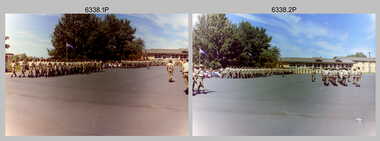
Photograph - Army Survey Regiment – CO’s Parade and Defence Force Service Medal Presentations, c1987
... Recipients were WO1 Neville Stone and three unidentified support staff from the Australian Army Catering Corps, Royal Australian Electrical and Mechanical Engineers and the Royal Australian Corps of Transport. ...Recipients were WO1 Neville Stone and three unidentified support staff from the Australian Army Catering Corps, Royal Australian Electrical and Mechanical Engineers and the Royal Australian Corps of Transport. ...These 34 photographs were taken at a CO’s parade at the Army Survey Regiment, Bendigo in c1987. The Colonel Commandant (honorary appointment) of the Survey Corps - COL Clem Sargent (Retd), presented the Defence Force Service Medal to four personnel in recognition of 15 years of efficient remunerated service, or the Clasp for 5 years of additional service. Recipients were WO1 Neville Stone and three unidentified support staff from the Australian Army Catering Corps, Royal Australian Electrical and Mechanical Engineers and the Royal Australian Corps of Transport. This is a set of 34 photographs of a CO’s parade and the presentation of the Defence Force Service Medal, at the Army Survey Regiment, Bendigo in c1987. The colour photographs are on 35mm negative film and are part of the Army Survey Regiment’s Collection. The photographs were scanned at 96 dpi. .1) to 2) - Photo, colour, c1987. Squadrons marching on parade ground. .3) to .4) - Photo, colour, c1987. Squadrons formed up on parade ground. RSM WO1 Jeff Lynch delivering orders. .5) - Photo, colour, c1987. Officers at ease in readiness to take posts. .6) - Photo, colour, c1987. Squadrons formed up on parade ground. RSM WO1 Jeff Lynch delivering orders. .7) - Photo, colour, c1987. RSM WO1 Jeff Lynch handing over to 2IC MAJ Terry Edwards. .8) - Photo, colour, c1987. Officers marching on to take posts. .9) - Photo, colour, c1987. L to R: CPL Paul Richards, SPR Todd Reynolds, SPR Eric Nicholson, MAJ Roger Rix, CPL Steve Hill, unidentified, CPL Russ Mollenhauer, remainder. .10) - Photo, colour, c1987. Guest of Honour - COL COMDT COL Clem Sargent arrives on parade ground, remainder unidentified. .11) - Photo, colour, c1987. Army Survey Regiment ready to salute Guest of Honour - COL COMDT COL Clem Sargent. .12) - Photo, colour, c1987, Guest of Honour - COL COMDT COL Clem Sargent returns salute. .13) - Photo, colour, c1987, L to R: 2IC MAJ Terry Edwards, SPR Eric Nicholson, COL COMDT COL Clem Sargent, SGT John ‘Stormy’ Tempest, unidentified (x2), SGT Mal Paterson, SGT Kevin Boehm, SSGT Peter Mustart, CPL Trevor Poll, SGT Terry Danger. .14) - Photo, colour, c1987, In left foreground MAJ Bob McHenry, unidentified personnel, unidentified officer, 2IC MAJ Terry Edwards, COL COMDT COL Clem Sargent, 3rd from right CAPT Graeme Wastell, CPL John Martin, SGT Martin Evans. .15) - Photo, colour, c1987, L to R: unidentified personnel, unidentified officer, 2IC MAJ Terry Edwards, COL COMDT COL Clem Sargent, SSGT Rick Van der Bom, CPL Paul Hunter, unidentified personnel, CAPT Graeme Wastell, SGT Paul Leskovec CSM, CPL John Martin, SGT Paul Cheater, SGT Martin Evans. .16) - Photo, colour, c1987, L to R: SGT Martin Evans. 2IC MAJ Terry Edwards, unidentified officer, COL COMDT COL Clem Sargent, unidentified personnel, SGT Paul Leskovec CSM, SGT Paul Cheater, SSGT Brian Collings, SSGT Ian ‘Rock’ Thistleton, WO1 Stevo Hinic. .17) - Photo, colour, c1987, L to R: unidentified personnel, 2IC MAJ Terry Edwards, COL COMDT COL Clem Sargent, SGT Roger Rees, unidentified female officer, SGT Phil Smalley, CPL Steve Coulsen, SPR Toni Wright, SGT Steve Gloster, SSGT Ken Talbot-Smith, CPL Darren Wilkinson, unidentified, SGT Paul Hopes. .18) - Photo, colour, c1987, L to R: unidentified female officer, COL COMDT COL Clem Sargent, unidentified, SGT Phil Smalley, CPL Steve Coulsen, SPR Toni Wright, CPL Steve Gloster, SSGT Ken Talbot-Smith, CPL Darren Wilkinson, SGT Paul Hopes. .19) - Photo, colour, c1987, L to R: unidentified personnel, CPL Peter ‘Jack’ Elverd, 2IC MAJ Terry Edwards, COL COMDT COL Clem Sargent, unidentified, SGT Stuart Hibbert, unidentified, Ted Burgess. .20) - Photo, colour, c1987, L to R: unidentified officer, COL COMDT COL Clem Sargent, 2IC MAJ Terry Edwards. .21) - Photo, colour, c1987, L to R: unidentified (x3), WO1 Neville Stone, COL COMDT COL Clem Sargent, SSGT Greg Anderson, unidentified officer, CAPT Graeme Wastell. .22) to .24) - Photo, colour, c1987, L to R: unidentified (x3), WO1 Neville Stone, COL COMDT COL Clem Sargent, SSGT Greg Anderson, unidentified officer. .25) to .26) - Photo, colour, c1987, L to R: unidentified, WO1 Neville Stone, unidentified, COL COMDT COL Clem Sargent, SSGT Greg Anderson, unidentified officer. .26) to 30) - Photo, colour, c1987, L to R: unidentified (x2), WO1 Neville Stone, COL COMDT COL Clem Sargent, SSGT Greg Anderson, unidentified officer. .31) to .34) - Photo, colour, c1987, L to R: unidentified, WO1 Neville Stone, COL COMDT COL Clem Sargent, unidentified officer..1P to .34P – There are no personnel identified.royal australian survey corps, rasvy, army survey regiment, army svy regt, fortuna, asr -
 Bendigo Military Museum
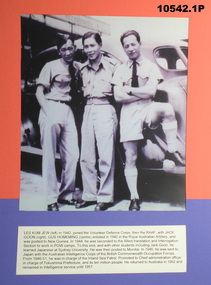
Photograph - AUSTRALIAN CHINESE SERVICEMEN/WOMEN, WW2, Bendigo & District RSL Club, Unknown
... PETER MOO (top right) served with the Australian Army in the Northern Territory, his brother FRANK MOO (top centre) served with the Australian Imperial Force in Rabaul and Bougainville, Frank's children CLARENCE MOO (top right) served with the Royal Australian Engineers and then transferred to the Royal Australian Air Force HARRY MOO (bottom left) served with the Royal Australian Air Force's 31 Beaufighter Squadron in Darwin and Morotai, MAVIS MOO (bottom centre) served with the Australian Army Medical Women's Service and ARTHUR MOO (bottom right) served with the Australian Army and later the Royal Australian Air Force. ...PETER MOO (top right) served with the Australian Army in the Northern Territory, his brother FRANK MOO (top centre) served with the Australian Imperial Force in Rabaul and Bougainville, Frank's children CLARENCE MOO (top right) served with the Royal Australian Engineers and then transferred to the Royal Australian Air Force HARRY MOO (bottom left) served with the Royal Australian Air Force's 31 Beaufighter Squadron in Darwin and Morotai, MAVIS MOO (bottom centre) served with the Australian Army Medical Women's Service and ARTHUR MOO (bottom right) served with the Australian Army and later the Royal Australian Air Force. 1.2.3. ...Australian Chinese Servicemen from WW2 photographs - Exhibition held at the Bendigo & District RSL, post 2010.1.2.3. Photographs on photographic paper, enlarged black and white portraits. Mount - red and blue colour cardboard, double mount with top area containing the photograph, lower area printed information. 1. Three servicemen in informal group. 2. Two servicewomen, one serviceman and a civilian - group portrait. 3. Five servicemen and one service woman in uniform - collection of small portraits.Printed information - black ink print. 1. LES KUM JEW (left)- in 1942, joined the Volunteer Defence Corps, then the RAAF, with JACK GOON (right). GUS HOMEMING (centre) enlisted in 1942 in the Royal Australian Artillery, and was posted to New Guinea. In 1944, he was seconded to the Allied translation and Interrogation Section to work in POW camps. To this end, and with other students including Jack Goon, he learned Japanese at Sydney University. He was then posted to Morotai. In 1946, he was sent to Japan with the Australian Intelligence Corps of the British Commonwealth Occupation Forces. From 1946-51, he was in charge of the Inland Sea Patrol. Promoted to Chief Administration Officer in charge of Tokushima Prefecture and its ten million people. He returned to Australia in 1952 and remained in Intelligence service until 1957. 2. EUNICE LEONG (top left) worked from 1940 as a wireless operator for the Army in Melbourne, Sydney and Alice Springs, and as a signals instructor at Bonegilla. Her sister, VALDA (top right) worked as a radar plotter with the WAAAF, and her brother MAX (bottom right) went with the British Commonwealth Occupation Forces to Japan after the War. 3. PETER MOO (top right) served with the Australian Army in the Northern Territory, his brother FRANK MOO (top centre) served with the Australian Imperial Force in Rabaul and Bougainville, Frank's children CLARENCE MOO (top right) served with the Royal Australian Engineers and then transferred to the Royal Australian Air Force HARRY MOO (bottom left) served with the Royal Australian Air Force's 31 Beaufighter Squadron in Darwin and Morotai, MAVIS MOO (bottom centre) served with the Australian Army Medical Women's Service and ARTHUR MOO (bottom right) served with the Australian Army and later the Royal Australian Air Force. photographs, chinese/australians, ww2 -
 Bendigo Military Museum
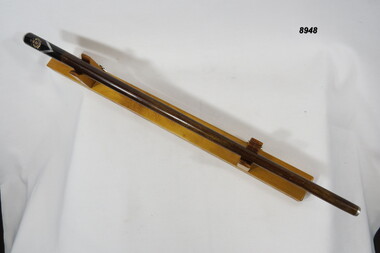
Equipment - SWAGGER STICK, Unknown
... Passchendaele Barracks Trust PBT244 Swagger stick Ceremonial Equipment Set in to the top/side of the stick - Australian Engineers Badge over a “'V”symbol. The Australian Army uses the Swagger stick as a traditional ceremonial symbol of authority, commonly carried under the right arm by a Company Sergeant Major and Commissioned Officers, particularly in ceremonial or “Walking Out” dress. ...The Australian Army uses the Swagger stick as a traditional ceremonial symbol of authority, commonly carried under the right arm by a Company Sergeant Major and Commissioned Officers, particularly in ceremonial or “Walking Out” dress. The swagger stick is made of dark coloured polished timber with the top 9 cm painted black, the top and bottom of the stick has metal caps screwed on.Set in to the top/side of the stick - Australian Engineers Badge over a “'V”symbol.passchendaele barracks trust, pbt244, swagger stick, ceremonial equipment -
 Bendigo Military Museum
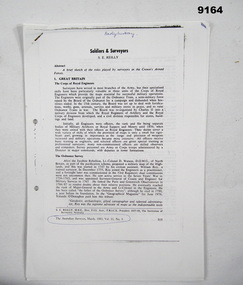
Administrative record - Soldiers and Surveyors by SE Rilley - Roles of Crown's Armed Forces UK and Australia, The Institution of Surveyors, Australia, Mar 1983
... Australian Intelligence Corps in 1907, a survey section within the Australian Engineers 1910 and eventually the Australian Survey Corps in 1915. This is a very detailed description of the personnel involved and the formation of the Australian Survey Corps, later the title "Royal" was granted in 1948 to become the Royal Australian Survey Corps. Royal Australian Survey Corps RASvy Fortuna Army ...This is a photocopy of an original article written by SE Reilly titled "Soldier Surveyors" that was then republished in the Australian Surveyor March 1983 Vol 31 No. 5 pages 315 - 326. The Author was Capt SE Riley MBE Hon FIS Aust, FRICS, President of the Institution of Surveyors, Australia 1957-1959. Includes Histories of both UK and Australian Mapping Agencies. This document records in detail with Names, the contribution of Officers of the Crown in the early stages of the settlement of Australia. Starting in 1787 their contributions were significant with most occupying positions as State Surveyors General and eventually contributing to the formation of the Australian Intelligence Corps in 1907, a survey section within the Australian Engineers 1910 and eventually the Australian Survey Corps in 1915. This is a very detailed description of the personnel involved and the formation of the Australian Survey Corps, later the title "Royal" was granted in 1948 to become the Royal Australian Survey Corps.Eleven A4 photocopied pages of typed text extracted from the Australian Surveyor March 1983 Vol 31 No. 5 pages 315 - 326royal australian survey corps, rasvy, fortuna, army survey regiment, army svy regt, asr
