
Showing 9 items matching "australian army significant operations"
-
 Lara RSL Sub Branch
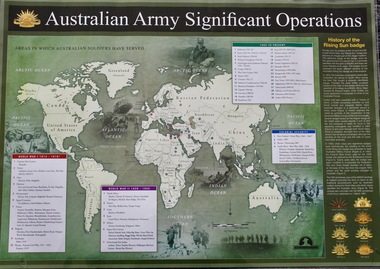
Map - Areas in Which Australian Soldiers Have Served - World War 1 and World War 2 and Other Theatres (2 Off), Australian Army Significant Operations Map. (2 Off)
... Australian Army Significant Operations Map. (2 Off)...Australian Army Significant Operations...Australian Army Significant Operations...Map of World showing Australian Armed Forces Theatre of Operations Australian Army Significant Operations Australian Army Significant Operations (Map)Rectangular in shape with a glossy front. (2 Off) Australian Army Significant Operations Map. (2 Off) Map Areas in Which Australian Soldiers Have Served - World War 1 and World War 2 and Other Theatres (2 Off) ...This map shows the areas in which Australian soldiers have served.Map of World showing Australian Armed Forces Theatre of Operations (Map)Rectangular in shape with a glossy front. (2 Off)Australian Army Significant Operationsaustralian army significant operations -
 Ringwood RSL Sub-Branch
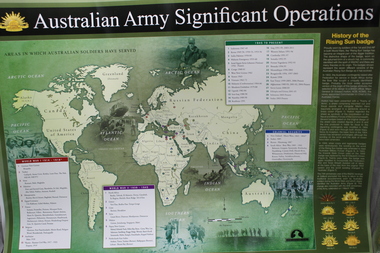
Work on paper - Australian army significant operations map, Memorabilia
... Australian army significant operations map...World map of operations x 2 Memorabilia Work on paper Australian army significant operations map ...World map of operations x 2 -
 Flagstaff Hill Maritime Museum and Village
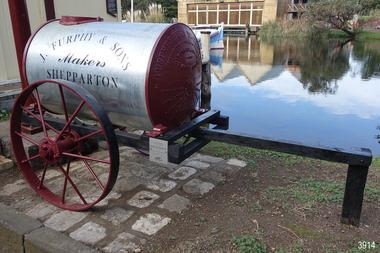
Vehicle - Furphy Water Cart, J. Furphy & Sons, c. 1942
... Australian time-saving and energy-saving invention of the 1880s, replacing the labour intensive activity of collecting and dispensing water from barrels and casks on the back of carts. The water cart’s connection with manufacturing companies J. Furphy & Sons and Furphy Foundry are significant for being early Australian businesses that are still in operation today. Furphy carts are of military significance for the role they played during The Great War (1914-1918) in Australian army ...This horse-drawn, two-wheeled cart with a tank, is known as a Furphy Farm Water Cart that was made in Shepparton, northern Victoria, c. 1942. John Furphy (1842-1920) was born in Moonee Ponds, in 1842 to Irish immigrant parents and subsequently raised in the Yarra Valley before the family moved to Kyneton in central Victoria, where he completed an apprenticeship with the firm Hutcheson and Walker. Murphy began operations of his own at a site on Piper Street in Kyneton in 1864. He relocated for a business opportunity and founded the first blacksmiths and wheelwrights shop in the newly surveyed town of Shepparton in 1873. Furphy invented many farming tools and machines including a patented grain-stripper, and won awards at the 1888-89 Melbourne International Exhibition. His most famous invention is the Furphy Farm Water Cart, designed in the 1880s, at a time when water for most households and farms was carted on wagons in wooden barrels. The Furphy’s water cart is a single item that combines a water metal tank and a cart. The design of the cart was simple yet effective, and became popular very quickly and established itself as a vital piece of farming equipment. The water cart has had a number of words cast into its ends over many years. References to the foundry’s location in Shepparton, as well as advertising of other products also manufactured by J. Furphy & Sons were present on the ends. However, the most significant set of words to feature on the tank, was a poem encouraging continual improvement: ‘Good Better Best, Never Let it Rest, Until your Good is Better, And your Better Best’. During The Great War (1914-1918), the water cart was used by the Australian militarily at a large AIF (Australian Imperial Force) camp in Broadmeadows (Melbourne) where thousands of men were camped for months, before being transported aboard. Furphy Water Carts provided water to the troops, and were usually placed near the camp latrines, which was one of the few places the troops could share gossip and tall tales away from the prying eyes and ears of their officers. The water cart drivers were also notorious sources of information, despite most of their news being hearsay, or totally unreliable. By the time the men of the AIF were in engaged in combat on the Gallipoli Peninsula and the Western Front, the carts used for water supply had no markings and became simply referred to as Furphys. This owed as much to the coining of the term ‘Furphy’, Australian slang for suspect information or rumour. After a number of decades as principally a soldier’s word, 'Furphy' entered the broader Australian vernacular and was used mainly by the political class until recently when the term was taken up by a Australian brewer as a beer brand. This Furphy Water Cart was purchased by Friends of Flagstaff Hill in 2014. The support of local individuals, organisations and businesses enabled its restoration and later its installation alongside the existing late-19th century water pipe stand and 1940s hand pump The Furphy Farm Water Cart is of historical significance as it represents a famous Australian time-saving and energy-saving invention of the 1880s, replacing the labour intensive activity of collecting and dispensing water from barrels and casks on the back of carts. The water cart’s connection with manufacturing companies J. Furphy & Sons and Furphy Foundry are significant for being early Australian businesses that are still in operation today. Furphy carts are of military significance for the role they played during The Great War (1914-1918) in Australian army camps, and theatres of war in Europe and the Middle East, to supply the AIF troops with fresh water. A wooden framed, two-wheeled, horse-drawn cart, fitted with a horizontally mounted, cylindrical metal tank. The tank is made of rolled, sheet steel with a riveted seam, and cast iron ends with cast iron ends. The spoked metal wheels have fitted flat iron tyres and metal hubs. A metal pipe is joined to the outlet. The tank is silver coloured, the ends, wheels and trims are crimson, and the script lettering on tank sides is black. There are inscriptions on the tank, ends, and hubs. The water tank was made in 1942 in Shepparton, Australia, by J. Furphy & Sons and has a capacity of 180 gallons (848 litres). Hub perimeter, embossed “J. FURPHY & SONS” “KEEP THE / BOLTS TIGHT” Hub centre embossed [indecipherable] Tank, each side, painted “J. FURPHY & SONS / Makers / SHEPPARTON” Tank ends, embossed – “FURPHY’S FARM WATER CART” “BORN ABOUT 1880 – STILL ‘GOING STRONG’ 1942” “j. FURPHY & SONS / MAKERS / SHEPPARTON - VIC “ “S - - - - - L MANUFACTURERS” [SPECIAL] “SPIKE ROLLERS” “SINGLE TREES” “PLOUGH WHEELS” “IRON CASTINGS” “LAND GRADERS” “STEEL DELVERS” “CAST IRON PIG” “CHAIN YOKES” “GOOD – BETTER – BEST / NEVER LET IT REST / TILL YOUR GOOD IS BETTER / AND YOUR BETTER – BEST” Image [Stork carrying a baby] above shorthand, transcribed "Produce and populate or perish" Image [Furphy Pig Feeder] beside ‘Cast Iron Pig’ Shorthand, transcribed “"Water is the gift of God but beer and whiskey are concoctions of the Devil, come and have a drink of water"warrnambool, flagstaff hill maritime museum, water cart, furphy cart, furphy tank, furphy farm water cart, furphy, john furphy, john furphy & sons, furphy foundry, kyneton, shepparton, mobile water tank, jinker, hutchinson & walker, blacksmith, farm equipment, implement maker, tool maker, horse drawn, stork and baby, good, better, best, barrel, tank, first world war, wwi, eastern front, gallipoli, j furphy & sons -
 Australian Commando Association - Victoria
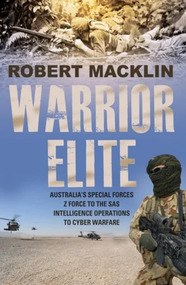
Book, Warrior Elite
... operations around the world. He has had significant cooperation from numerous sources within the special forces and the various intelligence agencies. Both thoroughly researched and colourfully written, Warrior Elite will attract the reader of action memoirs as well as those interested in broader military history and espionage. australian special forces australian army commandos military history Warrior Elite Book ...Warrior Elite is a unique and compelling account of Australia's special forces and intelligence operations - ranging from the early special forces of World War II to the establishment and development of the SAS and Commando Regiments as the elite fighters of today, and from the Australian Security Intelligence Service to the Australian Signals Directorate and ASIO. It is an authoritative, gripping and thoroughly up-to-date account of both the history and current state of our special forces and intelligence bodies - and gives a unique glimpse into the warfare of the future. Our future. Robert Macklin has conducted dozens of exclusive interviews and uncovered incredible, daring and sometimes heartbreaking stories of the elite troops that guard our nation and engage in secret operations around the world. He has had significant cooperation from numerous sources within the special forces and the various intelligence agencies. Both thoroughly researched and colourfully written, Warrior Elite will attract the reader of action memoirs as well as those interested in broader military history and espionage. australian special forces, australian army, commandos, military history -
 Bendigo Military Museum
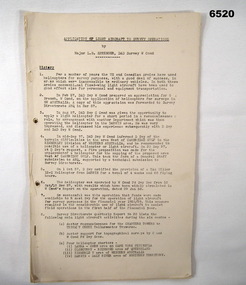
Administrative record - Application of Light Aircraft to Royal Australian Survey Corps Survey Operations - MAJ LB Sprenger (RASvy) 1957, Major LB Sprenger (RASvy), November 1957
... Australian Survey Corps Survey Operations - MAJ LB Sprenger (RASvy) 1957. This is a report to determine if light aircraft was suitable and financially beneficial for use in Royal Australian Survey Corps Survey Operations. The results were so successful that funds were made available to RASvy for operation of light aircraft for survey purposes in the financial year 1958/59. For a number of years the US and Canadian Armies had made significant...Australian Survey Corps Survey Operations - MAJ LB Sprenger (RASvy) 1957. This is a report to determine if light aircraft was suitable and financially beneficial for use in Royal Australian Survey Corps Survey Operations. The results were so successful that funds were made available to RASvy for operation of light aircraft for survey purposes in the financial year 1958/59. For a number of years the US and Canadian Armies had made significant ...Application of Light Aircraft to Royal Australian Survey Corps Survey Operations - MAJ LB Sprenger (RASvy) 1957. This is a report to determine if light aircraft was suitable and financially beneficial for use in Royal Australian Survey Corps Survey Operations. The results were so successful that funds were made available to RASvy for operation of light aircraft for survey purposes in the financial year 1958/59. For a number of years the US and Canadian Armies had made significant use of helicopters for survey purposes, this is the Australian experience. RASvy extensively used light aircraft for survey operations following this experience. MAJ LB Sprenger was later promoted and as LtCol LB Sprenger MBE he was the Commanding Officer of the Army Survey Regiment, Bendigo in 1969/70 and passed away during that appointment.A 23 x Foolscap page report of typed text, held together by staples and an ARNOS fastenerroyal australian survey corps, rasvy, fortuna, army survey regiment, army svy regt, asr -
 Bendigo Military Museum
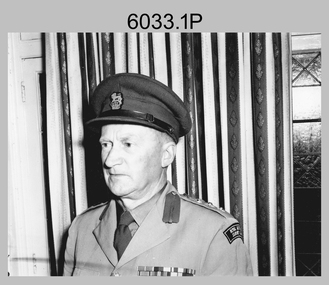
Photograph - Directors of Survey, Army Headquarters, c1942-1978
... Australian Army from 01 January 1936 to 22 March 1960. COL Frank D. Buckland, OBE MID was Director from March 1967 to August 1972 and was later appointed Colonel Commandant, after retirement and promotion to Brigadier, from January 1973 to January 1976. He served in the Australian Army from 01June 1938 to 31 October 1972. He was also Commanding Officer of the AHQ Survey Regiment from 1962 to 1965 overseeing significant changes to the Regiment's operation...Australian Army from 01 January 1936 to 22 March 1960. COL Frank D. Buckland, OBE MID was Director from March 1967 to August 1972 and was later appointed Colonel Commandant, after retirement and promotion to Brigadier, from January 1973 to January 1976. He served in the Australian Army from 01June 1938 to 31 October 1972. He was also Commanding Officer of the AHQ Survey Regiment from 1962 to 1965 overseeing significant changes to the Regiment's operation ...This is a set of ten photographs of Directors of Survey Army Headquarters circa 1942 to 1967. COL Lawrence FitzGerald OBE was Director from 1942 to 1960. He received the Order of the British Empire in 1948 for his service in WW2. Although it is not known when BRIG Lawrence FitzGerald OBE was promoted to Brigadier, it is possibly an honorary promotion on his retirement in 1960. He served in the Australian Army from 03 September 1923 to 05 January 1960. COL Lawrence FitzGerald OBE was succeeded by COL Donald Macdonald AM, MID, whose appointment to Director was from 1960 to 1967. COL Macdonald AM, MID was promoted to Brigadier on his retirement before assuming the honorary position of Colonel Commandant of the Royal Australian Survey Corps. He served in the Australian Army from 01 January 1936 to 22 March 1960. COL Frank D. Buckland, OBE MID was Director from March 1967 to August 1972 and was later appointed Colonel Commandant, after retirement and promotion to Brigadier, from January 1973 to January 1976. He served in the Australian Army from 01June 1938 to 31 October 1972. He was also Commanding Officer of the AHQ Survey Regiment from 1962 to 1965 overseeing significant changes to the Regiment's operation both technically and militarily. Colonel James L Stedman was Director from July 1975 to February 1975. He served in the Army from 27 February1941 to 28 February 1978 and was later appointed Colonel Commandant from September 1978 to February 1983. From 1940 to 1978 all Directors of Survey Army Headquarters served in the Second World War.This is a set of two photographs of Directors of Survey Army Headquarters circa 1942 to 1967.The photographs were printed on photographic paper and are part of the Army Survey Regiment’s Collection. They were scanned at 300 dpi. .1) - Photo, black and white, c1950s. D-SVY COL Lawrence FitzGerald OBE. .2) - Photo, black and white, c1960s. D-SVY COL Don Macdonald AM, MID. .3) - Photo, black and white, c1950s. D-SVY COL Lawrence FitzGerald OBE. .4) - Photo, black and white, c1960s. D-SVY COL Frank D. Buckland, OBE, MID. .5) - Photo, black and white, c1950s. D-SVY COL Frank D. Buckland, OBE, MID. .6) - Photo, black and white, c1960s. D-SVY COL Frank D. Buckland, OBE, MID. .7) - Photo, black and white, c1950s. D-SVY COL Frank D. Buckland, OBE, MID. .8) - Photo, black and white, c1950s. D-SVY COL Lawrence FitzGerald OBE. .9) - Photo, black and white, c1970s. D-SVY COL J. L. Stedman. .10) - Photo, black and white, c1970s. D-SVY COL J. L. Stedman..1P to .10P – no annotationsroyal australian survey corps, rasvy, army survey regiment, army svy regt, fortuna, asr, directorate of army survey, dsvy, director of survey - army, ahq survey regiment -
 Bendigo Historical Society Inc.
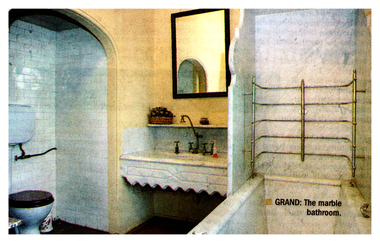
Newspaper - Fortuna Article - "Historic Building has Varied Past", Jul 25 2008
... operations. Purchased by George Lansell in 1871 for 20,000 pounds. Lansell made significant additions and modifications; he died in 1906. By 1938, the property was in disrepair but avoided demolition.In 1942, the Australian military sought a secure location for map printing and storage north of the Great Dividing Range. The Commonwealth acquired a lease on Fortuna, and Army...operations. Purchased by George Lansell in 1871 for 20,000 pounds. Lansell made significant additions and modifications; he died in 1906. By 1938, the property was in disrepair but avoided demolition.In 1942, the Australian military sought a secure location for map printing and storage north of the Great Dividing Range. The Commonwealth acquired a lease on Fortuna, and Army ...Built in 1856 by J.T.C. Balderstedt as an eight-room, two-storey red brick house near the New Chum gold reef. Extended in 1869 with a three-room gabled wing. Surrounded by ornate gardens and a masonry wall, overlooking gold mining operations. Purchased by George Lansell in 1871 for 20,000 pounds. Lansell made significant additions and modifications; he died in 1906. By 1938, the property was in disrepair but avoided demolition.In 1942, the Australian military sought a secure location for map printing and storage north of the Great Dividing Range. The Commonwealth acquired a lease on Fortuna, and Army tradesmen made alterations. Major Sari and 150 men arrived in June 1942. The Australian Survey Corps and Women's Army Corps produced classified mapping documents during World War II. Purchased by the Commonwealth Government in 1951. The Royal Australian Survey Corps was disbanded in 1996.D efence Imagery and Geospatial Organisation (DIGO) was established in 2000 in Canberra and Bendigo to provide geospatial intelligence for defence.In 2004, it was announced that DIGO operations would remain in Bendigo but move from Fortuna. The Department of Defence plans to vacate Fortuna, with its future use undecided.History Lives Article - "Historic Building has Varied Past" - The Bendigo Weekly Friday Jul 25 2008 This item contains the following: 11217.15a Colour Photo of Fortuna Long Room 11217.15b Colour Photo of Fortuna Staircase 11217.15c Colour Photo of Fortuna Steps and Entrance 11217.15d Part of page 7 - Fortuna Refit Not an Easy Option 11217.15e Colour Photo of Fortuna Bathroom 11217.15f Colour Photo of Fortuna Entrance Pathnon-fictionbendigo, fortuna, george lansell, australian army survey corps -
 Beechworth RSL Sub-Branch
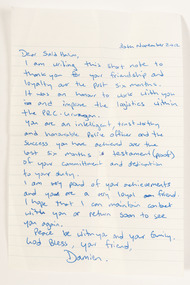
Letter, 30th November 2012
... Australian forces were often involved in mentoring and training Afghan police and army units. According to the letter Major Batty worked with Said Haim on logistics for PRC (Provincial Response Company) Uruzgan. The Commandos took part in 20 rotations with the Special Operations Task Group (SOTG) between 2007 and 2012. During this time they undertook significant...Australian forces were often involved in mentoring and training Afghan police and army units. According to the letter Major Batty worked with Said Haim on logistics for PRC (Provincial Response Company) Uruzgan. The Commandos took part in 20 rotations with the Special Operations Task Group (SOTG) between 2007 and 2012. During this time they undertook significant ...Major Damien Batty served in Afghanistan in 2011-2012 with the Bravo Commando Company Group, 2nd Commando Regiment in Uruzgan. Major Batty served alongside Said Haim, an Afghan police officer. Australian forces were often involved in mentoring and training Afghan police and army units. According to the letter Major Batty worked with Said Haim on logistics for PRC (Provincial Response Company) Uruzgan. The Commandos took part in 20 rotations with the Special Operations Task Group (SOTG) between 2007 and 2012. During this time they undertook significant combat operations, and were awarded for its actions, the regiment was collectively awarded the Unit Citation for Gallantry and the Meritorious Unit Citation. This letter is a rare example of first-person correspondence between a member of Australia's Special Forces and a member of the Afghan police force. The letters, both in Arabic and English, are significant for their capacity to illustrate the personal face of the Australian mission in Afghanistan, and to signify the nature of individual relationships between Australian personnel and local reconstruction forces. Two letters, one in Arabic and the second translated into English. Arabic letter is photocopied; English letter is written in blue pen. major damien batty, uruzgan, afghanistan, letter, police, prc, commandos -
 Wodonga & District Historical Society Inc
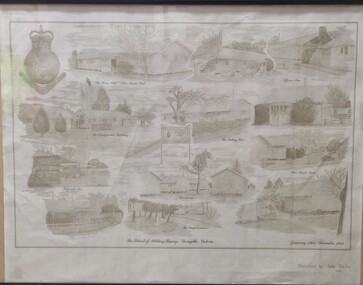
Artwork, other - Sketch - The School of Military Survey, Bonegilla, 1982
... operation Programmes The School moved into the newly developed Latchford Barracks in November 1982. Due to some military restructuring some of the roles of played by the Corps were taken over by civilian organisations or reverted to the Royal Australian Engineers and on the 1st July 1996 the Royal Australian Survey Corps was disbanded. This item is significant because it captures images of Bonegilla near Wodonga and the important role it played in both the history of migration to Australia and also the Australian military. Army ...The Army School of Survey was formed at Balcombe, Victoria in 1943 but later relocated to Bonegilla near Wodonga. The Australian Survey Corps had a proud history. It was raised as a unit of the Permanent Military Forces on July 1st 1915. Of the three officers and 17 other ranks who constituted the Survey Corps in 1915, all but three enlisted in the AIF and saw service in France, Belgium, Egypt or Palestine. The Corps entered World War 2 with nine officers and forty one other ranks. Its total strength reached a peak of 1,700 personnel with 5,500 men and women being engaged on mapping tasks during the war period. In 1948 the Australian Survey Corps was granted the prefix ‘Royal’ in recognition of its service during World War II. From the 1950s until its disbandment in 1996, members of the Corps undertook extensive geodetic surveys and mapping operations in all mainland states of Australia as part of the National Mapping Program as well as in Papua New Guinea. This included important work with the establishment of the Snowy River Hydro Scheme and the Woomera rocket range, The School of Military Survey moved to Bonegilla in 1965 when it also adopted ‘Wandering the Kings Highway’ as the Corps marching song. The School was responsible for training all RASVY personnel in Topographical Surveying, Cartography, Photography, Printing and Illustration. The School also trained Service and Civilian personnel from other agencies and countries, as part of Defence Co-operation Programmes The School moved into the newly developed Latchford Barracks in November 1982. Due to some military restructuring some of the roles of played by the Corps were taken over by civilian organisations or reverted to the Royal Australian Engineers and on the 1st July 1996 the Royal Australian Survey Corps was disbanded.This item is significant because it captures images of Bonegilla near Wodonga and the important role it played in both the history of migration to Australia and also the Australian military.A framed sketch depicting a variety of buildings at Bonegilla when it housed the School of Military Survey.Titles beneath different images At bottom - The School of Military Survey, Bonegilla, Victoria January 1933 - December 1982army at bonegilla, australian school of miltary survey
