
Showing 440 items matching "australian commonwealth government"
-
 Bendigo Military Museum
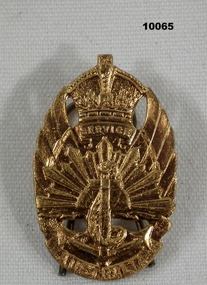
Award - SERVICE AUSTRALIA BADGE WW2, Australian Commonwealth Government, 1948
... Australian Commonwealth Government...COMMONWEALTH GOVT - AF, AMOR, SYDNEY. Serial No: 42970” General service badge showing a Rising Sun, Anchor, Wings and King's Crown. Words 'Service Australia' stamped on front. On reverse are manufacturers name, date of manufacture and serial number. Post on back and clip for attaching to lapel. Award SERVICE AUSTRALIA BADGE WW2 Australian Commonwealth Government ...The badge was issued to male and female service members who were ineligible for the Returned from Active Service Badge. Item is in the collection of Edward Warren Callaghan. See Cat No. 10057 for details of his service.General service badge showing a Rising Sun, Anchor, Wings and King's Crown. Words 'Service Australia' stamped on front. On reverse are manufacturers name, date of manufacture and serial number. Post on back and clip for attaching to lapel.Stamped on back: “1948, ISSUED BY COMMONWEALTH GOVT - AF, AMOR, SYDNEY. Serial No: 42970”edward warren callaghan, general service badge, raaf, ww2 -
 National Wool Museum
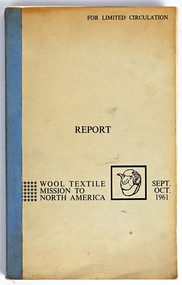
Archive - Report: Wool Textile Mission to North America, Commonwealth of Australia, Department of Trade, 1962
... Australian Commonwealth Government...Collins, Collins Bros, Geelong, to attend a meeting in 1962, as a panellist to discuss the problems of exporting blankets and rugs to North America, following recommendation from the outcomes of the mission. Australian Commonwealth Government Department of Trade Report Textiles North America United States of America Canada Export Blankets Rugs Collins Bros Mill Pty Ltd Godfrey Hirst & Co. ...Report published by the Commonwealth of Australia in February 1962 detailing the findings and recommendations following the Wool Textile Mission to North America the previous year whose itinerary covered six weeks, including twelve days in Canada and the remaining time in cities in the United States of America. Cedric Hirst, who was then the Managing Director of Godfrey Hirst Pty Ltd Geelong, was among the members of the mission. The mission sought to understand the market prospects for Australian made wool textiles products in North America. A letter in the front of the report details an invitation to Mr A. M. Collins, Collins Bros, Geelong, to attend a meeting in 1962, as a panellist to discuss the problems of exporting blankets and rugs to North America, following recommendation from the outcomes of the mission.One hundred and twenty five page report with appendixes featuring printed black text on cream paper. Book is bound with blue cloth and has printed black text and graphics on the cover. A typed letter addressed to Mr A. M. Collins with a Commonwealth of Australia Department of Trade letterhead is sitting inside the front cover.FOR LIMITED CIRCULATION / REPORT / WOOL TEXTILE / MISSION TO / NORTH AMERICA . SEPT. / OCT. / 1961australian commonwealth government, department of trade, report, textiles, north america, united states of america, canada, export, blankets, rugs, collins bros mill pty ltd, godfrey hirst & co. pty. ltd., wool textile mission -
 Whitehorse Historical Society Inc.
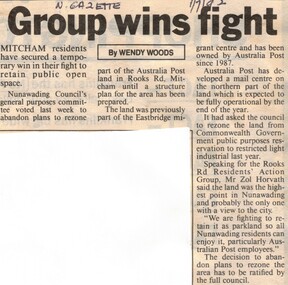
Article, Group wins fight, 1/07/1992 12:00:00 AM
... Mitcham resident group secure temporary fight with Nunawading Council to rezone Australia Post - Commonwealth Government land as open space....Mitcham resident group secure temporary fight with Nunawading Council to rezone Australia Post - Commonwealth Government land as open space. ...Mitcham resident group secure temporary fight with Nunawading Council to rezone Australia Post - Commonwealth Government land as open space.Mitcham resident group secure temporary fight with Nunawading Council to rezone Australia Post - Commonwealth Government land as open space.Mitcham resident group secure temporary fight with Nunawading Council to rezone Australia Post - Commonwealth Government land as open space.land use, mitcham, city of nunawading, australia post, rooks road, nunawading, eastbridge migrant hostel, rooks road residents action group, horvath, zol -
 Geelong RSL Sub Branch
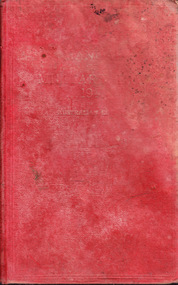
Book, L.F. Johnston Commonwealth Government Printer Canberra, Manual of Military Law 1941 Australian Edition, Early 20th Century
... Printed in Australia L.F. Johnston, Commonwealth Government Printer, Canberra....Johnston Printer Canberra Printed in Australia L.F. Johnston, Commonwealth Government Printer, Canberra. ...This Manual of Military Law 1941 Australian Edition contains Military Law that apply's to officers and enlisted personnel of the Australian Military Forces.The Manual provides rules and regulations that apply to officers and enlisted personnel of the AMF when not on war service and on war service.Leather bound book red in colour oblong shape. The front cover has faded over time.Printed in Australia L.F. Johnston, Commonwealth Government Printer, Canberra.military law manual 1941 l.f. johnston printer canberra -
 Kew Historical Society Inc
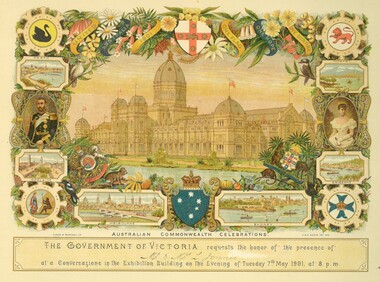
Document, Sands & McDougall Ltd, Invitation to a ‘Conversazione’ in the Exhibition Building, 1901
... Colour lithograph mounted on card to an evening event, a conversazione, held in the Exhibition Building on the evening of Tuesday 7th May 1901, as part of the Australian Commonwealth Celebrations. The Government of Victoria hosted the event. ...Printed front: UNITED AUSTRALIA 1901 / ONE FLAG / ONE HOPE / ONE DESTINY; AUSTRALIAN COMMONWEALTH CELEBRATIONS / THE GOVERNMENT OF VICTORIA requests the honour of the presence of / [name deleted] / at a Conversazione in the Exhibition Building on the Evening of Tuesday 7th May 1901 at 8 P.M. ...Colour lithograph mounted on card to an evening event, a conversazione, held in the Exhibition Building on the evening of Tuesday 7th May 1901, as part of the Australian Commonwealth Celebrations. The Government of Victoria hosted the event. ...A report in the Ballarat Star on 8 May 1901 recorded that: "THE CONVERSAZIONE. A GREAT SUCCESS. The conversazion given by the Government of Victoria at the Exhibition was very largely patronised. the guests includ ing the Prime Minister and a goodly proportion of the distinguished personages now in Melbourne. A programme of high-class music was gone through, and refreshments were served during the evening. Australian wines were very prominent."The document design has artistic and aesthetic merit. While it is not rare, it is representative of the kinds of formal designs used for the Australian Commonwealth celebrations at the time of Federation, and is in excellent condition. Such items as this invitation have local, state and national historic significance as mementoes of a key moment in Australia's history. Locally, the invitation is part of a group of Federation-related items owned and displayed by Mrs Grace Tabulo, the owner of 'Fairyland', 57 Malmsbury Street, Kew.Colour lithograph mounted on card to an evening event, a conversazione, held in the Exhibition Building on the evening of Tuesday 7th May 1901, as part of the Australian Commonwealth Celebrations. The Government of Victoria hosted the event. The invitation shows an etching of the Exhibition Building, surrounded by an ornate border of heraldic shields, portraits of the Duke and Duchess, views of Perth, Adelaide, Melbourne, Sydney, Brisbane and Hobart, and native flora (including wattle, waratah, pink heath, Sturt’s desert pea, and flannel flower), and native fauna (kookaburra, possum, lyre bird, cockatoo and koala). The royal crest ‘Dieu et mon droit’ and the Australian crest, ‘Advance Australia’ are also included.Printed front: UNITED AUSTRALIA 1901 / ONE FLAG / ONE HOPE / ONE DESTINY; AUSTRALIAN COMMONWEALTH CELEBRATIONS / THE GOVERNMENT OF VICTORIA requests the honour of the presence of / [name deleted] / at a Conversazione in the Exhibition Building on the Evening of Tuesday 7th May 1901 at 8 P.M. Reverse [handwritten]: Mrs G. Tabulo, 57 Malmsbury St.sands & mcdougall ltd, documents - invitations, first commonwealth parliament 1901, grace tabulo -- fairyland -- 57 malmsbury street -- kew (vic.) -
 Wodonga & District Historical Society Inc
Letter - Robert G Menzies re Australian Institute of Dairy Factory Managers Conferences 1965 & 1966
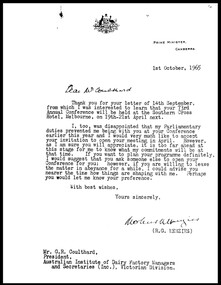
... R, Coulthard printed on Commonwealth of Australia Government letterhead....Robert G Menzies Australian Institute of Dairy Factory Managers Dairy industry Victoria 2 letters from Robert G. Menzies and Private Secretary to Mr. G. R, Coulthard printed on Commonwealth of Australia Government letterhead. ...These letters are part of communication which took place between Sir Robert Menzies and Mr. G. R. Coulthard, President of the Australian Institute of Dairy Factory Managers and Secretaries Inc. (Victorian Branch) in 1965 and 1966. The Butter Factories’ Managers Association was formed in the 1890s and held its first annual conference in 1893. This organisation became the Australian Dairy Institute and then was incorporated with the Australian Society of Dairy Technology on 24 March 1986 to become the Dairy Industry Association of Australia. Ross Coulthard was a former manager of the Tallangatta dairy factory and later manager of the North Eastern Dairy Company at Kiewa. He had gained experience at several dairies across Victoria and was a qualified Butter Maker, Milk and Cream Grader and Tester and later a Cheesemaker. He took over as manager at Tallangatta in 1954 and later became Manager of the North Eastern Dairy Company at Kiewa after a merger with the Tallangatta Butter Company. He served as Victorian President of the Dairy Industry Association in 1966 and 1976 and was the Australian National President in 1980. These letters are significant because they are linked to Australia's longest serving Prime Minister and the Victorian Dairy Industry.2 letters from Robert G. Menzies and Private Secretary to Mr. G. R, Coulthard printed on Commonwealth of Australia Government letterhead.robert g menzies, australian institute of dairy factory managers, dairy industry victoria -
 Warrnambool and District Historical Society Inc.
Certificate - Royal Review 1901 G Rolfe, 1901
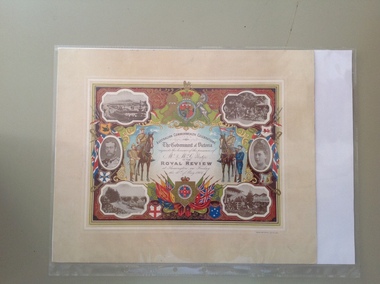
... ‘Australian Commonwealth Celebrations’ ‘The Government of Victoria requests the honour of the presence of Mr & Mrs G. ...Federation of Australian States George Rolfe of Lyndoch History of Warrnambool george rolfe ‘Australian Commonwealth Celebrations’ ‘The Government of Victoria requests the honour of the presence of Mr & Mrs G. ...This certificate was sent to those who had been present at one of the celebrations in connection with the Federation of the six States of Australia in 1901 – The Royal Review at Flemington Racecourse on 10th May 1901. The invitation to attend the event was issued by the Government of Victoria. The certificate was intended to be kept as a souvenir of the event and framed. This particular certificate was issued to George Rolfe and his wife of Warrnambool. George Rolfe (1836-1919), a tea merchant from Melbourne, began buying blocks of land near the mouth of the Hopkins River in Warrnambool in the 1870s. By the early 1880s he had acquired 50 acres of land in the town and several farming properties. He used the buildings on the land near the mouth of the Hopkins River as holiday accommodation and called the property, Lyndoch. He improved the property by adding stables, chaff and bone sheds, jetty, boathouse, reservoir, water well and windmill and extensive gardens and he spent most of his later life in the Warrnambool area. Lyndoch today is the site of an aged care facility. This certificate is of considerable importance for two reasons: 1. It is an important memento of a signal event on Australia’s history – the Federation of the six States in 1901 and the subsequent celebrations. 2. The certificate was issued to a prominent Warrnambool person, George Rolfe and his wife.This is multi-coloured sheet of paper mounted on card. There are four black and white photographs of the Royal Review at Flemington and photographs of the Duke and Duchess of Cornwall and York. The images include the Royal Crest, the shields of the six Australian States, a shield of Victoria with a background of flags, cannon and ammunition, two mounted soldiers with a soldier and sailor standing nearby and swords and bayonets. There is also much colour decoration around the edges of the certificate. The names of Mr and Mrs Rolfe are handwritten in black ink. ‘Australian Commonwealth Celebrations’ ‘The Government of Victoria requests the honour of the presence of Mr & Mrs G. Rolfe at the Royal Review at Flemington on Friday the 10th of May 1901’ federation of australian states, george rolfe of lyndoch, history of warrnambool, george rolfe -
 National Trust of Australia (Victoria)
Invitation
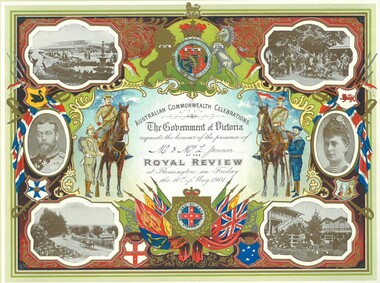
... "AUSTRALIAN COMMONWEALTH CELEBRATIONS. The Government of Victoria requests the honour of the presence of Mr & Mrs L Jenner AT THE ROYAL REVIEW at Flemington on Friday the 10th of May 1901."...Commonwealth of Australia, on the 9th of May 1901. The Duke and Duchess of Cornwall and York were to be present. rippon lea "AUSTRALIAN COMMONWEALTH CELEBRATIONS. The Government ...All the invitations are for the celebrations in Melbourne connected with the opening of the Parliament of the Commonwealth of Australia, on the 9th of May 1901. The Duke and Duchess of Cornwall and York were to be present.An invitation to attend the Royal Review at Flemington on Friday the 10th of May 1901. The card depicts sepia photos of: Melbourne and Portraits of the Duke and Duchess of Cornwall and York; as well as the coats of arms of the Australian States, the Commonwealth and of the Australian Nation."AUSTRALIAN COMMONWEALTH CELEBRATIONS. The Government of Victoria requests the honour of the presence of Mr & Mrs L Jenner AT THE ROYAL REVIEW at Flemington on Friday the 10th of May 1901."rippon lea -
 National Trust of Australia (Victoria)
Invitation
... "AUSTRALIAN COMMONWEALTH CELEBRATIONS" "THE GOVERNMENT OF VICTORIA requests the honor of the presence of Mr & Mrs L Jenner at a Conversazione in the Exhibition Building on the Evening of Tuesday 7th May 1901 at 8 p.m....Commonwealth of Australia, on the 9th of May 1901. The Duke and Duchess of Cornwall and York were to be present. rippon lea "AUSTRALIAN COMMONWEALTH CELEBRATIONS" "THE GOVERNMENT OF VICTORIA requests the honor of the presence of Mr & Mrs L Jenner at a Conversazione in the Exhibition Building on the Evening of Tuesday 7th May 1901 at 8 p.m. ...All the invitations are for the celebrations in Melbourne connected with the opening of the Parliament of the Commonwealth of Australia, on the 9th of May 1901. The Duke and Duchess of Cornwall and York were to be present.An invitation to Mr and Mrs Jenner to attend a Conversazione in the Exhibition Buildings, on 7th May 1901 at 8pm. Card depicts a sketch of the Exhibition Buildings. Surrounding the sketch are the coats of arms for the six states, sketches of the Capital cities, Australian flora and fauna and portraits of the Duke and Duchess of Cornwall and York. The coats of arms of the Commonwealth and Australia."AUSTRALIAN COMMONWEALTH CELEBRATIONS" "THE GOVERNMENT OF VICTORIA requests the honor of the presence of Mr & Mrs L Jenner at a Conversazione in the Exhibition Building on the Evening of Tuesday 7th May 1901 at 8 p.m.rippon lea -
 Kew Historical Society Inc
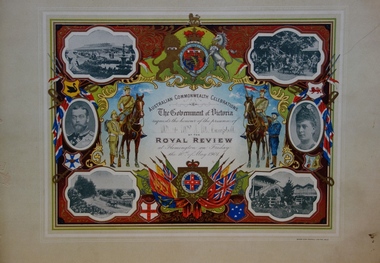
Document - Invitation to a Royal Review at Flemington, 1901
... An invitation, mounted on card to the Royal Review held at Flemington racecourse on Friday 10 May 1901, as part of the Government of Victoria's Australian Commonwealth Celebrations. The border is vividly decorated with flags, shields and a large coat of arms. ...Printed: AUSTRALIAN COMMONWEALTH CELEBRATIONS/ The Government of Victoria/ requests the honour of the presence of/ .../ AT THE/ ROYAL REVIEW/ at Flemington on Friday/ the 10th of May 1901. ...Australian Commonwealth celebrations at the time of Federation, and is in excellent condition. Such items as this invitation have local, state and national historic significance as mementoes of a key moment in Australia's history. Locally, the invitation is part of a group of Federation-related items issued to James Maitland Campbell (and his wife). Campbell was three times mayor of Kew in the second half of the 19th Century and the owner of Ramornie in Pakington Street, one of the significant extant mansions in Kew. federation events royal review - 1901 james maitland campbell federation -- invitations Printed: AUSTRALIAN COMMONWEALTH CELEBRATIONS/ The Government of Victoria/ requests the honour of the presence of/ .../ AT THE/ ROYAL REVIEW/ at Flemington on Friday/ the 10th of May 1901. ...The correspondent of The Argus recorded that: "The Parliament of the Commonwealth was opened yesterday by the Duke, of Cornwall and York, under a Commission signed by Queen Victoria and subsequently endorsed by King Edward VII. The ceremony was marked by the splendour and solemn impressiveness which befitted its historic importance. ... To-day the Heir to the Throne will review some 15,000 Australian troops at Flemington. ... It is a function which, on a lesser scale, might have been arranged at any time for many years past; but it could never previously have conveyed the meaning it does now. Soldiering was popularly regarded as a pastime here until South Africa tried the mettle of our men. It is serious business from henceforth. Those who followed the nascent aspirations of the volunteer soldiery in Australia must be impressed at the rapidity of their fulfillment. ... The document design has artistic and aesthetic merit. While it is not rare, it is representative of the kinds of formal designs used for the Australian Commonwealth celebrations at the time of Federation, and is in excellent condition. Such items as this invitation have local, state and national historic significance as mementoes of a key moment in Australia's history. Locally, the invitation is part of a group of Federation-related items issued to James Maitland Campbell (and his wife). Campbell was three times mayor of Kew in the second half of the 19th Century and the owner of Ramornie in Pakington Street, one of the significant extant mansions in Kew. An invitation, mounted on card to the Royal Review held at Flemington racecourse on Friday 10 May 1901, as part of the Government of Victoria's Australian Commonwealth Celebrations. The border is vividly decorated with flags, shields and a large coat of arms. The photographic images depict various scenes of Flemington in Melbourne, in addition to two separate portraits of the Duke and Duchess of Cornwall and York. Illustrations of military servicemen on foot and horseback flank the central block of text. The invitation was addressed to Mr & Mrs J. M. Campbell. James Maitland Campbell had been Mayor of Kew in the years 1889-90, 1890-91 and 1892-93.Printed: AUSTRALIAN COMMONWEALTH CELEBRATIONS/ The Government of Victoria/ requests the honour of the presence of/ .../ AT THE/ ROYAL REVIEW/ at Flemington on Friday/ the 10th of May 1901. Handwritten on the dotted line: Mr. & Mrs. J. M. Campbellfederation events, royal review - 1901, james maitland campbell, federation -- invitations -
 Kew Historical Society Inc
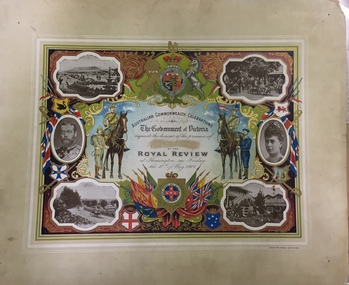
Document - Invitation to a Royal Review at Flemington, Sands & McDougall Ltd, 1901
... An invitation, mounted on card to the Royal Review held at Flemington racecourse on Friday 10 May 1901, as part of the Government of Victoria's Australian Commonwealth Celebrations. The border is vividly decorated with flags, shields and a large coat of arms. ...Printed: AUSTRALIAN COMMONWEALTH CELEBRATIONS/ The Government of Victoria/ requests the honour of the presence of/ [name deleted] / AT THE/ ROYAL REVIEW/ at Flemington on Friday/ the 10th of May 1901. ...Australian Commonwealth celebrations at the time of Federation, and is in excellent condition. Such items as this invitation have local, state and national historic significance as mementoes of a key moment in Australia's history. Locally, the invitation is part of a group of Federation-related items owned and displayed at 'Fairyland' by Mrs Grace Tabulo, and a rare survivor of that collection. federation events royal review - 1901 federation -- invitations grace tabulo -- fairyland -- 57 malmsbury street -- kew (vic.) Printed: AUSTRALIAN COMMONWEALTH CELEBRATIONS/ The Government ...The correspondent of The Argus recorded that: "The Parliament of the Commonwealth was opened yesterday by the Duke, of Cornwall and York, under a Commission signed by Queen Victoria and subsequently endorsed by King Edward VII. The ceremony was marked by the splendour and solemn impressiveness which befitted its historic importance. ... To-day the Heir to the Throne will review some 15,000 Australian troops at Flemington. ... It is a function which, on a lesser scale, might have been arranged at any time for many years past; but it could never previously have conveyed the meaning it does now. Soldiering was popularly regarded as a pastime here until South Africa tried the mettle of our men. It is serious business from henceforth. Those who followed the nascent aspirations of the volunteer soldiery in Australia must be impressed at the rapidity of their fulfillment. ... The document design has artistic and aesthetic merit. While it is not rare, it is representative of the kinds of formal designs used for the Australian Commonwealth celebrations at the time of Federation, and is in excellent condition. Such items as this invitation have local, state and national historic significance as mementoes of a key moment in Australia's history. Locally, the invitation is part of a group of Federation-related items owned and displayed at 'Fairyland' by Mrs Grace Tabulo, and a rare survivor of that collection.An invitation, mounted on card to the Royal Review held at Flemington racecourse on Friday 10 May 1901, as part of the Government of Victoria's Australian Commonwealth Celebrations. The border is vividly decorated with flags, shields and a large coat of arms. The photographic images depict various scenes of Flemington in Melbourne, in addition to two separate portraits of the Duke and Duchess of Cornwall and York. Illustrations of military servicemen on foot and horseback flank the central block of text. The invitation was part of the 'Fairyland Collection assembled by Jim and Grace Tabulo. The name on the certificate was expunged.Printed: AUSTRALIAN COMMONWEALTH CELEBRATIONS/ The Government of Victoria/ requests the honour of the presence of/ [name deleted] / AT THE/ ROYAL REVIEW/ at Flemington on Friday/ the 10th of May 1901. Reverse: Mrs G. Tabulo, 57 Malmsbury St.federation events, royal review - 1901, federation -- invitations, grace tabulo -- fairyland -- 57 malmsbury street -- kew (vic.) -
 Bendigo Historical Society Inc.
Document - PRINT OF INVITATION, 1901
... * Australian Commonwealth Celebrations. The Government of Victoria, requests the honour of the presence of Mr & Mrs.G.Lansell at the Royal review at Flemington on Friday the 10th of May 1901. 6 small photos in invitation. 1934 printed on back..... * Australian Commonwealth Celebrations. The Government of Victoria, requests the honour of the presence of Mr & Mrs.G.Lansell at the Royal review at Flemington on Friday the 10th of May 1901. 6 small photos in invitation. 1934 printed on back. ...Illuminated & framed invitation to Mr & Mrs G. Lansell to attend the Royal Review at Flemington Racecourse 1901. * Australian Commonwealth Celebrations. The Government of Victoria, requests the honour of the presence of Mr & Mrs.G.Lansell at the Royal review at Flemington on Friday the 10th of May 1901. 6 small photos in invitation. 1934 printed on back.document, invitations, official celebrations -
 Sunshine and District Historical Society Incorporated
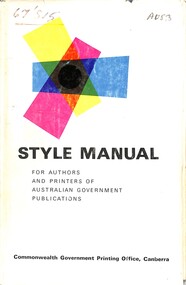
Book - Style Manual, A. J. Arthur, Style Manual For Authors And Printers Of Australian Government Publications, 1966
... Style Manual For Authors And Printers Of Australian Government Publications Commonwealth Government Printing Office Canberra On the front page there is a purple coloured stamp and writing, Ordnance factory Maribyrnong Technical Library Classification Writing G19 Accession No 67/815...This manual is primarily addressed to the authors, editors and printers of Australian Government publications so that there is uniform approach in the publication of books, briefing notes, etc. Style Manual For Authors And Printers Of Australian Government Publications Commonwealth Government Printing Office Canberra On the front page there is a purple coloured stamp and writing, Ordnance factory Maribyrnong Technical Library Classification Writing G19 Accession No 67/815 Hardcover book with paper jacket. ...This manual is primarily addressed to the authors, editors and printers of Australian Government publications so that there is uniform approach in the publication of books, briefing notes, etc.Hardcover book with paper jacket.non-fictionThis manual is primarily addressed to the authors, editors and printers of Australian Government publications so that there is uniform approach in the publication of books, briefing notes, etc. -
 Warrnambool and District Historical Society Inc.
Certificate - Federation Celebration Rolfe invitation, 1901
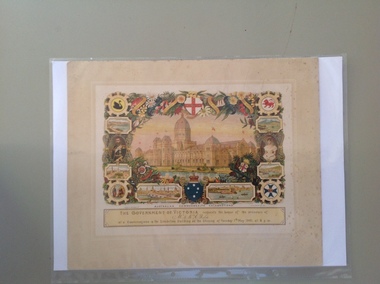
... ‘United Australia 1901 One Flag One Hope One Destiny Australian Commonwealth Celebrations’ ‘The Government of Victoria requests the honor of the presence of Mr & Mrs G. ...George Rolfe of Lyndoch, Warrnambool Federation of Australia History of Warrnambool george rolfe ‘United Australia 1901 One Flag One Hope One Destiny Australian Commonwealth Celebrations’ ‘The Government of Victoria requests the honor of the presence of Mr & Mrs G. ...This invitation to a ‘Conversazione’ to celebrate the Federation of the six colonies in Australia into the six States of Australia in 1901 was sent to the invitees after the event to keep as a souvenir of the occasion. The event was hosted by the Government of Victoria. The certificate was designed by George Brougham Austin, a Melbourne architect and artist employed by the Victorian Department of Public Works. He also designed many of the public decorations displayed in Melbourne during the Federation celebrations. Austin’s original work was lithographed by an artist at Sands and McDougall, Melbourne. This particular invitation was sent to George Rolfe and his wife, Annie. George Rolfe (1836-1919), a tea merchant from Melbourne, began buying blocks of land near the mouth of the Hopkins River in Warrnambool in the 1870s. By the early 1880s he owned 50 acres of land in the town and some nearby farming properties. He used the building on the ]and near the mouth of the Hopkins River as holiday accommodation and called the property, Lyndoch. He improved the property with the additions of stables, jetty, boathouse, bone and chaff sheds, reservoir and windmill and extensive gardens. Rolfe spent most of his later life at Lyndoch. Today the property is the site of an Aged Care facility. This certificate is of considerable importance for two reasons: 1. It is an important and attractive memento of a signal event in the history of Australia – the Federation of the States in 1901. 2. The certificate was an invitation to Mr and Mrs George Rolfe. George Rolfe was a prominent Warrnambool person in the late 19th and early 20th centuries. This is a multi-coloured certificate printed on a cream-coloured card. The certificate has an image of the Exhibition Building surrounded by an ornate border of heraldic shields, portraits of the Duke and Duchess of Cornwall and York, views of the six capital cities of Australia, native flora and fauna, the Royal Crest and the Crest of Australia. The names of the invitees are handwritten in black ink. ‘United Australia 1901 One Flag One Hope One Destiny Australian Commonwealth Celebrations’ ‘The Government of Victoria requests the honor of the presence of Mr & Mrs G. Rolfe at a Conversazione in the Exhibition Building on the Evening of Tuesday 7th May 1901 at 8 p.m.’ george rolfe of lyndoch, warrnambool, federation of australia, history of warrnambool, george rolfe -
 Kew Historical Society Inc
Document - Invitation to a ‘Conversazione’ in the Exhibition Building, George Austin, 1901
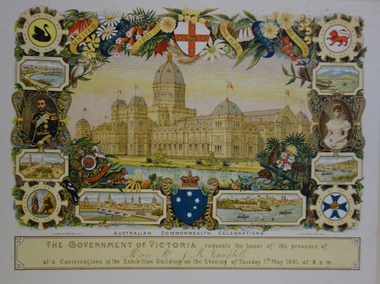
... Australian Commonwealth Celebrations. The recipients of the invitation were Mr and Mrs James Maitland Campbell of Kew. The Government...Printed: UNITED AUSTRALIA 1901 / ONE FLAG / ONE HOPE / ONE DESTINY; AUSTRALIAN COMMONWEALTH CELEBRATIONS / THE GOVERNMENT OF VICTORIA requests the honour of the presence of / / at a Conversazione in the Exhibition Building on the Evening of Tuesday 7th May 1901 at 8 P.M. ...Australian Commonwealth Celebrations. The recipients of the invitation were Mr and Mrs James Maitland Campbell of Kew. The Government ...A report in the Ballarat Star on 8 May 1901 recorded that: "THE CONVERSAZIONE. A GREAT SUCCESS. The conversazion given by the Government of Victoria at the Exhibition was very largely patronised. the guests includ ing the Prime Minister and a goodly proportion of the distinguished personages now in Melbourne. A programme of high-class music was gone through, and refreshments were served during the evening. Australian wines were very prominent."The document design has artistic and aesthetic merit. While it is not rare, it is representative of the kinds of formal designs used for the Australian Commonwealth celebrations at the time of Federation, and is in excellent condition. Such items as this invitation have local, state and national historic significance as mementoes of a key moment in Australia's history. Locally, the invitation is part of a group of Federation-related items issued to James Maitland Campbell (and his wife). Campbell was three times mayor of Kew in the second half of the 19th Century and the owner of Ramornie in Pakington Street, one of the significant extant mansions in Kew.Colour lithograph mounted on card to an evening event, a conversazione, held in the Exhibition Building on the evening of Tuesday 7th May 1901, as part of the Australian Commonwealth Celebrations. The recipients of the invitation were Mr and Mrs James Maitland Campbell of Kew. The Government of Victoria hosted the event. The invitation shows an etching of the Exhibition Building, surrounded by an ornate border of heraldic shields, portraits of the Duke and Duchess, views of Perth, Adelaide, Melbourne, Sydney, Brisbane and Hobart, and native flora (including wattle, waratah, pink heath, Sturt’s desert pea, and flannel flower), and native fauna (kookaburra, possum, lyre bird, cockatoo and koala). The royal crest ‘Dieu et mon droit’ and the Australian crest, ‘Advance Australia’ are also included.Printed: UNITED AUSTRALIA 1901 / ONE FLAG / ONE HOPE / ONE DESTINY; AUSTRALIAN COMMONWEALTH CELEBRATIONS / THE GOVERNMENT OF VICTORIA requests the honour of the presence of / / at a Conversazione in the Exhibition Building on the Evening of Tuesday 7th May 1901 at 8 P.M. Handwritten: Mr & Mrs J. M. Campbell.sands & mcdougall ltd, documents - invitations, first commonwealth parliament 1901, james maitland campbell (1847-1930), ramornie, ramornie - pakington street -
 Bendigo Historical Society Inc.
Document - BASIL MILLER COLLECTION: MOTOR SPIRIT CONSUMER'S LICENCE, 22/4/1949
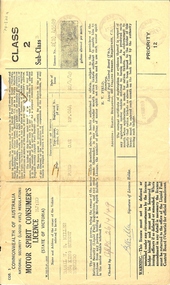
... Commonwealth of Australia, Government issued Motor Spirit consumer's Licence, Class 2, sub-class B. ...PERSON Individual basil miller Commonwealth of Australia, Government issued Motor Spirit consumer's Licence, Class 2, sub-class B. ...Commonwealth of Australia, Government issued Motor Spirit consumer's Licence, Class 2, sub-class B. Inscriptions: 'Basil W.B. Miller, 284 King Street, Bendigo', Ford, Car, MP.004, 22/4/1949. On back - record of ration tickets issued, with dates.person, individual, basil miller -
 Mission to Seafarers Victoria
Badge, Wallace Bishop, MN Australia, circa 1940
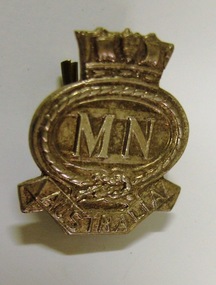
... commonwealth government 1940...badge...war service...australia...WW2 Merchant Navy Australia, issued by the Commonwealth Government 1940 MN War Service officially-numbered silver lapel badge. ...WW2 Merchant Navy Australia, issued by the Commonwealth Government 1940 MN War Service officially-numbered silver lapel badge. ...WW2 Merchant Navy Australia, issued by the Commonwealth Government 1940 MN War Service officially-numbered silver lapel badge. A company called Bishop also manufactured badges in Melbourne .Intended as a form of service badge for Australian Merchant Seafarers especially those perhaps serving on the newly armed civilian craft. The term Merchant Navy was coined by King George V in 1919, as recognition of the sacrifice made by merchant seafarers during the First World War.WW2 Merchant Navy war service solid (silver) badge. Initials ‘MN’ enclosed by oval rope motif with crown above. The word ‘Australia’ (UC) displayed beneath. Retains original two-loop lapel fixtures. Officially-numbered 10910 on the back. Inscribed "issued by the Commonwealth Government 1940". "Wallace-Bishop Brisbane".ww2, merchant navy, commonwealth government 1940, badge, war service, australia, mn -
 Flagstaff Hill Maritime Museum and Village
Certificate - Invitation, Norman Lindsay (Artist), Opening of the Parliament of the Commonwealth by His Royal Highness The Duke of Cornwall and York, ca. 1901
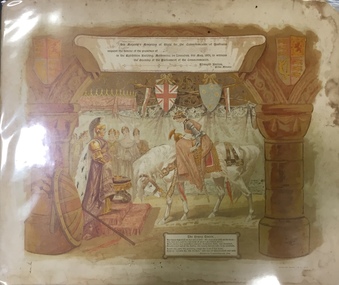
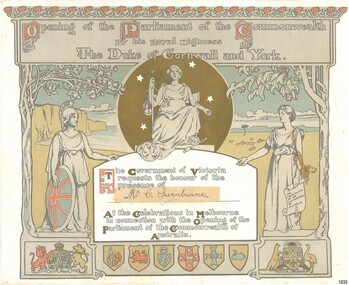
... Government of Victoria...Opening of Federal Parliament...HRH The Duke of Cornwall and York...C Swinburne...Susan Jane Granter...Susan Jane Swinburne...Federal Parliament...1901...Australian Federation...Ceremonies...Politics...Royal Exhibition Building...Invited guest...Britannia...Orb...Sceptre...Advance Australia Arms...Constitution of the Commonwealth...Australia became a Federation on January 1st, 1901, uniting Australia's six British colonies - New South Wales, Victoria, Queensland, South Australia, Western Australia and Tasmania – into States of the Commonwealth of Australia. The Government of Victoria invited 12,000 guests to attend the official celebrations for the Opening of the Federal Parliament by His Royal Highness, the Duke of Cornwall and York (later King George V). ...Australia became a Federation on January 1st, 1901, uniting Australia's six British colonies - New South Wales, Victoria, Queensland, South Australia, Western Australia and Tasmania – into States of the Commonwealth of Australia. The Government of Victoria invited 12,000 guests to attend the official celebrations for the Opening of the Federal Parliament by His Royal Highness, the Duke of Cornwall and York (later King George V). ...Australia became a Federation on January 1st, 1901, uniting Australia's six British colonies - New South Wales, Victoria, Queensland, South Australia, Western Australia and Tasmania – into States of the Commonwealth of Australia. The Government of Victoria invited 12,000 guests to attend the official celebrations for the Opening of the Federal Parliament by His Royal Highness, the Duke of Cornwall and York (later King George V). The historic occasion was held at noon on May 9th, 1901, at Melbourne's Royal Exhibition Building, the only building large enough for that number of guests. The guests represented all six states of Australia with varied connections and interests, including politics, business and industry, the arts, religion, education, and public service. In Melbourne, the occasion was followed by two weeks of celebrations. The decorative, elaborate design of the certificate-size invitation represents Australia’s colonial history and its transition to the Federated Commonwealth of Australia. The National Gallery of Australia attributes the artwork of this invitation to Australian artists Norman Lindsay (1879–1969) and John Longstaff (1861–1941) and its printing to Sands & McDougall Limited, Melbourne. The invitation has no date or location details. This invitation has the label “Mr. C Swinburne” added over an original, handwritten name. Perhaps it was a spelling correction, or a late change, with Swinburne attending in the place of another citizen. The book “Our Invited Guests An Official Directory, Melbourne, Victoria, 1901” lists all the guests, but not one has the surname SWINBURNE. There are five Warrnambool listings, eight people in all: - - MoCOBMICK, G. D., Esq., P.M., Warrnambool. - O’DOWD, The Ven. Monsignor, Warrnambool. - OPIE, C. N. T., Esq. (and Lady), Warrnambool. - OSBORNE, Hy. Wm., Esq., Shire Secretary (and Lady), Town Hall, Warrnambool. - STEVENS, Mrs. F. P., Mia Mia, Warrnambool. CHARLES GRANT SWINBURNE (1864-1934): - Charles Grant Swinburne, known as Chas.., was a prominent Warrnambool figure: a member of Toc H., the Progress Association and several other local clubs and societies. He purchased Warrnambool’s Tattersall’s Hotel in 1911 and had a booth at the 1914 Warrnambool Show. In 1891, he married Susan Jane Granter (1867-19 June 1935), daughter of Joseph Granter (1832-1879) and Ann (born Holley). Joseph had arrived in Melbourne on the famous tall ship Marco Polo in February 1856. In 1868, he was a shareholder of the Warrnambool Steam Packet Co., trading along the coast of Victoria. His portrait is among those recognised on the historic Warrnambool Pioneers Board. The invitation is nationally significant for its connection with the first Federal Parliament in May 1901, where the first federal parliamentarians were sworn in, and where the Duke and Duchess of Cornwall and York attended, representing the continued link with Britain. The invitation also unites a local Warrnambool businessman, Mr C Swinburne, with the 12,000 guests representing their towns and states that in 1901 became the Commonwealth of Australia. Swinburn was also married to the daughter of Joseph Granter, an early pioneer recognised on Warrnambool’s Pioneer Board. Invitation: certificate size, colour lithograph on cream card with gilt highlights. The Victorian Government invited Mr C Swinburne to celebrate the Opening of Federal Parliament by HRH the Duke of Cornwall and York, held in Melbourne. The invitation has printed drawings of figures, decorations, heraldic symbols, and gilt accents behind the central figure, on the capital letters of the message, and the Advance Australia Arms. Inscribed with a handwritten label that covers handwritten text. [The event was held at Noon, 9th May 1901, Royal Exhibition Building, Melbourne.] Inscription, handwritten on a label: "Mr. C. Swinburne" Left image: [figure of Britannia holding a blue shield with three crossing red bands, standing below an oak tree] Central image, in front of a gilt circle : [symbolic female royal future with Orbe and Sceptre seated on throne, four stars around her] Right image: [young female figure representing Australia holding a scroll, standing below a flowering gum] "THE CONSTITUTION OF THE COMMONWEALTH OF AUSTRALIA" Bottom left: Combined Arms: "[Duke of Cornwall and York, Prince George Frederick Ernest Albert, Princess Alexandra, his Duchess]" Bottom centre: [six symbols representing the Coat of Arms for each state of Australia] Bottom right: Advance Australia Arms "[Shield with six symbols, between Kangaroo and Emu, and below Rising Sun'] ADVANCE AUSTRALIA"flagstaff hill maritime museum and village, flagstaff hill, maritime museum, maritime village, warrnambool, great ocean road, shipwreck coast, invitation, certificate, mr c swinburne, government of victoria, opening of federal parliament, hrh the duke of cornwall and york, c swinburne, susan jane granter, susan jane swinburne, federal parliament, 1901, australian federation, ceremonies, politics, royal exhibition building, invited guest, britannia, orb, sceptre, advance australia arms, constitution of the commonwealth of australia, norman lindsay, john longstaff, sands & mcdougall, federation, british colonies, commonwealth of australia, charles grant swinburne, chas swinburne, c g swinburne, opening of the federal parliament, duke of cornwall and york, may 9th, tattersall’s hotel, marco polo, warrnambool steam packet co, warrnambool pioneers board, joseph granter, ann granter -
 Flagstaff Hill Maritime Museum and Village
Letter - William Ferrier, 14th November 1905
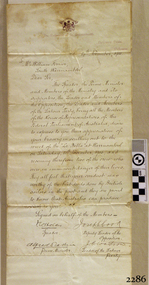
... It is one of the only two shipwrecks discovered in Lady Bay, Warrnambool, out of the 15-17 shipwrecks in the bay. la bella william ferrier bill ferrier lady bay 1905 10th november 1905 11th november 1905 parliament of the commonwealth prime minister australian government new zealand flagstaff hill warrnambool shipwrecked coast flagstaff hill maritime museum maritime museum shipwreck coast flagstaff hill maritime village The printed coat of arms is that of the House of Representatives. ...The letter to William Ferrier of South Warrnambool from the Prime Minister and the Parliament of the Commonwealth recognised the significance of William’s brave and courageous lifesaving act to the people of Australia; “They all feel that your conduct was worthy of the best deeds done by British sailors in the past and they are proud to know that Australia can produce such as you.” The story of that brave rescue follows on below … The ship from which the sailors were rescued was the three-masted, iron and steel barquentine the La Bella, built in Norway in 1893. She was one of two iron and steel ships by Johan Smith, The company was one of the leading shipping families in Tvedestrand, Norway. She was significant to Norwegian shipping, being one of only 27 iron and steel ships ever built in Norway. She was registered in New Zealand and engaged from 1902 in inter-colonial trading of timber in the Pacific, between New Zealand and Australia and was often in Port Phillip Bay, Victoria. On 5th October 1905, the twelve-year-old La Bella left Lyttleton, New Zealand carrying a cargo of timber bound for Warrnambool, Australia. She was manned by a crew of twelve: the Master, (Captain Mylius, previously 1st Mate of La Bella, appointed Captain to La Bella on 6th February 1903) 2 Mates, Cook, six able seamen, one ordinary seaman and a boy. Bad weather en route caused her to shelter at Burnie on Tasmania's North West coast. On November 10th, the 37th day of her journey, La Bella approached Warrnambool. Captain Mylius steered her towards Lady Bay Channel in heavy south-west seas and evening mist. He ordered the helmsman to steer for the light. As the ship came round, a tremendous sea struck her on the port quarter, causing her to breach broadside in a north-westerly direction into breakers. The helm was brought round twice more, but each time heavy seas broke over her, the third time throwing the La Bella on to a submerged reef in Lady Bay now known as La Bella Reef (about 100 yards from the Warrnambool breakwater). The sea was so rough that it even wrenched a one-and-a-half ton anchor from its fastenings and into the sea. As Captain Mylius headed to the steel wheelhouse, intending to send up a rocket flare, a huge sea slammed the steel door into him (resulting in massive bruising front and back) Despite his injuries he still managed to set off a blue light, which he held up in his hands. La Bella’s lifeboats were filled with seawater and broke up on their chocks. The blue light was the first indication to people on the shore that there was a ship in distress. The Harbour Master, Captain Roe (who lived in the Harbour Master’s House opposite Flagstaff Hill), organised a group of volunteers to crew the lifeboat because the trained crew was unavailable; the crewmen were working on a steamer in Port Fairy at the time. He then poured oil onto the water to try and smooth the sea. At around 11 pm three of the crew took shelter in the steel forecastle but the sea crashed into it and broke it up. While the rest of the crew and onlookers watched helplessly in the moonlight the bodies were washed away into the sea, never to be seen again. Some of the crew lashed themselves to the weather rail to keep from being washed away. Watson, the ordinary seaman, became tangled in the rigging lines and was too weak to move, so the 2nd Mate, Robertson, put a line onto him so that he wouldn’t wash off. Around 11 pm three of the crew were unconscious from exhaustion. The situation on La Bella was becoming dangerous. The 2nd Mate moved to the ‘house’ and soon afterwards the ship slipped in the heavy sea. The lashings of the 1st Mate and the ‘boy’ Denham had kept them safe until about 2 am when they were washed overboard; no one was able to help. One by one, the exhausted crew were being washed overboard, too weak to hold on any longer. During the night the La Bella had broken into two and the deckhouse ran out towards the sea. Two more men drowned when trying to reach the lifeboat. By sunrise, the only survivors of the twelve were the Master, 2nd Mate and three seamen. Early in the morning, Captain Roe used the rocket apparatus on shore to try and shoot a line to the ship for a safer rescue but each attempt fell short of the target. Several attempts were made by the lifeboat to rescue the stricken sailors, but the rough conditions made this difficult for the boat to get close enough to the ship and the lifeboat had to return to shore. During a final attempt to reach the ship Captain Mylius ordered his men to jump into the sea. Leonard Robertson, 2nd mate, jumped and swam towards the lifeboat, taking hold of the boat hook offered to him. Oscar Rosenholme managed to reach the boat floating on a piece of timber from the ship’s load and a third survivor, Noake, also made the boat. Along with the lifeboat rescue crew, 25-year-old William Ferrier rowed his small dingy through the heavy seas and managed to rescue the Captain, whom he landed on the breakwater. Ferrier then returned to the ship to attempt a final rescue, losing his oars and rowlocks into the high sea. Using just a spare paddle he skulled towards the La Bella, reaching her stern in time to cut loose the lone surviving sailor, Payne, from the lashing that held him to the ship; the terrified sailor dropped from the ship and into the dingy. Shortly after the last man was rescued, the La Bella was lifted by a huge wave and crashed back down on the reef; she broke up and sank. The ordeal had lasted ten hours. The survivors were taken to the nearby Bay View Hotel and gratefully received warm food and clothing, medical attention and a place to sleep. In the following days, an unidentified body of a young person has washed ashore; it was either Watson or Denham. The body was buried in the Warrnambool cemetery with an appropriate gravestone and inscription. William Ferrier became a national hero as news of the daring rescue spread. In recognition of his bravery in the two daring rescues, he was awarded the Silver Medal for Bravery by the Royal Humane Society and was honoured in the letter from the Prime Minister and the Parliament of the Commonwealth, telegrams and a cheque for £20 from the Governor-General, over £150 subscribed by the public, including Warrnambool and district and readers of The Argus, and a gold medal from the Glenelg Dinghy Club of South Australia. Ferrier’s rescue efforts are one of the most heroic in Victoria’s shipwreck history. (William Ferrier’s son, Frank, received a similar award almost fifty years later when he helped rescue four members of the crew on the yacht Merlan after it ran on to a reef near the Point Lonsdale Lighthouse. ) The wreck of La Bella now lies on her port side in 13 metres of sheltered water inside the reef she struck. The bow section is relatively intact and part of the stern has drifted north-easterly towards the mouth of the Hopkins River. The reef the La Bella struck now bears its name. Those five rescued from the La Bella were Captain George Mylius, Leonard Robertson (2nd Mate, 21 years old), R. Payne, Oscar Rosenholme and Jack Noake. Those seven who lost their lives were Mr Coulson (1st mate), Charles Jackman (cook) Gustave Johnson, Pierre Johann and Robert Gent (all able seamen), Harry Watson (ordinary seaman) and Jack Denham (ship’s boy), Captain Mylius was found guilty of careless navigation; he had sailed into the bay without the services of a pilot. His Master Certificate was suspended for twelve months. Later he was also charged with the manslaughter of one of the crew who had died when the La Bella was wrecked but found not guilty. The event’s adverse publicity and damage to his career took a toll on his health and he died of a heart attack six months after the wreck; he was only thirty-seven. His body was buried in the Melbourne General Cemetery. The La Bella was “the best documented of all sailing ships owned in New Zealand”. Her record books, ship logs, correspondence and supporting papers are still available. At the time of the tragedy, she was owned by Messers David C.Turnbull and Co. of Timaru, New Zealand timber merchants and shipping agents, who had purchased her on 13th December 1901. A detailed account of the last journey of La Bella can be read in “Leonard Robertson, the Whangaroa & La Bella” written by Jack Churchouse, published in 1982 by Millwood Press Ltd, Wellington, NZ. As well as this letter, Flagstaff Hill’s La Bella Collection includes a photograph of the wrecked La Bella, a brass rail holder and a postcard of William Ferrier with four of the survivors. Some 15 – 17 ships are believed to have sunk in Lady Bay, but only two have been discovered on the seafloor; the “La Bella” and the “Edinburgh Castle”. Both wrecks are popular diving sites and are preserved as significant historical marine and marine archaeological sites. This original congratulatory letter sent to William Ferrier by the Prime Minister and Government of Australia demonstrates the importance attached to his efforts for Victoria and to Australia. The letter is part of the La Bella Collection and is significant at both a local and state level. Its connection to the La Bella shipwreck and the rescue of five survivors highlights the dangers of Victoria’s Shipwreck Coast. The letter to William Ferrier from the Australian Government acknowledges the bravery of ordinary Australians who risked their lives to save victims of shipwrecks along the coast. The letter is significant to the history of Warrnambool as it honours William Ferrier, a local fisherman whose descendants continue to live in the area. It highlights the way of life of people who lived in coastal towns in 19th century Victoria and the effects of shipwrecks upon them. The letter connects to the postcard of William Ferrier with four of the five rescued crew, the photograph of the wreck of the La Bella and the artefact from the wreck, the rail holder. This letter is significant because of its association with the sailing ship “La Bella”. The “La Bella” is of local and state and national significance. It is one of the only two shipwrecks discovered in Lady Bay, Warrnambool, out of the 15-17 shipwrecks in the bay. Letter to William Ferrier of South Warrnambool from the Prime Minister and Members of Parliament commending him on his bravery. The printed letterhead includes a coat of arms in the top centre and the official address. The letter is very neatly hand written in black pen and includes 4 signatures of Members of Parliament. The rectangular paper is cream coloured with some yellow/brown discolouring. It has the letterhead on the right hand side of it and the written letter begins below the letterhead. The paper has been folded so that the right side becomes the cover page of the letter. The writing is continued onto the inside right hand page of the folded paper and the writing ends here. There is more recent writing on the bottom right hand corner of the back page. The paper has been officially folded in half a total 3 times and there is heavy discolouration on the sections that form the front and back of the folded letter. There is a 4th fold line that is less pronounced that the other folds and would make the paper the size to fit into a pocket. At several fold creases the paper has worn through. The edges of the paper have minor tears. The printed coat of arms is that of the House of Representatives. Underneath is printed “The Parliament of the Commonwealth, / Parliament House / Melbourne”. The hand written, letter is dated “14th November, 1905” and addressed to “Mr. William Ferrier / South Warrnambool” The letter begins “The Speaker, the Prime Minister and Members of the Ministry and its supporters, the Leader and Members of the Opposition, the Leader and Members of the Labour Party, being all the Members of the House of Representatives of the Federal Parliament of Australia” … It continues “desire to express to you their appreciation of your bravery in skulling out to the wreck of the “La Bella” at Warrnambool on Saturday, 11th November, 1905, and recovering therefrom two of the crew who were in imminent danger of their lives. They all feel that your conduct was worthy of the best deeds done by British sailors in the past and they are proud to know that Australia can produce such as you.” The letter is “Signed on behalf of the Members – Speaker (Frederick Holder ), Deputy Leader of the Opposition (Joseph Cook ), Prime Minister (Alfred Deakin), Leader of the Labour Party ( J.C. Watson)” On the back of the letter is blue ink handwriting “OWNER / G. FERRIER / TO. BE. PHOTOGRAPHED / 27-4-76”la bella, william ferrier, bill ferrier, lady bay, 1905, 10th november 1905, 11th november 1905, parliament of the commonwealth, prime minister, australian government, new zealand, flagstaff hill, warrnambool, shipwrecked coast, flagstaff hill maritime museum, maritime museum, shipwreck coast, flagstaff hill maritime village -
 Flagstaff Hill Maritime Museum and Village
Book - Record Book, Commonwealth Meteorological Bureau, Meteorological Observations, May 1945
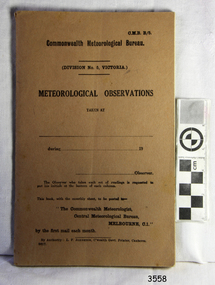
... Commonwealth of Australia. Meteorological Observations Book Record Book Commonwealth Meteorological Bureau L F Johnston, Commonwealth Government Printers ...This book of meteorological observations is dated May 1945. The book was published by the Commonwealth Meteorological Bureau, Victora Division. It was printed by L. F. Johnston, Commonwealth Government Printer, Canberra. Readings were recorded daily for barometric pressure, temperature, rain and wind velocity. At the end of each month, they were posted to the central Branch in Melbourne. These Meteorological Observations are an important accurate record of the local weather since the decades. They are part of Flagstaff Hill's Meteorological Observations collection of over seventy record books dating from the late 19th century. The collected information gives a picture of the weather patterns for the months and seasons, which then allows for warnings of events out of the normal or extreme, such as forecasting floods or droughts.Meteorological Observations, dated May 1945. Small brown cardboard printed cover with printed pages prepared for adding records. Published by the Commonwealth of Australia. Printed text includes "Commonwealth Meteorological Bureau / DIVISION NO. 5 VICTORIA / METEOROLOGICAL OBSERVATIONS " and "The Observer who takes each set of readings is requested to put his initials at the bottom of each column" "flagstaff hill, flagstaff hill maritime museum and village, warrnambool, maritime museum, maritime village, great ocean road, shipwreck coast, meteorological observations, commonwealth meteorological bureau, commonwealth meteorologist, central meteorological bureau, division no. 5 victoria, weather readings, weather records, may 1945, weather history, weather measurement, weather record -
 Flagstaff Hill Maritime Museum and Village
Book - Record Book, Commonwealth Meteorological Bureau, Meteorological Observations, November 1948
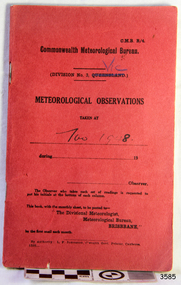
... Commonwealth of Australia. The book was printed for Queensland; the cover has been altered by hand to read Vic [Victoria], but the fly page has not been altered. Meteorological Observations Book Record Book Commonwealth Meteorological Bureau L F Johnston, Commonwealth Government Printers ...This book of Warrnambool's meteorological observations is dated November 1948. The book was published by the Commonwealth Meteorological Bureau, Victora Division. It was printed by L. F. Johnston, Commonwealth Government Printer, Canberra. It was originally printed for Division 3, Queensland but has been overwritten with 'Vic' [Victoria] and used for Warrnambool. Readings were recorded daily for barometric pressure, temperature, rain and wind velocity. At the end of each month, they were posted to the central Branch in Melbourne.These Meteorological Observations are an important accurate record of the local weather since the decades. They are part of Flagstaff Hill's Meteorological Observations collection of over seventy record books dating from the late 19th century. The collected information gives a picture of the weather patterns for the months and seasons, which then allows for warnings of events out of the normal or extreme, such as forecasting floods or droughts.Meteorological Observations record book. Recordings were taken at Warrnambool in November 1948. Small red cardboard printed cover with printed pages prepared for adding records. Published by the Commonwealth of Australia. The book was printed for Queensland; the cover has been altered by hand to read Vic [Victoria], but the fly page has not been altered.Printed cover text includes "Central Meteorological Bureau" "METEOROLOGICAL OBSERVATIONS DIVISION No. 3 QUEENSLAND" Handwritten on cover "VIC" "Nov 1948."flagstaff hill, flagstaff hill maritime museum and village, warrnambool, maritime museum, maritime village, great ocean road, shipwreck coast, meteorological observations, commonwealth meteorological bureau, weather readings, weather records, weather history, weather measurement, weather record, division no 3 queensland, victoria, november 1848 -
 Flagstaff Hill Maritime Museum and Village
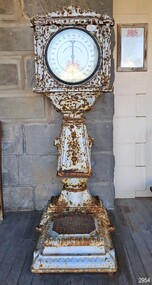
Instrument - Scale, Weighing Machine, G. Salter & Co, 1884-1909
... On December 21, 1946, the Commonwealth government invited offers to tender for the right to place automatic weighing machines on postal premises throughout the six states; the successful company then made arrangements with the federal Postmaster General's Department to place machines outside post offices across the country. A few years later, on September 11, 1950, the firm's Adelaide branch ceased trading. From 11th July 1950, the Australian...On December 21, 1946, the Commonwealth government invited offers to tender for the right to place automatic weighing machines on postal premises throughout the six states; the successful company then made arrangements with the federal Postmaster General's Department to place machines outside post offices across the country. A few years later, on September 11, 1950, the firm's Adelaide branch ceased trading. From 11th July 1950, the Australian ...This ornate, Victorian-era automatic weighing machine was made in England around 1884-1909, by George Salter and Co. of West Bromwich, UK, makers of scales since 1760. It is protected by Queen Victoria’s Royal Letters Patent, signed in 1900. The scale stood outside the Warrnambool Post Office in Timor Street from around 1909 to 1966, as shown on postcards and photographs held at the State Library of Victoria. The scale is identified by the Serial Number '665', and was installed by the distributors, the Australasian Automatic Weighing Machine Co. Ltd.. The scale’s weight measurements were in Imperial stones and pounds up to 20 stone (127 kg). The scale’s face included charts of average weights, for men, women, boys and girls, by various heights, in feet and inches. The coin slot and its face were converted to metric measurements by the Eastern Scale Company Pty. Ltd; that firm was registered on October 2, 1974. The Australasian Automatic Weighing Machine Co. Ltd was a large supplier of weighing scales in Australia and held the Royal Letters patent for their machines, distributing them in prominent locations. In 1902, the firm was listed under the Import Entries Passed at His Majesty’s Customs, importing into Sydney, NSW, eight cases of scales. In 1911, the company asked permission from the Port Pirie Corporation to install a machine in Alexander Street. In 1913, the company applied to the City of Sydney to install machines around the city, including at the tram depot. One application mentions “… three machines in three places for three pounds per year”. In 1923, the firm tendered for the right to place Automatic Weighing Machines on railway and tram premises throughout New South Wales, subsequently for five-year terms, in return for a fixed payment per machine and a portion of the revenue to the NSW Government. In 1928, the Sydney Harbour Trust gave the firm the right to place the weighing machines on various ferry jetties. The firm was still operating in 1941, advertising for two boys aged 14-16 for the workshop and messages, at the Rialto building, 497 Collins St., Melbourne. On December 21, 1946, the Commonwealth government invited offers to tender for the right to place automatic weighing machines on postal premises throughout the six states; the successful company then made arrangements with the federal Postmaster General's Department to place machines outside post offices across the country. A few years later, on September 11, 1950, the firm's Adelaide branch ceased trading. From 11th July 1950, the Australian and Eastern Engineering Company Pty. Ltd took over at the same premises, at 179 Pirie Street, Adelaide. The Perth branch ceased business in WA on July 6th, 1950. Percival Everitt invented and patented the automatic, coin-operated personal scale design. Everitt was a Norfolk-born engineer and regarded as the father of the coin-operated industry. As a young man in 1877, he invented a hay and corn pitcher, a turnip thinner in 1878 and an Automatic Travelling Anchor in 1880. But his fame came in 1883 with the first postcard-vending machine, over a hundred of which he distributed around London. In 1884, he patented one of his many inventions, the coin-operated scales for use in public places; for many people, it was their first exposure to coin-operated machines. His success prompted the formation of the Weighing Machine Company in 1885. Further inventions followed: a blow tester in 1887, the machine for testing a person's grip in 1888, and in 1889, the dispensing machine for hiring out opera glasses, and a device for shutting down the coin entry slot if the machine was empty. In 1890, he invented a fortune-telling machine. Everitt sadly did not make his fortune; he died suddenly in February 1893, in his late forties, with £71 to his name. George Salter & Co., West Bromwich, England, produced automatic weighing scale machines from Everitt’s patented design, and advertised them as suitable for hotels, pleasure gardens, theatres, exhibition halls, clubs, baths and places of public resort. The company was established in 1760 by brothers Richard and William Salter, and manufactured springs and pocket steelyards (spring balances). After several generations, the company was taken over in 1855 by a nephew, George, and renamed George Salter & Co. In 1884, Salter registered the trademark of a Staffordshire knot pierced by an arrow. The company's expanded range of products included the first coin-operated public weighing machines in the 1880s and, in 1895, the first English-made typewriter. In 1915, Salter became a limited company, Geo. Salter & Co. Ltd. When the last George Salter died in 1917, the company passed into the hands of other relatives, but continued to grow before being bought out by Staveley Industries in 1973. Despite several subsequent mergers, the Salter name continues to be seen on household products such as digital scales. This patented, coin-operated weight machine is significant for its association with Percival Everitt, the inventor of the world’s first slot machine, with the renowned maker of scales, G. Salter & Co., which began operating in 1760, and also with the Australasian Automatic Weighing Scale Co., which imported and widely distributed the scales throughout Australia from the early-to-mid 20th century. It is a rare example of an early vending machine used in public places from the late 19th through to the mid-20th century. These machines were the early step in the evolution of coin-in-the-slot machines, which are still used today. The scales give a glimpse into our history; they became quickly popular with the public, which, until then, had little access to weight scales apart from those at medical services. They also provided inexpensive entertainment for families, especially while waiting for trains or visiting the post office. The machines were also attractive and lucrative to the distributors; once installed, they required very little maintenance, and their low cost to customers kept the money coming in. This automatic weighing machine is also significant for its decades of service to the local and regional community of Warrnambool, for personal and commercial purposes. A public coin-operated weighing scale, also called a penny scale. It is a large, silver-painted cast metal stand with a square top on a pedestal that flares outwards to join a rectangular platform base with posts on the side and corners that may have had fitted wheels. The round, white face on top has red and black measurements and inscriptions. A slim indicator with a point at one end and an arc at the other is attached to the face’s centre. The coin slot is above the face, on the left, and the scale’s identification number is engraved on an oval plate on the right. Moulded motifs decorate the pedestal’s front and are repeated on its sides; they depict a tall, narrow urn with a bowl on top and fancy scrolls on either side. There is a decorative panel across the front top of the stand. The top of the pedestal has a small keyhole. The size of the coin slot fitted a penny coin, and the weight measurements on the face were in Imperial stones and pounds. Quite some time after 1966, when Australia introduced new decimal weights, measurements and currency, the scale was updated; the coin slot size was changed, and a new face with metric measurements was installed. The scale now accepts a $1 coin (one dollar) and the scale measures weight in kilograms and grams, from 0 to 125 kg.. The rear of the scale has a small, rectangular metal plate with printed text. The scale was made by G Salter & Co. of West Bromwich, UK, distributed by the Australasian Automatic Weighing Platform Co., and updated to metric measurements by Eastern Scale Co. Pty Ltd. It was previously installed at the Warrnambool Post Office. Engraved on an oval plate on the right: "665" Top centre of the face, in red: "$1 coin" Top of face: "EASTERN SCALE CO. PTY LTD" Base of face, in red: "[Royal Coat of Arms of Britain]" with words, below in red: "BY ROYAL LETTERS PATENT" Around the face, in black: "[numbers 0 to 125, in increments 5, and makes between the numbers for each 500g]" "kg" Below the face, moulded letters within a shield: "AUSTRALASIAN AUTOMATIC WEIGHING MACHINES CO. LTD." At the back of the weighing platform: "G SALTER & CO. / WEST BROMWICH", remnants of logo “[Staffordshire knot pierced by an arrow]” Plate on rear: THIS SCALE REMAINS THE PROPERTY OF EASTERN SCALE CO. PTY. LTD., 8 GEORGE COURT, GREENSBOROUGH, VIC, 3088. PHONE (03 ) _ 34 _ _ 33” (434 9333 ?_flagstaff hill, warrnambool, maritime village, maritime museum, flagstaff hill maritime museum and village, shipwreck coast, great ocean road, scale, weighing scale, salter, australasian, 1 dollar, $1 coin, 1p, 1 penny coin, penny scale, coin in slot scale, eastern scale co. pty. ltd., british royal coat of arms, royal letters patent, letters patent, health, ending machine, coin-operated machine, percival everett, weighing machine co., george salter & co., g salter & co, west bromwich, vending machine, weights & balances, measurements, slot machine, coin operated machine, penny-in-the-slot, coin fed, coin op scale, weights & measures, australasian automatic weighing machine co. ltd., warrnambool post office, machine 665, no. 665, blalnce technology, scales and weights, weights and measures, penny weight scales, vintage, weighing machine, coin in the slot, coin operated, public scale, public weighing machine, penny-weighing machines, penny weighing machines, penny scales, coin operated weighing machine, scale weighing machine -
 Flagstaff Hill Maritime Museum and Village
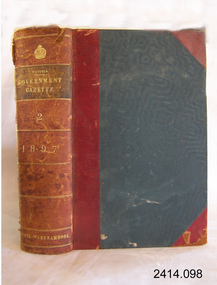
Book - Reference/Colonial Government Notification Gazette, Robert Smith Brain, The Victoria Government Gazette 1897 Vol 2 /102, 1897
... Australia. Beyond daily legislative Acts, his office printed monumental scientific and historical texts by authority of the government, including major botanical catalogues for legendary government botanist Ferdinand von Mueller. He remained the administrative head of the government's printing operations into the early years of the new century. He passed away in 1906, ending a multi-decade legacy that shaped how early Victorian and Commonwealth...government actions taken in colonial Victoria. Courts and historians still rely on them to establish exact dates of proclamations, appointments, and land dealings. The year 1897 falls in the lead-up to Australian Federation in 1901, so gazettes from this period can carry notices tied to the constitutional conventions, referendum arrangements, and colonial administration just before Victoria became a state of the Commonwealth. ...The Victoria Government Gazette and other government documents from 1887 were printed and published by Robert S. Brain, Government Printer, Melbourne. Brain held the position of Victorian Government Printer through the 1890s and into the early 1900s. The same imprint appears on other official Victorian publications from that era, such as the annual reports of the Board for the Protection of the Aborigines and the colony's Statistical Register. There wasn't really an editor in the modern sense the Gazette was compiled and issued under the authority of the colonial government, via the Chief Secretary's Department, with Brain's printing office producing and publishing it.Hard cover book. The Victorian Government Gazette 1897 Vol 2 /102 Printer: Robert Smith, Brain Publisher: Robert Smith, Brain Publisher: Authority of The Colonial Government Date: 1897 Further Information: Textured hard cover bound book leather burgundy colour spine with gilt lettering, covers embossed blue cloth & reinforced corners to front and back cover. non-fictionThe Victoria Government Gazette and other government documents from 1887 were printed and published by Robert S. Brain, Government Printer, Melbourne. Brain held the position of Victorian Government Printer through the 1890s and into the early 1900s. The same imprint appears on other official Victorian publications from that era, such as the annual reports of the Board for the Protection of the Aborigines and the colony's Statistical Register. There wasn't really an editor in the modern sense the Gazette was compiled and issued under the authority of the colonial government, via the Chief Secretary's Department, with Brain's printing office producing and publishing it.flagstaff hill, warrnambool, shipwrecked-coast, flagstaff-hill, flagstaff-hill-maritime-museum, maritime-museum, shipwreck-coast, flagstaff-hill-maritime-village, book, the victoria government gazette 1897, the victoria government gazette 1897 2 vol 102, the victoria government gazette -
 Flagstaff Hill Maritime Museum and Village
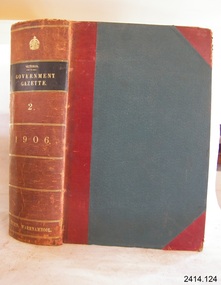
Book - Reference/Colonial Government Notification Gazette, James Kemp, The Victorian Government Gazette 1906 Vol 2 /129, 1906
... government. During his leadership, the Victorian GPO was also responsible for printing Australian colonial and state postage stamps, as well as early post-Federation Commonwealth stamp issues prior to the opening of the dedicated Commonwealth Stamp Printing Office. ...government. During his leadership, the Victorian GPO was also responsible for printing Australian colonial and state postage stamps, as well as early post-Federation Commonwealth stamp issues prior to the opening of the dedicated Commonwealth Stamp Printing Office. ...The Victoria Government Gazette and other government documents from 1887 were printed and published by Robert S. Brain, Government Printer, Melbourne. Brain held the position of Victorian Government Printer through the 1890s and into the early 1900s. The same imprint appears on other official Victorian publications from that era, such as the annual reports of the Board for the Protection of the Aborigines and the colony's Statistical Register. There wasn't really an editor in the modern sense the Gazette was compiled and issued under the authority of the colonial government, via the Chief Secretary's Department, with Brain's printing office producing and publishing it. In May 1906, James Kemp succeeded him, serving as Government Printer from May 1906 to August 1912, with the title of Acting Government Printer right at the very start of his tenure he was stepping into the role Brain had just vacated, and by later in December 1906 he was signing gazettes in that capacity, apparently before his appointment was made permanent. Then in 1913 Albert James Mullett took over the role starting from January 1913.Hard cover book. The Victorian Government Gazette 1906 Vol 2 /129 Printer: James Kemp Publisher: James Kemp Publisher: Authority of The Colonial Government Date: 1906 Further Information: Textured hard cover bound book leather burgundy colour spine with gilt lettering, covers embossed blue cloth & reinforced corners to front and back cover. non-fictionThe Victoria Government Gazette and other government documents from 1887 were printed and published by Robert S. Brain, Government Printer, Melbourne. Brain held the position of Victorian Government Printer through the 1890s and into the early 1900s. The same imprint appears on other official Victorian publications from that era, such as the annual reports of the Board for the Protection of the Aborigines and the colony's Statistical Register. There wasn't really an editor in the modern sense the Gazette was compiled and issued under the authority of the colonial government, via the Chief Secretary's Department, with Brain's printing office producing and publishing it. In May 1906, James Kemp succeeded him, serving as Government Printer from May 1906 to August 1912, with the title of Acting Government Printer right at the very start of his tenure he was stepping into the role Brain had just vacated, and by later in December 1906 he was signing gazettes in that capacity, apparently before his appointment was made permanent. Then in 1913 Albert James Mullett took over the role starting from January 1913. flagstaff hill, warrnambool, shipwrecked-coast, flagstaff-hill, flagstaff-hill-maritime-museum, maritime-museum, shipwreck-coast, flagstaff-hill-maritime-village, book, the victoria government gazette 1906 2 vol 129, the victoria government gazette 1906, the victoria government gazette -
 Flagstaff Hill Maritime Museum and Village
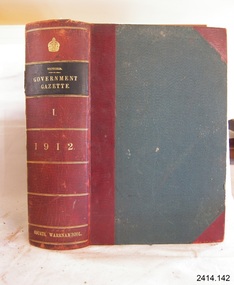
Book - Reference/State Government Notification Gazette, Albert John Mullett, The Victorian Government Gazette 1912 Vol 1 /146, 1912
... government actions taken in colonial Victoria. Courts and historians still rely on them to establish exact dates of proclamations, appointments, and land dealings, up to and continuing after Australian Federation in 1901. So gazettes from this period can carry notices tied to the constitutional conventions, referendum arrangements, and colonial administration just before Victoria became a state of the Commonwealth. ...The Victoria Government Gazette and other government documents from 1887 were printed and published by Robert S. Brain, Government Printer, Melbourne. Brain held the position of Victorian Government Printer through the 1890s and into the early 1900s. The same imprint appears on other official Victorian publications from that era, such as the annual reports of the Board for the Protection of the Aborigines and the colony's Statistical Register. There wasn't really an editor in the modern sense the Gazette was compiled and issued under the authority of the colonial government, via the Chief Secretary's Department, with Brain's printing office producing and publishing it. In May 1906, James Kemp succeeded him, serving as Government Printer from May 1906 to August 1912, with the title of Acting Government Printer right at the very start of his tenure he was stepping into the role Brain had just vacated, and by later in December 1906 he was signing gazettes in that capacity, apparently before his appointment was made permanent. Then in 1912 Albert John Mullett took over the role starting from January 1912 the same way Kemp had as Acting Government Printer with his appointment made permanent in 1913 where he served all through the 1920s.Hard cover book. The Victorian Government Gazette 1912 Vol 1 /146 Printer: Albert John Mullett Publisher: Albert John Mullett Publisher: Authority of The Colonial Government Date: 1912 Further Information: Textured hard cover bound book leather burgundy colour spine with gilt lettering, covers embossed blue cloth & reinforced corners to front and back cover. non-fictionThe Victoria Government Gazette and other government documents from 1887 were printed and published by Robert S. Brain, Government Printer, Melbourne. Brain held the position of Victorian Government Printer through the 1890s and into the early 1900s. The same imprint appears on other official Victorian publications from that era, such as the annual reports of the Board for the Protection of the Aborigines and the colony's Statistical Register. There wasn't really an editor in the modern sense the Gazette was compiled and issued under the authority of the colonial government, via the Chief Secretary's Department, with Brain's printing office producing and publishing it. In May 1906, James Kemp succeeded him, serving as Government Printer from May 1906 to August 1912, with the title of Acting Government Printer right at the very start of his tenure he was stepping into the role Brain had just vacated, and by later in December 1906 he was signing gazettes in that capacity, apparently before his appointment was made permanent. Then in 1912 Albert John Mullett took over the role starting from January 1912 the same way Kemp had as Acting Government Printer with his appointment made permanent in 1913 where he served all through the 1920s. flagstaff hill, warrnambool, shipwrecked-coast, flagstaff-hill, flagstaff-hill-maritime-museum, maritime-museum, shipwreck-coast, flagstaff-hill-maritime-village, book, the victoria government gazette 1912 1 vol 146, the victoria government gazette 1912, the victoria government gazette -
 Federation University Historical Collection
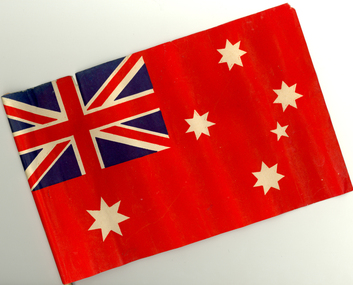
Flag - Australian Flag, Red Australian Flag
... Australia. This flag was probably used for a patriotic purpose in Ballarat, such as the end of World War One. The Red Ensign was the only flag private citizens could fly on land. By traditional British understanding, the Blue Ensign was reserved for Commonwealth Government...Australia. This flag was probably used for a patriotic purpose in Ballarat, such as the end of World War One. The Red Ensign was the only flag private citizens could fly on land. By traditional British understanding, the Blue Ensign was reserved for Commonwealth Government ...The Australian Red Ensign is a variant flag of Australia. This flag was probably used for a patriotic purpose in Ballarat, such as the end of World War One. The Red Ensign was the only flag private citizens could fly on land. By traditional British understanding, the Blue Ensign was reserved for Commonwealth Government use, with State and local governments, private organisations and individuals all using the Red Ensign.(http://en.wikipedia.org/wiki/Flag_of_Australia) There was some confusion over appropriate use of the ensigns until the Flags Act 1953 set the Blue Ensign as the national flag, and the Red Ensign as the flag of the Australian mercantile marine. Red ensigns continued to be used in Anzac Day marches into the 1960s.(http://en.wikipedia.org/wiki/Flag_of_Australia) Small red paper Australian flag attached to a stick. The Red Ensign features the Commonwealth Star at the hoist, and the Southern Cross in the other half.ballarat, flag, australian ensign, world war, australian flag, red ensign -
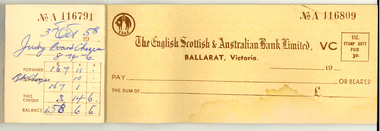 Federation University Historical Collection
Booklet - English Scottish and Australian Bank Cheque Book, 1950s, English, Scottish & Australian Bank Ltd Cheque Book, 1950s, c1950
... Australian Bank following the financial upheaval. The bank was one of 16 banks which supplied blank note forms to the Australian Government in 1911 which were superscribed as redeemable in gold and issued as the first Commonwealth notes. ...Australian Bank following the financial upheaval. The bank was one of 16 banks which supplied blank note forms to the Australian Government in 1911 which were superscribed as redeemable in gold and issued as the first Commonwealth notes. ...This cheque book was found in a shop on the corner of Sturt and Camp Streets, Ballarat by a builder around 2004. The English, Scottish & Australian Bank Limited was founded in 1852 by Royal Charter in London as the English, Scottish and Australian Chartered Bank. The bank opened its first Australian branch in Sydney in 1853. Australian banknotes were printed by the bank and issued at branches in Sydney, Adelaide, Hobart and Melbourne. In 1893, the bank was renamed the English, Scottish & Australian Bank following the financial upheaval. The bank was one of 16 banks which supplied blank note forms to the Australian Government in 1911 which were superscribed as redeemable in gold and issued as the first Commonwealth notes. The bank took over the Commercial Bank of Tasmania Limited and the London Bank of Australia Limited in 1921 and the Royal Bank of Australia Limited in 1927. On 1 October 1970, the bank merged with the Australia and New Zealand Bank to form the Australia and New Zealand Banking Group Limited. (http://en.wikipedia.org/wiki/English,_Scottish_and_Australian_Bank, accessed 27/03/2014)A half used cheque book from the English, Scottish & Australian Bank Ltd. The used cheques date from 1858 to 1860. Cheques are made out to the Old Colonists Club and Hotel Warrnambool. Notes on the inside cover are precautions against fraud.bank, banking, english scottish and australian bank, anz bank, cheque book -
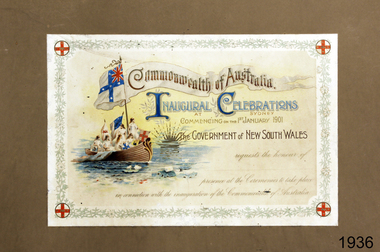 Flagstaff Hill Maritime Museum and Village
Document - Invitation, Government of New South Wales, Commonwealth of Australia Inaugural Celebrations, Bef. 01-01-1901
... Commonwealth of Australia...Inaugural Celebrations...Sydney...1st January 1901...01-01-1901...Federation of Australia...Australian States...Government...This is an Invitation to attend the Inaugural Celebrations of the Commonwealth of Australia, to celebrate the Federation of Australia's united Colonies. It was created on behalf of the Government of New South Wales. ...Commonwealth of Australia. / INAUGURAL CELEBRATIONS / AT SYDNEY / COMMENCING on the 1st JANUARY 1901" "The GOVERNMENT of NEW SOUTH WALES / requests the honour of / (blank line) / presence at the Celebrations to take place / in connection with the inauguration of the Commonwealth of Australia" Symbols: - [white flag, blue cross, Union Jack] (Australian Federation Flag) [blue Maltese cross with crown in centre] (Queensland symbol) [red St George cross with a lion in the centre] (New South Wales symbol) [white with a symbol on one side (crown?) ...Australian States Government of New South Wales symbols flags Australian Colony certificate G.U. Petturd picture framer and plush worker picture framer plush worker 1901 STAMP: "G.U. PETTERD, WARRNAMBOOL / PICTURE FRAMER & PLUSH / WORKER" TEST: - "Commonwealth ...This is an Invitation to attend the Inaugural Celebrations of the Commonwealth of Australia, to celebrate the Federation of Australia's united Colonies. It was created on behalf of the Government of New South Wales. January 1st, 1901, is the official date of Australia's Federation. There is no recipient's name on the invitation. The illustrations on the invitation represent the Federation of Australian States, with their historic symbols carried on the sailing ship, representing the colonisation of Australia. The 'rising sun' possibly represents the rising of the young Australia. The Sough Australian symbol appears to be the historic seal of South Australia, depicting Britania meeting an Australian Aboriginal seated on the beach. The symbol was replaced in 1904. The Victorian symbol of a crown above the Southern Cross appears on the flag at the back of the ship, with a crown and the Southern Cross beside each other. The invitation was originally framed by G.U. Petterd, a picture framer and plush worker in Warrnambool, Victoria.The invitation holds great significance, representing a point in Australia's history when the British Colony became an independent nation, with the states uniting under a Federal government. The symbols on the invitation represent those used by each state at the time, many of which have evolved and changed since that time. The decorative and careful creation of the certificate represents the importance placed on the celebrations.Invitation; rectangular page printed in colour with text and illustrations, and attached to cardboard. The document has a floral border with a symbol in each corner. The illustration includes a wooden sailing ship with six figures with long fair hair wearing white robes, and holding six flags or symbols. The mast holds a swallow-tailed banner showing a flag and text. The invitation is from the Government of New South Wales, for the recipient to attend the inaugural celebrations in Sydney on 1st January 1901, for the official date of the Federation of Australia. There is a purple oval stamp on the revers with inscriptions. The picture was originally framed by G.U. Petterd, WarrnamboolSTAMP: "G.U. PETTERD, WARRNAMBOOL / PICTURE FRAMER & PLUSH / WORKER" TEST: - "Commonwealth of Australia. / INAUGURAL CELEBRATIONS / AT SYDNEY / COMMENCING on the 1st JANUARY 1901" "The GOVERNMENT of NEW SOUTH WALES / requests the honour of / (blank line) / presence at the Celebrations to take place / in connection with the inauguration of the Commonwealth of Australia" Symbols: - [white flag, blue cross, Union Jack] (Australian Federation Flag) [blue Maltese cross with crown in centre] (Queensland symbol) [red St George cross with a lion in the centre] (New South Wales symbol) [white with a symbol on one side (crown?) with a blue flag with Southern Cross on the other] (Victoria's symbols of Crown above Southern Cross) [red lion on white] (Tasmanian symbol) [black swan on yellow] (Western Australia badge) [two figures, one standing and one seated] (South Australian seal) and image of (rising sun on the horizon)flagstaff hill, flagstaff hill maritime museum and village, warrnambool, maritime museum, maritime village, great ocean road, shipwreck coast, invitation, commonwealth of australia, inaugural celebrations, sydney, 1st january 1901, 01-01-1901, federation of australia, australian states, government of new south wales, symbols, flags, australian colony, certificate, g.u. petturd, picture framer and plush worker, picture framer, plush worker, 1901 -
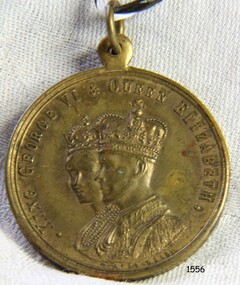 Flagstaff Hill Maritime Museum and Village
Medal - Commemorative Medal, Stokes & Sons, 1937
... The medal is significant for connecting Victoria, and Australia, to the British Commonwealth and the sovereignty of the British throne, in Australia's post-Federation years. It shows the importance placed by the Government of Australia in educating the generation of students in 1937 about Australia's place in the Commonwealth and the history of Australia. ...This medal commemorates the coronation of King George VI and Elizabeth as monarchs on the British throne, to be held on May 12th, 1937. The medal is one of over 300,000 distributed to school children as a memento of the occasion. The obverse shows the busts of King George VI and Elizabeth facing left. The reverse shows Victoria's Coat of Arms, the official heraldic symbol, with the Southern Cross on a shield, above it is a kangaroo facing left and holding a crown. The supporting figure on the left holds an olive branch of 'peace' and the supporter on the right holds a cornucopia horn of 'plenty', together representing the text on the ribbon between them 'Peace & Planty' symbol of 'prosperity'. On May 7th, 1937 each school child in Victoria, Australia, received a medal commemorating the upcoming coronation of King George VI and Elizabeth, to be held on May 12th, 1937. medals totalling 318,200 were distributed to scholars in 2,781 Victorian schools. Each school received a letter from the Governor, Lord Humingfield, detailing the significance of the occasion. Lessons on the day focused on the meaning behind the medal, and children recited their Allegiance to the King, saluted the flag bearing the Union Jack and Southern Cross, and sang Australila's then National Anthem "God Save the King", which today is sung as the Royal Anthem. The medal is significant for connecting Victoria, and Australia, to the British Commonwealth and the sovereignty of the British throne, in Australia's post-Federation years. It shows the importance placed by the Government of Australia in educating the generation of students in 1937 about Australia's place in the Commonwealth and the history of Australia. The history of the medal is socially and politically significant, reflecting the evolution of changes in Australian society.Medal or medallion, bgilt rass, with claw and ring on top. The obverse has the bust of a female and male, co-joined, and the reverse has the Coat of arms of the State of Victoria, which includes a kangaroo above a shield and a supporting figure on either side of the shield. Inscriptions are on both sides of the medal. The medal commemorates the coronation of their Majesties, King George VI and Queen Elizabeth, on May 12th 1937.Obverse, around the circle: "KING GEORGE VI & QUEEN ELIZABETH" Reverse, around the circle: "TO COMMEMORATE THEIR MAJESTIES' CORONATION / MAY 12TH 1937" Reverse, within the Coat of Arms: "VICTORIA" "PEACE & PROSPERITY" flagstaff hill, flagstaff hill maritime museum and village, warrnambool, maritime museum, maritime village, great ocean road, shipwreck coast, medallion, medal, commemorative, king george vi and elizabeth, 1937, 12-05-1937, students in victoria, schools in victoria, 7-5-1937, victoria's coat of arms, peace & prosperity, british monarch, british throne, british commonwealth, numesmatics, coil, student, victorian student -
 Mission to Seafarers Victoria
Journal (item) - Periodicals-Annual, Shiplovers' Society of Victoria, The Annual Dog Watch
... Australia Amongst Emigrants - S. Duncan - 43 The Persian Gulf or "Hells Kitchen" - K. Bull - 49 Monkey Business - Captn. James Gaby - 51 Anchor Hardy - Capt. R. G. Edwards - 52 Light Houses - C. E. Bonwick - 58 The Forlorn Hope - N. S. Smith - 59 Robert Louis Stevenson in The South Seas - Captn. Fred Klebingat - 68 Eastward-Ho! - Charles E. Howlett, B.A, LL.B. - 73 Commonwealth Government...Australia Amongst Emigrants - S. Duncan - 43 The Persian Gulf or "Hells Kitchen" - K. Bull - 49 Monkey Business - Captn. James Gaby - 51 Anchor Hardy - Capt. R. G. Edwards - 52 Light Houses - C. E. Bonwick - 58 The Forlorn Hope - N. S. Smith - 59 Robert Louis Stevenson in The South Seas - Captn. Fred Klebingat - 68 Eastward-Ho! - Charles E. Howlett, B.A, LL.B. - 73 Commonwealth Government ...This journal provides the reader with glimpses of the adventures and hardships of a seaman's life. Many of the stories are of sailing ships.Contributes to our knowledge of the importance of shipping and places on record those stories of the sea which would otherwise be lost.Contents Foreword - Commander R. S. .Veale, C.M.G. V.R.D. - 5 Editorial - - 7 Light Houses - N. S. Smith - 11 On Passing for Second Mate - R. Thiele - 18 Passenger Steamers on the Tasman Sea - I. Mackay - 22 Dune Ship - Dr. Philip Martin - 37 The Rum Runners - S. A. E. Strom - 38 To Australia Amongst Emigrants - S. Duncan - 43 The Persian Gulf or "Hells Kitchen" - K. Bull - 49 Monkey Business - Captn. James Gaby - 51 Anchor Hardy - Capt. R. G. Edwards - 52 Light Houses - C. E. Bonwick - 58 The Forlorn Hope - N. S. Smith - 59 Robert Louis Stevenson in The South Seas - Captn. Fred Klebingat - 68 Eastward-Ho! - Charles E. Howlett, B.A, LL.B. - 73 Commonwealth Government Rewards for School Boys - I. Wilson, M.P., Minister for Home Affairs - 78 Protection of Historic Wrecks off Queensland Coast - I. Wilson, M.P. - 79 The s.s. New Texas --Elder Dempster Line - Captn. L. Gibson - 83 Carmichael's Golden Fleece Line - L. Holmes - 89 Passing the Buck - - 95 Ice Barrier - D. M. Fyfe - 96 A Dream Come True - W. P. Shemmeld - 97 Homeward Bound - R. W. Rudd - 105 More of the Wreck of The City of York - A. T. Wreford and E. M. Christie - 110 A Fortunate Rescue - Captn. J. Gaby - 112 More About Sail - Capt. W. J. Cowling - 113 Book Reviews - 120sailing ships, steamships, shipping, seafaring life, shiplovers' society of victoria, dog watch
