
Showing 19 items matching "australian conservation foundation"
-
 Save the Dandenongs League Inc.
Archive (item), Save the Dandenongs League Incorporated, Establishing Field Studies Centres in Australia - Australian Conservation Foundation - Special Publication No. 4
... Establishing Field Studies Centres in Australia - Australian Conservation Foundation - Special Publication No. 4...Establishing Field Studies Centres in Australia - Australian Conservation Foundation - Special Publication No. 4 Archive Save the Dandenongs League Incorporated ... -
Save the Dandenongs League Inc.
Archive (sub-series), Save the Dandenongs League Incorporated, Habitat Australia - Australian Conservation Foundation
... Habitat Australia - Australian Conservation Foundation...Habitat Australia - Australian Conservation Foundation Archive Save the Dandenongs League Incorporated ... -
Whitehorse Historical Society Inc.
Document, Mullum Mullum Valley
... Produced by the Australian Conservation Foundation of the Mullum Mullum Valley....A laminated poster depicting an original water colour by Christine Bever, June 1999, produced by the Australian Conservation Foundation of the Mullum Mullum Valley....Produced by the Australian Conservation Foundation of the Mullum Mullum Valley. ...A laminated poster depicting an original water colour by Christine Bever, June 1999.A laminated poster depicting an original water colour by Christine Bever, June 1999, produced by the Australian Conservation Foundation of the Mullum Mullum Valley.A laminated poster depicting an original water colour by Christine Bever, June 1999. mullum mullum valley, conservation -
Lakes Entrance Historical Society
Book, Nankin Henry, Victorias Alps and Australian Endangered Heritage, 1983
... A description of the terrain flora fauna management and recommended management of Victorias Alpine region, produced by the Australian Conservation Foundation. Indexed...Topography Natural History Vegetation A description of the terrain flora fauna management and recommended management of Victorias Alpine region, produced by the Australian Conservation Foundation. Indexed Victorias Alps and Australian Endangered Heritage Book Nankin Henry ...A description of the terrain flora fauna management and recommended management of Victorias Alpine region, produced by the Australian Conservation Foundation. Indexedtopography, natural history, vegetation -
Federation University Historical Collection
Book, Geoff Mosley, Saving the Antarctic Wilderness, 2009
... ...Australian Conservation Foundation...Antarctica Geoff Mosley Janet Copland Antarctic treaty madrid protocol World Heritage Australian Conservation Foundation "For Clare Enjoy Janet Copland" Soft covered book. ...Janet Copland, the granddaughter of Ballarat School of Mines Principal Maurice Copland, is acknowledged in the book.Soft covered book."For Clare Enjoy Janet Copland"antarctica, geoff mosley, janet copland, antarctic treaty, madrid protocol, world heritage, australian conservation foundation -
Save the Dandenongs League Inc.
Document (item), Save the Dandenongs League Incorporated, Save the Dandenongs League Correspondence 1984-1985 [Part 8 of 14]: Conserv Groups ACF, FOSF Etc
... Australian Conservation Foundation...Australian Conservation Foundation Friends of Sherbrooke Forest Save the Dandenongs League Correspondence 1984-1985 [Part 8 of 14]: Conserv Groups ACF, FOSF Etc. ...australian conservation foundation, friends of sherbrooke forest -
 Bendigo Historical Society Inc.
Document - Digital, BENDIGO JAIL DEVELOPMENT
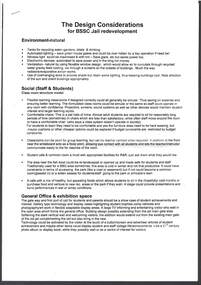
... Photocopy undated article from Australian Conservation Foundation re Bendigo Jail, together with undated Design Considerations for development of BSSC jail redevelopment. 1. ...BENDIGO Institutions bendigo jail Photocopy undated article from Australian Conservation Foundation re Bendigo Jail, together with undated Design Considerations for development of BSSC jail redevelopment. 1. ...Photocopy undated article from Australian Conservation Foundation re Bendigo Jail, together with undated Design Considerations for development of BSSC jail redevelopment. 1. Article by Brian Morley outlines history of the jail, Ronald Ryan's execution in 1967, and petitions against capital punishment. 2. Three page stapled A4 sheets, undated unknown authority document titled 'The Design Considerations for BSSC Jail redevelopment'. Outlines environment, class room structure models, general office & exhibition space, lecture theatre, overall buildings, design consistency, and learning area requirements.bendigo, institutions, bendigo jail -
 Greensborough Historical Society
Newsletter, Greenhills and North Greensborough Progress Association, Community News: official journal of the Greenhills and Nth. Greensborough Progress Association. 30th November 1973. Edition No. 10/73, 30/11/1973
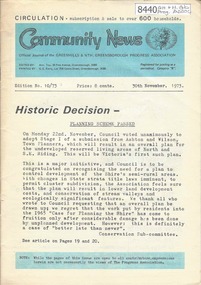
... This edition includes a report on the Progress Association's November 1973 meeting, Councillor's report, Historic decision: Planning Scheme passed, Continuation of the late Frank Andrew article, School and Kinder news, Diamond Valley repertory, Letter to Editor, From the Council Chamber, "Requiem for a small Valley" [Valley of the Eagles], A.C.F. [Australian Conservation Foundation] and its role. A digital copy of this Newsletter is available from Greensborough Historical Society....This edition includes a report on the Progress Association's November 1973 meeting, Councillor's report, Historic decision: Planning Scheme passed, Continuation of the late Frank Andrew article, School and Kinder news, Diamond Valley repertory, Letter to Editor, From the Council Chamber, "Requiem for a small Valley" [Valley of the Eagles], A.C.F. [Australian Conservation Foundation] and its role. A digital copy of this Newsletter is available from Greensborough Historical Society. ...This edition includes a report on the Progress Association's November 1973 meeting, Councillor's report, Historic decision: Planning Scheme passed, Continuation of the late Frank Andrew article, School and Kinder news, Diamond Valley repertory, Letter to Editor, From the Council Chamber, "Requiem for a small Valley" [Valley of the Eagles], A.C.F. [Australian Conservation Foundation] and its role. A digital copy of this Newsletter is available from Greensborough Historical Society.Newsletter, 24 p., illus.greenhills and north greensborough progress association, greenhills -
Surrey Hills Historical Society Collection
Work on paper - Vertical File, Kooyong 2
... ‘Vote for climate leadership’ How to vote in Kooyong (A4 2 copies 2 sided pamphlet); ‘Vote 1 for the animals’: Animal Justice Party (1 copy 2 sided pamphlet); Australian Conservation Foundation advertisement in Progress Leader 14.5.2019 with AEC advertisement on reverse (1 copy, 1 page); ‘Kooyong all about climate change’, Progress Leader 14.5.2019 (1 copy, 1 page); GetUp! ...‘Vote for climate leadership’ How to vote in Kooyong (A4 2 copies 2 sided pamphlet); ‘Vote 1 for the animals’: Animal Justice Party (1 copy 2 sided pamphlet); Australian Conservation Foundation advertisement in Progress Leader 14.5.2019 with AEC advertisement on reverse (1 copy, 1 page); ‘Kooyong all about climate change’, Progress Leader 14.5.2019 (1 copy, 1 page); GetUp! ...KOOYONG No 2 (2019-2021) 5. AEC Your official guide to the 2019 federal election (A 4 4 sided pamphlet). 6. 2019 ‘Local values matter!’ Jana Stewart, Labor for Kooyong (3 copies 2 sided pamphlet); How to vote for Jana Stewart (A 4 2 copies 2 sided pamphlet); How to vote for Jennifer Yang in Chisholm (A 4 1 copy 2 sided pamphlet); How to vote for Shireen Morris in Deakin (A 4 1 copy 2 sided pamphlet); ‘A new voice for Kooyong’ Labor Jana Stewart (2 copies 2 sided pamphlet); 2 different Jana Stewart pamphlets (1 copy each). 7. 2019 Julian Burnside Greens brochures (3 copies 4 sides A 4); How to vote pamphlets (2 copies 2 sides); Julian Burnside (2 copies of pamphlet); Julian Burnside (1 copy); Vote 1 Julian Burnside (2 copies 6 sided pamphlet). 8. 2019 GetUp! ‘Vote for climate leadership’ How to vote in Kooyong (A4 2 copies 2 sided pamphlet); ‘Vote 1 for the animals’: Animal Justice Party (1 copy 2 sided pamphlet); Australian Conservation Foundation advertisement in Progress Leader 14.5.2019 with AEC advertisement on reverse (1 copy, 1 page); ‘Kooyong all about climate change’, Progress Leader 14.5.2019 (1 copy, 1 page); GetUp! Advertisement in Progress Leader, 14.5.2019 (1 copy 1 page); How to vote ideas from Australian Education Union Victorian Branch (1 copy 1 page); Kooyong Climate Change Alliance 2 different pamphlets (1 copy each); Dr Angelina Zubac pamphlet (1 copy 2 sides); GetUp! ‘Coalition ? Coal. Chaos. Catastrophe.’ (1 copy 2 sided pamphlet); Vote 1 Bill Chandler Kooyong (1 copy 2 sided pamphlet); How to vote card Bill Chandler (1 copies 2 sided pamphlet); ‘Vote to change the government’, Victorian Trades Hall Council (2 copies 2 sided pamphlet). 9. 2019 Oliver Yates Independent for Kooyong (A 4 2 copies 4 sided pamphlet); ‘Vote 1 Yates Think Independent’ (A 4 4 copies 2 sided pamphlet); Oliver Yates letter to ‘Fellow Kooyong Residents’ (A 4 3 copies, 2 sided); ‘How the Preference Voting System Works in the House of Representatives’ (A4 2 copies 2 sided letter from oliveryates.com); ‘The facts about Oliver Yates’ (2 copies 2 sided pamphlet); ‘Oliver Yates Representing your voice’ (1 copy 2 sided pamphlet); ‘Oliver Yates think independent’ (1 copy 2 sided pamphlet). 10. 2019 : 8 A4 different letters to constituents from Josh Frydenberg, only 2 dated: March and May 2019, all printed on side, one has a tear off ‘how to vote’ section; A4 ‘How to vote’ and ‘Delivering our plan’ Josh Frydenberg (2 copies 2 sided pamphlet); ‘The Morrison Government Building our economy. Securing your future.’ Undated. (4 sided pamphlet); Josh Frydenberg advertisement from Progress Leader, 14.5.2019 (1 page); ‘Delivering for Kooyong’ Josh Frydenberg MP, Progress Leader 16.4.2019 (2 copies 6 page brochure); ‘This election will be very close’, undated Liberal flyer (2 copies); ‘Josh Frydenberg our plan for Kooyong’ undated (2 copies, 8 sided pamphlet); Josh Frydenberg flyer ‘We will ease congestion across Kooyong’ (1 copy double sided); Postal vote application form sent by Josh Frydenberg (2 copies 1 A4 page double sided); ‘Vote green or independent and you’ll get the bill’, Liberal party flyer undated (2 copies double sided); ‘Vote for the greens or independents and you’ll get Labor’s higher taxes’, Liberal Party flyer undated (2 copies double sided); ‘Labor can’t manage money’, Liberal Party flyer undated (2 copies double sided); 11. Josh Frydenberg MP Kooyong Community News Summer 2019-20 (2 copies 4 sided brochure) AND ’30 second survey’ (1 copy A4 double sided flyer). 12. ‘Economic recovery plan for Australia’ Josh Frydenberg MP, Kooyong Community News Budget 2020 edition (2 copies 6 sided A4 brochure). 13. ‘Federal economic support for Victoria through COVID-19’, Josh Frydenberg flyer undated assume 2020 or 2021 (2 copies double sided). 14. Josh Frydenberg Budget 2021 newsletter (2 copies, 6 sided brochure). 15. ‘Extra support for Victoria’ Josh Frydenberg flyer, 21.8.2021 (1 copy double sided). 16. Josh Frydenberg MP 2021 calendar (1 copy). 17. ‘Setting the standard in Kooyong’, The Age, 21.3.2019 (1 page). kooyong electorate -
 Sunshine and District Historical Society Incorporated
Administrative record - City of Sunshine - Commissioner Mr Alexander Alex George Gillon Collection 1976 - 1982 - Minutes of the ordinary meeting of council held on 13th July 1977, City of Sunshine, 13th July 1977
... John's College 204 Churchill Avenue Braybrook Land Use Permit Application Light Industrial (Bakery) Addition to Existing Shop 133 South Road Braybrook Land Use Permit Application St Bernadette's Primary School & Church Presbytery Addition to Existing Church and School Land Bounded by Suffolk Road, Westmoreland Road, Rufford Street & Willey Street Land Use Permit Application Sale and Distribution of Floor Coverings, Builders Hardware, Electrical Domestic Appliances and Furniture Land Bounded by Halstead Street and Ashley Street Land Use Permit Application Store & Building Materials and Crane Hampton Avenue The Melbourne Bikeway Plan Strata Subdivision 50 Middle Road Strata Subdivision 17 Mayne Street Strata Subdivision 1 Grandview Avenue Strata Subdivision 52A Forrest Street Strata Subdivision 10 Dunlop Street Westerngate North Estate Subdivision Amendment to Sealed Plan Stage 6A Nickson's Estate The Lower Yarra Crossing The Case Against The Toll Western Region Commission Meeting with City of Williamstown Relating to Disposal of Garbage Sunshine Tip Membership of Australian Conservation Foundation Certificate of Completion Glengala Stage 111 Private Street Scheme Inquiry into Goods Movements and Access to Services in the Metropolitan Area of Victoria Quotations Received for Fencing / Fencing Materials Garfield Street Watermain State Emergency Service Provisionof Footpath Dickson Street Flooding Boundary Road / Fairbairn Road Access Road Corio Street to Business Premises Request for Closure of Part of Northumberland Road Between Wiltshire Street and Suffolk Road by Sunshine North Technical School Engineering Vacation Employment University of Melbourne and R.M.I.T. ...John's College 204 Churchill Avenue Braybrook Land Use Permit Application Light Industrial (Bakery) Addition to Existing Shop 133 South Road Braybrook Land Use Permit Application St Bernadette's Primary School & Church Presbytery Addition to Existing Church and School Land Bounded by Suffolk Road, Westmoreland Road, Rufford Street & Willey Street Land Use Permit Application Sale and Distribution of Floor Coverings, Builders Hardware, Electrical Domestic Appliances and Furniture Land Bounded by Halstead Street and Ashley Street Land Use Permit Application Store & Building Materials and Crane Hampton Avenue The Melbourne Bikeway Plan Strata Subdivision 50 Middle Road Strata Subdivision 17 Mayne Street Strata Subdivision 1 Grandview Avenue Strata Subdivision 52A Forrest Street Strata Subdivision 10 Dunlop Street Westerngate North Estate Subdivision Amendment to Sealed Plan Stage 6A Nickson's Estate The Lower Yarra Crossing The Case Against The Toll Western Region Commission Meeting with City of Williamstown Relating to Disposal of Garbage Sunshine Tip Membership of Australian Conservation Foundation Certificate of Completion Glengala Stage 111 Private Street Scheme Inquiry into Goods Movements and Access to Services in the Metropolitan Area of Victoria Quotations Received for Fencing / Fencing Materials Garfield Street Watermain State Emergency Service Provisionof Footpath Dickson Street Flooding Boundary Road / Fairbairn Road Access Road Corio Street to Business Premises Request for Closure of Part of Northumberland Road Between Wiltshire Street and Suffolk Road by Sunshine North Technical School Engineering Vacation Employment University of Melbourne and R.M.I.T. ...Minutes of the Ordinary Meeting of Council held on 13th July 1977 Report of the Town Clerk's Department Report of the Town Clerk Financial Statements The Hub Operating Statement, Municipal Tip Operating Statement & Statement of Receipts & Expenditure Rates, Sanitary and Interest Abandonments for 1976/1977 Assistance to Unemployed Young People Protean Holdings Ltd Appeal Against Issue of Permit Land Transfer from the Council to Boral Resources (Vic) Pty Ltd Bon Thomas Reserve Proposed Development Legal Action to Recover Outstanding Account From The council for Soil from the Works at the new Monsanto Factory to More Park Sunshine Baseball Club Request for Extension to Lease Pavilion Dempster Park Use Dempster Park For Tennis Surrender of lease 23C Northumberland Road Swimming Pools Sunshine & Deer Park Payment of Wages by Cheque Course in Financial Management Diamond Reserve Shared Use of Education Department and Council Facilities Steers Street Group Part Private Street Scheme Involving Underground Drainage Only Financial Statement Year Ended 30th September 1976 and Auditor's Report Report of the Co-Ordinator of Welfare Services Welfare Officer Subsides Report of the Chief Health Inspector Report of Weights and Measures Inspector National Conference Health Surveyors Perth October 1977 Ardeer Infant Welfare Centre Dumping of Rubbish Burke Street, Duke Street, Evans Street & Maribyrnong River Riverbank Braybrook Report of the By-Laws Officer By-Laws Officers Course Report of the City Librarian Application for Library Council of Victoria (Public Libraries Division) Special Projects Grant 1977-78 Australian Library Week 16th to 24th September 1977 Report of the City Engineer Land Use Permit Application Flats Chifley Drive Land Use Permit Application Conversion of Existing Petrol Filling Station to Self Service North East Corner of Ballarat Road and Station Road Land Use Permit Application Single Service Premises South West Corner Tinto Close and Allandale Drive Deer Park Land Use Permit Application Consulting Rooms Dental Surgery Lot 173 Fairbairn Road Land Use Permit Application Extension to Existing Place of Worship Sunshine Congregation of Jehovah's Witnesses Corner Wilkinson Street and Islington Street Melbourne Metropolitan Planning Scheme Amendments Land Use Permit Application Display Home and Information Store Lots 69 & 70 Tamar Drive Land Use Permit Application Extension to Existing Factory Lots 56 & 57 Marshall Street Land Use Permit Application Factory Lot 208 Cromer Avenue Land Use Permit Application Addition to School St. John's College 204 Churchill Avenue Braybrook Land Use Permit Application Light Industrial (Bakery) Addition to Existing Shop 133 South Road Braybrook Land Use Permit Application St Bernadette's Primary School & Church Presbytery Addition to Existing Church and School Land Bounded by Suffolk Road, Westmoreland Road, Rufford Street & Willey Street Land Use Permit Application Sale and Distribution of Floor Coverings, Builders Hardware, Electrical Domestic Appliances and Furniture Land Bounded by Halstead Street and Ashley Street Land Use Permit Application Store & Building Materials and Crane Hampton Avenue The Melbourne Bikeway Plan Strata Subdivision 50 Middle Road Strata Subdivision 17 Mayne Street Strata Subdivision 1 Grandview Avenue Strata Subdivision 52A Forrest Street Strata Subdivision 10 Dunlop Street Westerngate North Estate Subdivision Amendment to Sealed Plan Stage 6A Nickson's Estate The Lower Yarra Crossing The Case Against The Toll Western Region Commission Meeting with City of Williamstown Relating to Disposal of Garbage Sunshine Tip Membership of Australian Conservation Foundation Certificate of Completion Glengala Stage 111 Private Street Scheme Inquiry into Goods Movements and Access to Services in the Metropolitan Area of Victoria Quotations Received for Fencing / Fencing Materials Garfield Street Watermain State Emergency Service Provisionof Footpath Dickson Street Flooding Boundary Road / Fairbairn Road Access Road Corio Street to Business Premises Request for Closure of Part of Northumberland Road Between Wiltshire Street and Suffolk Road by Sunshine North Technical School Engineering Vacation Employment University of Melbourne and R.M.I.T. Report of the Building Surveyor Building Office Public Relations Application Outbuilding 29 Verdun Street Maidstone Installation of Underground Tank B.P. Service Station Corner Ballarat Road and Stonemark Street Building Permit Lot 7 Clyde Street Maribyrnong The Hub Repairs Quotation Albion North Pre-School Centre House of Sunshine Repairs Quotation Deer Park Hall Repairs Quotation Ainsworth Reserve Child Care Centre / Pavilion Orders of the Day Proposal to Close A Road Between Marsh Street and Emu Road Maidstone Proposal to Construct The Steers Street Group Part Private Street Scheme Confirmation of Making A By-law In Connection with By-Law No 123 Garbage Receptacles city of sunshine, alexander "alex" george gillon, protean holdings pty ltd, bon thomas reserve, quinn street, deer park, deer park swimming pool, station road, sunshine swimming pool, sunshine baseball club, boral resources, dempster park, phoenix street, sunshine north, sunshine, sunshine north tennis club, diamond avenue, albansvale, steers street, kennedy street, the hub, sun crescent, sunshine tip, monsanto, more park, talmage street, albion, north sunshine tennis club, northumberland road, ardeer infant welfare centre, burke street, duke street, evans street, maribyrnong river, chifley drive, maribyrnong, ballarat road, tinto clos, allandale driv, fairbairn road, wilkinson street, islington street, tamar drive, marshall street, cromer avenue, st. john's college, sunshine congregation of jehovah's witnesse, churchill avenue, braybrook, south road, st bernadette's primary school, suffolk road, westmoreland road, rufford street, willey street, halstead street, ashley street, hampton avenue, middle road, mayne street, grandview avenue, forrest street, dunlop street, garfield street, st. albans, dickson street, boundary road, corio street, wiltshire street, verdun street, maidstone, clyde street, albion north pre-school centre, deer park hal, vernon street, sunshine west, marsh street, emu road, ainsworth reserve child care centre, stonemark street -
 Sunshine and District Historical Society Incorporated
Administrative record - City of Sunshine - Commissioner Mr Alexander Alex George Gillon Collection 1976 - 1982 - Notice of council ordinary meeting 13th July 1977, City of Sunshine, 6th July 1977
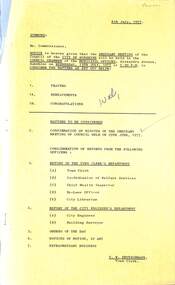
... John's College 204 Churchill Avenue Braybrook Land Use Permit Application Light Industrial (Bakery) Addition to Existing Shop 133 South Road Braybrook Land Use Permit Application St Bernadette's Primary School & Church Presbytery Addition to Existing Church and School Land Bounded by Suffolk Road, Westmoreland Road, Rufford Street & Willey Street Land Use Permit Application Sale and Distribution of Floor Coverings, Builders Hardware, Electrical Domestic Appliances and Furniture Land Bounded by Halstead Street and Ashley Street Land Use Permit Application Store & Building Materials and Crane Hampton Avenue The Melbourne Bikeway Plan Strata Subdivision 50 Middle Road Strata Subdivision 17 Mayne Street Strata Subdivision 1 Grandview Avenue Strata Subdivision 52A Forrest Street Strata Subdivision 10 Dunlop Street Westerngate North Estate Subdivision Amendment to Sealed Plan Stage 6A Nickson's Estate The Lower Yarra Crossing The Case Against The Toll Western Region Commission Meeting with City of Williamstown Relating to Disposal of Garbage Sunshine Tip Membership of Australian Conservation Foundation Certificate of Completion Glengala Stage 111 Private Street Scheme Inquiry into Goods Movements and Access to Services in the Metropolitan Area of Victoria Quotations Received for Fencing / Fencing Materials Garfield Street Watermain State Emergency Service Provisionof Footpath Dickson Street Flooding Boundary Road / Fairbairn Road Access Road Corio Street to Business Premises Request for Closure of Part of Northumberland Road Between Wiltshire Street and Suffolk Road by Sunshine North Technical School Engineering Vacation Employment University of Melbourne and R.M.I.T. ...John's College 204 Churchill Avenue Braybrook Land Use Permit Application Light Industrial (Bakery) Addition to Existing Shop 133 South Road Braybrook Land Use Permit Application St Bernadette's Primary School & Church Presbytery Addition to Existing Church and School Land Bounded by Suffolk Road, Westmoreland Road, Rufford Street & Willey Street Land Use Permit Application Sale and Distribution of Floor Coverings, Builders Hardware, Electrical Domestic Appliances and Furniture Land Bounded by Halstead Street and Ashley Street Land Use Permit Application Store & Building Materials and Crane Hampton Avenue The Melbourne Bikeway Plan Strata Subdivision 50 Middle Road Strata Subdivision 17 Mayne Street Strata Subdivision 1 Grandview Avenue Strata Subdivision 52A Forrest Street Strata Subdivision 10 Dunlop Street Westerngate North Estate Subdivision Amendment to Sealed Plan Stage 6A Nickson's Estate The Lower Yarra Crossing The Case Against The Toll Western Region Commission Meeting with City of Williamstown Relating to Disposal of Garbage Sunshine Tip Membership of Australian Conservation Foundation Certificate of Completion Glengala Stage 111 Private Street Scheme Inquiry into Goods Movements and Access to Services in the Metropolitan Area of Victoria Quotations Received for Fencing / Fencing Materials Garfield Street Watermain State Emergency Service Provisionof Footpath Dickson Street Flooding Boundary Road / Fairbairn Road Access Road Corio Street to Business Premises Request for Closure of Part of Northumberland Road Between Wiltshire Street and Suffolk Road by Sunshine North Technical School Engineering Vacation Employment University of Melbourne and R.M.I.T. ...Notice of Ordinary Council Meeting13th July 1977 Report of the Town Clerk's Department Report of the Town Clerk Financial Statements The Hub Operating Statement, Municipal Tip Operating Statement & Statement of Receipts & Expenditure Rates, Sanitary and Interest Abandonments for 1976/1977 Assistance to Unemployed Young People Protean Holdings Ltd Appeal Against Issue of Permit Land Transfer from the Council to Boral Resources (Vic) Pty Ltd Bon Thomas Reserve Proposed Development Legal Action to Recover Outstanding Account From The council for Soil from the Works at the new Monsanto Factory to More Park Sunshine Baseball Club Request for Extension to Lease Pavilion Dempster Park Use Dempster Park For Tennis Surrender of lease 23C Northumberland Road Swimming Pools Sunshine & Deer Park Payment of Wages by Cheque Course in Financial Management Diamond Reserve Shared Use of Education Department and Council Facilities Steers Street Group Part Private Street Scheme Involving Underground Drainage Only Financial Statement Year Ended 30th September 1976 and Auditor's Report Report of the Co-Ordinator of Welfare Services Welfare Officer Subsides Report of the Chief Health Inspector Report of Weights and Measures Inspector National Conference Health Surveyors Perth October 1977 Ardeer Infant Welfare Centre Dumping of Rubbish Burke Street, Duke Street, Evans Street & Maribyrnong River Riverbank Braybrook Report of the By-Laws Officer By-Laws Officers Course Report of the City Librarian Application for Library Council of Victoria (Public Libraries Division) Special Projects Grant 1977-78 Australian Library Week 16th to 24th September 1977 Report of the City Engineer Land Use Permit Application Flats Chifley Drive Land Use Permit Application Conversion of Existing Petrol Filling Station to Self Service North East Corner of Ballarat Road and Station Road Land Use Permit Application Single Service Premises South West Corner Tinto Close and Allandale Drive Deer Park Land Use Permit Application Consulting Rooms Dental Surgery Lot 173 Fairbairn Road Land Use Permit Application Extension to Existing Place of Worship Sunshine Congregation of Jehovah's Witnesses Corner Wilkinson Street and Islington Street Melbourne Metropolitan Planning Scheme Amendments Land Use Permit Application Display Home and Information Store Lots 69 & 70 Tamar Drive Land Use Permit Application Extension to Existing Factory Lots 56 & 57 Marshall Street Land Use Permit Application Factory Lot 208 Cromer Avenue Land Use Permit Application Addition to School St. John's College 204 Churchill Avenue Braybrook Land Use Permit Application Light Industrial (Bakery) Addition to Existing Shop 133 South Road Braybrook Land Use Permit Application St Bernadette's Primary School & Church Presbytery Addition to Existing Church and School Land Bounded by Suffolk Road, Westmoreland Road, Rufford Street & Willey Street Land Use Permit Application Sale and Distribution of Floor Coverings, Builders Hardware, Electrical Domestic Appliances and Furniture Land Bounded by Halstead Street and Ashley Street Land Use Permit Application Store & Building Materials and Crane Hampton Avenue The Melbourne Bikeway Plan Strata Subdivision 50 Middle Road Strata Subdivision 17 Mayne Street Strata Subdivision 1 Grandview Avenue Strata Subdivision 52A Forrest Street Strata Subdivision 10 Dunlop Street Westerngate North Estate Subdivision Amendment to Sealed Plan Stage 6A Nickson's Estate The Lower Yarra Crossing The Case Against The Toll Western Region Commission Meeting with City of Williamstown Relating to Disposal of Garbage Sunshine Tip Membership of Australian Conservation Foundation Certificate of Completion Glengala Stage 111 Private Street Scheme Inquiry into Goods Movements and Access to Services in the Metropolitan Area of Victoria Quotations Received for Fencing / Fencing Materials Garfield Street Watermain State Emergency Service Provisionof Footpath Dickson Street Flooding Boundary Road / Fairbairn Road Access Road Corio Street to Business Premises Request for Closure of Part of Northumberland Road Between Wiltshire Street and Suffolk Road by Sunshine North Technical School Engineering Vacation Employment University of Melbourne and R.M.I.T. Report of the Building Surveyor Building Office Public Relations Application Outbuilding 29 Verdun Street Maidstone Installation of Underground Tank B.P. Service Station Corner Ballarat Road and Stonemark Street Building Permit Lot 7 Clyde Street Maribyrnong The Hub Repairs Quotation Albion North Pre-School Centre House of Sunshine Repairs Quotation Deer Park Hall Repairs Quotation Ainsworth Reserve Child Care Centre / Pavilion Orders of the Day Proposal to Close A Road Between Marsh Street and Emu Road Maidstone Proposal to Construct The Steers Street Group Part Private Street Scheme Confirmation of Making A By-law In Connection with By-Law No 123 Garbage Receptacles city of sunshine, alexander "alex" george gillon, northumberland road, sunshine north, sunshine swimmng pool, deer park swimming pool, station road, deer park, kennedy street, the hub, sun crescent, sunshine, bon thomas reserve, quinn street, monsanto, footscray west, more park, ardeer, sunshine baseball club, talmage street, dempster park, phoenix street, diamond reserve, albanvale, steers street, burke street, duke street, evans street, maribyrnong river, braybrook, chifley drive, maribyrnong, ballarat road, tinto close, allandale drive, fairbairn road, sunshine west, sunshine congregation of jehovah's witnesses, wilkinson street, islington street, tamar drive, marshall street, st. john's college, churchill avenue, south road, bernadette's primary school, suffolk road, westmoreland road, rufford street, willey street, ashley street, halstead street, hampton avenue, middle road, mayne street, grandview avenue, forrest street, dunlop street, sunshine tip, garfield street, st. albans, dickson street, boundary road, corio street, wiltshire street, sunshine north technical school, verdun street, maidstone, stonemark street, clyde street, albion north pre-school centre, house of sunshine, deer park hall, ainsworth reserve child care centre, vernon street, marsh street, emu road -
 The Beechworth Burke Museum
Textile - Banner, c1872
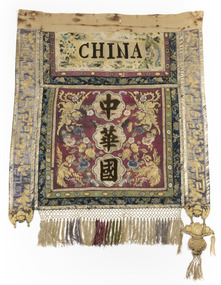
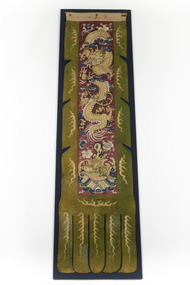
... Conservation Services with funding from Victoria’s Heritage Grants. In 2015, with the enormous support of the Copland Foundation and fundraising activities by the Friends of the Bur Museum Committee, conservation of the third banner was undertaken by Artlab Australia in Adelaide. ...Conservation Services with funding from Victoria’s Heritage Grants. In 2015, with the enormous support of the Copland Foundation and fundraising activities by the Friends of the Bur Museum Committee, conservation of the third banner was undertaken by Artlab Australia in Adelaide. ...This banner was one of five banners gifted to the Beechworth Chinese community in recognition of their support of the Hospital and Benevolent Asylum in 1875, from the Carnival Committee. These banners had been purchased in China by a social envoy from Beechworth then presented to the Chinese community during the Beechworth Fine Arts Exhibition in May of that same year, by Donald Fiddes, President of the Ovens District Hospital. The Burke Museum's Chinese Collection presents the history of Chinese settlement in Beechworth from 1856 and its involvement in local community affairs in the second half of the 19th century. In settling in the area they formed their own community with distinctive Chinese cultural traditions, forming their own 'camps' with laid out streets, housing a Temple, Chinese Theatre and restaurants, hotels, stores, gambling houses and dwellings. Members of the Chinese community took an active interest in town affairs and were generous donors to the appeal to build the Ovens District Hospital in 1856/7. The vibrant colours and dynamic graphics of the silk embroidered Chinese banners were a highlight of Beechworth Charitable processions that took place in the main street. Two of the Chinese banners were conserved for the Burke Museum in 2006 by Carol Campbell of Phoenix Conservation Services with funding from Victoria’s Heritage Grants. In 2015, with the enormous support of the Copland Foundation and fundraising activities by the Friends of the Bur Museum Committee, conservation of the third banner was undertaken by Artlab Australia in Adelaide. The banners display traditional Chinese textile techniques and are visually beautiful and very rare and are considered of local and national significance, with the potential to be deemed internationally significant.Multi panelled banner with embroidery and applied design motifs on front. Back panel is painted design of two men. The front panels have been constructed using strips of various weaves and colours of silk that have been embroidered or had a design applied prior to the overall construction of the piece. The embroidery is predominantly gold work with both plyed and floss silk threads. Silk macrame fringe and tassels to central panel and padded lotus and bowl motif hanging tassel from side panels. Velvet lettering applied to front "CHINA" CHINA /beechworth, burke museum, chinese, benevolent asylum, ovens district hospital, beechworth carnival processions, carnival, processions, beechworth chinese community, beechworth fine arts exhibition, donald fiddes -
 The Beechworth Burke Museum
Textile - Banner, c1872
... Conservation Services with funding from Victoria’s Heritage Grants. In 2015, with the enormous support of the Copland Foundation and fundraising activities by the Friends of the Bur Museum Committee, conservation of the third banner was undertaken by Artlab Australia in Adelaide....Conservation Services with funding from Victoria’s Heritage Grants. In 2015, with the enormous support of the Copland Foundation and fundraising activities by the Friends of the Bur Museum Committee, conservation of the third banner was undertaken by Artlab Australia in Adelaide. ...This banner was one of five banners gifted to the Beechworth Chinese community in recognition of their support of the Hospital and Benevolent Asylum in 1875, from the Carnival Committee. These banners had been purchased in China by a social envoy from Beechworth then presented to the Chinese community during the Beechworth Fine Arts Exhibition in May of that same year, by Donald Fiddes, President of the Ovens District Hospital. The Burke Museum's Chinese Collection presents the history of Chinese settlement in Beechworth from 1856 and its involvement in local community affairs in the second half of the 19th century. In settling in the area they formed their own community with distinctive Chinese cultural traditions, forming their own 'camps' with laid out streets, housing a Temple, Chinese Theatre and restaurants, hotels, stores, gambling houses and dwellings. Members of the Chinese community took an active interest in town affairs and were generous donors to the appeal to build the Ovens District Hospital in 1856/7. The vibrant colours and dynamic graphics of the silk embroidered Chinese banners were a highlight of Beechworth Charitable processions that took place in the main street. Two of the Chinese banners were conserved for the Burke Museum in 2006 by Carol Campbell of Phoenix Conservation Services with funding from Victoria’s Heritage Grants. In 2015, with the enormous support of the Copland Foundation and fundraising activities by the Friends of the Bur Museum Committee, conservation of the third banner was undertaken by Artlab Australia in Adelaide.The banners display traditional Chinese textile techniques and are visually beautiful and very rare and are considered of local and national significance, with the potential to be deemed internationally significant.Multi panelled banner with embroidery and applied design motifs on front. The front panels have been constructed using strips of various weaves and colours of silk that have been embroidered or had a design applied prior to the overall construction of the piece. The embroidery is predominantly gold work with both plyed and floss silk threads.beechworth, burke museum, chinese, benevolent asylum, ovens district hospital, beechworth carnival processions, carnival, processions, beechworth chinese community, beechworth fine arts exhibition, donald fiddes -
 The Beechworth Burke Museum
Textile - Banner, c1872
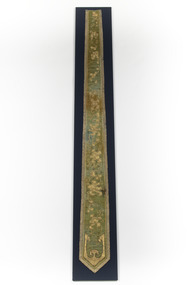
... Conservation Services with funding from Victoria’s Heritage Grants. In 2015, with the enormous support of the Copland Foundation and fundraising activities by the Friends of the Bur Museum Committee, conservation of the third banner was undertaken by Artlab Australia in Adelaide. ...Conservation Services with funding from Victoria’s Heritage Grants. In 2015, with the enormous support of the Copland Foundation and fundraising activities by the Friends of the Bur Museum Committee, conservation of the third banner was undertaken by Artlab Australia in Adelaide. ...This banner was one of five banners gifted to the Beechworth Chinese community in recognition of their support of the Hospital and Benevolent Asylum in 1875, from the Carnival Committee. These banners had been purchased in China by a social envoy from Beechworth then presented to the Chinese community during the Beechworth Fine Arts Exhibition in May of that same year, by Donald Fiddes, President of the Ovens District Hospital. The Burke Museum's Chinese Collection presents the history of Chinese settlement in Beechworth from 1856 and its involvement in local community affairs in the second half of the 19th century. In settling in the area they formed their own community with distinctive Chinese cultural traditions, forming their own 'camps' with laid out streets, housing a Temple, Chinese Theatre and restaurants, hotels, stores, gambling houses and dwellings. Members of the Chinese community took an active interest in town affairs and were generous donors to the appeal to build the Ovens District Hospital in 1856/7. The vibrant colours and dynamic graphics of the silk embroidered Chinese banners were a highlight of Beechworth Charitable processions that took place in the main street. Two of the Chinese banners were conserved for the Burke Museum in 2006 by Carol Campbell of Phoenix Conservation Services with funding from Victoria’s Heritage Grants. In 2015, with the enormous support of the Copland Foundation and fundraising activities by the Friends of the Bur Museum Committee, conservation of the third banner was undertaken by Artlab Australia in Adelaide. The banners display traditional Chinese textile techniques and are visually beautiful and very rare and are considered of local and national significance, with the potential to be deemed internationally significant.Multi panelled banner with embroidery and applied design motifs on front. The front panels have been constructed using strips of various weaves and colours of silk that have been embroidered or had a design applied prior to the overall construction of the piece. The embroidery is predominantly gold work with both plyed and floss silk threads.beechworth, burke museum, chinese, benevolent asylum, ovens district hospital, beechworth carnival processions, carnival, processions, beechworth chinese community, beechworth fine arts exhibition, donald fiddes -
 The Beechworth Burke Museum
Textile - Banner, c1872
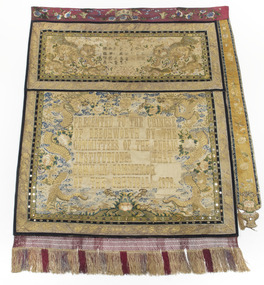
... Conservation Services with funding from Victoria’s Heritage Grants. In 2015, with the enormous support of the Copland Foundation and fundraising activities by the Friends of the Bur Museum Committee, conservation of the third banner was undertaken by Artlab Australia in Adelaide....Conservation Services with funding from Victoria’s Heritage Grants. In 2015, with the enormous support of the Copland Foundation and fundraising activities by the Friends of the Bur Museum Committee, conservation of the third banner was undertaken by Artlab Australia in Adelaide. ...This banner was one of five banners gifted to the Beechworth Chinese community in recognition of their support of the Hospital and Benevolent Asylum in 1875, from the Carnival Committee. These banners had been purchased in China by a social envoy from Beechworth then presented to the Chinese community during the Beechworth Fine Arts Exhibition in May of that same year, by Donald Fiddes, President of the Ovens District Hospital. The Burke Museum's Chinese Collection presents the history of Chinese settlement in Beechworth from 1856 and its involvement in local community affairs in the second half of the 19th century. In settling in the area they formed their own community with distinctive Chinese cultural traditions, forming their own 'camps' with laid out streets, housing a Temple, Chinese Theatre and restaurants, hotels, stores, gambling houses and dwellings. Members of the Chinese community took an active interest in town affairs and were generous donors to the appeal to build the Ovens District Hospital in 1856/7. The vibrant colours and dynamic graphics of the silk embroidered Chinese banners were a highlight of Beechworth Charitable processions that took place in the main street. Two of the Chinese banners were conserved for the Burke Museum in 2006 by Carol Campbell of Phoenix Conservation Services with funding from Victoria’s Heritage Grants. In 2015, with the enormous support of the Copland Foundation and fundraising activities by the Friends of the Bur Museum Committee, conservation of the third banner was undertaken by Artlab Australia in Adelaide.The banners display traditional Chinese textile techniques and are visually beautiful and very rare and are considered of local and national significance, with the potential to be deemed internationally significant.The banner has a narrow fuchsia embroidered top border, a wider embroidered panel depicting 2 dogs with embroidered Chinese text and a larger lower panel with the embroidered text “PRESENTED TO THE CHINESE OF BEECHWORTH BY THE COMMITEES OF THE PUBLIC INSTITUTIONS (missing) THAT TOWN IN COMMEMOR (missing) OF THE CARNIVAL 1873” The 2 lower panels have narrow decorative borders decorated with mirrors and extensive embroidery. There is an additional embroidered tab running along the right hand edge. The bottom edge has a wide knotted fringe. The back is lined with fabric decorated with a painted scene. Refer Attachment 1 quote ARTLAB AustPRESENTED TO THE CHINESE / OF BEECHWORTH BY THE / COMMITEES OF THE PUBLIC / INSTITUTIONS THAT / TOWN IN COMMEMOR / OF THE CARNIVAL 1873beechworth, burke museum, chinese, benevolent asylum, ovens district hospital, beechworth carnival processions, carnival, processions, beechworth chinese community, beechworth fine arts exhibition, donald fiddes -
 The Beechworth Burke Museum
Textile - Banner, c1872
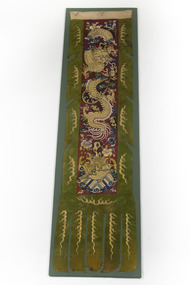
... Conservation Services with funding from Victoria’s Heritage Grants. In 2015, with the enormous support of the Copland Foundation and fundraising activities by the Friends of the Bur Museum Committee, conservation of the third banner was undertaken by Artlab Australia in Adelaide. ...Conservation Services with funding from Victoria’s Heritage Grants. In 2015, with the enormous support of the Copland Foundation and fundraising activities by the Friends of the Bur Museum Committee, conservation of the third banner was undertaken by Artlab Australia in Adelaide. ...This banner was one of five banners gifted to the Beechworth Chinese community in recognition of their support of the Hospital and Benevolent Asylum in 1875, from the Carnival Committee. These banners had been purchased in China by a social envoy from Beechworth then presented to the Chinese community during the Beechworth Fine Arts Exhibition in May of that same year, by Donald Fiddes, President of the Ovens District Hospital. The Burke Museum's Chinese Collection presents the history of Chinese settlement in Beechworth from 1856 and its involvement in local community affairs in the second half of the 19th century. In settling in the area they formed their own community with distinctive Chinese cultural traditions, forming their own 'camps' with laid out streets, housing a Temple, Chinese Theatre and restaurants, hotels, stores, gambling houses and dwellings. Members of the Chinese community took an active interest in town affairs and were generous donors to the appeal to build the Ovens District Hospital in 1856/7. The vibrant colours and dynamic graphics of the silk embroidered Chinese banners were a highlight of Beechworth Charitable processions that took place in the main street. Two of the Chinese banners were conserved for the Burke Museum in 2006 by Carol Campbell of Phoenix Conservation Services with funding from Victoria’s Heritage Grants. In 2015, with the enormous support of the Copland Foundation and fundraising activities by the Friends of the Bur Museum Committee, conservation of the third banner was undertaken by Artlab Australia in Adelaide. The banners display traditional Chinese textile techniques and are visually beautiful and very rare and are considered of local and national significance, with the potential to be deemed internationally significant.Multi panelled banner with embroidery and applied design motifs on front. The front panels have been constructed using strips of various weaves and colours of silk that have been embroidered or had a design applied prior to the overall construction of the piece. The embroidery is predominantly gold work with both plyed and floss silk threads. beechworth, burke museum, chinese, benevolent asylum, ovens district hospital, beechworth carnival processions, carnival, processions, beechworth chinese community, beechworth fine arts exhibition, donald fiddes -
 Eltham District Historical Society Inc
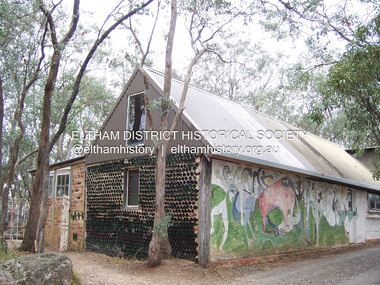
Photograph - Digital Photograph, Marguerite Marshall, Art Gallery at Clifton Pugh's Artists' Colony, Dunmoochin, Barreenong Road, Cottles Bridge, 5 February 2008
... Australian War Memorial’s official artist at the 75th anniversary of the landing at Gallipoli. Today one of Pugh’s legacies is the Dunmoochin Foundation, which gives seven individual artists or couples and environmental researchers the chance to work in beautiful and peaceful surroundings, usually for a year. By November 2007, more than 80 people had taken part, and the first disabled artist had been chosen to reside in a new studio with disabled access.1 In 1989, not long before Pugh died in 1990 of a heart attack at age 65, he established the Foundation with La Trobe University and the Victorian Conservation Trust now the Trust for Nature. ...Australian War Memorial’s official artist at the 75th anniversary of the landing at Gallipoli. Today one of Pugh’s legacies is the Dunmoochin Foundation, which gives seven individual artists or couples and environmental researchers the chance to work in beautiful and peaceful surroundings, usually for a year. By November 2007, more than 80 people had taken part, and the first disabled artist had been chosen to reside in a new studio with disabled access.1 In 1989, not long before Pugh died in 1990 of a heart attack at age 65, he established the Foundation with La Trobe University and the Victorian Conservation Trust now the Trust for Nature. ...Art Gallery with mural painted by Clifton Pugh (1924-1990) at his Artists' Colony, Dunmoochin, Barreenong Road, Cottles Bridge. Following military service in the second world war, Clifton Pugh studied under artist Sir William Dargie at the National Gallery School in Melbourne as well as Justus Jorgensen, founder of Montsalvat. For a while he lived on the dole but also worked packing eggs for the Belot family saving sufficient to purchase six acres (2.4 ha) of land at Barreenong Road, Cottles Bridge. He accumulated more land and persuaded several other artists and friends to buy land nearby, resulting in a property of approximately 200 acres, stablishing it as one of the first artistic communes in Australia alongside Montsalvat in Eltham. It was around 1951 that Pugh felt he had '"done moochin' around" and so the name of the property evolved. He bought timber from Alistair Knox to build his house on the crest of a hill. Inspired by local goldminer's huts, it was a one room wattle-and-daub structure with dirt floor. Over the years it expanded with thick adobe walls made from local clay, high ceilings and stone floors. All materials other than the local earth were sourced from second hand materials, most found at wreckers' yards. Artists from across the nation were drawn to Dunmoochin, with several setting up houses and shacks on the property, maintaining their independence but sharing their artistic zeal. Artists who worked or resided at Dunmoochin included Mirka Mora, John Perceval, Albert Tucker, Fred Williams, Charles Blackman, Arthur Boyd and John Olsen. In 2002, Pugh's house along with its treasure trove of art and a library of some 20,000 books was destroyed by fire. Traces of Pugh's home remain with the presence of the Victorian doorframe archway with leadlight of intricate design, procured from a demolished Melbourne mansion; and two bronze life-sized female statues created by Pugh and cast by Matcham Skipper. In place of Pugh's house rose two double-storey mud-brick artists' studios topped with corrugated iron rooves curved like the wings of a bird with accommodation for seven. The original studios, gallery and other buildings survived the fire. Covered under Heritage Overlay, Nillumbik Planning Scheme. Published: Nillumbik Now and Then / Marguerite Marshall 2008; photographs Alan King with Marguerite Marshall.; p153 It’s not surprising that artist Clifton Pugh was drawn to Cottles Bridge to establish his artists’ colony Dunmoochin. Undisturbed by the clamour of modern life at Barreenong Road, Pugh was surrounded by the Australian bush he loved, and where his ashes were later scattered. The 200 acres (81ha) of bushland, broken by glimpses of rolling hills, has more than 50 species of orchids and Pugh shared his property with native animals including kangaroos, emus, phascogales, wombats, and diverse bird life. Pugh encouraged these creatures to join him in the bush by creating, with Monash University, a holding station where the animals were raised. Dunmoochin inspired Pugh for such paintings as in a book on orchids and the Death of a Wombat series.1 But his love for the bush was accompanied by the fear that Europeans were destroying it and much of his painting illustrated this fear and his plea for its conservation.2 However it was his house rather than the surrounding bush that was to be destroyed. Tragically in 2002 Pugh’s house, with its treasure of art and library of 20,000 art books, was destroyed by fire. Traces of the beauty of Pugh’s home still remain, however, in the magnificent Victorian doorframe archway with leadlight of intricate design procured from a demolished Melbourne mansion; and two bronze life-sized female statues created by Pugh and cast by Matcham Skipper. Now in place of Pugh’s house, are two double-storey mud-brick artists’ studios topped with corrugated roofs curved like birds’ wings, with accommodation for seven. The original studios, gallery and other buildings remain.3 Pugh grew up on his parents’ hobby farm at Briar Hill and attended the Briar Hill Primary School, then Eltham High School and later Ivanhoe Grammar. At 15 he became a copy boy for the Radio Times newspaper, then worked as a junior in a drafting office. Pugh was to have three wives and two sons. After serving in World War Two in New Guinea and Japan, Pugh studied under artist Sir William Dargie, at the National Gallery School in Melbourne.4 Another of his teachers was Justus Jörgensen, founder of Montsalvat the Eltham Artists’ Colony. Pugh lived on the dole for a while and paid for his first six acres (2.4ha) at Barreenong Road by working as an egg packer for the Belot family. Pugh accumulated more land and persuaded several other artists and friends to buy land nearby, resulting in the 200 acre property. They, too, purchased their land from the Belot family by working with their chickens. Around 1951 Pugh felt he had ‘Done moochin’ around’ and so the name of his property was born. Pugh bought some used timber from architect Alistair Knox to build his house on the crest of a hill. Inspired by local goldminers’ huts it was a one-room wattle-and-daub structure with a dirt floor. It was so small that the only room he could find for his telephone was on the fork of a tree nearby.5 Over the years the mud-brick house grew to 120 squares in the style now synonymous with Eltham. It had thick adobe walls (sun-dried bricks) made from local clay, high ceilings and stone floors with the entire structure made of second-hand materials – most found at wreckers’ yards. Pugh’s first major show in Melbourne in 1957, established him as a distinctive new painter, breaking away from the European tradition ‘yet not closely allied to any particular school of Australian painting’.6 Pugh became internationally known and was awarded the Order of Australia. He won the Archibald Prize for portraiture three times, although he preferred painting the bush and native animals. In 1990 not long before he died, Pugh was named the Australian War Memorial’s official artist at the 75th anniversary of the landing at Gallipoli. Today one of Pugh’s legacies is the Dunmoochin Foundation, which gives seven individual artists or couples and environmental researchers the chance to work in beautiful and peaceful surroundings, usually for a year. By November 2007, more than 80 people had taken part, and the first disabled artist had been chosen to reside in a new studio with disabled access.1 In 1989, not long before Pugh died in 1990 of a heart attack at age 65, he established the Foundation with La Trobe University and the Victorian Conservation Trust now the Trust for Nature. Pugh’s gift to the Australian people – of around 14 hectares of bushland and buildings and about 550 art works – is run by a voluntary board of directors, headed by one of his sons, Shane Pugh. La Trobe University in Victoria stores and curates the art collection and organises its exhibition around Australia.2 The Foundation aims to protect and foster the natural environment and to provide residences, studios and community art facilities at a minimal cost for artists and environmental researchers. They reside at the non-profit organisation for a year at minimal cost. The buildings, some decorated with murals painted by Pugh and including a gallery, were constructed by Pugh, family and friends, with recycled as well as new materials and mud-bricks. The Foundation is inspired by the tradition begun by the Dunmoochin Artists’ Cooperative which formed in the late 1950s as one of the first artistic communes in Australia. Members bought the land collaboratively and built the seven dwellings so that none could overlook another. But, in the late 1960s, the land was split into private land holdings, which ended the cooperative. Dunmoochin attracted visits from the famous artists of the day including guitarists John Williams and Segovia; singer and comedian Rolf Harris; comedian Barry Humphries; and artists Charles Blackman, Arthur Boyd and Mirka Mora. A potters’ community, started by Peter and Helen Laycock with Alma Shanahan, held monthly exhibitions in the 1960s, attracting local, interstate and international visitors – with up to 500 attending at a time.3 Most artists sold their properties and moved away. But two of the original artists remained into the new millennium as did relative newcomer Heja Chong who built on Pugh’s property (now owned by the Dunmoochin Foundation). In 1984 Chong brought the 1000-year-old Japanese Bizan pottery method to Dunmoochin. She helped build (with potters from all over Australia) the distinctive Bizan-style kiln, which fires pottery from eight to 14 days in pine timber, to produce the Bizan unglazed and simple subdued style. The kiln, which is rare in Australia, is very large with adjoining interconnected ovens of different sizes, providing different temperatures and firing conditions. Frank Werther, who befriended Pugh as a fellow student at the National Gallery Art School in Melbourne, built his house off Barreenong Road in 1954. Werther is a painter of the abstract and colourist style and taught art for about 30 years. Like so many in the post-war years in Eltham Shire, as it was called then, Werther built his home in stages using mud-brick and second-hand materials. The L-shaped house is single-storey but two-storey in parts with a corrugated-iron pitched roof. The waterhole used by the Werthers for their water supply is thought to be a former goldmining shaft.4 Alma Shanahan at Barreenong Road was the first to join Pugh around 1953. They also met at the National Gallery Art School and Shanahan at first visited each weekend to work, mainly making mud-bricks. She shared Pugh’s love for the bush, but when their love affair ended, she designed and built her own house a few hundred yards (metres) away. The mud-brick and timber residence, made in stages with local materials, is rectangular, single-storey with a corrugated-iron roof. As a potter, Shanahan did not originally qualify as an official Cooperative member.This collection of almost 130 photos about places and people within the Shire of Nillumbik, an urban and rural municipality in Melbourne's north, contributes to an understanding of the history of the Shire. Published in 2008 immediately prior to the Black Saturday bushfires of February 7, 2009, it documents sites that were impacted, and in some cases destroyed by the fires. It includes photographs taken especially for the publication, creating a unique time capsule representing the Shire in the early 21st century. It remains the most recent comprehenesive publication devoted to the Shire's history connecting local residents to the past. nillumbik now and then (marshall-king) collection, art gallery, clifton pugh, dunmoochin, cottlesbridge, cottles bridge, barreenong road -
 Eltham District Historical Society Inc
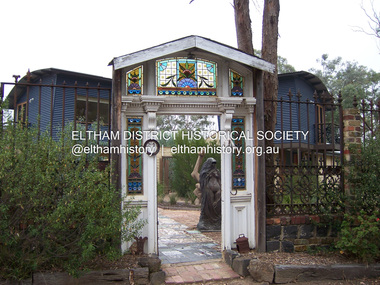
Photograph - Digital Photograph, Marguerite Marshall, Doorway of Clifton Pugh's former house at Dunmoochin, Barreenong Road, Cottles Bridge, 5 February 2008
... Australian War Memorial’s official artist at the 75th anniversary of the landing at Gallipoli. Today one of Pugh’s legacies is the Dunmoochin Foundation, which gives seven individual artists or couples and environmental researchers the chance to work in beautiful and peaceful surroundings, usually for a year. By November 2007, more than 80 people had taken part, and the first disabled artist had been chosen to reside in a new studio with disabled access.1 In 1989, not long before Pugh died in 1990 of a heart attack at age 65, he established the Foundation with La Trobe University and the Victorian Conservation Trust now the Trust for Nature. ...Australian War Memorial’s official artist at the 75th anniversary of the landing at Gallipoli. Today one of Pugh’s legacies is the Dunmoochin Foundation, which gives seven individual artists or couples and environmental researchers the chance to work in beautiful and peaceful surroundings, usually for a year. By November 2007, more than 80 people had taken part, and the first disabled artist had been chosen to reside in a new studio with disabled access.1 In 1989, not long before Pugh died in 1990 of a heart attack at age 65, he established the Foundation with La Trobe University and the Victorian Conservation Trust now the Trust for Nature. ...Following military service in the second world war, Clifton Pugh studied under artist Sir William Dargie at the National Gallery School in Melbourne as well as Justus Jorgensen, founder of Montsalvat. For a while he lived on the dole but also worked packing eggs for the Belot family saving sufficient to purchase six acres (2.4 ha) of land at Barreenong Road, Cottles Bridge. He accumulated more land and persuaded several other artists and friends to buy land nearby, resulting in a property of approximately 200 acres, stablishing it as one of the first artistic communes in Australia alongside Montsalvat in Eltham. It was around 1951 that Pugh felt he had '"done moochin' around" and so the name of the property evolved. He bought timber from Alistair Knox to build his house on the crest of a hill. Inspired by local goldminer's huts, it was a one room wattle-and-daub structure with dirt floor. Over the years it expanded with thick adobe walls made from local clay, high ceilings and stone floors. All materials other than the local earth were sourced from second hand materials, most found at wreckers' yards. Artists from across the nation were drawn to Dunmoochin, with several setting up houses and shacks on the property, maintaining their independence but sharing their artistic zeal. Artists who worked or resided at Dunmoochin included Mirka Mora, John Perceval, Albert Tucker, Fred Williams, Charles Blackman, Arthur Boyd and John Olsen. In 2002, Pugh's house along with its treasure trove of art and a library of some 20,000 books was destroyed by fire. Traces of Pugh's home remain with the presence of the Victorian doorframe archway with leadlight of intricate design, procured from a demolished Melbourne mansion; and two bronze life-sized female statues created by Pugh and cast by Matcham Skipper. In place of Pugh's house rose two double-storey mud-brick artists' studios topped with corrugated iron rooves curved like the wings of a bird with accommodation for seven. The original studios, gallery and other buildings survived the fire. Covered under Heritage Overlay, Nillumbik Planning Scheme. Published: Nillumbik Now and Then / Marguerite Marshall 2008; photographs Alan King with Marguerite Marshall.; p155 It’s not surprising that artist Clifton Pugh was drawn to Cottles Bridge to establish his artists’ colony Dunmoochin. Undisturbed by the clamour of modern life at Barreenong Road, Pugh was surrounded by the Australian bush he loved, and where his ashes were later scattered. The 200 acres (81ha) of bushland, broken by glimpses of rolling hills, has more than 50 species of orchids and Pugh shared his property with native animals including kangaroos, emus, phascogales, wombats, and diverse bird life. Pugh encouraged these creatures to join him in the bush by creating, with Monash University, a holding station where the animals were raised. Dunmoochin inspired Pugh for such paintings as in a book on orchids and the Death of a Wombat series.1 But his love for the bush was accompanied by the fear that Europeans were destroying it and much of his painting illustrated this fear and his plea for its conservation.2 However it was his house rather than the surrounding bush that was to be destroyed. Tragically in 2002 Pugh’s house, with its treasure of art and library of 20,000 art books, was destroyed by fire. Traces of the beauty of Pugh’s home still remain, however, in the magnificent Victorian doorframe archway with leadlight of intricate design procured from a demolished Melbourne mansion; and two bronze life-sized female statues created by Pugh and cast by Matcham Skipper. Now in place of Pugh’s house, are two double-storey mud-brick artists’ studios topped with corrugated roofs curved like birds’ wings, with accommodation for seven. The original studios, gallery and other buildings remain.3 Pugh grew up on his parents’ hobby farm at Briar Hill and attended the Briar Hill Primary School, then Eltham High School and later Ivanhoe Grammar. At 15 he became a copy boy for the Radio Times newspaper, then worked as a junior in a drafting office. Pugh was to have three wives and two sons. After serving in World War Two in New Guinea and Japan, Pugh studied under artist Sir William Dargie, at the National Gallery School in Melbourne.4 Another of his teachers was Justus Jörgensen, founder of Montsalvat the Eltham Artists’ Colony. Pugh lived on the dole for a while and paid for his first six acres (2.4ha) at Barreenong Road by working as an egg packer for the Belot family. Pugh accumulated more land and persuaded several other artists and friends to buy land nearby, resulting in the 200 acre property. They, too, purchased their land from the Belot family by working with their chickens. Around 1951 Pugh felt he had ‘Done moochin’ around’ and so the name of his property was born. Pugh bought some used timber from architect Alistair Knox to build his house on the crest of a hill. Inspired by local goldminers’ huts it was a one-room wattle-and-daub structure with a dirt floor. It was so small that the only room he could find for his telephone was on the fork of a tree nearby.5 Over the years the mud-brick house grew to 120 squares in the style now synonymous with Eltham. It had thick adobe walls (sun-dried bricks) made from local clay, high ceilings and stone floors with the entire structure made of second-hand materials – most found at wreckers’ yards. Pugh’s first major show in Melbourne in 1957, established him as a distinctive new painter, breaking away from the European tradition ‘yet not closely allied to any particular school of Australian painting’.6 Pugh became internationally known and was awarded the Order of Australia. He won the Archibald Prize for portraiture three times, although he preferred painting the bush and native animals. In 1990 not long before he died, Pugh was named the Australian War Memorial’s official artist at the 75th anniversary of the landing at Gallipoli. Today one of Pugh’s legacies is the Dunmoochin Foundation, which gives seven individual artists or couples and environmental researchers the chance to work in beautiful and peaceful surroundings, usually for a year. By November 2007, more than 80 people had taken part, and the first disabled artist had been chosen to reside in a new studio with disabled access.1 In 1989, not long before Pugh died in 1990 of a heart attack at age 65, he established the Foundation with La Trobe University and the Victorian Conservation Trust now the Trust for Nature. Pugh’s gift to the Australian people – of around 14 hectares of bushland and buildings and about 550 art works – is run by a voluntary board of directors, headed by one of his sons, Shane Pugh. La Trobe University in Victoria stores and curates the art collection and organises its exhibition around Australia.2 The Foundation aims to protect and foster the natural environment and to provide residences, studios and community art facilities at a minimal cost for artists and environmental researchers. They reside at the non-profit organisation for a year at minimal cost. The buildings, some decorated with murals painted by Pugh and including a gallery, were constructed by Pugh, family and friends, with recycled as well as new materials and mud-bricks. The Foundation is inspired by the tradition begun by the Dunmoochin Artists’ Cooperative which formed in the late 1950s as one of the first artistic communes in Australia. Members bought the land collaboratively and built the seven dwellings so that none could overlook another. But, in the late 1960s, the land was split into private land holdings, which ended the cooperative. Dunmoochin attracted visits from the famous artists of the day including guitarists John Williams and Segovia; singer and comedian Rolf Harris; comedian Barry Humphries; and artists Charles Blackman, Arthur Boyd and Mirka Mora. A potters’ community, started by Peter and Helen Laycock with Alma Shanahan, held monthly exhibitions in the 1960s, attracting local, interstate and international visitors – with up to 500 attending at a time.3 Most artists sold their properties and moved away. But two of the original artists remained into the new millennium as did relative newcomer Heja Chong who built on Pugh’s property (now owned by the Dunmoochin Foundation). In 1984 Chong brought the 1000-year-old Japanese Bizan pottery method to Dunmoochin. She helped build (with potters from all over Australia) the distinctive Bizan-style kiln, which fires pottery from eight to 14 days in pine timber, to produce the Bizan unglazed and simple subdued style. The kiln, which is rare in Australia, is very large with adjoining interconnected ovens of different sizes, providing different temperatures and firing conditions. Frank Werther, who befriended Pugh as a fellow student at the National Gallery Art School in Melbourne, built his house off Barreenong Road in 1954. Werther is a painter of the abstract and colourist style and taught art for about 30 years. Like so many in the post-war years in Eltham Shire, as it was called then, Werther built his home in stages using mud-brick and second-hand materials. The L-shaped house is single-storey but two-storey in parts with a corrugated-iron pitched roof. The waterhole used by the Werthers for their water supply is thought to be a former goldmining shaft.4 Alma Shanahan at Barreenong Road was the first to join Pugh around 1953. They also met at the National Gallery Art School and Shanahan at first visited each weekend to work, mainly making mud-bricks. She shared Pugh’s love for the bush, but when their love affair ended, she designed and built her own house a few hundred yards (metres) away. The mud-brick and timber residence, made in stages with local materials, is rectangular, single-storey with a corrugated-iron roof. As a potter, Shanahan did not originally qualify as an official Cooperative member.This collection of almost 130 photos about places and people within the Shire of Nillumbik, an urban and rural municipality in Melbourne's north, contributes to an understanding of the history of the Shire. Published in 2008 immediately prior to the Black Saturday bushfires of February 7, 2009, it documents sites that were impacted, and in some cases destroyed by the fires. It includes photographs taken especially for the publication, creating a unique time capsule representing the Shire in the early 21st century. It remains the most recent comprehenesive publication devoted to the Shire's history connecting local residents to the past. nillumbik now and then (marshall-king) collection, art gallery, clifton pugh, dunmoochin, cottlesbridge, cottles bridge, barreenong road -
 City of Melbourne Libraries
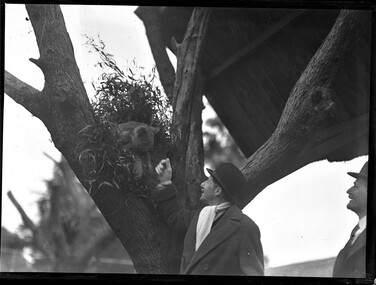
Photograph, Bull, Hugh Jones, 1897-1993, Vice-regal visit to zoo: Governor (Lord Huntingfield) and koala
... conservation campaign in Australia. It raised awareness of the vulnerability of a beloved animal and eventually brought about national parks and national laws for their protection. By 1936, community opposition to possum open seasons was beginning. The koala was made a Protected Species in all states in 1937, meaning no one is allowed to harm a koala, however the laws protecting the gum trees they rely on for food and shelter are weak. The Australian Government estimates the wild koala population in Australia is between 225,000 and 500,000 in 2024. The Australian Koala Foundation...conservation campaign in Australia. It raised awareness of the vulnerability of a beloved animal and eventually brought about national parks and national laws for their protection. By 1936, community opposition to possum open seasons was beginning. The koala was made a Protected Species in all states in 1937, meaning no one is allowed to harm a koala, however the laws protecting the gum trees they rely on for food and shelter are weak. The Australian Government estimates the wild koala population in Australia is between 225,000 and 500,000 in 2024. The Australian Koala Foundation ...Published: (1934, June 26). The Age (Melbourne, Vic. : 1854 - 1954), p. 11. Published title: VICE-ROYALTY GREETS THE KING OF THE BEASTS AT THE ZOO. Published caption: Lord Huntingfield experienced a pleasant “induction ceremony” as Patron of the Royal Zoological and Acclimatisation Society yesterday, when he made a tour of the Zoological Gardens. The picture shows the Governor, accompanied by Lady Huntingfield, inspecting the King of Beasts, who is submitting to a little playful treatment from the Director of the Gardens, Mr. Wilkie, while the Director whispers in his ear that a distinguished visitor has come to see him. (Inset), is a picture of Lord Huntingfield greeting one of the Koalas. Trove article identifier: http://nla.gov.au/nla.news-article204818472 Description: A man wearing a hat, scarf and overcoat reaches up to pat a koala in a tree watched by a man in a hat and suit. Research by project volunteer, Fiona Collyer: In 1932, the Zoo built an Australian native animal enclosure which visitors could enter and closely view koalas, wallabies, kookaburras and magpies all placed together. The branches of the trees in the enclosure were cut so that visitors could easily see and feed the koalas sitting in them. The cost to feed each koala fresh gum leaves was fifteen shillings per week. By 1924, Queensland was the last stronghold in Australia for the koala. They were functionally extinct in South Australia, only a few hundred in NSW, and an estimated population of 1000 animals remained in Victoria. There had been a six-month open season on koalas in Queensland in 1919 where over a million had been slaughtered, however with its vast, dense forests it was impossible to accurately know their numbers. Koala fur is tough, warm and waterproof and was in high demand from consumers in Canada, Britain and the US to make hats and gloves and for lining greatcoats. In 1927, with Queensland suffering a crippling drought and high unemployment, the cash-strapped McCormack Labor Government declared an “Open Season” on koalas and “opossums” for their skins, for the month of August. (Possums were often called “opossums” at this time but they are actually possums). There were widespread protests from many groups including the Nature Lovers League, Wild Life Preservation Society of Australia, Queensland Museum, C.W.A. Royal Australian Ornithologist Union, Boy Scouts, religious and women’s groups. There were letters to newspapers from ordinary people, editorials and pleas to women to refuse to wear or purchase koala fur. People questioned the masculinity of koala hunters as it was felt that no proper bushman or sportsman would kill such a defenceless creature. The Brisbane Courier newspaper led the campaign, devoting six columns a day to “Spare the Bear”. Author Vance Palmer sent an impassioned letter to the editor of the The Brisbane Courier, 19 July 1927: “Sir- It is be hoped that the disgust which all humane people have felt at the declaration of an open season for native bears in August will not be allowed to fade away until some protest... so overwhelming and effective that the question will never be raised again. For the shooting of our harmless and loveable native bear is nothing less than barbarous. His case is entirely different from that of other furred animals. No one has ever accused him of spoiling the farmers’ wheat, eating the squatters’ grass or even spreading the prickly pear. There is not a social vice that can be put down to his account. In addition, he is comparatively defenceless. He affords no sport to the gunman, and can be trusted to present a sitting target to the creature mean enough to aim at him. For this reason he has been almost blotted out already from some areas, in days when our fauna and flora were held in such little regard that the settlers’ first instinct was to shoot every strange animal and to sink his axe into every unfamiliar tree.” The Anglican Archbishop of Brisbane, Gerald Sharp, had his letter published in The Brisbane Courier on 16 July 1927: “Sir... The extermination of fauna so distinctive of our country, especially of such harmless and pretty creatures as our native bears, seems to me a shameful thing, and this is likely to mean their extermination.” But it was all to no avail. Known as “Black August”, the government was unmoved by the public’s outrage. 10,000 licences were issued to hunters and “the slaughter of the innocents” went ahead. The newspapers were full of stories of dreadful cruelty against the helpless, benign creatures by the heartless hunters who not only used guns and spotlights but wire snares and cyanide baits so that pelts wouldn’t be damaged. Infant koalas were left orphaned and unlikely to survive without their mothers. Top quality pelts were sold at an average price of 56 shillings and 9 pence per dozen, poor quality skins for as little as 2 1/2 pence each. In December 1927, the Minister for Agriculture and Stock, Mr W. Forgan Smith told the Parliament that during the August open season 597,985 koala pelts worth £139,595 had netted the state’s coffers £6000. 952,194 “opossum” pelts were sold and £9000 made for the State. The backlash that followed helped topple the Queensland Labor Government in 1929. The Wild Life Preservation Society of Australia lobbied the Prime Minister Mr Stanley Bruce to refuse to issue exportation permits for koala pelts and from 10 November 1927 the Commonwealth Government suspended the issuing of permits. In 1930, the Society made a direct appeal to USA President Herbert Hoover and he signed an order prohibiting the importation of koala and wombat fur to USA, eliminating a major market. Koala pelts were often deliberately mislabelled “wombat” to get around restrictions. The ban most likely saved the koala from probable extinction. Three years later the Australian Federal Government banned the export of koala products. This movement against koala killing was really the first conservation campaign in Australia. It raised awareness of the vulnerability of a beloved animal and eventually brought about national parks and national laws for their protection. By 1936, community opposition to possum open seasons was beginning. The koala was made a Protected Species in all states in 1937, meaning no one is allowed to harm a koala, however the laws protecting the gum trees they rely on for food and shelter are weak. The Australian Government estimates the wild koala population in Australia is between 225,000 and 500,000 in 2024. The Australian Koala Foundation estimates the national population at less than 60,000 in 2021 with a 30% decline in three years. Habitat loss from land clearing, dog attacks, road deaths, chlamydia, bushfires and drought exacerbated by climate change, continues to cause their decline. Over eight million koalas were killed for their pelts between 1888 and 1927. Any one of the annual harvests killed more koalas than are alive now. At this time, children were also being taught to appreciate Australian native animals. In 1933, “Blinky Bill: The Quaint Little Australian” book for children was published by Angus and Robertson. It was written and illustrated by New Zealand-born author Dorothy Wall and “Dedicated to my son Peter and all other Peters and Johns and Bobs and Toms and Marys and Bettys and Joans and Pats and all kind children.” The book tells the story of Blinky Bill - a mischievous, patched knickerbocker-wearing koala and his mother and father. The story has messages of conservation and instances of human unkindness and cruelty. Mr. and Mrs. Koala and young Blinky lead a mostly idyllic family life amongst a variety of other animals in the forest. However it all changes in chapter two, when Blinky Bill’s father is distressingly shot by a hunter. There is a harrowing description of Mr. Koala’s shooting and eventual death. “The Koala family lived so happily; never thinking of harm, or that anything could happen to disturb their little home, as all they asked for were plenty of fresh gum-leaves and the warm sun. They had no idea such things as guns were in the world or that a human being had a heart so cruel that he would take a pleasure in seeing a poor little body riddled with bullets hanging helplessly from the tree-top... That same being might just as well take his gun and shoot baby kookaburras, so helpless were they all and so trusting.” “Poor Mr. Koala one day was curled up asleep in his favourite corner, when the terrible thing happened. Bang! He opened his eyes in wonder. What was that? Did the limb of the tree snap where that young cub of his was skylarking? ... bang! again. This time he felt a stinging pain in his leg... Peering over the bough of the tree he saw a man on the ground with something long and black in his arms... Another bang and his ear began to hurt. Bang! again and now his little body was stinging all over. He grunted loudly and slowly climbed up the tree, calling Mrs. Koala and Blinky as he went. He managed to reach the topmost branch... Tears were pouring down his poor little face. He brushed them away with his front paws and cried just like a baby. Fortunately Mrs. Koala and Blinky Bill were hiding in the leaves quite motionless, and the shadows of the tree made them appear as part of it. The man with the gun stood and waited a long time, then walked away, whistling as he went - the only sound to be heard in the bush except the cries of the little bear far up in the tree.” Blinky and his mother quietly and fearfully wait for Mr. Koala to wake. In the morning, grunting and crying, they feel his lifeless body with their paws. Eventually Mrs. Koala realises that her husband is dead and that they need to move to a safe place. After travelling deeper into the forest, Mrs. Koala and Blinky meet koalas Mrs. Grunty and her son Snubby and she describes how she was captured as a baby by koala fur trappers to be a pet for a little girl. The trapper forgot to bring gum leaves for the koala so they try to feed her cake, milk and bananas, making her sick. The little girl’s father relays something he read in the paper: “During the year 1920 to 1921, two hundred and five thousand six hundred and seventy-nine koalas were killed and their skins sold to the fur market, under the name of wombat.” They place the koala in a box with a teddy bear for company. The baby koala’s health deteriorates and the alarmed trapper returns her to the bush. Mrs. Grunty tells Mrs. Koala that she and Blinky are the only bears that she has seen for ten years: “I remember well the little girl’s father telling her... that not so many years ago the bush was alive with us bears, from Queensland to the south of Victoria. Now, we are so rare that we have become a curiosity, something to put in zoos, for children to see; and actually in museums. I believe our grandparents sit there in glass cases, stuffed with something inside to make them appear alive, and, oh dear, glass eyes. In New South Wales, I think we could wander for miles from one corner to another and never meet a bear. I don’t know why we were all killed. As you know, we don’t eat the farmers’ crop or ruin their orchards. All we asked for were our own gum-trees.” At the end of the book, Dorothy tells her readers - “The kindest action of all would be to leave the koala baby in his own bushland, among his own playmates, with the sun, the sky, the birds, and the gum-trees, where he will grow to manhood and live for many years - happy as he should be.” In 1934, a “Wild Zoo”, the Sir Colin Mackenzie Sanctuary, opened on 32 hectares of land, formerly part of Coranderrk Aboriginal Reserve in the Yarra Valley, exclusively displaying Australian native animals, birds and reptiles. It was later renamed Healesville Sanctuary and is now managed by Melbourne Zoo and home to over 200 species of Australian native fauna. The Sanctuary is committed to rescuing, breeding, researching and raising awareness of the vulnerability of Australian animals. Andrew Arthur Wellesley Wilkie, 1853-1948, was Director of the Melbourne Zoo from 1923 to 1936 and was associated with the zoo for 70 years. He first worked as a horticultural assistant to Government botanist Baron Ferdinand von Mueller at the Botanical Gardens at the age of 13, along with his older brother David. One of Andrew’s jobs was to capture moths for the National Herbarium. In 1857, a group of prominent Melburnians assembled at St. Patrick’s Hall to form the Zoological Society of Victoria, with the aim of introducing animals and plants from overseas. It was conceived, “For the purposes of science and for that of affording the public the advantages of studying the habits of the animal creation in properly arranged zoological gardens.” The Victorian Government granted 32 acres (13 hectares) of land to the Zoological Society at the southern end of Richmond Paddock on the opposite bank to the Botanical Gardens. (This is where AAMI Stadium and Collingwood Football Club now stand.) In 1861, the Zoological Society of Victoria was renamed The Acclimatisation Society of Victoria. Unfortunately the Yarra River frontage was damp, swampy and subject to flooding, so the animals were briefly housed at the Botanical Gardens until in 1862, the City of Melbourne donated 55 acres (22 hectares) of land at Royal Park for the fledgling zoo. Baron von Mueller secured employment at Royal Park for Andrew and David and they helped to lay out the gardens, plant trees and take care of a collection of deer, pheasants, hares and partridges. Initially the zoo was used for the acclimatisation of animals recovering from the long voyage to Australia and for breeding them for sport. In 1872, the zoo bought two lions, a leopard and a cheetah that had been seized from circus showmen Keith and Phillips when they were unable to pay the bill of butcher Mr T K Bennet of Bourke Street. The first zoo director, Mr. Albert Le Souef, negotiated with captains of ships to buy animals at overseas ports they visited and soon a multitude of exotic species arrived, including a ten-year-old Indian elephant in 1878. In 1923, after being head keeper for some years, Andrew was appointed director of the zoo. By 1933, the zoo had 110 different species of animals, 200 species of birds and 72 species of reptiles under Andrew’s care. He had personally planted all but six trees and laid out the garden beds. As director he lobbied authorities for funds to build more humane enclosures for the animals. In June 1928, Table Talk magazine wrote of Andrew Wilkie: “Up at the Zoo there is a humble gentleman who is a lion among the lions, who knows the proper specific to employ when the boa constrictor has chilblains, and who is a friend and confidant of Queenie the elephant. His fount of zoological lore has never been plumbed. It is bottomless, like his good fellowship and geniality. Every day he may be seen somewhere in the grounds of that growing sanctuary for the strange and arresting fauna and creeping things of the world, and I assure you as one who is privy to his passion that that area and its inhabitants are rarely out of his thoughts.” Andrew retired from the zoo in 1936 at the age of 83 and in 1948 died at his home in Brunswick aged 94. He and his wife Josephine had six children. The Victorian Acclimatisation Society was founded in 1861 by Edward Wilson, 1813-1878, then owner and editor of The Argus newspaper. He said that Australian indigenous animals were practically useless, providing only “a little sport and an occasional meal”. The Society believed that Australia’s plants and animals were vastly inferior to those in Europe. They wanted to introduce and acclimatise to Victoria “all innoxious animals, birds, fishes, insects and vegetables, whether useful or ornamental” for sport and for the table, and to spread indigenous animals and plants from the colony around the world. Their motto was “if it lives, we want it”. The Society was primarily responsible for introducing sparrows, starlings, sambar and hog deer, ostriches, brown trout, blackberries, and carp to the Murray River. They released the European songbirds, thrush and blackbird to quell the homesickness of British settlers. The Society also sent Australian animals like platypus, echidnas, kangaroos and koalas to Europe for scientific and novelty purposes. Thomas Austin, a wealthy sheep farmer of Barwon Park, Winchelsea (property now owned by the National Trust) was a member and in 1859 he introduced hares, blackbirds, thrushes and partridges onto his property. He is probably best known for introducing 24 breeding rabbits onto his estate as game for shooting parties. Thomas quipped, “The introduction of a few rabbits could do little harm and might provide a touch of home, in addition to a spot of hunting." In 2022, genomic data confirmed that Australia’s feral rabbit population is entirely descended from these rabbits. Biological control has brought the rabbit population down from an estimated high of 10 billion rabbits in the 1920s to approximately 200 million today, inhabiting 70% of Australian landmass (5.3 million square kilometres). In 1872, the Acclimatisation Society was renamed The Zoological and Acclimatisation Society of Victoria and they focused on importing exotic animals for display purposes to the zoo. In 1937, the Royal Acclimatisation Society of Victoria was recreated as the Zoological Board of Victoria with a focus on research of native animals threatened with extinction. In an editorial for The Argus newspaper, 16 March 1856, Edward Wilson lamented: "...this country has been shamelessly stolen from the blacks. Had they been like the New Zealanders or the North American Indians, we should have bought their land, and supplied them with the means of living when we took it... In less than twenty years we have nearly swept them off the face of the earth. We have shot them down like dogs. In the guise of friendship we have issued corrosion sublimate in their damper, and consigned whole tribes to the agonies of an excruciating death. We have made them drunkards, and infected them with disease which has rotted the bones of their adults, and made such few children as are born amongst them a sorrow and a torture from the very instant of their birth. We have made them outcasts on their own land, and are rapidly consigning them to entire annihilation. There are but a few of them left, comparatively. This is what we would do for that few. We would feed and clothe every one of them.” [Note: this last sentence is italicized in the original newspaper article text]. Lord Huntingfield, (William Charles Arcedeckne Vanneck) 1883-1969, Governor of Victoria 1934-1939, was a British Conservative Party politician and the first ever Australian-born Governor of an Australian state (although he was always considered British). He was patron of the Royal Zoological and Acclimatisation Society of Victoria and was acting Governor-General for six months during the absence of Lord Gowie in 1938. Lady Huntingfield (née Margaret Eleanor Crosby) 1884-1943, his American-born wife showed great interest in social welfare and the advancement of women and children. She was president of the City Newsboys Society and Patroness of the Girls Friendly Society. In 1937, rose breeder Alister Clark named a yellow hybrid tea rose for her. In 1940, the City of Melbourne opened the Lady Huntingfield Free Kindergarten in North Melbourne, now the Lady Huntingfield Early Learning and Family Services Centre. Lady Huntingfield died in London in 1943 after her house was bombed during a German airstrike. The Lady Huntingfield Memorial Scholarship was established after the City of Melbourne raised £1000 in a public appeal conducted in her memory for students undertaking a Social Work degree at the University of Melbourne. It is awarded annually to this day. The Queen Victoria Hospital named a bed in her honour. References: VICE-ROYALTY GREETS THE KING OF BEASTS AT THE ZOO. (1934, June 26). The Age (Melbourne, Vic. : 1854 - 1954), p. 11. Retrieved August 23, 2024, from http://nla.gov.au/nla.news-article204818472 Prominent Personalities ANDREW WILKIE (1928, June 7). Table Talk (Melbourne, Vic. : 1885 - 1939), p. 15. Retrieved August 29, 2024, from http://nla.gov.au/nla.news-article146562949 'Edward Wilson (journalist)', Wikipedia, https://en.wikipedia.org/wiki/Edward_Wilson_(journalist) 'Thomas Austin (pastoralist)', Wikipedia, https://en.wikipedia.org/wiki/Thomas_Austin_(pastoralist) 'The Acclimatisation Society was driven by misguided ideals about 'fixing nature' in Australia', ABC News, https://www.abc.net.au/news/2022-11-04/acclimatisation-society-introduced-species-history-listen/101588262?utm_campaign=abc_news_web&utm_content=link&utm_medium=content_shared&utm_source=abc_news_web Blinky Bill: the quaint little Australian (eBook); by Dorothy Wall, 1933, 2023, Project Gutenberg Australia, https://gutenberg.net.au/ebooks04/0400571h.html "Black August": Queensland's Open Season on koalas in 1927 (thesis); Glenn Fowler, 1993, Australian National University, https://www.savethekoala.com/wp-content/uploads/2018/11/Black-August.pdf Unfair game: Queensland's Open Season on koalas in 1927; Jacqui Donegan, 2000, University of Queensland, https://mesto-ku.narod.ru/koalas.pdf OPEN SEASON CONDEMNED. (1927, July 19). The Brisbane Courier (Qld. : 1864 - 1933), p. 15. Retrieved September 5, 2024, from http://nla.gov.au/nla.news-article21863465 COUNTRY WOMEN'S ASSOCIATION. (1927, July 30). The Brisbane Courier (Qld. : 1864 - 1933), p. 25. Retrieved September 20, 2024, from http://nla.gov.au/nla.news-article21866965 AUSTRALIA: Barnardo's children at Melbourne Park Zoo (1929), British Pathé, YouTube, https://www.youtube.com/watch?v=_Wcrbo_cHpI 'Kodak Cinegraph Compilation No 8', ACMI Collection, https://www.youtube.com/watch?v=MCrBng5RwFI KOALA SKINS. EXPORT BAN SOUGHT. (1927, August 4). The Brisbane Courier (Qld. : 1864 - 1933), p. 10. Retrieved September 15, 2024, from http://nla.gov.au/nla.news-article21868746 THE ABORIGINES. (1856, March 16). The Argus (Melbourne, Vic. : 1848 - 1957), p. 5. Retrieved September 28, 2024, from http://nla.gov.au/nla.news-article4833244 Koala Bears (1937), British Pathé, YouTube, https://www.youtube.com/watch?v=XbqgMtyuzwE Australian Koala Bear (Earliest Archive Footage: 1929), Pond5, https://www.pond5.com/stock-footage/item/152767491-australian-koala-bear-earliest-archive-footage-1929Photographer notations on slide: "Vice Regal visit to zoo B42".1930-1939, zoos, governors, koalas, conservation, possums, botanic gardens
