
Showing 139 items matching "australian convicts"
-
 Greensborough Historical Society
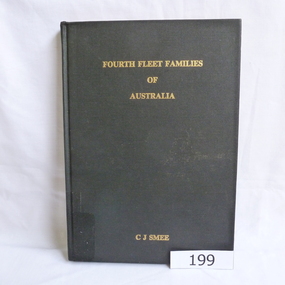
Book, Fourth Fleet families of Australia by C J Smee, 1992_
... australian convicts...Lists of the families of those convicts arriving in Australia in 1792....Lists of the families of those convicts arriving in Australia in 1792. australian convicts australia history convict ships pitt kitty royal admiral Yarra Plenty Regional Library Hard cover book, black cover with gold writing. ...Lists of the families of those convicts arriving in Australia in 1792.Hard cover book, black cover with gold writing. Pages not numbered. Yarra Plenty Regional Libraryaustralian convicts, australia history, convict ships, pitt, kitty, royal admiral -
 Warrnambool and District Historical Society Inc.
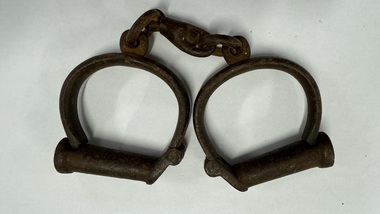
Functional object - Shackles, Metal Shackles, 22/05/2025
... ...Australian convicts...In earlier times in Australia it was common for convicts to be shackled both as a form of restraint and as a punishment. ...While these particular shackles have no known provenance, they remain as a powerful reminder of convict days in the early days of white settlement in Australia where convicts endured harsh and often cruel conditions. shackles warrnambool history Convict Australian convicts prison restraints These are cast iron metal circular rings D shaped with a lockable straight side and linked by a chain. ...Shackles were used as restraint with people who had been arrested. In earlier times in Australia it was common for convicts to be shackled both as a form of restraint and as a punishment. This set has no known provenance . While these particular shackles have no known provenance, they remain as a powerful reminder of convict days in the early days of white settlement in Australia where convicts endured harsh and often cruel conditions.These are cast iron metal circular rings D shaped with a lockable straight side and linked by a chain.shackles, warrnambool history, convict, australian convicts, prison restraints -
 Bendigo Historical Society Inc.
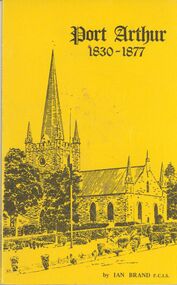
Book - STRAUCH COLLECTION: PORT ARTHUR 1830 - 1877
... ...Australian...convicts...HISTORY Australian convicts Tasmania-history-convicts-Port Arthur Ian Brand Port Arthur 1830 - 1877 by Ian Brand published by Jason Publications Tasmania, soft cover 77 pages with black & white photographs, illustration and maps. ...Port Arthur 1830 - 1877 by Ian Brand published by Jason Publications Tasmania, soft cover 77 pages with black & white photographs, illustration and maps.Ian Brandhistory, australian, convicts, tasmania-history-convicts-port arthur -
 Bendigo Historical Society Inc.
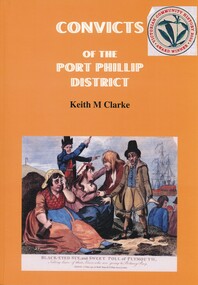
Book - CONVICTS OF THE PORT PHILLIP DISTRICT, 1999
... convicts...Australian history...Convicts of the Port Phillip district is a substantial addition to the books about convicts in Australia. The first part is a detailed account of convict settlement in Australia, the second part detailed information about each individual convict....AUSTRALIA History convicts Australian history Victorian history Family history. ...Convicts of the Port Phillip district is a substantial addition to the books about convicts in Australia. The first part is a detailed account of convict settlement in Australia, the second part detailed information about each individual convict.Keith M Clarkeaustralia, history, convicts, australian history, victorian history, family history. -
 Lakes Entrance Historical Society
Book, Braddon Russell, Images of Australia as seen by Russell Bradden, 1988
... A controversial account of the history of Australia from convict settlement to the Bi-Centennial Year...Social History Politics Aboriginals A controversial account of the history of Australia from convict settlement to the Bi-Centennial Year Images of Australia as seen by Russell Bradden Book Braddon Russell ...A controversial account of the history of Australia from convict settlement to the Bi-Centennial Yearsocial history, politics, aboriginals -
Unions Ballarat
Select Documents in Australian History 1788-1850, 1950
... ...australian settlement...convicts...Economic and social conditions Constitution, land, economic and social history pertinent to the period 1788-1850. australian history btlc ballarat regional trades and labour council cmh clark manning clark economics social policy crime australian settlement convicts migration lands squatters constitution land Previous owner's name and pencil notes on front page. ...Australian history 1788-1850 Table of contents: 1. The British background 2. The first settlements 3. Transportation 4. Immigration 5. Land policy 6. The squatters 7. Constitutional history 8. Economic and social conditionsConstitution, land, economic and social history pertinent to the period 1788-1850.Hardback; book.Previous owner's name and pencil notes on front page. Cover: authors' names and title.australian history, btlc, ballarat regional trades and labour council, cmh clark, manning clark, economics, social policy, crime, australian settlement, convicts, migration, lands, squatters, constitution, land -
 Sunshine and District Historical Society Incorporated
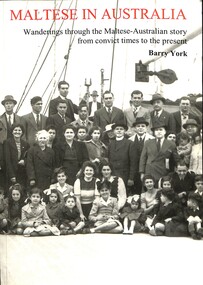
Book - Maltese in Australia, Barry York, Wandering through the Maltese - Australian story from convict times to the present
... Maltese in Australia - Wandering through the Maltese - Australian story from convict times to the present...Specific references to Sunshine on pages 3, 31, 41, 53, 70, 72, 77, 78, 79, 137 Maltese in Australia - Wandering through the Maltese - Australian story from convict times to the present Soft cover book with photo on front Wandering through the Maltese - Australian story from convict times to the present Book Maltese in Australia Barry York ...Reflections on the life of people from Malta immigrating to Australia. Specific references to Sunshine on pages 3, 31, 41, 53, 70, 72, 77, 78, 79, 137Soft cover book with photo on frontReflections on the life of people from Malta immigrating to Australia. Specific references to Sunshine on pages 3, 31, 41, 53, 70, 72, 77, 78, 79, 137maltese, migration, immigration -
 Warrnambool and District Historical Society Inc.
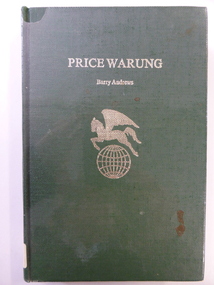
Book, Twayne Publishers, Price warung - Barry Andrews, 1976
... He worked for a great number of newspapers throughout Australia and began an association with the Sydney ‘Bulletin’ in 1890. At this time he wrote the powerful works for which he is best remembered – ‘Convict Days’, four volumes of stories about Australia’s convict period. ...He worked for a great number of newspapers throughout Australia and began an association with the Sydney ‘Bulletin’ in 1890. At this time he wrote the powerful works for which he is best remembered – ‘Convict Days’, four volumes of stories about Australia’s convict period. ...This is a biography of Price Warung by Barry Andrews. Price Warung (1854-1911), whose real name was William Astley, has a place in Australia’s history as a journalist, writer and campaigner for Federation. He worked for a great number of newspapers throughout Australia and began an association with the Sydney ‘Bulletin’ in 1890. At this time he wrote the powerful works for which he is best remembered – ‘Convict Days’, four volumes of stories about Australia’s convict period. The major theme of these stories is the sordid nature of the convict system. Astley became heavily involved with the Federation campaign, firstly as the Secretary of the Bathurst Federal League and then as the organizing Secretary of the 1896 Bathurst Convention. This convention is considered by historians to have given the Federation campaign a new and vigorous vitality. In 1898 Astley wrote most of the official articles publicizing the ‘Yes’ vote in the Federation referendum. Astley lived and worked in Warrnambool in 1883/4 (for about twelve months) as a journalist for the Warrnambool ‘Standard’. This book is of great interest as it documents the life of Price Warung (William Astley) who features in the history of Warrnambool journalism as an Australian writer of note who also wrote for the Warrnambool Standard. Examples of Astley’s journalism can be found in the Warrnambool Standards of 1883/4. He wrote lengthy articles in a free-flowing and attractive but verbose style. His two articles on the well-known horse stud and hop farm called ‘Bryan O’Lynn’ appeared in the Standard in October 1884. This is a hard cover book of 197 pages. It has a dark green cover with an image of a world globe and a Pegasus on the front. The printed title, the author’s name and the images are in gold print. The cover has a plastic overlay and a library label had been mostly removed from the bottom section of the spine. The book has notes on the author, a photograph of Price Warung, a Preface, Acknowledgements, Chronology, eight chapters on Price Warung, Notes and References, a Bibliography and an Index. Inside front page: ‘Jane Carpenter’ Stamp: ‘Withdrawn from Library’ price warung (william astley), warrnambool and federation, federation movement in australia, history of warrnambool, warrnambool standard, william astley -
Canterbury History Group
Article, Schulz, Matthew, How felons fell of our list, 18/02/2002 12:00:00 AM
... Article from the Progress Leader, 18 February 2002, on Canterbury historian Robin Da Costa- Adams' latest book "Address with signatories" reporting on the part played by women settlers in ending the shipping of convicts to Australia....Canterbury Authors Convicts History Da Costa-Adams> Robin Local Historians Article from the Progress Leader, 18 February 2002, on Canterbury historian Robin Da Costa- Adams' latest book "Address with signatories" reporting on the part played by women settlers in ending the shipping of convicts to Australia. How felons fell of our list Article Schulz, Matthew ...Article from the Progress Leader, 18 February 2002, on Canterbury historian Robin Da Costa- Adams' latest book "Address with signatories" reporting on the part played by women settlers in ending the shipping of convicts to Australia.canterbury, authors, convicts, history, da costa-adams> robin, local historians -
 Ballarat Heritage Services
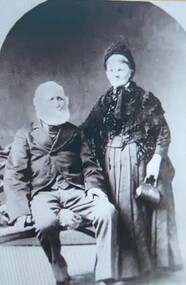
Photograph, George Ind and Ann Neagle
... George Ind arrived in Australia as a Pentonvillian convict or exile. He married Ellen Neagle who was an Irish orphan who sailed to Australia in 1849 on the Pemberton....George Ind arrived in Australia as a Pentonvillian convict or exile. He married Ellen Neagle who was an Irish orphan who sailed to Australia in 1849 on the Pemberton. ...George Ind arrived in Australia as a Pentonvillian convict or exile. He married Ellen Neagle who was an Irish orphan who sailed to Australia in 1849 on the Pemberton.Black and white photograph of George Ind and Ellen Neaglegeorge ind, ellen neagle, ellen ind, exile, pentonvillian, irish orphan -
 Warrnambool and District Historical Society Inc.
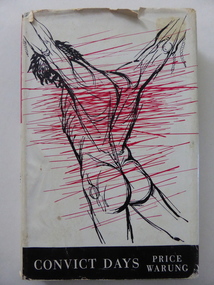
Book, Convict Days, 1960
... In this period he write the powerful works for which he is best known, ‘Convict Days’, a series of four volumes of stories about Australia’s convict system. The major theme of these writings is the sordid nature of the convict system. ...In this period he write the powerful works for which he is best known, ‘Convict Days’, a series of four volumes of stories about Australia’s convict system. The major theme of these writings is the sordid nature of the convict system. ...This book contains selections of the convict stories written by Price Warung, 1864-1911(real name William Astley). He was a journalist and writer who worked for a great number of newspapers throughout Australia and began an important association with the Sydney ‘Bulletin’ in 1890. In this period he write the powerful works for which he is best known, ‘Convict Days’, a series of four volumes of stories about Australia’s convict system. The major theme of these writings is the sordid nature of the convict system. Astley became heavily involved in the Federation campaign, firstly as the Secretary of the Bathurst Federal League and then as the organizing Secretary of the 1896 Bathurst Convention. This Convention is considered by historians to have given the Federation campaign a new and vigorous vitality. In 1898 Astley wrote most of the official articles publishing the ‘Yes’ case for the Federation referendum. In 1883 Astley was in Warrnambool, working as a journalist for the Warrnambool Standard newspaper and examples of his journalism can be found in the papers of this time. He wrote lengthy reports in a free-flowing and attractive but verbose style. His two articles on the well-known horse stud and hop farm called ‘Bryan O’Lynn’ appeared in the Standard in October 1884.This book is of considerable interest as it was written by Price Warung (William Astley). Not only is he of importance in Australia’s history but also he has his place in Warrnambool’s history as a journalist for the Warrnambool Standard in the 1880s. This is a hard cover book of 206 pages. The cover is grey with pink lettering on the spine. The dust cover is white with a black, white and red sketch of a convict on the front and a black and white photograph of the author and his biography on the back cover. The book contains an Introduction and thirteen stories by Price Warung. The dust cover is a little stained and torn. G Andersonprice warung (william astley), warrnambool standard, history of warrnambool -
Unions Ballarat
Book - Australian Labour History (D.J. Spiers Collection), Patmore, Gred
... Chapter headings: 1. Australian labour history 2. Convicts and free labour 1788-1850 3. ...Chapter headings: 1. Australian labour history 2. Convicts and free labour 1788-1850 3. ...Australian Industrial Relations series. Chapter headings: 1. Australian labour history 2. Convicts and free labour 1788-1850 3. A working man's paradise? Labour 1850-91 4. Labour and politics 1891-1957 5. Labour and the state: Compulsory arbitration and wages boards 1890-1914 6. Labour and capital: The labour process in Australia before 1972 7. Gender and work: Feminist labour historiography and equal pay in Australia 8. Race, ethnicity and work: Australia 1788-1972Significant to labour relations and unions in Australia.Book; paper.Front cover: Author's name and title. btlc, ballarat trades and labour council, history - labour -
 Eltham District Historical Society Inc
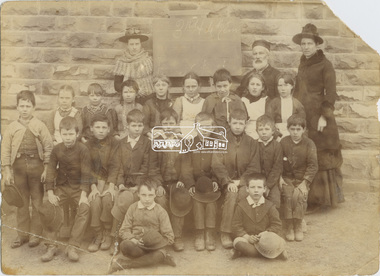
Photograph, 3rd and 4th Class, Eltham State School No. 209, c.1886
... Donated by May Smart, (c/o Pine Tree Village, 330 Springfield Road), student at Eltham State School 1915-1923, daughter of Alex Smart Alexander Wilson Smart, father of Edward Alexander and Alfred Francis abandoned his family and moved to Perth in Western Australia where he was convicted of bigamy and murder and sentenced to death by hanging. ...Donated by May Smart, (c/o Pine Tree Village, 330 Springfield Road), student at Eltham State School 1915-1923, daughter of Alex Smart Alexander Wilson Smart, father of Edward Alexander and Alfred Francis abandoned his family and moved to Perth in Western Australia where he was convicted of bigamy and murder and sentenced to death by hanging. ...Bottom seated row, right side end, Alex and Alfred (Tommy) Smart. Donated by May Smart, (c/o Pine Tree Village, 330 Springfield Road), student at Eltham State School 1915-1923, daughter of Alex Smart Alexander Wilson Smart, father of Edward Alexander and Alfred Francis abandoned his family and moved to Perth in Western Australia where he was convicted of bigamy and murder and sentenced to death by hanging. Photo used on the cover of "We did open a school in Little Eltham", Eltham Primary School (2006) David Clark Head Teacher 1855-1888 and Assistant, Catherine Clark, his sister. Note: Photo is a Class not Grade (examination level). Photo taken c. 1886. Edward Alexander Smart was May Smart's father and Alfred Francis Smart her Uncle - Tommy the MilkmanSepia photographic print mounted on card Details on reverse re donor and Smart children identifiedeltham, state school no. 209, dalton street, alex smart, alfred (tommy) smart, alfred francis (tommmy) smart, david clark, edward alexander (alex) smart, eltham primary school, may smart, victoria may kamm (nee smart), alfred francis (tommy) smart, catherine clark, david george clark, eltham state school, eltham state school no. 209 -
 Flagstaff Hill Maritime Museum and Village
Nail, circa 1810
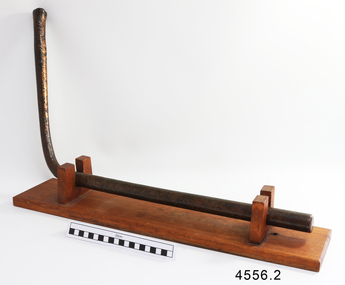
... She is also associated with Early Australian History and the transportation of convicts to Australia. ...This copper nail, sometimes known as a ‘Dumpy Bolt’ or spike, was salvaged from the hull of the wreck of the “George III”. It dates back to at least 1810. It was found by an abalone diver on the south east coast of Tasmania. The nail would have been used to hold the layers of the ship’s keel frame and the planking together. The nail has been passed from the abalone diver to an interested business man on a trip to the south of Hobart, on again to the business man’s close friend who then donated it to Flagstaff Hill Maritime Village. The metal of nails such as this one, after being in the sea for a long time, become affected by the natural reaction of the sea water, causing it to degenerate and thin, and the stress from the force of the sea over the years alters its shape. Iron nails had been used on ships previously, but they quickly corroded in the salt; ships needed regular, costly and time-consuming maintenance to replace the iron nails. Towards the end of the 18th century the British Navy trialled the use of copper nails, finding them to be very successful. Merchant ships began to adopt this process in the early 19th century, although it made ship building very expensive and was more often used for ships such as the “George III” that sailed on long voyages. The three masted sailing ship “George III” was a convict transport ship built in Deptford, England, in 1810. On 14th December 1834 she left Woolwich, England, bound for Hobart Town, Van Diemen’s Land (Tasmania), under Captain William Hall Moxey. She was carrying 220 male convicts plus crew, guards and their families, totalling 294 persons (another 2 were during the voyage). Amongst the cargo were military stores including several copper drums of gun powder. On 27th January 1835 the “George III” was near the Equator, about half way into her journey. A fire broke out and the gun powder was in danger of explosion, threatening the whole ship. Two convicts braved the heat and smoke, entered the store and seized the gun powder drums, suffering burns for their efforts but saving a probable disaster. The fire destroyed some of the provisions and food was scarce. Many became ill with scurvy and some died during the journey. Nearing the end of their journey on 10th April 1835 the “George III” was headed through the D'Entrecasteaux Channel, south east Tasmania, between the mainland and Bruny Island. She was sailing in the moonlit night to hasten her arrival in port due to the great number of sick on board. She struck uncharted rocks, known only to the local whalers, between Actaeon Reef and Southport Lagoon and within hours began to break up. The ship’s boats were used to first rescue the women and children. Firearms were used to help quell the panic of the convicts below decks and some were killed by the shots. Many convicts, including the sick, were drowned. In all, 133 lives were lost including 5 of the crew, guards and their families. It was the third worst shipping disaster in Tasmanian waters. A monument in honour of the prisoners who perished in the “George III” has been erected, noting the date of the wreck as “Friday 10th April 1835.” (NOTE: there are a few differences between sources regarding dates of the shipwreck, some saying March and others April 1835. There are also differences in the figures of those on board and the number of lives lost.) The copper nail is significant as an example of sailing ship construction; fasteners used in the early 19th century on ships carrying convicts to Australia. The nail is also significant for its association with the ship “George III”. The “George III” is registered on the Australian National Shipwreck Database, ID 7195 as an Historic Shipwreck. She is the third worst shipwreck in Tasmanian waters. She is also associated with Early Australian History and the transportation of convicts to Australia. The incident of the fire on board and the bravery of the convicts in making the gun powder safe is an example of the social character of the people in early Tasmanian colonisation. Copper nail (also called a Dumpy bolt or spike) from the convict ship George III, wrecked in 1835. Nail is long, bent in an ‘L’ shape about 3/5ths along, tapering from both ends to the bend. Both ends are flat and do not taper to a point, nor have a thread. The shorter end has been polished, showing bright copper. There is pitting along the nail and virdigris is evident on the longer, unpolished end. The nail is displayed with the longer section resting on a wooden board between two ‘U’ shaped uprights, the shorter section upright. flagstaff hill, warrnambool, shipwrecked coast, flagstaff hill maritime museum, maritime museum, shipwreck coast, flagstaff hill maritime village, great ocean road, george iii, ship construction, ship nail, 1835 shipwreck, 19th century shipwreck, william moxey, d'entrecasteaux channel, convict transportation, copper nail, dumpy bolt, spike, keel nail -
 Flagstaff Hill Maritime Museum and Village
Wood Sample, 1840
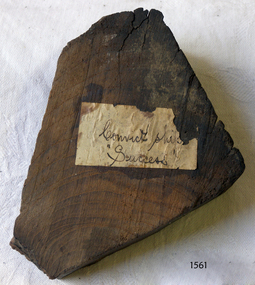
... convict hulk at Melbourne. The sailing ship “Success” was a teakwood vessel built in Natmoo (Natmaw), Tenasserim, Burma (now Myanmar) in 1840 for Cockerell & Co., Calcutta. Over its lifetime of 106 years, it was used to trade in the Indian subcontinent, to transport free emigrants to Australia, as a prison hulk in the Port of Melbourne for both hardened criminals, and later for women and boys, as a storage vessel for ammunition, a reformatory, and as a floating museum sent around the world to tell the tale of the convict era. ...convict hulk at Melbourne. The sailing ship “Success” was a teakwood vessel built in Natmoo (Natmaw), Tenasserim, Burma (now Myanmar) in 1840 for Cockerell & Co., Calcutta. Over its lifetime of 106 years, it was used to trade in the Indian subcontinent, to transport free emigrants to Australia, as a prison hulk in the Port of Melbourne for both hardened criminals, and later for women and boys, as a storage vessel for ammunition, a reformatory, and as a floating museum sent around the world to tell the tale of the convict era. ...This shipwreck artefact is a section of wood from the vessel “Success, a former immigrant ship, and later a convict hulk at Melbourne. The sailing ship “Success” was a teakwood vessel built in Natmoo (Natmaw), Tenasserim, Burma (now Myanmar) in 1840 for Cockerell & Co., Calcutta. Over its lifetime of 106 years, it was used to trade in the Indian subcontinent, to transport free emigrants to Australia, as a prison hulk in the Port of Melbourne for both hardened criminals, and later for women and boys, as a storage vessel for ammunition, a reformatory, and as a floating museum sent around the world to tell the tale of the convict era. During the time “Success” was used as a museum, pamphlets were distributed to paying customers advertising erroneously, that the “Success” was the oldest ship in the world. The “Success” sank and was re-floated twice: the first in Sydney in 1885, the second in the USA in 1918, before it was finally burned and sank July 4, 1946 in Lake Erie, near Sandusky, Ohio in 1946. Although the “Success” was home to prisoners while berthed in the Port of Melbourne, it was not used as convict transport. There has been speculation that Ned Kelly’s infamous armour was displayed on the “Success”, but this cannot be verified. Another link to Ned Kelly is Henry Johnson, an Irish prisoner on the Success, who was implicated in the murder of the ship’s warder, and later Johnson was supposedly a bushranger with Ned Kelly. It is also rumoured that Ned Kelly’s father John was a passenger on the Success, but this is also unverified. There are over 16 other ships named “Success”, although one in particular causes some confusion when researching “Success” in Australia. This other ship – the “HMS Success” was a 28 gun frigate built in1823, which was broken up in 1849. It also sailed to Australia. Statement of Significance: This piece of wood from the “Success” is connected to the ship Success, built in Burma in 1840. The “Success” is connected to the history of Australia because she was used as a merchant ship to transport immigrants to Australia, as a prison ship in Melbourne, a storage vessel, and as a floating “convict” museum, which travelled the world. Section of wood from ship “Success”. Wood appears to have been partially burnt, saw marks faintly visible on wood, remnant of a label with handwriting in black inklabel marked in script handwriting “Convict ship / “Success””flagstaff hill, warrnambool, shipwrecked-coast, flagstaff-hill, flagstaff-hill-maritime-museum, maritime-museum, shipwreck-coast, flagstaff-hill-maritime-village, sailing vessel success, wood sample of sailing ship success, cockerell & co. calcutta -
 Flagstaff Hill Maritime Museum and Village
Craft - Ship Model, Port Jackson Schooner
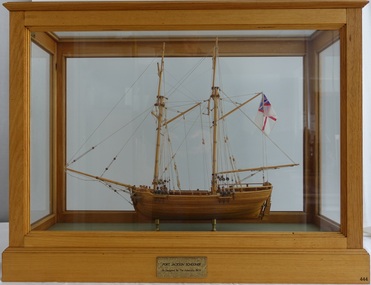
... Australia’s twenty dollar banknote since 1994. A sketch of the schooner is beside the portrait of Mrs Mary Reibey, who arrived as a convict and rose to become a respected and successful owner of a cargo shipping business. ...Australia’s twenty dollar banknote since 1994. A sketch of the schooner is beside the portrait of Mrs Mary Reibey, who arrived as a convict and rose to become a respected and successful owner of a cargo shipping business. ...This ship model is of a Colonial Port Jackson schooner, originally designed by the British Admiralty in 1803 as a response to the request of New South Wales' Governor Arthur Phillip. The drafts for the original plans are in Greenwich, UK, in the National Maritime Museum. The model is a Ledition edition, number 2 of 5, modelled by Bill Leonard. The model is rigged and decked in the manner of David McGregor. The flag on model of Port Jackson schooner is that of the British White Ensign which was used as the flag design of the Royal Australian Navy from 1911 - 1967. In 1785 the First Fleet arrived in the new British colony of Port Jackson (now Sydney Harbour) in New South Wales and Arthur Phillip was appointed as the first Governor. The following year Governor Phillip asked the English Royal Navy to provide drafts and materials for two ships for use in the Port Jackson colony for exploring and surveying rivers. The vessels needed a shallow draught and to be made from local cedar timber. He asked for the frames of the schooners to be provided along with shipwrights to assemble them. Many years later, in 1803, Governor Phillip’s request was fulfilled but he had already resigned from his post. The drafts titled ‘Schooner for Port Jackson’ were despatched by the Royal Navy from England to Australia. The original draft is still in the National Maritime Museum in Greenwich, UK. Meanwhile, the NSW Government had already built various other ships before 1803. In 1797 His Majesty’s Dockyard was opened at Port Jackson for building larger vessels. The Royal Navy’s 1803 design of a ‘Schooner for Port Jackson’ has been recognised on the obverse of Australia’s twenty dollar banknote since 1994. A sketch of the schooner is beside the portrait of Mrs Mary Reibey, who arrived as a convict and rose to become a respected and successful owner of a cargo shipping business. Her fleet included the Mercury, a schooner similar to the 1803 design for the Port Jackson schooner. Although the 1803 plans for a ‘Schooner for Port Jackson’ are commonly believed to be used for the first ship built in Australia, no records have been found of any ships being built according to these plans. However, it can be claimed that the plans were the ‘first Royal Navy plans made for a ship for use at Port Jackson, and to be built at Port Jackson, in Australia’. William (Bill) Leonard passed away on March 1st 1995.This ship model is significant for its representation of an early Australian colonial schooner. The 1803 Royal Navy’s plans for the colonial ‘Schooner for Port Jackson, were for the first ship specifically designed by the Royal Navy to be built and used in Port Jackson, for use in exploration and surveying of Australian ports and rivers. The plans are associated with Australia’s colonial settlement in the late 1700s. This ship model is significant for its association with the emblems of Australia’s history on the twenty dollar banknote. The colonial Port Jackson schooner is considered significant to Australian history, and represented on the 1994 twenty dollar banknote and its new version being rolled out in October 2019.Ship model of a colonial Port Jackson Schooner. Two-masted sailing ship displaying the flag named The British White Ensign. Mode of light coloured stained timberl is mounted on brass legs inside a glass case with timber frame and base. Metal engraved plaque states that the model is as designed by The Admiralty in 1803. Model is a number 2 of 5 in a limited edition, made by Bill Leonard.Engraved on metal plaque "PORT JACKSON SCHOONER / As Designed By The Admiralty. 1803"flagstaff hill, warrnambool, shipwrecked-coast, flagstaff-hill, flagstaff-hill-maritime-museum, maritime-museum, shipwreck-coast, flagstaff-hill-maritime-village, ship model port jackson schooner, sailing ship, limited edition model, model maker bill leonard, david mcgregor design, maritime trade, maritime vessel, colonial port jackson schooner, pacific island trade in early 1800s, sydney cove, governor arthur phillip, governor philip gidley king, a schooner for port jackson, national maritime museum greenwich, australian $20 banknote -
 Lara RSL Sub Branch
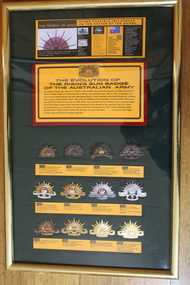
The Evolution of the Rising Sun Badge of the Australian Army, Captain D'arcy.2004, 2004
... Australia Arms' (named because of the motto inscription) became widely used in New South Wales and the neighbouring colonies by private corporations and individuals. Although they never had any official status, they formed the basis for several official coats of arms, including the New South Wales coat of arms. The representation below was reputedly painted for Thomas Silk, the son of the captain of the Prince of Orange, a convict...Australia Arms' (named because of the motto inscription) became widely used in New South Wales and the neighbouring colonies by private corporations and individuals. Although they never had any official status, they formed the basis for several official coats of arms, including the New South Wales coat of arms. The representation below was reputedly painted for Thomas Silk, the son of the captain of the Prince of Orange, a convict ...The origins of the rising sun badge are disputed. Rising sun designs had appeared on early Australian colonial coins and military insignia decades before the federation of the Australian colonies in 1901, and may have represented the image of Australia as 'a young nation' and a 'new Britannia'.[2] As early as the 1820s, the symbol of a 'rising sun' was used by various progressive organisations, loosely characterised under the banner "Advance Australia". The rising sun crest used in the New South Wales colonial and State crests was taken from the crest used on the first Advance Australia Arms, circa 1821, and consistently since then.[3] The oldest known example is the 'Advance Australia' coat of arms. The 'Advance Australia Arms' (named because of the motto inscription) became widely used in New South Wales and the neighbouring colonies by private corporations and individuals. Although they never had any official status, they formed the basis for several official coats of arms, including the New South Wales coat of arms. The representation below was reputedly painted for Thomas Silk, the son of the captain of the Prince of Orange, a convict ship that visited Sydney in 1821. The symbol struck a chord with the pre-federation population and many examples still exist on colonial architecture.[4] Proudly worn by soldiers of the 1st and 2nd Australian Imperial Force in both World Wars, the 'Rising Sun' badge has become an integral part of the digger tradition. The distinctive shape of the badge, worn on the upturned side of a slouch hat, is commonly identified with the spirit of Anzac.Glass covered Rectangular Picture Frame showing the Evolution of the Rising Sun Badge of the Australian Army.Gives a brief rundown on the Evolution of Rising Sun Badge with 12 examples and explanatory notes -
 Lara RSL Sub Branch
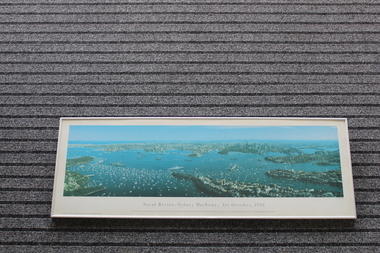
Framed Print of Naval Review,Sydney Harbour, 1st October,1988, Naval Review,Sydney Harbour, 1st October,1988, 12/01/1990
... Australia was celebrated in 1988. It marked 200 years since the arrival of the First Fleet of British convict ships at Sydney in 1788. ...Australia was celebrated in 1988. It marked 200 years since the arrival of the First Fleet of British convict ships at Sydney in 1788. ...The bicentenary of Australia was celebrated in 1988. It marked 200 years since the arrival of the First Fleet of British convict ships at Sydney in 1788. This aerial photo shows naval and pleasure craft in Sydney Harbour for the bicentennial celebrations.The bicentennial year marked Captain Arthur Phillip's arrival with the 11 ships of the First Fleet in Sydney Harbour in 1788, and the founding of the city of Sydney and the colony of New South Wales. 1988 is considered the official bicentenary year of the founding of Australia. Rectangular shaped glass covered picture frame showing photo of Naval Review, Sydney Harbour, 1st October,1988Naval Review, Sydney Harbour, 1st October,1988 This 140 degree panoramic photograph was taken from a helicopter by Phil Gray. It shows the visiting warships in the harbour including the USS New Jersey, FNS Colbert and HMS Ark Royal in the foreground.This print is the fourth in the Sydney Harbour Panorama series by Phil Gray who uses Kodak film.Printed in Australia.prints, naval photos, hms ships, sydney harbour, lara r.s.l. -
 Federation University Historical Collection
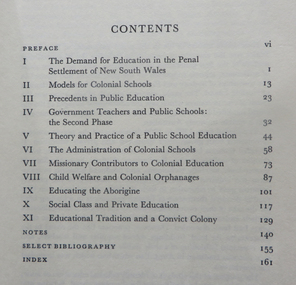
Book, John F. Cleverley, The First Generation: Schools and Society in Early Australia, 1971, 1971
... The book was part of the Ballarat Teachers' College Library. penal settlement education colonial education public education government teachers public school education school administration missions child welfare colonial orphanages aboriginal education private education convict colony Green hard covered book of 168 pages, with index. The First Generation: Schools and Society in Early Australia, 1971 Book John F. ...The book was part of the Ballarat Teachers' College Library.Green hard covered book of 168 pages, with index. penal settlement, education, colonial education, public education, government teachers, public school education, school administration, missions, child welfare, colonial orphanages, aboriginal education, private education, convict colony -
Federation University Historical Collection
Book, G. Quaife, Gold & Colonial Society: 1851-1870, 1975, 1975
... gold colonial eureka stockade diggings earl grey convicts immigration gold license gold license fee gold commission police law and order james scobie james bentley catherine bentley miners statistics average earnings of miners mining quartz crushing revenue gold yields state aid irish irish catholics Gold soft covered book Gold & Colonial Society: 1851-1870, 1975 Book Book G. Quaife Cassell Australia ...Gold soft covered book gold, colonial, eureka stockade, diggings, earl grey, convicts, immigration, gold license, gold license fee, gold commission, police, law and order, james scobie, james bentley, catherine bentley, miners statistics, average earnings of miners, mining, quartz crushing, revenue, gold yields, state aid, irish, irish catholics -
 Flagstaff Hill Maritime Museum and Village
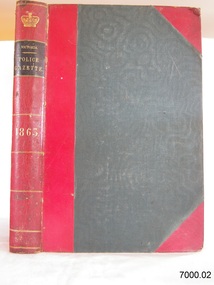
Administrative record - Reference Sociology/History, John Ferres, Government Printer, Victoria Police Gazettes for 1863, 1863
... Inclusions in this weekly publication were people wanted for questioning in relation to various crimes, prisoners discharged from city or country gaols, extracts from Police Gazettes in New South Wales, South Australia, Queensland, Tasmania, New Zealand, and occasionally overseas countries, as well as extracts from the Hobart Town Gazette listing escaped convicts and the person to whom they were assigned. ...The Victoria Police Gazette was a confidential, internal publication of the Victoria Police, issued to inform police officers, court and justice officials, and government departments about matters relevant to policing across the colony. It commenced in December 1853 and was initially published weekly by the Victoria Police. It was distributed each week to city and rural police stations and to government offices and newspaper publishers. Inclusions in this weekly publication were people wanted for questioning in relation to various crimes, prisoners discharged from city or country gaols, extracts from Police Gazettes in New South Wales, South Australia, Queensland, Tasmania, New Zealand, and occasionally overseas countries, as well as extracts from the Hobart Town Gazette listing escaped convicts and the person to whom they were assigned. There was also a "Missing Friends" section, where most people listed were not criminals but were sought by police so relatives, old friends, or government officials could renew contact with them. In addition, there was a record of deserted wives and children, listing the offender's name, birthplace, age, occupation, last known area of residence, likely future movements and known relatives. There was also a section on court lists, warrants issued, appointments and staffing changes within the police service, arrest and discharge records with physical descriptions, and lists of pastoralists with descriptions of their livestock brands.Hard Bound Volume. Victorian Police Gazettes for 1863 Author: Institutional Government Publication Publisher: John Ferres, Melbourne Date: 1863 Further Information: Compilation of Weekly Victorian Police Gazettes for 1863 in a hard bound volume with red spine and red corner reinforcing. Front panel grey coloured lettering in gilt with gilt banding to spine. Inside is twelve issues of the Police Gazettes for 1863.non-fictionThe Victoria Police Gazette was a confidential, internal publication of the Victoria Police, issued to inform police officers, court and justice officials, and government departments about matters relevant to policing across the colony. It commenced in December 1853 and was initially published weekly by the Victoria Police. It was distributed each week to city and rural police stations and to government offices and newspaper publishers. Inclusions in this weekly publication were people wanted for questioning in relation to various crimes, prisoners discharged from city or country gaols, extracts from Police Gazettes in New South Wales, South Australia, Queensland, Tasmania, New Zealand, and occasionally overseas countries, as well as extracts from the Hobart Town Gazette listing escaped convicts and the person to whom they were assigned. There was also a "Missing Friends" section, where most people listed were not criminals but were sought by police so relatives, old friends, or government officials could renew contact with them. In addition, there was a record of deserted wives and children, listing the offender's name, birthplace, age, occupation, last known area of residence, likely future movements and known relatives. There was also a section on court lists, warrants issued, appointments and staffing changes within the police service, arrest and discharge records with physical descriptions, and lists of pastoralists with descriptions of their livestock brands.warrnambool, shipwrecked-coast, flagstaff-hill, flagstaff-hill-maritime-museum, maritime-museum, shipwreck-coast, flagstaff-hill-maritime-village, shipwrecked-artefact, book, victoria police gazette 1862, victoria police gazette, warrnambool books and records, great ocean road -
 Flagstaff Hill Maritime Museum and Village
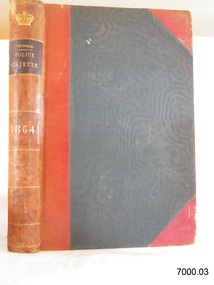
Administrative record - Reference Sociology/History, John Ferres, Government Printer, Victoria Police Gazettes for 1864, 1864
... Inclusions in this weekly publication were people wanted for questioning in relation to various crimes, prisoners discharged from city or country gaols, extracts from Police Gazettes in New South Wales, South Australia, Queensland, Tasmania, New Zealand, and occasionally overseas countries, as well as extracts from the Hobart Town Gazette listing escaped convicts and the person to whom they were assigned. ...The Victoria Police Gazette was a confidential, internal publication of the Victoria Police, issued to inform police officers, court and justice officials, and government departments about matters relevant to policing across the colony. It commenced in December 1853 and was initially published weekly by the Victoria Police. It was distributed each week to city and rural police stations and to government offices and newspaper publishers. Inclusions in this weekly publication were people wanted for questioning in relation to various crimes, prisoners discharged from city or country gaols, extracts from Police Gazettes in New South Wales, South Australia, Queensland, Tasmania, New Zealand, and occasionally overseas countries, as well as extracts from the Hobart Town Gazette listing escaped convicts and the person to whom they were assigned. There was also a "Missing Friends" section, where most people listed were not criminals but were sought by police so relatives, old friends, or government officials could renew contact with them. In addition, there was a record of deserted wives and children, listing the offender's name, birthplace, age, occupation, last known area of residence, likely future movements and known relatives. There was also a section on court lists, warrants issued, appointments and staffing changes within the police service, arrest and discharge records with physical descriptions, and lists of pastoralists with descriptions of their livestock brands.Hard Bound Volume. Victorian Police Gazettes for 1864 Author: Institutional Government Publication Publisher: John Ferres, Melbourne Date: 1864 Further Information: Compilation of Weekly Victorian Police Gazettes for 1864 in a hard bound volume with red spine and red corner reinforcing. Front panel grey coloured lettering in gilt with gilt banding to spine. Inside is twelve issues of the Police Gazettes for 1864.non-fictionThe Victoria Police Gazette was a confidential, internal publication of the Victoria Police, issued to inform police officers, court and justice officials, and government departments about matters relevant to policing across the colony. It commenced in December 1853 and was initially published weekly by the Victoria Police. It was distributed each week to city and rural police stations and to government offices and newspaper publishers. Inclusions in this weekly publication were people wanted for questioning in relation to various crimes, prisoners discharged from city or country gaols, extracts from Police Gazettes in New South Wales, South Australia, Queensland, Tasmania, New Zealand, and occasionally overseas countries, as well as extracts from the Hobart Town Gazette listing escaped convicts and the person to whom they were assigned. There was also a "Missing Friends" section, where most people listed were not criminals but were sought by police so relatives, old friends, or government officials could renew contact with them. In addition, there was a record of deserted wives and children, listing the offender's name, birthplace, age, occupation, last known area of residence, likely future movements and known relatives. There was also a section on court lists, warrants issued, appointments and staffing changes within the police service, arrest and discharge records with physical descriptions, and lists of pastoralists with descriptions of their livestock brands.warrnambool, shipwrecked-coast, flagstaff-hill, flagstaff-hill-maritime-museum, maritime-museum, shipwreck-coast, flagstaff-hill-maritime-village, shipwrecked-artefact, book, victoria police gazette 1862, victoria police gazette, warrnambool books and records, great ocean road -
 Flagstaff Hill Maritime Museum and Village
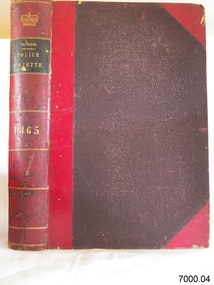
Administrative record - Reference Sociology/History, John Ferres, Government Printer, Victoria Police Gazettes for 1865, 1865
... Inclusions in this weekly publication were people wanted for questioning in relation to various crimes, prisoners discharged from city or country gaols, extracts from Police Gazettes in New South Wales, South Australia, Queensland, Tasmania, New Zealand, and occasionally overseas countries, as well as extracts from the Hobart Town Gazette listing escaped convicts and the person to whom they were assigned. ...The Victoria Police Gazette was a confidential, internal publication of the Victoria Police, issued to inform police officers, court and justice officials, and government departments about matters relevant to policing across the colony. It commenced in December 1853 and was initially published weekly by the Victoria Police. It was distributed each week to city and rural police stations and to government offices and newspaper publishers. Inclusions in this weekly publication were people wanted for questioning in relation to various crimes, prisoners discharged from city or country gaols, extracts from Police Gazettes in New South Wales, South Australia, Queensland, Tasmania, New Zealand, and occasionally overseas countries, as well as extracts from the Hobart Town Gazette listing escaped convicts and the person to whom they were assigned. There was also a "Missing Friends" section, where most people listed were not criminals but were sought by police so relatives, old friends, or government officials could renew contact with them. In addition, there was a record of deserted wives and children, listing the offender's name, birthplace, age, occupation, last known area of residence, likely future movements and known relatives. There was also a section on court lists, warrants issued, appointments and staffing changes within the police service, arrest and discharge records with physical descriptions, and lists of pastoralists with descriptions of their livestock brands.Hard Bound Volume. Victorian Police Gazettes for 1865 Author: Institutional Government Publication Publisher: John Ferres, Melbourne Date: 1865 Further Information: Compilation of Weekly Victorian Police Gazettes for 1865 in a hard bound volume with red spine and red corner reinforcing. Front panel grey coloured lettering in gilt with gilt banding to spine. Inside is twelve issues of the Police Gazettes for 1865.non-fictionThe Victoria Police Gazette was a confidential, internal publication of the Victoria Police, issued to inform police officers, court and justice officials, and government departments about matters relevant to policing across the colony. It commenced in December 1853 and was initially published weekly by the Victoria Police. It was distributed each week to city and rural police stations and to government offices and newspaper publishers. Inclusions in this weekly publication were people wanted for questioning in relation to various crimes, prisoners discharged from city or country gaols, extracts from Police Gazettes in New South Wales, South Australia, Queensland, Tasmania, New Zealand, and occasionally overseas countries, as well as extracts from the Hobart Town Gazette listing escaped convicts and the person to whom they were assigned. There was also a "Missing Friends" section, where most people listed were not criminals but were sought by police so relatives, old friends, or government officials could renew contact with them. In addition, there was a record of deserted wives and children, listing the offender's name, birthplace, age, occupation, last known area of residence, likely future movements and known relatives. There was also a section on court lists, warrants issued, appointments and staffing changes within the police service, arrest and discharge records with physical descriptions, and lists of pastoralists with descriptions of their livestock brands.warrnambool, shipwrecked-coast, flagstaff-hill, flagstaff-hill-maritime-museum, maritime-museum, shipwreck-coast, flagstaff-hill-maritime-village, shipwrecked-artefact, book, victoria police gazette 1862, victoria police gazette, warrnambool books and records, great ocean road -
 Flagstaff Hill Maritime Museum and Village
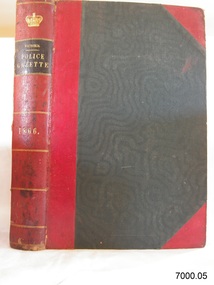
Administrative record - Reference Sociology/History, John Ferres, Government Printer, Victoria Police Gazettes for 1866, 1866
... Inclusions in this weekly publication were people wanted for questioning in relation to various crimes, prisoners discharged from city or country gaols, extracts from Police Gazettes in New South Wales, South Australia, Queensland, Tasmania, New Zealand, and occasionally overseas countries, as well as extracts from the Hobart Town Gazette listing escaped convicts and the person to whom they were assigned. ...The Victoria Police Gazette was a confidential, internal publication of the Victoria Police, issued to inform police officers, court and justice officials, and government departments about matters relevant to policing across the colony. It commenced in December 1853 and was initially published weekly by the Victoria Police. It was distributed each week to city and rural police stations and to government offices and newspaper publishers. Inclusions in this weekly publication were people wanted for questioning in relation to various crimes, prisoners discharged from city or country gaols, extracts from Police Gazettes in New South Wales, South Australia, Queensland, Tasmania, New Zealand, and occasionally overseas countries, as well as extracts from the Hobart Town Gazette listing escaped convicts and the person to whom they were assigned. There was also a "Missing Friends" section, where most people listed were not criminals but were sought by police so relatives, old friends, or government officials could renew contact with them. In addition, there was a record of deserted wives and children, listing the offender's name, birthplace, age, occupation, last known area of residence, likely future movements and known relatives. There was also a section on court lists, warrants issued, appointments and staffing changes within the police service, arrest and discharge records with physical descriptions, and lists of pastoralists with descriptions of their livestock brands.Hard Bound Volume. Victorian Police Gazettes for 1866 Author: Institutional Government Publication Publisher: John Ferres, Melbourne Date: 1866 Further Information: Compilation of Weekly Victorian Police Gazettes for 1866 in a hard bound volume with red spine and red corner reinforcing. Front panel grey coloured lettering in gilt with gilt banding to spine. Inside is twelve issues of the Police Gazettes for 1866.non-fictionThe Victoria Police Gazette was a confidential, internal publication of the Victoria Police, issued to inform police officers, court and justice officials, and government departments about matters relevant to policing across the colony. It commenced in December 1853 and was initially published weekly by the Victoria Police. It was distributed each week to city and rural police stations and to government offices and newspaper publishers. Inclusions in this weekly publication were people wanted for questioning in relation to various crimes, prisoners discharged from city or country gaols, extracts from Police Gazettes in New South Wales, South Australia, Queensland, Tasmania, New Zealand, and occasionally overseas countries, as well as extracts from the Hobart Town Gazette listing escaped convicts and the person to whom they were assigned. There was also a "Missing Friends" section, where most people listed were not criminals but were sought by police so relatives, old friends, or government officials could renew contact with them. In addition, there was a record of deserted wives and children, listing the offender's name, birthplace, age, occupation, last known area of residence, likely future movements and known relatives. There was also a section on court lists, warrants issued, appointments and staffing changes within the police service, arrest and discharge records with physical descriptions, and lists of pastoralists with descriptions of their livestock brands.warrnambool, shipwrecked-coast, flagstaff-hill, flagstaff-hill-maritime-museum, maritime-museum, shipwreck-coast, flagstaff-hill-maritime-village, shipwrecked-artefact, book, victoria police gazette 1862, victoria police gazette, warrnambool books and records, great ocean road -
 Flagstaff Hill Maritime Museum and Village
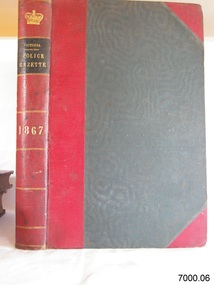
Administrative record - Reference Sociology/History, John Ferres, Government Printer, Victoria Police Gazettes for 1867, 1867
... Inclusions in this weekly publication were people wanted for questioning in relation to various crimes, prisoners discharged from city or country gaols, extracts from Police Gazettes in New South Wales, South Australia, Queensland, Tasmania, New Zealand, and occasionally overseas countries, as well as extracts from the Hobart Town Gazette listing escaped convicts and the person to whom they were assigned. ...The Victoria Police Gazette was a confidential, internal publication of the Victoria Police, issued to inform police officers, court and justice officials, and government departments about matters relevant to policing across the colony. It commenced in December 1853 and was initially published weekly by the Victoria Police. It was distributed each week to city and rural police stations and to government offices and newspaper publishers. Inclusions in this weekly publication were people wanted for questioning in relation to various crimes, prisoners discharged from city or country gaols, extracts from Police Gazettes in New South Wales, South Australia, Queensland, Tasmania, New Zealand, and occasionally overseas countries, as well as extracts from the Hobart Town Gazette listing escaped convicts and the person to whom they were assigned. There was also a "Missing Friends" section, where most people listed were not criminals but were sought by police so relatives, old friends, or government officials could renew contact with them. In addition, there was a record of deserted wives and children, listing the offender's name, birthplace, age, occupation, last known area of residence, likely future movements and known relatives. There was also a section on court lists, warrants issued, appointments and staffing changes within the police service, arrest and discharge records with physical descriptions, and lists of pastoralists with descriptions of their livestock brands.Hard Bound Volume. Victorian Police Gazettes for 1867 Author: Institutional Government Publication Publisher: John Ferres, Melbourne Date: 1867 Further Information: Compilation of Weekly Victorian Police Gazettes for 1867 in a hard bound volume with red spine and red corner reinforcing. Front panel grey coloured lettering in gilt with gilt banding to spine. Inside is twelve issues of the Police Gazettes for 1867.non-fictionThe Victoria Police Gazette was a confidential, internal publication of the Victoria Police, issued to inform police officers, court and justice officials, and government departments about matters relevant to policing across the colony. It commenced in December 1853 and was initially published weekly by the Victoria Police. It was distributed each week to city and rural police stations and to government offices and newspaper publishers. Inclusions in this weekly publication were people wanted for questioning in relation to various crimes, prisoners discharged from city or country gaols, extracts from Police Gazettes in New South Wales, South Australia, Queensland, Tasmania, New Zealand, and occasionally overseas countries, as well as extracts from the Hobart Town Gazette listing escaped convicts and the person to whom they were assigned. There was also a "Missing Friends" section, where most people listed were not criminals but were sought by police so relatives, old friends, or government officials could renew contact with them. In addition, there was a record of deserted wives and children, listing the offender's name, birthplace, age, occupation, last known area of residence, likely future movements and known relatives. There was also a section on court lists, warrants issued, appointments and staffing changes within the police service, arrest and discharge records with physical descriptions, and lists of pastoralists with descriptions of their livestock brands.warrnambool, shipwrecked-coast, flagstaff-hill, flagstaff-hill-maritime-museum, maritime-museum, shipwreck-coast, flagstaff-hill-maritime-village, shipwrecked-artefact, book, victoria police gazette 1862, victoria police gazette, warrnambool books and records, great ocean road -
 Flagstaff Hill Maritime Museum and Village
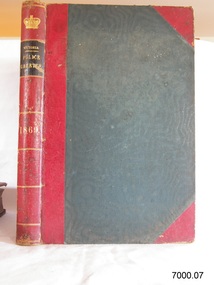
Administrative record - Reference Sociology/History, John Ferres, Government Printer, Victoria Police Gazettes for 1869, 1869
... Inclusions in this weekly publication were people wanted for questioning in relation to various crimes, prisoners discharged from city or country gaols, extracts from Police Gazettes in New South Wales, South Australia, Queensland, Tasmania, New Zealand, and occasionally overseas countries, as well as extracts from the Hobart Town Gazette listing escaped convicts and the person to whom they were assigned. ...The Victoria Police Gazette was a confidential, internal publication of the Victoria Police, issued to inform police officers, court and justice officials, and government departments about matters relevant to policing across the colony. It commenced in December 1853 and was initially published weekly by the Victoria Police. It was distributed each week to city and rural police stations and to government offices and newspaper publishers. Inclusions in this weekly publication were people wanted for questioning in relation to various crimes, prisoners discharged from city or country gaols, extracts from Police Gazettes in New South Wales, South Australia, Queensland, Tasmania, New Zealand, and occasionally overseas countries, as well as extracts from the Hobart Town Gazette listing escaped convicts and the person to whom they were assigned. There was also a "Missing Friends" section, where most people listed were not criminals but were sought by police so relatives, old friends, or government officials could renew contact with them. In addition, there was a record of deserted wives and children, listing the offender's name, birthplace, age, occupation, last known area of residence, likely future movements and known relatives. There was also a section on court lists, warrants issued, appointments and staffing changes within the police service, arrest and discharge records with physical descriptions, and lists of pastoralists with descriptions of their livestock brands.Hard Bound Volume. Victorian Police Gazettes for 1869 Author: Institutional Government Publication Publisher: John Ferres, Melbourne Date: 1869 Further Information: Compilation of Weekly Victorian Police Gazettes for 1869 in a hard bound volume with red spine and red corner reinforcing. Front panel grey coloured lettering in gilt with gilt banding to spine. Inside is twelve issues of the Police Gazettes for 1869.non-fictionThe Victoria Police Gazette was a confidential, internal publication of the Victoria Police, issued to inform police officers, court and justice officials, and government departments about matters relevant to policing across the colony. It commenced in December 1853 and was initially published weekly by the Victoria Police. It was distributed each week to city and rural police stations and to government offices and newspaper publishers. Inclusions in this weekly publication were people wanted for questioning in relation to various crimes, prisoners discharged from city or country gaols, extracts from Police Gazettes in New South Wales, South Australia, Queensland, Tasmania, New Zealand, and occasionally overseas countries, as well as extracts from the Hobart Town Gazette listing escaped convicts and the person to whom they were assigned. There was also a "Missing Friends" section, where most people listed were not criminals but were sought by police so relatives, old friends, or government officials could renew contact with them. In addition, there was a record of deserted wives and children, listing the offender's name, birthplace, age, occupation, last known area of residence, likely future movements and known relatives. There was also a section on court lists, warrants issued, appointments and staffing changes within the police service, arrest and discharge records with physical descriptions, and lists of pastoralists with descriptions of their livestock brands.warrnambool, shipwrecked-coast, flagstaff-hill, flagstaff-hill-maritime-museum, maritime-museum, shipwreck-coast, flagstaff-hill-maritime-village, shipwrecked-artefact, book, victoria police gazette 1862, victoria police gazette, warrnambool books and records, great ocean road -
 City of Moorabbin Historical Society (Operating the Box Cottage Museum)
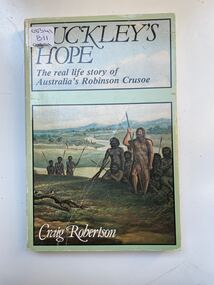
Book, Globe Press Pty. Ltd, Buckley's hope : the story of Australia's wild white man, 1981
... convicts indigenous tribes. On the third page there are five lines of text on the next page is a map of Southern Victoria listing the different indigenous tribes that lived from Port Phillip Bay west to Cape Otway on the next page there is another map showing Van Dieman's land in the South,Victoria and the South Australian border to the West and the Victorian N.S.W. border up to the Lachlan River in the north. ...A small soft cover book with a blue/green cover,on the front cover is a painting of early Australia with Indigenous Australians hunting with spears alongside them is a European with long unkept hair and a beard dressed in animal skins,on the back cover is text by the author giving a brief outline of the book.buckley, sorrento, robinson crusoe, port phillip, van diemen's land, colonialism, 1840, convicts, indigenous tribes. -
 City of Moorabbin Historical Society (Operating the Box Cottage Museum)
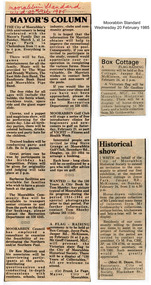
Photograph, Newspaper article, 'Reconstruction Box Cottage' Flag Ceremony 1985, 1985
... As such, it is an invaluable resource for students and all kinds of visitors. brighton, moorabbin, highett, ormond, mckinnon, cottages, pioneers, colonial, dendy henry, box william, box elizabeth, reitman william, convicts lewis timber co. ltd., deam h, smith arthur, museums, box alonzo, moody & smith builders highett, the moorabbin standard newspaper, the leader newspaper pty ltd., fox max , lewis laurie, moorabbin city council, national trust, connard geoff mlc, lawson geoff mlc, le page frank mayor city of moorabbin australian flag victorian state flag goldworthy mr; Written on clippings a) , b) ; Moorabbin Standard / Wed. 20th Feb. 1985 3 x clippings from The Moorabbin Standard Newspaper, Wednesday 20th February 1985, reporting the Flag Raising Ceremony to be held on Sunday 24th February 1985 at Box Cottage Joyce Park, Jasper Road, McKinnon ( now Ormond). ...The original small, pioneer cottage was built in the late 1840s to early1850s, by an unknown pioneer. It was located on part of a 30 Acre allotment that was originally part of Dendy’s Special Survey granted in 1841. The doors and window sashes, (made of red deal joinery timber), as well as the brass locks and fittings, are from the original cottage, and were imported from England. The fire-place bricks are from the original cottage, and are sun-dried, (not kiln fired), and are hand-made. Convict marks can be seen on two bricks. There is a small display of external cladding shingles from the original pioneer cottage. These shingles were hand-split, and most likely made from locally collected timber The nails included in this display were used to fasten the shingles on the original cottage, and are also hand-made. The cottage was occupied by William Box and family from 1865 until 1914 when it was sold to William Reitman who resided there until 1950. The enamel nameplate, “Colonial”, on the wall of the cottage, was the name chosen for the original pioneer cottage by Mr William Reitman, when he purchased the property in around 1915, for 1200 Pounds approximately. In 1974 Mr Lewis, a timber specialist, found the dilapidated building on property he had recently purchased in Jasper Rd and suggested it be reconstructed and relocated. Moorabbin Council agreed and the cottage was rebuilt just about 250 metres from its original site. The cost of the rebuild was met by 'Victoria's 150th Committee, plus a small grant from the City of Moorabbin, and Mr Laurie Lewis donated much of the timber for the reconstruction. The re-constructed cottage plan has followed faithfully the original dimensions, and plan of the original pioneer cottage, and as many original items from that cottage’s long occupation have been incorporated. The photographs in Album 1 record the progress of the reconstruction from February 1984 to the First Public Open Day November 18th 1984 and this Flag Raising Ceremony February 24th 1985. See MAV 01017 for photographs of this event.These 3 Newspaper clippings refer to the Flag Raising Ceremony to be held on February 24th 1985 at the 'Reconstructed Box Cottage' in McKinnon. The Moorabbin Standard Newspaper was the local paper for the City of Moorabbin during the 20th Century until it was absorbed into The Leader Newspaper Group Ltd. Mrs H. Deam and Mr A. Smith, CMHS members, took kept these reports to record the progress of the ‘Reconstruction’ from February 1984 to November 1984 and this event in 1985. Although 'Box Cottage' is a re-construction, it is an unique museum that, being located in the midst of a modern community in Ormond Victoria, can educate and demonstrate many aspects of the early settler’s way of life in Victoria. As such, it is an invaluable resource for students and all kinds of visitors. 3 x clippings from The Moorabbin Standard Newspaper, Wednesday 20th February 1985, reporting the Flag Raising Ceremony to be held on Sunday 24th February 1985 at Box Cottage Joyce Park, Jasper Road, McKinnon ( now Ormond). a) Paragraph in Mayor's Column by Cr Frank Le Page, Mayor City of Moorabbin, CMHS member ; b) Letters to the Editor Section " Historical Show " by Mrs H Deam, CMHS Secretary ; c) 'What's On Section' paragraph ' Box Cottage '.Written on clippings a) , b) ; Moorabbin Standard / Wed. 20th Feb. 1985brighton, moorabbin, highett, ormond, mckinnon, cottages, pioneers, colonial, dendy henry, box william, box elizabeth, reitman william, convicts lewis timber co. ltd., deam h, smith arthur, museums, box alonzo, moody & smith builders highett, the moorabbin standard newspaper, the leader newspaper pty ltd., fox max , lewis laurie, moorabbin city council, national trust, connard geoff mlc, lawson geoff mlc,, le page frank mayor city of moorabbin, australian flag, victorian state flag, goldworthy mr; -
Glenelg Shire Council Cultural Collection
Souvenir - Tea Towel, Bicentennial Portland Tea Towel, c. 1988
... Australia was celebrated in 1988. It marked 200 years since the arrival of the First Fleet of British convict ships at Sydney in 1788....Australia was celebrated in 1988. It marked 200 years since the arrival of the First Fleet of British convict ships at Sydney in 1788. bicentennial tall ships 1988 Tea towel, white linen/cotton. ...The bicentenary of Australia was celebrated in 1988. It marked 200 years since the arrival of the First Fleet of British convict ships at Sydney in 1788.Tea towel, white linen/cotton. Souvenir of Australian. Visit by Tall Ships. Brown 'rope' circle surrounding black and white tall ship. 'Australia' in yellow above circle, 'visit by the tall ships' beneath. 'PORTLAND VICTORIA' in blue, beneath this and 'Feb-March '88" beneath that. Top left corner ships wheel, top right, bell, bottom left, compass, right anchor - all surrounded by thin brown 'rope'.bicentennial, tall ships, 1988 -
 City of Moorabbin Historical Society (Operating the Box Cottage Museum)
Badge - Bicentennial Lapel Pin c.1988
... Australia was celebrated in 1988. It marked 200 years since the arrival of the First Fleet of British convict ships at Sydney in 1788. ...Australia was celebrated in 1988. It marked 200 years since the arrival of the First Fleet of British convict ships at Sydney in 1788. ...The bicentenary of Australia was celebrated in 1988. It marked 200 years since the arrival of the First Fleet of British convict ships at Sydney in 1788. The bicentennial year marked Captain Arthur Phillip’s arrival with the 11 ships of the First Fleet in Sydney Harbour in 1788, and the founding of the city of Sydney and the colony of New South Wales. 1988 is considered the official bicentenary year of the founding of Australia.A Souvenir of the Australian Bicentennial Celebration in 1988enamel metal pinaustralia bicentenary, captain arthur phillip, city of moorabbin historical society, moorabbin, cheltenham, bentleigh, early settlers, henry dendy special survey 1840.
