
Showing 47 items matching "australian cyclist"
-
 Federation University Historical Collection
Magazine, Various car magazines
... Australian Cyclist....1 Green covered The Australian Cyclist and tourist traveller July 1899 .2 Tan covered Austral Wheel cycling magazine May 1898 .3 Early Australian Motor Cars - Restored Cars Jan/Feb 1974 .4 Ballarat Swap 1990 - Restored Cars .5 Bicycles to Motorcars The Australian Way - Restored Cars Jan-Feb 1976 .6 The Veteran Car Club Gazette...Henry Sutton taught Applied Electricity at the Ballarat School of Mines in 1883 to 1886. Australian Cyclist Electra mr h. sutton and his work Austral Wheel Messrs. ...Various car magazines with articles relating to the Sutton Car..1 Green covered The Australian Cyclist and tourist traveller July 1899 .2 Tan covered Austral Wheel cycling magazine May 1898 .3 Early Australian Motor Cars - Restored Cars Jan/Feb 1974 .4 Ballarat Swap 1990 - Restored Cars .5 Bicycles to Motorcars The Australian Way - Restored Cars Jan-Feb 1976 .6 The Veteran Car Club Gazettenon-fictionVarious car magazines with articles relating to the Sutton Car.australian cyclist, electra, mr h. sutton and his work, austral wheel, messrs. sutton motorcycle, early australian motor cars, restored cars, sutton eco, ballarat swap 1990, the inventive genius of henry sutton, max gregory, sutton tandem motor-bicycle, suttons cycle agency, bicycles to motorcars, the australian way -
 Torquay and District Historical Society
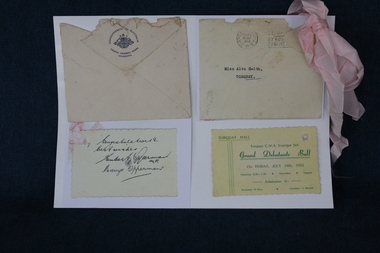
Ephemera - Ticket, Debutante Ball, 1952
... Sir Hubert Opperman (1904-1996) was an Australian cyclist and politician whose endurance cycling feats in the 1920s and 1930s earned him international acclaim. ...Sir Hubert Opperman (1904-1996) was an Australian cyclist and politician whose endurance cycling feats in the 1920s and 1930s earned him international acclaim. ...Sir Hubert Opperman (1904-1996) was an Australian cyclist and politician whose endurance cycling feats in the 1920s and 1930s earned him international acclaim. In 1949 he was elected to the Parliament of Australia for the Victorian electorate of Corio and held the seat for 17 years.Card for debutante ball held at Torquay Hall on Friday July 18th, 1952. Cream card with green typeface, scalloped edge. It is signed on the back by Hubert Opperman MP and Mavys Opperman. There is also an envelope addressed to Miss Alva Smith, Torquay with a government stamp on the back in blue ink and postmarked 21 July 1952.Commonwealth of Australia Federal Members Rooms Melbourne -
 Eltham District Historical Society Inc
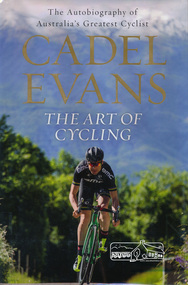
Book, Cadel Evans: the art of cycling, 2016
... The autobiography of "Australia's greatest cyclist" Cadel Evans. He is one of only two non-Europeans to have won the Tour de France (bike race), which he won in 2011. ...The autobiography of "Australia's greatest cyclist" Cadel Evans. He is one of only two non-Europeans to have won the Tour de France (bike race), which he won in 2011. ...The autobiography of "Australia's greatest cyclist" Cadel Evans. He is one of only two non-Europeans to have won the Tour de France (bike race), which he won in 2011. Cadel Evans spent much of his youth growing up in the rural area of the Shire of NillumbikHardbackracing cyclist, olympian, athlete, cadel evans, autobiography -
 Geelong Cycling Club
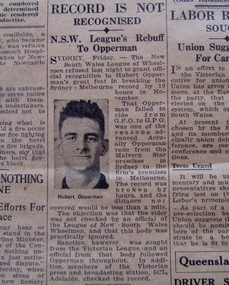
Newspaper - Article, Newspaper, 18 January 1930
... Sir Hubert Opperman (1904-1996) was an Australian politician and cyclist, whose endurance cycling feats in 1920s and 1930s earned him international acclaim. ...Sir Hubert Opperman (1904-1996) was an Australian politician and cyclist, whose endurance cycling feats in 1920s and 1930s earned him international acclaim. ...Sir Hubert Opperman (1904-1996) was an Australian politician and cyclist, whose endurance cycling feats in 1920s and 1930s earned him international acclaim. He competed in many international races including the Tour de France.Sir Hubert Opperman was award the OBE whose cycling feats earned him international acclaim.Newspaper article printed in the Sun News-Pictorial, Saturday, January 18, 1930. Article includes Hubert Opperman's photo together with a description of his cycling record ride from Sydney to Melbourne.geelong cycling club; sir hubert opperman; tour de france; newspaper article. -
 Bendigo Historical Society Inc.
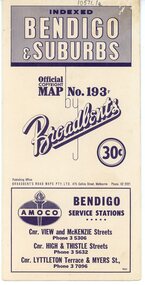
Map - Three Road Maps of Bendigo, 1962
... He established records for all distances between 130 and 220 miles (209 and 354 km), and for all times between 8 and 12 hours, at the Exhibition Grounds track in May 1894, and road records for 50 and 100 miles (80 and 161 km) in October 1896. The Australian Cyclist acknowledged him 'the finest road rider that Australia has ever produced'. ...He established records for all distances between 130 and 220 miles (209 and 354 km), and for all times between 8 and 12 hours, at the Exhibition Grounds track in May 1894, and road records for 50 and 100 miles (80 and 161 km) in October 1896. The Australian Cyclist acknowledged him 'the finest road rider that Australia has ever produced'. ...George Robert Broadbent (1863-1947), cyclist and map publisher, was born on 3 November 1863 at Ashby near Geelong, Victoria, son of George Adam Broadbent, Lancashire-born draper, and his wife Elizabeth, née Ruffhead. When the family moved to North Melbourne Broadbent attended the Errol Street school, followed his father's trade, and became an early cycling and cycle-racing enthusiast. At various times Broadbent held most Victorian and Australian road records, and two of his performances on solid tyres—203 miles (327 km) in 24 hours on a penny farthing, and 100 miles (161 km) in 6 hours 20 minutes on a 'safety' bicycle—were never bettered. He established records for all distances between 130 and 220 miles (209 and 354 km), and for all times between 8 and 12 hours, at the Exhibition Grounds track in May 1894, and road records for 50 and 100 miles (80 and 161 km) in October 1896. The Australian Cyclist acknowledged him 'the finest road rider that Australia has ever produced'. A foundation councillor of the League of Victorian Wheelmen in October 1893, Broadbent contested the first Warrnambool-Melbourne race in 1895, and was active in the Good Roads Movement. Next year he issued a road map of Victoria, 'prepared … after some sixteen years riding and touring in all parts of the Colony', which indicated general topography, distances, and roads classified as 'good', 'fair' or 'ridden with difficulty'. It was to become Victoria's standard map, and the basis of a continuous publishing programme by Broadbent's Official Road Guides Co.Three Road Maps of Bendigo, Bendigo and Suburbs, Bendigo and Eaglehawk. Two fold out maps printed in colour and produced by Broadbent's Road Maps Pty. Ltd. 475 Collins Street Melbourne. One map printed by Bolton's Bendigo.history, bolton's, bendio broadbent maps -
 Marysville & District Historical Society
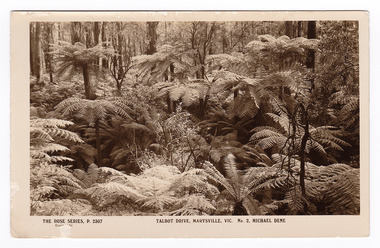
Postcard (item) - Black and white postcard, Rose Stereograph Company, Talbot Drive, Marysville, Vic. No. 2, Michael Dene, 1913-1967
... Australia as a souvenir of Marysville. A black and white photograph showing trees and tree ferns, taken along the Michaeldene Trail near Lady Talbot Drive in Marysville in Victoria. The Michaeldene Trail is a level two loop that leads to the Taggerty River Lookout and may be undertaken as either as a Short (2.7 km) Loop, or a Long (4.3 km) Loop - 30 minutes to one hour and a half. The attractive bushland linking the Steavenson and Taggerty Rivers allows walkers and cyclists ...A postcard in a series produced by the Rose Stereograph Company in Victoria, Australia as a souvenir of Marysville.A black and white photograph showing trees and tree ferns, taken along the Michaeldene Trail near Lady Talbot Drive in Marysville in Victoria. The Michaeldene Trail is a level two loop that leads to the Taggerty River Lookout and may be undertaken as either as a Short (2.7 km) Loop, or a Long (4.3 km) Loop - 30 minutes to one hour and a half. The attractive bushland linking the Steavenson and Taggerty Rivers allows walkers and cyclists to step back in time to Marysville’s historic logging past. Sections of this mostly flat circuit follow old tramline alignments, which in places reveal the original timber sleepers on which the big logs were transported to the nearby sawmill.The Taggerty River Lookout offers views over the Taggerty River. The Trestle Bridge was built to span a small gully and provide access to the timber on Red Hill. Lady Talbot Drive is a 24 kilometer scenic rainforest car journey which passes a number of walks and waterfalls in the Yarra Ranges National Park. Lady Talbot Drive is named after Lady Sarah Elizabeth, the wife of Sir Reginald Talbot, who was the Governor of Victoria from 25th April, 1904 to 6th July 1908. This postcard was produced by the Rose Stereograph Company as a souvenir of Marysville.REAL PHOTO POST CARD THE "ROSE"SERIES DE LUXE PRODUCED IN AUSTRALIA Published by "The Rose Stereographs" Armadale, Victoria.marysville, victoria, michael dene, michael dene track, p. 2307, walking track, rose series postcard, postcard, souvenir, lady talbot drive, sarah elizabeth talbot, sir reginald talbot -
 Marysville & District Historical Society
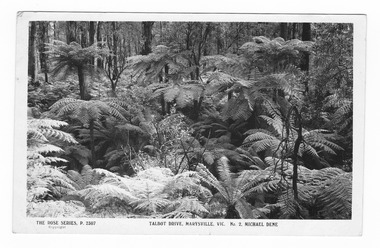
Postcard (item) - Black and white postcard, Rose Stereograph Company, Talbot Drive, Marysville, Vic. No. 2, Michael Dene, 1913-1967
... Australia as a souvenir of Marysville. A black and white photograph showing trees and tree ferns, taken along the Michaeldene Trail near Lady Talbot Drive in Marysville in Victoria. The Michaeldene Trail is a level two loop that leads to the Taggerty River Lookout and may be undertaken as either as a Short (2.7 km) Loop, or a Long (4.3 km) Loop - 30 minutes to one hour and a half. The attractive bushland linking the Steavenson and Taggerty Rivers allows walkers and cyclists ...A postcard in a series produced by the Rose Stereograph Company in Victoria, Australia as a souvenir of Marysville.A black and white photograph showing trees and tree ferns, taken along the Michaeldene Trail near Lady Talbot Drive in Marysville in Victoria. The Michaeldene Trail is a level two loop that leads to the Taggerty River Lookout and may be undertaken as either as a Short (2.7 km) Loop, or a Long (4.3 km) Loop - 30 minutes to one hour and a half. The attractive bushland linking the Steavenson and Taggerty Rivers allows walkers and cyclists to step back in time to Marysville’s historic logging past. Sections of this mostly flat circuit follow old tramline alignments, which in places reveal the original timber sleepers on which the big logs were transported to the nearby sawmill.The Taggerty River Lookout offers views over the Taggerty River. The Trestle Bridge was built to span a small gully and provide access to the timber on Red Hill. Lady Talbot Drive is a 24 kilometer scenic rainforest car journey which passes a number of walks and waterfalls in the Yarra Ranges National Park. Lady Talbot Drive is named after Lady Sarah Elizabeth, the wife of Sir Reginald Talbot, who was the Governor of Victoria from 25th April, 1904 to 6th July 1908.REAL PHOTO POST CARD THE "ROSE"SERIES DE LUXE PRODUCED IN AUSTRALIA Published by the Rose Stereographs Armadale, Victoria. Tomorrow is your Official day/ I believe. So Very Very many happy/ returns, & best of luck & good/ wishes from/ your May I rec'd this on/ 1st. (illegible)/ thought it a good snap of our ferns.marysville, victoria, michael dene, michael dene track, p. 2307, walking track, rose series postcard, postcard, souvenir, lady talbot drive, sarah elizabeth talbot, sir reginald talbot -
 Federation University Historical Collection
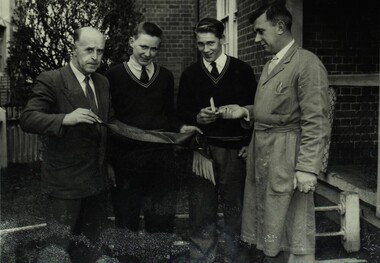
Photograph - Photograph - Black and White, Ballarat Technical School - Sports winners
... Australian team at the 1964 Tokyo Olympics and came 4th in the race, aged 18 years. In 1966 he went to the Commonwealth Games in Jamaica and won a Silver Medal at the Commonwealth Games in Edinburgh in 1970. Ray was Ballarat Sportsman's Club Sportsman-of-the-Year 1965/66 and inducted into their Hall of Fame. In 1965 Ray was Cyclist...Australian team at the 1964 Tokyo Olympics and came 4th in the race, aged 18 years. In 1966 he went to the Commonwealth Games in Jamaica and won a Silver Medal at the Commonwealth Games in Edinburgh in 1970. Ray was Ballarat Sportsman's Club Sportsman-of-the-Year 1965/66 and inducted into their Hall of Fame. In 1965 Ray was Cyclist ...Organised sport and clubs began in 1919 with the formation of the Junior Technical School Students' Association. Clubs included the Rifle Club, Wireless Club, Senior Cadet team, Photography Club and Bugle Band. Sport was the Associations main concern. The House system was developed and boys competed within this structure. In 1926 the North Central Junior Technical School Sports Association was formed. Students from the district competed against each other in football, cricket and tennis. The number of schools increased and more sports were introduced. Ballarat Junior Technical School was a strong competitor. Many ex-students made a mark in sport out of the Ballarat area. The photograph shows Ray Bilney - second from the left. Born 2 November 1945, Ray began cycling aged 10. In 1963 he was Australian Junior Road Champion. From 1964 to 1966 he was Australian Senior Road Champion. He was in the Australian team at the 1964 Tokyo Olympics and came 4th in the race, aged 18 years. In 1966 he went to the Commonwealth Games in Jamaica and won a Silver Medal at the Commonwealth Games in Edinburgh in 1970. Ray was Ballarat Sportsman's Club Sportsman-of-the-Year 1965/66 and inducted into their Hall of Fame. In 1965 Ray was Cyclist-of-the-Year and won the coveted Sir Hubert Opperman Trophy. In May 2013, Ray was inducted into the Victorian Cycling Hall-of-Fame. During his time at the Junior Technical School, he sporting abilities were evident and in 1961 he was Top Sportsman of the school. The same year he was one of eight boys chosen to be Prefects of the school. He is an Alumni of Federation University. Black and white photograph of two students and two teachers looking at a sash and medal won by the students. Second from the left is Ray Bilney.sport, clubs, rifle club, photography club, cadet team, bugle band, athletics carnival, victorian technical schools sports union, house system, wireless club, alumni, ray bilney, australian junior road champion, australian senior road champion, silver medal, olympic games, commonwealth games, cyclist-of-the-year, sir hubert opperman, trophy, sportsman-of-the-year, victorian cycling hall-of-fame, ballarat junior technical school student's association -
 Federation University Historical Collection
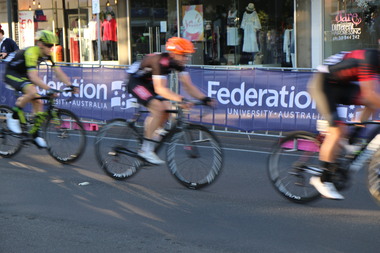
Photograph, Matthew Freeman, Federation University Cycling RoadNats Championships, 01/2018
... The event attracts riders from around the world. roadnats cycling federation university cycling australia ballarat sturt street ballarat bicycle Colour photographs of cyclists participating in RoadNats in Sturt Street Ballarat riding in front of a Federation University banner. ...The Federation University RoadNats Championships held in Ballarat from 03-07 January 2018. The event attracts riders from around the world. Colour photographs of cyclists participating in RoadNats in Sturt Street Ballarat riding in front of a Federation University banner. roadnats, cycling, federation university, cycling australia, ballarat, sturt street ballarat, bicycle -
Federation University Historical Collection
Book - Book - Scrapbook, Ballarat Institute of Advanced Education: Scrapbook of newspaper cutting, Book 9; April 1974 to September 1974
... Australian, The Herald. The cuttings cover the period from 29 April 1974 to 14 September 1974. ballarat institute of advanced education biae employment advertisements application for enrolment outline of courses election candidates for ballarat anne freeman engineer engineering interest for biae visitor library open to residents of ballarat biae in uni admission scheme $500 scholarship to philip brumley call to merge biae and teachers' college alp 'for the people' biae graduates in geelong ceremony cyclist western district colin smith bachelor of applied science degrees they favour biae men peter storey wins apprentice award campaign to recruit teachers geology students school plantations to be felled mini-computer chemistry students move to new building carol yates wins r w richards medal sister josepha caine profile-jack barker biae ceramics student lyn oliver smb apprenticeship ball college men at biae conference higher degrees required for college posts derek woolley librarianship course approved mrs rungkat shortage of science personnel predicted Book with yellow cover, front. ...Newspaper cuttings relating to Ballarat Institute of Advanced Education. These are from various newspapers and include The Age, Ballarat Courier, The Australian, The Herald. The cuttings cover the period from 29 April 1974 to 14 September 1974. Book with yellow cover, front. Spiral bound.ballarat institute of advanced education, biae, employment advertisements, application for enrolment, outline of courses, election candidates for ballarat, anne freeman engineer, engineering interest for biae visitor, library open to residents of ballarat, biae in uni admission scheme, $500 scholarship to philip brumley, call to merge biae and teachers' college, alp 'for the people', biae graduates in geelong ceremony, cyclist, western district, colin smith, bachelor of applied science degrees, they favour biae men, peter storey wins apprentice award, campaign to recruit teachers, geology students, school plantations to be felled, mini-computer, chemistry students move to new building, carol yates wins r w richards medal, sister josepha caine, profile-jack barker, biae ceramics student lyn oliver, smb apprenticeship ball, college men at biae conference, higher degrees required for college posts, derek woolley, librarianship course approved, mrs rungkat, shortage of science personnel predicted -
 Lara RSL Sub Branch
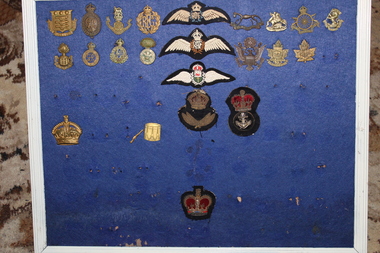
framed embroaded Patches & Brass military Medals, Blue material background Framed Patches & Medals
... Australian Air Force pilot's wings. The brevet has white cotton embroidered wings, a king's crown, and the letters 'R.A.A.F.' within a pale blue embroidered laurel wreath. Horse Badge - Small Brass - British Army Military. Saint George slaying he dragon - Small Brass Badge. Army Cyclist...Australian Air Force pilot's wings. The brevet has white cotton embroidered wings, a king's crown, and the letters 'R.A.A.F.' within a pale blue embroidered laurel wreath. Horse Badge - Small Brass - British Army Military. Saint George slaying he dragon - Small Brass Badge. Army Cyclist ...Some are rare in natureBlue material - background, White timber frame surround with 18 metal military cap badges and 6 military cloth patches., Row 1 British Army Cap Badge - Royal Army Ordnance Corps. F1 Household Life guards, Cap Badge, Center G.R. below V. Oval with motto on outside Banner. Royal Lancashire Cap Badge.World War 1 R.F.C. - Royal Flying Corps Cap Badge. surrounded by Laurel Wreath with Crown on top. Circ. 1895 Royal Australian Air Force pilot's wings. The brevet has white cotton embroidered wings, a king's crown, and the letters 'R.A.A.F.' within a pale blue embroidered laurel wreath. Horse Badge - Small Brass - British Army Military. Saint George slaying he dragon - Small Brass Badge. Army Cyclist Corps - World War 1 Cap Badge. Duke of Wellington's Regimental Cap Badge. Row 2 Royal Inniskilling Fusiliers Corps 1895 = Shoulder Title - Officer's. Royal Horse Guards Brass Army Cap Badge. Brass Badge - Queen; Mary's Own - 18th Hussars. Vintage Royal Welsh Fusiliers Cap Badge. R.A. F. Service Dress Wings with King's Crown. American Eagle Brass - Army Officers Cap Badge. 45th Overseas Battalion - Canada Expeditionary Forces. 48th Battlion, Victoria, Canada - British Columbia Brass Cap Badge. World War 1. Row 3. Center World War 11 - Rhodesian Air Force Cloth Pilots wings . row 4 Center - Embossed Woven Crown with metal gold thread woven feathers under. Right - Embossed Woven Crown with Brass Gold Anchor below.- Navy Petty Officer Cap Badge. Row 5. Large Metal Gold color Crown - British Army Warrant Officers Badge. Small Brass Single Rifle with ACT on the Butt of the rifle. Brass Badge - Drummers Proficiency., Last Row - center Embossed woven Crown Red Felt on Blue Back.none - no labels6 cloth patches raised and embossed, 18 military brass metal cap badges vary in type and country and conflict. -
 Geelong RSL Sub Branch
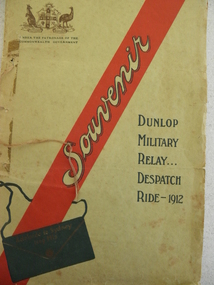
Souviner Program, No makers listed, Dunlop Military Relay ... Despatch Ride 1912, 1912
... Australia, Victoria and New South Wales. The purpose of the ride was to deliver a despatch in the quickest possible time by road through the three states mentioned. The ride was carried out under the auspices of the Dunlop Rubber Company and involved cyclists, motor cyclists and motorists....Australia, Victoria and New South Wales. The purpose of the ride was to deliver a despatch in the quickest possible time by road through the three states mentioned. The ride was carried out under the auspices of the Dunlop Rubber Company and involved cyclists, motor cyclists and motorists. ...In 1912 there was a Military Relay Despatch Ride through South Australia, Victoria and New South Wales. The purpose of the ride was to deliver a despatch in the quickest possible time by road through the three states mentioned. The ride was carried out under the auspices of the Dunlop Rubber Company and involved cyclists, motor cyclists and motorists.This is an original program of the event that was carried out in 1912. The program details the list of participants, a map of the route taken and statements of appreciation from the Military and the Promoters', there is also a message of greeting from the Military Commandant, South Australia to the Military Commandant, New South Wales.A cardboard cover program with white thick pages inside.On the front cover a Coat of Arms, a red stripe with souviner written in the stripe and Dunlop Military Relay ... Despatch Ride - 1912.military relay, 1912, despatch ride, dunlop rubber company -
Glenelg Shire Council Cultural Collection
Administrative record - Hire Purchase Agreement, c. 1939
... cyclists and commuters and other branches began to spread all over state of Victoria. In 1921 Healing’s son Keith joined the firm and became an apprentice bicycle maker and Healing cycles grew more popular and at peak production 25,000 bicycles were made per year. Shops under the name of Healing were now operating across Australia...cyclists and commuters and other branches began to spread all over state of Victoria. In 1921 Healing’s son Keith joined the firm and became an apprentice bicycle maker and Healing cycles grew more popular and at peak production 25,000 bicycles were made per year. Shops under the name of Healing were now operating across Australia ...From Aussie Velos: Alfred George Healing was born in 1868 in the suburb of Richmond, Melbourne (VIC). Starting in the cycle industry as a cycle builder and repairer in 1898, he obtained the Victorian agency for the English “Haddon” bicycle located on Bridge Road, Richmond. With many years behind him in the bicycle industry in 1907 he opened a small shop from borrowing £50 from his sister and began operating as A.G Healing. Importing bicycle parts Healing was quickly gaining a reputation for his quality and service among the cycling community, with steady business growth, Healing stumbled across an error that had been made in a recent order which resulted in twice the number of bicycle parts received. With no finances to pay for them, Healing decided to cycle around Victoria selling these parts to make the money he needed to fix up the order. As Healing travelled across Victoria he found that there was such a large market place for cycling gear that the order was soon fixed. It became apparent that Healing needed to open cycle shops in various locations. By 1912 Healing decided to open up his own proprietary company in Niagara Lane, Melbourne (VIC), the company was surging with enthusiastic cyclists and commuters and other branches began to spread all over state of Victoria. In 1921 Healing’s son Keith joined the firm and became an apprentice bicycle maker and Healing cycles grew more popular and at peak production 25,000 bicycles were made per year. Shops under the name of Healing were now operating across Australia. The business was now transferred to another location of Melbourne House, Post-office place (MELB). In 1926 Duncan and Co. wholesale and retail distributors of automotive parts was absorbed and was occupied in a larger building in Franklin Street (MELB) to maintain the warehouse operations. A.G Healing was now a public company. By 1933 the firm also began to specialize in importing radios and later began to make their own. One of the many Champions who rode on a Healing cycle was W.K “Bill” Moritz. His achievements included winning all major events in Australia and New Zealand during the years of 1936-37 path racing season. In 1936 Healing released a lightweight cycle that would rule in their supreme line-up, built from the lightest possible materials, the frame and forks were chrome plated, stripped for racing weighed exactly 16 1/2 lbs. It was fitted with special “Osgear” three-speed gear and built specially built for D. Byrant. By 1937, Healing cycles were being ridden by many, at the exhibition board track Jack Molloy won the Victorian ten-mile amateur championship, Bill Moritz captured the five mile professional, and Tassle Johnson the five-mile amateur scratch race. These wins brought up the total championships won in one week by Healing cycles to six.A hire agreement (hire purchase) between H.L. Vivian and R&G Finances Pty Ltd, for a Healing 'A' bicycle, with Eadie Coaster Hub brake. -
 Orbost & District Historical Society
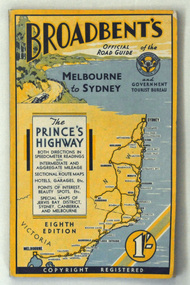
book, Broadbent's Melbourne - Sydney Guide Book, 1936
... George Robert Broadbent (1863-1947), cyclist and map publisher, was born on 3 November 1863 at Ashby near Geelong, Victoria. At various times Broadbent held most Victorian and Australian road cycling records. ...George Robert Broadbent (1863-1947), cyclist and map publisher, was born on 3 November 1863 at Ashby near Geelong, Victoria. At various times Broadbent held most Victorian and Australian road cycling records. ...Broadbent's Official Road Guides Company took over George R. Broadbent's business in 1935. In 1963, it changed its name to Broadbent's Road Maps Pty. Ltd. George Robert Broadbent (1863-1947), cyclist and map publisher, was born on 3 November 1863 at Ashby near Geelong, Victoria. At various times Broadbent held most Victorian and Australian road cycling records. Broadbent became an active vice-president of the Good Roads Association of Victoria in November 1912 and was consulted regularly during the preparation of the country roads bill. That year he took over the Argus motoring column, wrote tirelessly on road improvements and maintenance, and became manager of the Automobile Club's new touring department in 1914.A 160 pp road guide book titled Broadbent's Official Road Guide Melbourne - Sydney. The front cover has a yellow background with a map of the coastline from Sydney to Melbourne, the Prince's Highway route marked. This is inset in a drawing of a car driving along the coastal road.The book contains speedometer readings, route maps, advertisements and photos of points of interest. In the top right is the logo of the Royal Automobile Club of Victoria and at the bottom right is the price 1/-.traavel road-guides broadbent-george car-touring -
 Phillip Island and District Historical Society Inc.
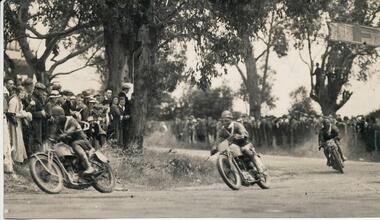
Photograph, 1935
... Australian Junior Tourist Trophy race over 75 miles/12 laps. The winner, Cec Weatherby received 20 pounds prize money and a sash. The race was run concurrectly with the Lightweight race, which was common back then. Peter Shannon's brother has the actual bike that came 3rd in that 1935 Lightweight race. local history photography motor cycle race black & white photograph sport motor cycle racing "tin pot corner" c weatherby john jenner bryant west Photograph of C. Weatherby leading other Motor Cyclists ...One of a collection of over 400 photographs in an album commenced in 1960 and presented to the Phillip Island & Westernport Historical Society by the Shire of Phillip Island The race in this photograph was the Australian Junior Tourist Trophy race over 75 miles/12 laps. The winner, Cec Weatherby received 20 pounds prize money and a sash. The race was run concurrectly with the Lightweight race, which was common back then. Peter Shannon's brother has the actual bike that came 3rd in that 1935 Lightweight race.Photograph of C. Weatherby leading other Motor Cyclists rounding "Tin Pot Corner" in a Motor Cycle Race in 1935. Corrections to the above given by Peter Shannon 2/11/2018. No. 11 was Don Bain actually leading the group, who came 3rd, No. 64 was Cec Weatherby who won the race and No. 25 was Ron Walters who came 4th. The Flyer was also given to us by Peter Shannon.local history, photography, motor cycle race, black & white photograph, sport, motor cycle racing, "tin pot corner", c weatherby, john jenner, bryant west -
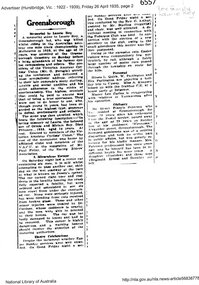 Greensborough Historical Society
Newspaper Clipping (copy), Greensborough. Memorial to Laurie Roy, 26/04/1935
... Laurie Roy, aged 19, was killed while riding in the Australian amateur one mile track cycling championship in February 1932. A memorial to him was erected in Greensborough Cemetery by the Victorian Amateur Cyclists' Union. ...Laurie Roy, aged 19, was killed while riding in the Australian amateur one mile track cycling championship in February 1932. A memorial to him was erected in Greensborough Cemetery by the Victorian Amateur Cyclists' Union. ...Laurie Roy, aged 19, was killed while riding in the Australian amateur one mile track cycling championship in February 1932. A memorial to him was erected in Greensborough Cemetery by the Victorian Amateur Cyclists' Union. Other local news is included - a car accident, Easter services, personal news and an obituary for Henry Francis Paterson.1 p. copy of p.2 of Advertiser (Hurstbridge) 26 April 1935roy family, greensborough, laurie roy -
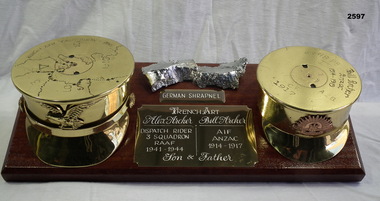 Bendigo Military Museum
Memorabilia - TRENCH ART, WW1, WW2, Post 1945 (estimated); Made in WWI and WWII and assembled upon return
... Cyclist he became a Dispatch Rider on 8.9.1942 between the RAAF and the Army. Alex served in the Middle East and Italy with 3 SQD. He embarked from Egypt diagnosed with Kyphosis and Scoliosis on 5.2.1944. In Australia...Cyclist he became a Dispatch Rider on 8.9.1942 between the RAAF and the Army. Alex served in the Middle East and Italy with 3 SQD. He embarked from Egypt diagnosed with Kyphosis and Scoliosis on 5.2.1944. In Australia ...William John ARCHER (Bill) No 321 (born Castlemaine, enlisted Castlemaine) in B Coy 21st Batt AIF on 18.1.15. Embarked for Eygpt 8.5.15. Hospital 9.9.15 with Influenza. Hospital 24.11.15 with Gastric Enteritis. Hospital 2.1.16 with Otitis Media. Transfers to the 57th Batt and embarks for France. Hospital with Trench Fever 4.10.16. Promoted to Cpl 28.4.17. Hospital 19.3.18 with Scabies. WIA 18.4.18 GSW's to chest and leg severe. Discharged from the AIF medically unfit 9.1.19. Alexander William ARCHER No 40637 (born Castlemaine, enlisted Melbourne) in the RAAF on 16.5.41 age 18 years 8 months. He wanted to be a Mess Steward and was taken in as he had worked in similar work line. He then has 5 postings before embarking for Egypt on 2.4.1942 and was posted to No 3 SQD RAAF on 20.5.1942. Re mustered as a Motor Cyclist he became a Dispatch Rider on 8.9.1942 between the RAAF and the Army. Alex served in the Middle East and Italy with 3 SQD. He embarked from Egypt diagnosed with Kyphosis and Scoliosis on 5.2.1944. In Australia he was re mustered as Office Orderly on 6.7.1944 and then discharged from the RAAF on 2.10.1944 Medically Unfit. Wooden base with brass shells either end resembling Officers caps,one being WWI, the other WWII, both inscribed. Centre plaque inscribed Alex Archer and Bill Archer, father and son. Above the centre plaque is a piece of German shrapnel chrome plated Map - "North Africa, 1940", on left hand side, "18-Pounder, 1917, Bill Archer-Anzac, 1914-1919", on right hand side, "German shrapnel"handcrafts - trench art, metal craft- brassware, arms - ammunition, military history - souvenirs -
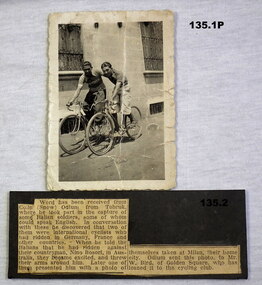 Bendigo Military Museum
Photograph - PHOTOGRAPH AND LEGEND, Pre war - 1941-42
... cyclists were taken prisoner in North Africa. The prisoners gave the photo to Colin Odlum and the result was that the photo came back to Australia and given to William (Billy) Bird who loaned the photo to the Cycling Club in Bendigo. ...cyclists were taken prisoner in North Africa. The prisoners gave the photo to Colin Odlum and the result was that the photo came back to Australia and given to William (Billy) Bird who loaned the photo to the Cycling Club in Bendigo. ...The two cyclists were taken prisoner in North Africa. The prisoners gave the photo to Colin Odlum and the result was that the photo came back to Australia and given to William (Billy) Bird who loaned the photo to the Cycling Club in Bendigo. Colin Odlum VX45898 2/23 Batt AIF. KIA 12.7.42. Refer 127.56, 128.2, 137.3P. Bettie Bird refer 136.2, Billy Bird 1601. .1) Photo, B & W of two Italian men on Racing Bikes with building in the background. .2) Original newspaper article re Italian POW's and Colin Odlum on a black background. .1) On the rear faded writing re the two cyclists "POW's"documents, historical notes, photography, photographs, military history -
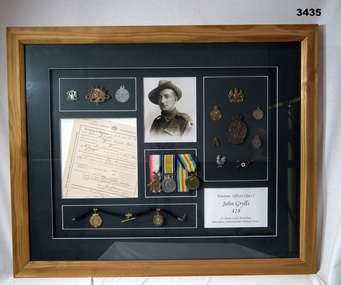 Bendigo Military Museum
Memorabilia - MONTAGE WW1, FRAMED, Post WW1
... Embarked for Egypt 19.10.1914, embark for Gallipoli 20.5.1915, to hospital 12.12.1915 with Mumps, rejoin unit 22.12.1915, embark for France 25.3.1916, transfer to 1st Anzac Cyclist Batt 12.5.1916, promoted to CSM 13.5.1916, promoted to RSM 7.4.1917, hospital 9.7.1917 with Scabies, rejoin unit 31.7.1917, embark for Australia 24.9.1918, disembark Colombo with Lobar Pnuemonia, embark for Australia 10.1.1919, discharged from the AIF 30.3.1919....Embarked for Egypt 19.10.1914, embark for Gallipoli 20.5.1915, to hospital 12.12.1915 with Mumps, rejoin unit 22.12.1915, embark for France 25.3.1916, transfer to 1st Anzac Cyclist Batt 12.5.1916, promoted to CSM 13.5.1916, promoted to RSM 7.4.1917, hospital 9.7.1917 with Scabies, rejoin unit 31.7.1917, embark for Australia 24.9.1918, disembark Colombo with Lobar Pnuemonia, embark for Australia 10.1.1919, discharged from the AIF 30.3.1919. ...Original owners: John GRYLLS Reg No 418, Unit: 4th Light Horse, WWI John Frederic GRYLLS Reg No 51033, Unit: RAAF, WWII John Grylls No 418 enlisted on 19.8.1914 in the 4th LH Regt AIF age 28 years 8 months. He enlisted with the rank of Sergeant having had 3 years prior service in the LH. Embarked for Egypt 19.10.1914, embark for Gallipoli 20.5.1915, to hospital 12.12.1915 with Mumps, rejoin unit 22.12.1915, embark for France 25.3.1916, transfer to 1st Anzac Cyclist Batt 12.5.1916, promoted to CSM 13.5.1916, promoted to RSM 7.4.1917, hospital 9.7.1917 with Scabies, rejoin unit 31.7.1917, embark for Australia 24.9.1918, disembark Colombo with Lobar Pnuemonia, embark for Australia 10.1.1919, discharged from the AIF 30.3.1919.Fawn wooden frame with white cardboard backing, glass front & rear white hanging cord. Sepia photo of WO Class 2 John GRYLLS with his medals, badges & Certificate of Discharge. All mounted on dark green background & border.Bottom RHS of Montage: “Warrant Officer Class I John Grylls - 418 1st ANZAC Cycle Battalion Australian Commonwealth Military Forces” montage, framed, 418 -
 Bendigo Military Museum
Photograph - PHOTOGRAPH & POSTCARDS, 2) 17/02/1916
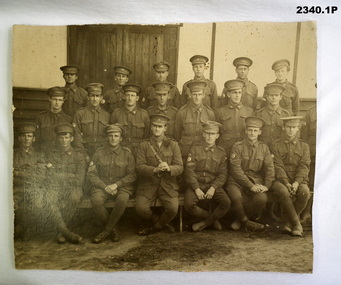
... Cyclist Batt on 2.11.1916 age 24 years. Embarked for England 16.12.1916, transfer to 8th Batt 7.3.1917, embark for France 14.6.1917, transfer to 37th Batt 29.6.1917, hospital accidental injury (sprained ankle) 5.7.1917, rejoin unit 10.9.1917, hospital 18.11.1917 with Trench Feet, rejoin unit 13.6.1918, WIA 10.8.1918 GSW left wrist (through the joint) return to Australia 20.10.1918, discharged from the AIF 29.1.1919. ...Cyclist Batt on 2.11.1916 age 24 years. Embarked for England 16.12.1916, transfer to 8th Batt 7.3.1917, embark for France 14.6.1917, transfer to 37th Batt 29.6.1917, hospital accidental injury (sprained ankle) 5.7.1917, rejoin unit 10.9.1917, hospital 18.11.1917 with Trench Feet, rejoin unit 13.6.1918, WIA 10.8.1918 GSW left wrist (through the joint) return to Australia 20.10.1918, discharged from the AIF 29.1.1919. ....1) Albert BOLDISTON, No. 747 enlisted 02/11/1916 ANZAC cyclist Batt. then 37th Bn. Discharged 29/01/1919. .2) Letter is to "Mr & Mrs DILLON from Pte. J. BURKE No. 3477 21st Batt. A.I.F", dated 17/02/1916. .3)-.10) These are "Daily mail official war pictures". Series 18. Albert Boldiston No 747 enlisted in the AIF in reinforcements 7 Anzac Cyclist Batt on 2.11.1916 age 24 years. Embarked for England 16.12.1916, transfer to 8th Batt 7.3.1917, embark for France 14.6.1917, transfer to 37th Batt 29.6.1917, hospital accidental injury (sprained ankle) 5.7.1917, rejoin unit 10.9.1917, hospital 18.11.1917 with Trench Feet, rejoin unit 13.6.1918, WIA 10.8.1918 GSW left wrist (through the joint) return to Australia 20.10.1918, discharged from the AIF 29.1.1919. Joseph Martin Burke No 3477 enlisted in the AIF in 8th reinforcements 21st Batt on 16.7.1915 age 21 years 4 months. Embark for Egypt 29.12.1915, transfer to 60th Batt 26.2.1916, then 57th 21.3.1916, then 13th FAB (Artillery) 27.3.1916, embark for France 16.6.1916, transfer to 25th FAB 9.7.1916 then 13th FAB 24.1.1917, hospital England while on leave 29.10.1918 with Influenza, return to Australia 21.12.1918 re the Influenza for discharge, discharged from the AIF 21.3.1919..1) Photo, B&W on cardboard, group of soldiers (20) seated outside building. Albert BOLDISTON is on 2nd left front row. .2) Postcard photo, B&W, soldier in peak cap standing. Letter on rear in ink from J.M. BURKE. .3) Postcard photo, B&W featuring "King George" in a gun pit. .4) Postcard photo, B&W featuring "Australian heavy gun at work". .5) Postcard photo, B&W featuring "Australians loading a trench mortar". .6) Postcard photo, B&W showing a camouflaged troopship. .7) Postcard photo, B&W, soldier keeping a lookout in trench. .8) Postcard photo, B&W showing "An observation balloon". .9) Postcard photo, B&W showing wounded waiting for the field ambulance. .10) Postcard photo, B&W showing "Australian gunners at work". .11) Card, yellow with black print both sides relating to a 37th Batt. 1st & 2nd A.I.F reunion "Whippbang 1950"..5) "Troopship in port".photography-photographs, military history - army -
 Warrnambool and District Historical Society Inc.
Medal - Four medals - Melbourne to Warrnambool Cycle Race
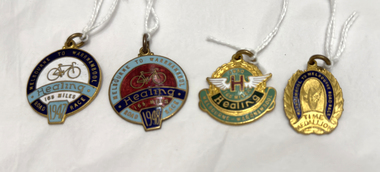
... Australia. Four of these medals were awarded to Ron Vernon from the Footscray Club. All riders who complete the race in a given time are awarded a Time Medallion. In 1947 Ron Vernon, riding the latest Healing Championship Cycle came in 26th. In 1948, riding off the 47 minute handicap, he took 7th place. IHe also won the Colac Sprint in that race. In 1950 he took 9th place. The fourth medal is a Time Medallion awarded to a cyclist...Australia. Four of these medals were awarded to Ron Vernon from the Footscray Club. All riders who complete the race in a given time are awarded a Time Medallion. In 1947 Ron Vernon, riding the latest Healing Championship Cycle came in 26th. In 1948, riding off the 47 minute handicap, he took 7th place. IHe also won the Colac Sprint in that race. In 1950 he took 9th place. The fourth medal is a Time Medallion awarded to a cyclist ...These four medals relate to the Melbourne to Warrnambool Cycle Race. This race was first held in 1895 and continues to the presenr day. It was originally a handicap race from Warrnambool to Melbourne but after 1938 it became a Melbourne to Warrnambool race After 1995 it became a scratch race and today the distance is shorter with the race starting from Avalon. It is the second oldest one-day cycling race in the world and the longest one-day cycling race in Australia. Four of these medals were awarded to Ron Vernon from the Footscray Club. All riders who complete the race in a given time are awarded a Time Medallion. In 1947 Ron Vernon, riding the latest Healing Championship Cycle came in 26th. In 1948, riding off the 47 minute handicap, he took 7th place. IHe also won the Colac Sprint in that race. In 1950 he took 9th place. The fourth medal is a Time Medallion awarded to a cyclist in 1960. These medals are of considerable interest as mementoes of the Melbourne to Warrnambool Cycle Race, an important sporting event associated with Warrnambool and one that is known Australia-wide and internationally..1 A round metal medal with a dark blue band around the edge, a light blue strip across the middle and a light blue tab at the bottom of the medal. The medal has gold-coloured printing and a gold image of a bicycle. A metal ring is attached at the top. .2 a round metal medal similar in design to .1 above with light blue, dark blue and red colouring. A metal ring is attached at the top .3 a green and gold round metal medal with a green curved strip attached to the bottom of the medal and white wings placed in the middle of the medal. The labelling is red and gold. A metal ring is attached at the top. .4 A gold and dark blue oval-shaped metal medal. A metal ring is attached at the top. .1 Melbourne to Warrnambool Road Race 165 miles Healing 1947 .2 Melbourne to Warrnambool Road Race 165 miles Healing 1948 .3 Melbourne-Warrnambool 165 miles Healing 1950 .4 Warrnambool to Melbourne Road Race Time Medallion 1960melbourne to warrnambool cycle race, ron vernon cyclist, warrnambool sport -
 Warrnambool and District Historical Society Inc.
Medal - Cycling Medals W. S. Toyne
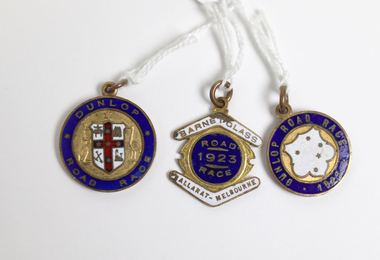
... Australia. All riders who complete the race in a given time are awarded a Time Medallion. The race was sponsored by the Dunlop company from 1901 to 1927. In 1923, 123 of the 196 riders, who started at 5:30am completed the 165 mile road race and were awarded the time medallion. W. S. Toyne was listed among the some of the first cyclists...Australia. All riders who complete the race in a given time are awarded a Time Medallion. The race was sponsored by the Dunlop company from 1901 to 1927. In 1923, 123 of the 196 riders, who started at 5:30am completed the 165 mile road race and were awarded the time medallion. W. S. Toyne was listed among the some of the first cyclists ...These cycling medals were awarded to W. S. Toyne. Two of these medals are time medallions relating to the Warrnambool to Melbourne Cycle Race. This race was first held in 1895 and continues to the present day. It was originally a handicap race from Warrnambool to Melbourne but after 1938 it became a Melbourne to Warrnambool race. After 1995 it became a scratch race and today the distance is shorter with the race starting from Avalon. It is the second oldest one-day cycling race in the world and the longest one-day cycling race in Australia. All riders who complete the race in a given time are awarded a Time Medallion. The race was sponsored by the Dunlop company from 1901 to 1927. In 1923, 123 of the 196 riders, who started at 5:30am completed the 165 mile road race and were awarded the time medallion. W. S. Toyne was listed among the some of the first cyclists to go through Camperdown at 8:16am. It was reported that over 50,000 spectators witnessed the progress of the race. These cycling medals belonged to a cyclist, W. S. Toyne, who completed in a significant sporting event in Warrnambool in 1923 and 1924. [.1] Round metal and enamel medal with blue enamel edge and an unidentified white coat of arms with a red cross containing five stars on the obverse side. The shield is held by an embossed kangaroo on the left and an emu on the right. The reverse is inscribed with name and time in an inner circle and the year and race on the outer edge. [.2] Round metal and enamel medal with blue enamel edge and a white enamel shield containing five stars in the centre of the obverse side. The reverse is inscribed with the name and time in the inner circle and the race name on the outer edge. [.3] metal and enamel medal with a blue enamel circle with white enamel boomerangs sitting above and below.[.1] Obverse: Dunlop Road Race; Reverse: Warrnambool-Melbourne Time Medallion 1924 Won by W. S. Toyne 5 Hrs. 47 Mns. 42 Sds. [.2] Obverse: Dunlop Road Race 1923; Reverse: Warrnambool-Melbourne Time Medallion; Won by W. S. TOYNE 10 Hrs. 30 Mns. Sds. [.3] Obverse: Barnet Glass Ballarat-Melbourne Road Race 1923; Reverse W. S. Toynew. s. toyne, dunlop road race, barnet glass road race, ballarat to melbourne cycle race, time medallions, warrnambool to melbourne cycle race -
 Kiewa Valley Historical Society
Folder - Falls Creek
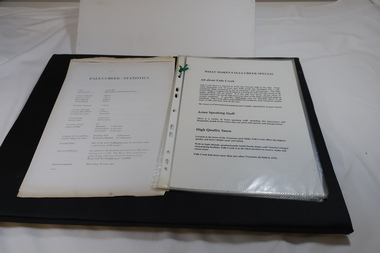
... It is a major ski resort in Australia and is currently promoting tourism in Summer especially for bush walkers and cyclists. ...Falls Creek Snow Resort is on the Bogong High Plains in north east Victoria. It competes with other Australian snow resorts during Winter. This folder was created in the 1990s.Falls Creek began during the construction of the Kiewa Hydro Electric Scheme. It is a major ski resort in Australia and is currently promoting tourism in Summer especially for bush walkers and cyclists.Red plastic folder with 6 pages in plastic sleeves. Each page has headings describing and promoting the facilities and benefits of Falls Creek Snow Resort.falls creek snow resort, tourism in alpine resorts -
 Warrnambool and District Historical Society Inc.
Trophy, Tea and Coffee Set (Cycle Trophy), Early 20th century
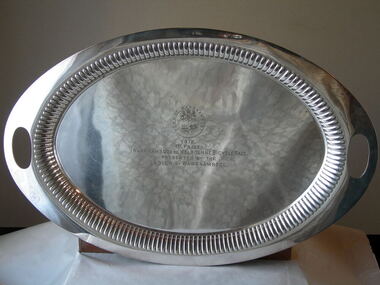
... The Warrnambool to Melbourne/ Melbourne to Warrnambool Cycle Race is an annual event which is nationally known and attracts today international cyclists and riders from around Australia. In 1912 the ladies of Warrnambool under the direction of Mrs Younger, the Lady Mayoress, arranged to have this tea and coffee service engraved with the town crest and the relevant details so that it could be presented to the winner of the 1912 Warrnambool to Melbourne Cycle Race. ...The Warrnambool to Melbourne/ Melbourne to Warrnambool Cycle Race is an annual event which is nationally known and attracts today international cyclists and riders from around Australia. In 1912 the ladies of Warrnambool under the direction of Mrs Younger, the Lady Mayoress, arranged to have this tea and coffee service engraved with the town crest and the relevant details so that it could be presented to the winner of the 1912 Warrnambool to Melbourne Cycle Race. ...The Warrnambool to Melbourne/ Melbourne to Warrnambool Cycle Race is an annual event which is nationally known and attracts today international cyclists and riders from around Australia. In 1912 the ladies of Warrnambool under the direction of Mrs Younger, the Lady Mayoress, arranged to have this tea and coffee service engraved with the town crest and the relevant details so that it could be presented to the winner of the 1912 Warrnambool to Melbourne Cycle Race. But the race was not run because of a dispute between the League of Wheelmen and the race sponsor. The trophy was kept for the following year but again the race was not held. Then again in 1914 the race was cancelled because of the outbreak of World War One. So it was decided to raffle the trophy to recoup the costs. The raffle was won by Mrs Herriot and eventually the trophy ended up in Queensland with a daughter of the winner. In 197… the trophy was donated to the Warrnambool and District Historical Society. This is one of the most attractive and interesting items in our collection. It is well provenanced and is of great importance in: 1. the history of the Melbourne to Warrnambool Cycle Race. This race, of prime importance in Warrnambool’s sporting calendar and history, is the second oldest one race cycle race in the world and one of the longest one day cycle events in the world. 2. demonstrating the way the women of Warrnambool in 1912 banded together to support a premier event in the Warrnambool’s annual sporting calendar.1 Silver-soldered oval tray with fluted inside edge (has inscription) .2 Silver-soldered oval-shaped coffee pot with handle and spout .3 Silver-soldered oval-shaped tea pot with hinged lid .4 Silver-soldered bowl-shaped sugar basin with two handles and concave-shaped lid and ridged on sides .5 Silver-soldered milk jug with lid and concave-shaped handle The five items are engraved with the Town of Warrnambool crest and all have the maker’s marks on the base of the item. Tray: ‘1912 1st Prize Warrnambool to Melbourne Bicycle Race Presented by the Ladies of Warrnambool’ Base of items: ‘F HP. W. & M. 53515A, Walker and Hall, Sheffield England, Warranted Hard & Silver Soldered’. warrnambool to melbourne cycle race, melbourne to warrnambool/ -
 Camp Eureka Working Collective
scarf
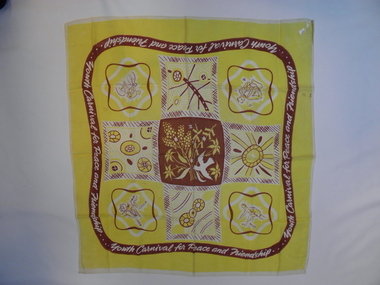
... Australian cities. Eileen Capocchi Eureka Youth League Choir Youth Carnival for Peace and Friendship Eureka Youth League 1952 "Youth Carnival for Peace and Friendship" white script on 3cm brown banner repeated 4 times around perimeter. Brown and yellow square rayon machine edged scarf made for the 1952 Youth Carnival for Peace and Friendship in Sydney. Central portion shows a peace dove, pink heath, flannel flower and wattle. Perimeter shows a saxophonist, ballet dancer, high jumper, hurdler, cyclist ...The scarf was worn by Eileen Capocchi, a member of the Eureka Youth League Choir who sang at the Youth Carnival for Peace and Friendship and donated the item. The planned event had been targeted by Prime Minister Menzies as a Communist Party activity. The Commonwealth Government pressured local Sydney Councils to deny the organisers a venue. These attempts failed. The event combined sporting, athletic and musical events at a football stadium. In later years it was the subject of two documentary films. The scarf is of historic and social significance because of its association with the Peace Carnival for Peace and Friendship of 1952 and the Eureka Youth League. The scarves were worn by all participants and by Eureka Youth League members in subsequent years. The scarf records some of the musical and sporting events organised by the Eureka Youth League in most major Australian cities.Brown and yellow square rayon machine edged scarf made for the 1952 Youth Carnival for Peace and Friendship in Sydney. Central portion shows a peace dove, pink heath, flannel flower and wattle. Perimeter shows a saxophonist, ballet dancer, high jumper, hurdler, cyclist and volleyball net. "Youth Carnival for Peace and Friendship" white script on 3cm brown banner repeated 4 times around perimeter.eileen capocchi, eureka youth league choir, youth carnival for peace and friendship, eureka youth league, 1952 -
 Bendigo Historical Society Inc.
Photograph - BENDIGO ADVERTISER COLLECTION: BIKES, 1988
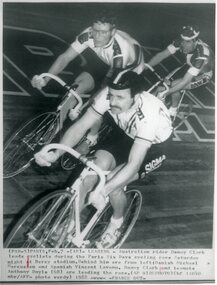
... Photograph - three men racing at a velodrome Label on front: (par-5) Paris, Feb.7 - (AP) - Leading - Australian rider Danny Clark leads cyclists during the paris Six Days cycling race Saturday night at Bercy Stadium, Behind him are from Left: Danish Michael Marcussen and Spanish Vincent Lavenu. ...RECREATIONS Sports Cycling Bendigo Advertiser Photograph - three men racing at a velodrome Label on front: (par-5) Paris, Feb.7 - (AP) - Leading - Australian rider Danny Clark leads cyclists during the paris Six Days cycling race Saturday night at Bercy Stadium, Behind him are from Left: Danish Michael Marcussen and Spanish Vincent Lavenu. ...Photograph - three men racing at a velodrome Label on front: (par-5) Paris, Feb.7 - (AP) - Leading - Australian rider Danny Clark leads cyclists during the paris Six Days cycling race Saturday night at Bercy Stadium, Behind him are from Left: Danish Michael Marcussen and Spanish Vincent Lavenu. Danny Clark and team mate Anthony Doyle (GB) are leading the race. (AP Wirephoto) (bf 11040 mbr/AFP-Photo verdy) 1988 -www- -France out-recreations, sports, cycling, bendigo advertiser -
 Warrnambool and District Historical Society Inc.
Book, John Gerard Craven, The 'Warrnambool' A fascinating and colourful insight into one of the world's greatest and oldest bike races, 2015
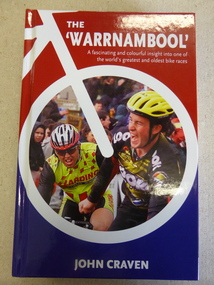
... It is therefore an important event on the Australian Cycle Race calendar. Many famous cyclists such as Sir Hubert Opperman, Billy Guyatt, Barry Waddell and Dean Woods have been competitors and/or winners in the race. ...It is therefore an important event on the Australian Cycle Race calendar. Many famous cyclists such as Sir Hubert Opperman, Billy Guyatt, Barry Waddell and Dean Woods have been competitors and/or winners in the race. ...History of the Melbourne to Warrnambool Cycling ClassicThis is a hard cover book of 406 pages. The cover has a blue and red background with two colour photographs of cyclists, some printed material and a marketing code with the ISBN number. The printed material includes a Contents page, an Honour Roll of winners of the Melbourne to Warrnambool/Warrnambool to Melbourne Cycle Race and photographs, both in black and white and colour and illustrations.non-fictionHistory of the Melbourne to Warrnambool Cycling Classiccycling, melbourne to warrnambool -
 Bendigo Military Museum
Book - MILITARY HISTORY, WW1, British - Australasian Publishing Service, "THE ALL-AUSTRALIA MEMORIAL", 1917
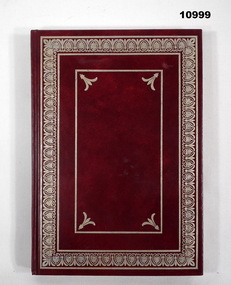
... Australia at cessation of hostilities.; disc August 7, 1919." Andersons War Service. Andrew Charles Anderson No 2116 (born Hay NSW, enlisted Liverpool) on 1.5.1915 in 6th Reinforcements 4th Bn age 20 years 11 months, embark for Eygpt 16.6.1915, joined Bn on Gallipoli 10.8.1915, Hospital 10.8.1915 (listed as Shock) transferred to England, rejoin Unit Eygpt 15.1.1916, transfer to 56th Bn then to 5Div Cyclist Bn, embark for France10.6.1916, Awarded Military Medal 25.6.1917, 16.1.1918 transfer to Aust Corps Cyclist Bn, hospital 16.2.1918 with Scabies then Furnunculosis, rejoin Unit 16.5.1918, RTA 19.4.1919, Discharged with the rank of Sgt on 7.8.1919....Australia at cessation of hostilities.; disc August 7, 1919." Andersons War Service. Andrew Charles Anderson No 2116 (born Hay NSW, enlisted Liverpool) on 1.5.1915 in 6th Reinforcements 4th Bn age 20 years 11 months, embark for Eygpt 16.6.1915, joined Bn on Gallipoli 10.8.1915, Hospital 10.8.1915 (listed as Shock) transferred to England, rejoin Unit Eygpt 15.1.1916, transfer to 56th Bn then to 5Div Cyclist Bn, embark for France10.6.1916, Awarded Military Medal 25.6.1917, 16.1.1918 transfer to Aust Corps Cyclist Bn, hospital 16.2.1918 with Scabies then Furnunculosis, rejoin Unit 16.5.1918, RTA 19.4.1919, Discharged with the rank of Sgt on 7.8.1919. ...From Title Page - "The All-Australia Memorial. A HISTORICAL RECORD OF NATIONAL EFFORT DURING THE GREAT WAR." Soldier's details - with portrait photograph. "ANDERSON, Andrew C. Sgt. 1st Anzac Cycle C.; s. of Mr and Mrs D. Anderson, Hay; b. Hay, June 11, 1894; educ. Jivtho S.S.; grocer; enl. May 31, 1915; emb. June 16, 1915. War Service; Egypt, Gallipoli, France, Belgium; ret. Australia at cessation of hostilities.; disc August 7, 1919." Andersons War Service. Andrew Charles Anderson No 2116 (born Hay NSW, enlisted Liverpool) on 1.5.1915 in 6th Reinforcements 4th Bn age 20 years 11 months, embark for Eygpt 16.6.1915, joined Bn on Gallipoli 10.8.1915, Hospital 10.8.1915 (listed as Shock) transferred to England, rejoin Unit Eygpt 15.1.1916, transfer to 56th Bn then to 5Div Cyclist Bn, embark for France10.6.1916, Awarded Military Medal 25.6.1917, 16.1.1918 transfer to Aust Corps Cyclist Bn, hospital 16.2.1918 with Scabies then Furnunculosis, rejoin Unit 16.5.1918, RTA 19.4.1919, Discharged with the rank of Sgt on 7.8.1919.Hardcover book. Cover - cardboard with dark ruby red coloured buckram. Gold and black coloured ink on front and spine. Front - Rising Sun emblem with "AUSTRALIAN/ COMMONWEALTH/ MILITARY FORCES". Pages 158 pages, cut, white paper with gold coloured trim on page edges. Numerous cardboard (brown coloured) pages dividing chapters. Illustrated - sepia coloured photographs, artworks and diagrams with some photographs mounted on cardboard pages. At front before Title page - inset photograph of a soldier in uniform with soldier's details (see in Context Historical) mounted on cardboard page.publications, books, military history, ww1 -
 National Wool Museum
Film - Sportwool, c.2000
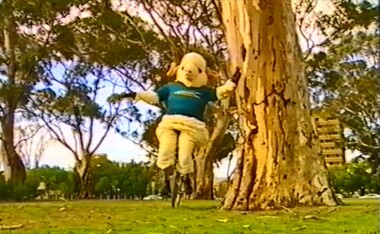
... Film includes colour footage and audio. 00:06 - titles 'Sportwool' 00:11 - line of cold looking people and sheep mascot 00:21 - sheep mascot and basketball players on indoor court 00:42 - sheep mascot on unicycle 00:54 - various scenes of Australian athletes 01:37 - Manchester United, various scenes 01:56 - basketball 02:16 - cyclists 02:32 - hockey 02:53 - Pat Farmer, ultramarathon athlete, running through outback landscape 03:03 - skiing 03:14 - netball 03:27 - australian football league 04:42 - end credits 04:45 - end...Film includes colour footage and audio. 00:06 - titles 'Sportwool' 00:11 - line of cold looking people and sheep mascot 00:21 - sheep mascot and basketball players on indoor court 00:42 - sheep mascot on unicycle 00:54 - various scenes of Australian athletes 01:37 - Manchester United, various scenes 01:56 - basketball 02:16 - cyclists 02:32 - hockey 02:53 - Pat Farmer, ultramarathon athlete, running through outback landscape 03:03 - skiing 03:14 - netball 03:27 - australian football league 04:42 - end credits 04:45 - end Film Sportwool ...Tape shows a long form advertisement for Sportwool, featuring national and international sports athletes.Black VHS tape with white stickers and hand written and printed text. Tape is housed in a white plastic case. Film includes colour footage and audio. 00:06 - titles 'Sportwool' 00:11 - line of cold looking people and sheep mascot 00:21 - sheep mascot and basketball players on indoor court 00:42 - sheep mascot on unicycle 00:54 - various scenes of Australian athletes 01:37 - Manchester United, various scenes 01:56 - basketball 02:16 - cyclists 02:32 - hockey 02:53 - Pat Farmer, ultramarathon athlete, running through outback landscape 03:03 - skiing 03:14 - netball 03:27 - australian football league 04:42 - end credits 04:45 - endLabel on tape: THE WOOLMARK COMPANY / SPORTS WOOL / Duration: 4 min 38 secfilm, textile industry, sheep, training, fitness, sport, athletes, uniforms, pat farmer, sportwool -
 National Wool Museum
Clothing - 1984 Los Angeles Olympics Men's Opening Ceremony Shirt, c. 1984
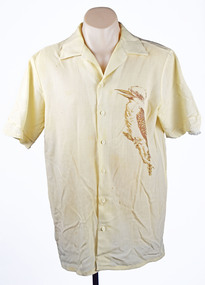
... cyclists by contrast develop thighs I liken to tree trunks and a uniform featuring tight trousers must be avoided at all cost. Suffice to say many ensembles require specialist ‘one off’ treatment for many athletes. Meanwhile there is a comfortable in between group who can accept regular sizes so you can cater for these by having back up stock with plenty of built in contingencies. Athletes may be domiciled anywhere in Australia...cyclists by contrast develop thighs I liken to tree trunks and a uniform featuring tight trousers must be avoided at all cost. Suffice to say many ensembles require specialist ‘one off’ treatment for many athletes. Meanwhile there is a comfortable in between group who can accept regular sizes so you can cater for these by having back up stock with plenty of built in contingencies. Athletes may be domiciled anywhere in Australia ...On the 1984 Los Angeles Olympic Uniforms donator Doug wrote- During the 1980s the Australian wool industry was at its most prosperous times with record numbers of sheep producing wool receiving ever increasing values due to the success of the Reserve Price Scheme, and the overall guidance of the Australian Wool Corporation (AWC). As a humble technician, my role was a low profile newly created position of “Controller, Technical Marketing” where wool was to be marketed on its technical properties, as distinct from the “Product Marketing Group” which exploited trhe traditional high profile approach of marketing wool;s superior fashion attributes. The Woolmark was the tool central to this approach. When the forthcoming Los Angeles Olympic Games was announced, the Product Marketing Group seized upon the chance to show the world that we could make top fashion garments and display them on our elite athletes on the world stage. A concept was launched using a contemporary top designer, Adel Weiss, with the most exclusive fabrics and knits available, and all with a lot of hype. This launch failed dismally for the following reasons- - The designer did a wonderful job presenting an excellent fashion range on perfect skinny models. The AOC however wanted a uniform which had an obvious Australian appearance when fitted to elite, and frequently muscular, athletes. - The fabrics chosen did not reflect the performance required by travelling athletes, there was no recognition of the need for ‘easy care.’ - There was no recognition given to the problem of measuring, manufacturing and distribution of a range of articles when the selected athlete could be domiciled anywhere in Australia. - There was no appreciation of such historical facts as Fletcher Jones, who had been unofficial suppliers dating back to the 1954 Olympics in Melbourne, and the Fletcher Jones board member, who was also an AWC board member, and was not in favour of the change. The project passed from Product Marketing to Public Relations, a big spending off-shoot of the AWC Chairman David Asimus, and due to the day to day operations of the project was passed to me and PR took care of the financial matters. The first task was to meet with the AOC and find out exactly their requirements. This lead to the production of a design and manufacturing brief, cointaining exact time lines for each event required to ensure an appropriate uniform on every athlete chosen to represent his/her country on the date given for the Opening Ceremony in Los Angeles. Working backwards the timeline becomes- 1. Noted the exact date of the Opening Ceremony. 2. Estimated the date for distributing completed garments to each athlete. 3. Estimated the time span available for measuring each athlete and commence making each component of the ensemble to the individual measurements of each athlete. 4. Decided the date for making the final choice of uniform design concept. 5. Decided the date for distribution of the design brief to selected designers. These five steps were spread out over a two year period. The Commonwealth Games occur midway between each Olympic Games, work on the Olympic uniform commences the week after the Commonwealth Games closing ceremony and MUST be ready by the prescribed day two years hence. The project also had to remain cognisant of trade politics existing within the span of the task, as well as the temperament of designers in general. It is no overstatement to say that in the past every designer in Australia believed they could, and should, be chosen to design the Australian Uniform. The final choice of designer almost always faced criticism from the fashion press and any designer who had been overlooked. However, with the contenders receiving an exacting brief the numbers of serious contenders greatly reduced. The Los Angeles Olympic Uniforms. A further reason for the AWC bid failure to design the LA uniform was that the AOC had already chosen Prue Acton to design it. This was based on her proven performance during previous games as she had a talent for creating good taste Australiana. Her design concepts also considered the effect when they were viewed on a single athlete as well as the impact when viewed on a 400 strong team coming on to the arena. A blazer trouser/skirt uniform in bright gold was chosen for the formal uniform. It was my task to select a pure wool faille fabric from Foster Valley weaving mill and have sufficient woven and ready within the prescribed timeline. The trouser/skirt fabric selected was a 60/40 wool polyester plain weave fabric from Macquarie Worsted. This fabric had a small effect thread of linen that was most attractive when dyed to match some eucalyptus bark Prue had brought back from central Australia. For the Opening Ceremony uniform, Prue designed a series of native fauna, a kookaburra for the men’s shirt and a pleated skirt with a rural scene of kangaroos, hills and plants. This presented an insurmountable printing challenge to the local printing industry as it had an unacceptably large repeat size and the number required (50) was also commercially unacceptable. The solution was a DIY mock up at RMIT and the employment of four student designers. The fabric selected for this garment was a light weight 19 micron, pure wool with a very high twist yarn in alternating S and Z twist, warp and weft. This fabric proved to be the solution to a very difficult problem, finding a wool product which is universally acceptable when worn next to the sin by young athletes competing in the heat of a Los Angeles summer. Modifications to this fabric were developed to exploit its success when facing the same problem in future games. Garment Making- The most exacting garment in the ensemble is the tailored blazer, plus the related trouser/skirt. Unfortunately tailoring athletes that come in various shapes and sizes such as; - Weight lifters develop an enormous chest, arms and neck size. A shirt made to a neck size of 52 would produce a shirt with cuffs extending well beyond the wearer’s hands. - Basketball players are up to 7 feet tall and garments relying ona chest measurement grading would produce a shirt with cuffs extending only to elbow length. - Swimmers develop enormous shoulders and slim hips, cyclists by contrast develop thighs I liken to tree trunks and a uniform featuring tight trousers must be avoided at all cost. Suffice to say many ensembles require specialist ‘one off’ treatment for many athletes. Meanwhile there is a comfortable in between group who can accept regular sizes so you can cater for these by having back up stock with plenty of built in contingencies. Athletes may be domiciled anywhere in Australia, this creates a fundamental problem of taking their measurements. The Fletcher Jones organisation was key to answering this problem due to their presence in every capital city, as well as many provincial towns around Australia. Each athlete on being selected for the Olympic Team was simultaneously requested to visit their nearest Fletcher Jones shop. The standardised measurement data collected was shared with the other manufacturers, e.g. Pelaco Shirts, Holeproof Socks and Knitwear, Maddison Belts, and even Hush Puppy Shoes. As the time for the Games approached the AOC made arrangements for combining meeting of all. Selected available athletes at the Australian Institute of Sport, Canberra, where, among other things, they were fitted and supplied with their uniform. The method evolved as follows.Men’s cream coloured button up, collared shirt. Images of a kookaburra have been printed onto the shirt, a single kookaburra on the left breast and a pair of kookaburras on the reverse of the shirt. The kookaburras are printed in a brown tone to complement the cream colour of the fabric.On tag - FMaustralian wool corporation, 1984 los angeles olympics, olympic uniforms, men's uniforms, sport, athletes
