
Showing 11 items matching "australian defence industrial"
-
 Sunshine and District Historical Society Incorporated
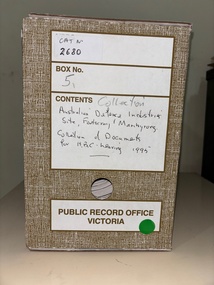
Archive - Australian Defence Industrial Site Footscray & Maribyrnong
... Australian Defence Industrial Site Footscray & Maribyrnong...Australian Defence Industrial...Collection of documents relating to the Australian Defence Industrial Site Footscray & Maribyrnong H.B.S. ...Australian Defence Industrial Site Footscray & Maribyrnong H.B.S. ...Australian Defence Industrial ADI Maribyrnong Footscray Australian Defence Industrial Site Footscray & Maribyrnong H.B.S. ...Australian Defence Industrial Site Footscray & Maribyrnong H.B.S. Hearing 1995australian defence industrial, adi, maribyrnong, footscray -
 Warrnambool RSL Sub Branch
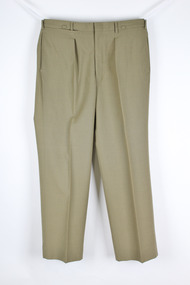
Army Uniform trousers, Polyester Trousers, 1989
... Australian Defence Industrial , Victoria, Australia ...This item of uniform was own, worn and donated by Major (Retd) Bernard Farley during service in the Army Reserve Infantry at 8/7 Royal Victoria Regiment (RVR) Ballarat VICPolyester trousers with two side pockets, one back pocket, money pocket with belt loops and brass ceremonial belt keepersTag - A.D.I. P/L VIC 1989 ARROW indicating Govt. NSN 8405-66-0185-5522 MACQUARIE 89, Batch C Size. 80RF W.90 L.77 NAME. SERVICE NO. DRY CLEAN ONLY(A) Press on original creases. Use damp cloth. Medium to hot steam iron -
 Moorabbin Air Museum
Document (item) - Interim Report of the Joint Committee on Foreign Affairs & Defence Industrial Support for Defence Needs and Allied Matters
... Commonwealth of Australia Interim Report of the Joint Committee on Foreign Affairs & Defence Industrial Support for Defence Needs and Allied Matters Document Interim Report of the Joint Committee on Foreign Affairs & Defence Industrial Support for Defence Needs and Allied Matters ...Commonwealth of Australia -
Moorabbin Air Museum
Document (item) - CAC Collection - Mr.D.J.Dalziel Documents,refer Description for further details
... Australia by Ian H. Ring. The Mirage Contract Committee, 1960-61. Report On The Limitations Of Fishermans Bend Airfield 1950. The Fitzgerald Report - 1958. The Mc Grath Report For The Defence (Industrial...Australia by Ian H. Ring. The Mirage Contract Committee, 1960-61. Report On The Limitations Of Fishermans Bend Airfield 1950. The Fitzgerald Report - 1958. The Mc Grath Report For The Defence (Industrial ...University of Melbourne Faculty of Economics and Commerce 1967 - The Establishment Of The Aircraft Manufacturing Industry In Australia by Ian H. Ring. The Mirage Contract Committee, 1960-61. Report On The Limitations Of Fishermans Bend Airfield 1950. The Fitzgerald Report - 1958. The Mc Grath Report For The Defence (Industrial) Committee - 1972. The Rationalisation Of The Aircraft Industry. Industries Assistance Commission Inquiry 1974-75. Parliamentary Joint Committee On Foreign Affairs And Defence , 1976 & 1978. -
 Sunshine and District Historical Society Incorporated
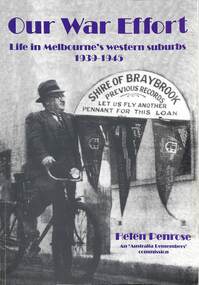
Book - Our War Effort - Life in Melbourne's Western Suburbs 1939 - 1945, Helen Penrose, 1997
... During World War II, the western suburbs of Melbourne were transformed by industrial mobilisation, civil defence measures, and social changes as civilians contributed to the war effort on the homefront. The book was commissioned in 1995 as a result of the 'Australia Remembers' campaign. ...The book is an historical account of life in Melbourne's western suburbs and its community's contributions to the war effort.Soft covered book with a photograph from the Sunshine Advocate (1943) depicting President Reg Barclay surveying War Loans Appeals records achieved by the Shire of Braybrook.non-fictionThe book is an historical account of life in Melbourne's western suburbs and its community's contributions to the war effort.sunshine, h.v. mckay massey harris, world war 1919 - 1945, war work, women in non traditional roles, social conditions, braybrook shire, munition and explosives factories, rationing and shortages -
 Sunshine and District Historical Society Incorporated
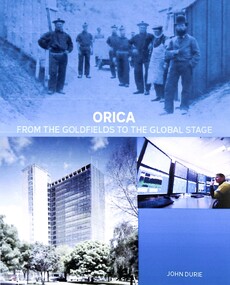
Book - Orica From The Goldfields To The Global Stage, John Durie, 2024
... industrial history dating back to the 1870s. The site was originally established for explosives manufacturing, playing a crucial role in Australia's mining and defence industries. ...industrial history dating back to the 1870s. The site was originally established for explosives manufacturing, playing a crucial role in Australia's mining and defence industries. ...In January 2008 Akzo Nobel chief Hans Wijers triumphantly signed the US$19.2 billion deal (€11.6 billion) that would seal the end of the 81-year-old Imperial Chemical Industries (ICI). Sixteen years later, ICI’s one-time subsidiary Orica marches on, transforming itself again from its explosives base to a global mining services giant employing 12,500 people, serving customers in over a hundred countries, with more than 62 per cent of sales outside Australia and Asia. Explosives remain the company’s core, accounting for more than 75 per cent of revenues, with copper and gold making up 45 per cent of output. Not bad for a company governed by a strict covenant, with its parent detailing what products could be sold into what market. The covenant laid down what products could be imported and exported and what investments could be made, although Philip Weickhardt, the last ICI Australia chief executive, admitted he had never seen a copy of the document. It was the preserve of the company’s lawyers, and something referred to in passing. In any case, in 1997 when he took over, Weickhardt’s task as to lead the company to independence after 123 years of foreign rule. Negotiations, he said, were very pragmatic because Australia wanted to be on its own and ICI wanted to get out. The covenant was no longer something even the lawyers needed to know about. ICI ultimately failed because of a corporate model that tried to serve too many different products and markets. Orica has stuck to its core, while over the years learning and benefiting from the strengths of its former parentDigital PDF Filenon-fictionIn January 2008 Akzo Nobel chief Hans Wijers triumphantly signed the US$19.2 billion deal (€11.6 billion) that would seal the end of the 81-year-old Imperial Chemical Industries (ICI). Sixteen years later, ICI’s one-time subsidiary Orica marches on, transforming itself again from its explosives base to a global mining services giant employing 12,500 people, serving customers in over a hundred countries, with more than 62 per cent of sales outside Australia and Asia. Explosives remain the company’s core, accounting for more than 75 per cent of revenues, with copper and gold making up 45 per cent of output. Not bad for a company governed by a strict covenant, with its parent detailing what products could be sold into what market. The covenant laid down what products could be imported and exported and what investments could be made, although Philip Weickhardt, the last ICI Australia chief executive, admitted he had never seen a copy of the document. It was the preserve of the company’s lawyers, and something referred to in passing. In any case, in 1997 when he took over, Weickhardt’s task as to lead the company to independence after 123 years of foreign rule. Negotiations, he said, were very pragmatic because Australia wanted to be on its own and ICI wanted to get out. The covenant was no longer something even the lawyers needed to know about. ICI ultimately failed because of a corporate model that tried to serve too many different products and markets. Orica has stuck to its core, while over the years learning and benefiting from the strengths of its former parentorica, deer park, ici -
 Sunshine and District Historical Society Incorporated
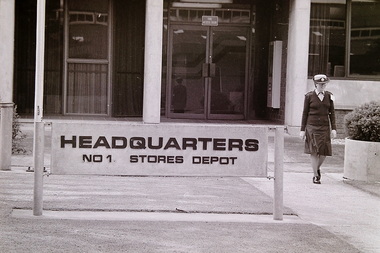
Photograph - RAAF No 1 Stores Depot South Road Braybrook Site Tour 1990 Photograph, C. McGee, 17th June 1991
... defence facilities in Melbourne’s west, a massive wartime logistics base built in 1944–45 and operated until 1993. The site expanded significantly after WWII, adding: RAAF Police Dog Training Centre (established 1962), supply‑officer training facilities, accommodation blocks, mess halls, chapels, gyms and sports grounds which transformed the depot into a self‑contained military community. It shaped Braybrook’s industrial landscape, employed hundreds of locals, and played a central role in Australia’s...These photographs capture only a small part of the No. 1 RAAF Stores Depot that one of Australia’s major wartime and post‑war defence logistics centres, representing the scale, organisation, and industrial capability required to support the Royal Australian Air Force from 1945 to 1993. ...No. 1 RAAF Stores Depot in Braybrook (often called the Tottenham RAAF Stores Depot) was one of the most important defence facilities in Melbourne’s west, a massive wartime logistics base built in 1944–45 and operated until 1993. The site expanded significantly after WWII, adding: RAAF Police Dog Training Centre (established 1962), supply‑officer training facilities, accommodation blocks, mess halls, chapels, gyms and sports grounds which transformed the depot into a self‑contained military community. It shaped Braybrook’s industrial landscape, employed hundreds of locals, and played a central role in Australia’s WWII and post‑war supply chain. These photographs capture only a small part of the No. 1 RAAF Stores Depot that one of Australia’s major wartime and post‑war defence logistics centres, representing the scale, organisation, and industrial capability required to support the Royal Australian Air Force from 1945 to 1993. Established during the critical final years of the Second World War, the depot consolidated dozens of scattered storage sites into a single purpose‑built facility, demonstrating the Commonwealth’s shift toward modern, centralised military supply systems. Its extensive warehouses, rail sidings, and specialised training areas illustrate mid‑20th‑century defence planning and the functional architectural style of the Department of Works. The depot played a vital role in national logistics, handling equipment, clothing, barracks stores, demobilisation materials, and returned overseas supplies. It was also a major employer in Melbourne’s western suburbs, shaping the social and economic life of Braybrook, Sunshine, and Tottenham for nearly five decades. The presence of the RAAF Police Dog Training Centre further highlights the site’s operational diversity and long‑term importance to defence readiness. Although most of the depot has been demolished, the surviving guard house and office block on Ashley Street remain as rare physical evidence of a once‑vast military complex. The depot’s legacy endures in the urban form of Braybrook and in the community memory of the thousands who worked there. Its significance lies in its contribution to Australia’s defence history, its impact on the development of Melbourne’s west, and its representation of large‑scale wartime infrastructure.R.A.A.F. Base Tour 285.1raaf no 1 store, south road, braybrook -
 Sunshine and District Historical Society Incorporated
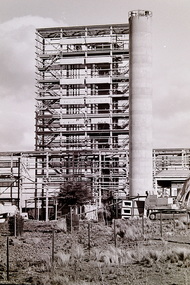
Photograph - Albion Explosive Factory Northern RDX Acid Plant Chimney Demolition 1990 Photographs, Sharon Cavanagh, 26th July 1990
... Defence Explosives Annexe No. 5, constructed rapidly in 1939–1940 as part of Australia’s WWII munitions expansion. It was built adjacent to the long‑established Nobel / ICI explosives works at Deer Park and produced TNT, nitroglycerine, cordite, RDX, DNT, and related explosive compounds. This plant manufactured Research Department Explosive (RDX), a nitrogen‑rich high explosive used in military munitions, which is far more powerful than TNT, yet relatively stable to store and transport. It is not a consumer or industrial...Defence Explosives Annexe No. 5, constructed rapidly in 1939–1940 as part of Australia’s WWII munitions expansion. It was built adjacent to the long‑established Nobel / ICI explosives works at Deer Park and produced TNT, nitroglycerine, cordite, RDX, DNT, and related explosive compounds. This plant manufactured Research Department Explosive (RDX), a nitrogen‑rich high explosive used in military munitions, which is far more powerful than TNT, yet relatively stable to store and transport. It is not a consumer or industrial ...The Albion Explosives Factory began as Commonwealth Defence Explosives Annexe No. 5, constructed rapidly in 1939–1940 as part of Australia’s WWII munitions expansion. It was built adjacent to the long‑established Nobel / ICI explosives works at Deer Park and produced TNT, nitroglycerine, cordite, RDX, DNT, and related explosive compounds. This plant manufactured Research Department Explosive (RDX), a nitrogen‑rich high explosive used in military munitions, which is far more powerful than TNT, yet relatively stable to store and transport. It is not a consumer or industrial product and sits firmly in the defence materials category.This series of time elapsed photographs records the demolition of the Northern RDX Acid Plant chimney by controlled demolition by explosive which safely brought the chimney down by making it to fall to one side. The history of the Albion Explosive Factory is tightly connected to the evolution of the Deer Park explosives precinct and the wider ICI industrial township.Chimney Blown Up Explosive Factory Deer Park 341.1albion explosive factory, ballarat road, deer park, ici -
 Puffing Billy Railway
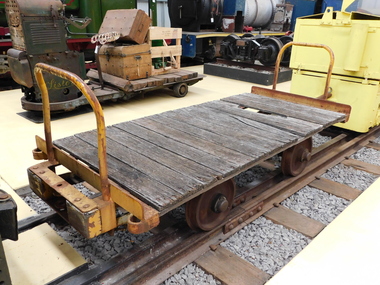
Explosives Wagon, unkown
... industrial operations is situated at Gate 6 of Tilburn Road. Operations include: • a specialty chemicals facility producing products for mining services operations • quarry services • other chemical manufacture activities. The Deer Park factory complex The factory complex is of historical significance for the major role it played in Australia's manufacturing and mining industries through the development of progressively more efficient and safer explosives. It also contributed to wartime production in ammunition, initiators and the development of synthetic ammonia production and construction of the Defence...industrial operations is situated at Gate 6 of Tilburn Road. Operations include: • a specialty chemicals facility producing products for mining services operations • quarry services • other chemical manufacture activities. The Deer Park factory complex The factory complex is of historical significance for the major role it played in Australia's manufacturing and mining industries through the development of progressively more efficient and safer explosives. It also contributed to wartime production in ammunition, initiators and the development of synthetic ammonia production and construction of the Defence ...This 2 foot 6 inch (762mm) gauge wagon was used for carrying explosives and was used with the Greenbat Battery loco. It was donated to the Walhalla Goldfields Railway on long term loan in 2013 along with a large quantity of narrow gauge trollies and light rail from Orica’s now closed munitions factory in Melbourne’s western suburbs. Orica - Deer Park Munitions factory Orica Deer Park in Melbourne’s west has been used since circa 1875 for various forms of manufacturing and storage of chemicals. Although the site is bounded by Ballarat Road, Station Street, Tilburn Road and the Western Ring Road, the current entry point for industrial operations is situated at Gate 6 of Tilburn Road. Operations include: • a specialty chemicals facility producing products for mining services operations • quarry services • other chemical manufacture activities. The Deer Park factory complex The factory complex is of historical significance for the major role it played in Australia's manufacturing and mining industries through the development of progressively more efficient and safer explosives. It also contributed to wartime production in ammunition, initiators and the development of synthetic ammonia production and construction of the Defence Explosives Annexe No 5 (later the Albion Explosives Factory) during World War Two. The factory complex is also of technical significance for the unusual and specialised design of many of the buildings and structures, both in the layout of the works and the individual design of buildings. Blast protection and safety measures such as mounds around the buildings, 'cleanways' and buffer zones between production areas were employed extensively. A characteristic of many production buildings was the elimination of cavities where explosive compounds could lodge. The combination of concrete barriers and light-weight construction was designed to direct explosion debris away from operators or other buildings. The narrow gauge tramway, which ran through the explosives section, is a rare survivor of nineteenth century materials-handling methods. Historic - Industrial Narrow Gauge Railway - Wagon for carrying Explosives at the Orica - Deer Park Munitions factory, Deer park, Victoria, Australia Wagon for carrying explosives made from Timber and steelwagon for carrying explosives, puffing billy, industrial narrow gauge railway, orica - deer park munitions factory, explosives wagon -
Unions Ballarat
Tenix Defence Systems Pty Ltd: Certified Agreement Industrial Award 1998-2001, 1998
... BTLC ballarat trades and labour council; ballarat trades hall Unions awards Australian Industrial Relations Commission Tenix Defence Systems AFMEU CEPU AWU Certified agreements - enterprise agreements Title and name of applicable company printed on the front cover. ...The award and certified agreement was negotiated between the employer and party unions. It was certified by Commissioner Simmonds on 20 January 1998. The document was expected to expire in 2001.Relates to rights and entitlements for Tenix workers. Pre-WorkChoices agreement (1998-2001).PaperbackTitle and name of applicable company printed on the front cover. Company name also printed on the back cover.btlc, ballarat trades and labour council;, ballarat trades hall, unions, awards, australian industrial relations commission, tenix defence systems, afmeu, cepu, awu, certified agreements - enterprise agreements -
 Flagstaff Hill Maritime Museum and Village
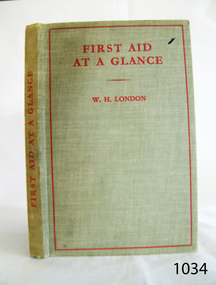
Book - Reference Medical/First Aid, William H. London, First Aid At A Glance, 1939
... Australian literature, publishing iconic authors such as Banjo Paterson, Henry Lawson, and May Gibbs. With the outbreak of World War II in late 1939, they pivoted heavily into printing military handbooks, educational materials, and civil defence manuals to support the Australian war effort and home front preparedness. The book holds clear historical and cultural significance, primarily as a home-front artefact of World War II. Printed in late 1939, it directly reflects Australia's rapid mobilisation and civilian preparation for war, including blackout conditions and potential air raids. Additionally, it captures a transitional period in Australian medical history that bridged surf lifesaving and industrial ...Published on the eve of World War II in 1939, First Aid at a Glance is a compact, highly practical emergency manual. Designed as a concise summary for quick reference during crisis situations, it covers core civil defence and emergency medical topics such as the treatment of wounds, severe bleeding, and shock. Other subjects covered in this publication are fracture immobilisation and bandaging techniques, resuscitation and drowning intervention, and the management of casualties in public, industrial, or home settings.Hard cover book, First Aid at a Glance Author: William H. London Publisher: Angus & Robertson, Sydney, Australia Date: 1939 Further Information: Green cloth covered hardback volume with title in rednon-fictionPublished on the eve of World War II in 1939, First Aid at a Glance is a compact, highly practical emergency manual. Designed as a concise summary for quick reference during crisis situations, it covers core civil defence and emergency medical topics such as the treatment of wounds, severe bleeding, and shock. Other subjects covered in this publication are fracture immobilisation and bandaging techniques, resuscitation and drowning intervention, and the management of casualties in public, industrial, or home settings.flagstaff hill, warrnambool, shipwrecked-coast, flagstaff-hill, flagstaff-hill-maritime-museum, maritime-museum, shipwreck-coast, flagstaff-hill-maritime-village, first aid at a glance, book, william london, w.r. angus
