
Showing 5 items matching "australian folk tales"
-
 Eltham District Historical Society Inc
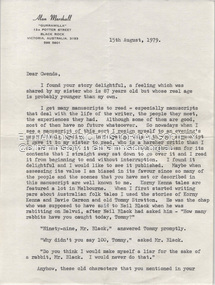
Document - Folder, Alan Marshall (1902-1984), Correspondence from Alan Marshall to Gwenda Sanderson, 1979-1983
... ...Folk tales...Australian...Korny Kenna Folk tales Australian Folk Tales Davie Carson Tommy Stratton Neil Black Black Emily Noorat Purnim encampment Pompey Austin Aboriginal characters John Manifold John Hooker Collins Publishers Eltham history Alan Marshall (Pioneers and Painters) James Bonwick Mount Shadwell Mount Noorat John Smith Blacksmith Mary Turner-Shaw On Mount Emu Creek (book) Wooiwyrite Western District Victoria Merrilyn Sanderson Mortlake The Land (poem) Collected Verse (book) Austin family Hammers over the Anvil (book) Eeyeuk Dennis family Peg Dennis Noorat Church Jim Smith Miss Dennis Mrs Polly Mrs Angus Gillies Mental health Frank Smith Country Life (English paper) Field (English paper) Peter McLeod Bill Beechey Angus Gillies Mag Dennis East Driscoll Camperdown Bill White Alec Irvine Jack Irvine Staughton's stable Cumming family Jallalabad Miss Baird Private Catholic School Jack Peoples Shaw's Weatherley Miss Ann Gordon Ballangeich Writer Author Sun (newspaper) William Collins (Aust.) ...Alan Marshall AM, (2 May 1902 – 21 January 1984) was an Australian writer, story teller, humanist and social documenter. Personal correspondence between Gwenda Sanderson and Alan Marshall, dated between 1979 and 1983. There are 21 letters in all, the last 3 of which were dictated from the Hurlingham Nursing Home in Brighton. Background information for the letters (daugher Merrilyn Sanderson 10 October 2025): My mother, Gwenda Sanderson ( nee White ) grew up in the western district and knew Alan Marshall's sister. Gwenda was an aspiring author, and reached out to Alan for support and advice regarding her writing. Alan proved to be a generous and inspiring mentor and as you will see, they established a rapport. In 1966 Gwenda moved from Mortlake to Montmorency (quite a culture shock!) and around 1983 she and her husband, Stan moved to Diamond Creek. Letters: 1. Alan Marshall to Gwenda Sanderson, 15 August 1979 2. Alan Marshall to Gwenda Sanderson, 22 August 1979 3. Alan Marshall to Gwenda Sanderson, 28 August 1979 4. Alan Marshall to Gwenda Sanderson, 7 September 1979 5. Alan Marshall to Gwenda Sanderson, 19 September 1979 6. Alan Marshall to Gwenda Sanderson, 11 October 1979 7. Alan Marshall to Gwenda Sanderson, 18 October 1979 8. Alan Marshall to Gwenda Sanderson, 1 November 1979 9. Alan Marshall to Gwenda Sanderson, 10 January 1980 10. Alan Marshall to Gwenda Sanderson, 24 January 1980 11. Alan Marshall to Gwenda Sanderson, 15 February 1980 12. Gwen Hardisty on behalf of Alan Marshall to Gwenda Sanderson, 27 May 1980 13. Alan Marshall to Gwenda Sanderson, 17 June 1980 14. Alan Marshall to Gwenda Sanderson, 29 July 1980 15. Alan Marshall to Gwenda Sanderson, 4 August 1980 16. Alan Marshall to Gwenda Sanderson, 22 August 1980 17. Alan Marshall to Gwenda Sanderson, 5 February 1981 18. Alan Marshall to Gwenda Sanderson, 5 August 1981 19. Gwen Hardisty on behalf of Alan Marshall to Gwenda Sanderson, 11 May 1982 20. Alan Marshall to Gwenda Sanderson, 27 Octopber 1982 21. Alan Marshall to Gwenda Sanderson, 21 February 1983 alan marshall, gwenda sanderson, gurrawilla, elsie louise mcconnell, black rock (vic.), korny kenna, folk tales, australian folk tales, davie carson, tommy stratton, neil black, black emily, noorat, purnim encampment, pompey austin, aboriginal characters, john manifold, john hooker, collins publishers, eltham history, alan marshall (pioneers and painters), james bonwick, mount shadwell, mount noorat, john smith, blacksmith, mary turner-shaw, on mount emu creek (book), wooiwyrite, western district victoria, merrilyn sanderson, mortlake, the land (poem), collected verse (book), austin family, hammers over the anvil (book), eeyeuk, dennis family, peg dennis, noorat church, jim smith, miss dennis, mrs polly, mrs angus gillies, mental health, frank smith, country life (english paper), field (english paper), peter mcleod, bill beechey, angus gillies, mag dennis, east driscoll, camperdown, bill white, alec irvine, jack irvine, staughton's stable, cumming family, jallalabad, miss baird, private catholic school, jack peoples, shaw's, weatherley, miss ann gordon, ballangeich, writer, author, sun (newspaper), william collins (aust.) ltd, chatsworth homestead, russia, i can jump puddles (book), nat gould, race horses, ethell dell, gertrude page, geoffrey farnell, east driscoll (story), shamrock smith, the catholic ball (story), lance skuthorpe, the blood of johnny meagher (story), winter-irving, sarah midgeley, richard skilbeck, miss edith (story), sun competition, mandeville hall, hampden council, alan marshall commemorative plaque noorat, russian theatrical troupe, noorat show, eliza sturgess, sam johnson the baker, elsie johnson, crupper, martingale, a.j. black, shaw women, miss laura, squatter, duke of edinburgh, royal family, 'texas' green, member for kalgoorlie, duke of gloucestor, the girl in pink, prince of wales, may creedie (story), mrs scott of mortlake, smouldering fires (book), lindsay russell, mary murray of our valley (book), the fellowship of australian writers, jim hamilton, journey to aboriginal victoria (book), mary gilmore, peter mcallum institute, may creedie (book), gwen hardisty, heart attack, bulletin (magazine), stephenson, gloria swanson, jennifer marshall, daniel (grandson), cathy (daughter), sandringham hospithal, east brighton nursing home, alan marshall writes alone (review) -
 Kiewa Valley Historical Society
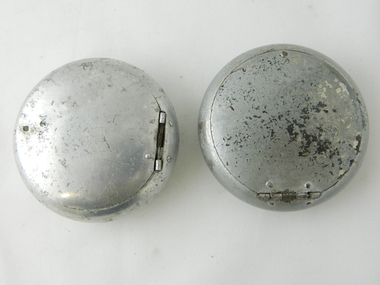
Ash Tray Pocket, Circa mid to late 1900s
... Australian rest period), at any time, especially after some hard physical work, the ability to have a self contained ashing apparatus, not to offend the gentler folk, was a pre-requisite . The rural environment, in the days of these cigarette ash containers,was one which could range from harsh and unforgiving to mild and relaxing. Smoking could be enjoyed anywhere and at any time without too much "fussing" around. This ash tray was mobile, convenient, unobtrusive and regarded by the user as being considerate to those around. It also eliminated the tell tale ...This flip top pocket steel ash tray was at the beginning of the social "cleaning up" of cigarette ash and related products. This cigarette waste container was for those occasions when it was polite not to throw the cigarette ash and used up cigarettes "buts" on the ground, or if working in any rural area during a dry fire prone season, when discarding burning cigarette waste could set up a severe "bush" fire. It was also at the beginning of an intensive look at the affects of smoking upon the health of users. Later in the 1900s was a time when medical evidence supported a ground swell of the anti smoking movement which resulted in further restrictions of the use cigarette smoking in public places. Before the anti cigarette smoking revolution, it was both fashionable and manly to either roll your own cigarette or open up a packet of "tailor made's". In the rural and man's man environment the roll your own provided a visual acknowledgement that the user was "true blue" Aussie male and not a city boy. The cycle of use of cigarettes has drastically changed from when this item was first used. Today's society (post 2000) has produced a ground swell of government and non government organisations whose aim is provide a cigarette "ash" free environment and society. This is highlighted in the beginning of the 2000 millennium by a cigarette "Free" Australia campaign, and the pocket flip top personal ash tray as a practical solution for butt litter disposal.This pocket ash tray not only was used when social graces required it to, but also provided a container for any unfinished cigarettes or stogies (cheap half used cigars). In rural areas (open fresh air countryside), where time was always made available for the "smoko" (Australian rest period), at any time, especially after some hard physical work, the ability to have a self contained ashing apparatus, not to offend the gentler folk, was a pre-requisite . The rural environment, in the days of these cigarette ash containers,was one which could range from harsh and unforgiving to mild and relaxing. Smoking could be enjoyed anywhere and at any time without too much "fussing" around. This ash tray was mobile, convenient, unobtrusive and regarded by the user as being considerate to those around. It also eliminated the tell tale evidence that the "no smoking" signs had been ignored. The Kiewa Valley was like many rural ares that found it hard for smokers to come to grips with a governmental "non smoking policy" to indoor recreational and other "confined space" environments. Tin plated mild steel round container with a lid. The opening lid is spring loaded, hinged top, circular and fixed by a clasp, pop- riveted (4) onto the main housing. Opposite the hinge the lid is held closed by a small metal ball fitting tightly to the top wall of the container. The lid is opened by the use of a fingernail positioned at junction of lid to body. This edge is bevelled to allow access. personal effects, tobacco waste products, smoking accessories -
 Kiewa Valley Historical Society
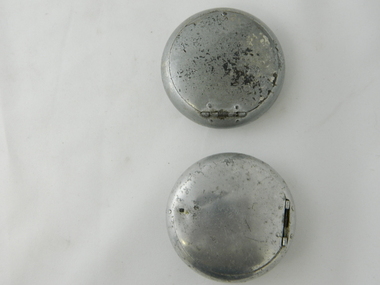
Ash Tray Pocket
... Australian rest period), at any time, especially after some hard physical work, the ability to have a self contained ashing apparatus, not to offend the gentler folk, was a pre-requisite . The rural environment, in the days of these cigarette ash containers,was one which could range from harsh and unforgiving to mild and relaxing. Smoking could be enjoyed anywhere and at any time without too much "fussing" around. This ash tray was mobile, convenient, unobtrusive and regarded by the user as being considerate to those around. It also eliminated the tell tale ...This flip top pocket aluminium ash tray was at the beginning of the social "cleaning up" of cigarette ash and related products. This cigarette waste container was for those occasions when it was polite not to throw the cigarette ash and used up cigarettes "buts" on the ground, or if working in any rural area during a dry fire prone season, when discarding burning cigarette waste could set up a severe "bush" fire. It was also at the beginning of an intensive look at the affects of smoking upon the health of users. Later in the 1900s was a time when medical evidence supported a ground swell of the anti smoking movement which resulted in further restrictions of the use cigarette smoking in public places. Before the anti cigarette smoking revolution, it was both fashionable and manly to either roll your own cigarette or open up a packet of "tailor made's". In the rural and man's man environment the roll your own provided a visual acknowledgement that the user was "true blue" Aussie male and not a city boy. The cycle of use of cigarettes has drastically changed from when this item was first used. Today's society (post 2000) has produced a ground swell of government and non government organisations whose aim is provide a cigarette "ash" free environment and society. This is highlighted in the beginning of the 2000 millennium by a cigarette "Free" Australia campaign, and the pocket flip top personal ash tray as a practical solution for butt litter disposal.This light weight aluminium pocket ash tray not only was used when social graces required it to, but also provided a container for any unfinished cigarettes or stogies (cheap half used cigars). In rural areas (open fresh air countryside), where time was always made available for the "smoko" (Australian rest period), at any time, especially after some hard physical work, the ability to have a self contained ashing apparatus, not to offend the gentler folk, was a pre-requisite . The rural environment, in the days of these cigarette ash containers,was one which could range from harsh and unforgiving to mild and relaxing. Smoking could be enjoyed anywhere and at any time without too much "fussing" around. This ash tray was mobile, convenient, unobtrusive and regarded by the user as being considerate to those around. It also eliminated the tell tale evidence that the "no smoking" signs had been ignored. The Kiewa Valley was like many rural ares that found it hard for smokers to come to grips with a governmental "non smoking policy" to indoor recreational and other "confined space" environments. The covered lid reduces odors and eliminates ashes from being blown around.Aluminium round container with a lid. The opening lid is spring loaded, hinged top, circular and fixed by a clasp, pop- riveted (4) onto the main housing. Opposite the hinge the lid is held closed by a small metal ball fitting tightly to the top wall of the container. The lid is opened by the use of a fingernail positioned at junction of lid to body. This edge is bevelled to allow access.personal effects, tobacco waste products, smoking accessories, tobacco -
 Narre Warren and District Family History Group
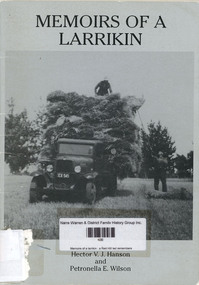
Book, Hector VJ Hanson et al, Memoirs of a larrikin : a Red Hill lad remembers, 1994
... Australia, and like all of us, has a story to tell. Generally. I believe that the stories of "ordinary folk" are all too often left unwritten. This book is just part of the history of each place that Hec lived, worked and relaxed, particularly the hilly country of Victoria's Mornington Peninsula. Hec knew the country like the back of his hand and in many instances could have told various landholders things about their properties that even they did not know. H.V.J.Hanson is "living history" and the tales ...Hector Valentine James Hanson Esq., a sort of "knock-about" bloke of over eighty, has lived and worked in quite a few areas of eastern Australia, and like all of us, has a story to tell. Generally. I believe that the stories of "ordinary folk" are all too often left unwritten. This book is just part of the history of each place that Hec lived, worked and relaxed, particularly the hilly country of Victoria's Mornington Peninsula. Hec knew the country like the back of his hand and in many instances could have told various landholders things about their properties that even they did not know. H.V.J.Hanson is "living history" and the tales related in this book are both interesting and entertaining. Foreword by Terence J. Wilson.non-fictionHector Valentine James Hanson Esq., a sort of "knock-about" bloke of over eighty, has lived and worked in quite a few areas of eastern Australia, and like all of us, has a story to tell. Generally. I believe that the stories of "ordinary folk" are all too often left unwritten. This book is just part of the history of each place that Hec lived, worked and relaxed, particularly the hilly country of Victoria's Mornington Peninsula. Hec knew the country like the back of his hand and in many instances could have told various landholders things about their properties that even they did not know. H.V.J.Hanson is "living history" and the tales related in this book are both interesting and entertaining. Foreword by Terence J. Wilson.red hill (vic.), mornington peninsula, hector vj hanson -
 Falls Creek Historical Society
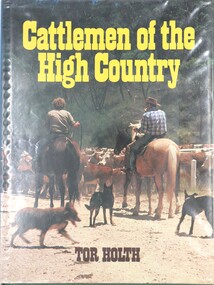
Book - Cattlemen of the High Country, Tor Holth with Jane Barnaby, 1980
... tales. In this book their yarns and reminiscences about their mates, their horses and Hereford cattle, and their indispensable dogs, reveal a characteristic courage and endurance, and an indomitable sense of humour. This book provides an enduring record of a vanishing breed of Australians, folk ...The lives of the mountain cattlemen of Victoria's alpine country revolve around the annual muster held before the first snowfall of autumn, when they bring their cattle down to lower pastures for winter feeding, or consign them for auction at the annual calf sales in Omeo or Myrtleford. The close-knit communities of cattlemen share the common hazards of this mountainous region, enduring the snow and freezing conditions of winter and the threat of ravaging bushfires in summer, finding shelter from the harshness of the environment in little huts which they built from the rough materials available. But the dangers of steep slopes and rocky terrain, in which more than one drover has lost his life, hold no terrors for them. These tough and resourceful cattlemen are self-sufficient and skilful in everything they do, whether it is bushmanship, horse-riding, or telling tall tales. In this book their yarns and reminiscences about their mates, their horses and Hereford cattle, and their indispensable dogs, reveal a characteristic courage and endurance, and an indomitable sense of humour. This book provides an enduring record of a vanishing breed of Australians, folk heroes in their own right, whose lives form the basis of verse and legend.A book of 224 pages including maps, illustrations and photographic images, both black and white and colour. It includes a bibliography.The lives of the mountain cattlemen of Victoria's alpine country revolve around the annual muster held before the first snowfall of autumn, when they bring their cattle down to lower pastures for winter feeding, or consign them for auction at the annual calf sales in Omeo or Myrtleford. The close-knit communities of cattlemen share the common hazards of this mountainous region, enduring the snow and freezing conditions of winter and the threat of ravaging bushfires in summer, finding shelter from the harshness of the environment in little huts which they built from the rough materials available. But the dangers of steep slopes and rocky terrain, in which more than one drover has lost his life, hold no terrors for them. These tough and resourceful cattlemen are self-sufficient and skilful in everything they do, whether it is bushmanship, horse-riding, or telling tall tales. In this book their yarns and reminiscences about their mates, their horses and Hereford cattle, and their indispensable dogs, reveal a characteristic courage and endurance, and an indomitable sense of humour. This book provides an enduring record of a vanishing breed of Australians, folk heroes in their own right, whose lives form the basis of verse and legend.mountain cattlemen, cattle breeders victoria, australian cattlemen, bogong high plains history
