
Showing 32 items matching "australian olympic committee"
-
 National Wool Museum
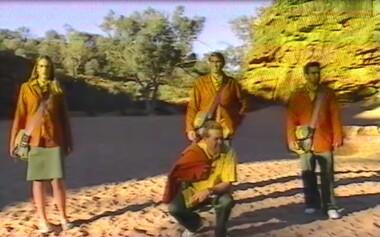
Film - Australian Olympic Uniform Design, The Woolmark Company, 2000
... ...australian olympic committee...Tape documents the design of Australian athletes Olympic Uniform for the Sydney 2000 Olympics. Film features Australian athletes, Australian Olympic Committee staff, The Woolmark Company staff and Mambo staff....Film includes colour footage and audio. 00:02 - titles 00:06 - Mambo artwork detail 00:11 - outback scenes 00:23 - detail of sewing machines 00:40 - Herb Elliot, Director of Athlete and Corporate Relations, Australian Olympic Committee speaking about design of Australian Olympic uniforms 01:10 - Australian athletes wearing uniforms 01:10 - Maria Italiano, Project Manager, Olympics and Sport Marketing Apparel, The Woolmark Company, speaking about uniform design 02:04 - Lachlan Barnard, Australian Menswear Designer, Mambo 02:36 - Deare Jennings, Creative Director, Mambo 04:24 - Russell Mark, Australian Clay Target Shooter 04:58 - Daniel Marsden, Australian Water Polo Team 05:12 - Paul Goudion, Australian Hockey Team 05:27 - end title 05:33 - end...Tape documents the design of Australian athletes Olympic Uniform for the Sydney 2000 Olympics. Film features Australian athletes, Australian Olympic Committee staff, The Woolmark Company staff and Mambo staff. ...Tape documents the design of Australian athletes Olympic Uniform for the Sydney 2000 Olympics. Film features Australian athletes, Australian Olympic Committee staff, The Woolmark Company staff and Mambo staff.Black VHS tape with white stickers and printed text. Tape is housed in clear plastic case. Film includes colour footage and audio. 00:02 - titles 00:06 - Mambo artwork detail 00:11 - outback scenes 00:23 - detail of sewing machines 00:40 - Herb Elliot, Director of Athlete and Corporate Relations, Australian Olympic Committee speaking about design of Australian Olympic uniforms 01:10 - Australian athletes wearing uniforms 01:10 - Maria Italiano, Project Manager, Olympics and Sport Marketing Apparel, The Woolmark Company, speaking about uniform design 02:04 - Lachlan Barnard, Australian Menswear Designer, Mambo 02:36 - Deare Jennings, Creative Director, Mambo 04:24 - Russell Mark, Australian Clay Target Shooter 04:58 - Daniel Marsden, Australian Water Polo Team 05:12 - Paul Goudion, Australian Hockey Team 05:27 - end title 05:33 - endLabel on tape: WOOLMARK / Ceremonial / Uniforms / Duration: 5 min 31 secfilm, sydney 2000 olympic games, uniform, the woolmark company, textile design, mambo, australian olympic committee, athletes -
 Tennis Australia
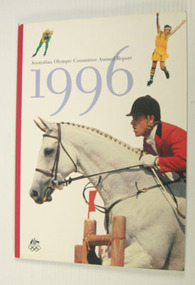
Organisational document, 1996
... Australian Olympic Committee Annual Report Materials: Paper, Ink, Cardboard...Tennis Australian Olympic Committee Annual Report Materials: Paper, Ink, Cardboard Organisational document ...Australian Olympic Committee Annual Report Materials: Paper, Ink, Cardboardtennis -
 Orbost & District Historical Society
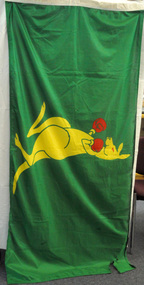
flag, After 1983
... The image was later bought by the Australian Olympic Committee, and is used as a mascot to represent the Australian Olympic team and to promote sport and fair play in schools....The image was later bought by the Australian Olympic Committee, and is used as a mascot to represent the Australian Olympic team and to promote sport and fair play in schools. ...In 1983 the boxing kangaroo received national and international prominence when it served as the symbol for the successful Australian challenge for the America's Cup, where the boxing kangaroo flag, a red-gloved golden kangaroo on a green background, was flown from the yacht Australia II. Alan Bond (owner of the Australia II yacht) owned the image and licensed it for mass production. The image was later bought by the Australian Olympic Committee, and is used as a mascot to represent the Australian Olympic team and to promote sport and fair play in schools.A synthetic rectangular green flag of the yellow boxing kangaroo wearing red boxing gloves. -
 Sunshine and District Historical Society Incorporated
Archive - Mark Doubleday Olympic Baseballer
... Typed Report Baseball 1996 Team Australia|Typed Media Release Australian Olympic Committee 13 June 1996|Typed Report Histoy Repeats Itself|Handwritten Letter Easton Product endorsement|Typed Recognition and Appreciation letter to Mark Doubleday|Photograph of Mark Doubleday in uniform|Photograph of 1996 Australian Olympic Team|Photograph Atlanta 1996 Top Row L to R Ian McIndoe Trainer Grant McDonald Ron Johnson Hitting Coach Adrian Meagher Pitching Coach Shane Tonkin Fred Linberg David Hynes Stuart Howell Dusty Rhodes Assistant Coach Middle Row L to R Mark Doubleday Richard Vagg Stuart Thompson John Moore Jeff Williams Peter Vogler Jason Hewitt Rob Derksen Head Coach Bottom Row L to R Steve Hinton Andrew McNally Michael Nakamura Scott Tunkin Matthew Sheldon Collins Andrew Scott Scott Dawes Simon Sheldon Collins...Mark Doubleday Baseball Athletics Olympics Typed Report Baseball 1996 Team Australia|Typed Media Release Australian Olympic Committee 13 June 1996|Typed Report Histoy Repeats Itself|Handwritten Letter Easton Product endorsement|Typed Recognition and Appreciation letter to Mark Doubleday|Photograph of Mark Doubleday in uniform|Photograph of 1996 Australian Olympic Team|Photograph Atlanta 1996 Top Row L to R Ian McIndoe Trainer Grant McDonald Ron Johnson Hitting Coach Adrian Meagher Pitching Coach Shane Tonkin Fred Linberg David Hynes Stuart Howell Dusty Rhodes Assistant Coach Middle Row L to R Mark Doubleday Richard Vagg Stuart Thompson John Moore Jeff Williams Peter Vogler Jason Hewitt Rob Derksen Head Coach Bottom Row L to R Steve Hinton Andrew McNally Michael Nakamura Scott Tunkin Matthew Sheldon Collins Andrew Scott Scott Dawes Simon Sheldon Collins Collection of articles and photos on Mark Doubleday Archive Mark Doubleday Olympic Baseballer ...Typed Report Baseball 1996 Team Australia|Typed Media Release Australian Olympic Committee 13 June 1996|Typed Report Histoy Repeats Itself|Handwritten Letter Easton Product endorsement|Typed Recognition and Appreciation letter to Mark Doubleday|Photograph of Mark Doubleday in uniform|Photograph of 1996 Australian Olympic Team|Photograph Atlanta 1996 Top Row L to R Ian McIndoe Trainer Grant McDonald Ron Johnson Hitting Coach Adrian Meagher Pitching Coach Shane Tonkin Fred Linberg David Hynes Stuart Howell Dusty Rhodes Assistant Coach Middle Row L to R Mark Doubleday Richard Vagg Stuart Thompson John Moore Jeff Williams Peter Vogler Jason Hewitt Rob Derksen Head Coach Bottom Row L to R Steve Hinton Andrew McNally Michael Nakamura Scott Tunkin Matthew Sheldon Collins Andrew Scott Scott Dawes Simon Sheldon Collinsmark doubleday, baseball, athletics, olympics -
 Federation University Historical Collection
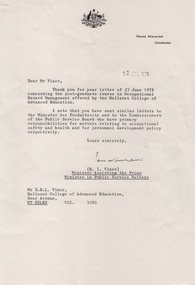
Document - Document - Submission for Approval, VIOSH: Ballarat College of Advanced Education; Submission to the Victorian Institute of Colleges, 1978
... This still needs approval from the Tertiary Education Commission for the purposes of the expenditure of funds under the provision of the State Government. viosh victorian institute of occupational safety and health ballarat college of advanced education pg1 graduate diploma in occupational hazard management minister assisting prime minister r i viner elizabeth o'keefe victoria institute of colleges vic academic committee w j robertson k b brown a j christophers bcae advisory committee w jinkins e wigglesworth bcad staff d j woolley t d norwood d b viner g fernandez royal australian college of surgeons department of health gas and fuel corporation medical officer olympic tyres school of engineering mechanical engineering school of business tertiary education committee state government state grants Letterhead of Victoria Institute of Colleges and the Prime Minister, Canberra Signature: R I Viner - Minister assisting the Prime MInister in Public Service Matters Elizabeth O'Keefe - Secretary to the Academic Committee in Engineering, V.I.C. ...Victorian Institute of Occupational Safety and Health (VIOSH) Australia is the Asia-Pacific centre for teaching and research in occupational health and safety (OHS) and is known as one of Australia's leaders on the field. VIOSH has a global reputation for its innovative approach within the field of OHS management. VIOSH had its first intake of students in 1979. At that time the Institution was known as the Ballarat College of Advanced Education. In 1990 it became known as Ballarat University College, then in 1994 as University of Ballarat. It was 2014 that it became Federation University. VIOSH Australia students are safety managers, senior advisors and experienced OHS professionals. They come from all over Australia and industry. Students are taught active research and enquiry; rather than textbook learning and a one-size fits all approach. VIOSH accepts people into the Graduate Diploma of Occupational Hazard Management who have no undergraduate degree - on the basis of extensive work experience and knowledge. Ballarat College of Advanced Education had been trying for approval of a PG1 Graduate Diploma in Occupational Hazard Management during 1976 and 1977. This last application was 1978. They were hoping to introduce it in 1979. Present at this meeting held on Tuesday 8th August 1978 were representatives from: EAC Subcommittee; W J Robertson (Convenor), Dr K B Brown (Medical Officer}, Dr A J Christophers (Chief Industrial Hygiene Officer, Dept of Health, E O'Keefe (Secretary to the Committee) Ballarat CAE Course Advisory Committee; W Jinkins (Safety Engineer, Gas & Fuel), E Wigglesworth (Injury Research Unit, Royal College of Surgeons) Ballarat College of Advanced Education; D J Woolley (Head of School of Engineering), T D Norwood (Head of Dept Mechanical Engineering), D Viner (Course Co-ordinator}, G Fernandez (School of Business} Recommendation that the proposed course for the award of PG1 Graduate Diploma in Occupational Hazard Management at Ballarat College of Advanced Education be approved for introduction in 1979 at first year level. This still needs approval from the Tertiary Education Commission for the purposes of the expenditure of funds under the provision of the State Government.Ten A4 pages - typed. Four correspondence and six the Draft of course for the applicationLetterhead of Victoria Institute of Colleges and the Prime Minister, Canberra Signature: R I Viner - Minister assisting the Prime MInister in Public Service Matters Elizabeth O'Keefe - Secretary to the Academic Committee in Engineering, V.I.C.viosh, victorian institute of occupational safety and health, ballarat college of advanced education, pg1, graduate diploma in occupational hazard management, minister assisting prime minister, r i viner, elizabeth o'keefe, victoria institute of colleges, vic academic committee, w j robertson, k b brown, a j christophers, bcae advisory committee, w jinkins, e wigglesworth, bcad staff, d j woolley, t d norwood, d b viner, g fernandez, royal australian college of surgeons, department of health, gas and fuel corporation, medical officer olympic tyres, school of engineering, mechanical engineering, school of business, tertiary education committee, state government, state grants -
 Federation University Historical Collection
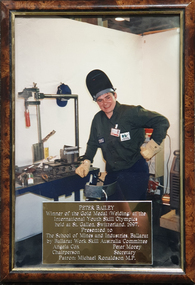
Photograph - colour photograph, Peter Bailey, winner of the International Youth Skills Olympics for Welding, c1997
... Olympics held at St Gallen, Switzerland, 1997. Presented to The Ballarat School of Mines and Industries, Ballarat by Ballarat Work Skill Australian Committee Angela Cox Peter Morey Chairperson Secretary Patron: Michael Ronaldson M.P....Peter Bailey studied at the Ballarat School of Mines ballarat school of mines peter bailey awards welding international youth skills olympics ballarat work skill australia angela cox peter morey michael ronaldson Peter Bailey Winner of the gold medal (Welding) at the International Youth Skills Olympics held at St Gallen, Switzerland, 1997. Presented to The Ballarat School of Mines and Industries, Ballarat by Ballarat Work Skill Australian Committee ...Peter Bailey studied at the Ballarat School of MinesFramed colour photograph with gold plaque. it shows Peter Bailer in the workshop.Peter Bailey Winner of the gold medal (Welding) at the International Youth Skills Olympics held at St Gallen, Switzerland, 1997. Presented to The Ballarat School of Mines and Industries, Ballarat by Ballarat Work Skill Australian Committee Angela Cox Peter Morey Chairperson Secretary Patron: Michael Ronaldson M.P.ballarat school of mines, peter bailey, awards, welding, international youth skills olympics, ballarat work skill australia, angela cox, peter morey, michael ronaldson -
 Flagstaff Hill Maritime Museum and Village
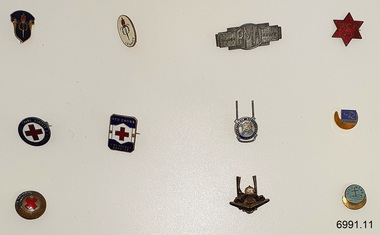
Badge - Collection of Organisation Badges, 1920's to 1940's
... Olympic Pool Committee, Food for Britain Organisation, Warrnambool Hospital, Anti-Cancer Council, Boys’ Club, Charitable Council, National Fitness Council and Air Raid Precautions Group. Dr Angus was also a member of the Steam Preservation Society and derived much pleasure from a steam traction engine on his farm. They were both involved in the creation of Flagstaff Hill, including the layout of the gardens until Dr Angus passed away in March 1970. This set of badges is significant for connecting Doctor Angus with Australian ...This set of eleven badges was collected from the 1920s to the 1940s by Dr W. R. Angus. It represents various organisations that he had interests in. The set of badges was donated to Flagstaff Hill Maritime Village by the family of Doctor Angus, Surgeon and Oculist. It is part of the “W.R. Angus Collection” which includes historical medical equipment, surgical instruments and material once belonging to Dr Edward Ryan and Dr Thomas Francis Ryan, (both of Nhill, Victoria) as well as Dr Angus’ own belongings. The Collection’s history spans the medical practices of the two Doctors Ryan, from 1885-1926 plus that of Dr Angus, up until 1969. ABOUT THE “W.R.ANGUS COLLECTION” Doctor William Roy Angus M.B., B.S., Adel., 1923, F.R.C.S. Edin.,1928 (also known as Dr Roy Angus) was born in Murrumbeena, Victoria in 1901 and lived until 1970. He qualified as a doctor in 1923 at the University of Adelaide, was Resident Medical Officer at the Royal Adelaide Hospital in 1924 and for a period was a house surgeon to Sir (then Mr.) Henry Simpson Newland. Dr Angus was briefly an Assistant to Dr Riddell of Kapunda, then commenced private practice at Curramulka, Yorke Peninsula, SA, where he was a physician, surgeon and chemist. In 1926, he was appointed as the new Medical Assistant to Dr Thomas Francis Ryan (T.F. Ryan, or Tom), in Nhill, Victoria, where his experiences included radiology and pharmacy. In 1927 he was Acting House Surgeon in Dr Tom Ryan’s absence. Dr Angus had become engaged to Gladys Forsyth and they decided he would take time to further his studies overseas in the UK in 1927. He studied at London University College Hospital and at Edinburgh Royal Infirmary and in 1928, was awarded FRCS (Fellow from the Royal College of Surgeons), Edinburgh. He worked his passage back to Australia as a Ship’s Surgeon on the Australian Commonwealth Line’s T.S.S. Largs Bay. Dr Angus married Gladys in 1929, in Ballarat. (They went on to have one son (Graham 1932, born in SA) and two daughters (Helen (died 12/07/1996) and Berenice (Berry), both born at Mira, Nhill ) Dr Angus was a ‘flying doctor’ for the A.I.M. (Australian Inland Ministry) Aerial Medical Service in 1928. The organisation began in South Australia through the Presbyterian Church in that year, with its first station being in the remote town of Oodnadatta, where Dr Angus was stationed. He was locum tenens there on North-South Railway at 21 Mile Camp. He took up this ‘flying doctor’ position in response to a call from Dr John Flynn; the organisation was later known as the Flying Doctor Service, then the Royal Flying Doctor Service. A lot of his work during this time involved dental surgery also. Between 1928-1932 he was a surgeon at the Curramulka Hospital, Yorke Peninsula, South Australia. In 1933 Dr Angus returned to Nhill where he’d previously worked as Medical Assistant and purchased a share of the Nelson Street practice and Mira hospital from Dr Les Middleton one of the Middleton Brothers, the current owners of what was once Dr Tom Ryan’s practice. Dr L Middleton was House Surgeon to the Nhill Hospital 1926-1933, when he resigned. [Dr Tom Ryan’s practice had originally belonged to his older brother Dr Edward Ryan, who came to Nhill in 1885. Dr Edward saw patients in his rooms, firstly in Victoria Street and in 1886 in Nelson Street, until 1901. The Nelson Street practice also had a 2-bed ward, called Mira Private Hospital ). Dr Edward Ryan was House Surgeon at the Nhill Hospital 1884-1902. He also had occasions where he successfully performed veterinary surgery for the local farmers too. Dr Tom Ryan then purchased the practice from his brother in 1901. Both Dr Edward and Dr Tom Ryan work as surgeons included eye surgery. Dr Tom Ryan performed many of his operations in the Mira private hospital on his premises. He too was House Surgeon at the Nhill Hospital 1902-1926. Dr Tom Ryan had one of the only two pieces of radiology equipment in Victoria during his practicing years – The Royal Melbourne Hospital had the other one. Over the years Dr Tom Ryan gradually set up what was effectively a training school for country general-practitioner-surgeons. Each patient was carefully examined, including using the X-ray machine, and any surgery was discussed and planned with Dr Ryan’s assistants several days in advance. Dr Angus gained experience in using the X-ray machine there during his time as assistant to Dr Ryan. Dr Tom Ryan moved from Nhill in 1926. He became a Fellow of the Royal Australasian College of Surgeons in 1927, soon after its formation, a rare accolade for a doctor outside any of the major cities. He remained a bachelor and died suddenly on 7th Dec 1955, aged 91, at his home in Ararat. Scholarships and prizes are still awarded to medical students in the honour of Dr T.F. Ryan and his father, Dr Michael Ryan, and brother, John Patrick Ryan. ] When Dr Angus bought into the Nelson Street premises in Nhill he was also appointed as the Nhill Hospital’s Honorary House Surgeon 1933-1938. His practitioner’s plate from his Nhill surgery states “HOURS Daily, except Tuesdays, Fridays and Saturday afternoons, 9-10am, 2-4pm, 7-8pm. Sundays by appointment”. This plate is now mounted on the doorway to the Port Medical Office at Flagstaff Hill Maritime Village, Warrnambool. Dr Edward Ryan and Dr Tom Ryan had an extensive collection of historical medical equipment and materials spanning 1884-1926 and when Dr Angus took up practice in their old premises he obtained this collection, a large part of which is now on display at the Port Medical Office at Flagstaff Hill Maritime Village in Warrnambool. During his time in Nhill Dr Angus was involved in the merging of the Mira Hospital and Nhill Public Hospital into one public hospital and the property titles passed on to Nhill Hospital in 1939. In 1939 Dr Angus and his family moved to Warrnambool where he purchased “Birchwood,” the 1852 home and medical practice of Dr John Hunter Henderson, at 214 Koroit Street. (This property was sold in1965 to the State Government and is now the site of the Warrnambool Police Station. ). The Angus family was able to afford gardeners, cooks and maids; their home was a popular place for visiting dignitaries to stay whilst visiting Warrnambool. Dr Angus had his own silk worm farm at home in a Mulberry tree. His young daughter used his centrifuge for spinning the silk. Dr Angus was appointed on a part-time basis as Port Medical Officer (Health Officer) in Warrnambool and held this position until the 1940’s when the government no longer required the service of a Port Medical Officer in Warrnambool; he was thus Warrnambool’s last serving Port Medical Officer. (The duties of a Port Medical Officer were outlined by the Colonial Secretary on 21st June, 1839 under the terms of the Quarantine Act. Masters of immigrant ships arriving in port reported incidents of diseases, illness and death and the Port Medical Officer made a decision on whether the ship required Quarantine and for how long, in this way preventing contagious illness from spreading from new immigrants to the residents already in the colony.) Dr Angus was a member of the Australian Medical Association, for 35 years and surgeon at the Warrnambool Base Hospital 1939-1942, He served as a Surgeon Captain during WWII1942-45, in Ballarat, Victoria, and in Bonegilla, N.S.W., completing his service just before the end of the war due to suffering from a heart attack. During his convalescence he carved an intricate and ‘most artistic’ chess set from the material that dentures were made from. He then studied ophthalmology at the Royal Melbourne Eye and Ear Hospital and created cosmetically superior artificial eyes by pioneering using the intrascleral cartilage. Angus received accolades from the Ophthalmological Society of Australasia for this work. He returned to Warrnambool to commence practice as an ophthalmologist, pioneering in artificial eye improvements. He was Honorary Consultant Ophthalmologist to Warrnambool Base Hospital for 31 years. He made monthly visits to Portland as a visiting surgeon, to perform eye surgery. He represented the Victorian South-West subdivision of the Australian Medical Association as its secretary between 1949 and 1956 and as chairman from 1956 to 1958. In 1968 Dr Angus was elected member of Spain’s Barraquer Institute of Barcelona after his research work in Intrasclearal cartilage grafting, becoming one of the few Australian ophthalmologists to receive this honour, and in the following year presented his final paper on Living Intrasclearal Cartilage Implants at the Inaugural Meeting of the Australian College of Ophthalmologists in Melbourne In his personal life, Dr Angus was a Presbyterian and treated Sunday as a Sabbath, a day of rest. He would visit 3 or 4 country patients on a Sunday, taking his children along ‘for the ride’ and to stay with him. Sunday evenings he would play the pianola and sing Scottish songs to his family. One of Dr Angus’ patients was Margaret MacKenzie, author of a book on local shipwrecks that she’d seen as an eyewitness from the late 1880s in Peterborough, Victoria. In the early 1950’s Dr Angus, painted a picture of a shipwreck for the cover jacket of Margaret’s book, Shipwrecks and More Shipwrecks. She was blind in later life and her daughter wrote the actual book for her. Dr Angus and his wife were very involved in Warrnambool’s community and society. Their interests included organisations such as the Red Cross, Rostrum, Warrnambool and District Historical Society (founding members), Wine and Food Society, Steering Committee for Tertiary Education in Warrnambool, Local National Trust, Good Neighbour Council, Housing Commission Advisory Board, United Services Institute, Legion of Ex-Servicemen, Olympic Pool Committee, Food for Britain Organisation, Warrnambool Hospital, Anti-Cancer Council, Boys’ Club, Charitable Council, National Fitness Council and Air Raid Precautions Group. Dr Angus was also a member of the Steam Preservation Society and derived much pleasure from a steam traction engine on his farm. They were both involved in the creation of Flagstaff Hill, including the layout of the gardens until Dr Angus passed away in March 1970. This set of badges is significant for connecting Doctor Angus with Australian organisations of the early-to-mid 20th century, including those relating to military service support. The W.R. Angus Collection is significant for still being located at the site it is connected with, Doctor Angus being the last Port Medical Officer in Warrnambool. The Collection includes historical medical objects that date back to the late 1800s.The eleven metal and enamel badges were collected by Dr W R Angus. They represent organisations that he was involved in. The set is part of the W.R. Angus Collection. Each badge has inscriptions.flagstaff hill, warrnambool, maritime museum, maritime village, great ocean road, shipwreck coast, metal badges, enamel badges, organisation badges, legacy, red cross society, red cross, bma, bma ladies badge, ladies badge, acf, australian comfort fund, presbyterian brotherhood, rostrum, australian legion of servicemen & women, oikumene, w.r. angus collection -
 Bendigo Military Museum
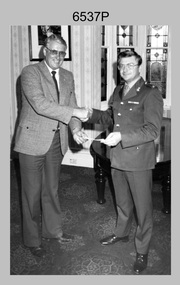
Photograph - Army Survey Regiment Officers Mess Fundraising Presentation, Fortuna Villa, Bendigo, 1983
... The President of the Mess Committee (PMC) MAJ Graham Baker presented a cheque amount of $1,150.00 to the Chairman of Bendigo’s Olympic Fundraising Committee Mr Neville Howell. The funds were probably raised by members of the Officers Mess at a dining-in night. Royal Australian ...This Officers Mess Fundraising Presentation photograph was taken in the Army Survey Regiment’s Officers Mess Long Room, in Fortuna Villa, Bendigo on the 7th of October 1983. The President of the Mess Committee (PMC) MAJ Graham Baker presented a cheque amount of $1,150.00 to the Chairman of Bendigo’s Olympic Fundraising Committee Mr Neville Howell. The funds were probably raised by members of the Officers Mess at a dining-in night.This photograph of an Officers Mess Fundraising Presentation was taken in the Officers Mess Long Room at Fortuna Villa, Bendigo on the 7th of October 1983. The black & white photograph was printed on photographic paper and is part of the Army Survey Regiment’s Collection. The photograph was scanned at 300 dpi. .1) - Photo, black & white, 1983. L to R: Chairman of Bendigo’s Olympic Fundraising Committee Mr Neville Howell, PMC of the Officers Mess MAJ Graham Baker.Annotated on back of photo ‘Officers Mess Fortuna raised $1150.0. Mr Neville Howell Chairman of Bendigo’s Olympic Fundraising Committee and MAJ Baker PMC 7 Oct 83 Dining-In Night’.royal australian survey corps, rasvy, army survey regiment, army svy regt, fortuna -
 Bendigo Historical Society Inc.
Document - The Victorian Country Volleyball Council (VCVC) Correspondence and Country Championship Reports, 1980
... This item contains Correspondence of the Council in 1980 and reports on the Country Chamionships for that year; it include. the following documents: 11171.19a VAVA Special Executive Meeting Minutes Feb 1980 11171.19b VAVA Special Executive Meeting Minutes Feb 1980 11171.19c VAVA Executive Meeting Minutes Feb 1980 11171.19d VAVA Statement of Account Feb 1980 11171.19e VCVC Meeting Minutes April 1980 11171.19f VAVA Executive Meeting Minutes March 1980 11171.19g VAVA Planning Meeting April 1980 11171.19h VCVC AGM June 1980 11171.19i VAVA Executive Council Meeting May 1980 11171.19j VAVA Executive Council Planning Meeting May 1980 11171.19k VAVA Executive Council Meeting June 1980 11171.19l VAVA Executive Council Meeting May 1980 11171.19m VAVA Executive Council Meeting July 1980 11171.19n VAVA Committee Listings Aug 1980 11171.19o VAVA Financial Statement Oct 1980 11171.19p VCVC two day conference minutes Oct 1980 11171.19q VAVA Executive meeting minutes Nov 1980 11171.19r Colour Map of South Australia showing where Volleyball is played 11171.19s VCVC Meeting minutes Dec 1980 at Moe 11171.19t VAVA Meeting minutes Dec 1980 11171.19u VCVC Letter from Secretary re petty cash 11171.19v Victorian Olympic Council re applicants for Promotions Officer 11171.19w VCVC Letter to the Phillip Island District Amateur Volleyball Association 11171.19x VAVA Victorian U15 Boys Selection Trials 11171.19y VCVC Executive Listings 11171.19z VAVA Volleypak Insurance fundraising scheme 11171.19aa VAVA Victorian U15 girls selection trials 11171.19ab Australia Post Box details 11171.19ac Sports Federation of Victoria Newsletter Feb 1980 11171.19ad VAVA 1980 Calendar 11171.19ae Letter to VCVC President Malcolm Darby re meetings 11171.19af Victorian High Schools' Sports Association selection trials 11171.19ag Sports Federation of Victoria Newsletter for March 11171.19ah Thank you letter from World sports Expo 11171.19ai Rebound Marketing proposal 11171.19aj Kyneton Amateur Volleyball Association Rule Book Request 11171.19ak VAVA to President Malcolm Darby re U17 Country Championships 11171.19al Greater Melbourne Volleyball Council re Veteran Championship 1980 11171.19am Bendigo YMCA Volleyball association registration of team colours 11171.19an Seymour Amateur Volleyball Association re monies owed 11171.19ao VCVC Balance Sheet 1980 11171.19ap VCVC to Secretary from Treasurer re monies outstanding 11171.19aq VCVC Record Secretary's annual report June 1980 11171.19ar VAVA re Personal Accident Cover 11171.19as VAVA Constitution revision Sept 1979 11171.19at U20 Men's Match Report 11171.19au The Sports Adminiastrtion Newsletter April 1980 11171.19av The Sports Adminiastrtion Newsletter May 1980...In 2023, the Commission handed the organisation of the Championships back to VVI, who with paid staff, were better equipped to manage the event. victorian country volleyball council vcvc victorian amateur volleyball association volleyball victoria This item contains Correspondence of the Council in 1980 and reports on the Country Chamionships for that year; it include. the following documents: 11171.19a VAVA Special Executive Meeting Minutes Feb 1980 11171.19b VAVA Special Executive Meeting Minutes Feb 1980 11171.19c VAVA Executive Meeting Minutes Feb 1980 11171.19d VAVA Statement of Account Feb 1980 11171.19e VCVC Meeting Minutes April 1980 11171.19f VAVA Executive Meeting Minutes March 1980 11171.19g VAVA Planning Meeting April 1980 11171.19h VCVC AGM June 1980 11171.19i VAVA Executive Council Meeting May 1980 11171.19j VAVA Executive Council Planning Meeting May 1980 11171.19k VAVA Executive Council Meeting June 1980 11171.19l VAVA Executive Council Meeting May 1980 11171.19m VAVA Executive Council Meeting July 1980 11171.19n VAVA Committee Listings Aug 1980 11171.19o VAVA Financial Statement Oct 1980 11171.19p VCVC two day conference minutes Oct 1980 11171.19q VAVA Executive meeting minutes Nov 1980 11171.19r Colour Map of South Australia showing where Volleyball is played 11171.19s VCVC Meeting minutes Dec 1980 at Moe 11171.19t VAVA Meeting minutes Dec 1980 11171.19u VCVC Letter from Secretary re petty cash 11171.19v Victorian Olympic Council re applicants for Promotions Officer 11171.19w VCVC Letter to the Phillip Island District Amateur Volleyball Association 11171.19x VAVA Victorian U15 Boys Selection Trials 11171.19y VCVC Executive Listings 11171.19z VAVA Volleypak Insurance fundraising scheme 11171.19aa VAVA Victorian U15 girls selection trials 11171.19ab Australia Post Box details 11171.19ac Sports Federation of Victoria Newsletter Feb 1980 11171.19ad VAVA 1980 Calendar 11171.19ae Letter to VCVC President Malcolm Darby re meetings 11171.19af Victorian High Schools' Sports Association selection trials 11171.19ag Sports Federation of Victoria Newsletter for March 11171.19ah Thank you letter from World sports Expo 11171.19ai Rebound Marketing proposal 11171.19aj Kyneton Amateur Volleyball Association Rule Book Request 11171.19ak VAVA to President Malcolm Darby re U17 Country Championships 11171.19al Greater Melbourne Volleyball Council re Veteran Championship 1980 11171.19am Bendigo YMCA Volleyball association registration of team colours 11171.19an Seymour Amateur Volleyball Association re monies owed 11171.19ao VCVC Balance Sheet 1980 11171.19ap VCVC to Secretary from Treasurer re monies outstanding 11171.19aq VCVC Record Secretary's annual report June 1980 11171.19ar VAVA re Personal Accident Cover 11171.19as VAVA Constitution revision Sept 1979 11171.19at U20 Men's Match Report 11171.19au The Sports Adminiastrtion Newsletter April 1980 11171.19av The Sports Adminiastrtion Newsletter May 1980 Document The Victorian Country Volleyball Council (VCVC) Correspondence and Country Championship Reports. ...Volleyball has been played in regional Victoria since the early-1960’s. During those early days, most competitions, like the founders of our great sport, were run by, or in conjunction with, the YMCA. Competitions were running at the Ballarat School of Mines and the YMCA’s of Bendigo, Geelong and Warrnambool. In August 1966, an invitation was extended by the Victorian Amateur Volleyball Association to play in the first State-wide event at Monash University. Geelong and Bendigo accepted the invitation with Melbourne represented by Sisu. For Bendigo players at least, this was the first exposure to ‘international rules’, which prevented upward scoops with open hands, introduced an action called a ‘dig’ and seemed to penalise most overhead actions using the fingers as ‘double hits’! Over the next few years, the sport expanded through the YMCA movement with weekly competitions starting up in Ararat, Warrnambool and Latrobe Valley. The Victorian Regional Council of YMCA’s proposed the first Victorian YMCA Championship in Warrnambool on 30th March 1968 with an entry fee of $4.00 per team. The sport continued to grow with additional regional associations affiliating with the Victorian Amateur Volleyball Association (now VVI) who provided the coaching and refereeing assistance needed to raise the standard of play. In 1970, the YMCA Championships started to give way to the Victorian Country Championships with the first ever event held in Bendigo. In 1973, a re-organisation of the VAVA saw the proposal to create separate Victorian Country and Metropolitan Volleyball Councils. The VCVC was established in 1974 and took over the organisation of the Victorian Country Championships. For the next 10-12 years, the Country Championships grew in stature with the inclusion of two divisions for open men and women and junior divisions for boys and girls. Representative teams successfully contested Australian Country Championships between Victoria, South Australia and New South Wales on several occasions. In October 1985, the VCVC voluntarily wound up the Council and handed the responsibility for the Country Championships back to Volleyball Victoria, who by that time had full-time State Executive and Coaching Directors. Since that time, the Long Weekend in June has continued to be the date of the major annual volleyball event for most regional associations, even though in 1986 the Junior Country Championships were wound up in favour of state and national schools events. A number of regional associations have ceased to exist, as have a number of regional tournaments. Regional leagues were created in both the Gippsland and Central, North-West regions, with Gippsland the only one to survive. Some associations have successfully competed in the State League competitions at various times. Following the experience gained by a number of regional administrators working on the Sydney Olympic Games, a proposal to revamp the Victorian Country Championship was put to VVI in early 2002. Later that year, the Volleyball Victoria Country Championships Commission was formed to implement the recommendations of the review and take control of the event into the future. These championships now provide regional players and officials an opportunity to participate in a consistently well-managed event, using many international protocols and a high standard of presentation. Without doubt, this event now ranks as one of the best volleyball events in Australia. Source: 2022 Country Championship regulations The management of the Country Championships by the Victorian Country Championship Commission certainly achieved the objective of raising the standard of presentation, and delivering a consistently high quality event. However, the demands on Host Associations began to take their toll, with several Associations declining the opportunity to host the event due to the high workload. Similarly, the workload of the volunteer Commissioners also took its toll, with the Commission unable to fill casual vacancies. In 2023, the Commission handed the organisation of the Championships back to VVI, who with paid staff, were better equipped to manage the event.This item contains Correspondence of the Council in 1980 and reports on the Country Chamionships for that year; it include. the following documents: 11171.19a VAVA Special Executive Meeting Minutes Feb 1980 11171.19b VAVA Special Executive Meeting Minutes Feb 1980 11171.19c VAVA Executive Meeting Minutes Feb 1980 11171.19d VAVA Statement of Account Feb 1980 11171.19e VCVC Meeting Minutes April 1980 11171.19f VAVA Executive Meeting Minutes March 1980 11171.19g VAVA Planning Meeting April 1980 11171.19h VCVC AGM June 1980 11171.19i VAVA Executive Council Meeting May 1980 11171.19j VAVA Executive Council Planning Meeting May 1980 11171.19k VAVA Executive Council Meeting June 1980 11171.19l VAVA Executive Council Meeting May 1980 11171.19m VAVA Executive Council Meeting July 1980 11171.19n VAVA Committee Listings Aug 1980 11171.19o VAVA Financial Statement Oct 1980 11171.19p VCVC two day conference minutes Oct 1980 11171.19q VAVA Executive meeting minutes Nov 1980 11171.19r Colour Map of South Australia showing where Volleyball is played 11171.19s VCVC Meeting minutes Dec 1980 at Moe 11171.19t VAVA Meeting minutes Dec 1980 11171.19u VCVC Letter from Secretary re petty cash 11171.19v Victorian Olympic Council re applicants for Promotions Officer 11171.19w VCVC Letter to the Phillip Island District Amateur Volleyball Association 11171.19x VAVA Victorian U15 Boys Selection Trials 11171.19y VCVC Executive Listings 11171.19z VAVA Volleypak Insurance fundraising scheme 11171.19aa VAVA Victorian U15 girls selection trials 11171.19ab Australia Post Box details 11171.19ac Sports Federation of Victoria Newsletter Feb 1980 11171.19ad VAVA 1980 Calendar 11171.19ae Letter to VCVC President Malcolm Darby re meetings 11171.19af Victorian High Schools' Sports Association selection trials 11171.19ag Sports Federation of Victoria Newsletter for March 11171.19ah Thank you letter from World sports Expo 11171.19ai Rebound Marketing proposal 11171.19aj Kyneton Amateur Volleyball Association Rule Book Request 11171.19ak VAVA to President Malcolm Darby re U17 Country Championships 11171.19al Greater Melbourne Volleyball Council re Veteran Championship 1980 11171.19am Bendigo YMCA Volleyball association registration of team colours 11171.19an Seymour Amateur Volleyball Association re monies owed 11171.19ao VCVC Balance Sheet 1980 11171.19ap VCVC to Secretary from Treasurer re monies outstanding 11171.19aq VCVC Record Secretary's annual report June 1980 11171.19ar VAVA re Personal Accident Cover 11171.19as VAVA Constitution revision Sept 1979 11171.19at U20 Men's Match Report 11171.19au The Sports Adminiastrtion Newsletter April 1980 11171.19av The Sports Adminiastrtion Newsletter May 1980victorian country volleyball council, vcvc, victorian amateur volleyball association, volleyball victoria -
 Bendigo Historical Society Inc.
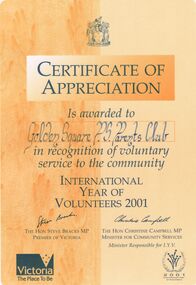
Document - GOLDEN SQUARE PRIMARY SCHOOL COLLECTION: CERTFICATES OF APPRECIATION
... Awards from International Year of Volunteers 2001; Loddon Campaspe Multicultural Services; Bendigo RSL; Indigenous Literacy Foundation; jeans for Genes; Generals Basketball Club; Melbourne City Mission; Anti-Cancer Council; Juvenile Diabetes Research Foundation; MS Readathon, State Schools Relief Committee; Clean up Australia; Family Support Services, Parents Victoria; Good Friday appeal; Victoria Police Historical Society; Jump rope for Heart; Safety House Committee; Starlight foundation; City of Greater Bendigo Olympic Torch Relay; Camp Quality; Zone Football Carnival, School's Garden Awards; Heart Foundation; Target; Scholastic Book Club; School Industry Partnership Project; Royal Flying Doctor Service; Juvenile Diabetes Foundation; McDonald Camp Quality Puppets; Neighbourhood Watch; Centenary of Federation medallion certificate; Derby Hill Camp....Awards from International Year of Volunteers 2001; Loddon Campaspe Multicultural Services; Bendigo RSL; Indigenous Literacy Foundation; jeans for Genes; Generals Basketball Club; Melbourne City Mission; Anti-Cancer Council; Juvenile Diabetes Research Foundation; MS Readathon, State Schools Relief Committee; Clean up Australia; Family Support Services, Parents Victoria; Good Friday appeal; Victoria Police Historical Society; Jump rope for Heart; Safety House Committee; Starlight foundation; City of Greater Bendigo Olympic Torch Relay; Camp Quality; Zone Football Carnival, School's Garden Awards; Heart Foundation; Target; Scholastic Book Club; School Industry Partnership Project; Royal Flying Doctor Service; Juvenile Diabetes Foundation; McDonald Camp Quality Puppets; Neighbourhood Watch; Centenary of Federation medallion certificate; Derby Hill Camp. ...42 Certificates of appreciation/participation awarded to Golden Square Primary School Parents' Club, students and teachers. Awards from International Year of Volunteers 2001; Loddon Campaspe Multicultural Services; Bendigo RSL; Indigenous Literacy Foundation; jeans for Genes; Generals Basketball Club; Melbourne City Mission; Anti-Cancer Council; Juvenile Diabetes Research Foundation; MS Readathon, State Schools Relief Committee; Clean up Australia; Family Support Services, Parents Victoria; Good Friday appeal; Victoria Police Historical Society; Jump rope for Heart; Safety House Committee; Starlight foundation; City of Greater Bendigo Olympic Torch Relay; Camp Quality; Zone Football Carnival, School's Garden Awards; Heart Foundation; Target; Scholastic Book Club; School Industry Partnership Project; Royal Flying Doctor Service; Juvenile Diabetes Foundation; McDonald Camp Quality Puppets; Neighbourhood Watch; Centenary of Federation medallion certificate; Derby Hill Camp.bendigo, education, golden square primary school -
 Ballarat Tramway Museum
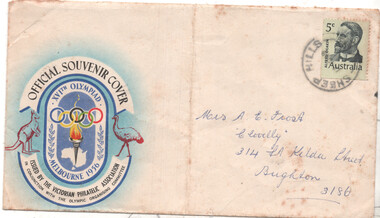
Ephemera, Victorian Philatelic Association, "Official Souvenir Cover - Melbourne Olympics", 1956
... committee. Posted from Sheep Hills Vic to Miss A Frost of Brighton, with a postcode of 3186 indicating it was used after the introduction of postcodes in Australia during 1967. Demonstrates an envelope printed to celebrate the 1956 olympics ...Envelope printed by the Victorian Philatelic Association for the Melbourne XVI Olympiad 1956 issued in conjunction with the organising committee. Posted from Sheep Hills Vic to Miss A Frost of Brighton, with a postcode of 3186 indicating it was used after the introduction of postcodes in Australia during 1967.Demonstrates an envelope printed to celebrate the 1956 olympics, but used many years later.Envelope - printed in colour with a 5c Australian stamp, postmarked Sheephills.melbourne olympic games, olympics, envelopes -
 Whitehorse Historical Society Inc.
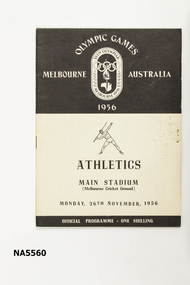
Booklet - 1956 Olympic Games Official Programme, Athletics, Sands & McDougall, C 1956
... Belonged to Ian Howie 1956 Olympic Games Athletics Programmes Olympic Games, Melbourne Australia 1956, Athletics - 16-page booklet - Programme for Main Stadium Athletics - Monday 26th Nov 1956 Booklet 1956 Olympic Games Official Programme, Athletics. Sands & McDougall Olympic Games Organising Committee ...Belonged to Ian Howie- 16-page booklet - Programme for Main Stadium Athletics - Monday 26th Nov 1956Olympic Games, Melbourne Australia 1956, Athletics1956 olympic games, athletics, programmes -
 Whitehorse Historical Society Inc.
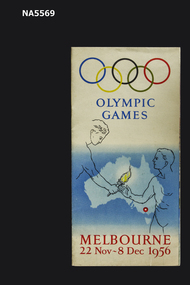
Pamphlet - Souvenir of Melbourne Olympic Games Including programmes, P.C. Grasser & Co. Ltd Melbourme (Lithograph), C 1955
... Promotional pamphlet promoting Melbourne Olympic Games Melbourne Olympic Games 56th Olympiad Promotional material Produced by Australian News and Information Bureau for the Organizing Committee XVI Olympiad. - 8-fold brochure printed both sides - Promotional of many aspects of Melbourne Olympics - Promotional materials of Melbourne Pamphlet Souvenir of Melbourne Olympic Games Including programmes P.C. ...Promotional pamphlet promoting Melbourne Olympic Games- 8-fold brochure printed both sides - Promotional of many aspects of Melbourne Olympics - Promotional materials of MelbourneProduced by Australian News and Information Bureau for the Organizing Committee XVI Olympiad.melbourne, olympic games, 56th olympiad, promotional material -
 Wodonga & District Historical Society Inc
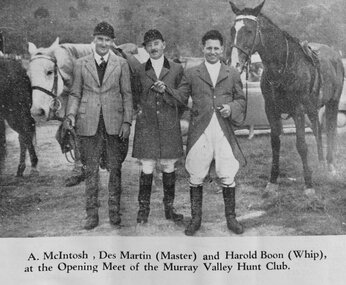
Photograph - Murray Valley Hunt Club opening, 1957
... Des also played a major role in Australia entering an equestrian team in the Melbourne Olympics in 1956 and served as a steward at that event. The Hunt was officially formed with a steering committee of Messrs Crawford, J T Sullivan (Chairman of the North Eastern District Racing Association), Mr Des Martin, Harold Boon and John Hamilton-Smith. ...Des also played a major role in Australia entering an equestrian team in the Melbourne Olympics in 1956 and served as a steward at that event. The Hunt was officially formed with a steering committee of Messrs Crawford, J T Sullivan (Chairman of the North Eastern District Racing Association), Mr Des Martin, Harold Boon and John Hamilton-Smith. ...Murray Valley Hunt Club’s formation stemmed from a conversation between Messrs Ken Crawford, then of "Nooroona", Holbrook, NSW and Des Martin of "Aherlo", Wodonga where they discussed bringing hunting to the people of the district around Wodonga and Albury in 1946. After participating in events and activities in New South Wales with other clubs, the Murray Valley Hunt Club began Point-to-Point racing on "Aherlo" in 1957 at “Aherlo”, the property of Des Martin located on the outskirts of Wodonga in the Huon Creek Valley. Des Martin was the only gentleman rider with permission to ride against professional jockeys within the metropolitan area in any type of jumping race in Victoria, a distinction not since achieved by any other amateur. Des also played a major role in Australia entering an equestrian team in the Melbourne Olympics in 1956 and served as a steward at that event. The Hunt was officially formed with a steering committee of Messrs Crawford, J T Sullivan (Chairman of the North Eastern District Racing Association), Mr Des Martin, Harold Boon and John Hamilton-Smith. Miss Z Cox was appointed Honorary Secretary and Mr J C B Mckenzie McHarg Legal Officer. In 1960 the Hunt Club meets moved to Wodonga Racecourse then in 1967 wet conditions called for a move to Chiltern and in 1968 they successfully applied to re-open the Old Rutherglen Racecourse in 1969. Des Martin died on 12 April 1995. This photograph is significant because it captures key people responsible for the founding of the Murray Valley Hunt Club.A black and white photo of key identities at the opening of the Murray Valley Hunt ClubA. McIntosh , Des Martin (Master) and Harold Boon (Whip), at the Opening Meet of the Murray Valley Hunt Club.murray valley hunt club, des martin, harold boon -
 Albert Park-South Melbourne Rowing Club
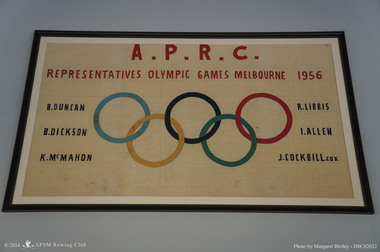
APRC 1956 Olympic Banner, 1957
... Australian rowing team. Additional historic significance derives from the fact that this is an unofficial expression of tribute and pride. The banner’s incorporation of the Olympic rings would now be likely to require licensing by the Australian Olympic Committee, a process that can dampen social engagement. ..."The banner has been with the Club since it was created in 1957. Recent research has confirmed that it was made by Joan Eddy, the wife of club member Kevin Eddy and a professional seamstress. Grace Blake’s interview notes record her conversation with Mr Eddy on 24 October 2014: Kevin confirmed that the banner was made by his wife, Joan Eddy, in time for the opening of the new shed after the Olympics (1957). Kevin was the Social Secretary at the time, and co-opted his wife, who had worked as a machinist for Harford Clothing in Carlton before they married. Her mother had also worked there as a sewing hand (hand sewing the linings for jackets). The company was later taken over by Sires. ... It was made at home (Joan had ‘retired’ from work by then)." Excerpt from the 2014 Significance Assessment, p32.Banner Celebrating Albert Park Rowing Club Olympic Representatives, 1956 Statement of significance by Margaret Birtley, October 2014 Harry Gordon, the distinguished Australian sports historian, wrote of the 1956 Melbourne Olympic Games: "When the Olympic Games moved into Melbourne ... it was as if the city had been brushed by a certain magic. Nothing before or since ... has ever evoked such sheer emotional involvement from the whole community." Gordon refers to the large crowds that massed in Melbourne with anticipation and exhilaration on the day before the official opening, ‘with little apparent motive other than just to be there, and be happy’. The hand-crafted banner celebrating Albert Park Rowing Club’s representatives at those Olympic Games seems to exude that same sense of joy and exhilaration. Made by the wife of the club’s social secretary, it testifies to the admiration felt by individuals and organisations for the success of their own on a world stage. The banner has historic significance for its accurate documentation of the great achievement of a single rowing club in contributing six outstanding athletes to the relatively small Australian rowing team. Additional historic significance derives from the fact that this is an unofficial expression of tribute and pride. The banner’s incorporation of the Olympic rings would now be likely to require licensing by the Australian Olympic Committee, a process that can dampen social engagement. While definitely a hand-made item, there is some aesthetic significance in the design and execution of the banner. Good judgement has been demonstrated in the selection of fabrics and the choice of colours. The workmanship is quite skilful. The vertical symmetry and the horizontal balance of the design are pleasing to the eye. The use of red for the heading lines and black for the Olympians names is well-chosen and aesthetically pleasing. The collection holds black and white photographs of the same oarsmen at the Olympic regatta. This banner complements their role in the collection by providing colour and a sense of connection with an affectionate and supportive community. Its social significance transcends the local context for which it was created and used, to become part of the large body of art, craft and memorabilia that are associated with the Olympic movement worldwide. A handmade embroidered banner to commemorate the Albert Park members who were part of the 1956 Olympic Rowing team.A.P.R.C. / REPRESENTATIVES OLYMPIC GAMES MELBOURNE 1956 / R. DUNCAN / R. DICKSON / K. McMAHON / R. LIBBIS / I. ALLEN / J COCKBILL coxrowing, apsm rowing club, olympic games, albert park rowing club, albert park lake, duncan, robert, dickson, bruce, allen, ian, libbis, reg, mcmahon, kevin, cockbill, john -
 Wodonga & District Historical Society Inc
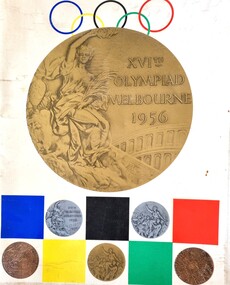
Book - The Games of the Sixteenth Olympiad Melbourne MCMLVI, The Argus and Australasian Limited, 1956
... This publication records a significant event in the sporting history of Australia and its place on the international stage, Melbourne Olympics 16th Olympiad Australian sporting events A publication prepared to commemorate the Games of the Sixteenth Olympiad to be held in Melbourne from November 22 until December 8, 1956. The booklet details information about the selection of Melbourne and preparation for the Games as well as a history of aspects of the Olympic Games. It includes names of the Organising Committee ...A publication prepared to commemorate the Games of the Sixteenth Olympiad to be held in Melbourne from November 22 until December 8, 1956. The booklet details information about the selection of Melbourne and preparation for the Games as well as a history of aspects of the Olympic Games. It includes names of the Organising Committee as well as many images of Melbourne and noted athletes.A paper back publication, including text and black and white photographs. The cover bears colour embossed images of the Olympic medals and the colours of the Olympics. The back cover features an image of the Coat of Arms of the City of Melbourne.A publication prepared to commemorate the Games of the Sixteenth Olympiad to be held in Melbourne from November 22 until December 8, 1956. The booklet details information about the selection of Melbourne and preparation for the Games as well as a history of aspects of the Olympic Games. It includes names of the Organising Committee as well as many images of Melbourne and noted athletes.melbourne olympics, 16th olympiad, australian sporting events -
 Wodonga & District Historical Society Inc
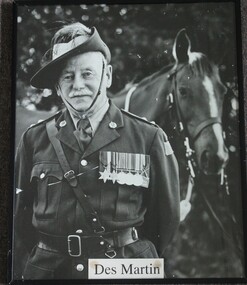
Photograph - Des Martin and his horse
... Australia entering an equestrian team in the Melbourne Olympics in 1956 and served as a steward at that event. Des also wrote several publications including “Australia Astride” in 1959, a history of the Albury Racing Club – a Century of Racing, and an historical novel “Many a Mile”. He collaborated with R. M. Williams to develop “Hoofs and Horns” to become a national publication. From 1969 to 1973, Des Martin also wrote a column for the Border Mail newspaper. He was also a member of the RSL for almost 50 years and held several committee...Australia entering an equestrian team in the Melbourne Olympics in 1956 and served as a steward at that event. Des also wrote several publications including “Australia Astride” in 1959, a history of the Albury Racing Club – a Century of Racing, and an historical novel “Many a Mile”. He collaborated with R. M. Williams to develop “Hoofs and Horns” to become a national publication. From 1969 to 1973, Des Martin also wrote a column for the Border Mail newspaper. He was also a member of the RSL for almost 50 years and held several committee ...This image is one from a series of portraits taken by Rob Elliott to record the character of the Border District through the faces if its identities. Des Martin lived all his life in Wodonga, except for his years of service during World War Two. He was raised on the family property Aherlo in the Huon Creek Valley. In 1937 he joined the 8th Light Horse Regiment but in May 1940 led his Wodonga Troop into the 2/2nd Australian Pioneer Battalion. This Battalion saw service in Syria, Java, New Guinea and Borneo. After the war, Des returned to Aherlo and his horses. He was granted permission by the Victorian Racing Club to participate as an amateur “gentleman” rider. He became the first president of the Victorian Amateur Riders Association and founded the Murray Valley Hunt Club. Des also played a major role in Australia entering an equestrian team in the Melbourne Olympics in 1956 and served as a steward at that event. Des also wrote several publications including “Australia Astride” in 1959, a history of the Albury Racing Club – a Century of Racing, and an historical novel “Many a Mile”. He collaborated with R. M. Williams to develop “Hoofs and Horns” to become a national publication. From 1969 to 1973, Des Martin also wrote a column for the Border Mail newspaper. He was also a member of the RSL for almost 50 years and held several committee positions during that time. Des Martin died on 12 April 1995.This is a portrait of a significant member of the Wodonga community who made an outstanding contribution as a farmer, soldier, horseman, author and member of the RSL and other community organisations.A black and white photograph of Des Martin in military uniform with his horse. The photo has been mounted in a metal frame.des martin, murray valley hunt club, 2/2nd australian pioneer battalion, albury racing club -
 Wodonga & District Historical Society Inc
Photograph - Des Martin mounted on his horse, 1986
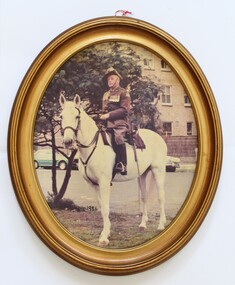
... Australia entering an equestrian team in the Melbourne Olympics in 1956 and served as a steward at that event. Des also wrote several publications including “Australia Astride” in 1959, a history of the Albury Racing Club – a Century of Racing, and an historical novel “Many a Mile”. He collaborated with R. M. Williams to develop “Hoofs and Horns” to become a national publication. From 1969 to 1973, Des Martin also wrote a column for the Border Mail newspaper. He was also a member of the RSL for almost 50 years and held several committee...Australia entering an equestrian team in the Melbourne Olympics in 1956 and served as a steward at that event. Des also wrote several publications including “Australia Astride” in 1959, a history of the Albury Racing Club – a Century of Racing, and an historical novel “Many a Mile”. He collaborated with R. M. Williams to develop “Hoofs and Horns” to become a national publication. From 1969 to 1973, Des Martin also wrote a column for the Border Mail newspaper. He was also a member of the RSL for almost 50 years and held several committee ...This image was taken in Melbourne on Anzac Day 1986 where Des had taken place in the annual parade. The photo itself has had a long journey. It was donated to the Star Hotel in Yackandandah, Victoria by Des Martin in 1994. The hotel changed hands so many times that the custodian "Pip" Beatty felt it was best placed at the Light Horse Museum at Bandiana, Victoria. Its journey was complete when the photo was returned to the Wodonga Historical Society. Des Martin lived all his life in Wodonga, except for his years of service during World War Two. He was raised on the family property Aherlo in the Huon Creek Valley. In 1937 he joined the 8th Light Horse Regiment but in May 1940 led his Wodonga Troop into the 2/2nd Australian Pioneer Battalion. This Battalion saw service in Syria, Java, New Guinea and Borneo. After the war, Des returned to Aherlo and his horses. He was granted permission by the Victorian Racing Club to participate as an amateur “gentleman” rider. He became the first president of the Victorian Amateur Riders Association and founded the Murray Valley Hunt Club. Des also played a major role in Australia entering an equestrian team in the Melbourne Olympics in 1956 and served as a steward at that event. Des also wrote several publications including “Australia Astride” in 1959, a history of the Albury Racing Club – a Century of Racing, and an historical novel “Many a Mile”. He collaborated with R. M. Williams to develop “Hoofs and Horns” to become a national publication. From 1969 to 1973, Des Martin also wrote a column for the Border Mail newspaper. He was also a member of the RSL for almost 50 years and held several committee positions during that time. Des Martin died on 12 April 1995.This is a portrait of a significant member of the Wodonga community who made an outstanding contribution as a farmer, soldier, horseman, author and member of the RSL and other community organisations.A coloured photograph of Des Martin in full military uniform mounted on his horse. The photo has been mounted in an oval wooden frame.des martin, murray valley hunt club, 2/2nd australian pioneer battalion, albury racing club -
 Falls Creek Historical Society
Mixed media - Ross Milne Memorial Ski Jump
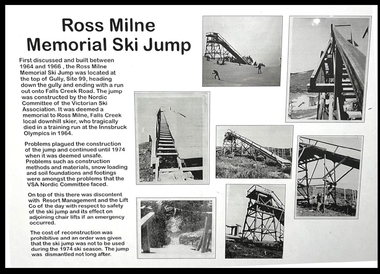
... Australian team that participated in the 1964 Olympic Winter Games at Innsbruck, Austria. A few days before the opening of the Games, on 25th January 1964, he tragically lost his life when he crashed into a tree during a training run for the Men's Downhill. He was only 19 years of age. The construction of the Ross Milne Memorial Ski Jump was first discussed and built between 1964 and 1966. It was located at the top of Gully, Site 99, heading down the gully and ending with a run out onto Falls Creek Road. The Jump was constructed by the Nordic Committee...Committee faced. On top of this there was discontent with Resort Management and the Lift Company of the day with respect to safety of the Ski Jump and its effect on adjoining chair lifts if an emergency should occur. The cost of reconstruction was prohibitive and an order was given that the SkiJump was not to be used during the 1974 ski season. The Jump was dismantled not long after. These items are significant as they document the development of a memorial to an Australian Olympic ...Ross Milne grew up on his family's tobacco property in Myrtleford, and began skiing at Falls Creek at an early age. He was taught by Austrian Sigi Haberzettl, who was chief coach at Falls Creek for 17 years. Ross went on to win the North-Eastern District Ski Association (NEDSA) Junior Championships for three consecutive years. In 1961 Ross was a member of the Australian team which competed against New Zealand in the Inter-Dominion Championships. In 1963, he won the Downhill and Alpine Combined title at the Australian Championships, while placing second in the Grand Slalom event. Ross was selected in the Australian team that participated in the 1964 Olympic Winter Games at Innsbruck, Austria. A few days before the opening of the Games, on 25th January 1964, he tragically lost his life when he crashed into a tree during a training run for the Men's Downhill. He was only 19 years of age. The construction of the Ross Milne Memorial Ski Jump was first discussed and built between 1964 and 1966. It was located at the top of Gully, Site 99, heading down the gully and ending with a run out onto Falls Creek Road. The Jump was constructed by the Nordic Committee of the Victorian Ski Association. Problems plagued the construction of the Jump and continued until 1974 when it was deemed unsafe. Problems such as construction methods and materials, snow loading and soil foundations and footings were some of the issues which the VSA Nordic Committee faced. On top of this there was discontent with Resort Management and the Lift Company of the day with respect to safety of the Ski Jump and its effect on adjoining chair lifts if an emergency should occur. The cost of reconstruction was prohibitive and an order was given that the SkiJump was not to be used during the 1974 ski season. The Jump was dismantled not long after.These items are significant as they document the development of a memorial to an Australian Olympic Skier, Ross Milne.A collection of documents and photographs documenting the construction of the Ross Milne Memorial Ski Jump built at Falls Creek in 1966. A display board including photographs and explanatory text is part of this collection.ross milne, ross milne memorial ski jump -
 Falls Creek Historical Society
Flyer - Austrian National Team Flyer
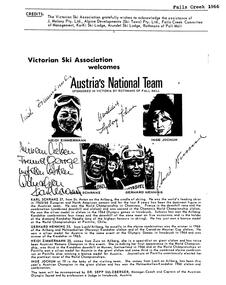
... Committee of Management, Ko-Ki Ski Lodge, Arundel Ski Lodge and Rothmans of Pall Mall. George Shirling arrived in Falls Creek in 1962. He engaged Phil Nowell to build the original Koki Alpine Lodge which opened in 1965 with 14 beds. George operated the lodge with Michael “Baldy” Blackwell as manager. He also graduated in sport psychology in 1981 and was invited to become team psychologist for the Australian Winter Olympic...Committee of Management, Ko-Ki Ski Lodge, Arundel Ski Lodge and Rothmans of Pall Mall. George Shirling arrived in Falls Creek in 1962. He engaged Phil Nowell to build the original Koki Alpine Lodge which opened in 1965 with 14 beds. George operated the lodge with Michael “Baldy” Blackwell as manager. He also graduated in sport psychology in 1981 and was invited to become team psychologist for the Australian Winter Olympic ...This item is from the private collection of George Shirling of Red Onion, Falls Creek. It records the visit of the Austrian National Ski team to Falls Creek in 1966. The first paragraph includes thanks from the Victorian Skiing Association to those who have supported the visit including J. Molony Pty. Ltd., Alpine Developments (Ski Tows) Pty. Ltd., Falls Creek Committee of Management, Ko-Ki Ski Lodge, Arundel Ski Lodge and Rothmans of Pall Mall. George Shirling arrived in Falls Creek in 1962. He engaged Phil Nowell to build the original Koki Alpine Lodge which opened in 1965 with 14 beds. George operated the lodge with Michael “Baldy” Blackwell as manager. He also graduated in sport psychology in 1981 and was invited to become team psychologist for the Australian Winter Olympic team which went to Albertville, France, in 1992. He later owned the Red Onion Chalet. George credited the success of Koki to “Baldy” Blackwell. “Baldy” and Phil Nowell started the Trackers Mountain Lodge in partnership during the 1980s. In 1971 George sold Koki Lodge to Sigi Doerr. In 2024 the renamed Koki Alpine resort remains a highly popular destination in Falls Creek. George Shirling passed away on 27th February 2023. He had remained actively involved in Falls Creek and was generous with his time and knowledge, always an amazing supporter of The Falls Creek Museum and Falls Creek Village.This item is significant because it documents an important visit by an international ski team to Falls Creek.A flyer welcoming the Austrian National Ski Team to Falls Creek in 1966. It includes profiles and images of the members of the team and has been autographed by them.george shirling, koki lodge, austrian national ski team 1966 -
 Falls Creek Historical Society
Medal - Paralympic Winter Games Salt Lake 2002 volunteer medal
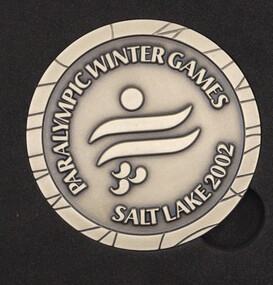
... Salt Lake 2002 was also the first organizing committee to integrate the planning for both the Olympics and Paralympic Games. The Paralympic Games were held from 7th to 16th March. Australia...Salt Lake 2002 was also the first organizing committee to integrate the planning for both the Olympics and Paralympic Games. The Paralympic Games were held from 7th to 16th March. Australia ...This item is from the private collection of George Shirling of Red Onion, Falls Creek. Salt Lake 2002 was also the first organizing committee to integrate the planning for both the Olympics and Paralympic Games. The Paralympic Games were held from 7th to 16th March. Australia was represented at these Games by Peter Boonaerts, Bartholomew (Bart) Bunting, Michael Milton, Scott Adams, Cameron Rahles-Rahbula, Mark Drinnan. Michael Milton won gold in all four of his events – Downhill, Slalom, Giant Slalom, and Super-G, and Bart Bunting with guide Nathan Chivers won gold in two events – Downhill and Super-G, and silver in the giant slalom. Australia finished 8th overall in the gold and total medal count. George Shirling arrived in Falls Creek in 1962. He engaged Phil Nowell to build the original Koki Alpine Lodge which opened in 1965 with 14 beds. George operated the lodge with Michael “Baldy” Blackwell as manager. He also graduated in sport psychology in 1981 and was invited to become team psychologist for the Australian Winter Olympic team which went to Albertville, France, in 1992. He later owned the Red Onion Chalet. George credited the success of Koki to “Baldy” Blackwell. “Baldy” and Phil Nowell started the Trackers Mountain Lodge in partnership during the 1980s. In 1971 George sold Koki Lodge to Sigi Doerr. In 2024 the renamed Koki Alpine resort remains a highly popular destination in Falls Creek. George Shirling passed away on 27th February 2023. He had remained actively involved in Falls Creek and was generous with his time and knowledge, always an amazing supporter of The Falls Creek Museum and Falls Creek Village.This medal is significant because it represents Australia's involvement in the Winter Paralympic Games in 2002 A medal presented to volunteers at the Salt Lake City 2002 Winter Paralympic Games. The front featured the Logo of these Games which included three Tae-Geuk, a Sino-Korean term meaning 'supreme or ultimate'. It linked the flag to the previous Winter Paralympic Games held in South Korea. The reverse featured the three Tae-Geuks more prominently. On the rim the words “Mind Body Spirit” were inscribed representing the three values of the 2002 Paralympic Winter Games.On Front: Logo surrounded by PARALYMPIC WINTER GAMES / SALT LAKE CITY 2002 On Reverse: 7 - 16 MARCH 2002/ MIND BODY SPIRITgeorge shirling, salt lake city winter paralympic games, salt lake city 2002 -
 Falls Creek Historical Society
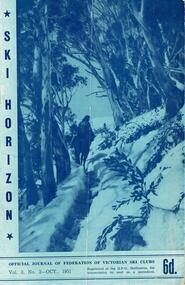
Journal - Ski-Horizon Vol. 3 No 2
... Australia to send a small team to the Winter Olympics in Oslo in early 1952. Falls Creek Village Advisory Committee establishedl...Australia to send a small team to the Winter Olympics in Oslo in early 1952. Falls Creek Village Advisory Committee establishedl Ski-Horizon Vol. 3 No 2. ...Ski-Horizon is the official journal of the Federation of Victorian Ski Clubs which began publication in 1949. The were 26 original member clubs which included Albury Ski Club, Bogong Ski Club, Myrtleford Ski Club, Tallangatta and District Ski Club and Wangaratta Ski Club. Two pioneers of Falls Creek, Tom Mitchell, M.L.A., and Martin Romuld were Vice-Presidents of the Federation.This Journal is significant because it documents the early development of skiing in Victoria.The journal features stories and events chronicling developments in Victoria and internationally. Items related to the Falls Creek Area in this publication include:- Page 2: Concerns about progress in Falls Creek in the coming year with programme cuts in SEC Copperhead snake killed in snow on High Plains similar to a feat by Elyne Mitchell in 1936. Tom Mitchell visits the NSW Snowy Hydro Electricity Authority. Nissen Ski Tow worked "well enough" at times. Page 11 Reminiscences of the Inter Dominion Ski Tour by New Zealand with planning underway for the next year. Australia to send a small team to the Winter Olympics in Oslo in early 1952. Falls Creek Village Advisory Committee establishedlski history victoria, federation of victorian ski clubs, oslo olympics 1952, falls creek advisory committee -
 Falls Creek Historical Society
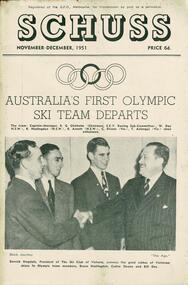
Journal - Schuss Vol. 17. No. 10 November - December 1951
... Items related to the Falls Creek Area in this issue include:- Cover - Australia's First Olympic Ski Team Departs - features a photo from "The Age" Derrick Stogdale, President of the Ski Club of Victoria, conveys the good wishes of Victorian skiers to Olympic team members, Bruce Haslingdon, Cedric Sloane and Bill Day. The team consisted of Captain-Manager R.G. Chisholm (Chairman, S.C.V. Racing Sub-Committee...Olympic Ski team Inter-Dominion event 1951 The journal features stories and events chronicling developments in Victoria and internationally. Items related to the Falls Creek Area in this issue include:- Cover - Australia's First Olympic Ski Team Departs - features a photo from "The Age" Derrick Stogdale, President of the Ski Club of Victoria, conveys the good wishes of Victorian skiers to Olympic team members, Bruce Haslingdon, Cedric Sloane and Bill Day. The team consisted of Captain-Manager R.G. Chisholm (Chairman, S.C.V. Racing Sub-Committee ...Schuss was advertised as Victoria’s Official Ski Journal It was issued monthly from 1935 to 1961 except during the war when summer issues covered two months. This continued after the war, but it averaged 10 issues annually over its 25 year life. Schuss was published by the Ski Club of Victoria which had a membership of 38 Ski Clubs and demanded to be recognised as the prime authority on skiing in the state. The other 30 ski clubs with 85% of the members disagreed and the politics of skiing became heated. These clubs formed the Federation of Victorian Ski Clubs with their own journal, Ski Horizon. With the establishment of the Victorian Ski Association, Ski-Horizon published its last issue in Nov - Dec. 1955 and the role of the official journal was fully taken over by “Schuss”. This item is significant because it contains stories, images and information documenting the development of the ski industry in Victoria.The journal features stories and events chronicling developments in Victoria and internationally. Items related to the Falls Creek Area in this issue include:- Cover - Australia's First Olympic Ski Team Departs - features a photo from "The Age" Derrick Stogdale, President of the Ski Club of Victoria, conveys the good wishes of Victorian skiers to Olympic team members, Bruce Haslingdon, Cedric Sloane and Bill Day. The team consisted of Captain-Manager R.G. Chisholm (Chairman, S.C.V. Racing Sub-Committee), W. Day (N.S.W.), B. Haslingdon (N.S.W.), R. Arnott (Vic), T. Aslangu (Vic) since withdrawn. Page 383 - Falls Creek Reminiscence - Australia - New Zealand Meeting 1951 gives a detailed recount of the events and activities held during a two week visit to Falls Creek by the New Zealand teadmschuss journal, 1952 winter olympic ski team, inter-dominion event 1951 -
 Falls Creek Historical Society
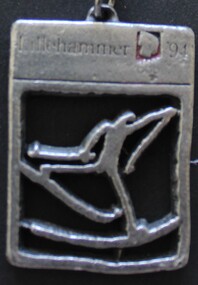
Badge - Winter Olympic Games 1994 and 2002
... Olympic committees for the Games in Lillehammer, Norway in 1994 and Salt Lake City, USA in 2002 to commemorate the holding of the games in their respective cities. The badges were owned and donated by Diana Patterson who was a talented cross country skier. She was born in Tasmania and originally pursued a career as a physical education teacher. After making a major career change, she applied to join the Australian...Olympic committees for the Games in Lillehammer, Norway in 1994 and Salt Lake City, USA in 2002 to commemorate the holding of the games in their respective cities. The badges were owned and donated by Diana Patterson who was a talented cross country skier. She was born in Tasmania and originally pursued a career as a physical education teacher. After making a major career change, she applied to join the Australian ...These badges and emblems were issued by the Winter Olympic committees for the Games in Lillehammer, Norway in 1994 and Salt Lake City, USA in 2002 to commemorate the holding of the games in their respective cities. The badges were owned and donated by Diana Patterson who was a talented cross country skier. She was born in Tasmania and originally pursued a career as a physical education teacher. After making a major career change, she applied to join the Australian Antarctic Division. She applied four times before she was accepted. Diana first travelled to the Antarctic in October 1987. By this time only ten Australian women had spent a winter there. She first worked at Casey Station, before becoming leader at Mawson Station therein becoming the first female leader of an Antarctic base of any nation. After retiring Diana guided tourist expeditions to the Antarctic for many years, as well as continuing work in research and conservation. In 2012 she published her story “The Ice Beneath My Feet: My Year In Antarctica”. Diana Patterson was awarded the Medal of the Order of Australia (OAM) for "service to conservation and the environment”. As well as these outstanding career achievements, Diana has been a Board Member of both the Mt. Buller Alpine Resort Management Board, including a period as Chairman, and also the Falls Creek Resort Management Board. She was also a founding member of Falls Creek Historical Society.These badges belonged to a highly recognised Australian and founding member of the Falls Creek Historical Society.Two badges issued to represent the Olympic cities of Lillehammer in 1994 and Park City, Salt Lake 2002, The badge for 1994 is rectangular and has a stylised figure of a skier in the centre. It has a chain attached at the top, so may have been part of a keychain. The 2002 badge for Park City is round and bears the emblem adopted for the Olympic Games held in Salt Lake as well as the Olympic rings.Badge 1: Lillehammer 1994 Badge 2: Olympic Venue City, Park City, Olympic Winter Games, Salt Lake 2002diana patterson, falls creek, lillehammer winter games, salt lake city winter games -
 City of Greater Bendigo - Civic Collection
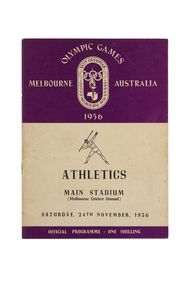
Programme, Wilke and Co Ltd, Olympic Games Melbourne Australia 1956 : Athletics, Main Stadium (Melbourne Cricket Ground), Friday, 23rd November, 1956, 1956
... Olympic Games Melbourne Australia 1956 : Athletics, Main Stadium (Melbourne Cricket Ground), Friday, 23rd November, 1956. Programme Australia Victoria Melbourne Wilke and Co Ltd Melbourne Olympic Committee ...Held in Melbourne from the 22nd November to 8th December, the 1956 Summer Olympics, officially known as the Games of the XVI Olympiad or the Melbourne Olympics were the first held outside of Europe or the USA. The Olympic torch relay passed through Central Victoria on its way from Cairns to Melbourne. Small book containing 15 pages including map of competition venues and programme on the back cover. Front cover depicts male javelin thrower. Printed in black and purple ink.melbourne olympic games, city of greater bendigo tourism -
 City of Greater Bendigo - Civic Collection
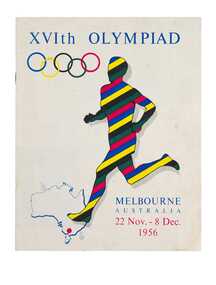
Programme - Official Olympic Souvenir, G. W. Green & Sons, XVIth Olympiad Melbourne Australia, 22 Nov.- 8 Dec. 1956, 1956
... Contents include an official programme listing all the events, venues and dates; photograph and map of Olympic grounds and Village; a guide to facilities and services available to visitors during the Olympic Games and lists of Australian cities and towns with brief statistics and description for each listing. Includes an introduction by Frank Selleck, Lord Mayor of Melbourne ; Maurice A. Nathan, Chairman, Olympic Civic Committee...Contents include an official programme listing all the events, venues and dates; photograph and map of Olympic grounds and Village; a guide to facilities and services available to visitors during the Olympic Games and lists of Australian cities and towns with brief statistics and description for each listing. Includes an introduction by Frank Selleck, Lord Mayor of Melbourne ; Maurice A. Nathan, Chairman, Olympic Civic Committee ...Held in Melbourne from the 22nd November to 8th December, the 1956 Summer Olympics, officially known as the Games of the XVI Olympiad or the Melbourne Olympics were the first held outside of Europe or the USA. This programme was originally enclosed with book 'Australia, Land of the Southern Cross' as is a visitors guide to Australian states and cities.Colour printed programme. 15, [1] pages. Illustrated. Colour printed front and back cover based on the Olympic ring colours. Inside pages printed in red and black. Contents include an official programme listing all the events, venues and dates; photograph and map of Olympic grounds and Village; a guide to facilities and services available to visitors during the Olympic Games and lists of Australian cities and towns with brief statistics and description for each listing. Includes an introduction by Frank Selleck, Lord Mayor of Melbourne ; Maurice A. Nathan, Chairman, Olympic Civic Committee.melbourne olympic games, olympic games 1956, city of bendigo tourism -
 Sunshine and District Historical Society Incorporated
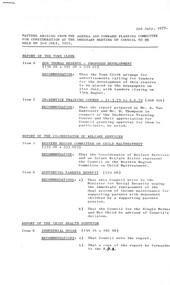
Administrative record - City of Sunshine - Commissioner Mr Alexander Alex George Gillon Collection 1976 - 1982 - Matters arising agenda and forward planning meeting 3rd July 1979, City of Sunshine, 2nd July 1979
... Matters arising agenda and forward planning meeting 3rd July 1979 Report of the Town Clerk Bon Thomas Reserve Proposed Development Inservice Training Course 21st March 1979 to 6th June 1979 Report of the Co-Ordinator of Welfare Services Western Region Committee of Child Maltreatment Supporting Parents Benefit Report of the Chief Health Surveyor Industrial Noise Monsanto Chemicals Somerville Road Footscray West, Sims Metals McDonald Road Brooklyn, S.C.I. Meat & Paper Pty Ltd Somerville Road Tottenham, Olympic Tyres Mitchell Street Maidstone, Australian...Meat & Paper Tottenham Olympic Tyres Mitchell Street Maidstone Australian Tube Mills Hawthorn Avenue Sunshine North Repco Consolidated Metal Products Forrest Street Ardeer Massey Ferguson Hampshire Road Sunshine Matters arising agenda and forward planning meeting 3rd July 1979 Report of the Town Clerk Bon Thomas Reserve Proposed Development Inservice Training Course 21st March 1979 to 6th June 1979 Report of the Co-Ordinator of Welfare Services Western Region Committee of Child Maltreatment Supporting Parents Benefit Report of the Chief Health Surveyor Industrial Noise Monsanto Chemicals Somerville Road Footscray West, Sims Metals McDonald Road Brooklyn, S.C.I. ...Matters arising agenda and forward planning meeting 3rd July 1979 Report of the Town Clerk Bon Thomas Reserve Proposed Development Inservice Training Course 21st March 1979 to 6th June 1979 Report of the Co-Ordinator of Welfare Services Western Region Committee of Child Maltreatment Supporting Parents Benefit Report of the Chief Health Surveyor Industrial Noise Monsanto Chemicals Somerville Road Footscray West, Sims Metals McDonald Road Brooklyn, S.C.I. Meat & Paper Pty Ltd Somerville Road Tottenham, Olympic Tyres Mitchell Street Maidstone, Australian Tube Mills Hawthorn Avenue Sunshine North, Repco Ltd Mitchell Street Maidstone, Consolidated Metal Products Forrest Street Ardeer, Massey Ferguson Hampshire Road Sunshine Report of the Chief By-Laws Officer Dog Act Report of the City Engineer & Planner Strategic Plan for the Development of the Council Deport Anderson Road Sunshine Report of the Building Surveyor Siting of Building 44 Lindenow Street Maidstonebon thomas reserve, quinn street, deer park, monsanto chemicals, somerville road, footscray west, mcdonald road, sims metals, brooklyn, s.c.i. meat & paper, tottenham, olympic tyres, mitchell street, maidstone, australian tube mills, hawthorn avenue, sunshine north, repco, consolidated metal products, forrest street, ardeer, massey ferguson, hampshire road, sunshine -
 Sunshine and District Historical Society Incorporated
Administrative record - City of Sunshine - Commissioner Mr Alexander Alex George Gillon Collection 1976 - 1982 - Minutes of the ordinary meeting of council held on 22nd May 1979, City of Sunshine, 22nd May 1979
... Committee Report of the Chief Health Surveyor Health Act registrations for 1979 Application for Transfer of Proprietorship of Premises under the Health Act J.L. MacTaggart (Victoria) Pty Ltd Maria Street Laverton North Town and Country Planning and Health Act Objections Offensive Trades Report of the Chief By-Laws Officer Proposed No Standing Area Majorca Street St. Albans Proposed No Standing Area Martin Street Sunshine Report of the City Librarian Australian Olympic...Committee Report of the Chief Health Surveyor Health Act registrations for 1979 Application for Transfer of Proprietorship of Premises under the Health Act J.L. MacTaggart (Victoria) Pty Ltd Maria Street Laverton North Town and Country Planning and Health Act Objections Offensive Trades Report of the Chief By-Laws Officer Proposed No Standing Area Majorca Street St. Albans Proposed No Standing Area Martin Street Sunshine Report of the City Librarian Australian Olympic ...Minutes of the Ordinary Meeting of Council held on 22nd May 1979 Report of the Town Clerk's Department Report of the Town Clerk Interim Report The Role of Local Government in Victoria Activities of the Municipal Association of Victoria Propose Lease Extension Tottenham Technical School 27 Duke Street Rate Recovery Sale 2nd December 1979 Land Transfer Fairbairn Road Widening Proposed Purchase of Land Station Road for Multi-Functional Building Local Authorities Superannuation Scheme Report of the Co-Ordinator of Welfare Services Teenage Holiday Programme Australian National Youth Workers' Conference Freemantle Western Australia 18th to 24th July 1979 Family and Community Service Program Election to Committee Concessions for Telephone Installation and Rental for Pensioners Residential Tenancies Bill Braybrook Pre-School Child Care Facility Cherry Crescent Braybrook Early Childhood Development Programme Braybrook Maidstone Housing Commission Liaison Committee Report of the Chief Health Surveyor Health Act registrations for 1979 Application for Transfer of Proprietorship of Premises under the Health Act J.L. MacTaggart (Victoria) Pty Ltd Maria Street Laverton North Town and Country Planning and Health Act Objections Offensive Trades Report of the Chief By-Laws Officer Proposed No Standing Area Majorca Street St. Albans Proposed No Standing Area Martin Street Sunshine Report of the City Librarian Australian Olympic Team Fund Report of the City Engineer & Planner Planning Permit Community Health Centre Andrea Street St. Albans Planning Permit Application Temporary Child Care Centre Andrea Street St. Albans Planning Permit Application Sky Sign Lot 8 Churchill Avenue Braybrook Planning Permit Application Service Premises & Caretaker's Dwelling Lots 317 & 318 Dover Street Albanvale Planning Permit Three Factories Lot 67 Somerville Road South West Corner of McDonald Road Brooklyn Planning Permit Application Hairdressing Salon Service Premise and Caretaker's Dwelling Lot 1 Ballarat Road Planning Permit Application Travel Agency Shop 1A Lot 3 Princess Street St. Albans Planning Permit Application Small Panel Sign Lot 4 McIntyre Road Sunshine North Planning Permit Application Display Homes Lots 1, 2, 3, 4, 5 & 6 Camelot Drive South East Corner Main Road West Albanvale Planning Permit Application Alterations to Shops Lots 1 & 2 Ballarat Road Deer Park Planning Permit Application Motor Workshop Lot 1 McIntyre Road Sunshine North Planning Permit Application Medical Consulting Room and Residence Lot 1 Ballarat Road South West Corner of Burnside Street Deer Park Planning Permit Application New Offices and Showrooms Railway Lot 24 North West Corner of Berkshire Road and Steers Street Sunshine North Strata Subdivision 5 & 7 Craddock Court Sunshine North Plan of Subdivision Westerngate Estate Subdivision Westerngate Estate Stage 1A Subdivision Consolidation of Title 811 - 811A Ballarat Road Deer Park Cancellation of Easement St. Albans Road Abutting Gilmour Road Sunshine North Strata Subdivision 101 Ballarat Road Maidstone Strata Subdivision 1 & 3 Craddock Court Sunshine North Replacement of Ford Falcon Utilities and Station Wagons Boring Operations by Melbourne & Metropolitan Board of Works Station Road, Gladstone Street & Washington Street St. Albans Relocation of Public Telephone Outside 38A Melton Street to between 26 & 28 Melon Street Braybrook Sewerage Facilities Declaration of Sewerage Area No 3760 Noxious Trades Outfall Sewer Replacement Lacy Street, Ballarat Road & Ashley Street, Braybrook and Thomson Street, Burns Street & Studley Street Maidstone Sewerage Facilities Council Reserve Larisa Road St. Albans Infant Welfare Centre Alexandra Avenue Sunshine Castley Hall in Poor Condition Exterior Security Lighting Central Library and Infant Welfare Centre Report of the Building Surveyor Building Over Easement 144 Murray Street Ardeer Building Over Easement 4 Tania Street Sunshine North Building Over Easement Lots 77, 78 & 79 Somers Street Sunshine North Siting of Building 39 Dunbar Avenue Sunshine Siting of Building 4 Norma Street Sunshine Building on Flood Prone Land 27 Navigator Street Maribyrnong Building on Flood Prone Land Lot 18 Riverview Court Maribyrnong Installation of Underground Tanks 3 Millers Road Brooklyn Installation of Underground Tanks Corner Ballarat Road and Lacy Street Braybrook Uniform Building Regulations Enforcement Staff Needs Report of the Director of Parks & Recreations Winslow Crescent Application to Use Land Bon Thomas Child Care Centre Landscaping Quotes Orders of the Day Accounts Submitted for Payment as at 30th April 1979 Uniform Building Regulations Enforcement Staff Needs Confirmation of Loan with the Melbourne & Metropolitan Board of Works Extraordinary Business Report of the Town Clerk Election of Council Representative Metropolitan Fire Brigade's Boardtottenham technical school, duke street, sunshine, station road, deer park, south road, braybrook, braybrook pre-school child care facility, cherry crescent, j.l. mactaggart, maria street, laverton north, majorca street, st. albans, martin street, andrea street community health care centre, andrea street, churchill avenue, dover street, albanvale, somerville road, mcdonald road, brooklyn, princess street, mcintyre road, sunshine north, camelot drive, main road west, ballarat road, burnside street, berkshire road, steers street, craddock court, st. albans road, gilmour road, maidstone, gladstone street, washington street, melton street, lacy street, ashley street, thomson street, burns street, studley street, laris reserve, larisa road, alexandra avenue infant welfare centre, alexandra avenue, castley hall, simmie street, sunshine west, murray street, ardeer, tania street, somers street, dunbar avenue, norma street, navigator street, riverview court, maribyrnong, millers road, bon thomas child care centre, quinn street -
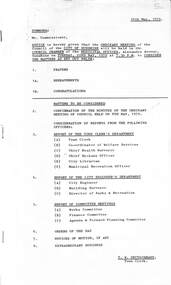 Sunshine and District Historical Society Incorporated
Administrative record - City of Sunshine - Commissioner Mr Alexander Alex George Gillon Collection 1976 - 1982 - Notice of ordinary meeting of the council 22nd May 1979, City of Sunshine, 16th May 1979
... Committee Report of the Chief Health Surveyor Health Act registrations for 1979 Application for Transfer of Proprietorship of Premises under the Health Act J.L. MacTaggart (Victoria) Pty Ltd Maria Street Laverton North Town and Country Planning and Health Act Objections Offensive Trades Report of the Chief By-Laws Officer Proposed No Standing Area Majorca Street St. Albans Proposed No Standing Area Martin Street Sunshine Report of the City Librarian Australian Olympic...Committee Report of the Chief Health Surveyor Health Act registrations for 1979 Application for Transfer of Proprietorship of Premises under the Health Act J.L. MacTaggart (Victoria) Pty Ltd Maria Street Laverton North Town and Country Planning and Health Act Objections Offensive Trades Report of the Chief By-Laws Officer Proposed No Standing Area Majorca Street St. Albans Proposed No Standing Area Martin Street Sunshine Report of the City Librarian Australian Olympic ...Notice of Ordinary Meeting of the Council 22nd May 1979 Report of the Town Clerk's Department Report of the Town Clerk Interim Report The Role of Local Government in Victoria Activities of the Municipal Association of Victoria Propose Lease Extension Tottenham Technical School 27 Duke Street Rate Recovery Sale 2nd December 1979 Land Transfer Fairbairn Road Widening Proposed Purchase of Land Station Road for Multi-Functional Building Local Authorities Superannuation Scheme Report of the Co-Ordinator of Welfare Services Teenage Holiday Programme Australian National Youth Workers' Conference Freemantle Western Australia 18th to 24th July 1979 Family and Community Service Program Election to Committee Concessions for Telephone Installation and Rental for Pensioners Residential Tenancies Bill Braybrook Pre-School Child Care Facility Cherry Crescent Braybrook Early Childhood Development Programme Braybrook Maidstone Housing Commission Liaison Committee Report of the Chief Health Surveyor Health Act registrations for 1979 Application for Transfer of Proprietorship of Premises under the Health Act J.L. MacTaggart (Victoria) Pty Ltd Maria Street Laverton North Town and Country Planning and Health Act Objections Offensive Trades Report of the Chief By-Laws Officer Proposed No Standing Area Majorca Street St. Albans Proposed No Standing Area Martin Street Sunshine Report of the City Librarian Australian Olympic Team Fund Report of the City Engineer & Planner Planning Permit Community Health Centre Andrea Street St. Albans Planning Permit Application Temporary Child Care Centre Andrea Street St. Albans Planning Permit Application Sky Sign Lot 8 Churchill Avenue Braybrook Planning Permit Application Service Premises & Caretaker's Dwelling Lots 317 & 318 Dover Street Albanvale Planning Permit Three Factories Lot 67 Somerville Road South West Corner of McDonald Road Brooklyn Planning Permit Application Hairdressing Salon Service Premise and Caretaker's Dwelling Lot 1 Ballarat Road Planning Permit Application Travel Agency Shop 1A Lot 3 Princess Street St. Albans Planning Permit Application Small Panel Sign Lot 4 McIntyre Road Sunshine North Planning Permit Application Display Homes Lots 1, 2, 3, 4, 5 & 6 Camelot Drive South East Corner Main Road West Albanvale Planning Permit Application Alterations to Shops Lots 1 & 2 Ballarat Road Deer Park Planning Permit Application Motor Workshop Lot 1 McIntyre Road Sunshine North Planning Permit Application Medical Consulting Room and Residence Lot 1 Ballarat Road South West Corner of Burnside Street Deer Park Planning Permit Application New Offices and Showrooms Railway Lot 24 North West Corner of Berkshire Road and Steers Street Sunshine North Strata Subdivision 5 & 7 Craddock Court Sunshine North Plan of Subdivision Westerngate Estate Subdivision Westerngate Estate Stage 1A Subdivision Consolidation of Title 811 - 811A Ballarat Road Deer Park Cancellation of Easement St. Albans Road Abutting Gilmour Road Sunshine North Strata Subdivision 101 Ballarat Road Maidstone Strata Subdivision 1 & 3 Craddock Court Sunshine North Replacement of Ford Falcon Utilities and Station Wagons Boring Operations by Melbourne & Metropolitan Board of Works Station Road, Gladstone Street & Washington Street St. Albans Relocation of Public Telephone Outside 38A Melton Street to between 26 & 28 Melon Street Braybrook Sewerage Facilities Declaration of Sewerage Area No 3760 Noxious Trades Outfall Sewer Replacement Lacy Street, Ballarat Road & Ashley Street, Braybrook and Thomson Street, Burns Street & Studley Street Maidstone Sewerage Facilities Council Reserve Larisa Road St. Albans Infant Welfare Centre Alexandra Avenue Sunshine Castley Hall in Poor Condition Exterior Security Lighting Central Library and Infant Welfare Centre Report of the Building Surveyor Building Over Easement 144 Murray Street Ardeer Building Over Easement 4 Tania Street Sunshine North Building Over Easement Lots 77, 78 & 79 Somers Street Sunshine North Siting of Building 39 Dunbar Avenue Sunshine Siting of Building 4 Norma Street Sunshine Building on Flood Prone Land 27 Navigator Street Maribyrnong Building on Flood Prone Land Lot 18 Riverview Court Maribyrnong Installation of Underground Tanks 3 Millers Road Brooklyn Installation of Underground Tanks Corner Ballarat Road and Lacy Street Braybrook Uniform Building Regulations Enforcement Staff Needs Report of the Director of Parks & Recreations Winslow Crescent Application to Use Land Bon Thomas Child Care Centre Landscaping Quotes Orders of the Day Accounts Submitted for Payment as at 30th April 1979 Uniform Building Regulations Enforcement Staff Needs Confirmation of Loan with the Melbourne & Metropolitan Board of Workstottenham technical school, duke street, sunshine, station road, deer park, south road, braybrook, braybrook pre-school childcare centre, cherry crescent, braybrook maidstone housing commission liaison committee, j.l. mactaggart, maria street, laverton north, majorca street, st. albans, martin street, andrea street, andrea street community health care centre, churchill avenue, dover street, albanvale, somerville road, mcdonald road, brooklyn, ballarat road, princess street, mcintyre road, sunshine north, camelot drive, main road west, burnside street, berkshire road, steers street, craddock court, maidstone, gladstone street, washington street, melton street, lacy street, ashley street, thomson street, burns street, studley street, larisa reserve, larisa road, alexandra avenue infant welfare centre, alexandra avenue, castley hall, simmie street, sunshine west, murray street, ardeer, tania street, somers street, dunbar avenue, norma street, navigator street, riverview court, maribyrnong, millers road, bon thomas child care centre, quinn street -
 Sunshine and District Historical Society Incorporated
Administrative record - City of Sunshine - Commissioner Mr Alexander Alex George Gillon Collection 1976 - 1982 - Minutes of the ordinary meeting of council held on 3rd July 1979, City of Sunshine, 27th June 1979
... Albans Road Corner Furlong Road Report of the Co-Ordinator of Welfare Services Western Region Committee of Child Maltreatment Request for Assistance Victorian Association for Deserted Children Glengala Housing Commission Estate Sunshine West 3rd Internation Community Education Conference 19th to 24th August 1979 Supporting Parents Benefit Report of the Chief Health Surveyor Health Act Registration Application for Transfer of Proprietorship of Premises Under the Health Act Prosecutions Proceedings Sunshine Magistrates Court Offensive Trades Werribee Murray Valley Protein Pty Ltd Lot 6 Holcourt Road Laverton North Industrial Noise Monsanto Chemicals Somerville Road Footscray West, Sims Metals McDonald Road Brooklyn, S.C.I. Meat & Paper Pty Ltd Somerville Road Tottenham, Olympic Tyres Mitchell Street Maidstone, Australian...Albans Road Corner Furlong Road Report of the Co-Ordinator of Welfare Services Western Region Committee of Child Maltreatment Request for Assistance Victorian Association for Deserted Children Glengala Housing Commission Estate Sunshine West 3rd Internation Community Education Conference 19th to 24th August 1979 Supporting Parents Benefit Report of the Chief Health Surveyor Health Act Registration Application for Transfer of Proprietorship of Premises Under the Health Act Prosecutions Proceedings Sunshine Magistrates Court Offensive Trades Werribee Murray Valley Protein Pty Ltd Lot 6 Holcourt Road Laverton North Industrial Noise Monsanto Chemicals Somerville Road Footscray West, Sims Metals McDonald Road Brooklyn, S.C.I. Meat & Paper Pty Ltd Somerville Road Tottenham, Olympic Tyres Mitchell Street Maidstone, Australian ...Minutes of the Ordinary Meeting of Council held on 3rd July 1979 Report of the Town Clerk's Department Report of the Town Clerk Financial Statement for Year Ended 30th September 1978 and Auditor's Report Road Funding New Fuel Levy Sunshine R.S.L. Land and Proposed Development Facilities for Proposed Local Government Seminar Pecuniary Interest of Councillors Submission by Municipal Association Bon Thomas Reserve Proposed Development Inservice Training Course 21st March 1979 to 6th June 1979 Municipal Association Seminar Bain's Board of Review Request for Assistance Provision of Equipment St. Johns Ambulance Land Transfer from the Council Railways Land Adjacent Alexander Avenue & Service Street and Discontinued Right of Way rear of Ardoyne Street Land Transfer to Council St. Albans Road Corner Furlong Road Report of the Co-Ordinator of Welfare Services Western Region Committee of Child Maltreatment Request for Assistance Victorian Association for Deserted Children Glengala Housing Commission Estate Sunshine West 3rd Internation Community Education Conference 19th to 24th August 1979 Supporting Parents Benefit Report of the Chief Health Surveyor Health Act Registration Application for Transfer of Proprietorship of Premises Under the Health Act Prosecutions Proceedings Sunshine Magistrates Court Offensive Trades Werribee Murray Valley Protein Pty Ltd Lot 6 Holcourt Road Laverton North Industrial Noise Monsanto Chemicals Somerville Road Footscray West, Sims Metals McDonald Road Brooklyn, S.C.I. Meat & Paper Pty Ltd Somerville Road Tottenham, Olympic Tyres Mitchell Street Maidstone, Australian Tube Mills Hawthorn Avenue Sunshine North, Repco Ltd Mitchell Street Maidstone, Consolidated Metal Products Forrest Street Ardeer, Massey Ferguson Hampshire Road Sunshine J.L. McTaggart (Victoria) Pty Ltd 17 - 19 Maria Street Laverton North Health (Hairdresser's Shops, Beauty Parlours and Chiropodists' Establishments) Regulations Deer Park Infant Welfare Centre Report of the Medical Officer of Health Report of the Chief By-Laws Officer Dog Act Proposed Special Parking Service Street for Multiple Sclerosis of Victoria use of Sunshine Heated Indoor Pool Proposed Restricted Are Station Place Adjacent of Our Lady's Primary School Course of By-Laws Officers 5th June 1979 Report of the Municipal Recreation Officer School Holiday Programme May 1979 Holiday Programme Funding Report of the City Engineer & Planner Rezoning of Land North East Corner Lawrence Street and Forrest Street Ardeer Planning Permit St. Peters Catholic Primary School, Administrative Offices and Canteen, Sporting Facilities and Associated Car Parking Pickersgill Avenue Sunshine West Planning Permit Application Building Extensions 594 Ballarat Road Ardeer Planning Permit Application Detached House within 60 Metres of Maribyrnong River Lot 88 Chifley Drive Maribyrnong Planning Permit Application Fascia Addition and Panel Signs Lot 2 North East Corner Geelong Road and McDonalds Road Brooklyn Planning Permit Petrol B.P. Filling Station North East Corner Ballarat Road and Robinsons Road Deer Park Planning Permit Application Internally Illuminated Sign 54A Station Place Sunshine Planning Permit St. Pauls Community Youth & Recreation Centre 200 Glengala Road Sunshine West Planning Permit Service Premise and Residence Lot 282 Corner Allandale Drive and Tinto Close Deer Park Planning Permit Application Physiotheraphy Consulting Room Lot 2 Rosamond Road Maidstone Planning Permit Application Warehouse & Workshop Lot 299 Hawthorn Avenue Sunshine North Planning Permit Application Place of Assembly & Dispatching of Pigeons Lot 103 Simpson Street Sunshine North Planning Permit Application B.P. Petrol Filling Station Lots 17 - 21 Corner Burgess Street & Princes Highway (Geelong Road) Brooklyn Proposed Lease of Lots 25 & 26 Chifley Drive Maribyrnong & Proposed Public Open Space Planning Permit Application Amended Plans Factory and Sales Complex Corner of Francis Street and Geelong Road Brooklyn Plan of Consolidation Ballarat Road and Hulett Street Albion Plan of Subdivision Ballarat Road and Hulett Street Albion Consolidation of Title North West Corner Churchill Avenue and Darnley Street Braybrook Contract Private Street Scheme Part of Warrs Road Maribyrnong Staff Accomodation and Service to the Public Strategic Plan for the Development of the Council Deport Anderson Road Sunshine Report of the Building Surveyor Building Over Easement 288 Station Road St. Albans Siting of Building 44 Lindenow Street Maidstone Building on Flood Prone Land Lot 2 Rockbank Road Ardeer Flats 28 - 30 Ridley Street Albion Orders of the Day Accounts Submitted for Payment as at 15th June 1979 Statement of Accounts for the Year Ended 30th September 1978 Submitted to be Finally Examined and Settleddickson street, sunshine, st. albans road, furlong road, st. albans, bon thomas reserve, quinn street, deer park, sunshine r.s.l., alexander avenue, service street, ardoyne street, werribee murray valley protein pty ltd, protein, holcourt road, laverton north, monsanto, somerville road, footscray west, sims metals, mcdonald road, brooklyn, s.c.i. meat & paper, tottenham, olympic tyres, mitchell street, maidstone, australian tube mills, hawthorn avenue, sunshine north, repco, consolidated metal products, forrest street, ardeer, massey ferguson, hampshire road, j.l. mctaggart, maria street, deer park infant welfare centre, ballarat road, sunshine heated indoor pool, station place, our lady's primary school, monash street, lawrence street, st. peters catholic primary school, pickersgill avenue, sunshine west, chifley drive, maribyrnong river, maribyrnong, geelong road, robinsons road, st. pauls community youth & recreation centre, glengala road, allandale drive, tinto close, rosamond road, simpson street, burgess street, princes highway, hulett street, albion, churchill avenue, darnley street, braybrook, warrs road, anderson road, station road, lindenow street, rockbank road, ridley street
