
Showing 1916 items matching "australian photographer"
-
 Bendigo Art Gallery
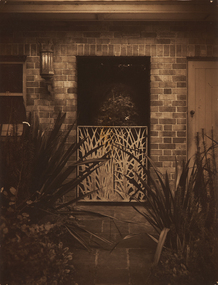
Photograph - Work on paper, Harold CAZNEAUX, Untitled (Architectural study of a wrought iron gate), c. 1930
... ... australian Photographer...Photograph silver gelatin australian Photographer australian artist lae iron work gate iron gate garden gate architecture Inscription verso "dr S". ...Inscription verso "dr S". Cazneaux image but not signed by artist.photograph, silver gelatin, australian photographer, australian artist, lae iron work, gate, iron gate, garden gate, architecture -
 Kiewa Valley Historical Society
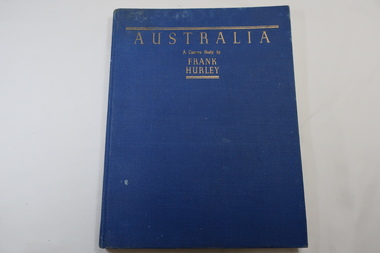
Book - Book- Photos, Australia - A Camera Study by / Frank / Hurley
... Frank Hurley photographer...Australian...Frank Hurley (1885-1962) was an Australian photographer and adventurer. He participated in trips to Antartica and was an official photographer with the Australian forces during both world wars. ...Frank Hurley (1885-1962) was an Australian photographer and adventurer. He participated in trips to Antartica and was an official photographer with the Australian forces during both world wars. ...Frank Hurley (1885-1962) was an Australian photographer and adventurer. He participated in trips to Antartica and was an official photographer with the Australian forces during both world wars. This book was first published in 1955.Photographs include the Hume Reservoir, Mt Buffalo and the Alpine High Country of Mt Kosciusko. (pages 140-144) All are associated with the type of country at each end of the Kiewa River. The Kiewa River flows into the Murray River just below the Hume Dam and Mt Buffalo and Mt Kosciusko are part of the Alpine High country near the Bogong High Plains. Clare Roper lived on a farm in the Kiewa Valley.Blue hard cover, bound book with the title in gold at the top. 208 pages. Mostly Black & white photos but some coloured.Inside back of first page - written 'Clare Roper'frank hurley photographer, australian photography, clare roper -
 Bendigo Art Gallery
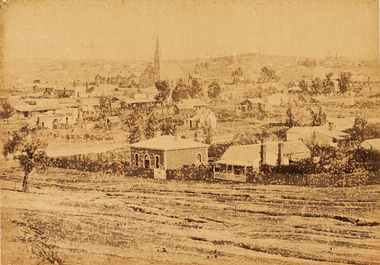
Photograph - Work on paper, Nicholas CAIRE, View of the Golden Square Township, 1875
... Australian Photographer...Australian Photographer albumen Bendigo Golden Square Sandhurst town city skyline l.l; N.J.Caire View of the Golden Square Township Photograph Work on paper Nicholas CAIRE ...l.l; N.J.Caireaustralian photographer, albumen, bendigo, golden square, sandhurst, town, city, skyline -
 Marysville & District Historical Society
THE TRIANGLE NEWS-VOL 5 NO 28-SEPTEMBER 19 1980
... australia...photographer...marysville victoria australia photographer australian boys' choir for sale community care centre think it over wanted to lease thank you wanted to buy marysville historical society meeting wanted to rent kinder footy club marysville bowls wirreanda meeting australian church women world community day marysville swimming club farewell congratulations annual kindergarten dinner debutante ball photos kinder needs a helper marysville newsagency sales marysville guides & brownies THE TRIANGLE NEWS-VOL 5 NO 28-SEPTEMBER 19 1980 ...marysville, victoria, australia, photographer, australian boys' choir, for sale, community care centre, think it over, wanted to lease, thank you, wanted to buy, marysville historical society meeting, wanted to rent, kinder, footy club, marysville bowls, wirreanda meeting, australian church women world community day, marysville swimming club, farewell, congratulations, annual kindergarten dinner, debutante ball photos, kinder needs a helper, marysville newsagency sales, marysville guides & brownies -
 Kew Historical Society Inc
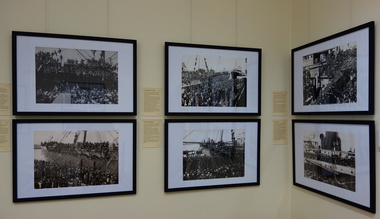
Photograph - Digital Photographs [Series], Robert Baker, Exhibition , Josiah Earl Barnes: The Embarkation Photographer, Kew Court House, 2015, 2015
... j.e. barnes - the embarkation photographer...australian...Smaller displays continue to be mounted in the Kew Library. photographers - kew (vic) - josiah earl barnes j.e. barnes - the embarkation photographer australian photography - world war 1 - 1914-1918 wwi Born digital series of photographs of an exhibition focusing on the World War I work of the Kew photographer, Josiah Earl Barnes, also known as 'the embarkation photographer'. ...From its beginnings in 1958, the Society has mounted exhibitions and/or displays, in early days in shop windows and in community spaces located in the Kew City Hall (later Kew Library), and since 2010 at the Kew Court House. Exhibitions typically coincided with the annual Kew Community Festival in March, but after 2013 evolved into three new exhibitions yearly at the Kew Court House. Smaller displays continue to be mounted in the Kew Library.Born digital series of photographs of an exhibition focusing on the World War I work of the Kew photographer, Josiah Earl Barnes, also known as 'the embarkation photographer'. All the images in the exhibition were lent by three of his descendants. The exhibition formed the Kew Historical Society's major contribution to the Gallipoli and Beyond Commemorations. photographers - kew (vic) - josiah earl barnes, j.e. barnes - the embarkation photographer, australian photography - world war 1 - 1914-1918, wwi -
 Bendigo Historical Society Inc.
Document - MARTIN WASHINGTON BENDIGO PHOTOGRAPHERS
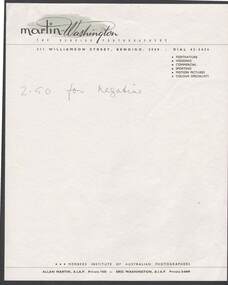
... Members Institute of Australian photographers. Allan Martin, A.I.A.P. Private 7435-- Eric Washington, A.I.A.P Private 3-6449...Members Institute of Australian photographers. Allan Martin, A.I.A.P. Private 7435-- Eric Washington, A.I.A.P Private 3-6449 Document MARTIN WASHINGTON BENDIGO PHOTOGRAPHERS ...Martin Washington 311 Williamson Street Bendigo, 3550, Ph 43-5626 invoice for $2.50 for negatives. Portraiture, Wedding, Commercial, Sporting, Motion Pictures, Colour Specialists. Members Institute of Australian photographers. Allan Martin, A.I.A.P. Private 7435-- Eric Washington, A.I.A.P Private 3-6449 -
 4th/19th Prince of Wales's Light Horse Regiment Unit History Room
Book, Official History of Australia in the War of 1914-18 Vol XII Photographic Record of the War
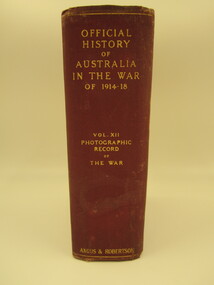
... Reproductions of prictures taken by the Australian official photographers (Captains G H Wilkins MC and J F Hurley, Lieutenants H K Baldwin and J P Campbell and others. ...Reproductions of Pictures Official Photographers War of 1914-18 Reproductions of prictures taken by the Australian official photographers (Captains G H Wilkins MC and J F Hurley, Lieutenants H K Baldwin and J P Campbell and others. ...Reproductions of prictures taken by the Australian official photographers (Captains G H Wilkins MC and J F Hurley, Lieutenants H K Baldwin and J P Campbell and others. Annotated by CEW Bean and H S Gullettreproductions of pictures, official photographers, war of 1914-18 -
 Flagstaff Hill Maritime Museum and Village
Book, Official History of Australia in the War of 1914-1918 Vol 12
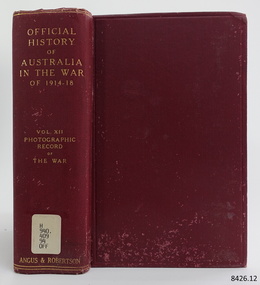
... Official History of Australia in the War of 1914-1918 Vol 12 "Annotated by C.E.W.Bean and H.S Gullett" Publisher: Angus & Robertson Ltd Date: 1943 Further Information: Photographic Record of the War Reproductions of the Pictures taken by the Australian official Photographers ...Official History of Australia in the War of 1914-1918 Vol 12 "Annotated by C.E.W.Bean and H.S Gullett" Publisher: Angus & Robertson Ltd Date: 1943 Further Information: Photographic Record of the War Reproductions of the Pictures taken by the Australian official Photographers Official History of Australia in the War of 1914-1918 Vol 12 Book ...This book was part of a large group of books referred to as the Pattison Collection, which belonged to the Warrnambool Public Library, part of the Warrnambool Mechanics’ Institute. About RALPH ERIC PATTISON and the ‘PATTISON COLLECTION’ The ‘Pattison Collection’ is a collection of books and records that was originally owned by the Warrnambool Mechanics’ Institute, founded in Warrnambool in 1853. By 1886 the Warrnambool Mechanics’ Institute (WMI) had grown to have a Library, Museum and Fine Arts Gallery, with a collection of “… choice productions of art and valuable specimens in almost every branch and many wonderful national curiosities, are now to be seen there, including historic relics of the town and district.” It later included a School of Design. Although it was very well patronised, the WMI was led to ask the City Council to take it over in 1911 due to a lack of financial support. In 1935 Ralph Pattison was appointed as City Librarian to establish and organise the Warrnambool Public Library as it was then called. Ralph Eric Pattison was born in Rockhampton, Queensland, in 1891. He married Maude Swan from Warrnambool in 1920 and they set up a home in Warrnambool. In 1935 when Pattison accepted the position as City Librarian for the Warrnambool City Council his huge challenge was to make a functional library within two rooms of the Mechanics’ Institute. He tirelessly cleaned, cleared and sorted a disarrayed collection of old books, jars of preserved specimens and other items reserved for exhibition in the city’s museum. He developed and updated the library with a wide variety of books for all tastes, including reference books for students; a difficult task to fulfil during the years following the Depression. He converted all of the lower areas of the building into a library, reference room and reading room for members and the public. The books were sorted and stored using a cataloguing and card index system that he had developed himself. He also prepared the upper floor of the building and established the Art Gallery and later the Museum, a place to exhibit the many old relics that had been stored for years for this purpose. One of the treasures he found was a beautiful ancient clock, which he repaired, restored and enjoyed using in his office during the years of his service there. Ralph Pattison was described as “a meticulous gentleman whose punctuality, floorless courtesy and distinctive neat dress were hallmarks of his character, and ‘his’ clock controlled his daily routine and his opening and closing of the library’s large heavy doors to the minute.” Pattison took leave from 1942 to 1945 to serve in the Royal Australian Navy, Volunteer Reserve as Lieutenant. A few years later he converted one of the Museum’s rooms into a Children’s Library, stocking it with suitable books for the younger generation. This was an instant success. In the 1950’s he had the honour of being appointed to the Victorian Library Board and received more inspiration from the monthly conferences in Melbourne. He was sadly retired in 1959 after over 23 years of service, due to the fact that he had gone over the working age of council officers. However, he continued to take a very keen interest in the continual development of the Library until his death in 1969. THE NEW WARRNAMBOOL LIBRARY When the WMI building was pulled down in 1963 a new civic building was erected on the site and the new Warrnambool Library, on behalf of the City Council, took over all the holdings of the WMI. At this time some of the items were separated and identified as the ‘Pattison Collection’, named after Pattison. Eventually, the components of the WMI were distributed from the Warrnambool Library to various places, including the Art Gallery, Historical Society and Flagstaff Hill. Later some were even distributed to other regional branches of Corangamite Regional Library and passed to and fro. It is difficult now to trace just where all of the items have ended up. The books at Flagstaff Hill Maritime Village generally display stamps and markings from Pattison as well as a variety of other institutions including the Mechanics’ Institute itself. The Pattison Collection, along with other items at Flagstaff Hill Maritime Village, was originally part of the Warrnambool Mechanics' Institute’s collection. The Warrnambool Mechanics’ Institute Collection is primarily significant in its totality, rather than for the individual objects it contains. Its contents are highly representative of the development of Mechanics' Institute libraries across Australia, particularly Victoria. A diversity of publications and themes has been amassed, and these provide clues to our understanding of the nature of and changes in the reading habits of Victorians from the 1850s to the middle of the 20th century. The collection also highlights the Warrnambool community’s commitment to the Mechanics’ Institute, reading, literacy and learning in the regions, and proves that access to knowledge was not impeded by distance. These items help to provide a more complete picture of our community’s ideals and aspirations. The Warrnambool Mechanics Institute book collection has historical and social significance for its strong association with the Mechanics Institute movement and the important role it played in the intellectual, cultural and social development of people throughout the latter part of the nineteenth century and the early twentieth century. The collection of books is a rare example of an early lending library and its significance is enhanced by the survival of an original collection of many volumes. The Warrnambool Mechanics' Institute’s publication collection is of both local and state significance. Official History of Australia in the War of 1914-1918 Vol 12 "Annotated by C.E.W.Bean and H.S Gullett" Publisher: Angus & Robertson Ltd Date: 1943 Further Information: Photographic Record of the War Reproductions of the Pictures taken by the Australian official Photographers The label on the spine cover with typed text H 940.40994 OFF Paste down front end paper has a sticker from Corangamite Regional Library Service.flagstaff hil, warrnambool, flagstaff hill maritime museum, maritime museum, shipwreck coast, flagstaff hill maritime village, great ocean road, book, pattison collection, warrnambool library, warrnambool mechanics’ institute, ralph eric pattison, corangamite regional library service, warrnambool city librarian, mechanics’ institute library, victorian library board, warrnambool books and records, warrnambool children’s library, official history of australia in the war of 1914-1918 vol 12, c.e.w.bean, h.s gullett -
 Eltham District Historical Society Inc
Book, ABC Books for the Australian Broadcasting Corporation, The Western Front 1916-1918 by Peter Cochrane, 2004
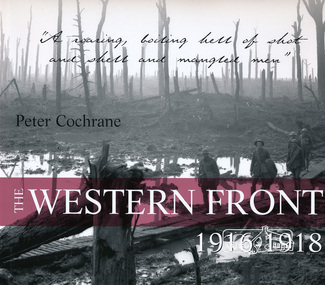
... "Using both official and unofficial photos, this is a powerful visual record of the ANZAC experience of the Western Front, WW1 - the scene of some of the bloodiest horrors and the greatest loss of life. Australian photographer." --Publisher's description...."Using both official and unofficial photos, this is a powerful visual record of the ANZAC experience of the Western Front, WW1 - the scene of some of the bloodiest horrors and the greatest loss of life. Australian photographer." --Publisher's description. world war 1914-1918 australian imperial force anzacs military campaigns western front ISBN 0733312802 138 pages : illustrations, portraits, map The Western Front 1916-1918 by Peter Cochrane Book ABC Books for the Australian Broadcasting Corporation ..."Using both official and unofficial photos, this is a powerful visual record of the ANZAC experience of the Western Front, WW1 - the scene of some of the bloodiest horrors and the greatest loss of life. Australian photographer." --Publisher's description.138 pages : illustrations, portraits, map ISBN 0733312802world war 1914-1918, australian imperial force, anzacs, military campaigns, western front -
Port Melbourne Historical & Preservation Society
Photograph - "Mooltan" passenger vessel, Ron Laing, 1988 - 1999
... the vessel "Mooltan" which brought the photographer to Australia...the vessel "Mooltan" which brought the photographer to Australia Photograph "Mooltan" passenger vessel Ron Laing ...Part of Ron Laing's collection of photographs recording Port Melbourne over a thirteen year period. Donated to the PMH&PS by the photographer.One of a set of 20 colour photographs 1980s-90s, of various events and subjects. the vessel "Mooltan" which brought the photographer to Australiaron laing -
 Lara RSL Sub Branch
Stereograph, The Rose Stereographs
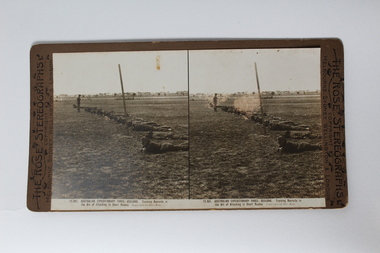
... George Rose was well known Australian photographer and postcard maker in the first half of the 20th century. ...George Rose was well known Australian photographer and postcard maker in the first half of the 20th century. ...George Rose was well known Australian photographer and postcard maker in the first half of the 20th century. This sterograph shows recruits training at Geelong during the First World War. Soldiers were trained to attack in short rushes rather than advancing in line due to the lethal power of the machine gun. The stereograph was an early technology that used double images to achieve a three dimensional image. Rectangular piece of cardboard with a stereograph image attached to the front. The image is a double reproduction of a black and white photograph. the photograph depicts a line of soldiers lying on the ground. AUSTRALIAN EXPERDITIONARY FORCE, GEELONG. Training Recruits in the Art of Attacking in Short Rushes. Copyright by Geo. Rose.wwi, rose series, postcard, lara, geelong, rsl, training, stereograph -
 Women's Art Register
Book, Barbara Hall and Jenni Mather, Australian Women Photographers 1840 - 1960, 1986
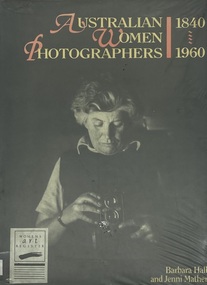
... First published history of Australian Women photographers, positioning them within the cultural, social and political developments, and technological advances, of their time. ...Book Australian Women Photographers 1840 - 1960 Book Book Barbara Hall and Jenni Mather Greenhouse Publications Pty Ltd ...Arising from research for an exhibition of the same name, which toured Australia 1981- 1982 the book covers the work of 45 amateur and professional photographers and their lives as innovators and travellers. Many of the works come from private collections and have not been previously published.Booknon-fictionArising from research for an exhibition of the same name, which toured Australia 1981- 1982 the book covers the work of 45 amateur and professional photographers and their lives as innovators and travellers. Many of the works come from private collections and have not been previously published.self portraiture, self-portraiture, pictorialism, home magazine, studio photography, melbourne society of women painters and sculptors, olive cotton, ruth hollick -
 Merri-bek City Council
Hand printed vintage black and white silver print, Stephen Wickham, Untitled 2, c. 1980
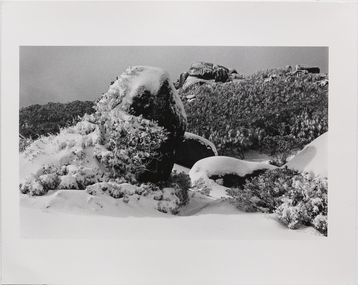
... Stephen Wickham is an Australian photographer and painter who has been actively exhibiting his works since the 1980s. ...Stephen Wickham is an Australian photographer and painter who has been actively exhibiting his works since the 1980s. ...Stephen Wickham is an Australian photographer and painter who has been actively exhibiting his works since the 1980s. A long standing preoccupation with Mt Buffalo since the 1980's has seen the artist produce a number of photographic suites and exhibitions that have been likened to German Romantic iconography and associated heavily with the European migrant experience (Robert Nelson, The Age 16 June 2001). Born to Viennese parents, hiking in the mountains for Wickham represents a traditional European family pastime. This series of work is comprised of expeditionary photographs taken between 1980 and 1985. Charles Green describes Wickham's landscape photographs as sublime, transcendental, spiritual and symbolic (Art in Australia Spring 1988). Set in Victoria’s Mount Buffalo National Park, the Mount Buffalo series captures the mountain plateau during winter. Rather than focusing on a lush green landscape, Wickham presents the viewer with close-ups of the snow-covered flaura and fauna of the alpine region.Donated through the Australian Government's Cultural Gifts Program by Miriam Kenter in memory of Master George Willibrord Kenter -
 Merri-bek City Council
Hand printed vintage black and white silver print, Stephen Wickham, Untitled 5, c. 1980
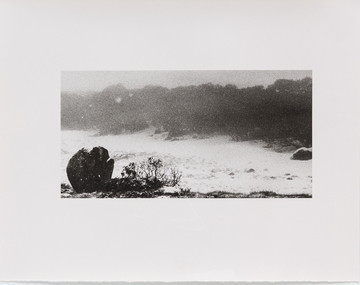
... Stephen Wickham is an Australian photographer and painter who has been actively exhibiting his works since the 1980s. ...Stephen Wickham is an Australian photographer and painter who has been actively exhibiting his works since the 1980s. ...Stephen Wickham is an Australian photographer and painter who has been actively exhibiting his works since the 1980s. A long standing preoccupation with Mt Buffalo since the 1980's has seen the artist produce a number of photographic suites and exhibitions that have been likened to German Romantic iconography and associated heavily with the European migrant experience (Robert Nelson, The Age 16 June 2001). Born to Viennese parents, hiking in the mountains for Wickham represents a traditional European family pastime. This series of work is comprised of expeditionary photographs taken between 1980 and 1985. Charles Green describes Wickham's landscape photographs as sublime, transcendental, spiritual and symbolic (Art in Australia Spring 1988). Set in Victoria’s Mount Buffalo National Park, the Mount Buffalo series captures the mountain plateau during winter. Rather than focusing on a lush green landscape, Wickham presents the viewer with close-ups of the snow-covered flaura and fauna of the alpine region.Donated through the Australian Government's Cultural Gifts Program by Miriam Kenter in memory of Master George Willibrord Kenter -
 Merri-bek City Council
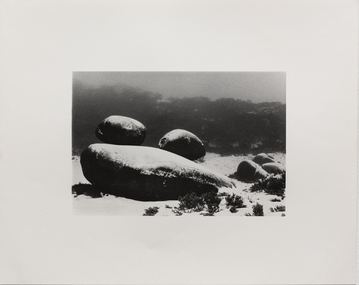
Hand printed vintage black and white silver print, Stephen Wickham, Untitled 6, c. 1980
... Stephen Wickham is an Australian photographer and painter who has been actively exhibiting his works since the 1980s. ...Stephen Wickham is an Australian photographer and painter who has been actively exhibiting his works since the 1980s. ...Stephen Wickham is an Australian photographer and painter who has been actively exhibiting his works since the 1980s. A long standing preoccupation with Mt Buffalo since the 1980's has seen the artist produce a number of photographic suites and exhibitions that have been likened to German Romantic iconography and associated heavily with the European migrant experience (Robert Nelson, The Age 16 June 2001). Born to Viennese parents, hiking in the mountains for Wickham represents a traditional European family pastime. This series of work is comprised of expeditionary photographs taken between 1980 and 1985. Charles Green describes Wickham's landscape photographs as sublime, transcendental, spiritual and symbolic (Art in Australia Spring 1988). Set in Victoria’s Mount Buffalo National Park, the Mount Buffalo series captures the mountain plateau during winter. Rather than focusing on a lush green landscape, Wickham presents the viewer with close-ups of the snow-covered flaura and fauna of the alpine region.Donated through the Australian Government's Cultural Gifts Program by Miriam Kenter in memory of Master George Willibrord Kenter -
 Merri-bek City Council
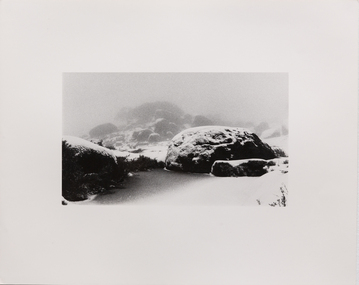
Hand printed vintage black and white silver print, Stephen Wickham, Untitled 7, c. 1980
... Stephen Wickham is an Australian photographer and painter who has been actively exhibiting his works since the 1980s. ...Stephen Wickham is an Australian photographer and painter who has been actively exhibiting his works since the 1980s. ...Stephen Wickham is an Australian photographer and painter who has been actively exhibiting his works since the 1980s. A long standing preoccupation with Mt Buffalo since the 1980's has seen the artist produce a number of photographic suites and exhibitions that have been likened to German Romantic iconography and associated heavily with the European migrant experience (Robert Nelson, The Age 16 June 2001). Born to Viennese parents, hiking in the mountains for Wickham represents a traditional European family pastime. This series of work is comprised of expeditionary photographs taken between 1980 and 1985. Charles Green describes Wickham's landscape photographs as sublime, transcendental, spiritual and symbolic (Art in Australia Spring 1988). Set in Victoria’s Mount Buffalo National Park, the Mount Buffalo series captures the mountain plateau during winter. Rather than focusing on a lush green landscape, Wickham presents the viewer with close-ups of the snow-covered flaura and fauna of the alpine region.Donated through the Australian Government's Cultural Gifts Program by Miriam Kenter in memory of Master George Willibrord Kenter -
 Merri-bek City Council
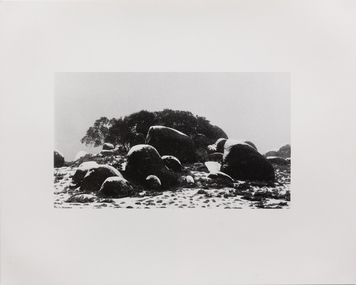
Hand printed vintage black and white silver print, Stephen Wickham, Untitled 8, c. 1980
... Stephen Wickham is an Australian photographer and painter who has been actively exhibiting his works since the 1980s. ...Stephen Wickham is an Australian photographer and painter who has been actively exhibiting his works since the 1980s. ...Stephen Wickham is an Australian photographer and painter who has been actively exhibiting his works since the 1980s. A long standing preoccupation with Mt Buffalo since the 1980's has seen the artist produce a number of photographic suites and exhibitions that have been likened to German Romantic iconography and associated heavily with the European migrant experience (Robert Nelson, The Age 16 June 2001). Born to Viennese parents, hiking in the mountains for Wickham represents a traditional European family pastime. This series of work is comprised of expeditionary photographs taken between 1980 and 1985. Charles Green describes Wickham's landscape photographs as sublime, transcendental, spiritual and symbolic (Art in Australia Spring 1988). Set in Victoria’s Mount Buffalo National Park, the Mount Buffalo series captures the mountain plateau during winter. Rather than focusing on a lush green landscape, Wickham presents the viewer with close-ups of the snow-covered flaura and fauna of the alpine region.Donated through the Australian Government's Cultural Gifts Program by Miriam Kenter in memory of Master George Willibrord Kenter -
 Merri-bek City Council
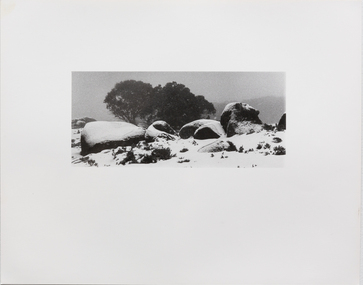
Hand printed vintage black and white silver print, Stephen Wickham, Untitled 9, c. 1980
... Stephen Wickham is an Australian photographer and painter who has been actively exhibiting his works since the 1980s. ...Stephen Wickham is an Australian photographer and painter who has been actively exhibiting his works since the 1980s. ...Stephen Wickham is an Australian photographer and painter who has been actively exhibiting his works since the 1980s. A long standing preoccupation with Mt Buffalo since the 1980's has seen the artist produce a number of photographic suites and exhibitions that have been likened to German Romantic iconography and associated heavily with the European migrant experience (Robert Nelson, The Age 16 June 2001). Born to Viennese parents, hiking in the mountains for Wickham represents a traditional European family pastime. This series of work is comprised of expeditionary photographs taken between 1980 and 1985. Charles Green describes Wickham's landscape photographs as sublime, transcendental, spiritual and symbolic (Art in Australia Spring 1988). Set in Victoria’s Mount Buffalo National Park, the Mount Buffalo series captures the mountain plateau during winter. Rather than focusing on a lush green landscape, Wickham presents the viewer with close-ups of the snow-covered flaura and fauna of the alpine region.Donated through the Australian Government's Cultural Gifts Program by Miriam Kenter in memory of Master George Willibrord Kenter -
 Merri-bek City Council
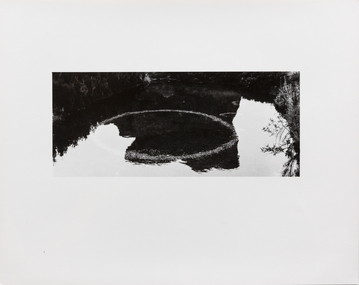
Hand printed vintage black and white silver print, Stephen Wickham, Untitled 10, c. 1980
... Stephen Wickham is an Australian photographer and painter who has been actively exhibiting his works since the 1980s. ...Stephen Wickham is an Australian photographer and painter who has been actively exhibiting his works since the 1980s. ...Stephen Wickham is an Australian photographer and painter who has been actively exhibiting his works since the 1980s. A long standing preoccupation with Mt Buffalo since the 1980's has seen the artist produce a number of photographic suites and exhibitions that have been likened to German Romantic iconography and associated heavily with the European migrant experience (Robert Nelson, The Age 16 June 2001). Born to Viennese parents, hiking in the mountains for Wickham represents a traditional European family pastime. This series of work is comprised of expeditionary photographs taken between 1980 and 1985. Charles Green describes Wickham's landscape photographs as sublime, transcendental, spiritual and symbolic (Art in Australia Spring 1988). Set in Victoria’s Mount Buffalo National Park, the Mount Buffalo series captures the mountain plateau during winter. Rather than focusing on a lush green landscape, Wickham presents the viewer with close-ups of the snow-covered flaura and fauna of the alpine region.Donated through the Australian Government's Cultural Gifts Program by Miriam Kenter in memory of Master George Willibrord Kenter -
 Ballarat Tramway Museum
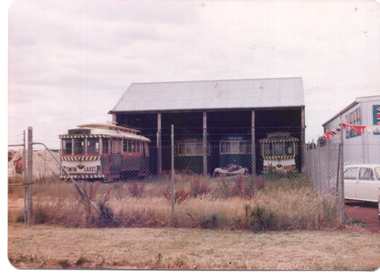
Photograph - BTPS Sebastopol offsite store, late 1978
... Tram 33 was taken to the depot on 11/12/1978 when 14 was taken to Melbourne for the 1979 Australia Day Pagent. Photographer unknown....Tram 33 was taken to the depot on 11/12/1978 when 14 was taken to Melbourne for the 1979 Australia Day Pagent. Photographer unknown. Yields information about BTPS trams stored at Sebastopol late 1978. tramcars tramways Ballarat BTPS Sebastopol offsite store tram 11 tram 671 tram 661 tram 14 Ballarat Tramway Colour print on plain paper. ...Colour print of the BTPS Sebastopol store late 1978 with trams 11 (part outside), 671, 661 and 33. Tram 33 was taken to the depot on 11/12/1978 when 14 was taken to Melbourne for the 1979 Australia Day Pagent. Photographer unknown.Yields information about BTPS trams stored at Sebastopol late 1978.Colour print on plain paper.tramcars, tramways, ballarat, btps, sebastopol, offsite store, tram 11, tram 671, tram 661, tram 14, ballarat tramway -
 Nhill and District Historical Society Inc.
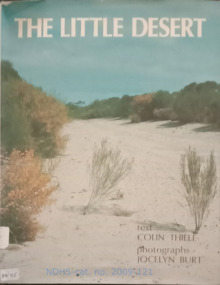
Book, Rigby Limited, The Little Desert, 1975
... Jocelyn Burt - photographer - author - Australian landscapes - environment...The photographs in this book depict the way the Little Desert looked back when they were taken in the 1970's, by one of Australia's prominent landscape photographer, Jocelyn Burt; and Colin Theile's description of the Little Desert as a re-nouned author and educator is something for environmentalists to refer to. ...The photographs in this book depict the way the Little Desert looked back when they were taken in the 1970's, by one of Australia's prominent landscape photographer, Jocelyn Burt; and Colin Theile's description of the Little Desert as a re-nouned author and educator is something for environmentalists to refer to. ...This book is a true pictorial and written experience of the Little Desert 's flora, fauna, animal habitats and environment as it was in the 1970's.hard cover book with dust jacket, with dog-ear top of spine. Quarto, 55 pages with numerous full-page colour illustrations from photographs by Jocelyn Burt.non-fictionThis book is a true pictorial and written experience of the Little Desert 's flora, fauna, animal habitats and environment as it was in the 1970's.jocelyn burt - photographer - author - australian landscapes - environment -
 Merri-bek City Council
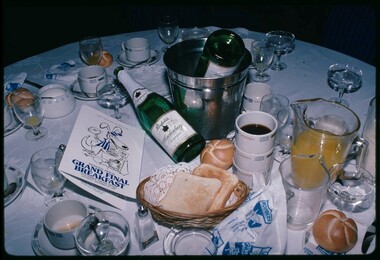
C-type print, Rennie Ellis, Grand Final breakfast 1982, 1982
... Rennie Ellis was an Australian documentary photographer and a key figure in Australian visual culture. ...Rennie Ellis was an Australian documentary photographer and a key figure in Australian visual culture. ...Rennie Ellis was an Australian documentary photographer and a key figure in Australian visual culture. Grand Final breakfast 1982 depicts a cluttered table during a football Grand Final day breakfast. The messily covered tablecloth, as well as the appearance of alcohol at a morning event, displays the signature larrikin attitude and passion with which football events are undertaken in Australia. This work was shown in the 2017 Counihan Gallery exhibition Leather Poisoning, along with many other works by Ellis, capturing the nation’s love of the game. Donated by the Rennie Ellis Photographic Archive -
 Melbourne Tram Museum
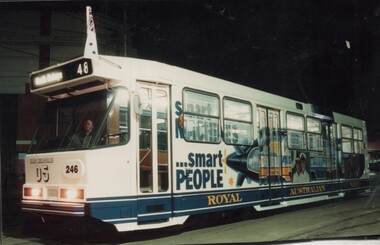
Photograph - Colour - A class 246 - RAN Tram
... Colour print of Public Transport Corporation (PTC) operated tram A1 246 in an all over adverting scheme for the Royal Australian Navy at night. Photographer unknown. Photographed at Kew Depot. ...Colour print of Public Transport Corporation (PTC) operated tram A1 246 in an all over adverting scheme for the Royal Australian Navy at night. Photographer unknown. Photographed at Kew Depot. ...Colour print of Public Transport Corporation (PTC) operated tram A1 246 in an all over adverting scheme for the Royal Australian Navy at night. Photographer unknown. Photographed at Kew Depot. Tram running a route 48. Yields information about the tram that painted for advertising the Royal Australian Navy in 1991.Colour print adhered to a black sheet, of PTC A Class tram 246 advertising the Royal Australian Navy in May 1991. trams, tramways, a1 class, advertising trams, route 48, royal australian navy, tram 246 -
 Geelong RSL Sub Branch
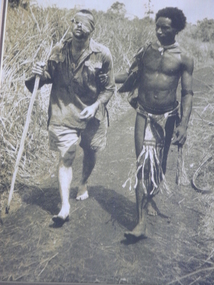
Statue and Photograph, Not known, Fuzzy Wuzzy Angels, Late 20th Century
... George Silk was a War Photographer for Australian Government, his appointment began in 1939. ...George Silk was a War Photographer for Australian Government, his appointment began in 1939. ...The photograph was taken by George Silk on Christmas Day 1942 near Buna, Papua New Guinea. George Silk was a War Photographer for Australian Government, his appointment began in 1939. He was in New Guinea with the AIF when this photograph was taken.The photograph shows the work and assistance of the Fuzzy Wuzzy Angels to Australian Servicemen who were Serving in Papua New Guinea during WW2.Photograph - black and white copy of the original in a wooden frame. Statue - free standing bronze statue on a wooden block.Photograph has a information on the bottom of the frame describing the picture and who is the photographer - George Silk. The men in the photograph are Pte G C Whittington 2/10th Battalion AIF and Papuan Raphael Oimbari. The photograph was taken on Christmas Day 1942 near Buna, Papua New Guinea.ww2 fuzzy wuzzy angel, qx23902 pte g c whittington, raphael oimbari, george silk -
 Nillumbik Shire Council
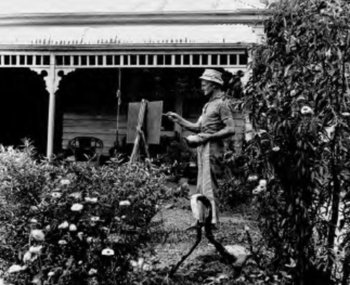
Photograph: Sue FORD (b.1943-d.2009), Sue Ford, Neil Douglas Research 1964, Photographed 1964; printed 2015
... Sue Ford (1943-2009) was an important practitioner in the wave of 1970's Australian feminist photographers. Ford regularly took intimate and candid pictures of artist friends, such as 'Neil Douglas Research 1964', documenting a time in Eltham when Montsalvat and Dunmoochin played an important part in the early attraction of artists to the Nillumbik area. ...Sue Ford (1943-2009) was an important practitioner in the wave of 1970's Australian feminist photographers. Ford regularly took intimate and candid pictures of artist friends, such as 'Neil Douglas Research 1964', documenting a time in Eltham when Montsalvat and Dunmoochin played an important part in the early attraction of artists to the Nillumbik area. ...Sue Ford (1943-2009) was an important practitioner in the wave of 1970's Australian feminist photographers. Ford regularly took intimate and candid pictures of artist friends, such as 'Neil Douglas Research 1964', documenting a time in Eltham when Montsalvat and Dunmoochin played an important part in the early attraction of artists to the Nillumbik area. Artist, conservationist and activist Neil Douglas (1911-2003) is best known for his garden at the Bend of Islands, Kangaroo Ground where he formed a co-operative for like-minded people who wished to live in harmony with the bush and wildlife. His love of nature and the beauty and fragility of the bush are constant themes that often run parallel in his ceramic works and paintings.Sue Ford and Neil Douglas were artists of national significance who both lived in the local Nillumbik area in the mid to late twentieth century. They were part of a community of artists integral in forging a dynamic artistic spirit, heavily inspired by the region's landscape and its people. Black and white silver gelatin photographic print of Neil Douglas plein-air painting in his rose garden at Research. Ed.1/3N/Aford, douglas, silver gelatin photograph, bend of isles, research, kangaroo ground, garden, environment -
 Ballarat Tramway Museum
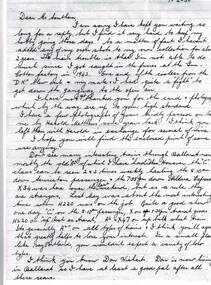
Document - Letter/s, Wal Jack, Wal Jack to John Southern
... John Southern lived in NSW and was a well known collector of information and photographer on Australian steam locomotives; wrote articles for the ARHS Bulletin and other publications. ...John Southern lived in NSW and was a well known collector of information and photographer on Australian steam locomotives; wrote articles for the ARHS Bulletin and other publications. ...Letters hand written by Jack, concerning primarily his observations of steam locomotives and trains in the Ballarat area, with some references to his health, trams, replacement of steam locomotives by diesels (which he did not like). John Southern lived in NSW and was a well known collector of information and photographer on Australian steam locomotives; wrote articles for the ARHS Bulletin and other publications. On first letter, Wal notes he was involved in an industrial accident at the Ballarat Gun Cotton factory in 1943 which severely affected his health. Photocopied from original letters held by Dave Macartney.Has a strong association with Wal Jack and yields information about steam locomotives and trains in the Ballarat district and VR during the 1950's.Set of 36 pages - stapled in top left hand corner, photocopies of letters from Wal Jack to John Southern from 7-2-1950 to 6-5-1961. trams, tramways, wal jack, letters, ballarat, steam locomotive, gun cotton, accidents -
Emerald Museum & Nobelius Heritage Park
Postcard - Emerald House, Rose Stereographs Co, 1940s-1950s
... The photographs on the postcards were original works by George, who has become reputed as one of the best photographers in Australia during the 19th and 20th centuries....The photographs on the postcards were original works by George, who has become reputed as one of the best photographers in Australia during the 19th and 20th centuries. ...The Rose Stereograph Co. was established in the year 1880. The firm's founder, George Rose Clune, began developing photographs from his father's shoe shop located in Prahran, Victoria. George would travel to the Dandenong foothills to sell his photographs to picnic parties, thus creating a connection to Emerald and surrounding districts. The Rose Stereograph Co. first began producing stereographs. After this medium lost popularity, George switched to postcards — referred to as the 'P' series, such as this example — in 1913. The firm continued to print postcards until 1967, after which they switched to machine-manufactured coloured postcards provided by an external supplier. The photographs on the postcards were original works by George, who has become reputed as one of the best photographers in Australia during the 19th and 20th centuries.The record holds very strong historic significance as it speaks to the transformation of the Dandenong foothills into a popular tourist destination in Victoria. Particularly, the Emerald House was an early tourist enterprise in region which had previously been dominated by industries of timber, gold and horticulture. The record is particularly significant for how it documents this important metamorphosis of Emerald into a key location for tourism. Furthermore, the postcard offers some research potential into the commercialisation of housing and its wider socioeconomic impacts on the local community, particularly in our current climate of short-term holiday rentals like AirBnB and Stayz.Black and white rectangular postcard printed on card. Depicted is a guest lodge known as Emerald House. There is a stationary vehicle parked in front of the house in the right hand side of the image. The guest lodge is made from weatherboard panels, with a corrugated iron or steel roof, and a brick chimney. Surrounding the house are various trees, plants and shrubs. In the far left hand side of the postcard, there is a sign denoting the accommodation is Emerald House. In the background of the image, there is a round elevated corrugated silo; this is possibly a water tank.Obverse: 'EMERALD / HOUSE'. / ACCOMMODATION / Afternoon Dinners / (?) / THE ROSE SERIES P. 3337 " EMERALD HOUSE," EMERALD, VIC. / COPYRIGHT / Reverse: PD00228b. / Copy / POST CARD / The "Rose" Series A Real Photograph / De Luxe Produced in Australia / Published by the Rose Stereograph Co. / Armadale, Victoria. / VEMUP0965 /rose series postcards, postcards, emerald house, accommodation, guest houses -
 City of Melbourne Libraries
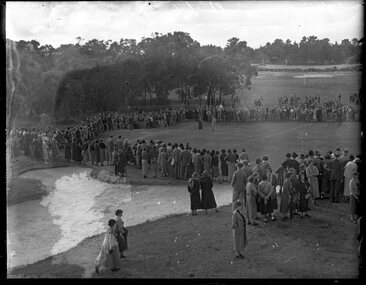
Photograph, The Age (Melbourne, Vic. : 1854 - 1954), Spectators at Australian Women's Golf Championship
... Runner-up was Australian Susie Morpeth. Photographer notations on slide: "Vic Women's Ch'ship 1935 B98" Published: The Age 5 September 1935 p11 Published title: THE HUGE GALLERY WHICH WATCHED THE FINAL OF THE AUSTRALIAN WOMEN'S CHAMPIONSHIP. ...Runner-up was Australian Susie Morpeth. Photographer notations on slide: "Vic Women's Ch'ship 1935 B98" Published: The Age 5 September 1935 p11 Published title: THE HUGE GALLERY WHICH WATCHED THE FINAL OF THE AUSTRALIAN WOMEN'S CHAMPIONSHIP. ...Crowd of spectators gathered around a green at Royal Melbourne Golf Course, Cheltenham for the Australian Women’s Golf Championship in 1935. The winner was Irish player Pat Walker. Runner-up was Australian Susie Morpeth. Photographer notations on slide: "Vic Women's Ch'ship 1935 B98" Published: The Age 5 September 1935 p11 Published title: THE HUGE GALLERY WHICH WATCHED THE FINAL OF THE AUSTRALIAN WOMEN'S CHAMPIONSHIP. Published caption: Advancing to the 12th Green at Royal Melbourne yesterday, the huge gallery, part of which, can be seen in this picture, was estimated to number about two thousand people. The players in the left corner of the picture are about to play on to the green, and the stewards are hard at work keeping back the enthusiastic crowd. Trove article identifier: http://nla.gov.au/nla.news-page19254515 18 year-old Miss Pamela Barton of England is teeing off at the ninth hole, watched by her competitor Miss Janet Gardiner of Queensland and a gallery of intensely focussed spectators. Both women went on to have diverse, non-sporting careers. During the Blitz and the Battle of Britain, Pam Barton (1917-1943) drove ambulances before joining the WAAF as a radio operator. Later she gained a commission as a Flight Officer in command of a staff of 600. In 1943, Pam was killed instantly when the RAF plane piloted by her unofficial fiancée crashed in heavy weather. The Pam Barton Memorial Salver is awarded to the winner of the British Ladies Amateur Golf Championship. The inscription reads “In Affectionate Memory of Pam Barton”. During WWII, Janet Gardiner (Mrs Jobson-Scott, 1907-1987) began manufacturing liquid hosiery at the Red Cross Link rooms as a fundraiser. Donated oyster bottles were used and they charged 2/6 for four ounces. However, in April 1942, in a broadcast to the women of Australia, the Minister for War Organisation of Industry, Mr Dedman, announced that leg make-up preparations were now a prohibited item. They contained titanium oxide, an essential ingredient in the manufacture of paints used for camouflaging military equipment. Other items of a woman’s “battle array” such as nail lacquer, some creams and suntan lotions were also banned as they contained ingredients used in munitions and medical supplies. Featured in "Newsworthy: Melbourne in photographs 1933-1936" exhibition at East Melbourne Library, October to December 2023. Exhibition caption by project volunteer, Fiona Collyer.Glass plate negativePhotographer notations on slide: "Vic Women's Ch'ship 1935 B98".golf, royal melbourne golf club, women golfers -
 The Beechworth Burke Museum
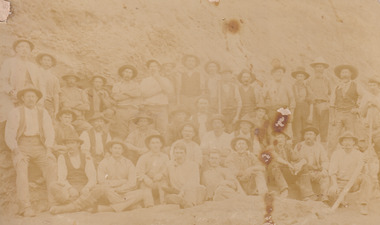
Photograph, Walter William McLean Thwaites, c.1870
... The Thwaites family were a long line of photographers and artists with Thwaites' father Walter WIlliam Thwaites Sr working as an artist and photographer in Australia after moving from England in 1834. ...The Thwaites family were a long line of photographers and artists with Thwaites' father Walter WIlliam Thwaites Sr working as an artist and photographer in Australia after moving from England in 1834. ...This photograph depicts a large group of men in their work clothing situated in front of a large bank of earth. They are identified as miners working in an unidentified location in Australia. This photograph was taken by photographer Walter Thwaites sometime during the period of 1865-1908, likely c.1870. It is unsure where this image was taken since Thwaites travelled a lot over his photography career and the photograph is not annotated with this information. In addition, the identities of the men in the photograph are also unknown. These men are photographed in front of a large bank of earth where they had presumably been mining for gold or other precious metals. The men, with the exception of four, are wearing wide brimmed hats to protect their faces from the sun. They are also wearing loose fitting white shirts which are often worn beneath a darker coloured vest. They wear pale coloured work pants and boots. The men are mostly clean shaven with the exception of the moustache and a couple of beards. Two of the men have pipes in their mouth. Their clothing is basic and much less dramatic than the outfits worn by the gold diggers of the 1852 gold rush. These men, by wearing similar outfits, are expressing a sense of comradery or equality between them. It is likely that they are from the same, or similar, social status. They have an air of independence and share social equality in their stance and clothing. Walter William McLean Thwaites (1840-1908) was a professional photographer born in Sydney, Australia. He learnt the craft in his father's Hobart studio, but later embarked on his own solo career and toured every existing Australian colony between 1860 to 1888. The Thwaites family were a long line of photographers and artists with Thwaites' father Walter WIlliam Thwaites Sr working as an artist and photographer in Australia after moving from England in 1834. Walter Thwaites Sr's father, also named Walter Thwaites, was a British miniature portrait artist.Images, like this one, of Australian gold rush history can reveal important information about the social and environmental impact of this period. This image depicts over 30 diggers standing in front of a bank of earth and therefore, this image has the capacity to reveal or support significant information for researchers studying the fashion and social status of diggers in Australia in approximately 1870. It can also provide information on the landscape of Australia in this period and the impact of mining for gold on both society and the Australian landscape. The Burke Museum is home to a substantial collection of Australian mining photographs which can be used to gain a deeper understanding into life on the gold fields, technology used in mining, the miners themselves and the impact of the gold digging on the environment.Sepia toned rectangular photograph printed on matte photographic paper and mounted on board.Reverse: 1997.208 / MINERS. / W. Thwaites / Photography /australia, australian photography, photography, miners, gold rush, australian landscape, diggers, walter thwaites, thwaites photography, w. thwaites photography, social history -
 The Beechworth Burke Museum
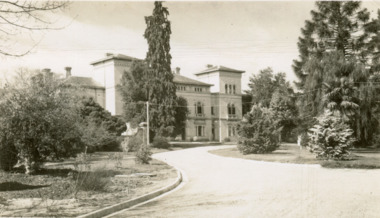
Postcard, George Rose, c.1945
... These were produced by Victorian-era photographer George Rose (1861-1942) often reputed as one of the best photographers in Australia during the later 19th Century and early 20th Century. ...These were produced by Victorian-era photographer George Rose (1861-1942) often reputed as one of the best photographers in Australia during the later 19th Century and early 20th Century. ...The Rose Stereograph Company first began producing postcards, identified as the 'P' series (like this particular example) in 1913 and continued in this business until 1967 after which they switched to machine manufactured colour postcards printed by an external company. These were produced by Victorian-era photographer George Rose (1861-1942) often reputed as one of the best photographers in Australia during the later 19th Century and early 20th Century. Rose was born in 1861 in Clunes and began his photography business in 1880 when he founded the Rose Stereograph Company. He later switched to producing postcards after stereographs lost popularity in the early 1920s. The Mayday Hills Hospital was one of these locations photographed by George Rose and published as a postcard. Beechworth's Mayday Hills was chosen as the site of Victoria's newest asylum, at the time, due to the landscape and altitude. The hilltop atmosphere and the native fauna, it was argued, would assist in the cure of the patients kept at the hospital (Wood 1985, 122). The positioning of the hospital had a beneficial effect on the rural town. A pamphlet published by James Ingram and Son (1849) reveal that famous landmarks in Beechworth which included the Post Office, Gaol, Courthouse and Asylum "demonstrate the appreciation of Beechworth by the Government not only as as important district center, but also as a site unrivaled as a sanitarium". There were other locations in contention at the time, but ultimately Beechworth was chosen (Craig 2000,33). Prior to the creation of the Asylum in Beechworth, those charged with having mental illnesses or, as it was termed, "insanity" were unable to be properly cared for in the Gaol (which is where they were often sent). John Buckley Castieau wrote, in 1861 for the Ovens and Murray Advertiser, that the Gaol was unable to properly care for those classified then as "insane" but that they would endeavor to treat them above the other inmates (which he notes is not always the case in other establishments). Castieau wrote this in favour of supporting the building of the Mayday Hills Hospital in Beechworth. It was stated that at the time the Mayday Hills Hospital was built, there were 83 prisoners kept in the Gaol who were to be rehoused to the Hospital on the grounds of "insanity". The classification as someone as "insane", in this period of time is a reflection on the inability to cure and understand illnesses of the mind during the mid to late 1800s. Opening on the 24th of October 1867, the Mayday Hills Hospital was originally named the "Ovens Lunatic Asylum", a title which is very much a product of its time. Whilst controversial, changes to the name is part of the history of the Hospital and can provide much insight into the understanding of mental illness throughout history and the use/disuse of this term provides information into the reception/changing opinions of mental illness in society. The Hospital would later become known as the "Mayday Hills Asylum" and/or "Mayday Hills Hospital" with the latter being the most commonly used title. An article in the Ovens and Murray Advertiser notes that on the 7th of March 1865, the foundation stone of the Hospital was laid (it would officially open in 1867) and that it was such a moment of accomplishment and joy for Beechworth that a letter to the editor even suggested that there should be a holiday dedicated to the day the foundation stone as laid. This reveals an extent to which the townspeople of early Beechworth valued the construction of the Hospital in their town. It provided the town with a sense of prestige and honour. At first glance, the remains of the Mayday Hills Hospital in Beechworth, Victoria, inspire tragedy, trauma and beauty. The buildings themselves, with their Italianate style Renaissance architecture designed by J.J. Clark (Craig 2000, 49 & Smith 2016, 203) reflect a bygone period of European and Australian history. The gardens provide a sense of tranquility and beauty. The experience of those within these walls remains a valuable area of study to provide a more complete understanding. This particular hospital is considered the fourth of its like and one of three identified as the largest of their kind. The Mayday Hills Hospital is a sister to the Kew and Ararat Asylums in Melbourne which are both located in relative proximity. Understanding the role of the Mayday Hills Hospital in Beechworth history is integral to understanding the development of the goldfields town, but also for providing important information as to the history of caring for, and the reception of, mental illnesses in Australian and wider European history. Mayday Hills provides a case study which can be researched through oral history, an analysis of the grounds/buildings and through images like this postcard which portray the structure in a highly deliberate manner. Images like this depict the strong façade of the Hospital and provide a glimpse into the tranquility of the gardens. This has been done deliberately to provide a sense of comfort and healing about the building to those looking from the outside. Further research into the importance of the Hospital in Beechworth and it's connection to the town will be supported through images like these kept in the Mayday Hills photo album in the collection of the Burke Museum.Pale sepia toned rectangular postcard printed on matte card.Obverse: THE ROSE SERIES P. 4689 / COPYRIGHT / ADMINISTRATIVE OFFICES, MENTAL HOSPITAL, BEECHWORTH, VIC / Reverse: Published by the Rose Stereograph Co. / Armadale, Victoria / POST CARD / THE "ROSE" SERIES / DE LUXE / A REAL PHOTOGRAPH / PRODUCED IN AUSTRALIA /mayday hills, asylum, mental hospital, hospital, beechworth
