
Showing 612 items matching "australian prisoners of war"
-
 Returned Nurses RSL Sub-branch
Book - Paperback book, Hachette Australia, War behind the wire: Australian prisoners of war, 2008
... War behind the wire: Australian prisoners of war......Australian prisoners of war...Includes first hand accounts and references to Australian Nurses taken as Prisoners of War....Includes first hand accounts and references to Australian Nurses taken as Prisoners of War. Prisoners of War WWII WW2 World War 1939-1945 Second World War Australian prisoners of war Stories from the Australians at War Film Archive that follows the stories of the POWs from capture to eventual liberation. ...Stories from the Australians at War Film Archive that follows the stories of the POWs from capture to eventual liberation. The book ranges across all the wars, from the men and women trapped under the ruthless Japanese regime, to the forgotten POWs of the Germans and the Italians, captured in Crete or Greece, or anywhere in occupied Europe. [Trove]The bottom half of the cover and the spine are black with the title printed in silver. The top half is a sepia photograph of two smiling prisoners of war, the bottom of the image is overlaid with black barbed wire.non-fictionStories from the Australians at War Film Archive that follows the stories of the POWs from capture to eventual liberation. The book ranges across all the wars, from the men and women trapped under the ruthless Japanese regime, to the forgotten POWs of the Germans and the Italians, captured in Crete or Greece, or anywhere in occupied Europe. [Trove]prisoners of war, wwii, ww2, world war 1939-1945, second world war, australian prisoners of war -
 Returned Nurses RSL Sub-branch
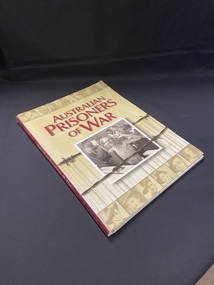
Book - Illustrated paperback book, Department of Veterans' Affairs, Canberra, Australian Prisoners of War, 2009
... Australian Prisoners of War......Australian Armed Forces...Prisoners of War...Australian Military History - 20th Century Australian Armed Forces Prisoners of War Nurses This resource primarily investigates the experiences of Australian POWs from World War Two and the Korean War. ...This resource primarily investigates the experiences of Australian POWs from World War Two and the Korean War. It provides students with resources for studying the major themes of these experiences through on-screen memories and words of former POWs, framed by accompanying narration and images which place those memories in an historical perspective. Covers the following wars: Boer War, 1899-1901; First World War, 1914-1918; Second World War, 1939-1945; Korea, 1950-1954. Includes teachers' information; guided activities; the stories; worksheets; review and reflection. - from Trove. .Maroon spine with title printed in cream and barbed wire either side. The cover shows a strip of sepia toned portraits of soldiers across the top and bottom of the page. The title is in large maroon lettering and a photo of an emaciated prisoner in a mess hall, is below, with barbed wire running across and behond the photograpnon-fictionThis resource primarily investigates the experiences of Australian POWs from World War Two and the Korean War. It provides students with resources for studying the major themes of these experiences through on-screen memories and words of former POWs, framed by accompanying narration and images which place those memories in an historical perspective. Covers the following wars: Boer War, 1899-1901; First World War, 1914-1918; Second World War, 1939-1945; Korea, 1950-1954. Includes teachers' information; guided activities; the stories; worksheets; review and reflection. - from Trove. .australian military history - 20th century, australian armed forces, prisoners of war, nurses -
 Lakes Entrance Historical Society
Book, Reid Richard, Page Courtney, Pounds Robert, In Captivity. Australian Prisoners of War in the 20th.Century, 1999
... In Captivity. Australian Prisoners of War in the 20th.Century...An account of Australians as prisoners of war from W.W.1 to the Korean War. ...Military History An account of Australians as prisoners of war from W.W.1 to the Korean War. ...An account of Australians as prisoners of war from W.W.1 to the Korean War. Includes personal recollections and short biographies. Illustrated with photographs.military history -
 Bendigo Military Museum
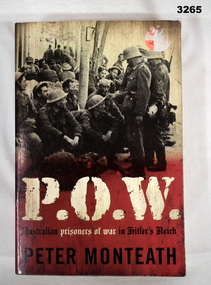
Book - BOOK, POW'S, P.O.W. Australian Prisoners of War in Hitler's Reich, 2011
... P.O.W. Australian Prisoners of War in Hitler's Reich....Australians from every branch of our armed forces in WWII found themselves captives in Hitler's notorious prisoner of war camps....P.O.W. Australian Prisoners of War in Hitler's Reich. Book BOOK, POW'S Peter Monteath Pan Macmillan Australia Pty Limited McPherson Printing Group ...Australians from every branch of our armed forces in WWII found themselves captives in Hitler's notorious prisoner of war camps.Cover - soft cardboard,black, cream & white print on front, spine & back. Background photo in black, white & red of soldiers in uniform sitting & standing. 523 pages, cut plain white paper. Illustrated with black & white photos & maps.books-military-history, pow's, reich -
 Bendigo Military Museum
Book, Richard Reid, In Captivity: Australian Prisoners of War in the 20th Century, 1999
... In Captivity: Australian Prisoners of War in the 20th Century...In Captivity: Australian Prisoners of War in the 20th Century Book BOOK Richard Reid Department of Veteran's Affairs ...ISBN 0642 4148 58Softcover book with black and white front cover with stylised barbed wire across centre. 70 pages with black and white photos."Donated by Bgo YMCA"books, military history, prisoners -
 Warrnambool RSL Sub Branch
Book. WW2. Prisoners-of-War, Australian Prisoners of War, 2014
... Australian Prisoners of War...Prisoners of War by Penguin Books in 1992. This new edition published by The Five Mile Press Ltd. 2014 Hardback with dustcover Australian Prisoners of War Book. ...Hardback with dustcoverOriginally published as Prisoners of War by Penguin Books in 1992. This new edition published by The Five Mile Press Ltd. 2014 -
 Monbulk RSL Sub Branch
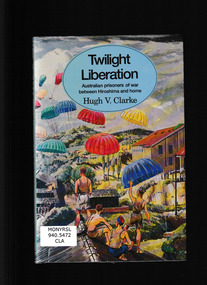
Book, George Allen & Unwin, Twilight liberation : Australian prisoners of war between Hiroshima and home, 1985
... Twilight liberation : Australian prisoners of war between Hiroshima and home...World war 1939 – 1945 - Prisons and prisoners – Japanese World War 1939-1945 - Personal narratives - Australia Australian prisoners of war in Japan in the aftermath of The Japanese surrender Ill, p.165 Twilight liberation : Australian prisoners of war between Hiroshima and home Book George Allen & Unwin Hugh V Clarke ...Australian prisoners of war in Japan in the aftermath of The Japanese surrenderIll, p.165non-fictionAustralian prisoners of war in Japan in the aftermath of The Japanese surrenderworld war 1939 – 1945 - prisons and prisoners – japanese, world war 1939-1945 - personal narratives - australia -
 Monbulk RSL Sub Branch
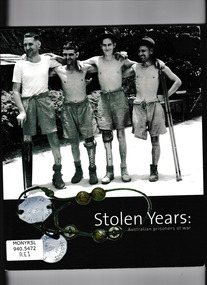
Book, Department of Veterans' Affair, Stolen Years : Australian Prisoners of War, 2002
... Stolen Years : Australian Prisoners of War...World war 1939 – 1945 - Prisons and prisoners – Australia Prisoners of war - Australia - Pictorial works Created by the Australian War Memorial, this book is an online companion to a travelling exhibition that explores the lives of those who were held captive by the Japanese. ...Created by the Australian War Memorial, this book is an online companion to a travelling exhibition that explores the lives of those who were held captive by the Japanese. It describes what happened during the time these individuals spend months and years behind barbed wire, hungry, bored, cold, and sick. The book tells the story of how many survived and why they deserve our respect and understanding.Ill, p.157.non-fictionCreated by the Australian War Memorial, this book is an online companion to a travelling exhibition that explores the lives of those who were held captive by the Japanese. It describes what happened during the time these individuals spend months and years behind barbed wire, hungry, bored, cold, and sick. The book tells the story of how many survived and why they deserve our respect and understanding. world war 1939 – 1945 - prisons and prisoners – australia, prisoners of war - australia - pictorial works -
 Monbulk RSL Sub Branch
Book, Macmillan, P.O.W. : Australian prisoners of war in Hitler's Reich, 2011
... P.O.W. : Australian prisoners of war in Hitler's Reich...P.O.W. : Australian prisoners of war in Hitler's Reich Book Macmillan Peter Monteath ...Australians from every field of conflict in World War II found themselves as prisoners in Hitler's notorious Stalags, or prisoner of war camps. Most were forced to labour in factories, down mines or on the land - often in conditions of enormous privation and hardship. All suffered from shortages, overcrowding and the mental strain of imprisonment. Peter Monteath's fascinating narrative history is exhaustively researched, and compelling in its detailed evocation.Index, bibliography, notes, ill, p.523.non-fictionAustralians from every field of conflict in World War II found themselves as prisoners in Hitler's notorious Stalags, or prisoner of war camps. Most were forced to labour in factories, down mines or on the land - often in conditions of enormous privation and hardship. All suffered from shortages, overcrowding and the mental strain of imprisonment. Peter Monteath's fascinating narrative history is exhaustively researched, and compelling in its detailed evocation.world war 1939 – 1945 - prisons and prisoners – germany, prisoners of war - australia -
 Monbulk RSL Sub Branch
Book, Commonwealth Dept. of Veterans' Affairs, In captivity : Australian prisoners of war in the 20th century, 1999
... In captivity : Australian prisoners of war in the 20th century...Ex prisoners of war - Biography World war 1939 – 1945 - Prisons and prisoners - Japanese A concise history of the occassions and experiences of Australian taken as Prisoners of War during World War One (1914-1918), World War Two (1939-1945), and the Korean War (1950-1953). ...A concise history of the occassions and experiences of Australian taken as Prisoners of War during World War One (1914-1918), World War Two (1939-1945), and the Korean War (1950-1953). Includes many quotes and anecdotes illustrating the experiences of POW's in their own words.Ill, p.70.non-fictionA concise history of the occassions and experiences of Australian taken as Prisoners of War during World War One (1914-1918), World War Two (1939-1945), and the Korean War (1950-1953). Includes many quotes and anecdotes illustrating the experiences of POW's in their own words. ex prisoners of war - biography, world war 1939 – 1945 - prisons and prisoners - japanese -
 National Vietnam Veterans Museum (NVVM)
Book, Reid, Richard, In captivity: Australian prisoners of war in the 20th Century
... In captivity: Australian prisoners of war in the 20th Century....In captivity: Australian prisoners of war in the 20th Century. Book Book Reid, Richard ...As the end of this century approaches, many of us feel drawn to reflect on the momentous events which have taken us from a scattered collection of colonies into a cohesive and thriving nation.As the end of this century approaches, many of us feel drawn to reflect on the momentous events which have taken us from a scattered collection of colonies into a cohesive and thriving nation.prisoners of war - history - 20th century, prisoners of war - australia -
 Lilydale RSL Sub Branch
Book, Patsy Adam Smith, Australian Prisoners of War, 2014 reprint
... Australian Prisoners of War...(1) World War 1914-1918 Prisoners and Prisons. (2) World War 1939-1945 Prisoners and Prisons. (3) Korean War 1050-1953 Prisoners and Prisons. Book Australian ...Book(1) world war 1914-1918 prisoners and prisons. (2) world war 1939-1945 prisoners and prisons. (3) korean war 1050-1953 prisoners and prisons. -
 Ringwood RSL Sub-Branch
Document POW Memorial, Bruce Ruxton Memorial Service. The Australian EX-Prisoners of War Memorial Ballarat Victoria 2012, 2012
... Bruce Ruxton Memorial Service. The Australian EX-Prisoners of War Memorial Ballarat Victoria 2012...Good Bruce Ruxton Memorial Service. The Australian EX-Prisoners of War Memorial Ballarat Victoria 2012 Document POW Memorial ...Good -
 Hymettus Cottage & Garden Ballarat
Functional object - Bookmark, The Australian Ex-Prisoners of War
... The Australian Ex-Prisoners of War...War memorial bookmark Prisoners of War The Australian Ex-Prisoners of War Functional object Bookmark ...A bookmark to mark the 20th anniversary service at the National Ex-POW memorial Ballarat and received by Michael Taffe having particular regard for his cousin Des Taafe who is commemorated on the memorial.This bookmark was produced to mark the 20th anniversary service at the National ex-POW memorial at Ballarat in 2024 and distributed to attendees. This memorial is the only national memorial not situated in the national capital. It features a memorial wall and standing sculpted stone obelisks created by Peter Blizzard.war memorial, bookmark, prisoners of war -
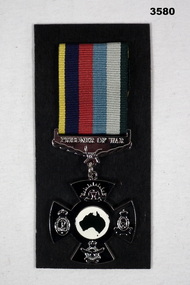 Bendigo Military Museum
Award - MEDAL
... Medal, Australian Prisoner of War, set on a black cardboard backing....Medals military Prisoners of war PRISONER OF WAR Medal, Australian Prisoner of War, set on a black cardboard backing. ...Item with the collection of Cyril John JOHNSON VX 36298 died as a POW of the Japanese. Refer 3144 for his service history.Medal, Australian Prisoner of War, set on a black cardboard backing.PRISONER OF WARmedals, military, prisoners of war -
 Ballarat Heritage Services
Photograph - War memorial, Clare Gervasoni, Ballarat Prisoner of War Memorial, 11/03/2017
... Designed in 2004 by sculptor Peter Lambert the memorial honours more than 35,000 Australians held prisoner of war during the Boer War, both world wars and the Korean War....Prisoner of War Memorial. The memorial includes a 130 metre long wall of highly polished granite engraved with the names of all Australian prisoners of war. ...Designed in 2004 by sculptor Peter Lambert the memorial honours more than 35,000 Australians held prisoner of war during the Boer War, both world wars and the Korean War. ...Designed in 2004 by sculptor Peter Lambert the memorial honours more than 35,000 Australians held prisoner of war during the Boer War, both world wars and the Korean War.Landscape featuring the Ballarat Prisoner of War Memorial. The memorial includes a 130 metre long wall of highly polished granite engraved with the names of all Australian prisoners of war. The paving stones at the centre of the path are cut in the shape of railway sleepers to symbolise the prisoners' journey. prisoner of war, ballarat priosner of war memorial, war memorial -
Federation University Historical Collection
Booklet, Commemoration of the 75th Anniversary of the Fall of Singapore and the service and sacrfice of all Australian Prisioners of War, 2017
... ...Australian Prisoners of War...The Australian Ex-Prisioners of War Memorial is located in Ballarat Fall of Singapore World War Two anniversary 75th anniversary Australian Prisoners of War Program for a service held at The Australian Ex-Prisioners of War Memorial in Ballarat Small boooklet with khaki cover and photographs throughout from the war and the fall of Singapore 1942 Commemoration of the 75th Anniversary of the Fall of Singapore and the service and sacrfice of all Australian Prisioners of War Booklet ...Program for a service held at The Australian Ex-Prisioners of War Memorial in BallaratSmall boooklet with khaki cover and photographs throughout from the war and the fall of Singapore 1942non-fictionProgram for a service held at The Australian Ex-Prisioners of War Memorial in Ballaratfall of singapore, world war two, anniversary, 75th anniversary, australian prisoners of war -
 Ballarat Tramway Museum
Document - Calendar, Bartell Calendars NSW, 2015
... ... Ex Australian Prisoners of War Memorial...Tramways trams Ballarat BTM Botanical Gardens Arch of Victory Ex Australian Prisoners of War Memorial Craig S Hotel Wall Calendar - heavy card covers, 12 gloss art pages inside, titled "Ballarat", calendar for 2016, featuring various Ballarat photographs. ...Wall Calendar - heavy card covers, 12 gloss art pages inside, titled "Ballarat", calendar for 2016, featuring various Ballarat photographs. Includes the Gardens, BTM No. 33, Lydiard St and Sturt St, Arch of Victory, Lake Wendouree, Botanical Gardens, Railway Station, Craigs Hotel, Conservatory and Statuary Pavilion. Photo of No. 33 in Wendouree Parade. Produced by Bartell Calendars.tramways, trams, ballarat, btm, botanical gardens, arch of victory, ex australian prisoners of war memorial, craig s hotel -
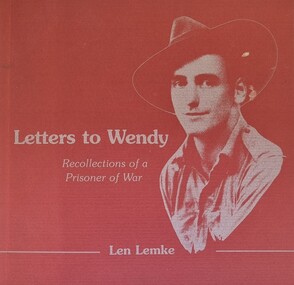 Wodonga & District Historical Society Inc
Book - Letters to Wendy - Recollections of a Prisoner of War, Len Lemke, 2003
... ...Australian Prisoners of War...World War 11 Lemke Family Wodonga Australian Prisoners of War The author was a son of Ernie and Susan Lemke who lived at "Waterford" Wodonga and raised a family of six boys and one daughter. ...The author was a son of Ernie and Susan Lemke who lived at "Waterford" Wodonga and raised a family of six boys and one daughter. Len and one of his brothers were captured and became prisoners of war in Changi. On the 15th February, 1942, fifty thousand allied soldiers became prisoners of war when Singapore fell to the Japanese army. Approximately thirteen thousand of those were Australians. They were told to surrender their weapons and then marched for three days to Changi and then Selerang Barracks in the north-east of the island. Len Lemke, known as "Loo" to his army mates, was one of those soldiers. In these collected letters he tells the story of his experiences at Changi and on the Thai-Burma Railway - the starvation, the hardships, the cruelty, the comradeship. The letters were written to his daughter Wendy and compiled by her into this book. Len Lemke died on 26 March 2009 in Wodonga, Victoria.A publication of 96 pages including illustrations and images.The author was a son of Ernie and Susan Lemke who lived at "Waterford" Wodonga and raised a family of six boys and one daughter. Len and one of his brothers were captured and became prisoners of war in Changi. On the 15th February, 1942, fifty thousand allied soldiers became prisoners of war when Singapore fell to the Japanese army. Approximately thirteen thousand of those were Australians. They were told to surrender their weapons and then marched for three days to Changi and then Selerang Barracks in the north-east of the island. Len Lemke, known as "Loo" to his army mates, was one of those soldiers. In these collected letters he tells the story of his experiences at Changi and on the Thai-Burma Railway - the starvation, the hardships, the cruelty, the comradeship. The letters were written to his daughter Wendy and compiled by her into this book. Len Lemke died on 26 March 2009 in Wodonga, Victoria. world war 11, lemke family wodonga, australian prisoners of war -
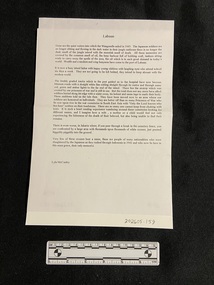 Returned Nurses RSL Sub-branch
Document - Typed account, Lyla McCauley, Labuan, unknown
... ...Australian prisoners of war...Prisoners Of War. The account goes on to compare various other POW cemeteries in South East Asia and Jakarta. War Memorial War cemeteries POWs Australian prisoners of war Labuan Island WWII WW2 World War Two Lyla McCauley Five typed paragraphs in black print on a white, single-sided, piece of A4 paper. ...A brief account written by Lyla McCauley about the island of Labuan (north-west Borneo). It highlights the differences between the island today and the island in 1945, when it became the final resting place of many Prisoners Of War. The account goes on to compare various other POW cemeteries in South East Asia and Jakarta.Five typed paragraphs in black print on a white, single-sided, piece of A4 paper.war memorial, war cemeteries, pows, australian prisoners of war, labuan island, wwii, ww2, world war two, lyla mccauley -
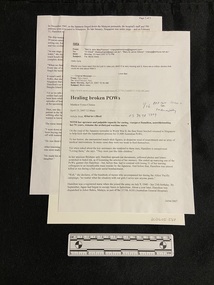 Returned Nurses RSL Sub-branch
Document - Copy of a news article, Courier Mail, Healing broken POWs, 23 April 2007
... ...Australian prisoners of war...An article about the care given to prisoners of war in Singapore and back in Australia by Sister Setchell (nee Hamilton). ...An article about the care given to prisoners of war in Singapore and back in Australia by Sister Setchell (nee Hamilton). ...An article about the care given to prisoners of war in Singapore and back in Australia by Sister Setchell (nee Hamilton). Sister Setchell joined the army in 1940 as a registered nurse, she was part of the evacuation of Singapore onboard the cargo liner, the Empire Star. In 1945 she was reassigned back to Singapore to aid the recovery of POWs. This story tells of the incredible impact she had on many of those soldiers.Two page, single-sided email printout. At the top of the first page 'mary' is printed in bold type and underlined, followed by the email details and a short message. Below that is the article details and then the article typed in full.'1/16 LOXTON STREET / Indooroopilly / 0733787309' [Handwritten in blue ink in the centre right of the first page] 'Attention Mustafa Eyiam / Footscray City College / Kinnear St / Footscray / Victoria 3011' [handwritten in blue ink on e back of the second page] 'Carmel Scarfe!' [Handwritten in black ink on the back of the second page] 'Peter / Sullivan [?] / 043883539[?] / 53758427 / 11/8 / Geelong' [handwritten in black ink on the back of the second page]australian army nurses, wwii, ww2, world war two, sister setchell, margaret hamilton, australian prisoners of war, pows, singapore -
 Returned Nurses RSL Sub-branch
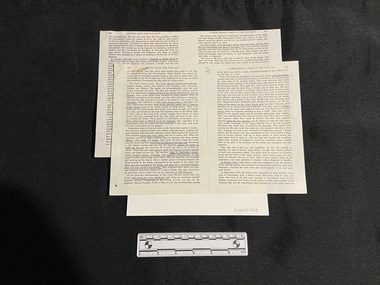
Document - Copy of excerpt from a publication, Allan S. Walker, Other prison camps in the Far East, unknown
... ...Australian prisoners of war...Australia in the War of 1939-1945.' This particular excerpt is under the heading 'Other prison camps in the Far East' and is marked as pages 660 - 663. The excerpt is about the sinking of the Vyner Brooke and what happened to those onboard and others that were taken as prisoners of war in the Second World War....Australian Army Nurses WWII WW2 World War Two Australian prisoners of war POWs Vyner Brooke treatment of Australian Prisoner of War Nurses [multiple words and lines underlined in blue ink throughout the document] '65 / 24 survived / 41' [handwritten in blue ink at the end of the article] Two single-sided A4 papers photocopied from a book in landscape orientation. ...Photocopied section of a book titled 'Clinical Problems of War, volume 1 of Australia in the War of 1939-1945.' This particular excerpt is under the heading 'Other prison camps in the Far East' and is marked as pages 660 - 663. The excerpt is about the sinking of the Vyner Brooke and what happened to those onboard and others that were taken as prisoners of war in the Second World War.Two single-sided A4 papers photocopied from a book in landscape orientation. Each sheet displays two pages from the open book (ie. 4 in total). There is a vertical black line down the centre of the page.[multiple words and lines underlined in blue ink throughout the document] '65 / 24 survived / 41' [handwritten in blue ink at the end of the article]australian army nurses, wwii, ww2, world war two, australian prisoners of war, pows, vyner brooke, treatment of australian prisoner of war nurses -
 Returned Nurses RSL Sub-branch
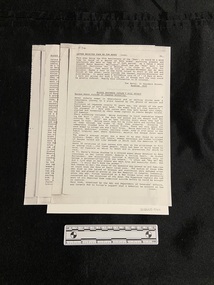
Document - Copy of an article, Lex Arthurson, Bloody bayonets couldn't kill spirit: nurses honor victims of Japanese brutality, 1992
... ...Australian prisoners of war... Army Nurses WWII WW2 World War Two Australian prisoners of war POWs Vyner Brooke Vivian Statham (nee Bullwinkel) Bangka Island memorial memorial ceremonies Ellen Mavis Hannah Ellen Mavis Allgrove Joyce Tweddell Jean Ashton Wilma Elizabeth Forster Oram 'H74' [handwritten in blue ink in the top left corner of first page] Three single-sided sheets of A4 paper with black type on each. ...An article submitted to the Ex Prisoners of War & Relatives Association by Lex Arthurson, to be included in their newsletter. The article is an account of the trek to Bangka Island for the memorial ceremony for those that did not make it home. It was attended by returned nurses and family members of those killed or who died in the camps and the Japanese bombings of ships. The nurses all agreed "we survived because we helped each other and cared for each other".Three single-sided sheets of A4 paper with black type on each. There are margin line marks from where the pages were photocopied from a book.'H74' [handwritten in blue ink in the top left corner of first page]australian army nurses, wwii, ww2, world war two, australian prisoners of war, pows, vyner brooke, vivian statham (nee bullwinkel), bangka island memorial, memorial ceremonies, ellen mavis hannah, ellen mavis allgrove, joyce tweddell, jean ashton, wilma elizabeth forster oram -
 Ballarat Heritage Services
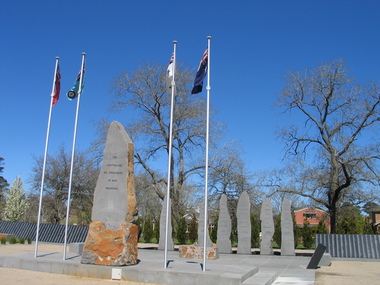
Photograph, L.J. Gervasoni, Australian Ex-Prisoner of War Memorial, Ballarat, 2014, 04/11/2014
... The Trustees of the Australian Ex-Prisoners of War Memorial have defined a Prisoner of War to be a person who was captured by a common enemy and/or interned in a neutral or non-combatant country. ...Colour photograph of a War Memorial designed by Peter Blizzard. The granite wall of the Australian Ex-Prisoners of War Memorial features a listing the names of Australian Prisoners and was opened on the 6th February 2004 by General Peter Cosgrove AM MC to recognise and remember over 36,000 Australians who became Prisoners of War during the Wars of the 20th Century. ...The Trustees of the Australian Ex-Prisoners of War Memorial have defined a Prisoner of War to be a person who was captured by a common enemy and/or interned in a neutral or non-combatant country. ...The Trustees of the Australian Ex-Prisoners of War Memorial have defined a Prisoner of War to be a person who was captured by a common enemy and/or interned in a neutral or non-combatant country. To be defined an Australian Prisoner of War, the person needs to be either an Australian Born person serving in the Uniform of an Australian Service; or in the Uniform of a friendly country, or Born Elsewhere and serving in the Uniform of an Australian Service. A Prisoner is a person who has lost personal privileges, suffers deprivation of liberty or is unable to return home or dies in captivity.Colour photograph of a War Memorial designed by Peter Blizzard. The granite wall of the Australian Ex-Prisoners of War Memorial features a listing the names of Australian Prisoners and was opened on the 6th February 2004 by General Peter Cosgrove AM MC to recognise and remember over 36,000 Australians who became Prisoners of War during the Wars of the 20th Century. In 2008 the Memorial became the First Military Memorial of National Significance outside Canberra. The Memorial which was designed by Peter Blizzard OAM, symbolises that all Australian prisoners embarked on a journey to serve away from their homeland and acknowledges the hardship, deprivation, brutality, starvation and disease endured by Prisoners of War during their capture and the scars that many continued to endure upon their repatriation to Australia. Heritage Victoria describes the memorial in the following way" "A JOURNEY OF HONOUR, REMEMBRANCE AND HEALING - The Australian Ex-Prisoners of War Memorial is a dramatic and highly symbolic tribute to the sacrifice made by more than 35,000 young Australian service men and women in four theatres of war. At the heart of the monument is a stark, 130 metre long, highly polished black granite wall, engraved with the names of all Australian prisoners of war. The names on this 'honour roll' are listed in historical order from the Boer War in 1899, through to the Korean War in 1953. It is a testament to the contribution made by so many. Standing sentinel at the centre of the Memorial are six huge basalt obelisks, etched with the names of all the countries where Australians were held prisoner of war. The obelisks stand in a large reflective pool, set back from the central pathway, symbolising the distance that separated Australia's prisoners of war from their homes and their loved ones. Opposite the pool is a larger obelisk flanked by flagpoles and a ceremonial stone on which to lay wreaths. The central pathway is itself symbolic, with each of the paving stones cut in the shape of a railway sleeper. The pathway defines 'the journey' taken by the prisoners of war and the journey visitors take around the monument. At the end of the granite wall where the pathway ends, visitors face a large stone engraved simply 'Lest We Forget'. Water flows from beneath the stone, along the base of the granite wall and into the reflection pool in which the obelisks stand. This cycle of flowing water, symbolising spirituality, healing, cleansing, birth and rebirth, guides visitors on their journey through the Memorial." ballarat, ballarat botanical gardens, peter blizzard, ballarat north gardens, war memorial, prisoner of war, prisoners of war -
 Bendigo Military Museum
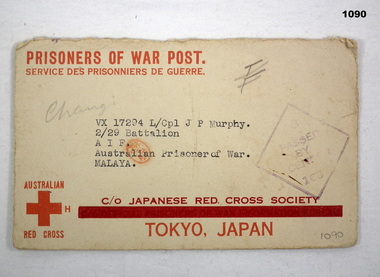
Accessory - ENVELOPE JAPANESE, 1942-45
... Typed “VX17294 L/Cpl J P Murphy 2/29 Battalion AIF Australian Prisoner of War Malaya”. In pencil “Changi”....Envelopes japanese POW Murphy Typed “VX17294 L/Cpl J P Murphy 2/29 Battalion AIF Australian Prisoner of War Malaya”. In pencil “Changi”. ...John Phillip MURPHY No VX17294 enlisted in the 2nd AIF on 15.5.1940 age 30 years 5 months. Posted to the 2/29th Bn 29.11.1940, embarked for Singapore 30.7.1941 disembarking 15.8.1941. Promoted to L/Cpl 2.1.1942, listed as missing 16.2.1942 then POW. A telegram in his records dated 4.8.1945 to his wife Mrs A Murphy of Kirkwood St Eaglehawk states “Alive at Changi Camp”. He disembarked Australia on 8.10.1945 and discharged from the Army on 6.12.1945. Refer also Cat No 1110.Envelope, “Prisoner of War Post” yellowed, red print, stamped “Passed by Censor” re J.P.Murphy.Typed “VX17294 L/Cpl J P Murphy 2/29 Battalion AIF Australian Prisoner of War Malaya”. In pencil “Changi”.envelopes japanese, pow, murphy -
Lakes Entrance Historical Society
Book, Reid, Richard, The Burma-Thailand Railway 1942-1943, 1998
... An account of the Australian Prisoners of War who laboured, starved and died on the Burma-Thailand Railway during 1942-1943 as prisoners of the Japanese, along with Asian civilians who suffered the same fate. ...Military History Memorials An account of the Australian Prisoners of War who laboured, starved and died on the Burma-Thailand Railway during 1942-1943 as prisoners of the Japanese, along with Asian civilians who suffered the same fate. ...An account of the Australian Prisoners of War who laboured, starved and died on the Burma-Thailand Railway during 1942-1943 as prisoners of the Japanese, along with Asian civilians who suffered the same fate. This booklet produced to mark the opening ofmilitary history, memorials -
 Alfred Hospital Nurses League - Nursing History Collection
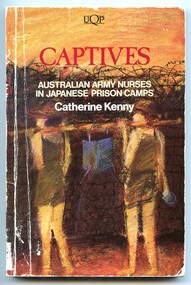
Book - Illustrated Book, Catherine Kenny 1962, Captives: Australian army nurses in Japanese prison camps, 1986
... ...Australian Army Nurses...prisoners of War...Twelve drowned when the ship was sunk off the coast of Sumatra, a further 21 died in the Banka Island massacre, and another eight died in captivity Of significance to AHNL as Alfred graduates were among the captives World War 1939-1945 Australian Army Nurses prisoners of War military nursing nurses Experiences of Australian Army nurses who were prisoners of the Japanese during World War two At the bottom left of the first page is a printed coloured donation sticker: AHNL logo, "This book was donated to AHNL Inc-Nursing Archives by" the Alfred Hospital Library 21/3/18 (handwritten in ink) The previous catalogue number is handwritten in ink at top right of this page. ...Experiences of Australian Army nurses who were prisoners of the Japanese during World War twoIllustrated book. Front cover has a painting by Cynthia Breusch depicting two female figures carrying a container hanging from a pole on their shoulders. Behind them is a barbwire topped fence. The book title is printed over this painting in red and white ink. The author's name is printed in white below the title, and the publisher's mark is printed in black above the title. The Spine is cream in colour, with abbreviated title printed in red, author's surname and publishers mark printed in black. The back cover has a cream background, with quotes from two nurses and a summary of the book overprinted in blacknon-fictionExperiences of Australian Army nurses who were prisoners of the Japanese during World War twoworld war 1939-1945, australian army nurses, prisoners of war, military nursing, nurses -
 Returned Nurses RSL Sub-branch
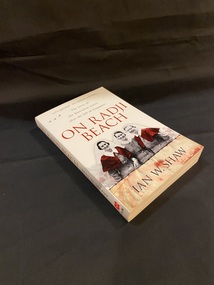
Book - Paperback book, Ian W. Shaw, On Radji Beach: the story of the Australian nurses after the fall of Singapore, 2012
... Australian Nurses...Singapore...Prisoners of war...Australian Nurses Singapore Prisoners of war World war two WWII World War 2 Vivian Bullwinkel When Singapore fell dramatically to the Japanese on 15 February 1942, hundreds of people scrambled to leave. ...When Singapore fell dramatically to the Japanese on 15 February 1942, hundreds of people scrambled to leave. Amongst the evacuees were 65 Australian nurses. They boarded a coastal freighter named the Vyner Brooke, which was sunk by the Japanese. Miraculously, there was one survivor, Vivian Bullwinkel who, in spite of a bullet wound, endured 13 days in the jungle before surrendering to another Japanese patrol. On 12 February 1942, Singapore was just days away from its fall to the Japanese. As the city burned, hundreds of desperate people scrambled to the docks to flee. Amongst them were 65 Australian Army nurses, who boarded a coastal freighter, the Vyner Brooke. But theirs was a doomed voyage. Japanese bombers attacked and sank the vessel off Sumatra. Those who survived drifted for up to three days before making landfall on one of the many beaches on Banka Island. A group of survivors, including 22 nurses, gathered at Radji Beach. They voted to surrender, but the Japanese patrol that found them divided them into three groups and the executions began. In the last group were the Australian nurses, who died in a hail of bullets as they walked, abreast, into the sea. Miraculously, there was one survivor, Vivian Bullwinkel, who in spite of a bullet wound endured 13 days in the jungle before surrendering to another Japanese patrol. She was reunited with the other surviving Vyner Brooke nurses in a makeshift camp on the island. Three-and-a-half years later, only 24 made it home. Meticulously researched from the diaries and papers of some of the nurses who survived, this is a moving account of the fate of every nurse who boarded the Vyner Brooke that day. [From Trove]Paperback book with a white cover and the title printed in red. The cover shows three Australian nurses standing together.non-fictionWhen Singapore fell dramatically to the Japanese on 15 February 1942, hundreds of people scrambled to leave. Amongst the evacuees were 65 Australian nurses. They boarded a coastal freighter named the Vyner Brooke, which was sunk by the Japanese. Miraculously, there was one survivor, Vivian Bullwinkel who, in spite of a bullet wound, endured 13 days in the jungle before surrendering to another Japanese patrol. On 12 February 1942, Singapore was just days away from its fall to the Japanese. As the city burned, hundreds of desperate people scrambled to the docks to flee. Amongst them were 65 Australian Army nurses, who boarded a coastal freighter, the Vyner Brooke. But theirs was a doomed voyage. Japanese bombers attacked and sank the vessel off Sumatra. Those who survived drifted for up to three days before making landfall on one of the many beaches on Banka Island. A group of survivors, including 22 nurses, gathered at Radji Beach. They voted to surrender, but the Japanese patrol that found them divided them into three groups and the executions began. In the last group were the Australian nurses, who died in a hail of bullets as they walked, abreast, into the sea. Miraculously, there was one survivor, Vivian Bullwinkel, who in spite of a bullet wound endured 13 days in the jungle before surrendering to another Japanese patrol. She was reunited with the other surviving Vyner Brooke nurses in a makeshift camp on the island. Three-and-a-half years later, only 24 made it home. Meticulously researched from the diaries and papers of some of the nurses who survived, this is a moving account of the fate of every nurse who boarded the Vyner Brooke that day. [From Trove]australian nurses, singapore, prisoners of war, world war two, wwii, world war 2, vivian bullwinkel -
 Returned Nurses RSL Sub-branch
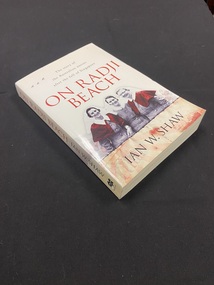
Book - Paperback book, Ian W. Shaw, On Radji Beach: the story of the Australian nurses after the fall of Singapore, 2012
... Australian Nurses...Singapore...Prisoners of war...Australian Nurses Singapore Prisoners of war World war two WWII World War 2 Vivian Bullwinkel When Singapore fell dramatically to the Japanese on 15 February 1942, hundreds of people scrambled to leave. ...When Singapore fell dramatically to the Japanese on 15 February 1942, hundreds of people scrambled to leave. Amongst the evacuees were 65 Australian nurses. They boarded a coastal freighter named the Vyner Brooke, which was sunk by the Japanese. Miraculously, there was one survivor, Vivian Bullwinkel who, in spite of a bullet wound, endured 13 days in the jungle before surrendering to another Japanese patrol. On 12 February 1942, Singapore was just days away from its fall to the Japanese. As the city burned, hundreds of desperate people scrambled to the docks to flee. Amongst them were 65 Australian Army nurses, who boarded a coastal freighter, the Vyner Brooke. But theirs was a doomed voyage. Japanese bombers attacked and sank the vessel off Sumatra. Those who survived drifted for up to three days before making landfall on one of the many beaches on Banka Island. A group of survivors, including 22 nurses, gathered at Radji Beach. They voted to surrender, but the Japanese patrol that found them divided them into three groups and the executions began. In the last group were the Australian nurses, who died in a hail of bullets as they walked, abreast, into the sea. Miraculously, there was one survivor, Vivian Bullwinkel, who in spite of a bullet wound endured 13 days in the jungle before surrendering to another Japanese patrol. She was reunited with the other surviving Vyner Brooke nurses in a makeshift camp on the island. Three-and-a-half years later, only 24 made it home. Meticulously researched from the diaries and papers of some of the nurses who survived, this is a moving account of the fate of every nurse who boarded the Vyner Brooke that day. [From Trove]Paperback book with a white cover and the title printed in red. The cover shows three Australian nurses standing together.non-fictionWhen Singapore fell dramatically to the Japanese on 15 February 1942, hundreds of people scrambled to leave. Amongst the evacuees were 65 Australian nurses. They boarded a coastal freighter named the Vyner Brooke, which was sunk by the Japanese. Miraculously, there was one survivor, Vivian Bullwinkel who, in spite of a bullet wound, endured 13 days in the jungle before surrendering to another Japanese patrol. On 12 February 1942, Singapore was just days away from its fall to the Japanese. As the city burned, hundreds of desperate people scrambled to the docks to flee. Amongst them were 65 Australian Army nurses, who boarded a coastal freighter, the Vyner Brooke. But theirs was a doomed voyage. Japanese bombers attacked and sank the vessel off Sumatra. Those who survived drifted for up to three days before making landfall on one of the many beaches on Banka Island. A group of survivors, including 22 nurses, gathered at Radji Beach. They voted to surrender, but the Japanese patrol that found them divided them into three groups and the executions began. In the last group were the Australian nurses, who died in a hail of bullets as they walked, abreast, into the sea. Miraculously, there was one survivor, Vivian Bullwinkel, who in spite of a bullet wound endured 13 days in the jungle before surrendering to another Japanese patrol. She was reunited with the other surviving Vyner Brooke nurses in a makeshift camp on the island. Three-and-a-half years later, only 24 made it home. Meticulously researched from the diaries and papers of some of the nurses who survived, this is a moving account of the fate of every nurse who boarded the Vyner Brooke that day. [From Trove]australian nurses, singapore, prisoners of war, world war two, wwii, world war 2, vivian bullwinkel -
 Returned Nurses RSL Sub-branch
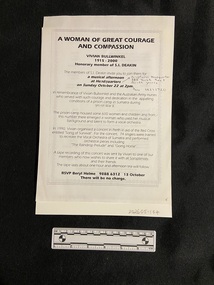
Document - Photocopy of flyer and programme, S I Deakin, A woman of great courage and compassion, 2000
... ...Australian Army Nurses...prisoners of war...The afternoon is in remembrance of Sister Vivian Bullwinkel and the Australian Army Nurses who were prisoners of war in Sumatra during World War II. ...World War Two WW2 WWII Vivian Bullwinkel Australian Army Nurses prisoners of war-Sumatra Vochal Orchestra of Sumatra Song of survival concert 'Soroptomist Headquarter / 383 Toorak Road / South Yarra / Phone 982722720' [Handwritten in black ink, right side of first page] Double-sided photocopy on white A4 paper. ...An invitation from the members of S I Deakin to attend a musical afternoon on Sunday October 22, 2000. The afternoon is in remembrance of Sister Vivian Bullwinkel and the Australian Army Nurses who were prisoners of war in Sumatra during World War II. In the prison camp in Sumatra a vocal orchestra was formed. In 1990 Vivian Bullwinkel organised a concert to aid the Red Cross, entitled 'Song of survival', where 74 singers were trained to recreate the Vocal Orchestra of Sumatra. The musical afternoon includes a viewing of the taped recording of that concert with afternoon tea to follow. The second page of the document is a programme of the order of songs and music from the Song of Survival concert.Double-sided photocopy on white A4 paper. The first side contains an invitation in black type with bold headings surrounded by a double-lined border. The second side is a typed programme list, headings in bold type, surrounded by a border made up of a continuous line of musical notes in bold black print.'Soroptomist Headquarter / 383 Toorak Road / South Yarra / Phone 982722720' [Handwritten in black ink, right side of first page]world war two, ww2, wwii, vivian bullwinkel, australian army nurses, prisoners of war-sumatra, vochal orchestra of sumatra, song of survival concert
