
Showing 16 items matching "australian sport and culture"
-
 Victorian Aboriginal Corporation for Languages
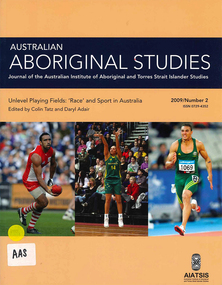
Periodical, Australian Institute of Aboriginal and Torres Strait Islander Studies, Australian Aboriginal studies : journal of the Australian Institute of Aboriginal and Torres Strait Islander Studies, 2009
... In contrast to this celebration of Freeman, the letters to the editor sections of 11 major newspapers became sites for competing claims over what constitutes Australian identity and the place of Aboriginal people in national culture. We analyse this under-explored medium of opinion and discuss how the deep feelings evident in these letters, and the often vitriolic responses to them, illustrate some of the enduring racial tensions in Australian society. ...In contrast to this celebration of Freeman, the letters to the editor sections of 11 major newspapers became sites for competing claims over what constitutes Australian identity and the place of Aboriginal people in national culture. We analyse this under-explored medium of opinion and discuss how the deep feelings evident in these letters, and the often vitriolic responses to them, illustrate some of the enduring racial tensions in Australian society. ...Darkness and a little light: ?Race? and sport in Australia Colin Tatz (AIATSIS & Australian National University) and Daryl Adair (University of Technology Sydney) Despite ?the wonderful and chaotic universe of clashing colors, temperaments and emotions, of brave deeds against odds seemingly insuperable?, sport is mixed with ?mean and shameful acts of pure skullduggery?, villainy, cowardice, depravity, rapaciousness and malice. Thus wrote celebrated American novelist Paul Gallico on the eve of the Second World War (Gallico 1938 [1988]:9-10). An acute enough observation about society in general, his farewell to sports writing also captures the ?clashing colors? in Australian sport. In this ?land of the fair go?, we look at the malice of racism in the arenas where, as custom might have it, one would least want or expect to find it. The history of the connection between sport, race and society - the long past, the recent past and the social present - is commonly dark and ugly but some light and decency are just becoming visible. Coming to terms: ?Race?, ethnicity, identity and Aboriginality in sport Colin Tatz (AIATSIS & Australian National University) Notions of genetic superiority have led to some of the world?s greatest human calamities. Just as social scientists thought that racial anthropology and biology had ended with the cataclysm of the Second World War, so some influential researchers and sports commentators have rekindled the pre-war debate about the muscular merits of ?races? in a new discipline that Nyborg (1994) calls the ?science of physicology?. The more recent realm of racial ?athletic genes?, especially within socially constructed black athletic communities, may intend no malice but this search for the keys to their success may well revive the old, discredited discourses. This critical commentary shows what can happen when some population geneticists and sports writers ignore history and when medical, biological and sporting doctrines deriving from ?race? are dislocated from any historical, geographic, cultural and social contexts. Understanding discourses about race, racism, ethnicity, otherness, identity and Aboriginality are essential if sense, or nonsense, is to be made of genetic/racial ?explanations? of sporting excellence. Between the two major wars boxing was, disproportionately, a Jewish sport; Kenyans and Ethiopians now ?own? middle- and long-distance running and Jamaicans the shorter events; South Koreans dominate women?s professional golf. This essay explores the various explanations put forward for such ?statistical domination?: genes, biochemistry, biomechanics, history, culture, social dynamics, the search for identity, alienation, need, chance, circumstances, and personal bent or aptitude. Traditional games of a timeless land: Play cultures in Aboriginal and Torres Strait Islander communities Ken Edwards (University of Southern Queensland) Sports history in Australia has focused almost entirely on modern, Eurocentric sports and has therefore largely ignored the multitude of unique pre- European games that are, or once were, played. The area of traditional games, especially those of Aboriginal and Torres Strait Islander peoples, is an important aspect of the cultural, social and historical experiences of Indigenous communities. These activities include customs of play that are normally not associated with European notions of competitive sport. Overall, this paper surveys research undertaken into traditional games among Indigenous Australians, as well as proposals for much needed further study in this area. Culture, ?race? and discrimination in the 1868 Aboriginal cricket tour of England David Sampson As a consequence of John Mulvaney?s important historical research, the Aboriginal cricket and performance tour of Britain in 1868 has in recent decades become established as perhaps the most famous of all public events in contact history involving Aborigines, white settlers and the British metropolis. Although recognition of its importance is welcome and significant, public commemorations of the tour have enveloped the tour in mythologies of cricket and nation. Such mythologies have obscured fundamental aspects of the tour that were inescapable racial and colonial realities of the Victorian era. This reappraisal of the tour explores the centrality of racial ideology, racial science and racial power imbalances that enabled, created and shaped the tour. By exploring beyond cricketing mythology, it restores the central importance of the spectacular performances of Aboriginal skills without which the tour would have been impossible. Such a reappraisal seeks to fully recognise the often trivialised non-cricketing expertise of all of the Aboriginal performers in 1868 for their achievement of pioneering their unique culture, skills and technologies to a mass international audience. Football, ?race? and resistance: The Darwin Football League, 1926?29 Matthew Stephen (Northern Territory Archive Service) Darwin was a diverse but deeply divided society in the early twentieth century. The Commonwealth Government introduced the Aboriginals Ordinance 1911 in the Northern Territory, instituting state surveillance, control and a racially segregated hierarchy of whites foremost, then Asians, ?Coloureds? (Aborigines and others of mixed descent) and, lastly, the so-called ?full-blood? Aborigines. Sport was important in scaffolding this stratification. Whites believed that sport was their private domain and strictly controlled non-white participation. Australian Rules football, established in Darwin from 1916, was the first sport in which ?Coloured? sportsmen challenged this domination. Football became a battleground for recognition, rights and identity for all groups. The ?Coloured? community embraced its team, Vesteys, which dominated the Northern Territory Football League (NTFL) in the 1920s. In 1926, amidst growing racial tension, the white-administered NTFL changed its constitution to exclude non-white players. In reaction, ?Coloured? and Chinese footballers formed their own competition - the Darwin Football League (DFL). The saga of that colour bar is an important chapter in Australia?s football history, yet it has faded from Darwin?s social memory and is almost unknown among historians. That picture - Nicky Winmar and the history of an image Matthew Klugman (Victoria University) and Gary Osmond (The University of Queensland) In April 1993 Australian Rules footballer Nicky Winmar responded to on-field racist abuse by lifting his jersey and pointing to his chest. The photographic image of that event is now famous as a response to racial abuse and has come to be seen as starting a movement against racism in football. The racial connotations in the image might seem a foregone conclusion: the power, appeal and dominant meaning of the photograph might appear to be self-evident. But neither the fame of the image nor its racial connotation was automatic. Through interviews with the photographers and analysis of the use of the image in the media, we explore how that picture came to be of such symbolic importance, and how it has remained something to be re-shown and emulated. Rather than analyse the image as a photograph or work of art, we uncover some of its early history and explore the debates that continue to swirl around its purpose and meaning. We also draw attention to the way the careful study of photographs might enhance the study of sport, race and racism. ?She?s not one of us?: Cathy Freeman and the place of Aboriginal people in Australian national culture Toni Bruce (University of Waikato) and Emma Wensing (Independent scholar) The Sydney 2000 Olympic Games generated a national media celebration of Aboriginal 400 metre runner Cathy Freeman. The construction of Freeman as the symbol of national reconciliation was evident in print and on television, the Internet and radio. In contrast to this celebration of Freeman, the letters to the editor sections of 11 major newspapers became sites for competing claims over what constitutes Australian identity and the place of Aboriginal people in national culture. We analyse this under-explored medium of opinion and discuss how the deep feelings evident in these letters, and the often vitriolic responses to them, illustrate some of the enduring racial tensions in Australian society. Sport, physical activity and urban Indigenous young people Alison Nelson (The University of Queensland) This paper challenges some of the commonly held assumptions and ?knowledges? about Indigenous young people and their engagement in physical activity. These include their ?natural? ability, and the use of sport as a panacea for health, education and behavioural issues. Data is presented from qualitative research undertaken with a group of 14 urban Indigenous young people with a view to ?speaking back? to these commentaries. This research draws on Critical Race Theory in order to make visible the taken-for-granted assumptions about Indigenous Australians made by the dominant white, Western culture. Multiple, shifting and complex identities were expressed in the young people?s articulation of the place and meaning of sport and physical activity in their lives. They both engaged in, and resisted, dominant Western discourses regarding representations of Indigenous people in sport. The paper gives voice to these young people in an attempt to disrupt and subvert hegemonic discourses. An unwanted corroboree: The politics of the New South Wales Aboriginal Rugby League Knockout Heidi Norman (University of Technology Sydney) The annual New South Wales Aboriginal Rugby League Knockout is so much more than a sporting event. Involving a high level of organisation, it is both a social and cultural coming together of diverse communities for a social and cultural experience considered ?bigger than Christmas?. As if the planning and logistics were not difficult enough, the rotating-venue Knockout has been beset, especially since the late 1980s and 1990s, by layers of opposition and open hostility based on ?race?: from country town newspapers, local town and shire councils, local business houses and, inevitably, the local police. A few towns have welcomed the event, seeing economic advantage and community good will for all. Commonly, the Aboriginal ?influx? of visitors and players - people perceived as ?strangers?, ?outsiders?, ?non-taxpayers? - provoked public fear about crime waves, violence and physical safety, requiring heavy policing. Without exception, these racist expectations were shown to be totally unfounded. Research report: Recent advances in digital audio recorder technology provide considerable advantages in terms of cost and portability for language workers.b&w photographs, colour photographs, tablessport and race, racism, cathy freeman, nicky winmar, rugby league, afl, athletics, cricket, digital audio recorders -
 Federation University Historical Collection
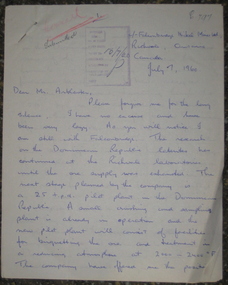
Correspondence, John Clelland to Harry Arblaster (Principal Ballarat School of Mines), 07/07/1960
... While President he established a foundation to aid in the culture, education and living standards for the Dominican People. ...While President he established a foundation to aid in the culture, education and living standards for the Dominican People. ...John Thomas Huyton Clelland was born in Glasgow, Scotland on 11 June 1936. He arrived in Australia with his family as a 10 year old. He maticulated from Ballarat College in 1953, enrolling at the Ballarat School of Mines in 1954. At the Ballarat School of Mines Clelland excelled in his studies, obtaining over 75% credit passes. Clelland was also a great extra-curricular contributer at the Ballarat School of Mines. He was President of the Students' representative Council, Captain of the Football Team and a member of the cricket team. In 1956 Clelland was awarded the Honour Blazer for sport and general qualities in leadership. In 1957 he won the Ballarat School of Mines Mica Smith Traveling Scholarship. Clelland worked for 6 months in Kalgoorli and 6 months in Mount Isa and Broken Hill. As part of his scholarship he travelled to Canada where he worked with Falconbridge Nickel processing nickel deposits. After 16 months in the Richvale Laboratory (Toronto) he was transferred to a pilot plant in Dominican Republic. The process was patented in the 1970s. He became President and General Manager of Falconbridge Dominicana. While President he established a foundation to aid in the culture, education and living standards for the Dominican People. John Clelland died peacefully at his home on 15 January 2012 at Savannah Georgia, USA . Upon his death John Clelland's wife, Loretta, informed his 'alma mater' that he was 'so proud of the opportunity which was afforded him at the School of Mines in Ballarat.' The University of Ballarat is proud to include John Clelland on our alumni roll.Four pages handwritten in blue ballpoint pen. The writer, John Clelland, was the recipient of the Ballarat School of Mines Mica Smith traveling Scholarship. The letter is addressed to Harry Arblaster, the Principal of the Ballarat School of Mines, and is an overview of Clelland's time in Canada. ballarat school of mines, john clelland, falconbridge nickel, canada, harry arblaster, dominican republic, scholarship, mica smith travelling scholarship, mining alumni -
 The Beechworth Burke Museum
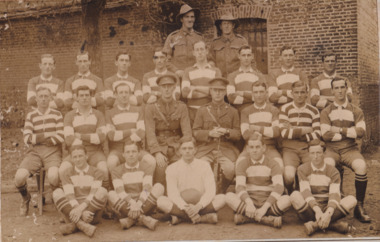
Photograph
... This insignia is almost always identified with the Australian Imperial Force. Sport has always been entwined with war. ...Taken some time between 1914-18, depicted is a large group of unidentified males. Four of them are dressed in Australian military uniforms. The remaining 19 men are dressed in striped uniforms. The male in the centre of the front row is cradling a football, suggesting that the group was part of a football or rugby league team. It is believed that the soldiers in this photograph were part of the Australian Imperial Force. This can be inferred by the chevron rank insignia visible on their uniforms. The placement of this insignia on the sleeve of the right arm suggests that this soldier was either a Warrant Officer or a Non-Commissioned Officer (NCO). Additionally, they are also wearing 'Rising Sun' collar badges on their coats. Australia, unlike most other Commonwealth countries, did not adopt metal regimental badges during the First World War. All units were issued with the Australian Army General Service Badge, better known as the 'Rising Sun’ badge. This insignia is almost always identified with the Australian Imperial Force. Sport has always been entwined with war. Both sport and war demand peak physical fitness, camaraderie, strategy, and allegiance to a team collaboratively working towards a common goal: to win. The connection between sport and war is especially strong in Australia since these two concepts form the basis of our national identity. The Australian War Memorial has a number of World War I recruitment posters linking war and sport in its collection. One of the posters produced in 1915 by the State Parliamentary Recruiting Committee in Victoria attempted to shame young men into enlisting by juxtaposing the image of an Australian soldier standing guard over his deceased mate with a photograph of a Victorian Football League match. Another poster, produced in 1917, features vignettes of different sports including cricket, bowling, boxing, kayaking and golf. Its slogan reads, "Join Together - Train Together - Embark Together - Fight Together: Enlist in the Sportman's 1000".The record is historically significant due to its connection to World War I. This conflict is integral to Australian culture as it was the single greatest loss of life and the greatest repatriation of casualties in the country's history. Australia’s involvement in the First World War began when the Australian government established the Australian Imperial Force (AIF) in August 1914. Immediately, men were recruited to serve the British Empire in the Middle East and on the Western Front. The record has strong research potential. This is due to the ongoing public and scholarly interest in war, history, and especially the ANZAC legend, which is commemorated annually on 25 April, known as ANZAC Day. Additionally, the record presents a unique opportunity to further explore the relationship between the arts, sport and war. This statement of significance has already established that war is integral to Australia's national identity - and sport is of equal importance. Specifically, the record begs to question how the peak physical fitness and camaraderie valued in team sports were creatively translated into military recruitment campaigns during World War I. Evidently, this record and its historic context demonstrates that there is potential here, and if further research is completed on this topic, it may provide insight into Australian military recruitment tactics used in the past and present, and into the future.Sepia rectangular photograph printed on matte photographic paper mounted on card.Reverse: 6529 / hyossest (?) / (?)1/11/1 /military album, army, military, war, wwi, world war i, sport, football, rugby, aif, australian imperial force -
 Eltham District Historical Society Inc
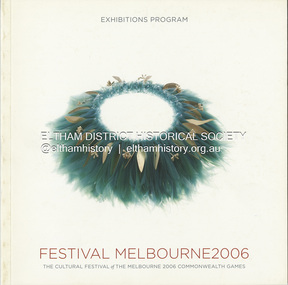
Programme - Book, Global Art Projects, Festival Melbourne2006: the Cultural festival of the Melbourne 2006 Commonwealth Games, Exhibtions Program, 2006
... Contents: Threading the commonwealth: textile tradition, culture, trade and politics, Canopy of the commonwealth: community textile project, Spirit of the games: the opening ceremony revealed, Common goods: cultures meet through craft, New06 and +plus factors: contemporary Australian art Single currency: Australian and New Zealand art Flash: Australian athletes in focus, Game on! ...Content includes text and photos of a totem pole under construction for Festival Melbourne2006, the cultural festival of the Melbourne 2006 Commonwealth Games. CARVE brought together artists from the Commonwealth nations of Canada, New Zealand and Australia, to examine the contemporary practice of traditional indigenous carving from each of these countries. Throughout the period of the Commonwealth Games each artist participated in demonstrations open to the public. Wayne Alfred from Canada, together with his son Marcus participated 18-25 March. The pole was carved alongside other carvers at Melbourne Museum. It was later donated to the Shire of Nillumbik. Contents: Threading the commonwealth: textile tradition, culture, trade and politics, Canopy of the commonwealth: community textile project, Spirit of the games: the opening ceremony revealed, Common goods: cultures meet through craft, New06 and +plus factors: contemporary Australian art Single currency: Australian and New Zealand art Flash: Australian athletes in focus, Game on! Sport and contemporary art, Best of the best: Commonwealth Photographic Awards.46 pagesnon-fictionContent includes text and photos of a totem pole under construction for Festival Melbourne2006, the cultural festival of the Melbourne 2006 Commonwealth Games. CARVE brought together artists from the Commonwealth nations of Canada, New Zealand and Australia, to examine the contemporary practice of traditional indigenous carving from each of these countries. Throughout the period of the Commonwealth Games each artist participated in demonstrations open to the public. Wayne Alfred from Canada, together with his son Marcus participated 18-25 March. The pole was carved alongside other carvers at Melbourne Museum. It was later donated to the Shire of Nillumbik. Contents: Threading the commonwealth: textile tradition, culture, trade and politics, Canopy of the commonwealth: community textile project, Spirit of the games: the opening ceremony revealed, Common goods: cultures meet through craft, New06 and +plus factors: contemporary Australian art Single currency: Australian and New Zealand art Flash: Australian athletes in focus, Game on! Sport and contemporary art, Best of the best: Commonwealth Photographic Awards.commonwealth games, art festivals, totem poles -
 Victorian Aboriginal Corporation for Languages
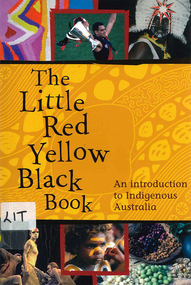
Book, Bruce Pascoe, The little red yellow black book : an introduction to Indigenous Australia, 2008
... Indigenous history culture art sport health education employment reconciliation resistance governance maps, b&w photographs, colour photographs The Little Red Yellow Black Book is an accessible and highly illustrated pocket-sized guide. ...The Little Red Yellow Black Book is an accessible and highly illustrated pocket-sized guide. It's an invaluable introduction to Australia's rich Aboriginal and Torres Strait Islander histories and culture. It takes a non-chronological approach and is written from an Indigenous viewpoint. The themes that emerge are the importance of identity, and adaptation and continuity. If you want to read stories the media don't tell you, mini-essays on famous as well as everyday individuals and organisations will provide insights into a range of Australian Indigenous experiences.maps, b&w photographs, colour photographsindigenous history, culture, art, sport, health, education, employment, reconciliation, resistance, governance -
 Sunshine and District Historical Society Incorporated
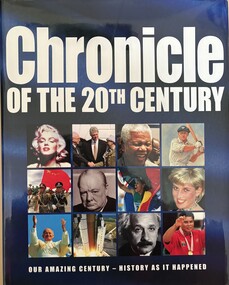
Book - Chronicle of the 20th Century - Our Amazing Century - History as It Happened, Penguin Books Australia, Chronicle of the 20th Century - Our Amazing Century - History as It Happened, 1999
... ...Australian sport and culture...Came from the private collection of John Willaton History Australian Society Australian Politics Australian labour Australian sport and culture it is a massive historical reference book franchise that shows world history in a month-by-month, year-by- year format. ...it is a massive historical reference book franchise that shows world history in a month-by-month, year-by- year format. The book covers major events in history, sport and culture. This is an Australasian edition and references H V McKay 8/04 and 5/26Large blue hard covered book with a blue glossy dust cover.non-fictionit is a massive historical reference book franchise that shows world history in a month-by-month, year-by- year format. The book covers major events in history, sport and culture. This is an Australasian edition and references H V McKay 8/04 and 5/26history, australian society, australian politics, australian labour, australian sport and culture -
 Broadmeadows Historical Society & Museum
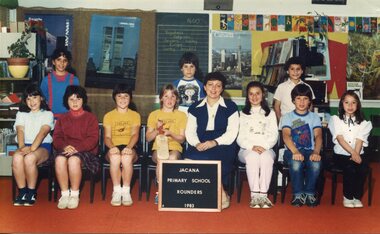
Photograph - Group Photograph, Jacana Primary School; Rounders, 1983, 1983
... Rounders, a popular playground sport at the time, was emblematic of the informal yet meaningful ways children engaged with one another and built community within the school setting. The photograph also offers a visual snapshot of the era, showcasing the fashion, hairstyles, and outdoor culture of Australian primary schools in the 1980s. ...Jacana Primary School, established in 1959 in Melbourne’s northern suburbs, was part of a post-war expansion of public education aimed at supporting families in rapidly growing suburban communities. By 1983, the school had become a well-established institution, known for its inclusive environment and strong community ties. Sport and physical education were central to student life at Jacana Primary, with games like rounders offering opportunities for teamwork, physical development, and social interaction. Rounders, a bat-and-ball game with similarities to baseball, was a popular playground and inter-school sport during the 1980s, especially among primary-aged students. The 1983 Rounders group photograph captures the spirit of school sport during this era—highlighting the importance of participation, camaraderie, and school pride. It also reflects broader trends in 1980s school life, including uniforms, hairstyles, and recreational activities. As Jacana Primary has since closed, this image serves as a valuable record of the school’s vibrant sporting culture and its role in shaping the everyday experiences of students in Melbourne’s north.The 1983 Rounders group photograph from Jacana Primary School is a culturally and historically significant artefact that captures the spirit of student life and sport during a formative period in the school’s history. Taken in the early 1980s, the image reflects the importance of physical education and recreational activities in fostering teamwork, resilience, and social connection among students. Rounders, a popular playground sport at the time, was emblematic of the informal yet meaningful ways children engaged with one another and built community within the school setting. The photograph also offers a visual snapshot of the era, showcasing the fashion, hairstyles, and outdoor culture of Australian primary schools in the 1980s. As Jacana Primary School has since closed, this image serves as a lasting tribute to the everyday experiences that shaped the lives of students and staff. It preserves the memory of a school that played a vital role in the social and educational development of children in Melbourne’s northern suburbs.A colour photograph on satin finish paper(Back blue label): PH-5388, (Back-stamp): Fujicolor /Paperjacana, jacana primary school, group photograph, team photograph, rounders, 1983 -
 Hepburn Shire Council Art and Heritage Collection
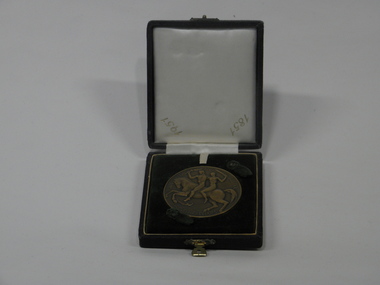
Medal, 1951 Commemorative Plaque, 1951
... Australians to artwork celebrating popular culture and the natural world, these objects illuminate our culture and history. Grounded in a centuries-old European art tradition, the medals create connections across disciplines and link such diverse subjects as scientific advances, religious themes, sport, the performing arts and motherhood. ...Medal commemorating the Centenary of Government of Victoria and the Discovery of Gold, commissioned by the Victorian Government and gifted to the Shire of Glenlyon. Designed by Andor Mészáros and minted by K.G. Luke, Melbourne, 1951. 1951 marked the centenary of Victoria's separation from the colony of New South Wales. As part of the celebrations, the Victorian Government commissioned this medal from Andor Meszaros. Drawing on his classical background, Mészáros developed the imagery for 'Equality and Justice through Freedom'. The man holding the torch represents equality; the blindfolded woman holding a sword is the symbol of justice, and both are mounted on a horse that has broken its shackles. Features on the reverse a design of a banksia and bottlebrush. There was another version of this medal which depicted a pair of gold prospectors on the reverse.This medal was presented to the Shire of Glenlyon in 1951. For over half a century, sculptors Andor (1900-1973) and Michael (1945- ) Meszaros have created medals that reflect the high points of life in Australia. From major awards and portraits of eminent Australians to artwork celebrating popular culture and the natural world, these objects illuminate our culture and history. Grounded in a centuries-old European art tradition, the medals create connections across disciplines and link such diverse subjects as scientific advances, religious themes, sport, the performing arts and motherhood. Through their public and private commissions and their personal artworks, the Meszaros sculptors have defined the modern Australian medal.Bronze medal with images and text insetObverse Description: Horse bounding left, broken shackles on foreleg, carrying woman holding sword and man holding torch; around, EQUALITY AND JUSTICE THROUGH FREEDOM Artist's name behind horse's tail: A MESZAROS Reverse Description: Stake supporting plant; above, CENTENARY OF GOVERNMENT OF VICTORIA 1851 - 1951; inscribed, Presented to / the Shire of / Glenlyon / 1951 Artist's initials to left of stakeglenlyon, hepburn shire, centenary of government, centenary of gold discovery, history of victoria, victorian governement, meszaros, kg luke, commemorative, commemorative plaque, centenary 1951 -
 Broadmeadows Historical Society & Museum
Photograph - Team Photograph, Jacana Primary School: Cricket 1986
... Cricket, a sport deeply embedded in Australian culture, was a key component of Jacana Primary’s extracurricular offerings. ...Cricket, a sport deeply embedded in Australian culture, was a key component of Jacana Primary’s extracurricular offerings. ...This 1986 colour photograph of Jacana Primary School’s cricket team offers a vivid snapshot of a school that played a foundational role in its local community from its establishment in 1959 until its closure in the early 2000s. The image serves as a valuable archival record, preserving the spirit and identity of the school during a period marked by social and educational transformation in Melbourne’s northern suburbs. Cricket, a sport deeply embedded in Australian culture, was a key component of Jacana Primary’s extracurricular offerings. The photograph reflects the school’s emphasis on fostering teamwork, discipline, and community engagement through sport. It also illustrates the inclusive and energetic environment that characterised student life in the late 1980s, a time when schools increasingly embraced holistic education models that valued physical activity and social development alongside academic achievement. As part of Jacana Primary’s visual archive, this image contributes to a broader understanding of how sporting programs shaped student experiences and reinforced community bonds. It stands as a testament to the school’s enduring legacy and its commitment to nurturing well-rounded individuals through meaningful participation in school life.This vibrant 1986 colour photograph of Jacana Primary School’s cricket team captures the energy and pride of a school that stood as a pillar of its community from its founding in 1959 until its closure in the early 2000s. More than just a snapshot, it preserves treasured memories of student life and highlights the school’s strong sporting culture, where teamwork and camaraderie were nurtured through active participation. The image also offers a glimpse into the social atmosphere of the late 1980s, reflecting the inclusive and spirited environment that defined Jacana Primary. As part of the school’s visual archive, it contributes to a deeper understanding of how extracurricular activities like cricket played a vital role in shaping student experiences and fostering lasting community connections.A colour photograph on Matte photograph paperBack: Top left Corner: PH-2127 (blue label) Manufacturer's Mark: Fujicolor Paperjacana primary school, photograph, school photograph, education, 1986, cricket -
 Federation University Art Collection
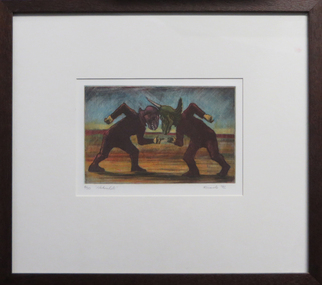
Work on paper - Limited Edition Coloured Print - 4/30, Geoffrey Ricardo, 'Naturalists' by Geoffrey Ricardo, 1992
... Print Award, Mornington Peninsula Arts Centre, Mornington, VIC Academy of Art & Culture, Calcutta, India ‘Synergy’, Touring: Lalit Kala Akademi, New Dehli, India; Jehangir Nicholson Gallery, Bombay, India; Birla, India ‘Contemporary Australian Tapestry’, Frederikshavn Kunstmuseum, Denmark; Australia House, London, UK 1995 ‘Interweave - Tapestry A Collaborative Art’, Heide Museum of Modern Art, Melbourne ‘Contemporary Printmakers’, La Trobe Regional Gallery, Morwell, VIC ‘Contemporary Australian Tapestry’, Australian High Commission, Singapore ‘Circus Capers’, Caulfield Arts Complex, Melbourne 1994 M.P.A.C. ...GEOFFREY RICARDO (1964- ) Born Melbourne, Australia 1984-86 Bachelor of Arts (Fine Art), Printmaking, Chisholm Institute of Technology, Melbourne 1987-89 Printing Assistant at Bill Young Studios, Editioning intaglio prints, King Valley, VIC 1988 Full-time Studio Technician at Printmaking Department, Chisholm Institute of Technology, Melbourne 1989-90 Graduate Diploma (Fine Art), Printmaking, Monash University, Melbourne 1991 Traveled to England, France, Spain and USA (Winsor & Newton International Travelling Bursary, National Students Art Prize) Worked in private studios in Gaucin, Spain and New York, USA 1994-95 Master of Fine Arts, Monash University, Melbourne 1995 Guest Lecturer, Victorian College of the Arts, Melbourne Traveled to Europe and America 1996 Guest Lecturer, Royal Melbourne Institute of Technology, Melbourne 1990-98 Sessional Lecturer, Monash University, Melbourne 1998 Traveled to America and Mexico 2001-05 Sessional Lecturer, The Victorian College of the Arts, Melbourne 2003-10 Printmaking Workshops, Warrnambool TAFE, Warrnambool, VIC 2004 Traveled to Europe, Mexico and Cuba 2005 Lecturer, National Art School (Summer School), Sydney Sessional Lecturer, Monash University, Melbourne Lecturer, Institution of Koorie Education, Deakin University, Geelong, VIC SOLO EXHIBITIONS 2012 ‘Collection of Works’ The Art Vault Mildura ‘Deeper Meanings’, The Incinerator Gallery, Melbourne ‘Three Projects’, Australian Galleries, Glenmore Road, Sydney Melbourne Art Fair Stand F33, Australian Galleries, Melbourne 2009 ‘Anno Domino, Antarctica and The Anatomy Lesson’, Australian Galleries Derby Street, Melbourne The Art Vault, Mildura, VIC 2008 MV Orlova (Quark Expeditions), The Drake Passage, Antarctica 2007 ‘Herd’, BMGArt, Adelaide ‘Herd’, Australian Galleries Painting & Sculpture, Sydney 2006 ‘Herd’, Australian Galleries Painting & Sculpture, Melbourne 2004 ‘Recent work’, BMGArt, Adelaide 2003 ‘The Rapunzel Suite and Other New Works’, Australian Galleries Works on Paper, Sydney ‘Recent Works’, Australian Galleries Painting & Sculpture, Melbourne ‘Recent works’, Cowwarr Art Space, Cowwarr, VIC 2002 ‘The Rapunzel Suite’, Australian Galleries Works on Paper, Melbourne ‘Strange Games’, Australian Galleries Works on Paper, Sydney 1999 ‘A Dark City Narrative’, Australian Galleries Works on Paper, Sydney ‘A Dark City Narrative’, Australian Galleries Works on Paper, Melbourne 1998 Cullity Gallery, School of Architecture and Fine Art, University of Western Australia, Perth 1997 Delaney Gallery, Perth Chapman Gallery, Canberra BMGArt, Adelaide ‘Menagerie’, Australian Galleries, Sydney ‘Menagerie’, Australian Galleries, Melbourne 1995 ‘Paintings, Prints and Sculpture’, Australian Galleries, Sydney ‘Prints, Paintings and Sculpture’, Australian Galleries, Melbourne 1994 Lawrence Wilson Art Gallery, University of Western Australia, Perth Graham Galleries + Editions, Brisbane ‘Wishful Thinking, Prints and Sculptures’, Lawrence Wilson Art Gallery, University of Western Australia, Perth 1992 ‘Prints, Sculptures and Watercolours’, Australian Galleries, Melbourne and Sydney 1990 ‘Watercolours, Prints and Small Bronzes’, Australian Galleries, Sydney ‘Paintings, Prints and Sculptures’, Australian Galleries, Melbourne GROUP EXHIBITIONS 2013 ‘Sculpture by the Sea’ Cottlesloe, Western Australia 2012 ‘Brave New World’, Toyota Community Spirit Gallery, Port Melbourne, VIC ‘Sculpture by the Sea’, Bondi, Sydney 2011 ‘Sculpture by the sea’, Aarhus, Denmark ‘Artwork to Tapestry’, Tarrawarra Museum of Art, Healesville, VIC Burnie Print Prize, Burnie Regional Gallery, Burnie, TAS ‘large exhibition of small works’, Australian Galleries, Roylston Street, Sydney ‘large exhibition of small works’, Australian Galleries, Derby Street, Melbourne ‘Nature of the Mark’, Australian Galleries, Smith Street, Melbourne Rick Amor Print Prize, Montsalvat, Eltham, VIC 2010 ‘Summer show’, Australian Galleries, Glenmore Road, Sydney ‘Summer stock show’, Australian Galleries, Smith Street, Melbourne ‘Sub10’, Substation, Melbourne ‘McClelland Sculpture Survey and Award 2010’, McClelland Gallery + Sculpture Park, Langwarrin, VIC ‘Artists’ Prints made with Integrity I’, Australian Galleries, Smith Street, Melbourne Montalto Sculpture Prize, Montalto Vineyard and Olive Grove, Red Hill South, VIC 2009 ‘Artists’ ink: printmaking from the Warrnambool Art Gallery Collection, 1970-2001’, Ararat Regional Art Gallery, Ararat, VIC ‘Lorne Sculpture’ (Winner), Lorne, VIC 2008 ‘Summer Stock Show’, Australian Galleries Smith Street, Melbourne 2007 ARC Biennial (Art, Design and Craft), Queensland University of Technology Art Museum, Brisbane ‘Prints Tokyo: International Print Exhibition’, Tokyo, Japan Seoul International Print, Photo and Edition Works Art Fair, Seoul, Korea Guanlan International Print Biennial, Guanlan, China ‘Summer Stock Show’, Australian Galleries Works on Paper, Sydney ‘Summer Stock Show’, Australian Galleries Painting & Sculpture, Melbourne ‘Summer Stock Show’, Australian Galleries Works on Paper, Melbourne ‘Antipodean Bestiary’, Project Space / Spare Room, RMIT University, Melbourne Montalto Sculpture Prize, Montalto Vineyard and Olive Grove, Red Hill South, VIC McClelland Sculpture Survey and Award 2007, McClelland Gallery + Sculpture Park, Langwarrin, VIC ‘2007: Works from the studio’, Lancaster Press, Melbourne ‘50 - a print exchange portfolio’, Geelong Art Gallery, Geelong, VIC ‘Small Pleasures’, Australian Galleries Painting & Sculpture, Melbourne ‘Stock Show’, Australian Galleries Painting & Sculpture, Melbourne ‘Artists for Kids Culture’, Brightspace, Melbourne 2006 ‘Partnership or perish’, Academy of the Arts, School of Visual and Performing Arts, University of Tasmania, Hobart Libris Awards, Artspace Mackay, Mackay, QLD ‘Summery’, Australian Galleries Painting & Sculpture, Sydney ‘Summer Stock Show’, Australian Galleries Works on Paper, Melbourne ‘Bookish’, Australian Galleries Works on Paper, Melbourne Melbourne Art Fair, Australian Galleries, Melbourne ‘Artists for Kids Culture’, Brightspace, Melbourne ‘50th Anniversary Exhibition’, Australian Galleries Painting & Sculpture, Melbourne 2005 ‘End of Year Group Exhibition’, Australian Galleries Painting & Sculpture, Sydney ‘Contemporary Works on Paper’, Australian Galleries Works on Paper, Melbourne ‘Expansion’, Lancaster Press, Melbourne ‘The Art of Collaboration’, Singapore Tyler Print Institute, Singapore ‘Double take’, Arts Project Australia, Melbourne ‘Small Treasures - 20 emerging and established artists’, TILT Contemporary Art, Melbourne Jacques Cadry Memorial Art Prize, Fox Studios and State Library of NSW, Sydney ‘Tales of the City’, Australian Galleries Painting & Sculpture, Melbourne ‘A Decade of Collecting 1995-2005’, Cairns Regional Gallery, Cairns, QLD ‘Artists for Kids Culture’, Brightspace, Melbourne ‘Surface Tension: 21 Contemporary Australian Printmakers’, University of Tasmania, Launceston, TAS ‘Neo-millenium’, Toyota Community Spirit Gallery, Melbourne 2004 ‘Artists for Kids Culture’, Brightspace, Melbourne ‘Group Exhibition’, Australian Galleries Painting & Sculpture, Melbourne ‘Species’, Australian Galleries Works on Paper, Melbourne ‘In the presence of creatures great and small’, Australian Galleries Works on Paper, Sydney ‘Tapestries from the Victorian Tapestry Workshop’, Australian Galleries, Melbourne ‘Sculpture’, Australian Galleries Painting & Sculpture, Sydney ‘Contemporary Australian Prints’, National Arts Club, New York, USA ‘Contemporary Australian Prints’, Gallery 101, Melbourne ‘Contemporary Australian Prints from the Collection’, Art Gallery of New South Wales, Sydney ‘Bridge’, Toyota Community Spirit Gallery, Melbourne ‘Vivid’, Fortyfive Downstairs, Melbourne Lake Gallery, Paynesville, VIC 2003 ‘Paper matters’, Lawrence Wilson Art Gallery, University of Western Australia, Perth ‘Artists for Kids Culture’, Brightspace, Melbourne ‘Less is more’, BMGArt, Adelaide ‘The ink’s on me: Bill Young master printmaker’, Wangaratta Exhibitions Gallery, Wangaratta, VIC ‘Fantastic and Visionary Art’, Touring: Global Arts Link, QLD; Ipswich Regional Gallery, QLD ; Orange Regional Gallery, NSW; Manning Regional Gallery, NSW; Parramatta Heritage Centre, Sydney; Ballarat Regional Gallery, VIC 2002 Shell Fremantle Print Award, Fremantle Arts Centre, Fremantle, WA ‘Artists for Kids Culture’, Brightspace, Melbourne 2001 Shell Fremantle Print Award, Fremantle Arts Centre, Fremantle, WA ‘Six Degrees of Collaboration’, RMIT Faculty of Art, Design and Communication Gallery, Melbourne ‘Reciprocal Moves’, Warrnambool Art Gallery, Warrnambool, VIC International Print Triennial, Kanagawa, Japan ‘Fantastic Art’, Orange Regional Gallery, Orange, NSW ‘Dancing Made a Man out of Me’, The Switchback Gallery, Monash University, Gippsland, VIC ‘Artists for Kids Culture’, Brightspace, Melbourne ‘Celebration’, Regional touring exhibition, VIC 2000-01 ‘Workings of the Mind: Melbourne Prints of the 1960s to the 1990s’, Touring: Grafton Regional Gallery, NSW; Toowoomba Regional Art Gallery, QLD; Nolan Gallery, Canberra; Bendigo Art Gallery, VIC; PercTucker Regional Gallery, QLD 2000 Shell Fremantle Print Award, Fremantle Arts Centre, Fremantle, WA The Hutchins Art Prize, Long Gallery, Hobart ‘Artists for Kids Culture’, Brightspace, Melbourne 1999 Shell Fremantle Print Award, Fremantle Arts Space, Fremantle, WA ‘We are Australian’, George Adams Gallery, Victorian Arts Centre, Melbourne Rena Ellen Jones Memorial Print Award, Warrnambool Art Gallery, Warrnambool, VIC ‘National Works on Paper’, Mornington Peninsula Gallery, Mornington, VIC ‘Artists for Kids Culture’, Brightspace, Melbourne ‘Pleasure’, Australian Galleries, Melbourne 1998-99 ‘Australian Prints’, Art Gallery of New South Wales, Sydney 1997 ‘KNOCK, KNOCK’, Australian Galleries, Melbourne ‘Woven Colour, The Art of Tapestry’, Dr Earl Lu Gallery, Singapore 1996 M.P.A.C. Print Award, Mornington Peninsula Arts Centre, Mornington, VIC Academy of Art & Culture, Calcutta, India ‘Synergy’, Touring: Lalit Kala Akademi, New Dehli, India; Jehangir Nicholson Gallery, Bombay, India; Birla, India ‘Contemporary Australian Tapestry’, Frederikshavn Kunstmuseum, Denmark; Australia House, London, UK 1995 ‘Interweave - Tapestry A Collaborative Art’, Heide Museum of Modern Art, Melbourne ‘Contemporary Printmakers’, La Trobe Regional Gallery, Morwell, VIC ‘Contemporary Australian Tapestry’, Australian High Commission, Singapore ‘Circus Capers’, Caulfield Arts Complex, Melbourne 1994 M.P.A.C. Print Award, Mornington Peninsula Arts Centre, Mornington, VIC Fremantle Print Award, Fremantle Arts Centre, Fremantle, WA Australian Universities of Visual Art, Australian High Commission, Singapore ‘Prints, Paintings and Sculpture’, BMGArt, Adelaide Fourth Australian Contemporary Art Fair, Royal Exhibition Building, Melbourne 1993 Fremantle Print Award, Fremantle Arts Centre, Fremantle, WA 1992 Fremantle Print Award, Fremantle Arts Centre, Fremantle, WA ‘Transitional Times’, Print Council of Australia, Melbourne ‘Second Kochi International Triennial Exhibition of Prints’, Japan 1991 Henry Worland Memorial Print Prize, Warrnambool Regional Art Gallery, Warrnambool, VIC Fremantle Print Award, Fremantle Arts Centre, Fremantle, WA ‘Table Top Sculpture’, Australian Galleries, Melbourne ‘Art 91’, London Contemporary Art Fair, London, UK 1990 M.P.A.C. Print Prize, Mornington Peninsula Arts Centre, Mornington, VIC Fremantle Print Prize, Fremantle Arts Centre, Fremantle WA ‘The Christmas Show’, Intaglio Printmaker, London, England ‘Australian Contemporary Art’, AZ Gallery, Tokyo, Japan 1989 National Student Art Prize, Mitchell College, Bathurst, NSW Fremantle Print Award, Fremantle Arts Centre, Fremantle, WA City of Doncaster Acquisitive Print Prize, Manningham Gallery, Melbourne ‘Affiliations’, Monash University Gallery, Melbourne 1988 M.P.A.C. Acquisitive Print Prize, Mornington Peninsula Arts Centre, Mornington, VIC Henry Worland Memorial Print Prize, Warrnambool Regional Art Gallery, Warrnambool, VIC 1987 ‘The Comedy Show’, Print Guild, Melbourne ‘Fluxus Art Flow’, Melbourne 1986 Mornington Peninsula Arts Council Acquisitive Print Prize, Mornington Peninsula, VIC Chisolm Institute of Technology, Graduating Students exhibition, Melbourne AWARDS 2013 King Valley Art Prize (printmaking) 2009 Lorne Sculpture Exhibition (Winner), Lorne, VIC 1989 Windsor and Newton International Travelling Bursary, UK Linbrook International First Prize for Printmaking, Australia COMMISSIONS 2005 Tapestry design for Bairnsdale Hospital (woven by the Victorian Tapestry Workshop, Melbourne), Bairnsdale, VIC 1999 Tapestry design ‘Emblem’ (woven by the Victorian Tapestry Workshop, Melbourne), Australia 1995 ‘A Night of Infectious Laughter’ Poster, St Kilda Festival, Melbourne 1994 Tapestry design ‘Elephant Gingham’ (woven by the Victorian Tapestry Workshop, Melbourne), Australia 1993 Tapestry design for the Festival of Perth Official Poster (woven by the Victorian Tapestry Workshop, Melbourne), Perth RESIDENCIES & PROJECTS 2013 ‘Come In Outside’, Collaboration set design for Pocketfool 2011 Mildura Wentworth Arts Festival Project, Mildura, VIC Residency, The Art Vault , Mildura, VIC 2010 ‘Wish’, Collaboration set design for Pocketfool, Artplay, Melbourne The Art Vault (included continuous public flag making workshops which were flown as part of The Wentworth Mildura Art Festival), Mildura, VIC 2009 The Art Vault (included two public printmaking workshops), Mildura, VIC 2008 Artist in residence, MV Orlova, Quark Expeditions, Antarctica 2003 Residency, Bairnsdale Regional Health Service, Bairnsdale, VIC 1998 Residency, School of Architecture & Fine Art, University of Western Australia, Perth 1997 Residency, La Salle/Fia, College of the Arts, Singapore 1996 Artist in residence, Victorian Tapestry Workshop, Melbourne 1993 Reduction Aquatint Workshop & Residency, Graphic Investigation Department, Canberra School of Art, Canberra NB: all residencies have included workshops involving students, children or the general public COLLECTIONS Artbank, Sydney Art Gallery of New South Wales, Sydney Canson Australia Pty Ltd, Australia City of Box Hill, Melbourne City of Whitehorse, Melbourne Downlands College, Toowoomba, QLD Geelong Grammar School, Geelong, VIC Gold Coast City Art Gallery, Gold Coast, QLD Griffith University, Gold Coast, QLD Helensvale High School, Brisbane Holmes à Court Collection, Perth Latrobe Regional Gallery, Morwell, VIC Monash University, Melbourne Mornington Peninsula Arts Council Collection, Mornington, VIC National Gallery of Australia, Canberra National Gallery of Victoria, Melbourne Parliament House Art Collection, Canberra Print Council of Australia, Melbourne Private collections in Australia, Switzerland, USA, UK, Singapore, Germany, Japan, Malaysia, Holland Queen Victoria Museum & Art Gallery, Launceston, TAS Queensland Art Gallery, Brisbane Queensland University of Technology, Brisbane Shire of Diamond Valley, Diamond Valley, VIC Star of the Sea College, Melbourne The Melbourne Club, Melbourne University of Central Queensland, Brisbane University of Technology, Sydney Wagga Wagga Regional Art Gallery, Wagga Wagga, NSW Warrnambool Regional Art Gallery, Warrnambool, VIC BIBLIOGRAPHY PERIODICALS AQ Journal of Contemporary Analysis, Vol. 70, Issue 4, July-August 1998 AQ Journal of Contemporary Analysis, Vol. 70, Issue 6, November-December 1998 AQ Journal of Contemporary Analysis, Vol.71, Issue 7, April 1999 Backhouse, Megan; “Going out of print and back to basics”, The Age, February 2003 Bellamy, Louise; “Renaissance of Western Art”, The Age (A2 section), 26 November 2005 Clabburn, Anna; “Fables and Foibles”, Art Monthly, September 1994 Dutkiewicz, Adam; “Edge of the sublime”, Advertiser, 1 December 2003, p. 76. Erickson, Dorothy; “The Festival that could have been”, The Bulletin, March 1994 Farmer, Alison; “Ricardo makes poster splash”, Sunday Times - Entertainment Extra, 19 September 1993 “Festival taps weaver’s art”, The West Australian, 11February 1994 Fiasco (web-page), March 2003 Jenkins, John; “A Dark City Narrative”, Imprint, Vol. 34, No. 4, 1999 Grishin, Sasha; “Multiplicity – collecting Australian prints”, Australian Art Review, Issue 13, March-June 2007, pp. 52-55 Grishin, Sasha; “Profiles in Print - Geoffrey Ricardo”, Craft Arts International, Issue 76, 2009, pp.1-4 Lloyd, Tim; “The elephant man”, The Advertiser (Review section), December 2007 Manzana Arné, Josep; “De L’Ex-Libris a L’Ex-Webis: Ex-Libris a Internet”, Ex-Libris, Associació Catalana D’Exlibristes, Barcelona, No. 27, July-December 2002, p.11 McDonald, John; “Dreams of hope and menace” The Sydney Morning Herald, 18 March 1995 McMillan, Peter; “Darkness visible”, The Age, 11September 1999 Nelson, Robert; “Circuses can be curated, but not cured”, The Age, 18 January 1995 Nelson, Robert; “Dream Weavers”, The Age, June 1995 Nelson, Robert; “Paen To Ricardo”, Imprint, Vol. 29, No.1, April, 1994 Nelson, Robert; “Revealed: Mother Nature’s vulgar past”, The Age, September 6, 2000 Nelson, Robert; “Riddled with hidden meaning”, The Age, September 8, 1999 Quadrant, April, 1995 Quadrant, Jan/Feb, 1995 Quadrant, October, 1995 Quadrant, November, 1994 “Ricardo’s surreal works at gallery”, Times-Spectator, 25 July 2003, p.7 Snell, Ted; “Art”, The Australian, 18 February1994 Snell, Ted; “Visual arts at the Festival of Perth”, Art Monthly, April 1994 Sunday Arts, ABC TV, 6 May 2007 Timms, Peter; “Geoff Ricardo: emerging from darkness”, Art Monthly, Issue 140, June 2001 Wallace, Dr Carmel; “Ways of seeing Australia”, Asian Art News, May/June 2004 BOOKS & CATALOGUES A Dark City Narrative, Australian Galleries, Melbourne, 1999 ARC Biennial Exhibition (Exhibition catalogue), Queensland University of Technology Art Museum, 2007, pp. 78-79 Clabburn, Anna; “The Collaborative Spirit”, Australian Tapestries: Victorian Tapestry Workshop, 1995, p. 37 Fantastic Art, Orange Regional Gallery, NSW, 2001 Field, Caroline; Herd, catalogue essay, Australian Galleries, Sydney, 2007 Grishin, Sasha; Australian Identities in Printmaking, Wagga Wagga Regional Art Gallery, 2000 Grishin, Sasha; Australian Printmaking in the 1990’s, Craftsman House, 1997 Havighurst, Sophie (Illustrations by Geoffrey Ricardo); When Lester lost his cool, The University of Melbourne, 2007 Kolenberg, Hendrik & Ryan, Anne; Australian Prints, Art Gallery of New South Wales, 1998 Lawrence, Michel; Framed; photographs of Australian Artists, 1998 Modern Australian Tapestries, Victorian Tapestry Workshop, 2000 The Rapunzel Suite, Australian Galleries, Melbourne, 2002 Wallace, Dr Carmel (Essay); Surface Tension, Twenty One Contemporary Australian Printmakers, Gallery 101, Melbourne, 2004 Workings of the Mind : Melbourne Prints of the 1960s to the 1990s, Queensland University of Technology Art Museum, Brisbane, 2000 TELEVISION Sunday Arts, ABC TV, 6 May 2007 Inside Art TV, Channel 31, July 2012 Framed limited edition coloured print showing two men in dinosaur masks, leaning over and heading butting each other. Edition is limited to 30, print is number four.On the left, between print and matting: 4/30 "Naturalists" On the right, between print and matting: signed Ricardo ' 92 On front upper right hand corner pale dark red stain on glass On back, left hand corner, red ink finger prints near where it appears that the backing board has been torn to remove the previous tape. On back, both vertical sides has a number of dents towards the outside of it near the tape. art, artwork, print, limited edition, geoffrey, ricardo, fantasy, colour, available, sport -
 Whitehorse Historical Society Inc.
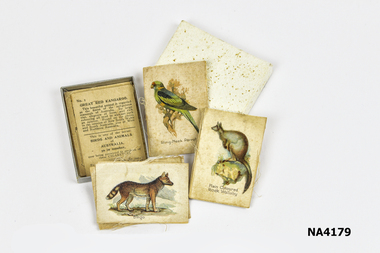
Memorabilia - Box - Cigarette silks, 1911 - 1917
... Military, animals and birds themes were also to the fore, with a touch of culture being provided by 'Shakespeare', 'Dickens', actresses and even classical 'Statuary'. ...These type of cigarette silks were included in WD & HO Wills cigarette packets to induce women in particular to take up smoking.|The Word 'Cartophilic?|It is believed that this unusual word was coined in the 1920s by Col. Bagnall, an Englishman, who was the father of the hobby of cigarette card and trade card collecting. It is thought to be a combination of a Latin word, 'carto' meaning 'card and the Greek word 'philic', meaning 'love'.- lover of cards. The term originally related to the collection of the two types mentioned, however, our Society has included postcards in the range of items collected by our members.|The Cigarette Card|The cigarette card began its evolution in the United States of America, in the early 1880s as a plain piece of cardboard used by tobacconists to protect the cigarettes which were sold in that era, not in packets, but loosely. A purchaser would buy his cigarettes then wrap them in paper around the small piece of cardboard, which acted as a stiffener. In fact, for many decades, cigarette cards were known as 'stiffeners' in the USA.|The card depicting 'The Marquis of Lome' is reputed to be the first known cigarette card issued. This is thought to have been in 1879. It did not take long for an enterprising entrepreneur to recognise the advertising potential of the cigarette card, and, very soon, the cards began displaying popular images, often in sets. This had the effect of youngsters, wishing to complete their sets, harassing their fathers to buy a specific brand of cigarettes. The kids who collected cards in the days when they were being issued in the cigarette packets, would hang around outside the local tobacconist's shop, pestering the men who had just bought a packet of cigarette, with the cry: 'can I have the cig can mister?'|It is a proven fact that, here in Australia during the 1930s, at least one set had one card deliberately withheld and issued very sparingly. This card is No. 86 (Mrs Jack Crawford) in the Carreras 'Turf Personality Series'. Thus, in a set of reasonably easy cards to get, this one card is a constant source of frustration for the collector, and as such, commands a premium when it comes to price. It is not hard to imagine the young collector nagging his to Dad to keep buying 'Turf' cigarettes to enable him to finish the set.|From small beginnings the cigarette card soon gave rise to a booming industry in itself. Artists and writers were|employed to produce the cards, which were miniature works of art and served as little encyclopaedia's for the children of the day. By the 1930s cards were being issued in the countless millions. It has been stated, in one book on the history of cards; that 450 million sets of a series produced and issued by the prolific issuer of cards in the United Kingdom, WD & HO Wills. As each set contained 50 cards you would need a calculator with a very long result window to see the answer to how many cards of that series were in circulation.|Australia's involvement would appear to have its beginnings with the English and American firms who shipped their tobacco products here and the cards of American Tobacco Company (ATC) are found in great numbers in early Australian collections; many featuring Australian subjects, e.g. 'Australian Parliament a 1901 issue. Earlier U.S. sets depicting Australians included Goodwin & Co's, so called. 'Australian Series' with cricketers and Australian Rules footballers who were on the sporting scene during the 1880s. The caption of one of theses cards reads:|'W.Hannysee. Captain Port Melbourne Football Club' which enables us to pinpoint the year of issue to either 1889 or 1890.|On the Australian scene the first local manufacturer who issued cards seems to have been The National Cigarette Company of Australia Proprietary Limited, whose 'Tally Ho' packets contained cards from a series of thirteen featuring the touring 'English Cricket Team 1897-8' Of the few Australian manufacturers who issued cards, only two companies issued more the two sets.|Undoubtedly the cards issued by the Melbourne firm Sniders & Abrahams (later Sniders & Abrahams Pty Ltd) are the 'jewels in the crown' of Australian card issues. They issued some thirty-three series, with numerous sub-series and allied issues such as metal badges, metal football shields, celluloid flags etc., which ensured that the hobbyist had a vast range from which to collect. Sporting themes – football, cricket, horse racing – dominate, indicating the Australians' love of sport and the outdoors was as strong in those earlier times as it is today. Military, animals and birds themes were also to the fore, with a touch of culture being provided by 'Shakespeare', 'Dickens', actresses and even classical 'Statuary'. Humour was not forgotten with 'Cartoons and Caricatures', 'Naval and Cricket (double meaning) Terms' and the 'Jokes' series. Art and history were covered by the artist, S.T. Gill's 'Views of Victoria in 1857' while the stereoscopic 'Views of the World' expanded the collectors' knowledge of the world as a whole.|The Sniders & Abrahams series began in 1904 and by 1919 the company was in decline and was eventually taken over by G.G. Goode & Co. Ltd. This company produced one set only, the highly collectable 'Prominent Cricketer Series' issued in 1924. During the early to mid-1920s, J.J. Schuh Tobacco Pty Ltd issued eight series, again containing the popular subjects of sport and war. At least two provincial tobacconists, Lentens of Bendigo and Baillies of Warrnambool, issued private football series. The last series of cards issued by a truly Australian firm was Dudgeon & Arnell's '1934 Australian Cricket Team'.|The Australian market was not neglected by the English companies with WD & HO Wills, Godfrey Phillips and Ogdens all making their contributions. By far the most active issuer was the long-established company Wills, whose 'Cricketers' of 1901 heralded the flood of Australian series, which continued into the mid-thirties.|The onset of the 1939-45 World War sounded the death knell of the cigarette card and very few post-war issues were made, certainly not here in Australia.|The Trade Card|The Trade Card is a non-tobacco item used by manufacturers to promote and advertise their products, in the same way that cigarette cards were. It is uncertain exactly when they were first produced, but in the USA, non-collectable cards were issued by firms in the early 1800s. These were more akin to a latter day 'business card'. It was not until the 1850s, when coloured and pictorial cards were issued to advertise and promote products that the Trade Card|became a collectable item. Many beautiful lithographic cards were produced in this early era and they are very mu sought after by collectors. By the 1870s the issues of Trade Cards became more prolific and it is from this era that more cards are seen.|Again, it is difficult to pinpoint the exact date of the first Australian Trade Card and it may be that the highly collectable and extremely rare 'American Candy Co's' - 'Pure Caramels' Australian Rules football card, issued i 1891, is the earliest series. This confectionery firm was located in Fitzroy, a Melbourne suburb. To date only two subjects have been seen.|Another early set was 'Flags', issued by F.H.Fauldings & Co. It featured testimonials of seven English cricketers who toured Australia with the 1894/5 Test team. Fauldings was an Adelaide based firm which manufactured medicinal toiletries, soaps and oils, using the distinctly Australian eucalyptus oil. During the 20th century a multitude of Australian businesses issued trade cards, with confectionery manufacturers such as Hoadleys, Allens, Sweetacres and Australian Licorice producing the majority of them. Again sporting themes dominated with the ever popular Aussie Rules football cards being the most numerous. Cricket issues ran a close second.|Apart from sporting cards, almost every subject imaginable was covered by the Trade Card, making it the most diverse and interesting branch of cartophilly. In contrast to the Cigarette Card, which had its demise prior to the Second World War, the Trade Card is still alive and well.|We all are aware of the long running 'Birds of Australasia' series put out by Tuck-fields Tea and 1 doubt if there is a kitchen drawer in Australia that has not got one or two of these informative and attractive cards floating about in it. These cards were first produced in the early 1960s and are still being inserted in that company's packets of tea. Such is also the case with Sanitarium Health Foods, manufacturers of the well known Weetbix, who began issuing cards, with a wide range of subjects, in the early 1940s and continue to do so.|The 1940s and 1950s saw the two breakfast food giants, Kornies and Weeties dominating the card scene. Kornies footballers were in production fora decade from 1948 to 1959. Four years later in 1963, we saw the start of four decades of Scanlens bubble-gum card issues, both football and cricket. In the mid 1990s, with the end of the Scanlens/Stimorol cards, the Trading Card came on the scene. These cards do not fit under the umbrella of the Trade Card, having been produced and marketed purely as a 'collectable' with no connection whatsoever to any product, which of course is necessary for an item to be classified as a Trade Card.|The earliest British postcard was issued in 1870 and was designed to send short messages; the stamp was printed on the card, therefore it did not require an envelope. It was considered by many to be lowering the postal standards because the texts were no longer private. However the cards were a great success as on the first day of issue in 1870, half a million passed through the London postal centre.|The first illustrated postcards are said to be those introduced by a French stationer in 1870. He realized that French troops fighting in the Franco-Prussian War needed to be able to send short messages to their families and designed a 'postcard' to suit the purpose. As many of the soldiers were illiterate they decorated their cards with sketches of their many activities at the front rather than writing; thus creating a picture postcard. Private enterprise soon saw the great financial possibilities of this new easy and attractive way of communication by post; also sending a postcard cost less than postage for letters. It was correctly assumed that postcards were likely to overtake letter writing in many instances.|Between 1875 and 1882 every state in Australia introduced official postcards, N.S.W. first and Tasmania last. Each state produced a simple type of postcard with a pre printed stamp allied to that state. The stamp side stated 'The Address Only To Be Written On This Side'; the reverse side sometimes carried a simple illustration or decoration with space fora short message, each state extolling their own state's virtues. In 1901, with the advent of Federation, the new Government became responsible for all postal services in Australia and produced postcards for sale in every state. With several mail deliveries each day in most towns, postcards were used for many purposes. One 1906 postcard, with an illustration of fruit, was sent from Mrs X in the morning to her greengrocer ordering her fruit and vegetables to be delivered that afternoon. Another lady asks her charlady to 'come this afternoon'.|Australian private enterprise also began selling pictorial postcards, most companies using the very experienced German printing works who were the worlds best in the field of lithography and fine detailed colour-printing. Many of these beautiful German cards still exist today, 100 years later. Australia did have a few fine printers but they were in the minority. Black and white postcards printed in Australia in the early 1900s were often of good quality e.g. postcards printed by 'The Bulletin', illustrating the works of 'The Bulletins' top artists.|Between c1903-09 The Melbourne company Osboldstone and Atkins etc. printed coloured reproductions of 46 J.A. Turner bush/rural life paintings, which were generally of good quality and became hugely popular and still sought after today. Like thousands of homes in Europe, Britain and U.S.A., many Australia homes had albums of cherished postcards, which were given pride of place for visitors to see and enjoy.|Postcard collecting remained popular but was changing with the times. About 1912 the Australian photographer George Rose of Melbourne began to produce topographical B/W real photographic postcards covering most of Australia and other photographers began to do likewise. These cards soon found their way into collections as well.|WWI and the horrors of war suddenly changed the world; postcards were still in great demand but the subject matter was far more serious. Thousands of postcards from the trenches in European war zones arrived in Australia to be included in family albums. Propaganda and recruitment messages were produced to encourage enlistment. Australian postcard producers began to create cards decorated with gum leaves, boomerangs, wattle etc., which were designed for sending to Australian troops serving overseas. Very few 'pretty' cards were available, as access to the Gentian printing works was no longer possible and exporting of postcards from Britain was very limited. By the end of WWI people had other more serious problems to contend with and the avid postcard collecting hobby declined, fold greetings took over and topographical photographic postcards became a small but steady income for the producers and newsagents etc. in every town.|Fortunately many of these old postcards still exist and are avidly collected by a new generation or postcard collectors. The Australian Cartophilic Society Inc. is one of four postcard/cigarette card organizations in Australia. They are, N.S.W. Post Card Collectors Society; Queensland Card Collectors' Society Inc. and West Australian Card Collectors|Society, and across the Tasman there is a New Zealand Postcard Society.|References:|Picture Postcards of the Golden Age A Collector's Guide by Toni & Valmai Holt. Picture Postcards in Australia 1898 - 1920 by David CookBox of Cigarette Silks ( 10 ) depicting animal motifs, which were placed in cigarette packets as an incentive for women in particular to smoke.|WD & HO Wills|Produced 1911 - 1917personal effects, smoking accessories, recreations, collections -
 Federation University Art Collection
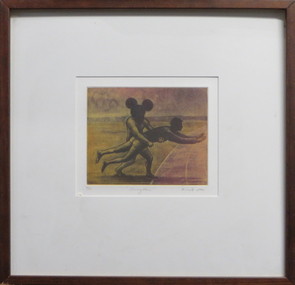
Work on paper - Artwork - Printmaking, Geoffrey Ricardo, 'Dummy Throw' by Geoffrey Ricardo, 2000
... Print Award, Mornington Peninsula Arts Centre, Mornington, VIC Academy of Art & Culture, Calcutta, India ‘Synergy’, Touring: Lalit Kala Akademi, New Dehli, India; Jehangir Nicholson Gallery, Bombay, India; Birla, India ‘Contemporary Australian Tapestry’, Frederikshavn Kunstmuseum, Denmark; Australia House, London, UK 1995 ‘Interweave - Tapestry A Collaborative Art’, Heide Museum of Modern Art, Melbourne ‘Contemporary Printmakers’, La Trobe Regional Gallery, Morwell, VIC ‘Contemporary Australian Tapestry’, Australian High Commission, Singapore ‘Circus Capers’, Caulfield Arts Complex, Melbourne 1994 M.P.A.C. ...GEOFFREY RICARDO (1964- ) Born 1964, Melbourne, Australia 1984-86 Bachelor of Arts (Fine Art), Printmaking, Chisholm Institute of Technology, Melbourne 1987-89 Printing Assistant at Bill Young Studios, Editioning intaglio prints, King Valley, VIC 1988 Full-time Studio Technician at Printmaking Department, Chisholm Institute of Technology, Melbourne 1989-90 Graduate Diploma (Fine Art), Printmaking, Monash University, Melbourne 1991 Traveled to England, France, Spain and USA (Winsor & Newton International Travelling Bursary, National Students Art Prize) Worked in private studios in Gaucin, Spain and New York, USA 1994-95 Master of Fine Arts, Monash University, Melbourne 1995 Guest Lecturer, Victorian College of the Arts, Melbourne Traveled to Europe and America 1996 Guest Lecturer, Royal Melbourne Institute of Technology, Melbourne 1990-98 Sessional Lecturer, Monash University, Melbourne 1998 Traveled to America and Mexico 2001-05 Sessional Lecturer, The Victorian College of the Arts, Melbourne 2003-10 Printmaking Workshops, Warrnambool TAFE, Warrnambool, VIC 2004 Traveled to Europe, Mexico and Cuba 2005 Lecturer, National Art School (Summer School), Sydney Sessional Lecturer, Monash University, Melbourne Lecturer, Institution of Koorie Education, Deakin University, Geelong, VIC SOLO EXHIBITIONS 2012 ‘Collection of Works’ The Art Vault Mildura ‘Deeper Meanings’, The Incinerator Gallery, Melbourne ‘Three Projects’, Australian Galleries, Glenmore Road, Sydney Melbourne Art Fair Stand F33, Australian Galleries, Melbourne 2009 ‘Anno Domino, Antarctica and The Anatomy Lesson’, Australian Galleries Derby Street, Melbourne The Art Vault, Mildura, VIC 2008 MV Orlova (Quark Expeditions), The Drake Passage, Antarctica 2007 ‘Herd’, BMGArt, Adelaide ‘Herd’, Australian Galleries Painting & Sculpture, Sydney 2006 ‘Herd’, Australian Galleries Painting & Sculpture, Melbourne 2004 ‘Recent work’, BMGArt, Adelaide 2003 ‘The Rapunzel Suite and Other New Works’, Australian Galleries Works on Paper, Sydney ‘Recent Works’, Australian Galleries Painting & Sculpture, Melbourne ‘Recent works’, Cowwarr Art Space, Cowwarr, VIC 2002 ‘The Rapunzel Suite’, Australian Galleries Works on Paper, Melbourne ‘Strange Games’, Australian Galleries Works on Paper, Sydney 1999 ‘A Dark City Narrative’, Australian Galleries Works on Paper, Sydney ‘A Dark City Narrative’, Australian Galleries Works on Paper, Melbourne 1998 Cullity Gallery, School of Architecture and Fine Art, University of Western Australia, Perth 1997 Delaney Gallery, Perth Chapman Gallery, Canberra BMGArt, Adelaide ‘Menagerie’, Australian Galleries, Sydney ‘Menagerie’, Australian Galleries, Melbourne 1995 ‘Paintings, Prints and Sculpture’, Australian Galleries, Sydney ‘Prints, Paintings and Sculpture’, Australian Galleries, Melbourne 1994 Lawrence Wilson Art Gallery, University of Western Australia, Perth Graham Galleries + Editions, Brisbane ‘Wishful Thinking, Prints and Sculptures’, Lawrence Wilson Art Gallery, University of Western Australia, Perth 1992 ‘Prints, Sculptures and Watercolours’, Australian Galleries, Melbourne and Sydney 1990 ‘Watercolours, Prints and Small Bronzes’, Australian Galleries, Sydney ‘Paintings, Prints and Sculptures’, Australian Galleries, Melbourne GROUP EXHIBITIONS 2013 ‘Sculpture by the Sea’ Cottlesloe, Western Australia 2012 ‘Brave New World’, Toyota Community Spirit Gallery, Port Melbourne, VIC ‘Sculpture by the Sea’, Bondi, Sydney 2011 ‘Sculpture by the sea’, Aarhus, Denmark ‘Artwork to Tapestry’, Tarrawarra Museum of Art, Healesville, VIC Burnie Print Prize, Burnie Regional Gallery, Burnie, TAS ‘large exhibition of small works’, Australian Galleries, Roylston Street, Sydney ‘large exhibition of small works’, Australian Galleries, Derby Street, Melbourne ‘Nature of the Mark’, Australian Galleries, Smith Street, Melbourne Rick Amor Print Prize, Montsalvat, Eltham, VIC 2010 ‘Summer show’, Australian Galleries, Glenmore Road, Sydney ‘Summer stock show’, Australian Galleries, Smith Street, Melbourne ‘Sub10’, Substation, Melbourne ‘McClelland Sculpture Survey and Award 2010’, McClelland Gallery + Sculpture Park, Langwarrin, VIC ‘Artists’ Prints made with Integrity I’, Australian Galleries, Smith Street, Melbourne Montalto Sculpture Prize, Montalto Vineyard and Olive Grove, Red Hill South, VIC 2009 ‘Artists’ ink: printmaking from the Warrnambool Art Gallery Collection, 1970-2001’, Ararat Regional Art Gallery, Ararat, VIC ‘Lorne Sculpture’ (Winner), Lorne, VIC 2008 ‘Summer Stock Show’, Australian Galleries Smith Street, Melbourne 2007 ARC Biennial (Art, Design and Craft), Queensland University of Technology Art Museum, Brisbane ‘Prints Tokyo: International Print Exhibition’, Tokyo, Japan Seoul International Print, Photo and Edition Works Art Fair, Seoul, Korea Guanlan International Print Biennial, Guanlan, China ‘Summer Stock Show’, Australian Galleries Works on Paper, Sydney ‘Summer Stock Show’, Australian Galleries Painting & Sculpture, Melbourne ‘Summer Stock Show’, Australian Galleries Works on Paper, Melbourne ‘Antipodean Bestiary’, Project Space / Spare Room, RMIT University, Melbourne Montalto Sculpture Prize, Montalto Vineyard and Olive Grove, Red Hill South, VIC McClelland Sculpture Survey and Award 2007, McClelland Gallery + Sculpture Park, Langwarrin, VIC ‘2007: Works from the studio’, Lancaster Press, Melbourne ‘50 - a print exchange portfolio’, Geelong Art Gallery, Geelong, VIC ‘Small Pleasures’, Australian Galleries Painting & Sculpture, Melbourne ‘Stock Show’, Australian Galleries Painting & Sculpture, Melbourne ‘Artists for Kids Culture’, Brightspace, Melbourne 2006 ‘Partnership or perish’, Academy of the Arts, School of Visual and Performing Arts, University of Tasmania, Hobart Libris Awards, Artspace Mackay, Mackay, QLD ‘Summery’, Australian Galleries Painting & Sculpture, Sydney ‘Summer Stock Show’, Australian Galleries Works on Paper, Melbourne ‘Bookish’, Australian Galleries Works on Paper, Melbourne Melbourne Art Fair, Australian Galleries, Melbourne ‘Artists for Kids Culture’, Brightspace, Melbourne ‘50th Anniversary Exhibition’, Australian Galleries Painting & Sculpture, Melbourne 2005 ‘End of Year Group Exhibition’, Australian Galleries Painting & Sculpture, Sydney ‘Contemporary Works on Paper’, Australian Galleries Works on Paper, Melbourne ‘Expansion’, Lancaster Press, Melbourne ‘The Art of Collaboration’, Singapore Tyler Print Institute, Singapore ‘Double take’, Arts Project Australia, Melbourne ‘Small Treasures - 20 emerging and established artists’, TILT Contemporary Art, Melbourne Jacques Cadry Memorial Art Prize, Fox Studios and State Library of NSW, Sydney ‘Tales of the City’, Australian Galleries Painting & Sculpture, Melbourne ‘A Decade of Collecting 1995-2005’, Cairns Regional Gallery, Cairns, QLD ‘Artists for Kids Culture’, Brightspace, Melbourne ‘Surface Tension: 21 Contemporary Australian Printmakers’, University of Tasmania, Launceston, TAS ‘Neo-millenium’, Toyota Community Spirit Gallery, Melbourne 2004 ‘Artists for Kids Culture’, Brightspace, Melbourne ‘Group Exhibition’, Australian Galleries Painting & Sculpture, Melbourne ‘Species’, Australian Galleries Works on Paper, Melbourne ‘In the presence of creatures great and small’, Australian Galleries Works on Paper, Sydney ‘Tapestries from the Victorian Tapestry Workshop’, Australian Galleries, Melbourne ‘Sculpture’, Australian Galleries Painting & Sculpture, Sydney ‘Contemporary Australian Prints’, National Arts Club, New York, USA ‘Contemporary Australian Prints’, Gallery 101, Melbourne ‘Contemporary Australian Prints from the Collection’, Art Gallery of New South Wales, Sydney ‘Bridge’, Toyota Community Spirit Gallery, Melbourne ‘Vivid’, Fortyfive Downstairs, Melbourne Lake Gallery, Paynesville, VIC 2003 ‘Paper matters’, Lawrence Wilson Art Gallery, University of Western Australia, Perth ‘Artists for Kids Culture’, Brightspace, Melbourne ‘Less is more’, BMGArt, Adelaide ‘The ink’s on me: Bill Young master printmaker’, Wangaratta Exhibitions Gallery, Wangaratta, VIC ‘Fantastic and Visionary Art’, Touring: Global Arts Link, QLD; Ipswich Regional Gallery, QLD ; Orange Regional Gallery, NSW; Manning Regional Gallery, NSW; Parramatta Heritage Centre, Sydney; Ballarat Regional Gallery, VIC 2002 Shell Fremantle Print Award, Fremantle Arts Centre, Fremantle, WA ‘Artists for Kids Culture’, Brightspace, Melbourne 2001 Shell Fremantle Print Award, Fremantle Arts Centre, Fremantle, WA ‘Six Degrees of Collaboration’, RMIT Faculty of Art, Design and Communication Gallery, Melbourne ‘Reciprocal Moves’, Warrnambool Art Gallery, Warrnambool, VIC International Print Triennial, Kanagawa, Japan ‘Fantastic Art’, Orange Regional Gallery, Orange, NSW ‘Dancing Made a Man out of Me’, The Switchback Gallery, Monash University, Gippsland, VIC ‘Artists for Kids Culture’, Brightspace, Melbourne ‘Celebration’, Regional touring exhibition, VIC 2000-01 ‘Workings of the Mind: Melbourne Prints of the 1960s to the 1990s’, Touring: Grafton Regional Gallery, NSW; Toowoomba Regional Art Gallery, QLD; Nolan Gallery, Canberra; Bendigo Art Gallery, VIC; PercTucker Regional Gallery, QLD 2000 Shell Fremantle Print Award, Fremantle Arts Centre, Fremantle, WA The Hutchins Art Prize, Long Gallery, Hobart ‘Artists for Kids Culture’, Brightspace, Melbourne 1999 Shell Fremantle Print Award, Fremantle Arts Space, Fremantle, WA ‘We are Australian’, George Adams Gallery, Victorian Arts Centre, Melbourne Rena Ellen Jones Memorial Print Award, Warrnambool Art Gallery, Warrnambool, VIC ‘National Works on Paper’, Mornington Peninsula Gallery, Mornington, VIC ‘Artists for Kids Culture’, Brightspace, Melbourne ‘Pleasure’, Australian Galleries, Melbourne 1998-99 ‘Australian Prints’, Art Gallery of New South Wales, Sydney 1997 ‘KNOCK, KNOCK’, Australian Galleries, Melbourne ‘Woven Colour, The Art of Tapestry’, Dr Earl Lu Gallery, Singapore 1996 M.P.A.C. Print Award, Mornington Peninsula Arts Centre, Mornington, VIC Academy of Art & Culture, Calcutta, India ‘Synergy’, Touring: Lalit Kala Akademi, New Dehli, India; Jehangir Nicholson Gallery, Bombay, India; Birla, India ‘Contemporary Australian Tapestry’, Frederikshavn Kunstmuseum, Denmark; Australia House, London, UK 1995 ‘Interweave - Tapestry A Collaborative Art’, Heide Museum of Modern Art, Melbourne ‘Contemporary Printmakers’, La Trobe Regional Gallery, Morwell, VIC ‘Contemporary Australian Tapestry’, Australian High Commission, Singapore ‘Circus Capers’, Caulfield Arts Complex, Melbourne 1994 M.P.A.C. Print Award, Mornington Peninsula Arts Centre, Mornington, VIC Fremantle Print Award, Fremantle Arts Centre, Fremantle, WA Australian Universities of Visual Art, Australian High Commission, Singapore ‘Prints, Paintings and Sculpture’, BMGArt, Adelaide Fourth Australian Contemporary Art Fair, Royal Exhibition Building, Melbourne 1993 Fremantle Print Award, Fremantle Arts Centre, Fremantle, WA 1992 Fremantle Print Award, Fremantle Arts Centre, Fremantle, WA ‘Transitional Times’, Print Council of Australia, Melbourne ‘Second Kochi International Triennial Exhibition of Prints’, Japan 1991 Henry Worland Memorial Print Prize, Warrnambool Regional Art Gallery, Warrnambool, VIC Fremantle Print Award, Fremantle Arts Centre, Fremantle, WA ‘Table Top Sculpture’, Australian Galleries, Melbourne ‘Art 91’, London Contemporary Art Fair, London, UK 1990 M.P.A.C. Print Prize, Mornington Peninsula Arts Centre, Mornington, VIC Fremantle Print Prize, Fremantle Arts Centre, Fremantle WA ‘The Christmas Show’, Intaglio Printmaker, London, England ‘Australian Contemporary Art’, AZ Gallery, Tokyo, Japan 1989 National Student Art Prize, Mitchell College, Bathurst, NSW Fremantle Print Award, Fremantle Arts Centre, Fremantle, WA City of Doncaster Acquisitive Print Prize, Manningham Gallery, Melbourne ‘Affiliations’, Monash University Gallery, Melbourne 1988 M.P.A.C. Acquisitive Print Prize, Mornington Peninsula Arts Centre, Mornington, VIC Henry Worland Memorial Print Prize, Warrnambool Regional Art Gallery, Warrnambool, VIC 1987 ‘The Comedy Show’, Print Guild, Melbourne ‘Fluxus Art Flow’, Melbourne 1986 Mornington Peninsula Arts Council Acquisitive Print Prize, Mornington Peninsula, VIC Chisolm Institute of Technology, Graduating Students exhibition, Melbourne AWARDS 2013 King Valley Art Prize (printmaking) 2009 Lorne Sculpture Exhibition (Winner), Lorne, VIC 1989 Windsor and Newton International Travelling Bursary, UK Linbrook International First Prize for Printmaking, Australia COMMISSIONS 2005 Tapestry design for Bairnsdale Hospital (woven by the Victorian Tapestry Workshop, Melbourne), Bairnsdale, VIC 1999 Tapestry design ‘Emblem’ (woven by the Victorian Tapestry Workshop, Melbourne), Australia 1995 ‘A Night of Infectious Laughter’ Poster, St Kilda Festival, Melbourne 1994 Tapestry design ‘Elephant Gingham’ (woven by the Victorian Tapestry Workshop, Melbourne), Australia 1993 Tapestry design for the Festival of Perth Official Poster (woven by the Victorian Tapestry Workshop, Melbourne), Perth RESIDENCIES & PROJECTS 2013 ‘Come In Outside’, Collaboration set design for Pocketfool 2011 Mildura Wentworth Arts Festival Project, Mildura, VIC Residency, The Art Vault , Mildura, VIC 2010 ‘Wish’, Collaboration set design for Pocketfool, Artplay, Melbourne The Art Vault (included continuous public flag making workshops which were flown as part of The Wentworth Mildura Art Festival), Mildura, VIC 2009 The Art Vault (included two public printmaking workshops), Mildura, VIC 2008 Artist in residence, MV Orlova, Quark Expeditions, Antarctica 2003 Residency, Bairnsdale Regional Health Service, Bairnsdale, VIC 1998 Residency, School of Architecture & Fine Art, University of Western Australia, Perth 1997 Residency, La Salle/Fia, College of the Arts, Singapore 1996 Artist in residence, Victorian Tapestry Workshop, Melbourne 1993 Reduction Aquatint Workshop & Residency, Graphic Investigation Department, Canberra School of Art, Canberra NB: all residencies have included workshops involving students, children or the general public COLLECTIONS Artbank, Sydney Art Gallery of New South Wales, Sydney Canson Australia Pty Ltd, Australia City of Box Hill, Melbourne City of Whitehorse, Melbourne Downlands College, Toowoomba, QLD Geelong Grammar School, Geelong, VIC Gold Coast City Art Gallery, Gold Coast, QLD Griffith University, Gold Coast, QLD Helensvale High School, Brisbane Holmes à Court Collection, Perth Latrobe Regional Gallery, Morwell, VIC Monash University, Melbourne Mornington Peninsula Arts Council Collection, Mornington, VIC National Gallery of Australia, Canberra National Gallery of Victoria, Melbourne Parliament House Art Collection, Canberra Print Council of Australia, Melbourne Private collections in Australia, Switzerland, USA, UK, Singapore, Germany, Japan, Malaysia, Holland Queen Victoria Museum & Art Gallery, Launceston, TAS Queensland Art Gallery, Brisbane Queensland University of Technology, Brisbane Shire of Diamond Valley, Diamond Valley, VIC Star of the Sea College, Melbourne The Melbourne Club, Melbourne University of Central Queensland, Brisbane University of Technology, Sydney Wagga Wagga Regional Art Gallery, Wagga Wagga, NSW Warrnambool Regional Art Gallery, Warrnambool, VIC BIBLIOGRAPHY PERIODICALS AQ Journal of Contemporary Analysis, Vol. 70, Issue 4, July-August 1998 AQ Journal of Contemporary Analysis, Vol. 70, Issue 6, November-December 1998 AQ Journal of Contemporary Analysis, Vol.71, Issue 7, April 1999 Backhouse, Megan; “Going out of print and back to basics”, The Age, February 2003 Bellamy, Louise; “Renaissance of Western Art”, The Age (A2 section), 26 November 2005 Clabburn, Anna; “Fables and Foibles”, Art Monthly, September 1994 Dutkiewicz, Adam; “Edge of the sublime”, Advertiser, 1 December 2003, p. 76. Erickson, Dorothy; “The Festival that could have been”, The Bulletin, March 1994 Farmer, Alison; “Ricardo makes poster splash”, Sunday Times - Entertainment Extra, 19 September 1993 “Festival taps weaver’s art”, The West Australian, 11February 1994 Fiasco (web-page), March 2003 Jenkins, John; “A Dark City Narrative”, Imprint, Vol. 34, No. 4, 1999 Grishin, Sasha; “Multiplicity – collecting Australian prints”, Australian Art Review, Issue 13, March-June 2007, pp. 52-55 Grishin, Sasha; “Profiles in Print - Geoffrey Ricardo”, Craft Arts International, Issue 76, 2009, pp.1-4 Lloyd, Tim; “The elephant man”, The Advertiser (Review section), December 2007 Manzana Arné, Josep; “De L’Ex-Libris a L’Ex-Webis: Ex-Libris a Internet”, Ex-Libris, Associació Catalana D’Exlibristes, Barcelona, No. 27, July-December 2002, p.11 McDonald, John; “Dreams of hope and menace” The Sydney Morning Herald, 18 March 1995 McMillan, Peter; “Darkness visible”, The Age, 11September 1999 Nelson, Robert; “Circuses can be curated, but not cured”, The Age, 18 January 1995 Nelson, Robert; “Dream Weavers”, The Age, June 1995 Nelson, Robert; “Paen To Ricardo”, Imprint, Vol. 29, No.1, April, 1994 Nelson, Robert; “Revealed: Mother Nature’s vulgar past”, The Age, September 6, 2000 Nelson, Robert; “Riddled with hidden meaning”, The Age, September 8, 1999 Quadrant, April, 1995 Quadrant, Jan/Feb, 1995 Quadrant, October, 1995 Quadrant, November, 1994 “Ricardo’s surreal works at gallery”, Times-Spectator, 25 July 2003, p.7 Snell, Ted; “Art”, The Australian, 18 February1994 Snell, Ted; “Visual arts at the Festival of Perth”, Art Monthly, April 1994 Sunday Arts, ABC TV, 6 May 2007 Timms, Peter; “Geoff Ricardo: emerging from darkness”, Art Monthly, Issue 140, June 2001 Wallace, Dr Carmel; “Ways of seeing Australia”, Asian Art News, May/June 2004 BOOKS & CATALOGUES A Dark City Narrative, Australian Galleries, Melbourne, 1999 ARC Biennial Exhibition (Exhibition catalogue), Queensland University of Technology Art Museum, 2007, pp. 78-79 Clabburn, Anna; “The Collaborative Spirit”, Australian Tapestries: Victorian Tapestry Workshop, 1995, p. 37 Fantastic Art, Orange Regional Gallery, NSW, 2001 Field, Caroline; Herd, catalogue essay, Australian Galleries, Sydney, 2007 Grishin, Sasha; Australian Identities in Printmaking, Wagga Wagga Regional Art Gallery, 2000 Grishin, Sasha; Australian Printmaking in the 1990’s, Craftsman House, 1997 Havighurst, Sophie (Illustrations by Geoffrey Ricardo); When Lester lost his cool, The University of Melbourne, 2007 Kolenberg, Hendrik & Ryan, Anne; Australian Prints, Art Gallery of New South Wales, 1998 Lawrence, Michel; Framed; photographs of Australian Artists, 1998 Modern Australian Tapestries, Victorian Tapestry Workshop, 2000 The Rapunzel Suite, Australian Galleries, Melbourne, 2002 Wallace, Dr Carmel (Essay); Surface Tension, Twenty One Contemporary Australian Printmakers, Gallery 101, Melbourne, 2004 Workings of the Mind : Melbourne Prints of the 1960s to the 1990s, Queensland University of Technology Art Museum, Brisbane, 2000 TELEVISION Sunday Arts, ABC TV, 6 May 2007 Inside Art TV, Channel 31, July 2012Framed coloured aquatint on paperUnder image in pencil '4/20 "Dummy Throw" Ricardo 2000' geoffrey ricardo, framed print, printmaking, available, available framed, sport -
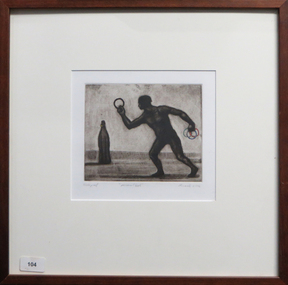 Federation University Art Collection
Work on paper - Artwork - Printmaking, 'Personal Best' by Geoffrey Ricardo, 2000
... Print Award, Mornington Peninsula Arts Centre, Mornington, VIC Academy of Art & Culture, Calcutta, India ‘Synergy’, Touring: Lalit Kala Akademi, New Dehli, India; Jehangir Nicholson Gallery, Bombay, India; Birla, India ‘Contemporary Australian Tapestry’, Frederikshavn Kunstmuseum, Denmark; Australia House, London, UK 1995 ‘Interweave - Tapestry A Collaborative Art’, Heide Museum of Modern Art, Melbourne ‘Contemporary Printmakers’, La Trobe Regional Gallery, Morwell, VIC ‘Contemporary Australian Tapestry’, Australian High Commission, Singapore ‘Circus Capers’, Caulfield Arts Complex, Melbourne 1994 M.P.A.C. ...GEOFFREY RICARDO (1964- ) Born Melbourne, Australia 1984-86 Bachelor of Arts (Fine Art), Printmaking, Chisholm Institute of Technology, Melbourne 1987-89 Printing Assistant at Bill Young Studios, Editioning intaglio prints, King Valley, VIC 1988 Full-time Studio Technician at Printmaking Department, Chisholm Institute of Technology, Melbourne 1989-90 Graduate Diploma (Fine Art), Printmaking, Monash University, Melbourne 1991 Traveled to England, France, Spain and USA (Winsor & Newton International Travelling Bursary, National Students Art Prize) Worked in private studios in Gaucin, Spain and New York, USA 1994-95 Master of Fine Arts, Monash University, Melbourne 1995 Guest Lecturer, Victorian College of the Arts, Melbourne Traveled to Europe and America 1996 Guest Lecturer, Royal Melbourne Institute of Technology, Melbourne 1990-98 Sessional Lecturer, Monash University, Melbourne 1998 Traveled to America and Mexico 2001-05 Sessional Lecturer, The Victorian College of the Arts, Melbourne 2003-10 Printmaking Workshops, Warrnambool TAFE, Warrnambool, VIC 2004 Traveled to Europe, Mexico and Cuba 2005 Lecturer, National Art School (Summer School), Sydney Sessional Lecturer, Monash University, Melbourne Lecturer, Institution of Koorie Education, Deakin University, Geelong, VIC SOLO EXHIBITIONS 2012 ‘Collection of Works’ The Art Vault Mildura ‘Deeper Meanings’, The Incinerator Gallery, Melbourne ‘Three Projects’, Australian Galleries, Glenmore Road, Sydney Melbourne Art Fair Stand F33, Australian Galleries, Melbourne 2009 ‘Anno Domino, Antarctica and The Anatomy Lesson’, Australian Galleries Derby Street, Melbourne The Art Vault, Mildura, VIC 2008 MV Orlova (Quark Expeditions), The Drake Passage, Antarctica 2007 ‘Herd’, BMGArt, Adelaide ‘Herd’, Australian Galleries Painting & Sculpture, Sydney 2006 ‘Herd’, Australian Galleries Painting & Sculpture, Melbourne 2004 ‘Recent work’, BMGArt, Adelaide 2003 ‘The Rapunzel Suite and Other New Works’, Australian Galleries Works on Paper, Sydney ‘Recent Works’, Australian Galleries Painting & Sculpture, Melbourne ‘Recent works’, Cowwarr Art Space, Cowwarr, VIC 2002 ‘The Rapunzel Suite’, Australian Galleries Works on Paper, Melbourne ‘Strange Games’, Australian Galleries Works on Paper, Sydney 1999 ‘A Dark City Narrative’, Australian Galleries Works on Paper, Sydney ‘A Dark City Narrative’, Australian Galleries Works on Paper, Melbourne 1998 Cullity Gallery, School of Architecture and Fine Art, University of Western Australia, Perth 1997 Delaney Gallery, Perth Chapman Gallery, Canberra BMGArt, Adelaide ‘Menagerie’, Australian Galleries, Sydney ‘Menagerie’, Australian Galleries, Melbourne 1995 ‘Paintings, Prints and Sculpture’, Australian Galleries, Sydney ‘Prints, Paintings and Sculpture’, Australian Galleries, Melbourne 1994 Lawrence Wilson Art Gallery, University of Western Australia, Perth Graham Galleries + Editions, Brisbane ‘Wishful Thinking, Prints and Sculptures’, Lawrence Wilson Art Gallery, University of Western Australia, Perth 1992 ‘Prints, Sculptures and Watercolours’, Australian Galleries, Melbourne and Sydney 1990 ‘Watercolours, Prints and Small Bronzes’, Australian Galleries, Sydney ‘Paintings, Prints and Sculptures’, Australian Galleries, Melbourne GROUP EXHIBITIONS 2013 ‘Sculpture by the Sea’ Cottlesloe, Western Australia 2012 ‘Brave New World’, Toyota Community Spirit Gallery, Port Melbourne, VIC ‘Sculpture by the Sea’, Bondi, Sydney 2011 ‘Sculpture by the sea’, Aarhus, Denmark ‘Artwork to Tapestry’, Tarrawarra Museum of Art, Healesville, VIC Burnie Print Prize, Burnie Regional Gallery, Burnie, TAS ‘large exhibition of small works’, Australian Galleries, Roylston Street, Sydney ‘large exhibition of small works’, Australian Galleries, Derby Street, Melbourne ‘Nature of the Mark’, Australian Galleries, Smith Street, Melbourne Rick Amor Print Prize, Montsalvat, Eltham, VIC 2010 ‘Summer show’, Australian Galleries, Glenmore Road, Sydney ‘Summer stock show’, Australian Galleries, Smith Street, Melbourne ‘Sub10’, Substation, Melbourne ‘McClelland Sculpture Survey and Award 2010’, McClelland Gallery + Sculpture Park, Langwarrin, VIC ‘Artists’ Prints made with Integrity I’, Australian Galleries, Smith Street, Melbourne Montalto Sculpture Prize, Montalto Vineyard and Olive Grove, Red Hill South, VIC 2009 ‘Artists’ ink: printmaking from the Warrnambool Art Gallery Collection, 1970-2001’, Ararat Regional Art Gallery, Ararat, VIC ‘Lorne Sculpture’ (Winner), Lorne, VIC 2008 ‘Summer Stock Show’, Australian Galleries Smith Street, Melbourne 2007 ARC Biennial (Art, Design and Craft), Queensland University of Technology Art Museum, Brisbane ‘Prints Tokyo: International Print Exhibition’, Tokyo, Japan Seoul International Print, Photo and Edition Works Art Fair, Seoul, Korea Guanlan International Print Biennial, Guanlan, China ‘Summer Stock Show’, Australian Galleries Works on Paper, Sydney ‘Summer Stock Show’, Australian Galleries Painting & Sculpture, Melbourne ‘Summer Stock Show’, Australian Galleries Works on Paper, Melbourne ‘Antipodean Bestiary’, Project Space / Spare Room, RMIT University, Melbourne Montalto Sculpture Prize, Montalto Vineyard and Olive Grove, Red Hill South, VIC McClelland Sculpture Survey and Award 2007, McClelland Gallery + Sculpture Park, Langwarrin, VIC ‘2007: Works from the studio’, Lancaster Press, Melbourne ‘50 - a print exchange portfolio’, Geelong Art Gallery, Geelong, VIC ‘Small Pleasures’, Australian Galleries Painting & Sculpture, Melbourne ‘Stock Show’, Australian Galleries Painting & Sculpture, Melbourne ‘Artists for Kids Culture’, Brightspace, Melbourne 2006 ‘Partnership or perish’, Academy of the Arts, School of Visual and Performing Arts, University of Tasmania, Hobart Libris Awards, Artspace Mackay, Mackay, QLD ‘Summery’, Australian Galleries Painting & Sculpture, Sydney ‘Summer Stock Show’, Australian Galleries Works on Paper, Melbourne ‘Bookish’, Australian Galleries Works on Paper, Melbourne Melbourne Art Fair, Australian Galleries, Melbourne ‘Artists for Kids Culture’, Brightspace, Melbourne ‘50th Anniversary Exhibition’, Australian Galleries Painting & Sculpture, Melbourne 2005 ‘End of Year Group Exhibition’, Australian Galleries Painting & Sculpture, Sydney ‘Contemporary Works on Paper’, Australian Galleries Works on Paper, Melbourne ‘Expansion’, Lancaster Press, Melbourne ‘The Art of Collaboration’, Singapore Tyler Print Institute, Singapore ‘Double take’, Arts Project Australia, Melbourne ‘Small Treasures - 20 emerging and established artists’, TILT Contemporary Art, Melbourne Jacques Cadry Memorial Art Prize, Fox Studios and State Library of NSW, Sydney ‘Tales of the City’, Australian Galleries Painting & Sculpture, Melbourne ‘A Decade of Collecting 1995-2005’, Cairns Regional Gallery, Cairns, QLD ‘Artists for Kids Culture’, Brightspace, Melbourne ‘Surface Tension: 21 Contemporary Australian Printmakers’, University of Tasmania, Launceston, TAS ‘Neo-millenium’, Toyota Community Spirit Gallery, Melbourne 2004 ‘Artists for Kids Culture’, Brightspace, Melbourne ‘Group Exhibition’, Australian Galleries Painting & Sculpture, Melbourne ‘Species’, Australian Galleries Works on Paper, Melbourne ‘In the presence of creatures great and small’, Australian Galleries Works on Paper, Sydney ‘Tapestries from the Victorian Tapestry Workshop’, Australian Galleries, Melbourne ‘Sculpture’, Australian Galleries Painting & Sculpture, Sydney ‘Contemporary Australian Prints’, National Arts Club, New York, USA ‘Contemporary Australian Prints’, Gallery 101, Melbourne ‘Contemporary Australian Prints from the Collection’, Art Gallery of New South Wales, Sydney ‘Bridge’, Toyota Community Spirit Gallery, Melbourne ‘Vivid’, Fortyfive Downstairs, Melbourne Lake Gallery, Paynesville, VIC 2003 ‘Paper matters’, Lawrence Wilson Art Gallery, University of Western Australia, Perth ‘Artists for Kids Culture’, Brightspace, Melbourne ‘Less is more’, BMGArt, Adelaide ‘The ink’s on me: Bill Young master printmaker’, Wangaratta Exhibitions Gallery, Wangaratta, VIC ‘Fantastic and Visionary Art’, Touring: Global Arts Link, QLD; Ipswich Regional Gallery, QLD ; Orange Regional Gallery, NSW; Manning Regional Gallery, NSW; Parramatta Heritage Centre, Sydney; Ballarat Regional Gallery, VIC 2002 Shell Fremantle Print Award, Fremantle Arts Centre, Fremantle, WA ‘Artists for Kids Culture’, Brightspace, Melbourne 2001 Shell Fremantle Print Award, Fremantle Arts Centre, Fremantle, WA ‘Six Degrees of Collaboration’, RMIT Faculty of Art, Design and Communication Gallery, Melbourne ‘Reciprocal Moves’, Warrnambool Art Gallery, Warrnambool, VIC International Print Triennial, Kanagawa, Japan ‘Fantastic Art’, Orange Regional Gallery, Orange, NSW ‘Dancing Made a Man out of Me’, The Switchback Gallery, Monash University, Gippsland, VIC ‘Artists for Kids Culture’, Brightspace, Melbourne ‘Celebration’, Regional touring exhibition, VIC 2000-01 ‘Workings of the Mind: Melbourne Prints of the 1960s to the 1990s’, Touring: Grafton Regional Gallery, NSW; Toowoomba Regional Art Gallery, QLD; Nolan Gallery, Canberra; Bendigo Art Gallery, VIC; PercTucker Regional Gallery, QLD 2000 Shell Fremantle Print Award, Fremantle Arts Centre, Fremantle, WA The Hutchins Art Prize, Long Gallery, Hobart ‘Artists for Kids Culture’, Brightspace, Melbourne 1999 Shell Fremantle Print Award, Fremantle Arts Space, Fremantle, WA ‘We are Australian’, George Adams Gallery, Victorian Arts Centre, Melbourne Rena Ellen Jones Memorial Print Award, Warrnambool Art Gallery, Warrnambool, VIC ‘National Works on Paper’, Mornington Peninsula Gallery, Mornington, VIC ‘Artists for Kids Culture’, Brightspace, Melbourne ‘Pleasure’, Australian Galleries, Melbourne 1998-99 ‘Australian Prints’, Art Gallery of New South Wales, Sydney 1997 ‘KNOCK, KNOCK’, Australian Galleries, Melbourne ‘Woven Colour, The Art of Tapestry’, Dr Earl Lu Gallery, Singapore 1996 M.P.A.C. Print Award, Mornington Peninsula Arts Centre, Mornington, VIC Academy of Art & Culture, Calcutta, India ‘Synergy’, Touring: Lalit Kala Akademi, New Dehli, India; Jehangir Nicholson Gallery, Bombay, India; Birla, India ‘Contemporary Australian Tapestry’, Frederikshavn Kunstmuseum, Denmark; Australia House, London, UK 1995 ‘Interweave - Tapestry A Collaborative Art’, Heide Museum of Modern Art, Melbourne ‘Contemporary Printmakers’, La Trobe Regional Gallery, Morwell, VIC ‘Contemporary Australian Tapestry’, Australian High Commission, Singapore ‘Circus Capers’, Caulfield Arts Complex, Melbourne 1994 M.P.A.C. Print Award, Mornington Peninsula Arts Centre, Mornington, VIC Fremantle Print Award, Fremantle Arts Centre, Fremantle, WA Australian Universities of Visual Art, Australian High Commission, Singapore ‘Prints, Paintings and Sculpture’, BMGArt, Adelaide Fourth Australian Contemporary Art Fair, Royal Exhibition Building, Melbourne 1993 Fremantle Print Award, Fremantle Arts Centre, Fremantle, WA 1992 Fremantle Print Award, Fremantle Arts Centre, Fremantle, WA ‘Transitional Times’, Print Council of Australia, Melbourne ‘Second Kochi International Triennial Exhibition of Prints’, Japan 1991 Henry Worland Memorial Print Prize, Warrnambool Regional Art Gallery, Warrnambool, VIC Fremantle Print Award, Fremantle Arts Centre, Fremantle, WA ‘Table Top Sculpture’, Australian Galleries, Melbourne ‘Art 91’, London Contemporary Art Fair, London, UK 1990 M.P.A.C. Print Prize, Mornington Peninsula Arts Centre, Mornington, VIC Fremantle Print Prize, Fremantle Arts Centre, Fremantle WA ‘The Christmas Show’, Intaglio Printmaker, London, England ‘Australian Contemporary Art’, AZ Gallery, Tokyo, Japan 1989 National Student Art Prize, Mitchell College, Bathurst, NSW Fremantle Print Award, Fremantle Arts Centre, Fremantle, WA City of Doncaster Acquisitive Print Prize, Manningham Gallery, Melbourne ‘Affiliations’, Monash University Gallery, Melbourne 1988 M.P.A.C. Acquisitive Print Prize, Mornington Peninsula Arts Centre, Mornington, VIC Henry Worland Memorial Print Prize, Warrnambool Regional Art Gallery, Warrnambool, VIC 1987 ‘The Comedy Show’, Print Guild, Melbourne ‘Fluxus Art Flow’, Melbourne 1986 Mornington Peninsula Arts Council Acquisitive Print Prize, Mornington Peninsula, VIC Chisolm Institute of Technology, Graduating Students exhibition, Melbourne AWARDS 2013 King Valley Art Prize (printmaking) 2009 Lorne Sculpture Exhibition (Winner), Lorne, VIC 1989 Windsor and Newton International Travelling Bursary, UK Linbrook International First Prize for Printmaking, Australia COMMISSIONS 2005 Tapestry design for Bairnsdale Hospital (woven by the Victorian Tapestry Workshop, Melbourne), Bairnsdale, VIC 1999 Tapestry design ‘Emblem’ (woven by the Victorian Tapestry Workshop, Melbourne), Australia 1995 ‘A Night of Infectious Laughter’ Poster, St Kilda Festival, Melbourne 1994 Tapestry design ‘Elephant Gingham’ (woven by the Victorian Tapestry Workshop, Melbourne), Australia 1993 Tapestry design for the Festival of Perth Official Poster (woven by the Victorian Tapestry Workshop, Melbourne), Perth RESIDENCIES & PROJECTS 2013 ‘Come In Outside’, Collaboration set design for Pocketfool 2011 Mildura Wentworth Arts Festival Project, Mildura, VIC Residency, The Art Vault , Mildura, VIC 2010 ‘Wish’, Collaboration set design for Pocketfool, Artplay, Melbourne The Art Vault (included continuous public flag making workshops which were flown as part of The Wentworth Mildura Art Festival), Mildura, VIC 2009 The Art Vault (included two public printmaking workshops), Mildura, VIC 2008 Artist in residence, MV Orlova, Quark Expeditions, Antarctica 2003 Residency, Bairnsdale Regional Health Service, Bairnsdale, VIC 1998 Residency, School of Architecture & Fine Art, University of Western Australia, Perth 1997 Residency, La Salle/Fia, College of the Arts, Singapore 1996 Artist in residence, Victorian Tapestry Workshop, Melbourne 1993 Reduction Aquatint Workshop & Residency, Graphic Investigation Department, Canberra School of Art, Canberra NB: all residencies have included workshops involving students, children or the general public COLLECTIONS Artbank, Sydney Art Gallery of New South Wales, Sydney Canson Australia Pty Ltd, Australia City of Box Hill, Melbourne City of Whitehorse, Melbourne Downlands College, Toowoomba, QLD Geelong Grammar School, Geelong, VIC Gold Coast City Art Gallery, Gold Coast, QLD Griffith University, Gold Coast, QLD Helensvale High School, Brisbane Holmes à Court Collection, Perth Latrobe Regional Gallery, Morwell, VIC Monash University, Melbourne Mornington Peninsula Arts Council Collection, Mornington, VIC National Gallery of Australia, Canberra National Gallery of Victoria, Melbourne Parliament House Art Collection, Canberra Print Council of Australia, Melbourne Private collections in Australia, Switzerland, USA, UK, Singapore, Germany, Japan, Malaysia, Holland Queen Victoria Museum & Art Gallery, Launceston, TAS Queensland Art Gallery, Brisbane Queensland University of Technology, Brisbane Shire of Diamond Valley, Diamond Valley, VIC Star of the Sea College, Melbourne The Melbourne Club, Melbourne University of Central Queensland, Brisbane University of Technology, Sydney Wagga Wagga Regional Art Gallery, Wagga Wagga, NSW Warrnambool Regional Art Gallery, Warrnambool, VIC BIBLIOGRAPHY PERIODICALS AQ Journal of Contemporary Analysis, Vol. 70, Issue 4, July-August 1998 AQ Journal of Contemporary Analysis, Vol. 70, Issue 6, November-December 1998 AQ Journal of Contemporary Analysis, Vol.71, Issue 7, April 1999 Backhouse, Megan; “Going out of print and back to basics”, The Age, February 2003 Bellamy, Louise; “Renaissance of Western Art”, The Age (A2 section), 26 November 2005 Clabburn, Anna; “Fables and Foibles”, Art Monthly, September 1994 Dutkiewicz, Adam; “Edge of the sublime”, Advertiser, 1 December 2003, p. 76. Erickson, Dorothy; “The Festival that could have been”, The Bulletin, March 1994 Farmer, Alison; “Ricardo makes poster splash”, Sunday Times - Entertainment Extra, 19 September 1993 “Festival taps weaver’s art”, The West Australian, 11February 1994 Fiasco (web-page), March 2003 Jenkins, John; “A Dark City Narrative”, Imprint, Vol. 34, No. 4, 1999 Grishin, Sasha; “Multiplicity – collecting Australian prints”, Australian Art Review, Issue 13, March-June 2007, pp. 52-55 Grishin, Sasha; “Profiles in Print - Geoffrey Ricardo”, Craft Arts International, Issue 76, 2009, pp.1-4 Lloyd, Tim; “The elephant man”, The Advertiser (Review section), December 2007 Manzana Arné, Josep; “De L’Ex-Libris a L’Ex-Webis: Ex-Libris a Internet”, Ex-Libris, Associació Catalana D’Exlibristes, Barcelona, No. 27, July-December 2002, p.11 McDonald, John; “Dreams of hope and menace” The Sydney Morning Herald, 18 March 1995 McMillan, Peter; “Darkness visible”, The Age, 11September 1999 Nelson, Robert; “Circuses can be curated, but not cured”, The Age, 18 January 1995 Nelson, Robert; “Dream Weavers”, The Age, June 1995 Nelson, Robert; “Paen To Ricardo”, Imprint, Vol. 29, No.1, April, 1994 Nelson, Robert; “Revealed: Mother Nature’s vulgar past”, The Age, September 6, 2000 Nelson, Robert; “Riddled with hidden meaning”, The Age, September 8, 1999 Quadrant, April, 1995 Quadrant, Jan/Feb, 1995 Quadrant, October, 1995 Quadrant, November, 1994 “Ricardo’s surreal works at gallery”, Times-Spectator, 25 July 2003, p.7 Snell, Ted; “Art”, The Australian, 18 February1994 Snell, Ted; “Visual arts at the Festival of Perth”, Art Monthly, April 1994 Sunday Arts, ABC TV, 6 May 2007 Timms, Peter; “Geoff Ricardo: emerging from darkness”, Art Monthly, Issue 140, June 2001 Wallace, Dr Carmel; “Ways of seeing Australia”, Asian Art News, May/June 2004 BOOKS & CATALOGUES A Dark City Narrative, Australian Galleries, Melbourne, 1999 ARC Biennial Exhibition (Exhibition catalogue), Queensland University of Technology Art Museum, 2007, pp. 78-79 Clabburn, Anna; “The Collaborative Spirit”, Australian Tapestries: Victorian Tapestry Workshop, 1995, p. 37 Fantastic Art, Orange Regional Gallery, NSW, 2001 Field, Caroline; Herd, catalogue essay, Australian Galleries, Sydney, 2007 Grishin, Sasha; Australian Identities in Printmaking, Wagga Wagga Regional Art Gallery, 2000 Grishin, Sasha; Australian Printmaking in the 1990’s, Craftsman House, 1997 Havighurst, Sophie (Illustrations by Geoffrey Ricardo); When Lester lost his cool, The University of Melbourne, 2007 Kolenberg, Hendrik & Ryan, Anne; Australian Prints, Art Gallery of New South Wales, 1998 Lawrence, Michel; Framed; photographs of Australian Artists, 1998 Modern Australian Tapestries, Victorian Tapestry Workshop, 2000 The Rapunzel Suite, Australian Galleries, Melbourne, 2002 Wallace, Dr Carmel (Essay); Surface Tension, Twenty One Contemporary Australian Printmakers, Gallery 101, Melbourne, 2004 Workings of the Mind : Melbourne Prints of the 1960s to the 1990s, Queensland University of Technology Art Museum, Brisbane, 2000 TELEVISION Sunday Arts, ABC TV, 6 May 2007 Inside Art TV, Channel 31, July 2012Framed coloured etchingon paper. Donated through the Australian Government's Cultural Gifts Programme by Katherine Littlewood.Under image in pencil ' state proof ', "personal best" Ricardo 2000'. From Strange Games series. geoffrey ricardo, printmaking, framed print, available framed, available, sport -
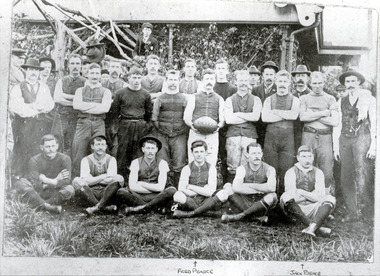 Bacchus Marsh & District Historical Society
Photograph, Bacchus Marsh Football Club 1901
... It is evidence of the growth of importance of sport, in this case Australian Rules football, as a cultural and social activity central to the Australian ethos. ...This is the earliest known photo of an Australian Rules football team in the Bacchus Marsh area. The photo is of 27 men and two boys standing in front of the Evans Pavilion at Maddingley Park Bacchus Marsh. The image shows players, officials and trainers, the players wearing early twentieth century playing guernseys featuring front fastenings. Some are wearing knickerbockers, some long trousers. Trainers have their towels slung over their shoulders. Men in civilian clothes, possibly club officials, are wearing suits and hats. The boys and two of the players are wearing caps, one player wearing a hat. The central figure, possibly the captain, is holding a football which has the initials B M I F C. These initials stand for "Bacchus Marsh Imperial Football Club". At this time, many football clubs used the word "imperial" in their title. This team may possibly have had the nick-name of "Imperials".This item has historic and social significance as the earliest image of one of the early sporting teams of Bacchus Marsh and district. It is evidence of the growth of importance of sport, in this case Australian Rules football, as a cultural and social activity central to the Australian ethos. It is also evidence of the dominance of the masculine ethos in the Australian culture of this time. The image has strong research value for the information it conveys about this particular club and its early participants.Photographic reproduction of earlier photographHand written below photograph "Bacchus Marsh Football Club 1901." The names Fred Pearce and Jack Bence with arrows indicating the players identified.bacchus marsh imperial football club, australian rules football -
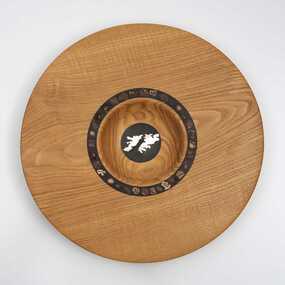 City of Greater Bendigo - Civic Collection
Decorative object - Corporate Gift
... Australia. They were the second Commonwealth Youth Games, which are held every four years. Corporate gift giving plays a large part in local government diplomacy and events such as these which attract delegates from across the world are opportunities to promote and share information about a countries natural resources and arts and culture. Commonwealth Youth Games 2004 City of Greater Bendigo Sport ...The 2004 Commonwealth Youth Games, officially known as the II Commonwealth Youth Games, and commonly known as Bendigo 2004,was an international sporting event that was held from 30 November to 3 December 2004 in Bendigo, Australia. They were the second Commonwealth Youth Games, which are held every four years. Corporate gift giving plays a large part in local government diplomacy and events such as these which attract delegates from across the world are opportunities to promote and share information about a countries natural resources and arts and culture. Round, wooden platter. Circular wood inlays with metal Falklands Island shaped central motif. Natural wood finish. verso; Presented / to the / City of Bendigo / by the / 2004 Falkland Islands / Commonwealth Youth / Games Teamcommonwealth youth games 2004, city of greater bendigo sport, city of greater bendigo corporate gift -
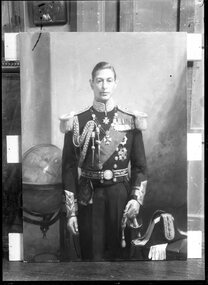 City of Melbourne Libraries
Photograph, Bull, Hugh Jones, 1897-1993, "A Royal Portrait" (Duke of York), 1933
... She took, and expressed, a keen interest in the social and political matters of the day with a special concern for the supremacy of England and Australia in all questions relating to sport, such as cricket, tennis and golf. ...She took, and expressed, a keen interest in the social and political matters of the day with a special concern for the supremacy of England and Australia in all questions relating to sport, such as cricket, tennis and golf. ...Published: The Age, Sat 14 October 1933 Published title: A Royal Portrait Published caption: "Seen at his studio, Alphington, Mr. W. B. Mclnnes's portrait of the Duke of York, which he painted recently on commission from the trustees of the Castlemaine Gallery, at St. John’s Wood, London, impresses as a vital record of one whose natural habitat is a palace, and whose place in life is one of near relationship to the throne of England. The Duke is painted in the uniform of the admiral of the fleet, a highly ornate vesture entailing much elaboration of gold and numerous medals, in dealing with which the artist has not failed to centre his attention on the head, and has succeeded in producing what is undoubtedly a soundly painted portrait and a good likeness. During the five fittings Mr. Mclnnes, apart from the ordinary social amenities, found his Royal sitter little inclined to talk, though he spoke feelingly of his trip to Australia and the pleasure it had given him: but with the Duchess the tendency to be sociable was much more clearly pronounced. She took, and expressed, a keen interest in the social and political matters of the day with a special concern for the supremacy of England and Australia in all questions relating to sport, such as cricket, tennis and golf. She spoke well of her portrait painted by Quinn, and regretted that she would not see the two hung side by side at the Castlemaine Gallery." Description: An unframed painting of a standing, middle-aged man dressed in the uniform of a Royal Navy admiral of the Fleet with medals, sash, ornate belt, cuffs and epaulettes. His left hand rests on the handle of a sword in its scabbard and his bicorn hat and white gloves are on a table beside him. To his right is a globe of the world showing Australia. Research by project volunteer, Fiona Collyer: In 1933, Castlemaine Art Gallery trustees commissioned artist W.B. McInnes (1889-1939) to paint a portrait of Prince Albert, Duke of York as a companion piece to the portrait of his wife, the Duchess of York, that the gallery had commissioned Australian official war artist James Quinn (1869-1951) to paint in 1930. During the First World War, the Duchess’s childhood home, Glamis Castle in Scotland was used as a makeshift military hospital and convalescence home for wounded soldiers. Many servicemen from the Castlemaine area recuperated there and had fond memories of the kindness of the teenage Lady Elizabeth Bowes-Lyon (1900-2002, later Duchess of York) who spent the war years running errands and aiding in the welfare and morale of the patients. In 1927, the Duke and Duchess of York (later King George VI and Queen Elizabeth) came to Australia to formally open the newly built Parliament House in Canberra and to tour the country. While visiting Victoria in April, they embarked on a whistle-stop train journey to Bendigo, stopping at Kyneton for ten minutes and Castlemaine for 15 minutes. At Kyneton, an excited crowd of 10,000 people welcomed the couple with “three cheers and three cheers for Baby Betty” before the Duchess was presented with a bouquet of locally grown roses and the Duke a bound album of photographs of noted beauty spots of the district. Next the Royal Couple stopped at Castlemaine to the cheers of 15,000 people. There the couple were presented with a basket of prime quality Harcourt apples and a pair of cot blankets, manufactured at Castlemaine Woollen Mills, a birthday gift for baby Princess Betty. The Duchess recognised Colonel W.E. James, of the Seventh Battalion, who had convalesced at Glamis Castle in 1917, and they chatted before the train departed, while the Duke shook hands with returned soldiers. Last stop was the town of Bendigo which was colourfully decorated with bunting and flags, arches and flowers. 3000 pigeons were released on their arrival and the liberated birds circled overhead for several minutes as if to welcome the Royal Couple. A crowd of 50,000 cheering people lined the streets in bright sunshine as the couple drove by. From an arch over Hargreaves Street, pretty girls showered the pair with rose petals. The Duke was presented with a gold nugget and an album, handsomely bound in morocco, of a history of the Bendigo mining industry, while the Duchess received a bouquet of prize winning white chrysanthemums. After 75 minutes in Bendigo they journeyed back to Melbourne for a State reception. While the couple were in Melbourne, the Duke often played lawn tennis at the Government House courts with three times Grand Slam champion Norman Brookes, who declared that while he considered the Duke a second class player whose serve lacked sting, he had a fine backhand and with time and practice he could become a first class player. The federal Parliament had previously been situated in Melbourne, but Canberra was chosen as the location for Australia’s capital as a compromise between fierce rival states, Victoria and NSW. It is written in the Constitution that the federal capital would be in “the State of NSW... distant not less than one hundred miles from Sydney.” The word Canberra is thought to derive from the local Ngunnawal word “Kanbarra” meaning “meeting place”. The Provisional Parliament House was a large, white, three storey building facetiously dubbed “The Wedding Cake”, plonked down in a bare, former sheep paddock. It was decorated for the event with Union Jacks and Australian red ensign flags. On 9 May, the day of the opening, the expectant crowd assembled in front of the building. Only two of the spectators were Aboriginal. One was Jimmy Clements (1847-1927, aka Nangar or Yangar, but popularly known as “King Billy”), accompanied by his three dogs. (The title “King” or “Queen” was often given by white settlers to Aborigines who were seen as allies and could maintain good relations between First Nations groups and the colonists. Some were given inscribed brass breastplates or gorgets to wear.) Jimmy was an excellent horse breaker and expert tracker for the police. He was also the nephew of “Queen” Nellie Hamilton (1842-1897) of the Canberra-Queanbeyan region, home of the Ngambri and Ngunnawal people. Nellie was the oldest surviving full-blooded Aboriginal woman in the district. The other was George John Noble (1840s-1928, aka Ooloogan, also “Marvellous” due to his regular use of the word). Both were initiated Wiradjuri walamira elders: “clever men” believed to have the ability to heal physical and spiritual ailments. They were also travelling showmen, skilled at boomerang and spear throwing and often performed at country agricultural shows and football matches. They had walked barefoot for three days from the Brungle Mission, near Gundagai. 11 May 1927, The Argus reported that “King Billy... claims sovereign rights to the Federal Territory” which the National Archives of Australia describes as “possibly the first recorded instance of Aboriginal protest at Parliament House in Canberra.” 10 May 1927, The Argus reported on Jimmy Clements: “During the wait great interest was taken in the appearance near the east stand of an aborigine, a member of the Gundagai tribe, and a well known character in the district. He was very old and grey and ruggedly picturesque. He was determined to go his own way in spite of the arguments of two inspectors and one sergeant of police. Immediately and instinctively the crowd in the stands rallied to his side. There were choruses of advice and encouragement for him to do as he pleased. A well-known clergyman stood up and called out that the aborigine had a better right than any man present to a place on the steps of the House of Parliament and in the Senate during the ceremony. The old man’s persistence and the sympathy of the crowd won him an excellent position and also a shower of small change that must have amounted to 30/ or 40/ [shillings].” At 10.30 am, Australia’s eighth Prime Minister, Mr Stanley Bruce (1923-1929) welcomed the Royal couple onto the crimson carpeted portico. Unfortunately, Dame Nellie Melba’s rendition of “God Save the King” and the greater part of the Duke’s reply was drowned out by the roar of squadrons of aeroplanes circling overhead. A brief religious service followed, conducted by leaders of the Methodist, Presbyterian and Anglican churches. Interestingly, there was no Roman Catholic representation at the ceremony even though around one quarter of Australians were Catholic at the time. The Duke unlocked the front doors with a golden key, then unveiled a statue of his father King George V by sculptor Sir Bertram Mackennal in the King’s Hall. Then the official party, Senators, members of the House of Representatives and invited guests entered the Senate chamber where the Duke read a message from the King, establishing Canberra as the seat of the Federal Government, watched on by Australia’s elite. The conclusion of the ceremony was announced by a gay fanfare of trumpets from the entrance of Parliament House and a 21 gun salute and answered by cheers from the crowd. The dignitaries then feasted on a luncheon of turtle soup, poached schnapper, fillets of beef, roast chicken and ham, straw potatoes, green peas, Canberra Pudding (a pudding made with dripping, dried fruit and jam), fruit, ices, coffee and cheese. They toasted the King with non-alcoholic fruit punch as the Federal Capital Territory (later ACT) was a “dry” area and no speeches were made. The diary entry that day of Ethel Baird, Lady Stonehaven, the wife of the Governor-General, is brief and to the point: “To P.H. & waited for Yorks. Ceremony went off without a hitch. Ghastly Banquet Lunch.” Later that day, the Duke mounted a coal black mare, police horse Number 303 which had been hastily re-named “Black Bess” for the occasion, to receive the final salute from the assembled troops and returned soldiers dressed in mufti. The RAAF squadron were flying overhead in “V” formations when suddenly, one of the planes, piloted by Flying Officer Francis Charles Ewen, left the formation, nose-diving 900 metres from Parliament House and landing behind the Y.W.C.A. refreshment marquee. Francis, aged only 28, tragically died of his wounds later that day. The Federal Capital Commission contracted Sargent’s Pies of Sydney to supply 5000 meals for the event. They supplied pies, sausage rolls, scones and sandwiches with the agreed price of 3 shillings a head. Only 1200 meals were served and the uneaten remainder dumped, with the Commission bearing the cost of the unsold food. An estimated crowd of 20,000 attended the opening, far fewer than the expected 100,000. Many visitors travelled long distances, bringing their own hampers of food and camping in tents as there was very limited accommodation available. Thousands of people around Australia listened to the ceremony broadcast on the wireless, with receiving sets installed in schools, public halls and workplaces and it was also filmed for posterity. The next morning, the Royal couple, along with Prime Minister Bruce and Mrs Bruce held an informal public reception on the steps of Parliament House where early settlers, residents and visitors to Canberra filed past them. The Press widely reported Jimmy Clements’ encounter with the Duke and Duchess. The Sun-Pictorial reported 11 May 1927: "MET THE DUKE. ABORIGINE KING HE APPROVED Sugarbag: Sports Suit. John Clements, otherwise King Billy, a full blooded aborigine king, aged 86, was among the 2000 who filed past the Duke and the Duchess at the public reception at Canberra to day. “How you likem Duke and Duchess Billy?” he was asked afterwards. “I think they are both very nice.” he replied in good English. King Billy was a very bedraggled figure, with tangled locks and a beard which almost hid his wrinkled and black face. He wore an old sports suit and carried a sugarbag. Passing the Duke and Duchess he turned full towards them. The crowd cheered, and the Duke and Duchess smiled. The Duke was particularly amused.” The Canberra Times reported 13 May 1927: "A REAL AUSTRALIAN. A quaint but pathetic figure stood in broad relief in the queue of ranks at the reception. Where his dusky forbears have gathered in native ceremonial for centuries past, a lone representative of a fast vanishing race saluted visiting Royalty. Despite the grotesque garb and untamed mane the aborigine comported himself not without dignity. With his three faithful dogs, he made an immediate target for a battery of cameras.” "The Argus reported 11 May 1927: "...an ancient aborigine who calls himself King Billy and who claims sovereign rights to the federal Territory walked slowly forward alone and saluted the Duke and Duchess. They cheerily acknowledged his greeting. The old aborigine, with his long, matted beard and nondescript clothing, is a popular identity of Canberra, and must be one of the most extraordinary figures who has received a Royal salute.” The Sun (Sydney) reported 10 May 1927: “Suddenly, in the midst of the forest of green and white colored hats of women, appeared a head with a shaggy leonine mane and a patriarchal beard. Jacky, the aboriginal, an identity of the district, who is also known as the King of Canberra, had arrived to testify to his loyalty. He saluted the Duke with an excellent dash, and shambled past with his faithful sheep dog aide-de-camp at his heels. The Duke and Duchess were highly amused at this quaint figure moving along with a sort of bodyguard of shrieking young boys and girls.” The Sydney Morning Herald 11 May 1927 mistook Jimmy for his friend “Marvellous”: “...the appearance of an aged aboriginal widely known in the district as “Marvellous, the uncrowned king of Queanbeyan." His beaming black countenance was almost hidden beneath a shock of hair and beard. Bare-footed and carrying a sugar bag in one hand and a tiny Australian flag in the other, he at first mistook a policeman at the foot of the steps for the Duke. To his great embarrassment and to the vast amusement of the onlookers, the policeman became the object of a hearty salutation. However, "Marvellous" was quickly shepherded back to a position in the procession and as he passed along brought his hand up to an approved military salute for the benefit of their Royal Highnesses. The Duke returned it with a special wave.” The Labor Daily 11 May 1927 irreverently reported on the scene: "People March Past. Some 400 people, old identities of Canberra marched past. They were mostly aged ladies with memories faithfully preserving the traditions of other days and curtsied reverently. The younger generations, who speedily joined the procession, behaved differently however. Surely it was the most motley collection that ever passed before Royalty. Men without collars jostled others well dressed. Fat women, young women, children of all heights and ages were there. The oldest inhabitants, in the persons of the abo, "Marbly", and his companion were present. The poor old fellows evidently were keen to get closer to the Duke than the procession dared go, but they were overawed by the stern glances of military men.” The Canberra Times reported 13 May 1927: "...and towards the end of the procession, a full-blooded aboriginal, bareheaded and barefooted, and carrying an old swag on his back, made a picturesque figure as he several times saluted the Royal couple, his old eyes beaming inexpressible delight.” The Register reported 11 May 1927: "PUBLIC MARCH PAST. Old “Jacky”, an aboriginal identity of the district, who has been following the proceedings of the various ceremonies with apparently great interest, appeared in the march past. He halted in front of the steps and raised his hand to his shaggy grey locks in an attempt at a salute. Smiling, the Duke returned the salute, and the Duchess bestowed a charming smile on the figure of mingled pathos and comedy.” Tweed Daily reported 12 May 1927: “King Billy” WAS THERE. Appropriately enough, the inevitable “King Billy” with his refreshing impression of possum and gum-leaves, was present at the dedication of the Federal capital at Canberra. Bare-footed, in a dingy old suit and battered felt hat, he wandered on to the empty stand after the illustrious assemblage had passed into Parliament House. A desolate figure in all that he stood for, he proved, an amiable representative of the dispossessed race. He cheerfully waved a Union Jack for the camera man, and grinned into the very eye of a movie man’s camera without flinching.” Footage of Jimmy filmed that day features in the film “The Birth Of White Australia” produced in 1928 and shows him enthusiastically waving a small Union Jack flag in front of Parliament House with his three dogs at his feet. The caption reads " "King Billy" calls for cheers for the son of the great white King across the seas. “Mine tinkit that pfellers father budgeree King liket me” supposedly says Jimmy." Jimmy told the Daily Telegraph, 13 May 1927 “I have opened your Parliament House on my own ground, now you can go and look at it." Jimmy died on 28 August 1927, aged 80. The Herald newspaper on 30 August 1927, published an illustration depicting Jimmy’s dog standing on his grave, his customary chimney pot hat leaning on his headstone. The caption reads: “The Dead King — His Only Mourner. Drawn by Will Dyson (King Billy, last of the Canberra aborigines, lived just long enough to see the Duke of York open Australia’s capital on the site where his tribe once roamed. He died in the Queanbeyan Hospital yesterday morning.)” A letter published in the Sydney Morning Herald, 19 September 1927 reported: "Old King Billy... Sir, ...I would like to mention... the passing away of one, if not the last remaining aboriginal chieftains. He may be called “Old King Billy,” and his death occurred here in Queanbeyan a few weeks ago. The removal of this well-known black has left another big gap in all that remains distinctively Australian in character. He was one of the last remaining tribe of the Monaro district, and one of the most predominant personalities throughout the Commonwealth. ...he had lived through 80 years all told. He was on many occasions sought by artists for his splendid physique and personality as a model, and many a journey he has had to make to Sydney on that account. A more striking and pronounced type could not be found. ...A very fine cast in lifelike form is to be seen in the Australian Museum, Sydney ...his last important appearance in public was at the Commonwealth celebrations at Canberra, to which territory he partly belonged. ...we have no aborigine statue chiselled to the memory of their race, a more fitting and lasting memorial could not be undertaken than to have one modelled from this fine figure and erected to the memory of his race at Canberra... It would be a fitting adornment if planted with the Australian gumtrees for any avenue or garden. [King Billy] ...a very intelligent fellow, responding readily to kindness and common sense. Hoping yet to see a befitting testimonial and a lasting memorial to a race that is rapidly and I may say, unfortunately, disappearing, I am etc., SYDNEY R.OAKLEY, Queanbeyan." The “lifelike form” referred to by the correspondent was a sculpture that Jimmy Clements had posed for: “The Wunderlich Aboriginal Group” for The Australian Museum in Sydney. In 1925, Mr Ernest Wunderlich, director of Wunderlich Limited, manufacturer of building materials and President of the Board of Trustees at The Australian Museum, commissioned renowned sculptor George Rayner Hoff (sculptor of the Anzac Memorial in Hyde Park, Sydney, National War Memorial in Adelaide, and “Lion” the original Holden Motor Company car emblem) to sculpt a life sized Aboriginal family group diorama as a gift to the Museum. There was much concern at this time that the Aboriginal population and especially the “full blooded” were fading into oblivion so fast that they may soon become extinct. Three “full blooded” Aborigines were chosen for models. An article in The Australian Museum magazine, July/September 1926 about The Wunderlich Aboriginal Group explained “...it will not be many years before the aborigine, in New South Wales and Victoria at least, will be an entity of the past. Every year sees a shrinkage in their number, and the coastal tribes that once roamed the Sydney district are, unfortunately, no longer with us. ...the man, who is hurling a boomerang, is Yangar, or “Jimmy Clements,” son of Gayan-Bleuet-Galoom, the late “King of Orange,” western New South Wales. “Jimmy” is an old man, but well preserved. He has a very retentive memory and recollects the various tribal customs and initiation ceremonies, but regarding these he is extremely reticent and will not communicate his “honoured secrets.” The female figure is “Nellie Walker,” a daughter of Geri-Bungel, and a native of Bombala, Monaro district, southern New South Wales. The boy is Harold Marsh, aged nine years, who was born at Kinchela, Macleay River, northern New South Wales. He is now living at the Brewarrina settlement... In the selection of aborigines great care had to be taken to ensure that the individuals were pure bloods, and to the Aborigines’ Protection Board and the Police Department of this State thanks are due for the valuable assistance rendered by them.” Ngarigo woman, Nellie Bungil Walker (1867-1932) had five children, two died as babies and her remaining children were taken from her. She worked as a domestic and was living at La Perouse Aboriginal Community, Sydney at the time of her sculpture’s creation. In the years after the sculpture was made, Nellie and Rayner remained friends. Yaegl boy Harold “Harry” Marsh was from the Kinchela Aboriginal Training Home for boys near Kempsey, (1924-1970), an agricultural training institution under the jurisdiction of the Aboriginal Protection Board to house Aboriginal boys forcibly removed from their families “in the interest of the moral or physical welfare” of the boys. The boys at Kinchela were aged 5-15 years old and referred to as numbers, not names and any connection to Aboriginal culture or language was forbidden. Brutal and cruel physical punishment and sexual assaults were rampant. Survivors recall being flogged and chained naked to a huge Morton Bay fig tree overnight or “sent down the line” where every boy was ordered to punch the “wrong doer” as hard as possible for fear that they would be next. The Kinchela children are acknowledged as part of the Stolen Generation. In 1925, Rayner Hoff created a terracotta bust “Harry Marsh” which is in the collection of the Art Gallery of New South Wales. The figures of the trio were modelled in clay before being cast in plaster and hand-coloured by Museum artist Miss Ethel A. King. The finished figures were completed with wigs and fur pelts and with Jimmy hurling a boomerang and Nellie holding a dilly-bag. They were placed in a glass cabinet in the Australian Ethnology Gallery. The subjects were not named. The Sydney Morning Herald 1 July 1926 critiqued the sculptures. "A GROUP OF STATUARY. MUSEUM’S ACQUISITION. Artistically the group is very fine, for the sculptor has caught his subjects in attitudes that reveal all the stalwart athletic lines of their bodies... The man, who is depicted as about 60 years of age, is bearded, immense, and savagely primitive-is throwing a boomerang, and beside him a boy, aged about 11 years is following beneath a shading hand, the flight of birds at which the hunter aims. Behind them, patient, obedient, stand(s) the woman waiting with her dilly bag to gather the spoils.” In 1996, Nellie’s daughter, Victoria Kempsey née Walker, happened to visit The Australian Museum and saw the sculpture of her mother, displayed semi-naked in a glass cabinet, alongside glass cabinets of taxidermied animals. She had last seen her mother 62 years previously when Nellie was dying from tuberculosis. Greatly distressed, Victoria wrote to the Museum requesting that they remove the sculpture, which they did. In 2023, a documentary was produced called “Her Name Is Nanny Nellie” which follows the journey of Nellie Walker’s great-granddaughter Auntie Irene Ridgeway discovering Nellie’s story, honouring her life and restoring her sculpture. Irene told Refinery29 Australia that “It was about reclaiming her life, reclaiming her history and who she really was as a real person. She was not a naked and unnamed lady standing in a museum. It's giving them back their families, they weren't just there to be looked at as flora and fauna or as 'natives'." The documentary was written and directed by Irene’s son Daniel King and premiered at the 2023 Adelaide Film Festival and broadcast on NITV. The restored sculpture of Nellie, dressed in 1920s style clothing was displayed at The Australian Museum, Sydney in The Bayala Nura Gallery in 2023. Irene wanted Nellie to be depicted in the way she actually was when she posed for the sculpture in 1925. The other two sculptures were not displayed due to ongoing conversations with family members and the fragility of the sculptures. It is anticipated that they may be displayed in the future. Melbourne born William Beckwith (Bill) McInnes (1889-1939) studied drawing at National Gallery School in Melbourne from the age of 14 under the tuition of artist Frederick McCubbin before succeeding his former teacher as Master of Drawing at the School from 1916-1934. He was acting Director of the NGV and Head of the National Gallery School from 1934. In 1927, Bill and official war artist H. Septimus Power were commissioned to paint the opening of the new federal Parliament House in Canberra. Septimus painted the general scene of the arrival of the Royal entourage in front of Parliament House, while Bill depicted the ceremony inside the Senate chamber. Bill was widely acclaimed for his landscapes and lauded as the heir to great Australian landscape artist Arthur Streeton. He won the Archibald Prize seven times (including the inaugural, a portrait of architect Desbrowe Annear) which made him a highly sought after portrait painter and he earned kudos for his commission to paint the Duke of York. During the breaks in painting the portrait, the pair chatted and Bill was surprised by the Duke’s wide knowledge of Australian affairs. The Duke was particularly interested to hear how the rabbit crisis was being handled. Bill’s work is held in major Australian galleries including the NGV, which has 12 of his paintings in their collection. Bill was married to fellow artist Violet McInnes and they lived at “The Poplars” in Alphington with their six children. Violet painted still life of flowers and portraits. In 1941, she entered her portrait of fellow artist Sybil Craig into the Archibald Prize and in 1945 Violet was appointed an official war artist. Defending his traditional style Bill said “...we in Australia have not been bitten by Cubism or Futurism or other of the “isms”...and I am glad of it”. References: THE DUCHESS OF YORK. (1931, December 7). The Argus (Melbourne, Vic. : 1848 - 1957), p. 8. Retrieved April 3, 2025, from http://nla.gov.au/nla.news-article4427568 WAR NURSE (1930, March 11). The Sun (Sydney, NSW : 1910 - 1954), p. 1. Retrieved April 3, 2025, from http://nla.gov.au/nla.news-article223714728 The Royal Visit. (1927, April 29). The Age (Melbourne, Vic. : 1854 - 1954), p. 9. Retrieved April 4, 2025, from http://nla.gov.au/nla.news-article205813465 Canberra. (1927, April 30). Advocate (Burnie, Tas. : 1890 - 1954), p. 5. Retrieved January 10, 2025, from http://nla.gov.au/nla.news-article68233606 Australian Dictionary of Biography, Nangar, https://adb.anu.edu.au/biography/nangar-33736 Australian Dictionary of Biography, Jimmy Clements, https://en.wikipedia.org/wiki/Jimmy_Clements Wikipedia, George John Noble, https://en.wikipedia.org/wiki/George_John_Noble PARLIAMENT AT CANBERRA. (1927, May 14). The Australasian (Melbourne, Vic. : 1864 - 1946), p. 37 (METROPOLITAN EDITION). Retrieved December 25, 2024, from http://nla.gov.au/nla.news-article140733921 CANBERRA CEREMONY (1927, May 10). The Argus (Melbourne, Vic. : 1848 - 1957), p. 19. Retrieved November 3, 2024, from http://nla.gov.au/nla.news-article3853643 CANBERRA. (1927, May 11). The Argus (Melbourne, Vic. : 1848 - 1957), p. 20. Retrieved November 24, 2024, from http://nla.gov.au/nla.news-article3853897 THE FINAL SCENES (1927, May 11). The Labor Daily (Sydney, NSW : 1924 - 1938), p. 5. Retrieved January 10, 2025, from http://nla.gov.au/nla.news-article236614453 TWIN SONS (1927, May 10). The Sun (Sydney, NSW : 1910 - 1954), p. 11. Retrieved April 4, 2025, from http://nla.gov.au/nla.news-article223616143 National Archives of Australia, Aboriginal [Jimmy Clements, a Wiradjuri elder] on steps of Parliament House (King Billy), https://recordsearch.naa.gov.au/SearchNRetrieve/Interface/ViewImage.aspx?B=3050026 Sydney Morning Herald, The chant of Jimmy Clements: I’ll do the honours on my ground, thanks, https://www.smh.com.au/national/the-chant-of-jimmy-clements-i-ll-do-the-honours-on-my-ground-thanks-20241023-p5kkt5.html MET THE DUKE (1927, May 11). The Sun News-Pictorial (Melbourne, Vic. : 1922 - 1954; 1956), p. 14. Retrieved November 3, 2024, from http://nla.gov.au/nla.news-article275177101 PUBLIC MARCH PAST. (1927, May 11). The Register (Adelaide, SA : 1901 - 1929), p. 11. Retrieved April 2, 2025, from http://nla.gov.au/nla.news-article54271512 A REAL AUSTRALIAN (1927, May 13). The Canberra Times (ACT : 1926 - 1995), p. 12. Retrieved December 18, 2024, from http://nla.gov.au/nla.news-article1213124 THE PEOPLE'S DAY (1927, May 13). The Canberra Times (ACT : 1926 - 1995), p. 3. Retrieved April 3, 2025, from http://nla.gov.au/nla.news-article1213105 KING BILLY" WAS THERE. (1927, May 12). Tweed Daily (Murwillumbah, NSW : 1914 - 1949), p. 2. Retrieved November 27, 2024, from http://nla.gov.au/nla.news-article190193273 A BUSY DAY. (1927, May 11). The Sydney Morning Herald (NSW : 1842 - 1954), p. 15. Retrieved November 3, 2024, from http://nla.gov.au/nla.news-article16374845 Nothing Wrong With Canberra Opening, Says "King Billy" (1927, May 13). The Daily Telegraph (Sydney, NSW : 1883 - 1930), p. 2. Retrieved November 3, 2024, from http://nla.gov.au/nla.news-article245750627 THIS IS MARVELLOUS! (1927, May 11). The Sun News-Pictorial (Melbourne, Vic. : 1922 - 1954; 1956), p. 16. Retrieved December 9, 2024, from http://nla.gov.au/nla.news-article275177155 Mildenhall's Canberra, Royal Visit, May 1927. Canberra citizens passing the Royal Party on the front steps of Parliament House at the Civic Reception 1927 [photograph], https://mildenhall.moadoph.gov.au/rephoto/62 Australian Dictionary of Biography, 1927 - Jimmy Clements, John Noble, and the Opening of Parliament House, https://adb.anu.edu.au/the-quest-for-indigenous-recognition/jimmy-clements YouTube, The Birth of White Australia (1928), amateurish racism on the big screen [Jimmy Clements at 11.12 minutes in], https://www.youtube.com/watch?v=OByX4iPsTgo YouTube, We Were Just Little Boys, https://m.youtube.com/watch?v=u4Hw9d91k2E WASTE AT CANBERRA. (1927, May 20). The South Eastern Times (Millicent, SA : 1906 - 1954), p. 1. Retrieved April 4, 2025, from http://nla.gov.au/nla.news-article200058308 YouTube, Museum of Australian Democracy at Old Parliament House, Whispers in the Corridors-An Aboriginal Presence, https://www.youtube.com/watch?v=fwifXP61M5Y History Snoop, Air Fatality in Canberra Scars an Historic Day in Australia, https://www.historysnoop.com/air-fatality-in-canberra/ YouTube, NFSA Films, The Opening Of Canberra, Australia's Capital City, https://www.youtube.com/watch?v=pOA8llA0iE0 Pauline Conolly, Pudding & Pies at Parliament House, https://paulineconolly.com/2022/pudding-and-pies-at-parliament-house/ THE MENU (1927, May 5). The Sun (Sydney, NSW : 1910 - 1954), p. 13 (FINAL EXTRA). Retrieved April 2, 2025, from http://nla.gov.au/nla.news-article223623278 PROMISING (1927, May 7). The Sun (Sydney, NSW : 1910 - 1954), p. 2. Retrieved December 15, 2024, from http://nla.gov.au/nla.news-article223616208 The Dead King -- His Only Mourner (1927, August 30). The Herald (Melbourne, Vic. : 1861 - 1954), p. 6. Retrieved November 3, 2024, from http://nla.gov.au/nla.news-article244196114 The VOICE of the CITY (1927, August 31). The Daily Telegraph (Sydney, NSW : 1883 - 1930), p. 4. Retrieved December 26, 2024, from http://nla.gov.au/nla.news-article246406061 THE LAST OF HIS TRIBE. (1927, September 2). Bairnsdale Advertiser and Tambo and Omeo Chronicle (Vic. : 1882 - 1946), p. 6. Retrieved December 24, 2024, from http://nla.gov.au/nla.news-article269318935 GONE WEST. (1927, September 17). The Irwin Index (Mingenew, WA : 1926 - 1956), p. 1. Retrieved December 23, 2024, from http://nla.gov.au/nla.news-article251554113 King Billy Dead. (1927, September 10). The Port Macquarie News and Hastings River Advocate (NSW : 1882 - 1950), p. 5. Retrieved December 1, 2024, from http://nla.gov.au/nla.news-article112534982 DEATH OF KING BILLY OF CANBERRA. (1927, September 16). Huon Times (Franklin, Tas. : 1910 - 1933), p. 5. Retrieved December 23, 2024, from http://nla.gov.au/nla.news-article136428435 OLD KING BILLY. (1927, September 19). The Sydney Morning Herald (NSW : 1842 - 1954), p. 5. Retrieved November 19, 2024, from http://nla.gov.au/nla.news-article16404722 "Marvellous" is Dead. (1928, March 30). The Gundagai Times and Tumut, Adelong and Murrumbidgee District Advertiser (NSW : 1868 - 1931), p. 2. Retrieved December 8, 2024, from http://nla.gov.au/nla.news-article122748136 LAST OF LACHLAN RIVER TRIBE (1926, May 3). Evening News (Sydney, NSW : 1869 - 1931), p. 7. Retrieved December 18, 2024, from http://nla.gov.au/nla.news-article117289515 Coal Strike Effects (1926, June 11). The Daily Telegraph (Sydney, NSW : 1883 - 1930), p. 14. Retrieved November 30, 2024, from http://nla.gov.au/nla.news-article245759732 SBS On Demand, Her name is Nanny Nellie, https://www.sbs.com.au/ondemand/movie/her-name-is-nanny-nellie/2300137539512 The Australian Museum Magazine, Vol. 2, No. 11, July-Sept 1926, The Wunderlich Aboriginal Group, https://shorturl.at/uViTe ABC News, King Billy and Marvellous were not invited to the 1927 opening of Parliament House — but that didn't stop their fight for sovereignty, https://shorturl.at/HGpjC Museum of Australian Democracy at Old Parliament House, The thieving diva: behind the scenes of the opening ceremony at Parliament House, https://www.moadoph.gov.au/explore/stories/heritage/the-thieving-diva-behind-the-scenes-of-the-opening-ceremony-at-parliament Refinery29, Beyond a museum glass case: one First Nations woman's quest to reclaim her ancestors' story, https://www.refinery29.com/en-au/my-name-is-nelly-documentary-irene-ridgeway-interview Sydney Morning Herald, Why it took 100 years to restore the dignity of Nanny Nellie, https://www.smh.com.au/national/why-it-took-100-years-to-restore-the-dignity-of-nanny-nellie-20230719-p5dpjo.html Australian Museum, Meeting Nanny Nellie, https://australian.museum/publications/explore_summer2024/nanny-nellie/ ABORIGINES. (1926, July 1). The Sydney Morning Herald (NSW : 1842 - 1954), p. 14. Retrieved November 29, 2024, from http://nla.gov.au/nla.news-article16302447 Wikipedia, Kinchela Aboriginal Boys Training Home, https://en.wikipedia.org/wiki/Kinchela_Aboriginal_Boys%27_Training_Home Art Gallery NSW, Harry Marsh by Rayner Hoff, https://www.artgallery.nsw.gov.au/collection/works/59.2000/ Art Gallery of South Australia, Lion (produced for the Holden Motor Company) by Rayner Hoff, https://www.agsa.sa.gov.au/collection-publications/collection/works/lion-produced-for-the-holden-motor-company/27253/ Wikipedia, William Beckwith McInnes, https://en.wikipedia.org/wiki/William_Beckwith_McInnes DUKE OF YORK PORTRAIT UNIVEILED IN CASTLEMAINE GALLERY (1933, December 4). The Sun News-Pictorial (Melbourne, Vic. : 1922 - 1954; 1956), p. 18. Retrieved April 4, 2025, from http://nla.gov.au/nla.news-article276125581 Castlemaine Art Museum, Portrait of His Royal Majesty the Duke of York, https://collection.castlemaineartmuseum.org.au/objects/181/portrait-of-his-royal-majesty-the-duke-of-yorkPhotographer notations on slide: "Portrait of Duke of York by W.B. McInnes 1933 B4".1930-1939, aboriginal culture, royal visits, openings (events), sculpture, land rights, museums, museum displays
