
Showing 6 items matching "australian womens weekly - 1954"
-
 Kew Historical Society Inc
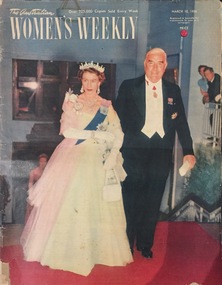
Magazine, The Australian Women's Weekly, March 10, 1954
... australian womens weekly - 1954...Single issue of the Australian Women's Weekly, published on March 10, 1954, picturing Queen Elizabeth II and the Australian Prime Minister, The Hon Robert Menzies, on the cover. ...The Australian Women's Weekly, March 10, 1954 Magazine Magazine ...Magazine published at the time of Elizabeth II's visit to Australia. The Rt Hon R G Menzies was the Member for Kew.Single issue of the Australian Women's Weekly, published on March 10, 1954, picturing Queen Elizabeth II and the Australian Prime Minister, The Hon Robert Menzies, on the cover. This 63-page edition was published during the Royal tour of Australia. It contains photographs, articles, stories, letters, advertisements etc.australian womens weekly - 1954, royal tours - 1954 -
 City of Melbourne Libraries
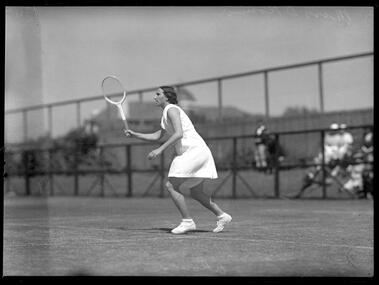
Photograph, Bull, Hugh Jones, 1897-1993, Tennis player, Dorothy Round, Albert Grounds, Melbourne
... 1954), p. 7 (Women's Supplement). Retrieved September 20, 2023, from http://nla.gov.au/nla.news-article28021332 Leading Tennis Referee Condemns Wearing of Shorts (1933, October 5). The Herald (Melbourne, Vic. : 1861 - 1954), p. 11. Retrieved September 20, 2023, from http://nla.gov.au/nla.news-article243193607 DOROTHY ROUND Chooses Going-Away TROUSSEAU (1937, September 4). The Australian Women's Weekly...1954), p. 7 (Women's Supplement). Retrieved September 20, 2023, from http://nla.gov.au/nla.news-article28021332 Leading Tennis Referee Condemns Wearing of Shorts (1933, October 5). The Herald (Melbourne, Vic. : 1861 - 1954), p. 11. Retrieved September 20, 2023, from http://nla.gov.au/nla.news-article243193607 DOROTHY ROUND Chooses Going-Away TROUSSEAU (1937, September 4). The Australian Women's Weekly ...Dorothy Round in shorts English-born Dorothy Round (1909-1982) plays tennis at Albert Park Cricket Ground, wearing her signature white sleeveless dress with divided skirt, pleated to form loose shorts. Dorothy won Wimbledon in 1934 and 1937, and the Australian Open in 1935. In the early 1930s, many women players in Europe and USA swapped stockings and long skirts for bare legs, short skirts and shorts. In October 1933, Mr Harley Malcolm, Secretary of Lawn Tennis Association Australia (LTAA) declared, “I consider shorts not regulation costume and would stop both men and women, particularly women, wearing them. I think women’s desire to strut themselves in such a costume is unreasonable.” However by November, the Victorian Lawn Tennis Association (VLTA) officially allowed shorts at Kooyong for both sexes. At the July 1934 Wimbledon Women’s Final, played in front of the King and Queen, Dorothy wore a sleeveless dress with the skirt divided. Her American competitor, Helen Jacobs, wore white tailored shorts with a black stripe on either side, described as “mannish, though businesslike”. In October, Australian tennis player Mrs Nell Hopman warned, “When Miss Dorothy Round arrives in a few weeks’ time, the LTAA will have to reconsider its decision about women playing in dresses, as she is sure to bring a trunkful of shorts. Miss Round has a “shorts only” rule which I fancy she will stick to here. She is the most stylish player I saw abroad.” The papers also reported that “Mrs Hopman saw no “he girls” among tennis players in Europe. Even the almost universal rule for shorts did not make them look masculine.” Dorothy said, “I wear shorts because they do not get in the way as a frock does. Mine are made in one piece and this avoids any tightness around the waist.” Featured in "Newsworthy: Melbourne in photographs 1933-1936" exhibition at East Melbourne Library, October to December 2023. Exhibition caption by project volunteer, Fiona Collyer. Photographer notations on slide: "Mrs D Round; D Round B6" Description: Dorothy Round plays tennis at Albert Grounds, Albert Park, Melbourne. She is wearing her signature white sleeveless dress with divided skirt, pleated to form loose shorts. Research by project volunteer, Fiona Collyer: Dorothy Round (1909-1982) was an English tennis champion from Dudley, Worcestershire. She won the Wimbledon Women’s Singles in 1934 and 1937. In 1935 she won the Australian Championships Women’s Singles in Melbourne. Dorothy won the Mixed Doubles at Wimbledon in 1934, 1935 and 1936. Dorothy was a staunch Methodist and taught Sunday School at Dudley Wesleyan Methodist Church throughout her career. She did not drink, smoke, dance or play tennis on Sundays and declined to compete in the 1933 French Open as tennis officials refused to comply to her scheduling preferences of No Sundays. During the Wightman Cup in New York when play was rained out on the Saturday, Dorothy refused to return on the Sunday. Officials reluctantly agreed to reschedule the clash for Monday, where she put in a sub par performance, prompting the New York Times to quip “Miss Round doesn’t play on Sundays, and doesn’t play particularly well on Mondays!”. In the early 1930s many women tennis players in Europe and USA abandoned their stockings and long skirts for bare legs, short skirts and shorts and some men swapped their long flannel trousers for shorts. British player Henry “Bunny” Austin was the first top male player to wear shorts at Centre Court Wimbledon in 1933, and his sister Joan Lycett nee Austin became the first female player to play without stockings on Centre Court, appearing with bare legs and ankle socks in 1931. In 1933 Mr Harley Malcolm, Secretary of the Lawn Tennis Association Australia (LTAA) and referee of big tournaments , said “the rules say regulation costume must be worn – I consider shorts are not regulation costume and would stop both men and women, particularly women, wearing them. I think women’s desire to strut themselves in such a costume is unreasonable.” (Herald 5/10/1933) However, by November 1933 the Victorian Lawn Tennis Assn officially allowed shorts as regulation dress at Kooyong for both sexes. One speaker suggested that as the majority of women were knock-kneed, the privilege of wearing shorts would not be taken up extensively by them. He added that women were not intended by nature to wear such garments. Another member mentioned that men were rather handsome objects and “works of art” and would carry off the short pants vogue nicely. (Sun Sydney 15/11/33) At the 1934 Wimbledon Singles Finals, playing in front of King George V and Queen Mary, Dorothy wore her signature outfit of sleeveless white dress with the skirt divided and pleated to form loose shorts and American Helen Jacobs wore white tailored shorts with a black stripe on either side described as “mannish, though business like.” In the lead up to Dorothy’s arrival in Australia to compete in the Australian Championship of 1935, there was much speculation written in the press about Dorothy’s preference for wearing shorts. Tennis player Mrs Nell Hopman warned “When Miss Dorothy Round arrives in a few weeks’ time, the Australian Lawn Tennis Association will have to reconsider its decision about women playing in dresses, as she is sure to bring a trunkful of shorts.” “Miss Round has a “shorts only” rule which I fancy she will stick to here. She is the most stylish player abroad.” Mrs Hopman saw no “he girls” among the tennis players in Europe. Even the almost universal rule for shorts did not make them look masculine. Mrs Hopman brought back a couple of pleated pairs that tennis player and designer Mrs Fearnley-Whittingstall (nee Eileen Bennett) made popular and worn by most English players. “They are really quite radical for they look no more startling than a short, pleated skirt” she said. (Newcastle Sun 1/10/1934) Writing for the Sydney Morning Herald 6/12/34, Dorothy said ”I have heard that a photograph of a player wearing shorts was sent to the Queen for her approval and I understand that she said in reply “that they were very attractive”. The Queen is a frequent and interested visitor to Wimbledon so this story is most credible and possibly explains the lack of official opposition to shorts this year.” “I wear shorts because they do not get in the way as a frock does. You have probably noticed that mine are made in one piece and this avoids any tightness around the waist. I don’t know whether shorts have come to stay. They do not suit everybody and the majority of the men don’t like the women in them and this may help condemn the fashion. I really think the men dislike them because too many people who shorts obviously do not suit rushed to be in the fashion and the result was devastating. For my part, I hope that this comfortable fashion endures.” Dorothy’s doubles partner, English tennis champion Fred Perry, did not approve of shorts for men and was particularly perturbed at the idea of women wearing them. Fred always wore long, white flannel trousers and white collared polo shirt on the tennis court. In July 1935 Dorothy took up a post as a dress designer and sportswear design advisor at British outfitters Jaeger. She published two books – “Modern Lawn Tennis” in 1935 and ”Tennis for Girls” in 1938 – described as cheerful and sensible guides. In 1937, Dorothy married Dr Douglas Leigh Little at Dudley Wesleyan Methodist Church. Her wedding dress was designed by renowned fashion designer Teddy Tinling who specialised in designing tennis dresses. (Tinling designed the dress worn by Billie Jean King for the famous “Battle of the Sexes” tennis match against Bobby Riggs in 1973.) News reel co. Gaumont British News filmed the wedding, showing 10,000 people, mostly women, surging towards the couple, describing it as a riot, and quipping that Dorothy’s forehand was useful when cutting the wedding cake. The city of Dudley gifted the couple an antique walnut bedroom suite chosen by them. Dorothy and Douglas had a son, Ian, and a daughter, Patricia. She gave up competitive tennis to coach and write newspaper articles. In later life she took up golf. Dorothy died of cancer in 1982 aged 73. She was inducted into the International Tennis Hall of Fame 1986. In 2004 a bronze bust of Dorothy was installed at Wimbledon, and in 2013 a life size bronze statue was erected at Priory Park, Dudley. References: MRS. HOPMAN RETURNS (1934, October 1). The Newcastle Sun (NSW : 1918 - 1954), p. 9. Retrieved September 20, 2023, from http://nla.gov.au/nla.news-article166292409 FIGURED IT OUT (1933, November 15). The Sun (Sydney, NSW : 1910 - 1954), p. 13 (FINAL EXTRA). Retrieved September 20, 2023, from http://nla.gov.au/nla.news-article230199908 FASHIONS OF THE TENNIS COURTS. (1934, December 6). The Sydney Morning Herald (NSW : 1842 - 1954), p. 7 (Women's Supplement). Retrieved September 20, 2023, from http://nla.gov.au/nla.news-article28021332 Leading Tennis Referee Condemns Wearing of Shorts (1933, October 5). The Herald (Melbourne, Vic. : 1861 - 1954), p. 11. Retrieved September 20, 2023, from http://nla.gov.au/nla.news-article243193607 DOROTHY ROUND Chooses Going-Away TROUSSEAU (1937, September 4). The Australian Women's Weekly (1933 - 1982), p. 39. Retrieved September 20, 2023, from http://nla.gov.au/nla.news-article51588090 Ban On Shorts For Tennis Girls? (1934, April 15). The Sun (Sydney, NSW : 1910 - 1954), p. 3. Retrieved February 5, 2024, from http://nla.gov.au/nla.news-article230535547 Dorothy Round Little - one of Britain's greatest champions, 13 September 2009, Tennis Forum, https://www.tennisforum.com/threads/dorothy-round-little-one-of-britains-greatest-champions.409612/Photographer notations on slide: "Mrs D Round; D Round B6".tennis, clothing and dress, 1930-1939 -
 City of Melbourne Libraries
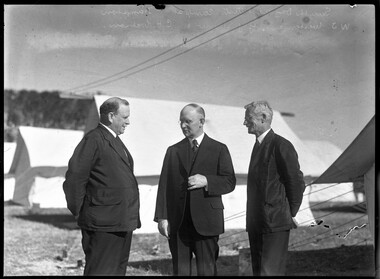
Photograph, Bull, Hugh Jones, 1897-1993, Seventh Day Adventists Camp at Hampton: W.J. Westerman, G.G. Stewart & C.H. Watson
... 1954), p. 12. Retrieved August 8, 2025, from http://nla.gov.au/nla.news-article242887972 1955, March 30). The Australian Women's Weekly (1933 - 1982), p. 38. ...1954), p. 12. Retrieved August 8, 2025, from http://nla.gov.au/nla.news-article242887972 1955, March 30). The Australian Women's Weekly (1933 - 1982), p. 38. ...Photographer notations on slide: Seventh Day Adventists Camp at Hampton W.J. Westerman, G.G. Stewart & C.H. Watson Published: 28 December 1933 Published title: SEVENTH DAY ADVENTISTS. Published caption: “I. — The Annual Camp of the Seventh Day Adventists in Highett-road, Hampton, comprising more than 250 tents and accommodating over a thousand persons. II. —W. J. Westerman (vice-president of Australasian) and Pastor G. G. Stewart (president of Victoria), conversing with Pastor C. H. Watson (world president of the Seventh Day Adventists).- III.— Evangelist E. R. Gane and family.” SEVENTH DAY ADVENTISTS. (1933, December 28). The Age (Melbourne, Vic. : 1854 - 1954), p. 9. Retrieved August 1, 2025, from http://nla.gov.au/nla.news-article203356427 Research by project volunteer, Fiona Collyer: In December 1933, the annual Seventh Day Adventists Conference of Victoria was held, with over a 1000 participants camping for ten days at Highett Road Hampton. Pastor Charles H. Watson, world president of the Seventh Day Adventists, Walter J. Westerman, vice-president of Australasian and Pastor George G. Stewart, president of Victoria attended. Interestingly, The Age newspaper modified the original photo in their publication, placing the three men close to each other. Description: Three middle aged men dressed in suits converse in front of tents. In December 1933, delegates from all over Victoria and beyond travelled to Melbourne for the annual Seventh Day Adventists Conference of Victoria, held over ten days on a vacant allotment at Highett Road Hampton. A canvas town of 250 tents for over 1000 campers was created along with large marquees for lectures, devotional services and kitchens. Many daily visitors also attended the lectures and services. The principal speaker was Victorian born world president of the Seventh Day Adventists, Pastor Charles H. Watson (1877-1962), who travelled from Washington DC for the event. The Highett Street campers attended a busy schedule of bible readings, devotional services and health lectures during the ten days of the camp. Lecture subjects included- “Among the Head Hunters of the Solomon Islands”, “ Looking Through the Prophetic Telescope into 1934”, “Soul Surgery”, “Viewing the Celestial Land Through the Prophetic Telescope”and “The Four Horsemen of the Apocalypse”. The Seventh Day Adventist religion was established in the USA in 1863. One of its co-founders was American Ellen G. White whose writings are regarded as divinely inspired and are still adhered to today. Ellen preached on the “Eight Laws of Health”- Nutrition, exercise, water, sunshine, temperance, air, rest and trust in God. Adventists regard their bodies as holy temples and avoid food deemed by the Bible as unclean. They eat a mainly plant based diet with no caffeinated beverages and abstain from alcohol and tobacco. They believe in the observance of Saturday, the seventh day of the week in the Christian (Gregorian) and Hebrew calendars as the sabbath and the literal and imminent second coming of Jesus Christ. New converts are baptised by immersion in water. The Adventists opened the Warburton Sanitarium in 1910 as a health retreat, integrating their holistic health philosophy of physical, mental and spiritual well being. It was a resort in the hills “among picturesque mountain scenery…surrounded by tall forests and deep fern gullies…” where highly strung Melburians could alleviate their digestive maladies, stress and jaded nerves as “…worn down nervous systems mend quickly in this peaceful environment…invigorating air and an abundance of home-grown fruit, vegetables, fresh eggs, milk, and cream help to build healthy bodies”. The resort also offered hydrotherapy, massage and electrical treatments. An advertisement in The Argus- 1 December 1947 assured readers- “EVERYTHING SUNNY AGAIN." “That's how you'll feel when you say farewell to Warburton Sanitarium and Hospital after spending a holiday here. Victoria's Hydro is famous far and wide for wonders worked with sufferers from nervous and digestive disorders. Wholesome food, perfectly cooked; splendid air, regulated exercise, sweet natural sleep; these quickly correct faulty digestion, restore vitality, bring back that sunny optimism natural to healthy people. Massage and curative baths under medical supervision…” Later, after further building work, it became the Warburton Hospital with medical, casualty and obstetrics wards as well as offering strategies to stop smoking, lose weight and for stress management. The hospital ceased operation in 2001. Ellen G. White wrote “God sent me to Australia” and in 1891, accompanied by her son William C. White she arrived in Australia to start a Bible school, spread her health philosophy and for missionary work. At first health food products were imported from America, but it soon became apparent that due to the expense and the food becoming stale over the long journey, that local manufacturing was necessary. In 1898 William secured the services of American Adventist baker Edward C. Halsey, who had worked at Dr Kellogg’s Battle Creek (“Cereal City”), Sanitarium, Michigan, USA. They rented the St George’s bakery in Northcote, Melbourne, producing the first ready to eat breakfast cereal Granola, Caramel Cereal, and peanut butter. The fledgling company relocated to larger premises in Cooranbong, NSW soon after. The Sanitarium Health Food Company opened a factory in Warburton in 1925, manufacturing Granose Biscuits, Cerix Puffed Wheat, San-Bran, Bixies malted wheat flakes, Betta peanut butter, Marmite, “Kwic-Bru - A delicious health “coffee” made from choicest cereals and free from drugs that affect the heart and nerves” In 1928, Sanitarium bought out Grain Products Limited who were manufacturing a sweet cereal biscuit called Weet-Bix which soon became Australia’s favourite breakfast cereal. The Warburton factory closed in 1997, with manufacturing shifting interstate. Sanitarium breakfast cereal boxes offered free collectable cards inside and children could buy albums from grocers for sixpence and mount the cards. Subjects of the albums included- “Aboriginal Tribes, Legends, Customs”, “Australia- Yesterday and Today”, “Marvels of the Great Barrier Reef”, “Advance Australia- a Pageant of the Years”. In 1902 the Adventist’s opened the “Pure Food Vegetarian Cafe” in Sydney (In 1907 the name was changed to “Sanitarium Health Food Cafe”), Eating vegetarian food was definitely a curiosity. “Cristina” reviewed the cafe for The Australasian-27 October 1906. Topics For The Block. “Feeling somewhat like a criminal, and hoping to escape detection, I stealthily made my way into a vegetarian restaurant the other day... If my friends happened to catch me walking in there, I should henceforth be considered a crank, a faddist, and little short of a lunatic! Whom did I find within, seated with the air of habitués at the small tables, but heaps of my friends. They had all this while been pursuing their vegetarian way, layin' low and sayin' nuffin'. Flesh-eaters, now that the Sydney summer has set in apparently in good earnest, are beginning to wonder if the vegetarians are not wiser in their day and generation. Roast beef, hot cornea beef, ragouts, and meat curries, the very thought of them makes one feel hot. Frosted lemon pudding, stewed fruits, wheatmeal rolls, and tomatoes sound nice when you look at their names on the vegetarian menu. Such weird messes are served, square, unintelligible blocks of some brown substance, a few bites of which form a full and satisfying meal. Cold nut foods, granose, nuttose, and jam protose, bromose, with jelly and various "ose" sandwiches, impossible for the unbeliever to diagnose, are put before you. You drink malted nut broth, you eat gluten sticks, stewed beans, lentil patties, with vegetable sauce, any or all of which are distinctly nourishing and filling at the price. A mock (decidedly mock) veal cutlet or a red lentil roast is sufficient lunch, it appears, for anyone. Thus, "you obtain the best working results from your machinery with the least possible expenditure..." In December 1906 the Adventists branched out to Melbourne, opening the Sanitarium Health Food Cafe at 289 Collins Street next to the Royal Bank building. (corner Collins and Elizabeth Streets, demolished in 1939). Their motto was “Quality and Purity”. “Cynthia” of The Leader “Social Circle” column reviewed the cafe in 9 March 1907- “Hundreds of people have a feeling of positive affection for a diet that will be satisfying, appetising and nourishing, without having meat for its backbone. It will come as news that we have in Melbourne a cafe where you can really enjoy yourself without eating anything in the way of meat. Cream, custard, cheese and the like are not cold shouldered out of the menu, and the housewife in search of new dishes will find here ever so much in the way of suggestions. Nuts figure conspicuously in the menu, and lentil and walnut cutlets may be instanced among the delicacies. Beans are cooked in quite alluring fashion, while creamed parsnips are excellent. For sandwiches you could hardly desire anything more appetising than granosi biscuits, and nut cheese. The combination is suggestive of school lunches, and nut meat might well be employed as a variant. A visit to the cafe itself — it is next the Royal Bank in Collins-street — will surprise anyone used to the average vegetarian restaurant. Every thing is fresh, fragrant, and thoroughly modern… It is run, in connection with that curious people the Seventh Day Adventists.” However, “Adele” writing for the Evelyn Observer and Bourke East Record -13 December 1907 had a different experience- CITY RESTAURANTS. “There is no glamour from the outside. We enter the dining room at six and secure a seat at a small table, for this night we are going to dine on vegetables. Some people pride themselves on being vegetarians, and devote a great deal of their spare cash and energy to disseminating vegetarian principles. I shall not in a hurry forget the dinner we tried to get through at this vegetarian restaurant. There was put before us plate after plate of vegetables not soaked, but sodden with water, not an atom of flavouring or dressing; no attempt was made to give the slightest piquancy to potato, cabbage, turnip or carrot. I beg pardon, I am unjust, there were two caterpillars in the cabbage. It is astonishing how persistently ordinary cooks spoil vegetables in the process of cooking and how little they understand the value of vegetables on a menu.” From the extensive menu of 1924, you could order cream of green pea soup, followed by nut meat with Yorkshire pudding, egg timbales, stewed brown lentils, savoury rissoles with piquant sauce. Among the dessert offerings were creamed sago, steamed figs and walnut drops. Washed down with fermented wine and to finish, “Frucerea”, a coffee substitute essence made from fruit and cereal. A four course meal of soup, entree, vegetables and sweets cost 1/6 in 1924. Proving that plant-based food was not just a novelty, 67,000 meals were served at the cafe in 1918, rising to 73,000 in 1921. Later the Sanitarium Cafe moved to 293 Little Collins Street, (opposite Royal Arcade) sharing the building with The Lilliput Golf Course, a miniature golf course of 18 holes. The course was a replica of the fashionable Lido Course in France and was open daily from 10am to midnight with a green fee of one shilling. It featured goldfish, waterfalls and dance music. Lilliput boasted that they were “Melbourne’s coolest indoor course” Miniature golf (mini, minnie, midget, miget, Tom Thumb, Wee golf, putt-putt, pigmy, peewee, crazy golf, obstacle golf) swept the globe in the 1930s, starting in the USA, then Europe. The courses provided affordable recreation during uncertainty at the start of the Great Depression. The craze arrived in Sydney September 1930 with the first mini golf course opening in the basement of the State Theatre. It featured a replica Sydney Harbour Bridge and attracted over 1000 players a day at one shilling per game. The miniature golf bug hit Melbourne hard in 1930-31 with nearly 200 courses springing up in the CBD and suburbs within a few months. The first miniature golf course to open in Melbourne was on 4 October 1930 in the basement of recently built art deco style Wentworth House at 203 Collins Street, designed by architect Cedric Heise Ballantyne, (also designed Regent Theatre, Plaza Ballroom, Athenaeum Club, National Theatre, St Kilda, built in 1930, demolished in 1974 for the City Square) It was managed by J. C. Williamson who advertised for a “Girl Spruiker” who “Must be Young, Attractive Personality, and Able to Talk to the Public” to work at the course. The Age 26 September 1930 reported - “The Wentworth House management have spared no expense in preparing the links. Water hazards, sand bunkers, running streams, ancestral castles, moats and a cunning drawbridge have each been devised to test the skill of players, while the walls and ceiling have been "atmospherically" treated to convey an exterior effect”. Even Melbourne City Council jumped on the bandwagon, leasing the lower hall of Melbourne Town Hall to colourful car dealer and racehorse owner Mr A. G. Barlow for £43 per week for the “Kit Kat Tiny Golf Course”, opening on 11 December 1930. (Turf identity, Mr Alexander George Barlow, (1880-1937) who raced under the nom de course “A. G. Vauxhall”, owned filly Frances Tressady, who in 1923 won the Victoria Derby and Oaks Stakes double and came fifth in the Melbourne Cup. The “Frances Tressady Stakes” is held each March at Flemington Racecourse in honour of the horse, the last filly to win the Derby. Barlow was the proprietor of Barlow Brothers Pty Ltd car dealership at 442 Elizabeth Street, Melbourne. He played 14 games for Carlton Football Club (VFL) on the half-forward line from 1901-1903). Patrons could vie for The Herald Miniature Golf Championship Cup, a gold cup worth £7/7, in an eight week long competition. Sports newspaper The Sporting Globe also offered a Cup and prize money. Many courses offered prizes of theatre tickets, cash and cigarettes. Myer’s department store, hoping to cash in on the fad, advertised in Melbourne’s newspapers that their Sports Department could design and equip complete miniature golf courses using “Fairway” imitation turf at 4/6 a yard. Newspaper cartoonists loved to lampoon the fad. Both Percy Leason, cartoonist for society magazine Table Talk and Syd Miller of Smith’s Weekly depicted “real” golfers causing havoc on a mini golf course, showing that being a “real” golf player was no advantage to playing miniature golf. But bust often follows boom. With such rapid market saturation, expensive novel hazards, waning interest, long opening hours, often to midnight, and price cutting of game fees from one shilling to sixpence and then to threepence amongst some courses, the bubble was bound to burst. The Sporting Globe columnist J.M.Dillon on 20 May 1931 lamented- £100,000 LOST Failure of ‘Minnie’ Golf. “Miniature golf might have provided fun and jokes for thousands of people in Australia, but there were many for whom it panned out a tragedy. It is likely that the dead losses of those who attempted to make money out of the game in Australia were in the vicinity of £100,000. …For a while there was hardly a spare block of land, or a possible “site” in the shape of a hall, or a showroom, in Sydney and Melbourne, that some one was not after to set upon it a “minnie links.” Big amusement firms and private individuals anxious to make money began to run courses. Practically every individual who touched the game had his finger’s financially burnt. …From the approximately £60,000 invested in Melbourne alone, there must have been £25,000 lost. …There are now dozens of courses going to ruin, and many more that the owners would be happy to give away if the takers would remove from them obligations of leases, &c…” The lease on the “Kit Kat Tiny Golf Club” at the Melbourne Town Hall expired on 30 April 1931, with Mr Barlow losing £798 on the venture. The hazards and fittings, which cost £400 and included a large replica of the Town Hall, now worthless. Due to declining patronage, the Little Collins Street cafe closed in 1938, although the adjacent shop continued to sell Sanitarium products. In New Zealand, the first Sanitarium factory opened in Christchurch in 1900, with the company later opening factories in Palmerston North and Auckland. The Adventists opened vegetarian cafes, firstly at 37 Taranaki Street Wellington in 1906, followed by cafes in Auckland, Christchurch and Dunedin. Weet-Bix is also New Zealand’s favourite cereal- there the jingle is “Kiwi kids are Weet-Bix kids.” In 1955, the Australian Women’s Weekly ran an illustrated, full colour advertisement featuring New Zealand born Edmund Hillary (later Sir) 1919-2008, who, along with Sherpa Tenzing Norgay, was the first climber to reach the summit of Mount Everest on 29 March 1953. The Australian Women’s Weekly, 30 March, 1955- “WEET-BIX carried by Hillary on Himalayan adventure! c/- N.Z. Alpine Club Inc., Dunedin, New Zealand. The Manager, Sanitarium Health Food Company, Christchurch, N.Z. Dear Sir. …Weet-Bix was chosen at my special request as I had always felt that some easily prepared form of breakfast was essential to the primitive conditions of high camps. Weet-Bix fulfilled its task very well indeed. We usually had them with hot milk (powdered) and sugar, and even when we were unable to eat anything else, we usually managed to have a little Weet-Bix . . . I regard them as a great success and expect they will be more widely used in the Himalayas in future. Yours faithfully, (Signed) E.P. Hillary. Sanitarium Marmite - motto- “Too much spoils the flavour”- is as beloved with Kiwis as Vegemite is with Australians. In 1966, a fire gutted the Christchurch Marmite factory causing a nation wide shortage. Once the factory was rebuilt, Sanitarium relaunched the yeasty extract in reusable glass tumblers with printed designs such as yachts, New Zealand birds and vintage cars. These popular collectibles can still be found in the kitchen cupboards of many New Zealand baches (holiday homes). After the devastating 2011 earthquake in Christchurch damaged the Marmite factory causing shortages and panic buying, a “Marmageddon” was declared with jars of the “black gold” advertised online for up to NZ$800. Consumers were advised to spread their Marmite sparingly until production resumed. (The Christchurch plant reportedly produces around 640,000kg of Marmite per year). Sanitarium Health and Wellbeing Company is exempt from paying company income tax on their profits due to their ownership by a religious organisation. Although not a compulsory rule for salvation, Adventists are encouraged to pay a tithe of 10% of their income to the church to support the ministry in God’s work. Nowadays, there are over 25 million members of the Seventh Day Adventists Church in 200 countries. ITEMS OF INTEREST (1933, December 22). The Argus (Melbourne, Vic. : 1848 - 1957), p. 8. Retrieved July 21, 2025, from http://nla.gov.au/nla.news-article11723188 SEVENTH DAY ADVENTISTS. (1933, December 28). The Age (Melbourne, Vic. : 1854 - 1954), p. 9. Retrieved July 1, 2025, from http://nla.gov.au/nla.news-article203356427 EVANGELISTS' CAMP (1933, December 20). The Herald (Melbourne, Vic. : 1861 - 1954), p. 30. Retrieved July 1, 2025, from http://nla.gov.au/nla.news-article243213209 Master Butchers Have A Time Pilots FOR School Air Race Charity Golf At Riversdale (1931, May 1). The Sun News-Pictorial (Melbourne, Vic. : 1922 - 1954; 1956), p. 14-15. Retrieved September 4, 2025, from http://nla.gov.au/nla.news-article276159136 2000 ADVENTISTS UNDER CANVAS (1933, December 27). The Herald (Melbourne, Vic. : 1861 - 1954), p. 17. Retrieved July 1, 2025, from http://nla.gov.au/nla.news-article243223698 TOPICS FOR THE BLOCK. (1906, October 27). The Australasian (Melbourne, Vic. : 1864 - 1946), p. 45. Retrieved August 30, 2025, from http://nla.gov.au/nla.news-article139178204 https://en.wikipedia.org/wiki/Seventh-day_Adventist_Church https://www.sanitarium.com/au/about/sanitarium-story/profits-for- ENTERTAINMENT AT MENZIES'. (1906, December 6). Punch (Melbourne, Vic. : 1900 - 1918; 1925), p. 26. Retrieved August 3, 2025, from http://nla.gov.au/nla.news-article175380296 https://encyclopedia.adventist.org/article?id=9HN0&highlight=Conference SOCIAL CIRCLE (1907, March 9). Leader (Melbourne, Vic. : 1862 - 1918, 1935), p. 41. Retrieved August 3, 2025, from http://nla.gov.au/nla.news-article196649677 CITY RESTAURANTS. (1907, December 13). Evelyn Observer and Bourke East Record (Vic. : 1902 - 1917), p. 1 (MORNING.). Retrieved August 3, 2025, from http://nla.gov.au/nla.news-article61133109 Advertising (1924, May 6). The Sun News-Pictorial (Melbourne, Vic. : 1922 - 1954; 1956), p. 9. Retrieved August 3, 2025, from http://nla.gov.au/nla.news-article274271406 1930, December 5). The Herald (Melbourne, Vic. : 1861 - 1954), p. 14. Retrieved August 5, 2025, from http://nla.gov.au/nla.news-page26374135 Thousands Are Still Playing Miniature Golf (1931, January 2). The Herald (Melbourne, Vic. : 1861 - 1954), p. 11. Retrieved August 8, 2025, from http://nla.gov.au/nla.news-article242880087 MINIATURE GOLF. (1930, October 16). The Argus (Melbourne, Vic. : 1848 - 1957), p. 10. Retrieved August 8, 2025, from http://nla.gov.au/nla.news-article4209280 THE REAL GOLFER WHO FORGOT HIMSELF ON THE MINIATURE GOLF COURSE (1930, November 13). Table Talk (Melbourne, Vic. : 1885 - 1939), p. 13. Retrieved August 8, 2025, from http://nla.gov.au/nla.news-article146706596 Advertising (1930, December 5). The Herald (Melbourne, Vic. : 1861 - 1954), p. 14. Retrieved August 8, 2025, from http://nla.gov.au/nla.news-article242761991 Advertising (1931, January 9). The Herald (Melbourne, Vic. : 1861 - 1954), p. 12. Retrieved August 8, 2025, from http://nla.gov.au/nla.news-article242887972 1955, March 30). The Australian Women's Weekly (1933 - 1982), p. 38. Retrieved August 9, 2025, from http://nla.gov.au/nla.news-page4812489 £100,000 LOST (1931, May 20). Sporting Globe (Melbourne, Vic. : 1922 - 1954), p. 1 (Edition1). Retrieved August 14, 2025, from http://nla.gov.au/nla.news-article183023946 1930, December 5). The Herald (Melbourne, Vic. : 1861 - 1954), p. 14. Retrieved August 15, 2025, from http://nla.gov.au/nla.news-page26374135 Advertising (1931, January 23). The Herald (Melbourne, Vic. : 1861 - 1954), p. 14. Retrieved August 15, 2025, from http://nla.gov.au/nla.news-article242887795 MINIATURE GOLF. (1931, February 5). The Dandenong Journal (Vic. : 1927 - 1954), p. 6. Retrieved August 16, 2025, from http://nla.gov.au/nla.news-article201082526 Still Time To Enter Midge (1931, January 16). The Herald (Melbourne, Vic. : 1861 - 1954), p. 12. Retrieved August 16, 2025, from http://nla.gov.au/nla.news-article242888830 WIT OF THE WEEK (1930, October 23). Table Talk (Melbourne, Vic. : 1885 - 1939), p. 23. Retrieved August 29, 2025, from http://nla.gov.au/nla.news-article146455050 Advertising (1930, October 2). Table Talk (Melbourne, Vic. : 1885 - 1939), p. 16. Retrieved August 18, 2025, from http://nla.gov.au/nla.news-article146454620 MIDGET GOLF LINKS. (1930, September 26). The Age (Melbourne, Vic. : 1854 - 1954), p. 6. Retrieved August 18, 2025, from http://nla.gov.au/nla.news-article202235074 https://www.smh.com.au/national/fairfax-archive-mini-golf-20131125-2y608.html TURF NOTES (1923, November 6). The Ballarat Star (Vic. : 1865 - 1924), p. 6. Retrieved September 3, 2025, from http://nla.gov.au/nla.news-article213855201 Advertising (1930, October 4). The Herald (Melbourne, Vic. : 1861 - 1954), p. 10. Retrieved October 14, 2025, from http://nla.gov.au/nla.news-article242937272 LAUGHTER AND TEARS. (1930, November 15). Smith's Weekly (Sydney, NSW : 1919 - 1950), p. 21. Retrieved September 9, 2025, from http://nla.gov.au/nla.news-article234426874 Advertising (1947, December 1). The Argus (Melbourne, Vic. : 1848 - 1957), p. 5. Retrieved September 15, 2025, from http://nla.gov.au/nla.news-article22523355Photographer notations on slide: "Seventh Day Adventists Camp at Hampton W.J. Westerman, G.G. Stewart & C.H. Watson".religion, health food, mini golf, 1930-1939, tents, churches, camps -
 City of Melbourne Libraries
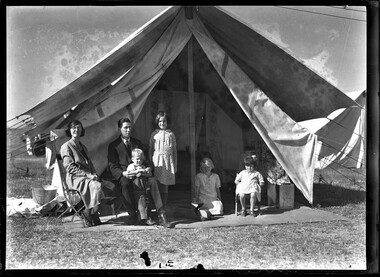
Photograph, Bull, Hugh Jones, 1897-1993, Seventh Day Adventists Camp at Hampton: E. Gane + family
... 1954), p. 12. Retrieved August 8, 2025, from http://nla.gov.au/nla.news-article242887972 1955, March 30). The Australian Women's Weekly (1933 - 1982), p. 38. ...1954), p. 12. Retrieved August 8, 2025, from http://nla.gov.au/nla.news-article242887972 1955, March 30). The Australian Women's Weekly (1933 - 1982), p. 38. ...Photographer notations on slide: Seventh Day Adventists Camp. E Gane + family Published: 28 December 1933 Published title: SEVENTH DAY ADVENTISTS. Published caption: “I. — The Annual Camp of the Seventh Day Adventists in Highett-road, Hampton, comprising more than 250 tents and accommodating over a thousand persons. II. —W. J. Westerman (vice-president of Australasian) and Pastor G. G. Stewart (president of Victoria), conversing with Pastor C. H. Watson (world president of the Seventh Day Adventists).- III.— Evangelist E. R. Gane and family.” SEVENTH DAY ADVENTISTS. (1933, December 28). The Age (Melbourne, Vic. : 1854 - 1954), p. 9. Retrieved August 1, 2025, from http://nla.gov.au/nla.news-article203356427 Research by project volunteer, Fiona Collyer: In December 1933, evangelist Mr E.R. Gane and his family gather outside their tent during the ten day Seventh Day Adventist Conference held in Highett Road, Hampton. Description: A woman, man and four small children sit and stand in front of a tent. One child plays with a toy train. In December 1933, delegates from all over Victoria and beyond travelled to Melbourne for the annual Seventh Day Adventists Conference of Victoria, held over ten days on a vacant allotment at Highett Road Hampton. A canvas town of 250 tents for over 1000 campers was created along with large marquees for lectures, devotional services and kitchens. Many daily visitors also attended the lectures and services. The principal speaker was Victorian born world president of the Seventh Day Adventists, Pastor Charles H. Watson (1877-1962), who travelled from Washington DC for the event. The Highett Street campers attended a busy schedule of bible readings, devotional services and health lectures during the ten days of the camp. Lecture subjects included- “Among the Head Hunters of the Solomon Islands”, “ Looking Through the Prophetic Telescope into 1934”, “Soul Surgery”, “Viewing the Celestial Land Through the Prophetic Telescope”and “The Four Horsemen of the Apocalypse”. The Seventh Day Adventist religion was established in the USA in 1863. One of its co-founders was American Ellen G. White whose writings are regarded as divinely inspired and are still adhered to today. Ellen preached on the “Eight Laws of Health”- Nutrition, exercise, water, sunshine, temperance, air, rest and trust in God. Adventists regard their bodies as holy temples and avoid food deemed by the Bible as unclean. They eat a mainly plant based diet with no caffeinated beverages and abstain from alcohol and tobacco. They believe in the observance of Saturday, the seventh day of the week in the Christian (Gregorian) and Hebrew calendars as the sabbath and the literal and imminent second coming of Jesus Christ. New converts are baptised by immersion in water. The Adventists opened the Warburton Sanitarium in 1910 as a health retreat, integrating their holistic health philosophy of physical, mental and spiritual well being. It was a resort in the hills “among picturesque mountain scenery…surrounded by tall forests and deep fern gullies…” where highly strung Melburians could alleviate their digestive maladies, stress and jaded nerves as “…worn down nervous systems mend quickly in this peaceful environment…invigorating air and an abundance of home-grown fruit, vegetables, fresh eggs, milk, and cream help to build healthy bodies”. The resort also offered hydrotherapy, massage and electrical treatments. An advertisement in The Argus- 1 December 1947 assured readers- “EVERYTHING SUNNY AGAIN." “That's how you'll feel when you say farewell to Warburton Sanitarium and Hospital after spending a holiday here. Victoria's Hydro is famous far and wide for wonders worked with sufferers from nervous and digestive disorders. Wholesome food, perfectly cooked; splendid air, regulated exercise, sweet natural sleep; these quickly correct faulty digestion, restore vitality, bring back that sunny optimism natural to healthy people. Massage and curative baths under medical supervision…” Later, after further building work, it became the Warburton Hospital with medical, casualty and obstetrics wards as well as offering strategies to stop smoking, lose weight and for stress management. The hospital ceased operation in 2001. Ellen G. White wrote “God sent me to Australia” and in 1891, accompanied by her son William C. White she arrived in Australia to start a Bible school, spread her health philosophy and for missionary work. At first health food products were imported from America, but it soon became apparent that due to the expense and the food becoming stale over the long journey, that local manufacturing was necessary. In 1898 William secured the services of American Adventist baker Edward C. Halsey, who had worked at Dr Kellogg’s Battle Creek (“Cereal City”), Sanitarium, Michigan, USA. They rented the St George’s bakery in Northcote, Melbourne, producing the first ready to eat breakfast cereal Granola, Caramel Cereal, and peanut butter. The fledgling company relocated to larger premises in Cooranbong, NSW soon after. The Sanitarium Health Food Company opened a factory in Warburton in 1925, manufacturing Granose Biscuits, Cerix Puffed Wheat, San-Bran, Bixies malted wheat flakes, Betta peanut butter, Marmite, “Kwic-Bru - A delicious health “coffee” made from choicest cereals and free from drugs that affect the heart and nerves” In 1928, Sanitarium bought out Grain Products Limited who were manufacturing a sweet cereal biscuit called Weet-Bix which soon became Australia’s favourite breakfast cereal. The Warburton factory closed in 1997, with manufacturing shifting interstate. Sanitarium breakfast cereal boxes offered free collectable cards inside and children could buy albums from grocers for sixpence and mount the cards. Subjects of the albums included- “Aboriginal Tribes, Legends, Customs”, “Australia- Yesterday and Today”, “Marvels of the Great Barrier Reef”, “Advance Australia- a Pageant of the Years”. In 1902 the Adventist’s opened the “Pure Food Vegetarian Cafe” in Sydney (In 1907 the name was changed to “Sanitarium Health Food Cafe”), Eating vegetarian food was definitely a curiosity. “Cristina” reviewed the cafe for The Australasian-27 October 1906. Topics For The Block. “Feeling somewhat like a criminal, and hoping to escape detection, I stealthily made my way into a vegetarian restaurant the other day... If my friends happened to catch me walking in there, I should henceforth be considered a crank, a faddist, and little short of a lunatic! Whom did I find within, seated with the air of habitués at the small tables, but heaps of my friends. They had all this while been pursuing their vegetarian way, layin' low and sayin' nuffin'. Flesh-eaters, now that the Sydney summer has set in apparently in good earnest, are beginning to wonder if the vegetarians are not wiser in their day and generation. Roast beef, hot cornea beef, ragouts, and meat curries, the very thought of them makes one feel hot. Frosted lemon pudding, stewed fruits, wheatmeal rolls, and tomatoes sound nice when you look at their names on the vegetarian menu. Such weird messes are served, square, unintelligible blocks of some brown substance, a few bites of which form a full and satisfying meal. Cold nut foods, granose, nuttose, and jam protose, bromose, with jelly and various "ose" sandwiches, impossible for the unbeliever to diagnose, are put before you. You drink malted nut broth, you eat gluten sticks, stewed beans, lentil patties, with vegetable sauce, any or all of which are distinctly nourishing and filling at the price. A mock (decidedly mock) veal cutlet or a red lentil roast is sufficient lunch, it appears, for anyone. Thus, "you obtain the best working results from your machinery with the least possible expenditure..." In December 1906 the Adventists branched out to Melbourne, opening the Sanitarium Health Food Cafe at 289 Collins Street next to the Royal Bank building. (corner Collins and Elizabeth Streets, demolished in 1939). Their motto was “Quality and Purity”. “Cynthia” of The Leader “Social Circle” column reviewed the cafe in 9 March 1907- “Hundreds of people have a feeling of positive affection for a diet that will be satisfying, appetising and nourishing, without having meat for its backbone. It will come as news that we have in Melbourne a cafe where you can really enjoy yourself without eating anything in the way of meat. Cream, custard, cheese and the like are not cold shouldered out of the menu, and the housewife in search of new dishes will find here ever so much in the way of suggestions. Nuts figure conspicuously in the menu, and lentil and walnut cutlets may be instanced among the delicacies. Beans are cooked in quite alluring fashion, while creamed parsnips are excellent. For sandwiches you could hardly desire anything more appetising than granosi biscuits, and nut cheese. The combination is suggestive of school lunches, and nut meat might well be employed as a variant. A visit to the cafe itself — it is next the Royal Bank in Collins-street — will surprise anyone used to the average vegetarian restaurant. Every thing is fresh, fragrant, and thoroughly modern… It is run, in connection with that curious people the Seventh Day Adventists.” However, “Adele” writing for the Evelyn Observer and Bourke East Record -13 December 1907 had a different experience- CITY RESTAURANTS. “There is no glamour from the outside. We enter the dining room at six and secure a seat at a small table, for this night we are going to dine on vegetables. Some people pride themselves on being vegetarians, and devote a great deal of their spare cash and energy to disseminating vegetarian principles. I shall not in a hurry forget the dinner we tried to get through at this vegetarian restaurant. There was put before us plate after plate of vegetables not soaked, but sodden with water, not an atom of flavouring or dressing; no attempt was made to give the slightest piquancy to potato, cabbage, turnip or carrot. I beg pardon, I am unjust, there were two caterpillars in the cabbage. It is astonishing how persistently ordinary cooks spoil vegetables in the process of cooking and how little they understand the value of vegetables on a menu.” From the extensive menu of 1924, you could order cream of green pea soup, followed by nut meat with Yorkshire pudding, egg timbales, stewed brown lentils, savoury rissoles with piquant sauce. Among the dessert offerings were creamed sago, steamed figs and walnut drops. Washed down with fermented wine and to finish, “Frucerea”, a coffee substitute essence made from fruit and cereal. A four course meal of soup, entree, vegetables and sweets cost 1/6 in 1924. Proving that plant-based food was not just a novelty, 67,000 meals were served at the cafe in 1918, rising to 73,000 in 1921. Later the Sanitarium Cafe moved to 293 Little Collins Street, (opposite Royal Arcade) sharing the building with The Lilliput Golf Course, a miniature golf course of 18 holes. The course was a replica of the fashionable Lido Course in France and was open daily from 10am to midnight with a green fee of one shilling. It featured goldfish, waterfalls and dance music. Lilliput boasted that they were “Melbourne’s coolest indoor course” Miniature golf (mini, minnie, midget, miget, Tom Thumb, Wee golf, putt-putt, pigmy, peewee, crazy golf, obstacle golf) swept the globe in the 1930s, starting in the USA, then Europe. The courses provided affordable recreation during uncertainty at the start of the Great Depression. The craze arrived in Sydney September 1930 with the first mini golf course opening in the basement of the State Theatre. It featured a replica Sydney Harbour Bridge and attracted over 1000 players a day at one shilling per game. The miniature golf bug hit Melbourne hard in 1930-31 with nearly 200 courses springing up in the CBD and suburbs within a few months. The first miniature golf course to open in Melbourne was on 4 October 1930 in the basement of recently built art deco style Wentworth House at 203 Collins Street, designed by architect Cedric Heise Ballantyne, (also designed Regent Theatre, Plaza Ballroom, Athenaeum Club, National Theatre, St Kilda, built in 1930, demolished in 1974 for the City Square) It was managed by J. C. Williamson who advertised for a “Girl Spruiker” who “Must be Young, Attractive Personality, and Able to Talk to the Public” to work at the course. The Age 26 September 1930 reported - “The Wentworth House management have spared no expense in preparing the links. Water hazards, sand bunkers, running streams, ancestral castles, moats and a cunning drawbridge have each been devised to test the skill of players, while the walls and ceiling have been "atmospherically" treated to convey an exterior effect”. Even Melbourne City Council jumped on the bandwagon, leasing the lower hall of Melbourne Town Hall to colourful car dealer and racehorse owner Mr A. G. Barlow for £43 per week for the “Kit Kat Tiny Golf Course”, opening on 11 December 1930. (Turf identity, Mr Alexander George Barlow, (1880-1937) who raced under the nom de course “A. G. Vauxhall”, owned filly Frances Tressady, who in 1923 won the Victoria Derby and Oaks Stakes double and came fifth in the Melbourne Cup. The “Frances Tressady Stakes” is held each March at Flemington Racecourse in honour of the horse, the last filly to win the Derby. Barlow was the proprietor of Barlow Brothers Pty Ltd car dealership at 442 Elizabeth Street, Melbourne. He played 14 games for Carlton Football Club (VFL) on the half-forward line from 1901-1903). Patrons could vie for The Herald Miniature Golf Championship Cup, a gold cup worth £7/7, in an eight week long competition. Sports newspaper The Sporting Globe also offered a Cup and prize money. Many courses offered prizes of theatre tickets, cash and cigarettes. Myer’s department store, hoping to cash in on the fad, advertised in Melbourne’s newspapers that their Sports Department could design and equip complete miniature golf courses using “Fairway” imitation turf at 4/6 a yard. Newspaper cartoonists loved to lampoon the fad. Both Percy Leason, cartoonist for society magazine Table Talk and Syd Miller of Smith’s Weekly depicted “real” golfers causing havoc on a mini golf course, showing that being a “real” golf player was no advantage to playing miniature golf. But bust often follows boom. With such rapid market saturation, expensive novel hazards, waning interest, long opening hours, often to midnight, and price cutting of game fees from one shilling to sixpence and then to threepence amongst some courses, the bubble was bound to burst. The Sporting Globe columnist J.M.Dillon on 20 May 1931 lamented- £100,000 LOST Failure of ‘Minnie’ Golf. “Miniature golf might have provided fun and jokes for thousands of people in Australia, but there were many for whom it panned out a tragedy. It is likely that the dead losses of those who attempted to make money out of the game in Australia were in the vicinity of £100,000. …For a while there was hardly a spare block of land, or a possible “site” in the shape of a hall, or a showroom, in Sydney and Melbourne, that some one was not after to set upon it a “minnie links.” Big amusement firms and private individuals anxious to make money began to run courses. Practically every individual who touched the game had his finger’s financially burnt. …From the approximately £60,000 invested in Melbourne alone, there must have been £25,000 lost. …There are now dozens of courses going to ruin, and many more that the owners would be happy to give away if the takers would remove from them obligations of leases, &c…” The lease on the “Kit Kat Tiny Golf Club” at the Melbourne Town Hall expired on 30 April 1931, with Mr Barlow losing £798 on the venture. The hazards and fittings, which cost £400 and included a large replica of the Town Hall, now worthless. Due to declining patronage, the Little Collins Street cafe closed in 1938, although the adjacent shop continued to sell Sanitarium products. In New Zealand, the first Sanitarium factory opened in Christchurch in 1900, with the company later opening factories in Palmerston North and Auckland. The Adventists opened vegetarian cafes, firstly at 37 Taranaki Street Wellington in 1906, followed by cafes in Auckland, Christchurch and Dunedin. Weet-Bix is also New Zealand’s favourite cereal- there the jingle is “Kiwi kids are Weet-Bix kids.” In 1955, the Australian Women’s Weekly ran an illustrated, full colour advertisement featuring New Zealand born Edmund Hillary (later Sir) 1919-2008, who, along with Sherpa Tenzing Norgay, was the first climber to reach the summit of Mount Everest on 29 March 1953. The Australian Women’s Weekly, 30 March, 1955- “WEET-BIX carried by Hillary on Himalayan adventure! c/- N.Z. Alpine Club Inc., Dunedin, New Zealand. The Manager, Sanitarium Health Food Company, Christchurch, N.Z. Dear Sir. …Weet-Bix was chosen at my special request as I had always felt that some easily prepared form of breakfast was essential to the primitive conditions of high camps. Weet-Bix fulfilled its task very well indeed. We usually had them with hot milk (powdered) and sugar, and even when we were unable to eat anything else, we usually managed to have a little Weet-Bix . . . I regard them as a great success and expect they will be more widely used in the Himalayas in future. Yours faithfully, (Signed) E.P. Hillary. Sanitarium Marmite - motto- “Too much spoils the flavour”- is as beloved with Kiwis as Vegemite is with Australians. In 1966, a fire gutted the Christchurch Marmite factory causing a nation wide shortage. Once the factory was rebuilt, Sanitarium relaunched the yeasty extract in reusable glass tumblers with printed designs such as yachts, New Zealand birds and vintage cars. These popular collectibles can still be found in the kitchen cupboards of many New Zealand baches (holiday homes). After the devastating 2011 earthquake in Christchurch damaged the Marmite factory causing shortages and panic buying, a “Marmageddon” was declared with jars of the “black gold” advertised online for up to NZ$800. Consumers were advised to spread their Marmite sparingly until production resumed. (The Christchurch plant reportedly produces around 640,000kg of Marmite per year). Sanitarium Health and Wellbeing Company is exempt from paying company income tax on their profits due to their ownership by a religious organisation. Although not a compulsory rule for salvation, Adventists are encouraged to pay a tithe of 10% of their income to the church to support the ministry in God’s work. Nowadays, there are over 25 million members of the Seventh Day Adventists Church in 200 countries. ITEMS OF INTEREST (1933, December 22). The Argus (Melbourne, Vic. : 1848 - 1957), p. 8. Retrieved July 21, 2025, from http://nla.gov.au/nla.news-article11723188 SEVENTH DAY ADVENTISTS. (1933, December 28). The Age (Melbourne, Vic. : 1854 - 1954), p. 9. Retrieved July 1, 2025, from http://nla.gov.au/nla.news-article203356427 EVANGELISTS' CAMP (1933, December 20). The Herald (Melbourne, Vic. : 1861 - 1954), p. 30. Retrieved July 1, 2025, from http://nla.gov.au/nla.news-article243213209 Master Butchers Have A Time Pilots FOR School Air Race Charity Golf At Riversdale (1931, May 1). The Sun News-Pictorial (Melbourne, Vic. : 1922 - 1954; 1956), p. 14-15. Retrieved September 4, 2025, from http://nla.gov.au/nla.news-article276159136 2000 ADVENTISTS UNDER CANVAS (1933, December 27). The Herald (Melbourne, Vic. : 1861 - 1954), p. 17. Retrieved July 1, 2025, from http://nla.gov.au/nla.news-article243223698 TOPICS FOR THE BLOCK. (1906, October 27). The Australasian (Melbourne, Vic. : 1864 - 1946), p. 45. Retrieved August 30, 2025, from http://nla.gov.au/nla.news-article139178204 https://en.wikipedia.org/wiki/Seventh-day_Adventist_Church https://www.sanitarium.com/au/about/sanitarium-story/profits-for- ENTERTAINMENT AT MENZIES'. (1906, December 6). Punch (Melbourne, Vic. : 1900 - 1918; 1925), p. 26. Retrieved August 3, 2025, from http://nla.gov.au/nla.news-article175380296 https://encyclopedia.adventist.org/article?id=9HN0&highlight=Conference SOCIAL CIRCLE (1907, March 9). Leader (Melbourne, Vic. : 1862 - 1918, 1935), p. 41. Retrieved August 3, 2025, from http://nla.gov.au/nla.news-article196649677 CITY RESTAURANTS. (1907, December 13). Evelyn Observer and Bourke East Record (Vic. : 1902 - 1917), p. 1 (MORNING.). Retrieved August 3, 2025, from http://nla.gov.au/nla.news-article61133109 Advertising (1924, May 6). The Sun News-Pictorial (Melbourne, Vic. : 1922 - 1954; 1956), p. 9. Retrieved August 3, 2025, from http://nla.gov.au/nla.news-article274271406 1930, December 5). The Herald (Melbourne, Vic. : 1861 - 1954), p. 14. Retrieved August 5, 2025, from http://nla.gov.au/nla.news-page26374135 Thousands Are Still Playing Miniature Golf (1931, January 2). The Herald (Melbourne, Vic. : 1861 - 1954), p. 11. Retrieved August 8, 2025, from http://nla.gov.au/nla.news-article242880087 MINIATURE GOLF. (1930, October 16). The Argus (Melbourne, Vic. : 1848 - 1957), p. 10. Retrieved August 8, 2025, from http://nla.gov.au/nla.news-article4209280 THE REAL GOLFER WHO FORGOT HIMSELF ON THE MINIATURE GOLF COURSE (1930, November 13). Table Talk (Melbourne, Vic. : 1885 - 1939), p. 13. Retrieved August 8, 2025, from http://nla.gov.au/nla.news-article146706596 Advertising (1930, December 5). The Herald (Melbourne, Vic. : 1861 - 1954), p. 14. Retrieved August 8, 2025, from http://nla.gov.au/nla.news-article242761991 Advertising (1931, January 9). The Herald (Melbourne, Vic. : 1861 - 1954), p. 12. Retrieved August 8, 2025, from http://nla.gov.au/nla.news-article242887972 1955, March 30). The Australian Women's Weekly (1933 - 1982), p. 38. Retrieved August 9, 2025, from http://nla.gov.au/nla.news-page4812489 £100,000 LOST (1931, May 20). Sporting Globe (Melbourne, Vic. : 1922 - 1954), p. 1 (Edition1). Retrieved August 14, 2025, from http://nla.gov.au/nla.news-article183023946 1930, December 5). The Herald (Melbourne, Vic. : 1861 - 1954), p. 14. Retrieved August 15, 2025, from http://nla.gov.au/nla.news-page26374135 Advertising (1931, January 23). The Herald (Melbourne, Vic. : 1861 - 1954), p. 14. Retrieved August 15, 2025, from http://nla.gov.au/nla.news-article242887795 MINIATURE GOLF. (1931, February 5). The Dandenong Journal (Vic. : 1927 - 1954), p. 6. Retrieved August 16, 2025, from http://nla.gov.au/nla.news-article201082526 Still Time To Enter Midge (1931, January 16). The Herald (Melbourne, Vic. : 1861 - 1954), p. 12. Retrieved August 16, 2025, from http://nla.gov.au/nla.news-article242888830 WIT OF THE WEEK (1930, October 23). Table Talk (Melbourne, Vic. : 1885 - 1939), p. 23. Retrieved August 29, 2025, from http://nla.gov.au/nla.news-article146455050 Advertising (1930, October 2). Table Talk (Melbourne, Vic. : 1885 - 1939), p. 16. Retrieved August 18, 2025, from http://nla.gov.au/nla.news-article146454620 MIDGET GOLF LINKS. (1930, September 26). The Age (Melbourne, Vic. : 1854 - 1954), p. 6. Retrieved August 18, 2025, from http://nla.gov.au/nla.news-article202235074 https://www.smh.com.au/national/fairfax-archive-mini-golf-20131125-2y608.html TURF NOTES (1923, November 6). The Ballarat Star (Vic. : 1865 - 1924), p. 6. Retrieved September 3, 2025, from http://nla.gov.au/nla.news-article213855201 Advertising (1930, October 4). The Herald (Melbourne, Vic. : 1861 - 1954), p. 10. Retrieved October 14, 2025, from http://nla.gov.au/nla.news-article242937272 LAUGHTER AND TEARS. (1930, November 15). Smith's Weekly (Sydney, NSW : 1919 - 1950), p. 21. Retrieved September 9, 2025, from http://nla.gov.au/nla.news-article234426874 Advertising (1947, December 1). The Argus (Melbourne, Vic. : 1848 - 1957), p. 5. Retrieved September 15, 2025, from http://nla.gov.au/nla.news-article22523355Photographer notations on slide: "Seventh Day Adventists Camp. E Gane + family".religion, health food, mini golf, 1930-1939, tents, churches, camps -
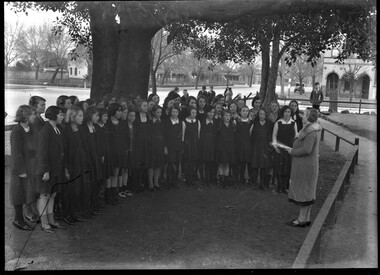 City of Melbourne Libraries
Photograph (item), Bull, Hugh Jones, 1897-1993, Miss Ida Park conducts the North Fitzroy State School Choir
... Australian Jewish News (Melbourne, Vic. : 1935 - 1999), p. 35. Retrieved September 23, 2025, from http://nla.gov.au/nla.news-article262493757 No title (1935, June 11). The Herald (Melbourne, Vic. : 1861 - 1954), p. 27. Retrieved September 29, 2025, from http://nla.gov.au/nla.news-article244840169 Dine, wine, and watch a stage show (1966, November 16). The Australian Women's Weekly...Australian Jewish News (Melbourne, Vic. : 1935 - 1999), p. 35. Retrieved September 23, 2025, from http://nla.gov.au/nla.news-article262493757 No title (1935, June 11). The Herald (Melbourne, Vic. : 1861 - 1954), p. 27. Retrieved September 29, 2025, from http://nla.gov.au/nla.news-article244840169 Dine, wine, and watch a stage show (1966, November 16). The Australian Women's Weekly ...The pupils of Falconer Street Central School No.3918 in North Fitzroy rehearse with conductress Miss Ida Park for their performance at the Temperance Hall, Russell Street Melbourne with proceeds going to the Lord Mayor’s Fund. The house on the right of the photograph is Jubilee House, 126 Michael Street North Fitzroy and is extant. Photographer notations on slide: Choir At Fitzroy State School 1933 B5 While this photograph appears not to have been published, a photograph taken from a different angle of the same event was published in The Age 21 July 1933. SCHOOL CHILDREN SING IN THE OPEN AIR. “A choir of children at North Fitzroy practise their songs for a Pantomime, to be given in the Temperance Hall for the Lord Mayor's Fund on Wednesday next. On the extreme left is the conductress of the Choir (Miss Ida Park).” Reference: http://nla.gov.au/nla.news-article204368572 Research by project volunteer, Fiona Collyer: Children of The Falconer Street Central School Choral Society, trained by conductress Miss Ida Park, along with dance and gymnastics pupils of Misses Dorothy Gibb and Inez Ellis, performed in the “Cinderella” pantomime at the Temperance Hall in Russell Street, Melbourne on 26 July, 1933. The proceeds went to the Lord Mayor’s Fund. Conductress Miss Ida Park (1904- 1952) lived in the North Fitzroy and Clifton Hill area all her life. She was immersed in the music world of Melbourne and was a member of the Musical Society of Victoria. Ida graduated from Melbourne University Conservatorium with a Bachelor of Music degree in 1929 before departing for London where she studied piano and organ at the Royal Academy of Music. Ida returned to Melbourne in 1931, and billed as “The Gifted Young Australian Pianist”, held pianoforte recitals of classical music at Assembly Hall, Collins Street. She also played the organ for services at St Paul’s Independent Church in Delbridge Street, North Fitzroy and later St Luke’s, North Fitzroy. Ida conducted the children of the Falconer Street Central School Choral Society as they competed in the State School Choral Championships and the 85 children of the Fitzroy City Centenary Choir who sang at Melbourne’s Centenary celebrations of 1934/35. In 1945, Ida married Charles Hazeldine, a tenor and returned digger who had served in two world wars. The pair performed together in many concerts over the years. Tragically, both Ida and Charles were badly injured when struck by a car while crossing Queens Parade Clifton Hill in June 1952, with Ida dying from head injuries at St Vincent’s Hospital soon after. She was 48 years old. Charles wrote on Ida’s death notice - “Called home.” The choir were pupils of Falconer Street Central School No. 3918 in North Fitzroy which was built in 1915 to provide upper primary education for grades 5 to 8 for the area. In 1957 it became Fitzroy High School. In 1992, the Kennett Government swept to power, embarking on a program of fiscal austerity and privatisation of government services. 390 government schools were closed, with the land proposed to be sold to developers. 7000 teachers were sacked: 10% of Victoria’s public school teachers. Auxiliary school staff also lost their jobs. Amongst the first to close was Fitzroy High School. Fearful that the land would be sold, hundreds of students, parents, teachers and local residents occupied the building around-the-clock in four hour shifts and overnight for 14 months, sleeping on gym mats in the principal’s office and administrators’ wing. The blockade was lifted when a arrangement was reached to allow Kangan Batman TAFE to use the school from 1993 until 1998. With the election of the Bracks Government in 1999, and construction of new buildings, Fitzroy High School was reopened in 2004 after a 12 year battle. Temperance Hall, at 172 Russell Street, where the children performed “Cinderella”, was built in 1872 by the Melbourne Total Abstinence Society as a venue for lectures, meetings and alcohol-free community concerts and events. From 1934, Temperance Hall was fitted out as a cinema and renamed the Imperial Theatre, showing popular Hollywood films, before closing in 1939 for renovations and reopening as the Savoy Theatre, Melbourne’s first “Continental” talkies cinema. At this time, Australian cinema programming was dominated by American and British films. The lessees, Continental Film Art Theatre began negotiating for theatre properties in Melbourne, Sydney, Adelaide, Brisbane, Perth and Auckland to screen foreign language films, hoping to present the finest productions from France, Germany, Holland and Italy. At the cost of £6000, the theatre was fitted with the latest Mirrophonic sound and projection system and enlarged to seat 800 patrons with luxurious, ultra modern fittings and furnishings in a colour palette of rust and beige. Instead of usherettes, General Manager Peter Dawson, hoping to bring a sophisticated European atmosphere to the theatre, employed attractive, multilingual “Continental hostesses” to assist guests (not patrons) and answer queries relating to the films. Collectively the hostesses spoke English, French, Dutch, German, Russian and Italian. The Age 20 May 1939- “Atmosphere is a very important part of the theatre's scheme. Ushers in the ordinary sense will not be employed; hostesses will look upon patrons as guests. They will be dressed in full evening dress, and the only indication that they are not guests is the little medallion pinned to their evening dress, on which their names are inscribed.” The hostesses were dressed in evening gowns of olive-green velvet, the full skirts embroidered with gold loops, wine velvet bolero jackets and long white kid gloves with silvery tiaras in their hair. For guests worried that they may not understand the plot, the management assured patrons that- “By means of superimposed English translations on the bottom of the screen, the dialogue is perfectly understandable and the whole witty story can be followed with ease.” The Gala opening of the Savoy Theatre, on 31 May 1939 was attended by a “who’s who” of Melbourne Society, the women wearing beautiful gowns, headdresses and furs. Amongst the guests were former premier Sir Stanley Argyle and Lady Argyle, former Lord Mayor Sir Harold Gengoult-Smith and his wife Cynthia, Field Marshall Thomas Blamey and Lady Blamey and Miss Jessie Brookes. The Vice Consul for France, Monsieur Frank Puaux and his wife attended, Madame Puaux dressed in a black satin gown and a musquash fur cape. She was presented with a beautiful bouquet of scarlet carnations and lily of the valley tied with the tricolour of France. In his speech Monsieur Puaux stated that “from the cultural, linguistic and artistic points of view it was excellent that the Australian public should have an opportunity to see foreign film in the original language.” “Letty” writing in Table Talk magazine described the atmosphere of “Continental” gaiety that had permeated Melbourne - “The Letters of Letty”, Table Talk 8 June 1939 “The “foreign influence” is definitely obtruding itself into the even tenor of Melbourne life these days…. but in the pleasantest manner possible! Included in the great number of Continental people who have recently made their homes here, we have stars of the Russian ballet settling in our midst…. and now… we have been presented with our own Continental picture theatre in the attractive shape of The Savoy, which opened its doors on Wednesday night for the exclusive release of foreign films. One could hardly recognise the old Temperance Hall in its adaptation to the smart, comfortable and thoroughly-intriguing Savoy Theatre. Where once this rather draughty old building stood in Russell Street there now greets us an unmistakable “Continental” edifice, living up to its exterior by sustaining within its walls its overseas’ atmosphere. Indeed, one feels as though one has crossed the threshold into a European city, stepping out of the unmistakably Australian street that is Russell into The Savoy lounge to be greeted by polite “messieurs” from the attractive, Continental-looking usherettes and to gaze upon a film as delightfully French in story and presentation as “La Kermesse Heroique.” But successful though “La Kermesse Heroique” proved on its initial presentation inside the theatre, the debut was no more triumphal than that made by the winning and pretty little French lass who had charge of the booking office outside in the foyer. With her attractive accent and Continental flair for making one “feel at home” she was undoubtedly one of the hits of the night-especially with the susceptible males, who spent very much longer in the lounge than is customary, racking their brains for excuses for making conversation with the attractive Parisienne! Those French girls certainly have a way with them!” The opening film, the 1935 French comedy “La Kermesse Heroique”, (The Heroic Sex) starring Francoise Rosay and Jean Murat (film now called “Carnival in Flanders”) was the winner of the Grand Prix du Cinema Francais as the finest picture of 1936 and described in the advertisement as “The Gay French Comedy of Laughter and Romance” The film is set during the 17th century Spanish occupation of Flanders in the Flemish town of Boom at the time of their annual festival. Hearing news of a pending visit to Boom by the commander, the Duke of Olivares and his army, and fearing rape and pillage, the boorish burgomaster feigns his own death, hoping the Spaniards will bypass the grieving town out of respect. The army arrives and the cowardly men of the town flee. The womenfolk decide on a different approach. Lead by the burgomaster’s beautiful wife Cornelia, they set out to to preserve the peace with grace and hospitality only to find the Spaniards attractive and virile, unlike their own husbands. The Sun newspaper described the film as “Mellow as a Stilton cheese, and as ripely suited to adult taste.” Preceding “La Kermesse Heroique” was a Gaumont British newsreel of King George VI and Queen Elizabeth departing for a tour of Canada and the Soviet documentary “Nine Months on a Drifting Ice Floe” During the war “Continental” films became difficult to source, so the Savoy screened Hollywood movies and held fund raisers for the war effort. After World War Two, the Savoy continued to screen “Continental” films, catering to post-war immigrants from Europe and bohemian Melburnians. In 1953, the Savoy had a wildly popular season with queues winding around the block to see Swedish summer romance “One Summer of Happiness” (Hon dansade en sommar) with its nude swimming scenes. The Chief Commonwealth Censor declined to cut the film on the grounds that although it displayed nudity, it was genuinely artistic. According to Wikipedia, film director Fred Schepisi was first exposed to European films such as “Bicycle Thieves”, “Rocco and His Brothers” and “The Wages of Fear” at the Savoy as a teenager, leading to his long career in filmmaking. In 1955, in response to the massive rise in car ownership, the Melbourne City Council recommended that parking stations be built on every block. The Savoy Theatre and adjacent buildings, which included the Golden Fleece Hotel were demolished in 1963 and replaced with Total House, a Brutalist commercial building consisting of a seven storey car park crowned by a four storey office block, shops at street level, and a basement theatre which housed the Lido Theatre Restaurant-Cabaret from 1965. The building was designed by architectural firm Bogle & Banfield Associates and named for the original tenant of the offices, French oil company, Total Oil Products P/L. The Lido Theatre Restaurant was managed by former Tivoli dancer and promoter David Hamilton McIlwraith, presenting dinner and a glamorous cabaret floor show of showgirls, (some topless) to accompany variety acts by local and international actors, singers, comedians and magicians. The interior of the Lido was opulently decorated in deep, lush green with old world gold trim and chandeliers. Handily, patrons could enter and leave via an elevator, straight from the building’s own car park! A four course gourmet dinner with show and dancing cost $8.00 in 1968. The Lido advertised in 1966 that “Every visitor to Melbourne soon discovers the brightest entertainment spot in the Southern Hemisphere with its million dollar decor, dining delights and spectacular stage productions.” Australian Jewish News - 21 April 1967 - “Superb decor and atmosphere, cuisine and service have been readily recognised as the contributing factors to the excellence of stage presentations, staging, costumes, decor and, of course, the actual choice of artists.” The bedazzling ensemble of 40 high-kicking, feathered and sequinned showgirls were advertised as the “Fabulous Lido girls and the controversial Baretop Lido Goddesses” who were described as “Statuesque Beauty as Nature intended” and “…a host of glamorous gals whose favourite shade is flesh pink.” Some of the acts who performed at the Lido were- -Broken Hill’s own - opera singer June Bronhill -1967. -Versatile singer Lovelace Watkins known as “Black Sinatra - 1967. -“Queen of the five-fingered boogie", honky-tonk and rollicking rag-time pianist, Winifred Atwell - 1967. -New Zealand pop duo, Bill and Boyd -1968. -American actress and soprano Kathryn Grayson -1968. -Denise Drysdale in “Say It With Music” -1968. -“Catwoman” Eartha Kitt -1969. -Internationally recognised female impersonator, Sydneysider Tracey Lee, (Maxwell Richie) billed as "controversial impressionist and singing personality from the famous Carousel Nightspot in Paris". -Frances Faye, American comedienne and show-tune singer and pianist-1969. -“Cry Guy” histrionic singer Johnnie Ray -1970. -Risqué revue “Oh Calcutta!” with some segments and the “four letter” words removed-1970. In 1970, under new management, the Lido was renovated with claret and gold wallpaper, midnight blue ceiling and a computerised fountain with fairy lights and relaunched by “The Tigress from Tiger Bay”, Shirley Bassey. The relaunch was short lived however, as later that year the venue became El Toro Espana, a Spanish restaurant and nightclub offering a four course meal for $4.50 while you watched the floorshow. The venue then briefly became the Red Garter Music Hall Theatre from 1972, then in 1974 the site became the 600 seat Total Theatre comprising of a cinema with a stage for live acts. There were also three bars to choose from - the Crush Bar, the Bleachers and the Snake Pit. Total Theatre had the unusual concept of a live music act, or plays, musicals and magicians followed by a film. In 1975 soprano Suzanne Steele featured, followed by the film “The Voyage” starring Sophia Loren and Richard Burton. In 1975, the Total held a rock film festival showing a Jimi Hendrix documentary, “Monterey Pop Festival”, “Pink Floyd in Pompeii” and more. In 1976, 17 year old Chrissy Amphlett, later of rock band Divinyls, played the role of Linda Lips for nine months in the Australian stage production of R-rated “sexual musical”, “Let My People Come” at the Total Theatre. The Total Theatre closed in 1979 and from 1980 to 2014 the venue became Billboard Nightclub, hosting local and international acts, including INXS, Tina Turner and John Farnham, and in 2009, 18 year old Taylor Swift. The venue is now called 170 Russell and presents hundreds of live local and international acts every year. In 2014, after being under threat of demolition, Total House was listed on the Victorian Heritage Register as “a landmark of post-World War II modernist design and…one of the earliest and best expressions of Brutalist architecture in Victoria”. References: RICHARD CROOKS ARRIVES SCHOOL AGAIN VENUE OF ROYAL VISIT (1939, May 31). The Age (Melbourne, Vic. : 1854 - 1954), p. 17. Retrieved November 21, 2025, from http://nla.gov.au/nla.news-article205629696 AMUSEMENTS. (1933, July 27). The Age (Melbourne, Vic. : 1854 - 1954), p. 12. Retrieved September 19, 2025, from http://nla.gov.au/nla.news-article204378853 https://larzra.wordpress.com/origins/ CONTINENTAL HOSTESSES, (1939, May 31). The Sun News-Pictorial (Melbourne, Vic. : 1922 - 1954; 1956), p. 27. Retrieved November 21, 2025, from http://nla.gov.au/nla.news-article278189387 The Letters of Letty (1939, June 8). Table Talk (Melbourne, Vic. : 1885 - 1939), p. 12. Retrieved October 29, 2025, from http://nla.gov.au/nla.news-article149320966 SAVOY THEATRE (1939, June 1). The Age (Melbourne, Vic. : 1854 - 1954), p. 7. Retrieved September 19, 2025, from http://nla.gov.au/nla.news-article205639035 NEW THEATRE OPENED (1939, June 1). The Argus (Melbourne, Vic. : 1848 - 1957), p. 8. Retrieved September 21, 2025, from http://nla.gov.au/nla.news-article12134234 https://en.wikipedia.org/wiki/Total_House Page [?] TOUCH OF SPAIN (1970, December 18). The Australian Jewish News (Melbourne, Vic. : 1935 - 1999), p. 35. Retrieved September 23, 2025, from http://nla.gov.au/nla.news-article262493757 No title (1935, June 11). The Herald (Melbourne, Vic. : 1861 - 1954), p. 27. Retrieved September 29, 2025, from http://nla.gov.au/nla.news-article244840169 Dine, wine, and watch a stage show (1966, November 16). The Australian Women's Weekly (1933 - 1982), p. 6. Retrieved November 9, 2025, from http://nla.gov.au/nla.news-article44025050 http://jonathanbollen.net/2011/02/26/tracey-lee/ LIDO ‘ART’ (1967, April 21). The Australian Jewish News (Melbourne, Vic. : 1935 - 1999), p. 8. Retrieved November 9, 2025, from http://nla.gov.au/nla.news-article263003136 THE FABULOUS LIDO (1965, October 22). The Australian Jewish News (Melbourne, Vic. : 1935 - 1999), p. 17. Retrieved November 9, 2025, from http://nla.gov.au/nla.news-article262983995 No title (1939, May 31). The Argus (Melbourne, Vic. : 1848 - 1957), p. 6. Retrieved November 21, 2025, from http://nla.gov.au/nla.news-article12134144 #NEW THEATRE OPENED (1939, June 1). The Argus (Melbourne, Vic. : 1848 - 1957), p. 8. Retrieved September 29, 2025, from http://nla.gov.au/nla.news-article12134234 https://en.wikipedia.org/wiki/Tracey_Lee_(female_impersonator) https://citycollection.melbourne.vic.gov.au/35b-40h-image-of-a-model-for-the-total-house-offices-and-car-park-on-russell-street/ https://www.theage.com.au/national/victoria/from-the-archives-1990-s-hundreds-of-school-closures-hit-victoria-20190801-p52cwj.html http://jonathanbollen.net/2011/05/29/the-lido-melbourne/Photographer notations on slide: primary schools, schools, music, education, choirs, fitzroy, cars, theatre restaurants, venues, films -
 Sunshine and District Historical Society Incorporated
Archive - Arlene Andrewartha Dossier, Arlene Andrewartha, 1954 - 1958
... Email containing a photograph of Arlene dated 30 April 2014|Type written notes Arlene satisfying a model ambition|Email dated 28 March 2014 contains Posts pick of a thousand beautiful women Our Miss Australia and Wegs Day cartoon|Newspaper Article Arlene Andrewartha Life after Sunshine Technical School|Newspaper Article Sunshine Advocate 26 November 1954 Local girl in Miss Teen Age Quest|Email dated 12 March 2014|Email dated 15 March 2014|Email dated 15 March 2014|Email dated 16 March 2014|Email dated 16 March 2014|Email dated 16 March 2014 contains Abion State School Photograph|Email dated 16 March 2014|Email dated 16 March 2014|Newspaper Article dated 25 November 1959 The Weekly Round|Email dated 16 March 2014|Email dated 16 March 2014 Photograph of students when Arlene was 10|Email dated 21 March 2014 Photographs of Miss Sunshine whe Arlene was 14|Email dated 21 March 2014 Photographs from The Sun newspaper|Email dated 22 March 2014 Photograph of the 1956 Debutantes and program|Email dated 22 March 2014 Dance program|Program Albion State School Mothers Club Parade of Fashion and Faults or the ABC of Dress 20 July 1956|Ticket 14 April 1956 Grand United Cricket Club Presentation Night Albion Progress hall|Email dated 25 March 2014|Ticket Football Centenary Year Sunshine Football Club Cabaret Ball 4 July 1958|Program Sunshine City Band Grand Cabaret Ball at Sunshine Town Hal 6 June 1958|Email dated 25 March 2014 Program Sunday Carnival Crowning of the Queen Footscray Oval 30 November 1957|Email dated 29 March 2014 Ticket Sunshine Hospital Ball Belle of the Ball 6 July 1956|Email dated 29 March 2014 Photograph of Arlenes house been built|Ticket Sunshine District Community Hospital Second Annual Ball 16 July 1954 Belle of the Ball|Ticket Finalist for the Belle of Sunshine Hospital Ball 1954|Email dated 29 March 2014 Train Tickets from Albion to Sunshine|Email dated 29 March 2014 Photographs from Debutantes night|Newspaper Pix 22 February 1958 A girl like Kim|Email dated 4 April 2014 Photographs of Debutantes|Email dated 7 April 2014 Photographs Belle of the Ball night 1955|Email dated 7 April 2014 Photograph at Sunshine Technical School reunion with Rhonda Francis...Andrewartha Sunshine City Band Sunshine Football Club Sunshine Hospital Sunshine Technical School Band Football Hosptial Technical School Email containing a photograph of Arlene dated 30 April 2014|Type written notes Arlene satisfying a model ambition|Email dated 28 March 2014 contains Posts pick of a thousand beautiful women Our Miss Australia and Wegs Day cartoon|Newspaper Article Arlene Andrewartha Life after Sunshine Technical School|Newspaper Article Sunshine Advocate 26 November 1954 Local girl in Miss Teen Age Quest|Email dated 12 March 2014|Email dated 15 March 2014|Email dated 15 March 2014|Email dated 16 March 2014|Email dated 16 March 2014|Email dated 16 March 2014 contains Abion State School Photograph|Email dated 16 March 2014|Email dated 16 March 2014|Newspaper Article dated 25 November 1959 The Weekly Round|Email dated 16 March 2014|Email dated 16 March 2014 Photograph of students when Arlene was 10|Email dated 21 March 2014 Photographs of Miss Sunshine whe Arlene was 14|Email dated 21 March 2014 Photographs from The Sun newspaper|Email dated 22 March 2014 Photograph of the 1956 Debutantes and program|Email dated 22 March 2014 Dance program|Program Albion State School Mothers Club Parade of Fashion and Faults or the ABC of Dress 20 July 1956|Ticket 14 April 1956 Grand United Cricket Club Presentation Night Albion Progress hall|Email dated 25 March 2014|Ticket Football Centenary Year Sunshine Football Club Cabaret Ball 4 July 1958|Program Sunshine City Band Grand Cabaret Ball at Sunshine Town Hal 6 June 1958|Email dated 25 March 2014 Program Sunday Carnival Crowning of the Queen Footscray Oval 30 November 1957|Email dated 29 March 2014 Ticket Sunshine Hospital Ball Belle of the Ball 6 July 1956|Email dated 29 March 2014 Photograph of Arlenes house been built|Ticket Sunshine District Community Hospital Second Annual Ball 16 July 1954 Belle of the Ball|Ticket Finalist for the Belle of Sunshine Hospital Ball 1954|Email dated 29 March 2014 Train Tickets from Albion to Sunshine|Email dated 29 March 2014 Photographs from Debutantes night|Newspaper Pix 22 February 1958 A girl like Kim|Email dated 4 April 2014 Photographs of Debutantes|Email dated 7 April 2014 Photographs Belle of the Ball night 1955|Email dated 7 April 2014 Photograph at Sunshine Technical School reunion with Rhonda Francis Documents containing notes, photographs (USB) and photocopies of Arlenes history from a child in Sunshine to a model including Miss Sunshine and Model of the year Various cards and booklets from events Train tickets Archive Arlene Andrewartha Dossier Arlene Andrewartha ...Email containing a photograph of Arlene dated 30 April 2014|Type written notes Arlene satisfying a model ambition|Email dated 28 March 2014 contains Posts pick of a thousand beautiful women Our Miss Australia and Wegs Day cartoon|Newspaper Article Arlene Andrewartha Life after Sunshine Technical School|Newspaper Article Sunshine Advocate 26 November 1954 Local girl in Miss Teen Age Quest|Email dated 12 March 2014|Email dated 15 March 2014|Email dated 15 March 2014|Email dated 16 March 2014|Email dated 16 March 2014|Email dated 16 March 2014 contains Abion State School Photograph|Email dated 16 March 2014|Email dated 16 March 2014|Newspaper Article dated 25 November 1959 The Weekly Round|Email dated 16 March 2014|Email dated 16 March 2014 Photograph of students when Arlene was 10|Email dated 21 March 2014 Photographs of Miss Sunshine whe Arlene was 14|Email dated 21 March 2014 Photographs from The Sun newspaper|Email dated 22 March 2014 Photograph of the 1956 Debutantes and program|Email dated 22 March 2014 Dance program|Program Albion State School Mothers Club Parade of Fashion and Faults or the ABC of Dress 20 July 1956|Ticket 14 April 1956 Grand United Cricket Club Presentation Night Albion Progress hall|Email dated 25 March 2014|Ticket Football Centenary Year Sunshine Football Club Cabaret Ball 4 July 1958|Program Sunshine City Band Grand Cabaret Ball at Sunshine Town Hal 6 June 1958|Email dated 25 March 2014 Program Sunday Carnival Crowning of the Queen Footscray Oval 30 November 1957|Email dated 29 March 2014 Ticket Sunshine Hospital Ball Belle of the Ball 6 July 1956|Email dated 29 March 2014 Photograph of Arlenes house been built|Ticket Sunshine District Community Hospital Second Annual Ball 16 July 1954 Belle of the Ball|Ticket Finalist for the Belle of Sunshine Hospital Ball 1954|Email dated 29 March 2014 Train Tickets from Albion to Sunshine|Email dated 29 March 2014 Photographs from Debutantes night|Newspaper Pix 22 February 1958 A girl like Kim|Email dated 4 April 2014 Photographs of Debutantes|Email dated 7 April 2014 Photographs Belle of the Ball night 1955|Email dated 7 April 2014 Photograph at Sunshine Technical School reunion with Rhonda Francisandrewartha, sunshine city band, sunshine football club, sunshine hospital, sunshine technical school, band, football, hosptial, technical school
