
Showing 1897 items matching "australian wood"
-
 The Beechworth Burke Museum
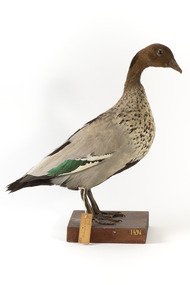
Animal specimen - Australasian Wood Duck (male), Trustees of the Australian Museum, 1860-1880
... ...australian wood duck...The Australasian Wood Duck is commonly described as 'goose-like' in appearance. They reside throughout Australia and Tasmania in regions including grasslands, open woodlands, wetlands, flooded pastures and along the coast and bays. ...This male Australian Wood Duck has a dark brown head with a pale brown-grey speckled body. ...This collection continues to be on display in the Museum and has become a key part to interpreting the collecting habits of the 19th century. taxidermy mount taxidermy animalia burke museum beechworth australian museum skin reynell eveleigh johns bird australian birds australaisian shovelor shovelor wood duck male male duck australian wood duck 132. / Maned Goose / Male / 132 This male Australian Wood Duck has a dark brown head with a pale brown-grey speckled body. ...The Australasian Wood Duck is commonly described as 'goose-like' in appearance. They reside throughout Australia and Tasmania in regions including grasslands, open woodlands, wetlands, flooded pastures and along the coast and bays. Unlike some breeds of ducks, this species can walk on land with ease and can often be seen perched on logs and in trees. The Wood Duck eat grass, clover and other herbs. On occasion they eat insects. This specimen is part of a collection of almost 200 animal specimens that were originally acquired as skins from various institutions across Australia, including the Australian Museum in Sydney and the National Museum of Victoria (known as Museums Victoria since 1983), as well as individuals such as amateur anthropologist Reynell Eveleigh Johns between 1860-1880. These skins were then mounted by members of the Burke Museum Committee and put-on display in the formal space of the Museum’s original exhibition hall where they continue to be on display. This display of taxidermy mounts initially served to instruct visitors to the Burke Museum of the natural world around them, today it serves as an insight into the collecting habits of the 19th century.This specimen is part of a significant and rare taxidermy mount collection in the Burke Museum. This collection is scientifically and culturally important for reminding us of how science continues to shape our understanding of the modern world. They demonstrate a capacity to hold evidence of how Australia’s fauna history existed in the past and are potentially important for future environmental research. This collection continues to be on display in the Museum and has become a key part to interpreting the collecting habits of the 19th century.This male Australian Wood Duck has a dark brown head with a pale brown-grey speckled body. The lower belly of this specimen is dark brown and the bill is a pale grey-yellow. The legs are a pale grey and stand upon a wooden platform. There is a paper tag tied to the upper part of the Wood Duck's right leg, a white label attached to the front right of the wooden platform and a grey label on the left beside the white label. 132. / Maned Goose / Male / 132taxidermy mount, taxidermy, animalia, burke museum, beechworth, australian museum, skin, reynell eveleigh johns, bird, australian birds, australaisian shovelor, shovelor, wood duck, male, male duck, australian wood duck -
 4th/19th Prince of Wales's Light Horse Regiment Unit History Room
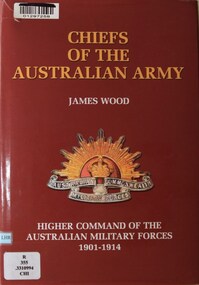
Book, James Wood, Chiefs of the Australian Army - Higher Command of the Australian Military Forces 1901-1914, 2006
... Hardcover book by James Wood on Chiefs of the Australian Army 1901-1914...Wood...Australian Military History Publications...australian army higher command biographies australian army higher command biographies Stamps and markings from previous owner - Defence Library Service - Watsonia ISBN 1-876439-40-8 Hardcover book by James Wood on Chiefs of the Australian Army 1901-1914 Chiefs of the Australian Army - Higher Command of the Australian Military Forces 1901-1914 Book Book James Wood Australian Military History Publications Army History Unit Shannon Books ...Hardcover book by James Wood on Chiefs of the Australian Army 1901-1914Stamps and markings from previous owner - Defence Library Service - Watsonia ISBN 1-876439-40-8australian army, higher command, biographies, australian army, higher command, biographies -
 The Beechworth Burke Museum
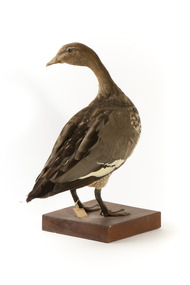
Animal specimen - Australasian Wood Duck (female), Trustees of the Australian Museum, 1860-1880
... ...australian wood duck...The Australasian Wood Duck is commonly described as 'goose-like' in appearance. They reside throughout Australia and Tasmania in regions including grasslands, open woodlands, wetlands, flooded pastures and along the coast and bays. ...This collection continues to be on display in the Museum and has become a key part to interpreting the collecting habits of the 19th century. taxidermy mount taxidermy animalia burke museum beechworth australian museum skin reynell eveleigh johns bird australian birds australaisian shovelor shovelor wood duck australian wood duck female duck maned duck female .... ...The Australasian Wood Duck is commonly described as 'goose-like' in appearance. They reside throughout Australia and Tasmania in regions including grasslands, open woodlands, wetlands, flooded pastures and along the coast and bays. Unlike some breeds of ducks, this species can walk on land with ease and can often be seen perched on logs and in trees. The Wood Duck eat grass, clover and other herbs. On occasion they eat insects. This specimen is part of a collection of almost 200 animal specimens that were originally acquired as skins from various institutions across Australia, including the Australian Museum in Sydney and the National Museum of Victoria (known as Museums Victoria since 1983), as well as individuals such as amateur anthropologist Reynell Eveleigh Johns between 1860-1880. These skins were then mounted by members of the Burke Museum Committee and put-on display in the formal space of the Museum’s original exhibition hall where they continue to be on display. This display of taxidermy mounts initially served to instruct visitors to the Burke Museum of the natural world around them, today it serves as an insight into the collecting habits of the 19th century.This specimen is part of a significant and rare taxidermy mount collection in the Burke Museum. This collection is scientifically and culturally important for reminding us of how science continues to shape our understanding of the modern world. They demonstrate a capacity to hold evidence of how Australia’s fauna history existed in the past and are potentially important for future environmental research. This collection continues to be on display in the Museum and has become a key part to interpreting the collecting habits of the 19th century.The female Wood Duck has a pale brown head with dark glass eyes. The head is looking backwards over left shoulder. The bill is a dull grey colour and the legs are a similar grey.The breast is speckled cream-grey with a white lower belly and under-tail. There is a paper tag tied to the upper part of the Wood Duck's right leg, a white label attached to the front right of the wooden platform and a grey label on the left beside the white label.....[missing] Goose / ....[missing] page 38. / 133 /taxidermy mount, taxidermy, animalia, burke museum, beechworth, australian museum, skin, reynell eveleigh johns, bird, australian birds, australaisian shovelor, shovelor, wood duck, australian wood duck, female duck, maned duck, female -
 Hepburn Shire Council Art and Heritage Collection
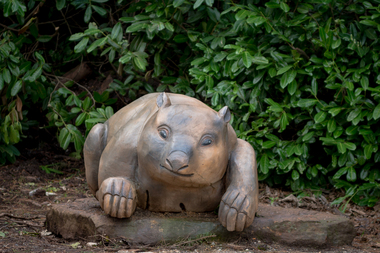
Public Art Work, 'Wombat' - Miriam Porter. 2013, 2012 - 2013
... ...australian wood...Cultural and Artistic Significance - Miriam Porter's 'Wombat' is a symbol of the Wombat Hill Botanical Gardens where visitors and locals alike love being photographed. daylesford hepburn shire public art miriam porter wombat art sculpture red gum australian wood australia tourist attraction Artist intends to sign the work with 'M' on one leg. ...Commissioned by the Friends of Wombat Hill Botanical Gardens and gifted to the Hepburn Shire in 2012. Historical Significance - In 1848, Irish immigrant John Egan took up land on the future town site then known as Wombat Flat. He and a party of searchers found alluvial gold in 1851 on ground now covered by Lake Daylesford initiating the local gold rush. Other finds quickly followed. With the finding of alluvial gold a town site was surveyed and founded in 1852. Initially called Wombat, it was renamed Daylesford. Cultural and Artistic Significance - Miriam Porter's 'Wombat' is a symbol of the Wombat Hill Botanical Gardens where visitors and locals alike love being photographed. Large scale solid redgum wombat sculpture.Artist intends to sign the work with 'M' on one leg.daylesford, hepburn shire, public art, miriam porter, wombat, art, sculpture, red gum, australian wood, australia, tourist attraction -
 Bendigo Art Gallery
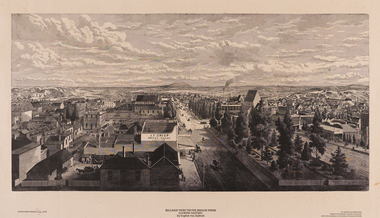
Work on paper, Eugene VON GUERARD, Ballarat from the Fire Brigade Tower (Looking East) 1870, 1870
... ... australian artist... Ballarat... wood...Work on paper print printmaker printmaking australian artist Ballarat wood engraving city town regional victoria goldfields c.l; Limited Edition number PROOF of 150, c; Ballarat from the Fire Brigade Tower/ (Looking East) 1870/ by Eugene Von Guerard, c.r;; An engraving printed from/Eugene Von Guerards original woodblock/now in the possession of the Ballarat Historical Society Ballarat from the Fire Brigade Tower (Looking East) 1870 Work on paper Eugene VON GUERARD ...c.l; Limited Edition number PROOF of 150, c; Ballarat from the Fire Brigade Tower/ (Looking East) 1870/ by Eugene Von Guerard, c.r;; An engraving printed from/Eugene Von Guerards original woodblock/now in the possession of the Ballarat Historical Societywork on paper, print, printmaker, printmaking, australian artist, ballarat, wood engraving, city, town, regional victoria, goldfields -
 Bendigo Historical Society Inc.
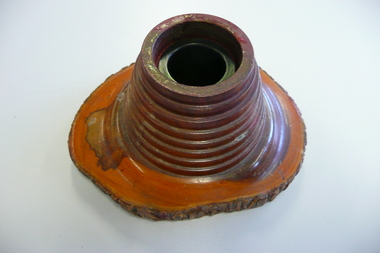
Functional object - WOODEN INKWELL
... Wooden inkwell with bakelite insert made from Australian mulga wood with top turned in steps....DOMESTIC EQUIPMENT Writing equipment ink well Genuine Australian Mulga Wooden inkwell with bakelite insert made from Australian mulga wood with top turned in steps. Functional object WOODEN INKWELL ...Wooden inkwell with bakelite insert made from Australian mulga wood with top turned in steps.Genuine Australian Mulgadomestic equipment, writing equipment, ink well -
 Sunshine and District Historical Society Incorporated
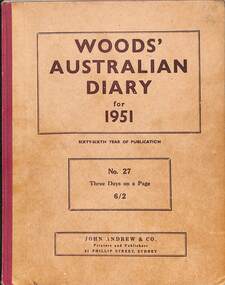
Journal - Farmer's Dairy, John Andrew & Co, 1950
... Wood's Australian diary for 1951 No 27 Three Days on a Page...McKay Massey Harris Sunshine Harvester Works New South Wales Narrandera Wood's Australian diary for 1951 No 27 Three Days on a Page Hard covered diary with notes on the daily life of a farmer Journal Farmer's Dairy John Andrew & Co. ...Wood's Australian diary for 1951 No 27 Three Days on a Pageh.v. mckay massey harris, sunshine harvester works, new south wales, narrandera -
 Department of Energy, Environment and Climate Action
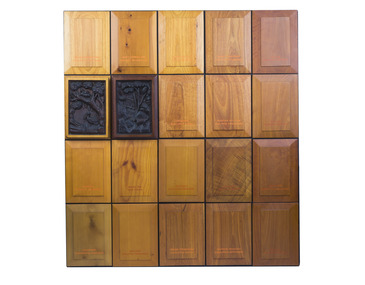
Display panel featuring different Victorian timbers, Forestry House - 601 Bourke Street
... Alternatively, in about 1994, forester Norm Endacott took them to the National Gallery for inspection by an expert in Australian wood carvers of early 20th Century who thought they may have been by Lewis John Godfrey (1836 - 1919)....Alternatively, in about 1994, forester Norm Endacott took them to the National Gallery for inspection by an expert in Australian wood carvers of early 20th Century who thought they may have been by Lewis John Godfrey (1836 - 1919). ...Timber panels salvaged from the foyer of Forestry House 601 Bourke Street in late1980s. They were on display in the Forests Commission's head office on the fourth floor of 1 Treasury Place in the 1970s The original panel comprised 76 individual samples of Victorian timbers, each with its botanical and common name identified, and four wood carvings of flora and fauna The material for the plaques was assembled in carpenters shop in FCV districts throughout the State. Timber was kiln dried by M. Feiglin & Sons at Nunawading and erected by Peter Danby Pty. Ltd. Closely linked to FCV Forestry House in MelbourneTimber Display PanelThe highly carved panels were possibly made by Robert Prenzel in about 1908. Alternatively, in about 1994, forester Norm Endacott took them to the National Gallery for inspection by an expert in Australian wood carvers of early 20th Century who thought they may have been by Lewis John Godfrey (1836 - 1919).forests commission victoria (fcv) -
 Department of Energy, Environment and Climate Action
Painting - Conrad Wood
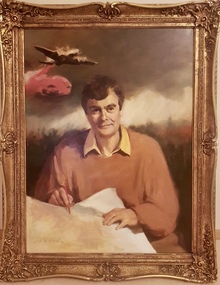
... Painting of Conrad Wood by Australian artist Joyce McGrath OAM... by Australian artist Joyce McGrath OAM Painting Conrad Wood ...Conrad Wood (Woody) graduated from the Victorian School of Forestry in 1957, and after postings with the Forests Commission Victoria (FCV) at Swifts Creek and Sirex surveys, he gravitated into the Forest Protection Division in Head Office in the early 1960s. He championed the setting up of proper contractual arrangements for aviation and was involved in implementing the first ongoing, organised contracts for firebombing in eastern Victoria in the 1960s. An early recipient of a prestigious Churchill Fellowship, Woody travelled extensively throughout 1969 in North America and Europe studying aviation in forestry and firefighting. Afterwards he was very active amongst the Churchill alumni. Woody had a passion for innovation and new technology and was instrumental in introducing new aircraft types and new approaches for forest firefighting and forest management. Amongst many other things, he played a major role in organising the trial of a RAAF C130 equipped with MAFFS for firebombing in south-eastern Australia in 1982-84, even piloting the lead plane. His inimitable style was crucial in successfully bringing together the cultures of the myriad organisations involved. Con advocated for the introduction of helicopters. He developed aerial fertilising and seeding techniques for forest management. He even managed to get involved in cloud seeding experiments for forest fire suppression and for improving water yield. Along with aviation, Conrad was passionate about literature, football, politics, food, drink, motorbikes, gardening and Glen Iris, to name a few. He was a committed campaigner on social justice issues and for many years read for vision-impaired people on public radio. He died in 2014. This painting of Woody by notable Australian artist Joyce McGrath OAM (also a Churchill Fellow) was done in the 1980s. Joyce asked Conrad to sit for this portrait which she planned to enter the Doug Moran National Portrait Prize. The portrait hung in Churchill House in Canberra, but when a new building was erected, it was returned to the artist/owner. The painting is now owned by Clare Harwood and is on permanent loan to the Forests Commission Retired Personnel Association (FCRPA) and is displayed at DEECA's Altona Museum.Painting of Conrad Wood by Australian artist Joyce McGrath OAMbushfire, bushfire aviation -
 Orbost & District Historical Society
postcards, 2008
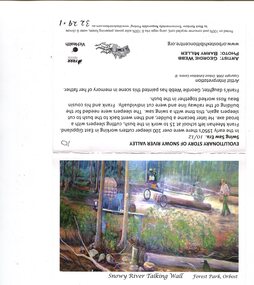
... It is the home to the National Wood Design Collection and the Annual Australian Wood Design Exhibition. Wood Workers of Orbost and District initiated the Orbost Exhibition Centre back in 1997 and it was opened in 2004. ...It is the home to the National Wood Design Collection and the Annual Australian Wood Design Exhibition. Wood Workers of Orbost and District initiated the Orbost Exhibition Centre back in 1997 and it was opened in 2004. ...These postcards were made for sale in the Orbost Ehibition Centre. The Snowy River Talking Wall is on the lower outside of the Orbost Exhibition Centre. The cards relate the history of Orbost both indigenous and white. The contributors are: Barry Miller; Gary Green; Becky Illume; Dawn Van Den Berg; Ruth Hansen; Geordie Webb; Graham Falls; Laurie Harvey and Jonathon Renn. The Orbost Exhibition Centre is a community based, not-for-profit arts and entertainment center in Orbost, Victoria. It is the home to the National Wood Design Collection and the Annual Australian Wood Design Exhibition. Wood Workers of Orbost and District initiated the Orbost Exhibition Centre back in 1997 and it was opened in 2004. (from web-site)These postcards are pictorial advertisements for Orbost. They are associated with the Orbost Exhibition Centre, an important tourist attraction, in the town.A set of eleven coloured postcards. Each depicts a section of the Snowy River Talking Wall. Each is a folded rectangle of cardboard with a photograph of a section of the display and information relating to it.talking-wall-orbost postcards orbost-exhibition-centre -
 Diamond Valley Vietnam Veterans Sub-Branch
Poster - Tunnel Rats
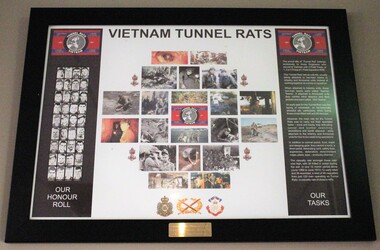
... Framed collage, of the Tunnel Rats (Sappers, Royal Australian Engineers), Vietnam. Rectangular, wood frame....Framed collage, of the Tunnel Rats (Sappers, Royal Australian Engineers), Vietnam. Rectangular, wood frame. Poster Tunnel Rats ...Collage of Tunnel Rats in action, including Honor Roll and text of Tunnel Rats tasks in Vietnam.A record of the 36 Tunnel Rats (Sappers) who died in service, of Tunnel Rat's general tasks, and 20 photos of Tunnel Rats in varying working and rest circumstances.Framed collage, of the Tunnel Rats (Sappers, Royal Australian Engineers), Vietnam. Rectangular, wood frame.Comprises 20 photos, three Tunnel Rats logos, four Corp badges and three Corp insignia with photos of the 36 Tunnel Rats (Sappers) who died in service down the lefthand side of the collage and a brief description of tasks performed by the Tunnel Rats down the righthand side of the collage. Engraved plate "Presented to the Diamond Valley Vietnam Veterans Association by Michael Van Poeteren".vietnam, vietnam war, diamond valley vietnam veterans sub branch, tunnel rats -
 Port Melbourne Historical & Preservation Society
Book - Port Melbourne Council, employee hours worked, Woods' Australian Diary from 1913, 1913
... Woods' Australian Diary from 1913 containing records of hours worked by employees e.g bricklayers, carpenters, labourers etc. ...Green/blue cover with black printing Woods' Australian Diary from 1913 Book Port Melbourne Council, employee hours worked ...Woods' Australian Diary from 1913 containing records of hours worked by employees e.g bricklayers, carpenters, labourers etc. Green/blue cover with black printinglocal government - town of port melbourne, workers, social activities -
 National Vietnam Veterans Museum (NVVM)
Painting, Unsung Heros
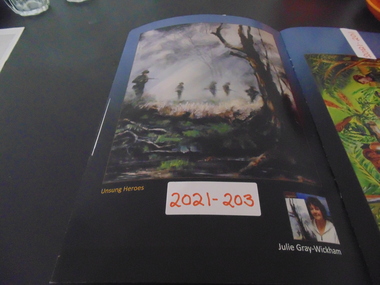
... An original painting titled "Unsung Heros" depicting six Australian soldiers walking through woods on patrol in the mist...Painting Australian Vietnam Forces Vietnam Lest We Forget An original painting titled "Unsung Heros" depicting six Australian soldiers walking through woods on patrol in the mist Unsung Heros Painting Painting ...An original painting titled "Unsung Heros" depicting six Australian soldiers walking through woods on patrol in the mistpainting, australian vietnam forces, vietnam lest we forget -
 Clunes Museum
Photograph, ca1861
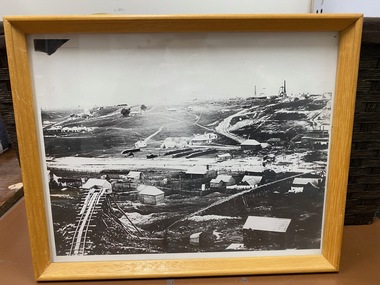
... Black and white reproduction of Port Phillip Colonial & Gold Mining Co., Clunes, Victoria, Australia in a light wood timber frame...The glass plates attributed to him by the State Library of Victoria show four images of the mines in Clunes, Victoria, Australia in the 1860's port phillip and colonial gold mining co. richard daintree On Reverse: Handwritten in pencil Port Phillip Co. 1860's Nettleton Photography glass plate Latrobe Library Black and white reproduction of Port Phillip Colonial & Gold Mining Co., Clunes, Victoria, Australia in a light wood timber frame Photograph PHOTOGRAPH RICHARD DAINTREE ...When Richard Daintree rejoined the Victorian Geological Survey as a field surveyor in January 1859, he pioneered the use of photography in field-work. The glass plates attributed to him by the State Library of Victoria show four images of the mines in Clunes, Victoria, Australia in the 1860'sBlack and white reproduction of Port Phillip Colonial & Gold Mining Co., Clunes, Victoria, Australia in a light wood timber frameOn Reverse: Handwritten in pencil Port Phillip Co. 1860's Nettleton Photography glass plate Latrobe Libraryport phillip and colonial gold mining co., richard daintree -
 Tennis Australia
Racquet, Circa 1965
... Varnished wood frame, leather grip. White painted mid-section, with red & black decals. Australian made. ...Varnished wood frame, leather grip. White painted mid-section, with red & black decals. Australian made. ...Oliver brand 'Bluebird' tennis racquet. Varnished wood frame, leather grip. White painted mid-section, with red & black decals. Australian made. Materials: Wood, Gut, Paint, Leathertennis -
Clunes Museum
Certificate - FRAMED CERTIFICATE
... ORNATE WOOD FRAMED AUSTRALIAN NATIVES CERTIFICATE AWARDED TO JOHN COOK FOR SERVICES AS PRESIDENT OF BRANCH NO. 12, CLUNES FOR THE YEAR 1914-1915...GREENHALGH A F HARDEN JOHN COOK A N A SIGNEDBY A GREENHALGH - PRESIDENT, ALF HADEN - SECRETARY ORNATE WOOD FRAMED AUSTRALIAN NATIVES CERTIFICATE AWARDED TO JOHN COOK FOR SERVICES AS PRESIDENT OF BRANCH NO. 12, CLUNES FOR THE YEAR 1914-1915 Certificate FRAMED CERTIFICATE ...THE CERTIFICATE WAS FOUND AT A SWAPMEETORNATE WOOD FRAMED AUSTRALIAN NATIVES CERTIFICATE AWARDED TO JOHN COOK FOR SERVICES AS PRESIDENT OF BRANCH NO. 12, CLUNES FOR THE YEAR 1914-1915SIGNEDBY A GREENHALGH - PRESIDENT, ALF HADEN - SECRETARYa. greenhalgh, a, f harden, john cook, a n a -
 Bendigo Military Museum
Photograph - PHOTOGRAPH WW2, FRAMED, Est 1940-42
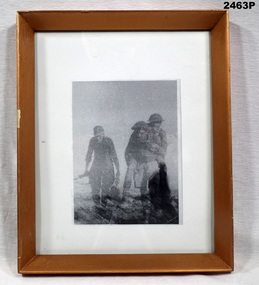
... Set on a white background shows a German Soldier carrying equipment while an Australian soldier carries a wounded Australian. Frame is wood, gold coloured....Set on a white background shows a German Soldier carrying equipment while an Australian soldier carries a wounded Australian. Frame is wood, gold coloured. Photograph PHOTOGRAPH WW2, FRAMED ...The wounded soldier is Bill Jeffers VX52782, 2/24th Batt 9 th Div. The soldier carrying Bill is Joe Battilana VX47314, the German soldier carrying the equipment had given himself up with the comment "I've had enough". Refer Ct No 147 for Bills service details.Photo B & W in frame copy of original for display. Set on a white background shows a German Soldier carrying equipment while an Australian soldier carries a wounded Australian. Frame is wood, gold coloured.photographs, military -
 Bendigo Military Museum
Book - BOOK, WW1, John Terraine, The Great War, 1997
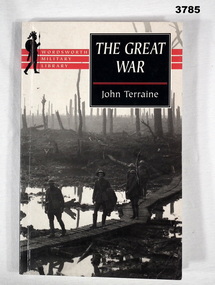
... Illustrated on front, black / white photo of Australian troops at Chateau Wood in the Ypres Salient on 29.10.1917. 195 pages, cut, plain, white. ...Illustrated on front, black / white photo of Australian troops at Chateau Wood in the Ypres Salient on 29.10.1917. 195 pages, cut, plain, white. ...Soft cardboard cover, white / red print, front spine & back. Illustrated on front, black / white photo of Australian troops at Chateau Wood in the Ypres Salient on 29.10.1917. 195 pages, cut, plain, white. No illustrations.book, great war -
 Bendigo Historical Society Inc.
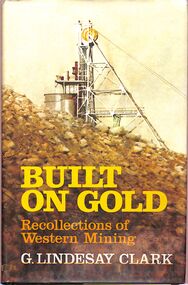
Book - "Built on Gold. Recollections of Western Mining", 1983
... After WW2 Lindesay led the re-establishment and expansion of gold mining operations within the WMC-GMA Group at centers such as Kalgoorlie, Norseman, Reedy's, Coolgardie and Bullfinch in Western Australia, and Woods Point and Newstead in Victoria. ...After WW2 Lindesay led the re-establishment and expansion of gold mining operations within the WMC-GMA Group at centers such as Kalgoorlie, Norseman, Reedy's, Coolgardie and Bullfinch in Western Australia, and Woods Point and Newstead in Victoria. ...A personal account of Sir Lindesay Clark, mining engineer. Clark records his early association with Gold Mines of Australia Limited and the formation of Western Mining Corporation Limited. He was appointed WMC's first Technical Managing Director. After WW2 Lindesay led the re-establishment and expansion of gold mining operations within the WMC-GMA Group at centers such as Kalgoorlie, Norseman, Reedy's, Coolgardie and Bullfinch in Western Australia, and Woods Point and Newstead in Victoria. In 1952 Lindesay became chairman of WMC. Lindesay had first-hand knowledge of working conditions below ground and living conditions above. "Built on Gold. Recollections of Western Mining" written by G. Lindesay Clark. Foreward by Henry Somerset. This book discusses the personal account of one of Australia's best-known mining engineers who first came linked with Collins House and W.S. Robinson in 1931. Published in Australia by Hill of Content Publishing Company in 1983. Hard cover book with dust jacket. Dust jacket has image of poppet head on front cover and image of miners on back. Cover of book is black with 'WMC' embossed into centre. Title is written in yellow and gold text. Several black and white photos in centre on book. Has index. 258 pp. mining, g. lindesay clark, gold mines of australia limited, western mining corporation -
 Tatura Irrigation & Wartime Camps Museum
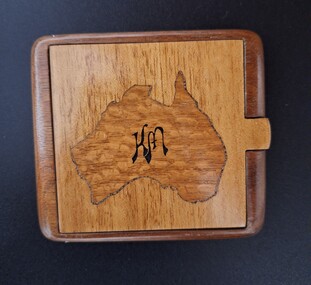
Functional object - cigarette box
... Wooden cigarette box with map of Australia cut out of lid and inlayed with map of Australia in different wood. Base of case has rounded sides and a piece trimmed out for a catch on the lid. ...Karl Muffler cigarette case Tatura camp 1 K M Wooden cigarette box with map of Australia cut out of lid and inlayed with map of Australia in different wood. Base of case has rounded sides and a piece trimmed out for a catch on the lid. ...Made in Tatura internment camp 1 by Karl Muffler during WW2. Wooden cigarette box with map of Australia cut out of lid and inlayed with map of Australia in different wood. Base of case has rounded sides and a piece trimmed out for a catch on the lid. Lid, map of Australia and rest of cigarette case are made from 3 different types of wood. Map of Australia has a "K M" written on it. K Mkarl muffler, cigarette case, tatura camp 1 -
 Melbourne Legacy
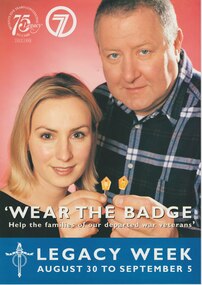
Poster, Wear the Badge. Help families of our departed war veterans', 1998
... This is an example of Melbourne Legacy promotional material from 1998. Australian actors John Wood and Lisa McCune are shown with Legacy badges. ...This is an example of Melbourne Legacy promotional material from 1998. Australian actors John Wood and Lisa McCune are shown with Legacy badges. ...This is an example of Melbourne Legacy promotional material from 1998. Australian actors John Wood and Lisa McCune are shown with Legacy badges. They were in the very popular tv police drama 'Blue Heelers' at the time. It ran from 1994 to 2006. The main time of year for fundraising is September when Legacy holds 'Badge Week'. Often there is a celebrity who gives his or her time as 'Personality of the Year'. Examples are Sir Weary Dunlop (1992), Clive James (1993), the Scott family (1994), The Emmanuel brothers (1995), Daryl Somers (1996 and 1997), and Patsy Adam Smith (1994?). Was in a folder with marketing material from the 1990s to 2009, see items 01240 to 01258. The collection shows the types of marketing materials that were produced and the celebrities that were helping Legacy.An example of promotional material from the 1990s. Marketing material and photos were compiled and released to newspapers, also printed as brochures and sometimes as stickers and collection tin wrappers.Colour A4 promotional poster with a photo of Lisa McCune and John Wood for Legacy Week 1998.Has the Channel 7 logo and the logo celebrating Legacy's 75th Anniversary.legacy promotion, badge appeal, legacy week, advertisements, 75th anniversary -
 Ballarat Tramway Museum
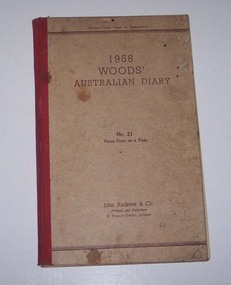
Administrative record - Log book, Diary, John Andrew & Co, 1957
... 1958 Woods' Australian Diary, No. 21, 3 days on a page, John Andrew and Co. red Rexene binding, card covers, sewn sections with ruled sheets providing a diary for 1958. ...Tram trams SEC Ballarat Depot Trackwork Rails 1958 Woods' Australian Diary, No. 21, 3 days on a page, John Andrew and Co. red Rexene binding, card covers, sewn sections with ruled sheets providing a diary for 1958. ...Yields information about the track maintenance activities of the track gang in Ballarat, the work they did, notes, names and other information.1958 Woods' Australian Diary, No. 21, 3 days on a page, John Andrew and Co. red Rexene binding, card covers, sewn sections with ruled sheets providing a diary for 1958. Has "useful information" sheets at from the diary, including a ruler along the side of the sheet. Used by the SEC Ballarat track gang to record their daily work, leave, welding, track cleaning, truck driver etc Rear pages - has notes on materials used and a list of Track gang for 1958. (December Cash Account) E. A. Goldsmith W. H. Goldsmith E. J. Davis G. McQuinn H. Hoy A. W. Cunningham N. McVitty C. Edwards E. Lakey H. Lancaster S. Chibnall H. Smith Loose contents 21/7/1958 - SEC Safety Officers Newsletter, Feb. 1958 - inside has notes and sketches where joints welded and the dates. Inside rear cover - Daily time sheet - with the addresses of the track gang on the rear. - list of materials - rails by type and sleepers on hand - Reg Item 3705 - Rules Governing Depot Employees with notes and sketches where joints welded and the dates on the rear. (Item to be stored in a separate envelope - note was folded in half and stored in the rear section)tram, trams, sec, ballarat, depot, trackwork, rails -
 Royal Australian and New Zealand College of Obstetricians & Gynaecologists (RANZCOG)
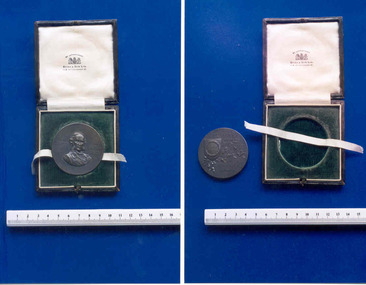
Commemorative Lister Memorial Oration medal presented to Dr George Rothwell Adam, 1922, Spink & Son Ltd, 1922 (approximate)
... The obverse of the Lister Medal shows a portrait of Lord Lister 1827-1912, and on the reverse is inscribed ‘British Medical Association, South Australian Branch, Lister Oration’. Wood Jones’ Lister Oration 1926 ‘Before a large attendance of members of the South Australian branch of the British Medical Association at Lister Hall, Hindmarsh Square [Adelaide] on Thursday evening [May 27thl Professor F. ...The obverse of the Lister Medal shows a portrait of Lord Lister 1827-1912, and on the reverse is inscribed ‘British Medical Association, South Australian Branch, Lister Oration’. Wood Jones’ Lister Oration 1926 ‘Before a large attendance of members of the South Australian branch of the British Medical Association at Lister Hall, Hindmarsh Square [Adelaide] on Thursday evening [May 27thl Professor F. ...This medal was awarded to Dr George Rothwell Adam, who was a lecturer in Obstetrics at the University of Melbourne from 1899 to 1913. As part of receiving this award, Adam delivered a Listerian Oration entitled ' The influence Listerism exercises on obstetrics' at a meeting of the South Australian Branch of the British Medical Association on May 25, 1922. "This Oration and Medal was established by the South Australian Branch of the British Medical Association in 1914. The first Oration was delivered on Thursday, June 25th of that year. On that day, the new premises of the Branch was opened. Subsequently, this annual Oration became recognized as the most important scientific event in the calendar of branch Scientific Meetings. In 1948 it was delivered by one of South Australia’s famous sons, Sir Hugh Cairns. There has been no Lister Oration since 1979. The obverse of the Lister Medal shows a portrait of Lord Lister 1827-1912, and on the reverse is inscribed ‘British Medical Association, South Australian Branch, Lister Oration’. Wood Jones’ Lister Oration 1926 ‘Before a large attendance of members of the South Australian branch of the British Medical Association at Lister Hall, Hindmarsh Square [Adelaide] on Thursday evening [May 27thl Professor F. Wood-Jones, F.R.S. of the Adelaide University, was heard with close attention during his lecture on “Disease and Individuality ’ ’. ’" from Frederic Wood Jones - his academic medals and those they honoured by B. E. Christophers, Aust. N.Z. J. Surg. (1995) 65, 122-134 Bronze coloured metal medallion with presentation box. Front of medal carries a bust image of Joseph Lister, and is inscribed "LISTER 1827-/1912". Back of medal carries an image of some foliage, topped by a shield motif. The shield carries a wreath and the text "LISTER/ORATION". Back of medal also carries the text "BRITISH/MEDICAL/ASSOCIATION/SOUTH/AUSTRALIAN/BRANCH". Edge of medal is engraved with the text "G. ROTHWELL ADAM 1922". Presentation box is covered in brown leather, with gold tooling on the lid. Inside of lid covered with cream satin, and base covered with green velvet. Small length of cream ribbon sits in case under medal allowing it to be easily lifted from the depression it sits in. Text printed inside lid reads, "BY APPOINTMENT/SPINK & SON LTD./17 & 18 PICCADILLY, W.""G.ROTHWELL ADAM 1922"numismatics -
Mission to Seafarers Victoria
Article, A Woman's Melbourne Letter
... The fittings are entirely of Australian wood. The pews, given in memory of some loved one by one of the members, are of Tasmanian hardwood. ...The fittings are entirely of Australian wood. The pews, given in memory of some loved one by one of the members, are of Tasmanian hardwood. ...A detailed description of the Mission and its activities written by a woman: Western Mail (Perth, WA : 1885 - 1954), Friday 13 December 1918, page 34 A WOMAN'S MELBOURNE LETTER. Melbourne, Dec. 4. There is an idea abroad, which as regards Melbourne, at any rate, is quite erroneous, that our sailors are not as well looked after as our soldiers, and that the noble men of the Mercantile Marine are much neglected ! For once, perhaps, my readers will pardon a letter dealing with only one subject, but the steady, unostentatious work done by the Ladies' Harbour Light Guild, in connection with the mission to seamen in Melbourne could not be adequately explained if dismissed in the usual short paragraph. Some of the most prominent names in Melbourne are associated with this guild and with the Mission Chaplain, and Mrs. Gurney Goldsmith, the members have made the Seamen's Institute a real home for those sailors of the Mercantile Marine, who touch our port. What we as a community owe to those men by their heroism in recent hostilities is certainly more understood by this band of enthusiastic workers than by the community generally. By using their unflagging energies, and influence on the sailor's behalf they endeavour to discharge a debt to which in some way or other we could and should all contribute. Even the most casual person can, if he thinks at all, sum up a few of the things our sailors - other than those belonging to our glorious navy - have done for us. On the spur of the moment we remember that those of the Mercantile Marine, are the men who manned our transports, who carried our wheat and wool, to oversea markets; who kept us in touch with our loved ones abroad; who kept the fires going in the furnaces of the great leviathans, bringing our wounded soldiers home again; who never flinched when self-sacrifice was demanded; who cared, with that tenderness, innate in all sailors, for the women and children, when the passenger ships were struck a dastardly blow by the wicked enemy; who, mocking death, gave up life with a heroism all the more heroic because it was always taken as a matter of course! Is it any wonder, then, that the members of the Ladies' Harbour Light Guild make it their business to provide a bright, homelike, spot in Melbourne, where the sailors are always certain of a cherry welcome ashore? The members of the guild are admirably drafted! The 360 non-workers each pay £1 1s. per annum. The workers, of whom there are between 700 and 800, donate 2s. 6d. and school members - it is confidently hoped that gradually all the schools will take an active interest in the mission - 1s. a year. The knights of the guild - as the men members are designated - are responsible for any sum they wish to name, from 5s. a year upwards. Everything is paid for out of these revenues, with the exception of a small grant from the Home Mission Fund - and such is the organisation, and management, that the entire concern is quite free from debt. The Seamen's Church and Institute, where the "Harbour Lights" gleam so brightly, is situated right in the midst of all the bustle and turmoil of the wharves, at the end of Flinders-street. The building, comprising chapel, and institute under the one red tiled roof, is grey stuccoed, with a small tower, from which flaunts the flag of 'The Flying Angel" - the badge of the guild. A visit to the institute makes one fully appreciate the boon the place must be to the voyage worn, weary, sailor. The atmosphere is eminently social in its best sense. While the architecture imparts an elegance, and quiet dignity which soothes by the very subtlety of its charm. With its comfortable furniture, its wealth of flowers, and the happy, wholesome, feminine influence which prevails everywhere, the quality which stands for the magic word "home" abounds. The Chaplain in the course of conversation said: -"We try to make this really a free club for sailors." But the habitues would probably tell you it was far more than that to them. The Institute is excellently appointed, and every little corner seems to have its particular history. It was built after the model of one of the old mission churches in California, and retains something of the old world attraction, while yet it combines all the advantages of modern, practical, conveniences. On entering the door the first thing, one notices is a huge compass, inlaid upon the floor, evidently to indicate one's proper bearings for it points due north - to the chapel! Only one other seamen's mission in the world boasts such a compass. As the sailor swings through the entrance he finds the office on his right, and there is, here, always a smiling face to welcome the shy, or timid, new comer. Quite a real post office is staffed by members of the guild, and all the letters received are listed alphabetically. Therefore, the expectant sailor has just to run his eye down the list, and he can immediately see whether there is a letter for him or not. If he is fortunate, he comes up to the member in charge, who unlocks the box, and produces the longed for missive. The boys are always encouraged to answer letters - and to write them. Often a few words about their mother, and their own home, will provoke a sleeping memory into activity. The writing room is well stocked with paper, envelopes, pens, and ink. The tables are so divided to ensure the utmost privacy, and through a calculated chain of circumstances, many an anxious mother receives a letter from her sailor lad, who, perhaps, might not have written but for these kindly inducements. The central hall - where social evenings are held every other night besides two special concerts a week - is inviting in the extreme. A handsome piano affords opportunity for those musically inclined. The tables are strewn with papers. The walls are bright with pictures, and here, and there, is a carved model, of a ship. One, of especial interest, is a model of "The Roon" carved, and presented by a French sailor. This German vessel will always be remembered in Australia. For it was across her bows that the first hostile shot was ever fired in Australian waters. In the corner is the canteen. It was fitted up entirely from the proceeds of a quotation calendar compiled by one of the members. The sailors may at any time, get a teapot of tea, or a tray of eatables, at a nominal cost. Before the canteen was in existence they had to go out for refreshments! - and sometimes they did not come back! Groups of sailors sit chatting at the tables. Half a dozen Swedes laugh and talk among themselves, for the simple reason they know no other language than their own. Several British sailors cluster about a dark-eyed Welsh lad - a perfect Celtic type - who, although only about twenty years of age, has been the victim of the Hun five times. Mines and torpedoes sank the ships he was in, either in the Channel or off the English coast, four times; and it is to his fifth experience, when the Inverness was wrecked, that everyone is eagerly listening. "We were in the boats eight days," he was saying, "I was pretty well mangled when they picked me up. The sufferings we endured were awful. At last we managed to reach Rapa, a Hawaiian island. The natives thought we were Germans, and came at us with spears. When they found we were British, they were awfully good to us. They even cried when we left, and the day before the rescue boat arrived they begged us to go into the hills and hide." At another table a Canadian lad - once a sailor - then a soldier, who trained at the Broadmeadows camp - was telling his experiences : - "The voyage which will always stick in my memory," he said, "was to a place which must be nameless. We left the United States not knowing whether we were bound, or what we were going to do. After some weeks we sighted a group of wonderfully beautiful islands, and we headed for the most remote and most lovely of them all. Then, and only then, we learned our mission from the skipper. We were taking their year's supply to a leprosy station! Oh no! I don't blame the skipper for not telling us ! Someone has to do these things, you know. A naval guard saw they didn't come near - and we all got sixty dollars extra. When the job was over we were quarantined on another island for two months, and one little chap - the baby of the crew, not eighteen - developed leprosy, and died before we left. Yes! I'll never forget that voyage, mates! Sometimes, I seem to see Leper's Island yet, with its lavish tropical vegetation and the gorgeous sunsets which stained all the water with blood. Then, too" - here the voice deepened - "there was an English girl - a leper - there. We heard she used to be an actress, and she contracted the disease somehow or other. She was always alone, and always watching us. In the distance we could see her come to the water's edge, and from there she would watch. Just watch . .. . watch . . .watch. ..." "Here come a couple of North Sea chaps," broke in an elderly man after pause. "One of them wounded, too, poor lad." It is not strange that all the sailors flock to the Institute. It is so comfortable, and essentially inviting, besides being full of human interest. The men's quarters comprise reading, writing and dressing rooms - hot and cold baths are always available - billiard room, and a special baggage room, where any sailor may leave his kit for as long as he likes. The payment of 3d. covers its complete insurance. Upstairs are the officers' quarters. These also have their own billiard room, writing and reading rooms, bath and dressing rooms. Just close are the apprentices' quarters - "The Half Deck," as popular parlance has it! The lads also have a billiard room of their own, and indulge in an easy armchair - amongst others - which was a donation from the Milverton School branch of the Guild. It is hoped by the committee to some day utilise the huge empty rooms, which run the length of the whole building. Their ultimate intention is to fit them up as cubicles, or "cabins," as they are to be called. They trust these "cabins" will be donated, either in memory, or in honour, of someone dear to the donor. Another forward movement soon to be put in hand, now that materials are available, is the establishment of "Norla Gymnasium." In a sailors' club such facility for exercise is absolutely essential. The men both need, and miss, exertion. As one boy, who had been backsliding, once said pathetically : -"If only there was something to do to get me into a good sweat, I would be all right." Soon such an one will be helped to swing from the trapese of the Norla Gymnasium into the right track! Sunday is always a fete day at the Institute, for 40 or 50 sailors generally come into tea. The up-to-date kitchen, which is fitted with every labour-saving appliance - all paid for out of working members' half crowns - is then a hive of animation, and methodical order. A formidable row of teapots await filling. Mrs. Goldsmith -, the chaplain's wife - rightly thinks it is far more homely to pour out the tea from a pot, than to serve it straight from the urns. So tea is poured out by a member, who sits at the head of a table gay with flowers, and chats to the guests. These latter are of all nationalities. But the French, the Spanish, Scandinavian, Norwegian - or any other sailor is equally welcome with the British. Two enthusiasts belonging to the Guild actually learnt Norwegian, so that men of this nation would have someone to talk to, and so be less lonely when they reached this, to them, foreign port ! The members of the Guild have their own private suite where they arrange the flow-err and do other necessary odds and ends undisturbed. No one appreciates flowers like a sailor, and the earliest and most beautiful may always be seen adorning the tables and rooms. Teas are served and lectures are held in the "Celia Little Hall," one of the most beautiful portions of the institute. It was erected by the chaplain in memory of his aunt from whom the hall takes its name. The Gothic windows open upon the cloisters, where, in the hot weather, the sailors enjoy their meals out of doors. The cloisters, indeed, form an exquisite spot. They are between a series of sweeping arches which lead to the chapel, and are sheltered by the open balcony of the chaplain's quarters. Grace of contour marks the architecture on every turn. Just around the corner is the chaplain's garden - a patch of green and colour, transformed from a desert waste, by a well-known woman horticulturist. The book room is a department especially valued by the sailors. There are two secretaries, one for home and the other for foreign literature. Books in French, English, Spanish, Scandinavian, Norwegian, and German may be found on the shelves. Each week about 36 convenient parcels of reading stuff are made up. These contain illustrated papers, books in various languages, and magazines. These parcels are eagerly accepted by the sailor with a long monotonous voyage before him. But complete as is every corner of the institute, no part is so well equipped as the memorial chapel erected by the Ladies' Harbour Light Guild, in memory of the officers and men, who have lost their lives during the war. St Peter's - for it is called after the sailor's patron saint - with its hallowed gentle dignity is a veritable sanctuary of peace, perhaps all the more so because it sprang out of war. The fittings are entirely of Australian wood. The pews, given in memory of some loved one by one of the members, are of Tasmanian hardwood. The reredos and altar chairs of carved blackwood. The rich carpet was provided by the members' magical half-crowns. Already this chapel holds memorials of peculiar historical interest. The altar lectern was given in memory of Commander Elwell, who, it will be remembered, was killed at Rabaul, in the early part of the war. The font commemorates two heroes - Nigel Hockley and Fred Hyde, who lost their lives at the hands of the Germans, although they survived the actual torpedoing of their ships, the Galgorn Castle off the coast of Ireland. The mother of one of them wrote out that her son had died as an Englishman should - fighting for the right. This noble sentiment is suitably paraphrased upon the inscription engraved upon the font. Practically every-hing enshrined in the chapel has its own sentimental value. The alms salver of beaten copper, studded with agate, is fragrant with the memory of a saintly woman.The eye of the sailor is caught and held by the pulpit, which is fashioned like a ship's hull and only a twist of rope guides the chaplain up the steps. For the last 13 years the Rev. A. Gurney Goldsmith, M.A., has acted as chaplain to the Seamen's Mission in Melbourne. Before that he and his wife worked in China. Mr Goldsmith visits all the boats and gets in touch personally with the sailor, over whom he has great influence. He is not only their chaplain and friend, but, amongst a wide range of other things, their banker besides. An exchange system exists between the various Missions, and the sailor who has "banked" his money with the chaplain, upon going away, receives a cheque which is cashed - minus exchange - by the chaplain of the next port. Mr. Goldsmith will tell you he has a soft spot in his heart for on old sailor he calls "Paddy." This ancient mariner has been wrecked ten times. It was a long time before the chaplain prevailed upon "Paddy" to partake of the spiritual and secular advantages afforded by the institute. He would not come, he said, until he could do so "with a good heart." Finally he frankly admitted that he had no "friends like those of 'the Flying Angel,' " and that he eventually proved his own "good heart" will be shown in this story. One day he came in to the chaplain and said bluffly, "Well, sir, I've been payin' off some old scores up Carlton way, an' I tells yer, plain, sir, not one of 'em would have seen a penny of their money but for the Mission." The Ladies' Harbour Light Guild has over thirty working suburban branches, and the excellent results achieved at the Institute now will no doubt be considerably augmented in the future. The practical actions of the members do more than anything else to convey the subtle meaning of the name of the Guild. To the visiting sailors the word "ladies" signifies the bread givers; "harbour" safety ; "lights" welcome; "guild" the welding of fraternity, and they one and all tell you the ideals thus embodied are unselfishly carried out by all the ladies who have banded together to care for the sailors' welfare.The article describes the Mission and the use of several spaces a year after its opening and gives details about the daily activities.Digital copy of an article published in the Western Mail on the 13th of December 1918. 717 flinders street, seamen's mission, norla dome, lhlg, reverend alfred gurney goldsmith, celia little room, garden, frederica godfrey -
 Flagstaff Hill Maritime Museum and Village
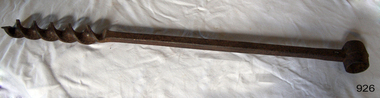
Tool - Auger, Robert Sorby, First half of the 20th Century
... wood saws, butchers saws and cleavers, garden tools, pruning knives, coopers’ knives, bricklayers tools and joiners tools. In 1923 Robert Sorby & Sons was bought by Sheffield company Hattersley and Davidson. They are today one of the few remaining British tool manufacturers. The company has a long tradition of making edged tools for various uses and exporting them to Australia ...A scotch eye auger is perfect for quickly making holes in dry or wet wood for making chairs, stools, and any number of woodworking projects. The scotch eye serves as a peg gauge and whatever peg you make to go into the hole should fit into the augers eye. Robert Sorby & Sons: The forbearer's of Robert Sorby had been cutlers in the Sheffield region of England, dating from the mid 17th century. Robert Sorby and Sons were registered in Sheffield in 1828 as a manufacturer of edge tools, saws, scythes and hay knives. In addition to manufacturing tools, they also diversified into the manufacture of crucible steel for tool manufacture. From circa 1860-1967, the Sorby factory in Sheffield was known as the “Kangaroo Works”. The Kangaroo Brand of tools was made by Robert Sorby & Sons. During the 19th century, they had a large trade in Australasia. By the early 20th century, they were manufacturing carving tools, planes and plane irons, circular saws, wood saws, butchers saws and cleavers, garden tools, pruning knives, coopers’ knives, bricklayers tools and joiners tools. In 1923 Robert Sorby & Sons was bought by Sheffield company Hattersley and Davidson. They are today one of the few remaining British tool manufacturers.The company has a long tradition of making edged tools for various uses and exporting them to Australia, however the subject item was probably made from the early 20th century up until 1967 when the company stopped exporting to Australia.Scotch Eye Auger, Double Twist with Lead Screw, square shaft, socket set at right angleRob Sorbey Sheffield stamped on shaft with Kangaroo trade markflagstaff hill, warrnambool, flagstaff-hill, flagstaff-hill-maritime-museum, maritime-museum, shipwreck-coast, flagstaff-hill-maritime-village, ring auger, carpenders tools, hole drilling, rob sorby & sons -
 Flagstaff Hill Maritime Museum and Village
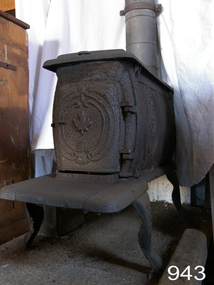
Domestic object - Stove, 1850-1890
... Australia around this time. The stove gives us a social snapshot into what life must have been like for our early colonialists using this device for heating and cooking in their meagre homes. flagstaff hill warrnambool shipwrecked-coast flagstaff-hill flagstaff-hill-maritime-museum maritime-museum shipwreck-coast flagstaff-hill-maritime-village stove domestic heating domestic cooking heater cooking unit pot belly stove wood fired stove wood stove The door has been cast with a maple leaf design and the sides have a pattern cast into them. ...In the industrialized world, as stoves replaced open fires and braziers as a source of more efficient and reliable heating, models were developed that could also be used for cooking, and these came to be known as kitchen stoves. The first manufactured cast-iron stove was produced at Lynn, Mass., in 1642. This stove had no grates and was little more than a cast-iron box. About 1740 Benjamin Franklin invented the “Pennsylvania fireplace,” which incorporated the basic principles of the heating stove. The Franklin stove burned wood on a grate and had sliding doors that could be used to control the draft (flow of air) through it. Because the stove was relatively small, it could be installed in a large fireplace or used free-standing in the middle of a room by connecting it to a flue. The Franklin stove warmed farmhouses, city dwellings, and frontier cabins throughout North America. Its design influenced the development of the pot-bellied stove, which was a familiar feature in some homes well into the 20th century. The first round cast-iron stoves with grates for cooking food on them were manufactured by Isaac Orr at Philadelphia, Pa., in 1800. The base-burning stove for burning anthracite coal was invented in 1833 by Jordan A. Mott. The subject item is a mid to late 19th century settlers stove probably of Canadian manufacture imported into Australia around this time. The stove gives us a social snapshot into what life must have been like for our early colonialists using this device for heating and cooking in their meagre homes. Cast iron stove with four-legs, 2 plates on top and a hinged front door. The door has been cast with a maple leaf design and the sides have a pattern cast into them.flagstaff hill, warrnambool, shipwrecked-coast, flagstaff-hill, flagstaff-hill-maritime-museum, maritime-museum, shipwreck-coast, flagstaff-hill-maritime-village, stove, domestic heating, domestic cooking, heater, cooking unit, pot belly stove, wood fired stove, wood stove -
 Flagstaff Hill Maritime Museum and Village
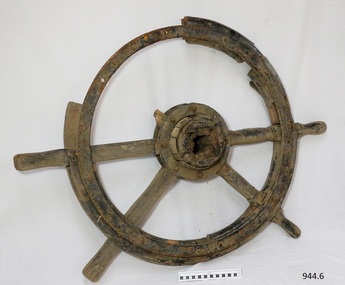
Equipment - Ship's Wheel, 1922
... wood and metal using a recycled cart wheel. It originally belonged to the "Reginald M", a coastal trading ketch. ‘REGINALD M’ 1922 to 1975- The vessel “Reginald M” was a two-masted coastal ketch, owned and built by Mr Jack (John) Murch of Birkenhead, Port of Adelaide, South Australia. ...wood and metal using a recycled cart wheel. It originally belonged to the "Reginald M", a coastal trading ketch. ‘REGINALD M’ 1922 to 1975- The vessel “Reginald M” was a two-masted coastal ketch, owned and built by Mr Jack (John) Murch of Birkenhead, Port of Adelaide, South Australia. ...This ship's wheel was hand-made from wood and metal using a recycled cart wheel. It originally belonged to the "Reginald M", a coastal trading ketch. ‘REGINALD M’ 1922 to 1975- The vessel “Reginald M” was a two-masted coastal ketch, owned and built by Mr Jack (John) Murch of Birkenhead, Port of Adelaide, South Australia. Its construction took approximately 6 months, and it launched at Largs Bay in 1922. The Reginald M’s purpose was to serve the coastal trade of South Australia, to carry cargo cheaply and efficiently. Some have said that the keel was, in fact, hewn from two telegraph poles! Its builder frequented all the salvage yards for materials and fittings. Reginald M had a very shallow draft and a flat bottom that enabled it to come close to shore and to sit high and dry at low tide or to be beached on sand. The flat bottom was also to make the ship able to skim over reefs. Wagons could load and unload direct from their sides. Its cargo included Guano, Barley, Wool, Horses, Cattle, Timber, Explosives, Potatoes, Shell Gritt and Gypsum. On April 9th 1931Reginald M weathered a large storm in St Vincent Gulf, SA. The vessel suffered great damage; the mast snapped, and the crew laboured for four hours to free it by chopping off the mast and rigging. The crew patched it up and slowly returned to Port Adelaide with only a portion of the insured cargo being damaged. The crew members at the time were owner Mr John H Murch of Wells Street, Largs Bay; Skipper Mr R Murch, John’s brother; Murray, son of Captain Murch; and Seaman John Smith. Reg Webb purchased Carribie Station, at Marion in the Warooka District, south of Adelaide, in 1921. He cleared the land and farmed sheep and grain. In 1923, he shipped his own wool and grain from Marion Bay, having first carted 300 bags of the barley grain, 12 bags at a time, along the unmade track to the jetty. A photograph donated to Flagstaff Hill, dating about 1929 - 1942, shows two men on the Reginald M, holding between them their fishing catch of a large hammer shark. The photograph is stamped “GRENFELL STUDIO PORT LINCOLN PRINT” and titled “hammer shark caught on Reginald Emm”. The donor’s family lived on the Your Peninsula and dispatched their grain from a chute at Gleeson’s Landing to the awaiting transport vessel. Reg knew the Murch Brothers from Port Adelaide. The brothers had been using their ketch, Reginald M, to ship Guano from the Islands, led by Captain Richard Murch. Reg approached them in 1934 about shipping grain from Marion Bay. The brothers visited the bay and thought it was an ideal place. They showed Reg where to stack his grain, and they measured up the cliffs. When Reg was ready, they brought down and installed a ninety-foot wooden chute. The bags of grain were individually pushed down the chute, landing in a waiting small boat, then rowed to Reginald M with 14 bags at a time. After 10 hours, Reginald M would have a load of 1300 bags of grain to ship to waiting ports. At one time, a wild storm destroyed the chute, so they built a stronger replacement chute. Reginald M engaged in the shipping of grain from there until 1938. In 1940, Able Seaman Allan H Lucas served on the Reginald M between September and December, being engaged and discharged from Port Adelaide. The ship’s Master, W S Murch, signed his Certificate of Discharge. It seems that at the Reginald M was used, at one time, as a Customs vessel, as one photograph in Flagstaff Hill’s collection shows “H.M.C. No. 3, Pt Adelaide” on the bow. In 1969, the last freight left Marion Bay on the ketch Reginald M carrying grain, wool, and explosives. In late 1970, the Mt. Lyell Mining and Railway Company bought the vessel to use as a barge to carry explosives. In 1972, the Navy League of Strahan, Tasmania, purchased it for use by the Strahan Sea Cadet Unit to use at Macquarie Harbour and renamed it T.S. Macquarie. However, this plan for the use of Reginald M did not happen. In 1974, Mr Andrew Rennie, of East Brighton, Melbourne, bought it for a similar purpose, paying $5,000 and donating a ‘Cadet of the Year’ trophy to the Sea Cadets. He sailed it from Strahan to Melbourne, planning to use it for pleasure sailing. Also, in 1975, Reginald M was bought by the Melbourne Ferry Company at auction. Later in 1975, Flagstaff Hill Maritime Museum bought the Reginald M for $20,000. It became a popular exhibit in the Village’s lake. In 2006, using funds from a $4,000 government grant, the restoration of the vessel continued. Flagstaff Hill Maritime Village’s Collection holds other artefacts associated with Reginald M. They include - Photographs of the Reginald M, including one photograph of it in Outer Harbour, S.A., dated 1947, with Skipper- R.F. Dale and Owner- John Murch. Another shows it docked at Port Adelaide, with the lettering H.M.C. No. 3 Pt ADEL (standing for His /Her Majesty’s Customs). There is a black and white photo of it at a wharf and another showing a person on board. - a lifebuoy, made of cork, with the inscription of “Pt Adelaide” on it. - Helm section, removed and replaced during restoration. - a bullet found in pieces of timber when Reginald M was restored in 1979 Reginald M was a much-loved exhibit at the Maritime Village, where many visitors enjoyed boarding and exploring a real ship with a long history. Sadly, the Reginald M was decommissioned in late 2016, due to the continuing prohibitive cost of maintenance and the risk to public safety. Components from the Reginald M are held in Flagstaff Hill's collection as a reminder of the Reginald M’s history. This ship's wheel is significant because of its association with the REGINALD M. REGNIALD M was a coastal trading ketch from South Australia built in 1922. It is one of very few sailing coastal trading vessels still extant, and its flat bottom, single chine shape illustrates a very simple but robust method of construction, compared to other round bilged examples of trading vessels. She is now listed on the Australian Register of Historic Vessels (ARHV Number: HV000562.)Ship’s wheel, also called a Helm, eight spoke design. Centre of wheel is handmade of wood and has iron rings around each side. The spokes are fitted into this wooden hub. The outer wheel has an iron ring on one side and sections of a wooden ring on the other. There are both original and modern bolt and screw fastenings. The wheel has remnants of black paint. This ship’s wheel was originally fitted to the ketch REGINALD M and removed during its restoration. flagstaff hill, warrnambool, shipwrecked-coast, flagstaff-hill, flagstaff-hill-maritime-museum, maritime-museum, shipwreck-coast, flagstaff-hill-maritime-village, ship's wheel, hand made ship's wheel, coastal trader, reginald m, ketch, john murch, ch murch, reg webb, carribie station, mt lyell copper company, queenstown navy league, andrew rennie, melbourne ferry company, r.f. dale -
 Flagstaff Hill Maritime Museum and Village
Document - Log Book page, 21/10/1805
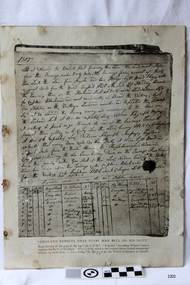
... Through the leadership and victory of Nelson, the British obtained the mastery of the seas over the French and Spanish and opened up the way for Britain to colonise many countries including Australia. The document is also associated with a wood sample from Napoleon's ship Victory that is in our Collection. flagstaff hill warrnambool shipwrecked-coast flagstaff-hill flagstaff-hill-maritime-museum maritime-museum shipwreck-coast flagstaff-hill-maritime-village log book flag signal hms euryalus nelson's famous signal battle of trafalgar october 21, 1805 admiral lord nelson french and spanish navies england expects that every man will do his duty hms victory sir home popham’s telegraphic code admiralty official day signal book (1799 issue) reporting frigates captain henry blackwood canvas-backed manuscript nelson collection at lloyd's lloyd’s of london lloyd’s patriotic fund napoleonic battles british naval history Reproduction of a page of the log book of HMS Euryalus recording Nelson's famous signal at the Battle of Trafalgar. ...This document is a reproduction of the page of the log book from the vessel HMS Euryalus, recording Nelson's famous signal at the Battle of Trafalgar. On October 21, 1805, Admiral Lord Nelson led the British Navy to victory against the French and Spanish navies in the Atlantic Ocean. The event became known as the Battle of Trafalgar. To commence the battle Nelson commanded his now-famous flag signal “England expects that every man will do his duty”. Nelson’s signal was transmitted from his ship HMS Victory in 12 separate flag-hoists, according to Sir Home Popham’s Telegraphic Code that had been supplied to the fleet as an experiment, with the numerical flags of the Admiralty official Day Signal book (1799 issue). The signal flags comprised eight that represented whole words and four that represented single letters - [ENGLAND] [EXPECTS] [THAT] [EVERY] [MAN] [WILL] [DO] [HIS] [D] [U] [T] [Y]. Nelson’s signal was received by the ‘reporting frigates’ who would then send them on to the other vessels. The signal was recorded by Captain Henry Blackwood who was in command of the HMS Euryalus. Captain Blackwood led a squadron of frigates, reporting back to Nelson on the movement of the French and Spanish fleets. Nelson’s famous signal was recorded in the log book of Euryalus and repeated to other vessels. The original log book is a canvas-backed manuscript written up from hour to hour during the battle. It is in the Nelson Collection at Lloyd's. Lloyd’s of London is a large insurance company in the United Kingdom. In 1803 Lloyd’s founded the Lloyd’s Patriotic Fund to honour the brave and provide for the wounded and dependents of those killed in major Napoleonic battles. Over the years Lloyd’s has accumulated an assorted collection of artefacts and memorabilia associated with Nelson, including this log book from HMS Euryalus. In 2003 Lloyds created a temporary exhibition to mark the bicentennial of Nelson’s Battle of Trafalgar. The display included key items from the Nelson Collection celebrating Nelson’s role in British Naval History. Lloyd’s now has a department called The Nelson Collection and Heritage Floor where historical artifacts are displayed and the story of Lloyd’s 300 years of history is told. This document, being a reproduction, is not significant in itself. However it's content is of historical significance for its connection to Admiral Nelson and The Battle of Trafalgar. Through the leadership and victory of Nelson, the British obtained the mastery of the seas over the French and Spanish and opened up the way for Britain to colonise many countries including Australia. The document is also associated with a wood sample from Napoleon's ship Victory that is in our Collection.Reproduction of a page of the log book of HMS Euryalus recording Nelson's famous signal at the Battle of Trafalgar. The original log book entry was handwritten, dated 21 Oct 1805.flagstaff hill, warrnambool, shipwrecked-coast, flagstaff-hill, flagstaff-hill-maritime-museum, maritime-museum, shipwreck-coast, flagstaff-hill-maritime-village, log book, flag signal, hms euryalus, nelson's famous signal, battle of trafalgar, october 21, 1805, admiral lord nelson, french and spanish navies, england expects that every man will do his duty, hms victory, sir home popham’s telegraphic code, admiralty official day signal book (1799 issue), reporting frigates, captain henry blackwood, canvas-backed manuscript, nelson collection at lloyd's, lloyd’s of london, lloyd’s patriotic fund, napoleonic battles, british naval history -
 Flagstaff Hill Maritime Museum and Village
Book - Portfolio, Newcraft Pulicity, The Line of Sail; Magnificent Clipper Ships, 1969
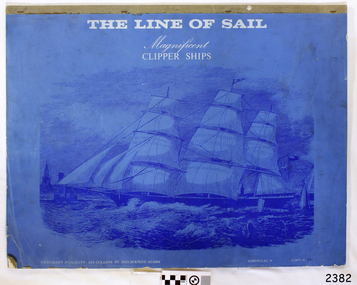
... There are copes in both the Victorian State Library and the National Library of Australia. flagstaff hill warrnambool shipwrecked-coast flagstaff-hill flagstaff-hill-maritime-museum maritime-museum shipwreck-coast flagstaff-hill-maritime-village lithographs Newscraft Publicity book The Line of Sail dlipper ships tall shipos sailing ships wood block print newspaper drawings newcraft productions newcraft melbourne portfolio of clipper ships limited edition wooden engravings magnificent clipper ships Stamped on front cover "086" The Line of Sail is a portfolio of sixteen fine line, black and white prints on paper. ...These prints include large sailing ships that were also referred to as Clippers and Tall Ships. These ships were used to transport cargo and passengers across the world in the 19th century. They were powered purely by harnessing the wind. It could take three to four months to sail in this manner from England to Australia. On many occasions the ships were wrecked, often close to their destination, through errors of navigation. The method of production of the original images is over a century old. The Melbourne publisher of this portfolio book, Newcraft Publicity, describes the contents as follows-' Magnificent Clipper Ships: Clipper ships in the line of sail make the most romantic and spectacular pictorial chapter of marine history. This collection depicting early clippers and other types of sailing ships were originally fine engravings on wooden printing blocks used in newspapers a century ago. They were taken directly from the original newspaper prints, and reproduced in enamel inks to provide a choice of fine line prints suitable for framing. LIST OF PRINTS- The New Australian Clipper "BLUE JACKET" The Clipper Ship “CHRYSOLIER” The “GAUNTLET” Clipper Ship The New American Clipper “GREAT REPUBLIC” The Clipper Ship “GUIDING STAR” New Emigrant Ship “HESPERIDES” for the South Australian Line Capt. Beatson’s Expedition in search of Sir John Franklin – the “ISABEL” The Black Ball Line Clipper Ship “JAMES BAINES” The “MERCHANT PRINCE” – Australian Clipper The White Star Line Clipper Ship “MORNING LIGHT” The Aberdeen Clipper Built Barque “PHOENICIAN” New Australian Clipper Ship the “ROYAL FAMILY” The “SOVEREIGN OF THE SEAS” American Clipper The New Iron Clipper Built Ship “TAYLEUR” for Australia H.M. New Frigate “THETIS” The American Clipper Ship “WITCH OF THE WAVE” ABOUT THE PUBLISHER- The Newcraft Publicity was a Melbourne business that operated in the 1960s at 243 Collins Street, Melbourne.This portfolio book of clipper ship prints is historically significant as it shows an important part of Australia's history, It includes some of the shipping lines famous in the 19th century for transporting passengers and goods to Australia. The prints are also significant for their origin in the carved wooden blocks used a century ago for creating images for the newspapers of the time. Book is also significant from being one of a limited edition of books produced. There are copes in both the Victorian State Library and the National Library of Australia.The Line of Sail is a portfolio of sixteen fine line, black and white prints on paper. The subject is clipper ships. The covers are paper-covered card, coloured a strong blue with white line images and text. The image side of the pages has a sheen, the back is matt. Each print has a caption. The top of the book is stapled and bound with grey tape. Produced by Newcraft Publicity, Melbourne. Limited Edition - Copy Number 086. Stamped on front cover "086"flagstaff hill, warrnambool, shipwrecked-coast, flagstaff-hill, flagstaff-hill-maritime-museum, maritime-museum, shipwreck-coast, flagstaff-hill-maritime-village, lithographs, newscraft publicity, book, the line of sail, dlipper ships, tall shipos, sailing ships, wood block print, newspaper drawings, newcraft productions, newcraft melbourne, portfolio of clipper ships, limited edition, wooden engravings, magnificent clipper ships -
 Flagstaff Hill Maritime Museum and Village
Print - Religious Print, The Last Supper, circa 1890
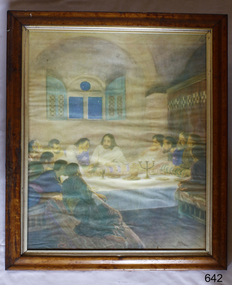
... Print of a watercolour painting, framed in Huon pine wood behind glass.Depicts the artist's impression of the Biblical event referred to as The Last Supper. Inscription marked on the back. Australian...Flagstaff Hill Maritime Museum and Village Flagstaff Hill Warrnambool Maritime Museum Maritime Village Shipwreck Coast Great Ocean Road Religion Religious service St Nicholas Seamen’s Church Williamstown Missions to Seamen Victoria last supper worship religious worship Ladies Lightkeepers’ Auxiliary Williamstown Lightkeepers' Auxiliary The Last Supper Mission to Seafarers St Nicholas Missions to Seamen’s Church Williamstown Missions to Seamen St Nicholas Missions to Seamen’s Church Flagstaff Hill 139 Nelson Place Williamstown Anglican church worship service church furnishings religious furnishings wall hanging framed print religious print On rear of board: "156" Print of a watercolour painting, framed in Huon pine wood behind glass.Depicts the artist's impression of the Biblical event referred to as The Last Supper. Inscription marked on the back. Australian ...This framed print is one of the items once used during religious services at the St. Nicholas Seamen’s Church and was donated to the organisation by the Williamstown Lightkeepers' Auxiliary. The church was located at 139 Nelson Place, Williamstown, Victoria, and operated by the Mission to Seamen organisation. THE MISSIONS TO SEAMEN (Brief History): - The Missions to Seamen was an Anglican charity in Great Britain that has served the world's seafarers since 1856. Its symbol is a Flying Angel, inspired by a Bible verse. Today, there are centres in over 200 ports worldwide where seamen of all backgrounds are offered a warm welcome and provided with a wide range of facilities. In Victoria, the organisation began in Williamstown in 1857 as a Sailors’ Church, also known as ‘Bethel’ or the ‘Floating Church’ in an old hulk floating in Hobson’s Bay, Port of Melbourne. It soon became part of the Missions to Seamen, Victoria. In 2000, the organisation, now named Mission to Seafarers, still operated locally in Melbourne, Portland, Geelong and Hastings. The Ladies’ Harbour Lights Guild was formed in 1906 to support the Missions to Seamen in Melbourne and other centres, such as Williamstown. Two of the most significant ladies of the Guild were founder Ethel Augusta Godfrey and foundation member Alice Sibthorpe Tracy (who established a branch of the Guild in Warrnambool in 1920). The Guild continued its work until the 1960s. In 1943, a former Williamstown bank was purchased for the Missions to Seamen Club. The chapel was named St Nicholas’ Seamen’s Church and was supported by the Ladies’ Harbour Lights Guild, the Williamstown Lightkeepers’ Auxiliary and the League of Soldiers’ and Sailors’ Friends. It ceased operation in 1966. A Missions to Seamen Chapel and Recreation Room was a significant feature of ports during the late 1800s and 1900s. It seemed appropriate for Flagstaff Hill to include such a representation within the new Maritime Village, and the Melbourne Board of Management of Missions to Seamen Victoria gave its permission on 21st May 1979 for the entire furnishings of the Williamstown chapel to be transferred to Flagstaff Hill. The St Nicholas Seamen’s Church was officially opened on October 11, 1981, and resembles the Williamstown chapel.This print is significant historically for its origin in the St Nicholas Mission to Seamen's Church in Williamstown, established in 1857 to cater for the physical, social, and spiritual needs of seafarers. It originated in Bristol, England when a Seamen's Mission was formed in 1837. The item is historically significant for its connection to the Williamstown Lightkeepers’ Auxiliary, an organisation of women, formed to support seafarers. The connection of this item to the Mission to Seamen and the Ladies Lightkeepers’ Auxiliary highlights the strong community awareness of the life of people at sea, their dangers and hardships, and their need for physical, financial, spiritual and moral support. Print of a watercolour painting, framed in Huon pine wood behind glass.Depicts the artist's impression of the Biblical event referred to as The Last Supper. Inscription marked on the back. Australian, circa 1890. The print is part of the St Nicholas Seamen's Church Collection On rear of board: "156" flagstaff hill maritime museum and village, flagstaff hill, warrnambool, maritime museum, maritime village, shipwreck coast, great ocean road, religion, religious service, st nicholas seamen’s church, williamstown, missions to seamen victoria, last supper, worship, religious worship, ladies lightkeepers’ auxiliary, williamstown lightkeepers' auxiliary, the last supper, mission to seafarers, st nicholas missions to seamen’s church williamstown, missions to seamen, st nicholas missions to seamen’s church flagstaff hill, 139 nelson place williamstown, anglican church, worship service, church furnishings, religious furnishings, wall hanging, framed print, religious print
