
Showing 15 items matching "australiana design"
-
 Orbost & District Historical Society
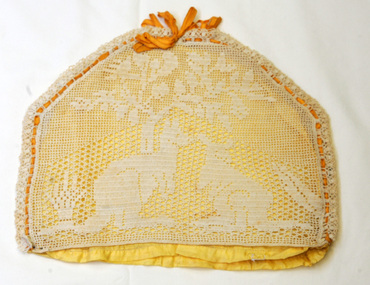
tea cosy, c. early 20th century
... tea-cosy womens-arts-crafts crochet Australiana-design...A hand crocheted white / echru coloured tea cosy with an Australiana design which incorporates two kangaroos and a bush setting on the front and back. ...An example of Australiana in design. tea-cosy womens-arts-crafts crochet Australiana-design A hand crocheted white / echru coloured tea cosy with an Australiana design which incorporates two kangaroos and a bush setting on the front and back. ...This crochet tea cosy was made by Marjorie McKeown who was member of the early pioneering families of the Orbost district. She was an expert needlewoman.An example of Australiana in design.A hand crocheted white / echru coloured tea cosy with an Australiana design which incorporates two kangaroos and a bush setting on the front and back. The cosy is lined with yellow satin and a deep yellow ribbon is threaded through the sides to hold the tea cosy together. The ribbon ties into a bow at the top of the cosy.tea-cosy womens-arts-crafts crochet australiana-design -
 Orbost & District Historical Society
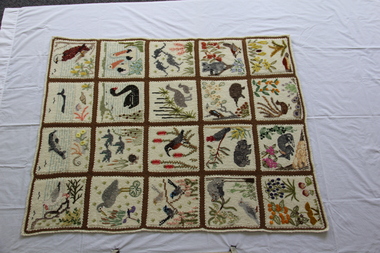
Textile - Handmade quilt, Elsa Williams, late1980s
... ...Australiana design...Elsa Williams handcrafted quilt Australiana design spinning and weaving A hand-made woollen quilt, cream background, with images of Australian flowers, plants, birds, and animals embroidered onto the cream background. ...This quilt or wall hanging is entirely hand-made by noted Orbost district craftsperson, Elsa Williams (nee Elsa Beavis, b 27-5-1924, d 22-6-2007) who lived on a property at Wombat Creek near Orbost in the 1980s. Elsa had her own sheep, spun and dyed the wool, and crafted this quilt. For about 20 years, Elsa was a member of a weaving group started by Gwenda Bland at Lake Tyers. Elsa wove carpets for her own home at Wombat Creek. Gwenda Beavis was given this quilt by Elsa in 2007 and it was often displayed around the district, receiving many comments due to the quality of the workmanship and design. This quilt has been made from hand-spun and hand-dyed wool. The background is Tricot crochet squares, and the coloured decorations of Australian animals and plants have been embroidered onto the tricot squares. This items is significant because it shows excellent creativity and quality of workmanship. It also represents an era in Australia when hand-weaving, spinning, and dying wool became very popular as hand-crafts. A hand-made woollen quilt, cream background, with images of Australian flowers, plants, birds, and animals embroidered onto the cream background. elsa williams, handcrafted quilt, australiana design, spinning and weaving -
 Embroiderers Guild, Victoria
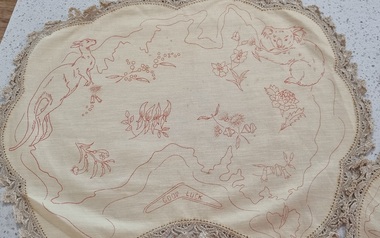
Functional object - Semco Dressing Table Set Depicting Australia, Semco, 1950
... Semco souvenir household linen with transfer printed Australiana design popular in 1950's...Semco souvenir household linen with transfer printed Australiana design popular in 1950's Australiana Australia Map Floral Koala Kangaroo Semco dressing table mat with a transfer printed design of map of Australia, floral emblems, koala and kangaroo. ...Semco souvenir household linen with transfer printed Australiana design popular in 1950'sSemco dressing table mat with a transfer printed design of map of Australia, floral emblems, koala and kangaroo. Unworked with working sheet and instructions. Crochet edgingaustraliana, australia, map, floral, koala, kangaroo -
 Embroiderers Guild, Victoria
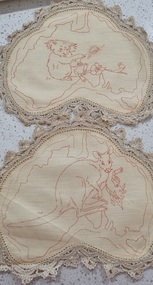
Functional object - Semco Dressing Table Small Mat, Semco, 1950
... Semco souvenir household linen with transfer printed Australiana design popular in 1950's...Semco souvenir household linen with transfer printed Australiana design popular in 1950's Australiana Australia Map Floral Koala Kangaroo Semco dressing table mat with a transfer printed design of map of Australia, floral emblems, koala and kangaroo. ...Semco souvenir household linen with transfer printed Australiana design popular in 1950'sSemco dressing table mat with a transfer printed design of map of Australia, floral emblems, koala and kangaroo. Unworked except for crochet edgingaustraliana, australia, map, floral, koala, kangaroo -
 Embroiderers Guild, Victoria
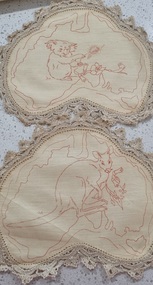
Functional object - Semco Dressing Table Small Mat, Semco, 1950
... Semco souvenir household linen with transfer printed Australiana design popular in 1950's...Semco souvenir household linen with transfer printed Australiana design popular in 1950's Australiana Australia Map Floral Koala Kangaroo Semco dressing table mat with a transfer printed design of map of Australia, floral emblems, koala and kangaroo. ...Semco souvenir household linen with transfer printed Australiana design popular in 1950'sSemco dressing table mat with a transfer printed design of map of Australia, floral emblems, koala and kangaroo. Unworked except for crochet edgingaustraliana, australia, map, floral, koala, kangaroo -
 National Wool Museum
Clothing - 1984 Los Angeles Olympics Men's Opening Ceremony Shirt, c. 1984
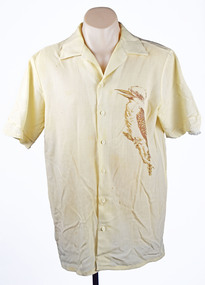
... design it. This was based on her proven performance during previous games as she had a talent for creating good taste Australiana. ...design it. This was based on her proven performance during previous games as she had a talent for creating good taste Australiana. ...On the 1984 Los Angeles Olympic Uniforms donator Doug wrote- During the 1980s the Australian wool industry was at its most prosperous times with record numbers of sheep producing wool receiving ever increasing values due to the success of the Reserve Price Scheme, and the overall guidance of the Australian Wool Corporation (AWC). As a humble technician, my role was a low profile newly created position of “Controller, Technical Marketing” where wool was to be marketed on its technical properties, as distinct from the “Product Marketing Group” which exploited trhe traditional high profile approach of marketing wool;s superior fashion attributes. The Woolmark was the tool central to this approach. When the forthcoming Los Angeles Olympic Games was announced, the Product Marketing Group seized upon the chance to show the world that we could make top fashion garments and display them on our elite athletes on the world stage. A concept was launched using a contemporary top designer, Adel Weiss, with the most exclusive fabrics and knits available, and all with a lot of hype. This launch failed dismally for the following reasons- - The designer did a wonderful job presenting an excellent fashion range on perfect skinny models. The AOC however wanted a uniform which had an obvious Australian appearance when fitted to elite, and frequently muscular, athletes. - The fabrics chosen did not reflect the performance required by travelling athletes, there was no recognition of the need for ‘easy care.’ - There was no recognition given to the problem of measuring, manufacturing and distribution of a range of articles when the selected athlete could be domiciled anywhere in Australia. - There was no appreciation of such historical facts as Fletcher Jones, who had been unofficial suppliers dating back to the 1954 Olympics in Melbourne, and the Fletcher Jones board member, who was also an AWC board member, and was not in favour of the change. The project passed from Product Marketing to Public Relations, a big spending off-shoot of the AWC Chairman David Asimus, and due to the day to day operations of the project was passed to me and PR took care of the financial matters. The first task was to meet with the AOC and find out exactly their requirements. This lead to the production of a design and manufacturing brief, cointaining exact time lines for each event required to ensure an appropriate uniform on every athlete chosen to represent his/her country on the date given for the Opening Ceremony in Los Angeles. Working backwards the timeline becomes- 1. Noted the exact date of the Opening Ceremony. 2. Estimated the date for distributing completed garments to each athlete. 3. Estimated the time span available for measuring each athlete and commence making each component of the ensemble to the individual measurements of each athlete. 4. Decided the date for making the final choice of uniform design concept. 5. Decided the date for distribution of the design brief to selected designers. These five steps were spread out over a two year period. The Commonwealth Games occur midway between each Olympic Games, work on the Olympic uniform commences the week after the Commonwealth Games closing ceremony and MUST be ready by the prescribed day two years hence. The project also had to remain cognisant of trade politics existing within the span of the task, as well as the temperament of designers in general. It is no overstatement to say that in the past every designer in Australia believed they could, and should, be chosen to design the Australian Uniform. The final choice of designer almost always faced criticism from the fashion press and any designer who had been overlooked. However, with the contenders receiving an exacting brief the numbers of serious contenders greatly reduced. The Los Angeles Olympic Uniforms. A further reason for the AWC bid failure to design the LA uniform was that the AOC had already chosen Prue Acton to design it. This was based on her proven performance during previous games as she had a talent for creating good taste Australiana. Her design concepts also considered the effect when they were viewed on a single athlete as well as the impact when viewed on a 400 strong team coming on to the arena. A blazer trouser/skirt uniform in bright gold was chosen for the formal uniform. It was my task to select a pure wool faille fabric from Foster Valley weaving mill and have sufficient woven and ready within the prescribed timeline. The trouser/skirt fabric selected was a 60/40 wool polyester plain weave fabric from Macquarie Worsted. This fabric had a small effect thread of linen that was most attractive when dyed to match some eucalyptus bark Prue had brought back from central Australia. For the Opening Ceremony uniform, Prue designed a series of native fauna, a kookaburra for the men’s shirt and a pleated skirt with a rural scene of kangaroos, hills and plants. This presented an insurmountable printing challenge to the local printing industry as it had an unacceptably large repeat size and the number required (50) was also commercially unacceptable. The solution was a DIY mock up at RMIT and the employment of four student designers. The fabric selected for this garment was a light weight 19 micron, pure wool with a very high twist yarn in alternating S and Z twist, warp and weft. This fabric proved to be the solution to a very difficult problem, finding a wool product which is universally acceptable when worn next to the sin by young athletes competing in the heat of a Los Angeles summer. Modifications to this fabric were developed to exploit its success when facing the same problem in future games. Garment Making- The most exacting garment in the ensemble is the tailored blazer, plus the related trouser/skirt. Unfortunately tailoring athletes that come in various shapes and sizes such as; - Weight lifters develop an enormous chest, arms and neck size. A shirt made to a neck size of 52 would produce a shirt with cuffs extending well beyond the wearer’s hands. - Basketball players are up to 7 feet tall and garments relying ona chest measurement grading would produce a shirt with cuffs extending only to elbow length. - Swimmers develop enormous shoulders and slim hips, cyclists by contrast develop thighs I liken to tree trunks and a uniform featuring tight trousers must be avoided at all cost. Suffice to say many ensembles require specialist ‘one off’ treatment for many athletes. Meanwhile there is a comfortable in between group who can accept regular sizes so you can cater for these by having back up stock with plenty of built in contingencies. Athletes may be domiciled anywhere in Australia, this creates a fundamental problem of taking their measurements. The Fletcher Jones organisation was key to answering this problem due to their presence in every capital city, as well as many provincial towns around Australia. Each athlete on being selected for the Olympic Team was simultaneously requested to visit their nearest Fletcher Jones shop. The standardised measurement data collected was shared with the other manufacturers, e.g. Pelaco Shirts, Holeproof Socks and Knitwear, Maddison Belts, and even Hush Puppy Shoes. As the time for the Games approached the AOC made arrangements for combining meeting of all. Selected available athletes at the Australian Institute of Sport, Canberra, where, among other things, they were fitted and supplied with their uniform. The method evolved as follows.Men’s cream coloured button up, collared shirt. Images of a kookaburra have been printed onto the shirt, a single kookaburra on the left breast and a pair of kookaburras on the reverse of the shirt. The kookaburras are printed in a brown tone to complement the cream colour of the fabric.On tag - FMaustralian wool corporation, 1984 los angeles olympics, olympic uniforms, men's uniforms, sport, athletes -
 Federation University Historical Collection
Work on paper - Artwork - Poster, Past and Present Ballarat of Forty Years of Progress from an Uninhabited Wilderness, 22/10/1892 - 17/03/1898
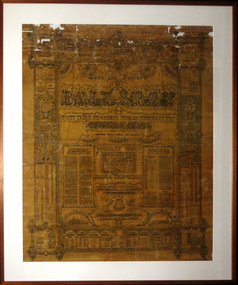
... designed and composed by Mr. Meek, who is 78 years of age, at the Asylum. It is done entirely with pen and ink, and was commenced on the 22nd October, 1892, and completed on 17th March, 1893. (Ballarat Star, 27 March 1893) Although 'Past and Present Ballarat of Forty Years of Progress from an Uninhabited Wilderness' was printed it appears that few have survived the ravages of time. Another copy of this works survives in the collection of the Australiana ...James McKain MEEK (1815-1899) Born England Arrived Australia 1838 James Meek was an artist who built the first house at Ballarat. He wrote 'designed, composed and written with pen and ink by James Meek (founder of the City). When this work was completed the in 1893 the Ballarat Star described the work: - "An Industrial Inmate. At the conclusion of Monday's meeting of the Ballarat Benevolent Asylum Committee one of the inmates, named James McBain Meek, having been introduced, laid upon the table a magnificently executed work of art, bearing the following inscription: - The past and present of Ballarat, or 40 years' progress from an uninhabited wilderness, 1852 to 1892, during which time it has become the grandest inland city of the Southern World. It stands unrivaled by that of any city in her Britannic Majesty's extensive domain over which the sun never sets, and o'er which Albion's beloved sovereign sways her benign sceptre." The work conveys by words and pictorial representations a complete history of Ballarat from its inception up to the 17th March inst. The various pillars and scrolls by which the many incidents that are related are surrounded are marvelously executed, the plain and ornamental lettering is exquisite; while the language used in the narrative is of the most eloquent and refined description. Sketches of the Ballarat Hospital and Benevolent Asylum, equal to any photographic picture, are shown at either end of the word " Ballarat," which occupies the most central position of the chart. The work, which is worthy of a position in any public library or private residence, has been designed and composed by Mr. Meek, who is 78 years of age, at the Asylum. It is done entirely with pen and ink, and was commenced on the 22nd October, 1892, and completed on 17th March, 1893. (Ballarat Star, 27 March 1893)Although 'Past and Present Ballarat of Forty Years of Progress from an Uninhabited Wilderness' was printed it appears that few have survived the ravages of time. Another copy of this works survives in the collection of the Australiana Room at the Central Highlands Regional Library Corp. No others have been located to date. (2012)Large black and white poster (now brown with age) with the hand drawn work of James Meek reproduced by the Ballarat printers Rider & Mercer. Many, but one includes 'Most respectfully dedicated to the native born children of European parents in the Ballarat Mining District by the author.'ballarat, james meek, meek, ballarat benevolent asylum, nazareth house, ballarat mayors, james bury, james oddie, la poer trench, welfare -
 Orbost & District Historical Society
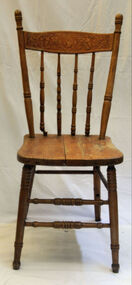
dining chair, from about 1906 until the 1930s
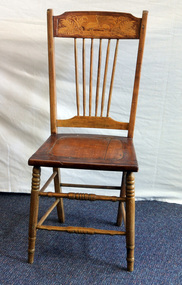
... This item is an example of domestic furniture created to reflect an Australiana type design with Australian motifs. chair dining-chair wooden-chair furniture-domestic Front top - Rd 253 Wooden, Australiana dining chair. ...This item is an example of domestic furniture created to reflect an Australiana type design with Australian motifs.Wooden, Australiana dining chair. Emus + bush scene carved into back with wood turned legs and supports.Front top - Rd 253chair dining-chair wooden-chair furniture-domestic -
 Orbost & District Historical Society
dining chair, from about 1906 until the 1930s
... This item is an example of domestic furniture created to reflect an Australiana type design with Australian motifs. chair dining-chair furniture-domestic RID 254 Australiana lyre bird wood dining chair. ...This item is an example of domestic furniture created to reflect an Australiana type design with Australian motifs.Australiana lyre bird wood dining chair. Lyre bird carving on head rest. Wood turned structuressRID 254chair dining-chair furniture-domestic -
 Embroiderers Guild, Victoria
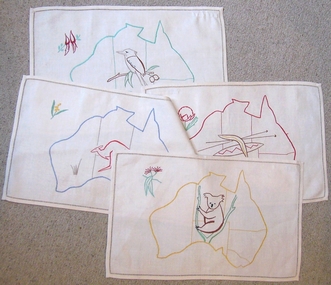
Textile - Set of Four Australiana Table Mats, Mr Brian McHenry, 1920-40
... Brian McHenry design, possibly embroidered by his wife. Machine Embroidery Mats 1920-40 Australia Australiana Set of four rectangular linen mats. ...Brian McHenry design, possibly embroidered by his wife.Set of four rectangular linen mats. Machine stitchery of map of mainland Australia, with a kookaburra, a koala, a kangaroo, and aboriginal tools. Spoke stitched edge.machine embroidery, mats, 1920-40, australia, australiana -
 National Wool Museum
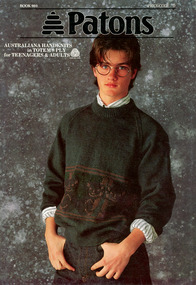
Book - Pattern Book, Patons Knitting Book, No.903, Patons and Baldwins, 1990s
... Fashion Design Knitwear Home Made Wool Pattern Book Patons front: [printed] BOOK 903 / PRICE CODE D / Patons / AUSTRALIANA HANDKNITS / in TOTEM 8 PLY / for TEENAGERS & ADULTS / PURE NEW WOOL Twenty four page knitting pattern book featuring black and white text and colour images. ...Twenty four page knitting pattern book featuring black and white text and colour images. The colour cover features a teenage boy wearing a knitted jumper with koala motifs.front: [printed] BOOK 903 / PRICE CODE D / Patons / AUSTRALIANA HANDKNITS / in TOTEM 8 PLY / for TEENAGERS & ADULTS / PURE NEW WOOLfashion, design, knitwear, home made, wool, pattern book, patons -
 National Wool Museum
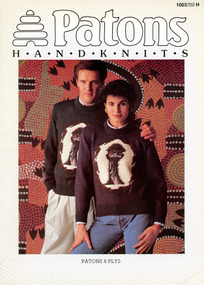
Book - Patons Handknits 1003, Patons and Baldwins, c.1980s
... Australiana...knitting...patons...handknits...craft...style...design...Pattern books pattern emu Australiana knitting patons handknits craft style design Front: [printed] 1003 / PRICE / CODE / H / Patons / H A N D K N I T S / PATONS 8 PLYS Twenty page book with black and white printed text and graphics. ...Twenty page book with black and white printed text and graphics. The front cover features a colour image of a man and a woman wearing matching knitted jumpers featuring an emu motif. Front: [printed] 1003 / PRICE / CODE / H / Patons / H A N D K N I T S / PATONS 8 PLYSpattern books, pattern, emu, australiana, knitting, patons, handknits, craft, style, design -
 Linton and District Historical Society Inc
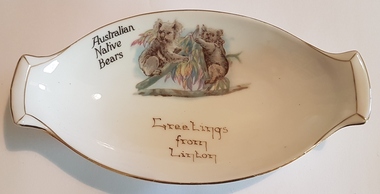
Dish, Opaline - Emblemware, Greetings From Linton
... Souvenirs Australiana On reverse: "Opaline-Emblemware-Designed in Australia-on Czechoslavakian china". ...Sold in Sandow's (later Jennings') greengrocer shop prior to WWII.Small white oval dish, with decoration, two Australian Native Bears. Inscribed "Greetings from Linton".On reverse: "Opaline-Emblemware-Designed in Australia-on Czechoslavakian china".souvenirs, australiana -
 Embroiderers Guild, Victoria
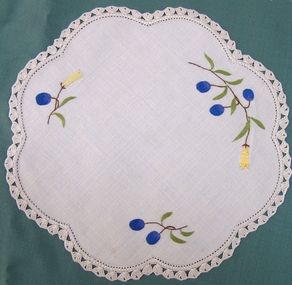
Textile - Geoff Riley Design Floral Doyley, Mr Geoff Riley, 1940-60
... Australiana type designs, many were embroidered by his wife Betty Riley as samples. See Supp. file. Embroidery Surface stitchery Mats 1940-60 Australia Circular doyley, cream linen with scalloped edge trimmed with crochet. Deep blue berries and yellow flowers of the Apple berry, surface stitchery in stranded cotton. Textile Geoff Riley Design ...Mr Geoff Riley was a designer who produced a number of Australiana type designs, many were embroidered by his wife Betty Riley as samples. See Supp. file.Circular doyley, cream linen with scalloped edge trimmed with crochet. Deep blue berries and yellow flowers of the Apple berry, surface stitchery in stranded cotton. embroidery, surface stitchery, mats, 1940-60, australia -
 Emerald Museum & Nobelius Heritage Park
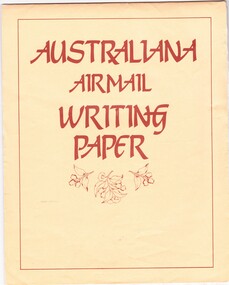
Domestic object - Airmail writing pad and two aerogrammes, Ken Dome, 1980s-1990s
... On front cover of writing pad: ' AUSTRALIANA / AIRMAIL /WRITING / PAPER' On back cover of writing pad: 'Four Designs / Twelve Sheets / Post Office Approved' on one side and on the other side: 'Designed and Printed / in Australia by / AUSIROO'. ...Aerogramme Australiana Ken Dome On front cover of writing pad: ' AUSTRALIANA / AIRMAIL /WRITING / PAPER' On back cover of writing pad: 'Four Designs / Twelve Sheets / Post Office Approved' on one side and on the other side: 'Designed and Printed / in Australia by / AUSIROO'. ...This writing pad has lightweight paper to minimise cost for international mail. The Australiana theme is a way of promoting Australia to the overseas recipient of the letter. One of the two aerogrammes cost 60c and has an illustration of a Melbourne tram by Australian artist Ken Dome This was one of four designs which he created for aerogrammes and released in 1989. The second aerogramme has a photograph of Australian coastline and cost 65c and so was released on or after 1993. These writing materials are a reminder of a time when ordinary communications across countries were primarily undertaken through letters carried by plane.Writing pad consisting of lightweight manilla-coloured pages in four different Australiana-themed designs. Eleven pages. (Originally twelve). Also, two aerogrammes - one is 60c and has a colourful drawing of a Melbourne tram and the other is 65c and has a photograph of the Australian coastline.On front cover of writing pad: ' AUSTRALIANA / AIRMAIL /WRITING / PAPER' On back cover of writing pad: 'Four Designs / Twelve Sheets / Post Office Approved' on one side and on the other side: 'Designed and Printed / in Australia by / AUSIROO'. On front of the 60c aerogramme: 'BY AIR MAIL PAR AVION / Aerogramme / Australia 60c' On front of the 65c aerogramme: 'BY AIR MAIL PAR AVION / Aerogramme / Australia 65c'aerogramme, australiana, ken dome
