
Showing 8 items matching "awol"
-
 Bendigo Military Museum
Book - AUTOBIOGRAPHY, BCOF, Donald Henry NANCARROW, “MY JOURNEY’, 2017
... Enlisted 21 March 1945. AWOL. To Japan- age 19 years March 1946. “Tour of Duty” in Japan ended September 1947. ...Enlisted 21 March 1945. AWOL. To Japan- age 19 years March 1946. “Tour of Duty” in Japan ended September 1947. ...“MY JOURNEY’ ‘ THE LIFE AND TIMES/ OF DONALD HENRY NANCARROW/ 1927-2017” 2nd AIF Service No VX 96723. Enlisted 21 March 1945. AWOL. To Japan- age 19 years March 1946. “Tour of Duty” in Japan ended September 1947. Discharged 9 October 1947Soft cover book Cover- front clear hard plastic, back black cardboard, metal spiral bound. Title page - black print on white paper 97 Pages- cut, plain white paper. Illustrated black and white and colour photographs and maps Title Page- handwritten donors name Title Page- handwritten donors name- blue pen “ Carol NANCARROW/ Mob 0418 382 503books, military history, ww2, bcof, japan -
 Bendigo Military Museum
Card - XMAS CARD WW1, 1915-1918
... After getting himself into trouble AWOL twice then threatening an Officer he transfers to the 23rd Batt on 20.8.1918, KIA 1.9.1918....After getting himself into trouble AWOL twice then threatening an Officer he transfers to the 23rd Batt on 20.8.1918, KIA 1.9.1918. documents - cards military history - souvenirs Xmas engineers Front cover; Australian Engineers badge with a spring of wattle under then the words “One King, One Flag, One Empire” with a crown and flag. ...Stanley Arthur BARRIE No 3176 enlisted in the AIF in Section A 6th Field Ambulance on 7.1.1915 age 23 years 8 months. Embarked for Egypt 4.6.1915, embark for Gallipoli 30.8.1915, hospital 8.10.1915 (unclear) rejoin unit 20.10.1915, embark for France 19.3.1916, hospital 12.11.1916 with Blistered Feet, rejoin unit 5.12.1916, detached to 2nd Div Engineers 6.7.1917, rejoin unit 29.12.1917. After getting himself into trouble AWOL twice then threatening an Officer he transfers to the 23rd Batt on 20.8.1918, KIA 1.9.1918.Xmas /New year card from Pte S BARRIE. The outer cover is yellowish cardboard with a light paper on the inside. A string tassel runs up through the spine with a faded purple tassel on the end.Front cover; Australian Engineers badge with a spring of wattle under then the words “One King, One Flag, One Empire” with a crown and flag. Under the words “On Active Service 1915-1918”. Inside has; “Best wishes for a Merry Christmas and a Happy New Year from Private S.A.Barrie A.A.M.C, 5th Field Coy Australian Engineers France” A.A.M.C meaning Australian Army Medical Corp.documents - cards, military history - souvenirs, xmas, engineers -
 Bendigo Military Museum
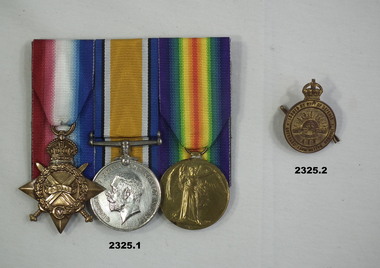
Award - MEDAL SET WW1 & BADGE, Post 1919
... Embarks for Eygpt 3.2.15, hospital Gallipoli 10.9.15 classed "Enteric", returns to Australia on 20.10.15. He goes AWOL on 24.3.16, classed as a deserter on 17.4.16. ...Embarks for Eygpt 3.2.15, hospital Gallipoli 10.9.15 classed "Enteric", returns to Australia on 20.10.15. He goes AWOL on 24.3.16, classed as a deserter on 17.4.16. ...Horace Eli Hambly (born Bendigo, enlisted Bendigo) No 794 enlisted on 7.12.14 in 3rd reinforcements 4th Light Horse Regt age 20 years 10 months. Embarks for Eygpt 3.2.15, hospital Gallipoli 10.9.15 classed "Enteric", returns to Australia on 20.10.15. He goes AWOL on 24.3.16, classed as a deserter on 17.4.16. He re enlists in NSW on 16.7.17 as David Edward Miles No 7856 3rd Aust Tunneling Coy, he then confesses and embarks for England on 21.11.17, hospital with PUO on 27.6.18, discharged from the AIF on 17.7.19. .1) Medals, court mounted, set of (3) re H.E Hambly. 1. 1914-15 Star. 2. War Medal 1914-18 3. Victory Medal 1914 - 1919 .2) "Returned from Active Service Badge". Metal, gold colour, round with crown at top, centre has Rising Sun with AIF under..1) "794 Cpl H.E.Hambly 4 L.H.R A.I.F" .2) "201258"medals, badges, military -
 Wangaratta RSL Sub Branch
Honour Board, Peechelba School 1939-1945
... Taylor was not charged with AWOL as everyone was happy to see him alive and let bygones be bygones....Taylor was not charged with AWOL as everyone was happy to see him alive and let bygones be bygones. honour board peechelba school world war 2 Peechelba School Roll of Honour 1939-1945. ...The name of W. Taylor in the "Memoriam" has been scratched out. After the war had ended W. Taylor was not demobolised back to Australia with his platoon, he was missing in action and later believed to be deceased. At a platoon reunion some years later, W. Taylor attended and informed the platoon that after the war he had lived in Scotland for a year before returning to Australia. His name was scratched out of the Memoriam list at the reunion. W. Taylor was not charged with AWOL as everyone was happy to see him alive and let bygones be bygones. Wooden board with fourth columns of names of those who served. Has a "Memoriam" list in centre of board with five names, one of which has been scratched out "Taylor. W". Peechelba School Roll of Honour 1939-1945. honour board, peechelba, school, world war 2 -
 National Vietnam Veterans Museum (NVVM)
Book, Whittaker, Bob, Jellybeans In The Jungle
... ...AWOL...Vietnam War 1961-1975 - Personal narratives - Australian Phuoc Tuy Province Long Khanh Province Cambodia B-52 North Vietnamese TAA Viscount Conscription AWOL 3rd Recruit Training Battalion 7th Battalion Royal Australian Regiment There is a very reliable rule of thumb when it comes to authority and command. ...There is a very reliable rule of thumb when it comes to authority and command.There is a very reliable rule of thumb when it comes to authority and command. vietnam war, 1961-1975 - personal narratives - australian, phuoc tuy province, long khanh province, cambodia, b-52, north vietnamese, taa viscount, conscription, awol, 3rd recruit training battalion, 7th battalion, royal australian regiment -
 Emerald Museum & Nobelius Heritage Park
Award - British War Medal 1914-20, Royal Mint, 1919-1920
... He was regularly disciplined for offences such as neglecting to obey orders, drunkenness, going AWOL and missing marching parades. He was discharged from the AIF at the conclusion of the First World War and returned home to New South Wales. ...He was regularly disciplined for offences such as neglecting to obey orders, drunkenness, going AWOL and missing marching parades. He was discharged from the AIF at the conclusion of the First World War and returned home to New South Wales. ...James Beashel enlisted for the Australian Imperial Force (AIF) on 1 June 1917. He served with the 33rd Battalion and was marched out to the front in France in February 1918. In that year the 33rd Battalion engaged in a number of significant battles as the Germans launched their ‘Spring Offensive’ – a final push for victory following the revolution and collapse of the Russian army in late 1917. Some of the notable engagements include the Battle of Mont St Quentin, the Battle of Amiens and the Battle of Villers Bretonneux. The British War Medal 1914-20 was instituted by King George V in 1919 to mark the end of the First World War. It was awarded to members of British and Imperial forces who had served for a prescribed period during the course of the war, or who had died in active service. Beashel was not the most disciplined of soldiers throughout his time with the AIF. He was regularly disciplined for offences such as neglecting to obey orders, drunkenness, going AWOL and missing marching parades. He was discharged from the AIF at the conclusion of the First World War and returned home to New South Wales. Later in life he relocated to Victoria and died in 1965. For his service he received the Victory Medal, the British War Medal 1914-20, and the 1914-15 Star.This item is historically significant as it represents the service of an Australian in one of the most significant events of the twentieth century, and indeed in human history. 416,809 Australians enlisted for service, of which more than 60,000 were killed and more than 150,000 were wounded, gassed, or taken prisoner. The First World War remains a significant event in Australia's history. The landings at Gallipoli on April 25, 1915 is remembered as ANZAC Day, and is still commemorated to this day, over 100 years later.Silver, circular medallion. The profile of King George V is impressed on the obverse, along with the words 'GEORGIVS V BRITT: OMN: REX ET IND: IMP:' The reverse has an impression of St George on horseback, along with '1914' and '1918'. The ribbon is a thick orange band, flanked on both sides by thinner blue, black and white bands.Obverse: GEORGIVS V BRITT: OMN: REX ET IND: IMP: / Reverse: 1914 1918 //medal, commemorative medals, military, first world war, world war one, world war i, world war 1, wwi, ww1 -
Emerald Museum & Nobelius Heritage Park
Award - War Medals - World War I, Royal Mint, 1919-1920
... He was regularly disciplined for offences such as neglecting to obey orders, drunkenness, going AWOL and missing marching parades. He was discharged from the AIF at the conclusion of the First World War and returned home to New South Wales. ...He was regularly disciplined for offences such as neglecting to obey orders, drunkenness, going AWOL and missing marching parades. He was discharged from the AIF at the conclusion of the First World War and returned home to New South Wales. ...James Beashel enlisted for the Australian Imperial Force (AIF) on 1 June 1917. He served with the 33rd Battalion and was marched out to the front in France in February 1918. In that year the 33rd Battalion engaged in a number of significant battles as the Germans launched their ‘Spring Offensive’ – a final push for victory following the revolution and collapse of the Russian army in late 1917. Some of the notable engagements include the Battle of Mont St Quentin, the Battle of Amiens and the Battle of Villers Bretonneux. Beashel was not the most disciplined of soldiers throughout his time with the AIF. He was regularly disciplined for offences such as neglecting to obey orders, drunkenness, going AWOL and missing marching parades. He was discharged from the AIF at the conclusion of the First World War and returned home to New South Wales. Later in life he relocated to Victoria and died in 1965. For his service he received the Victory Medal, the British War Medal 1914-20, and the 1914-15 Star. The 1914-15 Star was awarded to those who served with the British and Imperial Forces between 5 August 1914 and 31 December 1915 The British War Medal 1914-20 was instituted by King George V in 1919 to mark the end of the First World War. It was awarded to members of British and Imperial forces who had served for a prescribed period during the course of the war, or who had died in active service. The Victory Medal was awarded to those who served with the armed forces of the British and Imperial Forces or with certain voluntary organisations between 5 August 1914 and 11 November 1918.This item is historically significant as it represents the service of an Australian in one of the most significant events of the twentieth century, and indeed in human history. 416,809 Australians enlisted for service, of which more than 60,000 were killed and more than 150,000 were wounded, gassed, or taken prisoner. The First World War remains a significant event in Australia's history. The landings at Gallipoli on April 25, 1915 is remembered as ANZAC Day, and is still commemorated to this day, over 100 years later.Four medals. One is a bronze four-pointed star medallion, ensigned with a crown. The obverse has two crossed swords overlaid with a wreath and a scroll that reads '1914-15'. Below is the royal cypher of King George V - GV. The ribbon is a thick white band flanked by a thinner blue band on one side and a red band on the other. Two of the medals are the same. Silver, circular medallions. The profile of King George V is impressed on the obverse, along with the words 'GEORGIVS V BRITT: OMN: REX ET IND: IMP:' The reverse has an impression of St George on horseback, along with '1914' and '1918'. The ribbon is a thick orange band, flanked on both sides by thinner blue, black and white bands. One is a circular, bronze medallion, impressed on the obverse with a winged, female figure holding a palm branch in her right hand. The reverse reads 'THE GREAT WAR FOR CIVILISATION 1914 - 1919', surrounded by a laurel wreath. The ribbon is rainbow coloured.Medal 1: Obverse: 1914-15 / Medals 2 and 4: Obverse: GEORGIVS V BRITT: OMN: REX ET IND: IMP: / Reverse: 1914 1918 / Medal 3: Reverse: THE GREAT / WAR FOR / CIVILISATION / 1914 - 1919 /medal, commemorative medals, military, first world war, world war one, world war i, world war 1, wwi, ww1 -
 Wangaratta RSL Sub Branch
Photograph
... He resigned from this position on 8/5/1916, went AWOL and on 21/7/1920 discharged due to desertion. ...He resigned from this position on 8/5/1916, went AWOL and on 21/7/1920 discharged due to desertion. ...Photograph of soldiers taken circa 11 October 1914 All enlisted on the 17th of August, 1914 at Wangaratta unless stated otherwise, assigned to the 7th Battalion C Company and identified as follows:- Colour Sergeant William Baker 290 - Prior to enlistment at Essendon was serving with the 58th Battalion. He embarked Australia on the 21/10/14. Brothers Charles POWLEY 347 and John Hall POWLEY 348 from Boweya - Embarked 19/10/14 on HMAT Hororata. Charles aged 21 years KIA 25/4/15 at Gallipoli and John returned to Australia on 31/10/15. Charles attended Wangaratta High School. John Crocker 346 was born at Clunes and enlisted at Broadmeadows. He was 36 years old, a butcher by trade and served with the 2nd Scottish Horse in the Boer War. His mother was listed as next of kin residing in Bracknell Tasmania He was wounded at Gallipoli and discharged on 19/1/1917 Nelson Albert Hardy 363 Born in England and a butcher by trade .KIA 23/8/1915 at Gallipoli aged 22 Edward Fahey 364 Ovens Street Wangaratta, Aged 29 years, a Painter by trade. He returned to Australia in December 1915 and appointed a Recruiting Sergeant. He resigned from this position on 8/5/1916, went AWOL and on 21/7/1920 discharged due to desertion. Joseph Cowham 360 enlisted at Broadmeadows on 19/8/1914. Thomas Peter Williams 404 - Aged 24 and a Blacksmith. He received a gunshot wound to the wrist on 26/5/1915 and returned to Australia. Joseph Nathaniel O'Brien 376 or John William O'Brien 365 both of Rowan Street Wangaratta Handwritten on rear “Wangaratta Boys C Company 7th Battalion October 11th 1914 From Private John Crocker 346”Sepia photograph of 11 men six standing and five kneeling dressed in military uniform wearing forage cap with row of pine trees in background. Photograph is mounted on brown cardboard with handwriting across top border.Rear - Wangaratta Boys C Company 7th Battalion October 11th 1914 From Private John Crocker 346 Front - list of names handwritten in ink J Powly, Col Serg Baker? Corp Naldress?, Private Couham?, C Powly, L Williams N Hardy J Crocker, E Lahy?, J?? K Jarrot? wangaratta, c company, joseph cowham 360, nelson hardy 363, john crocker 346, charles powley 347, john powley 348, hororata, gallipoli, edward fahey 364, thomas peter williams 404, william baker 290, joseph nathaniel o'brien 376, john william o'brien 365, ww1, 7th battalion
