
Showing 7 items matching "axehead tool"
-
 Orbost & District Historical Society
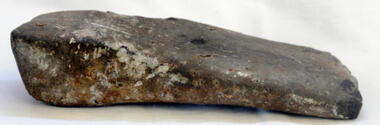
stone
... axehead tool...Not Aboriginal origin; an interesting stone shape. axehead tool A large rectangular piece of stone . ...Found at Buchan. Inspected by Joanna Freslov, archaeologist 2/6/2008. Not Aboriginal origin; an interesting stone shape.A large rectangular piece of stone . In the shape of an axe head.axehead tool -
 Orbost & District Historical Society
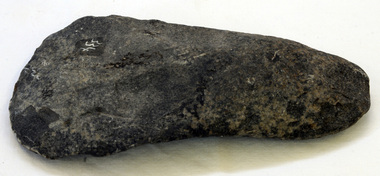
axe head
... axehead aboriginal tool stone-artefact...This axe head is an example of an early stone tool used by the Indigenous people of Eastern Australia. axehead aboriginal tool stone-artefact A handmade stone Aboriginal axe head. ...Inspected by Joonna Freslov, archaeologist 2.6.2008. Stone tools were used for a variety of purposes, in ways similar to those of steel knives, axes, hammers and chisels. Ground-edge tools are made from fracture-resistant stone, such as basalt which is able to withstand repeated impact, and is suitable for use in objects such as stone axes. The stone was quarried, and then roughly shaped into a tool blank with blows from a hammerstone. The edges were then sharpened and refined by grinding the tool against a coarse, gritty rock.The necessary tools and equipment for hunting, fishing and warfare were one of the very few items that Aboriginals carried with them from place to place. Most were used for a multiplicity of purposes. Because many were made from raw natural materials, such as wood, generally only partial remains are found today. This axe head is an example of an early stone tool used by the Indigenous people of Eastern Australia.A handmade stone Aboriginal axe head. Finger grips are clear.axehead aboriginal tool stone-artefact -
 Federation University Historical Collection
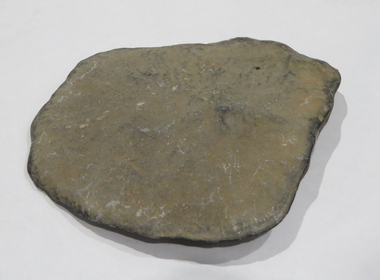
Ethnographic, Possible Aboriginal Axehead
... tool...stone...axe...axehead...aboriginal stone tool stone axe axehead limestone archaeology Possible stone axehead made of limestone with fractures Possible Aboriginal Axehead Ethnographic ...Possible stone axehead made of limestone with fractures aboriginal, stone tool, stone, axe, axehead, limestone, archaeology -
 Orbost & District Historical Society
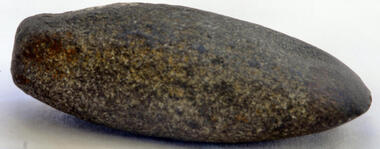
axe head
... axehead stone-artifact aboriginal tool...This axe head is an example of an early stone tool used by the Indigenous people of Victoria. axehead stone-artifact aboriginal tool Small grey oval-shaped axe head. axe head ...Inspected by Joanna Freslov, archaeologist 2/6/2008. Genuine Aboriginal axe head up to 2000 years old. Possibly came through trading from western district. Stone tools were used for a variety of purposes, in ways similar to those of the steel knives, axes, hammers and chisels. Ground-edge tools are made from fracture-resistant stone, such as basalt.This stone is able to withstand repeated impact, and and wqas generall used for stone axes. The stone was dug or found and then roughly shaped into a tool blank with blows from a hammerstone. The edges were then sharpened and refined by grinding the tool against a coarse, gritty rock. The necessary tools and equipment for hunting, fishing and warfare were one of the very few items that Aboriginals carried with them from place to place. Most were used for a multiplicity of purposes. Because many were made from raw natural materials, such as wood, generally only partial remains are found today. This axe head is an example of an early stone tool used by the Indigenous people of Victoria.Small grey oval-shaped axe head.axehead stone-artifact aboriginal tool -
 Orbost & District Historical Society
lil-lil
... tools and equipment for hunting, fishing and warfare were some of the very few items that Aboriginals carried with them from place to place. Most were used for a multiplicity of purposes. Because many were made from raw natural materials, such as wood, generally only partial remains are found today. This lil lil club is an example of a wooden weapon used by the Indigenous people of Eastern Australia. hunting fishing challenge-stick aboriginal A handmade wooden lil-lil club with a long handle and axehead ...The lil-lil is a type of club which was made and used only in eastern Australia. It was a dangerous weapon when used in battle.The necessary tools and equipment for hunting, fishing and warfare were some of the very few items that Aboriginals carried with them from place to place. Most were used for a multiplicity of purposes. Because many were made from raw natural materials, such as wood, generally only partial remains are found today. This lil lil club is an example of a wooden weapon used by the Indigenous people of Eastern Australia.A handmade wooden lil-lil club with a long handle and axehead shaped club at one end. Intricately carved with a turtle on one side of the club head and a wild dog on the other.hunting fishing challenge-stick aboriginal -
 Bendigo Historical Society Inc.
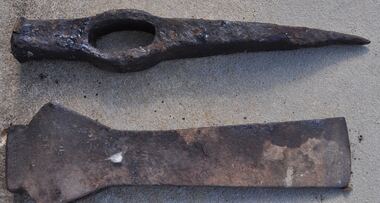
Tool - MINERS AXEHEAD AND PICK HEAD
... Axehead displaying the process of construction in the forge by the apparent separation of metal layers/. Tool ...Miners Axehead and Pick head. Both items significantly rusted. Axehead displaying the process of construction in the forge by the apparent separation of metal layers/.mining, mining tools, bendigo mining -
 Anglesea and District Historical Society
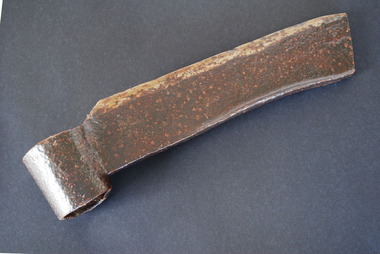
Shingle Splitter - Wood Shingle Shaping Tool (FROE)
... axehead shingle splitter froe, shake axe None Froe (or shake axe) is a tool for cleaving wood by splitting it along the grain, then twisting the blade in the wood by rotating the handle (haft). ...Froe (or shake axe) is a tool for cleaving wood by splitting it along the grain, then twisting the blade in the wood by rotating the handle (haft). The haft is a lever to multiply the force on the blade, allowing wood to be torn apart with little force applied to the haft.Noneaxehead shingle splitter, froe, shake axe
