
Showing 14 items matching "axminster loom"
-
 National Wool Museum
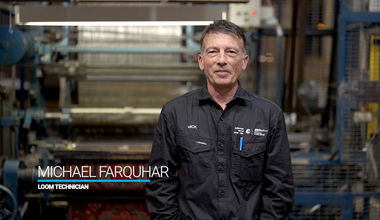
Film - Axminster Carpet Loom with Michael Farquhar, Streamline Media and Communications Group Pty Ltd, 2025
... Axminster Carpet Loom with Michael Farquhar......Loom Technician...Axminster...This film features Loom Technician Michael Farquhar demonstrating how the Axminster Carpet Loom works, at the National Wool Museum. ...This film features Loom Technician Michael Farquhar demonstrating how the Axminster Carpet Loom works, at the National Wool Museum. ...This film features Loom Technician Michael Farquhar demonstrating how the Axminster Carpet Loom works, at the National Wool Museum. The Axminster Carpet Loom has been set up as a focal point in the centre of the National Wool Museum. The loom was originally built by Brintons in England around 1910 and was initially operating in Geelong in 1960. Brintons designed and built most of their own looms and ancillary equipment. When superseded in 1975 the loom was donated to the Melbourne College of Textiles for weaving training. The College has now donated the loom to the National Wool Museum and Brintons engineering staff has restored it to full working condition. This loom is known as an Axminster gripper loom. The gripper system was invented by Brintons in 1890 and operates using a gripper shaped like a bird's beak. This grips the yarn, the yarn is then cut and the gripper swings down to place the tuft into the woven backing. This particular loom also uses a jacquard system for weaving colours. In jacquard weaving, punched cards are used to instruct the loom as to which colour to use. The system was invented by Joseph Jacquard, a silk weaver from Lyon, and was introduced in 1804. It revolutionised pattern weaving as it had the capacity to create intricate patterns through the use of the cards. By 1833 there were approximately 100,000 power-looms used in Great Britain that had been influenced by Jacquard's invention. Joseph Jacquard died in 1834. Charles Babbage was later to adapt Jacquard's punch-card system to produce a calculator that was the forerunner of todays methods of computer programming.Digital film featuring colour footage, audio and animated graphics. michael farquhar, loom technician, axminster carpet loom, brintons, geelong, textile industry, machinery, weaving, restoration, gripper, jacquard, punch cards -
 National Wool Museum
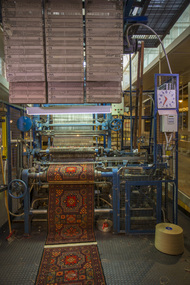
Machine - Axminster Carpet Loom, Brintons Ltd (UK), c. 1910
... Axminster Carpet Loom...The Axminster Carpet Loom has been set up as a focal point in the centre of the National Wool Museum. ...Axminster carpet loom featuring over 1000 Jacquard punch cards and over 100 bobbins of different colours of wool....The Axminster Carpet Loom has been set up as a focal point in the centre of the National Wool Museum. ...The Axminster Carpet Loom has been set up as a focal point in the centre of the National Wool Museum. The loom was originally built by Brintons in England around 1910 and was initially operating in Geelong in 1960. Brintons designed and built most of their own looms and ancillary equipment. When superseded in 1975 the loom was donated to the Melbourne College of Textiles for weaving training. The College has now donated the loom to the National Wool Museum and Brintons engineering staff has restored it to full working condition. This loom is known as an Axminster gripper loom. The gripper system was invented by Brintons in 1890 and operates using a gripper shaped like a birds beak. This grips the yarn, the yarn is then cut and the gripper swings down to place the tuft into the woven backing. This particular loom also uses a jacquard system for weaving colours. In jacquard weaving, punched cards are used to instruct the loom as to which colour to use. The system was invented by Joseph Jacquard, a silk weaver from Lyon, and was introduced in 1804. It revolutionised pattern weaving as it had the capacity to create intricate patterns through the use of the cards. By 1833 there were approximately 100,000 power-looms used in Great Britain that had been influenced by Jacquards invention. Joseph Jacquard died in 1834. Charles Babbage was later to adapt Jacquards punch-card system to produce a calculator that was the forerunner of todays methods of computer programmingAxminster carpet loom featuring over 1000 Jacquard punch cards and over 100 bobbins of different colours of wool.loom carpet wool, geelong woolbrokers' association, geelong, auction -
 National Wool Museum
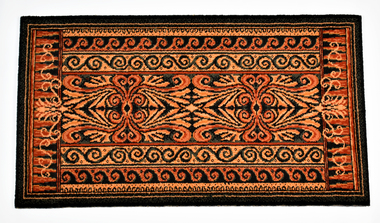
Textile - Greek Rug Carpet Sample, National Wool Museum, 1990s
... Axminster Loom...This rug sample was woven at the National Wool Museum on the 1910 gripper type Axminster Jacquard carpet loom. The rug is made from 80% wool and 20% nylon, the internationally preferred blend for high quality, long lasting carpets....Axminster Loom carpet sample rug wool National Wool Museum Brinton's back: [handwritten] 2/57 Orange, cream, green, red and black patterned carpet with jute backing. ...This rug sample was woven at the National Wool Museum on the 1910 gripper type Axminster Jacquard carpet loom. The rug is made from 80% wool and 20% nylon, the internationally preferred blend for high quality, long lasting carpets.Orange, cream, green, red and black patterned carpet with jute backing.back: [handwritten] 2/57axminster loom, carpet, sample, rug, wool, national wool museum, brinton's -
 National Wool Museum
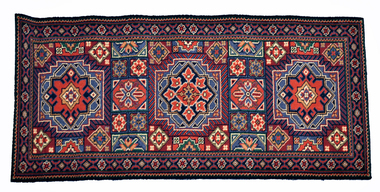
Textile - Manor House Rug Carpet Sample, National Wool Museum, 1990s
... Axminster Loom...This Manor House Rug sample was woven at the National Wool Museum on the 1910 gripper type Axminster Jacquard carpet loom. The rug is made from 80% wool and 20% nylon, the internationally preferred blend for high quality, long lasting carpets....Axminster Loom carpet sample rug wool National Wool Museum brintons Red, green, blue, black, cream floral patterned carpet sample with jute backing. ...The Manor House Rug was designed by Brinton's Carpets in 1990 exclusively for the National Wool Museum. The design is based on an earlier design from Brinton's UK Persian Rug Archive Library. This Manor House Rug sample was woven at the National Wool Museum on the 1910 gripper type Axminster Jacquard carpet loom. The rug is made from 80% wool and 20% nylon, the internationally preferred blend for high quality, long lasting carpets.Red, green, blue, black, cream floral patterned carpet sample with jute backing.axminster loom, carpet, sample, rug, wool, national wool museum, brintons -
 National Wool Museum
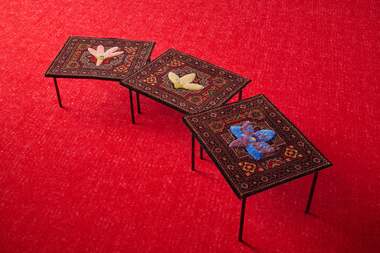
Textile - Orchid Tables, Dowel Jones, 2024
... ...Axminster Loom...The exhibition label reads: Sitting just outside this exhibition in the National Wool Museum is a 1910 Axminster Jacquard Carpet Loom. This loom was operating at Brintons factory in Geelong from 1960 to 1975, and then at the Melbourne College of Textiles, until it was donated to the museum. ...Dowel Jones Ten Years of Dowel Jones National Wool Museum Axminster Loom Carpet Manor House Rug Orchids Anglesea Design Art Furniture Beci Orpin Brintons Geelong Melbourne College of Textiles Three tables consisting of powder coated steel frames, with a woven carpet top. ...The Orchid Tables were on display as part of the Ten Years of Dowel Jones exhibition at the National Wool Museum in 2024. The exhibition label reads: Sitting just outside this exhibition in the National Wool Museum is a 1910 Axminster Jacquard Carpet Loom. This loom was operating at Brintons factory in Geelong from 1960 to 1975, and then at the Melbourne College of Textiles, until it was donated to the museum. In the 1990's the museum commissioned an exclusive pattern called the Manor House Rug. Based on earlier designs from Brintons UK Persian Rug Archive Library, the museum continues to make this rug through the expertise of Loom Technician Michael Farquhar. The Manor House Rug features a central medallion with floral pattern. Working with illustrator Beci Orpin, and referencing Margaret MacDonald & Angair's book 'Orchids of the Anglesea District', we identified regional orchids. By a process of removal and addition, the original floral medallion was replaced with local species as decorative motif. Ten Year of Dowel Jones presents three altered Manor House Rugs, each with different orchids tufted in wool and placed in the centre of each rug. The rugs have been attached by cotton thread to three table frames at different heights to create the Orchid Tables.Three tables consisting of powder coated steel frames, with a woven carpet top. The table tops are made from wool with a jute backing, and feature a red, green, blue, black and cream floral design with an orchid in the centre. Each table is a different height.dowel jones, ten years of dowel jones, national wool museum, axminster loom, carpet, manor house rug, orchids, anglesea, design, art, furniture, beci orpin, brintons, geelong, melbourne college of textiles -
 National Wool Museum
Rug
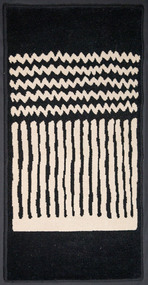
... Rug was made on National Wool Museum Brinton Axminster Gripper Loom by Brintons Carpets Geelong staff prior to the visit of Queen Elizabeth. ...Rug was made on National Wool Museum Brunton Axminster Gripper Loom by Brintons Carpets Geelong staff prior to the visit of Queen Elizabeth. ...Rug was made on National Wool Museum Brinton Axminster Gripper Loom by Brintons Carpets Geelong staff prior to the visit of Queen Elizabeth. ...Rug was made on National Wool Museum Brinton Axminster Gripper Loom by Brintons Carpets Geelong staff prior to the visit of Queen Elizabeth. On the afternoon of 28/4/1988 Queen Elizabeth was presented with a similiar rug but latex backed and labelled.Rug was made on National Wool Museum Brunton Axminster Gripper Loom by Brintons Carpets Geelong staff prior to the visit of Queen Elizabeth. Detail of rug made on National Wool Museum Brunton Axminster Gripper Loom by Brintons Carpets Geelong staff prior to the visit of Queen Elizabeth II. Label on rug made on National Wool Museum Brunton Axminster Gripper Loom by Brintons Carpets Geelong staff prior to the visit of Queen Elizabeth II. Label for rug made on National Wool Museum Brunton Axminster Gripper Loom by Brintons Carpets Geelong staff prior to the visit of Queen Elizabeth II.weaving, national wool museum, axminster -
 National Wool Museum
Rug, Tascot Templeton Carpet (TTC), c.1990
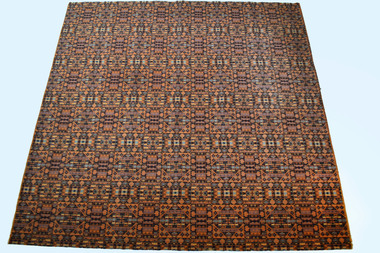
... ...axminster carpet loom...TTC manufactured primarily high-quality narrow and broad loom, Axminster and Wilton carpets for the domestic and commercial market. ...TTC manufactured primarily high-quality narrow and broad loom, Axminster and Wilton carpets for the domestic and commercial market. ...This rug was woven in the mid-1990s at the Tascot Templeton Carpet (TTC) mills in Devonport, Tasmania. It was an in-house design. The rug was woven as a one-off design exercise and was given a Golden Thread Award by the Australian Wool Corporation. The design never went into standard stock production and was never released for public sale. This rug has been woven with 100% wool on a 1 metre wide loom. The loom was purchased by TTC from United Carpet Mills of Preston and the rug was woven to demonstrate the capabilities of these looms. This rug is an example of Wilton weaving. Wilton differs from Axminster in that it is usually Loop Pile and 100% wool whereas Axminster is Plush (cut) pile and normally 80/20 wool nylon blend. TTC manufactured primarily high-quality narrow and broad loom, Axminster and Wilton carpets for the domestic and commercial market. They operated from the early 1960s until their closure in 2011. This rug was also on display in the Tascot Templeton head offices before being donated to the National Wool Museum in 2021 by Roger Warn. 3 x 3-meter carpet rug woven in 1-meter wide sections. The pattern repeats 3 times both in the width and the length. Starting from the bottom left corner, a square can be seen within a larger circular shape. These circular shapes connect end on end across the width and length of the rug. 5 Circles make up the length of the rug while 6 circles make up the width. Numerous small shapes encompass the entirety of the rug. These small shapes work together to form many interconnected repeating forms that draw your eye in a new direction every time you look at the rug. The predominant colour of the rug is a purple background with blue, cream and orange colours making up the foreground colours.carpet rugs, woollen rugs, tascot templeton carpets, axminster carpet loom -
 National Wool Museum
Rug
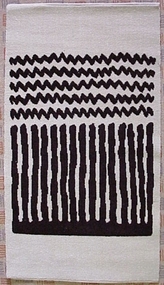
... Rug was made on National Wool Museum Brinton Axminster Gripper Loom by Brintons Carpets Geelong Staff prior to the visit of Queen Elizabeth. ...Rug was made on National Wool Museum Brinton Axminster Gripper Loom by Brintons Carpets Geelong Staff prior to the visit of Queen Elizabeth. ...Rug was made on National Wool Museum Brinton Axminster Gripper Loom by Brintons Carpets Geelong Staff prior to the visit of Queen Elizabeth. On the afternoon of 28/4/1988 Queen Elizabeth was presented with a similiar rug but latex backed and labelled.weaving, axminster -
 National Wool Museum
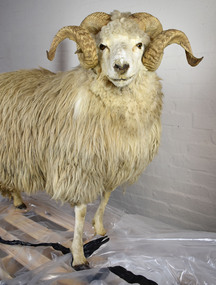
Taxidermy Sheep, Bilby Bill, c1980
... The yarn used on the National Wool Museum’s Axminster Gripper Loom to make the Manor House Rug is spun from the wool of Drysdale sheep....The yarn used on the National Wool Museum’s Axminster Gripper Loom to make the Manor House Rug is spun from the wool of Drysdale sheep. drysdale sheep new zealand Taxidermied male Drysdale sheep. ...Originating in New Zealand, the Drysdale, represented by Bilby Bill, was developed in the 1930s at Massey University (Canterbury) by crossing a coarse haired Romney and the hardy Cheviot breed. First imported to Australia in 1975, the Drysdale, due to a genetic abnormality, produces coarse, long staple fleece. This same gene also gives them their horns, something that generally does not occur in the parent breeds. Their fleece grows very fast, up to 25cm every six months; as such shearing is carried out twice a year. The coarse and hard wearing wool is mostly used for the manufacture of carpets. The Drysdale is a medium to large stocky sheep, weighing approximately 55kg and produces about 6 to 8kg of fleece per animal annually, which is 35 to 45 microns in diameter. The yarn used on the National Wool Museum’s Axminster Gripper Loom to make the Manor House Rug is spun from the wool of Drysdale sheep.Taxidermied male Drysdale sheep. Medium sized animal with white body coloration. Large horns protruding from the top of the skull. drysdale, sheep, new zealand -
 National Wool Museum
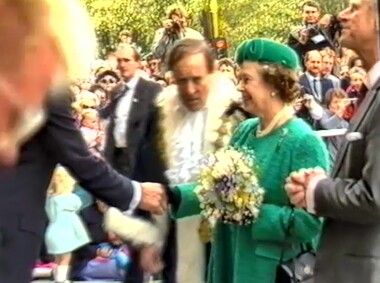
Film - The Visit to the National Wool Centre by Her Majesty Queen Elizabeth II, April 1988
... The Queen was presented with a rug woven by the museums 1910 gripper-type Axminster Jacquard carpet loom and the Duke was presented with a woollen jumper. ...The Queen was presented with a rug woven by the museums 1910 gripper-type Axminster Jacquard carpet loom and the Duke was presented with a woollen jumper. ...In 1988 Her Majesty Queen Elizabeth II and Prince Philip travelled across Australia to take part in the bicentenary celebrations. In April Her Majesty Queen Elizabeth II and Prince Philip arrived in Geelong to open the Wool Week Display in the almost complete National Wool Centre. Crowds gathered to welcome the royal couple, wool shearing demonstrations took place outside the centre and “Spud” the sheepdog exhibited his herding talents. During their visit to the wool centre they were met by the chairman of the Geelong Regional Commission, Mr Colin Atkins and Mrs Monique Atkins. The Queen was presented with a rug woven by the museums 1910 gripper-type Axminster Jacquard carpet loom and the Duke was presented with a woollen jumper. In return the Queen presented three letters from the archives of the Windsor Castle to the museum. The couple left in the afternoon, charming the Geelong crowd.Black VHS tape with black and yellow stickers and printed text. Tape is housed in a black plastic case. Film includes colour footage and audio. 00:13 - titles 00:21 - Queen greeting crowds of people on Moorabool Street 00:41 - sheep herding demonstration on Moorabool Street 01:04 - sheep shearing demonstration 01:53 - Queen tours inside the National Wool Centre 02:17 - Queen watches loom demonstration 02:34 - wool auction 04:02 - Queen and Prince Philip sign two registers 06:10 - Queen exits National Wool Centre 06:12 - Queen greets crowds on the street 07:04 - Queen enters vehicle 07:18 - endLabel on case: Queens Visit / National Wool Centre.film, national wool centre, bicentennial, her majesty queen elizabeth ii, prince philip, national wool museum, royal visit -
 National Wool Museum
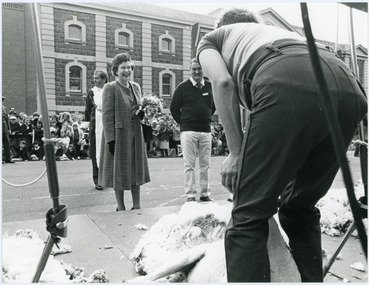
Photograph, Queen Elizabeth II visit to Geelong, 1988
... The Queen was presented with a rug woven by the museums 1910 gripper-type Axminster Jacquard carpet loom and the Duke was presented with a woollen jumper. ...The Queen was presented with a rug woven by the museums 1910 gripper-type Axminster Jacquard carpet loom and the Duke was presented with a woollen jumper. ...In 1988 Her Majesty Queen Elizabeth II and Prince Philip travelled across Australia to take part in the bicentenary celebrations. In April Her Majesty Queen Elizabeth II and Prince Philip arrived in Geelong to open the Wool Week Display in the almost complete National Wool Centre. Crowds gathered to welcome the royal couple, wool shearing demonstrations took place outside the centre and “Spud” the sheepdog exhibited his heading talents. During their visit to the wool centre they were met by the chairman of the Geelong Regional Commission, Mr Colin Atkins and Mrs Monique Atkins. The Queen was presented with a rug woven by the museums 1910 gripper-type Axminster Jacquard carpet loom and the Duke was presented with a woollen jumper. In return the Queen presented three letters from the archives of the Windsor Castle to the museum. The couple left in the afternoon, charming the Geelong crowd. Two black and white photographs of Her Majesty Queen Elizabeth II, accompanied by the City of Greater Geelong Mayor, Jim Fidge, watching a shearing demonstration by local Geelong shearers outside the then National Wool Centre. Her Majesty Queen Elizabeth II opened the Wool Week Display in the almost complete National Wool Centre during her visit in April 1988.royal visit, wool centre, geelong, queen elizabeth ii, prince philip, national wool centre., bicentenary celebrations -
 National Wool Museum
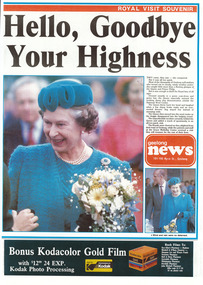
Royal Visit Souvenir, 29th April 1988
... The Queen was presented with a rug woven by the museums 1910 gripper-type Axminster Jacquard carpet loom and the Duke was presented with a woollen jumper. ...The Queen was presented with a rug woven by the museums 1910 gripper-type Axminster Jacquard carpet loom and the Duke was presented with a woollen jumper. ...In 1988 Her Majesty Queen Elizabeth II and Prince Philip travelled across Australia to take part in the bicentenary celebrations. In April Her Majesty Queen Elizabeth II and Prince Philip arrived in Geelong to open the Wool Week Display in the almost complete National Wool Centre. Crowds gathered to welcome the royal couple, wool shearing demonstrations took place outside the centre and “Spud” the sheepdog exhibited his herding talents. During their visit to the wool centre they were met by the chairman of the Geelong Regional Commission, Mr Colin Atkins and Mrs Monique Atkins. The Queen was presented with a rug woven by the museums 1910 gripper-type Axminster Jacquard carpet loom and the Duke was presented with a woollen jumper. In return the Queen presented three letters from the archives of the Windsor Castle to the museum. The couple left in the afternoon, charming the Geelong crowd. Souvenir newspaper, relating to Her Majesty Queen Elizabeth II visit to Geelong in April 1988 where she opened the Wool Week Display in the almost complete National Wool Centre.Front page title: Hello, Goodbye Your Highnessroyal visit -
 National Wool Museum
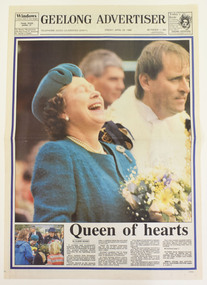
Royal Souvenir Edition, 29/4/1988
... The Queen was presented with a rug woven by the museums 1910 gripper-type Axminster Jacquard carpet loom and the Duke was presented with a woollen jumper. ...The Queen was presented with a rug woven by the museums 1910 gripper-type Axminster Jacquard carpet loom and the Duke was presented with a woollen jumper. ...In 1988 Her Majesty Queen Elizabeth II and Prince Philip travelled across Australia to take part in the bicentenary celebrations. In April Her Majesty Queen Elizabeth II and Prince Philip arrived in Geelong to open the Wool Week Display in the almost complete National Wool Centre. Crowds gathered to welcome the royal couple, wool shearing demonstrations took place outside the centre and “Spud” the sheepdog exhibited his heading talents. During their visit to the wool centre they were met by the chairman of the Geelong Regional Commission, Mr Colin Atkins and Mrs Monique Atkins. The Queen was presented with a rug woven by the museums 1910 gripper-type Axminster Jacquard carpet loom and the Duke was presented with a woollen jumper. In return the Queen presented three letters from the archives of the Windsor Castle to the museum. The couple left in the afternoon, charming the Geelong crowd. Souvenir newspaper, consisting of one large rectangular pieces of newsprint folded in half to form two pages. It contains articles and photographs relating to Her Majesty Queen Elizabeth II visit to Geelong in April 1988 where she opened the Wool Week Display in the almost complete National Wool Centre.Front page heading: Queen of heartsroyal visit -
 National Wool Museum
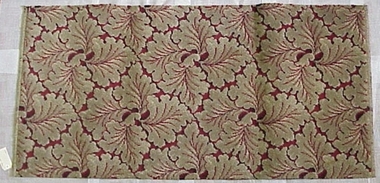
Sample, Carpet
... Heavy Axminster carpet sample from Brintons Kidderminster England, from a Wilton loom circa 1930. ...Heavy Axminster carpet sample from Brintons Kidderminster England, from a Wilton loom circa 1930. ...Heavy Axminster carpet sample from Brintons Kidderminster England, from a Wilton loom circa 1930. ...Heavy Axminster carpet sample from Brintons Kidderminster England, from a Wilton loom circa 1930. Part of a ten piece collection originally donated to the Queensland Museum by Mr Doug Glanville.Heavy Axminster carpet sample from Brintons Kidderminster England, from a Wilton loom circa 1930. Heavy Axminster carpet sample from Brintons Kidderminster England, from a Wilton loom circa 1930.Brintons Conda - 6weaving, brintons ltd (uk), carpet
