
Showing 194 items matching "back to the future"
-
 Melbourne Tram Museum
Newspaper, Baronial & The Basin Community News, "Back to the future", Oct. 2019
... "Back to the future"...Newspaper clipping from the "Baronial & The Basin Community News" or October 2019, titled "Back to the future" describing a visit to the Melbourne Tram Museum, gives a good report, sales, and how to get there. ...Has a photos including the Rhino. "Back to the future" Newspaper Baronial & The Basin Community News ...Newspaper clipping from the "Baronial & The Basin Community News" or October 2019, titled "Back to the future" describing a visit to the Melbourne Tram Museum, gives a good report, sales, and how to get there. No author. Has a photos including the Rhino.trams, tramways, melbourne tram museum, mtm, publicity, rhinos, hawthorn tram depot -
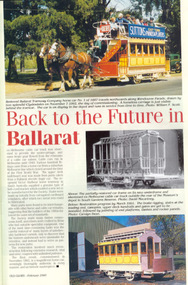 Ballarat Tramway Museum
Magazine, William. F. Scott, "Back to the Future in Ballarat", Old Glory Feb. 2000, Feb. 2000
... "Back to the Future in Ballarat", Old Glory Feb. 2000...Details of publisher in front cover. "Back to the Future in Ballarat", Old Glory Feb. 2000 Magazine William. ...Article written by Bill Scott on the reconstruction of the Horse Tram, No. 1, by the BTM in the Feb. 2000 issue of 'Old Glory', a UK Magazine that features items on the restoration/reconstruction of old vehicles. Article tells the story of the horse tram in Ballarat, the recovery of the vehicle, its reconstruction and return to service. Features five photographs. The magazine 84 page, A4 size with colour and black and white photographs of steam and other vintage vehicles. Published by CMS Publishing. Details of publisher in front cover.trams, tramways, horse trams, btm, reconstruction, restoration -
 Lilydale RSL Sub Branch
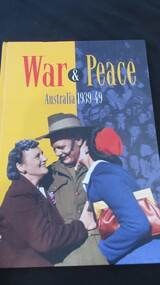
Book, Australia Post Philatelic Group, War & Peace Australia 1939-49, 1995
... ...Back to the Future...Produced by Australia Post in 1995 War in Europe Hostilities in the Pacific The Global War Transition to Peace Australia in the World Post-War Development Back to the Future Book War & Peace Australia 1939-49 Book Australia Post Philatelic Group Printset Cambec ...Produced by Australia Post in 1995Bookwar in europe, hostilities in the pacific, the global war, transition to peace, australia in the world, post-war development, back to the future -
 Ringwood and District Historical Society
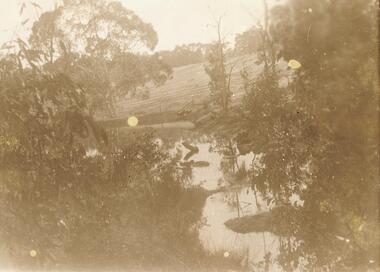
Photograph, Site of proposed lily pond at 'Quambee', North Ringwood, about 1912
... Written on back of photograph: "Future lily pond at 'Quambee', Nth Ringwood."...Written on back of photograph: "Future lily pond at 'Quambee', Nth Ringwood." ...Sepia photographWritten on back of photograph: "Future lily pond at 'Quambee', Nth Ringwood." -
Port Melbourne Historical & Preservation Society
Programme - Ten Arabian Nights, Street Illuminated Festival, Port Melbourne, "Ten Arabian Nights", Apr 1940
... Names of Council Officials at bottom and "price 3d". Back cover advertising future events ; a baby show; 50-50 dance; boxing and wrestling; comedy motor car act; and greasy pig race. ...Names of Council Officials at bottom and "price 3d". Back cover advertising future events ; a baby show; 50-50 dance; boxing and wrestling; comedy motor car act; and greasy pig race. ..."Ten Arabian Nights" Official Souvenir programme . Black and white with drawing of a machine gun and two soldiers on front cover. Names of Council Officials at bottom and "price 3d". Back cover advertising future events ; a baby show; 50-50 dance; boxing and wrestling; comedy motor car act; and greasy pig race. Inside includes list of Port Melbourne men enlisted in second AIF 1939-40.Port Melbourne Ten Arabian Nights. Street illuminated carnival in aid of comforts fund. Australia will be there.celebrations fetes and exhibitions, war - world war ii, james peter crichton, h v mays, c h wright, sydney sims anderson, port melbourne boys band, second aif port melbournee, rook's shoes, station hotel, dick krawley, albion hotel, d l hart, david bell, faram brothers hardware, rose & crown hotel, g legge, m bond, j e earl, j mowat, fountain inn, hausens ball, george westwood, william howe, mrs howey, mrs smith, mrs mccall, mrs cuthill, mrs whitford, mrs aanensen, mrs hart, mrs thompson, mrs law, mrs sinclair, mrs walsh, a & a parson, galatos chocolates, flower hotel, j w henley, mrs edward, mrs couslan, mrs white, mrs dunn, mrs brown, elizabeth branton crichton nee portbury, bert gardiner -
 Robin Boyd Foundation
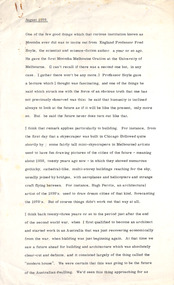
Document - Manuscript, Robin Boyd, ("One of the few things.."), 1970
... Discusses future cities and speculates on future trends. Looks back at ideas on the future of housing held by Boyd and his contemporaries in the 1950s and discusses how the reality of housing in the 1970s differs....Discusses future cities and speculates on future trends. Looks back at ideas on the future of housing held by Boyd and his contemporaries in the 1950s and discusses how the reality of housing in the 1970s differs. ...Discusses future cities and speculates on future trends. Looks back at ideas on the future of housing held by Boyd and his contemporaries in the 1950s and discusses how the reality of housing in the 1970s differs.Typewritten, quarto, 9 pagesfuture cities, apartments, suburban sprawl, modern houses, australian families, prefabrication, density, tensile construction, habitat 67, caravans, fred hoyle, tange, habitat 67, moomba, robin boyd, manuscript -
 Bendigo Historical Society Inc.
Newspaper - NEWSPAPER COLLECTION: BENDIGO ADVERTISER
... September 25, 1991, 9) Bendigo Back to the Future. June 29, 1998, 10) A Greater Bendigo. ...September 25, 1991, 9) Bendigo Back to the Future. June 29, 1998, 10) A Greater Bendigo. ...Folder 115 1) Bendigo Onward 1971-2000 2) Bendigo 150 Years 1853-2003 3) Bendigo 175 Years 1836-2011 4) Bendigo Remembers 1945-1995 - August 16, 1995, 5) Anzac Day 1986 "Lest We Forget" - 24 April 1986 6) Creating Our Future. Annual Supplement 2000 7) Bendigo A Capital City. September 27, 1989, 8) Bendigo A Spirit of Achievement. September 25, 1991, 9) Bendigo Back to the Future. June 29, 1998, 10) A Greater Bendigo. September 28, 1994, 11) Bendigo Booming - Region Shines Brightly. 2001 12) Bendigo Booming. August 7, 1996 13) Beautiful Bendigo "Into the Nineties" - September 26, 1990 14) The Bendigo Miner Final Edition - August 23, 2012 15) Bendigo Review - September 24, 1986 16) Centenary of Telecommunication in Bendigo - August 13 17) Bendigo Unlimited - May 7, 1994 18) Bendigo Unlimited - July 10,1982 19) In Bendigo We've Got The Life - September 25, 1985 20) Bendigo City of Golden Opportunity - September 26, 1986 21) Bendigo 160 Years, December 9, 1853-2013newspaper, 'bendigo advertiser -
 Federation University Historical Collection
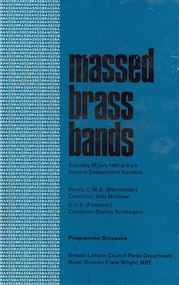
Programme, Massed Brass Bands 1968, 1968
... On the back cover is a list of future events to be held in the parks....On the back cover is a list of future events to be held in the parks. ...Frank Wright was a renown resident of Smeaton, where he was born. He lived at Laura Villa, and attended Smeaton State School. His father William was a gold miner and his mother's name was Sarah. Their family won many singing and instrumental awards. Frank was tutored by Percy Code and was awarded a gold medal for the highest marks in the ALCM examinations in the British Colonies at the age of seventeen years. He became the Australian Open Cornet Champion by the age of eighteen. A year later, Frank conducted the City of Ballarat Band, and later the Ballarat Soldiers’ Memorial Band. He formed the Frank Wright Frisco Band and Frank Wright and his Coliseum Orchestra. These bands won many South Street awards, and Frank as conductor won many awards in the Australian Band Championship contest. In 1933 Frank Wright sailed to England to conduct the famous St Hilda’s Band and was appointed in 1934 as the Musical Director of the London County Council (the GLC or Greater London Council), where he organized many amazing concerts in most of the 150 parks, in and around the London district. He was also responsible for some of London’s major concerts at Kenwood, the Crystal Palace and Holland Park. He was made Professor of Brass and Military Band Scoring and Conducting and was a Fellow of the Guildhall School of Music and Drama. Frank was often invited to adjudicate Brass Band Championships around Europe, in Australia, including South Street and in New Zealand. Frank was awarded an M.B.E. in 1967. The Frank Wright Medal at the Royal South Street competition is awarded to an individual recognized as making an outstanding contribution to brass music in Australia.Printed programme on white paper but with a coloured front cover. Inside is a description of the two participating bands in this Greater London Parks musical event held at Victoria Embankment Gardens and directed by Frank Wright, as well as the list of pieces being played. On the back cover is a list of future events to be held in the parks.frank wright, massed brass bands programme, victoria embankment gardens, greater london council parks, brass bands -
 Eltham District Historical Society Inc
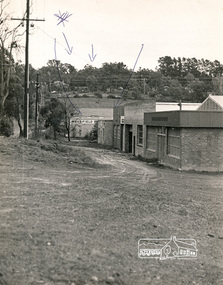
Photograph, N. J. Tillings Timber Factory, 15 June, 1975, 15/06/1975
... Being on high elevations backs of future buildings will be seen from Main Road Eltham and future Art Centre complex. ...Being on high elevations backs of future buildings will be seen from Main Road Eltham and future Art Centre complex. ...N. J. Tillings Timber Factory was part of the Brougham Street, Light industrial area, Eltham. Brick bulidings includes signage: Wakefield Pr... (printer?) No 17 Building C. This is one of 7 B/W 8x10 inch photos with notes on obverse by Dick Crichton. Accompanying letter from Florence Chrichton 2013 : "Originally sent to Shire of Eltham Engineer, Mr. McDonald. [These photographs were part of their campaign to the Shire of Eltham in 1975] claiming that the zoning regulations were being breached by the occupants of various factories in the nearby light industrial zone [Brougham Street, Eltham] - to the detriment of those living in adjoining residential zones, and that, despite .. earlier objections and complaints, nothing was done about it."1 black and white photograph printed with white borderInscribed on back: "Weekend photograph of factories in Brougham Street surrounded by by residential zone. On weekdays cars surround premises - these have been built approx. two years - where is the landscaping? * Undeveloped light industrial land. Careful planning needed for future. Being on high elevations backs of future buildings will be seen from Main Road Eltham and future Art Centre complex. Also Bolton Street becoming heavily used arterial road. Off street parking facilities most important." . The front of the photo has pen marks indicating points of interest.industrial estate, brougham street, eltham -
 Federation University Historical Collection
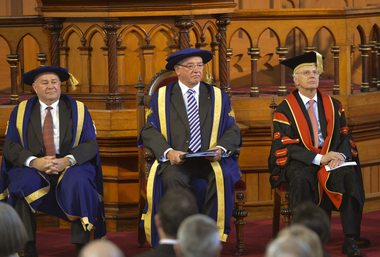
Photograph - Photograph - Colour, Installation of University of Ballarat Chancellor Paul Hemming, 2012, 17/0/2012
... Ballarat is an example of such resilience and confidence in its future that can be dated back to this University’s inception. ...Ballarat is an example of such resilience and confidence in its future that can be dated back to this University’s inception. ...In April 2012 former Royal Australian College of General Practitioners president Dr Paul Hemming was appointed the University of Ballarat’s new chancellor. Dr Hemming was a deputy chancellor of the university since 2011 and a member of the university council since 2007, and replaces outgoing chancellor Robert Smith. He was a founding director of Beyondblue and has been president of the Royal Australian College of General Practitioners. He was also president of the Australian Medical Association Victoria and has served on numerous federal government medical bodies and tribunals. Chancellors are appointed to chair the university's council (governing body) as the senior office holder of the University. They also confer the academic awards of the university, and represent the university at meetings, functions and ceremonies. At the installation of Dr Hemming as the Fifth Chancellor Of The University Of Ballarat Governor of Victoria Alex Chrnov said: "I join Bonnie Fagan in acknowledging the traditional owners of this land and I pay my respects to their elders past and present. It is my great pleasure, as Governor of Victoria and Visitor to the University of Ballarat, to install Dr Paul Hemming as the fifth Chancellor of this University. I extend to him and his family my warmest congratulations on this appointment and wish him all the best in his new role. I have no doubt that he will be an industrious and wise leader of this University. Although the University of Ballarat is one of Australia’s newest Universities, it is the third oldest Tertiary institution in our country with the School of Mines being established in 1870. It has much to be proud of, and should be recognised for its commitment to being one of our most outstanding regionally focused higher education institutions. It offers on six campuses a diverse, yet suitably targeted, group of learning models that include higher education, TAFE and senior secondary school education, and is one of the few universities in the country that has an associated Technology Park. This University is uniquely placed to provide higher education in Regional Victoria. For example, I understand that by 2020 the population in the Ballarat area will increase by 20% so this University will have the responsibility and opportunity to provide educational opportunities for this growing population. The role of the Governor can be divided into three parts – ceremonial, constitutional and community engagement. It is the third aspect of the role that is most time consuming and, I add, enjoyable. It includes making official visits to Regional areas of Victoria. To date Elizabeth and I have been on 16 such visits and the thing that stands out is that despite the challenges that face Regional communities whether it be through natural disasters, or the economy more broadly – the stoicism, volunteerism and self reliance are always present. Ballarat is an example of such resilience and confidence in its future that can be dated back to this University’s inception. When the School of Mines was established in 1870 on the back of the gold rush era of the 1850s, the local community had vision and faith in its future that is reflected in the building of this institution. It is not dissimilar to Melbourne, where its relatively few citizens established the iconic pillars of our society like the State Library, the University of Melbourne, Parliament Houses and the National Gallery of Victoria. The contribution by the University of Ballarat to Regional Victoria cannot be overstated. Not only does it provide top educational opportunities for students from the Region but its graduates almost invariably end up working in Regional Australia, and often in their own local communities. More specifically, almost three out of every four of the graduates from this University end up finding employment in Regional areas. Such figures highlight the University’s significant contribution to the Regional economy. But its impact is not limited to our Regional areas – it extends to other parts of Australia and overseas. But like so many other higher education institutions in Australia, the University of Ballarat is facing challenges brought about by events such as global uncertainties and the high Australian dollar that impact on the inflow of international students, and dealing with students, more and more of whom come from the lower socio economic sector. It is in those circumstances that the Chancellor must show leadership that involves, amongst others, objectively guiding the Council and supporting the Vice-Chancellor, albeit without becoming involved in the day to day micro management of the University. A strong, trusting and respectful working relationship between the Chancellor and the Vice-Chancellor is, I believe, critical to the sound progress of a University. Before I turn more specifically to Dr Hemming, I would like to reflect briefly on his immediate predecessor, Emeritus Professor Robert Smith. I am sure that Dr Hemming has already found in Professor Smith an invaluable source of assistance. He was a skilled and effective leader not only here, but also in the broader higher education sector. I mention by way of example his instigation and leadership two years ago of the much acclaimed Chancellors’ Conference that was held in Melbourne. There was great diffidence amongst the Chancellors in having it at all. It was a little like herding cats. But Bob Smith spearheaded the organisation of it, with great attention to detail. And it was his hard work and leadership that resulted in the Conference being such a success and of assistance to all Chancellors who attended. It was an illustration of Bob Smith’s skills as a leader in the sector and of this University. And the sector, just as this University remains indebted to him. And I have no doubt that Dr Hemming will similarly lead this University through the challenging, yet exciting, times that lie ahead. He is eminently qualified to do so, in terms of his personal attributes, academic achievements and experience in governance. With his extensive medical career as a General Practitioner, service on a number of Federal Government medical boards and tribunals, and having been a Founding Director of ‘Beyondblue’, President of the Royal Australian College of General Practitioners and President of the Australian Medical Association (Victoria), his list of personal and professional achievements, as well as his strong sense of public and community duty, is impressive. Importantly, Dr Hemming has a long standing connection with the Ballarat community, having moved here with his family from the United Kingdom in 1977. He is now even accepted as a “local” I am told. Given his range of experience to which I have referred and the time he has already spent on the Council and Standing Committees of this University, he is obviously well placed to take part in leading this University. So it is a great pleasure for me to install Dr Hemming as the fifth Chancellor of the University of Ballarat." (http://www.governor.vic.gov.au/victorias-governor/publications/speeches/speech/speech/104) Colour photographS of three men in academic regalia sitting inside the Ballarat Uniting Church, Lydiard Street South. Chancellor Dr Paul Hemming sit in the centre, with Vice-Chancellor Professor david Battersby on the left. Also audience images, academics and a dinner at Craig's Hotel.university of ballarat, federation university, regalia, chancellor, vice chancellor, paul hemming, david battersby, alex chrnov, todd walker, andy smith, craig's hotel, academics -
 Flagstaff Hill Maritime Museum and Village
Equipment - Crutch
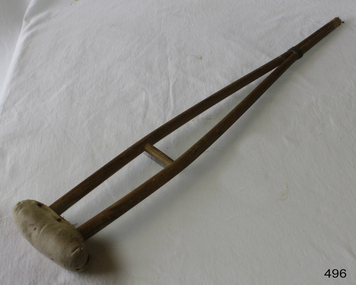
... And so back to Tiny Tim. In the 1860s, William Treloar, future Lord Mayor of London, became inspired to help crippled children after attending a public reading of A Christmas Carol. ...And so back to Tiny Tim. In the 1860s, William Treloar, future Lord Mayor of London, became inspired to help crippled children after attending a public reading of A Christmas Carol. ...“Alas for Tiny Tim, he bore a little crutch, and had his limbs supported by an iron frame!” A Christmas Carol has long proved one of Dickens’ most popular works. Debate still continues over what disease afflicted poor Tiny Tim, but I find it interesting to think about the crutch he used. As a child, crutches were almost a hallmark of the adventurous, from falling out of trees to the consequence of a luxurious skiing accident. Broadly speaking, a crutch is a medical device which helps a person walk from one spot to another. By helping to bear their body weight, crutches aid mobility in people with either short-term injuries to life-long disabilities. The first evidence of their use dates back to the time of the Pharaohs, clearly visible in a carving dating to nearly 3000 BCE. The earliest crutches were essentially a T-shaped design, which slowly morphed into the more popular V-shape in use today. They were made form a piece of hardwood cut to length, and split near the top to create this V-shape. A wooden underarm piece could then be attached for both underarm and handle use. Although uncomfortable as they lacked cushioning, they proved effective. Today, crutches are essentially of two basic designs. Canadian, Lofstrand or forearm crutches are the more popular design used outside of America. They have cuffs which give forearm support, along with grips which allow the user to either hold or rest their hands. These act together to help support the patient’s weight. These type of crutches tend to offer the best alternative for long-term use, and for people with impaired upper body strength. Perhaps for these reasons, underarm or axillary crutches are more commonly used in the States. These consist of a pad designed to rest below the armpit and against the rib cage, along with a hand support parallel to this. The body’s weight is taken by the hands, not the armpit; if used incorrectly, a condition known as crutch paralysis, or crutch palsy can arise from pressure on nerves in the armpit, or axilla. In 1917 Emile Schlick patented the first commercially-produced crutch, catering to the need of wounded returning WWI soldiers. Later, the first customisable crutches – they had a height-adjustable frame – were designed by A.R. Lofstrand, Jr. Crutch mills soon became common through out New England, some of which remain in production today, using production methods dating back to the Civil War. Plus, both types of crutches offer an alternative use: they are ideal for poking people to gain attention. And so back to Tiny Tim. In the 1860s, William Treloar, future Lord Mayor of London, became inspired to help crippled children after attending a public reading of A Christmas Carol. He established the Lord Mayor Treloar Cripple’s Hospital and College, in Alton, where pioneering orthopaedic treatments were used to help children deformed by tuberculosis and other diseases. The hospital closed in 1994. https://bonesurgeon.com.au/crutches-history/ This child's crutch was donated to Flagstaff Hill Maritime Village by the family of Doctor William Roy Angus, Surgeon and Oculist. It is part of the “W.R. Angus Collection” includes historical medical equipment, surgical instruments and material once belonging to Dr Edward Ryan and Dr Thomas Francis Ryan, (both of Nhill, Victoria) as well as Dr Angus’ own belongings. The Collection’s history spans the medical practices of the two Doctors Ryan, from 1885-1926 plus that of Dr Angus, up until 1969. ABOUT THE “W.R.ANGUS COLLECTION” Doctor William Roy Angus M.B., B.S., Adel., 1923, F.R.C.S. Edin.,1928 (also known as Dr Roy Angus) was born in Murrumbeena, Victoria in 1901 and lived until 1970. He qualified as a doctor in 1923 at University of Adelaide, was Resident Medical Officer at the Royal Adelaide Hospital in 1924 and for a period was house surgeon to Sir (then Mr.) Henry Simpson Newland. Dr Angus was briefly an Assistant to Dr Riddell of Kapunda, then commenced private practice at Curramulka, Yorke Peninsula, SA, where he was physician, surgeon and chemist. In 1926, he was appointed as new Medical Assistant to Dr Thomas Francis Ryan (T.F. Ryan, or Tom), in Nhill, Victoria, where his experiences included radiology and pharmacy. In 1927 he was Acting House Surgeon in Dr Tom Ryan’s absence. Dr Angus had become engaged to Gladys Forsyth and they decided he further his studies overseas in the UK in 1927. He studied at London University College Hospital and at Edinburgh Royal Infirmary and in 1928, was awarded FRCS (Fellow from the Royal College of Surgeons), Edinburgh. He worked his passage back to Australia as a Ship’s Surgeon on the on the Australian Commonwealth Line’s T.S.S. Largs Bay. Dr Angus married Gladys in 1929, in Ballarat. (They went on to have one son (Graham 1932, born in SA) and two daughters (Helen (died 12/07/1996) and Berenice (Berry), both born at Mira, Nhill ) According to Berry, her mother Gladys made a lot of their clothes. She was very talented and did some lovely embroidery including lingerie for her trousseau and beautifully handmade baby clothes. Dr Angus was a ‘flying doctor’ for the A.I.M. (Australian Inland Ministry) Aerial Medical Service in 1928 . Its first station was in the remote town of Oodnadatta, where Dr Angus was stationed. He was locum tenens there on North-South Railway at 21 Mile Camp. He took up this ‘flying doctor’ position in response to a call from Dr John Flynn; the organisation was later known as the Flying Doctor Service, then the Royal Flying Doctor Service. A lot of his work during this time involved dental surgery also. Between 1928-1932 he was surgeon at the Curramulka Hospital, Yorke Peninsula, South Australia. In 1933 Dr Angus returned to Nhill and purchased a share of the Nelson Street practice and Mira hospital (a 2 bed ward at the Nelson Street Practice) from Dr Les Middleton one of the Middleton Brothers, the current owners of what previously once Dr Tom Ryan’s practice. Dr Tom and his brother had worked as surgeons included eye surgery. Dr Tom Ryan performed many of his operations in the Mira private hospital on his premises. He had been House Surgeon at the Nhill Hospital 1902-1926. Dr Tom Ryan had one of the only two pieces of radiology equipment in Victoria during his practicing years – The Royal Melbourne Hospital had the other one. Over the years Dr Tom Ryan had gradually set up what was effectively a training school for country general-practitioner-surgeons. Each patient was carefully examined, including using the X-ray machine, and any surgery was discussed and planned with Dr Ryan’s assistants several days in advance. Dr Angus gained experience in using the X-ray machine there during his time as assistant to Dr Ryan. When Dr Angus bought into the Nelson Street premises in Nhill he was also appointed as the Nhill Hospital’s Honorary House Surgeon 1933-1938. His practitioner’s plate from his Nhill surgery is now mounted on the doorway to the Port Medical Office at Flagstaff Hill Maritime Village, Warrnambool. When Dr Angus took up practice in the Dr Edward and Dr Tom Ryan’s old premises he obtained their extensive collection of historical medical equipment and materials spanning 1884-1926. A large part of this collection is now on display at the Port Medical Office at Flagstaff Hill Maritime Village in Warrnambool. In 1939 Dr Angus and his family moved to Warrnambool where he purchased “Birchwood,” the 1852 home and medical practice of Dr John Hunter Henderson, at 214 Koroit Street. (This property was sold in1965 to the State Government and is now the site of the Warrnambool Police Station. and an ALDI sore is on the land that was once their tennis court). The Angus family was able to afford gardeners, cooks and maids; their home was a popular place for visiting dignitaries to stay whilst visiting Warrnambool. Dr Angus had his own silk worm farm at home in a Mulberry tree. His young daughter used his centrifuge for spinning the silk. Dr Angus was appointed on a part-time basis as Port Medical Officer (Health Officer) in Warrnambool and held this position until the 1940’s when the government no longer required the service of a Port Medical Officer in Warrnambool; he was thus Warrnambool’s last serving Port Medical Officer. (Masters of immigrant ships arriving in port reported incidents of diseases, illness and death and the Port Medical Officer made a decision on whether the ship required Quarantine and for how long, in this way preventing contagious illness from spreading from new immigrants to the residents already in the colony.) Dr Angus was a member of the Australian Medical Association, for 35 years and surgeon at the Warrnambool Base Hospital 1939-1942, He served with the Australian Department of Defence as a Surgeon Captain during WWII 1942-45, in Ballarat, Victoria, and in Bonegilla, N.S.W., completing his service just before the end of the war due to suffering from a heart attack. During his convalescence he carved an intricate and ‘most artistic’ chess set from the material that dentures were made from. He then studied ophthalmology at the Royal Melbourne Eye and Ear Hospital and created cosmetically superior artificial eyes by pioneering using the intrascleral cartilage. Angus received accolades from the Ophthalmological Society of Australasia for this work. He returned to Warrnambool to commence practice as an ophthalmologist, pioneering in artificial eye improvements. He was Honorary Consultant Ophthalmologist to Warrnambool Base Hospital for 31 years. He made monthly visits to Portland as a visiting surgeon, to perform eye surgery. He represented the Victorian South-West subdivision of the Australian Medical Association as its secretary between 1949 and 1956 and as chairman from 1956 to 1958. In 1968 Dr Angus was elected member of Spain’s Barraquer Institute of Barcelona after his research work in Intrasclearal cartilage grafting, becoming one of the few Australian ophthalmologists to receive this honour, and in the following year presented his final paper on Living Intrasclearal Cartilage Implants at the Inaugural Meeting of the Australian College of Ophthalmologists in Melbourne In his personal life Dr Angus was a Presbyterian and treated Sunday as a Sabbath, a day of rest. He would visit 3 or 4 country patients on a Sunday, taking his children along ‘for the ride’ and to visit with him. Sunday evenings he would play the pianola and sing Scottish songs to his family. One of Dr Angus’ patients was Margaret MacKenzie, author of a book on local shipwrecks that she’d seen as an eye witness from the late 1880’s in Peterborough, Victoria. In the early 1950’s Dr Angus, painted a picture of a shipwreck for the cover jacket of Margaret’s book, Shipwrecks and More Shipwrecks. She was blind in later life and her daughter wrote the actual book for her. Dr Angus and his wife Gladys were very involved in Warrnambool’s society with a strong interest in civic affairs. He had an interest in people and the community They were both involved in the creation of Flagstaff Hill, including the layout of the gardens. After his death (28th March 1970) his family requested his practitioner’s plate, medical instruments and some personal belongings be displayed in the Port Medical Office surgery at Flagstaff Hill Maritime Village, and be called the “W. R. Angus Collection”.The W.R. Angus Collection is significant for still being located at the site it is connected with, Doctor Angus being the last Port Medical Officer in Warrnambool. The collection of medical instruments and other equipment is culturally significant, being an historical example of medicine from late 19th to mid-20th century. Dr Angus assisted Dr Tom Ryan, a pioneer in the use of X-rays and in ocular surgery.A crutch only suitable for a small child with padded armpit rest. Constructed with wooden joints. Padding nailed on.None.flagstaff hill, warrnambool, shipwrecked-coast, flagstaff-hill, flagstaff-hill-maritime-museum, maritime-museum, shipwreck-coast, flagstaff-hill-maritime-village, crutches, fractures, children's medical support -
 The Beechworth Burke Museum
Animal specimen - Bluebird
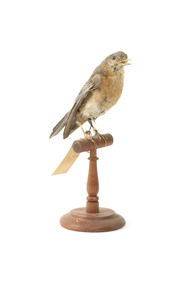
... future environmental research. This collection continues to be on display in the Museum and has become a key part to interpreting the collecting habits of the 19th century. taxidermy mount taxidermy animalia burke museum beechworth australian museum skin reynell eveleigh johns bird american birds bluebird Label: 122a. Blue-Bird / Catalogue Page 29. / Metal tag: 107 This female bluebird (likely Eastern) has a medium brown head and back ...Eastern bluebirds are well-known song birds that live in eastern North America. They are sexually dimorphic, easily recognised by the male's bright royal blue upper plumage, chest of reddish brown and white abdomen. The females is duller in colour than the male, with greyer upperparts and blue tinges to her wings. These Bluebirds, the European variety, are the most common of the three Bluebird species. When not nesting, these birds fly in small flocks around the countryside. Bluebirds feed on small insects including moths, termites and mosquitoes. They also eat grasshoppers, crickets and caterpillars. The Bluebird can spot caterpillars and other insects in tall grass from a distance of over 45 meters. The Bluebird is commonly identified in numerous cultures as being symbolic as a harbinger of happiness. Often in Russian fairytales, the Bluebird is used as a symbol of hope. This specimen is part of a collection of almost 200 animal specimens that were originally acquired as skins from various institutions across Australia, including the Australian Museum in Sydney and the National Museum of Victoria (known as Museums Victoria since 1983), as well as individuals such as amateur anthropologist Reynell Eveleigh Johns between 1860-1880. These skins were then mounted by members of the Burke Museum Committee and put-on display in the formal space of the Museum’s original exhibition hall where they continue to be on display. This display of taxidermy mounts initially served to instruct visitors to the Burke Museum of the natural world around them, today it serves as an insight into the collecting habits of the 19th century.This specimen is part of a significant and rare taxidermy mount collection in the Burke Museum. This collection is scientifically and culturally important for reminding us of how science continues to shape our understanding of the modern world. They demonstrate a capacity to hold evidence of how Australia’s fauna history existed in the past and are potentially important for future environmental research. This collection continues to be on display in the Museum and has become a key part to interpreting the collecting habits of the 19th century.This female bluebird (likely Eastern) has a medium brown head and back, a rufous breast, and a cream belly. The bird has blue-tinged wing and tail feathers. The bill is short and has been stylized with the bill partly open to provide the illusion that the bird is making a call. This specimen stands upon a wooden mount and has an identification tag tied around its leg. The bird's plumage has faded since it was first preserved; females generally have duller colouring than their male counterparts but the colour of this particular specimen is paler than it would have been.Label: 122a. Blue-Bird / Catalogue Page 29. / Metal tag: 107taxidermy mount, taxidermy, animalia, burke museum, beechworth, australian museum, skin, reynell eveleigh johns, bird, american birds, bluebird -
 The Beechworth Burke Museum
Animal specimen - White-Throated Needletail, Trustees of the Australian Museum, 1860-1880
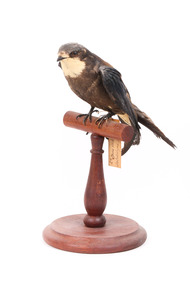
... future environmental research. This collection continues to be on display in the Museum and has become a key part to interpreting the collecting habits of the 19th century. taxidermy mount taxidermy burke museum beechworth australian museum skin reynell eveleigh johns bird white-throated needletail australian birds 2a / Spine-Tailed Swift / See catalogue, page 7 This White-Throated Needletail had grey-brown feathers. It has distinctive white patches on its throat and under the tail. The back ...The White-Throated Needletail is a highly sociable bird commonly seen in large flocks containing a hundred plus birds. This species is also known to mingle with birds of different species. They have a distinctive white throat and undertail. This species is mainly airborne, however they are known to reside in trees when on land. They can mainly be spotted along the north and east parts of Australia. This species is listed as vulnerable and threatened in the Australian Capital Territory, Queensland and Victoria. Since this is a taxidermy mount, it is not an accurate depiction of the White-Throated Needletail. The species should have a predominantly grey-brown plumage, with the exception of the throat and undertail which are white. There should also be a green tint to the species feathers. This specimen is part of a collection of almost 200 animal specimens that were originally acquired as skins from various institutions across Australia, including the Australian Museum in Sydney and the National Museum of Victoria (known as Museums Victoria since 1983), as well as individuals such as amateur anthropologist Reynell Eveleigh Johns between 1860-1880. These skins were then mounted by members of the Burke Museum Committee and put-on display in the formal space of the Museum’s original exhibition hall where they continue to be on display. This display of taxidermy mounts initially served to instruct visitors to the Burke Museum of the natural world around them, today it serves as an insight into the collecting habits of the 19th century.This specimen is part of a significant and rare taxidermy mount collection in the Burke Museum. This collection is scientifically and culturally important for reminding us of how science continues to shape our understanding of the modern world. They demonstrate a capacity to hold evidence of how Australia’s fauna history existed in the past and are potentially important for future environmental research. This collection continues to be on display in the Museum and has become a key part to interpreting the collecting habits of the 19th century.This White-Throated Needletail had grey-brown feathers. It has distinctive white patches on its throat and under the tail. The back of the bird is a light brown with a white patch in the center of the back. This specimen stands upon a wooden mount and has an identification tag tied around its leg. The bill is short and the wings are long and pointed. The bird's tail is short and square in shape with protruding feather shafts which give a spiky appearance.2a / Spine-Tailed Swift / See catalogue, page 7taxidermy mount, taxidermy, burke museum, beechworth, australian museum, skin, reynell eveleigh johns, bird, white-throated needletail, australian birds -
 The Beechworth Burke Museum
Animal specimen - Kookaburra, Trustees of the Australian Museum, 1860-1880
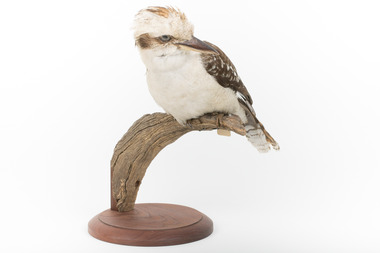
... future environmental research. This collection continues to be on display in the Museum and has become a key part to interpreting the collecting habits of the 19th century. taxidermy mount taxidermy animalia burke museum beechworth australian museum skin reynell eveleigh johns bird kookaburra australian birds laughing kookaburra W8083 / This Kookaburra has a predominantly white body. The back ...The Kookaburra is a sociable bird commonly seen in small flocks. These flocks mainly consist of family members. If not in flocks, these birds are commonly seen in pairs. They have a distinct appearance with brown wings, back and brown around the eyes, with majority of the plumage being white. This species reside in woodlands and open forests, however they can be seen in parks, wetlands, farms and any other space that is open with grass. This native Australian bird can mainly be found across the eastern Australia, however they have been introduced Tasmania, South-west Western Australia and New Zealand. Although this is a taxidermy mount, it looks exactly like a Kookaburra in real life. This specimen is part of a collection of almost 200 animal specimens that were originally acquired as skins from various institutions across Australia, including the Australian Museum in Sydney and the National Museum of Victoria (known as Museums Victoria since 1983), as well as individuals such as amateur anthropologist Reynell Eveleigh Johns between 1860-1880. These skins were then mounted by members of the Burke Museum Committee and put-on display in the formal space of the Museum’s original exhibition hall where they continue to be on display. This display of taxidermy mounts initially served to instruct visitors to the Burke Museum of the natural world around them, today it serves as an insight into the collecting habits of the 19th century.This specimen is part of a significant and rare taxidermy mount collection in the Burke Museum. This collection is scientifically and culturally important for reminding us of how science continues to shape our understanding of the modern world. They demonstrate a capacity to hold evidence of how Australia’s fauna history existed in the past and are potentially important for future environmental research. This collection continues to be on display in the Museum and has become a key part to interpreting the collecting habits of the 19th century.This Kookaburra has a predominantly white body. The back, wings and tail are a light shade of brown. There is a strip of brown going across the eyes. This specimen stands upon a wooden branch and has an identification tag ties around its leg. This bird is stout in shape and has a medium length tail and a broad bill. This bill is darker on top and lighter in colour on the bottom.W8083 / taxidermy mount, taxidermy, animalia, burke museum, beechworth, australian museum, skin, reynell eveleigh johns, bird, kookaburra, australian birds, laughing kookaburra -
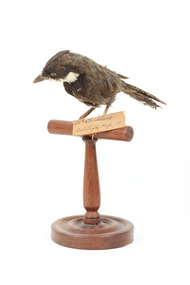 The Beechworth Burke Museum
Animal specimen - Eastern Whipbird, Trustees of the Australian Museum, 1860-1880
... future environmental research. This collection continues to be on display in the Museum and has become a key part to interpreting the collecting habits of the 19th century. taxidermy mount taxidermy animalia burke museum beechworth australian museum skin reynell eveleigh johns bird eastern whipbird australian birds 25a / Thickhead / catalogue page 11 This Eastern Whipbird is a small species of bird which has a dramatic stripe of white colouring on either side of the small bill and the crest is black. The belly and throat are black while the back ...The Eastern Whipbird isusually be found in pairs. They have a distinct white stripe on either side of the beak which helps to identify this bird. This species generally resides in wet habitats such as wetlands and rainforests, where there is dense vegetation. The Eastern Whipbird can be commonly found along the east coast of Australia. Since this is a taxidermy mount, there are a few inconsistencies. The main inconsistency is the colour of the specimen, the plumage should be an olive-green colour. This particular colouring has likely faded due to the taxidermy process and also the age of the specimen. There should also be black plume on top of the head which is missing from this specimen. This specimen is part of a collection of almost 200 animal specimens that were originally acquired as skins from various institutions across Australia, including the Australian Museum in Sydney and the National Museum of Victoria (known as Museums Victoria since 1983), as well as individuals such as amateur anthropologist Reynell Eveleigh Johns between 1860-1880. These skins were then mounted by members of the Burke Museum Committee and put-on display in the formal space of the Museum’s original exhibition hall where they continue to be on display. This display of taxidermy mounts initially served to instruct visitors to the Burke Museum of the natural world around them, today it serves as an insight into the collecting habits of the 19th century.This specimen is part of a significant and rare taxidermy mount collection in the Burke Museum. This collection is scientifically and culturally important for reminding us of how science continues to shape our understanding of the modern world. They demonstrate a capacity to hold evidence of how Australia’s fauna history existed in the past and are potentially important for future environmental research. This collection continues to be on display in the Museum and has become a key part to interpreting the collecting habits of the 19th century.This Eastern Whipbird is a small species of bird which has a dramatic stripe of white colouring on either side of the small bill and the crest is black. The belly and throat are black while the back, wings and tail are dark brown. This specimen stands upon a wooden perch and has an identification tag tied around its leg.25a / Thickhead / catalogue page 11taxidermy mount, taxidermy, animalia, burke museum, beechworth, australian museum, skin, reynell eveleigh johns, bird, eastern whipbird, australian birds -
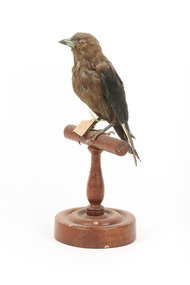 The Beechworth Burke Museum
Animal specimen - Dusky Woodswallow, Trustees of the Australian Museum, 1860-1880
... future environmental research. This collection continues to be on display in the Museum and has become a key part to interpreting the collecting habits of the 19th century. taxidermy mount taxidermy animalia burke museum beechworth australian museum skin reynell eveleigh johns bird australian birds swallow woodswallow dusky woodswallow [torn] / 9 / The Dusky Woodswallow has largely deep brown colouring with some areas of grey on the head, neck and chest. There is a deeper brown colouring between the wings on the back ...The Dusky Woodswallow is often found in flocks which can be located in two separate populations. The Eastern population if located in Atherton Tableland in Queensland south to Tasmania and west to Eyre Peninsula in South Australia. The other population is found in south-west Western Australia. They reside in open forests and woodlands. This species is surprisingly aggressive and may fight with other Woodswallows for territory and nest sights. They will even chase raptors away from their homes. This species flies in flocks of around 10 to 30 birds which cluster together. In terms of diet, these birds eat insects and nectar from flowers. This specimen is part of a collection of almost 200 animal specimens that were originally acquired as skins from various institutions across Australia, including the Australian Museum in Sydney and the National Museum of Victoria (known as Museums Victoria since 1983), as well as individuals such as amateur anthropologist Reynell Eveleigh Johns between 1860-1880. These skins were then mounted by members of the Burke Museum Committee and put-on display in the formal space of the Museum’s original exhibition hall where they continue to be on display. This display of taxidermy mounts initially served to instruct visitors to the Burke Museum of the natural world around them, today it serves as an insight into the collecting habits of the 19th century.This specimen is part of a significant and rare taxidermy mount collection in the Burke Museum. This collection is scientifically and culturally important for reminding us of how science continues to shape our understanding of the modern world. They demonstrate a capacity to hold evidence of how Australia’s fauna history existed in the past and are potentially important for future environmental research. This collection continues to be on display in the Museum and has become a key part to interpreting the collecting habits of the 19th century.The Dusky Woodswallow has largely deep brown colouring with some areas of grey on the head, neck and chest. There is a deeper brown colouring between the wings on the back of the specimen and the wings are black. This bird has a small curved bill which is grey and white. The legs are dark grey and the bird has long talons with an extra long toe in the centre. The eyes are made of brown glass with a back pupil. The bird is styalised standing on a wooden mount and has a paper identification tag attached to its right leg.[torn] / 9 /taxidermy mount, taxidermy, animalia, burke museum, beechworth, australian museum, skin, reynell eveleigh johns, bird, australian birds, swallow, woodswallow, dusky woodswallow -
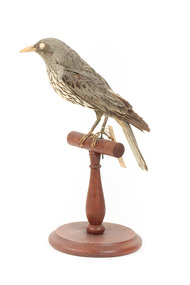 The Beechworth Burke Museum
Animal specimen - Olive-Backed Oriole, Trustees of the Australian Museum, 1860-1880
... future environmental research. This collection continues to be on display in the Museum and has become a key part to interpreting the collecting habits of the 19th century. taxidermy mount taxidermy animalia burke museum beechworth australian museum skin reynell eveleigh johns bird oriole olive-backed oriole yellow oriole australian birds Swing-tag: 52a / Australian Oriole / See catalogue page 17. ...The Olive-Backed Oriole are very common birds for northern and eastern Australia, as well as New Guinea. Similar to the Yellow Oriole, this species is more versatile yet less distinctive in colouring. The streaked underparts and red bill and eyes are easy identification features of this bird. Both sexes look very similar, with female colouring being slightly duller than males. This species frequents open forests and woodlands, and can tolerate dry climates. Most of this species breeds from September to January during the tropical wet season in northern Australia, but some are known to migrate south to breed in the summer. This species eats mainly native fruit, berries, and insects. This specimen is a good example of this species, but the colouring is very dull compared to living birds. This specimen has one red eye, which is a good example of a distinctive feature of this species. This specimen is part of a collection of almost 200 animal specimens that were originally acquired as skins from various institutions across Australia, including the Australian Museum in Sydney and the National Museum of Victoria (known as Museums Victoria since 1983), as well as individuals such as amateur anthropologist Reynell Eveleigh Johns between 1860-1880. These skins were then mounted by members of the Burke Museum Committee and put-on display in the formal space of the Museum’s original exhibition hall where they continue to be on display. This display of taxidermy mounts initially served to instruct visitors to the Burke Museum of the natural world around them, today it serves as an insight into the collecting habits of the 19th century.This specimen is part of a significant and rare taxidermy mount collection in the Burke Museum. This collection is scientifically and culturally important for reminding us of how science continues to shape our understanding of the modern world. They demonstrate a capacity to hold evidence of how Australia’s fauna history existed in the past and are potentially important for future environmental research. This collection continues to be on display in the Museum and has become a key part to interpreting the collecting habits of the 19th century.This Olive-Backed Oriole has a faint olive-green head and back, and a faint red-tinged beak. Its body is cream coloured with brown streaks. It has one red eye. This specimen appears to be immature and/or female, as it has a pale pill and a duller-olive green back, with streaks quite high up on it's chin, which is indicative of an immature female of this species. This specimen stands upon a wooden platform and has an identification tag tied around its leg.Swing-tag: 52a / Australian Oriole / See catalogue page 17. taxidermy mount, taxidermy, animalia, burke museum, beechworth, australian museum, skin, reynell eveleigh johns, bird, oriole, olive-backed oriole, yellow oriole, australian birds -
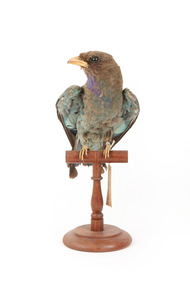 The Beechworth Burke Museum
Animal specimen - Dollarbird, Trustees of the Australian Museum, 1860-1880
... future environmental research. This collection continues to be on display in the Museum and has become a key part to interpreting the collecting habits of the 19th century. taxidermy mount taxidermy animalia burke museum beechworth australian museum skin reynell eveleigh johns bird dollarbird australian birds broad-billed roller Swing-tag: 96a / Australian Roller / Catalogue, page, 25. This adult Dollarbird has a brown body and head, blue-green back ...The Dollarbird is so-named because of the coin-shaped patches on the tips of their wings, which is clear when in flight. They have distinctive blue-green colouring on their backs and wings, and a bright blue throat. This species migrates to northern and eastern Australia for breeding, between the months of September and April. These birds migrate to New Guinea and nearby islands in the Winter, but can be found in Japan and India also. This species resides in open wooded areas, preferring hollow-bearing trees for nesting. They can be found spending most of their time perched on high branches in search of insects, and will often 'hawk' at dusk above the tree-tops, hovering on the wing for lengthy periods. This specimen is a good example of this species, however the distinctive coin-patches on the tips of the wings are partially hidden by the tuck of the wing. This specimen is part of a collection of almost 200 animal specimens that were originally acquired as skins from various institutions across Australia, including the Australian Museum in Sydney and the National Museum of Victoria (known as Museums Victoria since 1983), as well as individuals such as amateur anthropologist Reynell Eveleigh Johns between 1860-1880. These skins were then mounted by members of the Burke Museum Committee and put-on display in the formal space of the Museum’s original exhibition hall where they continue to be on display. This display of taxidermy mounts initially served to instruct visitors to the Burke Museum of the natural world around them, today it serves as an insight into the collecting habits of the 19th century.This specimen is part of a significant and rare taxidermy mount collection in the Burke Museum. This collection is scientifically and culturally important for reminding us of how science continues to shape our understanding of the modern world. They demonstrate a capacity to hold evidence of how Australia’s fauna history existed in the past and are potentially important for future environmental research. This collection continues to be on display in the Museum and has become a key part to interpreting the collecting habits of the 19th century.This adult Dollarbird has a brown body and head, blue-green back and wings. It has a distinctive bright blue or purple plumage around its throat. The tips of the wings are brown. The pale-blue coin shaped patches on the tips of the wings are just visible. This specimen stands upon a wooden platform and has an identification tag tied around its leg.Swing-tag: 96a / Australian Roller / Catalogue, page, 25. taxidermy mount, taxidermy, animalia, burke museum, beechworth, australian museum, skin, reynell eveleigh johns, bird, dollarbird, australian birds, broad-billed roller -
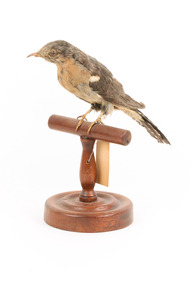 The Beechworth Burke Museum
Animal specimen - Fan-tailed Cuckoo, Trustees of the Australian Museum, 1860-1880
... future environmental research. This collection continues to be on display in the Museum and has become a key part to interpreting the collecting habits of the 19th century. taxidermy mount taxidermy animalia burke museum beechworth skin reynell eveleigh johns bird fan-tailed cuckoo cuckoo australian bird australian museum australian animal Swing-tag: 71a. / Fan-tailed Cuckoo / See Catalogue, Page 21 / This fan-tailed cuckoo has a dark grey/brown back and a pale rufous (a yellowy brown) underside. ...Fan-tailed Cuckoos are found throughout eastern and south-western Australia. They are also sometimes found in nearby small island nations as far as New Caledonia. Their call is a distinct, descending trill, which they are known to make even outside their breeding season. The neck is thin compared to a typical Fan-tailed Cuckoo - potentially a taxidermy error or damage. Otherwise, the specimen is reasonably representative. This specimen is part of a collection of almost 200 animal specimens that were originally acquired as skins from various institutions across Australia, including the Australian Museum in Sydney and the National Museum of Victoria (known as Museums Victoria since 1983), as well as individuals such as amateur anthropologist Reynell Eveleigh Johns between 1860-1880. These skins were then mounted by members of the Burke Museum Committee and put-on display in the formal space of the Museum’s original exhibition hall where they continue to be on display. This display of taxidermy mounts initially served to instruct visitors to the Burke Museum of the natural world around them, today it serves as an insight into the collecting habits of the 19th century.This specimen is part of a significant and rare taxidermy mount collection in the Burke Museum. This collection is scientifically and culturally important for reminding us of how science continues to shape our understanding of the modern world. They demonstrate a capacity to hold evidence of how Australia’s fauna history existed in the past and are potentially important for future environmental research. This collection continues to be on display in the Museum and has become a key part to interpreting the collecting habits of the 19th century.This fan-tailed cuckoo has a dark grey/brown back and a pale rufous (a yellowy brown) underside. The tail is also brown with white spots on some of the feather tips. The front of the face is pale rufous and blends into the black at the top of the head and neck. Some of the feathers around the neck are grey. There is a patch of white on halfway down the body on the left wing. The eyes are brown, the feet are yellow, and the beak, which is missing at the bottom, is yellow. The bird stands on a brown, wooden perch with a circular bar, curved stand, and circular base. It has an identification tag tied around its right leg. There is a swing-tag on the left leg.Swing-tag: 71a. / Fan-tailed Cuckoo / See Catalogue, Page 21 /taxidermy mount, taxidermy, animalia, burke museum, beechworth, skin, reynell eveleigh johns, bird, fan-tailed cuckoo, cuckoo, australian bird, australian museum, australian animal -
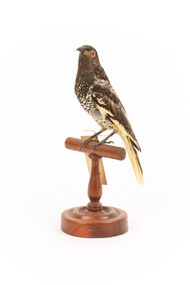 The Beechworth Burke Museum
Animal specimen - Regent Honeyeater, Trustees of the Australian Museum, 1860-1880
... future environmental research. This collection continues to be on display in the Museum and has become a key part to interpreting the collecting habits of the 19th century. taxidermy mount taxidermy animalia burke museum beechworth australian museum skin reynell eveleigh johns bird regent honeyeater honeyeater warty-faced honeyeater australian birds endangered birds endangered animals 57a. / Warty-faced Honey-eater ./ See Catalogue, Page 18 ./ This Regent Honeyeater has a dark brown/black crown with a distinct orange patch under each red-coloured eye. Its back ...Regent Honeyeaters get their name from their striking yellow-and-black plumage . Previously found across the south east of Australia far as Adelaide and Rockhampton in central Queensland, over the last thirty years their population has dwindled. Regent Honeyeaters are now only found between north-eastern Victoria and south-eastern Queensland, with only three known breeding grounds. Regent Honeyeaters typically live in eucalypt forests and woodlands. The yellow edging on the specimen's wings is duller than the bright yellow typical of most Regent Honeyeaters. The specimen is also stretched taller than most Regent Honeyeaters, resulting in a thinner neck and chest compared to the plumpness typically expected. This specimen is part of a collection of almost 200 animal specimens that were originally acquired as skins from various institutions across Australia, including the Australian Museum in Sydney and the National Museum of Victoria (known as Museums Victoria since 1983), as well as individuals such as amateur anthropologist Reynell Eveleigh Johns between 1860-1880. These skins were then mounted by members of the Burke Museum Committee and put-on display in the formal space of the Museum’s original exhibition hall where they continue to be on display. This display of taxidermy mounts initially served to instruct visitors to the Burke Museum of the natural world around them, today it serves as an insight into the collecting habits of the 19th century.The Regent Honeyeater is a critically endangered Australian bird due to the clearing of their natural habitat, particularly around the Yellow Box-White Box-Blakely's Red Gum Woodlands in New South Wales. This specimen is part of a significant and rare taxidermy mount collection in the Burke Museum. This collection is scientifically and culturally important for reminding us of how science continues to shape our understanding of the modern world. They demonstrate a capacity to hold evidence of how Australia’s fauna history existed in the past and are potentially important for future environmental research. This collection continues to be on display in the Museum and has become a key part to interpreting the collecting habits of the 19th century.This Regent Honeyeater has a dark brown/black crown with a distinct orange patch under each red-coloured eye. Its back and upper chest are also a dark brown but with a white scalloped pattern. At the lower are of its belly, the white colour dominates the brown. Its wings and tail are brown edged with yellow. Its beak is a short, dark brown curl and its legs are brown. The bird stands on a brown, wooden perch with a circular bar, curved stand, and circular base. It has an identification tag tied around its right leg.57a. / Warty-faced Honey-eater ./ See Catalogue, Page 18 ./taxidermy mount, taxidermy, animalia, burke museum, beechworth, australian museum, skin, reynell eveleigh johns, bird, regent honeyeater, honeyeater, warty-faced honeyeater, australian birds, endangered birds, endangered animals -
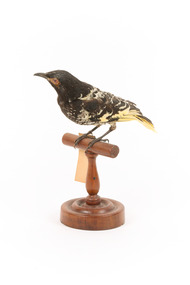 The Beechworth Burke Museum
Animal specimen - Regent Honey-Eater, Trustees of the Australian Museum, 1860-1880
... future environmental research. This collection continues to be on display in the Museum and has become a key part to interpreting the collecting habits of the 19th century. taxidermy mount taxidermy animalia burke museum beechworth australian museum skin reynell eveleigh johns bird australian bird honey-eater warty-faced honey-eater regent honeyeater critically endangered yellow Swing-tag: 56a. / Warty-Faced Honeyeater / See Catalogue, page 18 The striking Regent Honeyeater (Warty-faced honeyeater) has a black head, neck and upper breast, a lemon yellow back and breast scaled black, with the underparts grading into a white rump, black wings with conspicuous yellow patches, and a black tail edged yellow. ...The Warty-faced honeyeater Formerly more widely distributed in south-eastern mainland Australia from Rockhampton, Queensland to Adelaide, South Australia, the Regent Honeyeater is now confined to Victoria and New South Wales, and is strongly associated with the western slopes of the Great Dividing Range. The Regent Honeyeater is found in eucalypt forests and woodlands, particularly in blossoming trees and mistletoe. It is also seen in orchards and urban gardens. This species is critically endangered. They are native to Southeastern Australia. Specimen is mounted accurately. Colour around the eyes is red whereas they are yellow normally. This specimen is part of a collection of almost 200 animal specimens that were originally acquired as skins from various institutions across Australia, including the Australian Museum in Sydney and the National Museum of Victoria (known as Museums Victoria since 1983), as well as individuals such as amateur anthropologist Reynell Eveleigh Johns between 1860-1880. These skins were then mounted by members of the Burke Museum Committee and put-on display in the formal space of the Museum’s original exhibition hall where they continue to be on display. This display of taxidermy mounts initially served to instruct visitors to the Burke Museum of the natural world around them, today it serves as an insight into the collecting habits of the 19th century. This specimen is part of a significant and rare taxidermy mount collection in the Burke Museum. This collection is scientifically and culturally important for reminding us of how science continues to shape our understanding of the modern world. They demonstrate a capacity to hold evidence of how Australia’s fauna history existed in the past and are potentially important for future environmental research. This collection continues to be on display in the Museum and has become a key part to interpreting the collecting habits of the 19th century.The striking Regent Honeyeater (Warty-faced honeyeater) has a black head, neck and upper breast, a lemon yellow back and breast scaled black, with the underparts grading into a white rump, black wings with conspicuous yellow patches, and a black tail edged yellow. In males, the dark eye is surrounded by yellowish warty bare skin. Females are smaller, with a bare yellowish patch under the eye only, and have less black on the throat. Young birds resemble females, but are browner and have a paler bill. The colouring of this particular specimen helps identify it as male.Swing-tag: 56a. / Warty-Faced Honeyeater / See Catalogue, page 18taxidermy mount, taxidermy, animalia, burke museum, beechworth, australian museum, skin, reynell eveleigh johns, bird, australian bird, honey-eater, warty-faced honey-eater, regent honeyeater, critically endangered, yellow -
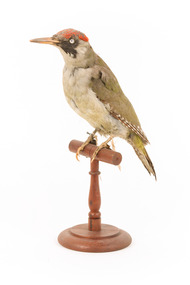 The Beechworth Burke Museum
Animal specimen - Green Woodpecker, Trustees of the Australian Museum, 1860-1880
... future environmental research. This collection continues to be on display in the Museum and has become a key part to interpreting the collecting habits of the 19th century. taxidermy mount taxidermy burke museum beechworth australian museum reynell eveleigh johns bird woodpecker green woodpecker eurasian green woodpecker Swing tag: 1e. / Green Woodpecker / Catalogue page 66 / Metal tag: 4308 / This Green Woodpecker has a distinctive red crown on its head that appears patchy. It has a black face, a black moustache-like stripe on each side of the beak, pale eyes and long light yellow-orange beak. The back ...This fairly large woodpecker of the Picadae family is widely distributed across most parts of Europe and the UK, with some occurrence in Western Asia. Preferring semi-open habitats such as woodlands, heathlands and gardens, the species is unique amongst woodpeckers as it prefers to hunt and feed on the ground for its ant prey. This species has a distinctive bright red crown, black moustasche-like stripes, mostly green back plumage and a paler green to yellow breast. This is a female of the species as the male has a red centre to the moustache stripe at the side of the beak. This specimen is a fairly accurate depiction of a Green Woodpecker. This specimen is part of a collection of almost 200 animal specimens that were originally acquired as skins from various institutions across Australia, including the Australian Museum in Sydney and the National Museum of Victoria (known as Museums Victoria since 1983), as well as individuals such as amateur anthropologist Reynell Eveleigh Johns between 1860-1880. These skins were then mounted by members of the Burke Museum Committee and put-on display in the formal space of the Museum’s original exhibition hall where they continue to be on display. This display of taxidermy mounts initially served to instruct visitors to the Burke Museum of the natural world around them, today it serves as an insight into the collecting habits of the 19th century.This specimen is part of a significant and rare taxidermy mount collection in the Burke Museum. This collection is scientifically and culturally important for reminding us of how science continues to shape our understanding of the modern world. They demonstrate a capacity to hold evidence of how Australia’s fauna history existed in the past and are potentially important for future environmental research. This collection continues to be on display in the Museum and has become a key part to interpreting the collecting habits of the 19th century.This Green Woodpecker has a distinctive red crown on its head that appears patchy. It has a black face, a black moustache-like stripe on each side of the beak, pale eyes and long light yellow-orange beak. The back of the bird is green, and its flank and breast is a pale cream-yellow colour. It has slightly visible distinct white-dotted brown feathers folded into its wings. The specimen is mounted on a wooden perch, with a metal tag tied around its right leg and a paper tag around each leg.Swing tag: 1e. / Green Woodpecker / Catalogue page 66 / Metal tag: 4308 /taxidermy mount, taxidermy, burke museum, beechworth, australian museum, reynell eveleigh johns, bird, woodpecker, green woodpecker, eurasian green woodpecker -
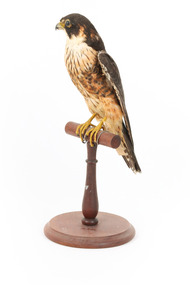 The Beechworth Burke Museum
Animal specimen - Australian Hobby, Trustees of the Australian Museum, 1860-1880
... future environmental research. This collection continues to be on display in the Museum and has become a key part to interpreting the collecting habits of the 19th century. taxidermy mount taxidermy burke museum beechworth australian museum skin reynell eveleigh johns bird australian hobby australian birds little falcon 23. / Australian Hobby / See catalogue, page, 6 / This Australian Hobby has a dark brown cap and cream-coloured half-collar. The back ...The Australian Hobby is a medium-sized falcon of the Falconidae family, similar in look to the larger sized Peregrine Falcon. This species is widespread and can be found across most of mainland Australia and Tasmania, preferring lightly wooded areas such as timbered wetlands, open wooded farmland, and some urban areas. Their diet consists of small birds, bats, and flying insects, which are caught mid-air. They sometimes hunt cooperatively to catch their prey. This specimen is an accurate depiction of an Australian Hobby. This specimen is part of a collection of almost 200 animal specimens that were originally acquired as skins from various institutions across Australia, including the Australian Museum in Sydney and the National Museum of Victoria (known as Museums Victoria since 1983), as well as individuals such as amateur anthropologist Reynell Eveleigh Johns between 1860-1880. These skins were then mounted by members of the Burke Museum Committee and put-on display in the formal space of the Museum’s original exhibition hall where they continue to be on display. This display of taxidermy mounts initially served to instruct visitors to the Burke Museum of the natural world around them, today it serves as an insight into the collecting habits of the 19th century.This specimen is part of a significant and rare taxidermy mount collection in the Burke Museum. This collection is scientifically and culturally important for reminding us of how science continues to shape our understanding of the modern world. They demonstrate a capacity to hold evidence of how Australia’s fauna history existed in the past and are potentially important for future environmental research. This collection continues to be on display in the Museum and has become a key part to interpreting the collecting habits of the 19th century.This Australian Hobby has a dark brown cap and cream-coloured half-collar. The back feathers of the bird are also a dark brown colour, while the neck is a cream with lighter brown streaks. The flank is a dappled dark brown, rufous-brown and cream, which transitions back into cream with brown streaks near the legs. The underwing feathers appear to be a banded dark brown and cream. The tip of the hooked beak is black which recedes to light blue-grey and then to yellowish near the head join. The legs are also yellow. The specimen is perched on a wooden perch mount with a swing tag tied around its left leg.23. / Australian Hobby / See catalogue, page, 6 / taxidermy mount, taxidermy, burke museum, beechworth, australian museum, skin, reynell eveleigh johns, bird, australian hobby, australian birds, little falcon -
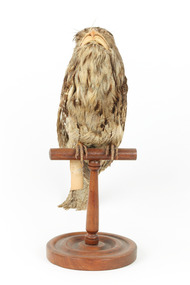 The Beechworth Burke Museum
Animal specimen - Tawny Frogmouth, Trustees of the Australian Museum, 1860-1880
... future environmental research. This collection continues to be on display in the Museum and has become a key part to interpreting the collecting habits of the 19th century. taxidermy mount taxidermy burke museum beechworth australian museum skin reynell eveleigh johns bird australian birds tawny frogmouth frogmouth 1a. / More-Park / See Catalogue, page 7 / This Tawny Frogmouth has a broad head and a creamy beige coloured wide triangular beak with a hooked tip. The plumage on the head and back ...The Tawny Frogmouth, although often mistaken for an owl, is a nocturnal Australian bird of the Podargidae family that is more closely related to the nightjars. They are widespread in terms of distribution and can be found all across mainland Australia and Tasmania in a diverse variety of habitats from woodlands, forests and urban areas. Masters of camouflage, the Tawny Frogmouth sleeps during the day on tree branches in a stiff upward facing position (as with this specimen) to mimic broken tree branches, their feathers assist in this deception as the mottled grey and brown colours blend into the environment seamlessly. This specimen differs in colours from the usual appearance of a Tawny Frogmouth, as the beak is usually a olive-grey to blackish tone and the plumage is generally more dominantly grey all over the bird. This specimen is part of a collection of almost 200 animal specimens that were originally acquired as skins from various institutions across Australia, including the Australian Museum in Sydney and the National Museum of Victoria (known as Museums Victoria since 1983), as well as individuals such as amateur anthropologist Reynell Eveleigh Johns between 1860-1880. These skins were then mounted by members of the Burke Museum Committee and put-on display in the formal space of the Museum’s original exhibition hall where they continue to be on display. This display of taxidermy mounts initially served to instruct visitors to the Burke Museum of the natural world around them, today it serves as an insight into the collecting habits of the 19th century.This specimen is part of a significant and rare taxidermy mount collection in the Burke Museum. This collection is scientifically and culturally important for reminding us of how science continues to shape our understanding of the modern world. They demonstrate a capacity to hold evidence of how Australia’s fauna history existed in the past and are potentially important for future environmental research. This collection continues to be on display in the Museum and has become a key part to interpreting the collecting habits of the 19th century.This Tawny Frogmouth has a broad head and a creamy beige coloured wide triangular beak with a hooked tip. The plumage on the head and back of the bird is a combination of darker and rufous browns, mottled with streaks of cream and grey. The underside of the bird from the bottom of the beak to the tail tip is a lighter cream colour with streaks of rufous-brown. The feet are an orange-brown colour. This specimen is adopting the skyward looking pose associated with the species, mimicking dead tree branches.1a. / More-Park / See Catalogue, page 7 /taxidermy mount, taxidermy, burke museum, beechworth, australian museum, skin, reynell eveleigh johns, bird, australian birds, tawny frogmouth, frogmouth -
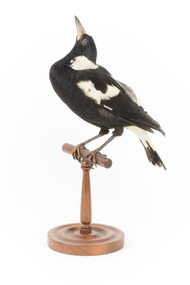 The Beechworth Burke Museum
Animal specimen - Australian Magpie, Trustees of the Australian Museum, 1860-1880
... future environmental research. This collection continues to be on display in the Museum and has become a key part to interpreting the collecting habits of the 19th century. taxidermy mount taxidermy animalia burke museum beechworth australian museum skin reynell eveleigh johns bird Australian Magpie Ornithological Ornithology white winged chough This specimen an Australian Magpie with black and white plumage over the body, mounted on a cedar stand. The specimen has a large straight beak and is in an unusual pose for a magpie, compressing the white patch on the back ...The Australian magpie is a passerine native to Australia and southern New Guinea. Renowned for its black and white plumage and distinctive song, the Australian magpie has also established populations in New Zealand and on the Fijian island of Taveuni, where it was introduced during the 19th century. Previously classified as three distinct species, it is now recognized as a single species comprising nine subspecies. Belonging to the family Artamidae, the Australian magpie is the sole member of the genus Gymnorhina and shares its closest relation with the black butcherbird (Melloria quoyi). Unlike the Eurasian magpie, it is not part of the Corvidae family. This specimen was originally misidentified as a white winged chough and is part of a collection of almost 200 animal specimens that were originally acquired as skins from various institutions across Australia, including the Australian Museum in Sydney and the National Museum of Victoria (known as Museums Victoria since 1983), as well as individuals such as amateur anthropologist Reynell Eveleigh Johns between 1860-1880. These skins were then mounted by members of the Burke Museum Committee and put-on display in the formal space of the Museum’s original exhibition hall where they continue to be on display. This display of taxidermy mounts initially served to instruct visitors to the Burke Museum of the natural world around them, today it serves as an insight into the collecting habits of the 19th century. This specimen is part of a significant and rare taxidermy mount collection in the Burke Museum. This collection is scientifically and culturally important for reminding us of how science continues to shape our understanding of the modern world. They demonstrate a capacity to hold evidence of how Australia’s fauna history existed in the past and are potentially important for future environmental research. This collection continues to be on display in the Museum and has become a key part to interpreting the collecting habits of the 19th century.This specimen an Australian Magpie with black and white plumage over the body, mounted on a cedar stand. The specimen has a large straight beak and is in an unusual pose for a magpie, compressing the white patch on the back of the neck. The beak has turned yellow where originally grey, potentially leading to a previous misidentification as a white-winged chough.taxidermy mount, taxidermy, animalia, burke museum, beechworth, australian museum, skin, reynell eveleigh johns, bird, australian magpie, ornithological, ornithology, white winged chough -
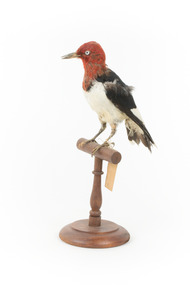 The Beechworth Burke Museum
Animal specimen - Red Headed Woodpecker, Trustees of the Australian Museum, 1860-1880
... future environmental research. This collection continues to be on display in the Museum and has become a key part to interpreting the collecting habits of the 19th century. taxidermy mount taxidermy animalia burke museum beechworth australian museum skin reynell eveleigh johns bird red headed woodpecker Swing-tag: 151a. Unnamed / Catalogue page, 60 / This Red Headed Woodpecker is a small to medium-sized bird found in North America. This specimen is tricoloured: it has a red head and neck, a white chest, a black back ...Red Headed Woodpeckers can be found in Southern Canada and a large portion of the United States of America, generally migrating to the south if they originated in the northern regions. Their habitat is open forests or savannahs. They are classed as omnivores, finding food from pecking at wood or in flight. The Red Headed Woodpecker is threatened in Canada and some areas of the United States due to deforestation, lack of deadwood for nesting, competition with other birds, and a lack of food. They are an important part of the ecosystem, controlling insect populations and pollinating flora. Red Headed Woodpeckers typically have a beautiful, vibrant red neck and head, a stark white chest, black back, and black wings with white secondary remiges. They have a large chisel-like beak, suitable for foraging for their food. Their heads are rounded and they have short tails. This specimen is part of a collection of almost 200 animal specimens that were originally acquired as skins from various institutions across Australia, including the Australian Museum in Sydney and the National Museum of Victoria (known as Museums Victoria since 1983), as well as individuals such as amateur anthropologist Reynell Eveleigh Johns between 1860-1880. These skins were then mounted by members of the Burke Museum Committee and put-on display in the formal space of the Museum’s original exhibition hall where they continue to be on display. This display of taxidermy mounts initially served to instruct visitors to the Burke Museum of the natural world around them, today it serves as an insight into the collecting habits of the 19th century.This specimen is part of a significant and rare taxidermy mount collection in the Burke Museum. This collection is scientifically and culturally important for reminding us of how science continues to shape our understanding of the modern world. They demonstrate a capacity to hold evidence of how Australia’s fauna history existed in the past and are potentially important for future environmental research. This collection continues to be on display in the Museum and has become a key part to interpreting the collecting habits of the 19th century.This Red Headed Woodpecker is a small to medium-sized bird found in North America. This specimen is tricoloured: it has a red head and neck, a white chest, a black back, and black wings with white secondary remiges. It has a large chisel-like beak. This specimen has pest or humidity damage on the neck and head area. This specimen is standing on a wooden mount with a swing tag attached to it's leg.Swing-tag: 151a. Unnamed / Catalogue page, 60 /taxidermy mount, taxidermy, animalia, burke museum, beechworth, australian museum, skin, reynell eveleigh johns, bird, red headed woodpecker -
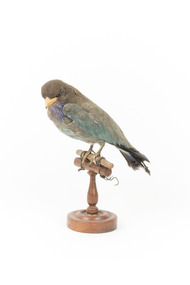 The Beechworth Burke Museum
Animal specimen - Dollarbird, Trustees of the Australian Museum, 1860-1880
... future environmental research. This collection continues to be on display in the Museum and has become a key part to interpreting the collecting habits of the 19th century. taxidermy mount taxidermy animalia burke museum beechworth australian museum skin reynell eveleigh johns bird dollar bird This juvenile Dollar bird's feet are a faded brown and the bill is a light yellow. The colour of this specimen's head and neck are a cool grey which fades to a patch of bright purple on its upper chest. The back ...The DollarBird is the only member of the Roller family found in Australia and can be found in forests and woodland areas. The name of this bird comes from the large white spot on the underside of each wing which resemble silver dollars. They travel to Australia each year to breed from New Guinea and the surrounding area. Their main source of food is insects which they hunt during flight. They capture these foods while displaying skillful aerial pursuits. They then return to the same perch they were upon when they left to catch their food. This specimen is part of a collection of almost 200 animal specimens that were originally acquired as skins from various institutions across Australia, including the Australian Museum in Sydney and the National Museum of Victoria (known as Museums Victoria since 1983), as well as individuals such as amateur anthropologist Reynell Eveleigh Johns between 1860-1880. These skins were then mounted by members of the Burke Museum Committee and put-on display in the formal space of the Museum’s original exhibition hall where they continue to be on display. This display of taxidermy mounts initially served to instruct visitors to the Burke Museum of the natural world around them, today it serves as an insight into the collecting habits of the 19th century.This specimen is part of a significant and rare taxidermy mount collection in the Burke Museum. This collection is scientifically and culturally important for reminding us of how science continues to shape our understanding of the modern world. They demonstrate a capacity to hold evidence of how Australia’s fauna history existed in the past and are potentially important for future environmental research. This collection continues to be on display in the Museum and has become a key part to interpreting the collecting habits of the 19th century.This juvenile Dollar bird's feet are a faded brown and the bill is a light yellow. The colour of this specimen's head and neck are a cool grey which fades to a patch of bright purple on its upper chest. The back is grey while the underbelly and wings are a light blue-grey. The tail feathers are tipped in black. The specimen is standing on a wooden mount.taxidermy mount, taxidermy, animalia, burke museum, beechworth, australian museum, skin, reynell eveleigh johns, bird, dollar bird -
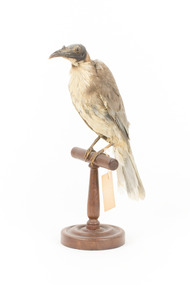 The Beechworth Burke Museum
Animal specimen - Noisy Friarbird, Trustees of the Australian Museum, 1860-1880
... future environmental research. This collection continues to be on display in the Museum and has become a key part to interpreting the collecting habits of the 19th century. taxidermy mount taxidermy animalia burke museum beechworth australian museum skin bird noisy friarbird friarbird australian birds oz animals wattlebird 59a / Friarbird / See Catalogue Page 18 / The Noisy Friarbird has a characteristically black head which lacks plumage and has a prominent casque (bump) on the base of its strong bill. The specimen has an off-white underbody and neck, a light brown back ...The Noisy Friarbird are conspicuous and active Honey-eaters mainly seen in small groups and often active in flowering plants, especially eucalyptus trees. Noisy Friarbirds are found along the east coast of Australia, from north-eastern Queensland to north-eastern Victoria. They often feed in noisy flocks, alongside other Honey-eaters such as the Red Wattlebird. This specimen has been mounted in an accurate, yet stylised fashion. This specimen is part of a collection of almost 200 animal specimens that were originally acquired as skins from various institutions across Australia, including the Australian Museum in Sydney and the National Museum of Victoria (known as Museums Victoria since 1983), as well as individuals such as amateur anthropologist Reynell Eveleigh Johns between 1860-1880. These skins were then mounted by members of the Burke Museum Committee and put-on display in the formal space of the Museum’s original exhibition hall where they continue to be on display. This display of taxidermy mounts initially served to instruct visitors to the Burke Museum of the natural world around them, today it serves as an insight into the collecting habits of the 19th century.This specimen is part of a significant and rare taxidermy mount collection in the Burke Museum. This collection is scientifically and culturally important for reminding us of how science continues to shape our understanding of the modern world. They demonstrate a capacity to hold evidence of how Australia’s fauna history existed in the past and are potentially important for future environmental research. This collection continues to be on display in the Museum and has become a key part to interpreting the collecting habits of the 19th century.The Noisy Friarbird has a characteristically black head which lacks plumage and has a prominent casque (bump) on the base of its strong bill. The specimen has an off-white underbody and neck, a light brown back and tail with a white tip at the end of the tail. This specimen stands upon a wooden platform and has an identification tag tied around its leg.59a / Friarbird / See Catalogue Page 18 /taxidermy mount, taxidermy, animalia, burke museum, beechworth, australian museum, skin, bird, noisy friarbird, friarbird, australian birds, oz animals, wattlebird -
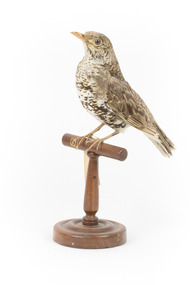 The Beechworth Burke Museum
Animal specimen - Bassian Thrush, Trustees of the Australian Museum, 1860-1880
... future environmental research. This collection continues to be on display in the Museum and has become a key part to interpreting the collecting habits of the 19th century. taxidermy mount taxidermy animalia burke museum beechworth australian museum skin bird australian birds bassian thrush thrush zoothera lunulata Swing Tag: 44a / mountain Thrush / See Catalogue Page 15 The plumage of this Bassian Thrush specimen is a mottled brown to olive-brown colour, heavily scalloped with black crescent-shaped bars on the back, rump and head. ...The Bassian Thrush is a secretive bird, often difficult to see, as it is an unobtrusive species that forages among dense vegetation. When disturbed, it sometimes crouches on the ground and freezes, relying on its scalloped plumage to conceal its presence. The Bassian Thrush feeds on the ground, scratching under the leaf-litter for small invertebrates. This specimen has been mounted in an accurate and yet stylised fashion. This specimen is part of a collection of almost 200 animal specimens that were originally acquired as skins from various institutions across Australia, including the Australian Museum in Sydney and the National Museum of Victoria (known as Museums Victoria since 1983), as well as individuals such as amateur anthropologist Reynell Eveleigh Johns between 1860-1880. These skins were then mounted by members of the Burke Museum Committee and put-on display in the formal space of the Museum’s original exhibition hall where they continue to be on display. This display of taxidermy mounts initially served to instruct visitors to the Burke Museum of the natural world around them, today it serves as an insight into the collecting habits of the 19th century. This specimen is part of a significant and rare taxidermy mount collection in the Burke Museum. This collection is scientifically and culturally important for reminding us of how science continues to shape our understanding of the modern world. They demonstrate a capacity to hold evidence of how Australia’s fauna history existed in the past and are potentially important for future environmental research. This collection continues to be on display in the Museum and has become a key part to interpreting the collecting habits of the 19th century.The plumage of this Bassian Thrush specimen is a mottled brown to olive-brown colour, heavily scalloped with black crescent-shaped bars on the back, rump and head. The paler underparts all have brown-black scalloping. It has a white eye-ring which surrounds glass eyes which have been included by the taxidermist to replace the originals. This specimen stands upon a wooden platform and has an identification tag tied around its leg.Swing Tag: 44a / mountain Thrush / See Catalogue Page 15 taxidermy mount, taxidermy, animalia, burke museum, beechworth, australian museum, skin, bird, australian birds, bassian thrush, thrush, zoothera lunulata -
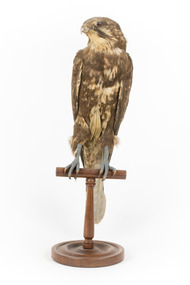 The Beechworth Burke Museum
Animal specimen - Brown Falcon, Trustees of the Australian Museum, 1860-1880
... future environmental research. This collection continues to be on display in the Museum and has become a key part to interpreting the collecting habits of the 19th century. taxidermy mount taxidermy animalia burke museum beechworth australian museum skin reynell eveleigh johns bird brown falcon falconidae 3 / Brown Hawk / See Catalogue, page 2 / The Brown Falcon specimen has plumage which is mostly brown and intermixed with white. This provides the appearance of having spotted colouring on the birds back ...The Brown Falcon is a small to medium bird of prey which can be found all throughout Australia. These birds are raptors and typically feed on mammals, birds, snakes, insects and rabbits. The Brown Falcon are located in all but the densest forests. They typically prefer to reside in locations of open grassland and agricultural areas which have scattered trees or telephone poles which the bird can perch on. When frequenting towns located in the Australian Outback, these birds are reportedly quite tame and can be approached by humans. They may stay in the same location throughout the year or chose to move around locally in response to any changes in weather conditions. This specimen is part of a collection of almost 200 animal specimens that were originally acquired as skins from various institutions across Australia, including the Australian Museum in Sydney and the National Museum of Victoria (known as Museums Victoria since 1983), as well as individuals such as amateur anthropologist Reynell Eveleigh Johns between 1860-1880. These skins were then mounted by members of the Burke Museum Committee and put-on display in the formal space of the Museum’s original exhibition hall where they continue to be on display. This display of taxidermy mounts initially served to instruct visitors to the Burke Museum of the natural world around them, today it serves as an insight into the collecting habits of the 19th centuryThis specimen is part of a significant and rare taxidermy mount collection in the Burke Museum. This collection is scientifically and culturally important for reminding us of how science continues to shape our understanding of the modern world. They demonstrate a capacity to hold evidence of how Australia’s fauna history existed in the past and are potentially important for future environmental research. This collection continues to be on display in the Museum and has become a key part to interpreting the collecting habits of the 19th century.The Brown Falcon specimen has plumage which is mostly brown and intermixed with white. This provides the appearance of having spotted colouring on the birds back. The head is also mostly brown with white under the beak area and a characteristic brown streak under the eye area. The eye is made from dark coloured glass.3 / Brown Hawk / See Catalogue, page 2 / taxidermy mount, taxidermy, animalia, burke museum, beechworth, australian museum, skin, reynell eveleigh johns, bird, brown falcon, falconidae
