
Showing 28 items matching "bale of paper"
-
 Flagstaff Hill Maritime Museum and Village
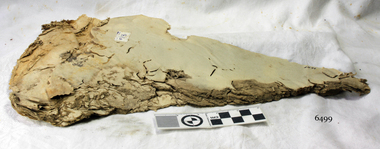
Functional object - Paper, circa 1908
... ...bale of paper...This wad of paper is a section from a bale of paper that was recovered from the Falls of Halladale. ...Paper wad; a section of a bale of many sheets. The paper has several layers and shows the effects of being in the sea for many years. ...This wad of paper is a section from a bale of paper that was recovered from the Falls of Halladale. ...This wad of paper is a section from a bale of paper that was recovered from the Falls of Halladale. The iron-hulled, four-masted barque, the Falls of Halladale, was a bulk carrier of general cargo. She left New York in August 1908 on her way to Melbourne and Sydney. In her hold, along with 56,763 tiles of unusual beautiful green American slates (roofing tiles), 5,673 coils of barbed wire, 600 stoves, 500 sewing machines, 6500 gallons of oil, 14400 gallons of benzene, and many other manufactured items, were 117 cases of crockery and glassware. Three months later and close to her destination, a navigational error caused the Falls of Halladale to be wrecked on a reef off the Peterborough headland at 3 am on the morning of the 15th of November, 1908. The captain and 29 crew members all survived, but her valuable cargo was largely lost, despite two salvage attempts in 1908-09 and 1910. ABOUT THE ‘FALLS OF HALLADALE’ (1886 - 1908) Built: in1886 by Russell & Co., Greenock shipyards, River Clyde, Scotland, UK. The company was founded in 1870 (or 1873) as a partnership between Joseph Russell (1834-1917), Anderson Rodger and William Todd Lithgow. During the period 1882-92 Russell & Co., standardised designs, which sped up their building process so much that they were able to build 271 ships over that time. In 1886 they introduced a 3000 ton class of sailing vessel with auxiliary engines and brace halyard winches. In 1890 they broke the world output record. Owner: Falls Line, Wright, Breakenridge & Co, 111 Union Street, Glasgow, Scotland. Configuration: Four masted sailing ship; iron-hulled barque; iron masts, wire rigging, fore & aft lifting bridges. Size: Length 83.87m x Breadth 12.6m x Depth 7.23m, Gross tonnage 2085 ton Wrecked: the night of 14th November 1908, Curdies Inlet, Peterborough south west Victoria Crew: 29 The Falls of Halladale was a four-masted sailing ship built-in 1886 in Glasgow, Scotland, for the long-distance cargo trade and was mostly used for Pacific grain trade. She was owned by Wright, Breakenridge & Co of Glasgow and was one of several Falls Line ships, all of which were named after waterfalls in Scotland. The lines flag was of red, blue and white vertical stripes. The Falls of Halladale had a sturdy construction built to carry maximum cargo and able to maintain full sail in heavy gales, one of the last of the ‘windjammers’ that sailed the Trade Route. She and her sister ship, the Falls of Garry, were the first ships in the world to include fore and aft lifting bridges. Previous to this, heavily loaded vessels could have heavy seas break along the full length of the deck, causing serious injury or even death to those on deck. The new, raised catwalk-type decking allowed the crew to move above the deck stormy conditions. This idea is still used today on the most modern tankers and cargo vessels and has proved to be an important step forward in the safety of men at sea. On 4th August 1908, with new sails, 29 crew, and 2800 tons of cargo, the Falls of Halladale left New York, bound for Melbourne and Sydney via the Cape of Good Hope. The cargo on board was valued at £35,000 and included 56,763 tiles of American slate roofing tiles (roof slates), 5,673 coils of barbed wire, 600 stoves, 500 sewing machines, 6,500 gallons of oil, 14,400 gallons of benzene, plumbing iron, 117 cases of crockery and glassware and many other manufactured items. The Falls of Halladale had been at sail for 102 days when, at 3 am on the night of 14th November 1908, under full sail in calm seas with a six knots breeze behind and misleading fog along the coast, the great vessel rose upon an ocean swell and settled on top of a submerged reef near Peterborough on the south-west Victoria’s coast. The ship was jammed on the rocks and began filling with water. The crew launched the two lifeboats and all 29 crew landed safely on the beach over 4 miles away at the Bay of Islands. The postmistress at Peterborough, who kept a watch for vessels in distress, saw the stranding and sent out an alert to the local people. A rescue party went to the aid of the sailors and the Port Campbell rocket crew was dispatched, but the crew had all managed to reach shore safely by the time help arrived. The ship stayed in full sail on the rocky shelf for nearly two months, attracting hundreds of sightseers who watched her slowly disintegrate until the pounding seas and dynamiting by salvagers finally broke her back, and her remains disappeared back into deeper water. The valuable cargo was largely lost, despite two salvage attempts in 1908-09 and 1910. Further salvage operations were made from 1974-1986, during which time 22,000 slate tiles were recovered with the help of 14 oil drums to float them, plus personal artefacts, ship fittings, reams of paper and other items. The Court of Marine Inquiry in Melbourne ruled that the foundering of the ship was entirely due to Captain David Wood Thomson’s navigational error, not too technical failure of the Clyde-built ship. The shipwreck is a popular site for divers, about 300m offshore and in 3 – 15m of water. Some of the original cargo can be seen at the site, including pieces of roof slate and coils of barbed wire. The section of paper has significance through its association with the Falls of Halladale. The shipwreck is listed on the Victorian Heritage Register (No. S255). She was one of the last ships to sail the Trade Routes. She is one of the first vessels to have fore and aft lifting bridges. She is an example of the remains of an International Cargo Ship and also represents aspects of Victoria’s shipping industry. The wreck is protected as a Historic Shipwreck under the Commonwealth Historic Shipwrecks Act (1976).Paper wad; a section of a bale of many sheets. The paper has several layers and shows the effects of being in the sea for many years. It was recovered from the wreck of the Falls of Halladale.flagstaff hill, warrnambool, shipwrecked coast, flagstaff hill maritime museum, maritime museum, shipwreck coast, flagstaff hill maritime village, great ocean road, falls of halladale, shipwreck peterborough, 1908 shipwreck, great clipper ships, russell & co., paper, bale of paper, ream of paper, wad of paper -
 National Wool Museum
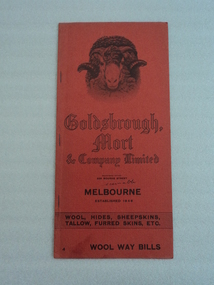
Booklet, 1940
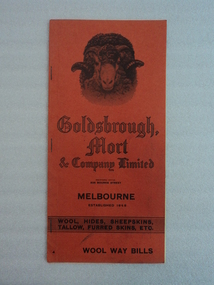
... Mr Clyde used this waybill booklet to record the details of wool bales which he sold through Goldsbrough Mort. The front yellow carbon paper slip indicated a sale of wool in 1946....paper booklet with three staples on left side spine. Front cover has an image of a rams head above decorative text reading -Goldsbrough, / Mort / & Company Limited-. Company address and services are also listed on front cover. Back cover has an image and addresses of warehouse storage locations. Inside front and back covers are instructions and tips on how to use the booklet. Several yellow lined pages are included inside, some of which have been removed. These pages are used to record bale...paper booklet with three staples on left side spine. Front cover has an image of a rams head above decorative text reading -Goldsbrough, / Mort / & Company Limited-. Company address and services are also listed on front cover. Back cover has an image and addresses of warehouse storage locations. Inside front and back covers are instructions and tips on how to use the booklet. Several yellow lined pages are included inside, some of which have been removed. These pages are used to record bale ...Donated by Mrs Robyn Adams, daughter of Victor Clyde- a wool grower in North East Victoria. Mr Clyde used this waybill booklet to record the details of wool bales which he sold through Goldsbrough Mort. The front yellow carbon paper slip indicated a sale of wool in 1946.Red paper booklet with three staples on left side spine. Front cover has an image of a rams head above decorative text reading -Goldsbrough, / Mort / & Company Limited-. Company address and services are also listed on front cover. Back cover has an image and addresses of warehouse storage locations. Inside front and back covers are instructions and tips on how to use the booklet. Several yellow lined pages are included inside, some of which have been removed. These pages are used to record bale details with carbon paper. There is a small, handwriten word on th front cover above the word MELBOURNE.wool growing, wool production, wool auctions, wool sales, wool transport, mrs robyn adams, elder smith goldsbrough mort limited -
 National Wool Museum
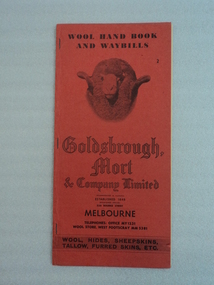
Booklet, 1946
... There are several yellow lined pages upon which the owner can record the wool bale details with carbon paper. Several pages have been used/removed from this booklet. ...There are several yellow lined pages upon which the owner can record the wool bale details with carbon paper. Several pages have been used/removed from this booklet. ...Red paper booklet with three metal staples on spine on left side. Front cover has black text at top reading -WOOL HAND BOOK / AND WAYBILLS-. Below is an image of a rams head. Below, in decorative font is text that reads -Goldsbrough, / Mort / & Company Limited-. Contact details and services provided are also listed on the front cover. Back cover has an image and addresses of warehouse storage locations. Inside are four white pages of instructions on how to use the booklet, as well as tips on the inside of the front and back covers. There are several yellow lined pages upon which the owner can record the wool bale details with carbon paper. Several pages have been used/removed from this booklet. There is a foldout map inside the back cover.wool growing, wool production, wool auctions, wool bales, wool sales, mrs robyn adams, wool transport, goldsbrough, mort and company limited, elder smith goldsbrough mort limited, dalgety and company limited elder smith goldsbrough mort limited -
 Federation University Historical Collection
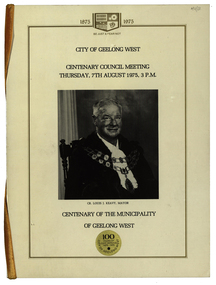
Booklet, City of Geelong West: Centenary Council Meeting and Dinner, 1975
... bales of wool. The modern adaptation of the official Coat of Arms is used in the booklet geelong west coat of arms transport industry agriculture louis keavy mayor centenary governor of victoria sir henry winneke government gazette .1 Booklet pages are edged with gold with banner at top. Yellow ribbon at spine. Photographs of councillors and Governor of Victoria .2 Thick paper ...The Geelong West Coat of Arms is divided into four sections representing Transport, Industry, Shipping and Agriculture. For Transport (top left) a steam train typified the Geelong-Melbourne railway. Top right showed a factory, bottom left was a sailing clipper and bottom right had bales of wool. The modern adaptation of the official Coat of Arms is used in the booklet.1 Booklet pages are edged with gold with banner at top. Yellow ribbon at spine. Photographs of councillors and Governor of Victoria .2 Thick paper with red writinggeelong west, coat of arms, transport, industry, agriculture, louis keavy, mayor, centenary, governor of victoria, sir henry winneke, government gazette -
 Orbost & District Historical Society
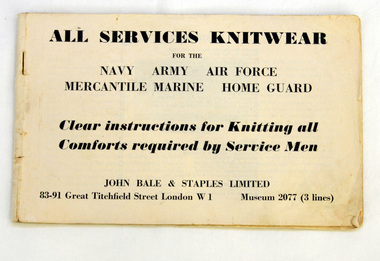
booklet, John Bales & Staples, All Services Knitwear, World War 11
... paper covers and states that it gives clear instructions for knitting all comforts required by Service men. . Contents include instructions for knitting mittens for the Navy, steering gloves for the Army, other gloves, socks, knee caps, wristlets, helmet with cape pieces for all services, ribbed helmet for the Navy, hospital stockings, scarf, service jacket and pullover and fisherman's sea-boot stockings. It is Illustrated with black/white photographs. All Services Knitwear booklet John Bales ...This booklet was in a box of items donated to the Orbost Op Shop by Orbost House. Orbost House, believed to have been established by the Macalister family around the turn of the 20th century was a boarding house in Lochiel Street, Orbost. A stapled paper handbook of knitting patterns for defence force knitwear. All Services Knitwear for the Navy, Army, Air Force, Mercantile Marine and Home Guard. Contains 27 pages in paper covers and states that it gives clear instructions for knitting all comforts required by Service men. . Contents include instructions for knitting mittens for the Navy, steering gloves for the Army, other gloves, socks, knee caps, wristlets, helmet with cape pieces for all services, ribbed helmet for the Navy, hospital stockings, scarf, service jacket and pullover and fisherman's sea-boot stockings. It is Illustrated with black/white photographs. knitting-patterns booklet handcraft -
 Bendigo Military Museum
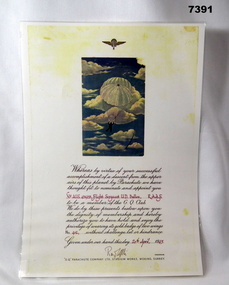
Certificate - CERTIFICATE 1945, G.Q. PARACHUTE COMPANY LTD, STADIUM WOORKS, 1945 Original Certificate
... baling out of a Halifax bomber. Illustrated in colour - G.Q. Parachute company logo above an illustration of a serviceman with parachute amongst clouds and sky, small aircraft in background. Paper...baling out of a Halifax bomber. Illustrated in colour - G.Q. Parachute company logo above an illustration of a serviceman with parachute amongst clouds and sky, small aircraft in background. Paper ...Certificate awarded by the "G.Q. PARACHUTE COMPANY LTD., STADIUM WORKS, WOKING, SURREY" Item in the collection re Vivian D BULLEN, refer Cat No 7386 for his AIF & RAAF Service details.Certificate - photocopy of an original certificate, a memento awarded to V.D. BULLEN in 1945 for baling out of a Halifax bomber. Illustrated in colour - G.Q. Parachute company logo above an illustration of a serviceman with parachute amongst clouds and sky, small aircraft in background. Paper - pale yellow colour. Below illustration - black print award statement with handwritten recipient information in red ink.Recipient information - in red ink. "No. AVS 431933, Flight Sergeant "V.D. BULLEN, R.A.A.F." "20TH April 1945"certificates, ww2, raaf, uk -
 Bendigo Military Museum
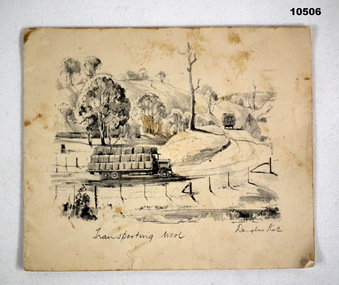
Postcard - CHRISTMAS GREETING, Australian Military Forces, 23 Dec 1941
... paper two ways. The front depicts a pen and ink drawing of civilian trucks hauling wool bales in an Australian Rural scene. ...paper two ways. The front depicts a pen and ink drawing of civilian trucks hauling wool bales in an Australian Rural scene. ..."John Ahem Torpie" QX39522 (Q119806) Enlisted 14/9/42 (2nd AIF) Discharged 6/11/46. Rank Captain. Black and white card formed by folding a sheet of paper two ways. The front depicts a pen and ink drawing of civilian trucks hauling wool bales in an Australian Rural scene. On the inside of the card there is an illustration of a soldier standing to attention and a 25 Pdr gun crew in action. The right side shows a heavy A.A. gun in action - mobile type of gun. Beside it are two artillery signallers, prone, working a radio set. The rear page has the actual letter greetings.Front Title - Transporting wool. Inner left - To Greet You Sincerely at Christmas and wish you Happiness in the New Year. Inner Right - Australian Military Forces. "I don't appear in the picture, not being a skite, I am hiding behind the gun. J.T.". Rear Page - 7th Inf. Brigade, Chermside Camp, Brisbane 23.12.41. Dear Ted & George. Wishing you both a Happy Christmas and a Prosperous New Year. Have been in camp hospital for ten days as a result of encounter with muma (?) - shall hardly land the M.C. but then so very few get their deserts. Often think of C.V.M.S. & wonder how you all are doing. Remember me to the boys. John A Torpie. ww2, postcard, artillery, christmas, john a torpie -
 Bendigo Historical Society Inc.
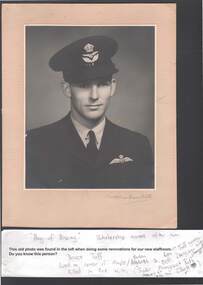
Photograph - GOLDEN SQUARE P.S. LAUREL ST. 1189 COLLECTION: BRUCE TUFF
... See attached document, where he baled out of his plane over the English Channel, to try to rescue his commanding officer whose plane had crashed. Written on paper...See attached document, where he baled out of his plane over the English Channel, to try to rescue his commanding officer whose plane had crashed. Written on paper ...Flying Officer Robert Bruce Tuff was reported missing over the English Channel during air operations, on the 22nd. February, 1944. A report was received by the RAAF in London that during a patrol, the Commanding Officer of the squadron was heard to say that he was going to ditch his plane, 8 miles north west of Guernsey. Later Flying Officed Tuff was heard to say that he had seen the CO injured in the water and that he was going to 'bale out' and help him. Neither Flying Officer Tuff or the Commanding Officer were ever found. His plane was observed diving into the ocean. Robert Bruce Tuff attended Laurel Street Primary School, Golden Square for part of his primary years. He was the son of R. and M. Tuff of 125 Myrtle Street, Golden Square and the brother of Ken, Margaret and Beth. Black and white photo of Bruce Tuff: image shows young man, dressed in Airforce uniform. Head and shoulders portrait, mounted on buff board. Label on photo states 'this old photo was found in the loft when doing some renovations for our new staffroom (Laurel Street Primary School, Golden Square) Do you know this person?' Handwritten notes state 'Bay of Biscay' scholarship named after him. Bruce Tuff lived on corner of Maple/Panton St. and was killed in World War 2. See attached document, where he baled out of his plane over the English Channel, to try to rescue his commanding officer whose plane had crashed. Written on paper insert: Sister Margaret Tuff, Harley st., Bendigo, now Elliott. Ken Tuff younger, Beth Dungey, Harkness St. primary, world war 2, r.a.a.f., wirraway, golden square primary school laurel street, robert bruce tuff, english channel -
 Bendigo Historical Society Inc.
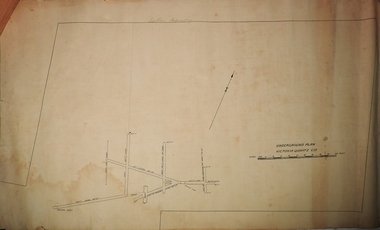
Plan - Victoria Quartz Gold Mine, Unknown
... baled water for six months then handed the mine over to the tributers who worked the upper levels for the share of the profits. The mine closed in 1913, having produced over 48,000 ounces of gold and paid dividends of £99,600. gold mining gold Bendigo Victoria Quartz Gold Mine Victoria Reef Printed in black text on light tan paper: 'Underground workings, Victoria Quartz Co''. ...Victoria Quartz Gold Mine was situated on Victoria Hill, Bendigo. Victoria Hill is situated on the Marong Road, opposite the Gold Mines Hotel. Victoria Hill was one of the richest areas on the Bendigo Goldfield. It had many successful mines, including Lansell's '180' and the Victoria Quartz, once the deepest gold mine in the world. At the turn of the century, this was the site of one of the premier mines on the Bendigo goldfield. In 1908, it boasted the world's deepest shaft - 4,478 feet (1,365 metres). The shaft reached a depth of 4,613 feet (1,406 metres) in 1910. In 1857 eight small claims in this area had been merged to form the Victoria Reef Quartz Mining Co. Another merger in 1877 led to the formation of the Victoria Quartz Co. For the next three decades, the mine produced consistent profits. In 1910, water burst into the claim, flooding the shaft and halting operations. The company baled water for six months then handed the mine over to the tributers who worked the upper levels for the share of the profits. The mine closed in 1913, having produced over 48,000 ounces of gold and paid dividends of £99,600.Printed in black text on light tan paper: 'Underground workings, Victoria Quartz Co''. Written on accompanying label: "Victoria Reef, underground plan'. Plan shows shaft, drives and geological features. Plan forms part of the Margaret Roberts Collection.gold mining, gold, bendigo, victoria quartz gold mine, victoria reef -
 Bendigo Historical Society Inc.
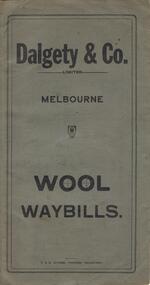
Document - ABBOTT COLLECTION: WOOL WAYBILLS, 1927
... The second page has handwriting detailing the 3 bales of wool received by R H Abbott. It also contains three sheets of carbon paper in special shiny pages at the back. ...The second page has handwriting detailing the 3 bales of wool received by R H Abbott. It also contains three sheets of carbon paper in special shiny pages at the back. ...Founded by Frederick Gonnerman Dalgety in 1846 in Melbourne as a stock and station agency with major interest in Victorian wool, much of which was exported to England for sale through their London agency.Dalgety & Co Wool Limited Melbourne Wool Waybills booklet. Grey Light cardboard cover contains 3 pages missing 6 torn out along the perforations. The second page has handwriting detailing the 3 bales of wool received by R H Abbott. It also contains three sheets of carbon paper in special shiny pages at the back. The booklet also contains advertising for sheep related products and a Tobacco Ad Printed by T & H Hunter printers Melbournedalgety & cpo., abbott -
 Bendigo Military Museum
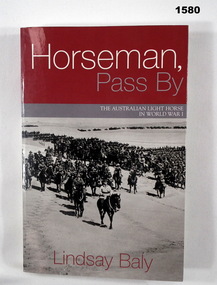
Book - BOOK, WW1, Lindsay Baly, "Horseman, Pass By", 2003
... paper. Illustrated in black and white photographs, maps and diagrams. "Horseman, Pass By" Book BOOK, WW1 Lindsay Baly Kangaroo Press Griffin Press ..."Horseman, Pass By. The Australian Light Horse in World War 1".Soft cover book. Cover - cardboard, white, red and grey colour print on front, spine and back. Front and back covers illustrated black and white photograph, a mounted division (of soldiers on horseback) march out. 337 pages, cut, plain white paper. Illustrated in black and white photographs, maps and diagrams.books, ww1, light horse -
 Bendigo Historical Society Inc.
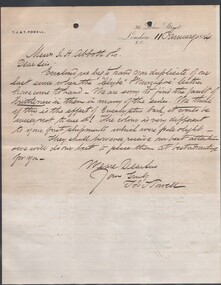
Administrative record - Abbott Collection: 1884 correspondence between J. H. Abbott and suppliers, 1884
... Powel re sales from the "Loch Katrine" and acknowledge letter advising 15 bales per the "Narvenne" 2403.99zg 5/09/1884 two-page letter orders dispatched from "Dumbarton and Hereward" make orders up to date; but could not obtain a quotation for Australian honey either by tins or kegs - suggesting a small trial consignment as the best plan to introduce the honey 2403.99zh 10/09/1884 doubler sided letter on blue paper from Ullathorne & Co. difficult to decipher 2403.99zi 26/09/1884 T.J. & T. ...Powel re sales from the "Loch Katrine" and acknowledge letter advising 15 bales per the "Narvenne" 2403.99zg 5/09/1884 two-page letter orders dispatched from "Dumbarton and Hereward" make orders up to date; but could not obtain a quotation for Australian honey either by tins or kegs - suggesting a small trial consignment as the best plan to introduce the honey 2403.99zh 10/09/1884 doubler sided letter on blue paper from Ullathorne & Co. difficult to decipher 2403.99zi 26/09/1884 T.J. & T. ...business records/correspondenceAbbott Collection: 1884 correspondence between J. H. Abbott and suppliers ( all handwritten correspondence, but difficult to decifer): 2403.99a 10/01/1884 T. J. & T. Powell issues with leather shipment from Abbott to London 2403.99b 11/01/1884 Ullathorne & Co. 12 bales of leather 2403.99c 18/01/1884 Memorandum from Ullathorne & Co. confirming 11 Jan consignment of leather 2403.99d 1/02/1884 Ullathorne & Co. confirming the assignment issues 2403.99e 8/02/1884 J.J. Schweizer & Co. concerning consignment quantities of not less than 5 to 10 tons 2403.99f 8/02/1884 T.J. & J. Powell acknowledging 19 Dec exchange re 12 bales pf leather per "Carlisle Castle" 2403.99g 5/02/1884 2-page letter Ullathorne & Co. requesting authorisation by Abbott of a consignment of leather for sale at 10/04 2403.99h 8/02/1884 most difficult to decipher double page letter re "Oakwood Buffalo Brand" 2403.99i 7/03/1884 T.J. & J. Powell acknowledging past correspondence of 29/02 and that they have sold 12 bales @ 10/4; also noting past shipment contained a good many brittle grained sides. 2403.99j 29/02/1884 T.J. & J. Powell referring to issues with shipment of plants (a supply of ripe acorns) 2403.99k 7/03/1884 Ullathorne & Co. pleased with the shipment and sale 2403.99l 21/03/1884 Ullathorne & Co. confirming correspondence of 7/03 re the consignment sent by the "Clyde" 2403.99m 7/03/1884 two-page letter from Ullathorne & Co. noting costs for a shipment and adjustment in favour of Abbotts. 2403.99n 27/03/1884 two-page letter from T.J. & J. Powell noting agreement that "a good market is better than a good article" when there is a bad market things are dull and people look with magnifying spectacles at faults in goods" 2403.99o 28/03/1884 memorandum from Ullathorne & Co re financial issue quoted surplus should be noted as a deficit 2403.99p 18/04/1844 letter from T.J. & t. Powell acknowledging the shipment of hides, and reporting a good market and firm prices 2403.99q 21/03/1884 small double-sided letter (difficult to decipher) 2403.99r 24/04/1884 small note (even more difficult to decipher) 2403.99s 1/05/1884 letter from T.J. & T. Powell reporting the market for Australian leather has improved with increased prices, no report of the "Carlisle Castle" anmd its cargo arrival 2403.99t 3/05/1884 letter from T.J. & T. Powell leather from the "Carlisle Castle" has arrived 2403.99u 30/05/1884 letter from Ullathorne & Co. reporting on the arrival of goods from the "Castlisle Castlre" and coment the "your tanning has improved" 2403.99v 5/06/1884 W. & A. Shammers (!) discussion on the quality of goods provided, notably hunting and jig whips 2403.99w 6/06/1884 Ullathorne & Co. a report on prices achieved and charged to Abbott 2403.99x 10/06/1884 Ullathorne & Co. reports on prices for Abbott's goods received and sold from both the "MacCallum More and Carlisle Castle" 2403.99y 20/06/1884 Ullathorne & Co. reports on rerceipt of an order, shipping documents fo the "Peterborough" noting prices are presently favourable to consigners. 2403.99z 27/06/1884 T.J. & T. Powell referencing goods anticipated from the "Peterborough", and looking forward to goods on the "Loch Katrine" 2403.99za 4/07/1884 Ullathorne & Co. acknowledges receoipt of and order from 16/06 2403.99zb 11/07/1884 Ullathorne & Co. encloses acount sales from the "Carlisle Castle" 2403.99zc 25/07/1884 T.J. & T. Powell encloses their monthly report. Noting the "Loch Katrine" has arrived but goods has not yet been discharged 2403.99zd 15/08/1884 two-page letter from W & A Shamman (!) difficult to decipher re dispute or query on prices quoted, charged and received for goods. 2403.99ze 22/08/1884 two-page letter from Ullathorne & Co. referencing costs, beeswax, honey and shipments coming by "Dumbarton , Loch Katrine and Hereward (!)" 2403.99zf 22/08/1884 T.J. & T. Powel re sales from the "Loch Katrine" and acknowledge letter advising 15 bales per the "Narvenne" 2403.99zg 5/09/1884 two-page letter orders dispatched from "Dumbarton and Hereward" make orders up to date; but could not obtain a quotation for Australian honey either by tins or kegs - suggesting a small trial consignment as the best plan to introduce the honey 2403.99zh 10/09/1884 doubler sided letter on blue paper from Ullathorne & Co. difficult to decipher 2403.99zi 26/09/1884 T.J. & T. Powell letter - difficult to decipher 2403.99zj 13/09/1884 Ullathorne & Co. a two-page report on 15 bales of Australian leather from "Ravenna" and per the "Peterborough" 2403.99zk 5/10/1884 T.J. & T. Powell letter 2403.99zl 9/10/1884 two-page blue notes, addressed to Ullathorne & Co.; referencing 7 casks beeswax from "Peterborough" and 3 casks beeswax from "Raveena" 2403.99zm 16/10/1884 T.J. & T. Powell letter reports "since last writing there is nothing fresh to report.... you may rely on our best attention to your consignments and interests" 2403.99zn 17/10/1884 T.J. & T. Powell memorandum re sales of leather from the "Peterborough" 2409.99zo 5/12/1884 small letter from A Shamman (!) Birmingham re late invoice 2403.99zp 12/12/1884 T.J. & T. Powell letter reporting on arrival leather from "Ballarat", "Peterborough", and "Rome" 2403.99zq 19/12/1884 Ullathorne & Co. also reports on sales from leather arriving on the "Ballarat", "Peterborough", and "Rome" 2403.99zr 23/12/1884 two-page letter from T.J. & T. Powell references quality, notably colour of hides, and possible classing as inferior - leaving Abbott to decide options for tanning improvement through Sydney or Melbourne, and therefore sales 2403.99zs 10/12/1884 T.J. & T. Powell reports on 13 bales of Australian leather from the "Rome" shipment, noting four different classifications for sales, focused on colour 2403.99t 3/01 to 21/05/1884 Abbott documentation of hides produced through its Edinburgh Tannery, Bendigodispute on condition of sales, sales of australian leather, shipments ofhides to england -
 National Wool Museum
Album - Photo Album, Grazcos, c.1999
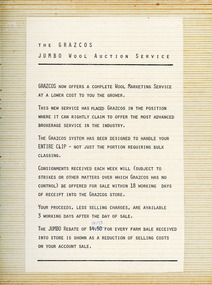
... bales to fit into the same container. This brought reductions in the costs of handling, selling, storing, and shipping of wool. This photo album details this process; from classing to shipping. This photo album was a draft copy produced for review before the production of mass-produced advertising flyers. Wool Auction Wool Processing Grazcos 12-page hard cover photo album. Internally colour images and printed text have been stuck behind a protective plastic onto paper ...Photo album detailing the process involved in the Jumbo Wool Auction Service. This process was developed by Grazcos, a company who advanced innovations for shearers and wool farmers before amalgamating with Dalgety in the early 1990s. Grazcos was a well-known name to source a competent shearing team, or as a destination for wool in need of bulk classing. The Jumbo Wool Auction service was designed to process wool more efficiently through volume. 63 traditionally dumped farm bales of wool would fill a typical shipping container. The Jumbo Wool Auction Service enabled 108 farm bales to fit into the same container. This brought reductions in the costs of handling, selling, storing, and shipping of wool. This photo album details this process; from classing to shipping. This photo album was a draft copy produced for review before the production of mass-produced advertising flyers. 12-page hard cover photo album. Internally colour images and printed text have been stuck behind a protective plastic onto paper. The backing paper has many distinctive orange and grey horizontal lines. Printed text is in black ink. Colour images are 2 x 3 inches with rounded corners. Images and text are numbered 1 to 16 detailing the process of the Jumbo Wool Auction Service developed by Grazcos.wool auction, wool processing, grazcos -
 National Wool Museum
Tool - Stencil, c.2018
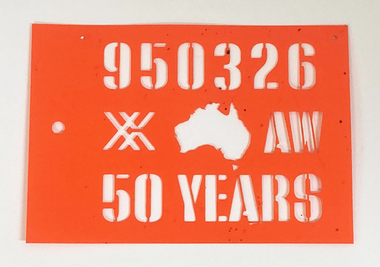
... It is branded across the front of a wool bale to indicate the quality of the wool, with the classers number used as a seal of approval. Accompanying the stencil are two sheets of white A4 paper with printing in gold and black ink. ...It is branded across the front of a wool bale to indicate the quality of the wool, with the classers number used as a seal of approval. Accompanying the stencil are two sheets of white A4 paper with printing in gold and black ink. ...The story of 90 years of wool classing between father & son begins in 1936, when a young boy by the name of Stanley James Hucker walked through the doors of the Gordon Technical School in Geelong. Born in 1921, Stanley was 15 years of age when he began his 3-year course in Wool Classing. 30 years later, Stanley’s second son Denis completed the same 3-year wool classing course. Beginning in 1966, Denis attended the same Gordon Technical School and walked the same halls as his father before him. Stanley finished his course in 1938. He went back to the family farm in Lake Bolac for a brief period before enrolling in the Second World War. At the completion of the war, Stanley returned home and married before gaining a soldier settler allotment, north of Willaura. This enabled Stan to use his wool classing knowledge. He ran between 1,500 and 2,000 sheep for many years, while his wool classer stencil also allowed him to go out and class at various sheds around the area. He held his stencil from 1938 until he retired at the age of 60 in 1981. On retirement, his second son Denis was working in the district, managing a local property while also leasing land himself. Upon his father’s retirement, Denis had the opportunity to lease his father’s farm, an opportunity he could not refuse. Denis had finished his wool classing course at the Gordon Technical School in 1968, graduating dux of his class. He began working with a local contractor and started classing wool in his team. Denis gained a great deal of experience working as part of this team in big sheds of up to 8 stands servicing between 10 & 20,000 sheep. It was not all smooth sailing for Denis however, and he soon learnt an important lesson. Class wool the way you’re taught, don’t listen to the owner standing over your shoulder. At a clip of Corriedales near Casterton, Denis was pushing too many fleeces into the line of fine wool. This resulted in a notice from the Australian Wool Exchange (AWEX) “mixing counts too much, submit three clips for inspection”. Denis was able to submit 3 clips with no further complaints, however, this proved a valuable lesson he would never forget over his long career classing wool. In the early 1980s, when Denis was leasing two properties including his father’s, things were going well until drought struck. February 1983 was the date of the Ash Wednesday bushfires, and saw Melbourne have three days over 40 °C for only the second time on record. This period saw Denis give away farming, turning towards contracting work instead. After the difficult times of the early 1980s, the next two decades were a good time for the sheep industry. 15 micron wool was selling for prices between 4 to 5,000 cents per kilo, double what you’d expect for the same wool in 2022. In 1995 a single bale of wool sold for a million dollars. This was a good time for Denis too. His contracting work saw him employing local shearers and shed staff. His team was involved with the shearing and classing of more than 130,000 sheep. After 20 years of contracting, it was time for Denis to transition into the next phase of his life. He gave up independent contracting, preferring instead to return to being a member of someone else’s team. In 2018, having completed 50 years of wool classing, it was time to call it a day and retire completely. At the annual Gordon Wool School Old Students Association dinner held in 2018, Denis was presented with his 50 years as a registered wool classer stencil awarded by the Australian Wool Exchange (AWEX). This is a rare honour achieved by few. As of February 2020, a total of 430 wool classers had achieved this 50-year milestone. For Denis however, his proudest achievement is achieving 90 years of wool classing with his father. The National Wool Museum is proud to share the collection of objects gained from 90 years in the wool classing industry by Stanley and Denis. This ranges from Stanley’s first stencil and Wool Sample book, started when he first attended the Gordon in 1936. The collection concludes 90 years later with Denis’ 50 years of wool classing Stencil. The collection contains many more objects, all telling the story of these 90 years, and the hard work invested by this dedicated father and son duo. Thin sheet of orange plastic with letters and numbers moulded to produce a consistent pattern for the surface below through the application of ink. This wool classing stencil once belonged to Denis Hucker. The top number is Denis’ Wool Classing Stencil Number. On the next line is the emblem of the Australian Wool Exchange, followed by an image of Australia, and finally the letters AW. The final line reads 50 years, indicating Denis’ experience in the profession of wool classing. This stencil is reserved for wool classers who have held their stencil and been actively classing wool in Australia for more than 50 years. Wool classers sort, classify, and grade wool into various lines so that it can be sold at best market price. They also manage and supervise wool-handling teams. The stencil is used in the final step of preparing a bale of wool for sale. It is branded across the front of a wool bale to indicate the quality of the wool, with the classers number used as a seal of approval. Accompanying the stencil are two sheets of white A4 paper with printing in gold and black ink. The first sheet was presented by the Australian Council of Wool Exporters & Processors to Denis Hucker for achieving 50 years of wool classing. Surrounded by a thin gold boarder, the page is made up of black text with gold headings. In the top right corner, an image of a sheep with an outline of Australia is found. The second piece of paper was presented by the Australian Wool Exchange to Denis Hucker for achieving 50 years of wool classing. Two thirds of the page is made up of a gold stencil which reads “50 years”. Accompanying the stencil is black text. Moulded letters, numbers, emblem, and imagery. “950326 / (emblem AWEX) (Image Australia) AW / 50 Years” A4 Paper. Printed. See Multimedia A4 Paper. Printed See Multimedia wool classing, stencil, 90 years wool classing between father & son -
 National Wool Museum
Document - Victorian Producers' Sale Catalogue, National Wool Centre, Geelong, Victorian Producers' Co-operative Limited, 11 January 1995
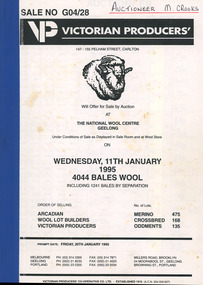
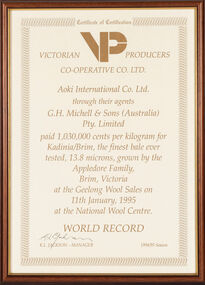
... CROOKS Front: [printed] SALE NO G04/28 / VICTORIAN PRODUCERS' / 147-155 PELHAM STREET, CARLTON / Will Offer for Sale by Auction / AT / THE NATIONAL WOOL CENTRE / GEELONG / Under Conditions of Sale as Displayed in Sale Room and at Wool Store / ON / WEDNESDAY, 11TH JANUARY / 1995 / 4044 BALES WOOL / INCLUDING 1241 BALES BY SEPARATION Bound paper booklet, approximately 35 pages, with printed and handwritten text. ...This sales catalogue was the one used by Auctioneer Michael Crooks on 11th January 1995 when the million dollar bale was sold at the National Wool Centre, Geelong. The wool was shorn from sheep of the Wyndarra and Rockbank bloodlines. A flock of 290 sheep were kept undercover at Kadinia, the property of the Appledore family from Brim in the Wimmera district of Victoria. Their record-breaking wool was produced by giving the sheep a special diet and providing each one with a UV-protective coat. Around 180 fleeces were selected for the million dollar bale. The sale of the first bale of wool measuring below 14 microns was held in the Auction Room here at the National Wool Museum. Bidding began at 40,000 (cents a kilogram) and steadily increased until there were only two bidders left. The bidders represented the Japanese firm Aoki International and Loro Piana of Italy. The hammer fell at 1,030,000 cents per kilogram, with Aoki International paying $1,194,800 for the 116kg bale. The fleece was scoured (cleaned) at the Goulburn Wool Scour, New South Wales. The degree of preparation and care taken with the task was extreme. The Scour closed production three days before and was extensively cleaned. On the day of scouring 12 tonnes of 17 micron wool was washed to condition the water, then nine bales of extra super fine wool, worth over $300,000 was washed as a trial run. Toabo Agaki Japan was employed to process the scoured wool into suit cloth. Taobo required the scoured wool to contain 0.5% residual grease, 12% moisture and a yield of 83kg. These requirements were met. The entire staff of the Scour wanted to be part of washing the best wool in the world. Without asking for payment both the night shift and afternoon shift crews assisted the day shift in the task. The bale was fed into the scour in seven minutes and fitted into three bowls, half the scour. It completely disappeared into the dryer and the last wool was fed before the first wool was out. The clean wool was hand-packed into cardboard cartons and freighted to Japan. Aoki International, based in Yokohama Japan, cut three suit lengths from the cloth, then blended the remaining wool into an exclusive line of commercially-available suits. These suits are labelled Kadinia.Bound paper booklet, approximately 35 pages, with printed and handwritten text.Front: [handwritten] AUCTIONEER M. CROOKS Front: [printed] SALE NO G04/28 / VICTORIAN PRODUCERS' / 147-155 PELHAM STREET, CARLTON / Will Offer for Sale by Auction / AT / THE NATIONAL WOOL CENTRE / GEELONG / Under Conditions of Sale as Displayed in Sale Room and at Wool Store / ON / WEDNESDAY, 11TH JANUARY / 1995 / 4044 BALES WOOL / INCLUDING 1241 BALES BY SEPARATIONmichael crooks, auctioneer, wool industry, million dollar bale, geelong, auction, kadinia, appledore, keith jackson, sale room, geelong wool centre -
 National Wool Museum
Booklet, 1947
... paper booklet with three metal staples on left side spine. Top of front cover has an image of a rams head above decorative text reading -Goldsbrough, / Mort / & Company Limited-. Address and services provided are also listed on font cover. Back cover shows an image of a warehouse and gives addresses of warehouse storage locations. Inside front and back covers have instructions and tips on using the booklet. There are several yellow pages upon which can be recorded the wool bale...Wool Sales Wool auctions Wool transportation Wool bales Mrs Robyn Adams Elder Smith Goldsbrough Mort Limited Dalgety and Company Limited Elder Smith Goldsbrough Mort Limited Goldsbrough, Mort and Company Limited Faded red/orange paper booklet with three metal staples on left side spine. ...Donated by Mrs Robyn Adams, daughter of Victor Clyde- a wool grower from North East Victoria. Mr CLyde would use this booklet to record the details of the wool bales which he sold through Goldsbrough Mort. The first yellow sheet in the booklet indicates that it was filled out in 1947.Faded red/orange paper booklet with three metal staples on left side spine. Top of front cover has an image of a rams head above decorative text reading -Goldsbrough, / Mort / & Company Limited-. Address and services provided are also listed on font cover. Back cover shows an image of a warehouse and gives addresses of warehouse storage locations. Inside front and back covers have instructions and tips on using the booklet. There are several yellow pages upon which can be recorded the wool bale details, transferred between pages with missing carbon paper. There is a loose, small white sheet of paper which displays an example of how the yellow sheets should be filled out.wool sales, wool auctions, wool transportation, wool bales, mrs robyn adams, elder smith goldsbrough mort limited, dalgety and company limited elder smith goldsbrough mort limited, goldsbrough, mort and company limited -
 National Wool Museum
Handbook, 1940
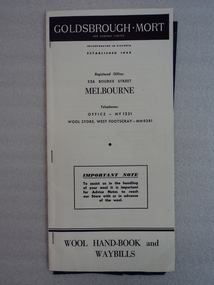
... Paper booklet bound with three staples on spine. White/off-white colour with dark blue text. Heading at the top reads -GOLDSBROUGH MORT / AND COMPANY LIMITED-. Text at the bottom of the page reads -WOOL HAND-BOOKS and / WAYBILLS-. Inside front cover and first two pags are notes on how to use the book and how to prepare a wool bale...Booklet is made up of pages with carbon paper copying, removable sheets upon which bale details can be described, coloured yellow and blue. ...Donated by Mrs Robyn Adams, daughter of booklet owner, a wool grower named Victor Clyde. Clyde operated in North-Eastern Victoria.Paper booklet bound with three staples on spine. White/off-white colour with dark blue text. Heading at the top reads -GOLDSBROUGH MORT / AND COMPANY LIMITED-. Text at the bottom of the page reads -WOOL HAND-BOOKS and / WAYBILLS-. Inside front cover and first two pags are notes on how to use the book and how to prepare a wool bale for transport. Booklet is made up of pages with carbon paper copying, removable sheets upon which bale details can be described, coloured yellow and blue. First yellow page has been filled in by owner. Inside back cover has list of things not to do when using booklet. Back cover has an image of the wool warehouse.mrs robyn adams, wool transport, wool auction, wool sales, wool growing, waybills, elder smith goldsbrough mort limited, dalgety and company limited elder smith goldsbrough mort limited, goldsbrough, mort and company limited -
 National Wool Museum
Waybill, 1940
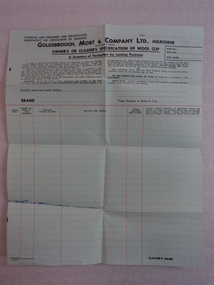
... paper page. Top part of page has typed black ink describing instructions on how to fill in lined section below, beneath headings reading -GOLSBROUGH, MORT & COMPANY LTD, MELBOUNRE- and -OWNER'S OR CLASSER'S SPECIFICATION OF WOOL CLIP-. Lower two-thirds of page is bordered with pink lines and split into six coloumns under headings. Fields can be filled in with information about wool lip/size/wiehgt/quality/bale...paper page. Top part of page has typed black ink describing instructions on how to fill in lined section below, beneath headings reading -GOLSBROUGH, MORT & COMPANY LTD, MELBOUNRE- and -OWNER'S OR CLASSER'S SPECIFICATION OF WOOL CLIP-. Lower two-thirds of page is bordered with pink lines and split into six coloumns under headings. Fields can be filled in with information about wool lip/size/wiehgt/quality/bale ...Part of a collection of items donated by Mrs Robyn Adams. Mrs Adams' father, Victor Clyde, was a wool grower who owned and used all of the items donated.Light pale blue/green lined paper page. Top part of page has typed black ink describing instructions on how to fill in lined section below, beneath headings reading -GOLSBROUGH, MORT & COMPANY LTD, MELBOUNRE- and -OWNER'S OR CLASSER'S SPECIFICATION OF WOOL CLIP-. Lower two-thirds of page is bordered with pink lines and split into six coloumns under headings. Fields can be filled in with information about wool lip/size/wiehgt/quality/bale stencil number/etc. Reverse of page is the same. Page has one vertical fold line in the centre and three horizontal fold lines. There is a dark blue line on the front and matching larger stain on the back, most likely from a carbon copy paper.elder smith goldsbrough mort limited, waybill, wool sales, wool clip, mrs robyn adams -
 National Wool Museum
Certificate
... Relates to Million Dollar Wool Bale on display in Gallery One Timber framed certificate with gold inlay and glass covering. Certificate is cream coloured paper with gold printed text and decorative boarder. ...Certificate commemorating The Geelong Wool Sales at the National Wool Centre 1995 durring which Aoki International paid 1,030,000 cents per kilogram for 13.8 micron wool. Wool was grown by the Appledore Family at Brim Victoria. Aoki International purchased the wool through their agets G.H. Michell & Sons (Australia) Pty. Ltd. Relates to Million Dollar Wool Bale on display in Gallery OneTimber framed certificate with gold inlay and glass covering. Certificate is cream coloured paper with gold printed text and decorative boarder. Hand Signed by K.L. Jackson on bottom left corner. Back of the frame has a horizontal hanging string -
 National Wool Museum
Document - Wool Auction Catalogue, Dalgety Farmers Limited, 1988
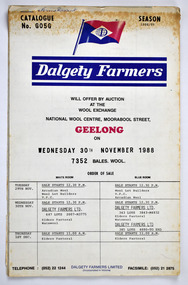
... G05’g / SEASON / 1988/89 / Dalgety Farmers / WILL OFFER BY AUCTION / AT THE / WOOL EXCHANGE / NATIONAL WOOL CENTRE, MOORABOOL STREET, / GEELONG / ON / WEDNESDAY 30TH NOVEMBER 1988 / 7352 BALES. WOOL. Nineteen page double sided paper catalogue held with one staple in the top left corner. ...Nineteen page double sided paper catalogue held with one staple in the top left corner. Pages are blue, yellow and white with black printed text. Cover shows printed text in blue, red, black and white with Dalgety Farmers banner and logo. front: [printed] CATALOGUE / No. G05’g / SEASON / 1988/89 / Dalgety Farmers / WILL OFFER BY AUCTION / AT THE / WOOL EXCHANGE / NATIONAL WOOL CENTRE, MOORABOOL STREET, / GEELONG / ON / WEDNESDAY 30TH NOVEMBER 1988 / 7352 BALES. WOOL.agriculture, wool, sales, dalgety, geelong, wool exchange, national wool centre, auction, catalogue -
 National Wool Museum
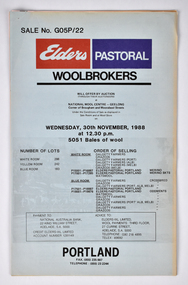
Archive - Wool Auction Catalogue, Elders Limited, 1988
... . / 5051 Bales of wool Nine page double sided paper catalogue held with one staple in the top left corner. ...Nine page double sided paper catalogue held with one staple in the top left corner. Pages are blue, yellow and white with black printed text. Cover shows printed text in blue, red and black with Elders logo banner.SALE No. G05P/22 / Eldres PASTORAL / WOOLBROKERS / WILL OFFER BY AUCTION / (THROUGH THEIR AUCTIONEERS / at / NATIONAL WOOL CENTRE – GEELONG / Corner of Brougham and Moorabool Streets / Under the Conditions of Sale as displayed in / Sale Room and at Wool Store / on / WEDNESDAY, 30th NOVEMBER, 1988 / at 12.30 p.m. / 5051 Bales of woolwool auction, catalogue, wool bales, sale, wool growing, agriculture, industry, geelong, elders, woolbrokers -
 National Wool Museum
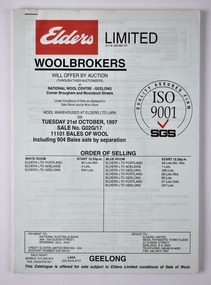
Archive - Wool Auction Catalogue, Elders Limited, 1997
... Wool Auction Catalogue Wool Bales Sale Wool Growing Agriculture Industry Geelong Elders Woolbrokers Elders / LIMITED / A.C.N. 004 045 121 / WOOLBROKERS / WILL OFFER BY AUCTION 300 page double sided paper catalogue held with one staple in the top left corner. ...Catalogue of wool sales at the National Wool Centre Geelong on Tuesday 21st October 1997. 300 page double sided paper catalogue held with one staple in the top left corner. Pages are white with black printed text. Cover is blue and shows printed text in red and black with Elders logo banner.Elders / LIMITED / A.C.N. 004 045 121 / WOOLBROKERS / WILL OFFER BY AUCTIONwool auction, catalogue, wool bales, sale, wool growing, agriculture, industry, geelong, elders, woolbrokers -
 Ararat Gallery TAMA
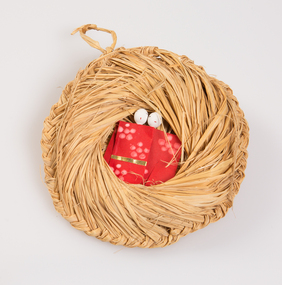
Sandawara Ningyo, c. 1900s
... bales in which rice is packed for the market. It is interesting, nevertheless, for its clever use of such a cheap and common material, and there is no denying its charm. The two dolls, made of paper...bales in which rice is packed for the market. It is interesting, nevertheless, for its clever use of such a cheap and common material, and there is no denying its charm. The two dolls, made of paper ...‘The Art of the Japanese Package’ was an exhibition that toured to 10 Australian and 11 New Zealand public galleries in 1979 and 1980. The touring exhibition comprised 221 objects of traditional Japanese packaging which extended from ceramics, wood and paper to woven fibre containers. At the conclusion of the tour, The Japan Foundation and the Crafts Board of the Australia Council donated the vast majority of the exhibition to the Ararat Gallery for its permanent collection. Combining the natural qualities of bamboo, paper and straw with delicate craftsmanship, these unique objects express Japanese aesthetics as applied through fibre crafts. In Japan, the qualities and traits of natural materials are exploited rather than hidden. The texture of straw, the septa of bamboo are not concealed but lovingly incorporated into the whole. In 1979 Hideyuki Oka, curator of ‘The Art of the Japanese Package’ wrote: “In no way self-conscious or assertive, these wrappings have an artless and obedient air that greatly moves the modern viewer. They are whispered evidence of the Japanese ability to create beauty from the simplest products of nature. They also teach us that wisdom and feeling are especially important in packaging because these qualities, or the lack of them, are almost immediately apparent. What is the use of a package if it shows no feeling?” The descriptions of the featured objects were written by Hideyuki Oka, curator of ‘The Art of the Japanese Package’, 1979.Gift of the Japan-Australia Foundation and the Crafts Board of the Australia Council, 1981This toy is a product of Tottori City, and its only connection with traditional packaging is that it copies the mats used to close the straw bales in which rice is packed for the market. It is interesting, nevertheless, for its clever use of such a cheap and common material, and there is no denying its charm. The two dolls, made of paper and wood, represent the emperor and empress who occupy the chief places in the traditional Doll Festival display. - Professor Hideyuki Oka, curator.japanese art, japanese packaging, tsutsumi, gift giving -
 Ararat Gallery TAMA
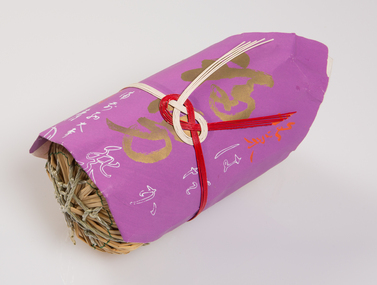
Miniature rice bale, c. 1900s
... Miniature copies of old-style rice bales are fashioned of reed (and tied with the same material) to serve as packages for sweets from the city of Saidaiji, near Okayama City. The material is appropriate, for Okayama is famous as a source of reed for making the floor mats called tatami. The handsome label, made of dyed paper...The descriptions of the featured objects were written by Hideyuki Oka, curator of ‘The Art of the Japanese Package’, 1979. japanese art japanese packaging tsutsumi gift giving Miniature copies of old-style rice bales are fashioned of reed (and tied with the same material) to serve as packages for sweets from the city of Saidaiji, near Okayama City. The material is appropriate, for Okayama is famous as a source of reed for making the floor mats called tatami. The handsome label, made of dyed paper ...‘The Art of the Japanese Package’ was an exhibition that toured to 10 Australian and 11 New Zealand public galleries in 1979 and 1980. The touring exhibition comprised 221 objects of traditional Japanese packaging which extended from ceramics, wood and paper to woven fibre containers. At the conclusion of the tour, The Japan Foundation and the Crafts Board of the Australia Council donated the vast majority of the exhibition to the Ararat Gallery for its permanent collection. Combining the natural qualities of bamboo, paper and straw with delicate craftsmanship, these unique objects express Japanese aesthetics as applied through fibre crafts. In Japan, the qualities and traits of natural materials are exploited rather than hidden. The texture of straw, the septa of bamboo are not concealed but lovingly incorporated into the whole. In 1979 Hideyuki Oka, curator of ‘The Art of the Japanese Package’ wrote: “In no way self-conscious or assertive, these wrappings have an artless and obedient air that greatly moves the modern viewer. They are whispered evidence of the Japanese ability to create beauty from the simplest products of nature. They also teach us that wisdom and feeling are especially important in packaging because these qualities, or the lack of them, are almost immediately apparent. What is the use of a package if it shows no feeling?” The descriptions of the featured objects were written by Hideyuki Oka, curator of ‘The Art of the Japanese Package’, 1979.Gift of the Japan-Australia Foundation and the Crafts Board of the Australia Council, 1981Miniature copies of old-style rice bales are fashioned of reed (and tied with the same material) to serve as packages for sweets from the city of Saidaiji, near Okayama City. The material is appropriate, for Okayama is famous as a source of reed for making the floor mats called tatami. The handsome label, made of dyed paper, is fastened to the package with mizuhiki, the cords traditionally tied around ceremonial gifts. - Professor Hideyuki Oka, curator.japanese art, japanese packaging, tsutsumi, gift giving -
 Ringwood RSL Sub-Branch
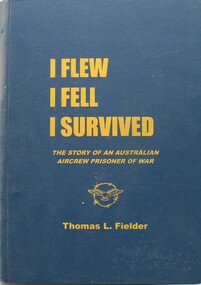
Book - RAAF WW2, I Flew I Fell I Survived. Story of an Australia Aircrew Prisoner of War, 2001
... Baled out from a Wellington Bomber over Italy and spent the rest of the War as a prisoner of the Germans. Hard Carboard outer, Paper, Text and Pictures. 393 pages. ...Baled out from a Wellington Bomber over Italy and spent the rest of the War as a prisoner of the Germans. Hard Carboard outer, Paper, Text and Pictures. 393 pages. ...Self published by Tom Fielder ex RAAF. Baled out from a Wellington Bomber over Italy and spent the rest of the War as a prisoner of the Germans. Hard Carboard outer, Paper, Text and Pictures. 393 pages. Tom Fielder CollectionEx P.O.W 270030. Stalag IVB, Germany, Muhlberg. -
 Mont De Lancey
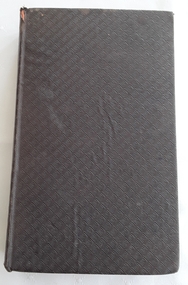
Book, Jean-Rodolphe Ostervald, La Nourriture De L'ame, ou Recueil De Prieres which translates to - The Food for the Soul or Collection of Prayers, 1833
... Bale. There is a drawing on the frontispiece of Jesus talking to men. At the back is a Table of Contents. Some pencil markings inside, foxing and tanning. There are two bookmarks included - One has Federal printed on it in red lettering with a rising sun pattern at each end with a French handwritten message written on the front and back. Another paper...Bale. There is a drawing on the frontispiece of Jesus talking to men. At the back is a Table of Contents. Some pencil markings inside, foxing and tanning. There are two bookmarks included - One has Federal printed on it in red lettering with a rising sun pattern at each end with a French handwritten message written on the front and back. Another paper ...Food for the Soul - a collection of prayers for every day of the week and for the main holidays of the week.This is a plain brown book with small diagonal squares pattern on the covers. La Nourriture De L'ame, ou Recueil De Prieres pour les Principales Fetes de L'annee which translates to - The Food for the Soul or Collection of Prayers for the Main Holidays of the Week. The author is Jean- Rodolphe Ostervald, pastor of the French Church of Bale. There is a drawing on the frontispiece of Jesus talking to men. At the back is a Table of Contents. Some pencil markings inside, foxing and tanning. There are two bookmarks included - One has Federal printed on it in red lettering with a rising sun pattern at each end with a French handwritten message written on the front and back. Another paper used as a bookmark has Y Foy and Gibson, Melbourne. 545p.non-fictionFood for the Soul - a collection of prayers for every day of the week and for the main holidays of the week. religion, prayers -
 Kew Historical Society Inc
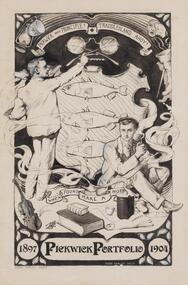
Work on paper, Pickwick Portfolio 1897-1904
... Frontispiece, created in watercolour and ink on artist's paper, for the first edition of the Pickwick Portfolio of 1904 by the Kew Pickwick Club. Signed lower left by Mark Tapley, the pseudonym within the Club of the artist A.M.E. Bale...Bale. Pickwick Portfolio 1897-1904 Work on paper ...The Pickwick Club of Kew was founded by local residents in 1897. In 1904 it produced its first publication - Pickwick Portfolio Vol.1 No.1 - for which the local artist and member Alice Marion Ellen Bale (1875-1955) designed this frontispiece. The frontispiece was printed in Volume 1/1 and adapted for Vol.1/2 in 1912. Each member of the Club adopted a pseudonym from a work by Charles Dickens. Alice Bale is recorded in the 1912 edition as using the name Mark Tapley, a character in Martin Chuzzlewit (Dickens, 1842). Gift of the Friends of the KHS Collection, 2022Frontispiece, created in watercolour and ink on artist's paper, for the first edition of the Pickwick Portfolio of 1904 by the Kew Pickwick Club. Signed lower left by Mark Tapley, the pseudonym within the Club of the artist A.M.E. Bale.Lower left in pencil "Mark Tapley" (pseudonym). Initials above to the right AMEB (Alice ME Bale)a m e bale, pickwick clubs, pickwick club of kew -
 Whitehorse Historical Society Inc.
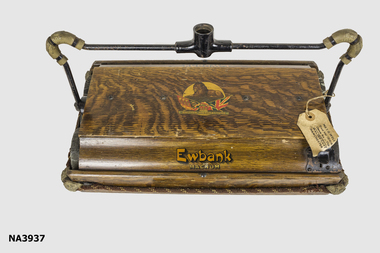
Machine - Carpet Sweeper
... Balal roller between wheels is painted gold with 'Ewbank Patent Ball Bearing - 23610 1902 18397 1904. Metal lever for dropping pans has Press Slide etched on. Instructions underneath on paper...Balal roller between wheels is painted gold with 'Ewbank Patent Ball Bearing - 23610 1902 18397 1904. Metal lever for dropping pans has Press Slide etched on. Instructions underneath on paper ...Carpet sweeper with wooden casing enclosing brush rollers. Four metal wheels with rubber covers and attached wooden handle. Metal handle with rubber bumpers with 'Ewbank Patent No. 183576 1920s logo on top of lion on wooden base with crossed flags behind crown and sign British Manufacture. Front and back have 'Ewbank Magnum' on case. Bumper is cord with rubber at corners with 'Ewbank 1925 Patent No. 34357 written on it. Balal roller between wheels is painted gold with 'Ewbank Patent Ball Bearing - 23610 1902 18397 1904. Metal lever for dropping pans has Press Slide etched on. Instructions underneath on paper labelsAs abovedomestic items, cleaning
