
Showing 105 items matching "band trousers"
-
 Bendigo Historical Society Inc.
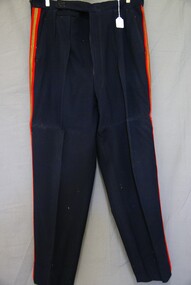
Clothing - MARONG MUNICIPAL (?) BRASS BAND TROUSERS, Late 1900's-2000
... MARONG MUNICIPAL (?) BRASS BAND TROUSERS......band trousers...Clothing MARONG MUNICIPAL (?) BRASS BAND TROUSERS ...Clothing. Men's pure wool trousers with a full length stripe - waist to ankle, 3cm wide (red) 1.3 cm gold metallic ribbon (stitched on top of red). Fob pocket at waistline. Side pockets on either side. Two pleats on either side of front. Metal zip fly 29 cms ;long. Adjustable waistband lined with cream coloured cotton buttons on inside to accomodate braces. One bound pocket with button closure, on back right hand side.No brand names visible. ''Andrews'' written in pencil on inside of back pocket- possibly the wearer.costume, male ceremonial, band trousers -
 Bendigo Historical Society Inc.
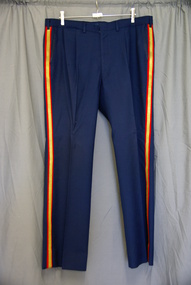
Clothing - MEN'S TROUSERS - MARONG MUNICIPAL BAND UNIFORM, 1980's - 1982
... MEN'S TROUSERS - MARONG MUNICIPAL BAND UNIFORM...marong municipal band uniform trousers...COSTUME Male ceremonial marong municipal band uniform trousers AGCF 1982 (Australian Government Clothing Factory). ...Clothing. Single knife pleat on either side of front waistband, 20 cms deep fly front, with plastic zip, and metal fastener on waistband. Also evidence of an internal front tab fastening with cotton stitched button hole, but button is missing. Two side pockets sewn into side seams, and two bound pockets on either side of back -all polyester or nylon fabric. Seven 1 cm belt loops around waistband. A 3 cm wide strip of red flannel is stitched from waistband to hem on the outer side of each leg. This is over laid with a 1.2cm wide gold metal thread, decorative weave braid.AGCF 1982 (Australian Government Clothing Factory).costume, male ceremonial, marong municipal band uniform trousers -
 Port Melbourne Historical & Preservation Society
Clothing - Trousers, Port Melbourne Municipal Band, 1940s
... Trousers, Port Melbourne Municipal Band...Port Melbourne Municipal Band uniform: black trousers with vertical red stripe...Societies Clubs Unions and other Organisations Arts and entertainment - music Port Melbourne Municipal Band Port Melbourne Municipal Band uniform: black trousers with vertical red stripe Clothing Trousers, Port Melbourne Municipal Band ...Port Melbourne Municipal Band uniform: black trousers with vertical red stripesocieties clubs unions and other organisations, arts and entertainment - music, port melbourne municipal band -
 Warrnambool RSL Sub Branch
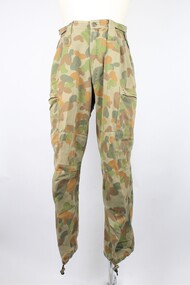
Trousers, Australian Defence Apparel, 2015
... Label on interior front right of trousers reads: “A13/ADA/VICTORIA 2008/(broad arrow)/SPECIFICATION ARMY (AUST)6542/NSN: 8415 66 152 1059/SIZE: 95 S/NAME/SERVICE NO/75% COTTON 25% POLYESTER/WARM MACHINE WASH 40*C/RINSE WELL, WARM IRON/DO NOT IRON OVER HOOK AND PILE/DO NOT BLEACH/DO NOT STARCH/MAY BE TUMBLE DRY 40*C/MADE IN AUSTRALIA” The name “FARLEY” is also handwritten on the back interior waist band of the trousers. ...As a set, the uniform has aesthetic significance in it’s design, incorporating the Disruptive Pattern style of camouflage which has its roots in the 1980s and continues to be adapted into uniform design by the Defence Force. camouflage general purpose uniform airforce uniform australian defence force Label on interior front right of trousers reads: “A13/ADA/VICTORIA 2008/(broad arrow)/SPECIFICATION ARMY (AUST)6542/NSN: 8415 66 152 1059/SIZE: 95 S/NAME/SERVICE NO/75% COTTON 25% POLYESTER/WARM MACHINE WASH 40*C/RINSE WELL, WARM IRON/DO NOT IRON OVER HOOK AND PILE/DO NOT BLEACH/DO NOT STARCH/MAY BE TUMBLE DRY 40*C/MADE IN AUSTRALIA” The name “FARLEY” is also handwritten on the back interior waist band of the trousers. ...These trousers are part of a Disruptive Pattern Combat Uniform issued by the Australian Airforce to Bernard Farley during service. This uniform type was used in base and field activities and was replaced in 2014 by the General Purpose Uniform as the uniform worn during general base duties and in non-warlike environments.This item has social significance, as an item of uniform worn by Warrnambool RSL community member and Secretary (2019), Bernard Farley during service with the Australian Airforce. The item is a representative example of previously standard issue Airforce uniform and is in excellent condition. As a set, the uniform has aesthetic significance in it’s design, incorporating the Disruptive Pattern style of camouflage which has its roots in the 1980s and continues to be adapted into uniform design by the Defence Force.Disruptive Pattern trousers in five colours of green and brown. Long pants with elasticised drawstring fastener at ankle and velcro adjustment fasteners at the waist. Pants take a straight leg style and bears several pockets: two thigh level pockets with zippered horizontal opening, two open hip pockets on the front, one open pocket on the reverse right hand side with blue plastic button fastener. Five large belt loops encircle the waist and there is a zippered fly, secured at the top with a blue plastic button.Label on interior front right of trousers reads: “A13/ADA/VICTORIA 2008/(broad arrow)/SPECIFICATION ARMY (AUST)6542/NSN: 8415 66 152 1059/SIZE: 95 S/NAME/SERVICE NO/75% COTTON 25% POLYESTER/WARM MACHINE WASH 40*C/RINSE WELL, WARM IRON/DO NOT IRON OVER HOOK AND PILE/DO NOT BLEACH/DO NOT STARCH/MAY BE TUMBLE DRY 40*C/MADE IN AUSTRALIA” The name “FARLEY” is also handwritten on the back interior waist band of the trousers. camouflage, general purpose uniform, airforce, uniform, australian defence force -
 Bendigo Historical Society Inc.
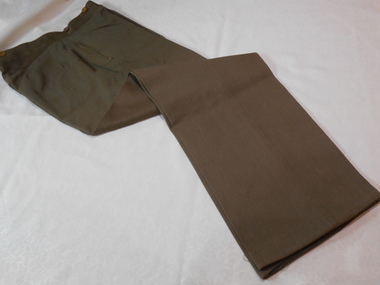
Clothing - JOHN KENNETH MARTIN COLLECTION:ARMY WW2 UNIFORM TROUSERS, 1939-1945
... trousers. Side pockets lined with cream coloured cotton fabric. Front fly opening (27 cm) fastened with six 1.5 cm plastic brown buttons. Four 1.8 cm brown plastic buttons across outside on either side of the centre back of waist band, to fasten braces. ...trousers. Side pockets lined with cream coloured cotton fabric. Front fly opening (27 cm) fastened with six 1.5 cm plastic brown buttons. Four 1.8 cm brown plastic buttons across outside on either side of the centre back of waist band, to fasten braces. ...Clothing, khaki coloured WW2 army uniform trousers. Side pockets lined with cream coloured cotton fabric. Front fly opening (27 cm) fastened with six 1.5 cm plastic brown buttons. Four 1.8 cm brown plastic buttons across outside on either side of the centre back of waist band, to fasten braces. Trousers belonged to John Kenneth Martin, padre in 2nd Australian Corps AIF. Served overseas as a Chaplain from 1940-1945. Old box 314Y.Name tag stitched inside waist band at back ''J.K.Martin''.costume, military, army uniform trousers ww2 -
 Bendigo Military Museum
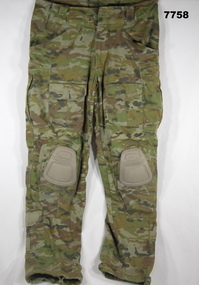
Uniform - TROUSERS - COMBAT DRESS, ARMY, Australian Defence Industries, 2019
... Nylon and metal zipper. Trousers - waist band with belt loops, two front pockets, two large side pockets with zipper closure, two small lower pockets with hook and pile flap closure, zipper fly. ...Nylon and metal zipper. Trousers - waist band with belt loops, two front pockets, two large side pockets with zipper closure, two small lower pockets with hook and pile flap closure, zipper fly. green cotton fabric pocket lining. ...AMCU (Australian Multi Camouflage Uniform) Combat Dress colours - light to dark green through to mid to dark brown. Cotton/polyester fabric. Green colour plastic button. Nylon and metal zipper. Trousers - waist band with belt loops, two front pockets, two large side pockets with zipper closure, two small lower pockets with hook and pile flap closure, zipper fly. green cotton fabric pocket lining. At ankle - elastic drawstring with plastic lock clip. White colour polyester fabric manufacturers label on right pocket lining. Light khaki colour plastic knee pads insitu. Manufacturers information on label - black ink print. "ADA/ MADE IN AUSTRALIA/ FED 2019/ PO: CC3623/ NSN: 84155 66 161 6287/ SIZE 32R ( 79-84 cm/ ^/ NAME:/ PM KEYS:/ MAIN: /75% COTTON/ 25% POLYESTER/ STRETCH:/ 91% NYLON 9% ELSATANE/ KNEE PAD MUST BE/ REMOVED BEFORE/ CLEANING HOT MACHINE/ WASH, NO BLEACH/ NO FABRIC SOFTENERS/ MAY BE TUMBLE DRIED HOT/ DO NOT IRON OVER STRETCH PANELS/ OR HOOK AND PILE".uniform, army, combat dress, amcu -
 Bendigo Military Museum
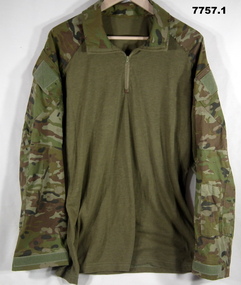
Uniform - SHIRT, TROUSERS - COMBAT DRESS ARMY, Australian Defence Industries, 2018
... No manufacturers label. 2. Trousers - waist band with belt loops, two front pockets, two large side pockets with zipper closure, two small pockets with hook and pile flap closure, zipper fly. ...No manufacturers label. 2. Trousers - waist band with belt loops, two front pockets, two large side pockets with zipper closure, two small pockets with hook and pile flap closure, zipper fly. ...AMCU (Australia Multi Camouflage Uniform) Combat Dress colours - light to dark green through to mid to dark brown. Cotton/polyester fabric. Green colour plastic buttons. Nylon and metal zippers. 1. Shirt - polo style, with collar, long sleeves with adjustable velcro and strap at cuff. Two large sleeve pockets with hook and pile closure flaps, one small pocket left sleeve. Half zipper closure. Front and back of shirt - plain khaki colour knit fabric. No manufacturers label. 2. Trousers - waist band with belt loops, two front pockets, two large side pockets with zipper closure, two small pockets with hook and pile flap closure, zipper fly. White colour polyester fabric manufacturers label on right pocket lining. Green cotton fabric pocket lining. At ankle - elastic drawstring with plastic lock clip.Manufacturers information on label - black ink print. 2. "ADA/ MADE IN AUSTRALIA/ NOV 2018/ PO: CC36LD/ NSN:8415 66 161 6292/ SIZE: 34l/ 84-89 cm/^/ NAME/ PM KEYS NO:/ MAIN:/ 75% COTON/ 25% POLYESTER/ STRETCH/ 91% NYLON 9% ELASTANE/ KNEE PADS MUST BE REMOVED BEFORE/ CLEANING. HOT MACHINE/WASH. NO BLEACH/ NO FABRIC SOFTENERS/ MAY BE TUMBLE DRIED HOT/ DO NOT IRON OVER/ STRETCH PANELS OR HOOK AND PILE" .uniform, army, combat dress, amcu -
 Bendigo Military Museum
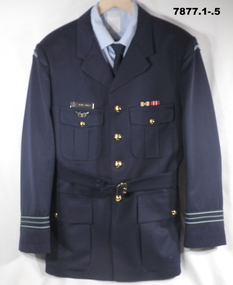
Uniform - SERVICE DRESS, RAAF, 2003
... Belt - fabric with gold colour plastic buckle with dark blue plastic buttons and strap belt keepers. 3. Trousers - waist band with belt loops, fob pocket, two side pocket and one inset back pocket. ...Belt - fabric with gold colour plastic buckle with dark blue plastic buttons and strap belt keepers. 3. Trousers - waist band with belt loops, fob pocket, two side pocket and one inset back pocket. ...Items in the collection of SQD LEADER "SHANE WRIGHT". Enlisted RAAF 1982 Regiment number 0323963/ 8194842. Became radio technician on Electrical systems on Orion and F111. 1990 became Electrical Systems Specialist promoted to Sgt. 1996 Commissioned as an Officer. Postings: HQ Logistic Command. Aerospace Equipment Systems. OTS as Specialist Military Training Flight Command. 2005 Promoted Sqn Leader. Posted Executive Officer RAAF Williamtown. 2018 Discharged from RAAF.1. 2. 3. Service dress style, dark blue colour wool/polyester fabric. 1. Jacket - collar, four front patch pockets with button down flap. Buttons - gold colour plastic with shank and raised emblem - crown and wings - RAAF. On right pocket, metal RAAF Badge, above metal name badge. Above left pocket - service ribbons. Blue and yellow ribbon - long service with three rosettes, black, red, white ribbon - Defence medal. Sleeves - three rank stripes, black and blue ribbon. Lining - dark blue polyester fabric with concealed pocket. White colour cotton/polyester fabric. Manufacturers label inside left side. 2. Belt - fabric with gold colour plastic buckle with dark blue plastic buttons and strap belt keepers. 3. Trousers - waist band with belt loops, fob pocket, two side pocket and one inset back pocket. Nylon and metal zipper fly and metal closer. Lining - dark blue polyester fabric to waistband and pockets. White colour cotton/polyester fabric. Manufacturers label on back pocket lining.. 4. Shirt - light blue cotton/polyester fabric. Long sleeves, collar, shoulder epaulettes with fabric rank slides - 3 stripes, black and blue ribbon - Sqdn Leader. Top left sleeve - dark blue and white oval shoulder patch, embroidered - wings and "AIR FORCE". Clear plastic buttons. Manufacturers label - illegible. 5. Tie - dark blue colour necktie. polyester/wool. 6. Cap - peaked, Service dress Officer, dark blue colour fabric with black cloth band around exterior of cap. Black colour patent leather chinstrap secured by two gold RAAF buttons around the front half of the brim. RAAF badge on front, Queens Crown with red insert over gold coloured wings over laurel leaves. Interior - black sateen fabric with clear plastic lining. Brown leather look sweatband, White cotton manufacturers label.Manufacturers information - black ink print. 1. "A73/ADA/VICTORIA 2003/ NSN:/ NAME: / SERVICE NO:/ 70% WOOL, 30% POLYESTER/ LAUNDRY INSTRUCTIONS/ DRY CLEAN ONLY/ PRESS ON ORIGINAL CREASES/ USE DAMP CLOTH OR MEDIUM/ TO HOT STEAM IRON/ MADE IN AUSTRALIA" 3. "A72/ADA/ VICTORIA 2003/ NSN:/ NAME: SERVICE NO:/ 70% WOOL 30% POLYESTER/ DRY CLEAN ONLY/ MADE IN AUSTRALIA" 1. 3. Handwritten blue/black ink "S. WRIGHT/ 40594" 5. Black label white embroidered print "NOONE/ IMAGE WEAR/ MADE IN / AUSTRALIA/ 2002" 6. "MOUNT CASTLE PTY LTD/ BRISBANE 1999/ SIZE 59^". Handwritten black ink "S. WRIGHT"uniforms, raaf, service dress, shane wright -
 Federation University Historical Collection
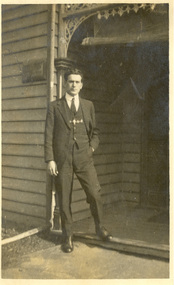
Photograph - Photograph - black and white, Lin Jenkins, Frank Wright at Doveton Street South, Ballarat, 23/07/1921
... Band Championships around Europe, in Australia, including South Street and in New Zealand. The Frank Wright Medal at the Royal South Street competition is awarded to an individual recognized as making an outstanding contribution to brass music in Australia. frank wright lin jenkins timber house wrought iron ballarat Handwritten on the back - Frank Wright, at the age of 19 years taken at 118 Doveton St Sth, Ballarat, by Lin Jenkins, 23-7-1921 Black and white photograph of a man with one hand in the pocket of his suit trousers, standing before the front porch of a timber house. ...Frank Wright was a renown resident of Smeaton, where he was born. He lived at Laura Villa, and attended Smeaton State School. His father William was a gold miner and his mother's name was Sarah. Their family won many singing and instrumental awards. Frank was tutored by Percy Code and became the Australian Open Cornet Champion by the age of eighteen. A year later, Frank conducted the City of Ballarat Band, and later the Ballarat Soldiers’ Memorial Band. He formed the Frank Wright Frisco Band and Frank Wright and his Coliseum Orchestra. These bands won many South Street awards, and Frank as conductor won many awards in the Australian Band Championship contest. In 1933 Frank Wright sailed to England to conduct the famous St Hilda’s Band and was later appointed Musical Director of the London County Council, where he organized many amazing concerts in parks, in and around the London district. He was made Professor of Brass and Military Band Scoring and conducted at the Guildhall of Music and Drama. Frank was often invited to adjudicate Brass Band Championships around Europe, in Australia, including South Street and in New Zealand. The Frank Wright Medal at the Royal South Street competition is awarded to an individual recognized as making an outstanding contribution to brass music in Australia.Black and white photograph of a man with one hand in the pocket of his suit trousers, standing before the front porch of a timber house. There is some wrought iron over the entrance to the porch. The man is Frank Wright and the house is at 118 Doveton Street South, Ballarat.Handwritten on the back - Frank Wright, at the age of 19 years taken at 118 Doveton St Sth, Ballarat, by Lin Jenkins, 23-7-1921frank wright, lin jenkins, timber house, wrought iron, ballarat -
 Federation University Historical Collection
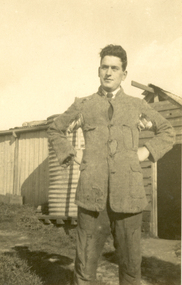
Photograph - Photograph - Black and White, Vernon Holt, Frank Wright at Smeaton (possibly at Sewell's), 1/8/1922
... Band Championships around Europe, in Australia, including South Street and in New Zealand. The Frank Wright Medal at the Royal South Street competition is awarded to an individual recognized as making an outstanding contribution to brass music in Australia frank wright ballarat cornet conductor smeaton vernon holt .1) Printed on back - Post Card, Kodak, Australia .2) Written in pen on back - Frank Wright, Smeaton, 1/8/22, Photo by Vernon Holt Two different sized identical black and white photographs of a man dressed in ragged jacket and trousers, standing with his hands on his hips. ...Frank Wright was a renown resident of Smeaton, where he was born. He lived at Laura Villa, and attended Smeaton State School. His father William was a gold miner and his mother's name was Sarah. Their family won many singing and instrumental awards. Frank was tutored by Percy Code and was awarded a gold medal for the highest marks in the ALCM examinations in the British Colonies at the age of seventeen years. He became the Australian Open Cornet Champion by the age of eighteen. A year later, Frank conducted the City of Ballarat Band, and later the Ballarat Soldiers’ Memorial Band. He formed the Frank Wright Frisco Band and Frank Wright and his Coliseum Orchestra. These bands won many South Street awards, and Frank as conductor won many awards in the Australian Band Championship contest. In 1933 Frank Wright sailed to England to conduct the famous St Hilda’s Band and was later appointed Musical Director of the London County Council, where he organized many amazing concerts in parks, in and around the London district. He was made Professor of Brass and Military Band Scoring and conducted at the Guildhall of Music and Drama. Frank was often invited to adjudicate Brass Band Championships around Europe, in Australia, including South Street and in New Zealand. The Frank Wright Medal at the Royal South Street competition is awarded to an individual recognized as making an outstanding contribution to brass music in AustraliaTwo different sized identical black and white photographs of a man dressed in ragged jacket and trousers, standing with his hands on his hips. In the background are farm buildings and a water tank.The man is Frank Wright and the place is Smeaton. .1) postcard sized photograph .2) small photograph.1) Printed on back - Post Card, Kodak, Australia .2) Written in pen on back - Frank Wright, Smeaton, 1/8/22, Photo by Vernon Holtfrank wright, ballarat, cornet, conductor, smeaton, vernon holt -
 Federation University Historical Collection
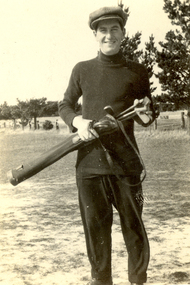
Photograph - Black and White, Oliver Peacock, Frank Wright at the Ballarat Gold Links, 1921, 29/4/21
... Band Championships around Europe, in Australia, including South Street and in New Zealand. The Frank Wright Medal at the Royal South Street competition is awarded to an individual recognized as making an outstanding contribution to brass music in Australia. frank wright ballarat ballarat golf links cornet conductor Witten in pen on the back - Frank Wright, Ballarat Golf Links, 29/4/21, Oliver Peacock Black and white photograph of a man in a dark polo neck jumper and trousers wearing a cap and holding a set of golf clubs in a golf bag. ...Frank Wright was a renown resident of Smeaton, where he was born. He lived at Laura Villa, and attended Smeaton State School. His father William was a gold miner and his mother's name was Sarah. Their family won many singing and instrumental awards. Frank was tutored by Percy Code and was awarded a gold medal for the highest marks in the ALCM examinations in the British Colonies at the age of seventeen years. He became the Australian Open Cornet Champion by the age of eighteen. A year later, Frank conducted the City of Ballarat Band, and later the Ballarat Soldiers’ Memorial Band. He formed the Frank Wright Frisco Band and Frank Wright and his Coliseum Orchestra. These bands won many South Street awards, and Frank as conductor won many awards in the Australian Band Championship contest. In 1933 Frank Wright sailed to England to conduct the famous St Hilda’s Band and was later appointed Musical Director of the London County Council, where he organized many amazing concerts in parks, in and around the London district. He was made Professor of Brass and Military Band Scoring and conducted at the Guildhall of Music and Drama. Frank was often invited to adjudicate Brass Band Championships around Europe, in Australia, including South Street and in New Zealand. The Frank Wright Medal at the Royal South Street competition is awarded to an individual recognized as making an outstanding contribution to brass music in Australia.Black and white photograph of a man in a dark polo neck jumper and trousers wearing a cap and holding a set of golf clubs in a golf bag. The man is standing on patchy grass with a fence, paddock and trees in the background. The place is the Ballarat Golf Links.Witten in pen on the back - Frank Wright, Ballarat Golf Links, 29/4/21, Oliver Peacockfrank wright, ballarat, ballarat golf links, cornet, conductor -
 Federation University Historical Collection
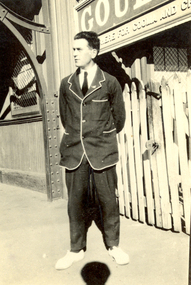
Photograph - Black and White, V. Holt, Frank Wright at Goulbourn Station, New South Wales, 1923
... Band Championships around Europe, in Australia, including South Street and in New Zealand. The Frank Wright Medal at the Royal South Street competition is awarded to an individual recognized as making an outstanding contribution to brass music in Australia. frank wright cornet conductor ballarat goulbourne railway station blazer Written in pen on the back - Frank Wright 21, on Goulbourne station N.S.W., Easter 1923 Black and white photograph of a man wearing trousers and a white trimmed blazer. ...Frank Wright was a renown resident of Smeaton, where he was born. He lived at Laura Villa, and attended Smeaton State School. His father William was a gold miner and his mother's name was Sarah. Their family won many singing and instrumental awards. Frank was tutored by Percy Code and was awarded a gold medal for the highest marks in the ALCM examinations in the British Colonies at the age of seventeen years. He became the Australian Open Cornet Champion by the age of eighteen. A year later, Frank conducted the City of Ballarat Band, and later the Ballarat Soldiers’ Memorial Band. He formed the Frank Wright Frisco Band and Frank Wright and his Coliseum Orchestra. These bands won many South Street awards, and Frank as conductor won many awards in the Australian Band Championship contest. In 1933 Frank Wright sailed to England to conduct the famous St Hilda’s Band and was later appointed Musical Director of the London County Council, where he organized many amazing concerts in parks, in and around the London district. He was made Professor of Brass and Military Band Scoring and conducted at the Guildhall of Music and Drama. Frank was often invited to adjudicate Brass Band Championships around Europe, in Australia, including South Street and in New Zealand. The Frank Wright Medal at the Royal South Street competition is awarded to an individual recognized as making an outstanding contribution to brass music in Australia.Black and white photograph of a man wearing trousers and a white trimmed blazer. He is standing on the platform at the Goulbourne railway station. The man is Frank Wright.Written in pen on the back - Frank Wright 21, on Goulbourne station N.S.W., Easter 1923frank wright, cornet, conductor, ballarat, goulbourne railway station, blazer -
 Federation University Historical Collection
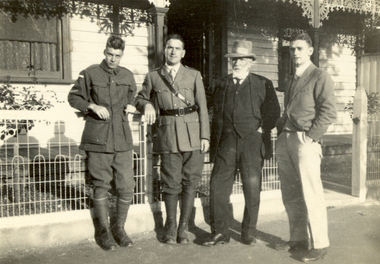
Frank and William Wright and friends, early 1930s
... The left hand man is dressed in a soldier's uniform, the middle, left hand man is dressed in the 71st Infantry Band uniform, the man to his right is an older man with a beard and dressed in a dark suit and the fouth man is dressed in a jacket and light trousers. ...The left hand man is dressed in a soldier's uniform, the middle, left hand man is dressed in the 71st Infantry Band uniform, the man to his right is an older man with a beard and dressed in a dark suit and the fouth man is dressed in a jacket and light trousers. ...Frank Wright was a renown resident of Smeaton, where he was born on 2 August 1901. He lived at Laura Villa, and attended Smeaton State School. His father William was a gold miner and his mother's name was Sarah. Their family won many singing and instrumental awards. Frank was tutored by Percy Code and was awarded a gold medal for the highest marks in the ALCM examinations in the British Colonies at the age of seventeen years. He became the Australian Open Cornet Champion by the age of eighteen. A year later, Frank conducted the City of Ballarat Band, and later the Ballarat Soldiers’ Memorial Band. He formed the Frank Wright Frisco Band and Frank Wright and his Coliseum Orchestra. These bands won many South Street awards, and Frank as conductor won many awards in the Australian Band Championship contest. In 1933 Frank Wright sailed to England to conduct the famous St Hilda’s Band and was later appointed Musical Director of the London County Council, where he organized many amazing concerts in parks, in and around the London district. He was made Professor of Brass and Military Band Scoring and conducted at the Guildhall of Music and Drama. Frank was often invited to adjudicate Brass Band Championships around Europe, in Australia, including South Street and in New Zealand. The Frank Wright Medal at the Royal South Street competition is awarded to an individual recognized as making an outstanding contribution to brass music in Australia.Black and white photograph of four men standing beside the fence of a weatherboard and lacework house. The left hand man is dressed in a soldier's uniform, the middle, left hand man is dressed in the 71st Infantry Band uniform, the man to his right is an older man with a beard and dressed in a dark suit and the fouth man is dressed in a jacket and light trousers. The middle, left hand man is Frank Wright and the man to his right is his father William Wright.frank wright, william wright, 71st infantry band -
 Federation University Historical Collection
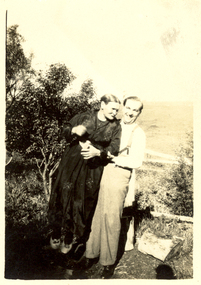
Photograph - Black and White, Scott's, Sarah and Alex? Wright (at Sewell's?), circa 1930
... Band Championships around Europe, in Australia, including South Street and in New Zealand. The Frank Wright Medal at the Royal South Street competition is awarded to an individual recognized as making an outstanding contribution to brass music in Australia. sarah wright alex wright frank wright navarre smeaton ballarat Printed on back - Printed at Scott's, Velox Black and white photograph of a man in shirt, trousers and braces hugging a woman in a dark frock. ...Alex Wright travelled to England in 1930 and was known as the Prince of Mimic although his stage name was Navarre. He died in an air raid in the Hippodrome Birmingham in 1940. Alex was the brother of Frank Wright who was a renown resident of Smeaton, where he was born. He lived at Laura Villa, and attended Smeaton State School. His father William was a gold miner and his mother's name was Sarah. Their family won many singing and instrumental awards. Frank was tutored by Percy Code and was awarded a gold medal for the highest marks in the ALCM examinations in the British Colonies at the age of seventeen years. He became the Australian Open Cornet Champion by the age of eighteen. A year later, Frank conducted the City of Ballarat Band, and later the Ballarat Soldiers’ Memorial Band. He formed the Frank Wright Frisco Band and Frank Wright and his Coliseum Orchestra. These bands won many South Street awards, and Frank as conductor won many awards in the Australian Band Championship contest. In 1933 Frank Wright sailed to England to conduct the famous St Hilda’s Band and was later appointed Musical Director of the London County Council, where he organized many amazing concerts in parks, in and around the London district. He was made Professor of Brass and Military Band Scoring and conducted at the Guildhall of Music and Drama. Frank was often invited to adjudicate Brass Band Championships around Europe, in Australia, including South Street and in New Zealand. The Frank Wright Medal at the Royal South Street competition is awarded to an individual recognized as making an outstanding contribution to brass music in Australia.Black and white photograph of a man in shirt, trousers and braces hugging a woman in a dark frock. They are standing in front of a fence with trees and a paddock in the background. They are Sarah Wright and her son Alex?.Printed on back - Printed at Scott's, Veloxsarah wright, alex wright, frank wright, navarre, smeaton, ballarat -
 Federation University Historical Collection
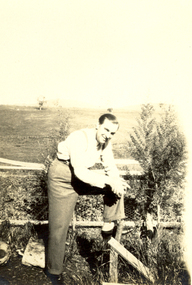
Photograph - Black and White, Scott's, Alex Wright?, circa 1930
... Band Championships around Europe, in Australia, including South Street and in New Zealand. The Frank Wright Medal at the Royal South Street competition is awarded to an individual recognized as making an outstanding contribution to brass music in Australia. alex wright. frank wright navarre smeaton ballarat Printed on back - Printed at Scott's, Velox Black and white photograph of a standing man, leaning his elbow onto his leg which is resting on a fence rail. He is dressed in shirt, trousers ...Alex Wright travelled to England in 1930 and was known as the Prince of Mimic although his stage name was Navarre. He died in an air raid in the Hippodrome Birmingham in 1940. Alex was the brother of Frank Wright who was a renown resident of Smeaton, where he was born. He lived at Laura Villa, and attended Smeaton State School. His father William was a gold miner and his mother's name was Sarah. Their family won many singing and instrumental awards. Frank was tutored by Percy Code and was awarded a gold medal for the highest marks in the ALCM examinations in the British Colonies at the age of seventeen years. He became the Australian Open Cornet Champion by the age of eighteen. A year later, Frank conducted the City of Ballarat Band, and later the Ballarat Soldiers’ Memorial Band. He formed the Frank Wright Frisco Band and Frank Wright and his Coliseum Orchestra. These bands won many South Street awards, and Frank as conductor won many awards in the Australian Band Championship contest. In 1933 Frank Wright sailed to England to conduct the famous St Hilda’s Band and was later appointed Musical Director of the London County Council, where he organized many amazing concerts in parks, in and around the London district. He was made Professor of Brass and Military Band Scoring and conducted at the Guildhall of Music and Drama. Frank was often invited to adjudicate Brass Band Championships around Europe, in Australia, including South Street and in New Zealand. The Frank Wright Medal at the Royal South Street competition is awarded to an individual recognized as making an outstanding contribution to brass music in Australia.Black and white photograph of a standing man, leaning his elbow onto his leg which is resting on a fence rail. He is dressed in shirt, trousers and braces. In the background is a grassy paddock. He is most probably Alex Wright.Printed on back - Printed at Scott's, Veloxalex wright. frank wright, navarre, smeaton, ballarat -
 Federation University Historical Collection
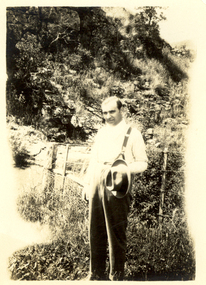
Photograph - Black and White, Scott's, Alex Wright?, circa 1930
... Band Championships around Europe, in Australia, including South Street and in New Zealand. The Frank Wright Medal at the Royal South Street competition is awarded to an individual recognized as making an outstanding contribution to brass music in Australia. alex wright. frank wright navarre smeaton ballarat Printed of back - Printed at Scott's, Velox Black and white photograph of a man in shirt, trousers and braces, holding a hat. ...Alex Wright travelled to England in 1930 and was known as the Prince of Mimic although his stage name was Navarre. He died in an air raid in the Hippodrome Birmingham in 1940. Alex was the brother of Frank Wright who was a renown resident of Smeaton, where he was born. He lived at Laura Villa, and attended Smeaton State School. His father William was a gold miner and his mother's name was Sarah. Their family won many singing and instrumental awards. Frank was tutored by Percy Code and was awarded a gold medal for the highest marks in the ALCM examinations in the British Colonies at the age of seventeen years. He became the Australian Open Cornet Champion by the age of eighteen. A year later, Frank conducted the City of Ballarat Band, and later the Ballarat Soldiers’ Memorial Band. He formed the Frank Wright Frisco Band and Frank Wright and his Coliseum Orchestra. These bands won many South Street awards, and Frank as conductor won many awards in the Australian Band Championship contest. In 1933 Frank Wright sailed to England to conduct the famous St Hilda’s Band and was later appointed Musical Director of the London County Council, where he organized many amazing concerts in parks, in and around the London district. He was made Professor of Brass and Military Band Scoring and conducted at the Guildhall of Music and Drama. Frank was often invited to adjudicate Brass Band Championships around Europe, in Australia, including South Street and in New Zealand. The Frank Wright Medal at the Royal South Street competition is awarded to an individual recognized as making an outstanding contribution to brass music in Australia.Black and white photograph of a man in shirt, trousers and braces, holding a hat. He is standing beside a fence with a rocky, scrubby hillside pictured behind. The man is most probably Alex Wright.Printed of back - Printed at Scott's, Veloxalex wright. frank wright, navarre, smeaton, ballarat -
 Federation University Historical Collection
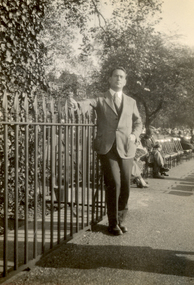
Photograph - Photograph - black and white, Frank Wright at Hyde Park, London, Oct. 1933, 10/1933
... The Frank Wright Medal at the Royal South Street competition is awarded to an individual recognized as making an outstanding contribution to brass music in Australia. frank wright brass bands conductor hyde park A black and white photo of Frank Wright leaning against a wrought iron fence at Hyde Park, London in October 1933. He is wearing a sports jacket and trousers ...Frank Wright was a renown resident of Smeaton, where he was born on 2 August 1901. He lived at Laura Villa, and attended Smeaton State School. His father William was a gold miner and his mother's name was Sarah. Their family won many singing and instrumental awards. Frank was tutored by Percy Code and was awarded a gold medal for the highest marks in the ALCM examinations in the British Colonies at the age of seventeen years. He became the Australian Open Cornet Champion by the age of eighteen. A year later, Frank conducted the City of Ballarat Band, and later the Ballarat Soldiers’ Memorial Band. He formed the Frank Wright Frisco Band and Frank Wright and his Coliseum Orchestra. These bands won many South Street awards, and Frank as conductor won many awards in the Australian Band Championship contest. In 1933 Frank Wright sailed to England to conduct the famous St Hilda’s Band and was later appointed Musical Director of the London County Council, where he organized many amazing concerts in parks, in and around the London district. He was made Professor of Brass and Military Band Scoring and conducted at the Guildhall of Music and Drama. Frank was often invited to adjudicate Brass Band Championships around Europe, in Australia, including South Street and in New Zealand. The Frank Wright Medal at the Royal South Street competition is awarded to an individual recognized as making an outstanding contribution to brass music in Australia.A black and white photo of Frank Wright leaning against a wrought iron fence at Hyde Park, London in October 1933. He is wearing a sports jacket and trousers.frank wright, brass bands, conductor, hyde park -
 Federation University Historical Collection
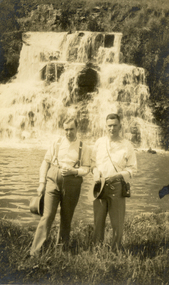
Photograph - Photograph - Black and White, Frank and Alex Wright at waterfall, 1930s?
... Band Championships around Europe, in Australia, including South Street and in New Zealand. The Frank Wright Medal at the Royal South Street competition is awarded to an individual recognized as making an outstanding contribution to brass music in Australia. Alex Wright travelled to England in 1930 and was known as the Prince of Mimic. His stage name was Navarre. He died in an air-raid in the Hippodrome Birmingham in 1940. frank wright alex wright waterfall conductor Navarre Alexander Wright mimic Two men dressed in trousers ...Frank Wright was a renown resident of Smeaton, where he was born on 2 August 1901. He, Alex and their siblings lived at Laura Villa, and attended Smeaton State School. His father William was a gold miner and his mother's name was Sarah. Their family won many singing and instrumental awards. Frank was tutored by Percy Code and was awarded a gold medal for the highest marks in the ALCM examinations in the British Colonies at the age of seventeen years. He became the Australian Open Cornet Champion by the age of eighteen. A year later, Frank conducted the City of Ballarat Band, and later the Ballarat Soldiers’ Memorial Band. He formed the Frank Wright Frisco Band and Frank Wright and his Coliseum Orchestra. These bands won many South Street awards, and Frank as conductor won many awards in the Australian Band Championship contest. In 1933 Frank Wright sailed to England to conduct the famous St Hilda’s Band and was later appointed Musical Director of the London County Council, where he organized many amazing concerts in parks, in and around the London district. He was made Professor of Brass and Military Band Scoring and conducted at the Guildhall of Music and Drama. Frank was often invited to adjudicate Brass Band Championships around Europe, in Australia, including South Street and in New Zealand. The Frank Wright Medal at the Royal South Street competition is awarded to an individual recognized as making an outstanding contribution to brass music in Australia. Alex Wright travelled to England in 1930 and was known as the Prince of Mimic. His stage name was Navarre. He died in an air-raid in the Hippodrome Birmingham in 1940.Two men dressed in trousers and shirt sleeves and carrying hats are standing in on the grassy bank of a pool fed by a waterfall. The men are Frank Wright on the right and his brother Alex on the left.frank wright, alex wright, waterfall, conductor, navarre, alexander wright, mimic -
 Federation University Historical Collection
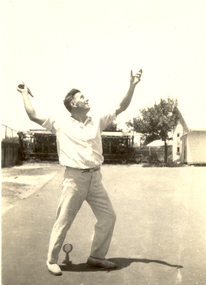
Photograph - black and white, Frank Wright Playing Tennis, 10/1928
... Band Championships around Europe, in Australia, including South Street and in New Zealand. The Frank Wright Medal at the Royal South Street competition is awarded to an individual recognized as making an outstanding contribution to brass music in Australia. frank wright conductor tennis tennis racquet 1). Black and white photograph of a man dressed in light coloured trousers ...Frank Wright was a renown resident of Smeaton, where he was born. He lived at Laura Villa, and attended Smeaton State School. His father William was a gold miner and his mother's name was Sarah. Their family won many singing and instrumental awards. Frank was tutored by Percy Code and was awarded a gold medal for the highest marks in the ALCM examinations in the British Colonies at the age of seventeen years. He became the Australian Open Cornet Champion by the age of eighteen. A year later, Frank conducted the City of Ballarat Band, and later the Ballarat Soldiers’ Memorial Band. He formed the Frank Wright Frisco Band and Frank Wright and his Coliseum Orchestra. These bands won many South Street awards, and Frank as conductor won many awards in the Australian Band Championship contest. In 1933 Frank Wright sailed to England to conduct the famous St Hilda’s Band and was later appointed Musical Director of the London County Council, where he organized many amazing concerts in parks, in and around the London district. He was made Professor of Brass and Military Band Scoring and conducted at the Guildhall of Music and Drama. Frank was often invited to adjudicate Brass Band Championships around Europe, in Australia, including South Street and in New Zealand. The Frank Wright Medal at the Royal South Street competition is awarded to an individual recognized as making an outstanding contribution to brass music in Australia.1). Black and white photograph of a man dressed in light coloured trousers and a white short sleeve shirt, serving a tennis ball. Situated on a tennis court with buildings in the background. The man is Frank Wright. 2). Black and white photograph of a young man dressed in tennis whites and a jacket, holding a tennis racquet and leaning against the net on a tennis court. In the background is a hedge topped timber fence with the roof of a house behind. The man is perhaps Frank Wright or a friend.frank wright, conductor, tennis, tennis racquet -
 Federation University Historical Collection
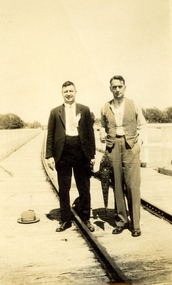
Photograph - Black and White, Pat McNamara, Near Maryborough, Queensland, 1932, March 1932
... Band Championships around Europe, in Australia, including South Street and in New Zealand. The Frank Wright Medal at the Royal South Street competition is awarded to an individual recognized as making an outstanding contribution to brass music in Australia. frank wright joe foster maryborough pier hervey bay Written in pencil on back - Taken on the pier about 20 miles from Maryborough (Q), Joe Foster sec Q.B.A., Frank Wright, March 1932 Printed on back - Printed by Pat McNamara Black and white photograph of two men, one dressed in a dark suit and the other dressed in trousers and waistcoat, holding a large fish in his right hand. ...Frank Wright was a renown resident of Smeaton, where he was born. He lived at Laura Villa, and attended Smeaton State School. His father William was a gold miner and his mother's name was Sarah. Their family won many singing and instrumental awards. Frank was tutored by Percy Code and was awarded a gold medal for the highest marks in the ALCM examinations in the British Colonies at the age of seventeen years. He became the Australian Open Cornet Champion by the age of eighteen. A year later, Frank conducted the City of Ballarat Band, and later the Ballarat Soldiers’ Memorial Band. He formed the Frank Wright Frisco Band and Frank Wright and his Coliseum Orchestra. These bands won many South Street awards, and Frank as conductor won many awards in the Australian Band Championship contest. In 1933 Frank Wright sailed to England to conduct the famous St Hilda’s Band and was later appointed Musical Director of the London County Council, where he organized many amazing concerts in parks, in and around the London district. He was made Professor of Brass and Military Band Scoring and conducted at the Guildhall of Music and Drama. Frank was often invited to adjudicate Brass Band Championships around Europe, in Australia, including South Street and in New Zealand. The Frank Wright Medal at the Royal South Street competition is awarded to an individual recognized as making an outstanding contribution to brass music in Australia.Black and white photograph of two men, one dressed in a dark suit and the other dressed in trousers and waistcoat, holding a large fish in his right hand. They are standing on the rail tracks of a pier. The men are Frank Wright on the right and Joe Foster on the left. The place is on the pier about 20 miles from Maryborough, Queensland (possibly Hervey Bay).Written in pencil on back - Taken on the pier about 20 miles from Maryborough (Q), Joe Foster sec Q.B.A., Frank Wright, March 1932 Printed on back - Printed by Pat McNamarafrank wright, joe foster, maryborough, pier, hervey bay -
 Federation University Historical Collection
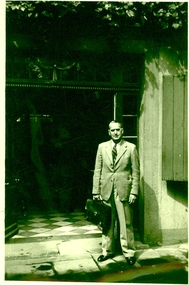
Photograph - black and white, Frank Wright, mid 1900s
... Band Championships around Europe, in Australia, including South Street and in New Zealand. The Frank Wright Medal at the Royal South Street competition is awarded to an individual recognized as making an outstanding contribution to brass music in Australia. He died on 16 November 1970. frank wright composer adjudicator musician Black and white photograph of a man dressed in a light jacket and trousers ...Frank Wright was a renoun resident of Smeaton, where he was born on 2 August 1901. He lived at Laura Villa, and attended Smeaton State School. His father William was a gold miner and his mother's name was Sarah. Their family won many singing and instrumental awards. Frank was tutored by Percy Code and was awarded a gold medal for the highest marks in the ALCM examinations in the British Colonies at the age of seventeen years. He became the Australian Open Cornet Champion by the age of eighteen. A year later, Frank conducted the City of Ballarat Band, and later the Ballarat Soldiers’ Memorial Band. He formed the Frank Wright Frisco Band and Frank Wright and his Coliseum Orchestra. These bands won many South Street awards, and Frank as conductor won many awards in the Australian Band Championship contest. In 1933 Frank Wright sailed to England to conduct the famous St Hilda’s Band and was later appointed Musical Director of the London County Council, where he organized many amazing concerts in parks, in and around the London district. He was made Professor of Brass and Military Band Scoring and conducted at the Guildhall of Music and Drama. Frank was often invited to adjudicate Brass Band Championships around Europe, in Australia, including South Street and in New Zealand. The Frank Wright Medal at the Royal South Street competition is awarded to an individual recognized as making an outstanding contribution to brass music in Australia. He died on 16 November 1970.Black and white photograph of a man dressed in a light jacket and trousers, carrying a brief case. He is standing at the entrance of building with a wide doorway which has an ornate carving over the door frame. A light and dark chequer board tiled floor can be seen inside. Thick vine covers the outer wall above the door. The man is Frank Wright.frank wright, composer, adjudicator, musician -
 Flagstaff Hill Maritime Museum and Village
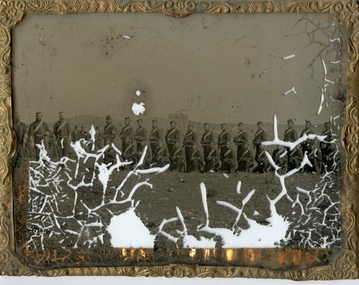
Photograph - Glass plate, circa 1866
... band pillbox forage caps helpmann manifold and bostock 1853 lee enfield musket tintype Warrnambool Garrison 1860s Cannon Hill Manifold & Bostock flour mill 3-storey building Photograph, rectangular glass plate, positive sepia image. Photograph has brass framed edges that fold over to the back, with mitred corners. The front edges are pressed with a decorative floral pattern. The photograph shows a group of thirty military men, standing or kneeling, in dark uniforms with pillbox forage caps, round-collared jackets with light buttons, light sashes worn from top left shoulder to bottom right side of waist belt, and long, straight-legged trousers ...This glass plate photograph shows good detail of members of the Warrnambool Garrison posing for their photograph in front of a young township. There are other well-dressed citizens behind them. The three men with frogging on their sleeves were commanders were likely to be commanders. The men are facing north with Cannon Hill and the fortification area in the background. It dates from the 1860s. The firearms held appear to be 1853 pattern Lee Enfield muskets used by the British army in Crimea at this time and in Australia, rather than the later Martini Henry cartridge rifles. The uniforms match other photos of the Warrnambool Garrison Militia and Band in our Collection, taken up until the 1880s. The three storey building in the photograph is likely to be the Manifold & Bostock flour mill, built in 1854 near the ‘cutting’ in Merri Street, which was one of the main streets at the time; if one faced the building’s front from a vantage point and looked south to south-east, the hills around Flagstaff Hill and Cannon Hill would be behind that mill, and the Harbour behind the hills. This is the area of the Fortifications. The glass plate method of photography was widely used during the mid-19th to early-20th century. The donor and maker of the photograph are unknown. Around this time the citizens of Victoria were prospering from the gold rush but felt isolated and uneasy about their security in the colony. In 1854 the Volunteer Act was passed to provide some military defence. In 1858 the Warrnambool Volunteer Rifle Corps was established, disbanded in 1863, then a new Warrnambool Detachment was formed in September 1866. Legislation was passed in 1884 that replaced the volunteers’ corps with a partly paid, permanent Militia Defence Force. The batteries manning the coastal forts of Victoria were termed Garrison Artillery Companies. When the Army was federated in 1901 there were eight Militia Companies in Victoria. Warrnambool and Port Fairy together were known as 8 Coy AGA (Australian Garrison Artillery). Changes to formation and name continued into the 20th century.This photograph is a record of the very early local defence force, circa 1866. The photograph signifies the connection of the colony in Victoria to the growing need for security due to the unrest in Europe at that time. The photograph is also locally significant to the industry of the young township of Warrnambool, showing what is likely to be one of the first flour mills in the town. The photograph is also the only example of the early methods of glass plate photography in our collection. Photograph, rectangular glass plate, positive sepia image. Photograph has brass framed edges that fold over to the back, with mitred corners. The front edges are pressed with a decorative floral pattern. The photograph shows a group of thirty military men, standing or kneeling, in dark uniforms with pillbox forage caps, round-collared jackets with light buttons, light sashes worn from top left shoulder to bottom right side of waist belt, and long, straight-legged trousers. Three of these men have light braid around the buttons on the front of their jackets, light frogging on their sleeve cuffs and stripes on the outside seams of their trousers. The other twenty-seven men have plain uniforms and are holding firearms in their right hands, steadied with their left hands. Other figures are standing behind this group of soldiers, including three or four men wearing top hats, jackets and ties. In the background is a row of buildings. The central building is three stories high. Bare hills are in the far background. The foreground is uneven ground with patches of short grass. Photographer looking towards the south east and Cannon Hill, with the Warrnambool Garrison facing north, ca.1860s.flagstaff hill, warrnambool, shipwrecked coast, flagstaff hill maritime museum, maritime museum, shipwreck coast, flagstaff hill maritime village, great ocean road, glass plate, photography 19th century, colonial forces, military defence, volunteer act 1854, volunteer rifle, garrison artillery, volunteer corps, militia, militia garrison band, pillbox forage caps, helpmann, manifold and bostock, 1853 lee enfield musket, tintype, warrnambool garrison, 1860s, cannon hill, manifold & bostock, flour mill, 3-storey building -
 Orbost & District Historical Society
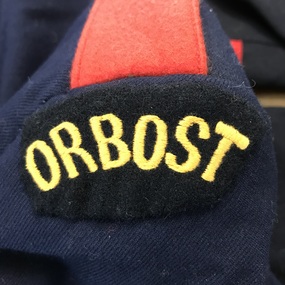
Uniform - Orbost Municipal Band, F Maxey & Son P/L, c. 1960s - 1970s
... A number of items of clothing (cap, coat, gloves, jacket, badges, trousers), banner, insignias, whistle. These are all items associated with the Orbost Municipal Band. .... - gloves Hersh's - on badges, also trousers, and jacket OMB - Orbost Municipal Band - on banner ORBOST - on cloth badges ...Bands labels on clothing: F. Maxey & Son P/L - on cap Simpson's Gloves P/L Vic. - gloves Hersh's - on badges, also trousers, and jacket OMB - Orbost Municipal Band - on banner ORBOST - on cloth badges A number of items of clothing (cap, coat, gloves, jacket, badges, trousers), banner, insignias, whistle. ...In 2024, while doing some renovations at the Orbost Customer Service Centre / Library, Council staff have found some boxes of old Orbost Municipal Band uniforms and flags which date back to the late 1970s (when it’s understood the band wound up). These items were offered to the O D Historical Society for its collection. A selection was made (3364). The first Orbost Brass Band was formed in 1889. Around 1908 the town band split and the Orbost Workers' Band was formed. Eventually the two bands merged in 1913 to reform as the Orbost Municipal Band under conductorship of Charles Spink. The band continued for many years but was later disbanded and again reformed. This was to happen a number of times, the last time being in 1961 and continuing through to the late 1970's. Also refer to items in the O D H S collection. Further info and Ref: In Times Gone By - Deborah Hall The items are significant because they are authentic parts of the Orbost Municipal Band. A number of items of clothing (cap, coat, gloves, jacket, badges, trousers), banner, insignias, whistle. These are all items associated with the Orbost Municipal Band. The costume items are all dark blue/black with gold and red trims. Gloves are white/cream gauntlet style. Whistle is silver. The banner is red background with gold trims and O M B appliqued. 3364.1 cap, dark blue with front visor, red ribbon decoration, 2 gold buttons on sides; large gold metal decoration of a lyre with crown on top a the front. 3364.2 pair of gloves, gauntlet style, white/cream leather, silver studs 3364.6 large jacket, dark blue/black, woollen, red epaulets on shoulders with gold buttons, 4 gold buttons on front, 6 on sleeves, gold braiding; drum badge on sleeves, 2 lyre badges; gold lanyard on right sleeve. Gold on black cloth badge on shoulders. A whistle is also with this jacket. 3364.4 small jacket, dark blue/black, woollen, red epaulets, gold studs, 2 lyre studs on lapels 3364.5 small trousers. dark blue/black, woollen. Red stripe down outside of both legs. 3364.3 a 41 cm square square red cloth banner, with gold fringe on the bottom, gold tassle on top with gold cord. Has O M B in large lettering appliqued to the banner. labels on clothing: F. Maxey & Son P/L - on cap Simpson's Gloves P/L Vic. - gloves Hersh's - on badges, also trousers, and jacket OMB - Orbost Municipal Band - on banner ORBOST - on cloth badges orbost municipal band, orbost bands -
 Montmorency–Eltham RSL Sub Branch
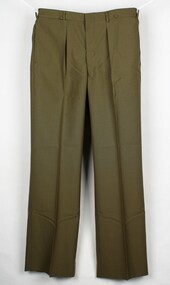
Uniform - Trousers, Khaki, Summer Dress, 1989
... trousers. Two pleats at the front. Fob pocket on the right front. Front zip with metal closure and button tag.. Pockets on the left and right hips. Pocket on the back right side with hidden button and button hole.Seven belt loops on waist band. ...trousers. Two pleats at the front. Fob pocket on the right front. Front zip with metal closure and button tag.. Pockets on the left and right hips. Pocket on the back right side with hidden button and button hole.Seven belt loops on waist band. ...Wool and polyester khaki dress trousers. Two pleats at the front. Fob pocket on the right front. Front zip with metal closure and button tag.. Pockets on the left and right hips. Pocket on the back right side with hidden button and button hole.Seven belt loops on waist band. Four small horizontal loops on the waist band, two at the front and two at the back. Label on the inside on the lining of the back pocket states - A.G.C.F. (Australian Government Clothing Factory) Vic 1989. 8405.66.018.5545. Macquarie 89. Batch U. Size 87.5L W.87.5 IL.82 Army No. Name. Dry clean only. re press on original creases use damp cloth or medium to hot steam iron. White tag on the waist band on the right back stating - Size 87.5L. Tag on the right hand side on the back above the pocket stating - This tag is for identification only. Please remove before wearing. Docket No. 1106512 Order No. 29743836 Size 87.5L Garment No. 20851A Remarks 6I11Manufacturer - A.G.C.F. VIC 1989polyesters, dress trousers, wool polyester -
 Montmorency–Eltham RSL Sub Branch
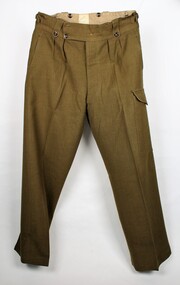
Uniform - Trousers, Patt. '49 Battle Dress, 1950
... Name_______________ Stamp on inner waist band - 'D ^ D'. Khaki Pattern 1949 Battle Dress trousers. Four hidden buttons in front closure. ...Standard issue battle dress pants, issued by defense department. Khaki Pattern 1949 Battle Dress trousers. Four hidden buttons in front closure. Nine exposed buttons around circumference of waistband. Seven internal plastic buttons around inner waist. Two large back pockets with hidden button under flap of each pocket. One large pocket with flap and hidden button on side of left leg/thigh. Bottom of pants hemmed with extra brown fabric attached on inner of each leg hem. Regular side pockets at front of each leg. At rim of each side of the pants there is a buckle feature. Sewn patch with faded illegible subscription. No. 18 visible. Regimental No. ...................... Name_______________ Stamp on inner waist band - 'D ^ D'.military uniforms, army, battle pants -
 Montmorency–Eltham RSL Sub Branch
Uniform - Trousers, Service Dress RAAF, 1985
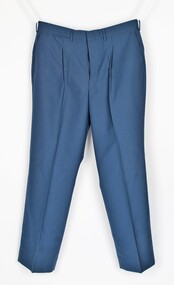
... trousers. (two side pockets, two back pockets; seven belt tabs around the waist band; metal fastener at the waist)...trousers. (two side pockets, two back pockets; seven belt tabs around the waist band; metal fastener at the waist) Uniform Trousers, Service Dress RAAF AUSTRALIAN GOVERNMENT CLOTHING FACTORY ...Part of a uniform on loan from Squadron Leader John Haines.Squadron Leader's Blue uniform trousers. (two side pockets, two back pockets; seven belt tabs around the waist band; metal fastener at the waist)haines, raaf -
 Flagstaff Hill Maritime Museum and Village
Uniform - Tunic or Doublet, David Lack Pty. Ltd, ca 1940s
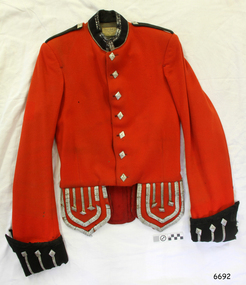
... Band now wears the Anderson tartan. The maker, David Lack Pty Ltd, advertised as a uniform specialist. In 1941 the business was located at 35-37 Little Latrobe Street, Melbourne. In the same year the firm won a contract with the Commonwealth Government Department of Supply, providing blue trousers for the Department of Air. ...Band now wears the Anderson tartan. The maker, David Lack Pty Ltd, advertised as a uniform specialist. In 1941 the business was located at 35-37 Little Latrobe Street, Melbourne. In the same year the firm won a contract with the Commonwealth Government Department of Supply, providing blue trousers for the Department of Air. ...The design of the uniform with its silver, diamond shaped buttons with the Scottish thistle symbol on them, indicate that the uniform was made for a Scottish Pipe Band member. There may be a connection with the local Warrnambool and District Pipes and Drums Inc, which began as the Warrnambool Pip Band in 1906, formed with the purpose of popularising Scottish music. Those with uniforms wore the Gordon tartan. In 1946 the uniforms were changed, with the Cameron or Errcht tartan chosen for the uniform. The Band now wears the Anderson tartan. The maker, David Lack Pty Ltd, advertised as a uniform specialist. In 1941 the business was located at 35-37 Little Latrobe Street, Melbourne. In the same year the firm won a contract with the Commonwealth Government Department of Supply, providing blue trousers for the Department of Air. In 1946 a branch of the firm operated in Myrtleford, Victoria. The Elizabeth Street, Melbourne, branch provided new uniforms in 1948 for the Leeton District Band. In the 1950s and 1960s David Lack manufactured blazers for the Olympic Teams as well as for bowls teams and schools. The Broken Hills Cameron Pipe Band' was gifted with uniforms that were also made by David Lack. It was a "... a Cameron of Lochlel red kilt and plaid, with black doublets and cross belts, and silver trimmings.” [Barrier Miner, Broken Hiss, 15-03-1954].The pipe band uniform jacket's design is associated with traditional Scottish pipe bands that originated in the United Kingdom and continue to this day in Australia and even locally in Warrnambool since 1908. The maker, David Lack Pty Ltd, is renowned as the maker of good quality uniforms who has supplied many government contracts for clothing and uniforms since the early 1940s. Uniform tunic; red jacket; Scottish Pipe Band Doublet with silver braid and silver diamond-shaped button closure and decoration. The buttons have the Scottish thistle symbol on them. There are seven buttons on the tunic front, three on each skirt flap, three on each contrasting black cuff and one on each black epaulette. The tunic has a two-inch stand-up collar. The whole item is fully lined with black nylon/silk blend fabric, the shoulders are padded, and there are pockets under the front skirts. There is an inscription on the maker's sewn-in label. Made by David Lack Pty Ltd, a uniform specialist in Melbourne.Label "David Lack Pty Ltd, uniform specialist Melbourne. "flagstaff hill maritime museum and village, warrnambool, great ocean road, shipwreck coast, uniform, tunic, dublet, jacket, scottish pipe band, pipe band, david lack pty ltd, david lack melbourne, uniform specialists, david lack, diamond buttons, silver buttons, scottish thistle buttons, scottish piper's buttons, thistle, scottland symbol, pipe band uniform, bag pipes -
 Bendigo Military Museum
Uniform - SHIRT, TROUSERS, WORK DRESS, ARMY, Australian Defence Industries, 1963, 1986
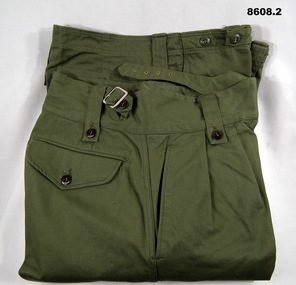
... Trousers - green colour cotton twill fabric. Plastic buttons - brown colour. 1. Five button fly with two straps with metal buckles at waist, button down belt loops, two side pockets, two back pockets with button flap. Waist and pocket lining green cotton fabric. Left leg side pocket with button down flap. 2. Four button fly, button down belt loops, two side pockets, two back pockets with buttons. Two front of leg pockets with button down flap. Pocket lining - green polyester fabric. Green cotton manufacturers label inside back waist band...Trousers - green colour cotton twill fabric. Plastic buttons - brown colour. 1. Five button fly with two straps with metal buckles at waist, button down belt loops, two side pockets, two back pockets with button flap. Waist and pocket lining green cotton fabric. Left leg side pocket with button down flap. 2. Four button fly, button down belt loops, two side pockets, two back pockets with buttons. Two front of leg pockets with button down flap. Pocket lining - green polyester fabric. Green cotton manufacturers label inside back waist band ...1. & 2. Trousers - green colour cotton twill fabric. Plastic buttons - brown colour. 1. Five button fly with two straps with metal buckles at waist, button down belt loops, two side pockets, two back pockets with button flap. Waist and pocket lining green cotton fabric. Left leg side pocket with button down flap. 2. Four button fly, button down belt loops, two side pockets, two back pockets with buttons. Two front of leg pockets with button down flap. Pocket lining - green polyester fabric. Green cotton manufacturers label inside back waist band. Army Work Dress commonly called "GREENS".Manufacturer's label - black ink print. 1. "C.G.C.F./ VICTORIA/ 1963/ SIZE 15/ ^/ REGIMENTAL NO/ NAME" 2. "A.G.C.F./ VICTORIA/ 1986/ 6 / WAIST AND SIZE/ 89/995/ 8405.66.029.0606/ ARMY NO/ NAME". passchendaele barracks trust, uniforms, army, workdress, trousers -
 Bendigo Military Museum
Uniform - WORKDRESS, NAVY, DPNU, ADA
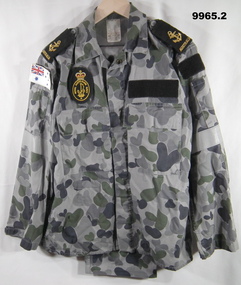
... band. Left front has a Velcro patch for name tag. 2. Trousers - DPNU - Two open hip pockets. ...band. Left front has a Velcro patch for name tag. 2. Trousers - DPNU - Two open hip pockets. ...Serving member of RAN - superseded pattern.1. Jacket - Disruptive Pattern Navy Uniform, long sleeves. Two breast pockets with flaps held shut with Velcro shoulder epaulettes with attached rank badges for Leading Seaman. Shoulder flash is White Ensign held with Velcro. Above pockets is an oval RAN badge. Front placket opening with 6 metal buttons. Both sleeves have a reflective band. Left front has a Velcro patch for name tag. 2. Trousers - DPNU - Two open hip pockets. Two leg pockets with zip closure. One back pocket with button close. Metal zip fly. Velcro on leg hems to draw tight.1. White tag on inside back below collar - ADA - top illegible. Name. Fibre content 75% cotton/25% polyester. Flame resistant/ WASH BEFORE USE/ Hot machine wash. May be tumble dried hot/ Warm iron, Do Not Bleach. Do Not Soak/ Dry Cleanable. 2. White tag illegible. Black texta name written - IBBOTSON 2 EA 1.uniform, work dress, ran/dpnu -
 Bendigo Military Museum
Uniform - UNIFORM, RAN - Summer Ceremonial, Red Anchor/Tailored garments
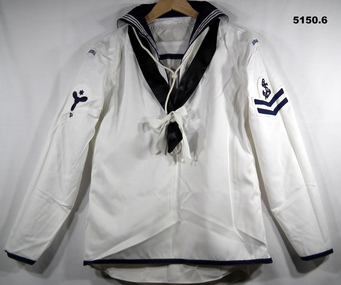
... Trousers - white polyester/cotton fabric, bell bottom. 3. Shirt - white polyester/cotton fabric, short sleeve, navy blue trim to square neckline. Insignia to left sleeve. 4. Silk - Black polyester black fabric to arrange around the collar. 5. Bow - white cotton tape. 6. Lanyard - white cord to arrange around neck. 7. Lid - white with black "Tally" band...band. " RED ANCHOR/TAILORED GARMENTS/ 65% POLYESTER 35% COTTON/ DO NOT BOIL, DRIP DRY, WARM IRON" 1. Jumper/Barathea - long sleeve white polyester/cotton fabric with Navy blue collar attached, side zip under arm. Insignia to left sleeve depicting rank. Right side insignia depicts category. 2. Trousers ...Royal Australian Navy - Uniform belonged to LS MTP E Rayner.1. Jumper/Barathea - long sleeve white polyester/cotton fabric with Navy blue collar attached, side zip under arm. Insignia to left sleeve depicting rank. Right side insignia depicts category. 2. Trousers - white polyester/cotton fabric, bell bottom. 3. Shirt - white polyester/cotton fabric, short sleeve, navy blue trim to square neckline. Insignia to left sleeve. 4. Silk - Black polyester black fabric to arrange around the collar. 5. Bow - white cotton tape. 6. Lanyard - white cord to arrange around neck. 7. Lid - white with black "Tally" band, sailors cap with Navy blue tape - chin strap. 1., 2. - Hand embroidered red cotton - "E RAYNER", 7. Handwritten, black ink, "LS MTP RAYNOR inside on the crown, Tally band - Embroidered gold thread "HMAS DERWENT'", on black band. " RED ANCHOR/TAILORED GARMENTS/ 65% POLYESTER 35% COTTON/ DO NOT BOIL, DRIP DRY, WARM IRON"ran, uniform
