
Showing 4 items matching "barry’s beach, phillip island"
-
 Phillip Island and District Historical Society Inc.
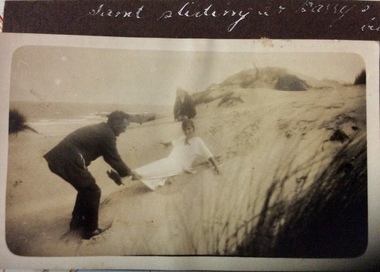
Photograph, Sand sliding, Barry’s Beach, 1925-1926
... ...Barry’s Beach, Phillip Island...photographs Barry’s Beach, Phillip Island Berry’s Beach, Phillip Island social life and customs Sand sliding at Barry’s Beach Sepia photograph of a woman sliding down a sand dune, with ocean in the background. ...Sepia photograph of a woman sliding down a sand dune, with ocean in the background. Helped by a man and another person kneeling in the background.Sand sliding at Barry’s Beachphotographs, barry’s beach, phillip island, berry’s beach, phillip island, social life and customs -
 Phillip Island and District Historical Society Inc.
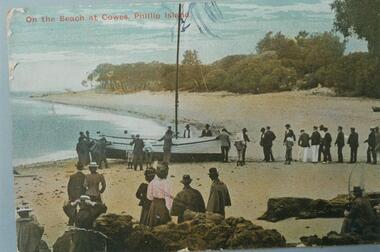
Photograph, Late 19th Century
... "On the Beach at Cowes, Phillip Island" On back: "1e Barry collection"...One of a collection of photographs donated by Bruce Bennett cowes beach phillip island sailing boats bruce bennett "On the Beach at Cowes, Phillip Island" On back: "1e Barry collection" Coloured copy of a postcard showing a number of people attending to a sailing boat on the beach with several people looking on. ...One of a collection of photographs donated by Bruce BennettColoured copy of a postcard showing a number of people attending to a sailing boat on the beach with several people looking on."On the Beach at Cowes, Phillip Island" On back: "1e Barry collection"cowes beach phillip island, sailing boats, bruce bennett -
 Bendigo Military Museum
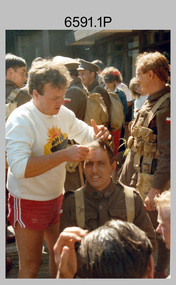
Photograph - The ANZACS TV Series - Army Survey Regiment’s Extras, Phillip Island, Victoria, 1985
... Beach. Standing L to R: Terry McIntyre, unidentified, Ian Fitzgerald, unidentified, John Reid, unidentified, Gary Tremain, unidentified (x2), Chad Hardwick, unidentified, Dave Lawler, Barry Hogan, Terry Danger, Peter Imeson, Garry Hudson. Kneeling L to R: unidentified, Peter Ball, Harald Mai, Paul Baker, Alan Staley, Ian McKenzie, Brad Peppler. Sitting: Rod Skidmore. The ANZACS TV Series - Army Survey Regiment’s Extras, Phillip Island ...This is a set of six photographs of Army Survey Regiment personnel who volunteered as extras in the ANZACS TV Series filmed in 1985. Many of the extras playing the roles of Australian soldiers were serving members of the Army Survey Regiment, Bendigo and the Armoured Regiment, Puckapunyal. This was done to keep costs down so that actors did not have to learn how to act as soldiers or to have to teach them how to use the weapons. Army Svy Regt’s 28 personnel left Bendigo in the early hours of the morning arriving at Phillip Island’s Cowes Motor Inn. Wardrobe staff make-up artists dressed the soldiers from both units in authentic WW1 uniforms in readiness for filming at Woolamai Surf Beach, on the other side of Phillip Island. Filming for the day involved a battle scene simulation of the beach landings at Gallipoli, Turkey. A long day of filming ensued, with 8 arduous re-takes of charges from the beach to the steep cliffs, and the scrubland beyond the cliffs before the producers were satisfied with the footage. The producers provided ample refreshments back at Cowes Motor Inn at the end of the day, before Army Svy Regt’s 28 personnel departed on the 4-hr trip back to Bendigo. This is a set of six photographs of Army Survey Regiment personnel who volunteered as extras in the ANZACS TV Series filmed at Phillip Island, Victoria in 1985. The colour photographs. were printed on photographic paper and are part of the Army Survey Regiment’s Collection. The photographs were scanned at 300 dpi. A newspaper article published by the Bendigo Advertiser on the 29th of October 1985 is stored with the photos. .1) - Photo, colour, 1985. A hairdresser attends to Garry Hudson’s hair at the Cowes Motor Inn. Glen Weatherall is on far right. .2) - Photo, colour, 1985. Production staff preparing a scene at the cliff base at Woolamai Surf Beach. .3) - Photo, colour, 1985. A make-up artist applies simulated wounds to an unidentified soldier. .4) - Photo, colour, 1985. Production staff preparing a beach landing scene. .5) - Photo, colour, 1985. Extras from the Army Svy Regt and 1st Armd Regt gather at Woolamai Surf Beach. L to R in foreground: Gary Tremain, Graham Hales, unidentified, Dave Lawler, unidentified. .6) - Photo, colour, 1985. The 28 extras from the Army Svy Regt at Woolamai Surf Beach. Standing L to R: Terry McIntyre, unidentified, Ian Fitzgerald, unidentified, John Reid, unidentified, Gary Tremain, unidentified (x2), Chad Hardwick, unidentified, Dave Lawler, Barry Hogan, Terry Danger, Peter Imeson, Garry Hudson. Kneeling L to R: unidentified, Peter Ball, Harald Mai, Paul Baker, Alan Staley, Ian McKenzie, Brad Peppler. Sitting: Rod Skidmore. ‘Filming of “ANZACS” 1985’ annotated on cover sleeve.royal australian survey corps, rasvy, army survey regiment, army svy regt, fortuna -
 Phillip Island Conservation Society Inc.
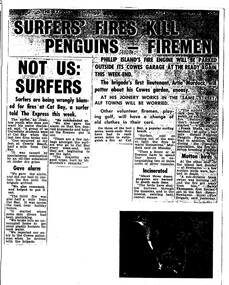
Work on paper - Photocopy of newspaper cutting, The Express, "SURFERS' FIRES KILL/ PENGUINS - FIREMEN//NOT US:/SURFERS"
... Phillip Island...Cat Bay...Country Fire Authority...Artie Murdoch...Alf Towns...Frank Dixon...Barry Thompson...Newhaven-San Remo Rural Fire Brigade...Penguin Parade...Cowrie Beach...Phillip Island Cat Bay Country Fire Authority Artie Murdoch Alf Towns Frank Dixon Barry Thompson Newhaven-San Remo Rural Fire Brigade Penguin Parade Cowrie Beach surfers coastal fires Photocopy of newspaper cuttings including 2 related articles. ...Written during the 1960s when surfing was burgeoning across Australia’s coast and Phillip Island surf beaches had become extremely popular, few management strategies were in place to control interaction of the public with the delicate flora and fauna of the coastal environments. There were few good access tracks, car parks, bins, toilets etc at coastal/surfing hotspots around the Phillip Island coast. A number of management issues occurred with the influx of surfers. These included dune erosion caused by surfers climbing dunes to see the surf before going on the beach; informal parking on wildlife habitat; numerous access paths from wherever cars were parked down to the beach cutting through habitat; illegal camping on foreshores; illegal lighting of fires on beach and in dunes; surfers’ dogs let out of the car while surfers were out on the water. The dogs were uncontrolled. Certainly some surfers behaved responsibly, as is almost invariably the case these days. However, in that era of this article few people understood the delicate nature of the coastal environment and that it need to be protected through public education, infrastructure and enforcement of regulations. As now, most rural Fire services were run by dedicated volunteers who faced many challenges in their roles as Country Fire Authority firefighters. However, it was not uncommon for visitors and locals to also assist with fire-fighting efforts.The article is significant in containing quotes from both sides of the discussion who were directly involved in coastal fire incidents on Phillip Island in the 1960s. It also indicates the large number of surfers visiting Phillip Island beaches, the volunteer nature of the firefighting service and the extra challenges they faced on Phillip Island as a visitor destination. The anonymous university student surfer who is quoted, also describes possible causes of the fires, methods he and his fellow surfers used to extinguish the fires and raise the alarm, and the way they assisted the volunteer firefighters . The reference to him breaking into one of the Summerland housing estate holiday houses is also significant because that housing estate was purchased over 2 decades by successive Victorian governments to remove management issues caused to the wildlife habitat on Summerland Peninsula.Photocopy of newspaper cuttings including 2 related articles. Five columns of black text on white paper with one poorly reproduced photo bottom rightphillip island, cat bay, country fire authority, artie murdoch, alf towns, frank dixon, barry thompson, newhaven-san remo rural fire brigade, penguin parade, cowrie beach, surfers, coastal fires
