
Showing 19 items matching "bathroom set"
-
 Warrnambool and District Historical Society Inc.
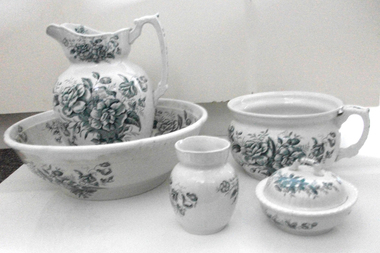
Toilet set, China toilet set, Early 20th century
... ...bathroom set...A bathroom set would have been a common item in most households in the 19th century and up the mid 20th century. ...This is a five-piece china bathroom/ toilet set. The five pieces that comprise the set have a white background with a floral pattern in sage green monochrome with roses, carnations, sweet pea and dianthus. ...It will be useful for display. social history bathroom set china bathroom set Staffordshire England Camelia’ This is a five-piece china bathroom/ toilet set. ...A bathroom set would have been a common item in most households in the 19th century and up the mid 20th century. Not many of the bathroom sets, however, would have been as fine and as attractive as this one as this one would have belonged to a family with some wealth. Bathroom sets went out of common use once houses were sewered or had septic tanks and toilets and bathrooms were constructed inside the main house building. This set is of interest as an example of a common household item in houses 100 years ago or more. It will be useful for display.This is a five-piece china bathroom/ toilet set. The five pieces that comprise the set have a white background with a floral pattern in sage green monochrome with roses, carnations, sweet pea and dianthus. In the pattern are also tendrils and foliage. The jug is an elongated oval shape with a decorated handle. The interior of the lip is chipped. The circular bowl has an indented ridge at the top with interior and exterior decoration. The bowl is partly discoloured and there is some crazing. The toothbrush holder has a vase-like shape with an indented rim with fluting on the top. The chamber pot is circular with a decorated handle and one crack. The soap holder is circular and has three parts – the circular decorated base, the inset piece with a fluted edge and one large and six small holes for draining, and the decorated lid which is also fluted around the edge. The markings at the base of each item have a crown symbol as well as the lettering. Staffordshire England Camelia’ social history, bathroom set, china bathroom set -
 Warrnambool and District Historical Society Inc.
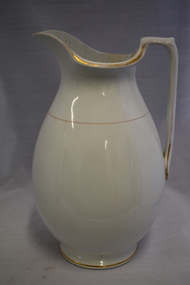
Household, Jug, Early 20th century
... This is a bathroom jug and could have been part of a set for bathroom use. ...This is a bathroom jug and could have been part of a set for bathroom use. ...This is a bathroom jug and could have been part of a set for bathroom use. It would have held mainly water, hot or cold. In the days before there were sinks with hot and cold running water in bathrooms, a jug such as this was an essential item and would have been in common use up to the first three decades of the 20th century. Today this item is more likely to be used as a vaseThis jug has no known local provenance and is kept as a memento of a household item in use 100 years ago. This is a large white china jug. The body of the jug is spherical or bulbous shaped, tapering to a smaller neck and a large lip. There is gold trim around the handle, the rim of the top opening, around the base and around the top part of the jug. The handle has a straight edge. The jug is stained inside and there is a small piece of china missing on the base. bathroom accessories, history of warrnambool -
 Ballarat and Queen's Anglican Grammar School
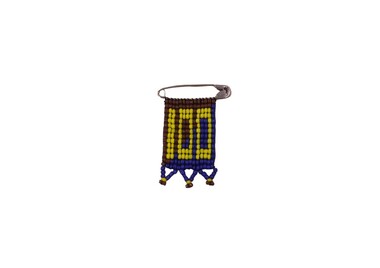
Badge, Noopsi Badges celebrating 100 years of Anglican education
... set up by the Church Assembly (Synod) in November 1908. Classes began for the 38 boys enrolled on 14 February 1911. The first building accommodated 90 day boys and 25 boarders. It comprised the Headmaster’s residence, three classrooms, one large dormitory, a small bathroom...set up by the Church Assembly (Synod) in November 1908. Classes began for the 38 boys enrolled on 14 February 1911. The first building accommodated 90 day boys and 25 boarders. It comprised the Headmaster’s residence, three classrooms, one large dormitory, a small bathroom ...Ballarat Grammar’s 23 acre site facing Forest and Howitt Streets, Wendouree was chosen carefully by the Committee set up by the Church Assembly (Synod) in November 1908. Classes began for the 38 boys enrolled on 14 February 1911. The first building accommodated 90 day boys and 25 boarders. It comprised the Headmaster’s residence, three classrooms, one large dormitory, a small bathroom, two cubicles for assistant masters and the matron’s room. During the first year the property was fenced, trees and cypress hedges were planted, a carriage drive was constructed and work commenced for the School Cricket Oval. Three Noopsi Badges celebrating 100 years of Anglican education at Ballarat & Queens Anglican Grammar School. These are beaded badges in blue, yellow and brown with "100" in yellow, mounted on a safety pin. "100" in worked in yellow beadsballarat, badge, queens, 100, cegs, 2011, bgs, noopsi, century-celebration, grammar-school, qceggs -
 Ballarat and Queen's Anglican Grammar School
Badge, Noopsi Badges celebrating 100 years of Anglican education
... set up by the Church Assembly (Synod) in November 1908. Classes began for the 38 boys enrolled on 14 February 1911. The first building accommodated 90 day boys and 25 boarders. It comprised the Headmaster’s residence, three classrooms, one large dormitory, a small bathroom...set up by the Church Assembly (Synod) in November 1908. Classes began for the 38 boys enrolled on 14 February 1911. The first building accommodated 90 day boys and 25 boarders. It comprised the Headmaster’s residence, three classrooms, one large dormitory, a small bathroom ...Ballarat Grammar’s 23 acre site facing Forest and Howitt Streets, Wendouree was chosen carefully by the Committee set up by the Church Assembly (Synod) in November 1908. Classes began for the 38 boys enrolled on 14 February 1911. The first building accommodated 90 day boys and 25 boarders. It comprised the Headmaster’s residence, three classrooms, one large dormitory, a small bathroom, two cubicles for assistant masters and the matron’s room. During the first year the property was fenced, trees and cypress hedges were planted, a carriage drive was constructed and work commenced for the School Cricket Oval. Three Noopsi Badges celebrating 100 years of Anglican education at Ballarat & Queens Anglican Grammar School. These are beaded badges in blue, yellow and brown with "100" in yellow, mounted on a safety pin. "100" in worked in yellow beadsballarat, badge, queens, 100, cegs, 2011, bgs, noopsi, century-celebration, grammar-school, qceggs -
 Ballarat and Queen's Anglican Grammar School
Badge, Noopsi Badges celebrating 100 years of Anglican education
... set up by the Church Assembly (Synod) in November 1908. Classes began for the 38 boys enrolled on 14 February 1911. The first building accommodated 90 day boys and 25 boarders. It comprised the Headmaster’s residence, three classrooms, one large dormitory, a small bathroom...set up by the Church Assembly (Synod) in November 1908. Classes began for the 38 boys enrolled on 14 February 1911. The first building accommodated 90 day boys and 25 boarders. It comprised the Headmaster’s residence, three classrooms, one large dormitory, a small bathroom ...Ballarat Grammar’s 23 acre site facing Forest and Howitt Streets, Wendouree was chosen carefully by the Committee set up by the Church Assembly (Synod) in November 1908. Classes began for the 38 boys enrolled on 14 February 1911. The first building accommodated 90 day boys and 25 boarders. It comprised the Headmaster’s residence, three classrooms, one large dormitory, a small bathroom, two cubicles for assistant masters and the matron’s room. During the first year the property was fenced, trees and cypress hedges were planted, a carriage drive was constructed and work commenced for the School Cricket Oval. Three Noopsi Badges celebrating 100 years of Anglican education at Ballarat & Queens Anglican Grammar School. These are beaded badges in blue, yellow and brown with "100" in yellow, mounted on a safety pin. "100" in worked in yellow beadsballarat, badge, queens, 100, cegs, 2011, bgs, noopsi, century-celebration, grammar-school, qceggs -
![Photograph - Colour Print, Harry Gilham [Attrib.], Living and Learning Centre, Main Road, Eltham, Aug 1988](/media/collectors/4f729f7b97f83e03086018a5/items/6a1ccb54e43e4200865b4676/item-media/6a1ccbd3e43e4200865b58ed/item-fit-380x285.jpg?cb=6) Eltham District Historical Society Inc
Eltham District Historical Society IncPhotograph - Colour Print, Harry Gilham [Attrib.], Living and Learning Centre, Main Road, Eltham, Aug 1988
... bathroom. In the early 1970s Eltham Shire Council, Councillors Frank Maas and Don Maling, were proposing an extended communities activities program be set up and the Commonwealth Grants Commission was approached for financial assistance to such a scheme. ...bathroom. In the early 1970s Eltham Shire Council, Councillors Frank Maas and Don Maling, were proposing an extended communities activities program be set up and the Commonwealth Grants Commission was approached for financial assistance to such a scheme. ...North face of house viewed from the current (1990) pottery area (now pathed) The kitchen was separate from the house as a safety measure in the late 1800s. A detailed history of the site and early development of the Eltham Living and Learning Centre can be found in EDHS_04870 - Folder, Shire of Eltham Living and Learning Centre, 1996 The original property was part of Josiah Holloways subdivision of Little Eltham. It had a 70 foot frontage to Maria Street and stretched down to the Diamond Creek. John Perason, a Tanner, purchased the property in 1857 for £100 and he built a solid brick house which over the years was modified significantly by various owners and which is the basis of the present-day Living and Learning Centre. Claire Fitzpatrick and her husband Alfred, a retired chemical engineer, bought it in the early 1950's. Claire's interest in farming and animal husbandry and breeding saw her modify and establish buildings on the property to house goats and poultry with a horse stable and storage sheds for the animal food. She also built the coach house with its horse box and tack room and built an adjoining garage for their car. Structural alterations to the house were also carried out during the period of their ownership. Their house renovations removed the four fireplaces and chimneys and added a wider verandah, a fibro cement extension on the north wall requiring a doorway to be made in the brick wall for access. Part of a passage wall was removed to join the northwest room, now the "sitting room". A new jarrah floor was put in as the old one was rotten with borer. The verandahs, front and back, were re-organised in design and the front door had its leadlighting panels removed to allow more light into the house. During this period the water catchment well was filled in. This well had a concrete slab fitted onto a collar around its top. The well is 12 feet deep and 8 feet in diameter. Septic sewerage was installed and an internal toilet fitted in the house. The former northeast room was divided into bathroom/toilet and passageway with cupboards to access the extension. Kitchen stove and sink was removed (they fell apart) and a slow-combustion stove with hot water heater installed. Basins and hot water were connected to the new bathroom. In the early 1970s Eltham Shire Council, Councillors Frank Maas and Don Maling, were proposing an extended communities activities program be set up and the Commonwealth Grants Commission was approached for financial assistance to such a scheme. During 1974 a $50,000 Commonwealth Government grant was received by the Shire Council to acquire the Fitzpatrick property as part of the Shire's planning to establish an "extended community activities program". Council's Committee recommended an annual budget of $26,950 for the program and the project was named the Living and Learning Centre and in charge of the program was the first co-ordinator, Carina Hack. The activities were planned to cover "practical skills for living" and included cooking, preserving, gardening, animal husbandry, home economics, electronics, carpentry, hairdressing, making children's clothes and car maintenance. Hobbies and arts and crafts that would include amongst other future items, winemaking, music spinning and weaving and painting. 739 main road eltham, eltham living and learning centre, living and learning centre, living and learning nillumbik (eltham), main road eltham -
 Eltham District Historical Society Inc
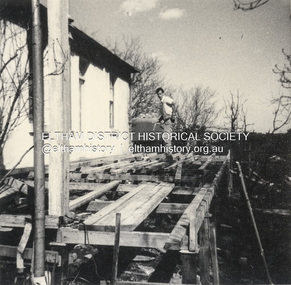
Photograph - Black and White Print, Widening of the verandah of 'Rosebank,' now Living and Learning Centre, Main Road, Eltham, c.1965
... bathroom. In the early 1970s Eltham Shire Council, Councillors Frank Maas and Don Maling, were proposing an extended communities activities program be set up and the Commonwealth Grants Commission was approached for financial assistance to such a scheme. ...bathroom. In the early 1970s Eltham Shire Council, Councillors Frank Maas and Don Maling, were proposing an extended communities activities program be set up and the Commonwealth Grants Commission was approached for financial assistance to such a scheme. ...Restructure of the front verandah of 'Rosebank' by widening, c.1965. It was glassed in at a later date. The west facing front verandah was widened and enclosed for additional class room use by the Living and Learning Centre. A detailed history of the site and early development of the Eltham Living and Learning Centre can be found in EDHS_04870 - Folder, Shire of Eltham Living and Learning Centre, 1996 The original property was part of Josiah Holloways subdivision of Little Eltham. It had a 70 foot frontage to Maria Street and stretched down to the Diamond Creek. John Perason, a Tanner, purchased the property in 1857 for £100 and he built a solid brick house which over the years was modified significantly by various owners and which is the basis of the present-day Living and Learning Centre. Claire Fitzpatrick and her husband Alfred, a retired chemical engineer, bought it in the early 1950's. Claire's interest in farming and animal husbandry and breeding saw her modify and establish buildings on the property to house goats and poultry with a horse stable and storage sheds for the animal food. She also built the coach house with its horse box and tack room and built an adjoining garage for their car. Structural alterations to the house were also carried out during the period of their ownership. Their house renovations removed the four fireplaces and chimneys and added a wider verandah, a fibro cement extension on the north wall requiring a doorway to be made in the brick wall for access. Part of a passage wall was removed to join the northwest room, now the "sitting room". A new jarrah floor was put in as the old one was rotten with borer. The verandahs, front and back, were re-organised in design and the front door had its leadlighting panels removed to allow more light into the house. During this period the water catchment well was filled in. This well had a concrete slab fitted onto a collar around its top. The well is 12 feet deep and 8 feet in diameter. Septic sewerage was installed and an internal toilet fitted in the house. The former northeast room was divided into bathroom/toilet and passageway with cupboards to access the extension. Kitchen stove and sink was removed (they fell apart) and a slow-combustion stove with hot water heater installed. Basins and hot water were connected to the new bathroom. In the early 1970s Eltham Shire Council, Councillors Frank Maas and Don Maling, were proposing an extended communities activities program be set up and the Commonwealth Grants Commission was approached for financial assistance to such a scheme. During 1974 a $50,000 Commonwealth Government grant was received by the Shire Council to acquire the Fitzpatrick property as part of the Shire's planning to establish an "extended community activities program". Council's Committee recommended an annual budget of $26,950 for the program and the project was named the Living and Learning Centre and in charge of the program was the first co-ordinator, Carina Hack. The activities were planned to cover "practical skills for living" and included cooking, preserving, gardening, animal husbandry, home economics, electronics, carpentry, hairdressing, making children's clothes and car maintenance. Hobbies and arts and crafts that would include amongst other future items, winemaking, music spinning and weaving and painting. 739 main road eltham, eltham living and learning centre, living and learning centre, living and learning nillumbik (eltham), main road eltham -
![Photograph - Colour Print, Harry Gilham [Attrib.], Living and Learning Centre, Main Road, Eltham, c.1988](/media/collectors/4f729f7b97f83e03086018a5/items/6a1cdaf8e43e4200865c849d/item-media/6a1cdb13e43e4200865c85b6/item-fit-380x285.jpg?cb=6) Eltham District Historical Society Inc
Eltham District Historical Society IncPhotograph - Colour Print, Harry Gilham [Attrib.], Living and Learning Centre, Main Road, Eltham, c.1988
... bathroom. In the early 1970s Eltham Shire Council, Councillors Frank Maas and Don Maling, were proposing an extended communities activities program be set up and the Commonwealth Grants Commission was approached for financial assistance to such a scheme. ...bathroom. In the early 1970s Eltham Shire Council, Councillors Frank Maas and Don Maling, were proposing an extended communities activities program be set up and the Commonwealth Grants Commission was approached for financial assistance to such a scheme. ...The 'back door' which faced the Main Road entrance to the office, Eltham Living and Learning Centre, herb garden at its peak, late 1980s A detailed history of the site and early development of the Eltham Living and Learning Centre can be found in EDHS_04870 - Folder, Shire of Eltham Living and Learning Centre, 1996 The original property was part of Josiah Holloways subdivision of Little Eltham. It had a 70 foot frontage to Maria Street and stretched down to the Diamond Creek. John Perason, a Tanner, purchased the property in 1857 for £100 and he built a solid brick house which over the years was modified significantly by various owners and which is the basis of the present-day Living and Learning Centre. Claire Fitzpatrick and her husband Alfred, a retired chemical engineer, bought it in the early 1950's. Claire's interest in farming and animal husbandry and breeding saw her modify and establish buildings on the property to house goats and poultry with a horse stable and storage sheds for the animal food. She also built the coach house with its horse box and tack room and built an adjoining garage for their car. Structural alterations to the house were also carried out during the period of their ownership. Their house renovations removed the four fireplaces and chimneys and added a wider verandah, a fibro cement extension on the north wall requiring a doorway to be made in the brick wall for access. Part of a passage wall was removed to join the northwest room, now the "sitting room". A new jarrah floor was put in as the old one was rotten with borer. The verandahs, front and back, were re-organised in design and the front door had its leadlighting panels removed to allow more light into the house. During this period the water catchment well was filled in. This well had a concrete slab fitted onto a collar around its top. The well is 12 feet deep and 8 feet in diameter. Septic sewerage was installed and an internal toilet fitted in the house. The former northeast room was divided into bathroom/toilet and passageway with cupboards to access the extension. Kitchen stove and sink was removed (they fell apart) and a slow-combustion stove with hot water heater installed. Basins and hot water were connected to the new bathroom. In the early 1970s Eltham Shire Council, Councillors Frank Maas and Don Maling, were proposing an extended communities activities program be set up and the Commonwealth Grants Commission was approached for financial assistance to such a scheme. During 1974 a $50,000 Commonwealth Government grant was received by the Shire Council to acquire the Fitzpatrick property as part of the Shire's planning to establish an "extended community activities program". Council's Committee recommended an annual budget of $26,950 for the program and the project was named the Living and Learning Centre and in charge of the program was the first co-ordinator, Carina Hack. The activities were planned to cover "practical skills for living" and included cooking, preserving, gardening, animal husbandry, home economics, electronics, carpentry, hairdressing, making children's clothes and car maintenance. Hobbies and arts and crafts that would include amongst other future items, winemaking, music spinning and weaving and painting. 739 main road eltham, eltham living and learning centre, living and learning centre, living and learning nillumbik (eltham), main road eltham -
![Photograph - Black and White Print, Harry Gilham [Attrib.], Living and Learning Centre, Main Road, Eltham, 1990](/media/collectors/4f729f7b97f83e03086018a5/items/6a1cdbffe43e4200865c95df/item-media/6a1cdc19e43e4200865c975d/item-fit-380x285.jpg?cb=6) Eltham District Historical Society Inc
Eltham District Historical Society IncPhotograph - Black and White Print, Harry Gilham [Attrib.], Living and Learning Centre, Main Road, Eltham, 1990
... bathroom. In the early 1970s Eltham Shire Council, Councillors Frank Maas and Don Maling, were proposing an extended communities activities program be set up and the Commonwealth Grants Commission was approached for financial assistance to such a scheme. ...bathroom. In the early 1970s Eltham Shire Council, Councillors Frank Maas and Don Maling, were proposing an extended communities activities program be set up and the Commonwealth Grants Commission was approached for financial assistance to such a scheme. ...The 'back door' which faced the Main Road entrance to the office, Eltham Living and Learning Centre - Shows original sandstone blocks in back verandah floor A detailed history of the site and early development of the Eltham Living and Learning Centre can be found in EDHS_04870 - Folder, Shire of Eltham Living and Learning Centre, 1996 The original property was part of Josiah Holloways subdivision of Little Eltham. It had a 70 foot frontage to Maria Street and stretched down to the Diamond Creek. John Perason, a Tanner, purchased the property in 1857 for £100 and he built a solid brick house which over the years was modified significantly by various owners and which is the basis of the present-day Living and Learning Centre. Claire Fitzpatrick and her husband Alfred, a retired chemical engineer, bought it in the early 1950's. Claire's interest in farming and animal husbandry and breeding saw her modify and establish buildings on the property to house goats and poultry with a horse stable and storage sheds for the animal food. She also built the coach house with its horse box and tack room and built an adjoining garage for their car. Structural alterations to the house were also carried out during the period of their ownership. Their house renovations removed the four fireplaces and chimneys and added a wider verandah, a fibro cement extension on the north wall requiring a doorway to be made in the brick wall for access. Part of a passage wall was removed to join the northwest room, now the "sitting room". A new jarrah floor was put in as the old one was rotten with borer. The verandahs, front and back, were re-organised in design and the front door had its leadlighting panels removed to allow more light into the house. During this period the water catchment well was filled in. This well had a concrete slab fitted onto a collar around its top. The well is 12 feet deep and 8 feet in diameter. Septic sewerage was installed and an internal toilet fitted in the house. The former northeast room was divided into bathroom/toilet and passageway with cupboards to access the extension. Kitchen stove and sink was removed (they fell apart) and a slow-combustion stove with hot water heater installed. Basins and hot water were connected to the new bathroom. In the early 1970s Eltham Shire Council, Councillors Frank Maas and Don Maling, were proposing an extended communities activities program be set up and the Commonwealth Grants Commission was approached for financial assistance to such a scheme. During 1974 a $50,000 Commonwealth Government grant was received by the Shire Council to acquire the Fitzpatrick property as part of the Shire's planning to establish an "extended community activities program". Council's Committee recommended an annual budget of $26,950 for the program and the project was named the Living and Learning Centre and in charge of the program was the first co-ordinator, Carina Hack. The activities were planned to cover "practical skills for living" and included cooking, preserving, gardening, animal husbandry, home economics, electronics, carpentry, hairdressing, making children's clothes and car maintenance. Hobbies and arts and crafts that would include amongst other future items, winemaking, music spinning and weaving and painting. 739 main road eltham, eltham living and learning centre, living and learning centre, living and learning nillumbik (eltham), main road eltham -
![Photograph - Black and White Print, Harry Gilham [Attrib.], Living and Learning Centre, Main Road, Eltham, c.1990](/media/collectors/4f729f7b97f83e03086018a5/items/6a1cddabe43e4200865cee41/item-media/6a1cddbbe43e4200865cf696/item-fit-380x285.jpg?cb=6) Eltham District Historical Society Inc
Eltham District Historical Society IncPhotograph - Black and White Print, Harry Gilham [Attrib.], Living and Learning Centre, Main Road, Eltham, c.1990
... bathroom. In the early 1970s Eltham Shire Council, Councillors Frank Maas and Don Maling, were proposing an extended communities activities program be set up and the Commonwealth Grants Commission was approached for financial assistance to such a scheme. ...bathroom. In the early 1970s Eltham Shire Council, Councillors Frank Maas and Don Maling, were proposing an extended communities activities program be set up and the Commonwealth Grants Commission was approached for financial assistance to such a scheme. ...Brick storage shed, south wall entry. This cool room, half set down in the soil still standing at time but with a more modern galvanised tin roof. A detailed history of the site and early development of the Eltham Living and Learning Centre can be found in EDHS_04870 - Folder, Shire of Eltham Living and Learning Centre, 1996 The original property was part of Josiah Holloways subdivision of Little Eltham. It had a 70 foot frontage to Maria Street and stretched down to the Diamond Creek. John Perason, a Tanner, purchased the property in 1857 for £100 and he built a solid brick house which over the years was modified significantly by various owners and which is the basis of the present-day Living and Learning Centre. Claire Fitzpatrick and her husband Alfred, a retired chemical engineer, bought it in the early 1950's. Claire's interest in farming and animal husbandry and breeding saw her modify and establish buildings on the property to house goats and poultry with a horse stable and storage sheds for the animal food. She also built the coach house with its horse box and tack room and built an adjoining garage for their car. Structural alterations to the house were also carried out during the period of their ownership. Their house renovations removed the four fireplaces and chimneys and added a wider verandah, a fibro cement extension on the north wall requiring a doorway to be made in the brick wall for access. Part of a passage wall was removed to join the northwest room, now the "sitting room". A new jarrah floor was put in as the old one was rotten with borer. The verandahs, front and back, were re-organised in design and the front door had its leadlighting panels removed to allow more light into the house. During this period the water catchment well was filled in. This well had a concrete slab fitted onto a collar around its top. The well is 12 feet deep and 8 feet in diameter. Septic sewerage was installed and an internal toilet fitted in the house. The former northeast room was divided into bathroom/toilet and passageway with cupboards to access the extension. Kitchen stove and sink was removed (they fell apart) and a slow-combustion stove with hot water heater installed. Basins and hot water were connected to the new bathroom. In the early 1970s Eltham Shire Council, Councillors Frank Maas and Don Maling, were proposing an extended communities activities program be set up and the Commonwealth Grants Commission was approached for financial assistance to such a scheme. During 1974 a $50,000 Commonwealth Government grant was received by the Shire Council to acquire the Fitzpatrick property as part of the Shire's planning to establish an "extended community activities program". Council's Committee recommended an annual budget of $26,950 for the program and the project was named the Living and Learning Centre and in charge of the program was the first co-ordinator, Carina Hack. The activities were planned to cover "practical skills for living" and included cooking, preserving, gardening, animal husbandry, home economics, electronics, carpentry, hairdressing, making children's clothes and car maintenance. Hobbies and arts and crafts that would include amongst other future items, winemaking, music spinning and weaving and painting. 739 main road eltham, eltham living and learning centre, living and learning centre, living and learning nillumbik (eltham), main road eltham -
![Photograph - Colour Print, Harry Gilham [Attrib.], Living and Learning Centre, Main Road, Eltham, 1995](/media/collectors/4f729f7b97f83e03086018a5/items/6a1cde5de43e4200865d0c81/item-media/6a1cde8be43e4200865d1127/item-fit-380x285.jpg?cb=6) Eltham District Historical Society Inc
Eltham District Historical Society IncPhotograph - Colour Print, Harry Gilham [Attrib.], Living and Learning Centre, Main Road, Eltham, 1995
... bathroom. In the early 1970s Eltham Shire Council, Councillors Frank Maas and Don Maling, were proposing an extended communities activities program be set up and the Commonwealth Grants Commission was approached for financial assistance to such a scheme. ...bathroom. In the early 1970s Eltham Shire Council, Councillors Frank Maas and Don Maling, were proposing an extended communities activities program be set up and the Commonwealth Grants Commission was approached for financial assistance to such a scheme. ...New Pavilion at left has plants appearing. Grass area needs a mow - verandah with repainted stool/forms - early spring 1995 A detailed history of the site and early development of the Eltham Living and Learning Centre can be found in EDHS_04870 - Folder, Shire of Eltham Living and Learning Centre, 1996 The original property was part of Josiah Holloways subdivision of Little Eltham. It had a 70 foot frontage to Maria Street and stretched down to the Diamond Creek. John Perason, a Tanner, purchased the property in 1857 for £100 and he built a solid brick house which over the years was modified significantly by various owners and which is the basis of the present-day Living and Learning Centre. Claire Fitzpatrick and her husband Alfred, a retired chemical engineer, bought it in the early 1950's. Claire's interest in farming and animal husbandry and breeding saw her modify and establish buildings on the property to house goats and poultry with a horse stable and storage sheds for the animal food. She also built the coach house with its horse box and tack room and built an adjoining garage for their car. Structural alterations to the house were also carried out during the period of their ownership. Their house renovations removed the four fireplaces and chimneys and added a wider verandah, a fibro cement extension on the north wall requiring a doorway to be made in the brick wall for access. Part of a passage wall was removed to join the northwest room, now the "sitting room". A new jarrah floor was put in as the old one was rotten with borer. The verandahs, front and back, were re-organised in design and the front door had its leadlighting panels removed to allow more light into the house. During this period the water catchment well was filled in. This well had a concrete slab fitted onto a collar around its top. The well is 12 feet deep and 8 feet in diameter. Septic sewerage was installed and an internal toilet fitted in the house. The former northeast room was divided into bathroom/toilet and passageway with cupboards to access the extension. Kitchen stove and sink was removed (they fell apart) and a slow-combustion stove with hot water heater installed. Basins and hot water were connected to the new bathroom. In the early 1970s Eltham Shire Council, Councillors Frank Maas and Don Maling, were proposing an extended communities activities program be set up and the Commonwealth Grants Commission was approached for financial assistance to such a scheme. During 1974 a $50,000 Commonwealth Government grant was received by the Shire Council to acquire the Fitzpatrick property as part of the Shire's planning to establish an "extended community activities program". Council's Committee recommended an annual budget of $26,950 for the program and the project was named the Living and Learning Centre and in charge of the program was the first co-ordinator, Carina Hack. The activities were planned to cover "practical skills for living" and included cooking, preserving, gardening, animal husbandry, home economics, electronics, carpentry, hairdressing, making children's clothes and car maintenance. Hobbies and arts and crafts that would include amongst other future items, winemaking, music spinning and weaving and painting. 739 main road eltham, eltham living and learning centre, living and learning centre, living and learning nillumbik (eltham), main road eltham -
![Photograph - Colour Print, Harry Gilham [Attrib.], Living and Learning Centre, Main Road, Eltham, 1995](/media/collectors/4f729f7b97f83e03086018a5/items/6a1cdf36e43e4200865d43d6/item-media/6a1cdf50e43e4200865d4778/item-fit-380x285.jpg?cb=6) Eltham District Historical Society Inc
Eltham District Historical Society IncPhotograph - Colour Print, Harry Gilham [Attrib.], Living and Learning Centre, Main Road, Eltham, 1995
... bathroom. In the early 1970s Eltham Shire Council, Councillors Frank Maas and Don Maling, were proposing an extended communities activities program be set up and the Commonwealth Grants Commission was approached for financial assistance to such a scheme. ...bathroom. In the early 1970s Eltham Shire Council, Councillors Frank Maas and Don Maling, were proposing an extended communities activities program be set up and the Commonwealth Grants Commission was approached for financial assistance to such a scheme. ...New verandah Eltham Living and Learning Centre on the western face looking down over the Tannery site and Diamond Creek. Pavilion in place (LH Side). The verandah with its upgrade of curtains 1995. Originally 4 feet 6 inches wide. A detailed history of the site and early development of the Eltham Living and Learning Centre can be found in EDHS_04870 - Folder, Shire of Eltham Living and Learning Centre, 1996 The original property was part of Josiah Holloways subdivision of Little Eltham. It had a 70 foot frontage to Maria Street and stretched down to the Diamond Creek. John Perason, a Tanner, purchased the property in 1857 for £100 and he built a solid brick house which over the years was modified significantly by various owners and which is the basis of the present-day Living and Learning Centre. Claire Fitzpatrick and her husband Alfred, a retired chemical engineer, bought it in the early 1950's. Claire's interest in farming and animal husbandry and breeding saw her modify and establish buildings on the property to house goats and poultry with a horse stable and storage sheds for the animal food. She also built the coach house with its horse box and tack room and built an adjoining garage for their car. Structural alterations to the house were also carried out during the period of their ownership. Their house renovations removed the four fireplaces and chimneys and added a wider verandah, a fibro cement extension on the north wall requiring a doorway to be made in the brick wall for access. Part of a passage wall was removed to join the northwest room, now the "sitting room". A new jarrah floor was put in as the old one was rotten with borer. The verandahs, front and back, were re-organised in design and the front door had its leadlighting panels removed to allow more light into the house. During this period the water catchment well was filled in. This well had a concrete slab fitted onto a collar around its top. The well is 12 feet deep and 8 feet in diameter. Septic sewerage was installed and an internal toilet fitted in the house. The former northeast room was divided into bathroom/toilet and passageway with cupboards to access the extension. Kitchen stove and sink was removed (they fell apart) and a slow-combustion stove with hot water heater installed. Basins and hot water were connected to the new bathroom. In the early 1970s Eltham Shire Council, Councillors Frank Maas and Don Maling, were proposing an extended communities activities program be set up and the Commonwealth Grants Commission was approached for financial assistance to such a scheme. During 1974 a $50,000 Commonwealth Government grant was received by the Shire Council to acquire the Fitzpatrick property as part of the Shire's planning to establish an "extended community activities program". Council's Committee recommended an annual budget of $26,950 for the program and the project was named the Living and Learning Centre and in charge of the program was the first co-ordinator, Carina Hack. The activities were planned to cover "practical skills for living" and included cooking, preserving, gardening, animal husbandry, home economics, electronics, carpentry, hairdressing, making children's clothes and car maintenance. Hobbies and arts and crafts that would include amongst other future items, winemaking, music spinning and weaving and painting. 739 main road eltham, eltham living and learning centre, living and learning centre, living and learning nillumbik (eltham), main road eltham -
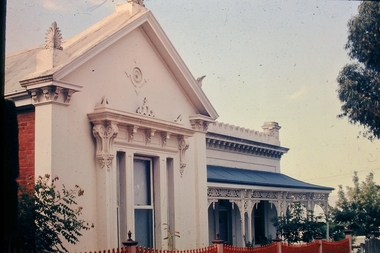 Bendigo Historical Society Inc.
Slide - No 10 Valentine Street Bendigo
... Set amongst a private garden on a corner allotment of approx. 827m2, the residence includes entrance hall, ornate formal Lounge Room, spacious renovated kitchen and family room, 4 Bedrooms plus a music room or office, Bathroom plus provision for 2nd bathroom or ensuite off the main Bedroom. ...Set amongst a private garden on a corner allotment of approx. 827m2, the residence includes entrance hall, ornate formal Lounge Room, spacious renovated kitchen and family room, 4 Bedrooms plus a music room or office, Bathroom plus provision for 2nd bathroom or ensuite off the main Bedroom. ...Situated walking distance from the city centre just off View Street is this superbly restored Victorian Residence displaying ornate treatment & style given to the house in 1880 by Bendigos famous architect William C. Vahland. Set amongst a private garden on a corner allotment of approx. 827m2, the residence includes entrance hall, ornate formal Lounge Room, spacious renovated kitchen and family room, 4 Bedrooms plus a music room or office, Bathroom plus provision for 2nd bathroom or ensuite off the main Bedroom. Large laundry, 2 toilets, downstairs includes large workshop, cellar and storage. Superb front & rear verandahs and private paved rear garden with double carport. The home is in excellent condition with loads of taste, style quality and charm. No 10 Valentine Street Bendigo - Slidehistory, bendigo, national trust collection bendigo, 10 valentine street -
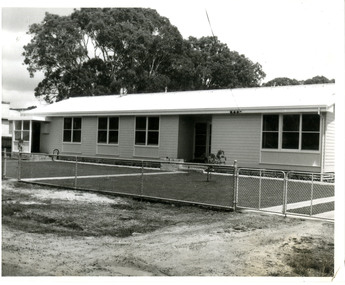 Victoria Police Museum
Police Stations (Apsley)
... The building was described, in 1930, as a four-roomed dwelling with an iron roof, set on a quarter of an acre of land. There was a bathroom, a WC, wash-house and a garage. ...The building was described, in 1930, as a four-roomed dwelling with an iron roof, set on a quarter of an acre of land. There was a bathroom, a WC, wash-house and a garage. ...Apsley is a small town in Victoria, Australia. It is on the Wimmera Highway, in the Shire of West Wimmera, 420 kilometres north-west of Melbourne, and 7 kilometres east of the South Australian border. Apsley Police Station opened on 29th November 1884 and was originally located in Wallace Street. It was staffed by one Foot Constable (motor cycle). The building was described, in 1930, as a four-roomed dwelling with an iron roof, set on a quarter of an acre of land. There was a bathroom, a WC, wash-house and a garage. An office adjoined the house and there was also a lockup. The station moved several times until the mid 1960s when a timber residence was moved onto land adjacent to the Post Office. The building is believed to have been transported from the Stawell area. Apsley is one of a handful of one-man police stations in Victoria and its current location, including residence, is at 19 Splatt Street. Apsley was in the Western District when it opened, then in "L" (Wimmera) District from January 1948 and "M" (Highlands/Wimmera) District from March 1990. 4 black & white photos, 1965 3 colour photos, 1987police stations; apsley police station -
 Warrnambool and District Historical Society Inc.
Household, Shaving mug & brush, Early 20th century
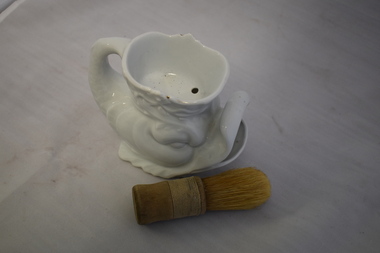
... This shaving set has no known local provenance and is kept for display purposes. bathroom accessories history of warrnambool This is a shaving set with a white china mug in the shape of a fish with a mouth where the excess water and lather are ejected and it has a handle in the shape of a fish’s tail. ...This shaving set was used, mostly by men, to lather the face prior to shaving. Ornamental mugs such as this one were often given as presents. Today most men use electric shavers. This shaving set has no known local provenance and is kept for display purposes.This is a shaving set with a white china mug in the shape of a fish with a mouth where the excess water and lather are ejected and it has a handle in the shape of a fish’s tail. The top open section that contains room for the lather and water has white ornamentation around the outer section and has three holes inside for drainage. There is evidence of some gilt decoration around the mouth and eye of the fish and the open top section but this is now mostly rubbed away. The brush has a wooden handle with cotton braiding and hair (probably horsehair). The brush is a little worn. bathroom accessories, history of warrnambool -
 Bendigo Military Museum
Photograph - Army Survey Regiment - Fortuna Interior, Bendigo, c1985
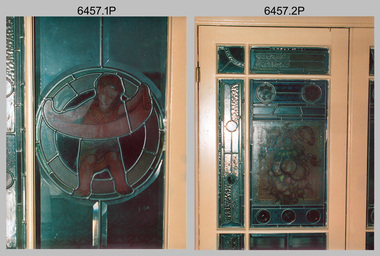
... Fortuna Villa – Main bathroom’s solid cedar toilet chest and water pitcher set. .8) to .14) - Photo, colour, c1985. ...Fortuna Villa – Main bathroom’s solid cedar toilet chest and water pitcher set. .8) to .14) - Photo, colour, c1985. ...This set of 22 photographs was taken inside Army Survey Regiment’s Fortuna Villa circa 1985. The photos feature some of Fortuna Villa’s interior. Unfortunately, the magnificent array of colours and hand-painted features of Fortuna’s leadlight windows are not highlighted with light transmission, as the photographer did not take the photos in the daytime. See item 6456.30P, for photos of Fortuna Villa’s exterior and The Army Survey Regiment’s out-buildings that were taken at the same time.This set of 22 photographs was taken inside Army Survey Regiment’s Fortuna Villa circa 1985. The colour photographs were printed on photographic paper and are part of the Army Survey Regiment’s Collection. The photographs were scanned at 300 dpi. .1) & .2) - Photo, colour, c1985. Fortuna Villa – Reception/Music Room leadlight windows. .3) - Photo, colour, c1985. Fortuna Villa – Entrance foyer door and leadlight windows. .4) - Photo, colour, c1985. Fortuna Villa – Entrance foyer vaulted ceiling. .5) - Photo, colour, c1985. Fortuna Villa – Dressing Room bay leadlight windows. .6) - Photo, colour, c1985. Fortuna Villa – Dressing Room wood panel wardrobe (concealed marble bath inside). .7) - Photo, colour, c1985. Fortuna Villa – Main bathroom’s solid cedar toilet chest and water pitcher set. .8) to .14) - Photo, colour, c1985. Fortuna Villa – Drawing Room bay leadlight windows. .15) to .16) - Photo, colour, c1985. Fortuna Villa – Cupola stairway leadlight windows. .17) - Photo, colour, c1985. Fortuna Villa – Dining/ballroom doorway with velvet wallpaper. .18) - Photo, colour, c1985. Fortuna Villa – Dining/ballroom. .19) - Photo, colour, c1985. Fortuna Villa – Billiard room’s timber vaulted ceiling. .20) & .21) - Photo, colour, c1985. Fortuna Villa – Top floor nursery samples of original wallpaper. .22) - Photo, colour, c1985. Fortuna Villa – Top floor ballroom/gymnasium’s elaborate vaulted ceiling.There are brief descriptions on a note behind each photograph.royal australian survey corps, rasvy, army survey regiment, army svy regt, fortuna, asr -
 Bendigo Historical Society Inc.
Album - Tui Mitchell Collection: "Greystanes" Photograph Album, 1990s
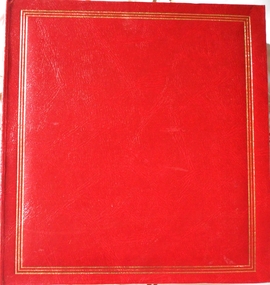
... sets of three gold coloured lines. The photographs are a record of the restoration of "Greystanes Manor" house including a restaurant, accommodation and reception rooms. It includes photographs of guest rooms, living rooms, kitchen areas, storage areas, fittings and furnishings, external areas, restoration works, bathrooms, gardens and staff members. ...sets of three gold coloured lines. The photographs are a record of the restoration of "Greystanes Manor" house including a restaurant, accommodation and reception rooms. It includes photographs of guest rooms, living rooms, kitchen areas, storage areas, fittings and furnishings, external areas, restoration works, bathrooms, gardens and staff members. ..."Greystanes" was originally "Hunter House" built at 57 Queen Street, Bendigo by Robert Hunter in 1882. Robert's brother William and his family lived there for almost 60 years. In 1945 the house was sold to Rex Hyett who renamed the house "Greystanes". Rex removed the original verandah and balcony and built the portico. There were several other owners before it was purchased by the Country Roads Board/ VicRoads where it was the local office for 36 years years (1958 - 1994). From the late 1990s "Greystanes" was restored by Bill and Tui Mitchell who operated it as accommodation, restaurant and reception rooms. New owners then turned it into a boutique hotel and conference centre. The current owners purchased "Greystanes" in 1910. It was renamed "Hunter House" and after extensive restorations was converted into a family home and business .Red leather covered three ring photograph album with fifty adhesive pages containing eighty nine coloured photographs, two letters and a two page printed wine list. Front of album has three gold coloured lines as a border and the spine has five horizontal sets of three gold coloured lines. The photographs are a record of the restoration of "Greystanes Manor" house including a restaurant, accommodation and reception rooms. It includes photographs of guest rooms, living rooms, kitchen areas, storage areas, fittings and furnishings, external areas, restoration works, bathrooms, gardens and staff members. The album also includes two letters of appreciation from guests who stayed at "Greystanes" and a two page wine list from the restaurant. The wine list includes wines from several local wineries.tui mitchell collection, greystanes, hunter house, william hunter, robert hunter, tui mitchell, bill mitchell -
 Ballarat Tramway Museum
Photograph - Colour Photograph/s - set of 10, Carolyn Dean and John Phillips, 30/07/2001 12:00:00 AM
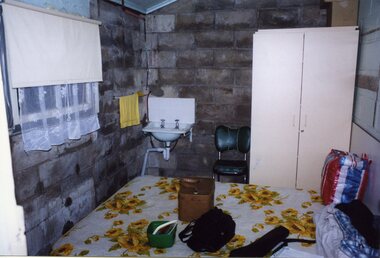
... Set of 10 colour photographs taken by John Phillips or Carolyn Dean of Bungaree House, property and works being carried out. Taken on 30.07.01 unless noted otherwise. On Kodak Paper. 1859.1 - Old bathroom...Set of 10 colour photographs taken by John Phillips or Carolyn Dean of Bungaree House, property and works being carried out. Taken on 30.07.01 unless noted otherwise. On Kodak Paper. 1859.1 - Old bathroom ...Set of 10 colour photographs taken by John Phillips or Carolyn Dean of Bungaree House, property and works being carried out. Taken on 30.07.01 unless noted otherwise. On Kodak Paper. 1859.1 - Old bathroom, now a bedroom .2 - New toilet area .3 - New bathroom area .4 - ditto .5 - extended kitchen .6 - dining area .7 - close up of extended kitchen - 15/7/01 .8 - close up of sink in old bathroom, now a bedroom - 15/7/01 .9 - Looking to the south from outside house, towards sheds and plenty of cows - 14/07/01 .10 - Looking at north end of house - 14/07/01.In blue ink on rear, date of photograph, and photographer.bungaree, houses -
 Emerald Museum & Nobelius Heritage Park
Domestic object - Writing equipment, 1900s
... set appears to be in Art Deco style, which suggests that it was in use at Carramar later in Carl Axel Nobelius' life, prior to his death in 1921, as the style became most popular in the years after the First World War. Carramar was the largest private residence in the area with sixteen rooms in addition to staff accommodations. A real estate listing from the sale of Carramar in 1941 indicates that it had five bedrooms, three reception areas, a large billiards room, two bathrooms...set appears to be in Art Deco style, which suggests that it was in use at Carramar later in Carl Axel Nobelius' life, prior to his death in 1921, as the style became most popular in the years after the First World War. Carramar was the largest private residence in the area with sixteen rooms in addition to staff accommodations. A real estate listing from the sale of Carramar in 1941 indicates that it had five bedrooms, three reception areas, a large billiards room, two bathrooms ...The item is a glass writing desk set used at Carramar, the family home of Carl Axel Nobelius, who founded the Gembrook Nurseries. Gembrook Nurseries were a major employer in the area, shipping fruit and decorative tree species around Australia and internationally. Carramar was the largest private residence in the area with sixteen rooms in addition to staff accommodations. The Nobelus family entertained several famous or important guests there, including Dame Nellie Melba and the Governor of Victoria, Sir Reginald Talbot. The desk set is thought to have been a gift to Carl Axel Nobelius and his wife Emily on the anniversary of their wedding. The Gembrook Nurseries, informally known as the Nobelius Nurseries after the founder Carl Axel Nobelius, began with the purchase of sixty-three acres in 1886 and boomed in the 1890s due to opportunities provided by employment-promoting schemes to develop public parks and gardens and street shade by local and State Governments around Australia. Trees were sold to more than forty councils and Government organisations in the 1890s, including the Department of Agriculture, Lands Department and Victorian Railways. The need to transport nursery products by train via Ferntree Gully rather than by bullock dray to Narre Warren was a factor in the successful petition to develop what is now known as the Puffing Billy Railway. Gembrook Nurseries had an indirect influence on the development of other farms and industries in the region. As a wholesale nursery with high sales volumes it was an important employer of local people. Peak season for employees was during the cooler months, during most farmers' off-season. This provided local farmers with a source of income while their own farms were becoming established. The desk set appears to be in Art Deco style, which suggests that it was in use at Carramar later in Carl Axel Nobelius' life, prior to his death in 1921, as the style became most popular in the years after the First World War. Carramar was the largest private residence in the area with sixteen rooms in addition to staff accommodations. A real estate listing from the sale of Carramar in 1941 indicates that it had five bedrooms, three reception areas, a large billiards room, two bathrooms, rooms for staff use and a separate six-room gardener's cottage as the home sat within extensive gardens. The Nobelus family entertained several famous or important guests there, including Dame Nellie Melba and the Governor of Victoria, Sir Reginald Talbot.The item is significant due to its association with the estate of Carl Axel Nobelius, a horticulturist whose business activities at the Gembrook Nurseries contributed to both the social and infrastructure development of Emerald and surrounds and the distribution of several plant species internationally.The item is a glass plate on small metal legs. Arranged across the surface of the glass plate are a metal rack suitable for holding letters, a square glass bottle with a metal lid sitting in a square metal receptacle which may have been used for ink and two metal brackets suitable for holding a pen. The metal used is silver-toned.carramar, carl axel nobelius, carl axel nobelius, gembrook nurseries, nobelius nursery, writing equipment, desk set, art deco
