
Showing 5 items matching "beam bending "
-
 Moorabbin Air Museum
Book - Aircraft engineering, Analysis and Design of Flight Vehicle Structures
... ...Beam bending & sheer stresses / membrane stresses / column & plate instabiity...Aircraft engineering Statically determinate structures Theory & methods for solving statically indeterminate structures Beam bending & sheer stresses / membrane stresses / column & plate instabiity Introduction to practical aircraft stress analysis Theory of elasticity & thermoelasticity Flight vehicle materials & their properties Strength of structural elements & composite structures Connections & design details Overview of the work of an aerospace structures engineer, circa 1973 Front / back covers wrapped in protectivce paper Analysis and Design of Flight Vehicle Structures Book Aircraft engineering ...Overview of the work of an aerospace structures engineer, circa 1973Front / back covers wrapped in protectivce papernon-fictionOverview of the work of an aerospace structures engineer, circa 1973statically determinate structures, theory & methods for solving statically indeterminate structures, beam bending & sheer stresses / membrane stresses / column & plate instabiity, introduction to practical aircraft stress analysis, theory of elasticity & thermoelasticity, flight vehicle materials & their properties, strength of structural elements & composite structures, connections & design details -
 Flagstaff Hill Maritime Museum and Village
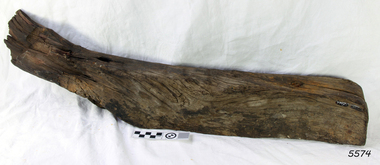
Functional object - Ship's Rib or Knee, before 1850
... beam. It is either a naturally bent piece of wood or wood cut into a bend like an elbow. ...beam. It is either a naturally bent piece of wood or wood cut into a bend like an elbow. ...This hanging knee was from the 1850 wreck of the schooner Enterprise. The 'hanging knee' or a 'ship's knee' is used for bracing a frame or supporting a beam. It is either a naturally bent piece of wood or wood cut into a bend like an elbow. The knee can be used in the frame of a boat or ship to spread load. THE “ENTERPRISE” 1847-1850 The wooden, two-masted schooner Enterprise was built in New Zealand in 1847 and registered in Melbourne, Australia. The Enterprise carried cargos of agricultural produce and other commodities for trade between the ports of the Colony. On September 14, 1850, the Enterprise was at anchor in Lady Bay under its Master, James Gardiner Caughtt, loaded with a cargo of wheat and potatoes. A strong south-easterly wind caused the vessel to drag on its only anchor and the rudder was lost. The gale-force wind blew it sideways and it became grounded. A local indigenous man, Buckawall, braved the rough sea to take a line from the shore to the Enterprise. All five members of the crew were able to make it safely to land. The Enterprise was wrecked. The Enterprise wreck was in an area called Tramway Jetty in Lady Bay. Since then the area became the location of the Lady Bay Hotel and now, in 2019, it is in the grounds of the Deep Blue Apartments. In fact, with the constantly changing coastline through built-up sand, the wreck site is now apparently under the No 2 Caravan Park on Pertobe Road, perhaps 150 metres from the high tide. Its location was found by Ian McKiggan (leader of the various searches in the 1980s for the legendary Mahogany Ship). DIFFERENTIATING the New Zealand Schooner “Enterprise” from John Fawkner’s “Enterprize“ Dr Murray Johns, Melbourne, says in his article The Mahogany Ship Story “… As I documented in 1985, the Warrnambool wreck was of an entirely different ship, also called Enterprize [with the spelling ‘Enterprise’], but built in New Zealand in 1847. Fawkner’s ship had already been sold to Captain Sullivan in 1845 and was wrecked on the Richmond Pier in northern New South Wales early in 1847. “ - (further details are in NOTES: and FHMV documents) The hanging knee is significant for its association wreck of the Victorian Heritage Listed schooner Enterprise, VHR S238, being a New Zealand built but Australian owned coastal trader. The wreck was also significant for its association with indigenous hero Buckawall who saved the lives of the five crew on board.Portion of a ship's rib; a hanging knee, wooden, from the schooner Enterprise, 1847-1850. flagstaff hill, warrnambool, shipwrecked-coast, flagstaff-hill, flagstaff-hill-maritime-museum, maritime-museum, shipwreck-coast, flagstaff-hill-maritime-village, hanging knee, ship's knee, knee bracing timber, wooden ship building, carpentry, shipwright trade, buckawall, lady bay, enterprise, coastal steamer, ship's rib, indigenous hero, indigenous rescue -
 Geelong Naval and Maritime Museum
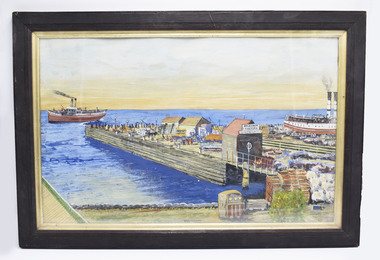
Painting, Excelsior Courier, Unsure
... Beam: 21 ft 1 in (6.43 m), Depth: 10 ft 7 in (3.23 m), First Owner: Huddart Parker & Co. A Timeline of SS Excelsior’s life: 15 Jan 1883 → the SS ‘Excelsior’ commenced the Melbourne to Geelong run. 27 Jan 1940 21 Jan 1890 →the SS ‘Flora’ ran aground whilst heading out to Hobart, Tasmania, on a tight bend in the Yarra River at Spotswood. ...Beam: 21 ft 1 in (6.43 m), Depth: 10 ft 7 in (3.23 m), First Owner: Huddart Parker & Co. A Timeline of SS Excelsior’s life: 15 Jan 1883 → the SS ‘Excelsior’ commenced the Melbourne to Geelong run. 27 Jan 1940 21 Jan 1890 →the SS ‘Flora’ ran aground whilst heading out to Hobart, Tasmania, on a tight bend in the Yarra River at Spotswood. ...The SS ‘Excelsior’ was an iron screw steamer, built in Southampton, England, in 1882 and first registered in Melbourne, Victoria, in 1882. Her journey from Southampton, England to Melbourne, Victoria is reported to have taken just 66 days. She would prove to be a very popular vessel on Port Phillip Bay, though her reign may have been relatively short as she was sunk in 1890. She was refloated sometime between 1890 to 1900 as some records state 1890, others at 1900. Gross Tonnage: 350, Net Tonnage: 172, Length: 186 ft 6 in (56.85 m), Beam: 21 ft 1 in (6.43 m), Depth: 10 ft 7 in (3.23 m), First Owner: Huddart Parker & Co. A Timeline of SS Excelsior’s life: 15 Jan 1883 → the SS ‘Excelsior’ commenced the Melbourne to Geelong run. 27 Jan 1940 21 Jan 1890 →the SS ‘Flora’ ran aground whilst heading out to Hobart, Tasmania, on a tight bend in the Yarra River at Spotswood. Whilst stuck fast in the mud, the SS ‘Excelsior’ ran into her stern – thankfully the damage to both vessels was only minor. 9 Jan 1897 → The SS ‘Excelsior’ sank the Ketch ‘Lu Lu’ on the south bank of the Hopetoun Channel near Geelong, Victoria. Blame is shared between Captains of both vessels: At the meeting of the Marine Board the report of the nautical expert committee, relative to the collision between the steamer Excelsior and ketch Lulu, was considered. The committee recommended that the matter should be remitted to the Marine Court, and a charge of misconduct preferred against Gilbert Moore, master of the Excelsior. Mr Wilson, one of the committee, dissented. He thought in view of the nature of the evidence charges should be preferred against both masters. Mr Dickens moved an amendment to the latter effect, but it was rejected, and the report adopted. 11 Jul 1899 → The SS ‘Edina’ sinks the SS ‘Excelsior’ during thick fog: Shortly after, half-past 11 o’clock this, morning a serious collision took place in Port Phillip Bay between the steamers Edina and the Excelsior. The Edina was on her way to Geelong, to which place she makes a trip every forenoon in the course of her trade with that port, and the Excelsior was coming up the bay to Melbourne. The weather was calm but thick, and a fog hung over the water. The Edina struck the Excelsior on the port side amidships, and she sank within a quarter of an hour. Both vessels carried a large number of passengers, and large cargoes, but there was very little excitement. The whole thing happened so suddenly that until the crash came those on board the steamers were not aware that any other boat was near at all. When both vessels began to draw away after the collision it was at once seen that the Excelsior was the most seriously injured of the two, and she at once began to settle down rapidly. Some of the Excelsior’s passengers were dragged on board the Edina at once, while the remainder, including the crew, were rescued by boats. As far as can be ascertained no one was drowned, but some 20 or 25 were injured. Dr. Wilson, headmaster of the Brighton Presbyterian Ladies’ College, was perhaps the most seriously injured of the Excelsior’s passengers. He was looking down the companion ladder ‘when the collision took place, and he was thrown violently below, sustaining a compound fracture of the right fore-arm. When attended to it was found, that he suffered severely from the shook of his fall and was rather in a bad way. A lady passenger by the Excelsior had her side lacerated, while another had her ankle sprained. The remainder of the others injured had either small cuts or were suffering from shock. The Excelsior went down stern first, and now lies in about five fathoms of water, with her bow above the surface. The Edina is almost uninjured, but she will be immediately placed in dock, as she is making water slightly. c 1900 → The SS ‘Excelsior’ was raised from her watery grave where a large cut can be seen on the SS Excelsior in dock and reveals the breach made and damage done by the Edina. c 1939 → Records regarding the SS ‘Excelsior’ are elusive until c 1939, when she was commissioned to relocate to Brisbane, Queensland, during the Second World War: The Excelsior came to Brisbane on a voyage north during the 1939-45 War. Being unseaworthy she could not be taken further and was used here as a workshop. After the war, she was discarded on Bishop Island. c 1946 → Sometime after WWII was over, the SS ‘Excelsior’ joined many a ship in the graveyard at Bishop Island in Queensland. The island has been the site for the disposal of many ships. Ships recorded as being discarded here include the Groper, Adonis, Roderick Dhu, Excelsior, Yosemite, Maida, Civility, Captain Cook, Bingera, St. Kilda, Lucinda, Moreton, Miner, Schnapper, Lochiel, Queensland, Victoria, and BadgerThe SS Excelsior is a well known ship from the history of Geelong. Its collision with the equally well known SS Edina is of particular interest to Geelong. She was a famous ship in the reckon of Port Phillip despite her short life stand, especially when compared to the SS Edina. Colour painting of ship departingship collision, ship wreck, ss excelsior, ss edina, bishop island -
Moorabbin Air Museum
Book - Aircraft structures, Airplane Structures
... Aircraft structures Design procedures Critical loading conditions Reactions Beams Torsion Truss analysis Graphical methods Ties & columns Connections Bending & compression Description of application of fundamental principles of structural theory to aircraft design, circa 1929 Airplane Structures Book Aircraft structures ...Description of application of fundamental principles of structural theory to aircraft design, circa 1929non-fictionDescription of application of fundamental principles of structural theory to aircraft design, circa 1929design procedures, critical loading conditions, reactions, beams, torsion, truss analysis, graphical methods, ties & columns, connections, bending & compression -
Moorabbin Air Museum
Book - Aircraft design, Aircraft Layout and Detail Design
... Aircraft design Requirements for a good layout Descriptive geometry Airfoils General design condsiderations Connections Forgings Castings Machined fittings Fitting analysis Strength calculations for riveted & bolted joints Bending Torsion Shear & its application to thin web beams Columns Overview of aircraft detail design, circa 1946 Aircraft Layout and Detail Design Book Aircraft design ...Overview of aircraft detail design, circa 1946non-fictionOverview of aircraft detail design, circa 1946requirements for a good layout, descriptive geometry, airfoils, general design condsiderations, connections, forgings, castings, machined fittings, fitting analysis, strength calculations for riveted & bolted joints, bending, torsion, shear & its application to thin web beams, columns
