
Showing 60 items matching "bed linen."
-
 Numurkah & District Historical Society
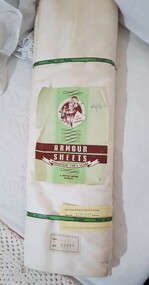
Bed linen - sheets
... Bed linen - sheets...bed linen, sheets, Armour...bed linen, sheets, Armour 1938 Armour Bed sheets still in original packaging Bed linen - sheets ...1938 Armour Bed sheets still in original packaging bed linen, sheets, armour -
 Bendigo Historical Society Inc.
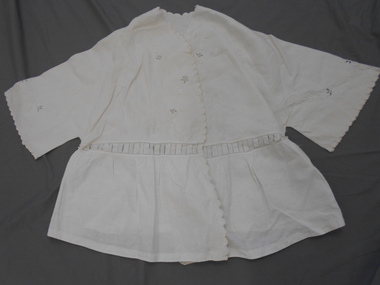
Clothing - WHITE LINEN BED JACKET, Early 1900's
... WHITE LINEN BED JACKET......white linen bed jacket...They would be 80+ years old. The linen bed jacket would be about the same age....Clothing WHITE LINEN BED JACKET ...All edges (except hemline) ie sleeves, and centre front, including neck edge, are finished in perle thread, buttonhole stitched two cm wide scallops. Satin stitch, and cut work embroidery, in a floral design, are on the lower edge of the short sleeves and on the front bodice.The waistline has a four cm wide band of ribbon, in an insertion design,- but there is no ribbon insertion evident. This would be the only form of closure, from the waistline a slightly gathered panel,22cm deep, gives a peplum effect. Hemline is faced with a 1.7cm wide cotton facing. The ribbon insertion panel has alternating 1.2cm wide floral embroidered ribbon and one cm wide plain ribbon. Magyer sleeves-extending from the side seam just above the waistline - bodice all one piece of fabric - no seams.Accompaning note - No date. The bloomers (11400.931), belonged to Antoinette Catling of Bendigo and were part of her trousseaux. They would be 80+ years old. The linen bed jacket would be about the same age.costume, female, white linen bed jacket -
 Flagstaff Hill Maritime Museum and Village
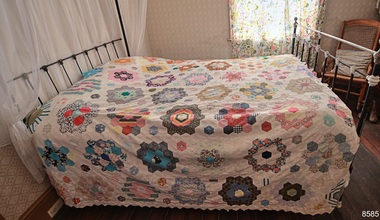
Textile - Bedspread, patchwork, 1976
... ...bed linen...It is made from reproduction fabric and quilt designs and represents the bed linen typical of a late 19th-century bedroom. ...It is made from reproduction fabric and quilt designs and represents the bed linen typical of a late 19th-century bedroom. ...This patchwork quilt or bedspread is a modern creation along the lines of the traditional 1800s handmade English paper piecing patchwork quilting craft. It is made from reproduction fabric and quilt designs and represents the bed linen typical of a late 19th-century bedroom. Years ago, patchwork was a form of recycling, where leftover or previously used pieces of fabric were used to create other useful item such as quilts, rugs, cushion covers and jackets. Special projects were sometimes made with fabrics representing special memories, such as pieces from baby clothes, wedding gowns, and school uniforms. The maker would use a cardboard template shaped like a hexagon, place it onto the fabric and trace around it. Often the cardboard was cut from a box such as a cereal box. Women would gather to work on their patchwork while enjoying their social time together. As in the case of this quilt, members of the South Western Branch of the Embroiderers Guild in Warrnambool worked on the project, designing and quilting as a group to achieve their aim, of presenting the quilt to the recently opened Flagstaff Hill Maritime Museum. It was the first Group Project of the Branch which was formed in 1974. In 1975 the members decided to make a Quilt as a project to promote the formation of friendship and togetherness. Under the foundation Treasurer, Rita Williams, members sourced their own fabrics for the 'flowers' which were then stitched into the calico borders. Provision was made for the quilt to be hung for display, with the addition of loops along one edge. The local disability services employees and members cut out octagonal paper batches and used their own fabrics to piece them together. The Branch's first exhibition raised funds for buying fabric and equipment to assemble the patchwork. The quilt was perfectly suited to dress the bed in the Lighthouse Keeper's Cottage. This carefully created and designed, recently made patchwork bedspread typifies bedding and handcraft of the late 19th century. The English paper patchwork technique was used. The quilt was the first community project of the South Western Branch of the Embroiderers' Guild of Victoria, and presented as an addition to the Lighthouse Keeper's Cottage tat Flagstaff Hill. Patchwork quilt or bedspread, double bed size, made from hundreds of hexagonal-shaped fabric of various colours and patterns, carefully stitched onto a white background. It was made using the English paper patchwork technique. One edge of the quilt has loops dispersed at regular intervals. This would allow the quit to be used as a wall hanging. It was handmade by the South Western Branch of The Embroiders Guild, Victoria, and presented to Flagstaff Hill Maritime Museum and Village in 1976. An inscription is embroidered in blue on a patch of the quilt. "Made and Presented by The Embroiderers Guild, Victoria (S.W. Branch) 1976"flagstaff hill, flagstaff hill maritime museum and village, warrnambool, maritime museum, maritime village, great ocean road, shipwreck coast, bedspread, patchwork quilt, quilt, embroiderers guild, bedding, bed linen, 1800's handcraft, quilting, south west branch, warrnambool embroiders guild, recycled fabric, 19th century, household textiles, english paper patchwork, paper patchwork technique -
 Mont De Lancey
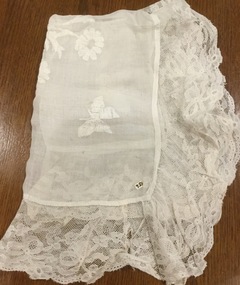
Pillow sham, Mrs. Frances Quayle, 1897
... bed linen....bed linen. bed accessories. Off-white, muslin pillow sham with shadow embroidery depicting flowers, leaves, a bow and two butterflies in opposite corners. ...Off-white, muslin pillow sham with shadow embroidery depicting flowers, leaves, a bow and two butterflies in opposite corners. It has a 10 cm. wide scalloped, white lace border.bed linen., bed accessories. -
 Flagstaff Hill Maritime Museum and Village
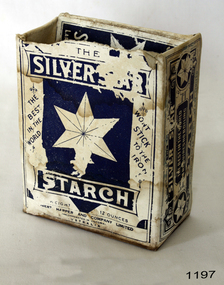
Decorative object - Starch, Robert Harper & Co, ca. 1890 to 1940
... ...bed linen...Starch was used by many households in the late 19th and the 20th century to give linen and uniformsa firm feeling. flagstaff hill warrnambool flagstaff-hill-maritime-museum shipwreck-coast starch silver star starch blue star Robert Harper and Co Ltd . laundry laundering washing bed linen table linen decorative linen "The Silver Star Starch" "Robert Harper &O Co." ...Starch is used during the laundry process to give fabric a feeling of stiffness. It is used often for linen, shirts and blouses. This box still has the remnants of starch inside it.Starch was used by many households in the late 19th and the 20th century to give linen and uniformsa firm feeling.Box: cardboard rectangular box, blue and white with star graphic. Contents inside. "The Silver Star Starch" Robert Harper and Co Ltd . "The Silver Star Starch" "Robert Harper &O Co."flagstaff hill, warrnambool, flagstaff-hill-maritime-museum, shipwreck-coast, starch, silver star starch, blue star, robert harper and co ltd ., laundry, laundering, washing, bed linen, table linen, decorative linen -
 Flagstaff Hill Maritime Museum and Village
Textile - Bedspread, Vera and Aurelia Giles, 1880+
... ...bed linen...The Giles family collection has social significance at a local level, because it illustrates the level of material support the Warrnambool community gave to Flagstaff Hill when the Museum was established. warrnambool flagstaff-hill-maritime-museum giles collection henry giles tower hill cooramook mailor’s flat vera & aurelin giles bedspread double bed bedspread bed linen quilt embossed cotton Bedspread, double bed size, white self-embossed floral pattern. ...There are many 19th century items of furniture, linen and crockery donated to Flagstaff Hill Maritime Village by Vera and Aurelin Giles. The items are associated with the Giles Family and are known as the “Giles Collection”. These items mostly came from the simple home of Vera’s parents-in-law, Henry Giles and his wife Mary Jane (nee Freckleton), whose photos are in the parlour. They married in 1880. Henry Giles was born at Tower Hill in 1858. He was a labourer on the construction of the Breakwater before leaving in 1895 to build bridges in N.S.W. for about seven years. Mary Jane was born in 1860 at Cooramook. She attended Mailor’s Flat State School where she was also a student teacher before, as family legend has it, she became a governess at “Injemiara” where her grandfather, Francis Freckleton, once owned land. Henry and Mary’s family of six, some of whom were born at Mailor’s Flat and later children at Wangoom, lived with their parents at Wangoom and Purnim west, where Henry died in 1933 and Mary Jane in 1940. The Giles family collection has social significance at a local level, because it illustrates the level of material support the Warrnambool community gave to Flagstaff Hill when the Museum was established.Bedspread, double bed size, white self-embossed floral pattern.warrnambool, flagstaff-hill-maritime-museum, giles collection, henry giles, tower hill, cooramook, mailor’s flat, vera & aurelin giles, bedspread, double bed bedspread, bed linen, quilt, embossed cotton -
 Flagstaff Hill Maritime Museum and Village
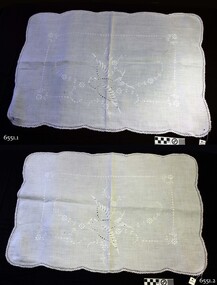
Textile - Pillow Shams, Daisy Dale, 1844-1900
... ...bed linen...Flagstaff Hill Warrnambool Flagstaff Hill Maritime Museum and Village Great Ocean Road Chamberlain family Dale family Lees Family Betty Stone Warrnambool Pioneer Warrnambool genealogy Wangoom Chamberlain Dale Lees collection glory box handmade craft manchester linen haberdashery needlework crochet pillow shams bed linen pillow covers Daisy Dale Daisy Welsh Betty Stone's mother A pair of white pillow shams, rectangular in shape with a shallow scalloped crochet edge. ...The two embroidered pillow shams were made by Betty Stones's mother Daisy (nee Dale) Welsh. A number of crocheted and embroidered articles were donated to Flagstaff Hill Museum by Betty Stone who advised that they cover a period of three generations from Sarah (nee Chamberlain) Lees, Ann (nee Lees) Dale, and Daisy Elvena (nee Dale) Welsh. All three were accomplished needlewomen, both Sarah Lees (born 1844) and her daughter, Ann (1865) these women crocheted a wide variety of articles for use in their homes. Today we have a few surviving examples of their skill that has survived the years.This item and others in the collection donated by Betty Stone are significant for their association with the early Warrnambool pioneering families of Chamberlain, Dale and Lees. These families are listed in the "Pioneers' Register" for Warrnambool Township and Shire, 1835-1900, and published by A.I.G.S. Warrnambool Branch. The item is a fine example of early 20th-century needlework and handmade domestic items.A pair of white pillow shams, rectangular in shape with a shallow scalloped crochet edge. The embroidered central design includes a bird motif. Made by Daisy Walsh (nee Dale). Part of the Chamberlain Dale Lees Collection.flagstaff hill, warrnambool, flagstaff hill maritime museum and village, great ocean road, chamberlain family, dale family, lees family, betty stone, warrnambool pioneer, warrnambool genealogy, wangoom, chamberlain dale lees collection, glory box, handmade, craft, manchester, linen, haberdashery, needlework, crochet, pillow shams, bed linen, pillow covers, daisy dale, daisy welsh, betty stone's mother -
 City of Moorabbin Historical Society (Operating the Box Cottage Museum)
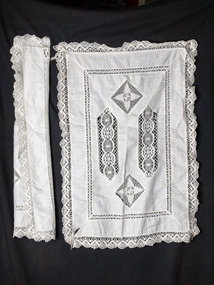
Haberdashery, Pillow Shams 1 pair white cotton,c1900, c1900
... clothing, haberdashery, crochet, bed linen, doilies, brighton, moorabbin, pioneers, dressmaking, market gardeners, early settlers, craftwork , bentleigh, lacework, moorabbin shire, hunt ailsa, dairy farms, fruit orchards...These pillow shams are examples of the dressmaking, crochet and needlework skills of the women of the early settler families in Moorabbin Shire c1900 clothing, haberdashery, crochet, bed linen, doilies, brighton, moorabbin, pioneers, dressmaking, market gardeners, early settlers, craftwork , bentleigh, lacework, moorabbin shire, hunt ailsa, dairy farms, fruit orchards 1 pair of white cotton pillow shams with crochet lace inserts Haberdashery, Pillow Shams 1 pair white cotton,c1900 Family of Ailsa Hunt ...This pair of white cotton pillow shams were made by women of the early settler families in Moorabbin Shire c1900 and show their needlework skills . Although living conditions were basic families still held onto their traditional English and European customs and took pride in presenting elements of refined society. These pillow shams are examples of the dressmaking, crochet and needlework skills of the women of the early settler families in Moorabbin Shire c1900 1 pair of white cotton pillow shams with crochet lace inserts clothing, haberdashery, crochet, bed linen, doilies, brighton, moorabbin, pioneers, dressmaking, market gardeners, early settlers, craftwork , bentleigh, lacework, moorabbin shire, hunt ailsa, dairy farms, fruit orchards -
 Flagstaff Hill Maritime Museum and Village
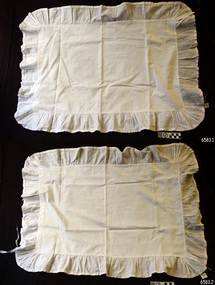
Pillowslip
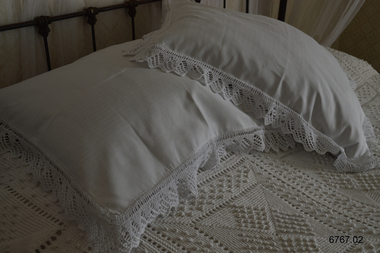
... ...bed linen...flagstaff hill warrnambool shipwrecked-coast flagstaff-hill flagstaff-hill-maritime-museum maritime-museum shipwreck-coast flagstaff-hill-maritime-village pillowslip pillow case bed linen Pillowslips (2), white with 3 fine pleats along each side, with frill 34" x 24" (3�" frill included in measurement). ...Pillowslips (2), white with 3 fine pleats along each side, with frill 34" x 24" (3�" frill included in measurement). Originally belonged to Mrs Vera Willsher and are approx 84 years old.flagstaff hill, warrnambool, shipwrecked-coast, flagstaff-hill, flagstaff-hill-maritime-museum, maritime-museum, shipwreck-coast, flagstaff-hill-maritime-village, pillowslip, pillow case, bed linen -
 Flagstaff Hill Maritime Museum and Village
Textile - Pillow Case, Mary Jane Giles (Mrs Harry Giles), Late 19th to Early 20th Century
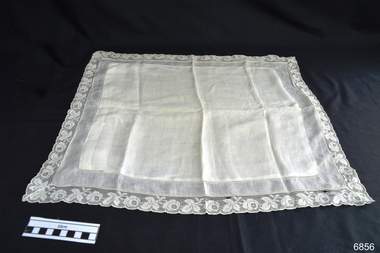
... ...bed linen...But the Giles collection also gives us today a snapshot into what domestic life was like in early colonial times prior to Federation. warrnambool shipwrecked-coast flagstaff-hill flagstaff-hill-maritime-museum shipwreck-coast flagstaff-hill-maritime-village manchester pillowcases hand crafted pillowcases bed linen giles collection henry giles tower hill warrnambool breakwater mailor’s flat wangoom 19th century household goods Textiles None Pillow Cases (2), white, with hand knitted lace border. ...These pillow cases are are of many 19th century items of furniture, linen and crockery donated to Flagstaff Hill Maritime Village by, Vera and Aurelin Giles. The items are associated with Warrnambool and the Giles Family history. Items donated by the family have come to be known as the “Giles Collection”. Many items in the Lighthouse Keeper’s Cottage were donated by Vera and Aurelin Giles and mostly came from the home of Vera’s parents-in-law, Henry Giles and his wife Mary Jane (nee Freckleton) who married in 1880 and whose photos are on display in the parlour. Henry was born at Tower Hill in 1858, and was a labourer on the construction of the Warrnambool Breakwater before leaving in 1895 for around seven years to build bridges in NSW. Mary Jane was born in 1860 at Cooramook and she attended Mailor’s Flat State School and where she eventually was to become a student teacher. After which she became a governess at “Injemiara” where her grandfather, Francis Freckleton, had once owned land. Henry and Mary’s family consisted of six, some of the children were born at Mailor’s Flat and later some children at Wangoom. They lived with their parents at Wangoom and Purnim west, and this is where Henry died in 1933 and Mary Jane in 1940. The Giles family collection is of social significance at a local level, because it not only illustrates the level of material support the Warrnambool community gave to Flagstaff Hill during it’s establishment. But the Giles collection also gives us today a snapshot into what domestic life was like in early colonial times prior to Federation.Pillow Cases (2), white, with hand knitted lace border. (Giles Collection)Nonewarrnambool, shipwrecked-coast, flagstaff-hill, flagstaff-hill-maritime-museum, shipwreck-coast, flagstaff-hill-maritime-village, manchester, pillowcases, hand crafted pillowcases, bed linen, giles collection, henry giles, tower hill, warrnambool breakwater, mailor’s flat, wangoom, 19th century household goods, textiles -
 Flagstaff Hill Maritime Museum and Village
Pillowcase, 29th century
... ...bed linen...Dr Angus assisted Dr Tom Ryan, a pioneer in the use of X-rays and in ocular surgery. flagstaff hill warrnambool shipwrecked coast flagstaff hill maritime museum maritime museum shipwreck coast flagstaff hill maritime village great ocean road dr w r angus pillowcase bed linen Pillowcase, part of the W.R. Angus Collection. ...This pillowcase was donated to Flagstaff Hill Maritime Village by the family of Doctor William Roy Angus, Surgeon and Oculist. It is part of the “W.R. Angus Collection” that includes historical medical equipment, surgical instruments and material once belonging to Dr Edward Ryan and Dr Thomas Francis Ryan, (both of Nhill, Victoria) as well as Dr Angus’ own belongings. The Collection’s history spans the medical practices of the two Doctors Ryan, from 1885-1926 plus that of Dr Angus, up until 1969. ABOUT THE “W.R.ANGUS COLLECTION” Doctor William Roy Angus M.B., B.S., Adel., 1923, F.R.C.S. Edin.,1928 (also known as Dr Roy Angus) was born in Murrumbeena, Victoria in 1901 and lived until 1970. He qualified as a doctor in 1923 at University of Adelaide, was Resident Medical Officer at the Royal Adelaide Hospital in 1924 and for a period was house surgeon to Sir (then Mr.) Henry Simpson Newland. Dr Angus was briefly an Assistant to Dr Riddell of Kapunda, then commenced private practice at Curramulka, Yorke Peninsula, SA, where he was physician, surgeon and chemist. In 1926, he was appointed as new Medical Assistant to Dr Thomas Francis Ryan (T.F. Ryan, or Tom), in Nhill, Victoria, where his experiences included radiology and pharmacy. In 1927 he was Acting House Surgeon in Dr Tom Ryan’s absence. Dr Angus had become engaged to Gladys Forsyth and they decided he further his studies overseas in the UK in 1927. He studied at London University College Hospital and at Edinburgh Royal Infirmary and in 1928, was awarded FRCS (Fellow from the Royal College of Surgeons), Edinburgh. He worked his passage back to Australia as a Ship’s Surgeon on the on the Australian Commonwealth Line’s T.S.S. Largs Bay. Dr Angus married Gladys in 1929, in Ballarat. (They went on to have one son (Graham 1932, born in SA) and two daughters (Helen (died 12/07/1996) and Berenice (Berry), both born at Mira, Nhill ) According to Berry, her mother Gladys made a lot of their clothes. She was very talented and did some lovely embroidery including lingerie for her trousseau and beautifully handmade baby clothes. Dr Angus was a ‘flying doctor’ for the A.I.M. (Australian Inland Ministry) Aerial Medical Service in 1928 . Its first station was in the remote town of Oodnadatta, where Dr Angus was stationed. He was locum tenens there on North-South Railway at 21 Mile Camp. He took up this ‘flying doctor’ position in response to a call from Dr John Flynn; the organisation was later known as the Flying Doctor Service, then the Royal Flying Doctor Service. A lot of his work during this time involved dental surgery also. Between 1928-1932 he was surgeon at the Curramulka Hospital, Yorke Peninsula, South Australia. In 1933 Dr Angus returned to Nhill and purchased a share of the Nelson Street practice and Mira hospital (a 2 bed ward at the Nelson Street Practice) from Dr Les Middleton one of the Middleton Brothers, the current owners of what previously once Dr Tom Ryan’s practice. Dr Tom and his brother had worked as surgeons included eye surgery. Dr Tom Ryan performed many of his operations in the Mira private hospital on his premises. He had been House Surgeon at the Nhill Hospital 1902-1926. Dr Tom Ryan had one of the only two pieces of radiology equipment in Victoria during his practicing years – The Royal Melbourne Hospital had the other one. Over the years Dr Tom Ryan had gradually set up what was effectively a training school for country general-practitioner-surgeons. Each patient was carefully examined, including using the X-ray machine, and any surgery was discussed and planned with Dr Ryan’s assistants several days in advance. Dr Angus gained experience in using the X-ray machine there during his time as assistant to Dr Ryan. When Dr Angus bought into the Nelson Street premises in Nhill he was also appointed as the Nhill Hospital’s Honorary House Surgeon 1933-1938. His practitioner’s plate from his Nhill surgery is now mounted on the doorway to the Port Medical Office at Flagstaff Hill Maritime Village, Warrnambool. When Dr Angus took up practice in the Dr Edward and Dr Tom Ryan’s old premises he obtained their extensive collection of historical medical equipment and materials spanning 1884-1926. A large part of this collection is now on display at the Port Medical Office at Flagstaff Hill Maritime Village in Warrnambool. In 1939 Dr Angus and his family moved to Warrnambool where he purchased “Birchwood,” the 1852 home and medical practice of Dr John Hunter Henderson, at 214 Koroit Street. (This property was sold in1965 to the State Government and is now the site of the Warrnambool Police Station. and an ALDI sore is on the land that was once their tennis court). The Angus family was able to afford gardeners, cooks and maids; their home was a popular place for visiting dignitaries to stay whilst visiting Warrnambool. Dr Angus had his own silk worm farm at home in a Mulberry tree. His young daughter used his centrifuge for spinning the silk. Dr Angus was appointed on a part-time basis as Port Medical Officer (Health Officer) in Warrnambool and held this position until the 1940’s when the government no longer required the service of a Port Medical Officer in Warrnambool; he was thus Warrnambool’s last serving Port Medical Officer. (Masters of immigrant ships arriving in port reported incidents of diseases, illness and death and the Port Medical Officer made a decision on whether the ship required Quarantine and for how long, in this way preventing contagious illness from spreading from new immigrants to the residents already in the colony.) Dr Angus was a member of the Australian Medical Association, for 35 years and surgeon at the Warrnambool Base Hospital 1939-1942, He served as a Surgeon Captain during WWII1942-45, in Ballarat, Victoria, and in Bonegilla, N.S.W., completing his service just before the end of the war due to suffering from a heart attack. During his convalescence he carved an intricate and ‘most artistic’ chess set from the material that dentures were made from. He then studied ophthalmology at the Royal Melbourne Eye and Ear Hospital and created cosmetically superior artificial eyes by pioneering using the intrascleral cartilage. Angus received accolades from the Ophthalmological Society of Australasia for this work. He returned to Warrnambool to commence practice as an ophthalmologist, pioneering in artificial eye improvements. He was Honorary Consultant Ophthalmologist to Warrnambool Base Hospital for 31 years. He made monthly visits to Portland as a visiting surgeon, to perform eye surgery. He represented the Victorian South-West subdivision of the Australian Medical Association as its secretary between 1949 and 1956 and as chairman from 1956 to 1958. In 1968 Dr Angus was elected member of Spain’s Barraquer Institute of Barcelona after his research work in Intrasclearal cartilage grafting, becoming one of the few Australian ophthalmologists to receive this honour, and in the following year presented his final paper on Living Intrasclearal Cartilage Implants at the Inaugural Meeting of the Australian College of Ophthalmologists in Melbourne In his personal life Dr Angus was a Presbyterian and treated Sunday as a Sabbath, a day of rest. He would visit 3 or 4 country patients on a Sunday, taking his children along ‘for the ride’ and to visit with him. Sunday evenings he would play the pianola and sing Scottish songs to his family. One of Dr Angus’ patients was Margaret MacKenzie, author of a book on local shipwrecks that she’d seen as an eye witness from the late 1880’s in Peterborough, Victoria. In the early 1950’s Dr Angus, painted a picture of a shipwreck for the cover jacket of Margaret’s book, Shipwrecks and More Shipwrecks. She was blind in later life and her daughter wrote the actual book for her. Dr Angus and his wife Gladys were very involved in Warrnambool’s society with a strong interest in civic affairs. He had an interest in people and the community They were both involved in the creation of Flagstaff Hill, including the layout of the gardens. After his death (28th March 1970) his family requested his practitioner’s plate, medical instruments and some personal belongings be displayed in the Port Medical Office surgery at Flagstaff Hill Maritime Village, and be called the “W. R. Angus Collection”. The W.R. Angus Collection is significant for still being located at the site it is connected with, Doctor Angus being the last Port Medical Officer in Warrnambool. The collection of medical instruments and other equipment is culturally significant, being an historical example of medicine from late 19th to mid-20th century. Dr Angus assisted Dr Tom Ryan, a pioneer in the use of X-rays and in ocular surgery. Pillowcase, part of the W.R. Angus Collection. Small pillowcase, fine white cotton fabric with ribbon closure and lace border. flagstaff hill, warrnambool, shipwrecked coast, flagstaff hill maritime museum, maritime museum, shipwreck coast, flagstaff hill maritime village, great ocean road, dr w r angus, pillowcase, bed linen -
 Flagstaff Hill Maritime Museum and Village
Pillowcase, early to mid 1900's
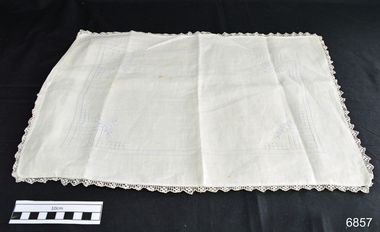
... ...bed linen...Dr Angus assisted Dr Tom Ryan, a pioneer in the use of X-rays and in ocular surgery. flagstaff hill warrnambool shipwrecked coast flagstaff hill maritime museum maritime museum shipwreck coast flagstaff hill maritime village great ocean road dr w r angus pillowcase handmade pillowcase bed linen Pillowcase, fine white cotton, with pale blue embroidered detail and white crocheted border. ...This pillowcase was donated to Flagstaff Hill Maritime Village by the family of Doctor William Roy Angus, Surgeon and Oculist. It is part of the “W.R. Angus Collection” that includes historical medical equipment, surgical instruments and material once belonging to Dr Edward Ryan and Dr Thomas Francis Ryan, (both of Nhill, Victoria) as well as Dr Angus’ own belongings. The Collection’s history spans the medical practices of the two Doctors Ryan, from 1885-1926 plus that of Dr Angus, up until 1969. ABOUT THE “W.R.ANGUS COLLECTION” Doctor William Roy Angus M.B., B.S., Adel., 1923, F.R.C.S. Edin.,1928 (also known as Dr Roy Angus) was born in Murrumbeena, Victoria in 1901 and lived until 1970. He qualified as a doctor in 1923 at University of Adelaide, was Resident Medical Officer at the Royal Adelaide Hospital in 1924 and for a period was house surgeon to Sir (then Mr.) Henry Simpson Newland. Dr Angus was briefly an Assistant to Dr Riddell of Kapunda, then commenced private practice at Curramulka, Yorke Peninsula, SA, where he was physician, surgeon and chemist. In 1926, he was appointed as new Medical Assistant to Dr Thomas Francis Ryan (T.F. Ryan, or Tom), in Nhill, Victoria, where his experiences included radiology and pharmacy. In 1927 he was Acting House Surgeon in Dr Tom Ryan’s absence. Dr Angus had become engaged to Gladys Forsyth and they decided he further his studies overseas in the UK in 1927. He studied at London University College Hospital and at Edinburgh Royal Infirmary and in 1928, was awarded FRCS (Fellow from the Royal College of Surgeons), Edinburgh. He worked his passage back to Australia as a Ship’s Surgeon on the on the Australian Commonwealth Line’s T.S.S. Largs Bay. Dr Angus married Gladys in 1929, in Ballarat. (They went on to have one son (Graham 1932, born in SA) and two daughters (Helen (died 12/07/1996) and Berenice (Berry), both born at Mira, Nhill ) According to Berry, her mother Gladys made a lot of their clothes. She was very talented and did some lovely embroidery including lingerie for her trousseau and beautifully handmade baby clothes. Dr Angus was a ‘flying doctor’ for the A.I.M. (Australian Inland Ministry) Aerial Medical Service in 1928 . Its first station was in the remote town of Oodnadatta, where Dr Angus was stationed. He was locum tenens there on North-South Railway at 21 Mile Camp. He took up this ‘flying doctor’ position in response to a call from Dr John Flynn; the organisation was later known as the Flying Doctor Service, then the Royal Flying Doctor Service. A lot of his work during this time involved dental surgery also. Between 1928-1932 he was surgeon at the Curramulka Hospital, Yorke Peninsula, South Australia. In 1933 Dr Angus returned to Nhill and purchased a share of the Nelson Street practice and Mira hospital (a 2 bed ward at the Nelson Street Practice) from Dr Les Middleton one of the Middleton Brothers, the current owners of what previously once Dr Tom Ryan’s practice. Dr Tom and his brother had worked as surgeons included eye surgery. Dr Tom Ryan performed many of his operations in the Mira private hospital on his premises. He had been House Surgeon at the Nhill Hospital 1902-1926. Dr Tom Ryan had one of the only two pieces of radiology equipment in Victoria during his practicing years – The Royal Melbourne Hospital had the other one. Over the years Dr Tom Ryan had gradually set up what was effectively a training school for country general-practitioner-surgeons. Each patient was carefully examined, including using the X-ray machine, and any surgery was discussed and planned with Dr Ryan’s assistants several days in advance. Dr Angus gained experience in using the X-ray machine there during his time as assistant to Dr Ryan. When Dr Angus bought into the Nelson Street premises in Nhill he was also appointed as the Nhill Hospital’s Honorary House Surgeon 1933-1938. His practitioner’s plate from his Nhill surgery is now mounted on the doorway to the Port Medical Office at Flagstaff Hill Maritime Village, Warrnambool. When Dr Angus took up practice in the Dr Edward and Dr Tom Ryan’s old premises he obtained their extensive collection of historical medical equipment and materials spanning 1884-1926. A large part of this collection is now on display at the Port Medical Office at Flagstaff Hill Maritime Village in Warrnambool. In 1939 Dr Angus and his family moved to Warrnambool where he purchased “Birchwood,” the 1852 home and medical practice of Dr John Hunter Henderson, at 214 Koroit Street. (This property was sold in1965 to the State Government and is now the site of the Warrnambool Police Station. and an ALDI sore is on the land that was once their tennis court). The Angus family was able to afford gardeners, cooks and maids; their home was a popular place for visiting dignitaries to stay whilst visiting Warrnambool. Dr Angus had his own silk worm farm at home in a Mulberry tree. His young daughter used his centrifuge for spinning the silk. Dr Angus was appointed on a part-time basis as Port Medical Officer (Health Officer) in Warrnambool and held this position until the 1940’s when the government no longer required the service of a Port Medical Officer in Warrnambool; he was thus Warrnambool’s last serving Port Medical Officer. (Masters of immigrant ships arriving in port reported incidents of diseases, illness and death and the Port Medical Officer made a decision on whether the ship required Quarantine and for how long, in this way preventing contagious illness from spreading from new immigrants to the residents already in the colony.) Dr Angus was a member of the Australian Medical Association, for 35 years and surgeon at the Warrnambool Base Hospital 1939-1942, He served as a Surgeon Captain during WWII1942-45, in Ballarat, Victoria, and in Bonegilla, N.S.W., completing his service just before the end of the war due to suffering from a heart attack. During his convalescence he carved an intricate and ‘most artistic’ chess set from the material that dentures were made from. He then studied ophthalmology at the Royal Melbourne Eye and Ear Hospital and created cosmetically superior artificial eyes by pioneering using the intrascleral cartilage. Angus received accolades from the Ophthalmological Society of Australasia for this work. He returned to Warrnambool to commence practice as an ophthalmologist, pioneering in artificial eye improvements. He was Honorary Consultant Ophthalmologist to Warrnambool Base Hospital for 31 years. He made monthly visits to Portland as a visiting surgeon, to perform eye surgery. He represented the Victorian South-West subdivision of the Australian Medical Association as its secretary between 1949 and 1956 and as chairman from 1956 to 1958. In 1968 Dr Angus was elected member of Spain’s Barraquer Institute of Barcelona after his research work in Intrasclearal cartilage grafting, becoming one of the few Australian ophthalmologists to receive this honour, and in the following year presented his final paper on Living Intrasclearal Cartilage Implants at the Inaugural Meeting of the Australian College of Ophthalmologists in Melbourne In his personal life Dr Angus was a Presbyterian and treated Sunday as a Sabbath, a day of rest. He would visit 3 or 4 country patients on a Sunday, taking his children along ‘for the ride’ and to visit with him. Sunday evenings he would play the pianola and sing Scottish songs to his family. One of Dr Angus’ patients was Margaret MacKenzie, author of a book on local shipwrecks that she’d seen as an eye witness from the late 1880’s in Peterborough, Victoria. In the early 1950’s Dr Angus, painted a picture of a shipwreck for the cover jacket of Margaret’s book, Shipwrecks and More Shipwrecks. She was blind in later life and her daughter wrote the actual book for her. Dr Angus and his wife Gladys were very involved in Warrnambool’s society with a strong interest in civic affairs. He had an interest in people and the community They were both involved in the creation of Flagstaff Hill, including the layout of the gardens. After his death (28th March 1970) his family requested his practitioner’s plate, medical instruments and some personal belongings be displayed in the Port Medical Office surgery at Flagstaff Hill Maritime Village, and be called the “W. R. Angus Collection”. The W.R. Angus Collection is significant for still being located at the site it is connected with, Doctor Angus being the last Port Medical Officer in Warrnambool. The collection of medical instruments and other equipment is culturally significant, being an historical example of medicine from late 19th to mid-20th century. Dr Angus assisted Dr Tom Ryan, a pioneer in the use of X-rays and in ocular surgery. Pillowcase, fine white cotton, with pale blue embroidered detail and white crocheted border. Part of the W.R. Angus Collection.flagstaff hill, warrnambool, shipwrecked coast, flagstaff hill maritime museum, maritime museum, shipwreck coast, flagstaff hill maritime village, great ocean road, dr w r angus, pillowcase, handmade pillowcase, bed linen -
 Whitehorse Historical Society Inc.
Domestic object - Counterpane, C 1900
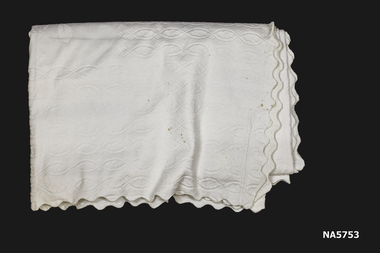
... Domestic bed linen.... - Scalloped edging appears to be machine made. Domestic bed linen Nil - C 1900 - White cotton counterpane - Scallop edging with blanket stitching - embossed self-pattern with self-border Domestic object Counterpane ...- Family considers it to be created early 20th century. - Scalloped edging appears to be machine made.- C 1900 - White cotton counterpane - Scallop edging with blanket stitching - embossed self-pattern with self-borderNildomestic bed linen -
 Friends of Westgarthtown
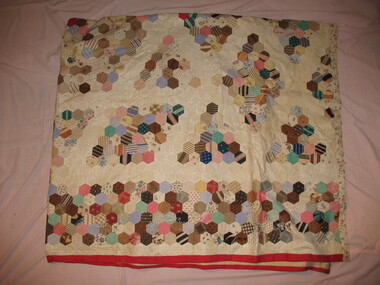
Textile - Quilt
... ...bed linen...manchester needlework quilt hexagonal bed linen handicrafts No visible markings Large cream quilt with red edging, decorated on front with hexagonal pieces of various materials. ...Large cream quilt with red edging, decorated on front with hexagonal pieces of various materials. Backed with cream materialNo visible markingsmanchester, needlework, quilt, hexagonal, bed linen, handicrafts -
 Mont De Lancey
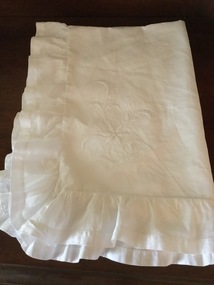
Functional object - Pillowcase, Unknown
... ...bed linen...pillowcases bed linen A large white cotton embroidered pillowcase with a wide frill. ...A large white cotton embroidered pillowcase with a wide frill. It has two white cotton covered buttons at the opening. There is floral embroidery on four corners.pillowcases, bed linen -
 Mont De Lancey
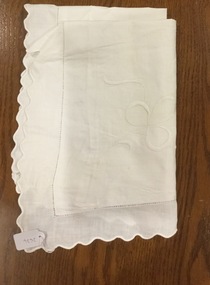
Tablecloth and pillow slip
... ...bed linen....table ware. bed linen. household textiles. White, nylon tablecloth with lace star in the centre, surrounded by lace lines, with embroidered crystal shapes within lace in each corner. ...White, nylon tablecloth with lace star in the centre, surrounded by lace lines, with embroidered crystal shapes within lace in each corner. White, linen pillow slip with an embroidered flower and leaves in each corner. It has a pulled thread and embroidered, scalloped border, (Torn)table ware., bed linen., household textiles. -
 Mont De Lancey
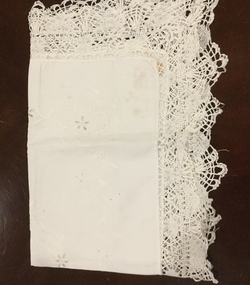
Pillow Sham
... bed linen...bed linen A pair of white cotton pillow shams with a white, hand-embroidered floral design and a 7 cm. crocheted lace border. ...A pair of white cotton pillow shams with a white, hand-embroidered floral design and a 7 cm. crocheted lace border.bed linen -
 Bendigo Historical Society Inc.
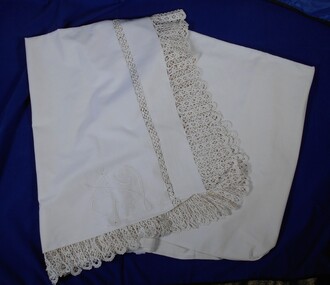
Textile - FAVALORO COLLECTION: BED-SPREAD PART OF MATCHING SET WITH PILLOW CASES, Late 1800-1900's
... ...Woven linen bed spread...Textiles. Finely woven linen bed spread, white in colour, and with a ''turn-back'' top to come over or under the pillows. ...TEXTILES Domestic Woven linen bed spread Textiles. Finely woven linen bed spread, white in colour, and with a ''turn-back'' top to come over or under the pillows. ...Textiles. Finely woven linen bed spread, white in colour, and with a ''turn-back'' top to come over or under the pillows. A 10.5 cm deep band of cotton lace trims the edge of this turn-back, and is gathered around the two lower corners, and extends 74 cm. along the side edges of the turn-back. An insert of lace, 2.5 cm wide, also outlines the turn-back, 8 cm from the edge of the linen. The lace trim has a scalloped edge, and a corded effect. Above the narrow band of lace, are beautifully embroidered initials CF. Some small red cotton embroidery on top hem-left hand corner. Embroidered in white cotton satin stitch, the initials are embellished with floral motifs and leaves, and some embroidered eyelets May be the initials of Caterina (Ina) Lamaro who married Giovanni "Jack" Favaloro, or Caterina "Kitty" Lopes who married Salvatoro "Salve" Favaloro.textiles, domestic, woven linen bed spread -
 Mont De Lancey
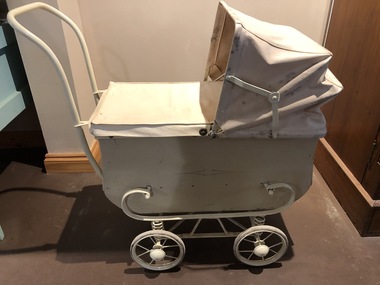
Dolls Pram
... Has an old fashioned doll and bed-linen in the pram....Has an old fashioned doll and bed-linen in the pram. Dolls Pram ...Wooden, cream painted doll's pram with a vinyl collapsible hood and cover. Four spring wheel with rubber tyres, and a metal handle. Has an old fashioned doll and bed-linen in the pram.dolls prams -
 City of Moorabbin Historical Society (Operating the Box Cottage Museum)
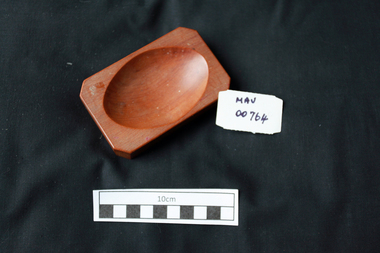
Sewing equipment, wooden pin tray, c1920
... Early settlers in Moorabbin Shire had to be self reliant and the women made their own clothes, bed linen and tableware as they established homes and farms for their families...Early settlers in Moorabbin Shire had to be self reliant and the women made their own clothes, bed linen and tableware as they established homes and farms for their families The Family of Mrs Nance Blackburn were early settlers in Moorabbin Shire c 1880 dressmaking crochet work metal pins pioneers early settlers moorabbin bentleigh cheltenham blackburn nance A polished wood tray used by women to hold pins when dressmaking, crocheting or mending clothes and linen c1920 Sewing equipment, wooden pin tray Family of Mrs Nance Blackburn ...Early settlers in Moorabbin Shire had to be self reliant and the women made their own clothes, bed linen and tableware as they established homes and farms for their familiesThe Family of Mrs Nance Blackburn were early settlers in Moorabbin Shire c 1880A polished wood tray used by women to hold pins when dressmaking, crocheting or mending clothes and linen c1920 dressmaking, crochet work, metal pins, pioneers, early settlers, moorabbin, bentleigh, cheltenham, blackburn nance -
 Flagstaff Hill Maritime Museum and Village
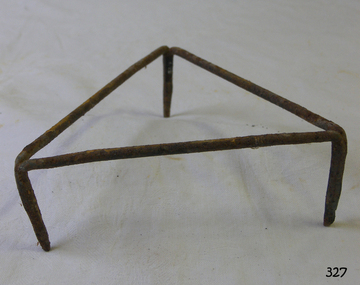
Domestic object - Iron stand
... Households from the 18th century onwards used a hot iron to removed wrinkles and creases in fabric such as clothing, table and bed linen This simple iron stand provided a rest for a hot iron between use during an ironing session and a place for the iron to cool when the session was completed. ...Households from the 18th century onwards used a hot iron to removed wrinkles and creases in fabric such as clothing, table and bed linen This simple iron stand provided a rest for a hot iron between use during an ironing session and a place for the iron to cool when the session was completed. ...Households from the 18th century onwards used a hot iron to removed wrinkles and creases in fabric such as clothing, table and bed linen This simple iron stand provided a rest for a hot iron between use during an ironing session and a place for the iron to cool when the session was completed. This item is associated with domestic life during the 19th and early 20th centuries. Triangular shaped stand made from metal rods welded together at feet. Painted black.flagstaff hill, flagstaff hill maritime museum and village, warrnambool, maritime museum, maritime village, great ocean road, shipwreck coast, iron stand, triangular iron stand, ironing, laundry equipment -
 Embroiderers Guild, Victoria
Domestic Object - Irish Knotted Work Bed Cover, 18th Century
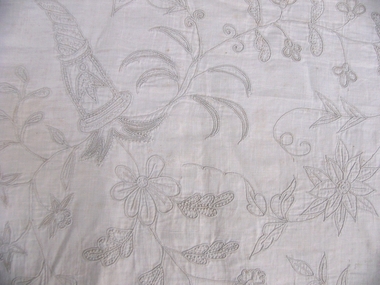
... Knotted linen thread couched onto white linen bed cover. ...Embroidery Whitework Bedcover 18th Century Ireland Knotted linen thread couched onto white linen bed cover. Domestic Object Irish Knotted Work Bed Cover ...Donor's mother brought this from the west of Ireland in 1950. Said to have been embroidered by her grandmother and her ladies in 1780-1800. (This may be a later rather than actual date). Knotting was a genteel pastime for leisured ladies requiring little concentration, so conversation could be carried out. Favoured at Court and practised in England in the late 17th C in William and Mary's reign and Queen Anne's reign in the early 18th C.Knotting was a genteel pastime for leisured ladies requiring little concentration, so conversation could be carried out. Favoured at Court and practised in England in the late 17th C in William and Mary's reign and Queen Anne's reign in the early 18th C. A knotting shuttle, larger than a tatting shuttle, made knots at every quarter inch or 6 mm intervals in string, linen, silk or wool. Mrs Mary Delaney enjoyed knotting and preferred linen thread which was stronger. The Ulster Museum in Belfast holds an embroidered bedcover by Delany, one of the few complete pieces of embroidery made by her. The threads between the knots was dependent on the thickness of the thread. This fashionable occupation was often mocked by men, Sir Charles Sedley, a wit and libertine wrote a verse mocking Queen Mary, the dull Protestant wife of William 111: "Blest we, who from such queens are freed/ Who, buy vain superstition led,/ Are always telling beads;/But here's a queen now, thanks to God/ Who, when she rides in Coach abroad/ Is always knotting threads. In the Spectator of 1712 it was suggested that men might take up knotting. Dr Johnson attempted to learn the skill but told Boswell "I once tried knotting: Dempster's sister undertook to teach me, but I could not learn it." Knotted linen thread couched onto white linen bed cover. embroidery, whitework, bedcover, 18th century, ireland -
 Orbost & District Historical Society
darning mushroom, 1950's
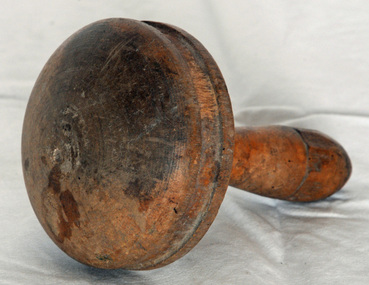
... The mushroom was used to make repairs to clothing and bed linen....The mushroom was used to make repairs to clothing and bed linen. This darning tool was an essential item in 19th and early 20th century household as self-reliant women often had to make and repair all their clothing. darning-mushroom needlework handicraft domestic A mushroom-shaped piece of smooth wood used to stretch and support material being darned. darning mushroom ...The darning mushroom would have been an essential tool in an era when women were constantly repairing worn socks.Before the common use of synthetic materials, socks and other items of clothing were in constant need of repair. Darning would have been considered a necessary skill for girls and young women, part of their education as future wives and mothers. The mushroom was used to make repairs to clothing and bed linen.This darning tool was an essential item in 19th and early 20th century household as self-reliant women often had to make and repair all their clothing.A mushroom-shaped piece of smooth wood used to stretch and support material being darned.darning-mushroom needlework handicraft domestic -
 Mont De Lancey
Textile - Tablecloth, Unknown
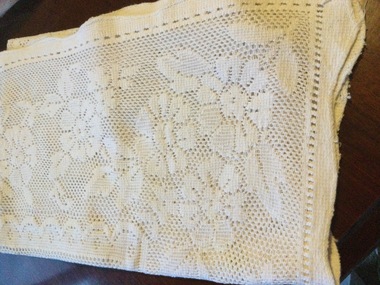
... Included were napkins, bed linens, tea towels and various cloths for every household function and were to sustain the bride and her future family throughout their lifetime together....Included were napkins, bed linens, tea towels and various cloths for every household function and were to sustain the bride and her future family throughout their lifetime together. tablecloths Cloths Table linen Household textiles A white lace rectangular tablecloth with a floral pattern and wide scalloped edge. ...Tablecloths were used to protect the table from damage when in use with cutlery, chinaware and general use. More decorative white cloths were used for special occasions and to show general position in society or wealth. The trousseau of a young woman in the 1900's consisted essentially of how many tablecloths she had collected - her dowry in many ways showed the more linen she had the wealthier she was. Included were napkins, bed linens, tea towels and various cloths for every household function and were to sustain the bride and her future family throughout their lifetime together.A white lace rectangular tablecloth with a floral pattern and wide scalloped edge.tablecloths, cloths, table linen, household textiles -
 City of Moorabbin Historical Society (Operating the Box Cottage Museum)
Furniture - 'Glory Box', c1900
... A large wooden box used by families to store linen, bed coverings, and clothing as part of a bride's trousseau while preparing for the wedding and afterwards as a store for these items c 20thC...A large wooden box used by families to store linen, bed coverings, and clothing as part of a bride's trousseau while preparing for the wedding and afterwards as a store for these items c 20thC The Green family were early settlers in Moorabbin Shire and this glory box is an example of household furniture items used c1900 clothing moorabbin furniture wedding bentleigh market gardeners early settlers green carol trousseau glory box A large, wooden box with dome-shaped lid and brass lock c20thC Furniture 'Glory Box' ...A large wooden box used by families to store linen, bed coverings, and clothing as part of a bride's trousseau while preparing for the wedding and afterwards as a store for these items c 20thCThe Green family were early settlers in Moorabbin Shire and this glory box is an example of household furniture items used c1900A large, wooden box with dome-shaped lid and brass lock c20thCclothing, moorabbin, furniture, wedding, bentleigh, market gardeners, early settlers, green carol, trousseau, glory box -
 Bendigo Historical Society Inc.
Textile - FAVALORO COLLECTION: EMBROIDERED AND LACE TRIMMED PILLOW CASES, Late 1800-1900's
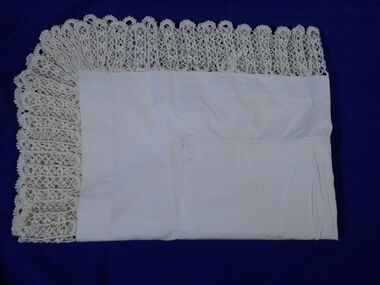
... It could be presumed that these pillow slips would be a decorative feature of the bed linen. As on the bedspread, lavishly embroidered initials may be the initials of Caterina (Ina) Lamaro, who married Giovanni (Jack) Favaloro, or Caterina (Kitty) Lopes, who married Salvatore (Salve) Favaloro....It could be presumed that these pillow slips would be a decorative feature of the bed linen. As on the bedspread, lavishly embroidered initials may be the initials of Caterina (Ina) Lamaro, who married Giovanni (Jack) Favaloro, or Caterina (Kitty) Lopes, who married Salvatore (Salve) Favaloro. ...Textiles. Large pieces of linen, 119 cm x 96 cm edged with a border, 8.5 cm deep of cotton lace, matching the lace of the bedspread. This lace has a corded effect, outlining 'finger shapes' of floral pattern, alternating with an open chain stitch, looped effect. Like the bedspread, the pillowcase is embroidered with the initials in satin stitch and some cut work embroidery. A smaller rectangle of linen fabric is stitched to the back of the fabric, to hold a pillow in place. Measuring 81 cm. x 48 cm. This envelope is tied with three ties of cotton tape. It could be presumed that these pillow slips would be a decorative feature of the bed linen. As on the bedspread, lavishly embroidered initials may be the initials of Caterina (Ina) Lamaro, who married Giovanni (Jack) Favaloro, or Caterina (Kitty) Lopes, who married Salvatore (Salve) Favaloro.textiles, domestic, two embroidered and lace pillow cases -
 Embroiderers Guild, Victoria
Textile - 18th C Pillow Cover, 1704
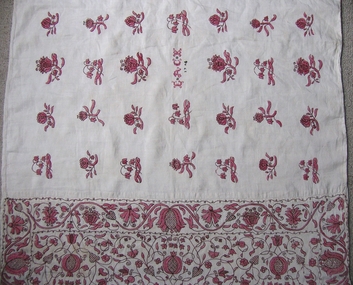
... Possibly made from a larger bed hanging. Fine white linen, embroidered in the Jacobean style with linen thread in pink and white, and outlined in a fine gilt, now tarnished. ...(cross stitch) Possibly made from a larger bed hanging. Fine white linen, embroidered in the Jacobean style with linen thread in pink and white, and outlined in a fine gilt, now tarnished. ...Possibly made from a larger bed hanging. Fine white linen, embroidered in the Jacobean style with linen thread in pink and white, and outlined in a fine gilt, now tarnished. Main area has 34 floral motifs. There is a 230 mm band in a pattern of scrolling flowers and pomegranates.1704 E.A.C.K. (cross stitch)embroidery, pillow cases, 18th century, england -
 Bendigo Historical Society Inc.
Clothing - FINE WHITE COTTON, SPLIT DRAWERS, 1850's-1900's
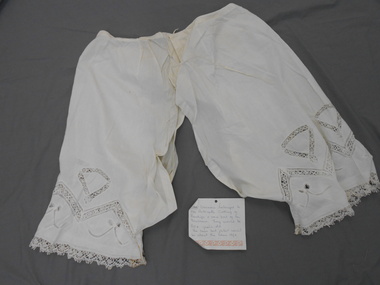
... They would be 80+ years old. The linen bed jacket (11400.930) would be about the same age....They would be 80+ years old. The linen bed jacket (11400.930) would be about the same age. ...Fine white cotton, with a drawstring in a 1.5xcm deep casing around the waistline. Completely opened at centre front, through crotch, and up the centre back to within 14cm of the waistline. One dart on either side of front, and two darts on either side of back. Machine stitched. A 2.5cm wide cotton lace is inset into a zig zag pattern around each leg. In each V shape a 1.5cm lace insert in a fan,under the V shapes are inserted needle woven bows, shape is inserted. Seven extremely fine pin tucks border the edge of the legs, which have a three cm wide lace edging. Split drawers were worn in the era when women wore corsets. The split front and back allowed women to go to the toilet, as the corsets could not be removed to allow for an act of nature.Accompanying note - No date. The bloomers belonged to Miss Antoinette Catling of Bendigo and were part of her trousseaux. They would be 80+ years old. The linen bed jacket (11400.930) would be about the same age.costume, female, fine white cotton split drawers -
 Flagstaff Hill Maritime Museum and Village
Textile - Bolster Sham, Eliza Towns, Late 19th century to early 20th century
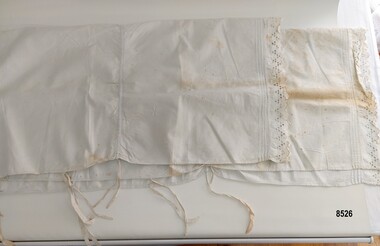
... Eliza probably had a treadle sewing machine and would have made many of her own clothes and household linens - adding her own handmade embroidered or crocheted decorative trim. Most beds during the late 19th and early 20th century had a feather, hair or spring mattress covered by a blanket and topped with an under sheet, an upper sheet, several blankets and a bedspread. ...Eliza probably had a treadle sewing machine and would have made many of her own clothes and household linens - adding her own handmade embroidered or crocheted decorative trim. Most beds during the late 19th and early 20th century had a feather, hair or spring mattress covered by a blanket and topped with an under sheet, an upper sheet, several blankets and a bedspread. ...This bolster sham is one of several linen and clothing items that were made and belonged to Mrs. Eliza Towns and donated to Flagstaff Hill Maritime Museum and Village. Eliza was born Eliza Gould in 1857 in South Melbourne (Emerald Hill) and in 1879 married Charles Towns. In the early 1880's they moved to Nhill in western Victoria and remained there for the rest of their married life. Charles was a jeweller and later became an accountant and for many years was involved with the Shire Council, the local show committee (A & P Society), the Hospital Committee and the Board of the local newspaper (the Nhill Free Press). They had three children and lived a life that would be regarded as comfortably "middle class". Eliza probably had a treadle sewing machine and would have made many of her own clothes and household linens - adding her own handmade embroidered or crocheted decorative trim. Most beds during the late 19th and early 20th century had a feather, hair or spring mattress covered by a blanket and topped with an under sheet, an upper sheet, several blankets and a bedspread. A flat bolster could be placed either under the pillows or on top of the pillows with a decorative sham. Washing pillows and quilts by hand would have been a very onerous task (involving heating water and handwashing in a tub or using a copper) and so it became the practise of many housewives to cover the pillows and bolsters with an outer slip (or sham) of washable material which could be easily removed and washed when needed. If the bolster was kept under the pillows it wouldn't need to be very decorative but many shams or slips that were "on show" were often highly decorated with embroidery, pintucks, ribbons or lace. This bolster sham is machine made and quite plain with the exception of some pintucking and eyelet lace on each end which suggests that it would mostly be hidden under the top pillows with just the decorative edges on display.This item is an example of the needlework skills of women in the early 20th century - combining machine stitching with hand embroidery to personalise and embellish a practical domestic object. It is also significant as an example of an early 20th century innovation that helped make the working lives of housewives a little bit easier.A long white cotton rectangular bolster sham, machine sewn, with seven ties and two buttons (plus one missing button) to enable it to be folded over lengthwise and closed. It has two pull string ties near each end to enclose a bolster and is finished with a decorative edge of pintucks and handmade eyelet lace and embroidery.flagstaff hill maritime museum and village, eliza towns, sham, bedding, great ocean road, shipwreck coast, warrnambool, household textiles, sewing, bolster sham, housework, pillow sham, charles towns, nhill, haberdashery, needlework, manchester, handmade, household linen -
Glenelg Shire Council Cultural Collection
Domestic object - Bed Sheets, 1850s
... Three pieces of linen joined length ways by hand stitching. Items hand stitched. Domestic object Bed Sheets ...Arrived on the "John Davies" 9/11/1852 - Portland. The JOhn Davies arrived in Portland in November of 1852 having left Liverpool, England in July 1852.Fawn in colour and has been dyed. Three pieces of linen joined length ways by hand stitching. Items hand stitched.immigration, liverpool, manchester, domestic item
