
Showing 6 items matching "bedroom equipment"
-
 Mont De Lancey
Domestic object - Vanity Set
... Bedroom equipment...While lavish dressing table or "toilet sets" emerged during the Victorian period, production peaked between the 1900s and the 1930s. Bedroom equipment Art Deco vanity sets Dressing table sets The celluloid dual toothed straight comb has: 'Made in England' There is an 'elephant' outline between the words 'Made in' and 'England'. ...Antique celluloid "French Ivory" bedroom mirror and brush sets became popular mass-market luxury items in the late 19th and early 20th centuries. Celluloid, invented in the 1860s, was the world's first successful thermoplastic. Manufacturers marketed it as "French Ivory," "Ivorine," or "Ivory Pyralin" to mimic genuine elephant ivory at an affordable price point. While lavish dressing table or "toilet sets" emerged during the Victorian period, production peaked between the 1900s and the 1930s. Seven antique pieces of an art deco bedroom vanity set made from celluloid or Ivory Celluloid to appear ivory like. The pieces include: 1. A shoehorn with a hole at the end to hang it up. 2. A narrow clothes brush with natural bristles. 3. Two hair combs, one with a curved handle the other celluloid straight dual toothed one has a manufacturing stamp on the back. 4. Two hand mirrors, one oval, the other round - both have bevelled edges. 5 . A flat tray with curved shaped raised edging to hold the pieces.The celluloid dual toothed straight comb has: 'Made in England' There is an 'elephant' outline between the words 'Made in' and 'England'.bedroom equipment, art deco vanity sets, dressing table sets -
 Bendigo Military Museum
Photograph - Typesetting Equipment and Personnel, Army Survey Regiment, Fortuna, Bendigo, c1968 to 1979
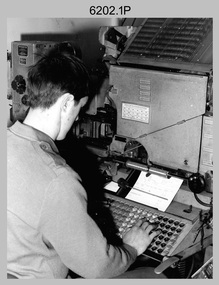
... This is a set of nine photographs of cartographic typesetting equipment and personnel in Cartographic Squadron at the Army Survey Regiment, Fortuna, Bendigo circa 1968 to 1979. The rooms on the top floor of Fortuna Villa where the photos were taken were formally the nursery and boys bedrooms during the Lansell family’s occupation of the building. ...This is a set of nine photographs of cartographic typesetting equipment and personnel in Cartographic Squadron at the Army Survey Regiment, Fortuna, Bendigo circa 1968 to 1979. The rooms on the top floor of Fortuna Villa where the photos were taken were formally the nursery and boys bedrooms during the Lansell family’s occupation of the building. ...This is a set of nine photographs of cartographic typesetting equipment and personnel in Cartographic Squadron at the Army Survey Regiment, Fortuna, Bendigo circa 1968 to 1979. The rooms on the top floor of Fortuna Villa where the photos were taken were formally the nursery and boys bedrooms during the Lansell family’s occupation of the building. The Fotosetter type setting machine replaced the letterpress method of type production in 1956. Its operator entered the text using a type order provided by cartographic draughtsmen/ draughtswomen. The type was output on a film positive, which was contacted onto strip film. The text was cut out by cartographic draughtsmen/ draughtswomen and affixed onto type sheets using bees wax. Cartographic Squadron’s CPL Arty Lane specialised in the operation of the Fotosetter type setting machine for many years, as shown in photos .3P and .4P. For more information on the Fotosetter, see page 71 of Valerie Lovejoy’s book 'Mapmakers of Fortuna – A history of the Army Survey Regiment’ ISBN: 0-646-42120-4. The computer based Editwriter Model 7500 typesetting system was introduced in 1975 as a replacement to the aging Fotosetter. It was operated by a specialised technician, who generated a large variety of map type styles and sizes quickly and reliably, as well as text panels. Output on Copy proof adhesive backed stripping type film replaced messy wax and spray adhesives in 1978. The Editwriter capability supported all RASvy units and its contractor type setting requirements. SGT Jim McDonald operated the Editwriter for a couple of years in the late 1970’s. He is seen in photos .7P and .8P. reading off a type order and entering text into the computer. See item 6181.23P, photo .1P for a reduced scale photo of SGT Jim McDonald undertaking this task. Also see item 6123.12P photos .1P and .2P featuring CPL Paul Richards, who was another technician that operated the Editwriter for several years in the 1980s. The Editwriter was also operated by SSGT Pat Lumsden, as featured in photo .9P taken in 1979. The Monotype Photolettering Machine seen in photos .5P and .6P is understood to be in service for a shorter period, as it was not as productive compared to the Fotosetter and Editwriter. This is a set of nine photographs of cartographic typesetting equipment at the Army Survey Regiment, Fortuna, Bendigo, c1968 to c1979. Black and white photos are on photographic paper and scanned at 300 dpi. .1) - Photo, black & white, c1960s, Fotosetter type setting machine, unidentified technician. .2) - Photo, black & white, c1960s, Fotosetter type setting machine. .3) to .4) - Photo, black & white, c1968, Fotosetter type setting machine, CPL Arty Lane. .5) to .6) - Photo, black & white, c1970s, Monotype Photolettering Machine, unidentified technician. .7) to .8) - Photo, black & white, c1979, Typesetting machine, ‘Editwriter’ Model 7500, SGT Jim McDonald. .9) - Photo, black & white, 1979, Typesetting machine, ‘Editwriter’ Model 7500, SSGT Pat Lumsden.Personnel and equipment are identified in photos .1P to .3P. on a card. A description is provided: ‘Fotosetter: This model was used from 1956 to 1974. Where photograph was taken: Army Survey Regiment. Person in Photograph: Arty Lane. Approx date photograph taken: 1968. Any Misc Information: All type on maps was set on this machine. The operator of the machine (Ex SGT Lane) joined the Army in 1956 and was discharged in 1977. Also with Survey from 1942 to 1946. Information given by: Arty Lane’. Photo .9P is dated 1979 on the back.’royal australian survey corps, rasvy, army survey regiment, army svy regt, fortuna, asr, carto -
 Bendigo Historical Society Inc.
Document - Coolock or Denderah House - A brief History and Auction, 1959 and 1991
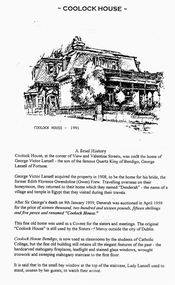
... Artworks (oil paintings, watercolors, prints, miniatures) Decorative items (marble sculptures, ormolu, cloisonné, porcelain, silverware)Household goods (rugs, curtains, carpets, kitchenware, linen, glassware) Collectibles (books, musical instruments, clocks, sporting goods, firearms) Garden and outdoor items (garden seats, pot plants, tools)Staff quarters and utility items (beds, wardrobes, kitchen equipment) Several pieces by renowned makers (Waring and Gillow, London) Unique items such as an exhibition French ornamental bedroom suite made for the Paris Exposition of 1880, and items from the "Fortuna" collection A wide range of silver and crystal tableware, antique carpets, and rare collectiblesStructure and Organization The catalog is organized by room and area (Drawing Room, Dining Room, Study, Bedrooms, Hall, Yard, Kitchen, Staff Quarters, etc.), with each lot described in detail....Artworks (oil paintings, watercolors, prints, miniatures) Decorative items (marble sculptures, ormolu, cloisonné, porcelain, silverware)Household goods (rugs, curtains, carpets, kitchenware, linen, glassware) Collectibles (books, musical instruments, clocks, sporting goods, firearms) Garden and outdoor items (garden seats, pot plants, tools)Staff quarters and utility items (beds, wardrobes, kitchen equipment) Several pieces by renowned makers (Waring and Gillow, London) Unique items such as an exhibition French ornamental bedroom suite made for the Paris Exposition of 1880, and items from the "Fortuna" collection A wide range of silver and crystal tableware, antique carpets, and rare collectiblesStructure and Organization The catalog is organized by room and area (Drawing Room, Dining Room, Study, Bedrooms, Hall, Yard, Kitchen, Staff Quarters, etc.), with each lot described in detail. bendigo fortuna george lansell coolck house denderah denderah auction george victor lansell edith lansell edith frew catholic college sisters of mercy Coolock House - A brief History and Auction This item contains the following document: 11217.59a A black and white brochure of Coolock House in 1991 with a brief history and a sketch of the house 11217.59b The auction catalog (24 pages) and sale notice for the estate of the late Sir George Lansell, held at his residence "Denderah" in Bendigo on April 7th and 8th, 1959. ...Coolock House, on the corner of View and Valentine Streets in Bendigo has a rich history marked by notable ownership and varied uses. Acquired in 1908 by George Victor Lansell, son of Bendigo's famous "Quartz King" George Lansell, as a home for himself and his bride, Edith Florence Gwendoline (Gwen) Frew. The couple named the house "Denderah" after a village and temple in Egypt they visited on their honeymoon. After Sir George's death in January 1959, the property was auctioned and renamed "Coolock House." It Served as a convent for the Sisters of Mercy and as a venue for meetings. The original "Coolock House" name is also associated with a Sisters of Mercy house outside Dublin. Currently, Coolock House is used as classrooms for Catholic College students in Bendigo. The building retains elegant historical features such as hand-carved mahogany fireplaces, leadlight and stained glass windows, wrought ironwork, and a sweeping mahogany staircase. A notable anecdote is that Lady Lansell would watch guests arrive from a small bay window at the top of the staircase. Coolock House remains a significant heritage building, blending its storied past with ongoing educational use. 1959 AUCTION The auction catalog (24 pages) and sale notice for the estate of the late Sir George Lansell, held at his residence "Denderah" in Bendigo on April 7th and 8th, 1959. The auction was conducted by Sandhurst and Northern District Trustees Limited and Agency Company Executors, as executors of George Victor Lansell's will. The property and its contents were offered for sale over two days, with viewing available the day before. The freehold property was specifically offered at 3 p.m. on April 7th. Highest bidder for each lot is the purchaser; disputes resolved by the auctioneer.25% deposit required immediately after winning a lot; full payment and removal by April 10th. The catalog lists hundreds of lots, including: Fine furniture (antique satinwood, mahogany, walnut, oak, Chippendale, French Buhl, etc.) Artworks (oil paintings, watercolors, prints, miniatures) Decorative items (marble sculptures, ormolu, cloisonné, porcelain, silverware)Household goods (rugs, curtains, carpets, kitchenware, linen, glassware) Collectibles (books, musical instruments, clocks, sporting goods, firearms) Garden and outdoor items (garden seats, pot plants, tools)Staff quarters and utility items (beds, wardrobes, kitchen equipment) Several pieces by renowned makers (Waring and Gillow, London) Unique items such as an exhibition French ornamental bedroom suite made for the Paris Exposition of 1880, and items from the "Fortuna" collection A wide range of silver and crystal tableware, antique carpets, and rare collectiblesStructure and Organization The catalog is organized by room and area (Drawing Room, Dining Room, Study, Bedrooms, Hall, Yard, Kitchen, Staff Quarters, etc.), with each lot described in detail.Coolock House - A brief History and Auction This item contains the following document: 11217.59a A black and white brochure of Coolock House in 1991 with a brief history and a sketch of the house 11217.59b The auction catalog (24 pages) and sale notice for the estate of the late Sir George Lansell, held at his residence "Denderah" in Bendigo on April 7th and 8th, 1959. The auction was conducted by Sandhurst and Northern District Trustees Limited and Agency Company Executors, as executors of George Victor Lansell's willnon-fictionbendigo, fortuna, george lansell, coolck house, denderah, denderah auction, george victor lansell, edith lansell, edith frew, catholic college, sisters of mercy -
 Bendigo Historical Society Inc.
Book - BOOK - MAY 1937. VICTORIA TELEPHONE DIRECTORY
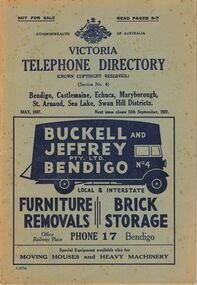
... LTD BENDIGO Local & Interstate FURNITURE, BRICK REMOVALS, STORAGE, Office Railway Place PHONE 17 Bendigo, Special Equipment available also for MOVING HOUSES and HEAVY MACHINERY" The back cover also features two ads, one for the Hotel Ritz which details "Country Visitors to Melbourne will find the HOTEL RITZ, FITZROY STREET ST. KILDA, Conveniently situated to Beaches (3 minutes) and City (10 minutes). Electric Trams pass the door. equipped with Central heating. Hot and Cold water and House Phone in every Bedroom...LTD BENDIGO Local & Interstate FURNITURE, BRICK REMOVALS, STORAGE, Office Railway Place PHONE 17 Bendigo, Special Equipment available also for MOVING HOUSES and HEAVY MACHINERY" The back cover also features two ads, one for the Hotel Ritz which details "Country Visitors to Melbourne will find the HOTEL RITZ, FITZROY STREET ST. KILDA, Conveniently situated to Beaches (3 minutes) and City (10 minutes). Electric Trams pass the door. equipped with Central heating. Hot and Cold water and House Phone in every Bedroom ...A copy of the Victoria Telephone Directory which is dated in May 1937. It features the telephone numbers for Bendigo, Castlemaine, Echuca, St. Arnaud, Sea Lakes, Swan hill Districts. The front cover also features an ad for the Bendigo moving Business Buckell and Jeffry which has a picture of a black truck with its back open and has the text "Buckell and Jeffry PTY. LTD BENDIGO Local & Interstate FURNITURE, BRICK REMOVALS, STORAGE, Office Railway Place PHONE 17 Bendigo, Special Equipment available also for MOVING HOUSES and HEAVY MACHINERY" The back cover also features two ads, one for the Hotel Ritz which details "Country Visitors to Melbourne will find the HOTEL RITZ, FITZROY STREET ST. KILDA, Conveniently situated to Beaches (3 minutes) and City (10 minutes). Electric Trams pass the door. equipped with Central heating. Hot and Cold water and House Phone in every Bedroom. Luxuriously Furnished. Execellent Cuisine. The Ritz offers the Finest in Hotel Accommodation." and the other ad for the Colonial Scale Repair Co. in Melbournebook, rural -
 Eltham District Historical Society Inc
Photograph - Digital Photograph, Alan King, Busst House, cnr Silver Street and Kerrie Crescent, Eltham, 2 February 2008
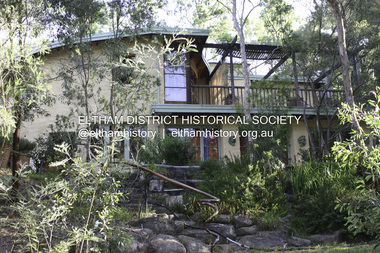
... equipment was then in its infancy. For instance drilling for explosives was done by hand, which was a slow and painful process. Knox, assisted by his foreman Horrie Judd and Gordon Ford (who was to become a famous landscape designer), built two large main rooms - a living room/ kitchen downstairs - and upstairs, a studio/bedroom. ...equipment was then in its infancy. For instance drilling for explosives was done by hand, which was a slow and painful process. Knox, assisted by his foreman Horrie Judd and Gordon Ford (who was to become a famous landscape designer), built two large main rooms - a living room/ kitchen downstairs - and upstairs, a studio/bedroom. ...Considered the best of the early mud-brick houses built by Alistair Knox. Covered under Heritage Overlay, Nillumbik Planning Scheme. Published: Nillumbik Now and Then / Marguerite Marshall 2008; photographs Alan King with Marguerite Marshall.; p143 The Busst house hidden by trees at the corner of Silver Street and Kerrie Crescent is considered the best of the early mud-brick houses built by Eltham architect, Alistair Knox. Knox himself said, that the Busst house was the most mature mud-brick house designed at that period. ‘It related with true understanding to its steep site and expressed the flexibility of earth building ………to develop a new sense of flowing form and shape’. Built in 1948 for artist Phyl Busst, a former art student at Montsalvat, the house helped usher in Eltham Shire’s distinctive mud-brick residential character. Knox was the pivotal figure of the style developed from the 1950s to the 1970s. Scarcity of building materials after World War Two encouraged mud-brick building because earth was a cheap and plentiful building medium. But when Knox began building in mud-brick in 1947, no council in Victoria knew anything of this ancient art and he needed a permit. Fortunately the Commonwealth Experimental Building Station at Ryde in NSW, had been experimenting with earth construction to help overcome the shortages of that time. They published a pamphlet that became available in Melbourne on the same day the Eltham Council was to consider whether the earth building should be allowed. Knox caught one of the three morning trains to the city in those days and bought several copies of the pamphlet to give to each councillor. On his return he found the councillors standing on the steps of the shire offices after lunch at the local hotel. He heard that earth building had been discussed before lunch and that they were not in favor of it. Knox gave each councillor a pamphlet. They passed that plan and by doing so, opened the door for all future earth building in Victoria and by default, in Australia. Mud-brick houses attracted artists to Eltham, for their aesthetic appeal and because they were cheap. Those who built their own houses, included film maker Tim Burstall, artists Peter Glass, Clifton Pugh, Matcham Skipper, Sonia Skipper and husband Jo Hannan. For Knox, mud-brick building was more than just a cheap building medium. He saw it as harmonising with the surrounding bush and as a way of counteracting the growing materialism of the age. He wrote of its impact on ‘ 20th century man. It should counteract the confusion that the perpetual flow of high technology products have upon him ..’ Building the Busst house on a steep site was difficult because most earth-moving equipment was then in its infancy. For instance drilling for explosives was done by hand, which was a slow and painful process. Knox, assisted by his foreman Horrie Judd and Gordon Ford (who was to become a famous landscape designer), built two large main rooms - a living room/ kitchen downstairs - and upstairs, a studio/bedroom. The studio/bedroom opens onto the balcony, which covers the living area. The bath made of solid concrete by stonemason Jack Fabro, is particularly deep. Sunshine pours through the three French windows of the north-east facing kitchen/living area, which is lined with timber. The large hearth can fit a family around the fire while the timber floors and solomite (compressed straw) ceilings add to the cosy atmosphere. The garden is thick with trees, and in the late 1990s, Ford put in a pool near the original dry wall he had built as a young man.This collection of almost 130 photos about places and people within the Shire of Nillumbik, an urban and rural municipality in Melbourne's north, contributes to an understanding of the history of the Shire. Published in 2008 immediately prior to the Black Saturday bushfires of February 7, 2009, it documents sites that were impacted, and in some cases destroyed by the fires. It includes photographs taken especially for the publication, creating a unique time capsule representing the Shire in the early 21st century. It remains the most recent comprehenesive publication devoted to the Shire's history connecting local residents to the past. nillumbik now and then (marshall-king) collection, alistair knox, alistair knox design, busst house, kerrie crescent, mudbrick construction, mudbrick houses, silver street -
 Parks Victoria - Mount Buffalo Chalet
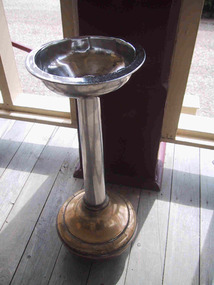
Spittoon
... equipment and other recreational items. (Pg 166 Historica). "Smoker's were well-catered for at the Chalet, and Smoking Rooms in similar resort establishments were considered to be a necessary facility. A guest house in the Blue Mountains in 1905 offered the' full comforts of a refined home' with views, spacious verandahs, tennis court and smoking room. James Boyce commented on expectorating smokers in the the Chalet's public rooms and recommended the provision of spittoons." (Pg 101. Historica) PROV . Undated photo of bedroom...equipment and other recreational items. (Pg 166 Historica). "Smoker's were well-catered for at the Chalet, and Smoking Rooms in similar resort establishments were considered to be a necessary facility. A guest house in the Blue Mountains in 1905 offered the' full comforts of a refined home' with views, spacious verandahs, tennis court and smoking room. James Boyce commented on expectorating smokers in the the Chalet's public rooms and recommended the provision of spittoons." (Pg 101. Historica) PROV . Undated photo of bedroom ...Probably original to Mt Buffalo Chalet. Listed in the Draft Inventory of Significant Collection items. Appendix A.3, Snow sports equipment and other recreational items. (Pg 166 Historica). "Smoker's were well-catered for at the Chalet, and Smoking Rooms in similar resort establishments were considered to be a necessary facility. A guest house in the Blue Mountains in 1905 offered the' full comforts of a refined home' with views, spacious verandahs, tennis court and smoking room. James Boyce commented on expectorating smokers in the the Chalet's public rooms and recommended the provision of spittoons." (Pg 101. Historica) PROV . Undated photo of bedroom sitting room with same chrome ashtray, there are 3 in the MBC Collection. (Fif 52. Pg 63 Historica) Similar ashtray sighted on Ebay listed as Victorian Railways Spitoon, February 2012.3 x Brass and chrome standing spittoons with bulbous bases and bowl on a stem.
