
Showing 39 items matching "bendigo building contractors"
-
 Bendigo Historical Society Inc.
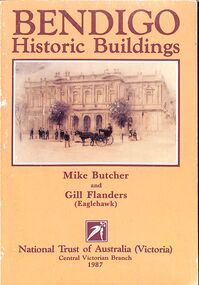
Book - "Bendigo Historic Buildings", Mike Butcher et al, 1987
... ...Bendigo building contractors...Historic Buildings Bendigo buildings Bendigo architects Bendigo building contractors Written in pen on first page "Edith Lunn C/O 208 Eaglehawk Rd. ...Light brown soft cover book. Black and white illustration of the Sandhurst Mechanics Institute and Building in the centre of the front cover. Illustration of the YMCA Building Bendigo in the centre of the back cover. Includes black and white photographs, maps and illustrations. 180 pp. Authors Mike Butcher and Gill Flanders (Eaglehawk). Published by the National Trust of Australia (Victoria) in 1987. Printed by The Book Printer, Maryborough. End papers "Birds-eye view of Sandhurst" 1885Written in pen on first page "Edith Lunn C/O 208 Eaglehawk Rd. Bendigo. (1/6/ crossed out) 1/6/07.historic buildings, bendigo buildings, bendigo architects, bendigo building contractors -
 Bendigo Military Museum
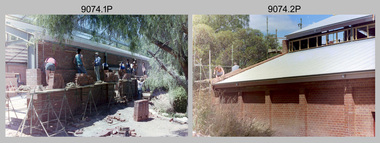
Photograph - New Printing Building Construction, Lithographic Squadron - Army Survey Regiment, Fortuna, Bendigo, 1989
... This is a set of seven photographs of contractors constructing Lithographic Squadron’s new Printing Building at Fortuna, Bendigo December 1989. ...This is a set of seven photographs of contractors constructing Lithographic Squadron’s new Printing Building at Fortuna, Bendigo December 1989. ...This is a set of seven photographs of contractors constructing Lithographic Squadron’s new Printing Building at Fortuna, Bendigo December 1989. The building was purpose built to house a new computer-controlled Heidelberg Speedmaster five colour lithographic offset Printing Press. The print room was named Wayzgoose Hall after a medieval printing house festival. Wayzgoose Hall and the Speedmaster Press printing capability was commissioned by the Commander of the 3rd Military District BRIG P. Davies AM, ADC on Wednesday 27th June 1990. This occasion is covered in more detail in page 145 of Valerie Lovejoy’s book 'Mapmakers of Fortuna – A history of the Army Survey Regiment’ ISBN: 0-646-42120-4. See items 6131.18P, 6444.16P and 6448.12P for photos of earlier phases of the construction process.This is a set of seven photograph of the construction of Lithographic Squadron’s new Printing Building, Army Survey Regiment at Fortuna, Bendigo, December 1989. Colour photographs are on 35mm negative film and scanned at 96 dpi. They are part of the Army Survey Regiment’s Collection. .1) to .7) - Photo, colour 1989. Construction of new printing building.No personnel are identified. A Minute written by CPL T. King addressed to the Unit Historian CPL Ian Nelson at para 1a: describes the item: ‘frames 18 to 21 – New Print Room under construction Dec 89’royal australian survey corps, rasvy, army survey regiment, army svy regt, fortuna, litho, printing -
 Bendigo Military Museum
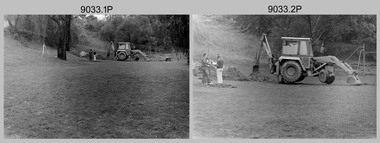
Photograph - New Printing Building Preparation, Lithographic Squadron - Army Survey Regiment, Fortuna, Bendigo, 1987
... This is a set of 9 photographs of contractors preparing the foundations for the construction of Lithographic Squadron’s new Printing Building at Fortuna, Bendigo in October 1987. ...This is a set of 9 photographs of contractors preparing the foundations for the construction of Lithographic Squadron’s new Printing Building at Fortuna, Bendigo in October 1987. ...This is a set of 9 photographs of contractors preparing the foundations for the construction of Lithographic Squadron’s new Printing Building at Fortuna, Bendigo in October 1987. The building was purpose built to house a new computer-controlled Heidelberg Speedmaster five colour lithographic offset Printing Press. The print room was named Wayzgoose Hall after a medieval printing house festival. Wayzgoose Hall and the Speedmaster Press printing capability was commissioned by the Commander of the 3rd Military District BRIG P. Davies AM, ADC on Wednesday 27th June 1990. This occasion is covered in more detail in page 145 of Valerie Lovejoy’s book 'Mapmakers of Fortuna – A history of the Army Survey Regiment’ ISBN: 0-646-42120-4. See item 6131.18P for more photos of preparation of foundations for the new print building. See item 6157.11P for more photos of construction of the new Lithographic Squadron building.This is a set of nine photograph of the foundations being prepared for Lithographic Squadron’s new Printing Building, Army Survey Regiment at Fortuna, Bendigo, October 1987. The photographs are on 35mm negative film and scanned at 96 dpi. They are part of the Army Survey Regiment’s Collection. .1) to .8) - Photo, black & white, 1987. Foundations preparation. .9) - Photo, black & white, 1989. New Lithographic Squadron building construction.No personnel are identifiedroyal australian survey corps, rasvy, fortuna, army survey regiment, litho -
 Bendigo Military Museum
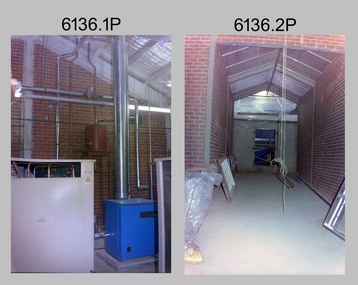
Photograph - New Printing Press, Lithographic Squadron – Army Survey Regiment, Fortuna, Bendigo, 1990
... This is a set of 30 photographs of contractors installing the Army Survey Regiment’s new Heidelberg Speedmaster 102 printing press in Lithographic Squadron’s purpose-built printing building at Fortuna, Bendigo in 1990. ...This is a set of 30 photographs of contractors installing the Army Survey Regiment’s new Heidelberg Speedmaster 102 printing press in Lithographic Squadron’s purpose-built printing building at Fortuna, Bendigo in 1990. ...This is a set of 30 photographs of contractors installing the Army Survey Regiment’s new Heidelberg Speedmaster 102 printing press in Lithographic Squadron’s purpose-built printing building at Fortuna, Bendigo in 1990. The computer-controlled five colour lithographic offset printing press provided the Royal Australian Survey Corps vastly improved printing capability, as the five colours for a standard topographic map was printed in a single pass. The print room was named Wayzgoose Hall after a medieval printing house festival. Wayzgoose Hall and the Speedmaster printing capability was commissioned by the Commander of the 3rd Military District BRIG P. Davies AM, ADC on Wednesday 27th June 1990. This occasion is covered in more detail in page 145 of Valerie Lovejoy’s book 'Mapmakers of Fortuna – A history of the Army Survey Regiment’ ISBN: 0-646-42120-4.This is a set of 30 photograph of the Heidelberg Speedmaster 102 Printing Press installation in Lithographic Squadron, Army Survey Regiment at Fortuna, Bendigo, 1990. The photographs were on 35mm colour negative film and were scanned at 96 dpi. They are part of the Army Survey Regiment’s Collection. No personnel are identified. Annotated with date on negative sleeve.royal australian survey corps, rasvy, army survey regiment, army svy regt, fortuna, asr, litho, printing -
 Bendigo Military Museum
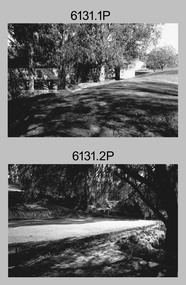
Photograph - New Printing Building foundation preparation, Lithographic Squadron - Army Survey Regiment, Fortuna, Bendigo, 1987
... This is a set of 18 photographs of contractors preparing the foundations for the construction of Lithographic Squadron’s new Printing Building at Fortuna, Bendigo on the 2nd of October 1987. ...This is a set of 18 photographs of contractors preparing the foundations for the construction of Lithographic Squadron’s new Printing Building at Fortuna, Bendigo on the 2nd of October 1987. ...This is a set of 18 photographs of contractors preparing the foundations for the construction of Lithographic Squadron’s new Printing Building at Fortuna, Bendigo on the 2nd of October 1987. The building was purpose built to house a new computer-controlled Heidelberg Speedmaster 102 five colour lithographic offset Printing Press. The print room was named Wayzgoose Hall after a medieval printing house festival. Wayzgoose Hall and the Speedmaster Press printing capability was commissioned by the Commander of the 3rd Military District BRIG P. Davies AM, ADC on Wednesday 27th June 1990. This occasion is covered in more detail in page 145 of Valerie Lovejoy’s book 'Mapmakers of Fortuna – A history of the Army Survey Regiment’ ISBN: 0-646-42120-4. See items 6444.16P, 6448.12P and 9074.7P for more photos of the construction process.This is a set of 18 photograph of the foundations being prepared for Lithographic Squadron’s new Printing Building, Army Survey Regiment at Fortuna, Bendigo, 2nd October 1987. Black and white photos .1P to .4P are on photographic paper and scanned at 300 dpi. Photographs .5P to.18P are on 35mm negative film and scanned at 96 dpi. They are part of the Army Survey Regiment’s Collection. .1) to .9) - Photo, black & white, 1987. Foundations preparation. .10) - Photo, black & white, 1987. Foundations preparation, Paul Baker. .11) - Photo, black & white, 1987. Foundations preparation, Gary Kerr .12) to .17) - Photo, black & white, 1987. Foundations preparation. .18) - Photo, black & white, 1987. Foundations preparation, Gary Kerr No personnel are identified. Annotated with date on negative sleeve.royal australian survey corps, rasvy, army survey regiment, army svy regt, fortuna, asr, litho, printing -
 Bendigo Military Museum
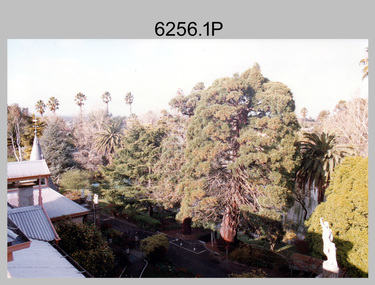
Photograph - Removal of Sequoia Californian Redwood Tree - Army Survey Regiment, Fortuna, Bendigo, 1994
... When Defence decided to relocate geospatial production to a new facility in Junortoun an outer suburb of Bendigo in 2008, the sequoia timber was used as a beautiful feature in the front foyer as well as several feature walls within the building, providing a historical connection Fortuna Villa. Royal Australian Survey Corps RASvy Army Survey Regiment Army Svy Regt Fortuna ASR .1P to .9P – No personnel are identified. This is a set of nine photographs of contractors ...These nine photographs of contractors felling a sequoia Californian redwood tree was taken at the Army Survey Regiment, Fortuna, Bendigo on the 16th of September 1994. Although 23 photos were taken at the time, 14 were not scanned due to their similarity to the nine featured photos. Two sequoia Californian redwood trees were planted at the front entrance of Fortuna Villa in the early days of gold mining magnate George Lansell’s occupation in the 1870’s. They were of immense proportion and much admired during the Lansell era and RA Svy’s occupation from 1942 to 1996. In these early days of Army occupation, the trees were lopped due to concerns of their size and proximity to the Villa. The felling of the tree in 1994 was considered unsafe due to perceptions of disease. These perceptions were upsetting to staff, as some believed that although there were a few dead branches, the tree was OK. As the tree had a noticeable lean, measurements were taken indicating the tree was stable. A sequoia sapling was eventually planted as a replacement to the diseased tree. It was decided to mill and store the timber of the felled tree on-site due to its historical significance. Although future uses were not determined at the time, the timber was eventually used to construct display cabinets and souvenir pens. When Defence decided to relocate geospatial production to a new facility in Junortoun an outer suburb of Bendigo in 2008, the sequoia timber was used as a beautiful feature in the front foyer as well as several feature walls within the building, providing a historical connection Fortuna Villa.This is a set of nine photographs of contractors felling a Sequoia (Californian redwood) tree at the Army Survey Regiment, Fortuna, Bendigo on the 16th of September 1994. The colour photographs were printed on photographic paper and are part of the Army Survey Regiment’s Collection. The photographs were scanned at 300 dpi. .1) - Photo, colour, 1994, Felling of sequoia Californian redwood tree. .2) - Photo, colour, 1994, Felling of sequoia Californian redwood tree. Neil Morgan (ground maintenance) is hugging the tree. .3) - Photo, colour, 1994, Felling of sequoia Californian redwood tree. .4) to .8) - Photo, colour, 1994, Felling of sequoia Californian redwood tree. .9) - Photo, colour, 1994, background on left - WO2 Bob Garritty, foreground L to R: Geoff (ground maintenance), unidentified, Neil Morgan (ground maintenance)..1P to .9P – No personnel are identified.royal australian survey corps, rasvy, army survey regiment, army svy regt, fortuna, asr -
 Bendigo Historical Society Inc.
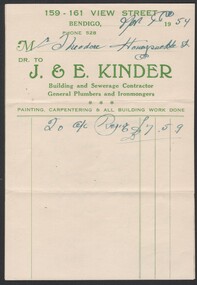
Document - William 'Bill' Theodore - invoices and receipts for plumbing works at Honeysuckle Street, Bendigo for Mr. Theodore, 1954
... Kinder, Building and Sewerage Contractor, General Plumbing and Ironmongers, 159-161 View Street, Bendigo for works for Mr. ...Kinder, Building and Sewerage Contractor, General Plumbing and Ironmongers, 159-161 View Street, Bendigo for works for Mr. ...William Anthony Theodore (19.3.1917 - 5.1.2007).William 'Bill' Theodore - two invoices (over three pages) and receipts for plumbing requisites from J. & E. Kinder, Building and Sewerage Contractor, General Plumbing and Ironmongers, 159-161 View Street, Bendigo for works for Mr. Theodore at Honeysuckle Street Bendigo: 1 Juily 1954 repairs to a water heater £4/1/4, paid 29 July 1954 6 Oct 1954 for fixing bath heater at £7/5/9, paid 15 Nov 1954 1/11/1954 follow up account for £ 7/5/9, paid as above 15 Nov 1954. bill theodore, william theodore -
 Bendigo Historical Society Inc.
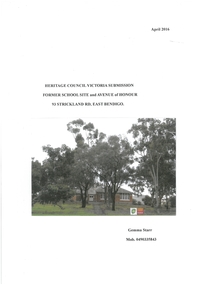
Article - Article for Bendigo East State School Heritage Council Submission
... Bendigo State School December 1998. Names associated with Submission: Gilbert Dyett, John Hampson, Keith Emmonson, Samuel C. Brittingham (Senior Architect). Joseph William Fairbanks (Building Contractor...Bendigo State School December 1998. Names associated with Submission: Gilbert Dyett, John Hampson, Keith Emmonson, Samuel C. Brittingham (Senior Architect). Joseph William Fairbanks (Building Contractor ...Gemma Starr Collection: Re: Heritage Council Victoria Submission Former School Site and Avenue of Honour 93 Strickland Road, East Bendigo. Contents: Statement of Cultural Heritage Significance, Overview of Victorian State School's WW1 Efforts, Early History of Bendigo East School and Avenue of Honour, Bendigo East School and Avenue of Honour Site Today, Men Commemorated in Bendigo East's Avenue of Honour, Comparison between Eurak Avenue of Honour Site and Bendigo East School and Avenue of Honour Site, School Avenues Planted before Bendigo East's Avenue, School Avenues Planted on the same Dade as Bendigo East's Avenue, Later School Avenues Mentioned in Heritage Victoria's Report, Final Comments, References, Appendices. Includes copies of original correspondence, newspaper articles and interviews with various people. Avenue of Honour planted 1916, Submission for Heritage Protection prepared 2016. Originally 23 trees planted then additional trees planted to make a total of 31 with plaques honouring 31 soldiers from the district. Brief biographies are listed within the submission for each soldier. The school merged with Weeroona College, and the doors closed on East Bendigo State School December 1998. Names associated with Submission: Gilbert Dyett, John Hampson, Keith Emmonson, Samuel C. Brittingham (Senior Architect). Joseph William Fairbanks (Building Contractor), Randall Jones, Stanley Symes. Jack Whitting, Mr. Phillips (Head Master 1916), Mr. Graham Parker (Last Principal), Mr. Donald Campbell (Principal)bendigo east state school, anzac, avenue of honour, heritage submission -
 Bendigo Historical Society Inc.
Photograph - GRAYDON COLLECTION: FAMILY PHOTOGRAPHS
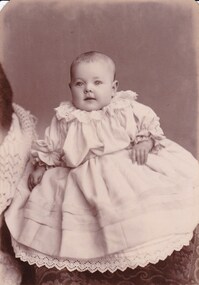
... Bendigo to Echuca. The contractors for this work engaged Mr Richardson, senr., as their timekeeper. When he left school James Richardson applied himself to learn the grocery business, and he gained a thorough knowledge of it with different employers at Bendigo, Taradale, and Daylesford. In 1872 he opened a grocery store on his own account in High-Street, Bendigo, but within a few months he had the great misfortune to be burnt out. The fire originated in an adjoining building...Bendigo to Echuca. The contractors for this work engaged Mr Richardson, senr., as their timekeeper. When he left school James Richardson applied himself to learn the grocery business, and he gained a thorough knowledge of it with different employers at Bendigo, Taradale, and Daylesford. In 1872 he opened a grocery store on his own account in High-Street, Bendigo, but within a few months he had the great misfortune to be burnt out. The fire originated in an adjoining building ...Charles Wallace Gordon Graydon the First came out to Victoria on the S.S. Almora, the same ship on which Eliza Richardson and her family arrived on New Years Day 1875. Evidently C.W.G.G.1st. must have retained fond memories of a young fourteen-year-old girl named Elizabeth Richardson who travelled from Scotland with her mother and family (her father had arrived earlier) because three years later at Kyneton they were married. It was December 26th 1860, and Elizabeth was just seventeen. As the bridegroom’s age is written as 24 years on the wedding certificate, he certainly must have been more than eighteen when he sailed on the "Almora" in 1856. The newly married couple went to live at Taradale, Victoria, and they made a good life for themselves in that town which had then a thriving gold mine. They lived in a large two-storied house in Survey Paddock, and it was there that four daughters - Susan Emily (1861-1906), Elizabeth Constance (1863-1945), Amelia Amy (1865 -1952, Ada Mary Maude (1867-1901), and one son Newenham Edward Eustace (1869-1945) named after his Irish Grandfather, were born. On his wedding certificate C.W.G. Graydon, is described as a foreman. His father-in-law, Robert Richardson was employed as a time-keeper on the Melbourne to Bendigo Railway works, and he and his family lived first in Prahran, then Kyneton, and then Taradale. Perhaps Charles Graydon worked on the railway with him. In Taradale however, he worked for a gold mining company in a surveying capacity. C.W.G.G.1st was to become Shire President of the Shire of Metcalfe. That particular year the Graydon Family entertained the visiting English cricket Eleven at their home in Taradale. He was certainly regarded as an important man in the district when he was requested by a great number of the residents to nominate for the Legislative Assembly election. About 1876 the Graydons left Taradale, and went to live at Sandhurst, now Bendigo, at Barkly Place East. The Richardsons had also left Taradale to go into the grocery business in the same town. Charles Wallace Gordon Graydon the First became a legal manager of mines, and a well-known and popular resident. Sad to say he became ill with a lung infection, and on June 4th. 1885 he died, and was buried at Sandhurst, now Bendigo Cemetery, Back Creek Rd. Eliza Richardson's brother was Mr. James Richardson, the well-known grocer, of Pall Mall and Golden-square, who died at his residence, "Balgownie," Short street, on Thursday 22 Jan 1914. James Richardson was a native of Scotland. He was born at Glasgow in1849 and was only eight years of age when his parents sailed for Australia in the ship Balmoral. The family arrived in Melbourne in 1857 and went to Taradale, where Mr. Richardson, senr., acted as inspector of works during the construction of the Taradale Viaduct. James Richardson, who had commenced his educationin Glasgow, attended school at Taradale until the family removed to Bendigo at the time the railway was being built from Bendigo to Echuca. The contractors for this work engaged Mr Richardson, senr., as their timekeeper. When he left school James Richardson applied himself to learn the grocery business, and he gained a thorough knowledge of it with different employers at Bendigo, Taradale, and Daylesford. In 1872 he opened a grocery store on his own account in High-Street, Bendigo, but within a few months he had the great misfortune to be burnt out. The fire originated in an adjoining building early one morning and both places were burnt to the ground. In spite of his loss, Mr. Richardson was not discouraged, for he soon made another start. His trade improved and he extended his business, opening the Eclipse Cash Store at Golden Square. A little later another branch was opened at the Oddfellows' Hall, and subsequently this business was transferred to the Eureka Cash Store, in Pall Mall, which was the head depot. In addition to the retail trade, Mr. Richardson had, for many years carried on an extensive wholesale business with the Northern District, and had made a specialty of fodder seeds. James was a man of probity and sincerity in business, and as a citizen he was highly esteemed and respected. He was a prominent member of the Bendigo Caledonian Society in the earlier days of his citizenship. He was a staunch member of St Andrew's Presbyterian Church, and was a member of the board of management. In the Easter Fair procession, Mr Richardson's display was always a prominent and attractive one. Mr. Richardson was a member of the Masonic Order, and was a life member of the Bendigo Art Gallery and the old Mechanics Institute. He was married at Daylesford in 1871. Mr James Richardson was interred in the Presbyterian section of the Bendigo Cemetery.A selection of black and white Graydon and Richardson family photographs taken by Bendigo photographers. All photos unnamed. Mounted as Cabinet cards. Photographers - D. Mendelfson, Bartlett Bros., The Studio - Chuck, Eden Society Studios, Alan Spicer, R. Bloomfield Rees,graydon, richardson, cabinet card -
 Bendigo Historical Society Inc.
Photograph - GRAYDON COLLECTION: FAMILY PHOTOGRAPHS
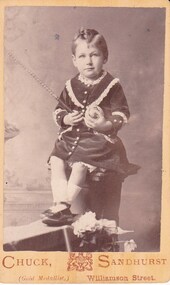
... Bendigo to Echuca. The contractors for this work engaged Mr Richardson, senr., as their timekeeper. When he left school James Richardson applied himself to learn the grocery business, and he gained a thorough knowledge of it with different employers at Bendigo, Taradale, and Daylesford. In 1872 he opened a grocery store on his own account in High-Street, Bendigo, but within a few months he had the great misfortune to be burnt out. The fire originated in an adjoining building...Bendigo to Echuca. The contractors for this work engaged Mr Richardson, senr., as their timekeeper. When he left school James Richardson applied himself to learn the grocery business, and he gained a thorough knowledge of it with different employers at Bendigo, Taradale, and Daylesford. In 1872 he opened a grocery store on his own account in High-Street, Bendigo, but within a few months he had the great misfortune to be burnt out. The fire originated in an adjoining building ...Charles Wallace Gordon Graydon the First came out to Victoria on the S.S. Almora, the same ship on which Eliza Richardson and her family arrived on New Years Day 1875. Evidently C.W.G.G.1st. must have retained fond memories of a young fourteen-year-old girl named Elizabeth Richardson who travelled from Scotland with her mother and family (her father had arrived earlier) because three years later at Kyneton they were married. It was December 26th 1860, and Elizabeth was just seventeen. As the bridegroom’s age is written as 24 years on the wedding certificate, he certainly must have been more than eighteen when he sailed on the "Almora" in 1856. The newly married couple went to live at Taradale, Victoria, and they made a good life for themselves in that town which had then a thriving gold mine. They lived in a large two-storied house in Survey Paddock, and it was there that four daughters - Susan Emily (1861-1906), Elizabeth Constance (1863-1945), Amelia Amy (1865 -1952, Ada Mary Maude (1867-1901), and one son Newenham Edward Eustace (1869-1945) named after his Irish Grandfather, were born. On his wedding certificate C.W.G. Graydon, is described as a foreman. His father-in-law, Robert Richardson was employed as a time-keeper on the Melbourne to Bendigo Railway works, and he and his family lived first in Prahran, then Kyneton, and then Taradale. Perhaps Charles Graydon worked on the railway with him. In Taradale however, he worked for a gold mining company in a surveying capacity. C.W.G.G.1st was to become Shire President of the Shire of Metcalfe. That particular year the Graydon Family entertained the visiting English cricket Eleven at their home in Taradale. He was certainly regarded as an important man in the district when he was requested by a great number of the residents to nominate for the Legislative Assembly election. About 1876 the Graydons left Taradale, and went to live at Sandhurst, now Bendigo, at Barkly Place East. The Richardsons had also left Taradale to go into the grocery business in the same town. Charles Wallace Gordon Graydon the First became a legal manager of mines, and a well-known and popular resident. Sad to say he became ill with a lung infection, and on June 4th. 1885 he died, and was buried at Sandhurst, now Bendigo Cemetery, Back Creek Rd. Eliza Richardson's brother was Mr. James Richardson, the well-known grocer, of Pall Mall and Golden-square, who died at his residence, "Balgownie," Short street, on Thursday 22 Jan 1914. James Richardson was a native of Scotland. He was born at Glasgow in1849 and was only eight years of age when his parents sailed for Australia in the ship Balmoral. The family arrived in Melbourne in 1857 and went to Taradale, where Mr. Richardson, senr., acted as inspector of works during the construction of the Taradale Viaduct. James Richardson, who had commenced his educationin Glasgow, attended school at Taradale until the family removed to Bendigo at the time the railway was being built from Bendigo to Echuca. The contractors for this work engaged Mr Richardson, senr., as their timekeeper. When he left school James Richardson applied himself to learn the grocery business, and he gained a thorough knowledge of it with different employers at Bendigo, Taradale, and Daylesford. In 1872 he opened a grocery store on his own account in High-Street, Bendigo, but within a few months he had the great misfortune to be burnt out. The fire originated in an adjoining building early one morning and both places were burnt to the ground. In spite of his loss, Mr. Richardson was not discouraged, for he soon made another start. His trade improved and he extended his business, opening the Eclipse Cash Store at Golden Square. A little later another branch was opened at the Oddfellows' Hall, and subsequently this business was transferred to the Eureka Cash Store, in Pall Mall, which was the head depot. In addition to the retail trade, Mr. Richardson had, for many years carried on an extensive wholesale business with the Northern District, and had made a specialty of fodder seeds. James was a man of probity and sincerity in business, and as a citizen he was highly esteemed and respected. He was a prominent member of the Bendigo Caledonian Society in the earlier days of his citizenship. He was a staunch member of St Andrew's Presbyterian Church, and was a member of the board of management. In the Easter Fair procession, Mr Richardson's display was always a prominent and attractive one. Mr. Richardson was a member of the Masonic Order, and was a life member of the Bendigo Art Gallery and the old Mechanics Institute. He was married at Daylesford in 1871. Mr James Richardson was interred in the Presbyterian section of the Bendigo Cemetery.Seventeen black and white Graydon and Richardson family photographs taken by Bendigo photographers. All photos unnamed. Mounted as Cartes de Visite. Photographers - The Studio - Chuck, , M. Bent, F. de Kock and Co., N. White, Bartlett Bros., Chevalier.graydon, richardson, carte de visite -
 Bendigo Historical Society Inc.
Mixed media - GRAYDON COLLECTION: FAMILY PHOTOGRAPHS and NOTES (See ITEM 11411)
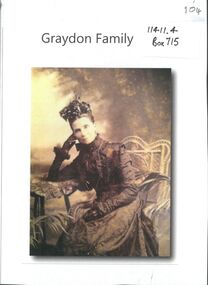
... Bendigo to Echuca. The contractors for this work engaged Mr. Richardson, as their timekeeper. When he left school James Richardson applied himself to learn the grocery business, and he gained a thorough knowledge of it with different employers at Bendigo, Taradale, and Daylesford. In 1872 he opened a grocery store on his own account in High-Street, Bendigo, but within a few months he had the great misfortune to be burnt out. The fire originated in an adjoining building...Bendigo to Echuca. The contractors for this work engaged Mr. Richardson, as their timekeeper. When he left school James Richardson applied himself to learn the grocery business, and he gained a thorough knowledge of it with different employers at Bendigo, Taradale, and Daylesford. In 1872 he opened a grocery store on his own account in High-Street, Bendigo, but within a few months he had the great misfortune to be burnt out. The fire originated in an adjoining building ...Charles Wallace Gordon Graydon the First came out to Victoria on the S.S. Almora, the same ship on which Eliza Richardson and her family arrived on New Years Day 1875. Evidently C.W.G.G.1st. must have retained fond memories of a young fourteen-year-old girl named Elizabeth Richardson who travelled from Scotland with her mother and family (her father had arrived earlier) because three years later at Kyneton they were married. It was December 26th, 1860, and Elizabeth was just seventeen. As the bridegroom’s age is written as 24 years on the wedding certificate, he certainly must have been more than eighteen when he sailed on the "Almora" in 1856. The newly married couple went to live at Taradale, Victoria, and they made a good life for themselves in that town which had then a thriving gold mine. They lived in a large two-storied house in Survey Paddock, and it was there that four daughters - Susan Emily (1861-1906), Elizabeth Constance (1863-1945), Amelia Amy (1865 -1952, Ada Mary Maude (1867-1901), and one son Newenham Edward Eustace (1869-1945) named after his Irish Grandfather, were born. On his wedding certificate C.W.G. Graydon, is described as a foreman. His father-in-law, Robert Richardson was employed as a timekeeper on the Melbourne to Bendigo Railway works, and he and his family lived first in Prahran, then Kyneton, and then Taradale. Perhaps Charles Graydon worked on the railway with him. In Taradale however, he worked for a gold mining company in a surveying capacity. C.W.G.G.1st was to become Shire President of the Shire of Metcalfe. That particular year the Graydon Family entertained the visiting English cricket Eleven at their home in Taradale. He was certainly regarded as an important man in the district when he was requested by a great number of the residents to nominate for the Legislative Assembly election. About 1876 the Graydons left Taradale, and went to live at Sandhurst, now Bendigo, at Barkly Place East. The Richardsons had also left Taradale to go into the grocery business in the same town. Charles Wallace Gordon Graydon the First became a legal manager of mines, and a well-known and popular resident. Sad to say he became ill with a lung infection, and on June 4th. 1885 he died, and was buried at Sandhurst, now Bendigo Cemetery, Back Creek Rd. Eliza Richardson's brother was Mr. James Richardson, the well-known grocer, of Pall Mall and Golden-square, who died at his residence, "Balgownie," Short Street, on Thursday 22 Jan 1914. James Richardson was a native of Scotland. He was born at Glasgow in1849 and was only eight years of age when his parents sailed for Australia in the ship Balmoral. The family arrived in Melbourne in 1857 and went to Taradale, where Mr. Richardson, senior., acted as inspector of works during the construction of the Taradale Viaduct. James Richardson, who had commenced his education in Glasgow, attended school at Taradale until the family removed to Bendigo at the time the railway was being built from Bendigo to Echuca. The contractors for this work engaged Mr. Richardson, as their timekeeper. When he left school James Richardson applied himself to learn the grocery business, and he gained a thorough knowledge of it with different employers at Bendigo, Taradale, and Daylesford. In 1872 he opened a grocery store on his own account in High-Street, Bendigo, but within a few months he had the great misfortune to be burnt out. The fire originated in an adjoining building early one morning and both places were burnt to the ground. In spite of his loss, Mr. Richardson was not discouraged, for he soon made another start. His trade improved and he extended his business, opening the Eclipse Cash Store at Golden Square. A little later another branch was opened at the Oddfellows' Hall, and subsequently this business was transferred to the Eureka Cash Store, in Pall Mall, which was the head depot. In addition to the retail trade, Mr. Richardson had, for many years carried on an extensive wholesale business with the Northern District and had made a specialty of fodder seeds. James was a man of probity and sincerity in business, and as a citizen he was highly esteemed and respected. He was a prominent member of the Bendigo Caledonian Society in the earlier days of his citizenship. He was a staunch member of St Andrew's Presbyterian Church, and was a member of the board of management. In the Easter Fair procession, Mr. Richardson's display was always a prominent and attractive one. Mr. Richardson was a member of the Masonic Order and was a life member of the Bendigo Art Gallery and the old Mechanics Institute. He was married at Daylesford in 1871. Mr James Richardson was interred in the Presbyterian section of the Bendigo Cemetery.DVD A selection of Graydon and Richardson family photographs taken by Bendigo photographers, and family history notesphotograph, person, graydon and richardson families. -
 Bendigo Historical Society Inc.
Document - BENDIGO POST OFFICE COLLECTION: SANDHURST TRUSTEES LTD, 1858
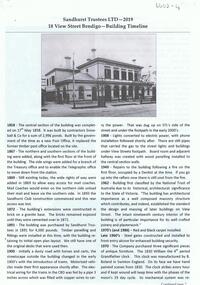
... Bendigo Post Office Sandhurst Trustees Snowball & Co Document. 1858 the central section of the building was completed on 17th May. It was built by contractors ...Document. 1858 the central section of the building was completed on 17th May. It was built by contractors Snowball & Co for the sum of 2,996 pounds. Built by the Government of the time as a new Post Office, it replaced the former timber post office located on the site.bendigo post office, sandhurst trustees, snowball & co -
 Bendigo Historical Society Inc.
Document - The Pitcher Dressers, W.G. O'Neill, Unknown
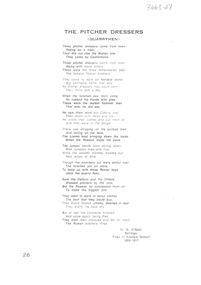
... Three copies of newspaper articles relating to quarry work and employees attached to poem: information regarding Brasier, Riley and Nelson, contractors (Bendigo and District 1902); 'The Stone Quarry Grievance' (Bendigo Advertiser, 15 June, 1959, p2); 'A Restriction Upon Industry' (Bendigo Advertiser, 2 June, 1859). Article 'A Restriction Upon Industry" details the anomalies that exist between working the quartz reefs for gold and quarrying for building stone. ...Three copies of newspaper articles relating to quarry work and employees attached to poem: information regarding Brasier, Riley and Nelson, contractors (Bendigo and District 1902); 'The Stone Quarry Grievance' (Bendigo Advertiser, 15 June, 1959, p2); 'A Restriction Upon Industry' (Bendigo Advertiser, 2 June, 1859). Article 'A Restriction Upon Industry" details the anomalies that exist between working the quartz reefs for gold and quarrying for building stone. ...Axedale is well known for its Bluestone. Early on the quarries employed a large number of people. In the 1860’s Napthali Ingham selected land in Axedale and opened a bluestone quarry beside the river later known as Ingham Hill. The quarry produced dressed curbing and pitchers for use in Bendigo and Melbourne. This bluestone can be seen throughout Axedale in the churches, the bridge over the Campaspe River and guttering in the township. The quarry also supplied bluestone products further afield, for example road metal. Napthali Ingham, the owner of one of the first quarries in Axedale, arrived in Victoria from Lancashire, England, some time before 1860, and settled in Brunswick, Victoria. He may have been building his home in Ewen[sic] Street in 1860, at approximately 31 years of age, when he placed two advertisements in The Argus, October 10. One called for tenders for carting "upwards of 100 perches of rubbish to Sandridge." The other calls for tenders to supply "800 bushels of Geelong Roche Lime." His address, given for the purpose of the advertisements, is Ewen Street, Brunswick. There were a number of quarries and clay pits in Brunswick at this time and by July 9, 1861, Ingham was operating a quarry and contracting services to local councils and boroughs for road works, including Sydney Road. He also operated the True Briton Hotel in Ewen Street. Ingham continued his quarry works and business dealings in the Brunswick area for a few years and, around 1872, was contracting for the City of Bendigo. He eventually moved to Axedale, between Bendigo and Heathcote, where he took up land and opened a bluestone quarry on the east bank of the Campaspe River. As he had difficulty transporting bluestone to Bendigo, he wrote a letter to The Bendigo Advertiser, suggesting a tramway be laid between Sandhurst (Bendigo) and Axedale. Over the next ten years or so, he modified this suggestion to a rail line connecting Sandhurst, Axedale and Heathcote to the North East line at Seymour. This suggestion did not materialise in its entirety, but it eventually resulted in what became the Wandong, Heathcote and Sandhurst Rail Line, the first sections, Bendigo-Heathcote and Wandong-Kilmore, opening October 1, 1888. In the 1870s, Ingham built the Quarry Hotel which is now the crumbling ruins adjoining Ingham Road on the east side of the Campaspe River.. Its condition is worsening as time passes. Ingham intended to have a tramline constructed from his Axedale bluestone quarry to the new rail line. This also did not happen but he was successful in getting a wood siding provided at the location that is today's Hanson's Quarry. Evidence of the rail siding are still evident at the site in 2025. Ingham's quarry is now owned by Hansen Quarries Ingham died in 1909 and the rail line that grew out of his suggestion lasted until 1958 when it was closed from Bendigo to Heathcote. The Heathcote Junction section was closed in 1968. Another quarry was owned and operated by Brasier, Riley and Nelson. 'This well known firm of contractors have a most extensive plant and all the latest improved machinery required for the supply of kerbstone, pitchers, monumental work and dressed bluestone metal for road making. ('Bendigo & District, 1902') 1. One page typed poem, written by W.G. O'Neill, titled 'The Pitcher Dressers, (Quarrymen). The poem tells the story of three Rowan brothers who came to the Axedale Quarry: 'They came to work on Axedale stone, Big contracts came that way, As pitcher dressers they could earn, Their thirty bob a day.' 2. Three copies of newspaper articles relating to quarry work and employees attached to poem: information regarding Brasier, Riley and Nelson, contractors (Bendigo and District 1902); 'The Stone Quarry Grievance' (Bendigo Advertiser, 15 June, 1959, p2); 'A Restriction Upon Industry' (Bendigo Advertiser, 2 June, 1859). Article 'A Restriction Upon Industry" details the anomalies that exist between working the quartz reefs for gold and quarrying for building stone. The cost of obtaining a license to 'quarry stone is 50 pounds sterling which must be paid down in order to merely prospect the ground. Some people who took out a lease to work a reef were actually 'looking for building stone'. On bottom of poem, W.G. O'Neill, Bendigo. Pupil of Axedale School, 1908-1917.axedale, quarry, napthali ingham, pitchers, pitcher dressers, bluestone, campaspe river, quarry hotel, rowan brothers -
 Bendigo Historical Society Inc.
Document - National Trust Collection: Churches of Bendigo and Inglewood, Nov 7th 1965
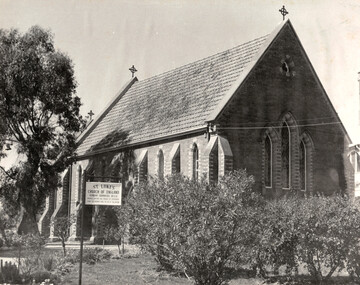
... contractor was N. Longstaff. Some architectural elements, such as the chancel, were added later when St. John's Presbyterian took over the building. Congregational attendance declined, leading to the purchase and alteration of a brick school complex in Olinda Street to serve as their headquarters.The timber church on Russell Street and the Calvin Street property were sold.The valuable Forest Street property was eventually sold to a London sect and later became an investment for the Methodist Church. history Church National Trust Bendigo Collection sacred heart cathedral Bendigo St Augustine's Church Myers Flat St Pauls church bendigo St Johns Presbyterian Church bendigo congregational church bendigo Historical information on seven denominational churches in Bendigo and Inglewood. ...St LUKES ANGLICAN CHURCH BENDIGO In 1852, a party of Cornish miners, refusing to give up and having dug, by hand, down nearly 70 feet ‘got their reward. Suddenly, their picks sank into soft pipe-clay, white, satin-smooth and seemingly depthless. The men began tunnelling. Presently, the roof forming above them showered gold at their feet – the secret of Bendigo’s famous White Hills lay revealed.’ In the ‘wild rush’ that followed, when ‘the White Hills yielded enormously and some pretty piles were made’, a young Anglican priest, John Herbert Gregory, held the first Anglican church service at White Hills in 1853. The Hamlet of White Hills was surveyed and mapped in 1854 and, by 1863, St Luke’s Church in White Hills was opened on ‘an elevated site’ in a generously sized ‘church reserve’. St AUGUSTINE'S CHURCH MYERS FLAT Early diggers to this area were men named Myers and Nicholls, hence the name - Myers Flat and Myers Creek. 1857 saw the discovery of gold in the area and in less than one month 1000 ounces of gold per week resulted. The number of diggers in the Myers Creek or Burnt Gully totalled 4000 to 5000. Myers Creek consisted of several shops and buildings, two hotels, a race course and a lock-up built of logs. On November 6th, 1864, the opening of the new church of St Augustine' took place. The first mass was celebrated by the Reverand Dean Hayes, of St Killian's Sandhurst. The church of gothic design was built by a local contractor, and with bricks made from local clay. The church also has a fire place and is widely known as "The church with the Chimney. For many years it was also a Catholic school. St AUGUSTINE'S CHURCH INGLEWOOD The church features an Early English design from 1864 and Decorated Gothic extensions from 1884.Notable elements include the sanctuary with the Catto Memorial window and interior cusped arcading of the wainscot. Architectural attribution is given to Vahland and Getzschmann for one or both sections. St JOHNS CHURCH (PRESBYTERIAN) BENDIGO The church's architect was W C Vahland VIA, and the builder was N Langstaff. It was built in April 1890, and opened in Feb 1891. The tender price was 2,481 pounds. The church style was gothic, built by the Congregational Church to replace an earlier building built in 1858. St Johns bought the church in 1949 and made additions in 1951. THE SACRED HEART CATHEDRAL BENDIGO Originally designed in 1895 by Reed, Smart and Tappin of Melbourne, the first stage opened in September 1901; the second stage began in January 1954 and was expected to finish in late 1976. Skilled stonemasons were brought from overseas for the completion. The Exterior built from Geelong sandstone and Harcourt granite, matching the original materials for color consistency. The cathedral is designed in the early English Gothic style. It Features a tower and spire weighing several thousand tons, with the spire rising 282 ft. from the floor and topped by a 10 ft. cross.Interior. The original stained glass window, made in Birmingham, England, is above the main entrance on the west side. Marble for the floor was imported from Vincenzo and Via Reggio, Italy; Sicilian Pearl marble is used in the four chapels. Ceilings in the chapels feature Western red cedar and yellow pine timbers.The transept includes Australian blackwood paneling and 12 carved shields representing the apostles. The internal height from floor to ceiling is 80 ft.Artistic Elements. Two large tapestries, specially designed and crafted by Mrs. Carrington, hang in the sanctuary as a symbolic link to Bendigo. ST PAULS BENDIGO The nave was built in 1868 and the tower in 1873. The nave is notable for unusual ceiling with metal and timber overlay members. The tower notable for early brick and bold Gothic influenced design. The church was opened on 12th Nov 1868 and a new chancel sanctuary and Transepts were added on 22 Oct 1927. The architect was Robert A Love. CONGREGATIONAL CHURCHES IN BENDIGO Three main Congregational church buildings existed in Bendigo: at the corner of Forest and Mackenzie Streets (the original site), on Quarry Hill (corner of Russell and Gladstone Streets), and on Calvin Street (later the Lutheran Church). The Calvin Street church was named in honor of John Calvin, a notable figure who lived in the area. In June 1858, 1.5 acres of land were purchased at the Forest and Mackenzie Streets corner for £1200.The first church was built on this site in November 1858 and later enlarged in May 1867 to seat 500 people. A prefabricated parsonage stood nearby until about 1920, serving as a caretaker's cottage for several years. In 1890, foundation stones for a new church designed by W.C. Vahland were laid, featuring a tall tower and two gable crossings (reduced from three to save costs). The new church opened on February 26, 1890, costing £2483. The contractor was N. Longstaff. Some architectural elements, such as the chancel, were added later when St. John's Presbyterian took over the building. Congregational attendance declined, leading to the purchase and alteration of a brick school complex in Olinda Street to serve as their headquarters.The timber church on Russell Street and the Calvin Street property were sold.The valuable Forest Street property was eventually sold to a London sect and later became an investment for the Methodist Church.Historical information on seven denominational churches in Bendigo and Inglewood. This item contains the following items: 3084.36a Black and white photo of St Lukes Bendigo Church of England, Napier Street, White Hills. 3084.36b St Augustine's Church Myers Flat 100 years newsletter 1965. The newsletter's purpose is for a Commemorative afternoon mass in memory of the pioneers of Myers Flat and district.Celebration of the 101st anniversary of the first mass at St. Augustine's Church; on Sunday, November 7th, 1965, at 2:00 PM.Location: St. Augustine's Church, Myers Flat. The invitation is extended to the recipient and their friends. This invitation serves both as a memorial and a community gathering to honour local history. Also included is some hand-written history notes of the church - See the notes in the Historical Section above. 3084.36c This document is a formal letter dated 9th November 1970 from the National Trust of Australia (Victoria) to Bishop Bernard Stewart. St. Augustine's Church in Bendigo has been awarded a "D" classification by the National Trust's expert committee. The church is now officially "recorded" by the National Trust. The letter is addressed to Bishop Bernard Stewart, with copies sent to Father Louis McDonnell (Eaglehawk), A. J. Watts (Town Clerk, Bendigo), and Mrs. R. R. Adams (Secretary, Central Victorian Branch). 3084.36d This document is a formal letter from the National Trust of Australia (Victoria) to Miss L. Doble, Registrar of the Bendigo Church of England Diocese, dated March 20, 1973. St. Augustine's Church of England in Inglewood has been officially placed on the National Trust's Classified List. This classification recognizes the church as essential to Australia's heritage and emphasizes its preservation. The church features an Early English design from 1864 and Decorated Gothic extensions from 1884.Notable elements include the sanctuary with the Catto Memorial window and interior cusped arcading of the wainscot. Architectural attribution is given to Vahland and Getzschmann for one or both sections. The church is about to celebrate the centenary of its consecration on May 13, with the Archbishop expected to attend. 3084.36e This document is a survey form used by the National Trust of Australia (Victoria) to collect detailed information about St Augustine's Church at Myers Flat. It records the original purpose, present use, and current name of the building.Requires a precise address or location description for site visits.It captures special features or points of interest not visible in photographs. It documents the present owner and occupant, including their addresses, the date of initial construction and supporting evidence for that date. 3084.36f Handwritten letter re history of St Johns Presbyterian Church Bendigo, 13th October 1980 - author unknown 3084.36g Typed notes - "Interesting information on the Sacred Heart Cathedral Bendigo", and hand-written notes on St Pauls Cathedral. 3084.36h Two pages of typed notes. Three main Congregational church buildings existed in Bendigo: at the corner of Forest and Mackenzie Streets (the original site), on Quarry Hill (corner of Russell and Gladstone Streets), and on Calvin Street (later the Lutheran Church). 3084.36i Hand-written notes on St Pauls Cathedral.history, church, national trust bendigo collection, sacred heart cathedral bendigo, st augustine's church myers flat, st pauls church bendigo, st johns presbyterian church bendigo, congregational church bendigo -
 Bendigo Historical Society Inc.
Document - National Trust Collection: Heritage Bid For Central Victorian Goldfields, 1981
... Estimated Cost was $55,000.Project, Team:Supervision: Kurt Bruhn (City Engineer), Colin Campbell Contractor: AllWeld Bendigo; Heritage Consultant: Andrew Ward,Engineering Consultant: Howard Osborne, Project Coordinator: Norm Cameron The restoration was funded by a loan from the Central Goldfields Restoration Fund, as part of a Commonwealth/State Bicentennial Project through the Ministry for Planning and Environment. history National Trust Bendigo Collection bendigo Central Goldfields Nell Gwynne Mine North Virginia Mine Invitation to Public Launch, Programme for the launch, Burra Charter - International Charter for the Conservation and Restoration of Monuments and sites, Building included in the initial Register. ...In November 1981 the City of Bendigo sent out an official invitation and informational outline for two significant events in Bendigo; the Public launch of the World Heritage Bid for the Central Victorian Goldfields and the official launch of the Central Nell Gwynne Poppet Legs Restoration The Central Nell Gwynne Mine operated from 1906 to 1950, reaching a depth of 1,912 feet and yielding 61,884 ounces of gold (approx. $25 million at current prices). The mine was one of the finest on the Bendigo field, with notable engineering features such as tubular steel lattice poppet legs and extensive mining equipment, much of which remains visible on site.Goals are to Stabilize the existing structure, Fabricate internal supports for the poppet legs and winding wheels, Restore original paint colors and install flood lighting. Estimated Cost was $55,000.Project, Team:Supervision: Kurt Bruhn (City Engineer), Colin Campbell Contractor: AllWeld Bendigo; Heritage Consultant: Andrew Ward,Engineering Consultant: Howard Osborne, Project Coordinator: Norm Cameron The restoration was funded by a loan from the Central Goldfields Restoration Fund, as part of a Commonwealth/State Bicentennial Project through the Ministry for Planning and Environment.Invitation to Public Launch, Programme for the launch, Burra Charter - International Charter for the Conservation and Restoration of Monuments and sites, Building included in the initial Register. This item contains the following documents: 3084.51a Invitation from the City of Bendigo to attend the Bendigo Bid for World Heritage of the Goldfields; and the launch of the Central Nell Gwynne Poppet Legs Restoration Project 9th Nov 1989 3084.51b Letters in 1974 from the Natrional Trust. The Bendigo City Council requested a list of historic buildings requiring urgent maintenance to support applications for Australian Government renovation funding and potential inclusion in the Historic Buildings Register. 3084.51c 1981 International Charter for the Restoration of Monuments and Sites (Venice 1966), and the Resolutions of the 5th General Assembly of ICOMOS (Moscow 1978) known as The Burra Charterhistory, national trust bendigo collection, bendigo, central goldfields, nell gwynne mine, north virginia mine -
 Bendigo Historical Society Inc.
Document - National Trust Collection: Bendigo Home and Hospital for the Aged, 1860-1970s
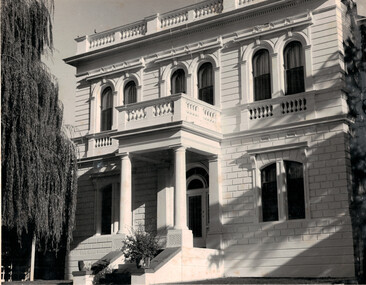
... Bendigo Benevolent Home was founded in 1857, with the main building inaugurated on March 15, 1860. The original site was chosen to avoid mining areas and was granted by the government. Early temporary premises were used before the current site in Barnard Street was established. The original building was designed by architect Robert A. Love, with construction by contractor...Bendigo Benevolent Home was founded in 1857, with the main building inaugurated on March 15, 1860. The original site was chosen to avoid mining areas and was granted by the government. Early temporary premises were used before the current site in Barnard Street was established. The original building was designed by architect Robert A. Love, with construction by contractor ...The Bendigo Benevolent Home was founded in 1857, with the main building inaugurated on March 15, 1860. The original site was chosen to avoid mining areas and was granted by the government. Early temporary premises were used before the current site in Barnard Street was established. The original building was designed by architect Robert A. Love, with construction by contractor Crawford and Clerk of Works Rigley. The structure features a basement (kitchen, storage, cellars, staff apartments), a first floor (large dining room, additional rooms), and upper floors (dormitories). The building uses the arch principle and includes hot air heating, lavatories, and good ventilation. A significant memorial stone of Harcourt granite was laid in December 1872, forming part of the building's front elevation. Additions and modifications were made over time, including a west wing in 1868 to house 50 girls, and further expansions by architects Vahland & Getchmann. The central block has seen little external alteration since completion, except for a small glassed-in wind shield.The Porter's Lodge and Superintendent's Residence remain in good condition.Some ancillary buildings have been modified or are at risk of demolition due to new construction.Typed History of the hospital, and letters regarding classification status and two A4 sized photos of the front of the building. This item contains the following documents: 3084.52a Black and White Photo of the Bendigo Benevolent Asylum Front Entrance 3084.52b Another Black and White Photo of the Bendigo Benevolent Asylum Front Entrance 3084.52c National Trust of Australia (Victoria) survey and data sheet 3084.52d Letters regarding the classification by the National Trust (Contact BHS for details) 3084.52e Handwritten Notes on the History of the Home and Hospital for the Aged (Contact BHS for details)history, national trust bendigo collection, bendigo, benevolant home bendigo, benevolant asylum bendigo, home and hospital for the aged bendigo, ann caudle centre bendigo -
 Bendigo Historical Society Inc.
Document - MCCOLL, RANKIN AND STANISTREET COLLECTION: LAURISTON RESERVOIR AUCTION, September 16th/17th 1941
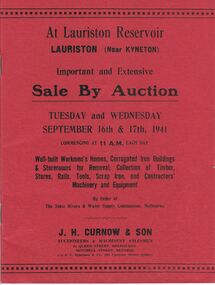
... buildings, timber, stores, rails, tools, scrap iron, and contractors machinery and equipment. Auction to be held Tuesday and Wednesday September 16th and 17th , 1941. By order of the State Rivers and Water Supply Commission, Melbourne. J. H. Curnow & Son, Auctioneers & Machinery Salesmen, 31 Queen Street, Melbourne 3000 and Mitchell Street Bendigo...buildings, timber, stores, rails, tools, scrap iron, and contractors machinery and equipment. Auction to be held Tuesday and Wednesday September 16th and 17th , 1941. By order of the State Rivers and Water Supply Commission, Melbourne. J. H. Curnow & Son, Auctioneers & Machinery Salesmen, 31 Queen Street, Melbourne 3000 and Mitchell Street Bendigo ...Catalogue of Sale By Auction of buildings, timber, stores, rails, tools, scrap iron, and contractors machinery and equipment. Auction to be held Tuesday and Wednesday September 16th and 17th , 1941. By order of the State Rivers and Water Supply Commission, Melbourne. J. H. Curnow & Son, Auctioneers & Machinery Salesmen, 31 Queen Street, Melbourne 3000 and Mitchell Street Bendigo Victoria 3550. To be held at Lauriston reservoir, Lauriston (near Kyneton).J.H. Curnow & Son, 31 Queen Street Melbourne.government, state, lauriston reservoir -
 Bendigo Historical Society Inc.
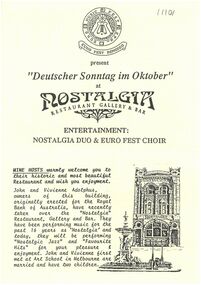
Document - Euro Fest menu and leaflet from 'Nostalgia Restaurant', Bendigo
... The building which housed the 'Nostalgia Restaurant, Gallery and Bar' at 17 View Point Street, Bendigo was designed by William Beene and George Garvin and opened in 1908 as a branch of the Royal Bank of Australia. Erected on the site of the old Oriental Hotel, the area was once known as the 'View Point Rocks'. The contractors...The building which housed the 'Nostalgia Restaurant, Gallery and Bar' at 17 View Point Street, Bendigo was designed by William Beene and George Garvin and opened in 1908 as a branch of the Royal Bank of Australia. Erected on the site of the old Oriental Hotel, the area was once known as the 'View Point Rocks'. The contractors ...The building which housed the 'Nostalgia Restaurant, Gallery and Bar' at 17 View Point Street, Bendigo was designed by William Beene and George Garvin and opened in 1908 as a branch of the Royal Bank of Australia. Erected on the site of the old Oriental Hotel, the area was once known as the 'View Point Rocks'. The contractors were W. H. Deague & Son, and the foundation stone was laid by the then Premier of Victoria, Sir Thomas Bent. The building was purchased by John and Viviene Adolphus in 1991. Menu and brochure leaflet from 'Nostalgia' restaurant gallery and bar, 17 View Point Street, Bendigo. A4 piece of paper, folded in half, and tan in color. Menu is from 'Deutscher Sonntag im Oktober'. Menu included Entree, Main Course, and Dessert. Leaflet gives description of chef and manager of the venue. nostalgia restaurant, dining, euro fest, garvin, beebe -
 Bendigo Historical Society Inc.
Document - THE BENDIGO JOSS HOUSE: NATIONAL TRUST OF AUSTRALIA (VICTORIA)
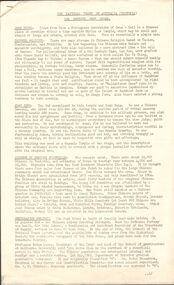
... BUILDINGS Church chinese joss house National Trust of Australia ''The Bendigo Joss House'' - National Trust of Australia (Victoria) - 2 pages incl - origin of term 'Joss'; basic information about ''Chinese Religion'' and Kwan Gung; synopsis on ''Chinese on Bendigo Goldfields''; details of the restoration project - including costs to date and list of people and bodies assisting. Names on second sheet ; Bendigo Chinese Society, Family of H. E. McGowan, D. O'Hoy, Mr W. Mitchell, Apex Club, Sandhurst Boys' Centre, Mr John Ball, Ordinance Factory, Bendigo Advertiser, b. C. V. 8, 3 B. O. Mrs H. Vellacott, Mrs B. Mullins, S. E. C., contractors ...''The Bendigo Joss House'' - National Trust of Australia (Victoria) - 2 pages incl - origin of term 'Joss'; basic information about ''Chinese Religion'' and Kwan Gung; synopsis on ''Chinese on Bendigo Goldfields''; details of the restoration project - including costs to date and list of people and bodies assisting. Names on second sheet ; Bendigo Chinese Society, Family of H. E. McGowan, D. O'Hoy, Mr W. Mitchell, Apex Club, Sandhurst Boys' Centre, Mr John Ball, Ordinance Factory, Bendigo Advertiser, b. C. V. 8, 3 B. O. Mrs H. Vellacott, Mrs B. Mullins, S. E. C., contractors and other workmen. Mrs R. R. Adams 39 Barkly Street Bendigo (Secretary).National Trust of Australiabuildings, church, chinese joss house -
 Bendigo Historical Society Inc.
Newspaper - JENNY FOLEY COLLECTION: CONSTRUCTION
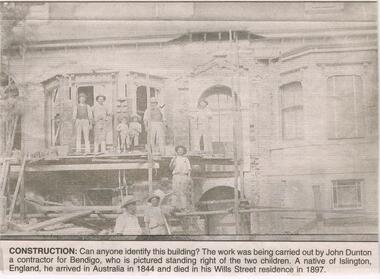
... Bendigo Advertiser ''The way we were'' from 2003. Construction: can anyone identify this building? The work was being carried out by John Dunton a contractor for Bendigo, who is pictured standing right of the two children. ...Bendigo Advertiser ''The way we were'' from 2003. Construction: can anyone identify this building? The work was being carried out by John Dunton a contractor for Bendigo, who is pictured standing right of the two children. ...BHS CollectionBendigo Advertiser ''The way we were'' from 2003. Construction: can anyone identify this building? The work was being carried out by John Dunton a contractor for Bendigo, who is pictured standing right of the two children. A native of Islington, England, he arrived in Australia in 1844 and died in his Wills Street residence in 1897. The clip is in a folder.newspaper, bendigo advertiser, the way we were -
 Bendigo Historical Society Inc.
Sign - J.L. Howard Name Plate
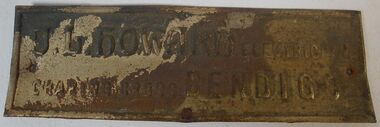
... From the years 1915 - 1917 he advertised in the Bendigo Advertiser as an Electrical contractor and supplier of Electrical accessories, operating from the Lyric Building in Charing Cross, Bendigo. ...From the years 1915 - 1917 he advertised in the Bendigo Advertiser as an Electrical contractor and supplier of Electrical accessories, operating from the Lyric Building in Charing Cross, Bendigo. ...Joseph Lambert Howard was born in Albury, NSW in 1886 and died in Bendigo, Vic. in 1958. From the years 1915 - 1917 he advertised in the Bendigo Advertiser as an Electrical contractor and supplier of Electrical accessories, operating from the Lyric Building in Charing Cross, Bendigo. He also produced an advertising calendar for 1917.Small metal name plate possible tin - has holes Centre of each side. Front is Gold in parts with brown dirty spots - back shows embossing in reverse with some discoloration. Rectangular in shape 6.5cm x 2.0cm. J.L HOWARD - Electrician Charing Cross Bendigo.bendigo electrician, j.l. howard, charing cross bendigo -
 Bendigo Historical Society Inc.
Memorabilia - GREEN BROS BUILDING CONTRACTORS ADVERTISING BROCHURE
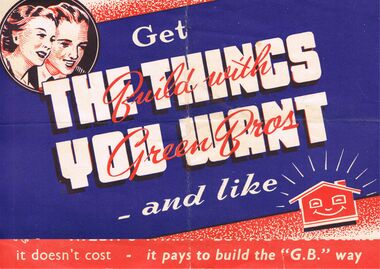
... building Contractors Advertising Brochure:-On cream paper background with red, black and blue print, has *Get The Things You Want - and like. Across these words in red ink is *Build with Green Bros* Top left corner in a circle is a man and women's faces smiling down at the words. Bottom right is a caricature of a smiling house. Open the brochure and it tells you about the company *G. B.'Is The Buy Word For All Types of Buildings - Houses, Hall, Garage or Shearers' Hut. See Green Bros Always. Green Bros Building Contractors Epsom, Via Bendigo...BUILDINGS House green bros builders. Green Bros Builders. Bendigo Heavy Haulage Co. Green Bros building Contractors Advertising Brochure:-On cream paper background with red, black and blue print, has *Get The Things You Want - and like. ...BHS CollectionGreen Bros building Contractors Advertising Brochure:-On cream paper background with red, black and blue print, has *Get The Things You Want - and like. Across these words in red ink is *Build with Green Bros* Top left corner in a circle is a man and women's faces smiling down at the words. Bottom right is a caricature of a smiling house. Open the brochure and it tells you about the company *G. B.'Is The Buy Word For All Types of Buildings - Houses, Hall, Garage or Shearers' Hut. See Green Bros Always. Green Bros Building Contractors Epsom, Via Bendigo, Phone 26 Huntly Branch: Henry St Deniliquin, Phone Deniliquin 88. Also is a drawing of a house plan. On the left side is 4 large red dots down the page and caricature of people enjoying themselves. On the Back is Advertising for House Moving Specialists. Bendigo Heavy Haulage Co. Box 625buildings, house, green bros builders., green bros builders. bendigo heavy haulage co. -
 Bendigo Historical Society Inc.
Document - MARKS COLLECTION: HERCULES AND ENERGETIC GOLDMINING CO. SPECIFICATIONS
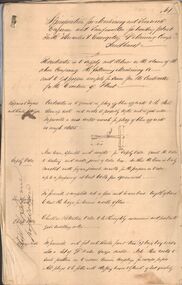
... BENDIGO Mining hercules & energetic mine Handwritten document (15 pages) with two page blue document appended at back. On front of handwritten document : specifications for machinery and ironwork engineer and ironfounder for building plant for the Hercules & Energetic Goldmining Comp., Sandhurst. The contractor ...Handwritten document (15 pages) with two page blue document appended at back. On front of handwritten document : specifications for machinery and ironwork engineer and ironfounder for building plant for the Hercules & Energetic Goldmining Comp., Sandhurst. The contractor is to supply and deliver on the claim of the above Company the following machinery &c - and to get proper receipts for same from the Contractor for the erection of plant. Areas in specifications include: repairs to engine and boiler set-up & c., safety valve, whistle, cylinder, stop valve, piston, eccentric, crank shaft, feed pump & eccentric, flywheel very extensive descriptions of all areas, some with diagrams. Appended to back of document Ironfounders general conditions of contract work required in the making and delivery on the claim machinery &c for a winding plant for the Hercules & |Energetic Co., Drawings prepared by Wm Middleton, Engineer, Sandhurst. Agreement entered into this twelfth day of October, 1878, by and between Messrs Mitchell & Osborne and Hercules and Energetic GMC. Signed by Mitchell & Osborne, per ? Dobson., Wm Middleton ?.bendigo, mining, hercules & energetic mine -
 Bendigo Historical Society Inc.
Document - MARKS COLLECTION: ARCHITECTS AND CIVIL ENGINEERS CONDITIONS OF CONTRACT
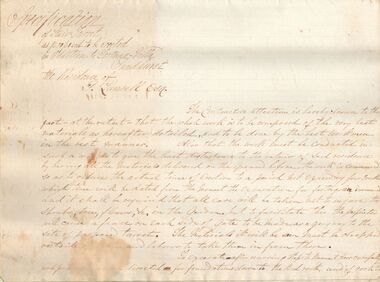
... BENDIGO Buildings fortuna villa 2 blue printed pages outlining regulations of the VICTORIAN Institute of Architects plus 4 handwritten pages of specifications of stairs = turret as proposed to be erected in addition to Fortuna Villa Sandhurst, the residence of G. Lansell. Introductory comments in the specification state: 'The Contractors ...2 blue printed pages outlining regulations of the VICTORIAN Institute of Architects plus 4 handwritten pages of specifications of stairs = turret as proposed to be erected in addition to Fortuna Villa Sandhurst, the residence of G. Lansell. Introductory comments in the specification state: 'The Contractors attention is hereby drawn to the fact - at the outset - that the whole work is to be composed of the very best materials as hereafter detailed, and to be done by the best workmen in the best manner'. Issues covered in the specification include excavation, removal of earth, schedule price for digging and stonework, pressed bricks, pugged mortar, joints, neck, dome roof (diagram of roof included) .bendigo, buildings, fortuna villa -
 Bendigo Historical Society Inc.
Photograph - EDITH LUNN COLLECTION: RENOVATION UNDERWAY 1995 OF DUDLEY HOUSE, VIEW STREET, BENDIGO, 05/08/1995
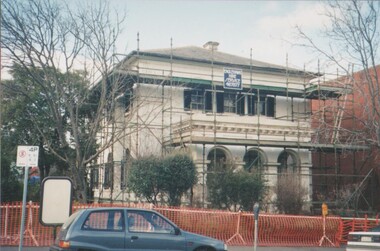
... building contractors Gretch and Cooper. Now part of the Arts Precinct in View Street. Edith Lunn Dudley House, View Street Bendigo. ...Former government building constructed 1858-59 by building contractors Gretch and Cooper. Now part of the Arts Precinct in View Street.Dudley House, View Street Bendigo. Building adjacent to old fire station. Repair and maintenance underway 5/08/1995.Edith Lunn -
 Bendigo Historical Society Inc.
Photograph - ESTELLE HEWSTON COLLECTION: SIX PHOTOGRAPHS OF INTERIOR AND EXTERNAL FEATURES OF THE BENDIGO LAW COURTS PALL MALL, 1990-1997
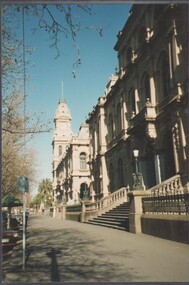
... Contractors R.C. Brown (foundations), McCulloch and McAlpine. Designed to complement the earlier post office alongside. Similarly viewed from all sides. Estelle Hewston Six colour photographs dated 1990 & 1997 of internal features and external facaeds of the Bendigo Law Courts Pall Mall. 14A Pall Mall façade, includes Post Office façade and tower. 14B Internal staircase. 14C façade showing side of building and rear lane to Law Courts. 14D Internal ornate presentation of Law court clock, Sept 1997. 14E Law court façade of Law courts overlooking the lane, and William Vahland façade. 14F Pall Mall facade of law Courts, September 1990. 14G interior view of lead light of entry to Law Courts, September 1997. ...Law Courts in Pall Mall. Architect G. Watson 1890-96. Contractors R.C. Brown (foundations), McCulloch and McAlpine. Designed to complement the earlier post office alongside. Similarly viewed from all sides.Six colour photographs dated 1990 & 1997 of internal features and external facaeds of the Bendigo Law Courts Pall Mall. 14A Pall Mall façade, includes Post Office façade and tower. 14B Internal staircase. 14C façade showing side of building and rear lane to Law Courts. 14D Internal ornate presentation of Law court clock, Sept 1997. 14E Law court façade of Law courts overlooking the lane, and William Vahland façade. 14F Pall Mall facade of law Courts, September 1990. 14G interior view of lead light of entry to Law Courts, September 1997.Estelle Hewston -
 Bendigo Historical Society Inc.
Document - BILL ASHMAN COLLECTION: BUILDING QUOTE, 1957
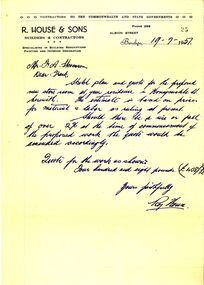
... Envelope addressed to Mr F.A.Stevenson Garage Hargreaves St Bendigo containing a quote and plan for a building from R.House & Sons Builders & Contractors Albion Street Bendigo dated 19.7.57....COMMUNICATION Postal letters Envelope addressed to Mr F.A.Stevenson Garage Hargreaves St Bendigo containing a quote and plan for a building from R.House & Sons Builders & Contractors Albion Street Bendigo dated 19.7.57. ...Envelope addressed to Mr F.A.Stevenson Garage Hargreaves St Bendigo containing a quote and plan for a building from R.House & Sons Builders & Contractors Albion Street Bendigo dated 19.7.57.communication, postal, letters -
 Bendigo Historical Society Inc.
Photograph - LONG GULLY HISTORY GROUP COLLECTION: IRONBARK EAST GOLD MINE
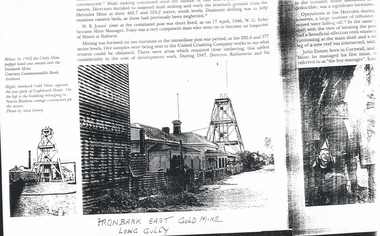
... BENDIGO History long gully history group The Long Gully History Group - Ironbark East Gold Mine Unity Mine Ironbark Mine Commonwealth Bank Archives Norris Brothers Allan Doney Copy of a page from a book showing a photo of the Ironbark East Gold Mine, Long Gully. Photo shows the poppet head beside the footpath and houses on each side. at the left is a building belonging to Norris Brothers cartage contractors ...Copy of a page from a book showing a photo of the Ironbark East Gold Mine, Long Gully. Photo shows the poppet head beside the footpath and houses on each side. at the left is a building belonging to Norris Brothers cartage contractors for the mines. Photo by Allan Doney. Also a smaller photo and printing: In 1942 the Unity Mine poppet head was erected over the Ironbark Mine. Courtesy Commonwealth Bank Archives. Written on the back: Eaglehawk Rd. Looking down from Flats (now??) Steel poppet head replaced wooden poppet.bendigo, history, long gully history group, the long gully history group - ironbark east gold mine, unity mine, ironbark mine, commonwealth bank archives, norris brothers, allan doney -
 Bendigo Historical Society Inc.
Photograph - GRAYDON COLLECTION: FAMILY PHOTOGRAPHS
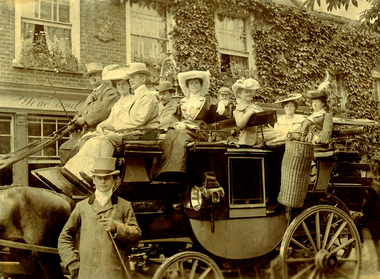
... Bendigo to Echuca. The contractors for this work engaged Mr Richardson, senr., as their timekeeper. When he left school James Richardson applied himself to learn the grocery business, and he gained a thorough knowledge of it with different employers at Bendigo, Taradale, and Daylesford. In 1872 he opened a grocery store on his own account in High-Street, Bendigo, but within a few months he had the great misfortune to be burnt out. The fire originated in an adjoining building...Bendigo to Echuca. The contractors for this work engaged Mr Richardson, senr., as their timekeeper. When he left school James Richardson applied himself to learn the grocery business, and he gained a thorough knowledge of it with different employers at Bendigo, Taradale, and Daylesford. In 1872 he opened a grocery store on his own account in High-Street, Bendigo, but within a few months he had the great misfortune to be burnt out. The fire originated in an adjoining building ...Charles Wallace Gordon Graydon the First came out to Victoria on the S.S. Almora, the same ship on which Eliza Richardson and her family arrived on New Years Day 1875. Evidently C.W.G.G.1st. must have retained fond memories of a young fourteen-year-old girl named Elizabeth Richardson who travelled from Scotland with her mother and family (her father had arrived earlier) because three years later at Kyneton they were married. It was December 26th 1860, and Elizabeth was just seventeen. As the bridegroom’s age is written as 24 years on the wedding certificate, he certainly must have been more than eighteen when he sailed on the "Almora" in 1856. The newly married couple went to live at Taradale, Victoria, and they made a good life for themselves in that town which had then a thriving gold mine. They lived in a large two-storied house in Survey Paddock, and it was there that four daughters - Susan Emily (1861-1906), Elizabeth Constance (1863-1945), Amelia Amy (1865 -1952, Ada Mary Maude (1867-1901), and one son Newenham Edward Eustace (1869-1945) named after his Irish Grandfather, were born. On his wedding certificate C.W.G. Graydon, is described as a foreman. His father-in-law, Robert Richardson was employed as a time-keeper on the Melbourne to Bendigo Railway works, and he and his family lived first in Prahran, then Kyneton, and then Taradale. Perhaps Charles Graydon worked on the railway with him. In Taradale however, he worked for a gold mining company in a surveying capacity. C.W.G.G.1st was to become Shire President of the Shire of Metcalfe. That particular year the Graydon Family entertained the visiting English cricket Eleven at their home in Taradale. He was certainly regarded as an important man in the district when he was requested by a great number of the residents to nominate for the Legislative Assembly election. About 1876 the Graydons left Taradale, and went to live at Sandhurst, now Bendigo, at Barkly Place East. The Richardsons had also left Taradale to go into the grocery business in the same town. Charles Wallace Gordon Graydon the First became a legal manager of mines, and a well-known and popular resident. Sad to say he became ill with a lung infection, and on June 4th. 1885 he died, and was buried at Sandhurst, now Bendigo Cemetery, Back Creek Rd. Eliza Richardson's brother was Mr. James Richardson, the well-known grocer, of Pall Mall and Golden-square, who died at his residence, "Balgownie," Short street, on Thursday 22 Jan 1914. James Richardson was a native of Scotland. He was born at Glasgow in1849 and was only eight years of age when his parents sailed for Australia in the ship Balmoral. The family arrived in Melbourne in 1857 and went to Taradale, where Mr. Richardson, senr., acted as inspector of works during the construction of the Taradale Viaduct. James Richardson, who had commenced his educationin Glasgow, attended school at Taradale until the family removed to Bendigo at the time the railway was being built from Bendigo to Echuca. The contractors for this work engaged Mr Richardson, senr., as their timekeeper. When he left school James Richardson applied himself to learn the grocery business, and he gained a thorough knowledge of it with different employers at Bendigo, Taradale, and Daylesford. In 1872 he opened a grocery store on his own account in High-Street, Bendigo, but within a few months he had the great misfortune to be burnt out. The fire originated in an adjoining building early one morning and both places were burnt to the ground. In spite of his loss, Mr. Richardson was not discouraged, for he soon made another start. His trade improved and he extended his business, opening the Eclipse Cash Store at Golden Square. A little later another branch was opened at the Oddfellows' Hall, and subsequently this business was transferred to the Eureka Cash Store, in Pall Mall, which was the head depot. In addition to the retail trade, Mr. Richardson had, for many years carried on an extensive wholesale business with the Northern District, and had made a specialty of fodder seeds. James was a man of probity and sincerity in business, and as a citizen he was highly esteemed and respected. He was a prominent member of the Bendigo Caledonian Society in the earlier days of his citizenship. He was a staunch member of St Andrew's Presbyterian Church, and was a member of the board of management. In the Easter Fair procession, Mr Richardson's display was always a prominent and attractive one. Mr. Richardson was a member of the Masonic Order, and was a life member of the Bendigo Art Gallery and the old Mechanics Institute. He was married at Daylesford in 1871. Mr James Richardson was interred in the Presbyterian section of the Bendigo Cemetery.A selection of Graydon and Richardson family photographs taken by Bendigo photograpers. all photos unnamed.photograph, person, graydon and richardson families. -
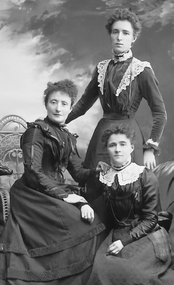 Bendigo Historical Society Inc.
Photograph - Graydon and Richardson Families in Bendigo
... Bendigo to Echuca. The contractors for this work engaged Mr Richardson, senr., as their timekeeper. When he left school James Richardson applied himself to learn the grocery business, and he gained a thorough knowledge of it with different employers at Bendigo, Taradale, and Daylesford. In 1872 he opened a grocery store on his own account in High-Street, Bendigo, but within a few months he had the great misfortune to be burnt out. The fire originated in an adjoining building...Bendigo to Echuca. The contractors for this work engaged Mr Richardson, senr., as their timekeeper. When he left school James Richardson applied himself to learn the grocery business, and he gained a thorough knowledge of it with different employers at Bendigo, Taradale, and Daylesford. In 1872 he opened a grocery store on his own account in High-Street, Bendigo, but within a few months he had the great misfortune to be burnt out. The fire originated in an adjoining building ...Charles Wallace Gordon Graydon the First came out to Victoria on the S.S. Almora, the same ship on which Eliza Richardson and her family arrived on New Years Day 1875. Evidently C.W.G.G.1st. must have retained fond memories of a young fourteen-year-old girl named Elizabeth Richardson who travelled from Scotland with her mother and family (her father had arrived earlier) because three years later at Kyneton they were married. It was December 26th 1860, and Elizabeth was just seventeen. As the bridegroom’s age is written as 24 years on the wedding certificate, he certainly must have been more than eighteen when he sailed on the "Almora" in 1856. The newly married couple went to live at Taradale, Victoria, and they made a good life for themselves in that town which had then a thriving gold mine. They lived in a large two-storied house in Survey Paddock, and it was there that four daughters - Susan Emily (1861-1906), Elizabeth Constance (1863-1945), Amelia Amy (1865 -1952, Ada Mary Maude (1867-1901), and one son Newenham Edward Eustace (1869-1945) named after his Irish Grandfather, were born. On his wedding certificate C.W.G. Graydon, is described as a foreman. His father-in-law, Robert Richardson was employed as a time-keeper on the Melbourne to Bendigo Railway works, and he and his family lived first in Prahran, then Kyneton, and then Taradale. Perhaps Charles Graydon worked on the railway with him. In Taradale however, he worked for a gold mining company in a surveying capacity. C.W.G.G.1st was to become Shire President of the Shire of Metcalfe. That particular year the Graydon Family entertained the visiting English cricket Eleven at their home in Taradale. He was certainly regarded as an important man in the district when he was requested by a great number of the residents to nominate for the Legislative Assembly election. About 1876 the Graydons left Taradale, and went to live at Sandhurst, now Bendigo, at Barkly Place East. The Richardsons had also left Taradale to go into the grocery business in the same town. Charles Wallace Gordon Graydon the First became a legal manager of mines, and a well-known and popular resident. Sad to say he became ill with a lung infection, and on June 4th. 1885 he died, and was buried at Sandhurst, now Bendigo Cemetery, Back Creek Rd. Eliza Richardson's brother was Mr. James Richardson, the well-known grocer, of Pall Mall and Golden-square, who died at his residence, "Balgownie," Short street, on Thursday 22 Jan 1914. James Richardson was a native of Scotland. He was born at Glasgow in1849 and was only eight years of age when his parents sailed for Australia in the ship Balmoral. The family arrived in Melbourne in 1857 and went to Taradale, where Mr. Richardson, senr., acted as inspector of works during the construction of the Taradale Viaduct. James Richardson, who had commenced his educationin Glasgow, attended school at Taradale until the family removed to Bendigo at the time the railway was being built from Bendigo to Echuca. The contractors for this work engaged Mr Richardson, senr., as their timekeeper. When he left school James Richardson applied himself to learn the grocery business, and he gained a thorough knowledge of it with different employers at Bendigo, Taradale, and Daylesford. In 1872 he opened a grocery store on his own account in High-Street, Bendigo, but within a few months he had the great misfortune to be burnt out. The fire originated in an adjoining building early one morning and both places were burnt to the ground. In spite of his loss, Mr. Richardson was not discouraged, for he soon made another start. His trade improved and he extended his business, opening the Eclipse Cash Store at Golden Square. A little later another branch was opened at the Oddfellows' Hall, and subsequently this business was transferred to the Eureka Cash Store, in Pall Mall, which was the head depot. In addition to the retail trade, Mr. Richardson had, for many years carried on an extensive wholesale business with the Northern District, and had made a specialty of fodder seeds. James was a man of probity and sincerity in business, and as a citizen he was highly esteemed and respected. He was a prominent member of the Bendigo Caledonian Society in the earlier days of his citizenship. He was a staunch member of St Andrew's Presbyterian Church, and was a member of the board of management. In the Easter Fair procession, Mr Richardson's display was always a prominent and attractive one. Mr. Richardson was a member of the Masonic Order, and was a life member of the Bendigo Art Gallery and the old Mechanics Institute. He was married at Daylesford in 1871. Mr James Richardson was interred in the Presbyterian section of the Bendigo Cemetery.Digital Image. Copy of photograph of three of the four Graydon girls. Ada, Lizzie and Amelia Graydon. B&W photo of three women - two seated and one standing - Studio portrait.Lizzie (Elizabeth Constance 1863-1945) standing. Amelia (Amelia Amy 1865 - 1952) Seated on right. Ada (Ada Mary Maude 1867-1901) seated left.graydon girls., graydon collection, graydon richardson, james richardson grocer, bendigo history
