
Showing 5 items matching "bendigo magistrates' court"
-
 Eltham District Historical Society Inc
Photograph, View of Bendigo from Post Office Tower, c.Aug. 1963
... ...Bendigo Magistrates' Court...In the immediate foreground to left is the Bendigo Magistrates' Court....In the immediate foreground to left is the Bendigo Magistrates' Court. Bendigo George Coop Collection Pall Mall Post Office Tower Bendigo Magistrates' Court Midland Highway Digital TIFF file Scan of 35mm Ilford FP3 black and white negative transparency View of Bendigo from Post Office Tower Photograph Photograph George Coop ...View looking northeast along the Midland Highway (Pall Mall) from the top of the Post Office tower, present day Post Office Gallery and Visitor Centre.. In the immediate foreground to left is the Bendigo Magistrates' Court.Digital TIFF file Scan of 35mm Ilford FP3 black and white negative transparencybendigo, george coop collection, pall mall, post office tower, bendigo magistrates' court, midland highway -
 Bendigo Historical Society Inc.
Book - SANDHURST COURT RECORDS LEDGER, 1857 - 1858
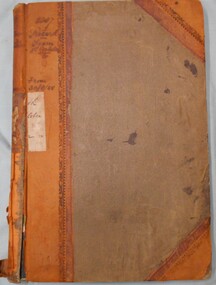
... magistrate Lachlan McLachlan. Notes Philip Barton inherited the book from his father Russell Barton who died in 2002. Russell Barton was a barrister who practised on the Supreme Court Circuit in Bendigo from 1960 - 1975. ...magistrate Lachlan McLachlan. Notes Philip Barton inherited the book from his father Russell Barton who died in 2002. Russell Barton was a barrister who practised on the Supreme Court Circuit in Bendigo from 1960 - 1975. ...District Police Office Sandhurst Court records. October 1857 - October 1858. Brown ledger containing the records of the District Police Office Sandhurst. Cover has linen like covering with suede leather corners and spine. All have decorative scroll and pattern work. Dates written in ink on the spine. Remnants of an adhesive label on the spine. Inside covers lined with red, green and gold patterned paper. Entries include names of judges, solicitors, witnesses, accused and plaintiffs, Each record include descriptions of charges and the rulings. Most of the sittings were conducted by police magistrate Lachlan McLachlan. Notes Philip Barton inherited the book from his father Russell Barton who died in 2002. Russell Barton was a barrister who practised on the Supreme Court Circuit in Bendigo from 1960 - 1975. He was interested in history and it is assumed that he was given the book by the Bendigo Court officials. Philip Barton gave the book to Dennis Johnason on the understanding that it be given to the Bendigo Historical Society. See Donor.government, local, court records -
 Bendigo Historical Society Inc.
Document - BENDIGO TOTAL ABSTINENCE SOCIETY COLLECTION: BENDIGO POLICE COURT PLEDGE
... Bendigo Police Court. Charge .... I Hereby freely and voluntarily sign the following PLEDGE. I will abstain from the use of intoxicating liquors of every kind and character for the period of.......from date, ....day of.......191. signed Address Age Witness. If, by releasing me from punishment this day, the opportunity be given me by the Magistrates...Bendigo Police Court. Charge .... I Hereby freely and voluntarily sign the following PLEDGE. I will abstain from the use of intoxicating liquors of every kind and character for the period of.......from date, ....day of.......191. signed Address Age Witness. If, by releasing me from punishment this day, the opportunity be given me by the Magistrates ...Document. Bendigo Police Court. Charge .... I Hereby freely and voluntarily sign the following PLEDGE. I will abstain from the use of intoxicating liquors of every kind and character for the period of.......from date, ....day of.......191. signed Address Age Witness. If, by releasing me from punishment this day, the opportunity be given me by the Magistrates of the abovenamed Court to become a sober and better citizen, I undertake to faithfully keep this Pledge. Six copies.organisation, community, abstinence society -
 Bendigo Historical Society Inc.
Book - "Eaglehawk. Recollections of the Borough", 1995
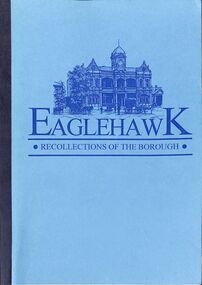
... Magistrates' Court closed on 1 January 1990. In 1994 the Borough of Eaglehawk was amalgamated by the Victorian Government with four other councils to become the city of Greater Bendigo....Magistrates' Court closed on 1 January 1990. In 1994 the Borough of Eaglehawk was amalgamated by the Victorian Government with four other councils to become the city of Greater Bendigo. ...Eaglehawk is a suburb within the City of Greater Bendigo and a former gold-mining town in Victoria, Australia. Eaglehawk is situated to the north-west of Bendigo on the Loddon Valley Highway. The highway is known locally as High Street until the intersection with Sailors Gully Road (Bendigo - Pyramid Road) and as Peg Leg Road to the west. Located on this intersection is Brassey Square which is the location of the town hall. Next to the town hall is the former post office and the Mechanics' Institute. To the north of the intersection on Napier Street is Canterbury Park and Lake Neangar while the Swan Hill railway line and the local railway station are located to the south. The original inhabitants of the area were the Dja Dja Wurrung. Following the discovery of gold at Sandhurst (Bendigo) in October 1851, Joseph Crook discovered a gold nugget while searching for stray horses. This event sparked a gold rush in the area leading to the establishment of the township in 1852, the population quickly building up to 40,000. The Post Office opened on 1 August 1857. In 1862, the Borough of Eaglehawk was established, which included the nearby township of California Gully. After the alluvial gold was exhausted in 1893, reef mines were established, with 300 tonnes of gold extracted. Most of the mines had closed by the 1890s and by 1947 the population had decreased substantially to 4,090. The Eaglehawk Magistrates' Court closed on 1 January 1990. In 1994 the Borough of Eaglehawk was amalgamated by the Victorian Government with four other councils to become the city of Greater Bendigo."Eaglehawk. Recollections of the Borough" by Jodie Clough, Et al. Soft cover. Sky blue cardboard cover with navy blue binding tape along spine. Title written in navy blue on front cover. Drawing of Eaglehawk Town Hall in front cover in navy blue. No page numbers. Illustrations in black ink throughout. Produced under the LEAP Program, a federally funded project for the long-term unemployed referred by the Commonwealth Employment Service. Has content page at front, but no index. Interviewees listed inside back cover with contact phone numbers. mining, education, eaglehawk -
 Bendigo Historical Society Inc.
Book - "A Fly on the Wall", 2010
... Magistrates' Court closed on 1 January 1990. In 1994 the Borough of Eaglehawk was amalgamated by the Victorian Government with four other councils to become the city of Greater Bendigo....Magistrates' Court closed on 1 January 1990. In 1994 the Borough of Eaglehawk was amalgamated by the Victorian Government with four other councils to become the city of Greater Bendigo. ...Eaglehawk is a suburb within the City of Greater Bendigo and a former gold-mining town in Victoria, Australia. In 1901 Eaglehawk had a total population of 8130. Eaglehawk is situated to the north-west of Bendigo on the Loddon Valley Highway. The highway is known locally as High Street until the intersection with Sailors Gully Road (Bendigo - Pyramid Road) and as Peg Leg Road to the west. Located on this intersection is Brassey Square which is the location of the town hall. Next to the town hall is the former post office and the Mechanics' Institute. To the north of the intersection on Napier Street is Canterbury Park and Lake Neangar while the Swan Hill railway line and the local railway station are located to the south. The original inhabitants of the area were the Dja Dja Wurrung. Following the discovery of gold at Sandhurst (Bendigo) in October 1851, Joseph Crook discovered a gold nugget while searching for stray horses. This event sparked a gold rush in the area leading to the establishment of the township in 1852, the population quickly building up to 40,000. The Post Office opened on 1 August 1857. In 1862, the Borough of Eaglehawk was established, which included the nearby township of California Gully. After the alluvial gold was exhausted in 1893, reef mines were established, with 300 tonnes of gold extracted. Most of the mines had closed by the 1890s and by 1947 the population had decreased substantially to 4,090. The Eaglehawk Magistrates' Court closed on 1 January 1990. In 1994 the Borough of Eaglehawk was amalgamated by the Victorian Government with four other councils to become the city of Greater Bendigo."A Fly on the Wall. Eaglehawk. 1901" written by Noelene Wild. Published in 2010. ISBN: 978-0-9579939-3-8. Soft cover. Sky blue front cover, spine and back cover. Title, author's name and picture of Eaglehawk Town Hall on front cover in maroon. 93 pp. Has index. Contains black and white images. List of all rate holders in the Borough of Eaglehawk towards back of book. eaglehawk, gold, mining, population
