
Showing 18 items matching "bendigo-sport-cricket"
-
 Bendigo Historical Society Inc.
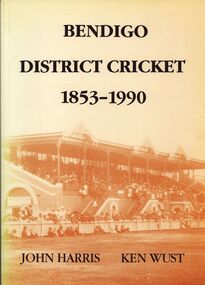
Book - STRAUCH COLLECTION - BENDIGO DISTRICT CRICKET 1853-1990
... ...Bendigo-Sport-Cricket...ORGANIZATION Club/society cricket club Bendigo-Sport-Cricket John Harris & Ken Wust Bendigo District Cricket 1853-1990, John Harris and Ken Wust, soft cover 95 pages with black & white photographs, lists of officials & players, printed by D.G.Walker Pty Ltd Bendigo. ...Bendigo District Cricket 1853-1990, John Harris and Ken Wust, soft cover 95 pages with black & white photographs, lists of officials & players, printed by D.G.Walker Pty Ltd Bendigo. John Harris & Ken Wust organization, club/society, cricket club, bendigo-sport-cricket -
 Bendigo Historical Society Inc.
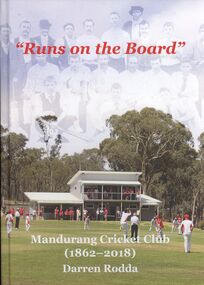
Book - RUNS ON THE BOARD MANDURANG CRICKET CLUB
... Bendigo...Cricket...Bendigo-Mandurang-Sport-Cricket...BOOK Bendigo Cricket Bendigo-Mandurang-Sport-Cricket Darren Rodda Hard cover book "Runs on the Board" Mandurang Cricket Club (1862 - 2018) 132 pages with black and white & coloured photographs. ...Hard cover book "Runs on the Board" Mandurang Cricket Club (1862 - 2018) 132 pages with black and white & coloured photographs. Darren Rodda book, bendigo, cricket, bendigo-mandurang-sport-cricket -
 Bendigo Historical Society Inc.
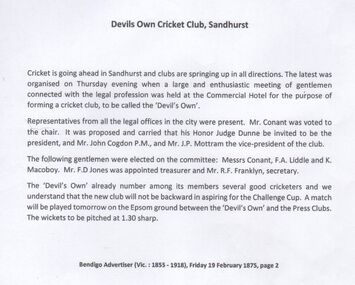
Article - Devils Own Cricket Club Established Bendigo Advertiser Article
... Bendigo’s legal fraternity name themselves DOCC with the intent that they would reflect the distinguished pedigree and qualities of the Devil’s Own regiment? Details of one the players in the 'Devils'Own' CC : Pelling Hugh Gough Pigott Stainsby Conant, solicitor, born Hampshire, England 1846. Arrived Australia 1871. Pelling was the son of Francis Pigott Stainsby Conant Esq., Lieutenant Governor of the Isle of Man. He married Catherine Anne Drummond. In 1874, his practice was in the Albion Chambers, Sandhurst, given as 'Pelling H.G.P.S. Conant, Solicitor'. Organisation-Club/society-sport DOCC Devils Own Cricket ...The Devils' Own Cricket Club was also referred to as the Law Cricket Club and the Law (Devils' Own) Cricket Club. The club was formed in 1875 from members of the local legal fraternity and business people in Sandhurst (Bendigo). In addition to the Devils' Own Cricket Club, there were many male cricket clubs formed in Bendigo in the 1870's, for example, the Bendigo United Cricket Club; Epsom Cricket Club; All Trades Cricket Club; New Chum Cricket Club; California Gully Cricket Club; Long Gully Cricket Club; Butchers' Cricket Club; View Point Cricket Club; Myers Street Cricket Club; Australian Natives Association Cricket Club; View Point Cricket Club; Beehive Cricket Club; Advertiser Cricket Club; Kangaroo Flat Cricket Club; Golden Square Cricket Club; North Bendigo Cricket Club; Crusoe Cricket Club; City Cricket Club; Bohemians Cricket Club and the Happy Valley Cricket Club. Where did the name 'Devils' Own' come from? The Inns of Court Regiment, London, has a unique place in history as a result of its ancient and intimate connection with the Law and lawyers. It recruited and 'officered' almost exclusively from the legal profession, drawn from barristers, attorneys, notaries and their clerks and students practising in the area of the Inns of Court comprising Middle Temple, Inner Temple, Lincoln’s Inn and Gray’s Inn. During Napoleonic Wars all Inns raised companies. During a review by King George III in Hyde Park in 1803, the King used his dislike for lawyers – particularly ones carrying arms – to name the massed ranks of the Law Association as "The Devil's Own".[5] "It is understood that the King was in high health and excellent spirits at the time. The Bloomsbury and Inns of Court Volunteers was reformed in 1797 during the Napoleonic Wars. It was shortly afterwards that the regiment gained its enduring nickname. During a review by King George III in Hyde Park in 1803, the King used his dislike for lawyers – particularly ones carrying arms – to name the massed ranks of the Law Association as "The Devil's Own". "It is understood that the King was in high health and excellent spirits at the time. When the 'Temple companies' had defiled before him, his Majesty enquired of Lord David Erskine, who commanded them, as lieutenant colonel, what was the composition of that corps? 'They are all lawyers, Sire,' said Erskine. 'What! What! 'exclaimed the King, 'all lawyers? all lawyers? Call them the Devil's Own, call them the Devil's Own!" "And the Devil's Own they were called accordingly." ( Norton, F.C., A short history of the military & naval services of the Inns of Court and the members of the Bench and the Bar, 1886, William Clowes & Sons, Stamford Street and Charing Cross, London) Did Bendigo’s legal fraternity name themselves DOCC with the intent that they would reflect the distinguished pedigree and qualities of the Devil’s Own regiment? Details of one the players in the 'Devils'Own' CC : Pelling Hugh Gough Pigott Stainsby Conant, solicitor, born Hampshire, England 1846. Arrived Australia 1871. Pelling was the son of Francis Pigott Stainsby Conant Esq., Lieutenant Governor of the Isle of Man. He married Catherine Anne Drummond. In 1874, his practice was in the Albion Chambers, Sandhurst, given as 'Pelling H.G.P.S. Conant, Solicitor'. Organisation-Club/society-sport A transcript of the Devils Own Cricket Club article in the 19th February, 1875 edition of the Bendigo Advertiser docc, devils own cricket club, sandhurst, bendigo advertiser, pelling h.g.p. s. conant, solicitor, barrister -
 Bendigo Historical Society Inc.
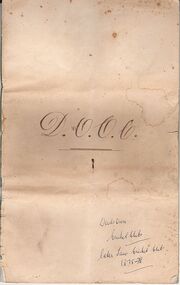
Document - Devils Own Cricket Club Member register and cash book 1875-1877
... Organisation-Club/society-sport DOCC Devils Own Cricket Club Sandhurst Bendigo Advertiser "Devils Own Cricket Club Later Law Cricket Club 1875-78" written in blue ink on the cover. ...Organisation-Club/society-sport A large but thin book consisting of blue lined paper and a cream coloured cover. Includes the handwritten list of Cricket club members and, later in the book, a list of cash transactions made by the club. "Devils Own Cricket Club Later Law Cricket Club 1875-78" written in blue ink on the cover. docc, devils own cricket club, sandhurst, bendigo advertiser -
 Bendigo Historical Society Inc.
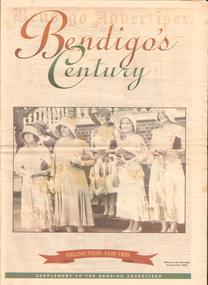
Newspaper - LONG GULLY HISTORY GROUP COLLECTION: BENDIGO'S CENTURY VOLUME FOUR: 1930 - 1939
... Bendigo Jockey Club, 1930s. Each year has heading of Who's Who, Weather, Sport and Business. First years are 1930 - 1939 titled A look back when. The page has photos of the Eaglehawk Cricket...Bendigo Jockey Club, 1930s. Each year has heading of Who's Who, Weather, Sport and Business. First years are 1930 - 1939 titled A look back when. The page has photos of the Eaglehawk Cricket ...Newspaper supplement titled Bendigo's Century Volume Four: 1930 - 1939. Front page is titled Bendigo's Century and has a photo of some women at the Bendigo Jockey Club, 1930s. Each year has heading of Who's Who, Weather, Sport and Business. First years are 1930 - 1939 titled A look back when. The page has photos of the Eaglehawk Cricket Club's first A Grade cricket premier ship team (1932 - 1933)., The monument to the late Bendigo mining magnate Ernst Mueller in Rosalind Park, The Bendigo Stock Exchange in the early 1930's - pictured are L L Dungey, T Williams, M P Kelly, C Mueller, E Hommoloff, R Kelly, T H Busst, T Hall, R Trembath, E A Woolcock, and C Burridge, the Carshalton mine in 1936 and The Edith and G V Lansell Laboratory at the Bendigo Hospital. 1930 - a photo of St Andrew's Church, the sundial outside the RSL Memorial Hall, The late Monsignor Rooney and The late John Douse Langley. The Ironbark Mine was the top gold producer. 1931 - Radio station goes on air, 1932 - Sir John dies, 1933 Bodyline men come to town, 1934 - Heroic rescues, 1935 - Hospital's new wing opened, 1936 - King mourned, 1937 - Beehive store towers above, 1938 - Mining shows mixed results and 1939 - Outbreak of war sobering. bendigo, history, long gully history group, the long gully history group - bendigo's century - volume four: 1930 - 1939, eaglehawk cricket club, ernst mueller, the bendigo stock exchangel l dungey, t williams, m p kelly, c mueller e hommoloff, r kelly, t h busst, t hall, r tremabath, e a woodcock, c burridge, charshalton mine, edith and g v lansell laboratory, st andrew's church, rsl memorial hall, mr gordon carter, sir john monash, state electricity commission, cr r watson, colonel gt v lansell, empire press congress, bendigo advertiser, mr e j hogan, eppalock weir, lyric theatre, bendigo red cross, mrs george mackay, st andrew's presbyterian church, mrs william hunter, right rev john douse langley, monsignor rooney, bendigo art gallery, the ironbark mine, coliban water, mr w wright, station 3bo, amalgamated wireless of australia ltd, advance bendigo group, the north league, st aidan's orphanage, bendigo freezing works, mr w wright, bendigo advertiser, mr w j stephens, advance bendigo group, north league, garden gully united gold mining company, bendigo football league, sir john quick, john quick snr, ironbark foundry, bendigo evening news, bendigo independent, bendigo advertiser, deakin governmnet, sir charles kingsford smith, southern cross, eppalock weir, bendigo art gallery, the hercules mine, gillies, aids & appliance shop, anne caudle centre, bill woodfull, harold larwood, dr john mccarthy, the hercules, douglas jardine, don bradman, sacred heart cathedral, joseph stapleton, john lynch, bert mcconchie, new red white and blue mine, royal humane society, william james, vernon shaw, south new moon mine, bendigo hospital, bendigo base hospital, duke of gloucester, rsl memorial hall, electricity commission, eaglehawk borough council, the plaza, backhaus estate, amalgamated freezing company, fortuna villa, mrs edith lansell, colonel lansell, the hercules mine, toni riley pharmacy, boardwalk, barkly hyett, the big blue consolidated company, the bendigo hospital, eaglehawk football team, kurmala wing of the bendigo base hospital, sir isaac isaacs, lyric theatre, sir john quick, hanro knitting mills, st luke's toddlers home, st aidan's orphanage, rsl memorial hall, lord and lady huntingfield, cr michelsen, bendigo art gallery, bendigo agricultural show, new blue mine, joseph stapleton, bendigo law association, bendigo hospital committee of management, bendigo rotary club, mr j mcrae, education department, andrew sunstan, sir stanley argyle, bendigo football league, north blue mining company, cr staples, king george v, king edward viii, cr j a michelsen, andrew mclay, bendigo advertiser, cohn bros, mrs wallis simpson, king george vi, capping mine shafts 1936, bendigo art gallery, madge freemen, william john leslie cross, judge wasley, the myer emporium, the baptist church, salvation army, ron masters, the central nell gwyn, sir john quick, leanne mcdonnell, windermere hotel, rev donald baker, john rumbold, central nell gwynne, the beehive building, the beehive store, james buick and co, thomas hope henderson, buick henderson & co, mr goodison, mr r o henderson, lt-col henderson, angus mackay, bendigo sewerage authority, mr s gordon moore, commercial bank of sydney, bendigo advertiser, edward alan morcom, polio, dr gardner kerr, the right rev conald baker, ridley theological college -
 Bendigo Historical Society Inc.
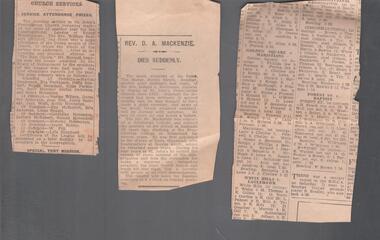
Newspaper - KEN HESSE COLLECTION: NEWSPAPER ITEMS ST. JOHN'S PRESBYTERIAN CHURCH, BENDIGO
... Bendigo...Ken Hesse Collection... collection... newspaper items... Rev. D .A. Mackenzie... singing... choir... sport... cricket...CHURCH History Presbyterian Church Forest St Bendigo Ken Hesse Collection collection newspaper items Rev. D .A. Mackenzie singing choir sport cricket history Various newspaper articles relating to members of the congregation of St. ...Various newspaper articles relating to members of the congregation of St. John's, Forest Street, Bendigo. Items of interest are church attendance prizes, the death of Rev. D. A. Mackenzie suddenly at the manse and cricket scores. Part of Ken Hesse Collection donated by Mr. James Lerk. church, history, presbyterian church forest st bendigo, ken hesse collection, collection, newspaper items, rev. d .a. mackenzie, singing, choir, sport, cricket, history -
 Bendigo Historical Society Inc.
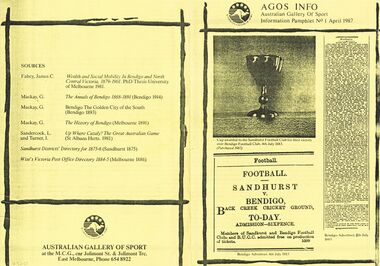
Document - AGOS INFO, BENDIGO, April 1987
... Bendigo. Australian Gallery of Sport. Information Pamphlet No. 1 April 1987. Photo cup awarded Sanhurst Football Club for victory Bendigo Football Club... 4th July 1883. (Purchased 1987). Advertiser... 4th July 1883 Match between Sandhurst v. Bendigo. Admission - Sixpence. Members Sanhurst & Bendigo Football Clubs and BUCC free. Extract... 5th July 1883... FOOTBALL Sandhurst v. Bendigo. Sandhurst. Bendigo July 4th 1883 Sandhurst and Bendigo provides insight into the Australian stage development.. . Trophy local jeweler... Mr Joseph Moody. .. Football weaker in Bendigo than in Ballarat. explained by the migrant proportion Bendigo population... its economic difficulties 1880s distance from Melbourne.. Football overtook cricket...Bendigo Advertiser, was Sheldon of Sandhurst, an ancestor of current day player Ken Sheldon of St Kilda. .. Fundamental issue about the place of sport in society. .. The reason for this is that the Bendigo club was in dispute with the Bendgio Union Cricket Club over control of the Back Creek Ground. ...Bendigo Advertiser, was Sheldon of Sandhurst, an ancestor of current day player Ken Sheldon of St Kilda. .. Fundamental issue about the place of sport in society. .. The reason for this is that the Bendigo club was in dispute with the Bendgio Union Cricket Club over control of the Back Creek Ground. ...AGOS INFO, Bendigo. Australian Gallery of Sport. Information Pamphlet No. 1 April 1987. Photo of cup awarded to the Sanhurst Football Club for their victory over Bendigo Football Club, 4th July 1883. (Purchased 1987). Extract from Bendigo Advertiser, 4th July 1883 advertising Match between Sandhurst and Bendigo. Admission - Sixpence. Members of Sanhurst & Bendigo Football Clubs and BUCC admitted free on production of tickets. Extract of Bendigo Advertiser, 5th July 1883, FOOTBALL Sandhurst v. Bendigo. (remainder of print too small to read. Sandhurst. Bendigo July 4th 1883 The match played between Sandhurst and Bendigo provides a rare insight into the Australian game at a crucial stage of its development.. . Trophy presented by local jeweler, Mr Joseph Moody. .. Football was relatively weaker in Bendigo than in the comparable city of Ballarat. This can be explained by the high migrant proportion of the Bendigo population, its economic difficulties in the 1880s and by its distance from Melbourne. .. Football overtook cricket by the end of the decade as the most popular sport. .. A regular Saturday competition was played, with matches also played on Wednesdays. These matches were a legacy of the earliest ''scratch'' matches, suggesting a relatively strong union movement which had won concessions for weekend work. Matches started at 3pm. ..The best player on the ground was a contractor and the captain an accountant. .. Transition. The predominance of the ''little mark'' the participation of sometimes frightened junior teams against adults and the division of the game into halves rather than quarters represents an era that has disappeared. Complaints of rough play, poor losers, the problems posed by children. .. An issue, was seen as a blight on the game in 1883. The greatest offender, alleged by ''Drop-Kick'' in The Bendigo Advertiser, was Sheldon of Sandhurst, an ancestor of current day player Ken Sheldon of St Kilda. .. Fundamental issue about the place of sport in society. .. The reason for this is that the Bendigo club was in dispute with the Bendgio Union Cricket Club over control of the Back Creek Ground. If they had been refused the ground, as it was feared, then the whole association would have been forced to disband. Only last minute negotiations resolved the dispute. .. Reflects the values of society, .. Broader conflicts about power and the control of resources within that society. 2000 turned out. The crowd cheered lustily and the players exhibited similar excitement and were urged on by their captains to play up and kick the ball. In the eventual Sanhurst victory, amongst the best players was Edward Cordner, a forerunner of the renowned Cordner family of the Melbourne Football Clubs. Shane Cahill. Sources: Fahey, James C. Wealth and Social Mobility In Bendigo and North Central Victoria, 1868-1891. Mackay, G. The Annals of Bendigo 1868-1891 (Bendigo 1914). Mackay, G. Bendigo The Golden City of the South (Bendigo 1893) Mackay, G. The History of Bendigo (Melbourne 1891). Sandercock, L.. And Turner, I. Up Where Cazaly? The Great Australian Game (St Albans Herts. 1981) Sanhurst Districts' Directory for 1875-6 (Sandhurst 1875) Wise's Victoria Post Office Directory 1884-5 (Melbourne 1886). Australian Gallery Of Sport at the MCG, cnr Joliment St. & Joliment Trc. East Melbourne, Phone 654 8922. clubs and associations, football, agos, agos info, bendigo. australian gallery of sport. information pamphlet no. 1 april 1987. photo cup awarded sanhurst football club for victory bendigo football club, 4th july 1883. (purchased 1987). advertiser, 4th july 1883 match between sandhurst v. bendigo. admission - sixpence. members sanhurst & bendigo football clubs and bucc free. extract, 5th july 1883, football sandhurst v. bendigo. sandhurst. bendigo july 4th 1883 sandhurst and bendigo provides insight into the australian stage development.. . trophy local jeweler, mr joseph moody. .. football weaker in bendigo than in ballarat. explained by the migrant proportion bendigo population, its economic difficulties 1880s distance from melbourne.. football overtook cricket by end decade the popular sport.. saturday competition played, matches also wednesdays. legacy of the earliest ''scratch'' matches, strong union movement concessions for weekend work. matches started at 3pm.. best player on the ground a contractor the captain accountant. .. transition. predominance ''little mark'' participation frightened junior teams adults game halves rather than quarters represents an era disappeared. complaints rough play, poor losers, problems posed children., a blight 1883. offender, ''drop-kick'', sheldon, ancestor ken sheldon of st kilda...bendigo club was in dispute bendgio union cricket club control of the back creek ground. refused, as it was feared, association forced to disband. negotiations resolved dispute..values of society.. conflicts power control resources. 2000 turned out. crowd cheered players exhibited similar excitement captains. edward cordner. cordner family melbourne football clubs. shane cahill. sources: fahey, james c. wealth and social mobility in bendigo and north central victoria, 1868-1891. mackay, g. the annals of bendigo 1868-1891 (bendigo 1914). mackay, g. bendigo the golden city of the south (bendigo 1893) mackay, g. the history of bendigo (melbourne 1891). sandercock, l.. and turner, i. up where cazaly? the great australian game (st albans herts. 1981) sanhurst districts' directory for 1875-6 (sandhurst 1875) wise's victoria post office directory 1884-5 (melbourne 1886). australian gallery of sport at the mcg, cnr joliment st. & joliment trc. east melbourne, phone 654 8922. -
 Bendigo Historical Society Inc.
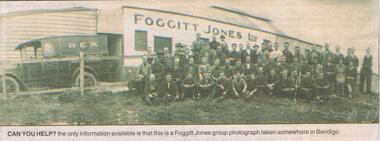
Newspaper - JENNY FOLEY COLLECTION: CAN YOU HELP?
... In Bendigo the company even sported its own cricket team. Full description of factory available at:- https://trove.nla.gov.au/newspaper/article/89985265?...In Bendigo the company even sported its own cricket team. Full description of factory available at:- https://trove.nla.gov.au/newspaper/article/89985265? ...An Australian food production company specialising in ham, bacon and smallgoods, had factories in Brisbane, Sydney and Freemantle before buying the factory of Roberts Osborne Co. in Golden Square in 1913. Over 5000 pounds was spent refurbishing the factory to bring it up to current health and safety requirements, including the installation of electricity. In addition the company established retail outlets at Bath Corner and Hargreaves Street. The company arranged for the Golden Square railway station to be used to offload stock rather than the Bendigo station. The company was well known for its "Rex" brand of goods. In Bendigo the company even sported its own cricket team. Full description of factory available at:- https://trove.nla.gov.au/newspaper/article/89985265?searchTerm=%22Foggitt%20Jones%22 Bendigo Advertiser '' The way we were'' from 2002. Can you help?: the only information available is that this is a Foggitt Jones group photograph taken somewhere in Bendigo. The clip is in a folder. newspaper, bendigo advertiser, the way we were -
 Bendigo Historical Society Inc.
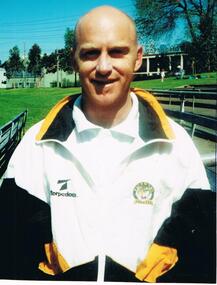
Photograph - BENDIGO ADVERTISER COLLECTION: SUPPLIED SPORT PHOTOS, LEISA ALEXANDER
... Cricket Leisa Alexander Coloured photographs, multiple people, multiple photographs, A collection of photos sent by Leisa Alexander to the Bendigo Advertiser with members of the Richmond Cricket Club on them. a. Colour photo of Gavin Holland. b. Colour photo of Mark Simpson. c. Colour photo of David Harris. d. Colour photo of Matthew McLeay. e. Colour photo of Alan Wise. f. Colour photo of Matthew Galbraith. g. Colour photo of Sam Taylor. h. Ian Hewett. i. Colour photo of Jason Arnberger. Photograph BENDIGO ADVERTISER COLLECTION: SUPPLIED SPORT ...Coloured photographs, multiple people, multiple photographs, A collection of photos sent by Leisa Alexander to the Bendigo Advertiser with members of the Richmond Cricket Club on them. a. Colour photo of Gavin Holland. b. Colour photo of Mark Simpson. c. Colour photo of David Harris. d. Colour photo of Matthew McLeay. e. Colour photo of Alan Wise. f. Colour photo of Matthew Galbraith. g. Colour photo of Sam Taylor. h. Ian Hewett. i. Colour photo of Jason Arnberger. Leisa Alexander recreations, sports, cricket -
 Bendigo Historical Society Inc.
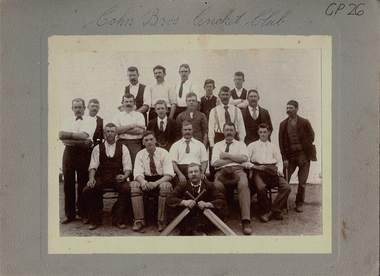
Photograph - COHN BROS CRICKET CLUB, 1920'S?
... Cricket...Bendigo... sport...RECREATIONS Sports Cricket Bendigo sport entertainment male portrait Cohn Brothers clubs clubs and associations business Sepia photograph on grey board of Cohn Bros Cricket Club. ...Sepia photograph on grey board of Cohn Bros Cricket Club. Perhaps employees of Cohns, dressed in suits, shirts, ties and pants. Some seated. Some on platform at rear, cricket pads on one male, one holding bats, another a ball. Inscriptions: on front - hand written at top in ball point pen 'Cohn Bros Cricket Club'. At top R corner 'GP26'.On back - 'Royal Historical society of Victoria, Bendigo Branch' circular stamp. Written in ink - 'Back row: Dave Guerin, Tom McCormick, W Nielsen, Squimpy Mead, Jack Davini', Middle row: Jack Burns, Jack Kirby, Jack Jordan, Mick Meehan, Pompey Franks, Jack Marshall, Toucher Leahey, Flook Kilby. Front row' Tom Dillon, Dehli Nielsen, Ned Carter, Huey Gratz, Bert Newell', 'Andy Ferrari' (all in pencil with blue ink over). History: Previous Acc. No. 'GP 26'. recreations, sports, cricket, bendigo, sport, entertainment, male, portrait, cohn brothers, clubs, clubs and associations, business -
 Bendigo Historical Society Inc.
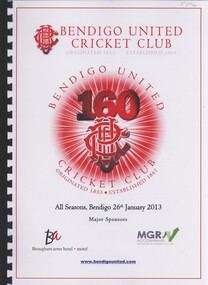
Book - BENDIGO UNITED CRICKET CLUB
... ORGANIZATION Club / society sport Bendigo United Cricket Club Bendigo United Cricket Club, Originated 1853, Established 1861 A 20 page booklet commemorating 160 years of the club's history with photographs, members names and statistics. ...Bendigo United Cricket Club, Originated 1853, Established 1861 A 20 page booklet commemorating 160 years of the club's history with photographs, members names and statistics. Bendigo United Cricket Club organization, club / society, sport -
 Bendigo Historical Society Inc.
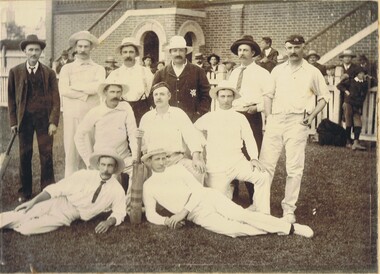
Photograph - CRICKET CLUB, 1ST ELEVEN, UNITED SERVICE, 1903 - 04
... ORGANIZATION Club/society sport United Service Cricket Club 1st Eleven. 1903-04. W. H. Robinson, Photo. Bendigo. ...Photograph - black and white. Photo of 11 men, on the bottom of the photo it says 'United Service C.C., 1st Eleven. Season 1903-04'. Someone has hand written some names around the photo being H. Trott, Win. Murray, W. J. Lowndes, Saryaas. W. H. Robinson, Photo. Bendigo. organization, club/society, sport, united service cricket club 1st eleven. 1903-04. -
 Bendigo Historical Society Inc.
Photograph - CRICKET MATCH ENGLAND VERSUS BENDIGO, 1901
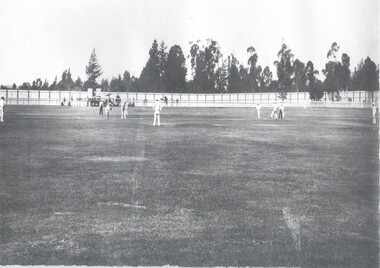
... TOPIC Sport cricket Black and white photo ( copy ) Photo is enclosed in cricket score book sheets. Written on outside of score sheet ' photos for Wes Harry. Originals 2. Large 1. ( Match Eng. V Bendigo ...Black and white photo ( copy ) Photo is enclosed in cricket score book sheets. Written on outside of score sheet ' photos for Wes Harry. Originals 2. Large 1. ( Match Eng. V Bendigo ) Wes Harry with ball ( 1901 ) presented to Father S ( ? ) Harry, taken at Upper Reserve Oval ( now QEO ) ( 1989 ) on grand stand steps. Cricket field with white clad players. 2 umpires. High fence in background. Written on back in biro : 'With compliments, Ken Hurst, Bendigo 1990 , England v Bendigo at Upper Reserve Oval Bendigo 1901. England 341 and 5 - 204. Batting for England Hayware and Tyldesby - photo. Bowling for Bendigo J. Harry, 6 - 107 - photo. topic, sport, cricket -
 Stawell Historical Society Inc
Photograph, “Grampian” Country Week Cricket Team with names 1931
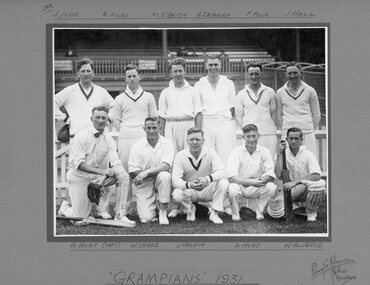
... Cricket “Grampian” Country Week Team 1931 Back row: DR. J. Joyce, A. Riley, M. O'Brien, H, Zacariah, F. Pola, J. Hall. Front row: H. Hunt (Capt.), W. Shade, J. Calnin, A. Hunt, W. Allgood. Edwin G. Adamson Melb. Phone F 6330 Written on the back: Grampian Country Week Team Defending in semi-final by Bendigo stawell sport ...Cricket “Grampian” Country Week Team 1931 Back row: DR. J. Joyce, A. Riley, M. O'Brien, H, Zacariah, F. Pola, J. Hall. Front row: H. Hunt (Capt.), W. Shade, J. Calnin, A. Hunt, W. Allgood. Edwin G. Adamson Melb. Phone F 6330 Written on the back: Grampian Country Week Team Defending in semi-final by Bendigo Black and white photograph of a group of cricketers on a grey mount. Names top and botton of mount. Grampians 1931 DR. J. Joyce, A. Riley, M. O'Brien, H, Zacariah, F. Pola, J. Hall. H. Hunt (Capt.), W. Shade, J. Calnin, A. Hunt, W. Allgood. Edwin G. Adamson Melb. Phone F 6330 Written on the back: Grampian Country Week Team Defending in semi-final by Bendigo stawell sport -
 Whitehorse Historical Society Inc.
Memorabilia - Box - Cigarette silks, 1911 - 1917
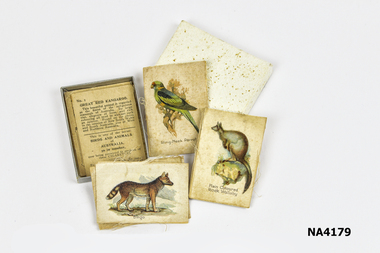
... sport and war. At least two provincial tobacconists, Lentens of Bendigo and Baillies of Warrnambool, issued private football series. The last series of cards issued by a truly Australian firm was Dudgeon & Arnell's '1934 Australian Cricket Team'. ...These type of cigarette silks were included in WD & HO Wills cigarette packets to induce women in particular to take up smoking.|The Word 'Cartophilic?|It is believed that this unusual word was coined in the 1920s by Col. Bagnall, an Englishman, who was the father of the hobby of cigarette card and trade card collecting. It is thought to be a combination of a Latin word, 'carto' meaning 'card and the Greek word 'philic', meaning 'love'.- lover of cards. The term originally related to the collection of the two types mentioned, however, our Society has included postcards in the range of items collected by our members.|The Cigarette Card|The cigarette card began its evolution in the United States of America, in the early 1880s as a plain piece of cardboard used by tobacconists to protect the cigarettes which were sold in that era, not in packets, but loosely. A purchaser would buy his cigarettes then wrap them in paper around the small piece of cardboard, which acted as a stiffener. In fact, for many decades, cigarette cards were known as 'stiffeners' in the USA.|The card depicting 'The Marquis of Lome' is reputed to be the first known cigarette card issued. This is thought to have been in 1879. It did not take long for an enterprising entrepreneur to recognise the advertising potential of the cigarette card, and, very soon, the cards began displaying popular images, often in sets. This had the effect of youngsters, wishing to complete their sets, harassing their fathers to buy a specific brand of cigarettes. The kids who collected cards in the days when they were being issued in the cigarette packets, would hang around outside the local tobacconist's shop, pestering the men who had just bought a packet of cigarette, with the cry: 'can I have the cig can mister?'|It is a proven fact that, here in Australia during the 1930s, at least one set had one card deliberately withheld and issued very sparingly. This card is No. 86 (Mrs Jack Crawford) in the Carreras 'Turf Personality Series'. Thus, in a set of reasonably easy cards to get, this one card is a constant source of frustration for the collector, and as such, commands a premium when it comes to price. It is not hard to imagine the young collector nagging his to Dad to keep buying 'Turf' cigarettes to enable him to finish the set.|From small beginnings the cigarette card soon gave rise to a booming industry in itself. Artists and writers were|employed to produce the cards, which were miniature works of art and served as little encyclopaedia's for the children of the day. By the 1930s cards were being issued in the countless millions. It has been stated, in one book on the history of cards; that 450 million sets of a series produced and issued by the prolific issuer of cards in the United Kingdom, WD & HO Wills. As each set contained 50 cards you would need a calculator with a very long result window to see the answer to how many cards of that series were in circulation.|Australia's involvement would appear to have its beginnings with the English and American firms who shipped their tobacco products here and the cards of American Tobacco Company (ATC) are found in great numbers in early Australian collections; many featuring Australian subjects, e.g. 'Australian Parliament a 1901 issue. Earlier U.S. sets depicting Australians included Goodwin & Co's, so called. 'Australian Series' with cricketers and Australian Rules footballers who were on the sporting scene during the 1880s. The caption of one of theses cards reads:|'W.Hannysee. Captain Port Melbourne Football Club' which enables us to pinpoint the year of issue to either 1889 or 1890.|On the Australian scene the first local manufacturer who issued cards seems to have been The National Cigarette Company of Australia Proprietary Limited, whose 'Tally Ho' packets contained cards from a series of thirteen featuring the touring 'English Cricket Team 1897-8' Of the few Australian manufacturers who issued cards, only two companies issued more the two sets.|Undoubtedly the cards issued by the Melbourne firm Sniders & Abrahams (later Sniders & Abrahams Pty Ltd) are the 'jewels in the crown' of Australian card issues. They issued some thirty-three series, with numerous sub-series and allied issues such as metal badges, metal football shields, celluloid flags etc., which ensured that the hobbyist had a vast range from which to collect. Sporting themes – football, cricket, horse racing – dominate, indicating the Australians' love of sport and the outdoors was as strong in those earlier times as it is today. Military, animals and birds themes were also to the fore, with a touch of culture being provided by 'Shakespeare', 'Dickens', actresses and even classical 'Statuary'. Humour was not forgotten with 'Cartoons and Caricatures', 'Naval and Cricket (double meaning) Terms' and the 'Jokes' series. Art and history were covered by the artist, S.T. Gill's 'Views of Victoria in 1857' while the stereoscopic 'Views of the World' expanded the collectors' knowledge of the world as a whole.|The Sniders & Abrahams series began in 1904 and by 1919 the company was in decline and was eventually taken over by G.G. Goode & Co. Ltd. This company produced one set only, the highly collectable 'Prominent Cricketer Series' issued in 1924. During the early to mid-1920s, J.J. Schuh Tobacco Pty Ltd issued eight series, again containing the popular subjects of sport and war. At least two provincial tobacconists, Lentens of Bendigo and Baillies of Warrnambool, issued private football series. The last series of cards issued by a truly Australian firm was Dudgeon & Arnell's '1934 Australian Cricket Team'.|The Australian market was not neglected by the English companies with WD & HO Wills, Godfrey Phillips and Ogdens all making their contributions. By far the most active issuer was the long-established company Wills, whose 'Cricketers' of 1901 heralded the flood of Australian series, which continued into the mid-thirties.|The onset of the 1939-45 World War sounded the death knell of the cigarette card and very few post-war issues were made, certainly not here in Australia.|The Trade Card|The Trade Card is a non-tobacco item used by manufacturers to promote and advertise their products, in the same way that cigarette cards were. It is uncertain exactly when they were first produced, but in the USA, non-collectable cards were issued by firms in the early 1800s. These were more akin to a latter day 'business card'. It was not until the 1850s, when coloured and pictorial cards were issued to advertise and promote products that the Trade Card|became a collectable item. Many beautiful lithographic cards were produced in this early era and they are very mu sought after by collectors. By the 1870s the issues of Trade Cards became more prolific and it is from this era that more cards are seen.|Again, it is difficult to pinpoint the exact date of the first Australian Trade Card and it may be that the highly collectable and extremely rare 'American Candy Co's' - 'Pure Caramels' Australian Rules football card, issued i 1891, is the earliest series. This confectionery firm was located in Fitzroy, a Melbourne suburb. To date only two subjects have been seen.|Another early set was 'Flags', issued by F.H.Fauldings & Co. It featured testimonials of seven English cricketers who toured Australia with the 1894/5 Test team. Fauldings was an Adelaide based firm which manufactured medicinal toiletries, soaps and oils, using the distinctly Australian eucalyptus oil. During the 20th century a multitude of Australian businesses issued trade cards, with confectionery manufacturers such as Hoadleys, Allens, Sweetacres and Australian Licorice producing the majority of them. Again sporting themes dominated with the ever popular Aussie Rules football cards being the most numerous. Cricket issues ran a close second.|Apart from sporting cards, almost every subject imaginable was covered by the Trade Card, making it the most diverse and interesting branch of cartophilly. In contrast to the Cigarette Card, which had its demise prior to the Second World War, the Trade Card is still alive and well.|We all are aware of the long running 'Birds of Australasia' series put out by Tuck-fields Tea and 1 doubt if there is a kitchen drawer in Australia that has not got one or two of these informative and attractive cards floating about in it. These cards were first produced in the early 1960s and are still being inserted in that company's packets of tea. Such is also the case with Sanitarium Health Foods, manufacturers of the well known Weetbix, who began issuing cards, with a wide range of subjects, in the early 1940s and continue to do so.|The 1940s and 1950s saw the two breakfast food giants, Kornies and Weeties dominating the card scene. Kornies footballers were in production fora decade from 1948 to 1959. Four years later in 1963, we saw the start of four decades of Scanlens bubble-gum card issues, both football and cricket. In the mid 1990s, with the end of the Scanlens/Stimorol cards, the Trading Card came on the scene. These cards do not fit under the umbrella of the Trade Card, having been produced and marketed purely as a 'collectable' with no connection whatsoever to any product, which of course is necessary for an item to be classified as a Trade Card.|The earliest British postcard was issued in 1870 and was designed to send short messages; the stamp was printed on the card, therefore it did not require an envelope. It was considered by many to be lowering the postal standards because the texts were no longer private. However the cards were a great success as on the first day of issue in 1870, half a million passed through the London postal centre.|The first illustrated postcards are said to be those introduced by a French stationer in 1870. He realized that French troops fighting in the Franco-Prussian War needed to be able to send short messages to their families and designed a 'postcard' to suit the purpose. As many of the soldiers were illiterate they decorated their cards with sketches of their many activities at the front rather than writing; thus creating a picture postcard. Private enterprise soon saw the great financial possibilities of this new easy and attractive way of communication by post; also sending a postcard cost less than postage for letters. It was correctly assumed that postcards were likely to overtake letter writing in many instances.|Between 1875 and 1882 every state in Australia introduced official postcards, N.S.W. first and Tasmania last. Each state produced a simple type of postcard with a pre printed stamp allied to that state. The stamp side stated 'The Address Only To Be Written On This Side'; the reverse side sometimes carried a simple illustration or decoration with space fora short message, each state extolling their own state's virtues. In 1901, with the advent of Federation, the new Government became responsible for all postal services in Australia and produced postcards for sale in every state. With several mail deliveries each day in most towns, postcards were used for many purposes. One 1906 postcard, with an illustration of fruit, was sent from Mrs X in the morning to her greengrocer ordering her fruit and vegetables to be delivered that afternoon. Another lady asks her charlady to 'come this afternoon'.|Australian private enterprise also began selling pictorial postcards, most companies using the very experienced German printing works who were the worlds best in the field of lithography and fine detailed colour-printing. Many of these beautiful German cards still exist today, 100 years later. Australia did have a few fine printers but they were in the minority. Black and white postcards printed in Australia in the early 1900s were often of good quality e.g. postcards printed by 'The Bulletin', illustrating the works of 'The Bulletins' top artists.|Between c1903-09 The Melbourne company Osboldstone and Atkins etc. printed coloured reproductions of 46 J.A. Turner bush/rural life paintings, which were generally of good quality and became hugely popular and still sought after today. Like thousands of homes in Europe, Britain and U.S.A., many Australia homes had albums of cherished postcards, which were given pride of place for visitors to see and enjoy.|Postcard collecting remained popular but was changing with the times. About 1912 the Australian photographer George Rose of Melbourne began to produce topographical B/W real photographic postcards covering most of Australia and other photographers began to do likewise. These cards soon found their way into collections as well.|WWI and the horrors of war suddenly changed the world; postcards were still in great demand but the subject matter was far more serious. Thousands of postcards from the trenches in European war zones arrived in Australia to be included in family albums. Propaganda and recruitment messages were produced to encourage enlistment. Australian postcard producers began to create cards decorated with gum leaves, boomerangs, wattle etc., which were designed for sending to Australian troops serving overseas. Very few 'pretty' cards were available, as access to the Gentian printing works was no longer possible and exporting of postcards from Britain was very limited. By the end of WWI people had other more serious problems to contend with and the avid postcard collecting hobby declined, fold greetings took over and topographical photographic postcards became a small but steady income for the producers and newsagents etc. in every town.|Fortunately many of these old postcards still exist and are avidly collected by a new generation or postcard collectors. The Australian Cartophilic Society Inc. is one of four postcard/cigarette card organizations in Australia. They are, N.S.W. Post Card Collectors Society; Queensland Card Collectors' Society Inc. and West Australian Card Collectors|Society, and across the Tasman there is a New Zealand Postcard Society.|References:|Picture Postcards of the Golden Age A Collector's Guide by Toni & Valmai Holt. Picture Postcards in Australia 1898 - 1920 by David Cook Box of Cigarette Silks ( 10 ) depicting animal motifs, which were placed in cigarette packets as an incentive for women in particular to smoke.|WD & HO Wills|Produced 1911 - 1917 personal effects, smoking accessories, recreations, collections -
 City of Greater Bendigo - Civic Collection
Souvenir, International Commonwealth Games Committee, Melbourne Commonwealth Games Queens Baton relay, 2006
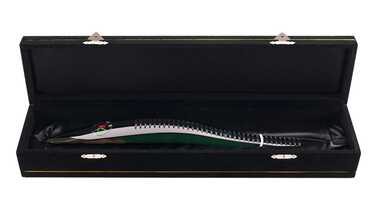
... Cricket Ground during the opening ceremony of the Melbourne 2006 Commonwealth Games on 15 March 2006. It was the first baton relay to visit all 71 nations of the Commonwealth. Athletes and non-athletes alike shared the privilege of carrying the baton. In Bendigo two sites were chosen for events. Bendigo Stadium: Basketball and Wellsford Rifle Range: Full Bore Shooting. Commonwealth Games 2006 City of Greater Bendigo Tourism City of Greater Bendigo Sport ...The Queen's Baton Relay has been the traditional curtain-raiser to the Commonwealth Games since 1958. It symbolises the gathering of people from across the Commonwealth. On 14 March 2005 Her Majesty placed a message in the baton at Buckingham Palace, signalling the start of a journey of almost 180,000 kilometres. The baton's journey to the opening ceremony took exactly one year and one day, arriving at the Melbourne Cricket Ground during the opening ceremony of the Melbourne 2006 Commonwealth Games on 15 March 2006. It was the first baton relay to visit all 71 nations of the Commonwealth. Athletes and non-athletes alike shared the privilege of carrying the baton. In Bendigo two sites were chosen for events. Bendigo Stadium: Basketball and Wellsford Rifle Range: Full Bore Shooting. Baton in display box. Reproduction of actual object. Front panel has 36 inserts, base is narrower than top. Queens message button near top which unlike the original is not removable. Top is gold coloured, back is dark green. Box is black with black inner liner. Top of box: Melbourne 2006 Commonwealth Games / Queen's Baton Relay commonwealth games 2006, city of greater bendigo tourism, city of greater bendigo sport -
 City of Greater Bendigo - Civic Collection
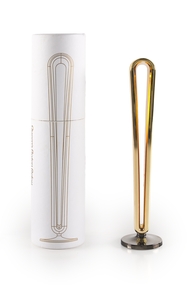
Souvenir, International Commonwealth Games Committee, Queen's Baton Relay Gold Coast 2018, 2018
... Cricket Ground during the opening ceremony of the Melbourne 2006 Commonwealth Games on 15 March 2006. It was the first baton relay to visit all 71 nations of the Commonwealth. Athletes and non-athletes alike shared the privilege of carrying the baton. In Bendigo two sites were chosen for events. Bendigo Stadium: Basketball and Wellsford Rifle Range: Full Bore Shooting. City of Greater Bendigo Sport ...The Queen's Baton Relay has been the traditional curtain-raiser to the Commonwealth Games since 1958. It symbolises the gathering of people from across the Commonwealth. On 14 March 2005 Her Majesty placed a message in the baton at Buckingham Palace, signalling the start of a journey of almost 180,000 kilometres. The baton's journey to the opening ceremony took exactly one year and one day, arriving at the Melbourne Cricket Ground during the opening ceremony of the Melbourne 2006 Commonwealth Games on 15 March 2006. It was the first baton relay to visit all 71 nations of the Commonwealth. Athletes and non-athletes alike shared the privilege of carrying the baton. In Bendigo two sites were chosen for events. Bendigo Stadium: Basketball and Wellsford Rifle Range: Full Bore Shooting. Gold baton in cardboard tube. Top of box: Melbourne 2006 Commonwealth Games / Queen's Baton Relay city of greater bendigo sport, gold coast 2018, queen's baton relay, 21st commonwealth games -
 Charlton Golden Grains Museum Inc
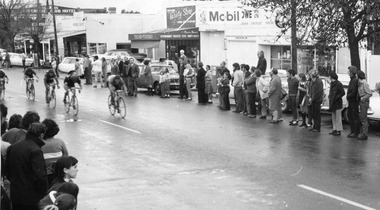
Photograph - Black and White Photo Bendigo to Charlton Bike Race
... Finish of Bendigo to Charlton cycle race in c1973 Photo of High Street Charlton east end of town. Flockhart's Cricket Club Hotel, Lloyd Paterson's Sport Store, ACA Motors, Trevor Turners Variety Store and Lowes Mobil Sales and Service Station can be seen in the background. ...Finish of Bendigo to Charlton cycle race in c1973 Photo of High Street Charlton east end of town. Flockhart's Cricket Club Hotel, Lloyd Paterson's Sport Store, ACA Motors, Trevor Turners Variety Store and Lowes Mobil Sales and Service Station can be seen in the background. Local residents line the street to view the conclusion of the race.
