
Showing 4 items matching "bessie sanger"
-
 Uniting Church Archives - Synod of Victoria
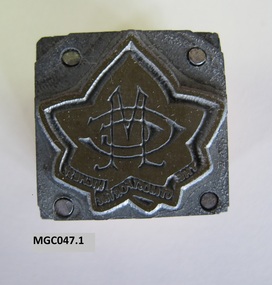
Equipment - Printing block, 1935 - 1966
... ...Bessie Sanger...The badge designed by Miss Bessie Sanger of Bondi, an ivy leaf signifying friendship, was chosen and subsequently became the badge of the Comrades Section of the Order. ...The badge designed by Miss Bessie Sanger of Bondi, an ivy leaf signifying friendship, was chosen and subsequently became the badge of the Comrades Section of the Order. ...In 1918 the Rev Harold Wheen presided at a meeting at Bondi and outlined the Constitution and the Ritual of the Methodist Girls' Comradeship. He suggested that members submit designs for a badge, incorporating the chosen colours (blue, white and gold) and the new name, Methodist Girls' Comradeship. The badge designed by Miss Bessie Sanger of Bondi, an ivy leaf signifying friendship, was chosen and subsequently became the badge of the Comrades Section of the Order. Wooden cube shaped block with a metal printer's die attached. The die is a replica of the Methodist Girls' Comradeship ivy-shaped badge emblem with the initials of the Comradeship inside and the motto at the bottom."MGC" "THE UTMOST FOR THE HIGHEST"methodist church of australasia, printing, methodist girls' comradeship, rev harold wheeen, bessie sanger -
 Uniting Church Archives - Synod of Victoria
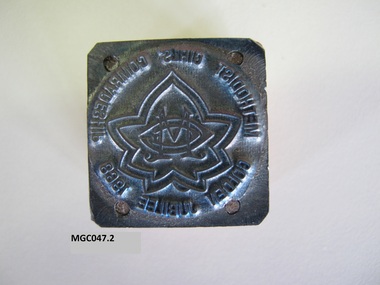
Equipment - Printing block, 1968
... The Methodist Girls' Comradeship badge was designed by Miss Bessie Sanger of Bondi. This block was created as part of the celebrations of the MGC Golden Jubilee in 1968. ...The Methodist Girls' Comradeship badge was designed by Miss Bessie Sanger of Bondi. This block was created as part of the celebrations of the MGC Golden Jubilee in 1968. ...The Methodist Girls' Comradeship badge was designed by Miss Bessie Sanger of Bondi. This block was created as part of the celebrations of the MGC Golden Jubilee in 1968. Wooden cube shaped block with a metal printer's die attached. The die is a replica of the Methodist Girls' Comradeship ivy leaf shaped badge emblem with MGC in the centre and writing round the outside."MGC" 'METHODIST GIRLS' COMRADESHIP GOLDEN JUBILEE 1968"methodist church of australasia, printing, methdoist girls' comradeship, methodist girls' comradeship golden jubliee 1968 -
 Uniting Church Archives - Synod of Victoria
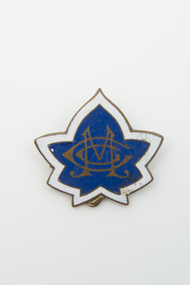
Badge, Methodist Girls' Comradeship
... It was designed in 1918 by Miss Bessie Sanger of Bondi. "The shape of the badge is the ivy leaf which stands for friendship - fellowship with our Heavenly Father and in His Church and friendship is our Comradeship with each other. ...It was designed in 1918 by Miss Bessie Sanger of Bondi. "The shape of the badge is the ivy leaf which stands for friendship - fellowship with our Heavenly Father and in His Church and friendship is our Comradeship with each other. ...This badge was not worn on the regalia of the Methodist Girls' Comradeship. It was designed in 1918 by Miss Bessie Sanger of Bondi. "The shape of the badge is the ivy leaf which stands for friendship - fellowship with our Heavenly Father and in His Church and friendship is our Comradeship with each other. The background is blue, symbolising fellowship. White is the symbol of purity and gold symbolises "true happiness". It is the symbol of wealth, and the greatest wealth in life is "true happiness" - a happiness that comes only when our lives, our wills, are one with God's will for us. This meaning of the badge shall be explained to the Comrade/Ray either at her initiation/welcome or on presentation of the badge. The badge is worn on the left should or collar (not on Regalia)." - from Leaders' Manual for Comradeship 1970.MGC 062.1 and MGC 062.2 Blue, white and gold enamel lapel Methodist Girls' Comradeship badges. Duplicates B021.1 and B021.2 "MGC"methodist girls' comradeship -
 Kew Historical Society Inc
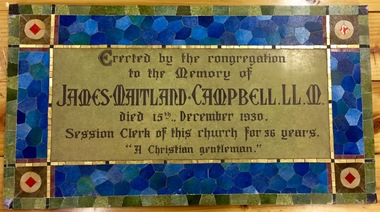
Plaque, Kew Presbyterian Church, James Maitland Campbell LL.M, 1931
... Members of their family, Bessie, Mary, Nellie and Lewis also sang in the Choir. Mary became a famed teacher of singing in Melbourne. ...Members of their family, Bessie, Mary, Nellie and Lewis also sang in the Choir. Mary became a famed teacher of singing in Melbourne. ...Extracts from The Church on the Hill: Presbyterianism in Kew 1874-1974 by John A. O’Neill (Mullaya, Canterbury (Vic), 1974, pp.58-60. “An outstanding family which gave devoted service to the Church was the Campbell family of which James Maitland was the “head”. He died at “Ramornie” on the afternoon of Monday 15 December 1930. … “James Maitland Campbell was born in 1847 in Melrose, Scotland, where his father, the Rev. A. J. Campbell D.D., was the Minister of the Kirk. The Rev. Dr. and Mrs. A. J. Campbell, with their family, came to Australia in 1861 and settled in St. George’s Church, Geelong, where he was the first Minister. James Maitland, after completing his secondary education at Geelong College, entered the Melbourne University where he graduated Master of Arts and Master of Laws, and eventually became a partner in the legal firm of Davies and Campbell. When he first came to Melbourne Mr Campbell attended Chalmers Church, East Melbourne, and married Miss Annie Harper, daughter of Robert Harper, a merchant and a sister of Professor Andrew Harper. In March 1875 the young couple settled in Pakington Street, Kew. After the induction of the Rev. Maxwell and the formation of a Board of Management, Mr. Campbell was elected its first Secretary. David Beath, James Maitland Campbell and Duncan Robert McGregor were the first Trustees of our Church. Mr. and Mrs. Campbell joined the Church Choir, and Mr. Campbell became Choir Leader. Members of their family, Bessie, Mary, Nellie and Lewis also sang in the Choir. Mary became a famed teacher of singing in Melbourne. She taught singing to members of the Choir, and gave lessons in voice production to students for the Ministry. In 1879 Mr. Campbell became Superintendent of the Sabbath School, a position he occupied for 27 years. In 1887 he was elected an Elder, and the Session Clerk for 37 years. In 1924 Mr. Campbell compiled a very complete Jubilee History of the Kew Presbyterian Church. Mr. J. M. Campbell saw our existing Church and the Old Manse erected, the Villa purchased, and, with the help of the Kew Congregation, the Charges of West Hawthorn, East Kew and Deepdene established. In the General Assembly of Australia and the General Assembly of Victoria he occupied the important position of Law Agent, and was a member of numerous Church Committees and Councils. … At the Annual Congregational Meeting on Wednesday 28 October 1931, it was decided to erect a tablet in the Church to the memory of the late Mr. J. M. Campbell to record his service to the Church. The tablet was unveiled at the morning service on 13 December by Mr. Legge. The Preacher was Rev. J. Barnaby.”James Maitland Campbell (1847-1930) the owner of “Ramornie” in Pakington Street was an important contributor to the community of Kew in the 19th and early 20th centuries. A Councillor of the Borough of Kew, he was to be elected Mayor on three occasions: 1889-90, 1890-91 and 1892-93. In addition to his political roles, he was the first Secretary of the Kew Presbyterian Church, being actively involved in the life of the Church until his death in 1930. The Kew Historical Society has a small collection of items once belonging to the Campbell family, including a series of invitations issued to Mr. and Mrs. J. M. Campbell for the festivities organised to commemorate the opening of the first Australian Parliament in Melbourne in 1901. Memorial Tablet to James Maitland Campbell (1847-1930) that was originally erected in the Kew Presbyterian Church in Cotham Road. The tablet is comprised of iridescent ceramic tiles.“Erected by the congregation to the Memory of James Maitland Campbell. LL.M. died 15th., December 1930. Session Clerk of this church for 36 years. “A Christian gentleman.”james maitland campbell (1847-1930), kew presbyterian church, ramornie (pakington street), campbell collection
