
Showing 8 items matching "between the wars 1919-1939"
-
 Moorabbin Air Museum
Book - Aviation history, The Aeroplane An Historical Survey
... war 1...Between the wars 1919-1939...Aviation history Early ides of flight 1800 - 1903 The Wright brothers & the flight of 1903 Beginnings of aviation in Europe 1900 - 1908 Practical powered flight 1909-1914 World war 1 Between the wars 1919-1939 World war 2 Modern aviation The origins of the kite The origins of the rocket The origins of the parachute The origins of the aero engine The origins of the airscrew Overview of the origins & development of the airplane, circa 1960 The Aeroplane An Historical Survey Book Aviation history ...Overview of the origins & development of the airplane, circa 1960non-fictionOverview of the origins & development of the airplane, circa 1960early ides of flight 1800 - 1903, the wright brothers & the flight of 1903, beginnings of aviation in europe 1900 - 1908, practical powered flight 1909-1914, world war 1, between the wars 1919-1939, world war 2, modern aviation, the origins of the kite, the origins of the rocket, the origins of the parachute, the origins of the aero engine, the origins of the airscrew -
 Greensborough Historical Society
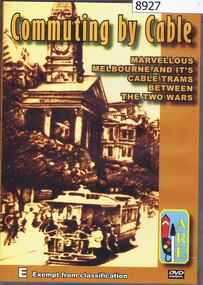
Film - DVD, John Reid, Commuting by cable: marvellous Melbourne and its cable trams between the two wars, 1988
... Covers the period between the two world wars 1919-1939....Covers the period between the two world wars 1919-1939. trams c able trams melbourne DVD PAL Region 0 in plastic case with printed iunsert Commuting by cable: marvellous Melbourne and its cable trams between the two wars Film DVD John Reid Association of Railway Enthusiasts Ltd. ...Documentary on Melbourne's cable trams assembled from various sources. Covers the period between the two world wars 1919-1939.DVD PAL Region 0 in plastic case with printed iunserttrams, c able trams, melbourne -
 Flagstaff Hill Maritime Museum and Village
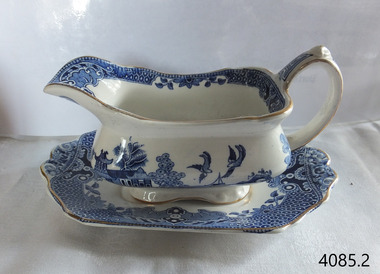
Ceramic - Gravy Boat and Saucer, Burleigh Pottery, 1930
... 1919, it became a private limited company, Burgess & Leigh Ltd. The years between the wars are often regarded as the company's "golden age", with many extremely talented designers and artists such as Harold Bennett, Charles Wilkes and Ernest Bailey. Perhaps the best known was Charlotte Rhead, who worked between 1926 and 1931, noted particularly for her work in tubelining. By 1939...1919, it became a private limited company, Burgess & Leigh Ltd. The years between the wars are often regarded as the company's "golden age", with many extremely talented designers and artists such as Harold Bennett, Charles Wilkes and Ernest Bailey. Perhaps the best known was Charlotte Rhead, who worked between 1926 and 1931, noted particularly for her work in tubelining. By 1939 ...Burleigh Pottery, also known as Burgess & Leigh, is the name of a pottery manufacturer in Middleport, Stoke-on-Trent. The business specialises in traditionally shaped and patterned domestic earthenware of high quality. The business was established in 1851 at the Central Pottery in Burslem as Hulme and Booth. The pottery was taken over in 1862 by William Leigh and Frederick Rathbone Burgess, and traded from that date as Burgess & Leigh. The trademark "Burleigh", used from the 1930s, is a combination of the two names. Burgess and Leigh moved to different works, first in 1868 to the Hill Pottery in Burslem and then in 1889 to the present factory at Middleport, which at the time was regarded as a model pottery. Its scale and linear organisation was in contrast to other potteries' constricted sites and haphazard layout of their working spaces. In 1887, Davenport Pottery was acquired by Burleigh primarily for its moulds. These historic moulds are still used today in the production of Burleigh ware. Leigh and Burgess died in 1889 and 1895, respectively, and were succeeded by their sons, Edmund Leigh and Richard Burgess. On Richard's death in 1912, the business passed entirely into the ownership of the Leigh family. In 1919, it became a private limited company, Burgess & Leigh Ltd. The years between the wars are often regarded as the company's "golden age", with many extremely talented designers and artists such as Harold Bennett, Charles Wilkes and Ernest Bailey. Perhaps the best known was Charlotte Rhead, who worked between 1926 and 1931, noted particularly for her work in tubelining. By 1939, the factory was employing over 500 people. The business took great pains, from as early as 1897, to build up a thriving export network, concentrating primarily on the Empire, later becoming the Commonwealth and American markets, and focusing later on Europe. After a run of financial difficulty, the company was sold in 1999 to the Dorling family, Rosemary and William Dorling, and traded as Burgess Dorling & Leigh. In 2010, it was acquired by Denby Holdings Ltd, the parent company of Denby Pottery.Burleigh was a significant company producing pottery over many generations and exporting their products all over the world. Its designs are still in use today, demonstrating the longevity and significance of the Burleigh Ware trade mark.Gravy boat with curved handle, and a matching saucer. The set has an overall rectangular design, with blue and white willow pattern on both pieces. The edges of the boat and saucer have gold line trim. The undersides of both pieces have a blue maker's mark stamp. The Willow pattern Burleigh Ware pieces were made in England.Burleigh Ware: "WILLOW" within a floral decoration, and "Made in England"flagstaff hill, flagstaff hill maritime museum and village, warrnambool, maritime museum, maritime village, great ocean road, shipwreck coast, willow pattern, willow ware, burleigh ware, made in england, blue and white china, gravy boat, gravy jug, gravy saucer, serving ware, domestic object, matching jug and saucer, oriental design, burleigh pottery, burgess & leigh -
Glen Eira Historical Society
Document - Strathfield College
... A foolscap page handwritten memories of the school by former teacher Miss Gwen Rowe who taught at the school between 1942 and 1958 A handwritten list form Sands and McDougall Directories 1919-1963 with school addresses and names of principals Schools Independent schools Primary school Pre-school Principals Pushon EM Miss Miller DM Miss Teachers Rowe Gwen Miss Students Opas Phillip Jones Barry Schildberger Michael World War 1939-1945 Ontario Street Methodist Hall Halls Parish halls Pearson Grove Slit trenches Document Strathfield College ...This file contains 2 items. A foolscap page handwritten memories of the school by former teacher Miss Gwen Rowe who taught at the school between 1942 and 1958 A handwritten list form Sands and McDougall Directories 1919-1963 with school addresses and names of principalsschools, independent schools, primary school, pre-school, principals, pushon em miss, miller dm miss, teachers, rowe gwen miss, students, opas phillip, jones barry, schildberger michael, world war 1939-1945, ontario street, methodist hall, halls, parish halls, pearson grove, slit trenches -
 Wangaratta RSL Sub Branch
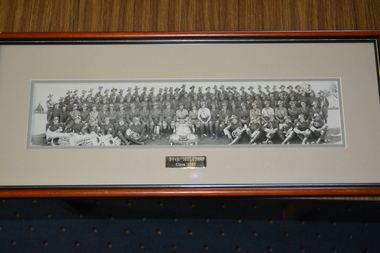
Photograph - Framed photograph, 59th Battalion
... between 1916 and 1918, before being disbanded in 1919. In 1921, it was re-raised as a part-time unit of the Militia in Victoria. They remained in existence until 1942 when, due to a manpower shortage in the Australian economy, the decision was made to amalgamate the battalion with the 58th Battalion to form the 58th/59th Battalion. Together they remained linked throughout World War II, serving in New Guinea and Bougainville in 1943–1945. In 1952, the 59th Battalion was re-raised and subsequently was absorbed into the Royal Victoria Regiment in 1960. 59th militia WW1 WW2 1939 ...The 59th Battalion was an infantry battalion of the Australian Army. Initially raised for service during World War I, the battalion fought on the Western Front in France and Belgium between 1916 and 1918, before being disbanded in 1919. In 1921, it was re-raised as a part-time unit of the Militia in Victoria. They remained in existence until 1942 when, due to a manpower shortage in the Australian economy, the decision was made to amalgamate the battalion with the 58th Battalion to form the 58th/59th Battalion. Together they remained linked throughout World War II, serving in New Guinea and Bougainville in 1943–1945. In 1952, the 59th Battalion was re-raised and subsequently was absorbed into the Royal Victoria Regiment in 1960.Brown timber frame containing cream coloured mount and photograph of large group of soldiers and bandsmenPlaque -59th Militia Circa 193959th militia, ww1, ww2, 1939 -
 Clunes Museum
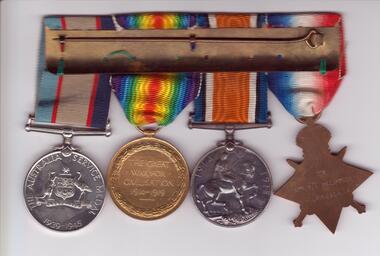
Medal - MEDALS
... L-R .4 The Australia Service Medal 1939-1945 was instituted in 1949 to recognise the service of members of the Australian Armed Forces and the Australian Mercantile Marine during World War II. .3 The Victory Medal was awarded to prescribed classes of persons who entered a theatre of war on duty between 5 August 1914 and 11 November 1918. .2 The British War Medal instituted by King George V in 1919 to mark the end of World War I and record the service given. ...L-R .4 The Australia Service Medal 1939-1945 was instituted in 1949 to recognise the service of members of the Australian Armed Forces and the Australian Mercantile Marine during World War II. .3 The Victory Medal was awarded to prescribed classes of persons who entered a theatre of war on duty between 5 August 1914 and 11 November 1918. .2 The British War Medal instituted by King George V in 1919 to mark the end of World War I and record the service given. ...Milton Arthur Williamson was born in Clunes, Victoria and enlisted at 22 years and 5 months on 29/3/1915. He embarked for Alexandria on 30/8/1915. He was injured during duty and had continual problems with his knee. He was returned to Australia on 10/9/1917 following several appearances before the Medical Board of the Australian Military Offices of London and Kent in the United Kingdom. The termination of his appointment was effected on 4/3/1918 and he was medically discharged from the AIF. L-R .4 The Australia Service Medal 1939-1945 was instituted in 1949 to recognise the service of members of the Australian Armed Forces and the Australian Mercantile Marine during World War II. .3 The Victory Medal was awarded to prescribed classes of persons who entered a theatre of war on duty between 5 August 1914 and 11 November 1918. .2 The British War Medal instituted by King George V in 1919 to mark the end of World War I and record the service given. *PTE SS WILLIAMSON 1 The 1914–15 Star was authorised in 1918 and was awarded for service in specified theatres of war between 5 August 1914 and 31 December 1915.4 MEDALS : L-R WITH RIBBONS .1 BRONZE : STAR SHAPED MEDAL 1914-1915 ON BANNER. BACK 1112 SPR M A WILLIAMSON 2/ DIV SIG COY AIF .2 PEWTER - ROUND MEDAL FACE OF GEORGE V 0 BACK 1914-1918 NUDE MAN ON HORSE WITH 2 FEET OFF GROUND. RIM : 636 PTE SS WILLIAMSON 8 BN AIF .3 ROUND MEDAL ANGEL IS HOLDING A PALM BRANCH. BACK : ENCIRCLED BY WREATH - THE GREAT WAR FOR CIVILISATION 1914-1919 .4 ROUND SILVER MEDAL PROFILE OF GEORGE VI. BACK : AUSTRALIAN COAT OF ARMS ENCIRCLED BY THE AUSTRALIAN SERVICE MEDAL 1939-1945 RIM : W 71800 A M WILLIAMSON RIBBON NAVY, RED, BEIGE, SKY BLUElocal history, numismatics, medals, military -
 Surrey Hills Historical Society Collection
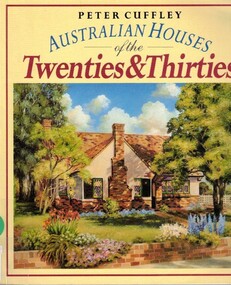
Book, Geoff Hocking, Australian Houses of the Twenties & Thirties, 1993
... between the two world wars is a fascinating and complex subject. Our preconceived notions are based on the more obvious styles and impressions, so that visions of bungalows set row upon row spring to mind quickly. Influences in the designs of Australian houses of the 1920s and 1930s were extraordinarily diverse. Apart from their obvious origins, they can be traced to India, Japan, Switzerland, Holland, Germany, Italy, Spain, Mexico and even the American backwoods. Australian architects travelled to England, Europe and North America bringing back ideas and influences. architecture (mr) peter cuffley dwellings interior decoration 1919 - 1929 1930 - 1939 ...Australian domestic architecture of the period between the two world wars is a fascinating and complex subject. Our preconceived notions are based on the more obvious styles and impressions, so that visions of bungalows set row upon row spring to mind quickly. Influences in the designs of Australian houses of the 1920s and 1930s were extraordinarily diverse. Apart from their obvious origins, they can be traced to India, Japan, Switzerland, Holland, Germany, Italy, Spain, Mexico and even the American backwoods. Australian architects travelled to England, Europe and North America bringing back ideas and influences.Includes: index, bibliography. Australian domestic architecture of the period between the two world wars is a fascinating and complex subject. Our preconceived notions are based on the more obvious styles and impressions, so that visions of bungalows set row upon row spring to mind quickly. Influences in the designs of Australian houses of the 1920s and 1930s were extraordinarily diverse. Apart from their obvious origins, they can be traced to India, Japan, Switzerland, Holland, Germany, Italy, Spain, Mexico and even the American backwoods. Australian architects travelled to England, Europe and North America bringing back ideas and influences.Front page: Sue Barnettarchitecture, (mr) peter cuffley, dwellings, interior decoration, 1919 - 1929, 1930 - 1939 -
 Wangaratta RSL Sub Branch
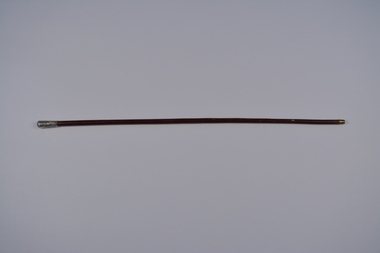
Equipment - Swagger Stick, c1863
... This swagger stick belonged to Private Ernest LUCAS who served with the Royal Defence Corps between 17/6/1907 and 18/5/1919 including the 6th Battalion Middlesex Regiment In the British Army before World War I, swagger sticks were carried by all other ranks when off duty as part of their walking out uniform. The stick took the form of a short cane of polished wood, with an ornamented metal head of regimental pattern. The usual custom was for the private soldier or NCO to carry the stick tucked under his arm. Until 1939...This swagger stick belonged to Private Ernest LUCAS who served with the Royal Defence Corps between 17/6/1907 and 18/5/1919 including the 6th Battalion Middlesex Regiment In the British Army before World War I, swagger sticks were carried by all other ranks when off duty as part of their walking out uniform. The stick took the form of a short cane of polished wood, with an ornamented metal head of regimental pattern. The usual custom was for the private soldier or NCO to carry the stick tucked under his arm. Until 1939 ...This swagger stick belonged to Private Ernest LUCAS who served with the Royal Defence Corps between 17/6/1907 and 18/5/1919 including the 6th Battalion Middlesex Regiment In the British Army before World War I, swagger sticks were carried by all other ranks when off duty as part of their walking out uniform. The stick took the form of a short cane of polished wood, with an ornamented metal head of regimental pattern. The usual custom was for the private soldier or NCO to carry the stick tucked under his arm. Until 1939 swagger sticks were still carried by peacetime regular soldiers when "walking out" of barracks but the practice ceased with the outbreak of World War II. The 6th Battalion Middlesex Regiment can trace its history back to 7 August 1760 as part of the Middlesex Militia. In 1778 it was titled the 1st East Middlesex Militia. By royal order the regiment was later designated the Royal East Middlesex Militia on 24 April 1804. By 1855 it was using the formal title of "1st or Royal East Middlesex Regiment of Militia". In 1900 the number of regular Middlesex Regiment battalions was doubled with the formation of a new the 3rd and 4th battalions; and the two militia battalions were renumbered as 5th and 6th battalions of the regiment. The unit's standing orders of 1863 record the regimental insignia as being somewhat unusual, in that it did not include standard royal crown, but featured a five-pointed Saxon Crown atop a shield with the arms of the East Saxon Kingdom i.e. three stylised Seaxes hilt and pommel.Long narrow round cane made from polished reddish/brown wood with brass metal tip and embossed silver topSilver metal top embossed with a crown above a shield inscribed 6th Battalion Middlesex Regtswagger stick, 6th battalion middlesex regiment, private ernest lucas
