
Showing 4 items matching "beverage bottles, milk containers"
-
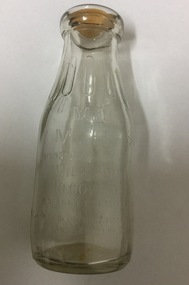 Mont De Lancey
Glass bottle, June 1838
... beverage bottles, milk containers...beverage bottles, milk containers Metro Dairy 22 Jessie Street, Preston. ...Bottle with cardboard lid - Metro Dairy Glass Milk BottleMetro Dairy 22 Jessie Street, Preston. This bottle is the property of Milk Bottles Recovery Ltd. On lid: Metro Dairy Farmers Pura pasteurised milk. 1 imperial pintbeverage bottles, milk containers -
 Flagstaff Hill Maritime Museum and Village
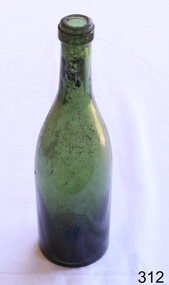
Container - Bottle, Late 19th century or early 20th century
... bottles blown by hand. Automated glass manufacturing produces nearly identical batches of jars. Glass blowing is awesome for unique, beautiful pieces of art. But for lots of lower priced and uniformly shaped containers, automatic manufacturing is the preferred method to create glass bottles and jars. https://www.containerandpackaging.com/resources/glass-bottles-brief-history The invention and development of glass for domestic items including bottles, has been nothing short of revolutionary. The use of glass bottles, that could be easily washed, led to improved hygiene, and mass manufacturing of drinks of all types, including milk, cordial and alcoholic beverages ...Glass manufacturing has evolved over thousands of years. Glass making has been traced back to 3500 BC in Mesopotamia. The earliest known glass objects were beads, perhaps made by accident while working with metal. In the late Bronze Age, several civilizations discovered how to make vessels and glass bottles by wrapping threads of melted glass around cores of sand or clay. Later, moulds were used to form dishes and table wares. Around the 1st century BC, glassblowing was discovered. This made glass containers less expensive than pottery. Mould-blown glass, the process of blowing a piece of molten glass into a wooden or metal mould, was invented during the 1st century AD. This technique was faster with more consistent results. It paved the way for mass production. It wasn’t until the late 1800s that the production process to become more efficient. In 1887, a company in England created a semi-automatic process that could produce up to 200 bottles an hour. This process has been refined to the point where modern machines can yield more than 600 containers per minute. Blown vs. Manufactured Glass Bottles Nowadays, glass bottles, jars, and cups are usually manufactured on a bigger scale than is found in individual glassblowing studios. If we still depended on hand-blown glass for all of our glass containers, we would see some major differences in the process of creating bottles and jars. First, there's the time. Hand blowing glass takes a significant amount of time, even for one simple container. In contrast, hundreds of jars per minute can be made using modern technology. This leads to the second advantage: price. Because of the automated and streamlined process, the price for manufactured containers is much lower than that of hand-blown glass. Third, manufactured bottles will be much more consistently uniform than bottles blown by hand. Automated glass manufacturing produces nearly identical batches of jars. Glass blowing is awesome for unique, beautiful pieces of art. But for lots of lower priced and uniformly shaped containers, automatic manufacturing is the preferred method to create glass bottles and jars. https://www.containerandpackaging.com/resources/glass-bottles-brief-history The invention and development of glass for domestic items including bottles, has been nothing short of revolutionary. The use of glass bottles, that could be easily washed, led to improved hygiene, and mass manufacturing of drinks of all types, including milk, cordial and alcoholic beverages.Green Glass Bottle Possibly a ginger beer bottle.Concave indentation at the base. Also on base are two raised lumps. flagstaff hill, warrnambool, shipwrecked-coast, flagstaff-hill, flagstaff-hill-maritime-museum, maritime-museum, shipwreck-coast, flagstaff-hill-maritime-village, glass -
 Mont De Lancey
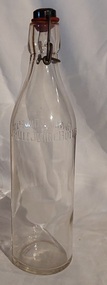
Domestic object - Glass Juice Bottle, Fowlers, c1900's
... bottles with wire stoppers likely date to the late 19th or early 20th century, when they were developed to create a reusable, airtight seal for products like milk, juice, and other beverages. These bottles often used a "lightning" or "gravity" stopper, which relied on a wire bail and a rubber gasket to create a secure closure and keep contents fresh for longer periods, particularly in home kitchens. Beverage bottles Glass bottles Juice bottle Drink containers ...Vintage Fowlers juice bottles are part of a home preserving system started by English immigrant Joseph Fowler in Melbourne, Australia, in 1915. Vintage glass juice bottles with wire stoppers likely date to the late 19th or early 20th century, when they were developed to create a reusable, airtight seal for products like milk, juice, and other beverages. These bottles often used a "lightning" or "gravity" stopper, which relied on a wire bail and a rubber gasket to create a secure closure and keep contents fresh for longer periods, particularly in home kitchens. A large clear glass Fowlers Fruit Juice bottle with a wire clip and black stopper with a red rubber seal. 'Fowlers One Pint Fruit Juice Bottle' stamped on the glass. On the bottom of the bottle is stamped 'F452' On top of the black stopper "Fowlers Vacola' beverage bottles, glass bottles, juice bottle, drink containers -
 Mont De Lancey
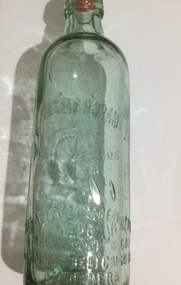
Glass bottle, Marchant & Co, 1915
... bottles with wire stoppers likely date to the late 19th or early 20th century, when they were developed to create a reusable, airtight seal for products like milk, juice, and other beverages. These bottles often used a "lightning" or "gravity" stopper, which relied on a wire bail and a rubber gasket to create a secure closure and keep contents fresh for longer periods, particularly in home kitchens. Beverage bottles Glass bottles Juice bottle Drink containers ...Vintage glass juice bottles with wire stoppers likely date to the late 19th or early 20th century, when they were developed to create a reusable, airtight seal for products like milk, juice, and other beverages. These bottles often used a "lightning" or "gravity" stopper, which relied on a wire bail and a rubber gasket to create a secure closure and keep contents fresh for longer periods, particularly in home kitchens. A large green tinted Marchant's soft drink bottle with a pink plastic screw in stopper.'Marchant & Co. Trade Mark with the company's logo of a 12 spoked wheel. Registered Australia' Visible are the 1/2 bottle joins. On the back of the bottle: 'This bottle is the property of Marchant & Co. & cannot be legally used by others'. On the base: 'M & Co. 1915'. beverage bottles, glass bottles, juice bottle, drink containers
