
Showing 9 items matching "biochemistry"
-
 Wheen Bee Foundation
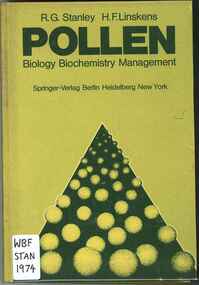
Publication, Stanley, R. G. & Linskens, H. F, Pollen: biology biochemistry management (Stanley, R. G. & Linskens, H. F.), Berlin, 1974, 1974
... Pollen: biology biochemistry management (Stanley, R. G. & Linskens, H. ...Pollen: biology biochemistry management (Stanley, R. G. & Linskens, H. ... -
 National Wool Museum
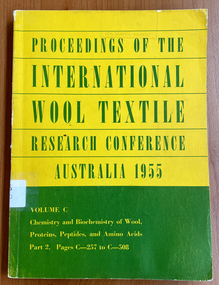
Book, Proceedings of the International Wool Textile Research Conference Australia 1955 vol. C, 1956
... ...biochemistry...C chemistry and biochemistry of wool, proteins, peptides and amino acids" produced by CSIRO....C chemistry and biochemistry of wool, proteins, peptides and amino acids" produced by CSIRO. ..."Proceedings of the International Wool Textile Research Conference Australia 1955; vol. C chemistry and biochemistry of wool, proteins, peptides and amino acids" produced by CSIRO.Book, paper cover in yellow and green.csiro, wool, textile, biochemistry, library, conference -
 Robin Boyd Foundation
Slide, Robin Boyd
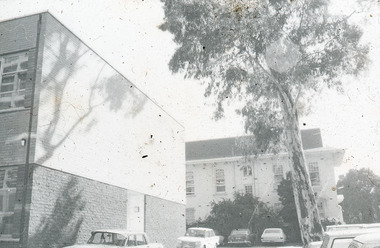
... Colour slide in a mount. Biochemistry Building (left) and Melba Hall (right), University of Melbourne, Parkville, Victoria, Australia. ...Melbourne slide Made in Sweden Colour slide in a mount. Biochemistry Building (left) and Melba Hall (right), University of Melbourne, Parkville, Victoria, Australia. ...Colour slide in a mount. Biochemistry Building (left) and Melba Hall (right), University of Melbourne, Parkville, Victoria, Australia. (Architects: Bates, Peebles & Smart; Bates, Smart & McCutcheon.)Made in Swedenmelbourne, slide -
 Alfred Hospital Nurses League - Nursing History Collection
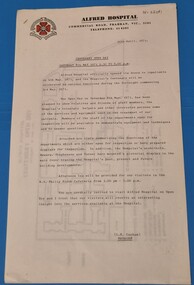
Document - Open Day Information, Alfred Hospital, Centenary Open Day, Alfred Hospital, Saturday 8th May, 1971, 1971
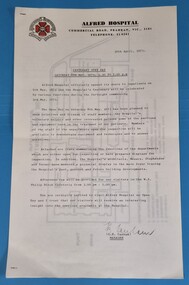
... This document provides information bout those various departments ( Haematology, Metabolic Unit, Speech Therapy & Audiology, Bacteriology, Biochemistry, Cardivascular Diagnostic Service, Diagnostic Radiology, Nuclear medicine, Monash medical school)...This document provides information bout those various departments ( Haematology, Metabolic Unit, Speech Therapy & Audiology, Bacteriology, Biochemistry, Cardivascular Diagnostic Service, Diagnostic Radiology, Nuclear medicine, Monash medical school) Importan milestone for the Alfred Hospital. ...To celbrate the centenary of the opening of the Alfred Hospital in 1871, the hospital held an open day on the afternoon of Saturday 8th May, 1971. Various hospital departments were open to the general public. This document provides information bout those various departments ( Haematology, Metabolic Unit, Speech Therapy & Audiology, Bacteriology, Biochemistry, Cardivascular Diagnostic Service, Diagnostic Radiology, Nuclear medicine, Monash medical school)Importan milestone for the Alfred Hospital. Provides insight into medical diagnostic services and allied health available in 1971Black print on four sheets of white paper. First two sheets are printed on one side only, third and fourth sheets are printed on both sides . First sheet has the contemporary [1971] letterhead of the Alfred Hospital. Second page has a map of the Alfred. Signed by hospital manager, G B CanhamHoles and rustmark at top left where a astaple has been removed. Previous catalogue number handwritten [black ink] at top rightalfred hospital, hospital open days -
 Alfred Hospital Nurses League - Nursing History Collection
Document - Open Day Information, Alfred Hospital, Centenary Open Day, Alfred Hospital, Saturday 8th May, 1971, 1971
... This document provides information bout those various departments ( Haematology, Metabolic Unit, Speech Therapy & Audiology, Bacteriology, Biochemistry, Cardivascular Diagnostic Service, Diagnostic Radiology, Nuclear medicine, Monash medical school)...This document provides information bout those various departments ( Haematology, Metabolic Unit, Speech Therapy & Audiology, Bacteriology, Biochemistry, Cardivascular Diagnostic Service, Diagnostic Radiology, Nuclear medicine, Monash medical school) Importan milestone for the Alfred Hospital. ...To celbrate the centenary of the opening of the Alfred Hospital in 1871, the hospital held an open day on the afternoon of Saturday 8th May, 1971. Various hospital departments were open to the general public. This document provides information bout those various departments ( Haematology, Metabolic Unit, Speech Therapy & Audiology, Bacteriology, Biochemistry, Cardivascular Diagnostic Service, Diagnostic Radiology, Nuclear medicine, Monash medical school)Importan milestone for the Alfred Hospital. Provides insight into medical diagnostic services and allied health available in 1971Black print on four sheets of white paper. First two sheets are printed on one side only, third and fourth sheets are printed on both sides . First sheet has the contemporary [1971] letterhead of the Alfred Hospital. Second page has a map of the Alfred. Signed by hospital manager, G B Canhamalfred hospital, hospital open days -
 Eltham District Historical Society Inc
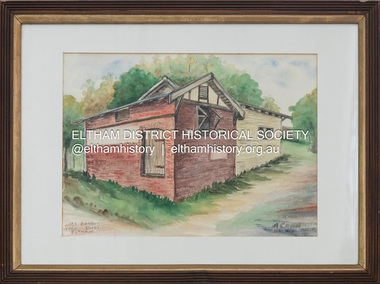
Painting, Audrey Cahn, Old Bakery, York Street, Eltham, May 1974
... During her time at the university, she undertook a series of studies in nutritional biochemistry. Of especial note is the analysis of common dietary foods so that the composition and calorific value, the data that was needed for inclusion in Food tables - that professional sports people and weight-watchers so avidly follow today! ...During her time at the university, she undertook a series of studies in nutritional biochemistry. Of especial note is the analysis of common dietary foods so that the composition and calorific value, the data that was needed for inclusion in Food tables - that professional sports people and weight-watchers so avidly follow today! ...Painted for the Shire of Eltham Historical Society by Audrey Cahn, a member of our Society for many years and Vice President till 1978. Audrey was the sister of the late Charis Palling, founding president of our Society. She had remained a member for many years although she had moved from her family home at Warrandyte to live with her daughter in New South Wales. Audrey had been blind for some years but maintained a local interest by having our Newsletter read to her. Audrey's associations with Warrandyte started because her father Professor Osbourne had bought 60 acres in 1904. " Gold mining was beginning to die out and Warrandyte was a decaying area. Land was cheap because of the lack of transport and the soil was poor for farming” Audrey said. Audrey first attended school in the city at the Church of England Girls Grammar School and was always a bit rebellious. “If I felt some restrictions were unfair or some judgement unjust, I resented it”. Audrey got into Agricultural Science at Melbourne University and in 1928 was the second women to get such a degree. Audrey married in 1926, and later divorced Leslie Cahn an architect. They had twin daughters whom she left with her parents in Warrandyte while she studied dietetics during the depression. She found employment as a microbiologist at the Kraft/Walker Milk and Cheese Factory in Drouin - she drove home at weekends to see her daughters who were then at boarding school. During the war Audrey was in charge of catering at the Heidelberg Military Hospital – again the appointment of a women caused some unrest. She was in the army for more than 4 years and achieved the rank of General which-made her the most highly-ranked-woman at the hospital. After the war she became a senior lecturer in Dietetics at Melbourne University, again being aware of the limitations her gender brought to promotion possibilities. During her time at the university, she undertook a series of studies in nutritional biochemistry. Of especial note is the analysis of common dietary foods so that the composition and calorific value, the data that was needed for inclusion in Food tables - that professional sports people and weight-watchers so avidly follow today! She was an early proponent of the need to reduce fat intake and to substitute saturated fats with polyunsaturated fatty acids. In the 1950's Audrey and fellow workers established norms for the growth of Australian children to be compared with British and American children. Over 17 years they concluded that Australian children were overweight and inactive - what is new! She bought a cottage in Warrandyte as her home. In 1968 she retired to further develop her other interests as a potter and painter. Audrey was a foundation member of the group of potters that set up Potters Cottage. Audrey died in 2008 aged 102. (Ref:Newsletter No. 185 March 2009)art, artwork, audrey cahn, eltham, old bakery, york street -
 Victorian Aboriginal Corporation for Languages
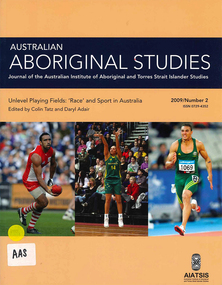
Periodical, Australian Institute of Aboriginal and Torres Strait Islander Studies, Australian Aboriginal studies : journal of the Australian Institute of Aboriginal and Torres Strait Islander Studies, 2009
... statistical domination?: genes, biochemistry, biomechanics, history, culture, social dynamics, the search for identity, alienation, need, chance, circumstances, and personal bent or aptitude. ...statistical domination?: genes, biochemistry, biomechanics, history, culture, social dynamics, the search for identity, alienation, need, chance, circumstances, and personal bent or aptitude. ...Darkness and a little light: ?Race? and sport in Australia Colin Tatz (AIATSIS & Australian National University) and Daryl Adair (University of Technology Sydney) Despite ?the wonderful and chaotic universe of clashing colors, temperaments and emotions, of brave deeds against odds seemingly insuperable?, sport is mixed with ?mean and shameful acts of pure skullduggery?, villainy, cowardice, depravity, rapaciousness and malice. Thus wrote celebrated American novelist Paul Gallico on the eve of the Second World War (Gallico 1938 [1988]:9-10). An acute enough observation about society in general, his farewell to sports writing also captures the ?clashing colors? in Australian sport. In this ?land of the fair go?, we look at the malice of racism in the arenas where, as custom might have it, one would least want or expect to find it. The history of the connection between sport, race and society - the long past, the recent past and the social present - is commonly dark and ugly but some light and decency are just becoming visible. Coming to terms: ?Race?, ethnicity, identity and Aboriginality in sport Colin Tatz (AIATSIS & Australian National University) Notions of genetic superiority have led to some of the world?s greatest human calamities. Just as social scientists thought that racial anthropology and biology had ended with the cataclysm of the Second World War, so some influential researchers and sports commentators have rekindled the pre-war debate about the muscular merits of ?races? in a new discipline that Nyborg (1994) calls the ?science of physicology?. The more recent realm of racial ?athletic genes?, especially within socially constructed black athletic communities, may intend no malice but this search for the keys to their success may well revive the old, discredited discourses. This critical commentary shows what can happen when some population geneticists and sports writers ignore history and when medical, biological and sporting doctrines deriving from ?race? are dislocated from any historical, geographic, cultural and social contexts. Understanding discourses about race, racism, ethnicity, otherness, identity and Aboriginality are essential if sense, or nonsense, is to be made of genetic/racial ?explanations? of sporting excellence. Between the two major wars boxing was, disproportionately, a Jewish sport; Kenyans and Ethiopians now ?own? middle- and long-distance running and Jamaicans the shorter events; South Koreans dominate women?s professional golf. This essay explores the various explanations put forward for such ?statistical domination?: genes, biochemistry, biomechanics, history, culture, social dynamics, the search for identity, alienation, need, chance, circumstances, and personal bent or aptitude. Traditional games of a timeless land: Play cultures in Aboriginal and Torres Strait Islander communities Ken Edwards (University of Southern Queensland) Sports history in Australia has focused almost entirely on modern, Eurocentric sports and has therefore largely ignored the multitude of unique pre- European games that are, or once were, played. The area of traditional games, especially those of Aboriginal and Torres Strait Islander peoples, is an important aspect of the cultural, social and historical experiences of Indigenous communities. These activities include customs of play that are normally not associated with European notions of competitive sport. Overall, this paper surveys research undertaken into traditional games among Indigenous Australians, as well as proposals for much needed further study in this area. Culture, ?race? and discrimination in the 1868 Aboriginal cricket tour of England David Sampson As a consequence of John Mulvaney?s important historical research, the Aboriginal cricket and performance tour of Britain in 1868 has in recent decades become established as perhaps the most famous of all public events in contact history involving Aborigines, white settlers and the British metropolis. Although recognition of its importance is welcome and significant, public commemorations of the tour have enveloped the tour in mythologies of cricket and nation. Such mythologies have obscured fundamental aspects of the tour that were inescapable racial and colonial realities of the Victorian era. This reappraisal of the tour explores the centrality of racial ideology, racial science and racial power imbalances that enabled, created and shaped the tour. By exploring beyond cricketing mythology, it restores the central importance of the spectacular performances of Aboriginal skills without which the tour would have been impossible. Such a reappraisal seeks to fully recognise the often trivialised non-cricketing expertise of all of the Aboriginal performers in 1868 for their achievement of pioneering their unique culture, skills and technologies to a mass international audience. Football, ?race? and resistance: The Darwin Football League, 1926?29 Matthew Stephen (Northern Territory Archive Service) Darwin was a diverse but deeply divided society in the early twentieth century. The Commonwealth Government introduced the Aboriginals Ordinance 1911 in the Northern Territory, instituting state surveillance, control and a racially segregated hierarchy of whites foremost, then Asians, ?Coloureds? (Aborigines and others of mixed descent) and, lastly, the so-called ?full-blood? Aborigines. Sport was important in scaffolding this stratification. Whites believed that sport was their private domain and strictly controlled non-white participation. Australian Rules football, established in Darwin from 1916, was the first sport in which ?Coloured? sportsmen challenged this domination. Football became a battleground for recognition, rights and identity for all groups. The ?Coloured? community embraced its team, Vesteys, which dominated the Northern Territory Football League (NTFL) in the 1920s. In 1926, amidst growing racial tension, the white-administered NTFL changed its constitution to exclude non-white players. In reaction, ?Coloured? and Chinese footballers formed their own competition - the Darwin Football League (DFL). The saga of that colour bar is an important chapter in Australia?s football history, yet it has faded from Darwin?s social memory and is almost unknown among historians. That picture - Nicky Winmar and the history of an image Matthew Klugman (Victoria University) and Gary Osmond (The University of Queensland) In April 1993 Australian Rules footballer Nicky Winmar responded to on-field racist abuse by lifting his jersey and pointing to his chest. The photographic image of that event is now famous as a response to racial abuse and has come to be seen as starting a movement against racism in football. The racial connotations in the image might seem a foregone conclusion: the power, appeal and dominant meaning of the photograph might appear to be self-evident. But neither the fame of the image nor its racial connotation was automatic. Through interviews with the photographers and analysis of the use of the image in the media, we explore how that picture came to be of such symbolic importance, and how it has remained something to be re-shown and emulated. Rather than analyse the image as a photograph or work of art, we uncover some of its early history and explore the debates that continue to swirl around its purpose and meaning. We also draw attention to the way the careful study of photographs might enhance the study of sport, race and racism. ?She?s not one of us?: Cathy Freeman and the place of Aboriginal people in Australian national culture Toni Bruce (University of Waikato) and Emma Wensing (Independent scholar) The Sydney 2000 Olympic Games generated a national media celebration of Aboriginal 400 metre runner Cathy Freeman. The construction of Freeman as the symbol of national reconciliation was evident in print and on television, the Internet and radio. In contrast to this celebration of Freeman, the letters to the editor sections of 11 major newspapers became sites for competing claims over what constitutes Australian identity and the place of Aboriginal people in national culture. We analyse this under-explored medium of opinion and discuss how the deep feelings evident in these letters, and the often vitriolic responses to them, illustrate some of the enduring racial tensions in Australian society. Sport, physical activity and urban Indigenous young people Alison Nelson (The University of Queensland) This paper challenges some of the commonly held assumptions and ?knowledges? about Indigenous young people and their engagement in physical activity. These include their ?natural? ability, and the use of sport as a panacea for health, education and behavioural issues. Data is presented from qualitative research undertaken with a group of 14 urban Indigenous young people with a view to ?speaking back? to these commentaries. This research draws on Critical Race Theory in order to make visible the taken-for-granted assumptions about Indigenous Australians made by the dominant white, Western culture. Multiple, shifting and complex identities were expressed in the young people?s articulation of the place and meaning of sport and physical activity in their lives. They both engaged in, and resisted, dominant Western discourses regarding representations of Indigenous people in sport. The paper gives voice to these young people in an attempt to disrupt and subvert hegemonic discourses. An unwanted corroboree: The politics of the New South Wales Aboriginal Rugby League Knockout Heidi Norman (University of Technology Sydney) The annual New South Wales Aboriginal Rugby League Knockout is so much more than a sporting event. Involving a high level of organisation, it is both a social and cultural coming together of diverse communities for a social and cultural experience considered ?bigger than Christmas?. As if the planning and logistics were not difficult enough, the rotating-venue Knockout has been beset, especially since the late 1980s and 1990s, by layers of opposition and open hostility based on ?race?: from country town newspapers, local town and shire councils, local business houses and, inevitably, the local police. A few towns have welcomed the event, seeing economic advantage and community good will for all. Commonly, the Aboriginal ?influx? of visitors and players - people perceived as ?strangers?, ?outsiders?, ?non-taxpayers? - provoked public fear about crime waves, violence and physical safety, requiring heavy policing. Without exception, these racist expectations were shown to be totally unfounded. Research report: Recent advances in digital audio recorder technology provide considerable advantages in terms of cost and portability for language workers.b&w photographs, colour photographs, tablessport and race, racism, cathy freeman, nicky winmar, rugby league, afl, athletics, cricket, digital audio recorders -
 Alfred Hospital Nurses League - Nursing History Collection
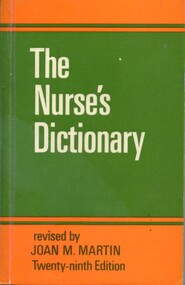
Book - Illustrated dictionary, Honnor Morten 1861-1913, The Nurse's Dictionary, 1980
... Over the years the dictionary has been updated by various editors to keep pace with evolving nursing practices and nedical terminology Insight into nursing knowledge and practice in 1980 nursing-dictionary medical-dictionary Provides definitions for medical and nursing terminology includes appendices on first aid, biochemistry, urine testing and diet on front end pag at top right 'W I THOMAS [blue ink]/Reference [black ink] Illustrated book. ...Provides definitions for medical and nursing terminology includes appendices on first aid, biochemistry, urine testing and dietIllustrated book. On front cover the title [white ink] is printed on green square. Orange bannd above and below, on lower band revisor and edition are printed [black ink] Same information brinted on spine.Book has been covered with clear adhesive filmnon-fictionProvides definitions for medical and nursing terminology includes appendices on first aid, biochemistry, urine testing and dietnursing-dictionary, medical-dictionary -
 Box Hill Historical Society
Book, William Hugh Sawyer, A life of science, c2018
... Science Dairying Family history Sawyer> Harry World War 1914-1918 Autobiography of early family life and life in biochemistry. Includes some family history and record of Harry Sawyer's World War II service. ...Autobiography of early family life and life in biochemistry. Includes some family history and record of Harry Sawyer's World War II service. Index with entries for Victoria, Australia only155 pages; colour, black & white and sepia photos. Includes appendices of listing of publications and diaries. Partial index insertnon-fictionAutobiography of early family life and life in biochemistry. Includes some family history and record of Harry Sawyer's World War II service. Index with entries for Victoria, Australia only science, dairying, family history, sawyer> harry, world war 1914-1918
