
Showing 17 items matching "biological sciences"
-
 University of Melbourne, Burnley Campus Archives
Booklet - Textbook, American Institute of Biological Sciences, Plant Growth and Development, 1963
... ...biological sciences...Textbook produced by American Institute of Biological Sciences, Biological Sciences Curriculum Study, Committee on Innovation in Laboratory Instruction: High School Biology A Laboratory Block. ...American Institute of Biological Sciences...Textbook produced by American Institute of Biological Sciences, Biological Sciences Curriculum Study, Committee on Innovation in Laboratory Instruction: High School Biology A Laboratory Block. ...Booklet with light cardboard cover. 3 holes for placement in folder. Textbook produced by American Institute of Biological Sciences, Biological Sciences Curriculum Study, Committee on Innovation in Laboratory Instruction: High School Biology A Laboratory Block. By Addison E. lee. 6 week course of laboratory experiments.plant growth, plant development, biological sciences, curriculum, laboratory insteruction, laboratory experiments -
University of Melbourne, Burnley Campus Archives
Photograph - Black and white print, Farewell to A.J. Farrance, 1975
... ...biological sciences...Kneen as farewell to A.J. Farrance. Biological Sciences....t.h. kneen farewell a.j. farrance biological sciences retirement Strip of 8 small photographs. ...Strip of 8 small photographs. Identified by T.H. Kneen as farewell to A.J. Farrance. Biological Sciences.t.h. kneen, farewell, a.j. farrance, biological sciences, retirement -
 University of Melbourne, Burnley Campus Archives
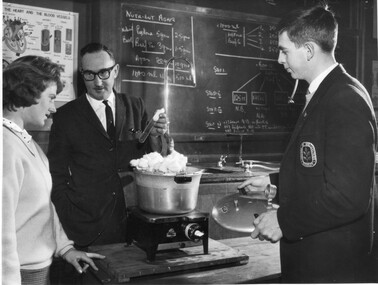
Photograph - Black and white print, Publicity Branch Victorian Department of Agriculture, Laboratory Class, c. 1962
... ...biological sciences...A.J. Farrance (Biological Sciences, holding a test tube)with 2 students in the Laboratory. ...A.J. Farrance (Biological Sciences, holding a test tube)with 2 students in the Laboratory. ...Black and white photograph. A.J. Farrance (Biological Sciences, holding a test tube)with 2 students in the Laboratory. Writing on blackboard in the background.On reverse, "Photograph by Publicity Branch Victorian Department Of Agriculture Ref. No. D.162.B."a.j. farrance, biological sciences, students, laboratory, students in class, publicity, dept of agriculture -
 University of Melbourne, Burnley Campus Archives
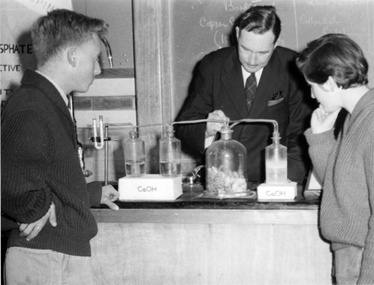
Photograph - Black and white print, Students in Chemistry Class, c. 1957
... ...biological sciences...On reverse, "Jack Farrance (Biological Sciences)1952-75, Alan Werner, Jocelyn Care." ...See photograph B93.0606 students chemistry jack farrance biological sciences alan werner jocelyn care green grows our garden a.p. winzenried vavuum bell jar belljar students in class On reverse, "Jack Farrance (Biological Sciences)1952-75, Alan Werner, Jocelyn Care." ...Appears as an illustration in, "Green Grows Our Garden," A.P. Winzenried p 103. See photograph B93.0606Black and white photograph. Students in Chemistry Class using vacuum bell jar. 2 copies, one an enlargement.On reverse, "Jack Farrance (Biological Sciences)1952-75, Alan Werner, Jocelyn Care." (Both 1957.)students, chemistry, jack farrance, biological sciences, alan werner, jocelyn care, green grows our garden, a.p. winzenried, vavuum bell jar, belljar, students in class -
 University of Melbourne, Burnley Campus Archives
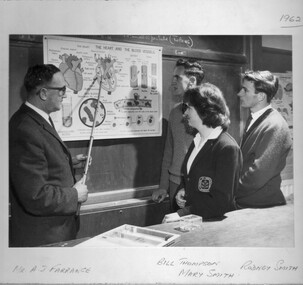
Photograph - Black and white print, Biology Class, 1962
... ...biological sciences...A.J. Farrance (Biological Sciences), Bill Thompson, Mary Smith, Rodney Smith."...A.J. Farrance (Biological Sciences), Bill Thompson, Mary Smith, Rodney Smith." ...Black and white photograph. Students being instructed about, "The Heart and the Blood Vessels," by A. J. Farrance.Inscribed, "1962, Mr. A.J. Farrance (Biological Sciences), Bill Thompson, Mary Smith, Rodney Smith."students, heart, blood vessels, a.j. farrance, biological sciences, bill thompson, mary smith, rodney smith, students in class -
 University of Melbourne, Burnley Campus Archives
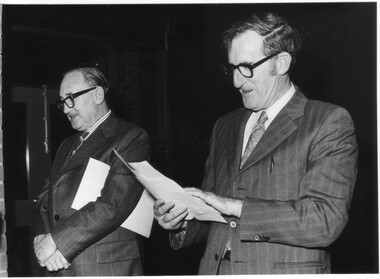
Photograph - Black and white print, Farewell to A. Jack. Farrance, 1975
... ...biological sciences...(D) A.J.Farrance. Biological Sciences....(D) A.J.Farrance. Biological Sciences. Farewell to A. Jack. Farrance Photograph Black and white print ...Strip of black and white photos and enlargements of B94.771. (A) A.J. Farrance and E.B. Littlejohn. (B) Group. (C) A.J. Farrance using a detecting microscope. (D) A.J.Farrance. Biological Sciences.a.j. farrance, e.b. littlejohn, biological sciences, farewell, retirement, jack farrance, staff, detecting microscope -
 University of Melbourne, Burnley Campus Archives
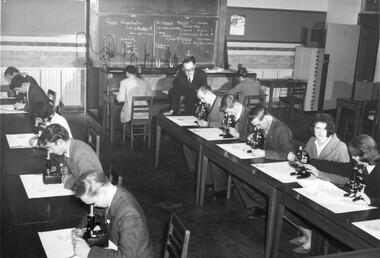
Photograph - Black and white print, Information Branch, Victorian Department of Agriculture, Students Using Microscopes, 1962-1967
... ...biological sciences...Kneen 18 December 1991, "Staff member standing: A.J.Farrance (Biological Sciences). Year group could be 1968-second from bottom left looks like David Young (1966) or Reg Packer (1965). ...Kneen 18 December 1991, "Staff member standing: A.J.Farrance (Biological Sciences). Year group could be 1968-second from bottom left looks like David Young (1966) or Reg Packer (1965). ...Note by T.H. Kneen 18 December 1991, "Staff member standing: A.J.Farrance (Biological Sciences). Year group could be 1968-second from bottom left looks like David Young (1966) or Reg Packer (1965). Or year could be 1962-seated girl at left of Farrance looks like Dianne Durrant. Photograph made 5 September 1967. Black and white photograph. Students in laboratory using microscopes.On reverse stamp," Photograph by Publicity Branch Victorian Department of Agriculture Ref. No. c.1695A."students, staff, a.j.farrance, biological sciences, david young, dianne durrant, reg packer, students in class, microscopes, publicity -
 University of Melbourne, Burnley Campus Archives
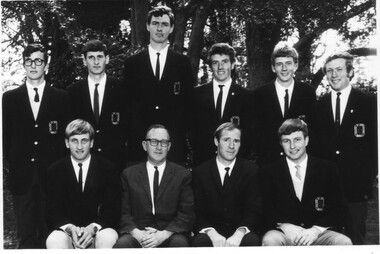
Photograph - Black and white print and negative, Information Branch Victorian Department of Agriculture, Student and Staff Group, 1968
... A. Farrance Biological Sciences....A. Farrance Biological Sciences. students staff phil clancy peter moody phil kenyon keith macdonald peter lalor geoff humphrey richard gardner a.j. farrance jack russell geo. toyne field instructor publicity On reverse, "L-R Phil Clancy, Peter Moody, Phil Kenyon, Keith MacDonald, Peter Lalor, Geoff Humphrey, Front Richard Gardner, A.J. ...G. Toyne Field Instructor Market Garden. A. Farrance Biological Sciences.Black and white photograph. 8 students with 2 staff members standing and seated in the Ornamental Garden. What they represent is unknown.On reverse, "L-R Phil Clancy, Peter Moody, Phil Kenyon, Keith MacDonald, Peter Lalor, Geoff Humphrey, Front Richard Gardner, A.J. Farrance, Jack Russell, Geo. Toyne. 1968," and, "Photograph by Information Branch Victorian Department of Agriculture Ref. No. D.1341."students, staff, phil clancy, peter moody, phil kenyon, keith macdonald, peter lalor, geoff humphrey, richard gardner, a.j. farrance, jack russell, geo. toyne, field instructor, publicity -
 Bendigo Historical Society Inc.
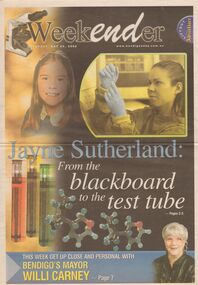
Newspaper - NEWSPAPER CUTTING: JAYNE SUTHERLAND, 25th Saturday, 2002
... Jayne born Bendigo; schooled at Epsom Primary and Flora Hill High before Bendigo Senior Secondary School (1990/910. Works in biological sciences (details in article)....Jayne born Bendigo; schooled at Epsom Primary and Flora Hill High before Bendigo Senior Secondary School (1990/910. Works in biological sciences (details in article). Newspaper NEWSPAPER CUTTING: JAYNE SUTHERLAND ...Newspaper cutting (Bendigo Advertiser 'Weekender' 25/5/2002) re Jayne Sutherland. Jayne born Bendigo; schooled at Epsom Primary and Flora Hill High before Bendigo Senior Secondary School (1990/910. Works in biological sciences (details in article).Bendigo Advertiserperson, individual, jane sutherland, epsom primary, flora hill high school -
 Sunshine and District Historical Society Incorporated
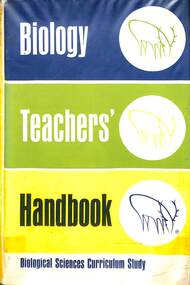
Book - Biology Teachers Handbook, Joseph J. Schwab, March 1966
... Front Cover - Biology Teachers Handbook Biological Sciences Curriculum Study First Page - Boy's Science Library. ...Front Cover - Biology Teachers Handbook Biological Sciences Curriculum Study First Page - Boy's Science Library. ...With each new generation our fund of scientific knowledge increases fivefold, this remarkable growth indicates, in part, why there has been widespread dissatisfaction with the content and methods of our science courses in secondary schools. This book was written with the task of including modern technology and improving secondary school biology.Blue, green and yellow hard covered book with text on the front covernon-fictionWith each new generation our fund of scientific knowledge increases fivefold, this remarkable growth indicates, in part, why there has been widespread dissatisfaction with the content and methods of our science courses in secondary schools. This book was written with the task of including modern technology and improving secondary school biology.sunshine technical school, derby road, sunshine -
 Stawell Historical Society Inc
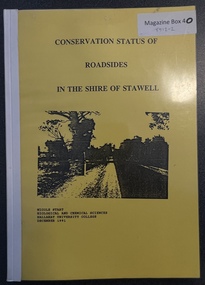
Document - Report, Nicole Start, Conservation Status of Roadsides in the Shire of Stawell, 1991
... Nicole Start Biological and Chemical Sciences Ballarat University Collage December 1991...Author Nicole Start Nicole Start Biological and Chemical Sciences Ballarat University Collage December 1991 Plastic Front Cover. ...Covers: Shire, roadsides, Assessment: Species, Flora, Grazing, Cropping, Gravel, Noxious weeds, Firebreaks, Road Design. With loos maps X 2 in back. Author Nicole StartPlastic Front Cover. Yellow Paper with Photo of a country road.Nicole Start Biological and Chemical Sciences Ballarat University Collage December 1991 -
 Stawell Historical Society Inc
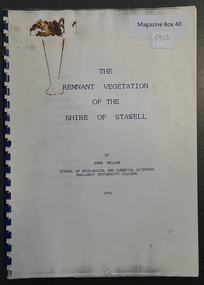
Book - Report, The Remnant Vegetation of the Shire of Stawell, 1990
... School of Biological and Chemical Sciences Ballarat University Collage...School of Biological and Chemical Sciences Ballarat University Collage Bound Paper The Remnant Vegetation of the Shire of Stawell Book Report ...Study of what remains of Native Vegetation towards conserving what remains on Public and Private land as well as revegetation through shireBound PaperThe Remnant Vegetation of the Shire of Stawell by John Miller. School of Biological and Chemical Sciences Ballarat University Collage -
 Federation University Historical Collection
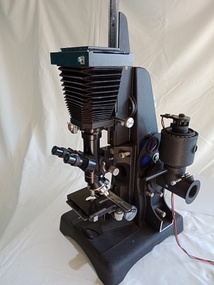
Instrument - Scientific Instrument, Ernest Leitz, Ernst Leitz Wetzlar Microscope, Panphot: Serial Number 493156, c1955-1957
... The Panphot was the first truly universal stand for photomicrography. leitz panphot camera microscope science equipment 35 mm camera filament and arc lamps optical equipment bellows bellows camera ernst leitz wetzlar Name of manufacturer - Ernst Leitz Wetzlar Serial Number - 493156 Leitz Panphot Biological Microscope photographic equipment kit light source. ...The Panphot was the first truly universal stand for photomicrography. Leitz Panphot Biological Microscope photographic equipment kit light source. This is a rare edition Leitz Panphot geared for biological use, and includes a metallurgical vertical illuminator with many many accessories.Name of manufacturer - Ernst Leitz Wetzlar Serial Number - 493156leitz panphot, camera microscope, science equipment, 35 mm camera, filament and arc lamps, optical equipment, bellows, bellows camera, ernst leitz, wetzlar -
 Flagstaff Hill Maritime Museum and Village
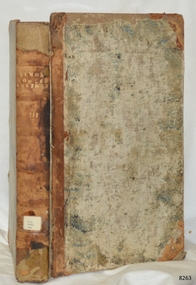
Book - Reference Fossils/Science, John Hill, A General Natural History, 1748
... science. Its greatest claim to fame is that in the Plants volume, John Hill became the very first writer to introduce Carl Linnaeus’s revolutionised system of biological classification to England. ...A General Natural History is a massive, ambitious three-volume compendium written to survey the natural world. It is divided into three distinct parts, which were published sequentially between 1748 and 1752. Volume One contains The History of Fossils (1748). Despite the modern name, "fossils" back then referred to anything dug out of the earth. This volume focuses heavily on mineralogy, gemstones, rocks, and minerals, mapping them out based on a microscopic examination. In Volume Two, A History of Plants (1751), Hill covers botany, describing the appearance, geographic range, and medicinal uses of various native and exotic plants (like the coffee tree, cacti, and various herbs). Volume Three concentrates on various animals and is called An History of Animals (1752). It's a zoological survey that starts with microscopic organisms before moving on to insects, marine life, reptiles, birds, and mammals. The book focused not just on describing these specimens, but also on outlining their "virtues and uses" in medicine and mechanics.A General Natural History Author: John Hill Publisher: Thomas Osborne Date: 1748 Badly damaged light brown hardcover with a damaged spine and lettering in gold. The spine has a Library label with an inscription.non-fictionA General Natural History is a massive, ambitious three-volume compendium written to survey the natural world. It is divided into three distinct parts, which were published sequentially between 1748 and 1752. Volume One contains The History of Fossils (1748). Despite the modern name, "fossils" back then referred to anything dug out of the earth. This volume focuses heavily on mineralogy, gemstones, rocks, and minerals, mapping them out based on a microscopic examination. In Volume Two, A History of Plants (1751), Hill covers botany, describing the appearance, geographic range, and medicinal uses of various native and exotic plants (like the coffee tree, cacti, and various herbs). Volume Three concentrates on various animals and is called An History of Animals (1752). It's a zoological survey that starts with microscopic organisms before moving on to insects, marine life, reptiles, birds, and mammals. The book focused not just on describing these specimens, but also on outlining their "virtues and uses" in medicine and mechanics.flagstaff hill, warrnambool, shipwrecked coast, flagstaff hill maritime museum, maritime museum, shipwreck coast, flagstaff hill maritime village, great ocean road, book, pattison collection, warrnambool library, warrnambool mechanics’ institute, ralph eric pattison, corangamite regional library service, warrnambool city librarian, mechanics’ institute library, victorian library board, warrnambool books and records, warrnambool children’s library, a general natural history, john hill -
 Victorian Aboriginal Corporation for Languages
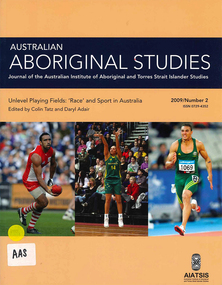
Periodical, Australian Institute of Aboriginal and Torres Strait Islander Studies, Australian Aboriginal studies : journal of the Australian Institute of Aboriginal and Torres Strait Islander Studies, 2009
... science of physicology?. The more recent realm of racial ?athletic genes?, especially within socially constructed black athletic communities, may intend no malice but this search for the keys to their success may well revive the old, discredited discourses. This critical commentary shows what can happen when some population geneticists and sports writers ignore history and when medical, biological...science of physicology?. The more recent realm of racial ?athletic genes?, especially within socially constructed black athletic communities, may intend no malice but this search for the keys to their success may well revive the old, discredited discourses. This critical commentary shows what can happen when some population geneticists and sports writers ignore history and when medical, biological ...Darkness and a little light: ?Race? and sport in Australia Colin Tatz (AIATSIS & Australian National University) and Daryl Adair (University of Technology Sydney) Despite ?the wonderful and chaotic universe of clashing colors, temperaments and emotions, of brave deeds against odds seemingly insuperable?, sport is mixed with ?mean and shameful acts of pure skullduggery?, villainy, cowardice, depravity, rapaciousness and malice. Thus wrote celebrated American novelist Paul Gallico on the eve of the Second World War (Gallico 1938 [1988]:9-10). An acute enough observation about society in general, his farewell to sports writing also captures the ?clashing colors? in Australian sport. In this ?land of the fair go?, we look at the malice of racism in the arenas where, as custom might have it, one would least want or expect to find it. The history of the connection between sport, race and society - the long past, the recent past and the social present - is commonly dark and ugly but some light and decency are just becoming visible. Coming to terms: ?Race?, ethnicity, identity and Aboriginality in sport Colin Tatz (AIATSIS & Australian National University) Notions of genetic superiority have led to some of the world?s greatest human calamities. Just as social scientists thought that racial anthropology and biology had ended with the cataclysm of the Second World War, so some influential researchers and sports commentators have rekindled the pre-war debate about the muscular merits of ?races? in a new discipline that Nyborg (1994) calls the ?science of physicology?. The more recent realm of racial ?athletic genes?, especially within socially constructed black athletic communities, may intend no malice but this search for the keys to their success may well revive the old, discredited discourses. This critical commentary shows what can happen when some population geneticists and sports writers ignore history and when medical, biological and sporting doctrines deriving from ?race? are dislocated from any historical, geographic, cultural and social contexts. Understanding discourses about race, racism, ethnicity, otherness, identity and Aboriginality are essential if sense, or nonsense, is to be made of genetic/racial ?explanations? of sporting excellence. Between the two major wars boxing was, disproportionately, a Jewish sport; Kenyans and Ethiopians now ?own? middle- and long-distance running and Jamaicans the shorter events; South Koreans dominate women?s professional golf. This essay explores the various explanations put forward for such ?statistical domination?: genes, biochemistry, biomechanics, history, culture, social dynamics, the search for identity, alienation, need, chance, circumstances, and personal bent or aptitude. Traditional games of a timeless land: Play cultures in Aboriginal and Torres Strait Islander communities Ken Edwards (University of Southern Queensland) Sports history in Australia has focused almost entirely on modern, Eurocentric sports and has therefore largely ignored the multitude of unique pre- European games that are, or once were, played. The area of traditional games, especially those of Aboriginal and Torres Strait Islander peoples, is an important aspect of the cultural, social and historical experiences of Indigenous communities. These activities include customs of play that are normally not associated with European notions of competitive sport. Overall, this paper surveys research undertaken into traditional games among Indigenous Australians, as well as proposals for much needed further study in this area. Culture, ?race? and discrimination in the 1868 Aboriginal cricket tour of England David Sampson As a consequence of John Mulvaney?s important historical research, the Aboriginal cricket and performance tour of Britain in 1868 has in recent decades become established as perhaps the most famous of all public events in contact history involving Aborigines, white settlers and the British metropolis. Although recognition of its importance is welcome and significant, public commemorations of the tour have enveloped the tour in mythologies of cricket and nation. Such mythologies have obscured fundamental aspects of the tour that were inescapable racial and colonial realities of the Victorian era. This reappraisal of the tour explores the centrality of racial ideology, racial science and racial power imbalances that enabled, created and shaped the tour. By exploring beyond cricketing mythology, it restores the central importance of the spectacular performances of Aboriginal skills without which the tour would have been impossible. Such a reappraisal seeks to fully recognise the often trivialised non-cricketing expertise of all of the Aboriginal performers in 1868 for their achievement of pioneering their unique culture, skills and technologies to a mass international audience. Football, ?race? and resistance: The Darwin Football League, 1926?29 Matthew Stephen (Northern Territory Archive Service) Darwin was a diverse but deeply divided society in the early twentieth century. The Commonwealth Government introduced the Aboriginals Ordinance 1911 in the Northern Territory, instituting state surveillance, control and a racially segregated hierarchy of whites foremost, then Asians, ?Coloureds? (Aborigines and others of mixed descent) and, lastly, the so-called ?full-blood? Aborigines. Sport was important in scaffolding this stratification. Whites believed that sport was their private domain and strictly controlled non-white participation. Australian Rules football, established in Darwin from 1916, was the first sport in which ?Coloured? sportsmen challenged this domination. Football became a battleground for recognition, rights and identity for all groups. The ?Coloured? community embraced its team, Vesteys, which dominated the Northern Territory Football League (NTFL) in the 1920s. In 1926, amidst growing racial tension, the white-administered NTFL changed its constitution to exclude non-white players. In reaction, ?Coloured? and Chinese footballers formed their own competition - the Darwin Football League (DFL). The saga of that colour bar is an important chapter in Australia?s football history, yet it has faded from Darwin?s social memory and is almost unknown among historians. That picture - Nicky Winmar and the history of an image Matthew Klugman (Victoria University) and Gary Osmond (The University of Queensland) In April 1993 Australian Rules footballer Nicky Winmar responded to on-field racist abuse by lifting his jersey and pointing to his chest. The photographic image of that event is now famous as a response to racial abuse and has come to be seen as starting a movement against racism in football. The racial connotations in the image might seem a foregone conclusion: the power, appeal and dominant meaning of the photograph might appear to be self-evident. But neither the fame of the image nor its racial connotation was automatic. Through interviews with the photographers and analysis of the use of the image in the media, we explore how that picture came to be of such symbolic importance, and how it has remained something to be re-shown and emulated. Rather than analyse the image as a photograph or work of art, we uncover some of its early history and explore the debates that continue to swirl around its purpose and meaning. We also draw attention to the way the careful study of photographs might enhance the study of sport, race and racism. ?She?s not one of us?: Cathy Freeman and the place of Aboriginal people in Australian national culture Toni Bruce (University of Waikato) and Emma Wensing (Independent scholar) The Sydney 2000 Olympic Games generated a national media celebration of Aboriginal 400 metre runner Cathy Freeman. The construction of Freeman as the symbol of national reconciliation was evident in print and on television, the Internet and radio. In contrast to this celebration of Freeman, the letters to the editor sections of 11 major newspapers became sites for competing claims over what constitutes Australian identity and the place of Aboriginal people in national culture. We analyse this under-explored medium of opinion and discuss how the deep feelings evident in these letters, and the often vitriolic responses to them, illustrate some of the enduring racial tensions in Australian society. Sport, physical activity and urban Indigenous young people Alison Nelson (The University of Queensland) This paper challenges some of the commonly held assumptions and ?knowledges? about Indigenous young people and their engagement in physical activity. These include their ?natural? ability, and the use of sport as a panacea for health, education and behavioural issues. Data is presented from qualitative research undertaken with a group of 14 urban Indigenous young people with a view to ?speaking back? to these commentaries. This research draws on Critical Race Theory in order to make visible the taken-for-granted assumptions about Indigenous Australians made by the dominant white, Western culture. Multiple, shifting and complex identities were expressed in the young people?s articulation of the place and meaning of sport and physical activity in their lives. They both engaged in, and resisted, dominant Western discourses regarding representations of Indigenous people in sport. The paper gives voice to these young people in an attempt to disrupt and subvert hegemonic discourses. An unwanted corroboree: The politics of the New South Wales Aboriginal Rugby League Knockout Heidi Norman (University of Technology Sydney) The annual New South Wales Aboriginal Rugby League Knockout is so much more than a sporting event. Involving a high level of organisation, it is both a social and cultural coming together of diverse communities for a social and cultural experience considered ?bigger than Christmas?. As if the planning and logistics were not difficult enough, the rotating-venue Knockout has been beset, especially since the late 1980s and 1990s, by layers of opposition and open hostility based on ?race?: from country town newspapers, local town and shire councils, local business houses and, inevitably, the local police. A few towns have welcomed the event, seeing economic advantage and community good will for all. Commonly, the Aboriginal ?influx? of visitors and players - people perceived as ?strangers?, ?outsiders?, ?non-taxpayers? - provoked public fear about crime waves, violence and physical safety, requiring heavy policing. Without exception, these racist expectations were shown to be totally unfounded. Research report: Recent advances in digital audio recorder technology provide considerable advantages in terms of cost and portability for language workers.b&w photographs, colour photographs, tablessport and race, racism, cathy freeman, nicky winmar, rugby league, afl, athletics, cricket, digital audio recorders -
University of Melbourne, Burnley Campus Archives
Book - PhD Thesis, Tebo Maseko, The Chemical Characterization and Biological Evaluation of Selium-enriched Agaricus bisporus Mushroom Organic Selenium Species, 2014
... PhD thesis Agricultural Science agaricus bisporus Typed and bound thesis The Chemical Characterization and Biological Evaluation of Selium-enriched Agaricus bisporus Mushroom Organic Selenium Species Book PhD Thesis Tebo Maseko ...phd thesis, agricultural science, agaricus bisporus -
Stawell Historical Society Inc
Animal specimen - Realia, Four Biology Dissection Rat Specimens
... 8700 -1 Dissected Rat Cut through in the medium sagittal plane Showing internal organs and arteries -2 The Blood Vascular System of the Rat Australian Biological Supply Company Ramsay Surgical Limited -3 Urinogenital System of the Rat Australian Biological Supply Company Ramsay Surgical Limited -4 The Alimentary System of the Rat Australian Biological Supply Company Ramsay Surgical Limited Education Science Four Dissected Rats. ...8700 -1 Dissected Rat Cut through in the medium sagittal plane Showing internal organs and arteries -2 The Blood Vascular System of the Rat Australian Biological Supply Company Ramsay Surgical Limited -3 Urinogenital System of the Rat Australian Biological Supply Company Ramsay Surgical Limited -4 The Alimentary System of the Rat Australian Biological Supply Company Ramsay Surgical Limited Four Dissected Rats. Mounted on Boards in Glass Jars and Formaldehydeeducation, science
