
Showing 4 items matching "biological specimen"
-
 Flagstaff Hill Maritime Museum and Village
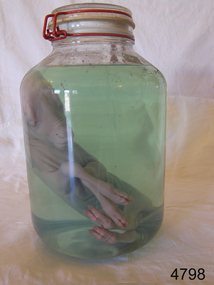
Animal specimen - Lamb Fetus
... ...biological specimen...Flagstaff Hill Flagstaff Hill Maritime Museum and Village Warrnambool Maritime Museum Maritime Village Great Ocean Road Shipwreck Coast lamb fetus lamb fetus animal specimen biological specimen Large glass jar containing a lamb fetus in preserving fluid. ...This lamb fetus has been placed in preserving fluid. This can be formaldehyde, isopropyl or ethanol. It is important that glass jars are used, as plastic will be affected by the chemicals over time in the preserving fluid. Note the glass lid and the rubber seal; also the plastic covered metal clasp that has no contact with the contents. It is not known how long the lamb has been in this jar, but it is remarkably well preserved with just a little film of scum on parts on the top of the interior of the jar.The use of such preserved specimens is widespread in teaching students of all ages, veterinary operatives and museums of the composition of certain animals, insects and birds. Any information about an animal — be it photographs, blood, feathers or fur samples — is better than no information at all. But specimens are vital to ground-truth.Large glass jar containing a lamb fetus in preserving fluid. Glass lid is secured with rubber seal and metal fastening. flagstaff hill, flagstaff hill maritime museum and village, warrnambool, maritime museum, maritime village, great ocean road, shipwreck coast, lamb, fetus, lamb fetus, animal specimen, biological specimen -
 Flagstaff Hill Maritime Museum and Village
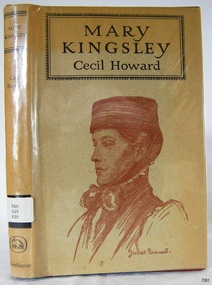
Book - Biography, Cecil Howard, Mary Kingsley, 1957
... His work focused on Victorian exploration, African colonial history, and ethnography, examining how Kingsley, who was a self-taught woman bound by domestic duties until her thirties, defied Victorian conventions to travel through West Africa, collect biological specimens, and advocate for African cultures and traders. ...His work focused on Victorian exploration, African colonial history, and ethnography, examining how Kingsley, who was a self-taught woman bound by domestic duties until her thirties, defied Victorian conventions to travel through West Africa, collect biological specimens, and advocate for African cultures and traders. ...Mary Kingsley is a popular biography of Mary Henrietta Kingsley (1862–1900), the English explorer, travel writer, and self-taught ethnographer known for her solo travels through West Africa (Sierra Leone, Angola, Gabon, Cameroon) in 1893–95. She collected zoological specimens for the British Museum, wrote sympathetically about African religions, law, and customs that challenged many contemporary European prejudices of the time, and published two influential books of her own: Travels in West Africa (1897) and West African Studies (1899). She died of typhoid while nursing Boer prisoners during the Second Boer War in 1900. Howard's book retells her life and travels for a general readership, and descriptions call it a lively account drawn from "the raciest and most exciting passages" of her own travel writing, tracing her journeys along the Ogowe River and through West African swamps.Hard cover book. Author: Cecil Howard Publisher: Hutchinson & Co Date: 1957 Further Information: Hardcover bound with dust cover intact with portrait frontispiece lettering in black. The spine has a Library label with an inscription.non-fictionMary Kingsley is a popular biography of Mary Henrietta Kingsley (1862–1900), the English explorer, travel writer, and self-taught ethnographer known for her solo travels through West Africa (Sierra Leone, Angola, Gabon, Cameroon) in 1893–95. She collected zoological specimens for the British Museum, wrote sympathetically about African religions, law, and customs that challenged many contemporary European prejudices of the time, and published two influential books of her own: Travels in West Africa (1897) and West African Studies (1899). She died of typhoid while nursing Boer prisoners during the Second Boer War in 1900. Howard's book retells her life and travels for a general readership, and descriptions call it a lively account drawn from "the raciest and most exciting passages" of her own travel writing, tracing her journeys along the Ogowe River and through West African swamps.shipwrecked-coast, flagstaff-hill, flagstaff-hill-maritime-museum, warrnambool, maritime-museum, shipwreck-coast, flagstaff-hill-maritime-village, shipwrecked-artefact, book, pattison collection, warrnambool library, warrnambool mechanics’ institute, ralph eric pattison, corangamite regional library service, warrnambool city librarian, mechanics’ institute library, victorian library board, warrnambool books and records, warrnambool children’s library, mary kingsley, cecil howard -
 The Beechworth Burke Museum
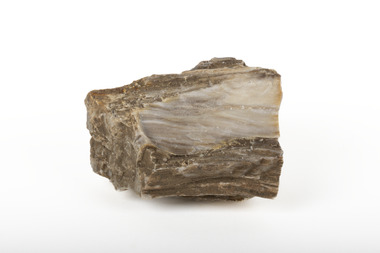
Geological specimen - Ribbonstone-banded Chert
... biological in origin, chert may also occur as a chemical precipitate or a diagenetic replacement--the product of petrified trees. Chert, also known as flint, was a common tool for early peoples during the stone age. It forms in limestone and chalk sediments as silicon dioxide microcrystals which grow into nodules of chert. Chert is found in many mines across the Northern Territory, however this specimen...biological in origin, chert may also occur as a chemical precipitate or a diagenetic replacement--the product of petrified trees. Chert, also known as flint, was a common tool for early peoples during the stone age. It forms in limestone and chalk sediments as silicon dioxide microcrystals which grow into nodules of chert. Chert is found in many mines across the Northern Territory, however this specimen ...Chert is a sedimentary rock composed of microcrystalline or cryptocrystalline quartz. While usually biological in origin, chert may also occur as a chemical precipitate or a diagenetic replacement--the product of petrified trees. Chert, also known as flint, was a common tool for early peoples during the stone age. It forms in limestone and chalk sediments as silicon dioxide microcrystals which grow into nodules of chert. Chert is found in many mines across the Northern Territory, however this specimen is sourced from the Mount Todd gold mine in Katherine. Its use in weaponry, both during the Stone Age and during the 18th century. Chert produces a spark when struck against steel, meaning t hat it can be used to start fires and fire guns. Chert was thus used in flintlock firearms, in which the gunpowder is ignited by a flint hammer striking a steel plate. Chert was commonly used in the Stone Age as a result of conchoidal fracturing causing very sharp edges, allowing early peoples to fashion weapons and cutting tools. It also rates a 7 on the Mohs Scale, making it a very hard and durable stone that maintains its sharpness. As a result, the significance of chert as a signifier of early indigenous Australian life makes this specimen important. It is also known that chert is a valuable mineral that was used as a trading commodity. Chert has also been valuable during the 1700s, proving itself to a be an important historical specimen in matters of war. A solid silicon dioxide mineral in shades of brown, white, and beigeburke museum, northern territory, chert, flint, minerals, geological specimen, katherine, mount todd gold mine, katherine northern territory -
 Stawell Historical Society Inc
Animal specimen - Realia, Four Biology Dissection Rat Specimens
... 8700 -1 Dissected Rat Cut through in the medium sagittal plane Showing internal organs and arteries -2 The Blood Vascular System of the Rat Australian Biological Supply Company Ramsay Surgical Limited -3 Urinogenital System of the Rat Australian Biological Supply Company Ramsay Surgical Limited -4 The Alimentary System of the Rat Australian Biological Supply Company Ramsay Surgical Limited Education Science Four Dissected Rats. Mounted on Boards in Glass Jars and Formaldehyde Four Biology Dissection Rat Specimens Animal specimen Realia ...8700 -1 Dissected Rat Cut through in the medium sagittal plane Showing internal organs and arteries -2 The Blood Vascular System of the Rat Australian Biological Supply Company Ramsay Surgical Limited -3 Urinogenital System of the Rat Australian Biological Supply Company Ramsay Surgical Limited -4 The Alimentary System of the Rat Australian Biological Supply Company Ramsay Surgical Limited Four Dissected Rats. Mounted on Boards in Glass Jars and Formaldehydeeducation, science
