
Showing 3 items matching "birds as omens"
-
 The Beechworth Burke Museum
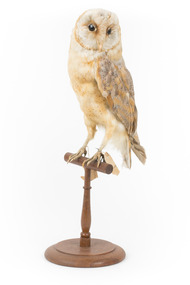
Animal specimen - Barn Owl, Trustees of the Australian Museum, 16-1880
... ...birds as omens...This collection continues to be on display in the Museum and has become a key part to interpreting the collecting habits of the 19th century. taxidermy mount taxidermy animalia burke museum beechworth australian museum skin owls birds of prey tyto alba heart-shaped faced owl nocturnal birds predator birds 'harbingers of misfortune' demon owl ghost owl death owl magical animals lich owl birds as omens barn owl carnivore hissing owl Swing tag: 36. / Barn [torn] / Catalogue [torn] / Metal tag: 4058 / This Barn Owl is medium sized with long wings and a short squarish tail. ...Barn Owls are the most widely distributed owl species in the world and one of the most widespread of all bird species, including in Australia. Barn Owls are sedentary and prefer open habitats such as grasslands, farmlands, and open woodlands, where they forage and hunt small mammals, particularly rodents, at night. Barn Owls nest in deep hollows in old trees, especially eucalypts, but also in caves, rock cavities, and sometimes cavities in buildings. Barn Owl's have a highly distinctive white heart-shaped face and pale underbelly feathers. They can be seen circling low above grassland areas at dusk or at night, and their drawn-out shrieking, hissing, and 'eerie' rasping sounds have led some rural populations to consider they have magical powers. Barn Owls vary in size but average 330-390mm in length, with wing spans between 800-950mm. Females are larger than males and most are a mix of white, pale brown and shades of grey speckled with fine black tear-shaped spots. They have a distinctive flat heart-shaped facial mask with oversized oblique black eye-slits and black irises. A ridge of feathers sits above the beak resembling a long nose. The feet vary in colour from pink to grey, and beaks can be pale to dark buff, corresponding to general plumage hue. This specimen is part of a collection of almost 200 animal specimens that were originally acquired as skins from various institutions across Australia, including the Australian Museum in Sydney and the National Museum of Victoria (known as Museums Victoria since 1983), as well as individuals such as amateur anthropologist Reynell Eveleigh Johns between 1860-1880. These skins were then mounted by members of the Burke Museum Committee and put-on display in the formal space of the Museum’s original exhibition hall where they continue to be on display. This display of taxidermy mounts initially served to instruct visitors to the Burke Museum of the natural world around them, today it serves as an insight into the collecting habits of the 19th century.This specimen is part of a significant and rare taxidermy mount collection in the Burke Museum. This collection is scientifically and culturally important for reminding us of how science continues to shape our understanding of the modern world. They demonstrate a capacity to hold evidence of how Australia’s fauna history existed in the past and are potentially important for future environmental research. This collection continues to be on display in the Museum and has become a key part to interpreting the collecting habits of the 19th century.This Barn Owl is medium sized with long wings and a short squarish tail. Its underbelly is pale and speckled with dark spots. The wings and tail feathers are light brown, grey and white with small, dark, tear-shaped speckles on the upper parts. It has a distinctive white heart-shaped facial disc with large black eyes and curved beak. This specimen stands on a wooden perch pedestal and it has metal and paper identification tags attached to its legs. Swing tag: 36. / Barn [torn] / Catalogue [torn] / Metal tag: 4058 /taxidermy mount, taxidermy, animalia, burke museum, beechworth, australian museum, skin, owls, birds of prey, tyto alba, heart-shaped faced owl, nocturnal birds, predator birds, 'harbingers of misfortune', demon owl, ghost owl, death owl, magical animals, lich owl, birds as omens, barn owl, carnivore, hissing owl -
 Embroiderers Guild, Victoria
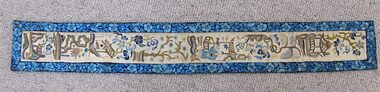
Accessory - Pair of Chinese Embroidered Sleeve Bands, 1880
... Two birds (possibly swallows): an omen approaching spring and also of approaching success. ...Two birds (possibly swallows): an omen approaching spring and also of approaching success. ...Label attached to record card states "Chinese Embroidery from the Royal Palace, Pekin J.M.S." Chinese sleeve embroidery bands, or wanxiu became popular in the late 19th century during the Qing Dynasty, evolving from the traditional Han cuff embroidery and Manchu styles. These detachable, decorated bands were added to women's informal jackets and robes, often featuring symbolic motifs like landscapes, flowers, and auspicious symbols. They served both a decorative function, displaying artistic skill and personal wishes, and a practical one by covering the sleeves when hands were folded at the waist. History and evolution: Origins: The practice of embroidering cuffs on robes existed during the previous Ming Dynasty for Han women, and this was adopted by the Manchu rulers who founded the Qing Dynasty. Qing Dynasty (1644-1911): The practice was popularized and elaborated upon during this era, with detachable bands becoming a fashionable element for informal wear. Symbolism: The embroidery included a complex visual vocabulary of wishes for a long life, many offspring, and a happy marriage, derived from nature, mythology, and classical literature. Functionality: Women would fold their arms, often with their hands inside the sleeves, so the embroidered bands, which were sewn to hang down the back of the jacket, would be displayed prominently down the front. 19th century peak: The late 19th century was the peak of their popularity, with intricate designs becoming fashionable and even influenced by court tastes, such as those favoured by the Empress Dowager Cixi. Later developments: The late 19th century saw the introduction of chemical 'aniline' dyes from Europe, leading to brighter, bolder colours in embroidery. Motifs and their Meanings: Auspicious symbols: Designs often included symbols for good fortune, wealth, and longevity. Natural imagery: Birds, flowers, and landscapes were common motifs that could represent natural beauty or convey specific symbolic meanings. Figurative scenes: Bands could also feature narrative scenes from classical stories or legends. The choice of motifs allowed women to express personal desires, cultural values, and aesthetic preferences, reflecting a more personal and informal style than official court attire. Pagoda: an omen of good. Two birds (possibly swallows): an omen approaching spring and also of approaching success. Rooster: a symbol of high rank (it's comb/crown (jinguan) is a pun for 'official' guan). Peony: a symbol of wealth. Deer (lu): means wealth and prosperity. Willow: a symbol of spring (chun). Willows with apricot blossoms (xinghuo), willlows (liu) and swallows (yan) symbolizes 'may you attend the spring banquet in the apricot grove (xinglin chunyan), or may you become a successful candidate. Pine: longevity. Mouth organ (sheng): is a pun for giving birth or 'to rise' as in rising in rank.Meaning : this pair of sleeve bands may have been wishing the owner of them good luck, success in an upcoming exam and that he may rapidly rise in rank, live a long life and continue to receive an official salary. Information from 'Hidden Meaning in Chinese Art' Terese Tse BartholomewFine white satin edged in shades oft blue silk flower embroidery. A fine example of Pekin knot stitch outlined with gold thread showing traditional Chinese motifs and figures. From bottom to top there is an outdoor scene with water and a building. Above this are flowers, hills, a rock formation, a pine and an animal (? pig or deer). Another building, blossoms and pine trees and a pot containing a cypress tree. Above the tree there is a male figure holding a bamboo pipe in one hand and a bird in the other. Further buildings follow, with a willow tree and two swallows flying.embroidery, garments, silk embroidery, late 19th century, china, trees, animals, pagoda -
 Ararat Gallery TAMA
Mixed media, Inga Hunter, Iboriis Sun Worshipper's Robe, 1986-1989
... This essentially peaceable religion is hated and feared by followers of the Bird God, so that Sunworshippers are hunted and destroyed whenever possible. It is considered a favourable omen if the year’s sacrificial victims can be Sunworshippers, a sure sign of a good future harvest. ...This essentially peaceable religion is hated and feared by followers of the Bird God, so that Sunworshippers are hunted and destroyed whenever possible. It is considered a favourable omen if the year’s sacrificial victims can be Sunworshippers, a sure sign of a good future harvest. ...“The Bird God cult is the official lboriisi religion, but there are certain sections of the planet where people worship the sun - not the big Voidstar, but the smaller erratic red star, known as Lanturan on lrusag, and lisa, or “Womb of the Wave Stone” on Iboriis. The sun is thought to be the creator and controller of all things, both benevolent and capricious. Priest of the Sunworshippers sacrifice appropriately coloured fruits and vegetables to the Sun God to ensure continuity of crops and a rich, peaceful life. When the red sun disappears from the sky on its erratic orbit, the God is thought to be displeased and the people gather in great groups to pray for better times. It is at this time that the Sun dances are performed in specially prepared dancing grounds in the forests. This essentially peaceable religion is hated and feared by followers of the Bird God, so that Sunworshippers are hunted and destroyed whenever possible. It is considered a favourable omen if the year’s sacrificial victims can be Sunworshippers, a sure sign of a good future harvest. Naturally enough, Sunworshippers are never delegates to the Court — this Robe was smuggled out of lboriis by a team of dedicated anthropologist who risked their lives to study the Sun God religion.” -Inga Hunter
