
Showing 83 items matching "black pigs"
-
 Wooragee Landcare Group
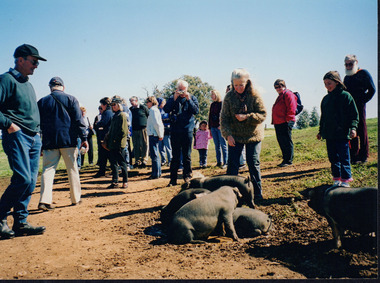
Photograph, 5 September 2004
... ...Black pigs...The photograph features several pigs believed to be the breed called Large Black. The Large Black Pig breed is a traditional, heritage breed that was first imported to Australia from the UK in the early 1900's. ...The photograph features several pigs believed to be the breed called Large Black. The Large Black Pig breed is a traditional, heritage breed that was first imported to Australia from the UK in the early 1900's. ...This photograph was taken at Samaria Farm on Sunday the 5th of September when Wooragee Landcare Group took a bus trip to the Tatong area (near Benalla) to look at land use on small farms. The day trip was organised to observe land use on small farms as well as a social event for the Group. Samaria Farm at the time was a nine-hectare property located in northeast Victoria, near Mount Samaria, 130 km Northeast of Melbourne. The photograph features several pigs believed to be the breed called Large Black. The Large Black Pig breed is a traditional, heritage breed that was first imported to Australia from the UK in the early 1900's. It is believed to have originated from the Old English Hog of the 16th and 17th Centuries. The first reference to them in the Australian Pure Bred Pig Herd Book was in 1912. They are a black pig with lop ears and were prized for their superior milking and mothering abilities and soon became popular with early Dairy Farmers who fed them whey from separated milk as part of their butter making process. They proved economical to keep and, being excellent grazing pigs, were also used to pick up windfall fruit in orchards. Their black colouring also enabled them to withstand the hot Australian summers and avoid sunburn which combined with their hardiness and docile temperament made them highly suitable for free-range pork production, however Large Black pigs tend to get very fat and were not suitable for intensive farming so were often crossed with other breeds for pork production. They are now quite rare as a pure breed having been on the edge of extinction for some time. They were rescued in the early 1990s by a rare breeds farmer in the Yarra Ranges. These days they are also the focus of a small conversation effort with six registered breeders currently in Australia. For biosecurity reasons there are no imports of live pigs or pig semen permitted into Australia. This photograph shows a group of people attending one of the events that Wooragee Landcare Group has organized within the educational framework of promoting best land management practices for all types of land uses and ensuring sustainability, in addition to encouraging community interaction via social events. The Large Black pig breed is significant because of their role in early Victorian farming. They are now quite rare as a pure breed having been on the edge of extinction for some time. These days they are the focus of a small conversation effort with six registered breeders currently in Australia. For biosecurity reasons there are no imports of live pigs or pig semen permitted into Australia. Wooragee Landcare Group is important to local community landcare and environmental management practices.Colour rectangular photograph printed on paperObverse: WAN NA EONA2N2. ANN+ 3 4240/ (No. 17) 370samaria farm, wooragee landcare, wooragee landcare group, tatong, benalla, black pigs, large black, traditional breed, heritage breed, pigs, lop ears, free range pork production, early victorian farming -
 Department of Health and Human Services
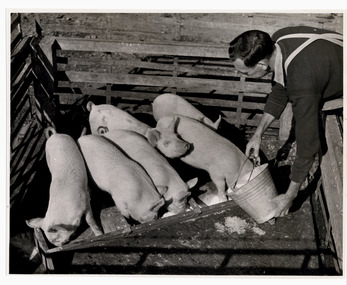
Photograph, Janefield Training Centre - Man feeding milk waste / whey into trough for 6 penned pigs - Black & White Photo
... Janefield Training Centre - Man feeding milk waste / whey into trough for 6 penned pigs - Black & White Photo...Janefield Training Centre - Man feeding milk waste / whey into trough for 6 penned pigs - Black & White Photo Photograph ... -
 Kiewa Valley Historical Society
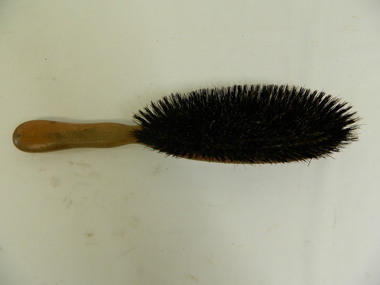
Clothes Brush - Personal Item
... A long brown wooden elongated oval shaped body and shaped handle with stiff black pig bristles ...costume accessories personal effects clothing A long brown wooden elongated oval shaped body and shaped handle with stiff black pig bristles Clothes Brush - Personal Item ...A long brown wooden elongated oval shaped body and shaped handle with stiff black pig bristles costume accessories, personal effects, clothing -
 Whitehorse Historical Society Inc.
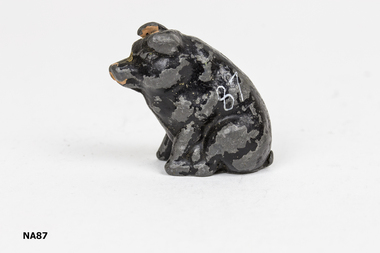
Leisure object - Toy - Pig
... Black painted pig with pink ears and snout....toys general Black painted pig with pink ears and snout. Leisure object Toy - Pig ...Black painted pig with pink ears and snout.toys, general -
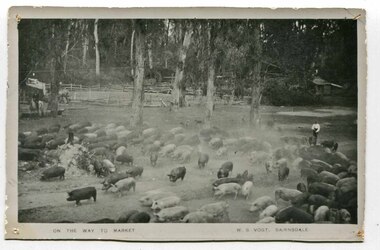 Orbost & District Historical Society
black and white photograph, late 19th century - early 20th century
... A black / white photograph of pigs being taken to market. There are men on horseback with them....This photograph is a pictorial record of Orbost farming practices in the early 20th century. agriculture farming-orbost pigs on front - On the Way to Market W.S. Vogt Bairnsdale A black / white photograph of pigs being taken to market. ...Pigs were taken to Bairnsdale by coaxing them with maize thrown from a wagonette . From Bairnsdale they were freighted to market by train. The journey to Bairnsdale took about five days . This method of transport continued until the rail line to Orbost was opened in 1916. This photograph is a pictorial record of Orbost farming practices in the early 20th century.A black / white photograph of pigs being taken to market. There are men on horseback with them.on front - On the Way to Market W.S. Vogt Bairnsdaleagriculture farming-orbost pigs -
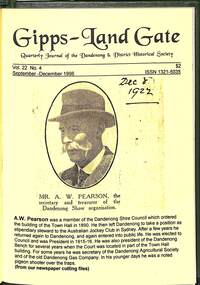 Dandenong & District Historical Society
Journal, Dandenong & District Historical Society, Gipps-Land Gate Vol.22 No.4, 1996
... Albert And Edna Bramley Farewell From The Commissioner Dandenong Show Tales Dandy Pig Returns Black Trackers In Victoria Harking Back 75 Years Ago The Taraden Story Society News ...Albert And Edna Bramley Farewell From The Commissioner Dandenong Show Tales Dandy Pig Returns Black Trackers In Victoria Harking Back 75 Years Ago The Taraden Story Society News Gipps-Land Gate Vol.22 No.4 Journal Dandenong & District Historical Society ...An interesting group of Early Dandenong Personalities, Places and EventsA5 size publication of the Gipps-Land Gate, September-December 1996 featuring an old picture of Dandenong on the cover. Albert And Edna Bramley Farewell From The Commissioner Dandenong Show Tales Dandy Pig Returns Black Trackers In Victoria Harking Back 75 Years Ago The Taraden Story Society News An interesting group of Early Dandenong Personalities, Places and Eventshotel history, early education in dandenong, interesting milestones, family histories -
 Federation University Historical Collection
Magazine, Sporting Shooter
... Eighty page magazine with articles such as looking after your hunting dog, Australia's Toughest Game, Pigs in Mud, Black Panthers in Oz, scoring Trophy Heads, Hunting in New Zealand. .2) May 2005. 106 page magaine including an article called "Big Cats in the Bush? ...Australian Animal Folklore Collection black panthers panther Mittagong Merimbula Thylacoleo carnifex puma feral cats Two copies of the Magazine 'Sporting Shooter' dated April 1999 and May 2005. .1) April 1999. Eighty page magazine with articles such as looking after your hunting dog, Australia's Toughest Game, Pigs in Mud, Black Panthers in Oz, scoring Trophy Heads, Hunting in New Zealand. .2) May 2005. 106 page magaine including an article called "Big Cats in the Bush? ...Two copies of the Magazine 'Sporting Shooter' dated April 1999 and May 2005. .1) April 1999. Eighty page magazine with articles such as looking after your hunting dog, Australia's Toughest Game, Pigs in Mud, Black Panthers in Oz, scoring Trophy Heads, Hunting in New Zealand. .2) May 2005. 106 page magaine including an article called "Big Cats in the Bush? by Rebecca Lang.australian animal folklore collection, black panthers, panther, mittagong, merimbula, , thylacoleo carnifex, puma, feral cats -
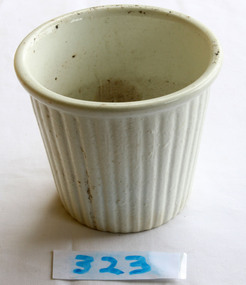 Flagstaff Hill Maritime Museum and Village
Domestic object - Pudding Mould
... pig's stomach is described. This original meaning of a pudding as a sausage is retained in black pudding, which is a blood sausage originating in the United Kingdom and Ireland made from pork or beef blood, with pork fat or beef suet, and a cereal. ...pig's stomach is described. This original meaning of a pudding as a sausage is retained in black pudding, which is a blood sausage originating in the United Kingdom and Ireland made from pork or beef blood, with pork fat or beef suet, and a cereal. ...One of the first documented mentions of pudding can be found in Homer's Odyssey where a blood pudding roasted in a pig's stomach is described. This original meaning of a pudding as a sausage is retained in black pudding, which is a blood sausage originating in the United Kingdom and Ireland made from pork or beef blood, with pork fat or beef suet, and a cereal. Another early documented recipe for pudding is a reference to asida, found in a tenth century Arabic cookbook by Ibn Sayyar al-Warraq called Kitab al-Ṭabīḫ (Arabic: كتاب الطبيخ, The Book of Dishes). It was described as a thick pudding of dates cooked with clarified butter (samn). A recipe for asida was also mentioned in an anonymous Hispano-Muslim cookbook dating to the 13th century. In the 13th and 14th centuries, in the mountainous region of the Rif along the Mediterranean coast of Morocco, flour made from lightly grilled barley was used in place of wheat flour. A recipe for asida that adds argan seed oil was documented by Leo Africanus (c. 1465–1550), the Arab explorer known as Hasan al-Wazan in the Arab world. According to the French scholar Maxime Rodinson, asida were typical foods among the Bedouin of pre-Islamic and, probably, later times. In the United Kingdom and some of the Commonwealth countries, the word pudding can be used to describe both sweet and savoury dishes. Unless qualified, however, the term in everyday usage typically denotes a dessert; in the United Kingdom, pudding is used as a synonym for a dessert course. Puddings had their 'real heyday...', according to food historian Annie Gray, '...from the seventeenth century onward'. It is argued that 'the future of the boiled suet pudding as one of England's national dishes was assured only when the pudding cloth came into use' and although puddings boiled in cloths may have been mentioned in the medieval era, one of the earliest mentions is in 1617 in a recipe for Cambridge pudding, a pudding cloth is indicated; 'throw your pudding in, being tied in a fair cloth; when it is boiled enough, cut it in the midst, and so serve it in'. The pudding cloth is said, according to food historian C. Anne Wilson, to have revolutionised puddings. 'The invention of the pudding-cloth or bag finally severed the link between puddings and animal guts. Puddings could now be made at any time, and they became a regular part of the daily fare of almost all classes. Recipes for them proliferated.' https://en.wikipedia.org/wiki/PuddingPuddings and pudding making have evolved over the years, and continue to do so. White ceramic pudding bowl with fluted decoration on the outside.flagstaff hill, warrnambool, shipwrecked-coast, flagstaff-hill, flagstaff-hill-maritime-museum, maritime-museum, shipwreck-coast, flagstaff-hill-maritime-village, puddings, ceramics -
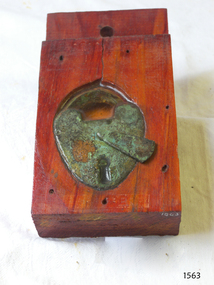 Flagstaff Hill Maritime Museum and Village
Functional object - Padlock, c. 1855
... Black Ball Line ships, MARCO POLO and LIGHTNING. On this, the SCHOMBERG’s maiden voyage, he was going to break records. SCHOMBERG departed Liverpool on 6 October 1855, flying the sign “Sixty Days to Melbourne”. She carried 430 passengers and 3000 tons of cargo, including iron rails and equipment intended to build the Melbourne to Geelong Railway and a bridge over the Yarra from Melbourne to Hawthorn. She also carried a cow for fresh milk, pens for fowls and pigs...Black Ball Line ships, MARCO POLO and LIGHTNING. On this, the SCHOMBERG’s maiden voyage, he was going to break records. SCHOMBERG departed Liverpool on 6 October 1855, flying the sign “Sixty Days to Melbourne”. She carried 430 passengers and 3000 tons of cargo, including iron rails and equipment intended to build the Melbourne to Geelong Railway and a bridge over the Yarra from Melbourne to Hawthorn. She also carried a cow for fresh milk, pens for fowls and pigs ...This padlock has been salvaged from the wrecked sailing ship SCHOMBERG. It is not known whether the padlock was a part of the ship’s equipment or if it was among personal effects or cargo. At some point in time the padlock has been mounted and sealed in resin, perhaps for both display and preservation purposes. ABOUT THE SCHOMBERG When SCHOMBERG was launched in 1855, she was considered the “Noblest ship that ever floated on water.” SCHOMBERG’s owners, the Black Ball Line, commissioned the ship for their fleet of passenger liners. She was built by Alexander Hall of Aberdeen. Overall, she had accommodation for 1000 passengers. SCHOMBERG’s 34-year-old master, Captain ‘Bully’ Forbes (James Nicol Forbes) was born in Aberdeen in 1821 and rose to fame with his record-breaking voyages on the famous Black Ball Line ships, MARCO POLO and LIGHTNING. On this, the SCHOMBERG’s maiden voyage, he was going to break records. SCHOMBERG departed Liverpool on 6 October 1855, flying the sign “Sixty Days to Melbourne”. She carried 430 passengers and 3000 tons of cargo, including iron rails and equipment intended to build the Melbourne to Geelong Railway and a bridge over the Yarra from Melbourne to Hawthorn. She also carried a cow for fresh milk, pens for fowls and pigs, 90,000 gallons of water for washing and drinking, 17,000 letters and 31,800 newspapers. The ship and cargo were insured for $300,000, a fortune for the time. The winds were poor as she sailed across the equator, slowing SCHOMBERG’s journey considerably. Land was first sighted on Christmas Day, at Cape Bridgewater near Portland, and Captain Forbes followed the coastline towards Melbourne. Forbes was said to be playing cards when called by the Third Mate Henry Keen, who reported land about 3 miles off, Due in large part to the captain's regarding a card game as more important than his ship, it eventually ran aground on a sand spit near Curdie's Inlet (about 56 km west of Cape Otway) on 26 December 1855, 78 days after leaving Liverpool. The sand spit and the currents were not marked on Forbes’s map. The crew from the scouting party advised Forbes to wait until morning before trying to take the passengers to safety in the lifeboats because the rough seas could easily overturn the small vessels. The ship’s Chief Officer spotted SS QUEEN at dawn and signalled the steamer. The master of the SS QUEEN approached the stranded vessel, and all of SCHOMBERG’s passengers and crew were able to disembark safely. The SCHOMBERG was lost and with her, Forbes’ reputation. The Black Ball Line’s Melbourne agent sent a steamer to retrieve the passengers’ baggage from the SCHOMBERG. Other steamers helped unload her cargo until the weather changed and prevented the salvage teams from accessing the ship. Later, one plunderer found a case of Wellington boots, but alas, all were for the left foot! Local merchants Manifold & Bostock bought the wreck and cargo, but did not attempt to salvage the cargo that was still on board the ship. They eventually sold it on to a Melbourne businessman and two seafarers. In 1864, after two of the men drowned when they tried to reach SCHOMBERG, salvage efforts were abandoned. Parts of the SCHOMBERG were washed ashore on the South Island of New Zealand in 1870, nearly 15 years after the wreck. The wreck now lies in almost 9 metres of water, and the shape of the ship can still be seen due to the remaining railway irons, girders and the ship’s frame. A variety of goods and materials can be seen scattered about nearby. Flagstaff Hill holds many items salvaged from the SCHOMBERG, including a ciborium (in which a diamond ring was concealed), communion set, ship fittings and equipment, personal effects, a lithograph, tickets, a menu and a photograph from the SCHOMBERG. This brass padlock is registered as an artefact in the SCHOMBERG collection. The SCHOMBERG collection as a whole is of historical and archaeological significance at a State level, listed on the Victorian Hertage Register VHR S612. Flagstaff Hill’s collection of artefacts from the SCHOMBERG is significant for its association with the Victorian Heritage Registered shipwreck. The collection is primarily significant because of the relationship between the objects, as together they have a high potential to interpret the story of the SCHOMBERG. The SCHOMBERG collection is archaeologically significant as the remains of an international passenger ship. The shipwreck collection is historically significant for representing aspects of Victoria’s shipping history and its potential to interpret sub-theme 1.5 of Victoria’s Framework of Historical Themes (living with natural processes). The collection is also historically significant for its association with the shipwreck and the ship, which was designed to be fastest and most luxurious of its day. The SCHOMBERG collection meets the following criteria for assessment: Criterion A: Importance to the course, or pattern, of Victoria’s cultural history. Criterion B: Possession of uncommon, rare or endangered aspects of Victoria’s cultural history. Criterion C: Potential to yield information that will contribute to an understanding of Victoria’s cultural Brass Padlock lying in a wooden block and encased in resin. The wood encasing the padlock has seven man-made holes in it, perhaps used to hand as a display. There was a paper label with an inscription on the top and bottom of the wood immediately surrounding the padlock. the brass has tarnished. Recovered from the wreck of the Schomberg in 1974.Marked on block - "Recovered 1974 'Schomberg'"flagstaff hill, warrnambool, shipwrecked-coast, flagstaff-hill, flagstaff-hill-maritime-museum, maritime-museum, shipwreck-coast, flagstaff-hill-maritime-village, padlock, schomberg shipwreck, brass padlock circa 1855, object salvaged from shipwreck, captain bully forbes, 19th century security hardware, sjouvenir, security, brass padlock -
 Greensborough Historical Society
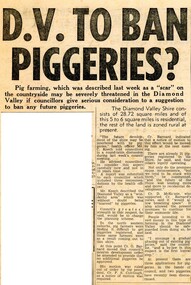
Article - Newspaper Clipping - Digital Image, D.V. to ban piggeries? 1966, 19/07/1966
... An article about changes of the area from rural to residential in the time of Shire of Diamond Valley. shire of diamond valley piggeries pig farms News clipping, black and white text. D.V. to ban piggeries? ...In 1966, approximately 25% of the Shire of Diamond Valley was zoned rural. There were up to 25 piggeries operating in the Shire. In this article, councillors are considering phasing out piggeries by proposing a change to by-laws.An article about changes of the area from rural to residential in the time of Shire of Diamond Valley.News clipping, black and white text.shire of diamond valley, piggeries, pig farms -
 Marysville & District Historical Society
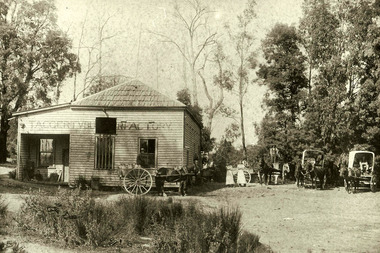
Photograph (Item) - Black and white photograph, 1904
... black and white photograph of the Taggerty Butter Factory in Victoria taken around 1904. The Taggerty Butter factory opened in 1892 in the township on the Little River. It was run by the Kennedy family and built by J.B. Coombs of Acheron Station. Coombs was later Shire President. Milk had been previously taken daily to the steam-driven separators at Thornton. Upper Thornton. The cream was separated and the remains were taken back to the farms for the pigs ...A black and white photograph of the Taggerty Butter Factory in Victoria.A black and white photograph of the Taggerty Butter Factory in Victoria taken around 1904. The Taggerty Butter factory opened in 1892 in the township on the Little River. It was run by the Kennedy family and built by J.B. Coombs of Acheron Station. Coombs was later Shire President. Milk had been previously taken daily to the steam-driven separators at Thornton. Upper Thornton. The cream was separated and the remains were taken back to the farms for the pigs and calves. Before these town separators existed butter had been made at home in a barrel, salted, and stored. The operation at Taggerty ceased in 1908 and the Alexandra Dairy Company took over production. The building no longer exists but materials from the original Taggerty Butter factory building now form part of the Williamson house off Swamp Creek Road.taggerty, victoria, taggerty butter factory, little river, kennedy family, j b coombs, acheron station, thornton, upper thornton, alexandra dairy company, williamson, swamp creek road -
 Marysville & District Historical Society
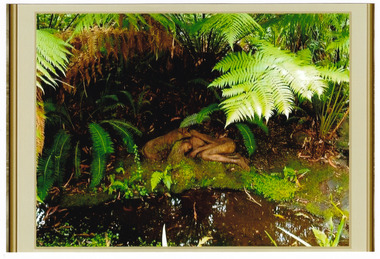
Photograph (Item) - Colour photograph, Unknown
... Bruno made the decision to re-sculpt the lost sculptures and re-built his gallery and re-open his garden to visitors to Marysville. bruno torfs gardens-design marysville victoria sculpture australia sculpture garden sculptors bruno's art and sculptures garden 2009 black saturday bushfires photograph A colour photograph of a sculpture in Bruno's Art & Sculptures Garden in Marysville in Victoria. Shows a woman lying with a pig ...A colour photograph of a sculpture in Bruno's Art & Sculptures Garden in Marysville in Victoria.A colour photograph of a sculpture in Bruno's Art & Sculptures Garden in Marysville in Victoria. Bruno's Sculptures Garden is one of Marysville's popular attractions. There is a sculpture garden as well as a gallery of artworks. Both the garden and gallery were destroyed during the 2009 Black Saturday bushfires. Some of the sculptures were totally destroyed though a few did survive the fires. Bruno made the decision to re-sculpt the lost sculptures and re-built his gallery and re-open his garden to visitors to Marysville.bruno torfs, gardens-design, marysville, victoria, sculpture, australia, sculpture garden, sculptors, bruno's art and sculptures garden, 2009 black saturday bushfires, photograph -
 Greensborough Historical Society
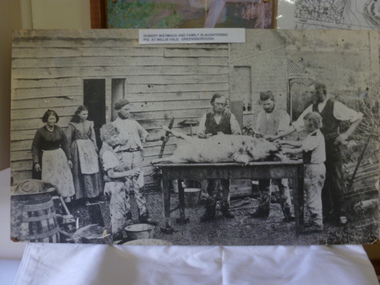
Photograph, Robert Whatmough and family slaughtering pig at Willis Vale Greensborough. 1870, 1870_
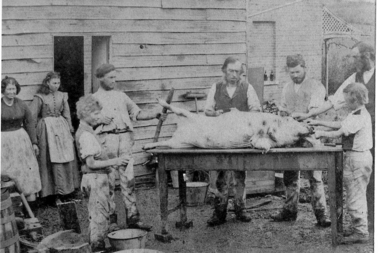
... Early evidence of farming and animal husbandry in the Greensborough area. robert whatmough whatmough willis vale greensborough wilson Typed caption pasted on front of photograph: 'Robert Watmaug [sic Whatmough] and family slaughtering pig at Willis Vale Greensborough.' Identification of those in photo by Faye Fort 2015. Black ...Robert Whatmough and family lived at Willis Vale from approx 1863 to 1878. Willis Vale was later owned by the Partington family. In this photograph the family is involved in butchering a pig. The people have been identified as: Mary (Hill) Whatmough b1813; and her daughter Rosalie b1856; Grandpa John Wilson; Joseph Wilson b1835; Emmett Whatmough b1842; John Thomas Fielding b1860; James Fielding b1861; Robert Whatmough b1815; [Sarah Whatmough b1845 m1866 Joe Wilson b1835 8 children]. Photo and article also appeared in The Diamond Valley News 9/10/1984 page 26.Early evidence of farming and animal husbandry in the Greensborough area.Black and white photograph, enlarged and mounted on timber backing.Typed caption pasted on front of photograph: 'Robert Watmaug [sic Whatmough] and family slaughtering pig at Willis Vale Greensborough.' Identification of those in photo by Faye Fort 2015.robert whatmough, whatmough, willis vale, greensborough, wilson -
 Greensborough Historical Society
Photograph - Digital Image, Willis Vale - Whatmoughs butcher a pig, 1870c
... pig. The people have been identified as: Mary (Hill) Whatmough b1813; and her daughter Rosalie b1856; Grandpa John Wilson; Joseph Wilson b1835; Emmett Whatmough b1842; John Thomas Fielding b1860; James Fielding b1861; Robert Whatmough b1815; [Sarah Whatmough b1845 m1866 Joe Wilson b1835 8 children]. A pioneer Greensborough family. willis vale robert whatmough Digital copy of black ...Robert Whatmough and family lived at Willis Vale from approx 1863 to 1878. Willis Vale was later owned by the Partington family. In this photograph the family is involved in butchering a pig. The people have been identified as: Mary (Hill) Whatmough b1813; and her daughter Rosalie b1856; Grandpa John Wilson; Joseph Wilson b1835; Emmett Whatmough b1842; John Thomas Fielding b1860; James Fielding b1861; Robert Whatmough b1815; [Sarah Whatmough b1845 m1866 Joe Wilson b1835 8 children].A pioneer Greensborough family.Digital copy of black and white photograph.willis vale, robert whatmough -
 Orbost & District Historical Society
black and white photograph, C1900
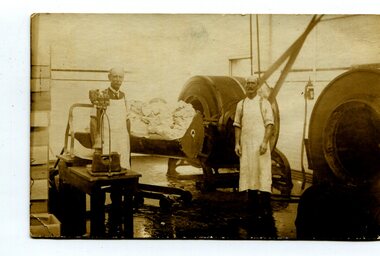
... pigs,which were abundant on the farms in the Orbost district. First directors – James Nixon (chairman), James Cameron, Carl H. Grove, Harry Richardson, David Rhys Morris, Lachlan Ross. The factory opened 11th January, 1893 with John Scouller as the manager. The Orbost Butter and Produce Co. Ltd was registered on June 1st 1893 and was an important source of income to the Orbost district. orbost-butter-factory scouller-john dairying on back - " Orbost. m. Gilbert. J. Scouller, Fred?????. Donated by Colin Perry" A black ...This photograph shows Mr John Scouller, the manager, on the left with His assistant, Fred ?. Mr Scouller was the manager of the Orbost Butter Factory for 30 years and was succeeded by Mr Stafford after his retirement. The Orbost Butter and Produce Co. Ltd was registered on June 1st, 1892.The first shipment to England went rank and was only good for axle grease on wagons and carts.The milk was brought to the factory by horse and dray.Most people would take the whey home for their pigs,which were abundant on the farms in the Orbost district. First directors – James Nixon (chairman), James Cameron, Carl H. Grove, Harry Richardson, David Rhys Morris, Lachlan Ross. The factory opened 11th January, 1893 with John Scouller as the manager. The Orbost Butter and Produce Co. Ltd was registered on June 1st 1893 and was an important source of income to the Orbost district.A black / white photograph of two men standing near machinery inside the Orbost Butter Factory.on back - " Orbost. m. Gilbert. J. Scouller, Fred?????. Donated by Colin Perry"orbost-butter-factory scouller-john dairying -
 Orbost & District Historical Society
black and white photograph, first half 20th century
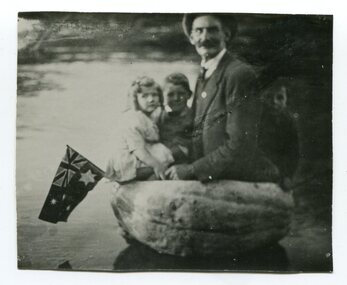
... pigs. There was usually a competition for the heaviest or biggest pumpkin at the annual Orbost agricultural Show. This photograph is associated with the history of pumpkin growing in the Orbost district. Mundy-Fred pumpkins-Orbost on back - "Alec Cameron, Mr Fred Mundy" ; "Record pumpkin - Mr Fred Mundy 194lbs" A small black ...The pumpkin in this photograph was an award winner and was grown by Fred Mundy Snr. It weighed 194 lbs (approx. 88 kgs). Pumpkins were grown widely on Orbost farms and used to feed pigs. There was usually a competition for the heaviest or biggest pumpkin at the annual Orbost agricultural Show.This photograph is associated with the history of pumpkin growing in the Orbost district.A small black / white photograph of man with three children sitting in a hollowed out pumpkin in water. An Australian flag is on the left side of the pumpkin.on back - "Alec Cameron, Mr Fred Mundy" ; "Record pumpkin - Mr Fred Mundy 194lbs"mundy-fred pumpkins-orbost -
 Orbost & District Historical Society
black and white photograph, C1943
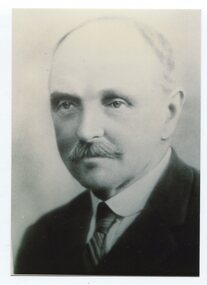
... pigs on the farm at Bete Bolong, that supplied the butchery on the farm and also the Dandy Bacon Factory. This item is associated with the Orbost Shire Council. The shire covered an area of 9,347 square kilometres and existed from 1892 until 1994 when it became part of the East Gippsland Shire Council. It is associated with William Cumming who was a prominent Orbost identity. cumming-william orbost-shire-council On back - "Cr W. Cumming, South Riding" A black ...This is a photograph of Councillor William Cumming who represented South Riding 1895-1911 and 1921 - 1943. William Cumming was a prominent Orbost identity. He was born in Ballymena, Northern Ireland, in 1866 the son of William Cumming and Mary Ann Montgomery. He came to Australia, at the age of 20, in 1890 and to Orbost in c.1890. He farmed at Bete Bolong and during WW1 ran a butcher's shop on his farm. He was a shire councillor of the Orbost Shire Council and served as a South Riding representative for 38 years. He was a keen Newmerella football supporter, a member of the Orbost Bowling Club as well as a director of the Orbost Butter Factory. Cumming was married to Ellen Louise Mundy (b1880, d1945) and they had three children ( Harold, William and Gordon). Information from Lori Fellows (Grand-daughter) April 2020: William Cumming. My paternal grandfather born in Ballymena Northern Ireland. Came to Australia aged 18. Married Ellen Mundy on 25/08/1902. This photo taken during his time as Orbost Shire Council President. Father of Harold, William and Gordon. Died in Orbost 24.11.1950. William Cumming (1866-1950) arrived in Australia in 1884 on the "Orient". His brothers David (1868-1932), John (1870-1920) & Samuel (1871-1953) arrived in 1887 on the "Orizaba". On the passenger list Samuel is listed as David. Also my grandfather was Chairman of Directors of the Dandenong Bacon Factory [later Australian Bacon Co]....he raised pigs on the farm at Bete Bolong, that supplied the butchery on the farm and also the Dandy Bacon Factory. This item is associated with the Orbost Shire Council. The shire covered an area of 9,347 square kilometres and existed from 1892 until 1994 when it became part of the East Gippsland Shire Council. It is associated with William Cumming who was a prominent Orbost identity.A black / white head and shoulders portrait of a moustached man in a suit.On back - "Cr W. Cumming, South Riding"cumming-william orbost-shire-council -
 Orbost & District Historical Society
Photograph - Photograph off Albert Trewin
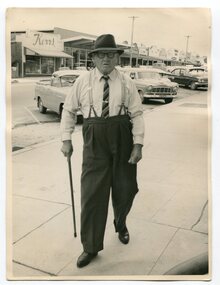
... Pigs went to Dandenong Bacon Factory where they were processed into Dandy Ham. This photograph appears to be c.1950s - 1960s. A photograph of one of Jarrahmond's earliest settlers. Jarrahmond Farming B/W photograph of a man walking along a footpath. He is wearing a hat and has a walking stick in his right hand. He is wearing braces, white long-sleeved shirt, striped tie, glasses, polished black ...Albert (Abby) Trewin (b.21.03.1876 d. 01.07.1970) was part of the Trewin family who were early settlers at Jarrahmond near Orbost. Albert was born at Kingston near Ballarat, shifted to Jarrahmond where the house was called "Hillview", located 3 miles from Orbost on the B Road. The Trewin selection at Jarrahmond had many big trees on it and because these looked a bit like Jarrah trees from Western Australia, they names their property Jarrahmond (which became the district location and the name of Jarrahmond School). He cleared the land with bullocks, horses, crosscut saws, burned the stumps, burying some logs which were too big to burn. Then they milked cows, planted maize, had pigs, drove the pigs to Bairnsdale or to Waygara (c. 1915 when the train reached Waygara) on a buggy track through the bush. Pigs went to Dandenong Bacon Factory where they were processed into Dandy Ham. This photograph appears to be c.1950s - 1960s.A photograph of one of Jarrahmond's earliest settlers.B/W photograph of a man walking along a footpath. He is wearing a hat and has a walking stick in his right hand. He is wearing braces, white long-sleeved shirt, striped tie, glasses, polished black shoes. Behind him are vehicles and buildings (shops). jarrahmond, farming -
 Orbost & District Historical Society
black and white photograph, Warren, Mrs H, firts half 20th century
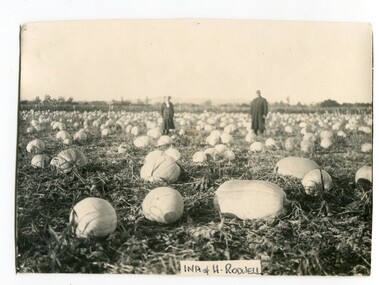
... pigs. There was usually a competition for the heaviest or biggest pumpkin at the annual Orbost agricultural Show. This photograph is associated with the history of pumpkin growing in the Orbost district. rodwell-harold rodwell-ina pumpkins-orbost agriculture-orbost farming-orbost on front - INA & H, Rodwell A black / white photograph of a man and a woman people standing in a large paddock of pumpkins. black and white photograph Warren, Mrs H. ...This photograph shows Harold Rodwell and his daughter, Ina, in a paddock full of pumpkins. Pumpkins were grown widely on Orbost farms and used to feed pigs. There was usually a competition for the heaviest or biggest pumpkin at the annual Orbost agricultural Show.This photograph is associated with the history of pumpkin growing in the Orbost district.A black / white photograph of a man and a woman people standing in a large paddock of pumpkins.on front - INA & H, Rodwellrodwell-harold rodwell-ina pumpkins-orbost agriculture-orbost farming-orbost -
 Orbost & District Historical Society
black and white photograph, Warren. Mrs H, first half 20th century
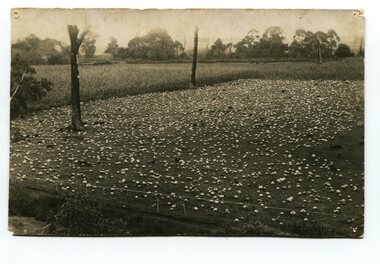
... It is also associated with Helena Warren. a well-known photographer born in Orbost. agriculture farming-Orbost pumpkins maize pigs Warren-Helena a black / white photograph black and white photograph Warren. ...Many farmers on the flats at Orbost used to grow a lot of maize and harvest the maize by putting the pigs in to eat the maize.. Maize and pumpkins fed in conjunction were largely used for fattening pigs. The photographer was Warren, Helena (1871-1962) who was a self-taught photographer who became both the local press correspondent and a producer of humorous trompe l'oeil postcard images. Helena Warren was a thirty-two year old settler living on a small mixed farm with her husband, William, at Newmerella, near Orbost in Gippsland, Victoria, when she bought her first camera, an Austral Box quarter-plate. Her family says she was entirely self-taught, like many women photographers who started out with nothing but the instructions on the packets of film and chemicals. In over fifty years practice she graduated from the total novice, who opened all her first mail order plates in bright sunlight and ruined them, to a competent photographer who became both the local press correspondent and an inveterate producer of humorous trompe l’oeil postcard images.This item is a pictorial record of farming in Orbost in the early 20th century. It is also associated with Helena Warren. a well-known photographer born in Orbost.a black / white photographagriculture farming-orbost pumpkins maize pigs warren-helena -
 Orbost & District Historical Society
black and white photograph, C1890's
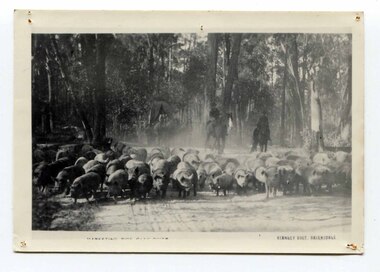
... A black / white photograph of men on horseback droving pigs from the Cann River district to market along a dirt road....This is a pictorial record of early farming in East Gippsland. pigs agriculture farming-Orbost-Cann River A black / white photograph of men on horseback droving pigs from the Cann River district to market along a dirt road. black and white photograph Vogt, Stanley Vogt, Stanley ...Farmers on the Orbost flats and nearby districts used to grow a lot of maize and harvest the maize by putting the pigs in to eat the maize. They had to get the pigs to Bairnsdale with other chaps, droving about 600 pigs. It would take them 12 days. A wagonette would go in front and dribble out the maize. When they reached Swan Reach, the drovers would often go over to the old grog shanty and got drunk while one man would stay to keep the 600 pigs together. It was a difficult job. The pigs were ferried across the rivers. This is a pictorial record of early farming in East Gippsland.A black / white photograph of men on horseback droving pigs from the Cann River district to market along a dirt road.pigs agriculture farming-orbost-cann river -
 Orbost & District Historical Society
black and white photograph, C1900
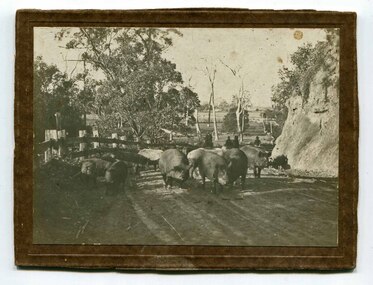
... A black / white photograph on a brown buff card showing pigs being taken to market. ...This photograph is a pictorial record of farming practices in the early 20th century. agriculture farming-Orbost pigs on back - "Pigs being driven from Orbost to Bairnsdale. M.Gilbert, Orbost" A black / white photograph on a brown buff card showing pigs being taken to market. ...Pigs were taken to Bairnsdale by coaxing them with maize thrown from a wagonette . From Bairnsdale they were freighted to market by train. The journey to Bairnsdale took about five days . This method of transport continued until the rail line to Orbost was opened in 1916.This photograph is a pictorial record of farming practices in the early 20th century.A black / white photograph on a brown buff card showing pigs being taken to market. The photograph shows the pigs close up with men on horseback behind them. The pigs are on a gravel road with a fence on one side and and the Orbost flats can be seen in the background.on back - "Pigs being driven from Orbost to Bairnsdale. M.Gilbert, Orbost"agriculture farming-orbost pigs -
 City of Moorabbin Historical Society (Operating the Box Cottage Museum)
Photographs, 7 x B&W Circa 1918 Cheltenham Methodist Youth Group, Circa 1918 Photos of Cheltenham Methodist Youth Group, 1918
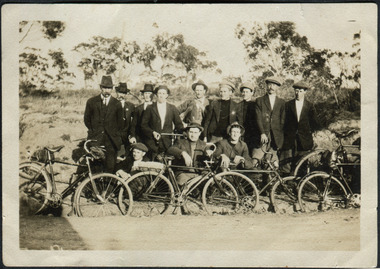
... The Methodist Church, Balcombe Road was the 2nd religious building to be erected in Spring Grove now known as Cheltenham c 1857 cheltenham cheltenham methodist youth group 1914 1918 charman stephen, gettens mary, spring grove, methodist church, charman road, balcombe road, dendy henry, henry dendy's special survey 1841, youth groups, social groups, market gardners, early settlers, pioneers, dairy farmers, poultry farmers, pig farmers,moorabbin, brighton, Photo 1 - 3 on back : Flinders 1918 Photo 4 left on back : Holiday at Cockatoo right on back : Whitehead Photo 5-7 nil 7 small black and white photographs of the Cheltenham Methodist Youth Group at Flinders, Cockatoo and unkown locations, c 1918 . ...Circa 1918: Various Photos of the Cheltenham Methodist Youth Group. Row 1 and 2: "At Flinders". Row 3: 1st Left, "Holidaying at Cockatoo". in 1852 Stephen Charman, who had arrived in Melbourne 1842 aged 21 years as one of Henry Dendy's emigrants, purchased 160 acres in Spring Grove ( now Cheltenham). Stephen and his family lived in a wattle and daub hut and worked hard to establish a market garden, poultry and pig farm. The first Methodist Church Services were held at their home. In 1855 Stephen gave 1 acre of his land on Balcombe Road to the Methodist Church for a School, Burial ground and a Chapel which was built in 1857.The Methodist Church, Balcombe Road was the 2nd religious building to be erected in Spring Grove now known as Cheltenham c 18577 small black and white photographs of the Cheltenham Methodist Youth Group at Flinders, Cockatoo and unkown locations, c 1918 . First 3 photos are of male cyclists on a trip to Flinders, Victoria. Photo 4 shows 6 ladies and a man on holiday at Cockatoo in the Dandenong Ranges ,Victoria . Photos 5 to 7 show men, women and children in bushland surroundings of unrecorded locations.Photo 1 - 3 on back : Flinders 1918 Photo 4 left on back : Holiday at Cockatoo right on back : Whitehead Photo 5-7 nilcheltenham, cheltenham methodist youth group, 1914, 1918, charman stephen, gettens mary, spring grove, methodist church, charman road, balcombe road, dendy henry, henry dendy's special survey 1841, youth groups, social groups, market gardners, early settlers, pioneers, dairy farmers, poultry farmers, pig farmers,moorabbin, brighton, -
 Phillip Island and District Historical Society Inc.
Photographs, Early 20th Century
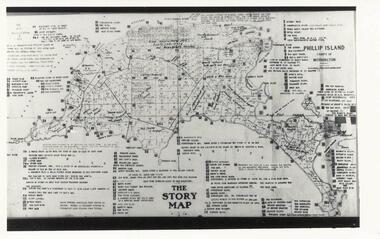
... pig-face" weed. 234-03. "Tom Tregellas" Nature Series No. 1. (Penguins) Phillip Island. Moulting Burrow on top of Cliff, Headland Rookery, which contained four birds. Note feathers outside burrow. 234-01. Black ...Three photographs/postcards donated by J Gliddon234-01. Black & White photograph of The Story Map of Phillip Island with allotments shown and extremely detailed information typed on it by Vernon McHaffie. 234-02. Sepia postcard of the penguin rookery on "Little Nobby", Phillip Island. Man sitting on hill looking down at the rookery showing tracks & entrances to burrows. 234-03. Sepia postcard of two people sitting on top of cliff, Headland Rookery, with moulting penguins on their laps. 234-02. "Tom Tregellas" Nature Series No. 1. (Penguins) Phillip Island. Rookery on Little Nobby, showing tracks and entrances to burrows amongst the "pig-face" weed. 234-03. "Tom Tregellas" Nature Series No. 1. (Penguins) Phillip Island. Moulting Burrow on top of Cliff, Headland Rookery, which contained four birds. Note feathers outside burrow.phillip island map, phillip island allotments, vernon mchaffie, wildlife - penguins, penguins phillip island, penguin rookeries phillip island, j gliddon -
 Phillip Island and District Historical Society Inc.
Photograph
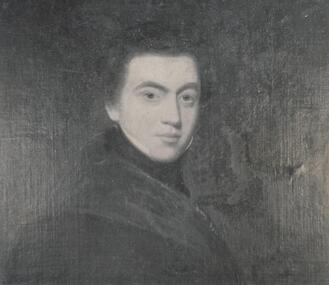
... black & white photograph...charles manton...pig...One of a collection of over 400 photographs in an album commenced in 1960 and presented to the Phillip Island & Westernport Historical Society by the Shire of Phillip Island local history photography photographs portrait of charles manton black & white photograph charles manton pig grazing early settlers John Jenner Bryant West Photograph of a portrait of Charles Manton. ...One of a collection of over 400 photographs in an album commenced in 1960 and presented to the Phillip Island & Westernport Historical Society by the Shire of Phillip IslandPhotograph of a portrait of Charles Manton. He grazed pigs on Phillip Island in 1841.local history, photography, photographs, portrait of charles manton, black & white photograph, charles manton, pig grazing, early settlers, john jenner, bryant west -
 Cheese World Museum
Photograph, Nirranda Creamery
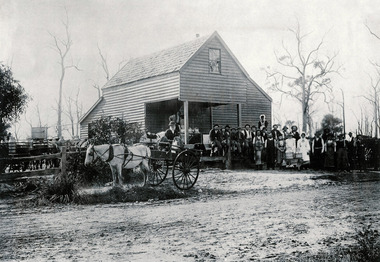
... pigs. At this time bacon was considered to be a dairy product. There were over 200 butter factories and creameries in Victoria in 1905. This is the only known photograph of the Nirranda Creamery. allansford nirranda creameries transport costumes warrnambool cheese and butter factory company Black & white photograph showing a two storey weatherboard building with horse and cart loaded with milk cans and a group of men and women standing in front. ...Warrnambool Cheese and Butter Factory at Allansford commenced in 1888. By the early 1900s it had 3 subsidiary creameries where farmers delivered their milk. Often the farmers collected the skim milk to feed pigs. At this time bacon was considered to be a dairy product. There were over 200 butter factories and creameries in Victoria in 1905.This is the only known photograph of the Nirranda Creamery.Black & white photograph showing a two storey weatherboard building with horse and cart loaded with milk cans and a group of men and women standing in front.allansford, nirranda, creameries, transport, costumes, warrnambool cheese and butter factory company -
 Cheese World Museum
Licence, Pig Breeders Licence, 1903
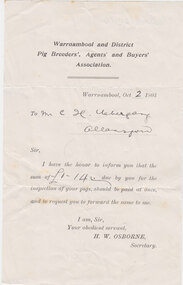
... A5 size paper with black printed details of the Warrnambool and District Pig Breeders', Agents' and Buyers' Association with the date of the licence, name of licensee and fee due....pigs, should be paid at once, and to request you to forward the same to me./I am, Sir,/Your obedient servant,/H.W. OSBORNE,/Secretary [on reverse in pencil] M Millard £20.16.0 A5 size paper with black printed details of the Warrnambool and District Pig Breeders', Agents' and Buyers' Association with the date of the licence, name of licensee and fee due. ...The Uebergang family came from Silesia to Australia in 1848 and were early settlers in the Allansford area. The sons and other descendants also purchased farms in the area. The Percy Uebergang family lived at Tooram Park, Allansford from 1912 until 1992. Percy and Myrtle Uebergang's children were twins, Ray and Joyce born in 1926 who lived at Tooram Park until their deaths, Ray in 1986 and Joyce in 1992 after which the property was sold. Neither Ray nor Joyce married and following the death of her brother Joyce set up the Ray and Joyce Uebergang Foundation which supports the local community. The collection of items from their property was put into store for a number of years before being given into the care of the Cheese World Museum. The family often re-used, recycled and repaired items and examples can be seen in the museum. This item is part of the collection of items given into the care of the Cheese World Museum. The Warrnambool and District Pig Breeders', Agents and Buyers' Association was responsible for inspecting pigs. During the early 20th century the pig industry was included as part of the dairy industry. After milk was separated the cream went to the factory and the skim milk went back to the farm to feed the pigs. Early newspaper reports include information relating to the price of bacon in the list of dairy goods. Warrnambool Cheese and Butter Factory commenced a bacon factory in the early 1900s but it was a short-lived operation. This licence is significant as it assists in understanding the relationship between the dairy industry and the pig industry.A5 size paper with black printed details of the Warrnambool and District Pig Breeders', Agents' and Buyers' Association with the date of the licence, name of licensee and fee due.Warrnambool and District/Pig Breeders', Agents' and Buyers'/Association/Warrnambool, Oct 2 1903/To Mr C H Uebergang/Allansford/Sir,/I have the honor to inform you that the sum of £1-14 due by you for the inspection of your pigs, should be paid at once, and to request you to forward the same to me./I am, Sir,/Your obedient servant,/H.W. OSBORNE,/Secretary [on reverse in pencil] M Millard £20.16.0allansford, uebergang, pigs, pig breeders, dairy industry, agriculture, warrnambool and district pig breeders -
 Orbost & District Historical Society
black and white photograph / postcard, first half 20th century
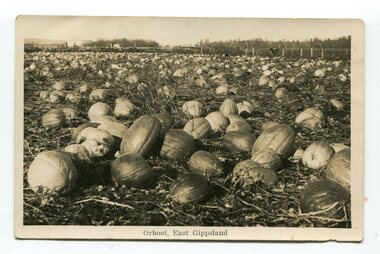
... Pumpkins were grown widely on Orbost farms and used to feed pigs This photograph is associated with pumpkin growing in Orbost. Orbost-agriculture pumpkins-Orbost on front- at bottom - "Orbost, East Gippsland" A black / white photograph / postcard of a paddock of pumpkins. black and white photograph / postcard ...Pumpkins were grown widely on Orbost farms and used to feed pigsThis photograph is associated with pumpkin growing in Orbost.A black / white photograph / postcard of a paddock of pumpkins.on front- at bottom - "Orbost, East Gippsland"orbost-agriculture pumpkins-orbost -
 Orbost & District Historical Society
bottles, late 19th - 1930s ?
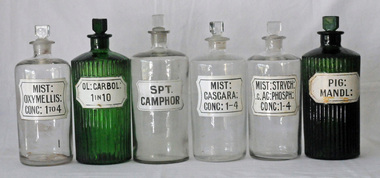
... AC : PHOSPH CONC : 1 - 4" 3210.6 - "PIG : MANDL : ": Six large glass bottles - four clear and two green. All have narrow necks with glass stoppers and are clearly labelled with black print on a white background. ...These bottles were used at the pharmacies in Orbost. Chemists who worked in Orbost included Henry Cottman; James Alfred Dubois Williams; Harry Arthur Murray; Miss P.E .Mason (Phyllis Estelle?); Miss Sybil Monica Buzza; Thomas James Frayer; Australia Shaw; James David Torley; John William Zimmer; Dalkeith William Steele; William Thomas Hollingsworth; E.E. Cohen; R.S. Anderson; Frances John Perry Faith Everard Pardew and Charles Anthony Wurf.Medicinal bottles are probably the largest and most diverse group of bottles. The practices of early pharmacists are revealed through these glass bottles. The items have a clear association with Orbost.Six large glass bottles - four clear and two green. All have narrow necks with glass stoppers and are clearly labelled with black print on a white background. Each of the the two coloured glass bottles have a fluted surface. These apothecary bottles were used to dispense medications and also for show or display purposes. The labels under glass bottles had a recessed section that the label was placed into. The label was then covered with a thin piece of glass to prevent the label from becoming damaged by the bottles contents. 3210.1 - "MIST ; OXYMELLIS : CONC : 1 TO 4" 3210.2 - " OL : CARBOL : 1 IN 10" 3210.3 - "SPT. CAMPHOR" 3210.4 - "MIST : CASCARA: CONC: 1 - 4" 3210.5 - "MIST : STRYCH: c. AC : PHOSPH CONC : 1 - 4" 3210.6 - "PIG : MANDL : ": bottles-pharmaceutical chemists-orbost medicine -
 Bendigo Military Museum
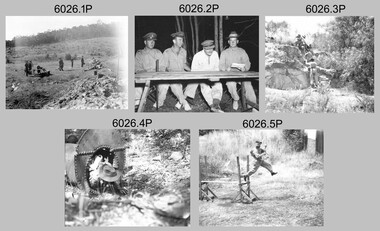
Photograph - Army Survey Regiment – Regimental Training, c1960s
... Royal Australian Survey Corps RASvy Army Survey Regiment Army Svy Regt Fortuna ASR .1) to .7) annotated on back “Regimental Training” .8) annotated on back “Fatted Pig-Coal Lift-Western Mines” This is a set of photographs of Army Survey Regiment personnel undertaking regimental training in the 1960s. All eight photographs were printed on photographic paper and are part of the Army Survey Regiment’s Collection. The photographs were scanned at 300 dpi. .1) to .7) Photo, black ...These photographs of RASvy personnel from the Army Survey Regiment undertaking regimental training lack any annotation that could identify names, dates and locations. The training was possibly conducted at Balcombe and Dromana, located on the Mornington Peninsula, Victoria. There is no explanation on the meaning of the annotation on back of the last photograph.This is a set of photographs of Army Survey Regiment personnel undertaking regimental training in the 1960s. All eight photographs were printed on photographic paper and are part of the Army Survey Regiment’s Collection. The photographs were scanned at 300 dpi. .1) to .7) Photo, black & white, Regimental Training .8) Photo, black & white, possibly Regimental Training.1) to .7) annotated on back “Regimental Training” .8) annotated on back “Fatted Pig-Coal Lift-Western Mines”royal australian survey corps, rasvy, army survey regiment, army svy regt, fortuna, asr
