
Showing 4 items matching "blessing of the centre"
-
 Slovenian Association Melbourne
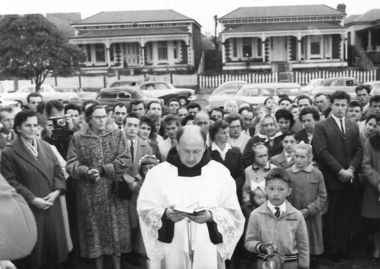
Blessing of Slovenski Dom, Blessing of Slovenian Home in Carlton by Fr Basil in 1960, 1960
... ...blessing of the Centre...Black and white photo of the Blessing at the opening of the Slovenian Centre - Slovenski Dom in Carlton by Fr Basil in 1960. ...Being the first Slovenian Home in Australia Slovenski Dom Slovenian Centre in Carlton Slovenian club Melbourne blessing of the Centre Blessing of the Slovenian Dom Black and white photo of the Blessing at the opening of the Slovenian Centre - Slovenski Dom in Carlton by Fr Basil in 1960. ...The Slovenian Home in Carlton was purchased partially by donations and personal members loans. The Dom had comfortable rooms for meetings, drama group practices, welcoming ceremonies, some sporting activities, singing and poetry recitals.Being the first Slovenian Home in AustraliaBlack and white photo of the Blessing at the opening of the Slovenian Centre - Slovenski Dom in Carlton by Fr Basil in 1960. Slovenians were very proud to have achieved the goal and purchased a building, the very first Slovenian centre in Australia.Blessing of the Slovenian Domslovenski dom, slovenian centre in carlton, slovenian club melbourne, blessing of the centre -
 Flagstaff Hill Maritime Museum and Village
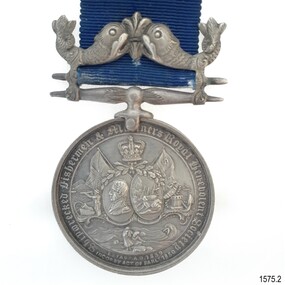
Award - Medal, Stokes, c 1882
... centre, with the letters S F M S displayed, one in each quadrant. Nominations are made by members each year of those who have performed outstanding acts of bravery in helping those in peril in the sea. The inscription on the reverse "PRESENTED FOR HEROIC EXERTIONS IN SAVING LIFE FROM DROWNING / JOB XXIX 13" refers to a verse in the Bible, which in the King James version reads "The blessing of him that was ready to perish came upon me; and I caused the widow's eart to sing for joy."...centre, with the letters S F M S displayed, one in each quadrant. Nominations are made by members each year of those who have performed outstanding acts of bravery in helping those in peril in the sea. The inscription on the reverse "PRESENTED FOR HEROIC EXERTIONS IN SAVING LIFE FROM DROWNING / JOB XXIX 13" refers to a verse in the Bible, which in the King James version reads "The blessing of him that was ready to perish came upon me; and I caused the widow's eart to sing for joy." ...This medal was presented by the Shipwrecked Fishermen and Mariners' Royal Benevolent Society and was posthumously awarded to Captain John Coffey’s family for his efforts at saving life at sea, in 1882. Captain Coffey lost his life in this attempt. The shipwreck occurred between Australia and England. The included letter was written by the donor, who is the grandson of John Coffey. It is interesting that the medal and note were packaged in a small tin whose original purpose was to present a wedding cake gift to guests. The container is decorated with wedding bells pressed into the lid. Shipwrecked Fishermen and Mariners’ Royal Benevolent Society: - The Shipwrecked Mariners (Shipwrecked Fishermen and Mariners’ Royal Benevolent Society) is a national charity established in 1839. It is run by a network of volunteers in the UK and Ireland. The organisation assists former mariners, their dependants and their families. John Rye and his servant Charles-Gee Jones, of Bath, UK, encouraged its formation after a severe storm caused the loss of life from the ‘Clovelly’ fishing fleet in November 1838. The Society was incorporated by an Act of Parliament in 1850. The Society’s flag is the St George’s Cross, a red cross on a white background and a gold crown in the centre, with the letters S F M S displayed, one in each quadrant. Nominations are made by members each year of those who have performed outstanding acts of bravery in helping those in peril in the sea. The inscription on the reverse "PRESENTED FOR HEROIC EXERTIONS IN SAVING LIFE FROM DROWNING / JOB XXIX 13" refers to a verse in the Bible, which in the King James version reads "The blessing of him that was ready to perish came upon me; and I caused the widow's eart to sing for joy."This is the only medal in our collection awarded from the Shipwrecked Fishermen and Mariners' Royal Benevolent Society. Medal, silver with blue ribbon. The obverse of the medal has images of the British flag, a crown flag with "S.F.", a portrait of a man, a shipwreck, a cannon and anchor, a man with a telescope, and two people attending a body on the shore. The reverse of the medal has text. The medal clasp depicts a fleur de lies between two fish. The medal maker is Stokes. The metal was donated in a tin container and included a letter. The medal was presented posthumously to the family of Captain John Coffey for his efforts at saving life at sea, in 1882. It has an accompanying letter and container.On rim "CAPTAIN JOHN COFFEY - 1882" Obverse "SHIPWRECKED FISHERMEN AND MARINERS ROYAL BENEVOLENT SOCIETY" and "ESTAB AD 1839 INCOd BY ACT OF PARLt 1850" Reverse "PRESENTED FOR HEROIC EXERTIONS IN SAVING LIFE FROM DROWNING / JOB XXIX 13" and "ENGLAND EXPECTS EVERY MAN WILL DO HIS DUTY" The tin box has "MEDAL" handwritten in black.flagstaff hill, flagstaff hill maritime museum and village, warrnambool, maritime museum, maritime village, great ocean road, shipwreck coast, medal, captain john coffey, john coffey, numismatics, hero, saving lives, shipwrecked fishermen and mariners’ royal benevolent society, sfms, shipwrecked mariners' society -
 Emerald Museum & Nobelius Heritage Park
Postcard - Postcard with photo of infant Jack Nobelius, 1914- 1915
... This postcard not only captures the early life of Jack Nobelius, but also provides insight into timelines on his life, the brief natures of postcards, their use as new years blessings, and the unique nature of Florence Nobelius' handwriting, featuring informal, somewhat rushed cursive script, with some errors in the writing. Nobelius early emerald nobelius 1910s Reverse, Centre ...As stated in the postcard, Jack Nobelius, the infant in the photograph, is only 12 months old, dating the image to late 1914- early 1915, as Jack Nobelius was born on the 21st of December, 1913. Therefore, this postcard would have been written during the First World War, following Australian commitment to fight Germany as a dominion of Britain. Jack Nobelius was the son of Carl Oscar Nobelius and Florence Cathleen Nobelius (Prescott). He also had an older brother, Roland Nobelius.This postcard not only captures the early life of Jack Nobelius, but also provides insight into timelines on his life, the brief natures of postcards, their use as new years blessings, and the unique nature of Florence Nobelius' handwriting, featuring informal, somewhat rushed cursive script, with some errors in the writing. A black and white photograph of an infant wearing a white dress, sittin in a wooden char out the front of a house.The back of the post card reads a message, presumably from the child's parents, to a friend, wishing them a happy new year. Reverse, Centre: "POST CARD / To our --.wishing you a bright new year. With love from us all. / Yours lovingly / Florrie" Reverse, Lower Left: "Jack Nobelius / age 12 months -"nobelius, early emerald nobelius, 1910s -
 Great Stupa of Universal Compassion
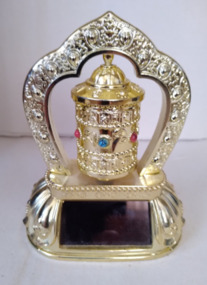
Ceremonial object - Solar-powered prayer wheel
... blessings to all. Often placed by Buddhist practitioners on a windowsill or car dashboard. tibetan buddhism holy objects worship devices This modern adaptation of the traditional Tibetan Buddhist prayer wheel has a mantra-filled drum which rotates automatically using solar power when exposed to light. The ornate gold-coloured frame and prayer wheel in the centre ...As Buddhism spread to Tibet in the 7th century, prayer wheels became an essential attribute of Tibetan Buddhist practice. This practice is linked to teachings attributed to Nagarjuna (ca. 150 –250 CE), who emphasised the power of mantra recitation and visualisation. A prayer wheel, used for personal worship, allowed to release the spiritual power contained within the mantras, enabling practitioners, including those who could not read, to generate spiritual merit.Prayer wheels have been used in Tibetan Buddhism for personal worship since the 7th century. Turning the wheel with a pure, compassionate intention is believed to release the mantras into the universe, resulting in purification of negative karma of the practitioner, accumulation of merit, and spreading compassion to all living beings. This solar-powered prayer wheel is based on the traditional Tibetan prayer wheel design. However, it uses solar power to rotate the wheel containing mantras, disseminating the blessings to all. Often placed by Buddhist practitioners on a windowsill or car dashboard.This modern adaptation of the traditional Tibetan Buddhist prayer wheel has a mantra-filled drum which rotates automatically using solar power when exposed to light. The ornate gold-coloured frame and prayer wheel in the centre (embellished with small faux gemstones) reflect the aesthetic traditions associated with Tibetan Buddhist sacred objects. The solar panel is concealed in the base. tibetan buddhism, holy objects, worship devices
