
Showing 11 items matching "blood vessels"
-
 University of Melbourne, Burnley Campus Archives
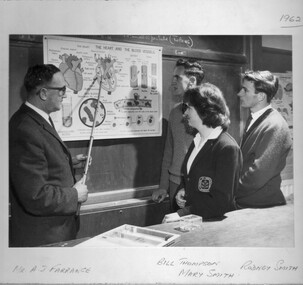
Photograph - Black and white print, Biology Class, 1962
... ...blood vessels...Students being instructed about, "The Heart and the Blood Vessels," by A. J. Farrance....students heart blood vessels a.j. farrance biological sciences bill thompson mary smith rodney smith students in class Inscribed, "1962, Mr. ...Black and white photograph. Students being instructed about, "The Heart and the Blood Vessels," by A. J. Farrance.Inscribed, "1962, Mr. A.J. Farrance (Biological Sciences), Bill Thompson, Mary Smith, Rodney Smith."students, heart, blood vessels, a.j. farrance, biological sciences, bill thompson, mary smith, rodney smith, students in class -
 Vision Australia
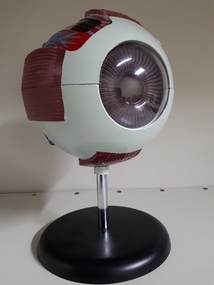
Education kit - Object, 3D model of eye
... The eyeball divides in half to study the interior and shows attachments for all six muscles that move the eyeball, the optic nerve, and surrounding blood vessels. Through the cornea the iris and pupil are visible. ...The eyeball divides in half to study the interior and shows attachments for all six muscles that move the eyeball, the optic nerve, and surrounding blood vessels. Through the cornea the iris and pupil are visible. ...This 3D model of the eye on shows the way they eye connects to the brain. The eyeball divides in half to study the interior and shows attachments for all six muscles that move the eyeball, the optic nerve, and surrounding blood vessels. Through the cornea the iris and pupil are visible. The iris, cornea and lens can be removed.1 pedestal mounted 3D model of the eye, hand painted in green, red, blue yellow and black equipment, model -
 National Vietnam Veterans Museum (NVVM)
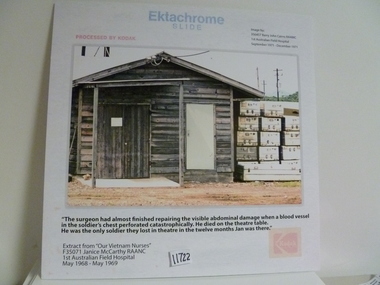
Film, untitled, 68/69 (estimate)
... The surgean had almost finished repairing the visible abdominal damage when a blood vessel in the soldier's chest perforated catastrophically. ...1st Australian Field Hospital Nurses - Vietnam RAANC The surgean had almost finished repairing the visible abdominal damage when a blood vessel in the soldier's chest perforated catastrophically. ...Ektachrome slide. Photograph by Barry John Cairns of building with coffins stacked up beside the building.The surgean had almost finished repairing the visible abdominal damage when a blood vessel in the soldier's chest perforated catastrophically. He died on the treatre table. He was the only soldier they lost in theatre in the twelve months Jan was there. (Extract from "Our Vietnam Nurses" F35071 Janice McCarthy RAANC May 1968 - May 1969)1st australian field hospital, nurses - vietnam, raanc -
 Flagstaff Hill Maritime Museum and Village
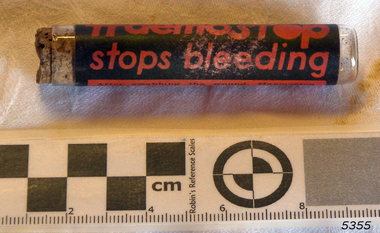
Container - Vial, 20th century
... It reduces bleeding from very small blood vessels (capillaries). The chemical in this vial is in a powder form. ...It reduces bleeding from very small blood vessels (capillaries). The chemical in this vial is in a powder form. ...Heamostop is a haemostatic agent, prescribed for the management of blood loss in menorrhagia, and after surgery. It reduces bleeding from very small blood vessels (capillaries). The chemical in this vial is in a powder form. This product is now supplied in the form of tablets and injections. The text on the vial reads "Haemostop stops bleeding. After swabbing the wound, Haemostop should be sprinkled or sprayed on as quickly as possible. Enough should be used to leave a definite dry residue on the wound. Where the blood oozes through the powder, more powder should be applied."This vial is an example of chemicals used with surgery and excessive bleeding in the early 20th century. It is also an example of pharmaceutical manufacturing and packaging.Glass vial with cork stopper and printed paper label that includes instructions. Vial contains Haemostop, a chemical powder used to stop bleeding. This vial was produced by Pharma Chemical Laboratories, NSW. Haemostop. Stops Bleeding. "PHARMA" CHEMICAL LABORATORIES, Drs. G. Bock & H. Goldhammer NSW. (Includes instructions for use.)flagstaff hill, warrnambool, shipwrecked-coast, flagstaff-hill, flagstaff-hill-maritime-museum, maritime-museum, shipwreck-coast, flagstaff-hill-maritime-village, medicine, pharmacy, chemist, haemostatic agent, blood loss management, surgury medication, pharma chemical laboratories nsw, drs g book & h. goldhammer, haemostop -
 Royal Australian and New Zealand College of Obstetricians & Gynaecologists (RANZCOG)
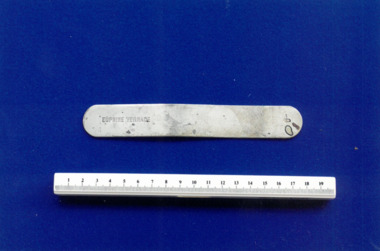
Tool - Metal tongue depressor
... It regulates and strengthens the heart, contracts the blood vessels of the splanchnic area, but dilates those of the heart and lung. ...It regulates and strengthens the heart, contracts the blood vessels of the splanchnic area, but dilates those of the heart and lung. ...Believed to have been acquired from Dr Frank Forster. Eupnine Vernade was a product used in the early 20th century for the treatment of bronchitis, asthma, emphysema and bronchiectasis adjuvant in the treatment of sequaelae of influenza. It contained 10% caffeine iodide, and "exerts an intense action on the respiratory tract, stimulating the bronchial secretion and facilitating expectoration. It regulates and strengthens the heart, contracts the blood vessels of the splanchnic area, but dilates those of the heart and lung. It "also exerts a powerful diuretic action, thus diminishing the strain on the heart." This tongue depressor, therefore, also functions as a form of medical advertising.Metal tongue depressor with rounded ends and a slight convex curve. Inscribed "EUPNINE VERNADE"."EUPNINE VERNADE"examination, advertising -
 The Cyril Kett Optometry Museum
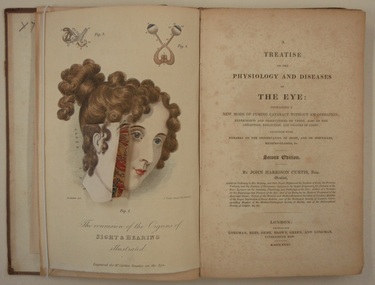
Book, A treatise on the physiology and diseases of the eye containing a new mode of curing cataract, 1835 (exact)
... There is a coloured plate facing the title page with three figures featuring an ingenious lift up section of a woman's face to show the blood vessels and nerves underneath. There is a philosophical introduction, a chapter on ocular anatomy, two chapters on diseases and their treatment, one on the nature of light and one on the preservation of vision. ...There is a coloured plate facing the title page with three figures featuring an ingenious lift up section of a woman's face to show the blood vessels and nerves underneath. There is a philosophical introduction, a chapter on ocular anatomy, two chapters on diseases and their treatment, one on the nature of light and one on the preservation of vision. ...This book is the 1835 second edition of John Harrison Curtis' 1833 'A Treatise on the Physiology and Diseases of the Eye, containing a new mode of curing cataract without an operation, experiments and observations on vision, also on the inflection, reflection and colours of light together with remarks on the preservation of sight, and on spectacles, reading glasses etc'. The title page describes J H Curtis (1778-1860) as an oculist and also as an expert on the ear. His knowledge of eye pathology and surgery was poor but this was typical of the medical profession until the middle of the 19th century. He was 'aurist in ordinary' to His Majesty and other members of the royal family and his hospital and teaching appointments had more to do with the ear rather than the eye. The last pages of the book list his other publications most of which concern the ear and the deaf. He was the first person, in 1803, to apply speaking tubes to assist the deaf. He established the Royal Ear Hospital in Soho, UK in 1816.This book is of historic significance as it shows contemporary understanding of ocular pathology in the early nineteenth century. It is quite rare as no other copies of the second edition are known in Australia.'A Treatise on the Physiology and the Diseases of the Eye' by J H Curtis is book of 1835 bound in its original boards, in very good condition, 230 x 140 mm, 242 pages, second edition. There is a coloured plate facing the title page with three figures featuring an ingenious lift up section of a woman's face to show the blood vessels and nerves underneath. There is a philosophical introduction, a chapter on ocular anatomy, two chapters on diseases and their treatment, one on the nature of light and one on the preservation of vision. Cataract is treated by withdrawal of blood from behind the ear and the application of an ointment to an induced blister on the neck, with potash applied to the cornea daily.optics, ocular anatomy, ocular disease, physiology, cataract -
 Northern District School of Nursing. Managed by Bendigo Historical Society Inc.
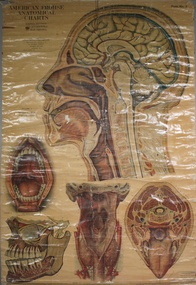
Poster - Head, Neck, Pharynx and Mouth, 1919
... Three drawings across the lower section of the poster are labeled left to right - FIGURE 2 LATERAL VIEW OF UPPER AND LOWER JAWS (The Nerve Supply of the teeth is Shown in the Upper Jaw and the Blood Vessels in the Lower). FIGURE 4 CORONAL SECTION OF NECK the view is from behind. the Pharynx has been cut open. ...Three drawings across the lower section of the poster are labeled left to right - FIGURE 2 LATERAL VIEW OF UPPER AND LOWER JAWS (The Nerve Supply of the teeth is Shown in the Upper Jaw and the Blood Vessels in the Lower). FIGURE 4 CORONAL SECTION OF NECK the view is from behind. the Pharynx has been cut open. ...Educational teaching chart used at the Northern District School of Nursing, Rowan Street, Bendigo. The Northern District School of Nursing opened in 1950 in to address the issues around nurse recruitment, training and education that had previously been hospital based. The residential school was to provide theoretical and in-house education and practical training over three years. The students would also receive practical hands-on training in the wards of associated hospitals. The Northern District School of Nursing operated from Lister House, Rowan Street, Bendigo. It was the first independent school of nursing in Victoria and continued until it closed in 1989 Since 1918, Adam, Rouilly & Co has supplied innovative clinical skills simulators, skeletons, anatomical models & charts to medical education worldwide. Max Brödel was a pioneer of modern medical illustration, see https://pubmed.ncbi.nlm.nih.gov/21294618/ Coloured educational chart of the Head, Neck, pharynx and Mouth. Off white paper with canvas backing, wooden header and footer. Five coloured drawings labeled 1 to 5 with numbered parts. Printed at top left - AMERICAN FROHSE ANATOMICAL CHARTS. EDIETED, REVISED AND AUGMENTED BY MAX BRODEL. ADAM, ROUILLY & COMPANY HUMAN OSTEOLOGY ect., ect. 18 FITZROY STREET FITZROYBSQUARE LONDON W1 telephone MUSEUM 2730. printed at top right - Plate No.7 The main drawing is labeled FIGURE1 MEDIAN SECTION THROUGH HEAD.The smaller drawing at middle left is labeled - FIGURE 3 THE MOUTH CAVITY (cheeks have been cut to allow distention of Jaws) signed Max Brodel 1919. Three drawings across the lower section of the poster are labeled left to right - FIGURE 2 LATERAL VIEW OF UPPER AND LOWER JAWS (The Nerve Supply of the teeth is Shown in the Upper Jaw and the Blood Vessels in the Lower). FIGURE 4 CORONAL SECTION OF NECK the view is from behind. the Pharynx has been cut open. Singed Max Brodel 1919. FIGURE 5 HOROZOMTAL ECTION OF NECK The section is through the Second Cervical Vertebra. Singed Max Brodel 1919. Adam, Rouilly & Co details are repeated in the lower right corner. education chart, nurse training, lister house, northern district school of nursing, adam rouilly & co, max brodel, anatomical charts, american frohse -
 Mission to Seafarers Victoria
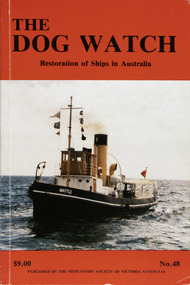
Journal (item) - Periodicals-Annual, Shiplovers' Society of Victoria, The Annual Dog Watch, 1991
... Vessel — The Portland Lifeboat - Reprinted from the Journal of Portland Smelter Services Pty. Ltd. - 79 Any port in a Storm - W.P. Shemmeld - 81 A Happy Introduction to Sail - Captain George Molyneux - 87 Restored Ships in Sydney Harbour - Jean Barrie - 89 The Voyage of the Jane Richardson — 1889 Part II - Late E. Binham - 99 Preservation of HMAS Castlemaine. - Peter J. Williams - 103 When Blood...Vessel — The Portland Lifeboat - Reprinted from the Journal of Portland Smelter Services Pty. Ltd. - 79 Any port in a Storm - W.P. Shemmeld - 81 A Happy Introduction to Sail - Captain George Molyneux - 87 Restored Ships in Sydney Harbour - Jean Barrie - 89 The Voyage of the Jane Richardson — 1889 Part II - Late E. Binham - 99 Preservation of HMAS Castlemaine. - Peter J. Williams - 103 When Blood ...This journal provides the reader with glimpses of the adventures and hardships of a seaman's life. Many of the stories are of sailing ships.Contributes to our knowledge of the importance of shipping and places on record those stories of the sea which would otherwise be lost.Contents Foreword - - 5 Editorial - - 9 Steam Tug Wattle - G.C. Hogben - 11 The Legend of the Marco Polo Pride of all New Brunswick - Sponsors of the Marco Polo Restoration Project - 17 Yarra Mud Re-visited - Harrow Morgan - 21 Abandon Ship (in Dry Dock) - T. E. Goldfinch - 33 The Golden Plover Lives Again - Alison Forte - 37 San Pedro Offshore - P.H. Lewis - 41 White Sails in Australian Waters - Late D. McLennan - 45 Barque Polly Woodside - - 52 The Edwin Fox Restoration Picton, New Zealand - - 55 A Gulf Trader - R.N. Thiele - 57 The Great Britain (Poem) - C.E. Bonwick - 65 Singapore for Orders - - 67 Memories of a Master Under Sail The China Coast - Late Captain William Phillip - 71 Junior Marine Radio Officer on the S.S. Iron Flinders - Ellery Teare - 75 Australia’s Oldest Vessel — The Portland Lifeboat - Reprinted from the Journal of Portland Smelter Services Pty. Ltd. - 79 Any port in a Storm - W.P. Shemmeld - 81 A Happy Introduction to Sail - Captain George Molyneux - 87 Restored Ships in Sydney Harbour - Jean Barrie - 89 The Voyage of the Jane Richardson — 1889 Part II - Late E. Binham - 99 Preservation of HMAS Castlemaine. - Peter J. Williams - 103 When Blood Stained the Wattle - Late D. McLennan - 107 Book Reviews - - 112sailing ships, steamships, shipping, seafaring life, shiplovers' society of victoria, dog watch, wattle tug, tug boat -
 Geoffrey Kaye Museum of Anaesthetic History
Equipment - Cannulae, Transfusion
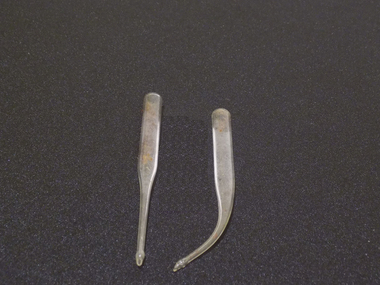
... Blood groups were identified by 1907 and the Kimpton Brown vessel (see 3675) slowed coagulation. ...Blood groups were identified by 1907 and the Kimpton Brown vessel (see 3675) slowed coagulation. ...Blood was long thought to be the essence of life and the centre of the soul; it was believed to provide a person with physical strength and mental abilities. In 1677, Richard Lower and Jean Baptiste Denis, in separate experiments, attempted animal-to-man transfusions to treat mental disorders. They had mixed success but didn't appear to cure the ailment. In 1818, James Blundell became interested in blood transfusion after witnessing the many deaths resulting from post-partum haemorrhage. He began with experiments in dogs and soon established it was possible to transfuse using a syringe if he worked quickly. Blundell established that cross-species transfusions didn't work and were dangerous. The early part of the 20th Century saw major developments in blood transfusion. Blood groups were identified by 1907 and the Kimpton Brown vessel (see 3675) slowed coagulation. These transfusion needles were used to collect and administer blood for transfusions.Two glass tubes, one with straight and one with a curve at the base. The tubes, known as cannualae, were used to facilitate blood transfusions.transfusion, cannula, kimpton brown, blood, blood transfusion, blundell, lower, denis -
 Northern District School of Nursing. Managed by Bendigo Historical Society Inc.
Poster - Circulation of the Blood and Lymph
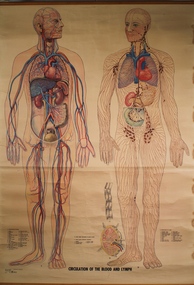
... The main drawings A - Circulation of Blood, B - Circulation of Lymph. Two smaller drawings C - Lymph vessel sectioned to show valves, D - Lymph Gland dissected, showing. ....The main drawings A - Circulation of Blood, B - Circulation of Lymph. Two smaller drawings C - Lymph vessel sectioned to show valves, D - Lymph Gland dissected, showing. . ...Educational teaching chart used at the Northern District School of Nursing, Rowan Street, Bendigo. The Northern District School of Nursing opened in 1950 in to address the issues around nurse recruitment, training and education that had previously been hospital based. The residential school was to provide theoretical and in-house education and practical training over three years. The students would also receive practical hands-on training in the wards of associated hospitals. The Northern District School of Nursing operated from Lister House, Rowan Street, Bendigo. It was the first independent school of nursing in Victoria and continued until it closed in 1989 Coloured educational chart of the Circulation of the Blood and Lymph. Off white paper with canvas backing, wooden header and footer.-Four coloured drawings labeled A to D with numbered parts and a list of their names. The main drawings A - Circulation of Blood, B - Circulation of Lymph. Two smaller drawings C - Lymph vessel sectioned to show valves, D - Lymph Gland dissected, showing. .education chart, nurse training, lister house, northern district school of nursing, blood and lymph circulation -
 Carlton Football Club
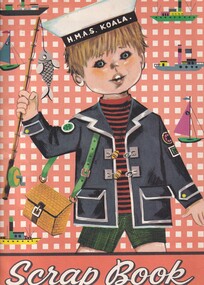
Scrap Book, Dedicated to Carlton Player John Goold
... But one of Carlton’s problems was that Goold had been kicked on a shin against St Kilda, causing a burst blood vessel and serious swelling. Despite the best efforts of the club medical staff, Ragsy had only a slim chance of playing in the Grand Final right up until game day, when his worried coach reluctantly allowed him to take his place in the side. ...John Goold double Premiership PlayerA scrap Book dedicated to twice Premiership Player 1968 - 1970 John Goold Career : 1963 - 1970 Debut : Round 7, 1963 vs Footscray, aged 21 years, 338 days Carlton Player No. 754 Games : 108 Goals : 3 Last Game : Grand Final, 1970 vs Collingwood, aged 29 years, 90 days Guernsey No. 11 Height : 184 cm (6 ft ½ in.) Weight : 76 kg (12 stone, 0 lbs.) DOB : June 27, 1941 Premiership Player 1968, 1970 Carlton Hall of Fame All Australian 1966 A brilliant, flamboyant, two-time Premiership player for Carlton during the Barassi years in the ‘swingin’ sixties,’ John William Crosbie Goold became almost as famous for his dapper appearance off the field, as for his exploits on it. At the height of his football career, he was also a prominent ladies fashion designer – which led to him being dubbed ‘Mr Elegance’ by leading football commentator Lou Richards. Supporters and team-mates however, called him ‘Rags’ or ‘Ragsy,’ because of his involvement in the clothing, or ‘rag’ trade. Goold first came under notice as an outstanding junior athlete at Melbourne Grammar School. A true all-round sportsman, he shone at tennis, athletics, football and cricket. He was also a keen horseman who loved the game of polo and the rough and tumble of fox hunting. While at school he was a fervent Melbourne supporter, but strangely, never had much confidence in his football ability. “If I thought I was good enough, I would certainly have gone to Melbourne,” he said many years later. “But I honestly didn’t think I would ever amount to anything in this game. Cricket and tennis were the games that really interested me.’ However, after graduating from MGS, Goold went home to Healesville to star in the Bloods’ 1962 Yarra Valley Football Association Premiership team – an achievement that brought tempting offers from more than one VFL club. “Incentives were offered elsewhere,” he recalled, “but I gravitated to Carlton – partly because the deep blue of their guernsey attracted me, but mostly because of the good advice I got from people who even then were longsighted enough to predict that big things were ahead for this club.” The Blues were confident enough in Goold’s potential to offer him the guernsey number 11 previously worn with distinction by the likes of Jack Hale, Jim Knight, Ron Hines and Laurie Kerr, and his first senior game came in round 7, 1963 against Footscray at the Western Oval. He played on a half-forward flank alongside Brownlow Medallists Gordon Collis and John James on that Saturday afternoon, and kicked his first career goal in an 8-point win. Little did he know though, that it would be another six seasons before he would again experience the thrill of sending a football spinning between the big posts, because his future lay in defence. By his own admission, Goold struggled to find his feet in VFL football during his first two seasons, until the shock appointment of Ron Barassi as captain-coach of Carlton in 1965 began steering his career back on track. “I think you could say that 1965 was my first year of League football,” he said, “That’s the way I felt - that’s the way I reacted to Barassi.” Under Barassi, Goold rapidly developed into a superb running half-back flanker. Tenacious, and an often freakish high mark, he was unmistakable on the field thanks to his mane of dark hair, his loping running style and somewhat awkward kicking action. Furthermore, he had boundless courage. There is no doubt that he would have played many more games had he not been regularly pole-axed under the high ball – a fact he later freely admitted. “I was always getting knocked out,” he said, “and spent half my bloody time in hospital.” In the second half of 1965, an injury to centre half-back Gordon Collis forced Barassi to use Goold in the key defensive post. While it curtailed his rebounding instincts somewhat, ‘Ragsy’ rose to the challenge and rarely lowered his colours. Testament to his improvement, he finished third behind John Nicholls and Sergio Silvagni in Carlton’s 1965 Best and Fairest award, and followed up by being selected in the Victorian team for the 1966 Hobart Carnival. There, he had a superb series in which he was runner-up to West Australian Barry Cable in voting for the Tassie Medal, and capped it off by being named on a half-back flank in the All Australian team. Barassi’s influence at Carlton bore fruit in his third year, when the Blues returned to finals football at last. Richmond, Carlton, Geelong and Collingwood fought out the 1967 Premiership, and Ragsy Goold won the hearts of the Carlton faithful with two lion-hearted performances. Although Carlton was knocked out of contention by successive losses to Richmond and Geelong, Goold was tireless throughout both games, and it was obvious that he thrived on the added pressure of finals football. Precisely twelve months later, the bitter taste of those defeats was washed away when Barassi’s Blues edged out Essendon by 3 points in the 1968 Grand Final, and ended 21 years of despair at Princes Park. To win Carlton’s ninth VFL flag, the Blues had had to defeat the minor premier Bombers twice during the finals – and did so, thanks to a watertight defence led by Goold, and a dominant ruck division headed by John Nicholls. In round 5, 1969, Carlton hosted South Melbourne at Princes Park in a match significant for a number of reasons. As he regularly did, Ron Barassi swung his team around prior to the opening bounce, and Goold found himself in the unaccustomed role of ruck-rover. While the Blues set about establishing a good break on the scoreboard, Ragsy relished the freedom to kick two first half goals - his first majors for 78 games. Just before half-time however, he was flattened in a pack, concussed again, and replaced during the long break by Barry Gill. Alex Jesaulenko was substituted at the same time – by a shy, ambitious youngster named Bruce Doull, making his senior debut for Carlton in guernsey number 4. In September, 1969 the Navy Blues began their third straight finals campaign with an impressive 6-goal Semi Final win over Collingwood in front of more than 108,000 fans at the MCG. A fortnight later, Richmond stunned the flag favourites with a withering last quarter in the Grand Final, and knocked Carlton out of the Premiership race again at the last hurdle. Half-way through the year, Carlton's club doctor discovered that Goold had been playing with shin splints in both of his lower legs. The pain they caused was considerable, but Ragsy soldiered on and held down centre half-back throughout the season. John Goold’s VFL career at Carlton culminated in the fabled 1970 Grand Final triumph over Collingwood. What is not so well known is that Ragsy was only cleared to play in that game on the morning of the match. After narrowly losing to Collingwood in the second Semi Final, the Navy Blues destroyed St Kilda by 62 points in the Preliminary Final, and earned another shot at the Magpies in the decider. But one of Carlton’s problems was that Goold had been kicked on a shin against St Kilda, causing a burst blood vessel and serious swelling. Despite the best efforts of the club medical staff, Ragsy had only a slim chance of playing in the Grand Final right up until game day, when his worried coach reluctantly allowed him to take his place in the side. Later, Barassi justified his decision by saying that in his opinion, a less than fully fit Goold was still worth his place in the team. By half time in the Grand Final however, he was probably questioning that judgement - because Carlton had been totally outplayed, and trailed an impressive, cohesive Collingwood by 44 points. Therefore, Carlton’s magnificent comeback – orchestrated by Barassi, and sparked by the fairytale exploits of 19th man Ted Hopkins – is one of the greatest of all football stories. Against enormous odds, the Navy Blues fought their way back into the contest, and eventually, rolled over the top of the frantic Magpies to snatch victory by 10 points in the last few minutes of the match. Hopkins ended up with four goals, Barassi was hailed a genius, and Ragsy Goold was carted off to hospital immediately after the game to have further urgent treatment. While there, he decided that there was no better time to end his VFL career – especially because his burgeoning business interests were demanding more and more of his time. In the years after his football career ended, John Goold created a remarkably successful business empire. In 1971 he sold his fashion label and took up farming at Mortlake in western Victoria, where he coached the local football team for three seasons. Later, he formed a diversified pastoral company, and purchased a magnificent complex called Ballangeich Run at nearby Ellerslie. While his passion for farming and livestock grew, he began breeding top quality polo ponies, and represented Australia in international competition. During the 1997 and 1998 seasons, John's son Ed Goold played reserve grade football for Carlton. MEMORIES.... Ragsy Goold; the name stirs memories form my long ago childhood. Ragsy, with his unique kicking style, where he'd hold the ball (always a drop punt - in a time when the drop kick and the torpedo punt still reigned supreme) at the point of the ball, elbows bent and he'd lavishly drop the ball, his right arm then flinging back and up dramatically. That was the thing about Ragsy (so named because he worked in the clothing, or 'rag' trade), he was always dramatic. He always ensured his ankle guards and wrist guard were glowing white to match the great white CFC monogram he wore proudly on his chest, and with his long flowing locks, cut a dynamic figure through a young boy's mind. Ragsy was my idol. I loved his dashes from half back, his long accurate drop punts, most of all I loved his flair for the game. Ragsy played the game as an entertainer as well as a sportsman - he leapt high to punch or mark, and always seemed to have a bit of the thoroughbred about him - which is probably why after he retired, he took up fox chasing, polo, and riding his beloved thoroughbreds across the paddocks and over the fences of his property, I think he may have even represented Australia at the sport – really, that’s sort of how he played as a footballer. All sinewy muscle, long legs and famous leaps for the saving punch. Ragsy was part of the great backline that helped revive Carlton's fortunes. Legendary players Wes Lofts, Ian Collins, Kevin 'Racehorse' Hall, Vinnie Waite among them. All great teams have a great defence and the defence that Ragsy was an integral part of was no different. Where others provided the biffo, the muscle or the defensive pressure, Ragsy provided the dash, the flair, the sense of adventure that all great backlines must have. AND MORE.... I have had many favourite players while following the Blues, but there will always be a special spot for Ragsy Goold - running the lines, all long hair and flashing white guards. As a young man I moved to Carlton and began acting in a place called one-c-one. One night after a play, I was walking home. It was winter, and I was wearing my favouritte overcoat, a genuine ankle length tweed affair I had picked up in an Op Shop in Oakleigh for three dollars. As I strutted across Lygon Street, a deep male voice behind me called, 'hey laddie, how much for the overcoat?' I turned, and there was my childhood idol, Ragsy Goold, two beautiful women in tow, smiling and waiting for my answer. I loved that coat too much to part with it, even to Ragsy, so I shook my head - and he smiled, then walked off. I stood for a moment in the middle of the street shaking my head in disbelief. Ragsy bloody Goold had just offered to buy my overcoat! I knew at that point, as a young man of about twenty three, that life was going to be full of surprises and very entertaining - a bit like John ‘Ragsy’ Goold. ONE MORE.... A cold, wet day in the mid 1960's at the MCG and Victoria were playing South Australia (?) The ball that day was like a piece of soap, with players finding it impossible to mark. Just before half time a long kick sailed toward the mud heap that was the centre of the ground, and the pack rose to meet it. From this group of players an arm shot straight up, and the ball instantly came to a dead stop. The footy stuck in the player's palm as if the hand was coated in Tarzan's Grip. After all these years, it's the only recollection I have of that match, and that player was 'Mr. Elegance' John Goold. HUMOROUS HUNGRY.... Former opponent Richmond's Kevin Bartlett on Radio SEN in 2012 received a phone call from John. After the call Kevin told his listeners how "Mr Elegance" would always be dressed in a nice suit, shirt-tie and highly polished shoes. He then cracked a joke saying something like; "You know, John was so 'posh' that he used to play football wearing a cravat!" Milestones 50 Games: Round 15, 1967 vs Melbourne 100 Games: Round 13, 1970 vs Geelong Career Highlights 1965 - Percy Bentley Trophy - 3rd Best & Fairest 1966 - 5th Best & Fairest 1967 - Maurie Sankey Memorial Trophy - 4th Best & Fairest (on count back) 1968 - Premiership Player 1970 - 7th Best & Fairest 1970 - Premiership PlayerFoolscap Scrap Book
