
Showing 44 items matching "bmm"
-
 The Beechworth Burke Museum
Photograph - Carte de Visite
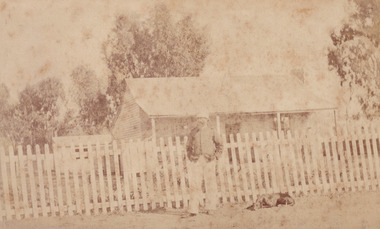
... BMM 8083...This photograph is also of artistic significance because of the popularity of the CdV during the nineteenth century. kelly album glenrowan police police station photograph ned kelly australia colonial australia victoria james bray william e barnes daniel mullins BMM 8083 A sepia toned photograph mounted on grey card with rounded corners. ...This Carte-de-viste (CdV) previously belonged to the donor's grandfather, Daniel Mullins who was a Police Officer stationed at Glenrowan soon after the Kelly gang siege. It is unclear; however, whether or not the man depicted in the photograph is Daniel Mullins or a different police officer. The Police Station at Glenrowan depicted in this CdV stood during the events of the Kelly gang's siege. Today, the siege has become an important part of Australian culture and Ned Kelly and the Kelly Gang (comprising of Ned Kelly, Dan Kelly, Steve Hart and Joe Byrne) has become ingrained in Australian history and mythology. A CdV is a sepia toned photograph mounted on card and is generally of a small size. This particular style was first patented by Andre Adolphe Eugene Disdéri (1819-1889) in 1854. In 1857, the CdV was introduced to England and after photographs of Queen Victoria, Prince Albert and their family were taken using CdV in 1860 the popularity of this method reached a peak. This photograph is part of the Burke Museum "Kelly album" which includes a significant collection of photographs and artefacts connected to Ned Kelly and the Kelly Gang. Ned Kelly and his gang have become ingrained in Australian popular culture and thus many museums, art galleries and private collections house material connected to the Kelly story which allows the events and people to be researched and interpreted. Items pertaining to the Kelly gang, including photographs like this one which depicts a police officer standing outside of the Glenrowan Police Station, are of great historical significance. Photographs like this can provide valuable information on the architecture, lifestyle and dress of colonial Australia. When studied, photographs have the ability to shed more light on the events of the Kelly gang and colonial Australia. This photograph is also of artistic significance because of the popularity of the CdV during the nineteenth century.A sepia toned photograph mounted on grey card with rounded corners. The image has been captured by an unknown photographer and depicts the outside the Glenrowan Police Station. In front of the Station stands an unidentified policeman and lying on the ground behind the policeman is a medium sized dog with dark colouring. The Police Station depicted in this photograph is a classic example of Australian country colonial architecture typically seen dating to the nineteenth century. It has the typical features of an Australian colonial 'miners' cottage' with the gable roof and a skillion at rear. A white picket fence is stands between the Station and the policeman. A small building is located at the rear of the Station which may have served as a lockup.BMM 8083kelly album, glenrowan, police, police station, photograph, ned kelly, australia, colonial australia, victoria, james bray, william e barnes, daniel mullins -
 The Beechworth Burke Museum
Photograph, Late 1800s
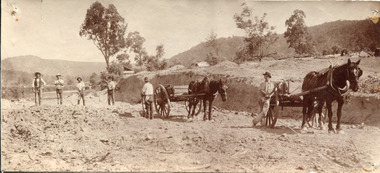
... Reverse: BMM 2982 / ...Road Construction Beechworth Roads 1800s 1800s Beechworth Beechworth Hills Horse and Cart Beechworth Road Making Beechworth Council Roads Road Expansion Beechworth Surrounding Hills Reverse: BMM 2982 / Sepia rectangular photograph on matte photographic paper mounted on card Photograph Photograph E.J. ...This photograph depicts six men and two horses with carts in the process of constructing a road. The men each stand in a relatively relaxed position, posing for the camera. However, the amount of upturned soil surrounding them suggests the hard work they have endured, armed only with pitchforks and shovels. The creation of new roads in the Beechworth area had become a priority for the Beechworth council in the second half of the nineteenth century. This included connecting roads which radiated out of Beechworth to surrounding towns. This led to the expansion of the local government authority over the surrounding countryside, greatly strengthening Beechworth's central position. The use of horse and cart to take away the removed soil, as well as the style of the men's attire, suggests that this photograph dates back to the late 1800s. It can also be assumed that this photograph was taken somewhere in the surrounding hills of Beechworth. This photograph is historically significant as it provides insight into the rapid expansion of roads in and around Beechworth during the second half of the nineteenth century. Sepia rectangular photograph on matte photographic paper mounted on card Reverse: BMM 2982 / road construction, beechworth roads, 1800s, 1800s beechworth, beechworth hills, horse and cart, beechworth road making, beechworth council roads, road expansion, beechworth surrounding hills -
 The Beechworth Burke Museum
Animal specimen - Sand Goanna, Trustees of the Australian Museum, 1860-1880
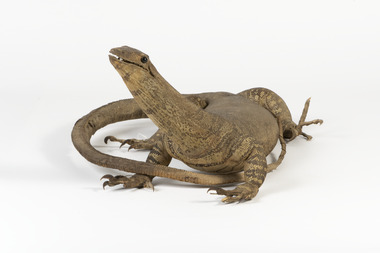
... On tag: BMM / 5892 /...This collection continues to be on display in the Museum and has become a key part to interpreting the collecting habits of the 19th century. taxidermy mount taxidermy animalia burke museum beechworth australian museum skin reynell eveleigh johns lizard goanna sand goanna monitor lizard various gouldii On tag: BMM / 5892 / Small goanna with a streamlined body and textured scaly skin in different shades of olive and brown. ...Sand goannas are the second largest species of carnivorous lizards found across mainland Australia. They can grow up to 160cm in length and can weigh as much as 6kg. Their common name is derived from "iguana", since early European bush settlers in Australia likened goannas to the South American lizards. Goannas retain special cultural and historic significance within Australian folklore and Indigenous culture. They were an important traditional native food source and are commonly represented in Aboriginal Dreamtime stories. In some Aboriginal languages, the sand goanna is called "bungarra"; a term also commonly used by non-Aboriginal people in Western Australia. In Pitjantjatjara and other central Australian languages, goannas are called "tingka". This specimen is part of a collection of almost 200 animal specimens that were originally acquired as skins from various institutions across Australia, including the Australian Museum and the National Museum of Victoria, as well as individuals such amateur anthropologist Reynell Eveleigh Johns between 1860-1880. These skins were then mounted by members of the Burke Museum Committee and put-on display in the formal space of the Museum’s original exhibition hall where they continue to be on display. This display of taxidermy mounts initially served to instruct visitors to the Burke Museum of the natural world around them, today it serves as an insight into the collecting habits of the 19th century. This specimen is part of a significant and rare taxidermy mount collection in the Burke Museum. This collection is scientifically and culturally important for reminding us of how science continues to shape our understanding of the modern world. They demonstrate a capacity to hold evidence of how Australia’s fauna history existed in the past and are potentially important for future environmental research. This collection continues to be on display in the Museum and has become a key part to interpreting the collecting habits of the 19th century.Small goanna with a streamlined body and textured scaly skin in different shades of olive and brown. It has a long neck and a long tail which narrows towards the tip. The goanna has four short, stocky legs which meet with large, curled claws. Its mouth is slightly slightly open, and it has two black glass eyes.On tag: BMM / 5892 /taxidermy mount, taxidermy, animalia, burke museum, beechworth, australian museum, skin, reynell eveleigh johns, lizard, goanna, sand goanna, monitor lizard, various gouldii -
 The Beechworth Burke Museum
Animal specimen - Platypus, Trustees of the Australian Museum, 1860-1880
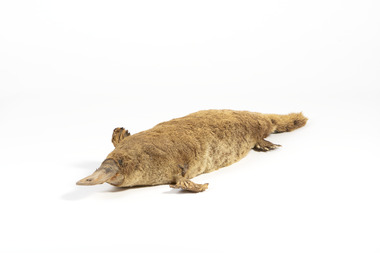
... On tag: BMM / 5899 /...This collection continues to be on display in the Museum and has become a key part to interpreting the collecting habits of the 19th century. taxidermy mount taxidermy animalia burke museum beechworth australian museum skin reynell eveleigh johns platypus monotreme mammal ornithorhynchus anatinus On tag: BMM / 5899 / A long, stocky platypus with a streamlined body and a flat bill. ...The platypus is a semi-aquatic, egg-laying mammal endemic to eastern Australia. It is the sole living representative of its family and genus. They can grow up to 63cm in length and weigh up to 3kg, and their life span is typically 6-15 years. The unique mix of physical features of the platypus make it an important subject in the study of evolutionary biology, and a recognisable and iconic symbol of Australia. Furthermore, the platypus is culturally significant to several Aboriginal peoples of Australia. The animal has also appeared as a mascot at national events and features on the reverse of the Australian twenty-cent coin, and is the animal emblem of the state of New South Wales. This specimen is part of a collection of almost 200 animal specimens that were originally acquired as skins from various institutions across Australia, including the Australian Museum and the National Museum of Victoria, as well as individuals such amateur anthropologist Reynell Eveleigh Johns between 1860-1880. These skins were then mounted by members of the Burke Museum Committee and put-on display in the formal space of the Museum’s original exhibition hall where they continue to be on display. This display of taxidermy mounts initially served to instruct visitors to the Burke Museum of the natural world around them, today it serves as an insight into the collecting habits of the 19th century. This specimen is part of a significant and rare taxidermy mount collection in the Burke Museum. This collection is scientifically and culturally important for reminding us of how science continues to shape our understanding of the modern world. They demonstrate a capacity to hold evidence of how Australia’s fauna history existed in the past and are potentially important for future environmental research. This collection continues to be on display in the Museum and has become a key part to interpreting the collecting habits of the 19th century.A long, stocky platypus with a streamlined body and a flat bill. The platypus has four short limbs with webbed feet, and the front-right foot is positioned upright. The hair is short and dense; the upperbody fur has an auburn tint, and the underbody fur is a silver/cream colour. The platypus has two beady black glass eyes.On tag: BMM / 5899 /taxidermy mount, taxidermy, animalia, burke museum, beechworth, australian museum, skin, reynell eveleigh johns, platypus, monotreme, mammal, ornithorhynchus anatinus -
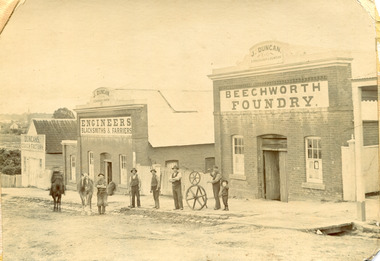 The Beechworth Burke Museum
Photograph, c1900
... Reverse 97.2321 / BMM A03115...The foundry was reopened by W H Phillips in 1905 and taken over by H Delora in 1906 This image is significant as it shows some of the many buildings of the Beechworth Foundry, which was a fundamental business to the running of the town and surrounding district, and supplied many of the tools and machines required for the mining and agricultural industries, as well as other aspects of life between the 1850s and early 1900s Duncan John Duncan J Duncan M Straughair Straughair Foundry Beechworth Foundry industry factory Newtown New Ford Street Foundry A Roger Roger W H Phillips Phillips W Phillips H Delora Delora Metalwork Farming and agriculture Tools Mining workmen Reverse 97.2321 / BMM A03115 Sepia rectangular photograph printed on paper. ...The Beechworth Foundry was vital to the industry of the town and surrounding district in the early years of the town’s development. Originally opened as the New Ford Street Foundry by A. Roger in 1858, J Duncan and M Straughair amalgamated and established the Beechworth Foundry in 1867. The business was extensive and operated out of many buildings, each with their own specialisation. All of the buildings pictured in this image are part of the larger Beechworth Foundry. In the late 1860s it employed 16 men. The foundry was fundamental to the running of the town and surrounding district, as it manufactured all manner of items, including tools and machinery for the mining and agricultural industries. The foundry business collapsed in 1896 after the death of it’s founder, John Duncan, the same year (Straughair had died in 1882). The foundry was reopened by W H Phillips in 1905 and taken over by H Delora in 1906 This image is significant as it shows some of the many buildings of the Beechworth Foundry, which was a fundamental business to the running of the town and surrounding district, and supplied many of the tools and machines required for the mining and agricultural industries, as well as other aspects of life between the 1850s and early 1900sSepia rectangular photograph printed on paper. It has rough, torn-looking edgesReverse 97.2321 / BMM A03115duncan, john duncan, j duncan, m straughair, straughair, foundry, beechworth foundry, industry, factory, newtown, new ford street foundry, a roger, roger, w h phillips, phillips, w phillips, h delora, delora, metalwork, farming and agriculture, tools, mining, workmen -
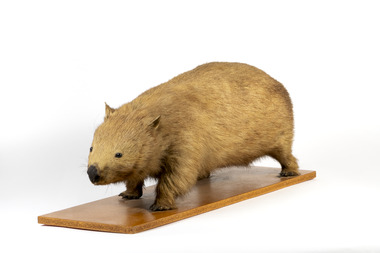 The Beechworth Burke Museum
Animal specimen - Common Wombat, Trustees of the Australian Museum, 1860-1880
... On wooden mount: BMM 5901 /...This collection continues to be on display in the Museum and has become a key part to interpreting the collecting habits of the 19th century. taxidermy mount taxidermy wombat animalia vombatidae burke museum beechworth australian museum skin reynell eveleigh johns Common wombat On wooden mount: BMM 5901 / Medium sized stocky wombat with a broad head and two muscular forelegs and two weaker hind legs that are met with long sharp black claws. ...Common wombats are short-legged, muscular, nocturnal marsupials that live in a wide variety of habitats throughout Australia. A common wombat can grow up to 1.2 metres in length and weigh up to 35 kilograms. The name “wombat” comes from the Darug language spoken by the Aboriginal Darug people, who originally inhabited the Sydney area. The wombat was first recorded in 1798 by explorer John Price on a visit to Bargo in New South Wales, however, wombats are depicted on Aboriginal rock-art that date back as far as 4,000 years ago. This specimen is part of a collection of almost 200 animal specimens that were originally acquired as skins from various institutions across Australia, including the Australian Museum and the National Museum of Victoria, as well as individuals such amateur anthropologist Reynell Eveleigh Johns between 1860-1880. These skins were then mounted by members of the Burke Museum Committee and put-on display in the formal space of the Museum’s original exhibition hall where they continue to be on display. This display of taxidermy mounts initially served to instruct visitors to the Burke Museum of the natural world around them, today it serves as an insight into the collecting habits of the 19th century. This specimen is part of a significant and rare taxidermy mount collection in the Burke Museum. This collection is scientifically and culturally important for reminding us of how science continues to shape our understanding of the modern world. They demonstrate a capacity to hold evidence of how Australia’s fauna history existed in the past and are potentially important for future environmental research. This collection continues to be on display in the Museum and has become a key part to interpreting the collecting habits of the 19th century. Medium sized stocky wombat with a broad head and two muscular forelegs and two weaker hind legs that are met with long sharp black claws. The hair is long, thick and coarse in brown/yellow shades. The head features two small black eyes that have been made from glass, two short pointed ears and a bare nose pad. On wooden mount: BMM 5901 /taxidermy mount, taxidermy, wombat, animalia, vombatidae, burke museum, beechworth, australian museum, skin, reynell eveleigh johns, common wombat -
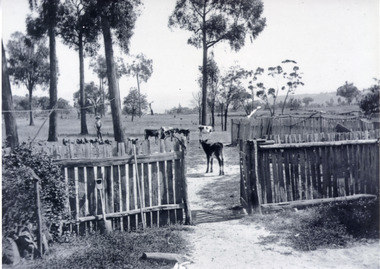 The Beechworth Burke Museum
Photograph, circa. 1850
... Reverse: 5896/ BMM 8093-1...Farm Agriculture farming and agriculture Beechworth Beechworth farm industry Reverse: 5896/ BMM 8093-1 Black and white rectangular photograph on matte photographic paper, unmounted Photograph Photograph ...Date not confirmed, a farm in the Beechworth, Warner property with a farmer overlooking calves, poultry and timber. This photograph depicts the farming and agriculture industry in Beechworth. The property, known as Daintree Stud or the Warner property, formed a part of the town of Beechworth, Victoria. Beechworth became famous in the 19th century from a short- lived gold-rush. The town grew to the extent of building a hospital and mental hospital, courthouse, hotels, convent, and prison. During this time, the industrial growth of Beechworth was significant, seeing a rise in practices including tanning, cobbling, blacksmithing, and the selling of livestock. This photograph perhaps reveals a small degree of insight into the livestock business.Black and white rectangular photograph on matte photographic paper, unmountedReverse: 5896/ BMM 8093-1farm, agriculture, farming and agriculture, beechworth, beechworth farm, industry -
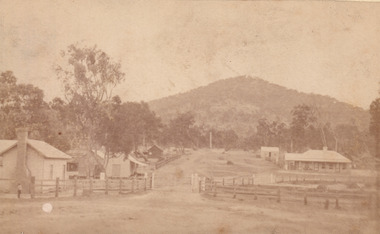 The Beechworth Burke Museum
Photograph - Carte de Visite
... Glenrowan / taken 1.4.83 ... / BMM 8086...It is also interesting to emphasise that the police station was built on the site of Ned Kelly and the Kelly gang's last stand. kelly album ned kelly glenrowan police history police australian architecture streetscape glenrowan 1883 1883 dan kelly steve hart joe byrne carte-de-viste james bray daniel mullins william e barnes colonial australia police station photograph Glenrowan / taken 1.4.83 ... / BMM 8086 This photograph is a sepia image of the Glenrowan streetscape depicting several buildings. ...In July of 1880, Ann Jones' successful hotel in Glenrowan burnt to the ground during the Kelly siege. She had opened her business in the year prior having been unsuccessful in her attempt to run a tea-room business in Wangaratta. The first building on this particular site was the home Ann Jones had built for herself and her family. Two years later she converted the home and added the hotel to the rear of the structure. One year later it was burnt to the ground. This image depicts the streetscape of Glenrowan in 1883, three years after the siege. Importantly, it reveals the appearance of several buildings which can reveal information for how Glenrowan (as a small town) might have stood during the siege. These buildings are of typical Australian colonial "miner's cottage" style. On what would have been the site of Ann Jones' hotel, to the far left of the photograph, a police station stands. This police station was built before April 1883. This image was captured by an unknown photographer. This Carte-de-viste (CdV) previously belonged to the donor's grandfather, Daniel Mullins who was a Police Officer stationed at Glenrowan soon after the Kelly gang siege. Today, the siege has become an important part of Australian culture and Ned Kelly and the Kelly Gang (comprising of Ned Kelly, Dan Kelly, Steve Hart and Joe Byrne) has become ingrained in Australian history and mythology. A CdV is a sepia toned photograph mounted on card and is generally of a small size. This particular style was first patented by Andre Adolphe Eugene Disdéri (1819-1889) in 1854. In 1857, the CdV was introduced to England and after photographs of Queen Victoria, Prince Albert and their family were taken using CdV in 1860 the popularity of this method reached a peak.This photograph is part of the Burke Museum "Kelly album" which includes a significant collection of photographs and artefacts connected to Ned Kelly and the Kelly Gang. Ned Kelly and his gang have become ingrained in Australian popular culture and thus many museums, art galleries and private collections house material connected to the Kelly story which allows the events and people to be researched and interpreted. Artefacts and photographs pertaining to the Kelly gang are particularly valuable for Australian museums. This particular photograph is significant for its connection to the Glenrowan Siege and Ann Jones' Hotel which burnt down during the siege in June 1880. Taken in 1883, this photograph (taken by an unidentified photographer) has the opportunity to provide information about the townscape of Glenrowan shortly after the siege. It also provides important insight into the architecture and layout of the town. To the far right of the image, the photograph depicts the police station which was built on the site of Ann Jones' Hotel which can provide important information for the Kelly story and how the town evolved following 1880. It is also interesting to emphasise that the police station was built on the site of Ned Kelly and the Kelly gang's last stand.This photograph is a sepia image of the Glenrowan streetscape depicting several buildings. The newly built police station (in 1883) stands on the far right of the image on the site of the former Ann Jones Hotel. On the left are several buildings built in typical 'miner's cottage' Australian colonial style. This includes the gable roof with the skillion at rear. An unidentifiable individual stands next to the chimney of the front left building. Numerous paddocks appear in the image, particularly in the front right and the rear of the houses contain many trees. To the rear of the image, there is a mountain. A street runs through the centre of the photograph.Glenrowan / taken 1.4.83 ... / BMM 8086kelly album, ned kelly, glenrowan, police history, police, australian architecture, streetscape, glenrowan 1883, 1883, dan kelly, steve hart, joe byrne, carte-de-viste, james bray, daniel mullins, william e barnes, colonial australia, police station, photograph -
 The Beechworth Burke Museum
Photograph, James Bray, 1880
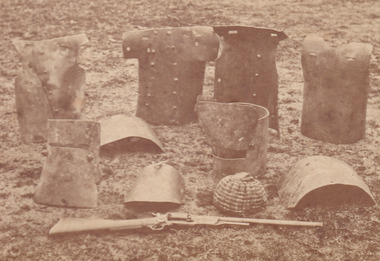
... Reverse: Kellys armour/ BMM 8084...This photograph has the capacity to provide important information about the construction of the armour used by the Kelly gang at Glenrowan and importantly dates to 1880. kelly album Reverse: Kellys armour/ BMM 8084 This photograph is a cabinet portrait commissioned by the police depicting the Kelly armour arranged on the ground at Glenrowan following the siege by Ned Kelly and the Kelly gang in 1880. ...This photograph was taken by James Bray who worked as a professional photographer in Camp Street Beechworth from 1870-1891. He was one of four men who photographed the Kelly gang after the siege in Glenrowan in 1880. He is also renowned for his previous work photographing members of the Kelly gang. The photograph depicts pieces of the Kelly gang's armour crafted from plough mouldboards which are arranged on the ground. The exact relation of each piece of armour to the Kelly members was unclear for many years following the siege because the suits were disassembled without documentation and rearranged by guesswork. It was through photographs like this one, which depict the armour very soon after the siege that enabled researchers, in 2002, to reunite each of the suits with their correct pieces. This image is identified as a "Cabinet Portrait". This refers to a photograph mounted on a hard piece of cardboard. They are larger and thicker than the Carte de Visite and gradually replaced the latter in popularity after the 1860s. Identifying features of the Cabinet Portrait is on the front of the image which is generally embossed (or printed) with the details of the photographer. In the case of this image, James Bray is identified as photographer. The image is yellow in tone which compliments the gold coloured mount of the photograph. This photograph is part of the Burke Museum "Kelly album" which includes a significant collection of photographs and artefacts connected to Ned Kelly and the Kelly Gang. Ned Kelly and his gang have become ingrained in Australian popular culture and thus many museums, art galleries and private collections house material connected to the Kelly story which allows the events and people to be researched and interpreted. Artefacts and photographs pertaining to the Kelly gang are particularly valuable for Australian museums. This particular photograph is significant for its connection to Beechworth photographer James Bray who is responsible for many images depicting members of the Kelly gang. The photograph is also of artistic significance as an example of a Cabinet Portrait dating to 1880. This image was commissioned by the police shortly after the defeat of the Kelly gang at Glenrowan. The armour was collected and placed on the ground for photography. No care was taken to retain the correct grouping of the armour and therefore, the identity of each piece to the correct owner was unclear for many years. Photographs of the armour taken at the time, like this one, helped researchers to reconstruct the correct armour and identify which pieces belonged to which member of the Kelly gang which is significant for Australian history. This photograph has the capacity to provide important information about the construction of the armour used by the Kelly gang at Glenrowan and importantly dates to 1880.This photograph is a cabinet portrait commissioned by the police depicting the Kelly armour arranged on the ground at Glenrowan following the siege by Ned Kelly and the Kelly gang in 1880. The armour includes helmets, breastplates a rifle and the inner knitted helmet worn by Ned Kelly. Reverse: Kellys armour/ BMM 8084kelly album -
 Bendigo Military Museum
Award - VICTORIA CROSS, Post 1945
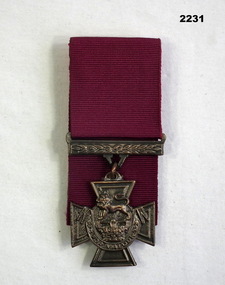
... The item as used for school groups who visited the BMM Museum....The item as used for school groups who visited the BMM Museum. Awards medals for valour Replica "Victoria Cross", Court mounted crimson ribbon. ...The item as used for school groups who visited the BMM Museum.Replica "Victoria Cross", Court mounted crimson ribbon. A clasp attached to the ribbon holds the "Cross" via a ring. Centre of the cross is a lion over a crown. A scroll under say "For Valour". awards, medals, for valour -
 The Beechworth Burke Museum
Photograph
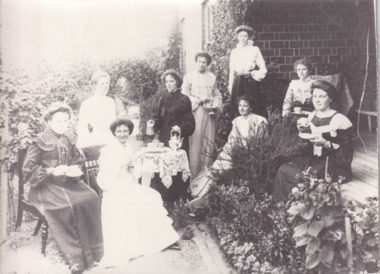
... Reverse: BMM 8785 / 1997 2600/ PH 79 ...This image depicts the way in which female residents in Beechworth in the late 1800s would enjoy their time through garden tea parties, providing insight to their ways of entertainment. beechworth tea party burke museum garden party garden verandah cups and saucers Reverse: BMM 8785 / 1997 2600/ PH 79 Black and white rectangular reproduced photograph printed on matte photographic paper Photograph Photograph ...A large black and white photograph of 9 ladies dressed in long garms with tea cups and saucers, some standing and some sitting in a house garden and onto verandah. A central figure is pouring tea from a silver pot on a table with a lace table cloth. This image depicts the way in which female residents in Beechworth in the late 1800s would enjoy their time through garden tea parties, providing insight to their ways of entertainment. Black and white rectangular reproduced photograph printed on matte photographic paper Reverse: BMM 8785 / 1997 2600/ PH 79 beechworth, tea party, burke museum, garden party, garden, verandah, cups and saucers -
 The Beechworth Burke Museum
Photograph, different times
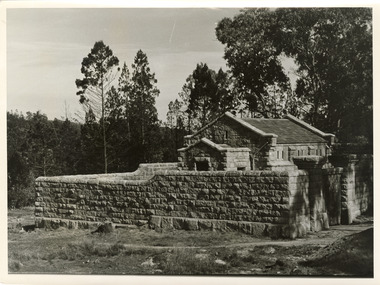
... 1. Reverse BMM 8666.1 2. Reverse Photo/ Noel C Elliston/ Wangaratta/ BMM 8666.2 3. ...Reverse Photo The Age (not used)/ 13777/ S/S 4 1/16"/ 133 Screen/ Copyright stamp/ BMM 8666.3 4. Reverse Roof has been removed/ BMM 8666.4 5. ...The Powder Magazine at Beechworth was built in 1859 with the stone boundary walls completed the following year. The building was used to store large amounts of gunpowder for the surrounding mining and quarrying industries. It was closed in 1918 and was left to deteriorate over the following decades. During the depression, people would camp in the deteriorating building so the council had the roof removed. The roof and the building were restored between 1963-1966 by the National Trust of Australia (Victoria) and is now structurally sound and open to the public. These photographs are significant as they depict a building that is historically significant with the history of gold mining in the area, demonstrating the features of the buildings being designed for the safe storage of black powder.Black and white rectangular photographs printed on paper1. Reverse BMM 8666.1 2. Reverse Photo/ Noel C Elliston/ Wangaratta/ BMM 8666.2 3. Reverse Photo The Age (not used)/ 13777/ S/S 4 1/16"/ 133 Screen/ Copyright stamp/ BMM 8666.3 4. Reverse Roof has been removed/ BMM 8666.4 5. Reverse Photo by F Strahan Parkville/ (unknown writing), 1965/ Reduce to 5 5/8 wide/ 133 Screen 13777/ BMM 8666.5 6. Reverse BMM 8666.6/ Replacing roof 1965 7. Obverse Powder magazine/ proposed to be built/ at Portland 7. Reverse Enlarge to 4"/ 2 H T Blocks/ 133 Screen 13955/ Melb University Press/ BMM 8666.7powder magazine, beechworth powder magazine, gold mining, quarry, historical building, buildings -
 The Beechworth Burke Museum
Container - Trunk, c1870
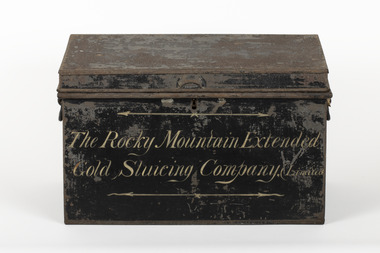
... The Rocky Mountain Extended / Gold Slucing Company. (Limited / BMM 8068...The Rocky Mountain Extended / Gold Slucing Company. (Limited / BMM 8068 A tin trunk painted in black with gold script painted on the front. ...A tin trunk used by the Rocky Mountain Extended Sluicing Company (Limited).Mining played an important role in the history of Beechworth, for the township was established in the mid-1850s after gold was discovered in the area. The success of goldmining lead to the growth and development of early Beechworth. The Rocky Mountain Company was a very successful gold mining company and had a big impact on the people and landscape of early Beechworth.A tin trunk painted in black with gold script painted on the front.The Rocky Mountain Extended / Gold Slucing Company. (Limited / BMM 8068 -
 The Beechworth Burke Museum
Photograph
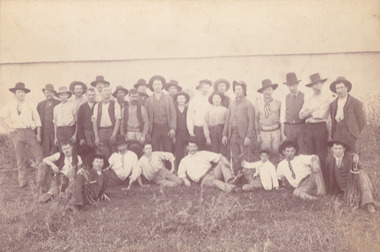
... Reverse: BMM 8032/ Group(?) Beechworth Mines about 1900/ 80...This image is of important historical significance for its ability to convey information about society at the time, regarding fashion (which can potentially reveal social status) and mining in Beechworth in 1900. quartz north east gold sluicing gold sluicing hydraulic sluicing mining gold mining north-east victoria beechworth burke museum 1900 group miners hats vests ties wild shrubs tin quartz mining Reverse: BMM 8032/ Group(?) Beechworth Mines about 1900/ 80 Black and white rectangular photograph printed on matte photographic paper mounted on board. ...The photograph, captured around 1900, depicts a large group of minors located in Beechworth. Importantly, this photograph can provide information into the clothing and fashion of minors during this period of history. These men wear loose fitting shirts which are mostly a pale white colour, several wear vests and/or jackets and loose fitting trousers with boots. The majority of men wear wide brimmed hats to protect their skin and eyes from the sunlight. One man has a wooden pipe in his mouth and a few have ties/neckerchief's tied around their necks. The outfits of these miners has the potential to provide insight into their social status, these men are all dressed equally which provides the notion that they are of equal societal standing. The outfits of these miners dating to the 1900s is not dissimilar to photographs of those captured in the 1880s. The location of this photograph is not easy to interpret, but the photograph is recorded to have been taken in the Beechworth region. Displayed in this image is some wild shrubbery and grass where the men are standing/sitting and behind the group is a tin wall or even tin building. At the end of 1899, companies were continuing to search for gold in Beechworth and the surrounds but these attempts were not overly successful. In the early 1900's Quartz mining was occurring but this was done by individuals or smaller parties. It is unclear if these men are mining for gold or for quartz.The search for gold is ingrained into the history of Victoria and therefore, the study of images like this one which portrays some of the miners who worked behind-the-scenes for these discoveries has the potential to reveal important information regarding society, fashion etc. The date when the photograph was taken is vague but it allows us to form a timeline of mining activities in the North East. This image is of important historical significance for its ability to convey information about society at the time, regarding fashion (which can potentially reveal social status) and mining in Beechworth in 1900. Black and white rectangular photograph printed on matte photographic paper mounted on board.Reverse: BMM 8032/ Group(?) Beechworth Mines about 1900/ 80quartz, north east gold, sluicing, gold sluicing, hydraulic sluicing, mining, gold mining, north-east victoria, beechworth, burke museum, 1900, group, miners, hats, vests, ties, wild shrubs, tin, quartz mining -
 The Beechworth Burke Museum
Postcard
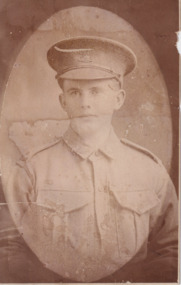
... Reverse: BMM 2640.4 / P RD / Write here for Inland Postage on /...This is due to the ongoing public and scholarly interest in war, history, and especially the ANZAC legend, which is commemorated annually on 25 April, known as ANZAC Day. military album aif australian imperial force corporal war wwi world war i rising sun badge uniform military Reverse: BMM 2640.4 / P RD / Write here for Inland Postage on / Sepia rectangular postcard printed on card. ...Taken on an unknown date, depicted is a portrait of a young, unidentified male soldier. He is dressed in an Australian military uniform. It is believed that this soldier was part of The Australian Imperial Force during World War I. This can be inferred by the chevron rank insignia visible on the uniform. The placement of this insignia on the sleeve of the right arm suggests that this soldier was either a Warrant Officer or a Non-Commissioned Officer (NCO). Specifically, the number of chevron stripes - here, there are two - are believed to signify a Corporal rank. The man in this photograph is also wearing a 'Rising Sun' collar badge on his coat. Australia, unlike most other Commonwealth countries, did not adopt metal regimental badges during the First World War. All units were issued with the Australian Army General Service Badge, better known as the 'Rising Sun’ badge. This insignia is almost always identified with the Australian Imperial Force.The record is historically significant due to its connection to World War I. This conflict is integral to Australian culture as it was the single greatest loss of life and the greatest repatriation of casualties in the country's history. Australia’s involvement in the First World War began when the Australian government established the Australian Imperial Force (AIF) in August 1914. Immediately, men were recruited to serve the British Empire in the Middle East and on the Western Front. The first significant Australian action of the war was the Australian Naval and Military Expeditionary Force’s (ANMEF) landing on Rabaul on 11 September 1914. The ANMEF took possession of German New Guinea at Toma on 17 September 1914 and of the neighbouring islands of the Bismarck Archipelago in October 1914. On 25 April 1915, members of the AIF landed on Gallipoli in Turkey with troops from New Zealand, Britain, and France. This specific event holds very strong significance within Australian history. The record has strong research potential. This is due to the ongoing public and scholarly interest in war, history, and especially the ANZAC legend, which is commemorated annually on 25 April, known as ANZAC Day.Sepia rectangular postcard printed on card.Reverse: BMM 2640.4 / P RD / Write here for Inland Postage on /military album, aif, australian imperial force, corporal, war, wwi, world war i, rising sun, badge, uniform, military -
 The Beechworth Burke Museum
Photograph, c1970
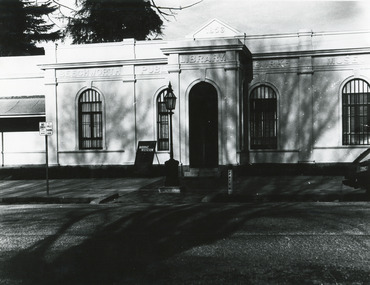
... Obverse: 1856/ BEECHWORTH/ PUBLIC/ LIBRARY/ BURKE/ MUSEUM/ BURK MUSEUM/ (parking signs illegible) Reverse: BMM 84-2-1/ A02989 1997 2696/ BMM 84-2-3...Burke Museum Beechworth Beechworth Athenaeum Athenaeum memorial Robert O'Hara Burke Robert Burke Burke and Wills exhibitions Obverse: 1856/ BEECHWORTH/ PUBLIC/ LIBRARY/ BURKE/ MUSEUM/ BURK MUSEUM/ (parking signs illegible) Reverse: BMM 84-2-1/ A02989 1997 2696/ BMM 84-2-3 Black and white rectangular photograph printed on paper. ...Historical photograph taken of the frontage of the Burke Museum in Beechworth. As Australia’s oldest regional museum, the building used for the Burke Museum was originally built as the Beechworth Athenaeum, and was later dedicated as a museum in memorial to the explorer Robert O’Hara Burke, who died on the Burke and Wills expeditions in 1861. The Burke and Wills exhibitions were a significant colonial event that was memorialised in paintings, buildings, monuments, and statues. The photograph has historical significance, connecting with various themes such as exploring, establishing pathways, and significant colonial events or persons. The photograph depicts the frontage of the Burke Museum, which was dedicated as a memorial to the explorer Robert O’Hara Burke, who died on the Burke and Wills expeditions in 1861. Robert O’Hara Burke was a significant person who was connected to both Beechworth and to an important colonial event, the Burke and Wills expeditions. Born in Ireland, Burke migrated to Australia in 1853 and nearly a year later, was appointed to senior inspector at Beechworth. Described as quick-tempered yet generous, Burke later joined an expedition to explore the interior of the Victorian colony, which was later termed the Burke and Wills expeditions. While the expeditions generated a significant amount of interest, the objectives of the Burke and Wills expeditions were hazy, as was its planned route, leading to disaster on the trip as group infighting, poor provisions, and a lack of clear instructions ultimately resulted in Burke’s death. Regardless, the Burke and Wills expeditions promoted discovery and endures today in popular memory.Black and white rectangular photograph printed on paper.Obverse: 1856/ BEECHWORTH/ PUBLIC/ LIBRARY/ BURKE/ MUSEUM/ BURK MUSEUM/ (parking signs illegible) Reverse: BMM 84-2-1/ A02989 1997 2696/ BMM 84-2-3burke museum, beechworth, beechworth athenaeum, athenaeum, memorial, robert o'hara burke, robert burke, burke and wills exhibitions -
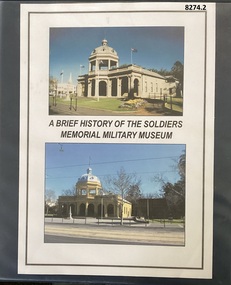 Bendigo Military Museum
Literary work - MILITARY MUSEUM HISTORY, A brief history of the Soldiers Memorial Institute Military Museum Bendigo
... ...Bmm...Brsl Smirsl Brief history Bmm “Compiled and written by Peter Ball” Folder, 4 Binder A4 blue covers with plastic inserts, text is typed in red & black No 1 - 67 pages, 9 Parts plus a Postscript. 52 pages of photos up to 6 per page, 12 pages plans, sketches, 6 Museum newsletters from a total of 84, 6 pages of awards to Museum Volunteers, Museum Volunteers Honour roll, those who have passed on. ...The main reason for this brief history of the Soldiers Memorial Institute Military Museum (now Bendigo Military Museum) came about due to the cataloguing of the Soldiers Memorial Institute Building and the Bendigo RSL history as a section of the Cataloguing of the Museum collection. The Bendigo RSL has held occupancy of the SMI building since it was opened in 1921. The how and why the SMI became a Museum was not really documented as such in the minutes/records of the Bendigo RSL pre 1998 when the Museum opened to the Public. Any records were mainly “one Liners”. The coverage begins in 1993 with the Billiard room being turned into a “Drop in Centre” for RSL Members and a small Memorabilia display. The main theme is from 1997 to 2021 inclusive to cover 25 years and the 100th birthday of the SMI Building. Those years cover the build up from minimum to maximum, the first paid staff, renovations minor and major with closure, the first paid Curator and more paid staff, the big re opening and then the crash of Covid and losing the Curator and Staff, coming out of into uncertainty. The following 3 years 2022 - 2024 give a glimpse of that uncertainty but slowly gaining a Curator again. Post script is a a dot point brief of the main items. Part 1 - 1993 - Feb 1998. The early years. Part 2 - 1998 - 2002. Opening up and learning. Part 3 - 2003 - 2008. Sub Committee formed and moving forward. Part 4 - 2009 - 2014. Camera on the Somme, renovations and planning begins. Part 5 - 2015 - 2018. Changes begin, re development, closure and re opening. Part 6 - 2019 - 2021. A big year and the Covid crash. Part 7 - 2022 - 2024. Uncertainty and moving forward. Part 8 - Awards. Part 9 - Post script 2025 - 2026............. Appendices Volunteers Honour Roll (Those that have passed on) ………. Photos are a small selection of over 1,100 images. This history is for the Volunteers for without them there would not have been a Museum.Folder, 4 Binder A4 blue covers with plastic inserts, text is typed in red & black No 1 - 67 pages, 9 Parts plus a Postscript. 52 pages of photos up to 6 per page, 12 pages plans, sketches, 6 Museum newsletters from a total of 84, 6 pages of awards to Museum Volunteers, Museum Volunteers Honour roll, those who have passed on. These are added in where appropriate to the story.“Compiled and written by Peter Ball”brsl, smirsl, brief history, bmm -
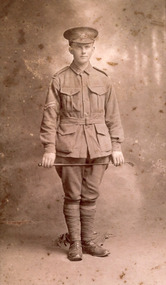 The Beechworth Burke Museum
Photograph, 1916-17
... Reverse: BMM 8779 item catalogue number pencilled in right-hand bottom corner....Peach is also one of the diarists of WWI, including of this significant period of Australian military history, from 1916 to 18, which can be accessed via the Australian War Memorial. military medal defending Australia and Victoria military service HMAT A64 Demosthenes Wipers ANZAC Burke Museum Beechworth Ypres Australian military services Beechworth Post Office First World War wartime our boys Belgium Flanders Fields WW1 British War Medal Victory Medal Broodseinde Third Battle of Ypres Reverse: BMM 8779 item catalogue number pencilled in right-hand bottom corner. ...Portrait of William Edward Peach in First World War military uniform, holding a crop in front of his thighs with military kit on the ground behind him. A Beechworth postal employee who enlisted in 1915, this photograph is probably taken in 1917, as he is a corporal in the photo and was promoted to this rank in May 1917. This photograph is of historic significance as it depicts William Edward Peach, a Beechworth postal assistant who enlisted in the Australian Imperial Force (AIF) on his nineteenth birthday, 5 August 1915, which required his parents' permission. He was decorated with the military medal for his courage in battle 4/5 October 1917 at the Battle of Broodseinde Ridge near Ypres, the most successful allied attack of the Third Battle of Ypres (31 July to 10 November 1917), also known as the Battle of Paschendale, which saw the greatest loss of human life during World War One, with almost half a million lives were lost on all sides. According to the recommendation for his military medal, Peach 'displayed conspicuous courage and initiative', taking charge after his platoon commander became a casualty, handling the men 'under heavy fire with great skill'. He also assisted the Company Commander in reorganising their military objectives. The photograph is of social as well as historic significance for the Beechworth community, because it provides a direct link between local, national and international histories in relation to Australia' s participation in one of WWI's best-known battles. The record has strong research potential given the ongoing public and scholarly interest in war, history, and especially the ANZAC legend, which is commemorated annually on 25 April, known as ANZAC Day. Peach is also one of the diarists of WWI, including of this significant period of Australian military history, from 1916 to 18, which can be accessed via the Australian War Memorial. Sepia rectangular photograph printed on gloss Kodak photographic paper mounted on board. Reverse: BMM 8779 item catalogue number pencilled in right-hand bottom corner.military medal, defending australia and victoria, military service, hmat a64 demosthenes, wipers, anzac, burke museum, beechworth, ypres, australian military services, beechworth post office, first world war, wartime, our boys, belgium, flanders fields, ww1, british war medal, victory medal, broodseinde, third battle of ypres -
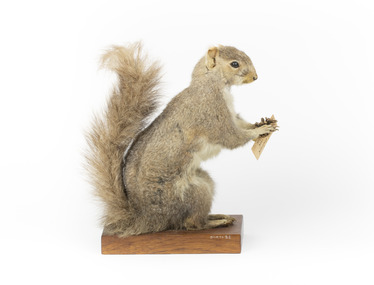 The Beechworth Burke Museum
Animal specimen - Squirrel, Trustees of the Australian Museum, 1860-1880
... 40. ash-coloured / Squirrel / Catalogue, Page, 49. / A.4484 / BMM 75 32 /...This collection continues to be on display in the Museum and has become a key part to interpreting the collecting habits of the 19th century. taxidermy mount taxidermy animalia burke museum beechworth australian museum skin reynell eveleigh johns squirrel 40. ash-coloured / Squirrel / Catalogue, Page, 49. / A.4484 / BMM 75 32 / Grey Squirrel standing on a wooden platform. ...The Squirrel is a small to medium sized member of the rodent family Sciuridae. They are commonly located in America, Eurasia and Africa. The Squirrel was introduced to Australia by humans. Interestingly, the tail of the Squirrel serves the purpose of keeping the rain, wind or cold off the body of the animal, to help it cool off in hot weather, to counterbalance when moving and can be utilized as a parachute when jumping from one location to the next. Squirrels consume foods that are rich in protein, carbohydrates and fats. They eat nuts, seeds. fruits and vegetation. This specimen is part of a collection of almost 200 animal specimens that were originally acquired as skins from various institutions across Australia, including the Australian Museum and the National Museum of Victoria, as well as individuals such amateur anthropologist Reynell Eveleigh Johns between 1860-1880. These skins were then mounted by members of the Burke Museum Committee and put-on display in the formal space of the Museum’s original exhibition hall where they continue to be on display. This display of taxidermy mounts initially served to instruct visitors to the Burke Museum of the natural world around them, today it serves as an insight into the collecting habits of the 19th century.This specimen is part of a significant and rare taxidermy mount collection in the Burke Museum. This collection is scientifically and culturally important for reminding us of how science continues to shape our understanding of the modern world. They demonstrate a capacity to hold evidence of how Australia’s fauna history existed in the past and are potentially important for future environmental research. This collection continues to be on display in the Museum and has become a key part to interpreting the collecting habits of the 19th century.Grey Squirrel standing on a wooden platform. The small sized specimen holds a pinecone between its hands and has a paper identification tag tied to one of its arms. It has grey/ash coloured fur with a pale belly and dark coloured glass eyes. It has a long and bushy tail that stands along its back in an arched shape. It has tiny hands and feet.40. ash-coloured / Squirrel / Catalogue, Page, 49. / A.4484 / BMM 75 32 /taxidermy mount, taxidermy, animalia, burke museum, beechworth, australian museum, skin, reynell eveleigh johns, squirrel -
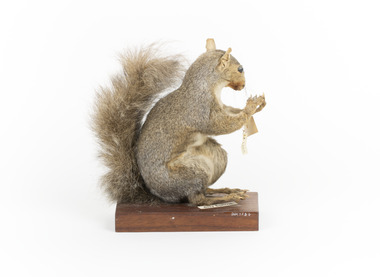 The Beechworth Burke Museum
Animal specimen - Grey Squirrel, Trustees of the Australian Museum, 1860-1880
... Grey Squirrel / BMM 7534 / A.4485/ 41. Squirrel Sp / Catalogue Page, 49 /...This collection continues to be on display in the Museum and has become a key part to interpreting the collecting habits of the 19th century. taxidermy mount taxidermy animalia burke museum beechworth australian museum skin reynell eveleigh johns squirrel Grey Squirrel / BMM 7534 / A.4485/ 41. Squirrel Sp / Catalogue Page, 49 / This specimen has silver-grey fur with a brown colouring located on the face and a pale underside. ...The Grey Squirrel is a small to medium sized member of the rodent family Sciuridae. This species is commonly located in England, Wales and central Scotland. They are known for their agility and ability to climb trees. Interestingly, the tail of the Squirrel serves the purpose of keeping the rain, wind or cold off the body of the animal, to help it cool off in hot weather, to counterbalance when moving and can be utilized as a parachute when jumping from one location to the next. Squirrels consume foods that are rich in protein, carbohydrates and fats. They eat nuts, seeds. fruits and vegetation. This specimen is part of a collection of almost 200 animal specimens that were originally acquired as skins from various institutions across Australia, including the Australian Museum and the National Museum of Victoria, as well as individuals such amateur anthropologist Reynell Eveleigh Johns between 1860-1880. These skins were then mounted by members of the Burke Museum Committee and put-on display in the formal space of the Museum’s original exhibition hall where they continue to be on display. This display of taxidermy mounts initially served to instruct visitors to the Burke Museum of the natural world around them, today it serves as an insight into the collecting habits of the 19th century.This specimen is part of a significant and rare taxidermy mount collection in the Burke Museum. This collection is scientifically and culturally important for reminding us of how science continues to shape our understanding of the modern world. They demonstrate a capacity to hold evidence of how Australia’s fauna history existed in the past and are potentially important for future environmental research. This collection continues to be on display in the Museum and has become a key part to interpreting the collecting habits of the 19th century.This specimen has silver-grey fur with a brown colouring located on the face and a pale underside. The tale stands tall along the back of the specimen and is bushy. The specimen is of a smaller size and has no tuffs on its ears. It stands on a wooden platform and has two paper tags tied to its hands.Grey Squirrel / BMM 7534 / A.4485/ 41. Squirrel Sp / Catalogue Page, 49 /taxidermy mount, taxidermy, animalia, burke museum, beechworth, australian museum, skin, reynell eveleigh johns, squirrel -
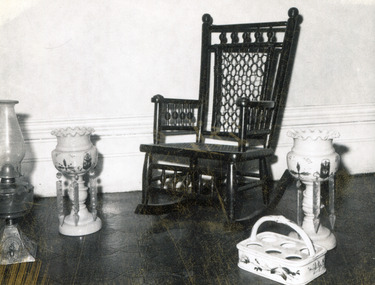 The Beechworth Burke Museum
Photograph, The Ovens and Murray Advertiser, Unknown
... Reverse: BMM A03328/ 1997.3132/ 28 1/2 ems/ E32k491/ THE OVENS AND MURRAY ADVERTISER...Moreover, it also has protentional to demonstrate the shifting designs of rocking chairs, kerosene lamps, bottle holders and epergnes. rocking chair chair lamp kerosene lamp bottle holder Burke Museum Beechworth Reverse: BMM A03328/ 1997.3132/ 28 1/2 ems/ E32k491/ THE OVENS AND MURRAY ADVERTISER Black and white rectangular photograph printed on paper. ...The photograph depicts a rocking chair, a kerosene lamp, a bottle holder, and two epergnes.The photograph contains historical and research significance of domestic life in Beechworth. Through the depiction of the historical rocking chair, the kerosene lamp, the bottle holder and the epergnes, the picture displays some of the everyday objects that would have been found within a Beechworth house. Although kerosene lamps and bottle holders are no longer in widespread use, this photograph not only acts as historical document and depiction of both, but it also displays the evolution of everyday tools. The interpretive capacity of the photograph extends its significance as it contains the potential to reveal information regarding the domestic life of Beechworth residents. Moreover, it also has protentional to demonstrate the shifting designs of rocking chairs, kerosene lamps, bottle holders and epergnes.Black and white rectangular photograph printed on paper.Reverse: BMM A03328/ 1997.3132/ 28 1/2 ems/ E32k491/ THE OVENS AND MURRAY ADVERTISERrocking chair, chair, lamp, kerosene lamp, bottle holder, burke museum, beechworth -
 The Beechworth Burke Museum
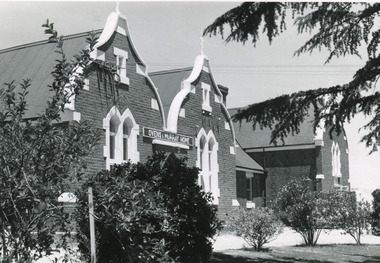
Photograph, J. Collins, c.1940-1950s
... Obverse: OVENS & MURRAY HOME / Reverse: KODAK PAPER / 727 / J. Collins BMM 8689.1 /...It can also be studied for what it reveals about society in Beechworth and compared and contrasted to similar institutions across Australia and with additional photographs in the Burke Museum collection. mayday hills beechworth benevolent asylum ovens benevolent home asylum refuge poor and destitute goldrush flemish gothic revival architecture Obverse: OVENS & MURRAY HOME / Reverse: KODAK PAPER / 727 / J. Collins BMM 8689.1 / Black and white rectangular photograph printed on gloss photographic paper Photograph Photograph J. ...This photograph was captured sometime between an estimated 1940s-1950s. It depicts the Beechworth Benevolent Asylum (later the Ovens and Murray Hospital for the Aged) which was built in 1862. It is located on an elevated site in Beechworth, Victoria because it was believed the height was beneficial to the health of the patients at the Benevolent. Later wings were added to the original building between 1867 and 1890. The building was constructed in an unusual Flemish Gothic Revival style which contrasts with the classical style of the Mayday Hills Hospital in close proximity to the Benevolent. The Hospital was designed in Italianate Revival architecture. The appearance of buildings like the Mayday Hills Hospital and the Ovens Benevolent Asylum are representative of the importance of Beechworth as a town shortly after the goldrush. During the 1850s and 1860s, administration buildings were erected alongside churches, shops and structures of justice. This marks a movement away from the "chaotic" structure of life on the goldfields and towards a more civilised and cultural lifestyle. This social phenomenon is also witnessed in Melbourne with the creation of buildings like the State Library and the University of Melbourne. The Beechworth Benevolent Asylum was renamed the Ovens Benevolent Home in 1935. The Asylum had been set up to provide accommodation and care for permanently injured gold miners, and for women and children who were penniless, homeless, or whose parents were guests of the state. In 1954 it was renamed as The Ovens and Murray Home (as pictured in this photograph). The purpose of this building was to provide a refuge for the poor and destitute, homeless older men, deserted women and children along with providing care for the mentally ill. These buildings were built at the government's expense and are of great historical and architectural significance.This photograph depicts the Ovens and Murray Home (previously the Ovens Benevolent Home) during the 1940s or 1950s. Since this building is of great historic and architectural significance, photographs like this are especially valuable in reconstructing the use history and any changes/additions to the building over a period of time. This building is important for what it can reveal about society in Beechworth and also architectural styles. This building is made in the Flemish Gothic Revival style which is quite unusual for the 1860s. It is important as an early example of a building constructed for a specific purpose, in the case of this particular building: caring for the aged/destitute. This building is important for research into the civic development of Beechworth as an early Gold Rush town located in Victoria's North-East. During this period, Beechworth was developing as the main center of administration in this region which made it a very influential and quickly developed town. Photographs like this one which depict a building during one period in history can reveal important information for the use and alterations of a building and for preferences in architectural style. It can also be studied for what it reveals about society in Beechworth and compared and contrasted to similar institutions across Australia and with additional photographs in the Burke Museum collection.Black and white rectangular photograph printed on gloss photographic paperObverse: OVENS & MURRAY HOME / Reverse: KODAK PAPER / 727 / J. Collins BMM 8689.1 /mayday hills, beechworth benevolent asylum, ovens benevolent home, asylum, refuge, poor and destitute, goldrush, flemish gothic revival, architecture -
 The Beechworth Burke Museum
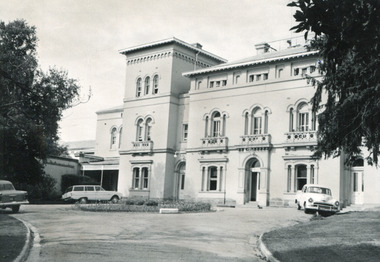
Photograph - Photographs, E. Yellard, c. 1950's
... 8688.1 reverse: Beechworth / Mental / Hospital / 80% 19cm / 12 cm / 80% / 728 / New / Print / BMM / 8688.1 / E. / Yellard / [Stamped : ILFORD] 8688.2 reverse: Beechworth / Mental / Hospital / E. / Yellard / BMM / 8688.1 / [Stamped : ILFORD]...Yellard The Public Works Department Public Works Department hospital Mayday Hills Hospital Beechworth Lunatic Asylum Lunatic Asylum Asylum Ovens goldfield Indigo Shire Indigo Shire gold rush 8688.1 reverse: Beechworth / Mental / Hospital / 80% 19cm / 12 cm / 80% / 728 / New / Print / BMM / 8688.1 / E. / Yellard / [Stamped : ILFORD] 8688.2 reverse: Beechworth / Mental / Hospital / E. / Yellard / BMM / 8688.1 / [Stamped : ILFORD] 2 x black and white rectangular photographs [copies] printed on Ilford photographic paper Photograph Photographs E. ...Two rectangular black and white photographs of the Beechworth Mental Hospital (Mayday Hills) administrative building showing the left and right hand sides of the exterior building with three cars parked in driveway turning circle in the foreground taken in the 1950's by E. Yellard. Mayday Hills Hospital, originally known as the Beechworth Lunatic Asylum was constructed between 1864-67 designed by The Public Works Department. The hospital is made up of a number of buildings, landscaping, ha-ha, workshops, laundry, administrative facilities and farmland, it was constructed in 'Italianate' style by a team of up to two hundred and fifty workers (Woods p. 122). The asylum was established in response to the need for the regional shire to locally care for those particularly affected by their time working the Ovens goldfield during the Indigo Shire gold rush era where poor living conditions and isolation were significantly affecting the welfare of a great many people through poverty and lack of resources. The gaol and orphan labour systems were not able to effectively support to give housing, rehabilitation and ongoing care for the mentally ill, and transporting to Melbourne by waggon was a time consuming and counter-productive solution when the metro facilities were already overcrowded. According to Woods (A Titan's Field p. 122), between 1901 and 1911 a large percentage (thirty five percent in 1901 and twenty four in 1911) of the Beechworth population were either patients or inmates of Beechworth institutions, Mayday Hills accounted for some six hundred and seventy four patients in 1901, Beechworth's Mayday Hills was chosen as the site of Victoria's newest asylum, at the time, due to the landscape and altitude. The hilltop atmosphere and the native fauna, it was argued, would assist in the cure of the patients kept at the hospital (Wood 1985, 122). The positioning of the hospital had a beneficial effect on the rural town and the large volume of people living at the hospital and contributing to this population growth is counted as reason for the survival of Beechworth as a regional township. According to the Victorian Heritage database, during the period 1921-1950 Mayday Hills underwent some modernisation by Public Works Department architect Percy Everett which included a nurses' hostel and new ward which were further developed and continued to function as a mental hospital up until 1995 when it was sold to LaTrobe university. The building and grounds are listed on the Victorian Heritage Register under criterion A, B, D, E and F.These photographs give a good indication of the ongoing use of Mayday Hills from its original establishment in the 1860's through to almost one hundred years later when these photographs were taken. The clarity of the images combined with the style and make of the cars in the foreground give a good indication of the time period and show the continued use and need for the facility over the years. Through images of building facades such as these, we might gain fuller understanding of the structural and aesthetic characteristics to be used in any future development or restorative work.2 x black and white rectangular photographs [copies] printed on Ilford photographic paper8688.1 reverse: Beechworth / Mental / Hospital / 80% 19cm / 12 cm / 80% / 728 / New / Print / BMM / 8688.1 / E. / Yellard / [Stamped : ILFORD] 8688.2 reverse: Beechworth / Mental / Hospital / E. / Yellard / BMM / 8688.1 / [Stamped : ILFORD]administrative building, black and white photographs, beechworth, mental hospital, beechworth mental hospital, mayday hills, cars, 1950, e. yellard, the public works department, public works department, hospital, mayday hills hospital, beechworth lunatic asylum, lunatic asylum, asylum, ovens goldfield, indigo shire, indigo shire gold rush -
 The Beechworth Burke Museum
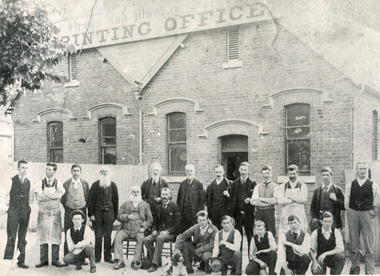
Photograph, c1900
... Obverse: Ovens and Murray/ Printing Office Reverse: Ovens and Murray Advertiser Staff 7721/ Beechworth/ BMM 79.15...Ovens and Murray advertiser the ovens and murray advertiser Newspaper printing richard warren journalism advertising 1800s 1800s Beechworth #beechworth local business advertiser workmen hats printers journalists Warren mary ann mitchell mary ann warren R Warren loch street 1890s 1890s Beechworth Obverse: Ovens and Murray/ Printing Office Reverse: Ovens and Murray Advertiser Staff 7721/ Beechworth/ BMM 79.15 Rectangular black and white photo printed on photographic material, unmounted. ...This photograph shows a group of workmen outside the Loch Street Printing Office of the Ovens and Murray Advertiser in Beechworth. The Advertiser was a local paper, first printed as a weekly in 1855, and then as a daily in 1857. It continues to be printed today, albeit in a different form. Initially based on Ford Street, the Loch Street office opened in 1893, after printing facilities were updated. The Advertiser was launched by architect Francis Hodgson Nixon with assistance from businessman John Henry Gray, and newspaperman Richard Warren. Warren was sole owner from 1860 until his death in 1906, and it responsible for much of the paper’s success. He appears in this photo alongside twenty of his staff and is the man standing directly in front of the doorway. When it launched, the paper’s goals included coverage of local events, as well as of global news, and the promotion of economic liberty, arts, and sciences. Beyond these initial goals, the Advertiser was instrumental in local politics, particularly Beechworth’s association with conversates and constitutionalism in the 1860s and 1870s. Numerous other papers sprung up to contest the Advertiser’s hold during the latter half of the nineteenth-century, but none were able to completely oust it from its post. As well as representing a key chapter in Beechworth’s history, the Advertiser can be used as a key source for the stories and figures of historic Beechworth. As well as managing the Advertiser, Richard Warren's owned or managed multiple businesses in Beechworth, founded the Ovens hospital and Benevolent asylum, invested in local companies, and participated in a range of religious brotherhoods and societies. He married Mary Ann Mitchell when he was twenty-six, and, while the couple were unable to have children, they adopted one son, who began managing the Advertiser in the late-nineteenth century. This photograph has historic significance afor its relationship to the history of the Ovens and Murray Advertiser, which is a key example of of successful nineteenth-century business in Beechworth, and for including an image of Richard Warren, a key figure in the period.Rectangular black and white photo printed on photographic material, unmounted. Obverse: Ovens and Murray/ Printing Office Reverse: Ovens and Murray Advertiser Staff 7721/ Beechworth/ BMM 79.15ovens and murray advertiser, the ovens and murray advertiser, newspaper, printing, richard warren, journalism, advertising, 1800s, 1800s beechworth, #beechworth, local business, advertiser, workmen, hats, printers, journalists, warren, mary ann mitchell, mary ann warren, r warren, loch street, 1890s, 1890s beechworth -
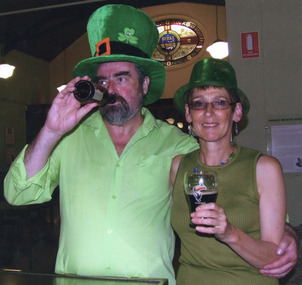 The Beechworth Burke Museum
Photograph, c.2000s
... First Card: WITKOWSKI, Beryl / TOOLE, James / BMM 3067 / Databased Second Card: Burke Museum / 3067 /...Burke Museum Beechworth museum staff celebrations st patrick's day beer Australia st patrick's day celebration First Card: WITKOWSKI, Beryl / TOOLE, James / BMM 3067 / Databased Second Card: Burke Museum / 3067 / A colour, square photograph printed on rectangular photographic paper. ...This is a photograph of two people (James Toole and Beryl Witkowski) amid celebrations for St Patrick's Day at the Burke Museum in an unknown year. St Patrick's Day is traditionally an Irish religious holiday, but has been adopted in countries such as Australia to celebrate an idea of Irish culture. These celebrations often include wearing green clothes, especially a shamrock hat, and drinking beer, all pictured here. This celebration appears to be taking place within the Burke Museum itself, with museum's iconic stained glass oval window in the background. The Museum, situated in Beechworth, holds a collection of over 30,000 individual objects - including this photograph. James Toole (left) was the 'face of the Beechworth Post Office' until his retirement in 2015, following a 45-year career in mail service. He is a Friend of the Burke Museum, volunteering on projects such as crafting the Burke Museum's float in the 2018 Beechworth Bakery and Beechworth Honey Grand Parade at the Golden Horseshoes Festival. He is known for his flamboyant character. Beryl Witkowski (right) was a historian and curator for the Burke Museum, retiring from her position in 2016. She was involved as a Friend of the Burke Museum from at least 2004.This photograph is significant to the Burke Museum and Beechworth as it depicts two prominent, contemporary members of the museum's paid and volunteer staff in the museum itself. It highlights both how the staff interacted with the museum through celebrations and how the museum itself was used in capacities other than object display. The photograph can also be used to interpret Australia's relationship to the St Patrick's Day holiday, especially given the presence of Irish immigrants to the Beechworth area in the nineteenth century.A colour, square photograph printed on rectangular photographic paper.First Card: WITKOWSKI, Beryl / TOOLE, James / BMM 3067 / Databased Second Card: Burke Museum / 3067 /burke museum, beechworth, museum staff, celebrations, st patrick's day, beer, australia, st patrick's day celebration -
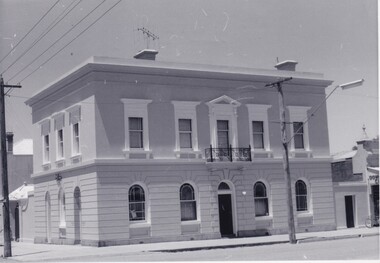 The Beechworth Burke Museum
Photograph, Saunders, Unknown
... Reverse: 23/80 / Beechworth / (Indecipherable) / Banking to (Indecipherable) / Sydney / “Bank of Victoria” / BMM 8692.1 / [Stamped: ILFORD]...Bank of Victoria Beechworth banks beechworth bank 1858 1867 ford street camp street victoria john farran smith and watts italian architecture italian style building brick building brick banking money fire building destroyed Reverse: 23/80 / Beechworth / (Indecipherable) / Banking to (Indecipherable) / Sydney / “Bank of Victoria” / BMM 8692.1 / [Stamped: ILFORD] Black and white rectangular photograph printed on paper. ...The photograph depicts the two-storey building of the Bank of Victoria which was built in 1858 and was replaced in 1867 after a fire destroyed the original building. The branch had originally opened under John Farran in 1856 before the office building was erected in Beechworth. The building was located on the corner of Ford and Camp streets and embodied the dignified appearance of Beechworth during the mid-1800s due to the building's features. The Bank of Victoria was designed by "Smith and Watts" and built from white brick and render, which cost three thousand and seven hundred pounds to construct. The building was inspired by a formal Italian villa, including square-headed windows, cornices, and a parapet. The ground floor consisted of banking chambers, a strong room, and servants' quarters. The residential quarters were located on the second floor.The photograph is significant as it depicts not only depicts a building of importance to the town of Beechworth but it also shows aesthetic significance due to the style it was built in. As the Bank of Victoria was constructed in the classic Italian style, it exemplifies the classic quality and refined manner of this architectural style. This building style represents the image Beechworth held for itself at that time, which was a sophisticated and distinguished town.Black and white rectangular photograph printed on paper.Reverse: 23/80 / Beechworth / (Indecipherable) / Banking to (Indecipherable) / Sydney / “Bank of Victoria” / BMM 8692.1 / [Stamped: ILFORD]bank of victoria, beechworth, banks, beechworth bank, 1858, 1867, ford street, camp street, victoria, john farran, smith and watts, italian architecture, italian style building, brick building, brick, banking, money, fire, building destroyed -
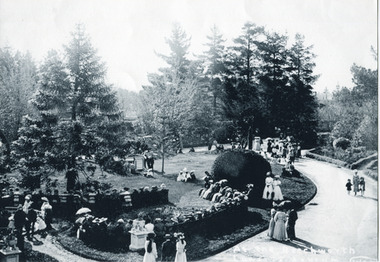 The Beechworth Burke Museum
Photograph, 1880 - 1900
... Reverse: at the Beechworth Lunatic Asylum/ (wade)/ do not copy - copy for Burke Museum/ for collection only only/ BMM 8326...Mayday Mayday Hills Hospital Mayday Hills Mayday Hills Mental Asylum Beechworth Asylum Beechworth Lunatic Asylum Beechworth Mental Hospital Beechworth institution Healthcare mental health nurses quarters nurses gaol garden garden party Reverse: at the Beechworth Lunatic Asylum/ (wade)/ do not copy - copy for Burke Museum/ for collection only only/ BMM 8326 Black and white photograph printed on matte photographic paper Photograph Photograph Burke Museum ...Mayday Hills Mental Hospital was originally constructed in 1864 under the name of the Beechworth Lunatic Asylum. It was built for locals in need of help who were kept in the local gaol. In its first decade, the residents of the hospital were used as menial labourers but over time, as mental healthcare progressed, were cared for in more nuanced ways. This site became a training hospital for nurses in the 1960's. Eventually, mental health patients were moved to other care facilities and Mayday Hills was operating as a geriatric care facility. It was closed in 1995, after which the buildings and their grounds were purchased to La Trobe University to be used as a campus. The university sold the site in 2011 to private ownership. This image depicts people enjoying the grounds and gardens.Mayday Hills Mental Hospital is a historically significant site for many factors. It is representative of healthcare practice in nineteenth century Victoria. It contains rare examples of construction and architecture. It is also significant for aesthetic and technical reasons.Black and white photograph printed on matte photographic paperReverse: at the Beechworth Lunatic Asylum/ (wade)/ do not copy - copy for Burke Museum/ for collection only only/ BMM 8326mayday, mayday hills hospital, mayday hills, mayday hills mental asylum, beechworth asylum, beechworth lunatic asylum, beechworth mental hospital, beechworth institution, healthcare, mental health, nurses quarters, nurses, gaol, garden, garden party -
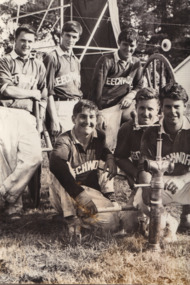 The Beechworth Burke Museum
Photograph, c1970
... Reverse: BMM 8781.1 / The Ovens and Murray Advertiser / Garry Paul, Jarvis McIntosh, -, Ross Lucas, Rod Gaskett, Graeme Warner...Photograph of 6 men in Beechworth fire brigade jumpers standing and sitting in front of a fire drill and holding various pieces of equipment. emergency services beechworth fire brigade burke museum fire Reverse: BMM 8781.1 / The Ovens and Murray Advertiser / Garry Paul, Jarvis McIntosh, -, Ross Lucas, Rod Gaskett, Graeme Warner Black and white rectangular photo printed on matte photographic paper Photograph Photograph ...Photograph of 6 men in Beechworth fire brigade jumpers standing and sitting in front of a fire drill and holding various pieces of equipment. Black and white rectangular photo printed on matte photographic paperReverse: BMM 8781.1 / The Ovens and Murray Advertiser / Garry Paul, Jarvis McIntosh, -, Ross Lucas, Rod Gaskett, Graeme Warneremergency services, beechworth, fire brigade, burke museum, fire -
 The Beechworth Burke Museum
Photograph, 1877
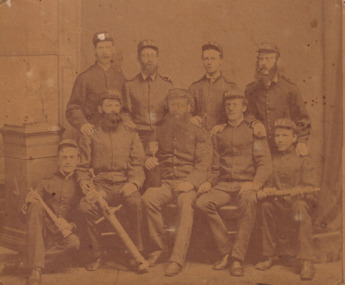
... The Trophy Cup showing in the Photo is the small cup on display in the adjacent display case./ BMM 3936...The Trophy Cup showing in the Photo is the small cup on display in the adjacent display case./ BMM 3936 Sepia rectangular photograph printed on photographic paper and mounted on board Photograph Photograph ...Taken in 1877, this photograph features nine members of the Beechworth Volunteer Fire Brigade holding a cup that was awarded to the group for winning the double hose competition. The cup is currently on display in the Burke Museum's 'Street of Shops' display Report of the event in the Ovens and Murray Advertiser, 3/4/1877 - The Fire Brigade Competition was held in Beechworth at Easter 1877. The double-hose competition carried a prize of ten pounds with an entry fee of ten shillings. The task was for eight men to run with reel 200 yards. fix hydrant, run out not less than 100ft of hose, fix branch, and throw water over rope 10ft high. Run out a second line of hose, not less than 100ft, fix branch, and throw water as before. Beechwoeth first team competed against Wangaratta and Chiltern, coming first in a time of 70 seconds. Wangaratta were disqualified. Sepia rectangular photograph printed on photographic paper and mounted on boardReverse: Member of B.V.Brigade, 1877. The Trophy Cup showing in the Photo is the small cup on display in the adjacent display case./ BMM 3936burke museum, emergency services, fire brigade, fire, competition, cup, photograph -
 The Beechworth Burke Museum
Photograph - Carte de Visite, William E Barnes
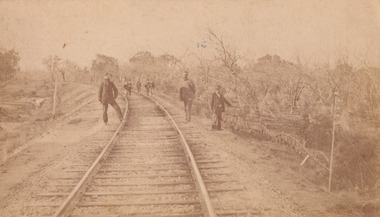
... Barnes / Photographer / Wangaratta / BMM 8089 /...Barnes / Photographer / Wangaratta / BMM 8089 / This sepia coloured Carte de Visite is attached to yellow cardboard. ...This Carte-de-visite (CdV) taken by renowned Wangaratta based photographer William Edward Barnes previously belonged to the donor's grandfather, Daniel Mullins who was a Police Officer stationed at Glenrowan soon after the Kelly gang siege. Today, the siege has become an important part of Australian culture and Ned Kelly and the Kelly Gang (comprising of Ned Kelly, Dan Kelly, Steve Hart and Joe Byrne) has become ingrained in Australian history and mythology. A CdV is a sepia toned photograph mounted on card and is generally of a small size. This particular style was first patented by Andre Adolphe Eugene Disdéri (1819-1889) in 1854. In 1857, the CdV was introduced to England and after photographs of Queen Victoria, Prince Albert and their family were taken using CdV in 1860 the popularity of this method reached a peak. In this photograph, eight men stand along the railway line near Glenrowan. The photo dates to shortly after 1880 and references the attempt by the Kelly gang to derail a police train in June 1880 on those very tracks. Ultimately, this plan failed and the police train was never derailed. Ned Kelly and the Kelly gang took their final stand at Glenrowan which has been immortalised through Australian popular culture.This photograph is part of the Burke Museum "Kelly album" which includes a significant collection of photographs and artefacts connected to Ned Kelly and the Kelly Gang. Ned Kelly and his gang have become ingrained in Australian popular culture and thus many museums, art galleries and private collections house material connected to the Kelly story which allows the events and people to be researched and interpreted. Artefacts and photographs pertaining to the Kelly gang are particularly valuable for Australian museums. This particular photograph is significant for its connection to Wangaratta based photographer William Edward Barnes and to the Glenrowan Siege of June 1880. Taken at an unknown time, after the siege at Glenrowan, this image depicts eight gentlemen standing about the railway line near Glenrowan. This is a reference to the Kelly gang's plan to derail a train which would barrel up to Glenrowan after news reached Melbourne that Aaron Sherritt had been shot by Joe Byrne in the Woolshed Valley. This image is important for its artistic information that it can provide about the Kelly story and the fashion and streetscape of Glenrowan.This sepia coloured Carte de Visite is attached to yellow cardboard. The obverse of the photo depicts the railway line near Glenrowan around 1880s. The rails are positioned in the centre of the image and are made on an incline of earth. In the foreground are three men, two standing next to the rails and one slightly off to the right of the image. In the background are trees which line the side of the rails and slightly in front of these trees is a group of five men standing on the rails. The reverse of the image is yellow card and contains printed and pencil writing. The printed writing is in the centre of the card. It reveals that the photographer was William E Barnes from Wangaratta. The pencil writing provides the inscription stating that the photo was taken near Glenrowan around the time of Ned Kelly.Pencil: Railway line near / Glen Rowan / Kelly's time / Printed: W. E. Barnes / Photographer / Wangaratta / BMM 8089 /kelly album, glenrowan, glenrowan siege, carte-de-visite, glenrowan railway, ned kelly, kelly gang, last stand, colonial australia, kelly siege, train, railway line, railway, sepia, photography, william e barnes, william barnes
