
Showing 140 items matching "botanists"
-
 Kiewa Valley Historical Society
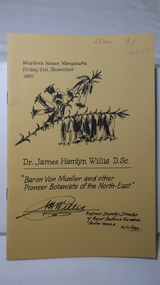
Booklet - Book - Reference Botany - North-east Victoria, Baron Von Mueller and other Pioneer Botanists of the North-East by Dr. James Hamlyn Willis D.Sc
... Baron Von Mueller and other Pioneer Botanists of the North-East by Dr. James Hamlyn Willis D.Sc....botanists...The subject of the Oration was "Baron Von Mueller and other Pioneer Botanists of the North East" (of Victoria). This included the Kiewa Valley and surrounding mountains. botanists dr. james hamlyn willis wangaratta oration 1980 Name written on cover: C. ...This small booklet is the transcript of the annual McKay Memorial Oration, given at Murdock House, Wangaratta on the 21st November 1980 by Dr. James Hamlyn Willis D.Sc. - Retired Deputy Director of Royal Botanic Gardens South Yarra 21st November 1980.The subject of the Oration was "Baron Von Mueller and other Pioneer Botanists of the North East" (of Victoria). This included the Kiewa Valley and surrounding mountains.Small yellow booklet of 12 pagesName written on cover: C. Roper. Also: $1botanists, dr. james hamlyn willis, wangaratta oration 1980 -
 Whitehorse Historical Society Inc.
Article, Fresh light on Mitcham's history, 27/09/1961 12:00:00 AM
... Believed to be the first settler in Mitcham and who assisted Baron Von Mueller in his capacity as a botanist....Boyle on his grandfather David Boyle, believed to be the first settler in Mitcham and who assisted Baron Von Mueller in his capacity as a botanist....Believed to be the first settler in Mitcham and who assisted Baron Von Mueller in his capacity as a botanist. Boyle David Boyle C.H. Pioneers Article in Eastern Times of 27/9/1961 by C.H. ...Article in Eastern Times of 27/9/1961 by C.H. Boyle on his grandfather David Boyle.Article in Eastern Times of 27/9/1961 by C.H. Boyle on his grandfather David Boyle, believed to be the first settler in Mitcham and who assisted Baron Von Mueller in his capacity as a botanist.Article in Eastern Times of 27/9/1961 by C.H. Boyle on his grandfather David Boyle.boyle, david, boyle, c.h., pioneers -
Whitehorse Historical Society Inc.
Article, Mueller's name on many plants, 1964
... He came to Melbourne in 1853 and was appointed the State's first official botanist. He was the first white man to climb Mt Buller and Mt Buffalo. ...He came to Melbourne in 1853 and was appointed the State's first official botanist. He was the first white man to climb Mt Buller and Mt Buffalo. ...He came to Melbourne in 1853 and was appointed the State's first official botanist. He was the first white man to climb Mt Buller and Mt Buffalo. ...Article on the history of Ferdinand von Mueller.Article on the history of Ferdinand von Mueller. He arrived in Adelaide in 1847 (had a PhD from Kiel University). He came to Melbourne in 1853 and was appointed the State's first official botanist. He was the first white man to climb Mt Buller and Mt Buffalo. Apart from his activities with the Melbourne Botanical Gardens he was Government Botanist for 43 years. His name is found in the name of some 80 native trees and shrubs.Article on the history of Ferdinand von Mueller. plants, von mueller, ferdinand, dallachy, john, melbourne botanical gardens -
 Federation University Historical Collection
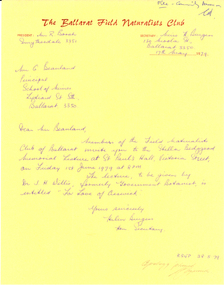
Letter - Document, Letter from the Ballarat Field Naturalists Club, 1979, 17 May 1979
... Handwritten invitation to the Stella Bedggood Memorial Lecture to be given by former Government Botanist Dr. J. H. Willis- title "For the Love of Creswick"...Willis, formerly Government Botanist, is entitled "For Love of Creswick." ...Willis, formerly Government Botanist, is entitled "For Love of Creswick." ...Yellow quarto sized paper with maroon printing. Handwritten invitation to the Stella Bedggood Memorial Lecture to be given by former Government Botanist Dr. J. H. Willis- title "For the Love of Creswick"Dear Mr Beanland, Members of the Field Naturalists Club of Ballarat invite you to the Stella Bedggood Memorial Lecture at St Paul's Hall, Victoria Street, on Friday 1st June 1979 at 8 PM. The lecture, to be given by Dr J. H. Willis, formerly Government Botanist, is entitled "For Love of Creswick." Yours sincerely Helen Burgess Hon. Secretary.bosch, burgess, smb, ballarat school of mines, ballarat science and field naturalists club, stella bedggood, st paul's hall, j. h. willis, beanland, helen burgess, letterhead -
Tatura Irrigation & Wartime Camps Museum
Book - text, Professor Dr D Schmeil, Schmeil Grundrisz Der Pflanzenkunde, 1926
... ...Botanist...A book in German language which appears to describe plants, possibly weeds. Useful to a botanist. It has pages of coloured illustrations. ...Useful to a botanist. It has pages of coloured illustrations. ...A book in German language which appears to describe plants, possibly weeds. Useful to a botanist. It has pages of coloured illustrations. Written in 1926 in Leipzig.Presented to Karl Wied on 27 November 1946plants, botanist, camp 3, internee, professor dr d schmeil -
 Flagstaff Hill Maritime Museum and Village
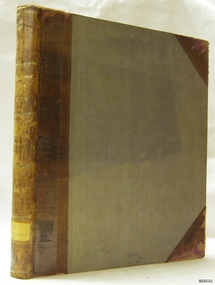
Book, The Forest Flora of New South Wales Vol 1
... Maiden Government Botanist and Director of the Botanic Gardens, Sydney Publisher: Government Printer Sydney Date: 1904...Maiden Government Botanist and Director of the Botanic Gardens, Sydney Publisher: Government Printer Sydney Date: 1904 The Forest Flora of New South Wales Vol 1 Book ...This item is from the ‘Pattison Collection’, a collection of books and records that was originally owned by the Warrnambool Mechanics’ Institute, which was founded in Warrnambool in 1853. By 1886 the Warrnambool Mechanics’ Institute (WMI) had grown to have a Library, Museum and Fine Arts Gallery, with a collection of “… choice productions of art, and valuable specimens in almost every branch and many wonderful national curiosities are now to be seen there, including historic relics of the town and district.” It later included a School of Design. Although it was very well patronised, the lack of financial support led the WMI in 1911 to ask the City Council to take it over. In 1935 Ralph Pattison was appointed as City Librarian to establish and organise the Warrnambool Library as it was then called. When the WMI building was pulled down in 1963 a new civic building was erected on the site and the new Warrnambool Library, on behalf of the City Council, took over all the holdings of the WMI. At this time some of the items were separated and identified as the ‘Pattison Collection’, named after Ralph Pattison. Eventually the components of the WMI were distributed from the Warrnambool Library to various places, including the Art Gallery, Historical Society and Flagstaff Hill. Later some were even distributed to other regional branches of Corangamite Regional Library and passed to and fro. It is difficult now to trace just where all of the items have ended up. The books at Flagstaff Hill Maritime Village generally display stamps and markings from Pattison as well as a variety of other institutions including the Mechanics’ Institute itself. RALPH ERIC PATTISON Ralph Eric Pattison was born in Rockhampton, Queensland, in 1891. He married Maude Swan from Warrnambool in 1920 and they set up home in Warrnambool. In 1935 Pattison accepted a position as City Librarian for the Warrnambool City Council. His huge challenge was to make a functional library within two rooms of the Mechanics’ Institute. He tirelessly cleaned, cleared and sorted a disarrayed collection of old books, jars of preserved specimens and other items reserved for exhibition in the city’s museum. He developed and updated the library with a wide variety of books for all tastes, including reference books for students; a difficult task to fulfil during the years following the Depression. He converted all of the lower area of the building into a library, reference room and reading room for members and the public. The books were sorted and stored using a cataloguing and card index system that he had developed himself. He also prepared the upper floor of the building and established the Art Gallery and later the Museum, a place to exhibit the many old relics that had been stored for years for this purpose. One of the treasures he found was a beautiful ancient clock, which he repaired, restored and enjoyed using in his office during the years of his service there. Ralph Pattison was described as “a meticulous gentleman whose punctuality, floorless courtesy and distinctive neat dress were hallmarks of his character, and ‘his’ clock controlled his daily routine, and his opening and closing of the library’s large heavy doors to the minute.” Pattison took leave during 1942 to 1945 to serve in the Royal Australian Navy, Volunteer Reserve as Lieutenant. A few years later he converted one of the Museum’s rooms into a Children’s Library, stocking it with suitable books for the younger generation. This was an instant success. In the 1950’s he had the honour of being appointed to the Victorian Library Board and received more inspiration from the monthly conferences in Melbourne. He was sadly retired in 1959 after over 23 years of service, due to the fact that he had gone over the working age of council officers. However he continued to take a very keen interest in the continual development of the Library until his death in 1969. Warrnambool's Mechanics' Institute (or Institution as it was sometimes called) was one of the earliest in Victoria. On 17th October 1853 a meeting was held where it was resolved to request the Lieutenant Governor of the Colony to grant land for the erection of a Mechanics' Institutes building. A committee was formed at the meeting and Richard Osburne chaired the first meeting of this committee. The land on the North West corner of Banyan and Merri Streets was granted but there were no funds to erect the building. The Formal Rights of the Warrnambool Mechanics' Institute's encompassed its aims and these were officially adopted in1859; "This Institution has for its object the diffusion of literary, scientific, and other useful knowledge amongst its members, excluding all controversial subjects, religious or political. These objects are sought to be obtained by means of a circulating library, a reading room, the establishment of classes, debates, and the occasional delivery of lectures on natural and experimental philosophy, mechanics, astronomy, chemistry, natural history, literature, and the useful and ornamental arts, particularly those which have a more immediate reference to the colony." The Warrnambool Mechanics' Institute opened its first reading room in November1884 in the National School building at the corner of Banyan and Timor Streets. The Institute was funded by member subscription, payable on a quarterly, half yearly or yearly basis. Samuel Hannaford, the Manager of the Warrnambool Bank of Australasia, was the first Honorary Secretary of the Mechanics' Institutes, and an early President and Vice-President. He also gave several of the early lectures in the Reading Room. Another early Secretary, Librarian and lecturer was Marmaduke Fisher, the teacher at the National School. Lecture topics included The Poets and Poetry of Ireland', 'The Birth and Development of the Earth', 'The Vertebrae - with Remarks on the pleasures resulting from the study of Natural History' and 'Architecture'. In 1856 the Reading Room was moved to James Hider's shop in Timor Street, and by 1864 it was located in the bookshop of Davies and Read. In the 1860's the Mechanics' Institute struggled as membership waned but in 1866, after a series of fund raising efforts, the committee was able to purchase land in Liebig Street, on a site then called Market Square, between the weighbridge and the fire station. A Mechanics' Institute building was opened at this site in August 1871. The following year four more rooms were added to the main Reading Room and in 1873 the Artisan School of Design was incorporated into the Institute. The same year Joseph Archibald established a Museum; however it deteriorated when he was transferred to Bendigo in 1877. In 1880, with Archibald's return to Warrnambool, the Museum was re-established, and in 1885 a new building was built at the back of the Institute to accommodate the re-created School of Design, the Art Gallery and the Museum. In 1887 the Museum section was moved to the former court house in Timor Street (for some time the walls of the building formed part of the TAFE cafeteria but all is now demolished)). In 1911 the Museum was transferred back to the original building and the management of the Mechanics' Institute was handed over to the Warrnambool City Council. The Museum and Art Gallery became one and housed many fine works of art, and the Library continued to grow. The building was well patronised, with records showing that at the beginning of the 20th century there were between 500 and 800 visitors. During World War One the monthly figures were in the thousands, with 3,400 people visiting in January 1915. The Museum was a much loved Institution in Warrnambool until the contents of the Museum and Art Gallery were removed to make room for the Warrnambool City Council Engineers' Department. The contents were stored but many of the items were scattered or lost. When the original building was demolished the site became occupied by the Civic Centre, which included the new City Library. (The library was temporarily located in the old Palais building in Koroit Street.) In the process of reorganisation the Collection was distributed amongst the community groups: -The new City Library took some of the historic books and some important documents, historic photographs and newspapers. -The Art Gallery kept the 19th Century art collection and some of the artefacts from the museum. -The Historic Society has some items -The State Museum has some items -Some items were destroyed -Flagstaff Hill Maritime Village has old newspapers, Government Gazettes, most of the Mechanics' Institute Library, ledgers and documents connected to the Mechanics' Institute Library, some framed and unframed art works and some photographs. The Warrnambool Mechanics' Institute Library book collection is deemed to be of great importance because it is one of the few collections in an almost intact state, and many of the books are now very rare and of great value. The Pattison Collection, along with other items at Flagstaff Hill Maritime Village, was originally part of the Warrnambool Mechanics' Institute’s collection. The Warrnambool Mechanics’ Institute Collection is primarily significant in its totality, rather than for the individual objects it contains. Its contents are highly representative of the development of Mechanics' Institute libraries across Australia, particularly Victoria. A diversity of publications and themes has been amassed, and these provide clues to our understanding of the nature of and changes in the reading habits of Victorians from the 1850s to the middle of the 20th century. The collection also highlights the Warrnambool community’s commitment to the Mechanics’ Institute, reading, literacy and learning in the regions, and proves that access to knowledge was not impeded by distance. These items help to provide a more complete picture of our community’s ideals and aspirations. The Warrnambool Mechanics Institute book collection has historical and social significance for its strong association with the Mechanics Institute movement and the important role it played in the intellectual, cultural and social development of people throughout the latter part of the nineteenth century and the early twentieth century. The collection of books is a rare example of an early lending library and its significance is enhanced by the survival of an original collection of many volumes. The Warrnambool Mechanics' Institute’s publication collection is of both local and state significance. The Forest Flora of New South Wales Vol 1 Author: J. H. Maiden Government Botanist and Director of the Botanic Gardens, Sydney Publisher: Government Printer Sydney Date: 1904Label on spine cover with typed text PAT 581.9944 MAI Pastedown front endpaper has sticker from Warrnambool Mechanics Institute and Free Library Front loose endpaper has a sticker from Corangamite Regional Library Service Front loose endpaper has a stamp from Corangamite Regional Library Service Fly page has in handwriting “Purchased by Government Subsidy. Bound and Received June 27-‘14" warrnambool, shipwrecked-coast, flagstaff-hill, flagstaff-hill-maritime-museum, maritime-museum, shipwreck-coast, flagstaff-hill-maritime-village, shipwrecked-artefact, book, pattison collection, warrnambool library, warrnambool mechanics’ institute, ralph eric pattison, corangamite regional library service, warrnambool city librarian, mechanics’ institute library, victorian library board, warrnambool books and records, warrnambool children’s library, great ocean road, the forest flora of new south wales vol 1, j. h. maiden -
 Flagstaff Hill Maritime Museum and Village
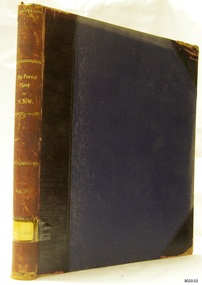
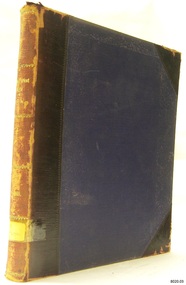
Book, The Forest Flora of New South Wales Vol 2
... Maiden Government Botanist and Director of the Botanic Gardens, Sydney Publisher: Government Printer Sydney Date:1907...Maiden Government Botanist and Director of the Botanic Gardens, Sydney Publisher: Government Printer Sydney Date:1907 The Forest Flora of New South Wales Vol 2 Book ...This item is from the ‘Pattison Collection’, a collection of books and records that was originally owned by the Warrnambool Mechanics’ Institute, which was founded in Warrnambool in 1853. By 1886 the Warrnambool Mechanics’ Institute (WMI) had grown to have a Library, Museum and Fine Arts Gallery, with a collection of “… choice productions of art, and valuable specimens in almost every branch and many wonderful national curiosities are now to be seen there, including historic relics of the town and district.” It later included a School of Design. Although it was very well patronised, the lack of financial support led the WMI in 1911 to ask the City Council to take it over. In 1935 Ralph Pattison was appointed as City Librarian to establish and organise the Warrnambool Library as it was then called. When the WMI building was pulled down in 1963 a new civic building was erected on the site and the new Warrnambool Library, on behalf of the City Council, took over all the holdings of the WMI. At this time some of the items were separated and identified as the ‘Pattison Collection’, named after Ralph Pattison. Eventually the components of the WMI were distributed from the Warrnambool Library to various places, including the Art Gallery, Historical Society and Flagstaff Hill. Later some were even distributed to other regional branches of Corangamite Regional Library and passed to and fro. It is difficult now to trace just where all of the items have ended up. The books at Flagstaff Hill Maritime Village generally display stamps and markings from Pattison as well as a variety of other institutions including the Mechanics’ Institute itself. RALPH ERIC PATTISON Ralph Eric Pattison was born in Rockhampton, Queensland, in 1891. He married Maude Swan from Warrnambool in 1920 and they set up home in Warrnambool. In 1935 Pattison accepted a position as City Librarian for the Warrnambool City Council. His huge challenge was to make a functional library within two rooms of the Mechanics’ Institute. He tirelessly cleaned, cleared and sorted a disarrayed collection of old books, jars of preserved specimens and other items reserved for exhibition in the city’s museum. He developed and updated the library with a wide variety of books for all tastes, including reference books for students; a difficult task to fulfil during the years following the Depression. He converted all of the lower area of the building into a library, reference room and reading room for members and the public. The books were sorted and stored using a cataloguing and card index system that he had developed himself. He also prepared the upper floor of the building and established the Art Gallery and later the Museum, a place to exhibit the many old relics that had been stored for years for this purpose. One of the treasures he found was a beautiful ancient clock, which he repaired, restored and enjoyed using in his office during the years of his service there. Ralph Pattison was described as “a meticulous gentleman whose punctuality, floorless courtesy and distinctive neat dress were hallmarks of his character, and ‘his’ clock controlled his daily routine, and his opening and closing of the library’s large heavy doors to the minute.” Pattison took leave during 1942 to 1945 to serve in the Royal Australian Navy, Volunteer Reserve as Lieutenant. A few years later he converted one of the Museum’s rooms into a Children’s Library, stocking it with suitable books for the younger generation. This was an instant success. In the 1950’s he had the honour of being appointed to the Victorian Library Board and received more inspiration from the monthly conferences in Melbourne. He was sadly retired in 1959 after over 23 years of service, due to the fact that he had gone over the working age of council officers. However he continued to take a very keen interest in the continual development of the Library until his death in 1969. Warrnambool's Mechanics' Institute (or Institution as it was sometimes called) was one of the earliest in Victoria. On 17th October 1853 a meeting was held where it was resolved to request the Lieutenant Governor of the Colony to grant land for the erection of a Mechanics' Institutes building. A committee was formed at the meeting and Richard Osburne chaired the first meeting of this committee. The land on the North West corner of Banyan and Merri Streets was granted but there were no funds to erect the building. The Formal Rights of the Warrnambool Mechanics' Institute's encompassed its aims and these were officially adopted in1859; "This Institution has for its object the diffusion of literary, scientific, and other useful knowledge amongst its members, excluding all controversial subjects, religious or political. These objects are sought to be obtained by means of a circulating library, a reading room, the establishment of classes, debates, and the occasional delivery of lectures on natural and experimental philosophy, mechanics, astronomy, chemistry, natural history, literature, and the useful and ornamental arts, particularly those which have a more immediate reference to the colony." The Warrnambool Mechanics' Institute opened its first reading room in November1884 in the National School building at the corner of Banyan and Timor Streets. The Institute was funded by member subscription, payable on a quarterly, half yearly or yearly basis. Samuel Hannaford, the Manager of the Warrnambool Bank of Australasia, was the first Honorary Secretary of the Mechanics' Institutes, and an early President and Vice-President. He also gave several of the early lectures in the Reading Room. Another early Secretary, Librarian and lecturer was Marmaduke Fisher, the teacher at the National School. Lecture topics included The Poets and Poetry of Ireland', 'The Birth and Development of the Earth', 'The Vertebrae - with Remarks on the pleasures resulting from the study of Natural History' and 'Architecture'. In 1856 the Reading Room was moved to James Hider's shop in Timor Street, and by 1864 it was located in the bookshop of Davies and Read. In the 1860's the Mechanics' Institute struggled as membership waned but in 1866, after a series of fund raising efforts, the committee was able to purchase land in Liebig Street, on a site then called Market Square, between the weighbridge and the fire station. A Mechanics' Institute building was opened at this site in August 1871. The following year four more rooms were added to the main Reading Room and in 1873 the Artisan School of Design was incorporated into the Institute. The same year Joseph Archibald established a Museum; however it deteriorated when he was transferred to Bendigo in 1877. In 1880, with Archibald's return to Warrnambool, the Museum was re-established, and in 1885 a new building was built at the back of the Institute to accommodate the re-created School of Design, the Art Gallery and the Museum. In 1887 the Museum section was moved to the former court house in Timor Street (for some time the walls of the building formed part of the TAFE cafeteria but all is now demolished)). In 1911 the Museum was transferred back to the original building and the management of the Mechanics' Institute was handed over to the Warrnambool City Council. The Museum and Art Gallery became one and housed many fine works of art, and the Library continued to grow. The building was well patronised, with records showing that at the beginning of the 20th century there were between 500 and 800 visitors. During World War One the monthly figures were in the thousands, with 3,400 people visiting in January 1915. The Museum was a much loved Institution in Warrnambool until the contents of the Museum and Art Gallery were removed to make room for the Warrnambool City Council Engineers' Department. The contents were stored but many of the items were scattered or lost. When the original building was demolished the site became occupied by the Civic Centre, which included the new City Library. (The library was temporarily located in the old Palais building in Koroit Street.) In the process of reorganisation the Collection was distributed amongst the community groups: -The new City Library took some of the historic books and some important documents, historic photographs and newspapers. -The Art Gallery kept the 19th Century art collection and some of the artefacts from the museum. -The Historic Society has some items -The State Museum has some items -Some items were destroyed -Flagstaff Hill Maritime Village has old newspapers, Government Gazettes, most of the Mechanics' Institute Library, ledgers and documents connected to the Mechanics' Institute Library, some framed and unframed art works and some photographs. The Warrnambool Mechanics' Institute Library book collection is deemed to be of great importance because it is one of the few collections in an almost intact state, and many of the books are now very rare and of great value. The Pattison Collection, along with other items at Flagstaff Hill Maritime Village, was originally part of the Warrnambool Mechanics' Institute’s collection. The Warrnambool Mechanics’ Institute Collection is primarily significant in its totality, rather than for the individual objects it contains. Its contents are highly representative of the development of Mechanics' Institute libraries across Australia, particularly Victoria. A diversity of publications and themes has been amassed, and these provide clues to our understanding of the nature of and changes in the reading habits of Victorians from the 1850s to the middle of the 20th century. The collection also highlights the Warrnambool community’s commitment to the Mechanics’ Institute, reading, literacy and learning in the regions, and proves that access to knowledge was not impeded by distance. These items help to provide a more complete picture of our community’s ideals and aspirations. The Warrnambool Mechanics Institute book collection has historical and social significance for its strong association with the Mechanics Institute movement and the important role it played in the intellectual, cultural and social development of people throughout the latter part of the nineteenth century and the early twentieth century. The collection of books is a rare example of an early lending library and its significance is enhanced by the survival of an original collection of many volumes. The Warrnambool Mechanics' Institute’s publication collection is of both local and state significance. The Forest Flora of New South Wales Vol 2 Author: J. H. Maiden Government Botanist and Director of the Botanic Gardens, Sydney Publisher: Government Printer Sydney Date:1907Label on spine cover with typed text PAT 581.9944 MAI Pastedown front endpaper has sticker from Warrnambool Mechanics Institute and Free Library Front loose endpaper has a sticker from Corangamite Regional Library Service Front loose endpaper has a stamp from Corangamite Regional Library Service Fly page has in handwriting “Purchased by Government Subsidy. Bound and Received June 27- ‘14” warrnambool, shipwrecked-coast, flagstaff-hill, flagstaff-hill-maritime-museum, maritime-museum, shipwreck-coast, flagstaff-hill-maritime-village, shipwrecked-artefact, book, pattison collection, warrnambool library, warrnambool mechanics’ institute, ralph eric pattison, corangamite regional library service, warrnambool city librarian, mechanics’ institute library, victorian library board, warrnambool books and records, warrnambool children’s library, great ocean road, the forest flora of new south wales vol 2, j. h. maiden -
 Flagstaff Hill Maritime Museum and Village
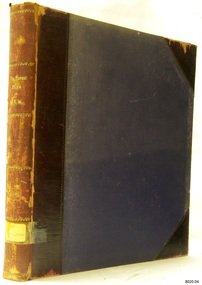
Book, The Forest Flora of New South Wales Vol 3
... Maiden Government Botanist and Director of the Botanic Gardens, Sydney Publisher: Government Printer Sydney Date: 1908...Maiden Government Botanist and Director of the Botanic Gardens, Sydney Publisher: Government Printer Sydney Date: 1908 The Forest Flora of New South Wales Vol 3 Book ...This item is from the ‘Pattison Collection’, a collection of books and records that was originally owned by the Warrnambool Mechanics’ Institute, which was founded in Warrnambool in 1853. By 1886 the Warrnambool Mechanics’ Institute (WMI) had grown to have a Library, Museum and Fine Arts Gallery, with a collection of “… choice productions of art, and valuable specimens in almost every branch and many wonderful national curiosities are now to be seen there, including historic relics of the town and district.” It later included a School of Design. Although it was very well patronised, the lack of financial support led the WMI in 1911 to ask the City Council to take it over. In 1935 Ralph Pattison was appointed as City Librarian to establish and organise the Warrnambool Library as it was then called. When the WMI building was pulled down in 1963 a new civic building was erected on the site and the new Warrnambool Library, on behalf of the City Council, took over all the holdings of the WMI. At this time some of the items were separated and identified as the ‘Pattison Collection’, named after Ralph Pattison. Eventually the components of the WMI were distributed from the Warrnambool Library to various places, including the Art Gallery, Historical Society and Flagstaff Hill. Later some were even distributed to other regional branches of Corangamite Regional Library and passed to and fro. It is difficult now to trace just where all of the items have ended up. The books at Flagstaff Hill Maritime Village generally display stamps and markings from Pattison as well as a variety of other institutions including the Mechanics’ Institute itself. RALPH ERIC PATTISON Ralph Eric Pattison was born in Rockhampton, Queensland, in 1891. He married Maude Swan from Warrnambool in 1920 and they set up home in Warrnambool. In 1935 Pattison accepted a position as City Librarian for the Warrnambool City Council. His huge challenge was to make a functional library within two rooms of the Mechanics’ Institute. He tirelessly cleaned, cleared and sorted a disarrayed collection of old books, jars of preserved specimens and other items reserved for exhibition in the city’s museum. He developed and updated the library with a wide variety of books for all tastes, including reference books for students; a difficult task to fulfil during the years following the Depression. He converted all of the lower area of the building into a library, reference room and reading room for members and the public. The books were sorted and stored using a cataloguing and card index system that he had developed himself. He also prepared the upper floor of the building and established the Art Gallery and later the Museum, a place to exhibit the many old relics that had been stored for years for this purpose. One of the treasures he found was a beautiful ancient clock, which he repaired, restored and enjoyed using in his office during the years of his service there. Ralph Pattison was described as “a meticulous gentleman whose punctuality, floorless courtesy and distinctive neat dress were hallmarks of his character, and ‘his’ clock controlled his daily routine, and his opening and closing of the library’s large heavy doors to the minute.” Pattison took leave during 1942 to 1945 to serve in the Royal Australian Navy, Volunteer Reserve as Lieutenant. A few years later he converted one of the Museum’s rooms into a Children’s Library, stocking it with suitable books for the younger generation. This was an instant success. In the 1950’s he had the honour of being appointed to the Victorian Library Board and received more inspiration from the monthly conferences in Melbourne. He was sadly retired in 1959 after over 23 years of service, due to the fact that he had gone over the working age of council officers. However he continued to take a very keen interest in the continual development of the Library until his death in 1969. WARRNAMBOOL'S MECHANICS' INSTITUTE Warrnambool's Mechanics' Institute (or Institution as it was sometimes called) was one of the earliest in Victoria. On 17th October 1853 a meeting was held where it was resolved to request the Lieutenant Governor of the Colony to grant land for the erection of a Mechanics' Institutes building. A committee was formed at the meeting and Richard Osburne chaired the first meeting of this committee. The land on the North West corner of Banyan and Merri Streets was granted but there were no funds to erect the building. The Formal Rights of the Warrnambool Mechanics' Institute's encompassed its aims and these were officially adopted in1859; "This Institution has for its object the diffusion of literary, scientific, and other useful knowledge amongst its members, excluding all controversial subjects, religious or political. These objects are sought to be obtained by means of a circulating library, a reading room, the establishment of classes, debates, and the occasional delivery of lectures on natural and experimental philosophy, mechanics, astronomy, chemistry, natural history, literature, and the useful and ornamental arts, particularly those which have a more immediate reference to the colony." The Warrnambool Mechanics' Institute opened its first reading room in November1884 in the National School building at the corner of Banyan and Timor Streets. The Institute was funded by member subscription, payable on a quarterly, half yearly or yearly basis. Samuel Hannaford, the Manager of the Warrnambool Bank of Australasia, was the first Honorary Secretary of the Mechanics' Institutes, and an early President and Vice-President. He also gave several of the early lectures in the Reading Room. Another early Secretary, Librarian and lecturer was Marmaduke Fisher, the teacher at the National School. Lecture topics included The Poets and Poetry of Ireland', 'The Birth and Development of the Earth', 'The Vertebrae - with Remarks on the pleasures resulting from the study of Natural History' and 'Architecture'. In 1856 the Reading Room was moved to James Hider's shop in Timor Street, and by 1864 it was located in the bookshop of Davies and Read. In the 1860's the Mechanics' Institute struggled as membership waned but in 1866, after a series of fund raising efforts, the committee was able to purchase land in Liebig Street, on a site then called Market Square, between the weighbridge and the fire station. A Mechanics' Institute building was opened at this site in August 1871. The following year four more rooms were added to the main Reading Room and in 1873 the Artisan School of Design was incorporated into the Institute. The same year Joseph Archibald established a Museum; however it deteriorated when he was transferred to Bendigo in 1877. In 1880, with Archibald's return to Warrnambool, the Museum was re-established, and in 1885 a new building was built at the back of the Institute to accommodate the re-created School of Design, the Art Gallery and the Museum. In 1887 the Museum section was moved to the former court house in Timor Street (for some time the walls of the building formed part of the TAFE cafeteria but all is now demolished)). In 1911 the Museum was transferred back to the original building and the management of the Mechanics' Institute was handed over to the Warrnambool City Council. The Museum and Art Gallery became one and housed many fine works of art, and the Library continued to grow. The building was well patronised, with records showing that at the beginning of the 20th century there were between 500 and 800 visitors. During World War One the monthly figures were in the thousands, with 3,400 people visiting in January 1915. The Museum was a much loved Institution in Warrnambool until the contents of the Museum and Art Gallery were removed to make room for the Warrnambool City Council Engineers' Department. The contents were stored but many of the items were scattered or lost. When the original building was demolished the site became occupied by the Civic Centre, which included the new City Library. (The library was temporarily located in the old Palais building in Koroit Street.) In the process of reorganisation the Collection was distributed amongst the community groups: -The new City Library took some of the historic books and some important documents, historic photographs and newspapers. -The Art Gallery kept the 19th Century art collection and some of the artefacts from the museum. -The Historic Society has some items -The State Museum has some items -Some items were destroyed -Flagstaff Hill Maritime Village has old newspapers, Government Gazettes, most of the Mechanics' Institute Library, ledgers and documents connected to the Mechanics' Institute Library, some framed and unframed art works and some photographs. The Warrnambool Mechanics' Institute Library book collection is deemed to be of great importance because it is one of the few collections in an almost intact state, and many of the books are now very rare and of great value The Pattison Collection, along with other items at Flagstaff Hill Maritime Village, was originally part of the Warrnambool Mechanics' Institute’s collection. The Warrnambool Mechanics’ Institute Collection is primarily significant in its totality, rather than for the individual objects it contains. Its contents are highly representative of the development of Mechanics' Institute libraries across Australia, particularly Victoria. A diversity of publications and themes has been amassed, and these provide clues to our understanding of the nature of and changes in the reading habits of Victorians from the 1850s to the middle of the 20th century. The collection also highlights the Warrnambool community’s commitment to the Mechanics’ Institute, reading, literacy and learning in the regions, and proves that access to knowledge was not impeded by distance. These items help to provide a more complete picture of our community’s ideals and aspirations. The Warrnambool Mechanics Institute book collection has historical and social significance for its strong association with the Mechanics Institute movement and the important role it played in the intellectual, cultural and social development of people throughout the latter part of the nineteenth century and the early twentieth century. The collection of books is a rare example of an early lending library and its significance is enhanced by the survival of an original collection of many volumes. The Warrnambool Mechanics' Institute’s publication collection is of both local and state significance. The Forest Flora of New South Wales Vol 3 Author: J. H. Maiden Government Botanist and Director of the Botanic Gardens, Sydney Publisher: Government Printer Sydney Date: 1908Label on spine cover with typed text PAT 581.9944 MAI Pastedown front endpaper has sticker from Warrnambool Mechanics Institute and Free Library Front loose endpaper has a sticker from Corangamite Regional Library Service Front loose endpaper has a stamp from Corangamite Regional Library Service Fly page has in handwriting “Purchased by Government Subsidy. Bound and Received June 27- ‘14” warrnambool, shipwrecked-coast, flagstaff-hill, flagstaff-hill-maritime-museum, maritime-museum, shipwreck-coast, flagstaff-hill-maritime-village, shipwrecked-artefact, book, pattison collection, warrnambool library, warrnambool mechanics’ institute, ralph eric pattison, corangamite regional library service, warrnambool city librarian, mechanics’ institute library, victorian library board, warrnambool books and records, warrnambool children’s library, great ocean road -
 Flagstaff Hill Maritime Museum and Village
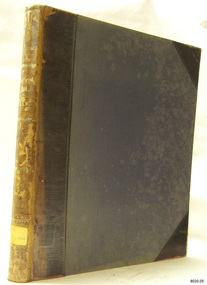
Book, The Forest Flora of New South Wales Vol 4
... Maiden Government Botanist and Director of the Botanic Gardens, Sydney Publisher: Government Printer Sydney Date: 1913...Maiden Government Botanist and Director of the Botanic Gardens, Sydney Publisher: Government Printer Sydney Date: 1913 The Forest Flora of New South Wales Vol 4 Book ...This item is from the ‘Pattison Collection’, a collection of books and records that was originally owned by the Warrnambool Mechanics’ Institute, which was founded in Warrnambool in 1853. By 1886 the Warrnambool Mechanics’ Institute (WMI) had grown to have a Library, Museum and Fine Arts Gallery, with a collection of “… choice productions of art, and valuable specimens in almost every branch and many wonderful national curiosities are now to be seen there, including historic relics of the town and district.” It later included a School of Design. Although it was very well patronised, the lack of financial support led the WMI in 1911 to ask the City Council to take it over. In 1935 Ralph Pattison was appointed as City Librarian to establish and organise the Warrnambool Library as it was then called. When the WMI building was pulled down in 1963 a new civic building was erected on the site and the new Warrnambool Library, on behalf of the City Council, took over all the holdings of the WMI. At this time some of the items were separated and identified as the ‘Pattison Collection’, named after Ralph Pattison. Eventually the components of the WMI were distributed from the Warrnambool Library to various places, including the Art Gallery, Historical Society and Flagstaff Hill. Later some were even distributed to other regional branches of Corangamite Regional Library and passed to and fro. It is difficult now to trace just where all of the items have ended up. The books at Flagstaff Hill Maritime Village generally display stamps and markings from Pattison as well as a variety of other institutions including the Mechanics’ Institute itself. RALPH ERIC PATTISON Ralph Eric Pattison was born in Rockhampton, Queensland, in 1891. He married Maude Swan from Warrnambool in 1920 and they set up home in Warrnambool. In 1935 Pattison accepted a position as City Librarian for the Warrnambool City Council. His huge challenge was to make a functional library within two rooms of the Mechanics’ Institute. He tirelessly cleaned, cleared and sorted a disarrayed collection of old books, jars of preserved specimens and other items reserved for exhibition in the city’s museum. He developed and updated the library with a wide variety of books for all tastes, including reference books for students; a difficult task to fulfil during the years following the Depression. He converted all of the lower area of the building into a library, reference room and reading room for members and the public. The books were sorted and stored using a cataloguing and card index system that he had developed himself. He also prepared the upper floor of the building and established the Art Gallery and later the Museum, a place to exhibit the many old relics that had been stored for years for this purpose. One of the treasures he found was a beautiful ancient clock, which he repaired, restored and enjoyed using in his office during the years of his service there. Ralph Pattison was described as “a meticulous gentleman whose punctuality, floorless courtesy and distinctive neat dress were hallmarks of his character, and ‘his’ clock controlled his daily routine, and his opening and closing of the library’s large heavy doors to the minute.” Pattison took leave during 1942 to 1945 to serve in the Royal Australian Navy, Volunteer Reserve as Lieutenant. A few years later he converted one of the Museum’s rooms into a Children’s Library, stocking it with suitable books for the younger generation. This was an instant success. In the 1950’s he had the honour of being appointed to the Victorian Library Board and received more inspiration from the monthly conferences in Melbourne. He was sadly retired in 1959 after over 23 years of service, due to the fact that he had gone over the working age of council officers. However he continued to take a very keen interest in the continual development of the Library until his death in 1969. WARRNAMBOOL'S MECHANICS' INSTITUTE Warrnambool's Mechanics' Institute (or Institution as it was sometimes called) was one of the earliest in Victoria. On 17th October 1853 a meeting was held where it was resolved to request the Lieutenant Governor of the Colony to grant land for the erection of a Mechanics' Institutes building. A committee was formed at the meeting and Richard Osburne chaired the first meeting of this committee. The land on the North West corner of Banyan and Merri Streets was granted but there were no funds to erect the building. The Formal Rights of the Warrnambool Mechanics' Institute's encompassed its aims and these were officially adopted in1859; "This Institution has for its object the diffusion of literary, scientific, and other useful knowledge amongst its members, excluding all controversial subjects, religious or political. These objects are sought to be obtained by means of a circulating library, a reading room, the establishment of classes, debates, and the occasional delivery of lectures on natural and experimental philosophy, mechanics, astronomy, chemistry, natural history, literature, and the useful and ornamental arts, particularly those which have a more immediate reference to the colony." The Warrnambool Mechanics' Institute opened its first reading room in November1884 in the National School building at the corner of Banyan and Timor Streets. The Institute was funded by member subscription, payable on a quarterly, half yearly or yearly basis. Samuel Hannaford, the Manager of the Warrnambool Bank of Australasia, was the first Honorary Secretary of the Mechanics' Institutes, and an early President and Vice-President. He also gave several of the early lectures in the Reading Room. Another early Secretary, Librarian and lecturer was Marmaduke Fisher, the teacher at the National School. Lecture topics included The Poets and Poetry of Ireland', 'The Birth and Development of the Earth', 'The Vertebrae - with Remarks on the pleasures resulting from the study of Natural History' and 'Architecture'. In 1856 the Reading Room was moved to James Hider's shop in Timor Street, and by 1864 it was located in the bookshop of Davies and Read. In the 1860's the Mechanics' Institute struggled as membership waned but in 1866, after a series of fund raising efforts, the committee was able to purchase land in Liebig Street, on a site then called Market Square, between the weighbridge and the fire station. A Mechanics' Institute building was opened at this site in August 1871. The following year four more rooms were added to the main Reading Room and in 1873 the Artisan School of Design was incorporated into the Institute. The same year Joseph Archibald established a Museum; however it deteriorated when he was transferred to Bendigo in 1877. In 1880, with Archibald's return to Warrnambool, the Museum was re-established, and in 1885 a new building was built at the back of the Institute to accommodate the re-created School of Design, the Art Gallery and the Museum. In 1887 the Museum section was moved to the former court house in Timor Street (for some time the walls of the building formed part of the TAFE cafeteria but all is now demolished)). In 1911 the Museum was transferred back to the original building and the management of the Mechanics' Institute was handed over to the Warrnambool City Council. The Museum and Art Gallery became one and housed many fine works of art, and the Library continued to grow. The building was well patronised, with records showing that at the beginning of the 20th century there were between 500 and 800 visitors. During World War One the monthly figures were in the thousands, with 3,400 people visiting in January 1915. The Museum was a much loved Institution in Warrnambool until the contents of the Museum and Art Gallery were removed to make room for the Warrnambool City Council Engineers' Department. The contents were stored but many of the items were scattered or lost. When the original building was demolished the site became occupied by the Civic Centre, which included the new City Library. (The library was temporarily located in the old Palais building in Koroit Street.) In the process of reorganisation the Collection was distributed amongst the community groups: -The new City Library took some of the historic books and some important documents, historic photographs and newspapers. -The Art Gallery kept the 19th Century art collection and some of the artefacts from the museum. -The Historic Society has some items -The State Museum has some items -Some items were destroyed -Flagstaff Hill Maritime Village has old newspapers, Government Gazettes, most of the Mechanics' Institute Library, ledgers and documents connected to the Mechanics' Institute Library, some framed and unframed art works and some photographs. The Warrnambool Mechanics' Institute Library book collection is deemed to be of great importance because it is one of the few collections in an almost intact state, and many of the books are now very rare and of great value The Pattison Collection, along with other items at Flagstaff Hill Maritime Village, was originally part of the Warrnambool Mechanics' Institute’s collection. The Warrnambool Mechanics’ Institute Collection is primarily significant in its totality, rather than for the individual objects it contains. Its contents are highly representative of the development of Mechanics' Institute libraries across Australia, particularly Victoria. A diversity of publications and themes has been amassed, and these provide clues to our understanding of the nature of and changes in the reading habits of Victorians from the 1850s to the middle of the 20th century. The collection also highlights the Warrnambool community’s commitment to the Mechanics’ Institute, reading, literacy and learning in the regions, and proves that access to knowledge was not impeded by distance. These items help to provide a more complete picture of our community’s ideals and aspirations. The Warrnambool Mechanics Institute book collection has historical and social significance for its strong association with the Mechanics Institute movement and the important role it played in the intellectual, cultural and social development of people throughout the latter part of the nineteenth century and the early twentieth century. The collection of books is a rare example of an early lending library and its significance is enhanced by the survival of an original collection of many volumes. The Warrnambool Mechanics' Institute’s publication collection is of both local and state significance. The Forest Flora of New South Wales Vol 4 Author: J. H. Maiden Government Botanist and Director of the Botanic Gardens, Sydney Publisher: Government Printer Sydney Date: 1913Label on spine cover with typed text PAT 581.9944 MAI Pastedown front endpaper has sticker from Warrnambool Mechanics Institute and Free Library Front loose endpaper has a sticker from Corangamite Regional Library Service Front loose endpaper has a stamp from Corangamite Regional Library Service Fly page has in handwriting “Purchased by Government Subsidy. Bound and Received June 27- ‘14” warrnambool, shipwrecked-coast, flagstaff-hill, flagstaff-hill-maritime-museum, maritime-museum, shipwreck-coast, flagstaff-hill-maritime-village, shipwrecked-artefact, book, pattison collection, warrnambool library, warrnambool mechanics’ institute, ralph eric pattison, corangamite regional library service, warrnambool city librarian, mechanics’ institute library, victorian library board, warrnambool books and records, warrnambool children’s library, great ocean road, the forest flora of new south wales vol 4, j. h. maiden -
 Flagstaff Hill Maritime Museum and Village
Book, The Forest Flora of New South Wales Vol 5
... Maiden Government Botanist and Director of the Botanic Gardens, Sydney Publisher: Government Printer Sydney Date: 1913...Maiden Government Botanist and Director of the Botanic Gardens, Sydney Publisher: Government Printer Sydney Date: 1913 The Forest Flora of New South Wales Vol 5 Book ...This item is from the ‘Pattison Collection’, a collection of books and records that was originally owned by the Warrnambool Mechanics’ Institute, which was founded in Warrnambool in 1853. By 1886 the Warrnambool Mechanics’ Institute (WMI) had grown to have a Library, Museum and Fine Arts Gallery, with a collection of “… choice productions of art, and valuable specimens in almost every branch and many wonderful national curiosities are now to be seen there, including historic relics of the town and district.” It later included a School of Design. Although it was very well patronised, the lack of financial support led the WMI in 1911 to ask the City Council to take it over. In 1935 Ralph Pattison was appointed as City Librarian to establish and organise the Warrnambool Library as it was then called. When the WMI building was pulled down in 1963 a new civic building was erected on the site and the new Warrnambool Library, on behalf of the City Council, took over all the holdings of the WMI. At this time some of the items were separated and identified as the ‘Pattison Collection’, named after Ralph Pattison. Eventually the components of the WMI were distributed from the Warrnambool Library to various places, including the Art Gallery, Historical Society and Flagstaff Hill. Later some were even distributed to other regional branches of Corangamite Regional Library and passed to and fro. It is difficult now to trace just where all of the items have ended up. The books at Flagstaff Hill Maritime Village generally display stamps and markings from Pattison as well as a variety of other institutions including the Mechanics’ Institute itself. RALPH ERIC PATTISON Ralph Eric Pattison was born in Rockhampton, Queensland, in 1891. He married Maude Swan from Warrnambool in 1920 and they set up home in Warrnambool. In 1935 Pattison accepted a position as City Librarian for the Warrnambool City Council. His huge challenge was to make a functional library within two rooms of the Mechanics’ Institute. He tirelessly cleaned, cleared and sorted a disarrayed collection of old books, jars of preserved specimens and other items reserved for exhibition in the city’s museum. He developed and updated the library with a wide variety of books for all tastes, including reference books for students; a difficult task to fulfil during the years following the Depression. He converted all of the lower area of the building into a library, reference room and reading room for members and the public. The books were sorted and stored using a cataloguing and card index system that he had developed himself. He also prepared the upper floor of the building and established the Art Gallery and later the Museum, a place to exhibit the many old relics that had been stored for years for this purpose. One of the treasures he found was a beautiful ancient clock, which he repaired, restored and enjoyed using in his office during the years of his service there. Ralph Pattison was described as “a meticulous gentleman whose punctuality, floorless courtesy and distinctive neat dress were hallmarks of his character, and ‘his’ clock controlled his daily routine, and his opening and closing of the library’s large heavy doors to the minute.” Pattison took leave during 1942 to 1945 to serve in the Royal Australian Navy, Volunteer Reserve as Lieutenant. A few years later he converted one of the Museum’s rooms into a Children’s Library, stocking it with suitable books for the younger generation. This was an instant success. In the 1950’s he had the honour of being appointed to the Victorian Library Board and received more inspiration from the monthly conferences in Melbourne. He was sadly retired in 1959 after over 23 years of service, due to the fact that he had gone over the working age of council officers. However he continued to take a very keen interest in the continual development of the Library until his death in 1969. WARRNAMBOOL'S MECHANICS' INSTITUTE Warrnambool's Mechanics' Institute (or Institution as it was sometimes called) was one of the earliest in Victoria. On 17th October 1853 a meeting was held where it was resolved to request the Lieutenant Governor of the Colony to grant land for the erection of a Mechanics' Institutes building. A committee was formed at the meeting and Richard Osburne chaired the first meeting of this committee. The land on the North West corner of Banyan and Merri Streets was granted but there were no funds to erect the building. The Formal Rights of the Warrnambool Mechanics' Institute's encompassed its aims and these were officially adopted in1859; "This Institution has for its object the diffusion of literary, scientific, and other useful knowledge amongst its members, excluding all controversial subjects, religious or political. These objects are sought to be obtained by means of a circulating library, a reading room, the establishment of classes, debates, and the occasional delivery of lectures on natural and experimental philosophy, mechanics, astronomy, chemistry, natural history, literature, and the useful and ornamental arts, particularly those which have a more immediate reference to the colony." The Warrnambool Mechanics' Institute opened its first reading room in November1884 in the National School building at the corner of Banyan and Timor Streets. The Institute was funded by member subscription, payable on a quarterly, half yearly or yearly basis. Samuel Hannaford, the Manager of the Warrnambool Bank of Australasia, was the first Honorary Secretary of the Mechanics' Institutes, and an early President and Vice-President. He also gave several of the early lectures in the Reading Room. Another early Secretary, Librarian and lecturer was Marmaduke Fisher, the teacher at the National School. Lecture topics included The Poets and Poetry of Ireland', 'The Birth and Development of the Earth', 'The Vertebrae - with Remarks on the pleasures resulting from the study of Natural History' and 'Architecture'. In 1856 the Reading Room was moved to James Hider's shop in Timor Street, and by 1864 it was located in the bookshop of Davies and Read. In the 1860's the Mechanics' Institute struggled as membership waned but in 1866, after a series of fund raising efforts, the committee was able to purchase land in Liebig Street, on a site then called Market Square, between the weighbridge and the fire station. A Mechanics' Institute building was opened at this site in August 1871. The following year four more rooms were added to the main Reading Room and in 1873 the Artisan School of Design was incorporated into the Institute. The same year Joseph Archibald established a Museum; however it deteriorated when he was transferred to Bendigo in 1877. In 1880, with Archibald's return to Warrnambool, the Museum was re-established, and in 1885 a new building was built at the back of the Institute to accommodate the re-created School of Design, the Art Gallery and the Museum. In 1887 the Museum section was moved to the former court house in Timor Street (for some time the walls of the building formed part of the TAFE cafeteria but all is now demolished)). In 1911 the Museum was transferred back to the original building and the management of the Mechanics' Institute was handed over to the Warrnambool City Council. The Museum and Art Gallery became one and housed many fine works of art, and the Library continued to grow. The building was well patronised, with records showing that at the beginning of the 20th century there were between 500 and 800 visitors. During World War One the monthly figures were in the thousands, with 3,400 people visiting in January 1915. The Museum was a much loved Institution in Warrnambool until the contents of the Museum and Art Gallery were removed to make room for the Warrnambool City Council Engineers' Department. The contents were stored but many of the items were scattered or lost. When the original building was demolished the site became occupied by the Civic Centre, which included the new City Library. (The library was temporarily located in the old Palais building in Koroit Street.) In the process of reorganisation the Collection was distributed amongst the community groups: -The new City Library took some of the historic books and some important documents, historic photographs and newspapers. -The Art Gallery kept the 19th Century art collection and some of the artefacts from the museum. -The Historic Society has some items -The State Museum has some items -Some items were destroyed -Flagstaff Hill Maritime Village has old newspapers, Government Gazettes, most of the Mechanics' Institute Library, ledgers and documents connected to the Mechanics' Institute Library, some framed and unframed art works and some photographs. The Warrnambool Mechanics' Institute Library book collection is deemed to be of great importance because it is one of the few collections in an almost intact state, and many of the books are now very rare and of great value The Pattison Collection, along with other items at Flagstaff Hill Maritime Village, was originally part of the Warrnambool Mechanics' Institute’s collection. The Warrnambool Mechanics’ Institute Collection is primarily significant in its totality, rather than for the individual objects it contains. Its contents are highly representative of the development of Mechanics' Institute libraries across Australia, particularly Victoria. A diversity of publications and themes has been amassed, and these provide clues to our understanding of the nature of and changes in the reading habits of Victorians from the 1850s to the middle of the 20th century. The collection also highlights the Warrnambool community’s commitment to the Mechanics’ Institute, reading, literacy and learning in the regions, and proves that access to knowledge was not impeded by distance. These items help to provide a more complete picture of our community’s ideals and aspirations. The Warrnambool Mechanics Institute book collection has historical and social significance for its strong association with the Mechanics Institute movement and the important role it played in the intellectual, cultural and social development of people throughout the latter part of the nineteenth century and the early twentieth century. The collection of books is a rare example of an early lending library and its significance is enhanced by the survival of an original collection of many volumes. The Warrnambool Mechanics' Institute’s publication collection is of both local and state significance. The Forest Flora of New South Wales Vol 5 Author: J. H. Maiden Government Botanist and Director of the Botanic Gardens, Sydney Publisher: Government Printer Sydney Date: 1913Label on spine cover with typed text PAT 581.9944 MAI Pastedown front endpaper has sticker from Warrnambool Mechanics Institute and Free Library Front loose endpaper has a sticker from Corangamite Regional Library Service Front loose endpaper has a stamp from Corangamite Regional Library Service Fly page has in handwriting “Purchased by Government Subsidy. Bound and Received June 27- ‘14” Fly page has a stamp from Warrnambool Public Museum warrnambool, shipwrecked-coast, flagstaff-hill, flagstaff-hill-maritime-museum, maritime-museum, shipwreck-coast, flagstaff-hill-maritime-village, shipwrecked-artefact, book, pattison collection, warrnambool library, warrnambool mechanics’ institute, ralph eric pattison, corangamite regional library service, warrnambool city librarian, mechanics’ institute library, victorian library board, warrnambool books and records, warrnambool children’s library, great ocean road, the forest flora of new south wales vol 5, j. h. maiden -
 Federation University Historical Collection
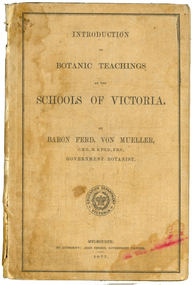
Book, Ferdinand Von Mueller, Introduction to Botanic Teachings at the Schools of Victoria, 1877
... Inside front cover "Botanist, Teacher, researcher. My you make your mark like the baron. ...No. 12062 victorian schools botany ferdinand von mueller von mueller botanic illustrations flora change number Inside front cover "Botanist, Teacher, researcher. My you make your mark like the baron. ...Ferdinand von Mueller was an examiner of botany at the Ballarat School of Mines (SMB) between 1880 and 1888. During that era he was active in donating related items to the School. When the Ballarat School of Mines Council agreed to introduce pharmacy and botany classes in 1879, it was apparent students would require access to botanical specimens in order to further their studies. Council members, who were inspired by the work of Baron Ferdinand von Mueller, authorised development of an area along the School's northern boundary, fronting Lydiard Street South, and oversaw the establishment of the new Botanical Gardens. Baron von Mueller took a practical role the development of SMB's Botanical Gardens from the beginning. He became a generous benefactor who 'donated collections of seeds and leguminous fodder plants, including valued grasses of interest and use to agriculturalists and graziers generally' to SMB over many years. Ferdinand von Mueller's entry on the University of Ballarat Honour Roll can be found at http://www.ballarat.edu.au/curator/honour-roll/honourroll_von_mueller.shtml Also See Cat. No. 12062A light brown, hardcovered book of 152 pages. Chapters include Eucalyptus Trees; Wattles or Acacias; Casuarinas or Sheoaks; Cypress Pines or Sandarac trees; Exocarpos trees of Natice Cherry trees; Mistletoes; Native Honeysuckles or Banksias; Bellflower, Lobelia and Goodenia; Heaths; Correas; Mallow; Buttercups and Clematis; Cruciferous Plants; Mints; Orchids; grasses; ferns. The book has numerous botanical line drawings, and a comprehensive index.Inside front cover "Botanist, Teacher, researcher. My you make your mark like the baron. Best wishes for your birthday 1999 Martin"victorian, schools, botany, ferdinand von mueller, von mueller, botanic illustrations, flora, change number -
Federation University Historical Collection
Books, Ballarat Teachers' College Ornithology Syllabus, 1951, 1951 and 1961
... Pescot, Director and Government Botanist regarding a specimen of Datura stramonium and Lactuca serriola, 03/03/1961....Pescot, Director and Government Botanist regarding a specimen of Datura stramonium and Lactuca serriola, 03/03/1961. ...Two foolscap folders and notes, and two letters. .1) .2) .3) Letter on Royal Botanic Gardens and National Herbarium, letterhead addressed to Alan Sonsee from R.T.M. Pescot, Director and Government Botanist regarding a specimen of Plumatells, 24/08/1961 .4) Letter on Royal Botanic Gardens and National Herbarium, letterhead addressed to Alan Sonsee from R.T.M. Pescot, Director and Government Botanist regarding a specimen of Datura stramonium and Lactuca serriola, 03/03/1961. -
Glenelg Shire Council Cultural Collection
Administrative record - Administrative record - History of William Allitt, HISTORY OF WILLIAM ALLITT, 21/12/1970
... It bears the stamp of the Director and Government Botanist, at the Royal Botanic Gardens, Melbourne....It bears the stamp of the Director and Government Botanist, at the Royal Botanic Gardens, Melbourne. ...Two-page typed history of William Allitt (1828-1893) Gardner and nurseryman who was instrumental in establishing the Portland Botanic Gardens. It bears the stamp of the Director and Government Botanist, at the Royal Botanic Gardens, Melbourne. -
 Ringwood and District Historical Society
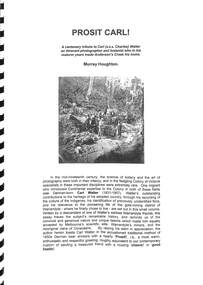
Book, Murray Houghton, Prosit Carl! - A Tribute to Carl (a.k.a. Charles) Walter, 2007
... Charles) Walter, (1831-1907), an itinerant potographer and botanist who in his maturer years made Anderson's Creek his home. ...Charles) Walter, (1831-1907), an itinerant potographer and botanist who in his maturer years made Anderson's Creek his home. ...A centenary tribute to Carl (a.k.a. Charles) Walter, (1831-1907), an itinerant potographer and botanist who in his maturer years made Anderson's Creek his home. Includes photographs attributed to Walter, and anecdotes and recollections of author Murray Houghton's ancestors."... By raising his stein in appreciation, the author herein toasts Carl Walter in the accostomed traditional method of 1850s German beer drinkers with a hearty 'Prosit!', i.e., a most warm, enthusiastic and respectful greeting, roughly equivalent to our contemporary custom of saluting a treasured friend with a rousing 'cheers!' or 'good health!'." -
Creswick Campus Historical Collection - University of Melbourne
Document, School of Forestry Grounds Book, 1967-1981
... School of Forestry Grounds Book - reports from student 'Forest Botanists'...School of Forestry Grounds Book - reports from student 'Forest Botanists' Book School of Forestry Grounds Book Document ...School of Forestry Grounds Book - reports from student 'Forest Botanists'Book -
 Federation University Historical Collection
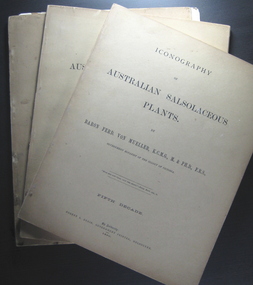
Book, Ferdinand Von Mueller, Iconography of Australian Salsolaceous Plants, 1889 and 1890
... ...botanist...Ferdinand Von Mueller was the Government Botanist for the Colony of Victoria. He was an early examiner in Botany at the Ballarat School of Mines. ...Ferdinand Von Mueller was the Government Botanist for the Colony of Victoria. He was an early examiner in Botany at the Ballarat School of Mines. botany ferdinand von mueller ballarat school of mines eucalypts botanist bookplate Three volumes of a book by Ferdinand Von Mueller (First, Third, and Fifth Decade). ...Ferdinand Von Mueller was the Government Botanist for the Colony of Victoria. He was an early examiner in Botany at the Ballarat School of Mines. Three volumes of a book by Ferdinand Von Mueller (First, Third, and Fifth Decade). The soft cover is brown, and the book includes text and black and white illustrations.botany, ferdinand von mueller, ballarat school of mines, eucalypts, botanist, bookplate -
 Kilmore Historical Society
Book, Baron Ferdinand von Mueller et al, EUCOLYPTOGRAPHIA. Eighth Decade, 1882
... Part eight of a series of ten written1879-1884 by Baron Ferdinand Mueller, Government Botanist for the Colony of Victoria published. ...Part eight of a series of ten written1879-1884 by Baron Ferdinand Mueller, Government Botanist for the Colony of Victoria published. ...A Descriptive Atlas of the Eucalypts of Australia and the Adjoining Islands.Light card cover, some staining, central longitudinal crease back and front covers. Discoloration from light exposure. Blue cloth backstrip on spine. Minor insect damage top left corner back cover. Light foxing throughout. Binding intact. Good condition.non-fictionA Descriptive Atlas of the Eucalypts of Australia and the Adjoining Islands.botany, eucalypts, australia -
 Kilmore Historical Society
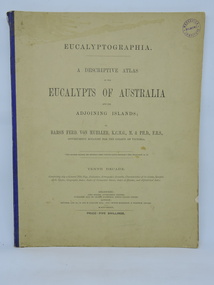
Book, Baron Ferdinand von Mueller et al, EUCALYPTOGRAPHIA. Third Decade, 1879
... Part three of a series written 1879-84 by Baron Ferdinand von Mueller, Government Botanist for the Colony of Victoria...Part three of a series written 1879-84 by Baron Ferdinand von Mueller, Government Botanist for the Colony of Victoria Early study of the Eucalypts of Australia. botany eucalypts australia A descriptive atlas of the Eucalypts of Australia and the adjoining islands Circular stamp top right corner front cover - "Mechanics Institute Kilmore". ...A descriptive atlas of the Eucalypts of Australia and the adjoining islandsLight card cover, creased top right front, tearing at bottom, with faded and worn blue cloth backstrip to spine. Backstrip torn at top and separated from body of book. Several pages missing at the front. Moisture stains on cover. Minor insect damage to some pages. Foxing throughout. Poor condition.non-fictionA descriptive atlas of the Eucalypts of Australia and the adjoining islandsbotany, eucalypts, australia -
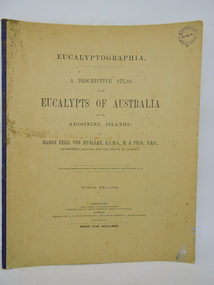 Kilmore Historical Society
Book, Baron Ferdinand von Mueller et al, EUCALYPTOGRAPHIA. Ninth Decade, 1883
... Part nine of a series of ten written 1879-84 by Baron Ferdinand von Mueller, Government Botanist for the State of Victoria....Part nine of a series of ten written 1879-84 by Baron Ferdinand von Mueller, Government Botanist for the State of Victoria. Early definitive study of the eucalypts of Australia. botany eucalypts australia A descriptive atlas of the eucalypts of Australia and the adjoining islands. ...A descriptive atlas of the eucalypts of Australia and the adjoining islands.Light card cover, some staining, discoloration due to light exposure. Light vertical crease probably due to folding. Blue cloth back strip on spine, some wear at top and bottom. Light foxing throughout. Minor insect damage to rear endpaper. Binding intact. Good condition.non-fictionA descriptive atlas of the eucalypts of Australia and the adjoining islands.botany, eucalypts, australia -
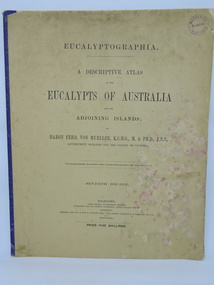 Kilmore Historical Society
Book, Baron Ferdinand von Mueller et al, EUCALYPTOGRAPHIA. Seventh Decade, 1880
... Part of seven of a ten part series written 1879- 1884 by Baron Ferdinand von Mueller, Government Botanist for Victoria....Part of seven of a ten part series written 1879- 1884 by Baron Ferdinand von Mueller, Government Botanist for Victoria. An early definitive study of Australian Eucalypts. botany eucalypts australia A descriptive atlas of the Eucalypts of Australia and the adjoining islands Circular stamp top right front cover - "Mechanics Institute Kilmore". ...A descriptive atlas of the Eucalypts of Australia and the adjoining islandsLight card cover, mould and mildew staining, discoloration from light exposure. Minor insect damage to top right front cover. Mould staining front four pages. Mildew & fluid stains through out. Some foxing throughout. Blue cloth backstrip on spine, worn at top and bottom. Binding intact. Fair condition.non-fictionA descriptive atlas of the Eucalypts of Australia and the adjoining islandsbotany, eucalypts, australia -
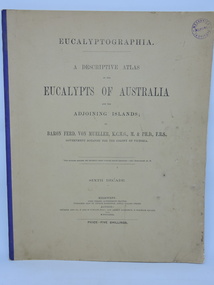 Kilmore Historical Society
Book, Baron Ferdinand von Mueller et al, EUCALYPTOGRAPHIA. Sixth Decade, 1880
... Part six of a series of ten written 1879-84 by Baron Ferdinand von Mueller, Government Botanist for the State of Victoria....Part six of a series of ten written 1879-84 by Baron Ferdinand von Mueller, Government Botanist for the State of Victoria. Early definitive study of the Eucalypts of Australia. botany eucalypts australia A descriptive atlas of the Eucalypts of Australia and the adjoining islands. ...A descriptive atlas of the Eucalypts of Australia and the adjoining islands.Light card cover with some mildew & other staining back & front. Discoloration from light exposure. Blue cloth backstrip on spine with minor wear top & bottom. Mildew & moisture staining throughout, light foxing. Binding intact. Fair condition.non-fictionA descriptive atlas of the Eucalypts of Australia and the adjoining islands.botany, eucalypts, australia -
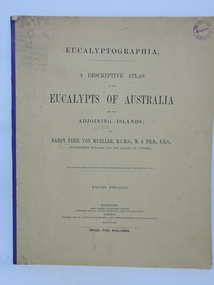 Kilmore Historical Society
Book, Baron Ferdinand von Mueller et al, EUCALYPTOGRAPHIA. Fifth Decade, 1880
... Part five of a ten part series written 1879-84 by Baron Ferdinand von Mueller, Government Botanist for the State of Victoria....Part five of a ten part series written 1879-84 by Baron Ferdinand von Mueller, Government Botanist for the State of Victoria. Early definitive study of Australian Eucalypts. botany eucalypts australia A descriptive atlas of the eucalypts of Australia and the adjoining islands. ...A descriptive atlas of the eucalypts of Australia and the adjoining islands.Light card cover with blue clothe backstrip on spine. Mildew staining top left front cover, small stains elsewhere. Minor insect damage top left back cover. Slight tearing top of backstrip. Moisture staining throughout with some mildew stains. Foxing on some pages. Binding intact. Fair conditionnon-fictionA descriptive atlas of the eucalypts of Australia and the adjoining islands.botany, eucalypts, australia -
 Kilmore Historical Society
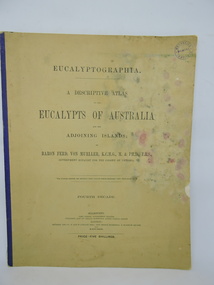
Book, Baron Ferdinand von Mueller et al, EUCALYPTOGRAPHIA. Fourth Decade, 1879
... Part four of a ten part series written 1879-84 by Baron Ferdinand von Mueller, Government Botanist for the Colony of Victoria....Part four of a ten part series written 1879-84 by Baron Ferdinand von Mueller, Government Botanist for the Colony of Victoria. Early definitive study of Australian botany. botany eucalypts australia A descriptive atlas of the Eucalypts of Australia and the adjoining islands Circular stamp top right corner front cover - "Mechanics Institute Kilmore". ...A descriptive atlas of the Eucalypts of Australia and the adjoining islandsLight card cover with worn blue cloth backstrip, tearing at top and bottom. Widespread moisture, mildew and fungal staining throughout. Small patches of insect damage to cover. Poor conditionnon-fictionA descriptive atlas of the Eucalypts of Australia and the adjoining islandsbotany, eucalypts, australia -
 Kilmore Historical Society
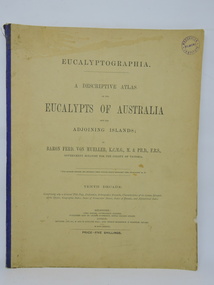
Book, Baron Ferdinand von Mueller et al, EUCALYPTOGRAPHIA. Tenth Decade, 1884
... Part ten of a ten part series written 1879-1884 by Baron Ferdinand von Mueller, Government Botanist for the Colony of Victoria....Part ten of a ten part series written 1879-1884 by Baron Ferdinand von Mueller, Government Botanist for the Colony of Victoria. Early definitive study of the Eucalypts of Australia. botany eucalypts australia A descriptive atlas of the Eucalypts of Australia and adjoining islands. ...A descriptive atlas of the Eucalypts of Australia and adjoining islands. This last part of the series also contains a Synopsis of the Species, Geographic Index, Index of Vernacular Names, Index of Decades and Alphabetical Index.Light card cover with blue cloth backstrip to spine, torn at upper extremity. Some staining and marks on cover, discoloration from light exposure. Some foxing through out. Binding intact. Fair condition.non-fictionA descriptive atlas of the Eucalypts of Australia and adjoining islands. This last part of the series also contains a Synopsis of the Species, Geographic Index, Index of Vernacular Names, Index of Decades and Alphabetical Index.botany, eucalypts, australia -
 Kilmore Historical Society
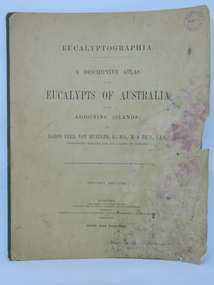
Book, Baron Ferdinand von Mueller et al, EUCALYPTOGRAPHIA. Second Decade, 1879
... Part two of a ten part series written 1879-1884 by Baron Ferdinand von Mueller, Government Botanist for the Colony of Victoria....Part two of a ten part series written 1879-1884 by Baron Ferdinand von Mueller, Government Botanist for the Colony of Victoria. Early definitive study of the Eucalypts of Australia. botany eucalypts australia A descriptive atlas of the Eucalypts of Australia and adjoining islands. ...A descriptive atlas of the Eucalypts of Australia and adjoining islands.Light card cover with green cloth backstrip to spine. Significant moisture, mildew and fungal staining on cover and throughout. cover and several pages are torn at extremities. Poor condition.non-fictionA descriptive atlas of the Eucalypts of Australia and adjoining islands.botany, eucalypts, australia -
Kilmore Historical Society
Book, Baron Ferdinand von Mueller et al, EUCALYPTOGRAPHIA. First Decade, 1879
... Part one of a ten part series written 1879-1884 by Baron Ferdinand von Mueller, Government Botanist for the Colony of Victoria....Part one of a ten part series written 1879-1884 by Baron Ferdinand von Mueller, Government Botanist for the Colony of Victoria. Early definitive study of Australian Eucalypts. botany eucalypts australia A descriptive atlas of the Eucalypts of Australia and the adjoining islands. ...A descriptive atlas of the Eucalypts of Australia and the adjoining islands.Light card cover with green cloth backstrip to spine, worn at extremities. Widespread foxing and moisture stains throughout. Some insect damage to front pages. Poor condition.non-fictionA descriptive atlas of the Eucalypts of Australia and the adjoining islands.botany, eucalypts, australia -
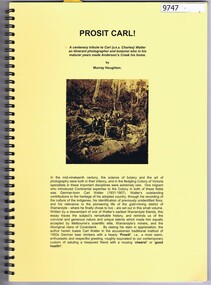 Greensborough Historical Society
Book, Warrandyte Historical Society, Posit Carl!, 2007
... Charles) Walter an itinerant photographer and botanist who in his mature years made Anderson's Creek his home....Charles) Walter an itinerant photographer and botanist who in his mature years made Anderson's Creek his home. ...A centenary tribute to Carl (a.k.a. Charles) Walter an itinerant photographer and botanist who in his mature years made Anderson's Creek his home.Spiral book 68 pages, with yellow cover, black text and black and white photosandersons creek, charles walter, photographers, warrandyte, coranderrk -
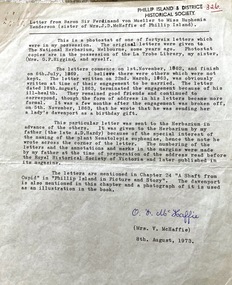 Phillip Island and District Historical Society Inc.
Letter, Letter from Baron Von Mueller to Miss Euphemia Henderson
... Von Mueller, one of Australia's greatest botanists and contributor to the early development of the Melbourne Botanic Gardens. ...Von Mueller, one of Australia's greatest botanists and contributor to the early development of the Melbourne Botanic Gardens. ...Von Mueller, one of Australia's greatest botanists and contributor to the early development of the Melbourne Botanic Gardens. He had a home on Phillip island and was engaged to Euphemia Henderson. 5 pages. One typed sheet from Mrs V. McHaffie and 4 photocopied handwritten pages of letter. Letter from Baron Von Mueller to Miss Euphemia Henderson [ sister of Mr J. D. McHaffie of Phillip Island]. Mrs V. McHaffie. 8 August 1973 Melbourne Botanic Garden, Sunday 22 February 1863baron von mueller, miss euphemia henderson, letters, mrs v. mchaffie -
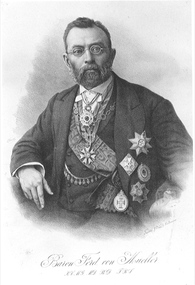 Federation University Historical Collection
Photograph - Photograph - Black and White, Ferdinand Jakob Heinrich Von Mueller
... He was appointed government botanist by Lieutenant Governor Charles La Trobe in 1853. ...He was appointed government botanist by Lieutenant Governor Charles La Trobe in 1853. ...Ferdinand Von Mueller was born in 1825 and died in 1896. He was appointed government botanist by Lieutenant Governor Charles La Trobe in 1853. Von Mueller was an examiner in Botany at the Ballarat School of Mines from 1880 to 1883.Black and white image of Ferdinand Von Mueller. von mueller, ferdinand von mueller, botany, ballarat school of mines -
Friends of Ballarat Botanical Gardens History Group
Work on paper - Simon Grant: Part 7 of The Plant Hunters, Sir Joseph Dalton Hooker: 1817-1911, C 1998
... ...Botanist...Sir Joseph Dalton Hooker was the leading botanist of the 19th century and director of one of the world's great botanic gardens, Kew. ...Sir Joseph Dalton Hooker was the leading botanist of the 19th century and director of one of the world's great botanic gardens, Kew. ...Sir Joseph Dalton Hooker was the leading botanist of the 19th century and director of one of the world's great botanic gardens, Kew. He was a friend of Charles Darwin and became famous through his numerous publications after extensive explorations.Joseph Hooker's last publication covered all the known members of 200 plant families and was the basis for the ordered arrangement of species for 130 years until it was replaced by a DNA-based one.2 pages and a small paragraph on p.3. On p.1, there is a black and white photograph of Joseph Hooker halfway down the left column of the page. On the second page, there is a coloured photograph of Magnolia campbellii halfway down the left column and another coloured photograph of Rhodendron thomsonii almost halfway down the right column. p.3 has 2 coloured photographs and news of the Southern Highlands Botanic Gardens.None.john garner, doctor john garner, ballarat botanical gardens, friends of ballarat botanical gardens, sir joseph dalton hooker, botanist, charles darwin, plant hunter, kew gardens, john garner collection, gardens, ballarat
