
Showing 6 items matching "boys bugle band"
-
 Williamstown Historical Society Inc
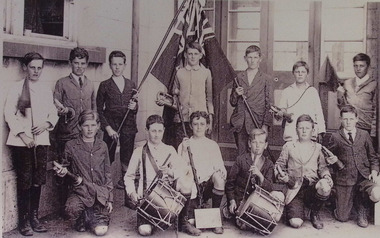
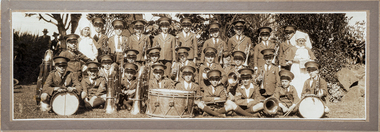
Photograph - Williamstown North State School Boys Bugle Band 1917
... Williamstown North State School Boys Bugle Band 1917...Williamstown North State School Boys Bugle Band 1917...Williamstown North State School Boys Bugle Band 1917 Photograph Williamstown North State School Boys Bugle Band 1917 ...williamstown north state school boys bugle band 1917 -
 Williamstown Historical Society Inc
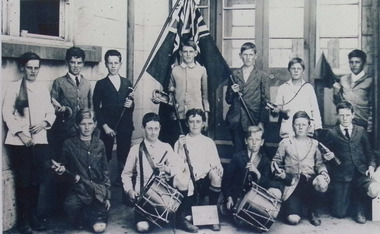
Photograph - Williamstown North Primary School No.1409, Boys Bugle Band, c.1917-18
... Williamstown North Primary School No.1409, Boys Bugle Band, c.1917-18......Boys Bugle Band...Williamstown North Primary School No.1409 Boys Bugle Band c.1917-18 Photograph Williamstown North Primary School No.1409, Boys Bugle Band, c.1917-18 ...williamstown north primary school no.1409, boys bugle band, c.1917-18 -
 Mission to Seafarers Victoria
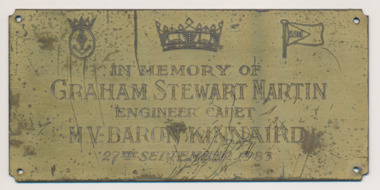
Plaque - Memorial plaque, Graham Stewart Martin, 1983
... He grew up in the south side of Glasgow and became an active member of the Boys Brigade, progressing through the different sections to eventually gain the organisation's highest award, the Queens Badge. During these years Graham became a proficient bugler and trumpeter, taking part in many nationwide competitions as part of the company band. ...He grew up in the south side of Glasgow and became an active member of the Boys Brigade, progressing through the different sections to eventually gain the organisation's highest award, the Queens Badge. During these years Graham became a proficient bugler and trumpeter, taking part in many nationwide competitions as part of the company band. ...Graham was born in 1962 in Glasgow, Scotland. He grew up in the south side of Glasgow and became an active member of the Boys Brigade, progressing through the different sections to eventually gain the organisation's highest award, the Queens Badge. During these years Graham became a proficient bugler and trumpeter, taking part in many nationwide competitions as part of the company band. After completion of his school education, Graham was accepted as an apprentice engineering officer by the Scottish Ship Management who ran a fleet of bulk carriers. After training at the Glasgow Nautical College he then went to sea, firstly on the MV Baron Napier and subsequently the MV Baron Kinnaird, the ship he was on when he travelled to Australia. On the 27th November 1983, there were parties throughout Australia to celebrate the winning of The Americas Cup yacht race, Melbourne was no exception and Graham and several colleagues went ashore to join in. During the celebrations, Graham climbed up some scaffolding to get a better view but a girder became disloged and he fell to the ground and was struck by the falling girder. He died shortly after despite the best efforts of the ambulance crews. Graham's body was returned home to Glasgow and a cremation service took place in the Linn Crematorium near where he lived and grew up. Money was donated by the ship's crew and officer and sent to the Mission (Reverend Chin) to purchase an engraved plaque in his memory. The plaque was mounted on a bench used as coffee table. In January 2025, Alain, his former girlfriend visited the Mission to view the plaque.The Mission is a place of memorial for seafarers.Rectangular brass plaque, on top 3 logos: Merchant Navy, Merchant Navy crown and flag of the SSM (Scottish Ship Management)Engraved: In Memory of / Graham Stewart Martin / Engineer Cadet / MV Baron Kinnaird / 27th September 1983graham stewart martin, engineer cadet, m.v. baron kinnaird, scottish ship management, ssm, 1983, america's cup, bench -
 Federation University Historical Collection
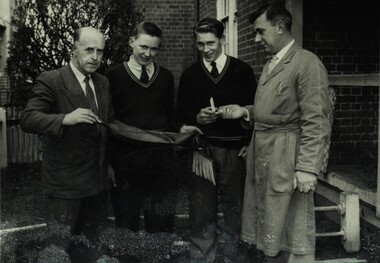
Photograph - Photograph - Black and White, Ballarat Technical School - Sports winners
... Bugle Band. Sport was the Associations main concern. The House system was developed and boys competed within this structure. ...Bugle Band. Sport was the Associations main concern. The House system was developed and boys competed within this structure. ...Organised sport and clubs began in 1919 with the formation of the Junior Technical School Students' Association. Clubs included the Rifle Club, Wireless Club, Senior Cadet team, Photography Club and Bugle Band. Sport was the Associations main concern. The House system was developed and boys competed within this structure. In 1926 the North Central Junior Technical School Sports Association was formed. Students from the district competed against each other in football, cricket and tennis. The number of schools increased and more sports were introduced. Ballarat Junior Technical School was a strong competitor. Many ex-students made a mark in sport out of the Ballarat area. The photograph shows Ray Bilney - second from the left. Born 2 November 1945, Ray began cycling aged 10. In 1963 he was Australian Junior Road Champion. From 1964 to 1966 he was Australian Senior Road Champion. He was in the Australian team at the 1964 Tokyo Olympics and came 4th in the race, aged 18 years. In 1966 he went to the Commonwealth Games in Jamaica and won a Silver Medal at the Commonwealth Games in Edinburgh in 1970. Ray was Ballarat Sportsman's Club Sportsman-of-the-Year 1965/66 and inducted into their Hall of Fame. In 1965 Ray was Cyclist-of-the-Year and won the coveted Sir Hubert Opperman Trophy. In May 2013, Ray was inducted into the Victorian Cycling Hall-of-Fame. During his time at the Junior Technical School, he sporting abilities were evident and in 1961 he was Top Sportsman of the school. The same year he was one of eight boys chosen to be Prefects of the school. He is an Alumni of Federation University. Black and white photograph of two students and two teachers looking at a sash and medal won by the students. Second from the left is Ray Bilney.sport, clubs, rifle club, photography club, cadet team, bugle band, athletics carnival, victorian technical schools sports union, house system, wireless club, alumni, ray bilney, australian junior road champion, australian senior road champion, silver medal, olympic games, commonwealth games, cyclist-of-the-year, sir hubert opperman, trophy, sportsman-of-the-year, victorian cycling hall-of-fame, ballarat junior technical school student's association -
 Port Melbourne Historical & Preservation Society
Photograph - Band at Royal Children's Hospital benefit c1928
... Boys High School. WATTERS Bob Junior Patsy St Vincents Gardens Band at Royal Children's Hospital benefit c 1928. Bob Watters junior with bugle ...The Watters family moved from Albert Park to Garden City Port Melbourne circa 1934 buying a Bank House at 128 Williamstown Road (later renumbered to 400). The family consisted of Bob Watters senior and his wife Ellen (nee Oakley), children Patsy (b 1920), Bob Junior (b 1922) and Norma (b1924). The children attended Albert Park Primary, Middle Park Central School and then MacRobertson Girls High School and Melbourne Boys High School.Band at Royal Children's Hospital benefit c 1928. Bob Watters junior with bugle second row. Patsy Watters nurse on left. In St Vincents Gardenswatters, bob junior, patsy, st vincents gardens -
 Hymettus Cottage & Garden Ballarat
Photograph, photograph of 71st Battalion Bugle Band 1918, 1919
... boys aged 12 to 17 began Compulsory Military Training in Australia from 1912. The following year the militia was reformed with Ballarat East being allocated the 70th Infantry and Ballarat West being allocated the 71st Infantry. The 71st Battalion was known as the Ballarat West Battalion until changing to (City of Ballarat) Infantry with its depots reaching as far as Warrnambool. In this photograph of the prize winning 71st Battalion Bugle Band...boys aged 12 to 17 began Compulsory Military Training in Australia from 1912. The following year the militia was reformed with Ballarat East being allocated the 70th Infantry and Ballarat West being allocated the 71st Infantry. The 71st Battalion was known as the Ballarat West Battalion until changing to (City of Ballarat) Infantry with its depots reaching as far as Warrnambool. In this photograph of the prize winning 71st Battalion Bugle Band ...All boys aged 12 to 17 began Compulsory Military Training in Australia from 1912. The following year the militia was reformed with Ballarat East being allocated the 70th Infantry and Ballarat West being allocated the 71st Infantry. The 71st Battalion was known as the Ballarat West Battalion until changing to (City of Ballarat) Infantry with its depots reaching as far as Warrnambool. In this photograph of the prize winning 71st Battalion Bugle Band a young 16 year old Michael Taffe is a bugler and won several awards with the band and as a solo bugler. A record of the immediate post-war activities still popular in 1919-1920.Mounted photograph of bugle bandcity of ballarat infantry, 71st battalion, warrnambool, ballarat, michael taffe, ballarat west battalion, cadets., bugle band, awards, bugler
