
Showing 1268 items matching "brass objects"
-
 Flagstaff Hill Maritime Museum and Village
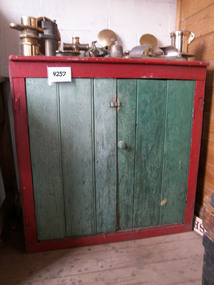
Furniture - Cupboard, 1912-1972
... ...brass objects...Flagstaff Hill Flagstaff Hill Maritime Museum and Village Warrnambool Maritime Museum Maritime Village Great Ocean Road Shipwreck Coast Briggs Briggs Marine Briggs Foundry cupboard storage brass objects Briggs family marine products village display Briggs Brass Foundry Briggs Marine Foundry Briggs Marine Products Herbert Harrison Briggs George Edward Briggs Cyril Falkiner McKinnon Briggs Collingwood Moorabbin Frank Lee Les Lee Eva Lee Briggs Marine Warrnambool non-ferrous founders bell specialists ship bell specialists sand cast marine equipment marine fittings foundry brass foundry founders Cupboard; wooden, painted red with two green doors, round wood door knobs a wood catch. ...At Briggs’ Brass Foundry, traditional sand-casting techniques have been practised for generations. Sand casting, a craft that spans over two thousand years, involves creating intricate moulds into which molten metal is poured. This handcrafted process produces durable brass and copper alloy goods, which are particularly suited to marine environments. Items such as bells, boat hooks, cowls, propellers, handles, lids, rowlocks, hooks, letters, bolts, rail holders, brackets, deck plates, flanges, rudder guides, portholes and covers have all been made using this technique. The bronze mixture used by Briggs is a copper-based alloy, carefully formulated from locally sourced ingots of copper, tin, zinc and lead in precise quantities. This results in a non-ferrous finished product, renowned for its longevity and resilience, often lasting indefinitely even in harsh conditions. Donation to Flagstaff Hill: In Flagstaff Hill's formative years, 1972-1975, the Briggs family generously donated a range of related items, including casting patterns, brassware, tools, machinery and a cupboard. These patterns illustrate the historic trades of foundering and metalwork, both of which have been essential in supporting marine industries such as shipwrights and boatbuilders. Furthermore, local industries like farming and manufacturing have relied on foundries for the casting of essential equipment. It is believed that Briggs Marine’s family members gave personal assistance in setting up the displays in the original village shops, particularly the ‘Brass Foundry’ building. Exhibition and Legacy: The donated items were displayed in a simulated Brass Foundry within the Village. This exhibit was part of a broader showcase of working crafts, trades and services typical of a Maritime town. The display was available to the public from the completion of the building in 1986 until 1994, when the space was repurposed. A notable feature of the Village Brass Foundry was the historic Cornish chimney, presented as a working model. This chimney visually demonstrated the process of smelting metal in furnaces and pouring it into sand moulds. Constructed from specially curved bricks, the chimney now stands at about two-thirds of its original height, having been relocated from the Grassmere Cheese factory.The small cupboard holds particular significance due to its association with brass foundries operating across Victoria. Marine industries, including ship and boat building, depend heavily on high-quality castings for their machinery, equipment and fittings. Briggs Brass Foundry developed a specialised brass alloy using non-ferrous metals, ensuring the durability and longevity of its products in demanding marine environments. The cupboard is linked to Briggs Maine, a longstanding business dedicated to producing cast goods tailored for the marine sector. The foundry was equipped to meet requirements for both custom and mass-produced items. Briggs Foundry’s products were commonly installed on sailing and steam vessels operating along Victoria’s coastline, including in Warrnambool. In addition to general marine fittings, Briggs Marine was recognised for its expertise in bell-founding. The foundry is notably associated with the Schomberg Bell at Flagstaff Hill, having restored this small, historic bell to its original condition. The Schomberg Bell is a fine example from a luxury migrant vessel dating back to the mid-19th century, reflecting the craftsmanship and heritage preserved by Briggs Brass Foundry.Cupboard; wooden, painted red with two green doors, round wood door knobs a wood catch. Doors are made from tongue-and-groove wood. Inside are two shelves. Stored on the shelves are an assortment of brass hinges, pipes, handles, ventilators, collars, and so on from the Briggs Foundry, Melbourne.flagstaff hill, flagstaff hill maritime museum and village, warrnambool, maritime museum, maritime village, great ocean road, shipwreck coast, briggs, briggs marine, briggs foundry, cupboard, storage, brass objects, briggs family, marine products, village display, briggs brass foundry, briggs marine foundry, briggs marine products, herbert harrison briggs, george edward briggs, cyril falkiner mckinnon briggs, collingwood, moorabbin, frank lee, les lee, eva lee, briggs marine warrnambool, non-ferrous founders, bell specialists, ship bell specialists, sand cast, marine equipment, marine fittings, foundry, brass foundry, founders -
 National Wool Museum
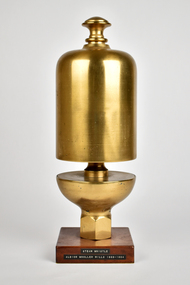
Instrument - Steam Whistle
... Cylindrical shaped brass object mounted on a wooden base.....' – exhibition label, In the Factory Instruments Pressure Gauge Albion Mill Dane Taylor & Co Pty Ltd South Melbourne Geelong Wool Industry Printed: STEAM WHISTLE / ALBION WOOLLEN MILLS 1869 - 1964 Cylindrical shaped brass object mounted on a wooden base. Instrument Steam Whistle ...Albion Mill Whistle – 'The whistle signalled the changes in shifts and Geelong residents regulated their lives by it.' – exhibition label, In the FactoryCylindrical shaped brass object mounted on a wooden base.Printed: STEAM WHISTLE / ALBION WOOLLEN MILLS 1869 - 1964instruments, pressure gauge, albion mill, dane taylor & co pty ltd, south melbourne, geelong, wool industry -
 Geoffrey Kaye Museum of Anaesthetic History
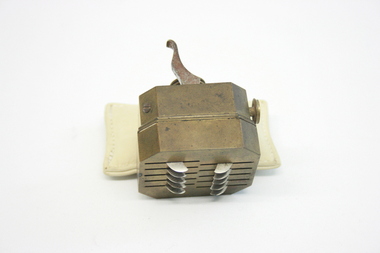
Machine - Scarificator
... Square, solid brass object with lever to release blades underneath....Metal Blades Bloodletting Etched on side: Mundy / London Square, solid brass object with lever to release blades underneath. ...Scarifiers were traditionally used for blood letting, and in folk medicine for the practice of cupping. Spring loaded knives cut the skin, then a warmed metal or glass cup is placed over the cuts. As the air inside the cup cools, it creates a vacuum drawing out the "bad" blood. The process is also related to the ancient medical theory of "humors". This theory dates back to the Hippocratic tradition and persisted through to the mid-19th Century. According to this theory, the body had four "humors", "airs" or "elements" which neeed to be kept in balance. Any imbalance could cause illness and this was often explained in terms of excess fluids. One prescribed treatment was to remove the excess blood which would restore the balance.Square, solid brass object with lever to release blades underneath.Etched on side: Mundy / Londonmetal, blades, bloodletting -
 National Wool Museum
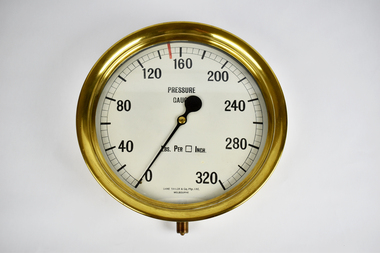
Instrument - Pressure Gauge, Dane Taylor & Co. Pty. Ltd
... Circular brass object with black hand painted text and numbers, and a central dial. .... / MELBOURNE [on base]: 277828 Circular brass object with black hand painted text and numbers, and a central dial. ...Used in the Albion Mill to determine the pressure in the departments requiring steam such as the boiler and dyeing rooms. Circular brass object with black hand painted text and numbers, and a central dial. Printed: PRESSURE / GAUGE / LBS. PER INCH. DANE TAYLOR & Co. Pty. Ltd. / MELBOURNE [on base]: 277828instruments, pressure gauge, albion mill, dane taylor & co pty ltd, south melbourne, geelong, wool industry -
 Flagstaff Hill Maritime Museum and Village
Wall Gimbal
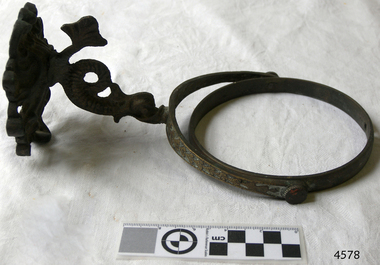
... Brass object with circular ring attached to stand with decorative base. ...Flagstaff Hill Warrnambool Shipwrecked-coast Flagstaff-Hill Flagstaff-Hill-Maritime-Museum Maritime-Museum Shipwreck-coast Flagstaff-Hill-Maritime-Village Brass object with circular ring attached to stand with decorative base. ...Brass object with circular ring attached to stand with decorative base. Decorative fish as the support arm. Length 9" Width 5".flagstaff hill, warrnambool, shipwrecked-coast, flagstaff-hill, flagstaff-hill-maritime-museum, maritime-museum, shipwreck-coast, flagstaff-hill-maritime-village -
 Federation University Historical Collection
Equipment - Equipment - Scientific, Heliostat
... Black metal and brass object with scale measure (0 - 90 and glass circle on top that can be raised and lowered. ...Black metal and brass object with scale measure (0 - 90 and glass circle on top that can be raised and lowered. ...A heliostat (from helios, the Greek word for sun, and stat, as in stationary) is a device that includes a mirror, usually a plane mirror, which turns so as to keep reflecting sunlight toward a predetermined target, compensating for the sun's apparent motions in the sky. Nowadays, most heliostats are used for daylighting or for the production of concentrated solar power, usually to generate electricity. They are also sometimes used in solar cooking. A few are used experimentally to reflect motionless beams of sunlight into solar telescopes. Before the availability of lasers and other electric lights, heliostats were widely used to produce intense, stationary beams of light for scientific and other purposes.Black metal and brass object with scale measure (0 - 90 and glass circle on top that can be raised and lowered. Three legs with brass feet.Markings on scale measure. heliostat, metal, brass, mirror, guage -
 Flagstaff Hill Maritime Museum and Village
Object
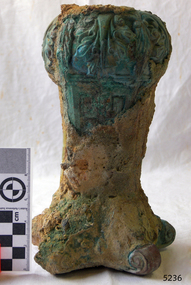
... Heavy metal object from a wreck, possibly Loch Ard. Ornate brass object. Piece of glass visible in concretion. ...flagstaff hill warrnambool shipwrecked-coast flagstaff-hill flagstaff-hill-maritime-museum maritime-museum shipwreck-coast flagstaff-hill-maritime-village Heavy metal object from a wreck, possibly Loch Ard. Ornate brass object. Piece of glass visible in concretion. ...Heavy metal object from a wreck, possibly Loch Ard. Ornate brass object. Piece of glass visible in concretion. Object has 5 feet.flagstaff hill, warrnambool, shipwrecked-coast, flagstaff-hill, flagstaff-hill-maritime-museum, maritime-museum, shipwreck-coast, flagstaff-hill-maritime-village -
 Warrnambool and District Historical Society Inc.
Lighter, Holder for tapers & matches for gas lighting
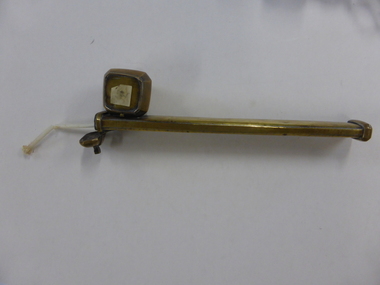
... This is a brass object made in two parts – a rectangular container holding six wax tapers and a squat jar-shaped container for holding matches. ...This taper and matches holder has no known local significance but is an attractive object and will be useful for display. social history warrnambool history metal candle taper This is a brass object made in two parts – a rectangular container holding six wax tapers and a squat jar-shaped container for holding matches. ...This object was used to light gas burners, lamps, lights etc. The tapers were used to light a burner that was hard to reach. It may also have been used in a church to light candles. This taper and matches holder has no known local significance but is an attractive object and will be useful for display.This is a brass object made in two parts – a rectangular container holding six wax tapers and a squat jar-shaped container for holding matches. The match holder is welded to the taper holder. The tapers are bent or broken in several places. The taper holder has a hinged lid with a brass top. The match holder has an embedded shell-shaped emblem. social history, warrnambool history, metal candle taper -
 Bendigo Military Museum
Functional object - CIGARETTE LIGHTER WW1, Imperial German Army
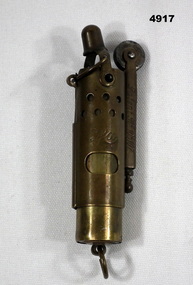
... This is a two part brass cylindrical object. The two pieces slide apart a small distance. ...Pat 105107 This is a two part brass cylindrical object. The two pieces slide apart a small distance. ...This is a two part brass cylindrical object. The two pieces slide apart a small distance. This mechanism when operated removes a cap from the wick. On the side is a square, long section that holds a flint & string. On the tip of this section is a circular wheel with a serrated edge. When the inner section is slid down a little, the flame is shielded from the wind by the holes in the outer section. There is a ring mounted in the bottom., Engraved on one side are the letters CFA. Engraved on side of square section is "Patent 91 105107". On other side of square section are the words "Made in Austria". Pat 105107cigarette lighter, souvenir, smoking -
 Glenelg Shire Council Cultural Collection
Functional object - Survey Mark
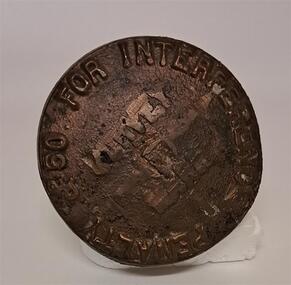
... Brass mushroom shaped object. The stalk end has a split in the bottom like an old peg. ...Survey Surveying Tool Land Marker Penalty 50 for interference Brass mushroom shaped object. The stalk end has a split in the bottom like an old peg. ...Brass mushroom shaped object. The stalk end has a split in the bottom like an old peg. The top of the marker has 50 pound penalty for interference on it. It looks as though several words have been chipped off or out from the middle of the top. Look to be ' Survey Mark'Penalty 50 for interferencesurvey, surveying tool, land, marker -
 Flagstaff Hill Maritime Museum and Village
Decorative object - Brass Finial, Russell & Co, circa 1886
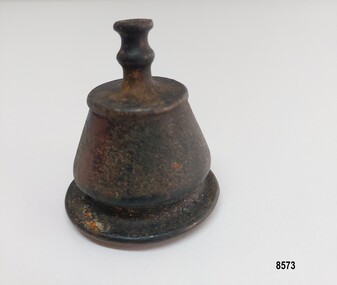
... A brass, bell-shaped object with a body approximately 3 cm high. ...It has a decorative topping almost 2 cm high, which has a double concave hollow neck. Decorative object Brass Finial Russell & Co. ...In the 19th century, the Industrial Revolution meant that shipbuilders could build ships using iron. These iron ships could be much larger, with more space for cargo, and they didn't need as much work to keep them in good condition. Isambard Kingdom Brunel's "Great Britain" built in 1843, was the first ship to be built entirely of wrought iron. In the 1880's steel began to be used instead of iron. Ships also began to be fitted with steam engines, although a great deal of coal was needed to travel even short distances. For this reason, ships continued to be fitted out with sails even though many came with engines. The iron-hulled, four-masted barque, the Falls of Halladale, was a bulk carrier of general cargo. She left New York in August 1908 on her way to Melbourne and Sydney. In her hold, along with 56,763 tiles of unusual, beautiful green American slates (roofing tiles), 5,673 coils of barbed wire, 600 stoves, 500 sewing machines, 6500 gallons of oil, 14400 gallons of benzene, and many other manufactured items, were 117 cases of crockery and glassware. Three months later and close to her destination, a navigational error caused the Falls of Halladale to be wrecked on a reef off the Peterborough headland at 3 am on the morning of the 15th of November, 1908. The captain and 29 crew members all survived, but her valuable cargo was largely lost, despite two salvage attempts in 1908-09 and 1910. ABOUT THE ‘FALLS OF HALLADALE’ (1886 - 1908): - Built: in1886 by Russell & Co., Greenock shipyards, River Clyde, Scotland, UK. The company was founded in 1870 (or 1873) as a partnership between Joseph Russell (1834-1917), Anderson Rodger and William Todd Lithgow. During the period 1882-92, Russell & Co. standardised designs, which sped up their building process so much that they were able to build 271 ships over that time. In 1886, they introduced a 3000-ton class of sailing vessel with auxiliary engines and brace halyard winches. In 1890, they broke the world output record. Owner: Falls Line, Wright, Breakenridge & Co, 111 Union Street, Glasgow, Scotland. Configuration: Four-masted sailing ship; iron-hulled barque; iron masts, wire rigging, fore & aft lifting bridges. Size: Length 83.87m x Breadth 12.6m x Depth 7.23m, Gross tonnage 2085 ton Wrecked: the night of 14th November 1908, Curdies Inlet, Peterborough, south west Victoria Crew: 29 The Falls of Halladale was a four-masted sailing ship built in 1886 in Glasgow, Scotland, for the long-distance cargo trade and was mostly used for Pacific grain trade. She was owned by Wright, Breakenridge & Co of Glasgow and was one of several Falls Line ships, all of which were named after waterfalls in Scotland. The lines flag was of red, blue and white vertical stripes. The Falls of Halladale had a sturdy construction built to carry maximum cargo and was able to maintain full sail in heavy gales, one of the last of the ‘windjammers’ that sailed the Trade Route. She and her sister ship, the Falls of Garry, were the first ships in the world to include fore and aft lifting bridges. Previous to this, heavily loaded vessels could have heavy seas break along the full length of the deck, causing serious injury or even death to those on deck. The new, raised catwalk-type decking allowed the crew to move above the deck in stormy conditions. This idea is still used today on the most modern tankers and cargo vessels and has proved to be an important step forward in the safety of men at sea. On 4th August 1908, with new sails, 29 crew, and 2800 tons of cargo, the Falls of Halladale left New York, bound for Melbourne and Sydney via the Cape of Good Hope. The cargo on board was valued at £35,000 and included 56,763 tiles of American slate roofing tiles (roof slates), 5,673 coils of barbed wire, 600 stoves, 500 sewing machines, 6,500 gallons of oil, 14,400 gallons of benzene, plumbing iron, 117 cases of crockery and glassware and many other manufactured items. The Falls of Halladale had been at sail for 102 days when, at 3 am on the night of 14th November 1908, under full sail in calm seas with a six knots breeze behind and misleading fog along the coast, the great vessel rose upon an ocean swell and settled on top of a submerged reef near Peterborough on the south-west Victoria’s coast. The ship was jammed on the rocks and began filling with water. The crew launched the two lifeboats and all 29 crew landed safely on the beach over 4 miles away at the Bay of Islands. The postmistress at Peterborough, who kept a watch for vessels in distress, saw the stranding and sent out an alert to the local people. A rescue party went to the aid of the sailors, and the Port Campbell rocket crew was dispatched, but the crew had all managed to reach shore safely by the time help arrived. The ship stayed in full sail on the rocky shelf for nearly two months, attracting hundreds of sightseers who watched her slowly disintegrate until the pounding seas and dynamiting by salvagers finally broke her back, and her remains disappeared back into deeper water. The valuable cargo was largely lost, despite two salvage attempts in 1908-09 and 1910. Further salvage operations were made from 1974-1986, during which time 22,000 slate tiles were recovered with the help of 14 oil drums to float them, plus personal artefacts, ship fittings, reams of paper and other items. The Court of Marine Inquiry in Melbourne ruled that the foundering of the ship was entirely due to Captain David Wood Thomson’s navigational error, not too technical failure of the Clyde-built ship. The shipwreck is a popular site for divers, about 300m offshore and in 3 – 15m of water. Some of the original cargo can be seen at the site, including pieces of roof slate and coils of barbed wire. This particular artefact was one of many found by John Laidlaw (a local Warrnambool diver) when diving on the Falls of Halladale in the 1960's. In August 1973, John Laidlaw and Stan McPhee went on to discover the underwater location of the Schomberg - a passenger ship that ran aground on December 26th 1855 near Peterborough and which now lies in almost 9 metres of water. When John Laidlaw died, his family donated a number of artefacts to Flagstaff Hill. The brass finial may have been part of a larger decorative item such as a lamp or clock bracket.This item is significant as it was taken from the Falls of Halladale shipwreck which is listed on the Victorian Heritage Register (No. S255). She was one of the last ships to sail the Trade Routes. She is one of the first vessels to have fore and aft lifting bridges. She is an example of the remains of an International Cargo Ship and also represents aspects of Victoria’s shipping industry. The wreck is protected as a Historic Shipwreck under the Commonwealth Historic Shipwrecks Act (1976)A brass, bell-shaped object with a body approximately 3 cm high. It has an outer lip, straight sides that taper in and a flat "cap". The inside of the object is plain with evidence of vertigris. It has a decorative topping almost 2 cm high, which has a double concave hollow neck.flagstaff hill, flagstaff hill divers, flagstaff hill maritime museum and village, great ocean road, warrnambool, falls of halladale, falls of halladale wreck, shipwreck artefact, artefact, brass artefact, brass finial, brass fitting, shipwreck coast, diver, john laidlaw, finial, brass decoration, handmade -
 Bendigo Historical Society Inc.
Medal - MEDAL COLLECTION: BOER WAR MEDAL, 1900
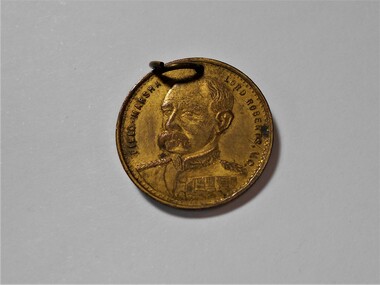
... Object. Brass coloured medal with hole drilled at top with suspension ring. ...NUMISMATICS Medals - military Boer War Medal Object. Brass coloured medal with hole drilled at top with suspension ring. ...Object. Brass coloured medal with hole drilled at top with suspension ring. Obverse: Around edge ''FIELD MARSHALL LORD ROBERTS V.C.'' Picture of Frederick Sleigh Roberts in Uniform. British Commander in the Boer War. Reserve: Around edge ''BRITISH TRANSVAAL WAR 1900''. Picture of Queen Victoria.numismatics, medals - military, boer war medal -
 Bendigo Historical Society Inc.
Accessory - BADGE COLLECTION: ARTILLERY COLLAR BADGE, 1901-1912
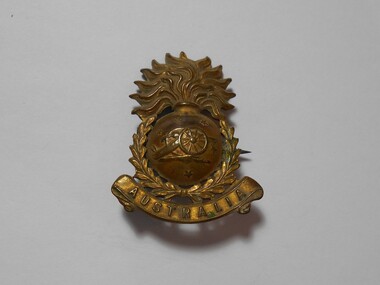
... Object. Brass collar badge for Australian Field Artillery (Militia) 1901-1912. ...NUMISMATICS Badges - military Artillery Collar Badge Object. Brass collar badge for Australian Field Artillery (Militia) 1901-1912. ...Object. Brass collar badge for Australian Field Artillery (Militia) 1901-1912. Brooch style attachment device on back. Badge in shape of a bomb with flames coming out of top. Bomb surrounded by a laurel wreath. Imprinted on the bomb is a wheeled cannon. A banner beneath the bomb has the word ''AUSTRALIA''.numismatics, badges - military, artillery collar badge -
 Bendigo Historical Society Inc.
Accessory - BADGE COLLECTION: MILITARY FORCES BADGE, 1904-1949
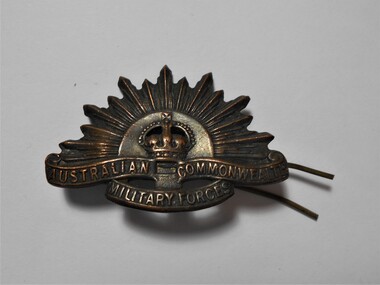
... Object. Brass lapel badge of the AUSTRALIAN COMMONWEALTH MILITARY FORCES with two loops plus hair pin fastener. ...NUMISMATICS Badges - military Military Forces Badge Object. Brass lapel badge of the AUSTRALIAN COMMONWEALTH MILITARY FORCES with two loops plus hair pin fastener. ...Object. Brass lapel badge of the AUSTRALIAN COMMONWEALTH MILITARY FORCES with two loops plus hair pin fastener. Badge has the emblem of the Rising Sun and a crown, with three banners underneath. "AUSTRALIAN COMMONWEALTH MILITARY FORCES''. This is the third pattern of the Rising Sun Badge. It was used between 1904-1949.numismatics, badges - military, military forces badge -
 Bendigo Historical Society Inc.
Medal - MEDAL COLLECTION: CORONATION MEDAL, 1911
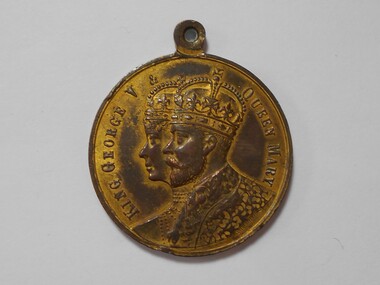
... Object. Brass coloured metal medal with suspension ring attached at crest. ...NUMISMATICS Medals - commemorative Coronation Medal Object. Brass coloured metal medal with suspension ring attached at crest. ...Object. Brass coloured metal medal with suspension ring attached at crest. Obverse: Overlapping profiles of King George V and Queen Mary. Around the edges '' KING GEORGE V & QUEEN MARY''. Reverse: In centre State of Victoria Coat of Arms. Around the edge ''To COMMEMORATE THEIR MAJESTIES CORONATION JUNE 22 1911''.numismatics, medals - commemorative, coronation medal -
 Bendigo Historical Society Inc.
Accessory - BADGE COLLECTION: MILITARY FORCES BADGE, 1904-1949
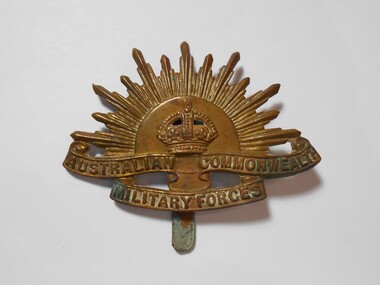
... Object. Brass hat badge of the Australian Commonwealth Military Forces with a slider bar. ...NUMISMATICS Badges - military Military Forces Badge Object. Brass hat badge of the Australian Commonwealth Military Forces with a slider bar. ...Object. Brass hat badge of the Australian Commonwealth Military Forces with a slider bar. This badge was used by the Light Horse to slide onto the front of the puggaree on the slouch hat. Badge has the emblem of the Rising Sun and a crown, with three banners underneath, " AUSTRALIAN COMMONWEALTH MILITARY FORCES''. This is the third pattern of the Rising Sun badge. It was used between 1904-1949.numismatics, badges - military, military forces badge -
 Bendigo Historical Society Inc.
Medal - MEDAL COLLECTION: PROMOTE FEDERATION MEDAL, 1899
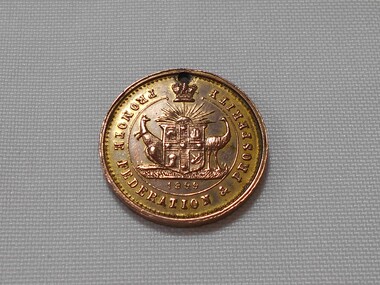
... Object. Brass coloured medal with 1.5 mm hole drilled near top edge. ...NUMISMATICS Badges-commemorative promote federation medal1899 Object. Brass coloured medal with 1.5 mm hole drilled near top edge. ...Object. Brass coloured medal with 1.5 mm hole drilled near top edge. Obverse:Australian Coat of Arms. Kangaroo and emu have their heads turned. Engraved around edge. ''Promote Federation & Prosperity'', Underneath Coat of Arms ''1899''. Reverse: Laurel leaves around the edge. Map of Australia in the centre with ''1899''. Engraved around map ''Australia's Commonwealth''.numismatics, badges-commemorative, promote federation medal1899 -
 Flagstaff Hill Maritime Museum and Village
Functional object - Ship's Fitting, circa 1825
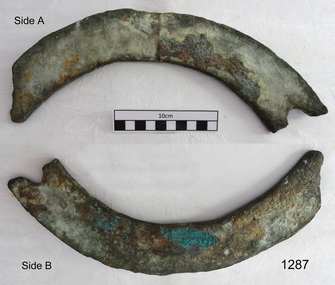
... Once the apparently obvious use of the brass object is discounted, an accurate and reliable alternative classification is difficult to specify. ...Once the apparently obvious use of the brass object is discounted, an accurate and reliable alternative classification is difficult to specify. ...This attractively patinated artefact was raised from the wreck site of the CHILDREN and was quite reasonably catalogued as a portion of a ship's porthole. This identification is unlikely, however, because the CHILDREN was built at Liverpool in 1824, and round portholes were not in common use until the 1850s. The catalogue identification has since been changed to "Ship's Fitting" Before the appearance of round portholes in the middle of the nineteenth century, the function of introducing light to lower decks was performed by square half-glassed ‘ports’ in the side of the hull (known as a port-sash), or ground-glass ‘bullseyes’ inserted in the deck (scuttles). In historical terms, ports were always square, cut into the timber originally to allow the firing of a ship's guns, and were closed in weather by a tight-fitting square hatch. Flagstaff Hill Shipwreck Museum has three portholes on display that illustrate the gradual development and adoption of circular brass portholes. First in sequence is a small 12.5cm diameter window (with a deep frame for thick wooden hulls) from the 1855 wreck of SCHOMBERG. The second and third are larger 25cm diameter windows (with a shallower frame for thinner iron hulls) from the 1892 wreck of the NEWFIELD and the 1908 wreck of the FALLS OF HALLADALE. Once the apparently obvious use of the brass object is discounted, an accurate and reliable alternative classification is difficult to specify. One artefact register notes it was ‘found in about the centre of the wreck site’. This would mitigate against the possibilities of (1) ‘horseshoe frame’ joining pieces of the keel and hull at the bow of the vessel, or (2) ‘deckseat’ for a binnacle at the stern. It may support the idea of a ‘head frame’ on a cooped companionway or a ‘deckseat’ for a mainmast pump. But this is only speculation. The actual identification is not known. The sip's fitting recovered from the Children's wreck is significant as part of the original fittings of the early 19th-century barque. The 1839 wreck and recovered artefacts are examples of the construction methods and materials used in that era and can be used to study the evolution of shipbuilding methods and principles. The wreck of the Children is of state significance as one of colonial Victoria’s earliest and most significant maritime disasters, and one of the first vessels lost in the Western District. This is recognised by its inclusion on the Victorian Heritage Register, VHR No. S116. Little is left on the seabed to mark the tragedy, apart from some of the house bricks intended for the Henty settlement. Ship's fitting, of heavy gauge brass circle, previously classified as a section of the ship's fitting, which was raised from the wreck of the Children. One end is broken off at an original bolt hole, and the other is severed or cut at an acute angle from the inner rim. The artefact is 6cm across and 1cm deep, indicating strength and function as a substantial and finished item of moulded metal. The upper face bears sedimentary accretion stained red/brown. The rear face has been gouged by hard or corrosive materials and bears brilliant blue/green oxidation.flagstaff hill, flagstaff hill maritime museum and village, warrnambool, maritime museum, maritime village, great ocean road, shipwreck coast, shipwreck artefact, children, childer’s cove, port campbell, 1839 shipwreck, james henty and co, henty brothers, captain h. browne, portland, portland bay, brass flange, brass rim, ship’s fitting -
 Bendigo Historical Society Inc.
Tool - BRASS OBJECT
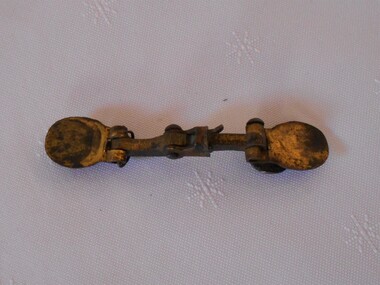
... BRASS OBJECT......brass object...Object. Curved brass bar with circular disc at one end. ...HISTORY Australian brass object Object. Curved brass bar with circular disc at one end. ...Object. Curved brass bar with circular disc at one end. L shaped piece (broken at end) attached in centre by rivet - moveable. At either end are circular flat discs - one attached by a rivet, the other by a piece of wire - both moveable. Possibly part of a set of scales.history, australian, brass object -
 Bendigo Historical Society Inc.
Medal - MEDAL COLLECTION: QUEEN VICTORIA JUBILEE MEDAL, 1887
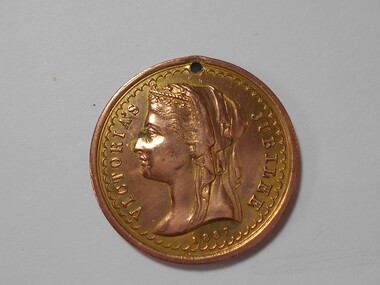
... Object. Brass coloured metal medal with 1mm hole drilled in top edge. ...NUMISMATICS Medals - commemorative Queen Victoria Jubilee Medal 1887 Object. Brass coloured metal medal with 1mm hole drilled in top edge. ...Object. Brass coloured metal medal with 1mm hole drilled in top edge. This medal was produced by the Borough of Eaglehawk to commemorate the Jubilee Year of Queen Victoria. George Willan was Mayor at the time. Obverse: Crowned and veiled profile head of Queen Victoria. Around edge ''VICTORIA'S JUBILEE 1887''. Reverse: Royal Coat of Arms above an eagle with outstretched wings with mullock heap to the left and factory to the right. Around the edge ''GEORGE WILLAN MAYOR''.numismatics, medals - commemorative, queen victoria jubilee medal 1887 -
 City of Moorabbin Historical Society (Operating the Box Cottage Museum)
Scales, Imperial weights & brass bowls, c1900
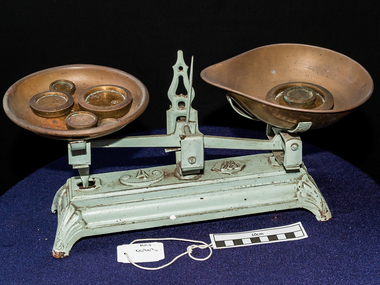
... A set of steel weighing scales with a balance beam that holds 2 brass dishes in which are 7 brass weights. The object/ substance to be weighed is placed in 1 dish and the weights are added to the other dish until the two dishes balance equally on the beam. ...A set of steel weighing scales with a balance beam that holds 2 brass dishes in which are 7 brass weights. The object/ substance to be weighed is placed in 1 dish and the weights are added to the other dish until the two dishes balance equally on the beam. ...A pair of scales or dishes in which objects to be weighed and the weights / masses against which to weigh them are placed is an "Apparatus for weighing. The pan, or each of the pans, of a balance." These common kitchen / dairy scales would be used by the householder to weigh flour, sugar, cereal, vegetables, fruit, meats, butter, cheese etc. prior to cooking or storing . Its parts include a fulcrum, a beam that balances on it, two pans at the ends of the beam to hold the materials to be weighed, and counter-balancing weights.Its parts include a fulcrum, a beam that balances on it, two pans at the ends of the beam to hold the materials to be weighed, and counter-balancing weights.. A set of steel weighing scales with a balance beam that holds 2 brass dishes in which are 7 brass weights. The object/ substance to be weighed is placed in 1 dish and the weights are added to the other dish until the two dishes balance equally on the beam. The base is engraved with '4 lbs' thus indicating that this set will balance up to that weight.scales 4 lbs ( 4 Pounds ) each weight is marked with its weight in Imperial Measure 1 0z = 1 ounce to 4lbmarket gardeners, early settlers, fruit vegetables, farmers, cooking, recipes, scales, weights, measures, brass, balance beam, moorabbin, cheltenham, bentleigh, kitchen scales, dairy products, cereals, wheat flour -
 Bendigo Historical Society Inc.
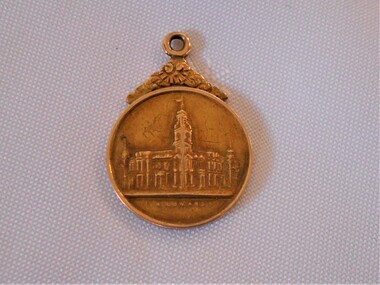
Medal - MEDAL COLLECTION: FIRST AWARD MEDAL1886, 1886
... Object. Brass coloured medal with a suspension piece and suspension ring on the crest. ...NUMISMATICS Medals - civil First Award Medal Object. Brass coloured medal with a suspension piece and suspension ring on the crest. ...Object. Brass coloured medal with a suspension piece and suspension ring on the crest. Obverse: Bendigo Town Hall, Below picture, ''J. B. EDWARDS''. Reverse: Around edge, ''Bendigo Juvenile & Industrial Exhibition 1886'', Engraved in centre ''FIRST AWARD MISS ELY HANDMADE SHIRT''. The Bendigo Juvenile and Industrial Exhibition was held in 1886. It was opened by the Governor. The exhibition was organized to encourage young people to engage in useful activities. The Picture Gallery had over 700 entries and impetus for the establishment of the Bendigo Art Gallery.numismatics, medals - civil, first award medal -
 Bendigo Historical Society Inc.
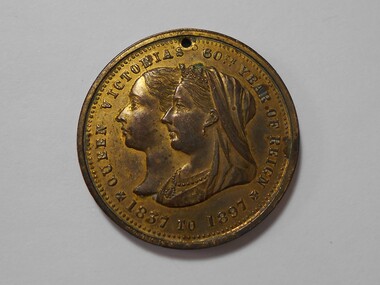
Medal - MEDAL COLLECTION: QUEEN VICTORIA JUBILEE MEDAL, 1897
... Object. Brass coloured metal medal with 1mm hole drilled in the top edge. ...NUMISMATICS Medals - commemorative Queen Victoria's Jubilee Medal 1897 Object. Brass coloured metal medal with 1mm hole drilled in the top edge. ...Object. Brass coloured metal medal with 1mm hole drilled in the top edge. This coin was produced by the Borough of Eaglehawk to commemorate the 60th Jubilee Year of Queen Victoria. E.C.Brown was Mayor at the time. Obverse: In the centre overlapping profile of Queen Victoria at different ages. Around the edge ''QUEEN VICTORIA'S 60TH YEAR OF REIGN 1837 - 1897''. Reverse: Diamond outline around Royal Coat of Arms above an eagle with outstretched wings with mullock heap to the left and factory to the right . Around the edge ''EAGLEHAWK E.C. BROWN. MAYOR 1897''.numismatics, medals - commemorative, queen victoria's jubilee medal 1897 -
 Flagstaff Hill Maritime Museum and Village
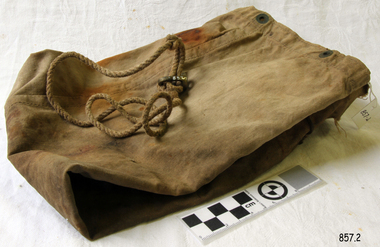
Functional object - Ditty Bag, Late 19th century
... Items such as these although they were regarded at the time as everyday objects help us now to map various aspects of marine archaeology thorough the ages. flagstaff hill warrnambool shipwrecked-coast flagstaff-hill flagstaff-hill-maritime-museum maritime-museum shipwreck-coast flagstaff-hill-maritime-village None Sailors Ditty Bag, canvas bag for holding all the sail making and roping tools, with tie and brass clasp. ...A Ditty Bag (or box) was originally called “ditto bag” because it contained at least two of everything, two needles, two spools of thread, two buttons, etc. With the passing of years, the “ditto” was dropped in favour of "ditty" and remains so today. Before World War I, the Navy issued ditty boxes made of wood and styled after footlockers. These carried the personal gear and some clothes of the sailor. Today, the ditty bag is still issued to recruits and contains a sewing kit, toiletry articles and personal items such as writing paper and pens. Another source says a Ditty Box or Ditty Bag is possibly from the Saxon word “dite”, meaning tidy or from the English word “dittis”, a type of canvas material. A small box or bag in which a sailor kept his valuables such as letters, small souvenirs and sewing supplies.An item that is socially significant as it gives insight into a sailors life aboard ship and is another part of marine history. Items such as these although they were regarded at the time as everyday objects help us now to map various aspects of marine archaeology thorough the ages.Sailors Ditty Bag, canvas bag for holding all the sail making and roping tools, with tie and brass clasp. Holed.Noneflagstaff hill, warrnambool, shipwrecked-coast, flagstaff-hill, flagstaff-hill-maritime-museum, maritime-museum, shipwreck-coast, flagstaff-hill-maritime-village -
 Flagstaff Hill Maritime Museum and Village
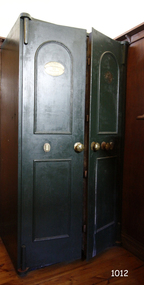
Functional object - Safe, W. Marr, Circa 1855
... brass knob and an oval keyhole. The top panels of the left door has an oval plaque with an inscription; the right door has evidence that there was an oval attachment. Made by W. Marr, London. Functional object ...This strong, heavy bank safe was made by W. Marr in London. It was formerly owned by the ANZ Bank in Portland, Victoria. Portland’s ANZ Bank was originally a branch of the Bank of Australasia, which first came to Australia in 1835, opening in Sydney. Portland’s Bank of Australasia began in a bluestone building built on the north corner of Julia and Bentinck Streets by stonemason William Robb in 1855, around the time of Australia’s Gold Rush. Eventually, in 1951, the Bank of Australasia merged with the Union Bank to become the Australia & New Zealand Bank, known as the ANZ. Portland’s branch of the Bank of Australasia then moved into the old Union Bank building at 44 Percy Streets; both bank buildings were built around the same. The maker of this safe, W. (William) Marr, obtained a patent in 1834 for what is believed to be the first fire-retarding patent, building this into the lining of strong boxes. Others made further design improvements such as hardening the metal plates used to make the boxes. In about 1840 Thomas Milner, a Sheffield tinsmith, made the earliest safes that could safely protect their contents from a surrounding fire. This was achieved by including tubes of a substance between the inner and outer walls of the safe that would react to the heat and the contents would put the fire out. In 1851 an Exhibition at London’s Crystal Palace included fire-proof safes from different vendors. William Marr was listed under Fireproof Box Makers in the 1842 London Trades Directory, at 33 Broad Street, and 52 Cheapside. William Marr & Son were appointed to supply Her Majesty’s National Debt Office and other departments in 1860, with the address 9 Walbrook, Vulcan Safe Works, Skin Yard, Bankside, Southwark, London. 1n 1870 the address for William Marr listed under Safe Makers and Agents in the London Trades Directory was 67 Cannon Street. The manufacturer, W Marr, is significant as an inventor of a way to make a strong box fireproof, then patented his secure safe. This invention indicates that security of money was of great importance in the mid-1800s as it continues to be today. The secure safe would have given much comfort to those with investments and savings, as well as to the bank itself, the custodian of other people's money. This safe was made in London and exported to colonial Australia, giving significance to the safe as an item that was high in the list of the needs of the early Australians and their businesses. The safe has local historical significance as it was used by the original Bank of Australasia in Portland, which was built in 1855 and went on to become the ANZ Bank, still in operation today. The bank was an integral part of the establishment and growth of commerce in Colonial Victoria.Safe; heavy metal bank safe, painted green. Double doors each have top and bottom external hinges, and two front panels; the top panels are arched. The thick doors have five sliding locks. Inside is a fixed metal compartment with a locked sliding metal drawer, and several fitted shelves plus some temporary removable shelving. Both doors have a decorative brass knob near the centre opening. Left door has an oval artificial keyhole and a space where another fitting has been attached. The right door has a second brass knob and an oval keyhole. The top panels of the left door has an oval plaque with an inscription; the right door has evidence that there was an oval attachment. Made by W. Marr, London.Text embossed on plaque: "W. MARR / PATENTEE & MANUFACTURER / 52 / /CHEAPSIDE / LONDON" flagstaff hill, warrnambool, shipwreck coast, flagstaff hill maritime museum, flagstaff hill maritime village, maritime museum, great ocean road, shipwreck artefact, safe, bank safe, vault, security, finances, anz bank, portland bank, w marr, william w marr, financial institution, savings, gold exchange, loans, investments, safety, safe maker, lock maker, iron box, strong-room -
 Flagstaff Hill Maritime Museum and Village
Functional object - Cash Bag, late 1800s to early 1900s
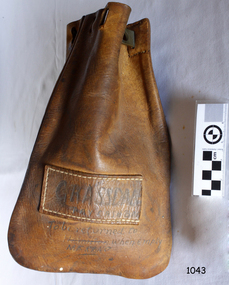
... brass peg for securing opening. Has stitched leather rectangle nameplate with hand written inscription. Functional object ...The leather bag is a Pay Cash Bag. It was used to transfer cash between the the railway stations of Grassdale and Merino.This Pay Cash Bag is an example of the connection between people in the remote areas of Victoria. The railway system was used to transfer people, goods and cash between districts in western Victoria. Pay Cash Bag; a rectangular leather bag with rounded bottom corners, stitched, with brass peg for securing opening. Has stitched leather rectangle nameplate with hand written inscription.Handwritten; “GRASSDALE PAY CASH BAG” “To be returned to MERINO when empty”flagstaff hill, flagstaff hill maritime museum and village, warrnambool, maritime museum, maritime village, great ocean road, shipwreck coast, cash bag, merino railway station, rural banking, finances, grassdale railway station -
 Flagstaff Hill Maritime Museum and Village
Functional object - Cash Bag, late 1800s to early 1900s
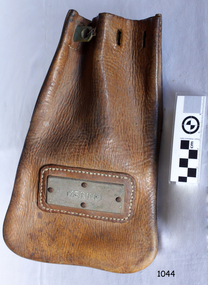
... Has stitched leather rectangle frame and brass nameplate with inscription. Functional object Cash Bag ...The leather bag is a Railway Cash Bag. It was used to transfer cash between the the railway stations of Merino and Casterton. The Casterton Railway Station was Merino's banking station. This Cash Bag is an example of the connection between people in the remote areas of Victoria. The railway system was used to transfer people, goods and cash between the districts of western Victoria.Railway Cash Bag; a rectangular leather bag with rounded bottom corners, stitched, with brass peg for securing opening. Has stitched leather rectangle frame and brass nameplate with inscription."MERINO"flagstaff hill, flagstaff hill maritime museum and village, warrnambool, maritime museum, maritime village, great ocean road, shipwreck coast, cash bag, railway cash bag, merino railway station, casterton railway station, banking station, rural banking, finances -
 Flagstaff Hill Maritime Museum and Village
Functional object - Porthole Frame, Russell & Co, 1888
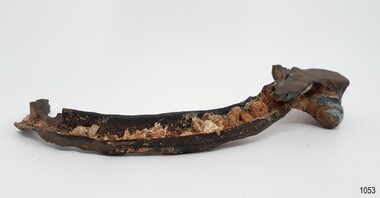
... brass, large part corroded away. Hing is still visible on the end. The underside is shaped to allow the fitting of the glass. Recovered from the wreck of the Antares. Functional object ...This portion of the porthole frame was part of the fittings of the Antares. The Italian barque “Antares” was an iron three-masted sailing ship built in 1888 by Russell & Co of Port Glasgow. The ship was originally named the “Sutlej” but was renamed the “Antares” in 1907 when sold to the Semider Bros of Genoa, Italy, where it was registered. The vessel left Marseilles on the 18th of December 1913 with its master Captain Gazedo destined for Mullaly & Byrne of Melbourne with a cargo of roofing tiles but failed to arrive. The wreckage was found near the Bay of Islands, twenty-two miles east of Warrnambool, after a body had washed ashore. Some of the timbers washed up were charred by fire, and a small boat's stern board with the name "Sutlej" led to the identification of the wreck as Antares, which had been reported missing. According to later reports, the Antares wrecking was overshadowed by war news at the time. A young local boy had remarked that the Germans had arrived off the coast as he had seen them firing off shells and rockets, but his story was passed off as a joke. These rockets were most likely the distress signals from the stricken ship. The Italian barque, clipper, Antares was sometime later reported as overdue. The wreck of the ship was later found at the base of a cliff at the Bay of Islands near Warrnambool in November 1914; there were no survivors.The Antares is significant as it was a sail trader carrying international inbound cargo during the early part of the 20th century. It is part of the Great Ocean Road Historic Shipwreck Trail and as such is registered as a protected wreck in the Victorian Heritage Database VHS S34 .Porthole frame section, brass, large part corroded away. Hing is still visible on the end. The underside is shaped to allow the fitting of the glass. Recovered from the wreck of the Antares. Noneflagstaff hill, warrnambool, shipwrecked-coast, flagstaff-hill, flagstaff-hill-maritime-museum, maritime-museum, shipwreck-coast, flagstaff-hill-maritime-village, antares, tall ship, sailing ship, peterborough, phillip le couteur, peter mathieson, constable stainsbury, sutlej, antares rock., bay of islands, porthole, ship fitting, 1914 shipwreck, porthole frame -
 Flagstaff Hill Maritime Museum and Village
Functional object - Portmanteau, 1930-1950
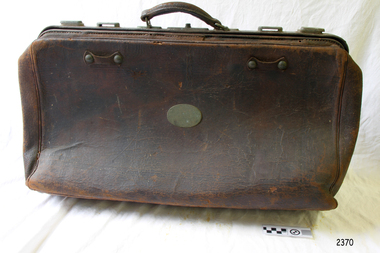
... Portmanteau leather bag, with brass oval badge, tan interior with compartment separator. Functional object Portmanteau Allchin Bros ...The etymology of the word portmanteau: A portmanteau was a travelling bag used as a mailbag. During the eighteenth and nineteenth centuries, both newspapers and letters were transported in these leather mailbags that opened into two sections. A portmanteau is a word created by the blending of two other words in terms of the sounds and meaning. Portmanteau itself is a portmanteau; made up of the French ‘porter’ meaning ‘to carry’ and ‘manteau’ meaning ‘cloak’. The other meaning of this word is ‘a travelling case or bag' but was coined by Lewis Carroll with its new meaning in 1882. History: English merchant Thomas Witherings established mail routes throughout Europe in the 1620s. He drew up a proposal in 1635 for an English mail system based in London in which portmanteaux (containing 2 leather bags lined with cotton) could travel to European towns with sealed bags of mail for protection against spies. The system was put into motion and some 26,000 letters were mailed safely and unopened between London and European towns each week. In the nineteenth century, the official portmanteau was used to carry the mail, letters and newspapers on Americas New England stagecoaches that travelled the postal routes. Before 1789 newspapers were mostly excluded from the mail and the official portmanteau. After the first United States Congress (1789–1791) the postmaster general allowed printers free postage to communicate reports and articles of Congressional informational newspapers with other publishers in other towns and cities for distribution. Example of a mid-20th-century leather bag not connected to a person of significance from history or a historic event. The significance lies in the historic social aspect of this type of bag and how it got its name. This type of bag was popular from the mid 19th century for personal use and fell out of favour in until the 1950s and the origin and meaning of the word used to describe this type of leather bag "portmanteau". Portmanteau leather bag, with brass oval badge, tan interior with compartment separator. Inscribed "Allchin Bros Makers Ballarat". flagstaff hill, warrnambool, shipwrecked-coast, flagstaff-hill, flagstaff-hill-maritime-museum, maritime-museum, shipwreck-coast, flagstaff-hill-maritime-village, portmanteau, allchin bros -
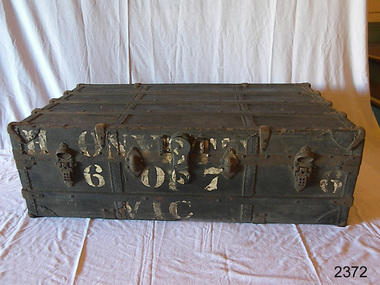 Flagstaff Hill Maritime Museum and Village
Functional object - Travel Trunk, 1890-1920
... This assessment is based on the type of locks used the trunk itself could have been made in America or Britain as the locks used in both countries came from American lock makers. flagstaff hill warrnambool shipwrecked-coast flagstaff-hill flagstaff-hill-maritime-museum maritime-museum shipwreck-coast flagstaff-hill-maritime-village trunk In white paint "H Onvett, 6 of 7 and bottom right of front the number 6 (Owner) Trunk wooden large covered with leather wood cleats and brass locks, also unreadable table Functional object Travel Trunk ...Steamer trunks (named after their location of storage in the cabin of a steamship, or "steamer") which are sometimes referred to as flat-tops, first appeared in the late 1870s, although the greater bulk of them date from the 1880–1920 period. They are distinguished by either their flat or slightly curved tops and were usually covered in canvas, leather or patterned paper and about (36 cm) tall to accommodate steamship luggage regulations. Steamer trunks were originally called a cabin trunk. An orthodox name for this type of trunk would be a "packer" trunk, but since it has been widely called a steamer for so long, it is now a hallmark of the style. A trunk, also known as a travel trunk, is a large cuboid container designed to hold clothes and other personal belongings. They are most commonly used for extended periods away from home. Trunks are differentiated from chests by their more rugged construction due to their intended use as luggage, instead of storage. Among the many styles of trunks, there are Jenny Lind, Saratoga, monitor, steamer or Cabin, barrel-staves, octagon or bevel-top, wardrobe, dome-top, barrel-top, wall trunks, and even full dresser trunks. These differing styles often only lasted for a decade or two and along with the hardware can be extremely helpful in dating an unmarked trunk. Although trunks have been around for thousands of years in China and elsewhere, the most common styles seen and referred to today date from the late 18th century to the early 20th century when they were supplanted in the market by the cost-effective and lighter suitcase. There were hundreds of trunk manufacturers in the United States and a few of the larger and well-known companies were Rhino Trunk & Case, C.A. Taylor, Haskell Brothers, Martin Maier, Romadka Bros, Goldsmith & Son, Crouch & Fitzgerald, M. M. Secor, Winship, Hartmann, Belber, Oshkosh, Seward, and Leatheroid. One of the largest American manufacturers of trunks at one point the Seward Trunk Co. of Petersburg, Virginia still makes them for school and camp, and another company Shwayder Trunk Company of Denver, Colorado would eventually become Samsonite. Another is the English luxury goods manufacturer H.J. Cave trading since 1839. Their Osilite trunk was used by such famous customers as T.E. Lawrence and Ruth Vincent Some of the better known French trunk makers were Louis Vuitton, Goyard, Moynat, and Au Départ. Only a few remain with the most prominent US company being Rhino Trunk and Case, Inc who probably manufacture more trunks than any company in the world.A snapshot into our social history regards how travel was undertaken over a hundred years ago and how people travelled so differently than today as they often packed for extended travel on ships. Travel then was so different with people having to pack a very large wardrobe of clothes to last for some time possibly for months overseas. The subject item looks like it was of military issue and was used for travel during the first world war by a military man from Victoria and was one of six similar trunks. This assessment is based on the type of locks used the trunk itself could have been made in America or Britain as the locks used in both countries came from American lock makers.Trunk wooden large covered with leather wood cleats and brass locks, also unreadable tableIn white paint "H Onvett, 6 of 7 and bottom right of front the number 6 (Owner)flagstaff hill, warrnambool, shipwrecked-coast, flagstaff-hill, flagstaff-hill-maritime-museum, maritime-museum, shipwreck-coast, flagstaff-hill-maritime-village, trunk
